EDINBURGH
Map: New Town Walk: Georgian Edinburgh
SHOPPING STREETS AND NEIGHBORHOODS
Map: Edinburgh City Center Hotels
Map: West End Hotels & Restaurants
Map: B&Bs & Restaurants South of the City Center
Map: Edinburgh City Center Restaurants
IN THE B&B NEIGHBORHOOD, TO THE SOUTH
ROUTE TIPS FOR DRIVERS HEADING SOUTH
Edinburgh is the historical, cultural, and political capital of Scotland. For nearly a thousand years, Scotland’s kings, parliaments, writers, thinkers, and bankers have called Edinburgh home. Today, it remains Scotland’s most sophisticated city.
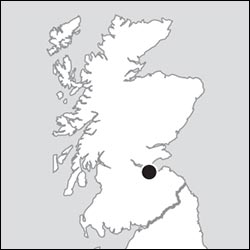
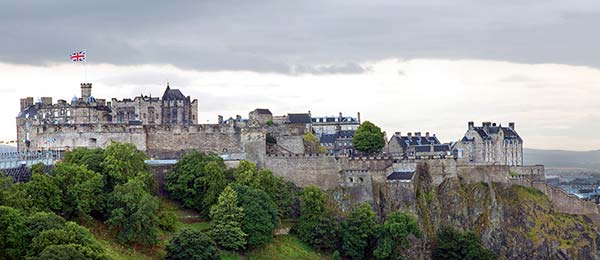
Edinburgh (ED’n-burah—only Americans pronounce it like “Pittsburgh”) is Scotland’s showpiece and one of Europe’s most entertaining cities. It’s a place of stunning vistas—nestled among craggy bluffs and studded with a prickly skyline of spires, towers, domes, and steeples. The commanding Edinburgh Castle sits boldly on a rock high above it all. Proud statues of famous Scots dot the urban landscape. Many of the buildings, a harmonious yellow-gray, are built from the same local sandstone.
Culturally, Edinburgh has always been the place where Lowland culture (urban and English) met Highland style (rustic and Gaelic). Tourists will find no end of traditional Scottish clichés: kilt shops, bagpipe-playing buskers, and gimmicky tours featuring Scotland’s bloody history and ghost stories. Whisky tastings abound.
Today’s Edinburgh is big in banking, scientific research, and scholarship at its four universities. Students and professionals pack the pubs and art galleries. It’s especially lively in August, when the Edinburgh Festival takes over the town. Historic, monumental, fun, and well organized, Edinburgh is a tourist’s delight.
PLANNING YOUR TIME
While the major sights can be seen in a day, I’d give Edinburgh two days and three nights.
Day 1: Tour the castle, then take my self-guided Royal Mile Walk, stopping in at St. Giles’ Cathedral and whichever shops and museums interest you (Gladstone’s Land is especially worthwhile). At the bottom of the Mile, consider visiting the Scottish Parliament, the Palace of Holyroodhouse, or both. If the weather and your energy are good, you could tackle Arthur’s Seat, the ancient hill that rises up behind the palace.
Day 2: Visit the National Museum of Scotland. After lunch, stroll through the Scottish National Gallery. Then follow my self-guided walk through the New Town, visiting the Scottish National Portrait Gallery and the Georgian House—or zip out to Leith to squeeze in a quick tour of the good ship Britannia (confirm last entry time before you go).
Evenings: Options include various “haunted Edinburgh” walks, the literary pub crawl, or live music. Perhaps the most authentic evening out is just settling down in a pub to sample the whisky and local beers while meeting the locals...and attempting to understand them through their thick Scottish accents.
Orientation to Edinburgh
A VERBAL MAP
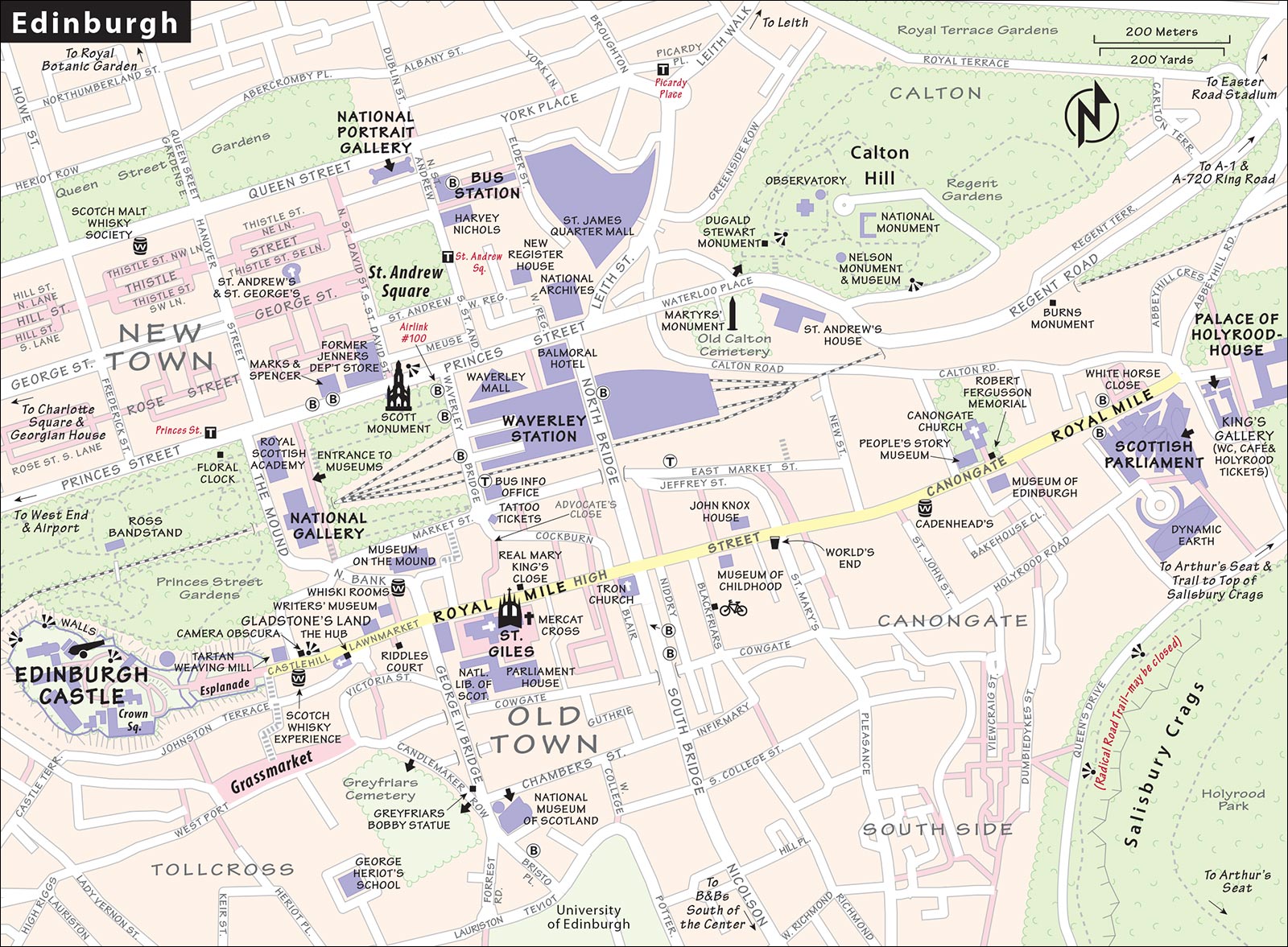
With 500,000 people (835,000 in the metro area), Edinburgh is Scotland’s second-biggest city, after Glasgow. But the tourist’s Edinburgh is compact: Old Town, New Town, West End, and the B&B area south of the city center.
Edinburgh’s Old Town stretches across a ridgeline slung between two bluffs. From west to east, this “Royal Mile” runs from the Castle Rock—which is visible from anywhere in town—to the base of the 822-foot extinct volcano called Arthur’s Seat. Along this colorful labyrinth of cobbled streets and narrow lanes, medieval skyscrapers stand shoulder to shoulder, hiding peaceful courtyards. For visitors, this east-west axis is the center of the action. Just south of the Royal Mile are the university and the National Museum of Scotland; farther to the south is a handy B&B neighborhood that lines up along Dalkeith Road and Mayfield Gardens.
A few hundred yards north of the Old Town lies the New Town. In this magnificent planned neighborhood from the 1700s, you’ll enjoy upscale shops, broad boulevards, straight streets, square squares, circular circuses, and Georgian mansions decked out in Greek-style columns and statues.
Just to the west of the New Town, the West End, near Charlotte Square, is a prestigious and quieter neighborhood boasting more Georgian architecture, cobbled lanes, fine dining options, and a variety of concert and theater venues.
In the center of it all—in a drained lakebed between the Old and New Towns—sit the Princes Street Gardens park and Waverley Bridge, where you’ll find Waverley train station, Waverley Mall, a bus info office (starting point for most city bus tours), and the Scottish National Gallery.
ARRIVAL IN EDINBURGH
By Train: Most long-distance trains arrive at Waverley Station in the city center (those staying at West End accommodations might consider disembarking instead at Haymarket Station). Waverley Station is a bit of a maze; follow signs carefully to find your way. For groceries to go, M&S Simply Food, near track 2, is economical and efficient (long hours daily). There are three major exits:
Princes Street Exit: Use this exit to reach buses to B&Bs south of the city center. Follow signs for #1, Princes Street. You’ll ride a series of escalators (passing the Waverley Mall on your left) and pop out along busy Princes Street, facing the New Town. Cross the street and head left to the bus stops in front of the Marks & Spencer store. Numerous buses go from here to the B&B neighborhood south of the city center; confirm bus numbers and stops on Google Maps or with your B&B host.
Waverley Bridge Exit: This exit sends you up a long ramp; you’ll pop out between the Old Town and the New Town, handy for those who’d like to walk to either area. There’s an official taxi stand generally along the south end of the bridge.
Market Street Exit: There’s another taxi stand outside this exit. Once outside, turn left and walk 100 yards under the bridge to find the taxis.
By Bus: Scottish Citylink, Megabus, and National Express buses use the bus station (with luggage lockers) in the New Town, two blocks north of Waverley Station just past St. Andrew Square.
By Car: No matter where you’re coming from, avoid needless driving in the city by taking advantage of Edinburgh’s bypass road, A-720. To conveniently reach my recommended B&Bs, circle the city on the A-720 (direction: Edinburgh South), until the last roundabout, named Sheriffhall. Exit the roundabout at the first left (A-7 Edinburgh). From here it’s four miles to the B&B neighborhood south of the center; after a while, the A-7 becomes Dalkeith Road. If you see the huge Royal Commonwealth Pool, you’ve gone a couple of blocks too far.
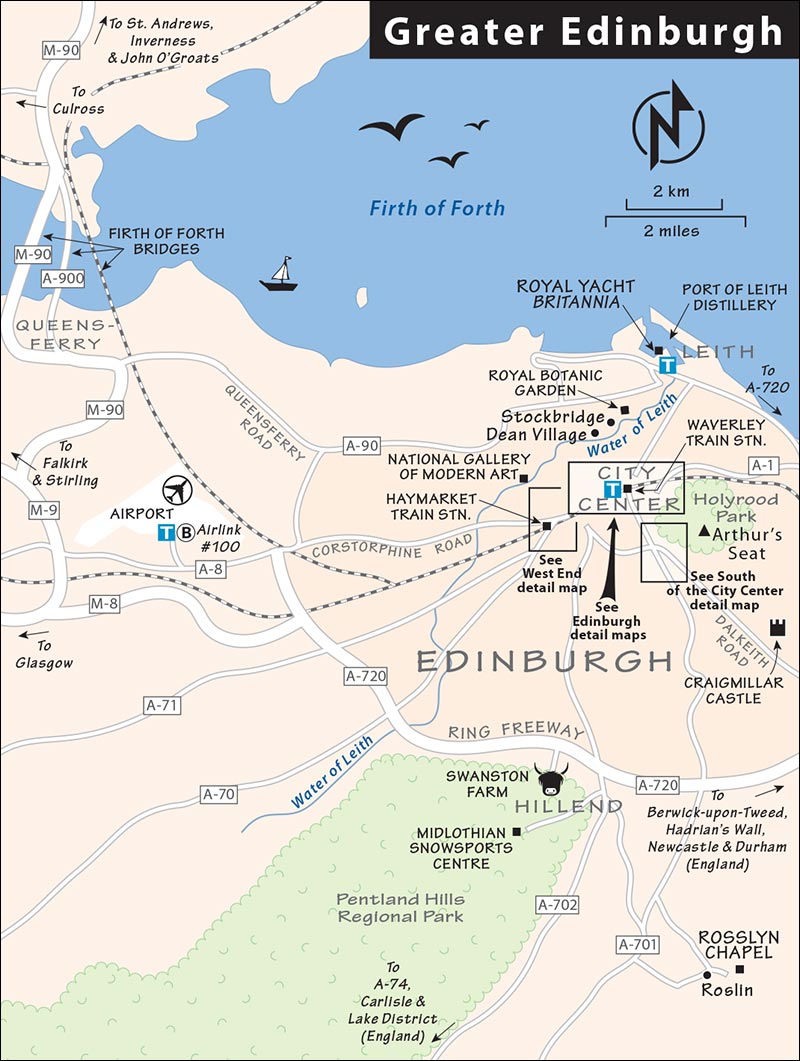
By Plane: Edinburgh’s airport is eight miles west of downtown—about a 30-minute tram or taxi ride. For information, see “Edinburgh Connections,” at the end of this chapter.
HELPFUL HINTS
- Tourist Information: Edinburgh has no physical TI. You can find good information on Edinburgh at the city’s tourism site, edinburgh.org and at visitscotland.com.
- Book Ahead: Reservations are a must for just about everything in August, when the biggest festivals are on. You’ll want to buy tickets for Edinburgh Castle as early as you can; in summer it’s also smart to reserve ahead for the Camera Obscura and the Palace of Holyroodhouse.
- Sightseeing Passes: Edinburgh Tours sells a £69 Royal Edinburgh Ticket that covers 48 hours of unlimited travel on three different hop-on, hop-off buses, plus admission at Edinburgh Castle, the Palace of Holyroodhouse, and the Royal Yacht Britannia (royaledinburghticket.co.uk). This is a good deal if you plan to use the buses and see all three sights. If your travels take you beyond Edinburgh, consider the Historic Scotland’s Explorer Pass, which can save money if you visit the castles at both Edinburgh and Stirling, or the Orkney Islands (for details, see here). You’ll need to book an entry time for Edinburgh Castle with either pass.
- Markets: On weekends, open-air markets have food stalls and artisans (10:00-16:00). Saturday is at Grassmarket (below the castle) and in Leith (at Dock Place), plus there’s a Saturday morning farmers market in the Edinburgh Castle parking lot. Sunday is market day in Stockbridge, along Saunders Street and the Water of Leith Walkway (stockbridgemarket.com).
- Festivals: August is a crowded, popular month in Edinburgh thanks to the multiple festivals hosted here, including the official Edinburgh International Festival, the Fringe Festival, and the Military Tattoo. Book ahead for hotels, events, and restaurant dinners, and expect to pay significantly more for your room. Many museums and shops have extended hours in August. For more festival details, see ricksteves.com/festivals.
- Baggage Storage: There’s a luggage storage office at the train station and lockers at the bus station near St. Andrew Square, just two blocks north.
- Laundry: The Ace Cleaning Centre launderette is located between my recommended B&Bs south of town and the city center (full service or do-it-yourself, pick-up/delivery possible; Mon-Tue 8:00-19:30, Wed and Fri until 16:00, Sat 9:00-17:00, Sun 10:00-16:00, closed Thu; right at the Bernard Terrace bus stop, 13 South Clerk Street—see map on here, +44 131 667 0549, acelaunderetteanddrycleaners.co.uk). In the West End, Johnsons the Cleaners will do your laundry (Mon-Fri 8:30-17:30, Sat until 17:00, closed Sun, 5 Drumsheugh Place—see map on here, +44 131 225 8077).
- Bike Rental and Tours: The laid-back crew at Cycle Scotland happily recommends good bike routes with your rental (e-bikes available, generally open daily 10:00-18:00, closed mid-Dec-March, just off Royal Mile at 29 Blackfriars Street, +44 131 556 5560, cyclescotland.co.uk, Peter). They also run guided three-hour bike tours daily at 11:00 that start on the Royal Mile and ride through Holyrood Park, Arthur’s Seat, Duddingston Village, Doctor Neil’s (Secret) Garden, and along the Innocent railway path (£45/person, more for e-bikes, book ahead).
- Dress for the Weather: Weather blows in and out—bring your sweater and be prepared for rain.
GETTING AROUND EDINBURGH
Many of Edinburgh’s sights are within walking distance of one another, but Lothian city buses come in handy—especially if you’re staying at a B&B south of the city center (lothianbuses.com). The single tram line connects the airport, central Edinburgh, and the port at Leith (edinburghtrams.com).
Tickets: Buses and trams use the same tickets. A single ride costs £2.20; pay with a contactless card, payment app, or exact change. Contactless payment is automatically capped at £5/day or £24.50/week. A £5.50 day ticket, covering buses and the tram, can be purchased from bus drivers, tram ticket machines, or the Lothian Bus & Tram app. If you purchase from a bus driver, be sure to ask for a paper ticket.
If you plan to use buses and the tram throughout the day, the choice of contactless card versus day ticket comes down to how you’d prefer to manage payment. Using your card each time you board ultimately saves a little money with the £5 daily cap; with the day ticket, you’ll pay £5.50 once, and just show your ticket (on your phone or on paper) without pulling out your card every time you board.
By Bus: Numerous buses run between the New Town, South Bridge on the Royal Mile, and the B&B neighborhood south of town. Bus #35 runs along the Royal Mile between South Bridge and the Scottish Parliament, and is useful for connecting the Royal Mile to the National Museum or Leith (Royal Yacht Britannia). Double-decker buses have fine views upstairs.
Mapping apps like Google Maps work great for determining the best bus for your journey, including real-time departure times and delays. Route maps are available at the TravelHub bus information office at the Old Town end of Waverley Bridge (Mon-Sat 8:30-17:30, closed Sun, 44 131 555 6363).
By Tram: Edinburgh’s single tram line runs every seven minutes from 6:00 until midnight. Rides to or from the airport are £7.90. There are handy stops near my recommended West End hotels, Princes Street and St. Andrew Square near the Waverley train station, and the Royal Yacht Britannia.
By Taxi or Uber: The 1,300 taxis cruising Edinburgh’s streets are easy to flag down (a ride between downtown and the B&B neighborhood south of the center costs about £12-15; rates go up after 18:00 and on weekends). You can hail cabs on the street (taxis can turn on a dime, so hail them in either direction) or call +44 131 228 1211 or +44 131 229 2468.
You can also summon a taxi using Uber or the Freenow app (easy to set up, works like Uber). Uber may save a few pounds—or cost more during “surge” times; use the Freenow app to compare Uber and taxi prices.
Tours in Edinburgh
Royal Mile Walking Tours
Walking tours are an Edinburgh specialty; you’ll see groups trailing entertaining guides all over town. Below I’ve listed good all-purpose walks; for literary pub crawls and ghost tours, see “Nightlife in Edinburgh” on here.
Edinburgh Tour Guides offers a good historical walk (without all the ghosts and goblins). Their Royal Mile tour is a gentle 2.5-hour stroll from near the Palace of Holyroodhouse to Edinburgh Castle (£32.50; daily at 9:30 and 14:00; meet at the Abbey Strand Apartments on Abbey Strand, near the palace; must reserve ahead, +44 785 888 0072, edinburghtourguides.com). Their other offerings include Outlander-themed Edinburgh walks and day tours.
Mercat Tours offers a “Secrets of the Royal Mile” walk that’s more entertaining than intellectual (£27, 1.5 hours; £40 adds optional 45-minute guided Edinburgh Castle visit that lets you skip the ticket line; daily at 10:00 and 13:00, leaves from Mercat Cross on the Royal Mile; +44 131 225 5445, mercattours.com). The guides, who enjoy making a short story long, ignore the big sights and take you behind the scenes with piles of barely historical gossip, bully-pulpit Scottish pride, and fun but forgettable trivia. They also offer ghost walks, whisky tastings, and Outlander sights, among others.
Sandemans New Edinburgh runs “free” tours multiple times daily; you won’t pay up front, but the guide will expect a tip (check schedule online, 2.5 hours, meet at 130 High Street, neweuropetours.eu).
The Voluntary Guides Association offers free two-hour walks during the Edinburgh Festival. You don’t need a reservation—just show up (check website for times, generally depart from City Chambers across from St. Giles’ Cathedral on the Royal Mile, edinburghfestivalguides.org). You can also hire their guides (for a small fee) for private tours outside of festival time.
Blue Badge Local Guides
The following guides charge similar prices and offer half-day and full-day tours: Jean Blair (a delightful teacher and guide, walking tours only, £220/half-day, £330/day, +44 798 957 0287, travelthroughscotland.com); Sergio La Spina (an Argentinean who adopted Edinburgh as his hometown more than 30 years ago, £240/half-day, £340/day, can also do driving tours, +44 797 330 6579, vivaescocia.com); Ken Hanley (who wears his kilt as if pants don’t exist, walking tours only, £225/half-day, £400/day, +44 771 034 2044, small-world-tours.co.uk); Liz Everett, who is passionate about history (walking tours only; £250/half-day, £350/day, +44 782 168 3837, liz.everett@live.co.uk); Maggie McLeod (another top-notch guide, £250/half-day walking tour, £800 day trips with car, +44 775 151 6776, scotlandandmore.com, margaret.mcleod@live.co.uk).
Hop-On, Hop-Off Bus Tours
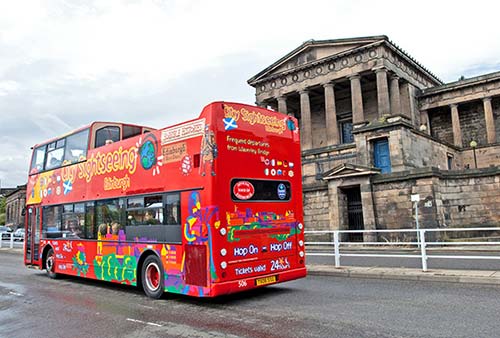
Three one-hour hop-on, hop-off bus tour routes, all run by the same company, circle the town center, stopping at the major sights. Edinburgh Tour (green buses) focuses on the city center, with live guides (stay on for the entire loop if you like your guide). City Sightseeing (red buses, focuses on Old Town) has recorded commentary, as does the Regal Tour (blue buses, goes to the port of Leith and includes a stop at the Britannia and Royal Botanic Garden). You can pay for just one tour (£18/24 hours), but most people pay a few pounds more for a ticket covering all buses (£25/24 hours, £29/48 hours; buses run April-Oct roughly 9:00-18:00, shorter hours off-season; about every 10 minutes, buy tickets on board or online, +44 131 475 0618, edinburghtour.com). On sunny days, the buses go topless. As is true for most such tours, there’s patter the entire time but almost nothing of real importance other than identifying what you’re driving by.
Day Trips from Edinburgh
Many companies run a variety of day trips to regional sights, as well as multiday and themed itineraries. (Several of the local guides listed earlier have cars, too.)
The most popular tour is an all-day Highlands trip, which gives those with limited time a chance to experience the wonders of Scotland’s wild and legend-soaked Highlands in a single long day (about £60-75, roughly 8:00-20:00). Itineraries vary, but you’ll generally visit/pass through the Trossachs, Rannoch Moor, Glencoe, Fort William, Fort Augustus on Loch Ness (some tours offer an optional boat ride), and Pitlochry. To save time, look for a tour that gives you a short glimpse of Loch Ness rather than driving its entire length or doing a boat trip.
Larger outfits, typically using bigger buses, include Timberbush Tours (timberbush-tours.co.uk), Gray Line (graylinescotland.com), Highland Experience (highlandexperience.com), and Highland Explorer (highlandexplorertours.com). Rabbie’s (rabbies.com) keeps its group sizes small, using 16-seat minibuses.
For young backpackers, Haggis Adventures runs day tours plus overnight trips of up to 10 days (haggisadventures.com).
At Discreet Scotland, Matthew Wight and his partners specialize in tours of greater Edinburgh and Scotland in spacious SUVs—good for families (£630/2 people, 10 hours, +44 798 941 6990, discreetscotland.com).
Walks in Edinburgh
4 Bank/High Streets Intersection
10 Scottish Parliament Building
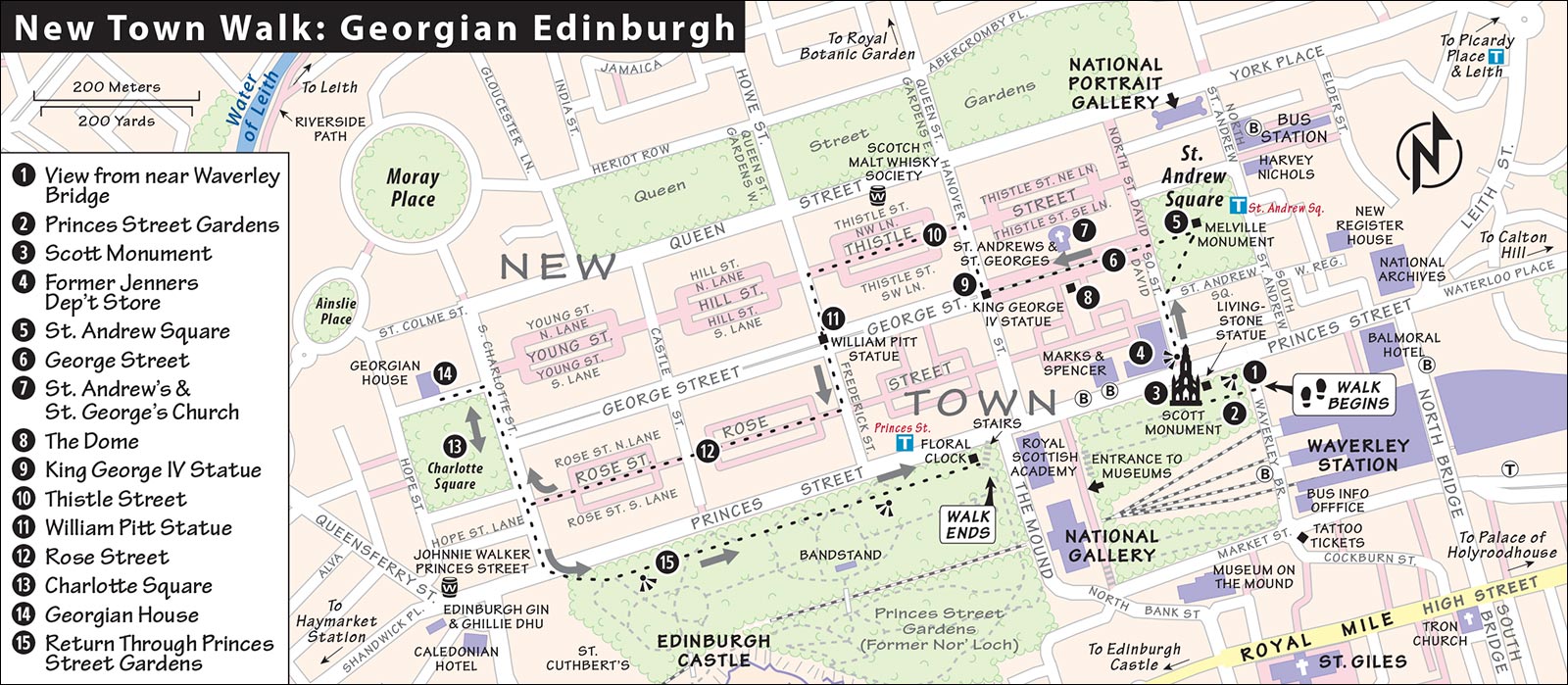
NEW TOWN WALK: GEORGIAN EDINBURGH
Map: New Town Walk: Georgian Edinburgh
I’ve outlined two walks in Edinburgh: along the Royal Mile, and through the New Town. Many of the sights we’ll pass on these walks are described in more detail later in this chapter, under “Sights in Edinburgh.”
THE ROYAL MILE
The Royal Mile is one of Europe’s most interesting historic walks (rated ▲▲▲).  Download my free Royal Mile Walk audio tour and I’ll narrate as you walk.
This 1.5-hour walk covers the Royal Mile’s landmarks but skips the many museums and indoor sights along the way (these are described in walking order under “Sights in Edinburgh”, later). Doing this walk as an orientation upon arrival in the early morning or evening allows you to focus on the past without having to dodge crowds.
Another option is to review the sight descriptions beforehand, plan your walk around their open hours, and pop into those that interest you as you pass them.
Overview
Start at Edinburgh Castle at the top and amble down to the Palace of Holyroodhouse. The street itself changes names—Castlehill, Lawnmarket, High Street, and Canongate—but it’s a straight, downhill shot totaling just over one mile. And nearly every step is packed with shops, cafés, and lanes leading to tiny squares.
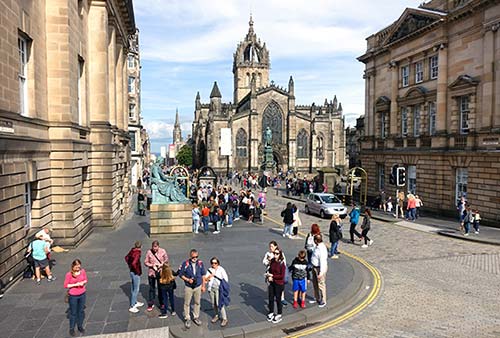
Celtic tribes (and maybe the Romans) once occupied the rock at the top, where the castle stands today. As the town grew, it spilled downhill along the sloping ridge that became the Royal Mile. Because this strip of land is so narrow, there was no place to build but up. So, in medieval times, it was densely packed with multistory tenements—large edifices under one roof that housed a number of tenants.
As you walk, you’ll be tracing the growth of the city: its birth atop Castle Hill, its Old Town heyday in the 1600s, its expansion in the 1700s into the Georgian New Town (leaving the old quarter an overcrowded, disease-ridden Victorian slum), and on to the 21st century at the modern Scottish parliament building (2004).
Most of the Royal Mile feels like one long Scottish shopping mall, selling all manner of kitschy souvenirs (known locally as “tartan tat”), shortbread, and whisky. But the streets are also packed with history, and if you push past the souvenir racks into one of the many side alleys, you can still find a few surviving rough edges of the old city. Despite the drizzle, be sure to look up—spires, carvings, and towering Gothic “skyscrapers” give this city its unique urban identity.
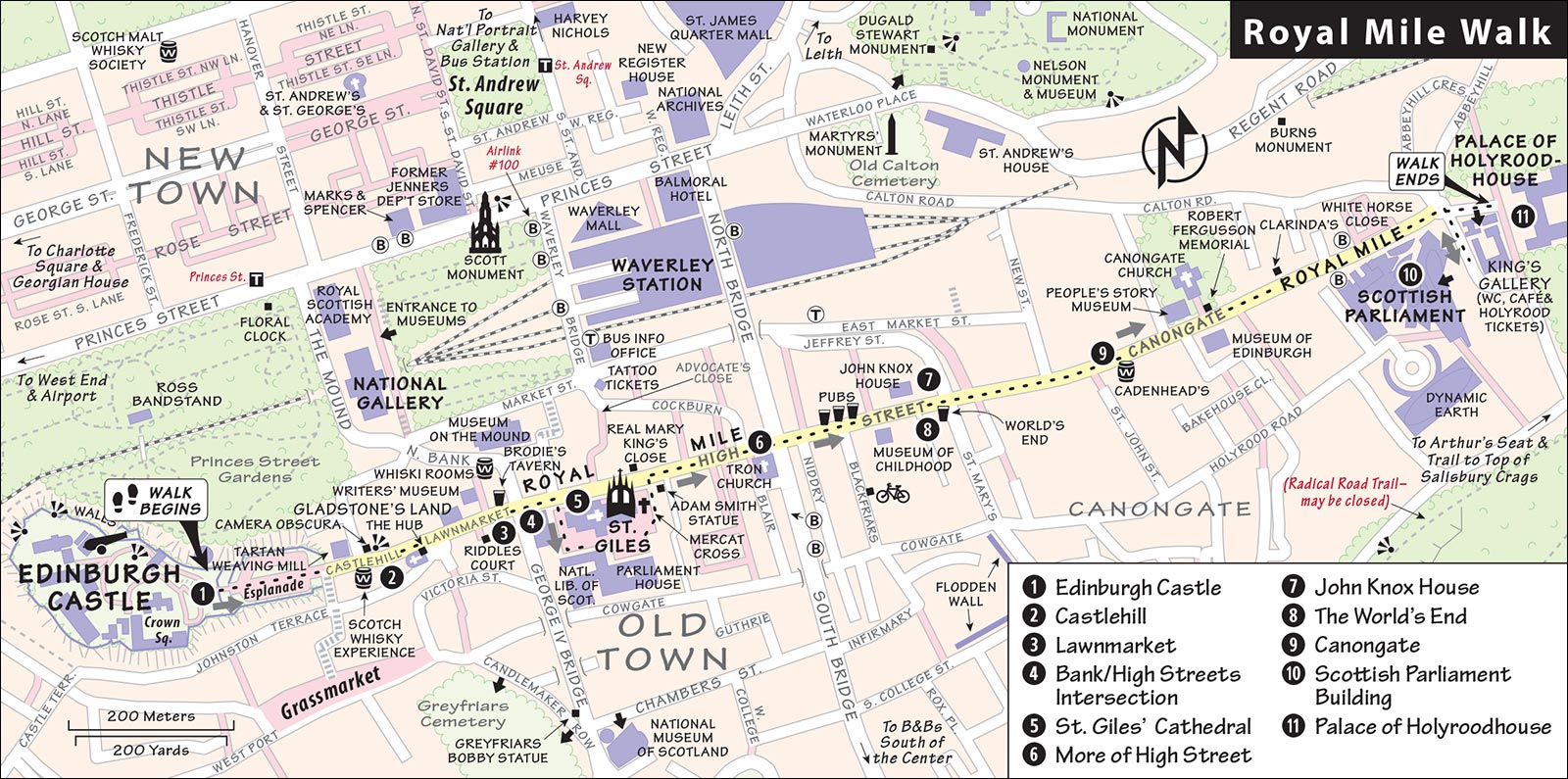
• We’ll start at the castle esplanade, the big parking lot at the entrance to...
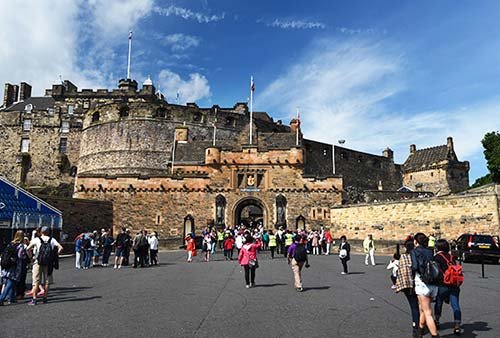
1 Edinburgh Castle
Edinburgh was born on the bluff—a big rock—where the castle now stands. Since before recorded history, people have lived on this strategic, easily defended perch (for a self-guided castle tour, see its sight listing, later).
The castle esplanade—built as a military parade ground (1816)—is now the site of the annual Military Tattoo. This spectacular massing of regimental bands fills the square nightly for most of August. Fans watch from temporary bleacher seats to see kilt-wearing dancers and bagpipers marching against the spectacular backdrop of the castle. (It takes three months to set up the bleachers, so you’ll see them, in some form, for most of the summer—and if the area is closed off, you may need to start this walk down where the esplanade meets the road.)
When the bleachers aren’t up, there are fine views in both directions from the esplanade. Facing north, you’ll see the body of water called the Firth of Forth (the estuary where the River Forth flows into the North Sea) and Fife beyond that. Still facing north, find the lacy spire of the Scott Monument and two Neoclassical buildings housing art galleries. Beyond them, the stately buildings of Edinburgh’s New Town rise. Panning to the right, find the Nelson Monument and some faux Greek ruins atop Calton Hill.
The city’s many bluffs, crags, and ridges were built up by volcanoes, then carved down by glaciers—a city formed in “fire and ice,” as the locals say. During the Ice Age, as glaciers swept in from the west (behind today’s castle), they ran into the super-hard volcanic basalt of Castle Rock and flowed around it, cutting valleys on either side and leaving a tail that became the Royal Mile you’re about to walk.
At the bottom of the esplanade, where the square hits the road, look left (with your back to the castle) to find a plaque on the wall above the tiny witches’ well (now a planter, on the side of the Tartan Weaving Mill). This memorializes 300 women who were accused of witchcraft and burned here.
• Start walking down the bustling Royal Mile. The first block is a street called...
2 Castlehill
The big, squat, tank-like building immediately on your left was formerly the Old Town’s reservoir. While it once held 1.5 million gallons of water, today it’s filled with the touristy Tartan Weaving Mill (open daily 9:00-19:00), a massive four-floor complex selling every kind of Scottish cliché. At the bottom level (a long way down) is a floor of big looms and weavers sometimes at work.
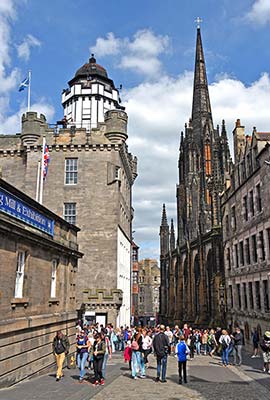
The black-and-white tower ahead on the left has entertained visitors since the 1850s with its camera obscura, a darkened room where a mirror and a series of lenses capture live images of the city surroundings outside. Across the street, filling the old Castlehill Primary School, is a gimmicky if intoxicating whisky-sampling exhibit called the Scotch Whisky Experience (see “Experiences in Edinburgh,” later).
• Just ahead, in front of the church with the tall lacy spire, is the old market square known as...
3 Lawnmarket
During the Royal Mile’s heyday, in the 1600s, this intersection was bigger and served as a market for fabric (especially “lawn,” a linen-like cloth). The market would fill this space with hustle, bustle, and lots of commerce. The round white hump in the middle of the roundabout is all that remains of the official weighing beam called the Butter Tron—where all goods sold were weighed for honesty and taxes.
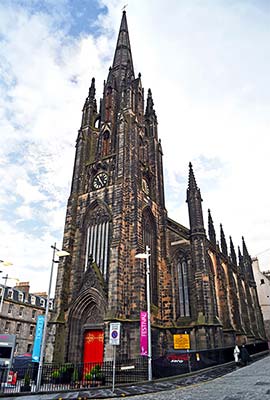
Towering above Lawnmarket, with the highest spire in the city, is the former Tolbooth Church. This impressive Neo-Gothic structure (1844) is now nicknamed the Hub. It’s closed to the public for much of the year, but in August it earns its name, becoming the box office and information center, as well as a performance venue, for the Edinburgh International Festival (see “Edinburgh’s Festivals,” later). When it’s open, it’s a handy stop for its WC and café.
In the 1600s, Lawnmarket—along with the next stretch, called High Street—was the city’s main street. At that time, Edinburgh was bursting with breweries, printing presses, and banks. Tens of thousands of citizens were squeezed into the narrow confines of the Old Town.
Here on this ridge stood tenements (multiple-unit residences), rising 10 stories and more; they were some of the tallest domestic buildings in Europe. The living arrangements shocked class-conscious English visitors to Edinburgh because rich and poor alike occupied the tenements—usually the poor in the cellars and attics, and the rich in the middle floors.
• Continue a half-block down the Mile.
Gladstone’s Land (at #477b, on the left), a surviving original tenement, was acquired by a wealthy merchant in 1617. Stand in front of the building and look up at this centuries-old skyscraper. This design was standard for its time: a shop or shops on the ground floor, with columns and an arcade, and residences on the floors above. Because window glass was expensive, the lower halves of window openings were made of cheaper wood, which swung out like shutters for ventilation—and were convenient for tossing out garbage. Now a museum, Gladstone’s Land is worth visiting for its intimate look at life here 400 years ago.
Branching off the spine of the Royal Mile are narrow alleyways that go by various local names. To explore one of these alleyways, head into Lady Stair’s Close (on the left, 10 steps downhill from Gladstone’s Land). This alley pops out in a small courtyard, where you’ll find the Writers’ Museum. It’s free and well worth a visit for fans of Scotland’s holy trinity of writers (Robert Burns, Sir Walter Scott, and Robert Louis Stevenson), but also for a glimpse of what a typical home might have looked like in the 1600s. Burns actually lived for a while in this neighborhood, in 1786, when he first arrived in Edinburgh. Notice that the courtyard is paved with stones memorializing various Scottish-born writers.
Opposite Gladstone’s Land (at #322), another close leads to Riddles Court. Wander through here and imagine Edinburgh in the 17th and 18th centuries, when tourists came to marvel at its skyscrapers. Some 40,000 people were jammed into the few blocks between here and the World’s End pub (which we’ll reach soon).
No city in Europe was as densely populated—or perhaps as filthy. Without modern hygiene, it was a living hell of smoke, stench, and noise, with the constant threat of fire, collapse, and disease. The dirt streets were soiled with sewage from bedpans emptied out windows. By the 1700s, the Old Town was rife with poverty and disease. The smoky home fires rising from tenements and the infamous smell (or “reek” in Scottish) that wafted across the city gave it a nickname that sticks today: “Auld Reekie.”
• Return to the Royal Mile and continue down it a few steps to take in some sights at the...
4 Bank/High Streets Intersection
Several sights cluster here, where Lawnmarket changes its name to High Street and intersects with Bank Street and George IV Bridge.
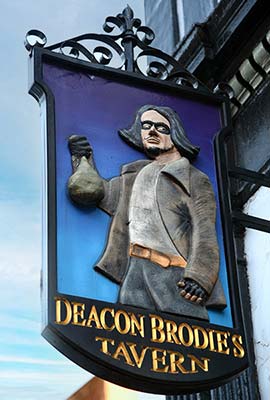
Begin with Deacon Brodie’s Tavern, on the left corner. Read the “Doctor Jekyll and Mr. Hyde” story of this pub’s notorious namesake on the wall facing Bank Street. Then, to see his spooky split personality, check out both sides of the hanging signpost. Brodie—a pillar of the community by day but a burglar by night—epitomizes the divided personality of 1700s Edinburgh. It was a rich, productive city—home to great philosophers and scientists, who actively contributed to the Enlightenment. Meanwhile, the Old Town was riddled with crime and squalor. The city was scandalized when this respected surgeon—driven by a passion for medical research and needing corpses—was accused of colluding with two lowlifes, named Burke and Hare, to acquire freshly murdered corpses for dissection. (A century later, novelist Robert Louis Stevenson would capture the dichotomy of Edinburgh’s rich-poor society—and, perhaps, borrow some specifics from the tale of Brodie himself—in his Strange Case of Dr. Jekyll and Mr. Hyde.)
In the late 1700s, Edinburgh’s upper class moved out of the Old Town into a planned community called the New Town (a quarter-mile north of here). Eventually, most tenements were torn down and replaced with newer Victorian buildings. You’ll see some at this intersection.
Look left down Bank Street to the green-domed building. From 1805, this was the headquarters of the Bank of Scotland, the country’s first and oldest bank, founded in 1695 to capitalize and develop trade. The building now houses the Museum on the Mound, with a free exhibit on banking history.
If you detour left down Bank Street toward the bank, you’ll find the recommended Whiski Rooms Shop. If you head in the opposite direction, down George IV Bridge, you’ll reach the National Library of Scotland (with its fine “Treasures” exhibit), the excellent National Museum of Scotland, the famous Greyfriars Bobby statue, photogenic Victoria Street, which leads to the pub-lined Grassmarket square (all described later in this chapter), and several recommended eateries. Victoria Street is so dreamy, many Harry Potter fans figure it must be the inspiration for that series’ Diagon Alley.
Across the street from Deacon Brodie’s Tavern is a seated green statue of hometown boy David Hume (1711-1776)—one of the most influential thinkers not only of Scotland, but in all of Western philosophy. The atheistic Hume was one of the towering figures of the Scottish Enlightenment of the mid-1700s. Hume questioned cause and effect in thought puzzles such as this: We can see that when one billiard ball strikes another, the second one moves, but how do we know the collision “caused” the movement? Notice his shiny toe: People on their way to trial (in the high court just behind the statue) or students on their way to exams (in the nearby university) rub it for good luck.
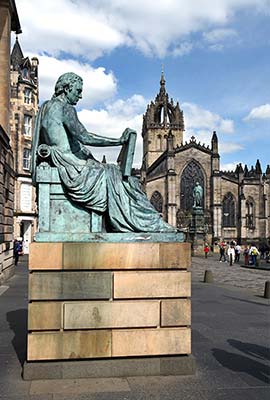
Follow David Hume’s gaze to the opposite corner, where a brass H in the pavement marks the site of the last public execution in Edinburgh in 1864. Deacon Brodie himself was hanged about here (in 1788, on gallows whose design he had helped to improve—smart guy).
• From the brass H, continue down the Royal Mile, pausing just before the church square at a stone wellhead with the pyramid cap.
All along the Royal Mile, wellheads like this (from 1835) provided townsfolk with water in the days before buildings had plumbing. These neighborhood wells were served by the reservoir up at the castle. Imagine long lines of people in need of water standing here, gossiping and sharing the news. Eventually buildings were retrofitted with water pipes—the ones you see running along building exteriors.
• Ahead of you (past the Victorian statue of some duke), embedded in the cobblestones near the street, is a big heart.
The Heart of Midlothian marks the spot of the city’s 15th-century municipal building and jail. In times past, in a nearby open space, criminals were hanged, traitors were decapitated, and witches were burned. Citizens hated the rough justice doled out here. Locals still spit on the heart in the pavement. Go ahead...do as the locals do—land one right in the heart of the heart.
• Make your way to the entrance of the church.
5 St. Giles’ Cathedral
This is the flagship of the Church of Scotland (Scotland’s largest denomination)—called the “Mother Church of Presbyterianism.” The interior serves as a kind of Scottish Westminster Abbey, filled with monuments, statues, plaques, and stained-glass windows dedicated to great Scots and moments in history.
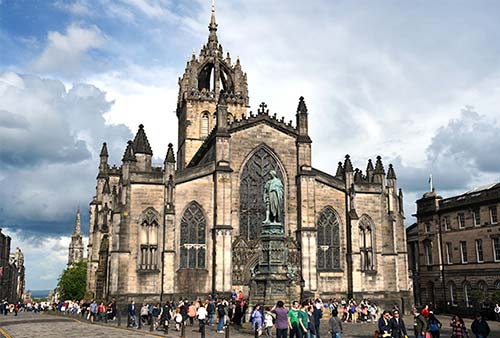
A church has stood on this spot since 854, though this structure is an architectural hodgepodge, dating mostly from the 15th through 19th century. In the 16th century, St. Giles was a kind of national stage on which the drama of the Reformation was played out. The reformer John Knox (1514-1572) was the preacher here. His fiery sermons helped turn once-Catholic Edinburgh into a bastion of Protestantism. During the Scottish Reformation, St. Giles was transformed from a Catholic cathedral to a Presbyterian church. The spacious interior is well worth a visit (for a self-guided tour, see here).
• Facing the church entrance, curl around its right side, into a parking lot.
Sights Around St. Giles
The grand building across the parking lot from St. Giles is the old Parliament House. Since the 13th century, the king had ruled a rubber-stamp parliament of nobles and bishops. But the Protestant Reformation promoted democracy, and the parliament gained real power. From the early 1600s until 1707, this building evolved to become the seat of a true parliament of elected officials. That came to an end in 1707, when Scotland signed an Act of Union, joining what’s known today as the United Kingdom and giving up its right to self-rule. (More on that later in the walk.) To peek inside, head through the door at #11 (free, Mon-Fri 9:00-16:30, closed Sat-Sun).
The great reformer John Knox is buried—with appropriate austerity—under parking lot spot #23. The statue among the cars shows King Charles II riding to a toga party back in 1685.
• Continue through the parking lot, around the back end of the church.
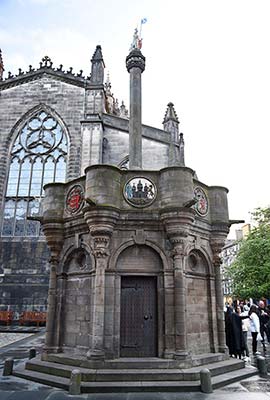
Every Scottish burgh (town licensed by the king to trade) had three standard features: a “tolbooth” (basically a Town Hall, with a courthouse, meeting room, and jail), a “tron” (official weighing scale), and a “mercat” (or market) cross. The mercat cross standing just behind St. Giles’ Cathedral has a slender column decorated with a unicorn holding a flag with the cross of St. Andrew. Royal proclamations have been read at this mercat cross since the 14th century. In 2022, a town crier heralded the news that Britain had a new king—three days after the actual event (traditionally the time it took for a horse to speed here from London). Today, Mercat Cross is the meeting point for many of Edinburgh’s walking tours—both historic and ghostly.
• Circle around to the street side of the church, to the statue at the nearest corner.
This memorial to Adam Smith honors the Edinburgh author of the pioneering Wealth of Nations (1776), in which he laid out the economics of free-market capitalism. Smith theorized that an “invisible hand” wisely guides the unregulated free market. Stand in front of Smith and imagine the intellectual energy of Edinburgh in the mid-1700s, when it was Europe’s most enlightened city. Adam Smith was right in the center of it. James Watt, inventor of the steam engine, was another proud Scotsman of the age. With great intellectuals like these, Edinburgh helped create the modern world. The poet Robert Burns, geologist James Hutton, and the publishers of the first Encyclopedia Britannica all lived in Edinburgh. Steeped in the inquisitive mindset of the Enlightenment, they applied cool rationality and a secular approach to their respective fields.
Across the street from Smith, you’ll see the entrance to a fun attraction called The Real Mary King’s Close (described under “Sights in Edinburgh”).
• Head on down the Royal Mile.
6 More of High Street
Continuing down this stretch of the Royal Mile, which is traffic-free most of the day (notice the bollards that raise and lower for permitted traffic), you’ll see the Fringe Festival shop (on the right, at #180), street musicians, and another wellhead (with horse “sippies,” dating from 1675).
Notice those three red boxes. In the 20th century, people used these to make telephonic calls to each other. (Imagine that!) These cast-iron booths were produced in Scotland for all of Britain. As phone booths are decommissioned, some are finding new use as tiny shops and ATMs, and even showing up in residential neighborhoods as nostalgic garden decorations.
At the next intersection, on the left, is Cockburn Street (pronounced “COE-burn”), with a reputation for its eclectic independent shops and string of trendy bars and eateries. In the Middle Ages, only tiny lanes (like Fleshmarket Close just uphill) interrupted the long line of Royal Mile buildings. Cockburn Street was cut through High Street’s dense wall of medieval buildings in the 1860s to give easy access to the Georgian New Town and the train station. Notice how the sliced buildings were thoughtfully capped with facades that fit the aesthetic look of the Royal Mile.
• When you reach the Tron Church (with a fine 17th-century interior, often housing an artists’ market—see “Shopping in Edinburgh,” later), you’re at the intersection of North and South Bridge streets. These major streets lead left to Waverley Station and right to the B&B neighborhood south of the center. Several handy bus lines run along here.
This is the halfway point of this walk. Stand on the corner diagonally across from the church. Look up to the top of the Royal Mile at the former Tolbooth Church and its 240-foot spire. In front of that, take in the spire of St. Giles’ Cathedral—inspired by the Scottish crown and the thistle, Scotland’s national flower.
Downhill, with its faux turret and made-up 16th-century charm, the Radisson Blu Hotel is entirely new construction, dating only from 1990 but built to fit in. The city is protecting its historic look. The Inn on the Mile, directly across, was once a fancy bank with a lavish interior. As modern banks are moving away from city centers, their sumptuous buildings are being converted into ornate pubs and restaurants.
Continue downhill. In the next block are three side-by-side and characteristic pubs (The Mitre, Royal Mile, and Whiski) that offer free folk music many evenings. On the facing buildings, notice the chimneys. Tenement buildings shared stairways and entries, but held individual apartments, each with its own chimney.
• Go down High Street another block, passing near the free Museum of Childhood (on the right, at #42, and worth a stop; open daily 10:00-17:00).
Across the street, just below another wellhead, is the...
7 John Knox House
Remember that Knox was a towering figure in Edinburgh’s history, converting Scotland to a Calvinist style of Protestantism. His religious bent was “Presbyterianism,” in which parishes are governed by elected officials rather than appointed bishops. This more democratic brand of Christianity also spurred Scotland toward political democracy. If you’re interested in Knox or the Reformation, this sight is worth a visit. Full disclosure: It’s not certain that Knox ever actually lived here. Attached to the Knox House is the Scottish Storytelling Centre, where locals with the gift of gab perform regularly; check the schedule posted outside during open hours.
• A few steps farther down High Street, at the intersection with St. Mary’s and Jeffrey streets, you’ll reach...
8 The World’s End
For centuries, a wall stood here, marking the end of the burgh of Edinburgh. For residents within the protective walls of the city, this must have felt like the “world’s end,” indeed. The area beyond was called Canongate, a monastic community associated with Holyrood Abbey. At the intersection, find the brass bricks in the street that trace the gate (demolished in 1764).
Look to the right down St. Mary’s Street about 200 yards to see a surviving bit of that old wall, known as the Flodden Wall. In the 1513 Battle of Flodden, the Scottish king James IV made the disastrous decision to invade northern England. James and 10,000 of his Scotsmen were killed. Fearing a brutal English counterattack, Edinburgh scrambled to reinforce its broken-down city wall.
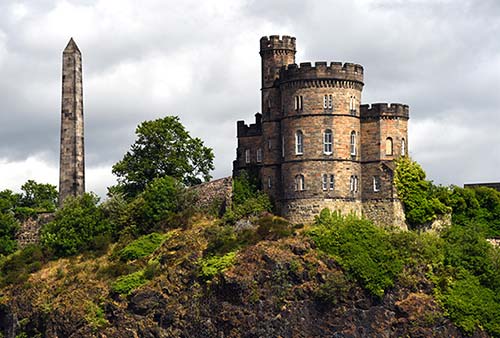
Look left down Jeffrey Street past the train tracks for a good view of Old Calton Cemetery up on Calton Hill. The obelisk, called Martyrs’ Monument, remembers a group of 18th-century patriots exiled by London to Australia for their reform politics. The round building to the left is the grave of philosopher David Hume. Today, the main reason to go up Calton Hill is for the fine views.
• Continue down the Royal Mile—leaving old Edinburgh—as High Street changes names to...
9 Canongate
A couple blocks farther along (on the right at #172) you reach Cadenhead’s, a serious whisky shop (see “Shopping in Edinburgh,” later in this chapter). Beyond that, you’ll pass two worthwhile and free museums, the People’s Story Museum (on the left, in the old tollhouse at #163) and the Museum of Edinburgh (on the right, at #142), with the entry to the characteristic Bakehouse Close next door. But our next stop is the church just across from the Museum of Edinburgh.
The 1688 Canongate Kirk (Church)—located not far from the royal residence of Holyroodhouse—is where the royal family worships whenever they’re in town. (So, don’t sit in the front pew, marked with a crown.) The gilded emblem at the top of the roof, high above the door, has the antlers of a stag from the royal estate of Balmoral.
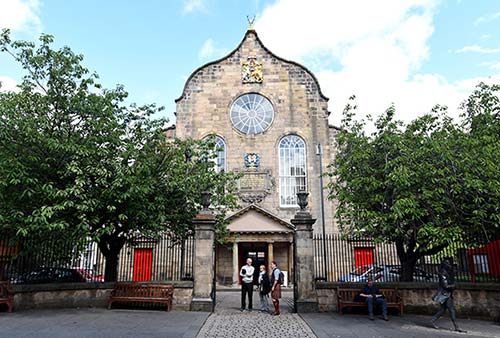
The church is open only when volunteers have signed up to welcome visitors. Chat them up and borrow the description of the place. Then step inside the lofty blue and red interior, renovated with royal money; the church is filled with light and the flags of various Scottish regiments.
Outside, turn right as you leave the church and walk up into the graveyard. The large, gated grave (abutting the back of the People’s Story Museum) is the affectionately tended tomb of Adam Smith, the father of capitalism.
In the sidewalk in front of the church is a statue of the poet Robert Fergusson (read the plaque on the fence), one of the first to write verse in the Scots language. He so inspired Robert Burns that Burns paid for Fergusson’s tombstone in the Canongate churchyard and composed his epitaph.
Now look across the street at the gabled house next to the Museum of Edinburgh. Scan the facade to see shells placed there in the 17th century to defend against the evil power of witches yet to be drowned.
• Walk about 300 yards farther along (past the recommended Clarinda’s Tea Room). In the distance you can see the Palace of Holyroodhouse (the end of this walk) and soon, on the right, you’ll come to the modern Scottish parliament building.
Just opposite the parliament building is White Horse Close (on the left; passage marked 27 in the white arcade that juts out over the sidewalk). Step into this 17th-century courtyard. It was from here that the Edinburgh stagecoach left for London. Eight days later, the horse-drawn carriage would pull into its destination: Scotland Yard.
• Now walk up around the corner and cross the street to the flagpoles (flying the flags of Europe, Britain, and Scotland) in front of the...
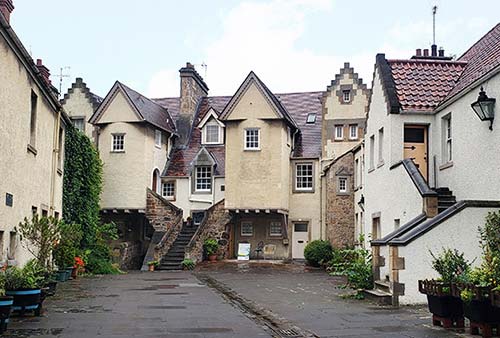
10 Scottish Parliament Building
Finally, after centuries of history, we reach the 21st century. And finally, after three centuries of London rule, Scotland has a parliament building...in Scotland. When Scotland united with England in 1707, its parliament was dissolved. But in 1999, the Scottish parliament was reestablished, and in 2004, it moved into this striking home. Notice how the eco-friendly building, by the Catalan architect Enric Miralles, mixes wild angles, lots of light, bold windows, oak, and native stone into a startling complex.
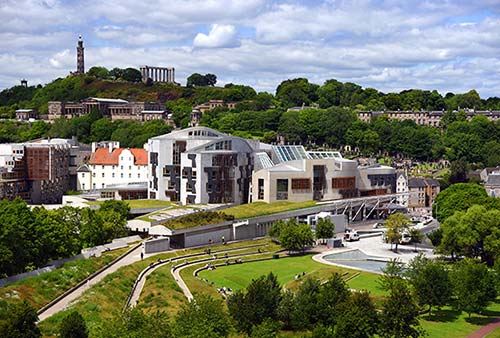
Since it celebrates Scottish democracy, the architecture is not a statement of authority. There are no statues of old heroes. There’s not even a grand entry. You feel like you’re entering an office park. Given its neighborhood, the media often calls the Scottish Parliament “Holyrood” for short (similar to calling the US Congress “Capitol Hill”).
• Across the street is the King’s Gallery, with a sampling of the royal art collection. Finally, walk to the end of the road (Abbey Strand), and step up to the impressive wrought-iron gate of the palace. Look up at the stag with its holy cross, or “holy rood,” on its forehead, and peer into the palace grounds. (The ticket office and palace entryway, a fine café, and a handy WC are just through the arch on the right.)
11 Palace of Holyroodhouse
Since the 16th century, this palace has marked the end of the Royal Mile. An abbey—part of a 12th-century Augustinian monastery—originally stood in its place. While most of that old building is gone, you can see the surviving nave behind the palace on the left. According to one legend, it was named “holy rood” for a piece of the cross, brought here as a relic by Queen (and later Saint) Margaret. Another version of the story is that King David I, Margaret’s son, saw the image of a cross upon a stag’s head while hunting here and took it as a sign that he should build an abbey on the site.
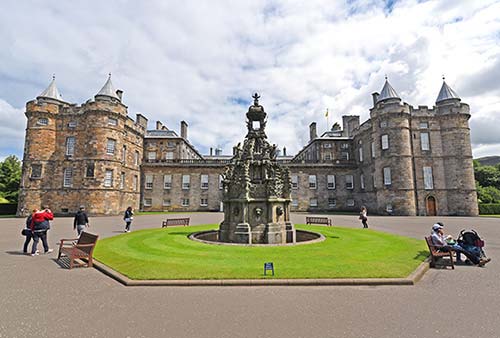
Because Scotland’s royalty preferred living at Holyroodhouse to the blustery castle on the rock, the palace grew over time. If the royals aren’t visiting, the palace welcomes visitors.
• Your walk—from the castle to the palace, with so much Scottish history packed in between—is complete. But if your appetite is whetted, don’t worry, there’s much more to see. Enjoy the rest of Edinburgh.
NEW TOWN WALK: GEORGIAN EDINBURGH
Many visitors, mesmerized by the Royal Mile, never venture to the New Town. And that’s a shame. With the city’s finest Georgian architecture (from its 18th-century boom period), the New Town has a completely different character than the Old Town. This self-guided walk—worth ▲▲—gives you a quick orientation in about one hour.
• Make your way to Waverley Bridge, spanning the gully between the Old and New towns; to get there from the Royal Mile, just head down the curved Cockburn Street near the Tron Church (or cut down any of the “close” lanes opposite St. Giles Cathedral). Cross the bridge and stand in front of the wrought-iron fence, facing the castle.
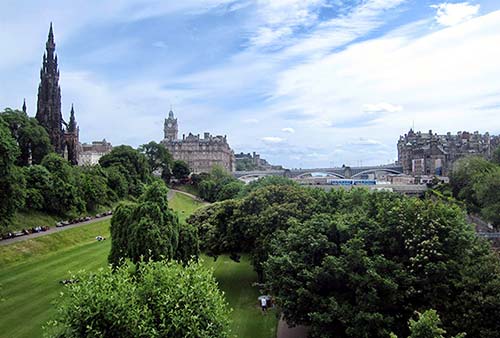
1 View from near Waverley Bridge: From this vantage point, you can enjoy fine views of medieval Edinburgh, with its 10-story-plus “skyscrapers.” It’s easy to imagine how miserable crowding in the Old Town prompted the city to expand during the Georgian period.
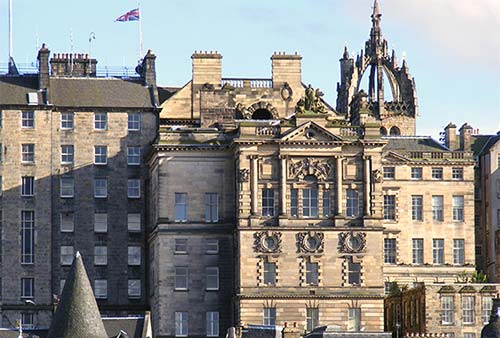
A big lake called the Nor’ Loch once was to the north (nor’) of the Old Town; now it’s a valley between Edinburgh’s two towns. The lake was drained around 1800 as part of the expansion. Before that, the lake was the town’s water reservoir...and its sewer.
The long-gone loch was also a handy place for drowning witches. With their thumbs tied to their ankles, they’d be lashed to dunking stools. Those who survived the ordeal were considered “aided by the devil” and burned as witches. If they died, they were innocent and given a good Christian burial. Scotland burned more witches per capita than any other country—17,000 souls between 1479 and 1722.
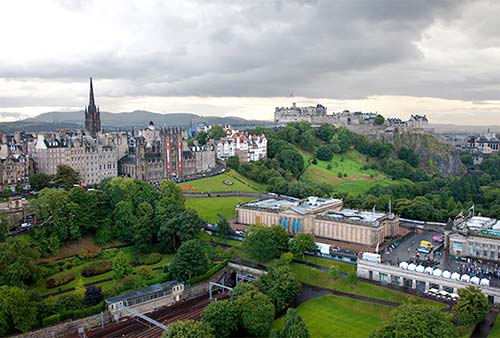
Facing the Old Town, look right and visually trace the train tracks as they disappear into a tunnel below the Scottish National Gallery (with the best collection anywhere of Scottish paintings; you can visit it during this walk—it’s described in “Sights in Edinburgh,” later). The two fine Neoclassical buildings of the National Gallery date from the 1840s and sit upon a mound that’s called...The Mound. When the New Town was built, tons of rubble from the excavations were piled here (1781-1830), forming a dirt bridge that connected the new development with the Old Town to allay merchant concerns about being cut off from the future heart of the city.
Turning 180 degrees (and facing the ramps down into the train station), notice the huge, turreted building with the clock tower. (The clock is famously four minutes fast to help locals not miss their trains.) The Balmoral was one of the city’s two grand hotels during its glory days (its opposite bookend, the Caledonian Edinburgh, sits at the far end of the former lakebed—near the end of this walk). Aristocrats arriving by train could use a hidden entrance to go from the platform directly up to their plush digs.
• Continue straight, toward the New Town. Before the corner, enter the gated gardens on the left, and head toward the big, pointy monument. You’re at the edge of...
2 Princes Street Gardens: This grassy park, filling the former lakebed, offers a wonderful escape from the bustle of the city. Once the private domain of the wealthy, it was opened to the public around 1870—not as a democratic gesture, but in hopes of increasing sales at the Princes Street department stores.
• Take a seat on the bench as encouraged by the statue of Livingstone (Dr. Livingstone, I presume?). Look up at the towering...
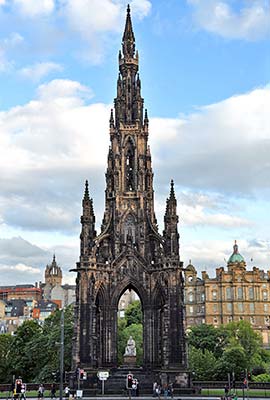
3 Scott Monument: Built in the early 1840s, this elaborate Neo-Gothic monument honors the great author Sir Walter Scott, one of Edinburgh’s many illustrious sons. When Scott died in 1832, it was said that “Scotland never owed so much to one man.” Scott almost singlehandedly created the image of the Scotland we know. Just as the country was in danger of being assimilated into England, Scott celebrated traditional songs, legends, myths, architecture, and kilts, thereby reviving Highland culture and cementing a national identity. Nicknamed “the Gothic Rocket,” this 200-foot-tall monument shelters a marble statue of Scott and his favorite pet, Maida, a deerhound who was one of 30 canines this dog lover owned during his lifetime. Climbing the tight, stony spiral staircase of 221 steps earns you a peek at a tiny museum partway up and a fine city view on the third floor (£9, open daily 10:00-12:30 & 13:45-15:30; 30-minute tours depart on the half hour, last tour at 15:30; edinburghmuseums.org.uk).
• Exit the park and head across busy Princes Street to the...
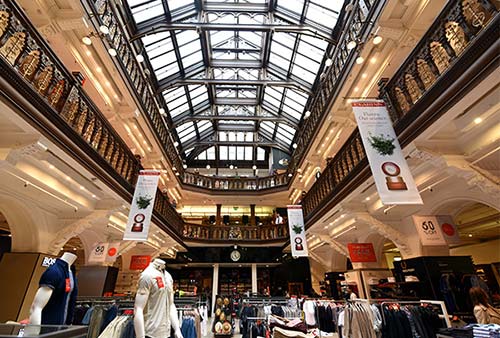
4 Former Jenners Department Store: As you wait for the light to change, consider the importance of this downtown department store in its heyday. The arrival of new fashions here was such a big deal in the old days that they’d announce it by flying flags on the Nelson Monument atop Calton Hill (which you can see in the distance on the right). But Jenners began to struggle in the age of online shopping. After 183 years of continuous operation, it closed its doors during the Covid-19 lockdown...and never reopened. An extensive refurbishment of its historic building is underway, likely with a new tenant; it may still be under construction when you visit.
• Walk straight up South St. David Street. At the top of the block, kitty-corner on your right, you’ll see...
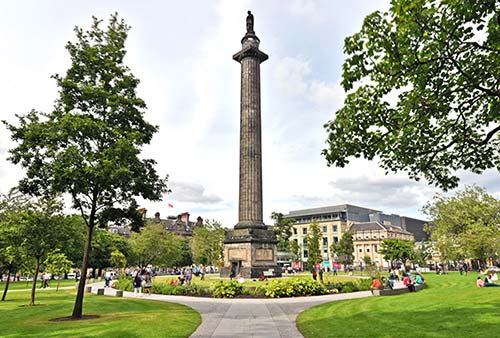
5 St. Andrew Square: Step into this green space, which is dedicated to the patron saint of Scotland. In the early 19th century, there were no shops around here—just fine residences, and this was a private garden for the fancy people living here. Now open to the public, the square is a popular lunch hangout for workers. The Melville Monument honors a powermonger member of parliament who, for four decades (around 1800), was nicknamed the “uncrowned king of Scotland.”
One block beyond the top of the park on Queen Street is the excellent Scottish National Portrait Gallery, which introduces you to the biggest names in Scottish history.
• Follow the Melville Monument’s gaze straight ahead out of the park. Cross the street and stand at the top of...
6 George Street: This is the main drag of Edinburgh’s grid-planned New Town. Laid out in 1776, when King George III was busy putting down a revolution in a troublesome overseas colony, the New Town was a model of urban planning. The architectural style is “Georgian”—British for “Neoclassical.” And the street plan came with an unambiguous message: to celebrate the union of Scotland with England into the United Kingdom. (This was particularly important, since Scotland was just two decades removed from the failed Jacobite uprising of Bonnie Prince Charlie.)
If you look at a map, you’ll see the politics in the street plan: St. Andrew Square (patron saint of Scotland) and Charlotte Square (George III’s queen) bookend the New Town, with its three main streets named for the royal family of the time (George, Queen, and Princes). Thistle and Rose streets—which we’ll see near the end of this walk—are named for the national flowers of Scotland and England.
The plan for the New Town was the masterstroke of the 23-year-old urban designer James Craig. George Street—20 feet wider than the others (so a four-horse carriage could make a U-turn)—was the main drag. Running down the high spine of the area, it afforded grand, unobstructed views.
• Halfway down the first block of George Street, on the right, is...
7 St. Andrew’s and St. George’s Church: Designed as part of the New Town plan in the 1780s, the church is a product of the Scottish Enlightenment. It has an elliptical plan (the first in Britain) so that all can focus on the pulpit. If it’s open, step inside. The church conveys the idea that God is space, light, reason, and ordered beauty. A fine leaflet tells the story of the church, and a handy cafeteria downstairs serves cheap and cheery lunches.
• Directly across the street from the church is another temple, this one devoted to money.
8 The Dome: This former bank building now houses a recommended restaurant; consider ducking inside to view the stunning domed atrium. Its pediment is filled with figures demonstrating various ways to make money, which they do with all the nobility of classical gods.
• Continue down George Street to the intersection with a statue.
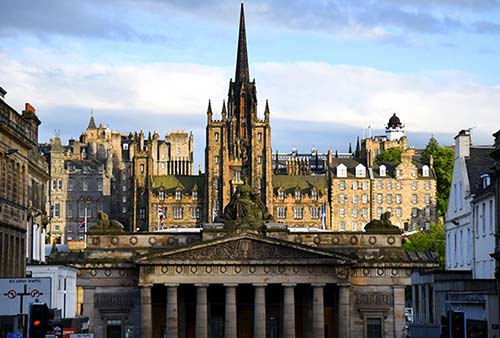
9 Statue of King George IV: This statue commemorates George IV’s visit to Edinburgh in 1822. Notice the particularly fine axis formed by this cross-street: The National Gallery lines up perfectly with the Royal Mile’s skyscrapers and the former Tolbooth Church, creating a Gotham City collage. If you look in the opposite direction, you’ll see the Firth of Forth glimmering in the distance—a reminder of how close Edinburgh is to the sea.
• By now you’ve gotten your New Town bearings. Feel free to stop this walk here: If you were to turn left and head down Hanover Street, in a block you’d run into the Scottish National Gallery; the street behind it curves back up to the Royal Mile.
But to see more of the New Town—including the Georgian House, offering an insightful look inside one of these fine 18th-century homes—stick with me for a few more long blocks, zigzagging through side streets to see the various personalities that inhabit this rigid grid.
Cross over Hanover Street, turn right, and walk along Hanover just one (short) block. Turn left down...
10 Thistle Street: Of the many streets in the New Town, this has perhaps the most vivid Scottish character. And that’s fitting, as it’s named after Scotland’s national flower. At the beginning and end of the street, also notice that Craig’s street plan included tranquil cul-de-sacs within the larger blocks. Thistle Street holds characteristic boutiques and good restaurants (see “Eating in Edinburgh,” later).
• You’ll soon reach Frederick Street. Turn left and head toward the...
11 Statue of William Pitt the Younger: Pitt was a prime minister under King George III during the French Revolution and the Napoleonic Wars. His father gave his name to the American city of Pittsburgh (which Scots pronounce as “Pitts-burrah”...I assume).
• For an interesting contrast, we’ll continue down another side street. Carrying on past the statue of Pitt (heading toward Edinburgh Castle), turn right onto...
12 Rose Street: This stretch of Rose Street is more commercialized, jammed with chain stores. The far end is packed with pubs and restaurants.
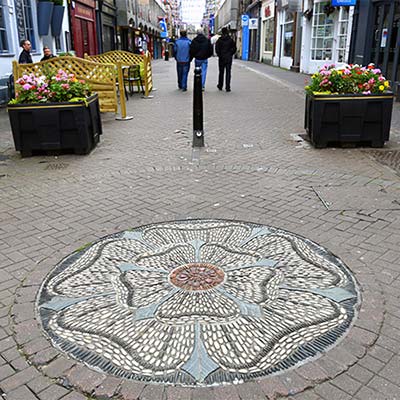
As you walk, keep an eye out for the cobbled Tudor rose embedded in the brick sidewalk. When you cross the aptly named Castle Street, linger over the grand views to Edinburgh Castle. It’s almost as if they planned it this way...just for the views.
• Popping out at the far end of Rose Street, across the street and to your right is...
13 Charlotte Square: The building of the New Town started cheap with St. Andrew Square but finished well with this stately space. In 1791, the Edinburgh town council asked the prestigious Scottish architect Robert Adam to pump up the design for Charlotte Square. Adam’s design, which raised the standard of New Town architecture to “international class,” created Edinburgh’s finest Georgian square. To this day, the fine garden filling the square is private, reserved for residents only.
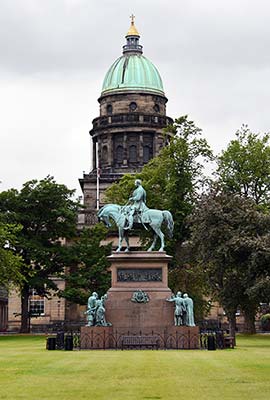
• North of Charlotte Square, at #7, you can visit the 14 Georgian House, which gives you a great peek behind these harmonious Neoclassical facades (see “Sights in Edinburgh,” later). It’s right next to the official residence of Scotland’s First Minister (at #5).
When you’re done touring the Georgian House, we’ll make a restful return to our starting point.
15 Return Through Princes Street Gardens: From Charlotte Square, drop down to busy Princes Street (noticing the red building to the right—the grand Caledonian Hotel and twin sister of The Balmoral at the start of our walk). But rather than walking along the busy bus-and-tram-lined shopping drag, head into Princes Street Gardens (cross Princes Street and enter the gate on the left). With the castle looming overhead on your right, walk back toward The Mound. You’ll pass a playground, a fanciful Victorian fountain, more monuments to great Scots, and war memorials. Finally, you’ll reach a staircase up to the Scottish National Gallery and the oldest floral clock in the world—perhaps telling you it’s time for a spot of tea.
• Our walk is over. From here, you can tour the gallery, head up Bank Street just behind it to reach the Royal Mile, or continue through the Princes Street Gardens to the Scott Monument and our starting point.