SOUTH WALES
Cardiff • Near Cardiff • Wye Valley
Map: Cardiff Center Hotels & Restaurants
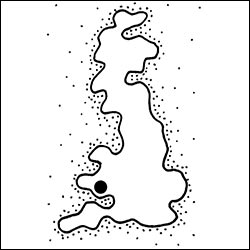
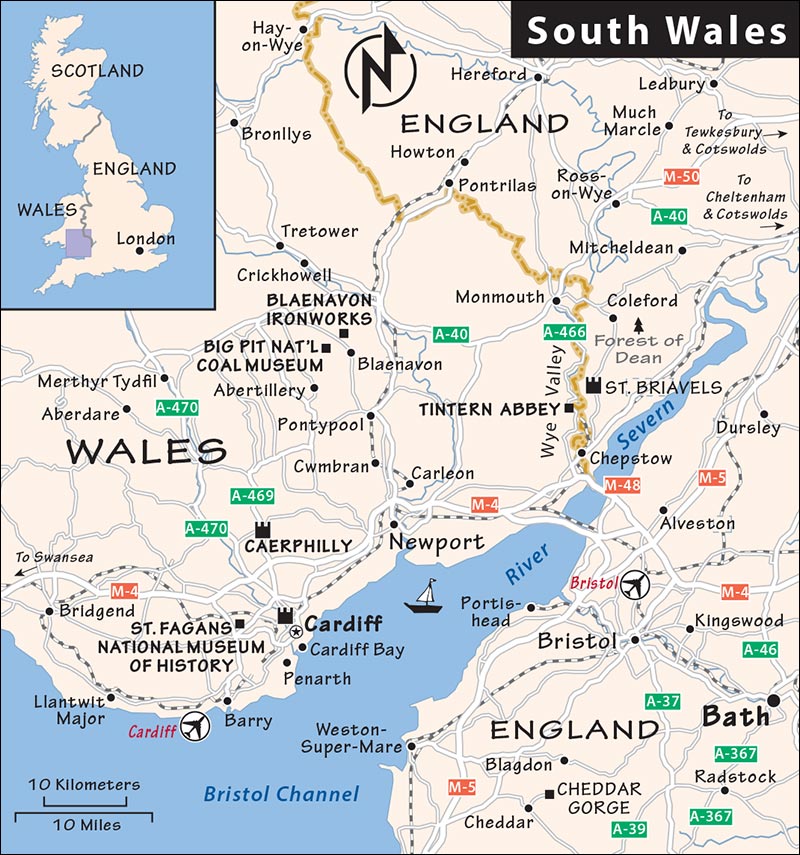
South Wales offers a taste of Welsh flavor just an hour from major English destinations such as Bath and the Cotswolds. While the dramatic castles and scenery that many find quintessentially Welsh are in the north, spunky South Wales leaves you with great memories—from the revitalized capital city of Cardiff with its own castle ruins, to the lush Wye Valley with the romantic Tintern Abbey.
Cardiff—like so many Industrial Age giants—became a run-down rust-belt city but has reemerged with fresh vigor. Its castle has medieval intrigue as well as Victorian bling, its downtown is ruddy yet vibrant, and its port—which shipped 20 percent of the world’s fuel when coal was king—is now a delightful place to stroll.
Just outside Cardiff, St. Fagans’ open-air museum celebrates unheralded Welsh culture. The towns of Chepstow and Caerphilly both have stout castles designed by the British to keep the natives of this feisty little country in line. And beloved Tintern Abbey, frequently immortalized in verse and on canvas, is the most spectacular of Britain’s many ruined abbeys.
PLANNING YOUR TIME
South Wales could fill two or three days (overnight in Cardiff or near Tintern Abbey). To learn about Welsh history and culture, spend a few hours at the St. Fagans National Museum of History; for an urban Welsh experience, visit Cardiff. Castle lovers and romantics should consider seeing Tintern Abbey and the castles of Caerphilly and Chepstow (Caerphilly is best).
For a targeted visit, cherry-pick the best sights on a busy day between Bath and the Cotswolds:
| 9:00 | Leave Bath for South Wales. |
| 10:30 | Tour St. Fagans (or visit Cardiff). |
| 14:30 | Head to Tintern Abbey and/or a castle of your choice, then drive to the Cotswolds. |
| 18:00 | Set up in your Cotswolds home base. |
Cardiff
The Welsh capital of Cardiff (pop. 350,000) feels underrated. It has a fine castle, a revitalized pedestrian core, a smattering of museums, and a modern waterfront. While rugby and soccer fans know Cardiff as the home of Principality Stadium, and sci-fi fans know it as the place where Doctor Who is filmed, the Welsh proudly view the city as their political and cultural capital.
PLANNING YOUR TIME
If you’re just passing through, Cardiff can be seen in a few hours: Visit the castle, follow my self-guided town walk, and take a quick look at the Cardiff Bay waterfront. But it’s also worth considering as an overnight home base for exploring more of South Wales. Just outside Cardiff are two sights well worth visiting: St. Fagans National Museum of History (open-air folk museum) to the west, and Caerphilly (with its sturdy castle) to the north—all doable with just one night and a busy day on either side. If you’re seeing other ruined castles in North Wales, Caerphilly is skippable (consider Tintern Abbey instead).
Orientation to Cardiff
Compact Cardiff can be seen quickly, with two main sightseeing zones: the castle and adjacent city center, and Cardiff Bay (a short bus or taxi ride away).
TOURIST INFORMATION
While Cardiff has no official TI, you can find information in a hut within the castle visitors center (just to the right when you enter, next to the ticket office) and online at visitcardiff.com. The staff at the Museum of Cardiff also answer basic questions and hand out city maps.
ARRIVAL IN CARDIFF
By Train: Cardiff Central train station (with the bus station just across the square) is at the southern edge of the town center. From here, it’s about a 15-minute walk to the castle: Exit the station to the right, then bear left when you hit busy St. Mary Street. Follow this as it becomes High Street, which runs right into Cardiff Castle. The train station has no lockers; you can walk 10 minutes to the Old Library and use the lockers there (see “Helpful Hints,” below).
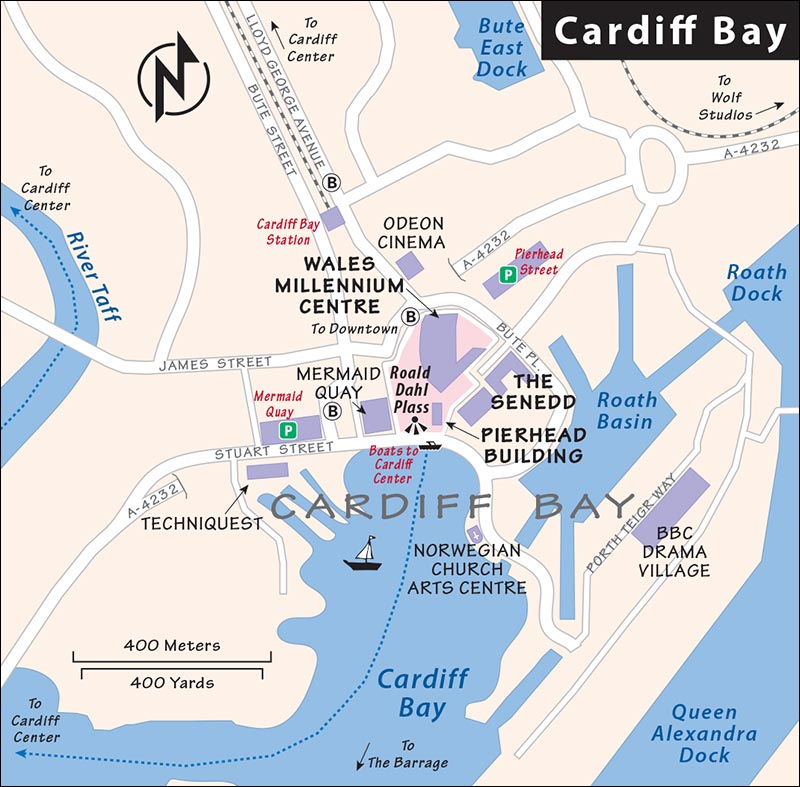
By Car: The most convenient, spacious, and reasonably priced parking garages are associated with St. David’s mall, southeast of the castle area. To get as close as possible to the castle, try finding street parking in the Civic Center area (near the National Museum, just east of the castle). If heading for Cardiff Bay, the Pierhead Street garage is handiest to the sights, while the Mermaid Quay garage is closer to restaurants (see the “Cardiff Bay” map, later). Warning: Cardiff’s ridiculously high and jagged curbs seem designed to damage any car that challenges them...trust me.
HELPFUL HINTS
- Getting Around: The only public transit you’ll likely need is to connect the castle and downtown with the port zone. Buses #6 and #8, as well as a small boat service, shuttle people efficiently. For details, see here.
- Walking Tours: Local Green Badge guide Sarah Salter offers a four-hour Cardiff City and Bay walking tour for up to four people (£180, +44 770 924 7634, sarahswales.co.uk). Fogos Free Tours offers a “pay what you want” two-hour walk through the city center on Tuesdays, Thursdays, Saturdays, and select Sundays at 11:00 (reserve online, meet at John Batchelor statue on The Hayes, private tours available on request, fogosfreetours.com).
- Baggage Storage: You’ll find pay storage lockers at the Museum of Cardiff in the Old Library, in the pedestrian core of town just behind the big church. It’s a 5-minute walk from Cardiff Castle and a 10-minute walk from the train station (lockers open daily 10:00-15:30).
- Welsh Crafts: The Castle Welsh Crafts Shop (directly across the street from the castle entrance) is an insanely touristy place offering every Welsh cliché, plus an exhibit of traditional carved wooden love spoons (Mon-Sat 9:30-17:30, Sun 10:00-17:00, 1 Castle Street).
Cardiff Walk
Ideally, visit the castle first (see “Sights in Cardiff”). Then follow this brief self-guided walk from the castle, past just about everything worth seeing in the town center, and ending a few blocks from a bus stop for Cardiff Bay. Allow about an hour.
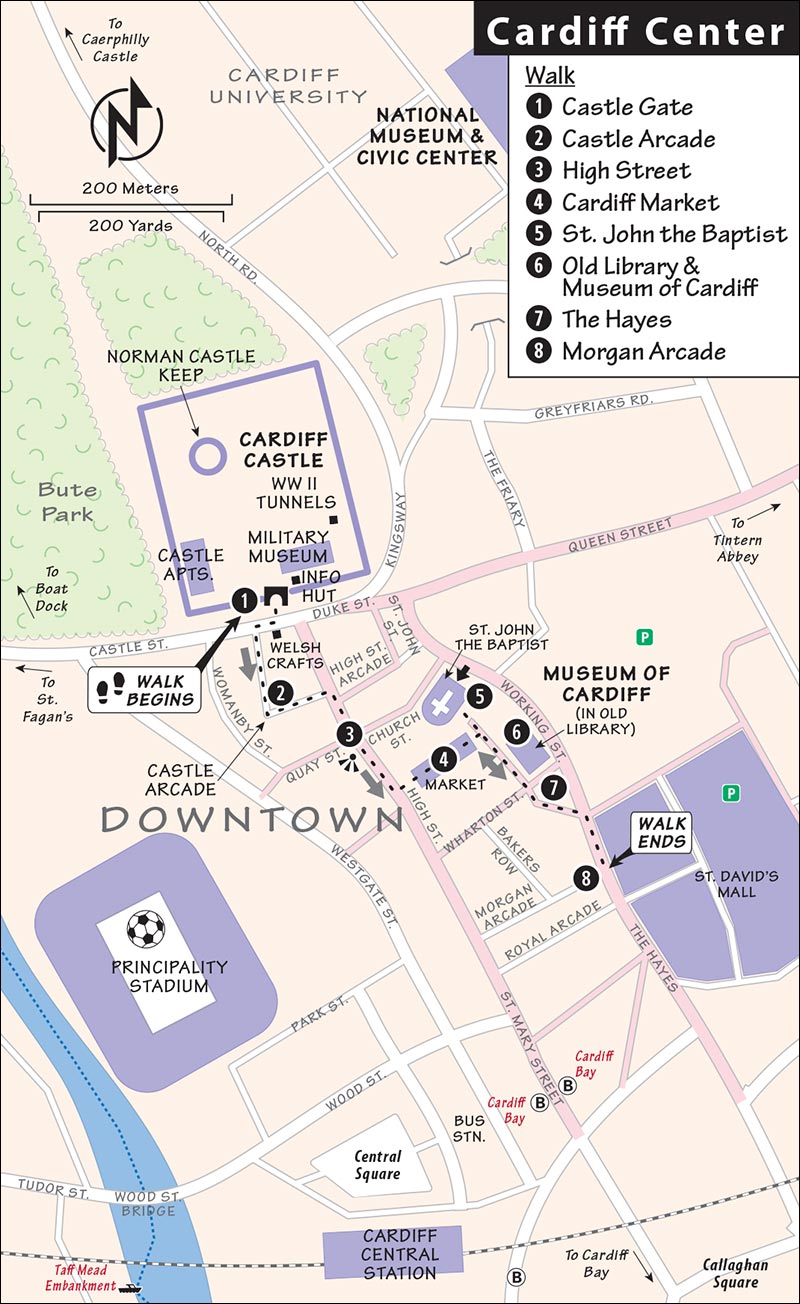
• We’ll begin at the 1 castle gate, with the castle to your back. Look across the busy street to the start of High Street.
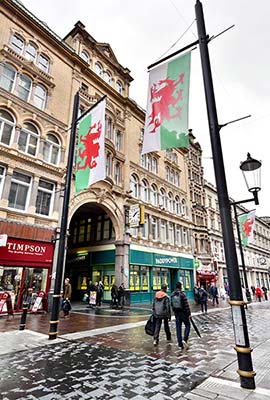
Cardiff was a garrison town back when Wales was an English-ruled apartheid society. The English lived within the walls (now long gone), and the indigenous Welsh who lived beyond made the English thankful they had those walls. The medieval city was mostly built over during Cardiff’s Victorian boom times. Pedestrianized High Street (which becomes St. Mary Street) is the spine, running from the castle’s entrance through the center.
• We’ll head down High Street...eventually. But first, take a little detour. Cross the busy street and bear right (past the Castle Welsh Crafts Shop) to the entrance of the...
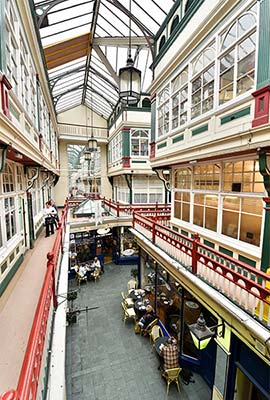
2 Castle Arcade: This is the most impressive of the many Victorian-era “arcades” burrowing through the city center. During the late 1800s, when Cardiff was booming, there emerged a class of wealthy women who demanded climate-controlled, London-quality shopping. The city answered by developing several arcades with glass roofs, ensuring the ladies stayed warm in the winter and didn’t get a “working-class” tan in the summer. (The term “blue blooded” refers to the fact that their wrists were so lily white that the blue of their veins showed through.) These long, narrow Victorian arcades—echoing the shape of farm plats from the days when people lived and farmed within the town’s protective walls—were state of the art when first constructed, with some of the first electric lighting anywhere.
Today, the joy of visiting these arcades lies in their characteristic shops and little cafés, the majority of which are family-run rather than chain stores. Stroll through Castle Arcade and look above to see the upper gallery (accessed via well-marked staircases).
• Exiting the far end of Castle Arcade, you’ll pop out along...
3 High Street (Heol Fawr): Cardiff’s main street was pedestrianized in 2007, making it a delightful walking zone. Turn right and stroll down the street.
At the first corner with Quay Street, look right to glimpse a small corner (and the big, white, sail-like riggings) of gigantic Principality Stadium. This is the main sports venue for all of Wales, and it seems to dwarf the city. Nicknamed “The Dragon’s Den” (after the national symbol and sports mascot of Wales), it serves as the home pitch of the Welsh national rugby (WRU) and soccer teams, hosted soccer matches during the 2012 London Summer Olympics, and is the place for big rock concerts in Wales. The stadium boasts the largest retractable roof in Europe. Even if you don’t join 74,500 screaming spectators for a rugby or soccer match, you can pay for a guided tour of the building (principalitystadium.wales.
• A half-block farther down High Street, watch on the left for a big, white clock with the date 1891 in the stone threshold, marking the entrance to the...
4 Cardiff Market (Marchnad Caerdydd): Like Cardiff itself, this lively market does its best to cater to tourists...but is predominantly used by locals. Spend some time exploring this all-purpose space (open Mon-Sat 8:00-17:00, closed Sun). You’ll find plenty of butchers, fishmongers, fruits and veggies, and sweets, along with nonfood items such as hardware, vintage menswear (“Traders to the Dandy”), jewelry, greeting cards, and hair extensions. There are also food stalls, ranging from basic snack stands to gourmet cheese counters and healthy lunches. Upstairs is a top-notch vintage record store (Kelly’s) and a few bric-a-brac shops. For a tasty treat, find Bakestones (under the clock tower in the middle of the main floor), where a big griddle cooks up an endless supply of cheap, fresh, piping-hot Welsh cakes.
• Exit the far end of the market, turn left, and hook around to the base of the church tower to enter the church of...
5 St. John the Baptist: This Anglican church is the most important church in Cardiff’s city center. Built in 1180, then rebuilt in the 15th century after damage sustained during a rebellion against English rule, St. John the Baptist is one of the oldest buildings in Cardiff. If it’s open, step inside to enjoy the Victorian stained glass and the Herbert family tomb (in the chapel to the left of the main altar). The Herberts ran the town in the 16th century like gangster Medicis.
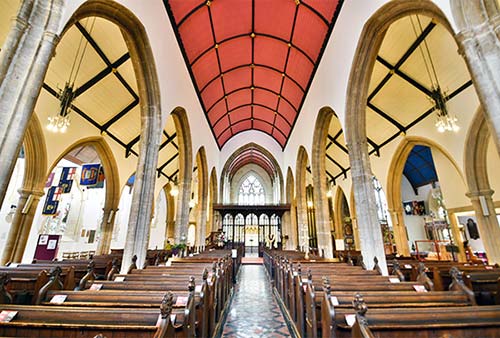
As you face the altar, exit the church through the door on your right, emerging into the churchyard. Look for the tall, well-worn nub of a medieval preaching cross. Originally standing on High Street, this cross marked the site of official announcements and special preaching (e.g., “Join in on the newest crusade!”).
• With the church at your back, exit the churchyard through the gate, turn left, then continue past the fenced park to the...
6 Old Library (Yr Hen Lyfrgell): This fine building dates from Cardiff’s Victorian glory days—back when city leaders wanted to be sure the general public had access to good books. Today it contains a fine shop full of classy Welsh souvenirs, lockers for baggage storage, WCs, and a museum exhibit.
As you enter the library, head straight back, then turn right to find the gorgeously preserved, colorfully tiled Victorian corridor—evoking the spare-no-expense gentility of Cardiff’s boom era.
The building houses the free, engaging Museum of Cardiff (Mon-Sat 10:00-16:00, closed Sun, cardiffmuseum.com). Step into its one large room for a concise, vividly illustrated look at the full sweep of Cardiff’s history—including a big model of its sprawling port circa 1913. More rotating exhibits are in the basement, including a children’s dress-up area and a reading nook with comfy couches and lots of Cardiff- and Wales-related books to choose from.
• Beyond the Old Library, at a plaza with tall trees, the street widens into a pedestrian boulevard called...
7 The Hayes (Yr Aes): Like High Street, The Hayes was revitalized (in 2006) and transformed into the city’s finest shopping zone. The trees mark a small food court called Hayes Island. Stroll beyond that, noticing the vast, sprawling, modern St. David’s mall on your left. For more local browsing, watch on your right for the entrance to the 8 Morgan Arcade—another classic Victorian shopping gallery.
• To continue to Cardiff’s other main sightseeing zone—Cardiff Bay—find the nearby bus stop. Walk through Morgan Arcade to the far end. You’ll pop out on St. Mary Street, the southern part of High Street. Turn left and walk two blocks to the curve of a busy road. Here you’ll see bus stops—hop on bus #6, known as the “Baycar,” for a ride to Cardiff Bay.
Sights in Cardiff
I’ve listed Cardiff’s main sights below. For two worthwhile sights within 30 minutes of the city (St. Fagans National Museum of History and Caerphilly Castle), see the “Near Cardiff” section, later.
IN THE CENTER
▲Cardiff Castle
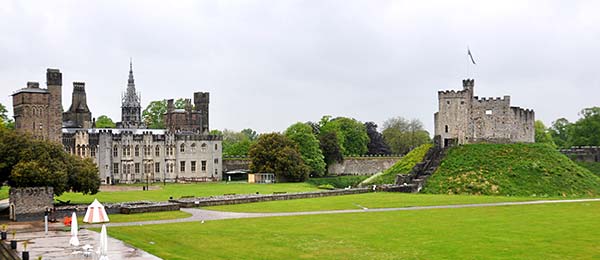
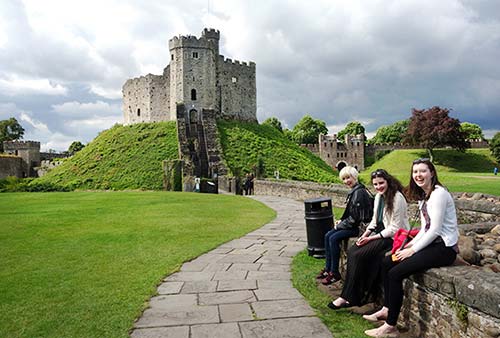
Cardiff Castle (Castell Caerdydd) is one of the town’s top sights—a fun complex that contains within its big medieval wall bits of several fortresses erected here since Roman times. You’ll ramble its ramparts, climb an impressive Norman keep built on a man-made mound, see a WWII bomb shelter, visit a Welsh military museum, and tour a romantically rebuilt Victorian-era palace that is less than historic but dazzling just the same.
Cost and Hours: £16; Mon-Fri 10:00-18:00, Sat-Sun from 9:00, Nov-Feb until 17:00; last entry one hour before closing; download free app with audioguide, café, +44 29 2087 8100, cardiffcastle.com.
Tours: For a 50-minute tour of the 19th-century palace, ask at the ticket office and pay £4.50 extra as you enter. Tours depart at the top of each hour and cover the rooms you can see on your own plus a handful of otherwise inaccessible rooms (the nursery, bedroom, and rooftop garden).
Visiting the Castle: Your visit includes the following stops, which you can tour in any order. All are well explained in the app.
The entrance building has the ticket office, shop, café, and WCs. Downstairs is part of a 2,000-year-old Roman wall (discovered in 1922) and a fine military exhibit called “Firing Line: Museum of the Welsh Soldier.” Illustrated with plenty of artifacts (uniforms, medals, and weapons), the exhibit zigzags chronologically through the cellar, from conflict to conflict. You’ll learn why a goat always leads Welsh regiments into battle.
WWII Tunnels: Stepping out into the main courtyard, on your right (near the catapult) is a long, two-level stretch of passageways—the battlements and WWII tunnels. The old battlements are above, and underneath them is a tunnel that was used during WWII air raids as a bomb shelter. Cardiff was an important military port (20 percent of all American GIs who fought in Europe landed here), which made it a target of Nazi bombers. While the port was hit hard, the city center got off pretty lightly.
Keep: Dominating the castle grounds is the keep, a classic Norman motte-and-bailey construction, with a stout fortress on top of a man-made hill. The original structure, made of wood, was built by William the Conqueror in 1081. He was returning from what he called a “pilgrimage” to St. Davids—a cathedral town in western Wales—which clearly included a little scouting for future military action. You can ascend the very steep steps into the keep’s courtyard, then even more steps to reach the (empty) inner chamber, the (empty) jail, and the rest of this mostly empty shell.
Castle Apartments: Finally, on the left is the most interesting interior in the castle complex. This Neo-Gothic fantasy palace was rebuilt by John Crichton-Stuart, third marquess of Bute, whose income from the thriving coal trade flowing through his docklands made him one of Europe’s wealthiest men in the late 1860s. He spared no expense. With his funds and architect William Burges’ know-how, the castle was turned into a whimsical, fantastical take on the Middle Ages. It’s the Welsh equivalent of “Mad” King Ludwig’s fairy-tale castles in Bavaria (built in the same romantic decade). In 1947, the family donated it to the city of Cardiff.
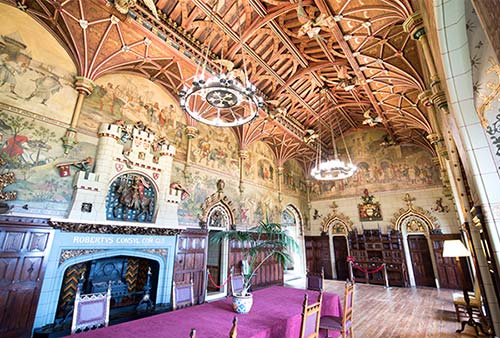
Heading upstairs, peek into the glittering Arab Room, slathered in gold, including a gold-leaf stalactite ceiling. Then you’ll step into the highlight of the complex, the breathtaking Banqueting Hall—with every surface covered in the highly detailed, gilded imagery of medieval symbolism. This hall grandly evokes the age of chivalry, right down to the raised minstrels’ gallery (where musicians could perform overhead but remain unseen). Farther along, the small dining room has a table designed for a grapevine to grow up through a hole in the middle—so that guests could pick their own dessert. And the library boasts rows of leather-bound books and desks that double as radiators.
Nearby: The lush Bute Park—the largest urban park in Britain (as big as New York’s Central Park)—runs from the castle to the open valley beyond Cardiff. It offers a world of escapes for relaxing locals—formal gardens, rugby and cricket pitches, and a riverside path that leads through natural surroundings from the castle into the hills (the stone circle may look ancient, but it’s a modern installation dating only to 1978). On the River Taff, at the southeast end of the park (nearest the castle), you’ll find the dock for the boats to the port (for boat info, see “Getting to Cardiff Bay,” later).
National Museum and Civic Center
The National Museum focuses on art (with a particularly strong Impressionist collection), natural history (dinosaurs and mammoths), and archaeology (scant fragments of prehistoric Wales).
The imposing Civic Center—a gathering of stately buildings—was erected just before Cardiff reached the end of its boom. A leading citizen sold the city some prime land at a great price on one condition: Grand London-class structures made of Portland stone must be built here and remain forever open to the public. So, in 1910 the city built its Edwardian City Hall, law courts, National Museum, and the University of Wales just north of the castle on North Road.
Cost and Hours: Free, Tue-Sun 10:00-17:00, closed Mon, Cathays Park, +44 300 111 2333, museum.wales/cardiff.
CARDIFF BAY
Cardiff Bay (worth ▲▲) was the city’s industrial engine during its golden age—and its most miserable corner during its era of precipitous decline. But today the bay has bounced back, with lots of new construction and some thoughtful refurbishment of historical sights. It’s worth the short bus or boat ride from downtown to this lively area to get a glimpse of Cardiff’s past, present, and future, and to see how a once-flailing city can right the ship.
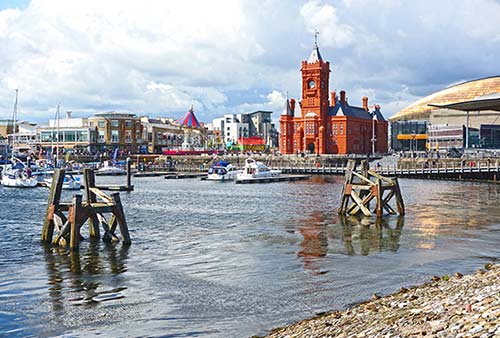
Getting to Cardiff Bay: It’s about 15 minutes by bus from downtown. While various routes get you close, your best bets are bus #6 (aka the “Baycar”) and bus #8. You can catch bus #6 from the Wyndham Arcade stop at the southern end of St. Mary Street, near the end of my self-guided walk (£2.50, exact change or use contactless payment; about every 30 minutes, cardiffbus.com). Hop off at the Wales Millennium Centre (walk through the Millennium Centre to pop out on Roald Dahl Plass). Bus #8 leaves from the Philharmonic stop across the street from Wyndham Arcade and takes you to Mermaid Quay.
You can also get here by slightly slower yet scenic boat. Two companies (Aquabus and Princess Katharine) leave from a dock in Bute Park not far from the castle, below the Castle Street bridge and Pettigrew Tea Rooms (£7.50, each company goes hourly—alternating on the half-hour, 25 minutes, aquabus.co.uk, cardiffboat.com).
Background: Cardiffians love to brag that in its heyday, the port of Cardiff shipped almost a quarter of the world’s coal. Valleys rich with the best coal deposits anywhere funneled the black gold of the 19th century right into Cardiff. Capitalizing on the Industrial Revolution demand for steam power, the city built a massive port, ultimately with about 200 miles of train tracks lining its shipping piers. (There are none of the vast brick warehouses you’d expect in a 19th-century port; rather than being warehoused, the coal was simply piled next to the tracks and shipped almost immediately upon arrival.)
But with the advent of imported coal and oil, Cardiff’s port declined. A generation ago, the port was derelict—a place no tourist would dream of visiting. In the late 1980s, city leaders hatched a scheme for the “Cardiff Bay Barrage,” designed to seal off the mouth of the port and create a permanent high-tide waterline. Their goal was to attract developers with the promise of an inviting new people zone on the waterfront. It worked. Today, as with formerly rusty old ports all over Europe, Cardiff Bay is thriving—packed with sparkling bold architecture, sightseeing attractions, and fun entertainment.
▲▲Cardiff Bay Visual Tour
There’s a lot to see at Cardiff Bay. Fortunately, you can see almost all of it with a strategic sweep of the head. To get your bearings, plant yourself on the little bridge at the harbor end of Roald Dahl Plass (named for the Cardiff-born children’s author) and survey the bay.
• Begin by facing straight out to sea.
Cardiff Bay and the Barrage: Before 2002, one of the biggest tides in the world literally emptied this bay twice a day. Now, the mouth of the harbor is dammed by “The Barrage” (BAH-rahzh), a high-tech dam marked by the grassy slope in the distance. While locks let in boats and a fish ladder lets in fish, the tide is kept out, and Cardiff Bay has become an inviting tourist zone. The bluff called Penarth Head (right of the Barrage) is a desirable residential zone, and on a clear day, you can spot the hills of West England in the far distance.
On the embankment below and in front of you, you’ll see boat docks offering harbor cruises or a boat ride up the River Taff to the city center (a scenic return if you came here by bus; see “Getting to Cardiff Bay,” earlier). The giant bronze circular sculpture (called the Celtic Ring) is the starting point for the Taff Trail, a beloved 55-mile walking-and-cycling riverside path that leads through the green core of Cardiff all the way to the village of Brecon, deep in the Welsh interior.
• The stately, red-brick building on your left is the...
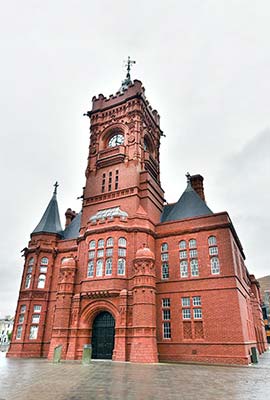
Pierhead Building: Sometimes called the “Welsh Big Ben,” this landmark is a symbol of the city. The building was originally the port authority for Cardiff Bay, which was later merged with the Cardiff Railway Company (logical, since this is where rails met ships). Note the evocative relief celebrating steamships and trains with the Welsh phrase wrth ddŵr a thân (“by water and fire”)—still the motto of the Welsh railways. A history exhibit inside shows a free and interesting video (Mon-Fri 9:00-16:30, Sat from 10:30, closed Sun, senedd.wales).
Behind the Pierhead—but not visible from here—is the Welsh National Assembly (more on this later).
• Looking just to the right from the Pierhead, you’ll see a white shiplap church that seems like it would be more at home on a fjord. This is the...
Norwegian Church Arts Centre: This was originally built as a seamen’s mission by the Norwegian merchant marines, in properly austere Lutheran style during Cardiff’s Industrial Age boom. Originally, it sat where the Wales Millennium Centre is today, but in the 1970s and 1980s—when the docklands were a dangerous, derelict no-man’s-land—the church was literally disassembled and mothballed for future use. Over the decades, it has been reassembled, reconsecrated, refurbished, and repurposed as a successful arts center (free, daily 10:30-18:00, café, norwegianchurchcardiff.com [URL inactive]).
• Beyond the Norwegian Church are a few other sights.
More Bay Sights: Many popular BBC television shows are filmed in Cardiff. On Roath Lock sprawls the BBC Drama Village, the studio lot where shows such as Casualty and the Welsh-language soap opera Pobol y Cwm are filmed, but perhaps best known as the former, longtime home of Doctor Who (now filmed at Wolf Studios, beyond Roath Dock).
In the bay beyond, notice the rotting wooden pilings in the harbor. Nicknamed “dolphins,” these were used to brace ships caught here by falling tides before the construction of the Barrage. (Captains would tie their boats to a dolphin and gently settle onto mud without toppling.)
• Now turn with your back to the bay. You’re looking right at the huge plaza at the center of this area called...
Roald Dahl Plass: Visitors congregate on this expansive bowl-shaped main plaza. You can see a seated statue of the beloved children’s author, known for such titles as James and the Giant Peach, on the right. (The Norwegian term plass—“square”—honors Dahl’s Norwegian ancestry.) As this area was once a coal port, it angles down to the water. The pillars are illuminated with a light show after dark, and the 70-foot-tall silver water tower is always trickling.
• On the left side of the square is Mermaid Quay, a sprawling outdoor-dining zone loaded with mostly chain restaurants. On the right side of the square is the dramatic...
Wales Millennium Centre: Wales, a land famous for its love of music, had no national opera house until 2004. The Welsh fixed that with gusto when they built the 2,000-seat Wales Millennium Centre. It’s a cutting-edge venue housing opera and theater, among other performances (funded mostly by lottery money). The enormous opera house anchors the entire Cardiff Bay district. Its facade—dominated by slate and steel, two important Welsh resources that have kept this small country humming—is carved with the words of one-time Welsh national poet Gwyneth Lewis: the English phrase “In these stones horizons sing,” and the Welsh phrase Creu gwir fel gwydr o ffwrnais awen (“Creating truth like glass from the furnace of inspiration”). The expansive lobby holds shops, an enticing food court, and lots of activities, including occasional free lunch concerts (+44 29 2063 6464, wmc.org.uk).
• One more important sight nearby is not visible from here. Facing the water, walk to the left along the railing. Looking to your left, soon you’ll see the big, modern...
Senedd, the National Assembly of Wales: This building with a huge overhanging roof is essentially the Welsh capitol. While Wales—like Scotland and Northern Ireland—has a degree of autonomy from the United Kingdom, many matters are still decided in London. The National Assembly was created in 1999, moved into these new digs in 2006, and gained more authority in 2007. The building, with vast walls of glass symbolizing the ideal of an open and transparent government, was designed by prominent architect Richard Rogers (best known for London’s Millennium Dome and Lloyd’s Building, and—with frequent collaborator Renzo Piano—Paris’ Pompidou Centre).
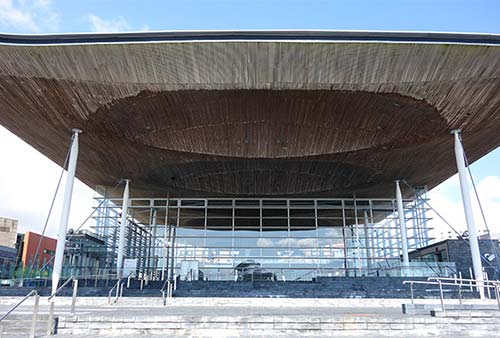
In front of the Senedd, notice the modern sculpture that resembles the hull of a ship—but notice that its prow has the ghostly features of a human head. This is the Merchant Marine Memorial, built to remember the sailors who died keeping Britain supplied during the WWII Battle of the Atlantic.
• Our tour is over. We’ve covered the main landmarks, but there’s much more to see and do around this bay: bikes and boats for rent, a hands-on science museum (Techniquest), fake yet thrilling whitewater rafting, an open-air exhibit of boats from around the world, a multiplex (with Wales’ only IMAX screen), and the nearby International Sports Village (with an ice arena and swimming pool; take bus #5 from the Millennium Centre). Enjoy!
Sleeping in Cardiff
CHAIN HOTELS IN THE CENTER
Cardiff’s city center—where you’ll be spending most of your sightseeing time—is full of big chain hotels at every price point. Midrange options include ££ Leonardo Hotel (1 Park Place), ££ Holiday Inn (Castle Street), ££ Premier Inn (near the Queen Street train station, 10 Churchill Way), £ Hotel Indigo (inside Dominions Arcade), and £ Travelodge (St. Mary Street and Queen Street locations). Generally, these are a good deal in a convenient location; when it’s busy (such as when there’s a big rugby match), prices skyrocket and the city center can feel rowdy. Either way, parking can be pricey.
AWAY FROM THE CENTER
The first three places are along the tree-lined and stately Cathedral Road. To reach them, walk one mile or take bus #25 to the Beverly Hotel stop, a short ride from downtown. The River House is above the River Taff.
££ Lincoln House Hotel offers 21 rooms, traditionally decorated and neatly maintained, and appealing public spaces—from a plush lounge to a convivial bar (limited free parking, 118 Cathedral Road, +44 29 2039 5558, lincolnhotel.co.uk, reservations@lincolnhotel.co.uk).
££ The Beverly Hotel sits above a laid-back pub with 17 stylish and modernly comfortable rooms in a traditional Victorian house (free parking, 75 Cathedral Road, +44 29 2034 3443, innkeeperscollection.co.uk).
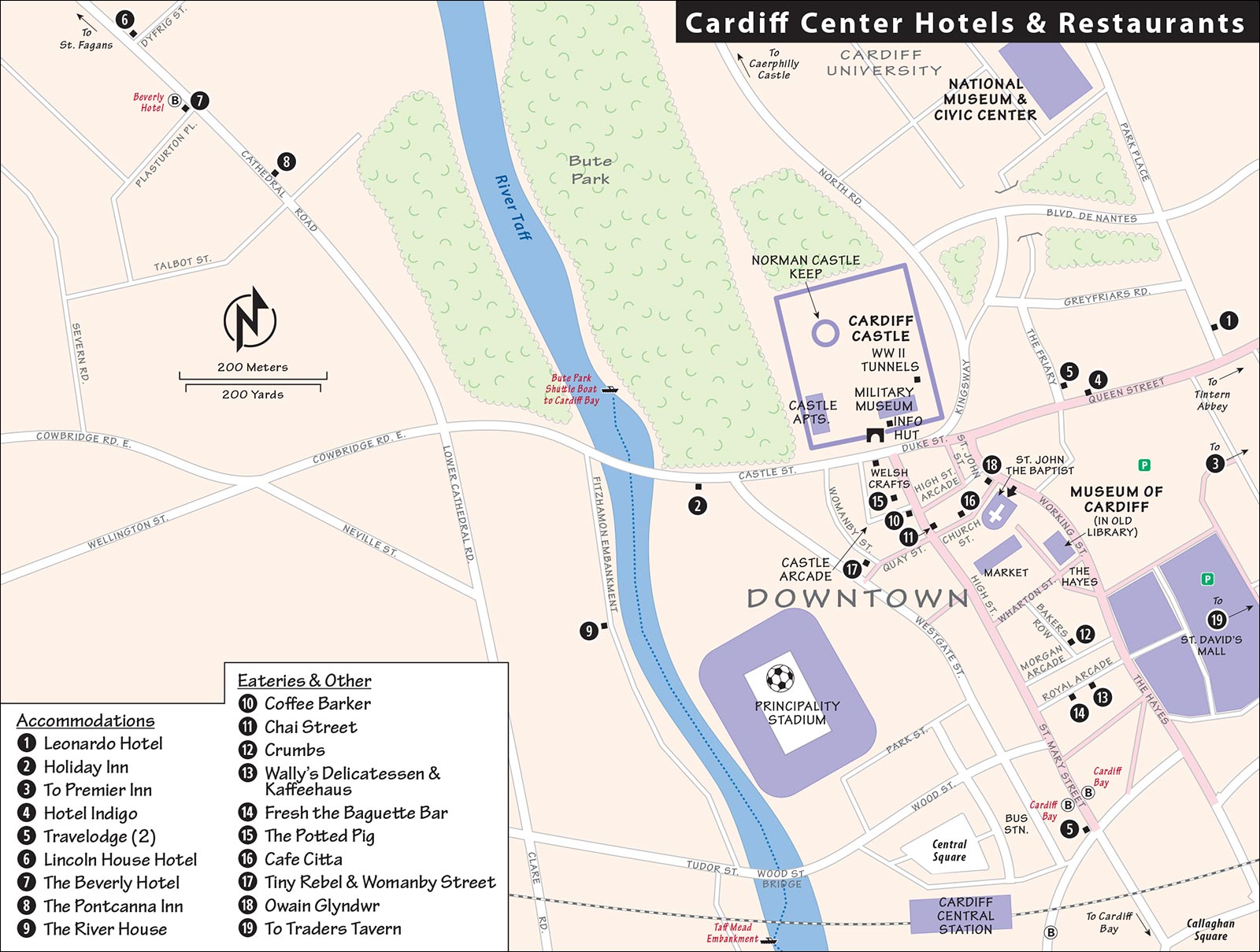
£ The Pontcanna Inn is an ethereal boutique hotel with botanical-inspired rooms that come in “cozy” or “comfy” (slightly larger) categories. Downstairs, the inviting pub is popular with locals and matches the serene decor with an enjoyable outdoor terrace (ask about parking, 36 Cathedral Road, +44 29 2023 2917, pontcannainn.com, pontcannainn@youngs.co.uk).
¢ The River House, in a quiet middle-class neighborhood of row houses, is a delightful hostel/backpackers’ hotel, conscientiously run by brother-and-sister team Charlie and Abi. Their 12 rooms include doubles, as well as four- and six-bed dorms (all with shared bath). They pride themselves on offering good value and a welcoming, mellow home base in Cardiff. There’s a shared kitchen, a small lounge, and a delightful back garden. No wonder they’ve been voted best hostel in Wales (breakfast extra, 59 Fitzhamon Embankment, +44 29 2010 5590, icardiff.co.uk/riverhouse, riverhouse@icardiff.co.uk).
Eating in Cardiff
My recommendations are all in the city center. Many are deep inside Cardiff’s delightful shopping arcades, and most are lunch-only. If looking for a meal on Cardiff Bay, simply peruse the restaurants at Mermaid Quay.
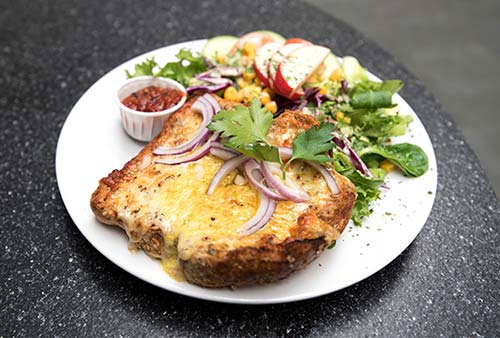
In Castle Arcade: ££ Coffee Barker is a sprawling yet cozy café, good for a beverage or a light breakfast or lunch either inside or out on the arcade (Mon-Fri 8:30-16:00, Sat until 17:30, Sun 10:00-16:30, coffeebarker.com).
On High Street: £ Chai Street serves Indian street food on silver thali platters and a budget-friendly £7.50 lunch (daily, 15 High Street, chaistreet.com).
In Morgan Arcade: £ Crumbs features an all-vegetarian menu, including a build-your-own salad, along with homemade soups, quiches, and savory pies (Mon-Sat 9:00-16:00, Sun from 10:00, 33 Morgan Arcade, +44 29 2115 6527, crumbskitchencardiff.co.uk).
In Royal Arcade: £ Wally’s Delicatessen & Kaffeehaus has a wide variety of gourmet picnic-basket fillers on the ground floor and a Viennese-style coffee house with hearty lunches upstairs (café open Mon-Sat 9:30-16:00, closed Sun; deli open daily, slightly longer hours, 38 Royal Arcade, +44 29 2022 9265, wallysdeli.co.uk). Two doors down, hungry locals queue patiently at the tiny but mighty £ Fresh the Baguette Bar for their turn to order from a myriad of specialty sandwiches (Mon-Fri 10:30-15:00, closed Sat-Sun, 32 Royal Arcade, +44 29 2022 3158).
Near the Castle: ££££ The Potted Pig is the place for a fancy meal downtown. It’s in a cellar with straightforward decor that doesn’t compete with the menu: locally sourced, seasonal, and artfully composed modern Welsh dishes with French influences. Reservations are smart at dinnertime. While it’s pricey to order à la carte, their lunch special—just £25 for two courses—is affordable (Tue dinner only, Sun lunch only, closed Mon, hours vary—check ahead, directly in front of Cardiff Castle at 27 High Street, +44 29 2022 4817, thepottedpig.com).
££ Cafe Citta, in the pedestrian zone in front of the castle, is a local favorite for Italian food. In this tight and cozy place (call ahead to reserve), the first language spoken is Italian—and the food is authentically delicious (closed Sun-Mon, 4 Church Street, +44 29 2022 4040).
Local Brews: In a town of interchangeable brew- and gastropubs, these three stand out.
££ Tiny Rebel fills a striking, classic red-brick building near the stadium. With a youthful but mellow ambience and a basic menu of burgers and bar food, this is a good place to sample flights of Welsh brews. It’s an outpost of a brewery in nearby Newport (daily, food served Sun until 18:00, 25 Westgate Street). Tiny Rebel also marks the start of Womanby Street, a lively after-hours zone where bars and clubs fill formerly abandoned industrial buildings.
££ Owain Glyndwr might seem relatively subdued, but don’t be fooled—it’s the official rugby pub of Cardiff and overflows with rowdy fans on game nights. Near St. John the Baptist church, it covers all things athletic on its 35 televisions and features local Welsh brews and daily meal deals (long hours, 10 St. John Street).
For a truly local experience, head beyond St. David’s Mall to £ Traders Tavern, a cozy, family-run pub with inexpensive, basic meals and standard snacks. As one patron described it, you’ll come for the drinks but stay for the good time (food served Mon-Sat 10:00-15:00, closed Sun, 6 David Street, +44 29 2023 8795).
Cardiff Connections
From Cardiff by Train to: Caerphilly (2-4/hour, 20 minutes), Bath (hourly, 1-1.5 hours), Birmingham (1/hour direct, more with change in Bristol, 2 hours), London’s Paddington Station (2/hour, 2 hours), Chepstow (2/hour, 35 minutes; then bus #69 to Tintern—runs every 1-2 hours, 20 minutes). Train info: +44 871 200 2233, traveline.cymru.
By Car: For driving directions from Bath to Cardiff, see “Route Tips for Drivers,” at the end of this chapter.
Near Cardiff
▲▲St. Fagans National Museum of History
The best look anywhere at traditional Welsh folk life, St. Fagans is a 100-acre open-air museum with more than 40 carefully reconstructed and fully furnished historic buildings from all corners of Wales, as well as a “castle” (actually a Tudor-era manor house) that offers a glimpse of how the other half lived. Also known as Amgueddfa Werin Cymru (Museum of Welsh Life), its workshops feature busy craftspeople eager to demonstrate their skills. Each house comes equipped with a local expert warming up beside a toasty fire, happy to tell you anything you want to know about life in this old cottage. Ask questions.
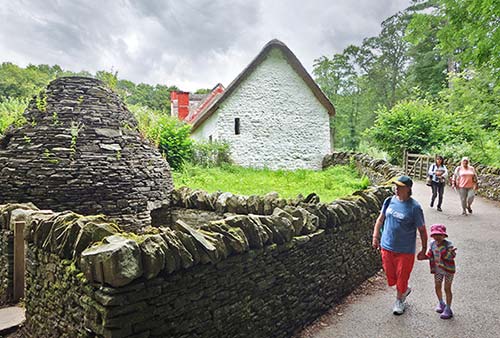
Cost and Hours: Free, daily 10:00-17:00, pay parking, +44 30 0111 2333, museum.wales/stfagans.
Information: Pick up the essential map (small fee). Plaques by each building do an exceptional job of succinctly explaining where the building came from, its role in Welsh culture, and how it came to be here, all illustrated by a helpful timeline.
Getting There: From Cardiff’s bus station, catch bus #32A, which stops right at the museum entrance; bus #320 takes you to St. Fagans village, a five-minute walk to the museum (buses run about 2/hour, last bus departs St. Fagans at 17:15, 25 minutes, traveline.cymru). Drivers leave the M-4 at Junction 33 and follow the brown signs to Museum of Welsh Life. Leaving the museum, jog left on the freeway, take the first exit, and circle back, following signs to the M-4.
Eating at St. Fagans: There’s a handy cafeteria inside the visitors center. Within the park are plenty of snack stands, as well as The Buttery inside the castle. Derwen Bakehouse sells snacks and traditional fruit-studded bread, which is tasty and warm out of the oven. Back in the real world, The Plymouth Arms pub, just outside the museum, serves the best food.
Visiting the Museum: Buy the map and pick up the list of today’s activities. Once in the park, you’ll find most of the traditional buildings to your left, while to the right are the castle and its surrounding gardens. Here’s a rough framework for seeing the highlights:
First, head left and do a clockwise spin around the traditional buildings, starting with the circa-1800, red-and-white Kennixton Farmhouse. Then swing left, go down past the mill, and hook left again down the path to the fine Lywyn-yr-eos Farmhouse. Along with the castle, this is the only building at the museum that stands in its original location. It’s furnished as it would have been at the end of World War I—complete with “welcome home” banner and patriotic portraits of stiff-upper-lip injured troops. From here you can side-trip five minutes to two Celtic round houses, which were farmhouses back in the Iron Age.
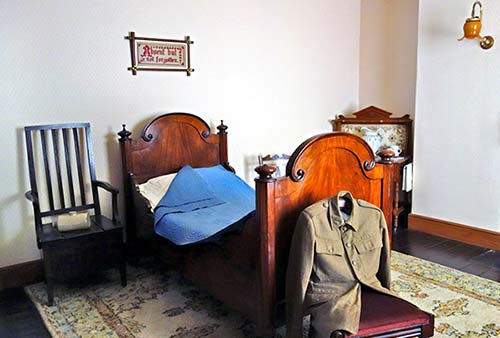
Head back up the main path and continue deeper into the park, turning left at the fork (toward Church and Y Garieg Fawr). Passing another farmhouse, then a small mill (used for grinding gorse—similar to scotch broom—into animal feed) and a Tudor-era trader’s house, continue through the woods to St. Teilos’ Church, surrounded by a whitewashed stone fence. The interior has been restored to the way it looked around 1520—including vibrantly colorful illustrations of Bible stories on all the walls.
Leaving the church, turn left and continue ahead to the Oakdale Workmen’s Institute—basically a leisure club and community center for hardworking miners and their families. Poking around the building—from the library, reading room, and meeting hall downstairs to the concert hall upstairs—you can imagine how a space like this provided a humble community with a much-needed social space.
Next up, just past the tall red box (a telephone booth from the 20th century, where people would make “telephonic” calls) are the Gwalia Stores, village general stores where you could buy just about anything imaginable (poke around to see what locals may have shopped for). One still sells canned goods, local cheeses, sweets, and ice cream.
Pass the olde-tyme portrait studio on your way up to the museum’s highlight, the Rhyd-y-Car terrace of row houses, which displays ironworker cottages as they might have looked in 1805, 1855, 1895, 1925, 1955, and 1985—offering a fascinating zip through Welsh domestic life from hearths to microwaves. Notice the pea patches in front, the outhouse, and the chicken coops in the back.
Just past the row houses is a large grassy expanse (with a penny arcade and period rides on the far side). Take a sharp right onto the lane parallel with the row houses and step into the one-room St. Mary’s Board Schoolhouse, where the docent can explain the various items used to punish ill-behaved kids in the late 19th century. What looks like a wooden version of brass knuckles was used to force lefties to write right. The “Welsh not” was worn as a badge of shame by any student heard speaking Welsh rather than the required English. Students could pass it on to other kids they heard speaking Welsh, and whoever was wearing it at day’s end was caned (spanked with a stick).
After exiting the schoolhouse, pass the saddler’s workshop and take a hard right at the tollhouse to reach Derwen Bakehouse. This is a fine place to break for coffee and cake—they sell bara brith (speckled bread), a kind of fruit bread, hot out of the oven. Sitting on the picnic benches, you can enjoy all the family fun around you. Listen for parents talking to their kids in Welsh.
Head back past the entrance area and continue to the castle and gardens. You’ll dip down past a series of terraced ponds, then climb steeply up to the misnamed “castle”—so-called because it was built on the remains of a real, Norman-era castle that once stood here. This circa-1580 Elizabethan manor house boasts a stately interior decorated with antique period furnishing. It feels like the perfect setting for a murder mystery or a ghost tale. Entering, you’ll walk through The Hall (a reception room for visitors), The Study (where the master of the house carried out his business), and The Drawing Room (where the ladies would convene for a post-dinner chat, à la Downton Abbey). Climb the funhouse stairs up to the long gallery, where you can dip into a series of bedrooms.
Leaving the castle, if it’s nice out, turn left and explore the expansive manicured gardens that stretch out across the grounds. Near the far end is a woolen mill, and back in the visitors center three galleries exhibit more historical artifacts.
▲▲Caerphilly Castle
This impressive but gutted old castle—evocative but with no actual artifacts—is surrounded by lakes, gently rolling hills, and the town of Caerphilly. It’s the most visit-worthy castle in South Wales, with a recently reconstructed Great Hall evoking its medieval heyday (with not-so-medieval digital displays). But if you’re heading to the great castles of North Wales (such as Conwy and Caernarfon) a visit here is redundant.
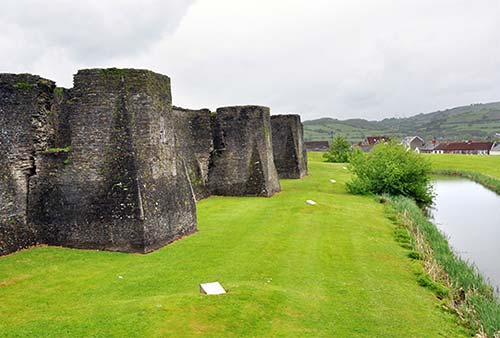
Cost and Hours: £11.90; daily 9:30-17:00, July-Aug until 18:00; Nov-Feb 10:00-16:00; +44 300 025 2239, cadw.gov.wales [URL inactive].
Information: Across the moat in the parking lot, Caerphilly’s helpful town TI happily answers questions and sells locally sourced, nontacky Welsh souvenirs (daily 10:00-17:00, +44 29 2088 0011, visitcaerphilly.com).
Getting There: The castle is located right in the center of the town of Caerphilly, nine miles north of Cardiff. By train it’s a 20-minute trip (4/hour Mon-Sat, hourly Sun) followed by a 5-minute walk. It’s 20 minutes by car from St. Fagans (exit 32, following signs from the M-4). Once in town, follow signs to park in the pay lot right next to the TI, facing the castle.
Background: Spread over 30 acres, Caerphilly is the second-largest castle in Britain after Windsor. English earl Gilbert de Clare erected this squat behemoth to try to establish a stronghold in Wales. With two concentric walls, it was considered a brilliant arrangement of defensive walls and moats. Attackers had to negotiate three drawbridges and four sets of doors and portcullises just to reach the main entrance. For the record, there were no known successful enemy forays beyond the current castle’s inner walls. Later, this castle understandably became a favorite of Romantics, who often painted it in the shimmering Welsh mist. And in modern times, during the Great Depression of the 1930s, the castle’s owner undertook a restoration of the then mostly ruined structure (as a sort of private stimulus package), restoring it at least partway to its previous glory. Today it’s surrounded by a picturesque, picnic-perfect park.
Visiting the Castle: Cross the first moat and enter the outer gate to buy your ticket. Then head across the second moat to reach the central keep of the castle.
You’ll enter through the Inner East Gatehouse, with models of the castle and stone missiles on the ground floor, and unfurnished but still stately residential halls upstairs. The top-floor terrace offers great views between the crenellations of the castle complex and the town. On the way up and down, look for the little bathrooms. No need to flush—the chute beneath the hole drops several stories directly into the moat below. (Just one more disincentive for would-be attackers thinking of crossing that moat.)
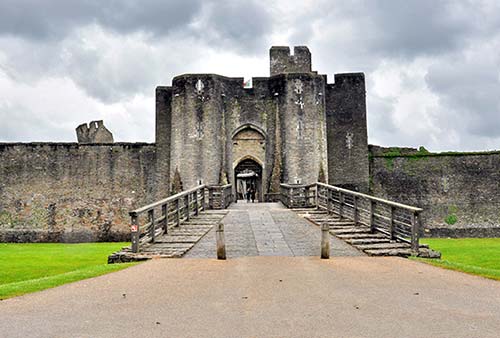
From there, head into the Inner Ward—the central yard (or “bailey”) that’s ringed by thick walls and stout towers. To the left as you enter the Inner Ward is the restored, cavernous Great Hall, with thick stony walls, a wood-beam ceiling, and a man-sized fireplace. This space helps you imagine a great medieval feast. (If you’d like to do more than imagine, you can rent out the hall for a banquet of your own.)
Hiding behind the Great Hall is the icon of the castle—a half-destroyed listing tower (which, they like to brag, “out-leans Pisa’s”). Following the English Civil War, the Parliament decreed that many castles like this one be destroyed as a preventive measure; this tower was a victim. Some believe that the adjacent Braose Gallery has a resident ghost: Legend has it that de Clare, after learning of his wife Alice’s infidelity, exiled her back to France and had her lover killed. Upon discovering her paramour’s fate, Alice died of a broken heart. Since then, the “Green Lady,” named for her husband’s jealousy, has reportedly roamed the ramparts.
Before leaving, be sure to visit the strip of yard that stretches out in front of the ticket office (along the inner moat). The first tower has a replica (complete with sound effects) of the latrines that were used by the soldiers—again, these dumped right into the moat. Just beyond that tower is a collection of life-size replica siege engines—ingenious catapult-like devices and oversized crossbows designed to deter attackers (each one is well described).
Blaenavon
To learn just how important the coal industry was to the economic development of South Wales, venture 30 miles north of Cardiff to a former coal mine and ironworks in Blaenavon.
Big Pit National Coal Museum
Now part of the National Museum of Wales, the Blaenavon coal mine, known as “Big Pit,” operated from 1860 to 1980. You can wander the grounds to see machinery and visit old buildings and exhibits. The highlight is the hour-long miner-guided tour 300 feet underground (hard hats and headlamps provided).
Cost and Hours: Entry and tour are free, £8 for underground tours (best to reserve a timed-entry ticket online; £5 for day-of tickets, which are limited in number and may require a long wait); Feb-Nov open daily 9:30-17:00, underground tours run 10:00-15:30, shorter hours off-season, last entry one hour before closing; pay parking, coffee shop, in Blaenavon on the A-4043, +44 300 111 2333, museum.wales/bigpit.
Blaenavon Ironworks
Thanks to surrounding mineral-rich hillsides, the Blaenavon Ironworks solidified Wales as a prominent steel producer during the Industrial Revolution—and, because coal was needed to produce steel, is the reason “Big Pit” came into existence. Construction of the ironworks began in 1788, with cottages (to attract quality workers and their families), a company store, and three furnaces—a first in the industry. By the late 1870s, the town had grown to 5,000 inhabitants.
Today, the site is a museum where visitors can imagine steam engines blasting hot air through enormous overhead pipes into what are possibly the best-preserved furnaces of the time, wander through the decades of housing—the last tenants moved out in the 1970s—and climb the hill to see the impressive tower lift and views over “Big Pit” in the distance.
Cost and Hours: £7.70; daily 10:00-17:00, Nov-March Fri-Sun 10:00-16:00, closed Mon-Thu; +44 300 025 2239, cadw.gov.wales [URL inactive].
The Wye Valley
From Chepstow, on the mouth of the River Severn, the River Wye cuts north, marking the border between Wales (Monmouthshire, on the west bank) and England (Gloucestershire, on the east bank). While everything covered here is in Wales, it’s all within sight of England—just over the river.
This land is lush, mellow, and historic. Local tourist brochures explain the area’s special dialect, its strange political autonomy, and its oaken ties to Trafalgar and Admiral Nelson (who harvested timbers for his ships in the Forest of Dean). The valley is home to the legendary Tintern Abbey, the ruined skeleton of a glorious church that’s well worth a quick stop. The abbey sits partway between two pleasant, workaday towns with interesting sights of their own: Chepstow (with a fine castle) and Monmouth (a market town with some quirky sights). (Note that just to the east of the river, in England, is the heavily promoted but disappointing and skippable Forest of Dean, a 43-square-mile patch of “ancient woodland”—what Americans call “old-growth forest.”)
If you’ve always dreamed of visiting Tintern Abbey—and wouldn’t mind a quick taste of a stout castle and a couple of charming Welsh towns—the riverside A-466 traces the Wye and makes a detour between Bath and the Cotswolds that’s worth considering (adding about an hour of driving compared with the less scenic, more direct route). I’ve listed these sights in the order you’ll reach them as you move north up the Wye.
Chepstow
This historic burg enjoys a strategic location, for the same reason it may be your first stop in Wales: It marks the natural boundary between England and Wales. Driving into town, you’ll pass through the town gate where, in medieval times, folks arriving to sell goods or livestock were hit up for tolls.
Park in the pay lot just below the castle, which is also convenient to the TI, museum, and free WCs. Everything worth seeing is within a short walk. To explore more of the town, buy the Chepstow Town Trail guide at the TI (Mon-Sat 10:30-12:30 & 13:30-16:30, Nov-March until 15:00, Bridge Street, +44 1291 623 772, visitmonmouthshire.com) or the Chepstow Museum, or download it for free from visitdeanwye.co.uk. St. Mary’s Street is lined with appealing little lunch spots (try the LT16 café, lt16.co.uk).
Chepstow Castle
Perched on a riverside ridge overlooking the pleasant village of Chepstow on one side and the River Wye on the other, this castle is worth a short stop for drivers heading for Tintern Abbey, or it’s a 10-minute walk from the Chepstow train station (follow signs; uphill going back).
Cost and Hours: £10; daily 9:30-17:00, July-Aug until 18:00; Nov-Feb 10:00-16:00; guidebook-£5, in Chepstow village a half-mile from train station, +44 300 025 2239, cadw.gov.wales [URL inactive].
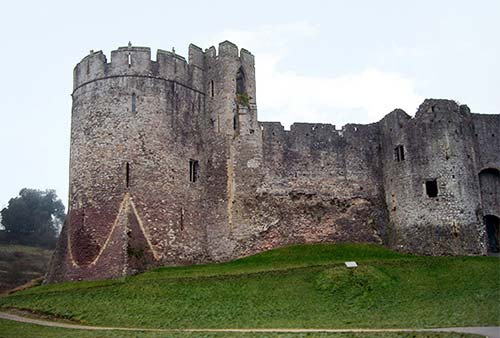
Visiting the Castle: The stone-built Great Tower, dating from 1066, was among the first castles the Normans plunked down to secure their turf in Wales, and it remained in use through 1690. While many castles of the time were built first in wood, Chepstow, then a key foothold on the England-Wales border, was built from stone from the start for durability.
You’ll work your way up through various towers and baileys (inner yards) and past a wall displaying a set of the castle’s doors from 1180 (said to be the oldest in Europe); a few posted plaques provide details, but you’re mostly on your own. As you clamber along the battlements (with great views to town and over the river to England), you’ll find architectural evidence of military renovations through the centuries, from Norman to Tudor right up through Cromwellian additions. You can tell which parts date from Norman days—they’re the ones built from yellow sandstone instead of the grayish limestone that makes up the rest of the castle. While the castle would benefit from more exhibits (it’s basically an empty shell), with a little imagination you can resurrect the skeletons of buildings and appreciate how formidable and strategic it must have been in its heyday.
▲Chepstow Museum
Highlighting Chepstow’s history, this museum is in an 18th-century townhouse across the street from the TI. Endearingly earnest, jammed with artifacts, and well presented, it says just about everything that could possibly be said about this small town. Upstairs, the 1940 machine for giving women permanents will be etched in your memory forever.
Cost and Hours: Free; Tue and Thu-Sun 11:00-16:00, closed Mon and Wed year-round and mid-Dec-mid-Feb, +44 1291 625 981, monlife.co.uk.
Riverfront Park
From the TI and parking lot, walk one block down Bridge Street to the River Wye. A graceful, white cast-iron bridge spans the river. If you walk across it to the ornate decorations in the middle (at the Gloucester/Monmouth sign), you can stand with one foot in Wales and the other in England (notice the Gloucestershire sign across the bridge). From the bridge, you’ll also have great views back to the castle. Beneath your feet, the River Wye’s banks and water are muddy because this is a tidal river, which can rise and fall about 20 feet twice a day.
Back in Wales, stroll 100 yards along the riverside park (with the river on your left), noticing that the English bank sits on a chalk cliff—into which has been painted a Union Jack (to celebrate King George V’s Silver Jubilee in 1935). Near the standing stones is a large circular plaque marking the beginning of the Welsh Coast Path; from here, you can walk 870 miles all the way along the coast of Wales. Nearby is the 176-mile Offa’s Dyke Path, which roughly traces the border between Wales and England. Together, these two paths go almost all the way around the country.
▲▲Tintern Abbey
Inspiring monks to prayer, William Wordsworth to poetry, J. M. W. Turner to a famous painting, and rushed tourists to a thoughtful moment, this verse-worthy ruined-castle-of-an-abbey merits a five-mile detour off the motorway. Founded in 1131 on a site chosen by Norman monks for its tranquility, it functioned as an austere Cistercian abbey until its dissolution in 1536. The monks followed a strict schedule. They rose several hours after midnight for the first of eight daily prayer sessions and spent the rest of their time studying, working the surrounding farmlands, and meditating. Dissolved under Henry VIII’s Act of Suppression in 1536, the magnificent church moldered in relative obscurity until tourists in the Romantic era (late 18th century) discovered the wooded Wye Valley and abbey ruins. J. M. W. Turner made his first sketches in 1792, and William Wordsworth penned “Lines Composed a Few Miles Above Tintern Abbey...” in 1798.
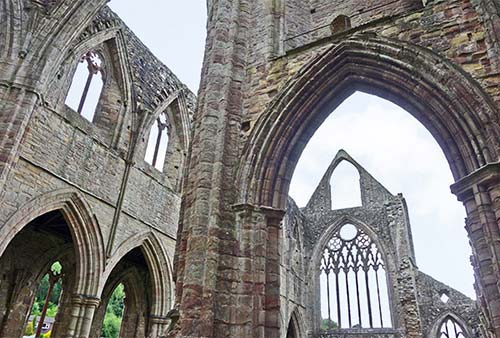
With all the evocative ruined abbeys dotting the British landscape, why all the fuss about this one? Because few are as big, as remarkably intact, and as picturesquely situated. Most of the external walls of the 250-foot-long, 150-foot-wide church still stand, along with the exquisite window tracery and outlines of the sacristy, chapter house, and dining hall. Informational plaques identify and explain various parts of the complex. The daylight that floods through the roofless ruins highlights the Gothic decorated arches—in those days a bold departure from Cistercian simplicity. Stroll the cavernous interior and let your imagination roam, like the generations of Romantics before you.
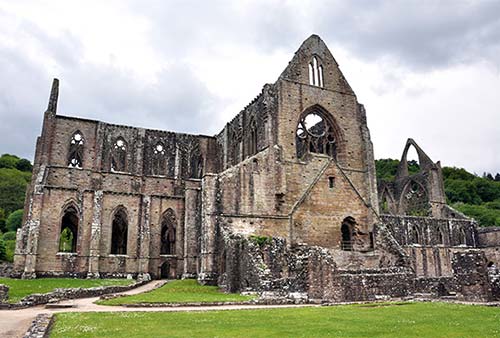
In summer, the abbey is flooded with tourists, so visit early or late to miss the biggest crowds. The shop sells Celtic jewelry and other gifts. Take an easy 15-minute walk up to St. Mary’s Church (on the hill above town) for a view of the abbey, River Wye, and England just beyond.
Cost and Hours: £9; daily 9:30-17:00, July-Aug until 18:00, Nov-Feb 10:00-16:00 (access may be limited due to restoration work); occasional summertime concerts in the cloisters (check website for schedule or ask at the TI), +44 300 025 2239, cadw.gov.wales [URL inactive].
Getting There: Drivers park in the pay lot right next to the abbey; the parking cost is refunded with admission. By public transportation from Cardiff, catch a 35-minute train to Chepstow; from there, take bus #69 (every 1-2 hours, 20 minutes) or a taxi (about £10 one-way) the final six miles to the abbey.
Near Tintern Abbey: The villages of Tintern and Tintern Parva cluster in wide spots along the main riverside road, just north of the abbey. A couple of miles north, just beyond the last of the inns, you’ll find the Old Station—a converted train station with old rail cars that house a regional TI, a gift shop, and an exhibit on the local railway (Tue-Sun 10:00-16:00, closed Mon and Nov-March, pay parking lot, +44 1291 689 566, visitmonmouthshire.com). Surrounding the train cars are a fine riverside park, a café, and a few low-key, kid-friendly attractions.
Monmouth
Another bustling market town—bookending the valley of the River Wye with Chepstow—Monmouth has a pleasant square, a few offbeat museums, and an impressive roster of past residents. The main square is called Agincourt Square, after the famous battle won by a king who was born right here: Henry V (you’ll see a statue of him in the niche on the big building). The stately building on that square, which houses the TI, is Shire Hall, the historic home of the courts and town council, which is undergoing renovations. This was the site of a famous 1840 trial of John Frost, a leader of the Chartist movement (championing the rights of the working class in Victorian Britain).
Standing in front of Shire Hall is a statue of Charles Rolls (1877-1910), contemplating a model airplane. This descendant of a noble Monmouth family was a pioneer of ballooning and aviation, and—together with his business partner, Frederick Royce—revolutionized motoring with the creation of their company, Rolls-Royce. The airplane he’s holding, which he purchased from the Wright Brothers, helped him become the first person to fly over the English Channel and back, in 1910. (Just over a month later, he also became the first British person to die in a plane crash, when that same Wright Flyer lost its tail midflight.)
When it’s open, Shire Hall also hosts the endearing Nelson Museum (aka Monmouth Museum). Admiral Horatio Nelson, who was considered in Victorian times (and still today, by many) to be the savior of England for his naval victories in the Napoleonic Wars, was a frequent visitor to Monmouth. This remarkable collection of Nelson-worship began as the personal collection of local noblewoman Lady Georgiana Llangattock, who was also the mother of Charles Rolls. You’ll see several of Nelson’s personal effects, a replica of his uniform, the actual sword he wore in the Battle of Trafalgar (as well as the two swords surrendered by the French and Spanish commanders), and some 800 letters by or to him (pull out the drawers to see them). There are also a few small exhibits about other aspects of town history, including the Rolls family (monmouthshire.gov.uk, check for updates on the renovations.)
Across the street from Shire Hall, angle right and turn up Castle Hill lane to the Regimental Museum and the scant ruins of Monmouth Castle, where Henry V was born in 1386. While there’s not much to see, the site may wring out a few goose bumps for historians.
A few blocks downhill in the opposite direction (down Monnow Street from Agincourt Square) is the picturesque, 13th-century Monnow Bridge, with its graceful arches and stout defensive tower in the middle.
Sleeping in the Wye Valley
If you’re seduced into spending the night in this charming area, you’ll find plenty of B&Bs near Tintern Abbey or in the castle-crowned town of Chepstow, located just down the road (a one-hour drive from Bath). These places are near the abbey.
££ Parva Farmhouse has seven old-fashioned rooms in a 400-year-old building right along the main road through Tintern. While a bit dated, it comes with Welsh charm and is within walking distance of the abbey, village, and local pubs (+44 1291 689 411, parvafarmhouse.co.uk, contact@parva.wales, Roger and Marta).
¢ St. Briavels Castle Youth Hostel is housed in an 800-year-old Norman castle used by King John in 1215 (the year he signed the Magna Carta). The hostel is comfortable (as castles go), friendly, and in the center of the quiet village of St. Briavels just north of Tintern Abbey (private rooms possible, modern kitchen and medieval banquet hall, +44 345 371 9042, yha.org.uk, stbriavels@yha.org.uk). The village of St. Briavels sits in a forest high above the river. From Tintern, head north on the A-466, watch for the St. Briavels turnoff on the right, and switchback up the steep road into town.
South Wales Connections
ROUTE TIPS FOR DRIVERS
Bath to Cardiff and St. Fagans: Leave Bath following signs for the A-4, then the M-4. It’s 10 miles north (on the A-46 past a village called Pennsylvania) to the M-4 freeway. Zip westward, crossing a huge suspension bridge over the Severn, into Wales. Stay on the M-4 (not the M-48) past Cardiff, take exit 33, and follow the brown signs south to St. Fagans National Museum of History/Amgueddfa Werin Cymru/Museum of Welsh Life.
Bath to Tintern Abbey: Follow the directions above to the M-4. Take the M-4 to exit 21 and get on the M-48. After crossing the northern bridge into Wales, take exit 2 for the A-466 for six miles (follow signs to Chepstow, then Tintern). You’ll see the abbey on your right.
Cardiff to the Cotswolds via Forest of Dean: On the Welsh side of the big suspension bridge, take the Chepstow exit and follow signs up the A-466 to Tintern Abbey and the Wye River Valley. Continue on to Monmouth and follow the A-40 and the M-50 to the Tewkesbury exit, where small roads lead to the Cotswolds.