STRATFORD-UPON-AVON
To see or not to see? Stratford, Shakespeare’s hometown, is a must for every big-bus tour in England, and one of the most popular side trips from London. English majors and actors are in seventh heaven here. Sure, it’s touristy, and nonliterary types might find it’s much ado about nothing. But nobody back home would understand if you skipped Shakespeare’s house.

Shakespeare connection aside, the town’s riverside and half-timbered charm, coupled with its hardworking tourist industry, make Stratford a fun stop. But the play’s the thing to bring the Bard to life—and here you can see the Royal Shakespeare Company (the world’s best Shakespeare ensemble) performing in a state-of-the-art theater complex.
PLANNING YOUR TIME
If you’re just passing through Stratford, it’s worth a half-day—stroll the charming core, visit your choice of Shakespeare sights (Shakespeare’s Birthplace is best), and watch the swans along the river. But if you can squeeze it in, it’s worth it to stick around to see a play. To do so, you’ll need to spend the night here or drive in from the Cotswolds (just 30 minutes away; see previous chapter).
By Train or Bus: It’s easy to stop in Stratford for a wander or an overnight. Stratford is well connected by train to London and Oxford and linked by bus and train to nearby towns (Warwick and Coventry to the north, and Moreton in the Cotswolds to the south).
By Car: Stratford, conveniently located at the northern edge of the Cotswolds, is made to order for drivers connecting the Cotswolds with points north (such as Ironbridge Gorge or North Wales).
Orientation to Stratford
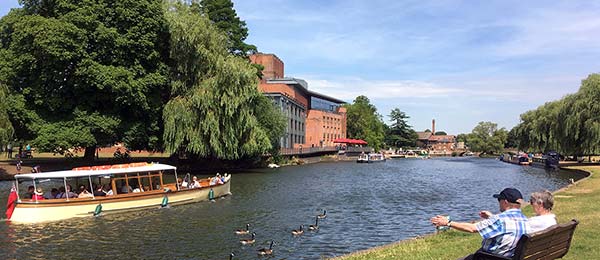
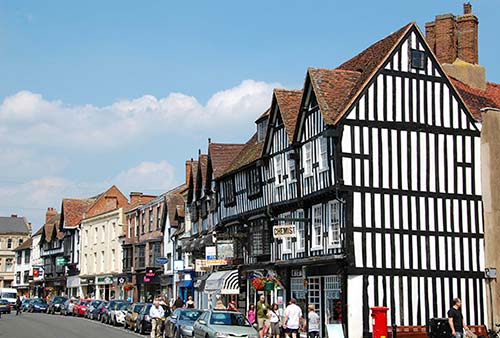
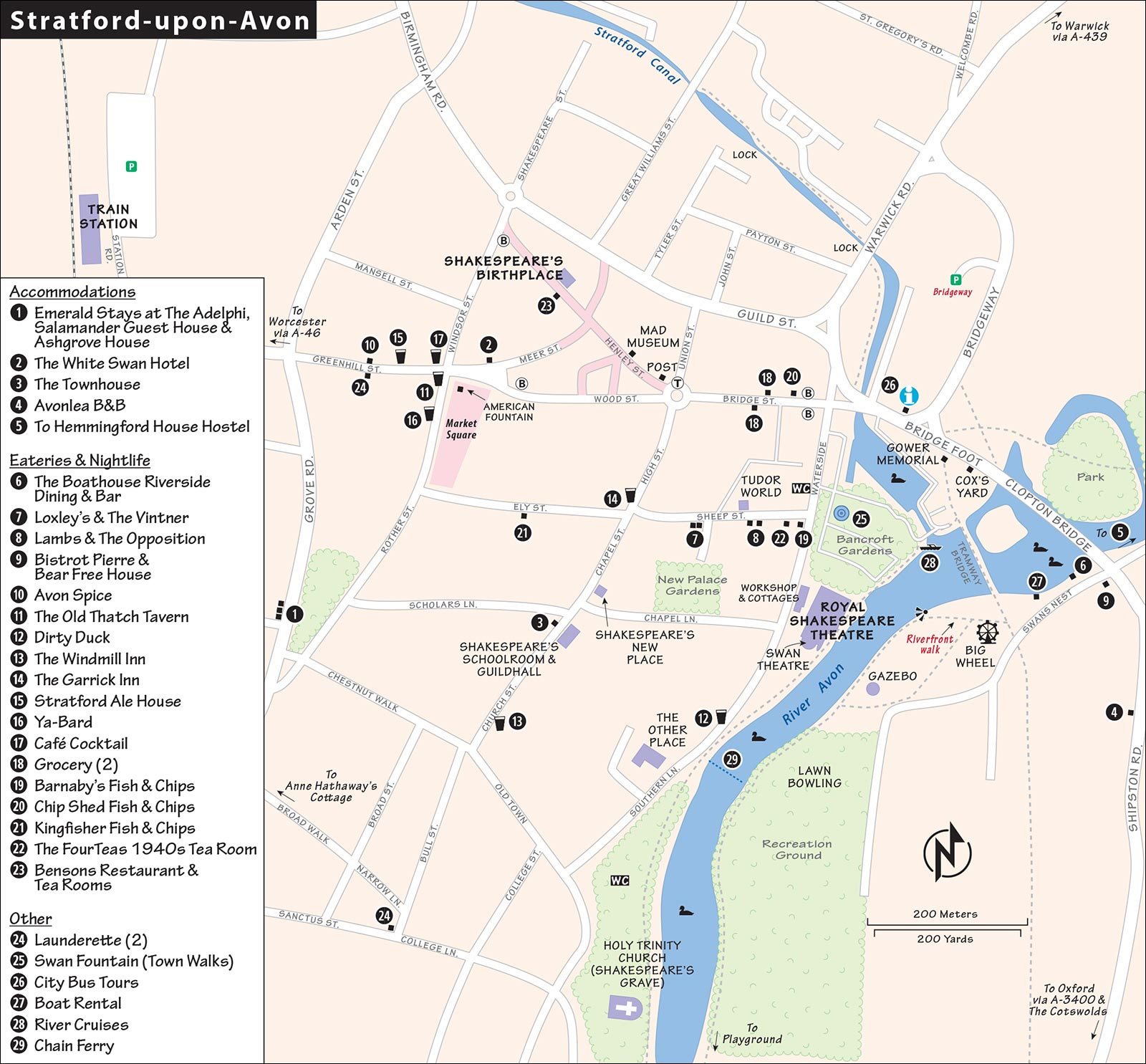
Stratford, with around 30,000 people, has a compact old town, with the TI and theater along the riverbank, and Shakespeare’s Birthplace a few blocks inland; you can easily walk to everything except Anne Hathaway’s Cottage. The core of the town is lined with half-timbered houses. The River Avon has an idyllic yet playful feel, with a park along both banks, rowboats, swans, and a fun old crank-powered ferry.
TOURIST INFORMATION
The TI is in a small brick building on Bridge Foot, where the main street hits the river (Mon-Sat 9:00-17:00, Sun 10:00-16:00, closes daily for lunch 12:30-13:30, +44 1789 264 293, vic@stratford-dc.gov.uk).
ARRIVAL IN STRATFORD
By Train: Don’t get off at the Stratford Parkway train station—you want Stratford-upon-Avon. Once you arrive at the train station, exit onto the plaza, bear right up the stairs, then turn left and follow the main drag straight to the river. (For the Grove Road B&Bs, turn right at the first big intersection.)
By Car: If you’re sleeping in Stratford, ask your B&B for arrival and parking details (many have a few free parking spaces, but it’s best to reserve one). If you’re just here for the day, you’ll find plenty of lots scattered around town. The Bridgeway garage is big, easy, reasonably priced, and central—coming from the south (i.e., the Cotswolds), cross the big bridge and veer right, following Through Traffic, P, and Wark (Warwick Road) signs. Go around the block—turning right and right and right—and enter the multistory garage, also on your right. The City Sightseeing bus stop and the TI are a block away. Find inexpensive parking at the park-and-ride near the Stratford Parkway train station, just off the A-46—from here you can ride a shuttle bus into town (£2.50 round-trip, 4/hour until 18:30, drops off at Wood Street NatWest Bank and Windsor Street near Shakespeare’s Birthplace).
HELPFUL HINTS
- Combo-Tickets: Shakespeare sights are covered by various combo-tickets (for details, see “Shakespearean Sights,” later). City Sightseeing offers a range of combo-tickets that will save a little money if you combine a hop-on, hop-off bus tour with a boat cruise or rental, Shakespeare houses, or the whole shebang.
- Discounts: A ticket stub from a Stratford town walk (see “Tours in Stratford,” below) gets you a discount at many sights, shops, and restaurants. B&Bs occasionally have discount vouchers as well.
- Name That Stratford: If you’re coming by train or bus, be sure to request a ticket for “Stratford-upon-Avon,” not just “Stratford” (to avoid a mix-up with Stratford Langthorne, near London).
- Market Days: A local crafts and food market runs at Waterside (near the theater complex) on Sundays from 10:00 to 17:00 (sometimes on Bridge Street in winter), and on Rother Street on Fridays from 9:00 to 16:00 and Saturdays until 17:00.
- Festival: Every year, on the weekend nearest to Shakespeare’s birthday (traditionally considered to be April 23—also the day he died), Stratford celebrates. The town hosts free events, including activities for children.
- Baggage Storage: The Tudor World museum (see listing under “Other Stratford Sights,” later) can store your luggage (£1/bag, free with museum visit, daily 10:30-17:30, 40 Sheep Street, +44 1789 298 070).
- Laundry: Find Laundry Quarter on the road between the train station and the river (daily self-service 8:00-20:00, bring coins, soap available, drop-off only Mon and Thu 9:00-12:00 for pickup the same day, 34 Greenhill Street, +44 1789 417 766). The other option is Sparklean, a 10-minute walk from the city center or about five minutes from the Grove Road B&Bs (daily 8:00-20:00, full-service option sometimes available—call, 74 Bull Street, +44 1789 269 075).
- Taxis: Try 007 Taxis (+44 1789 414 007) or the taxi stand on Bridge Street, near the intersection with High Street. To arrange for a private car and driver, contact Platinum Cars (£290/half-day tour, also does airport transfers from Heathrow and Birmingham, +44 1789 264 626, platinum-cars.co.uk).
Tours in Stratford
Stratford Town Walks
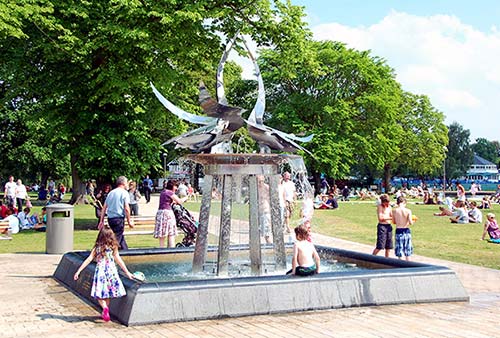
These entertaining, award-winning two-hour walks introduce you to the town’s main sights and the story of its famous playwright. Tours run daily year-round, rain or shine, and leave from the Swan fountain (on the waterfront) in front of the Royal Shakespeare Theatre (£12, reservations required; ticket stub offers discounts to some sights, shops, and restaurants; daily at 11:00, Sat also at 14:00; +44 7855 760 377, stratfordtownwalk.co.uk). They also run an evening ghost walk (£12, Sat at 19:30, 1.5 hours, must book in advance).
Tudor World
This museum offers 1.5-hour Shakespeare tours and one-hour ghost tours; see the listing under “Other Stratford Sights.”
City Sightseeing Bus Tours
Open-top buses let you hop on and hop off at stops within the compact town, and head out to Anne Hathaway’s Cottage. The full circuit takes about an hour and comes with entertaining and informative commentary (£17, ticket valid 24 hours, buy on bus, online, or at TI; buses leave from the TI every 30 minutes, 9:30-17:00, no buses Nov-March, some weekend buses have live guides; citysightseeing-stratford.com).
Shakespearean Sights
The best Shakespeare-related thing you can do in Stratford is see a play at the Royal Shakespeare Theatre. Beyond the theater, Stratford’s biggest Shakespeare sights are run by the Shakespeare Birthplace Trust (shakespeare.org.uk). While these sights are designed more to please the crowd than to tickle academics, they’re well run and genuinely interesting. Shakespeare’s Birthplace and Shakespeare’s New Place are in town; Anne Hathaway’s Cottage is just outside Stratford. Each has a tranquil garden and helpful, eager docents who love to tell a story; and yet, each is quite different, so visiting all three gives you a well-rounded look at the Bard and his influences. Another sight, Shakespeare’s Schoolroom and Guildhall, is run by a different organization and requires a separate ticket—although a combo-ticket with Shakespeare’s Birthplace may be available (see later).
If you’re here for Shakespeare sightseeing and your time is limited, visit only Shakespeare’s Birthplace, which is the most convenient to reach (right in the town center) and offers the best historical introduction to the playwright. Note that Shakespeare’s New Place is closed in winter.
Combo-Tickets: The £27 Shakespeare’s Story combo-ticket covers Shakespeare’s Birthplace, Anne Hathaway’s Cottage, and Shakespeare’s New Place. It’s worth it if you are visiting even two of these sights (buy online or at the TI; you’ll need to select a time slot for Shakespeare’s Birthplace). Combo-tickets may also be available for Shakespeare’s Schoolroom and Guildhall with either Shakespeare’s Birthplace (£28.50) or the MAD Museum (£19.20). Find details at tickets.shakespeare.org.uk or shakespearesschoolroom.org.
▲▲Shakespeare’s Birthplace
While the birthplace itself is a bit underwhelming, it’s rewarding to stand in the bedroom where Shakespeare was born, and helpful docents make this a good introduction to the Bard. Live mini performances emphasize how his work continues to inspire.
Cost and Hours: £20, timed-entry ticket required, buy online to avoid lines, covered by Shakespeare’s Story and Birthplace-Schoolroom combo-tickets; open daily 10:00-17:00, Nov-March until 16:00; in town center on Henley Street, +44 1789 204 016, shakespeare.org.uk.
Visiting Shakespeare’s Birthplace: Your visit begins with a pair of intense, quote-filled videos, followed by an exhibit exploring Shakespeare’s early influences. After exiting into the garden, keep right to enter the building where young William grew up. (A queue often forms.)
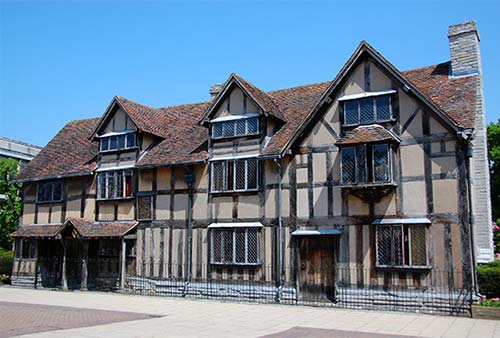
I find this half-timbered Elizabethan building a bit disappointing, as if millions of visitors have rubbed it clean of anything authentic. It was restored in the 1800s, and the furnishings are true to 1575, when William was 11. To enliven the otherwise dead-feeling house, well-versed attendants are posted in many of the rooms, eager to engage with travelers and answer questions.
Shakespeare’s father, John—who came from humble beginnings but bettered himself by pursuing a career in glovemaking (you’ll see the window where he sold them to customers on the street)—provided his family with a comfortable upper-middle-class existence. The guest bed in the parlor was a major status symbol: They must have been rich to afford such a nice bed that wasn’t used every day. This is also the house where Shakespeare and his bride, Anne Hathaway, began their married life together. After Shakespeare’s father died and William inherited the building, the thrifty playwright converted it into a pub to make a little money.
Upstairs are the rooms where young Will, his siblings, and his parents slept (along with their servants). Look for the window etched with the names of important visitors, from Sir Walter Scott to actor Henry Irving. Speaking of important visitors: In 1844, American circus showman P. T. Barnum visited the birthplace. He liked it so much, he tried to buy the building and ship it to America to be part of his museum—but he was thwarted by Charles Dickens, who, with the help of Prince Albert and others, raised enough money to save the birthplace (and British pride).
The most engaging part of your visit comes after exiting the house. Step into the fine garden, where Shakespearean actors regularly perform brief scenes (and may even take requests). Pull up a bench and listen, imagining the playwright as a young boy stretching his imagination in this very place.
Shakespeare’s New Place
While nothing remains of the house the Bard inhabited when he made it big (it was demolished in the 18th century), its manicured grounds are a tranquil spot to soak up some history. Today, modern sculptures and traditional gardens adorn the grounds of the mansion Shakespeare called home for nearly 20 years.
Cost and Hours: £15, covered by Shakespeare’s Story combo-ticket; daily 10:00-17:00, closed Nov-March; 22 Chapel Street, +44 1789 204 016, shakespeare.org.uk.
Visiting the Site: It’s hard to imagine a house on this site, but room markers on the ground, vivid docent descriptions, and visual aids help bring the history to life. The expansive lawn is a pleasant respite from the hubbub of town, and the perfect place to sip a coffee or compose sonnets. Back here, you’ll find nine evocative, meant-to-be-touched statues by American artist Greg Wyatt, each inspired by a Shakespeare play. Next door, Nash’s House (which belonged to Shakespeare’s granddaughter and her husband) hosts rotating exhibits on the history of the property and Shakespeare’s plays and influences.
Shakespeare’s Grave (Holy Trinity Church)
Shakespeare was a rector for Holy Trinity Church when he died. While the church is surrounded by an evocative graveyard, the Bard is entombed inside, in a place of honor: right in front of the altar. The church marks the ninth-century birthplace of the town, which was once a religious settlement. It also houses a King James Bible from 1611, which Shakespeare likely read from.
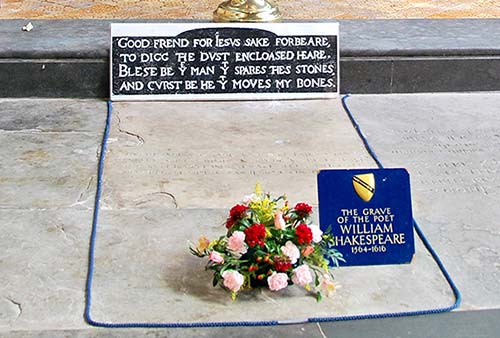
Cost and Hours: Free to enter, £5 to see Shakespeare’s grave; generally Mon-Sat 10:00-17:00, Sun 12:00-16:00, shorter hours in winter—check website for updates; 10-minute walk past the theater—see its graceful spire as you gaze down the river, +44 1789 266 316, stratford-upon-avon.org.
Shakespeare’s Schoolroom and Guildhall
The guildhall and the guild’s schoolhouse help visitors imagine Shakespeare’s childhood years (and offer a slightly more personal, hands-on experience than the Birthplace Trust sights). Built between 1418 and 1420, the guildhall was the headquarters for the Guild of the Holy Cross, where everyone from Stratford and nearby towns—from tradesmen to craftsmen to clergy and nobility—networked and struck deals. Anyone could join for a small fee; in return, the guild supported members’ families, even employing priests to pray for their souls. It also provided social services, such as town infrastructure—and established Stratford’s first school.
Cost and Hours: £13.50, combo-tickets often available with Shakespeare’s Birthplace and the MAD Museum, described later (for combo-ticket info, see here); daily 11:00-17:00; Church Street, +44 1789 868 262, shakespearesschoolroom.org.
Visiting the Guildhall and Schoolroom: The guildhall’s priest’s chapel and the Guild Chapel next door both contain fragments of medieval wall paintings that were probably whitewashed during Reformation efforts—during William’s father’s tenure as chamberlain here. (The paintings were uncovered when the chapel was restored in 1804 and are barely visible.)
In the very room where Shakespeare attended school for six years, you’ll see a wood table with centuries-old student-carved graffiti, and you can attempt writing with a quill. A costumed docent describes student life in a room where wood benches faced each other so kids could easily help each other learn. Since paper was so expensive, students were taught mainly verbally, perhaps boosting young Will’s flair for storytelling. Groups of traveling actors performed at the guildhall several times while Will attended school here. In the days before TV, movies, or social media, these productions were the pinnacle of entertainment, and likely inspired him.
▲Anne Hathaway’s Cottage
Located 1.5 miles out of Stratford (in Shottery), this home is a 12-room farmhouse where the Bard’s wife grew up. William courted Anne here—she was 26, he was only 18—and his tactics proved successful. (Maybe a little too much, as she was several months pregnant at their wedding.) Their 34-year marriage produced two more children and lasted until his death in 1616 at age 52. The Hathaway family lived here from the 1500s until 1911; much of the family’s 92-acre farm remains part of the sight.
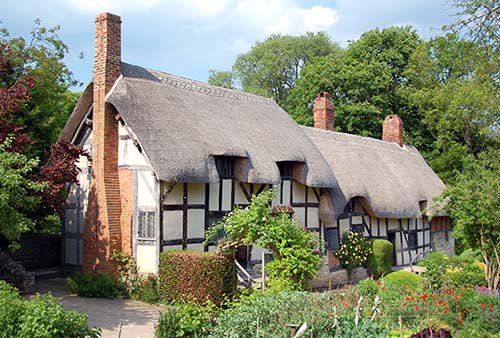
Cost and Hours: £15, covered by Shakespeare’s Story combo-ticket; daily 10:00-17:00, Nov-March until 16:00; +44 1789 338 532, shakespeare.org.uk.
Getting There: It’s a 30-minute walk from central Stratford (20 minutes from the Grove Road B&Bs), a stop on the hop-on, hop-off tour bus, or a quick taxi ride from downtown Stratford (around £7). Drivers will find it well signposted entering Stratford from any direction, with easy, cheap parking.
Visiting Anne Hathaway’s Cottage: The thatched-roof cottage looks cute enough to eat, and it’s fun to imagine the writer of some of the world’s greatest romances wooing his favorite girl right here during his formative years. (If the place shakes, a tourist has thunked their head on the low beams.) The docent talks provide an intimate peek at life in Shakespeare’s day.
Maybe even more interesting than the cottage are the gardens, which have several parts, including a prizewinning “traditional cottage garden” and a fun sculpture garden littered with modern interpretations of Shakespearean characters and references (such as Falstaff’s mead gut, and a great photo-op statue of the British Isles sliced out of steel). Signs throughout the sculpture garden cleverly use quotes from his plays to tell you what plant you’re looking at.
THE ROYAL SHAKESPEARE COMPANY
The Royal Shakespeare Company (RSC), undoubtedly the best Shakespeare company on earth, performs year-round in Stratford and in London. While seeing a play here is the best Shakespeare experience in Stratford, exploring the cleverly designed Royal Shakespeare Theatre building (renovated in 2011) is also worth your time. The smaller attached Swan Theatre—refurbished during its pandemic closure—hosts plays on a more intimate scale, with only 469 seats.
Seeing a Play
Watching a play here in the Bard’s birthplace is a must for Shakespeare fans and a memorable ▲▲▲ experience for anybody. Between its excellent acting and remarkable staging, the RSC makes Shakespeare as accessible and enjoyable as it gets.
It’s easy to take in a play, thanks to the RSC’s very user-friendly website, painless ticket-booking system, and chock-a-block schedule that fills the summer with mostly big-name Shakespeare plays (plus a few more obscure titles to please the die-hard aficionados). Performances take place most days (Mon-Sat generally at 19:15 at the Royal Shakespeare Theatre or 19:30 at the Swan, matinees Thu and Sat around 13:15 at the RST or 13:30 at the Swan, sporadic Sun shows). Shows generally last three hours or more, with one intermission; for an evening show, don’t count on getting back to your B&B much before 23:00. There’s no strict dress code—nice jeans and short-sleeve shirts are fine—but shorts are discouraged.
Getting Tickets: Tickets range from £16 to £85, with most around £60 (see website for discount details, including “rush” tickets available online at 12:00 each Friday for the following week’s shows). Saturday evening shows—the most popular—are the most expensive. You can book tickets as you like it: online (rsc.org.uk), by phone (+44 1789 331 111, Mon-Fri 12:00-18:00), or in person at the box office during normal building hours (see “Visiting the Theaters,” next). Because it’s so easy to get tickets online or by phone, it makes no sense to pay extra to book tickets through any other source.
Tickets go on sale well in advance, depending on the show and season. Saturdays and very famous plays (such as Romeo and Juliet or Hamlet)—or any play with a well-known actor—sell out the fastest. Before your trip, check the website, and consider buying tickets if something strikes your fancy. But demand is difficult to predict, and some tickets do go unsold. On a past visit, on a sunny Friday in June, the riverbank was crawling with tourists. I stepped into the theater on a lark to see if they had any tickets. An hour later, I was watching King Lear lose his marbles.
Even if there aren’t any seats available, you may be able to buy a returned ticket on the same day of an otherwise sold-out show. While you can check at the box office anytime during the day, it’s best to go either when it opens at 10:00 (daily) or between 17:30 and 18:00 (Mon-Sat). Be prepared to wait.
Standing Tickets: £10 standing tickets are available for all shows at the Swan Theatre (best for taller people) and some shows at the Royal Shakespeare Theatre. If you’re feeling bold, buy a cheap standing ticket and slip into an open seat as the lights dim—if nothing is available during the play’s first half, something could open up after intermission.
Visiting the Theaters
▲The Royal Shakespeare Theatre
The RSC’s flagship theater is one of Stratford’s main sights. Come before your show to poke around the building and check out interesting tidbits of theater history—or visit when the building is open. Note that you are not allowed to see the actual stage and auditorium unless you take a guided tour (explained below) or have tickets to see a show.
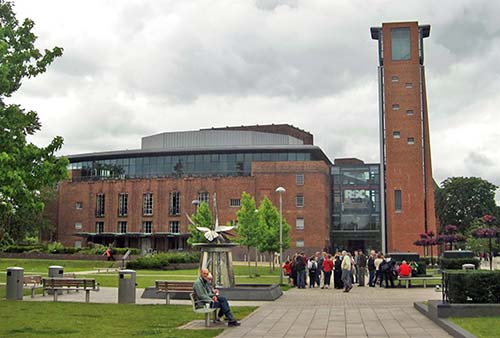
Cost and Hours: Free entry; daily 10:00-17:00 or until the end of evening intermission on performance days; +44 1789 331 111, rsc.org.uk.
Guided Tours: Well-informed RSC volunteers lead a variety of entertaining tours that include parts of the theater not otherwise open to the public. The basic hour-long “Theatre Tour” goes into the auditorium, unless a performance is happening or a set is being built (£13.50; generally 4/day at at 10:15, 11:45, 14:00, and 15:30; fewer tours Mon and Sat; confirm schedule at box office or online; best to book ahead by phone or on website).
Background: The original Victorian-style theater was built in 1879 to honor the Bard, but it burned down in 1926. The big Art Deco-style building you see today was erected in 1932 and outfitted with a stodgy Edwardian “picture frame”-style stage, even though actors preferred the more dynamic “thrust”-style stage, which was surrounded by viewers on three sides and better for engaging the audience. (It would also have been closer in design to Shakespeare’s original Globe stage, which jutted into the crowd.)
The 2011 renovation addressed this ill-conceived design, adding an updated thrust-style stage. They’ve left the shell of the 1930s theater but given it an unconventional deconstructed-industrial style, with the seats stacked at an extreme vertical pitch. Though smaller, the redesigned theater can seat about the same size audience as before (1,048 seats), and now there’s not a bad seat in the house—no matter what, you’re no more than 50 feet from the stage (the cheapest “gallery” seats look down right onto Othello’s bald spot). Productions are staged to play to all the seats throughout the show. Those sitting up high appreciate different details from those at stage level, and vice versa.
Visiting the Theater: Head through the entrance in front of the gift shop, then turn left. In the atrium between the circular brick wall of the modern theater and fragments of the previous theater, notice the ratty old floorboards—pried up from the 1932 stage and laid down here; you’re treading on theater history. Two floors up (directly above the entrance) is the Paccar Room, with temporary exhibits assembled from the RSC’s substantial collection of historic costumes, props, manuscripts, and other theater memorabilia. Continue upstairs to level 3 and enter the Rooftop Restaurant (described below). High on the partition that runs through the restaurant, facing the brick theater wall, notice the chairs affixed to the wall. These are original seats from the earlier theater, situated where the back row used to be (90 feet from the stage)—illustrating how much more audience-friendly the new design is.
Returning to the ground floor, pass through the gift shop area to find the Swan Theatre (described next).
Back outside, notice the building across the street with the steep gable and huge door (marked CFE 1887). This was built as a workshop for building sets, which could be moved in large pieces to the main theater. To this day, all the sets, costumes, and props are made here in Stratford. The row of cottages to the right is housing for actors. The RSC’s reputation exerts enough pull to attract serious actors from all over the UK and beyond, who live here for the entire season. The RSC uses a repertory company approach, where the same actors appear in multiple shows concurrently: Today’s Lady Macbeth may be tomorrow’s Rosalind.
Tower View: For a God’s-eye view of all of Shakespeare’s houses, ride the elevator to the top of the RSC’s tower (free; tower open daily 12:00-16:00; closed on matinee performance days and in bad weather). Aside from a few sparse exhibits, the main attraction here is the 360-degree view over the theater building, the River Avon, and the lanes of Stratford.
The Food’s the Thing: The main theater has a casual ££ café with a terrace overlooking the river (daily from 10:00), as well as the fancier £££ Rooftop Restaurant—though I’d dine elsewhere (Mon-Sat 11:30 until late, Sun until 15:30, dinner reservations smart, +44 1789 403 449, rsc.org.uk/rooftop).
Nearby: Outside the theater, notice the building across the street with the steep gable and huge door (marked CFE 1887). This was built as a workshop for building sets, which could be moved in large pieces to the main theater. To this day, all the sets, costumes, and props are made here in Stratford. The row of cottages to the right is housing for actors. The RSC’s reputation exerts enough pull to attract serious actors from all over the UK and beyond, who live here for the entire season. The RSC uses a repertory company approach, where the same actors appear in multiple shows concurrently: Today’s Lady Macbeth may be tomorrow’s Rosalind.
The Swan Theatre
Adjacent to the Royal Shakespeare Theatre (and entered through the same lobby) is the smaller, charming Swan Theatre, named not for the birds that fill the park out front but for the Bard himself, who became known as the “sweet swan of Avon.” The Swan was built into a surviving old, Gothic-style Victorian space from the original 1879 Memorial Theatre. It has a vertical layout and a thrust stage similar to the Royal Shakespeare Theatre, but its wood trim and railings give it a cozier, more traditional feel. The Swan is used for lesser-known Shakespeare plays and alternative works. Occasionally, the lowest level of seats is removed to accommodate “groundling” (standing-only) tickets, much like at the Globe Theatre in London.
Upstairs, an immersive exhibit called The Play’s the Thing lets you digitally try on costumes, design sets, and grace a Shakespearean stage. At the back of the exhibit is one of Shakespeare’s First Folios.
The Other Place (Former Courtyard Theatre)
A two-minute walk down Southern Lane from the original Royal Shakespeare Theatre, the Courtyard Theatre (affectionately called the “rusty shed” by locals) was built as a replacement venue while the RST was being renovated. Now called The Other Place, it primarily serves as a rehearsal space but hosts occasional productions as well.
Other Stratford Sights
Avon Riverfront
The River Avon is a playground of swans and canal boats. The swans have been the mascots of Stratford since 1623, when, seven years after the Bard’s death, Ben Jonson’s poem in the First Folio dubbed him “the sweet swan of Avon.”
Strolling the Riverfront: For a nice riverfront walk, consider crossing over the Tramway Footbridge and following the trail to the right (west) along the south bank of the Avon. To your left is the Stratford Big Wheel, not as big as the London Eye, but much cheaper (£8). From here, you’ll get a great view of the Royal Shakespeare Theatre across the river. Continuing down the path, you’ll pass the local lawn bowling club (guest players welcome, £5, Tue and Thu 13:30-15:30, tea and biscuits served at the end) and Lucy’s Mill Weir, an area popular with fishers and kayakers, where you can turn around. On the way back, cross the river by the chain ferry (described later) and return to the town center via the north bank for a full loop.
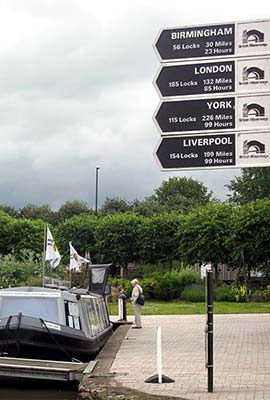
In the water you’ll see colorful canal boats. These boats saw their workhorse days during the short window of time between the start of the Industrial Revolution and the establishment of the railways. Today they’re mostly pleasure boats. The boats are long and narrow, so two can pass in the slim canals. There are 2,000 miles of canals in England’s Midlands, built to connect centers of industry with seaports and provide vital transportation during the early days of the Industrial Revolution. Stratford was as far inland as you could sail on natural rivers from Bristol; it was the terminus of the man-made Birmingham Canal, built in 1816. Even today you can motor your canal boat all the way to London from here. Along the embankment, look for the signs indicating how many hours it’ll take—and how many locks you’ll traverse—to go by boat to various English cities.
Boating and Cruising: For a little bit of mellow river action, rent a canoe or rowboat, or, for more of a challenge, pole yourself around on a Cambridge-style punt—the canal is only 4-5 feet deep (each option £11/hour per person). You can rent boats from Avon Boating at the Swans Nest Boathouse across the Tramway Footbridge.
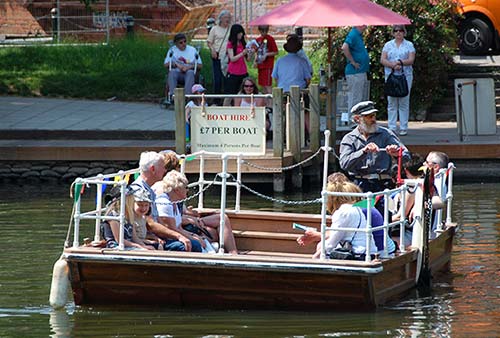
Avon Boating also offers a sleepy 30-minute river cruise with commentary (£11, daily generally 10:30-17:00, +44 1789 267 073, avon-boating.co.uk; board in Bancroft Gardens near Royal Shakespeare Theatre, or ask at Swans Nest Boathouse across Tramway Bridge). For a quick and cheap way to get upon-the-Avon, take the oldest surviving chain ferry in Britain (c. 1937, £1), which shuttles people across the river just beyond the theater.
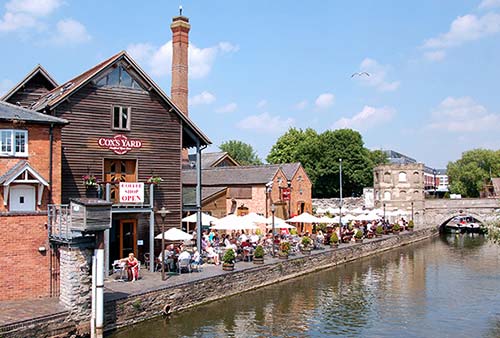
Riverfront Park (near the Tramway Bridge): The old Cox’s Yard, a riverside timber yard until the 1990s, is a rare physical remnant of the days when Stratford was an industrial port. Today, Cox’s has been taken over by a restaurant complex, with a café, lots of outdoor seating, and occasional live music. Upstairs is the Attic Theatre, which puts on fringe theater acts as well as mainstream productions—including works by Shakespeare (theattictheatre.co.uk).
In the riverfront park, roughly between Cox’s Yard and the TI, the Gower Memorial honors the Bard and his creations. Named for Lord Ronald Gower, the man who paid for and sculpted the memorial, this 1888 work shows Shakespeare up top ringed by four of his most indelible creations, each representing a human pursuit: Hamlet (philosophy), Lady Macbeth (tragedy), Falstaff (comedy), and Prince Hal (history). Originally located next to the theater, it was moved here following the theater’s destruction by fire in 1926.
▲MAD Museum
A refreshing change of pace in Bard-bonkers Stratford, the Mechanical Art and Design (MAD) Museum celebrates machines as art, showcasing a changing collection of skillfully constructed robots, gizmos, and Rube Goldberg machines that spring to entertaining life. It’s riveting for engineers but engaging for anyone.
Cost and Hours: £8.80, ask about combo-ticket with Shakespeare’s Schoolroom and Guildhall; Sun-Fri 10:00-17:00, Sat until 17:30, shorter hours in winter, last entry 45 minutes before closing; near Shakespeare’s Birthplace at 4 Henley Street, +44 1789 269 356, themadmuseum.co.uk [URL inactive].
Tudor World at the Falstaff Experience
This attraction is tacky, gimmicky, and more about entertainment than education. (And, while it’s named for a Shakespeare character, the exhibit isn’t about the Bard.) Filling Shrieve’s House Barn with mostly kid-oriented exhibits (mannequins and descriptions, but few real artifacts), it sweeps through Tudor history from the plague to Henry VIII’s privy chamber to a replica 16th-century tavern. If you’re into ghost-spotting, their nightly ghost tours may be your best shot.
Cost and Hours: Museum—£8, daily 10:30-17:30; Shakespeare tour—£10, Sat at 14:00; ghost tours—£9.50, daily at 18:00, Sat also 19:00, 20:00, and 21:00; book online, additional tours possible Fri-Sat; 40 Sheep Street, +44 1789 298 070, tudorworld.com.
Sleeping in Stratford
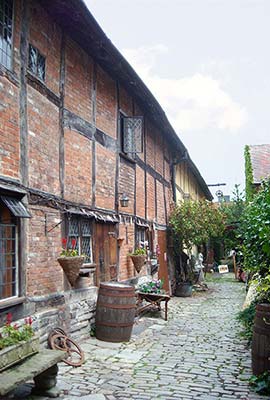
Ye olde timbered hotels are scattered through the city center. Most B&Bs are a short walk away on the fringes of town, right on the busy ring roads that route traffic away from the center. (The recommended places below generally have double-paned windows for rooms in the front, but still get some traffic noise.)
In general, the weekend on or near Shakespeare’s birthday (April 23) is particularly tight, but Fridays and Saturdays are always busy. A two-night minimum stay may be required on weekends. This town is so reliant on the theater for its business that some B&Bs have insurance covering their loss if the Royal Shakespeare Company ever stops performing in Stratford.
ON GROVE ROAD
These places are at the edge of town on busy Grove Road, across from a grassy square. From here, it’s about a 10-minute walk either to the town center or to the train station (opposite directions).
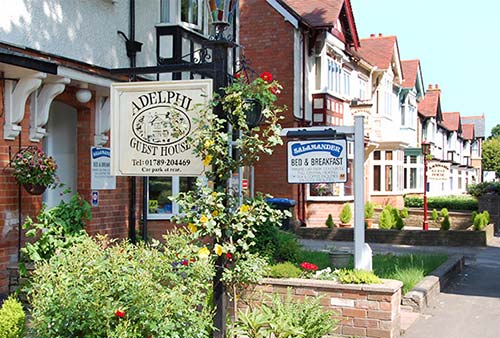
££ Emerald Stays at The Adelphi is a bright, modern guesthouse offering seven studio rooms with kitchenettes, as well as a private apartment with a patio and conservatory dining area (RS%, no parking, no breakfast, 39 Grove Road, +44 7919 841 448, adelphi-guesthouse.com, info@adelphi-guesthouse.com).
£ Salamander Guest House rents eight simple rooms in a variety of configurations (family rooms, no breakfast, free parking if reserved in advance, 40 Grove Road, +44 1789 205 728, salamanderguesthouse.co.uk, info@salamanderguesthouse.co.uk).
£ Ashgrove House lacks some of the charm found at the neighboring guesthouses but has six clean and comfortable rooms. Ask for one of the large doubles (no kids under 5, minifridges, pay parking, 37 Grove Road, +44 1789 297 278, ashgrovehousestratford.co.uk, info@ashgrovehousestratford.co.uk, Iain and Diane).
ELSEWHERE IN STRATFORD
£££ The White Swan has been a hotel since the 1500s and has 41 unique and refurbished rooms, some with a lot of character. It also has a traditional pub and restaurant that serves your breakfast in the morning and classic British dishes later in the day (air-con, Rother Street, +44 1789 297 022, white-swan-stratford.co.uk, whiteswanhotel@fullers.co.uk).
££ The Townhouse rents 12 spacious and tastefully decorated rooms opposite Shakespeare’s Schoolroom and Guildhall. On the ground floor is a small, cozy pub with friendly staff (includes breakfast when you book direct, 16 Church Street, +44 1789 262 222, stratfordtownhouse.co.uk, hello@stratfordtownhouse.co.uk).
£ Avonlea is a welcoming B&B renting six rooms across the river. Beds are comfortable and the rooms have a homey feel. Owners Clare and Rob cook up a hearty breakfast and are in touch with the local dining scene (free parking, 47 Shipston Road, +44 1789 205 940, avonlea-stratford.co.uk, enquiries@avonlea-stratford.co.uk).
¢ Hostel: Family-friendly Hemmingford House has 32 rooms in a Georgian mansion, half of them en suite. It’s a 10-minute bus ride from town (private rooms, family rooms, camping pods and tents, breakfast extra, take bus #15 two miles to Alveston, hostel is on Wellesbourne Road, +44 3453 719 661, yha.org.uk/hostel/stratford-upon-avon, stratford@yha.org.uk).
Eating in Stratford
RESTAURANTS
Stratford’s numerous restaurants vie for your pretheater business, with special hours and meal deals. (Most offer light two- and three-course menus before 19:00.) Unfortunately, posttheater dinners are more challenging, as Stratford tends to go to bed once the lights go up.
£££ The Boathouse Riverside Dining & Bar takes pride in its daily selection of fresh fish and has a remarkable location by the river. Reserve early to get a front-row table overlooking the water. For a sunny lunch, sit out in the garden (daily, Swans Nest Lane, +44 1789 414 960, thestratfordboathouse.co.uk).
£££ Loxley’s has a good wine selection and serves up eclectic dishes in an eclectic setting (daily, 3 Sheep Street, +44 1789 292 128).
£££ Sheep Street Eateries: The next three places, part of the same chain, line up along Sheep Street, offering trendy ambience and modern English cuisine at relatively high prices (but with good-value pretheater menus). Lambs is intimate and serves meat, fish, and veggie dishes with panache. Sit inside under low half-timbered beams, or outside in their heated courtyard (daily, Mon dinner only, 12 Sheep Street, +44 1789 292 554). The Opposition, next door, has a less formal bistro ambience (closed Sun, Mon dinner only, +44 1789 269 980, theoppo.co.uk; book in advance for posttheater dinner here Fri-Sat). The Vintner, just up the street, is known for their burgers and sandwiches (daily breakfast, then à la carte lunch and dinner, closes at 16:00 on Sun, 4 Sheep Street, +44 1789 297 259).
£££ Bistrot Pierre is a French eatery by the river with indoor and outdoor seating and French (read: slow) service (long hours daily, Swan’s Nest Hotel, Bridge Foot, +44 1789 264 804, bistrotpierre.co.uk). The pub next door, Bear Free House, is owned by the same people and shares the kitchen but offers a different menu.
Indian: If you’re up for a walk and don’t mind a dive, ££ Avon Spice has an extensive selection of quality Indian dishes at good prices for takeout or dine-in meals (daily from 17:30, 7 Greenhill Street, +44 1789 267 067).
PUBS
Multiple Stratford watering holes bill themselves as the oldest pub in town. Like the restaurants, many are hopping before showtime, but few are cracking late. Your best bet for a posttheater beverage is the Dirty Duck...because that’s where the actors like to unwind.
££ The Old Thatch Tavern serves up London-based Fuller’s brews in a cozy setting. The food is a cut above what you’ll get in other pubs. Enjoy it either in the bar; in the tight, candlelit restaurant; or out on the quiet patio (daily, on Greenhill Street overlooking the market square, +44 1789 612 319).
££ Dirty Duck is tucked away on a quiet street near the Royal Shakespeare Theatre. It gained notoriety as the pub where RSC actors came (and occasionally still come) after shows—the walls of the internal “actor’s bar” are covered with headshots (daily, reservations smart on weekends, Waterside, +44 1789 297 312, greeneking-pubs.co.uk/pubs/warwickshire/dirty-duck).
££ The Windmill Inn serves decent, modestly priced fare in a 17th-century inn. It combines old and new styles, and—since it’s a few steps beyond the heart of the tourist zone—actually attracts some locals as well. Order drinks and food at the bar, then either settle into a comfy chair or head out to the half-timbered courtyard to wait for your meal (daily, Church Street, +44 1789 297 687).
££ The Garrick Inn comes with a cozy, dimly lit restaurant vibe. Choose between the pub and the table-service section; either way, you’ll dine on bland, pricey pub grub (daily, 25 High Street, +44 1789 292 186).
If you want a change of pace from creaky old pubs, mix it up with the locals at grungy £ Stratford Ale House (no food, closed Mon, 12 Greenhill Street, +44 7746 807 966); sip heavy, American-style craft beer at £ Ya-Bard (no food, closed Mon, 13 Rother Street, +44 7826 867 808); or stir a stiff cocktail at ££ Café Cocktail (closed Tue, 3 Windsor Court, +44 1789 224 221).
PICNICS
With its sprawling and inviting riverfront park, Stratford is a particularly pleasant place to picnic. Grabbing a bench and enjoying views of the river and vacation houseboats while munching your meal is a dreamy way to spend a midsummer night’s eve. For groceries or prepared foods, find Marks & Spencer on Bridge Street (daily, shorter hours on Sun, small coffee-and-sandwiches café upstairs). Across the street, Sainsbury’s Local stays open later than other supermarkets (daily 7:00-22:00).
For fish-and-chips, you have a few options: £ Barnaby’s is a greasy fast-food joint near the waterfront—convenient if you want takeout for the riverside park just across the street (daily, at Sheep Street and Waterside). For better food, go a block farther to the ££ Chip Shed—a small, quality chain (27 Bridge Street)—or queue up with the locals at £ Kingfisher and ask for the freshly battered haddock (closed Sun, a long block up at 13 Ely Street, +44 1789 292 513).
TEAROOMS
££ The FourTeas 1940s Tea Room transports diners to another era, with period details ranging from the servers’ housedresses to the ration-card menu to the Glenn Miller-era soundtrack. Don’t be fooled by the theme: This place eludes kitsch, with high-quality pastries, classic sandwiches, breakfast until noon, and local ingredients (Mon-Sat until 17:00, Sun until 16:00, 24 Sheep Street, +44 1789 293 908).
££ Bensons Restaurant and Tea Rooms, across the street from Shakespeare’s Birthplace, has outdoor tables right on the main pedestrian mall and friendly service, with teas available all day (daily 9:00-17:00, 40 Henley Street, +44 1789 415 572).
Stratford Connections
Remember: When buying tickets or checking schedules, ask for “Stratford-upon-Avon,” not just “Stratford.”
From Stratford-upon-Avon by Train to: London (hourly, one transfer, 2.5 hours, to Marylebone Station), Moreton-in-Marsh (every 2 hours, 3 hours, change in Worcester, better by bus). Train info: nationalrail.co.uk.
By Bus to: Cotswolds towns (bus #1 or #2, Mon-Sat 5/day, none on Sun, 50 minutes to Chipping Campden, 1.5 hours to Moreton-in-Marsh, some also stop at Broadway and/or Blockley, stagecoachbus.com; bus #51 also goes to Moreton-in-Marsh, Tue-Sat 5/day, 1 hour, pulhamscoaches.com). Most intercity buses stop on Stratford’s Bridge Street (a block up from the TI). Traveline provides information for all the region’s bus companies (traveline.info).
By Car: Driving is easy and distances are short: Chipping Campden (12 miles), Stow-on-the-Wold (22 miles).
ROUTE TIPS FOR DRIVERS
These tips assume you’re heading north from Stratford.
Leaving the Bridgeway garage in downtown Stratford, circle to the right around the same block, but stay on “the Wark” (Warwick Road, the A-439—eventually becomes Stratford Road).
To the Northeast: Heading toward York, Durham, and other destinations northeast of Stratford, take the Wark to the A-46. Just past Coventry, it merges into the M-69 toward Leicester, which intersects with a major north-south route, the M-1.
To the Northwest: When heading toward Ironbridge Gorge, North Wales, Liverpool, or the Lake District, take the A-46 toward Warwick, then exit onto the M-40 north toward Birmingham. Avoid driving through Birmingham. After Warwick, take the M-42 to the west; the sign will read The Southwest (M5), Birmingham (S & W), Redditch. When the M-42 ends at the M-5, follow the M-5 north; the sign will read The Northwest, B’ham, Stourbridge.
After Birmingham, for Ironbridge Gorge, take the M-54 toward Telford. For specifics on getting to Ironbridge Gorge, see here. For other destinations, take the M-6.