WINDSOR & CAMBRIDGE
Cambridge Town and College Walk
Map: Cambridge Town & College Walk
Windsor and Cambridge are two very different but equally enjoyable day-trip possibilities near London.
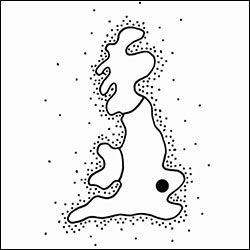
The primary residence of the late Queen Elizabeth II, the charming town of Windsor hosts a castle that’s regally lived-in, yet open to the public. This is simply a charming town that offers relaxation—and its proximity to Heathrow Airport makes it easy to combine with a flight into or out of London. Nearby is a grab bag of intriguing sights, including Eton College (Britain’s most elite high school), Ascot Racecourse (horse racing), and Legoland Windsor.
North of London, Britain’s venerable University of Cambridge is mixed into the delightful town of Cambridge, which offers a mellow, fun-to-explore townscape with a big-league university. You’ll be following along in the footsteps of Darwin, Newton, and Hawking, among others.
GETTING AROUND
By Train: If day-tripping from London, take advantage of discounts. The round-trip “off-peak day return” ticket costs virtually the same as one-way, provided you depart London outside rush hour (usually after 9:30 on weekdays and anytime Sat-Sun). Be sure to get the “day return” ticket (round-trip within a single day) rather than the more expensive, standard “return” ticket. You can also save a little money if you purchase tickets before 18:00 the day before your trip.
Windsor
Windsor, a compact and easy walking town of about 30,000 people, grew up around the royal residence. In 1070, William the Conqueror took over the Saxon settlement called Windlesora—which eventually became “Windsor.” He built a fortified castle there on a chalk hill above the Thames, initiating centuries of royal occupation. Later kings added on to William’s early designs, rebuilding and expanding the castle and surrounding gardens.
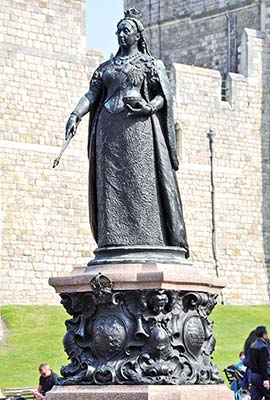
By setting up their primary residence here, modern monarchs increased Windsor’s popularity and prosperity—most notably, Queen Victoria, whose stern statue glares at you as you approach the castle. After her death, Victoria joined her beloved husband, Albert, in the Royal Mausoleum situated in Home Park, the private grounds of Windsor Castle.
The late Queen Elizabeth II also considered Windsor her primary residence, and Prince William, Princess Kate, and their children occupy a “cottage” in Home Park. King Charles III has been spending more time in Windsor to be near his grandchildren. You can tell if the monarch is in residence by which flag is flying above the round tower: If it’s the royal standard (a red, yellow, and blue flag) instead of the Union Jack, the King is in.
While 99 percent of visitors just come to tour the castle and go, some enjoy spending the night. Daytime crowds trample Windsor’s charm, which is most evident when the tourists are gone. Consider overnighting here—parking and access to Heathrow Airport are easy, and an evening at the horse races (on Mondays) is hoof-pounding, heart-thumping fun.
GETTING TO WINDSOR
By Train: Windsor has two train stations—Windsor & Eton Central and Windsor & Eton Riverside. London’s Paddington Station connects with Windsor & Eton Central (2/hour, 30-40 minutes, easy change at Slough—typically just across the platform). London’s Waterloo Station connects with Windsor & Eton Riverside (2/hour, no changes but slower, 1 hour). Either trip costs about £12 one-way (a few pounds more for same-day return, nationalrail.co.uk).
By Bus: Windsor Express bus #702 runs—very slooooowly—from London’s Victoria Colonnades (between the Victoria train and coach stations) to the Parish Church stop on Windsor’s High Street, before continuing on to Legoland (1/hour, 1.5 hours to Windsor, from £3 one-way, +44 1189 594 000, reading-buses.co.uk).
By Car: Windsor is about 20 miles from London and well signposted from the M-4 motorway. It’s a convenient first stop if you’re arriving at Heathrow and renting a car there (see next).
From Heathrow Airport: It’s easy and cheap to get to Windsor on Windsor Express bus #703 from Terminal 5 (2/hour, 45 minutes, £3 one-way). The slower First Bus Company’s bus #8 also leaves from Terminal 5 (2/hour, 1 hour). By car it’s about a 20-minute drive. London black cabs can (and do) charge whatever they like from Heathrow to Windsor; avoid them by calling a local cab company, such as Windsor Cars (£25-30, 20 minutes, +44 1753 677 677, windsorcars.com).
Orientation to Windsor
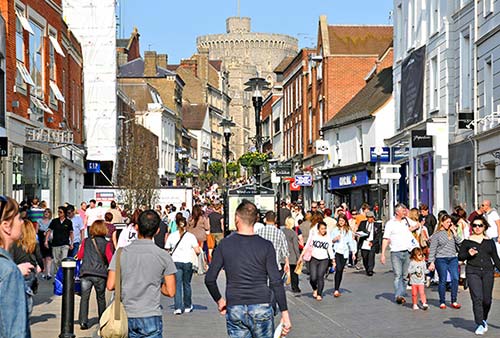
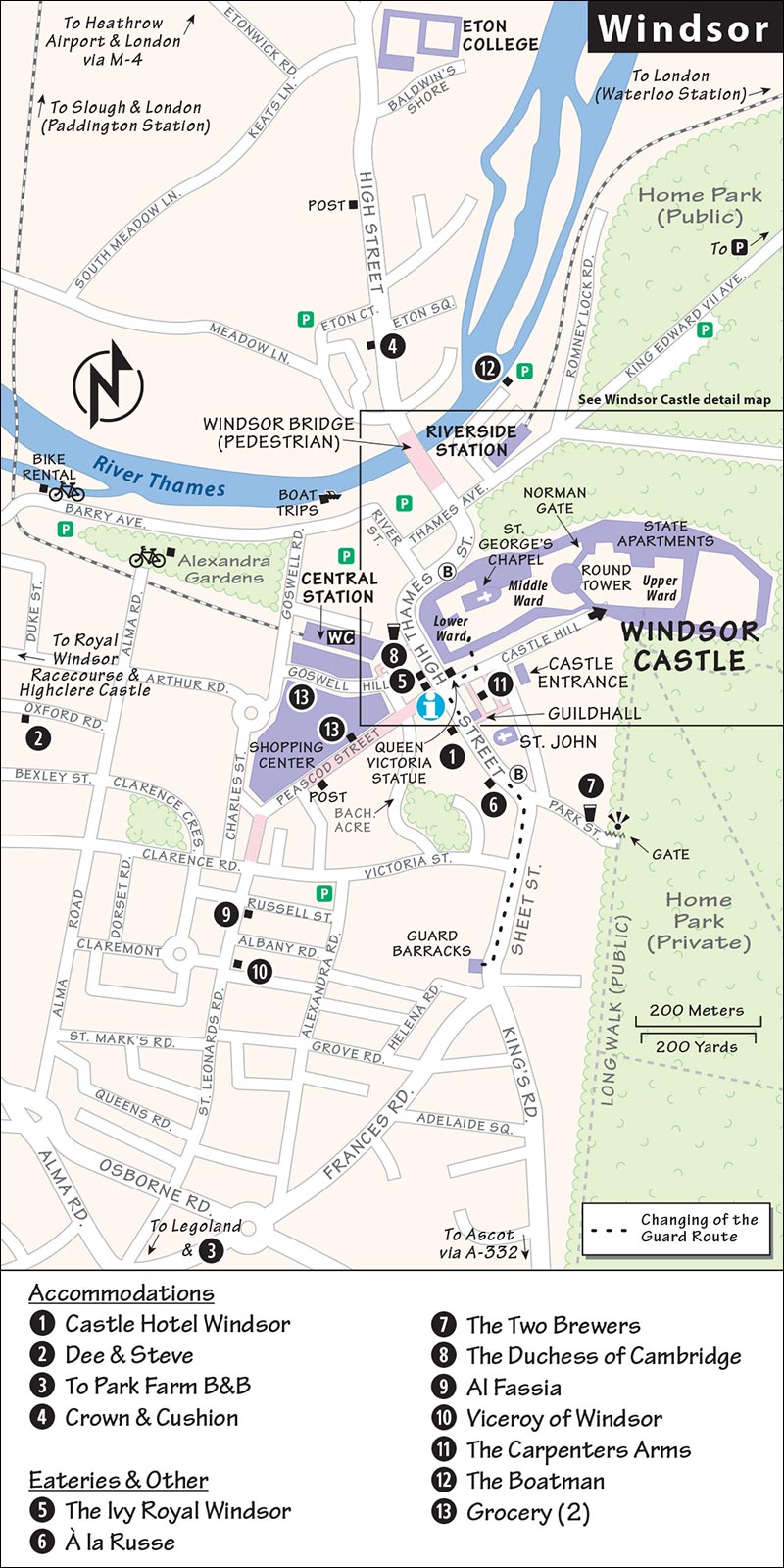
Windsor’s pleasant pedestrian shopping zone litters the approach to its famous palace with fun temptations. You’ll find most shops and restaurants around the castle on High and Thames streets, and down the pedestrian Peascod Street (PESS-cot), which runs perpendicular to High Street.
TOURIST INFORMATION
Windsor’s modest TI desk is housed in a corner of the Indelibly Windsor souvenir shop, directly across the street from the Queen Victoria statue in front of the castle (Wed-Sat 9:00-18:30, closed Sun-Tue, 29 High Street, windsor.gov.uk, windsortic@rbwm.gov.uk).
ARRIVAL IN WINDSOR
By Train: From either train station, it’s only a five-minute walk to the castle. From Windsor & Eton Central, turn left to walk through the Windsor Royal Shopping Centre and up the hill to the castle. From Windsor & Eton Riverside, you’ll see the castle as you exit—just follow the wall up and around to the entrance.
By Car: Follow signs from the M-4 motorway for pay parking in the center. River Street car park is closest to the castle but is pricey and often full. The cheaper, bigger Alexandra Gardens car park (near riverside Alexandra Gardens) is farther west, just below the Windsor & Eton Central train station (find the stairs up to the station platform and exit into the Windsor Royal Shopping Centre). Farther out (northeast of the castle, a 15-minute walk) and cheaper are the King Edward VII Avenue and Home Park car parks.
HELPFUL HINTS
- Supermarkets: Pick up picnic supplies at Marks & Spencer (on the pedestrian shopping street near Windsor & Eton Central, at 130 Peascod Street) or the bigger Waitrose (buried in the King Edward Court Shopping Centre behind the station). Just outside the castle, you’ll find long benches near the statue of Queen Victoria—great for people-watching while you munch.
- Hiking and Biking: Windsor and Eton occupy a lovely area on the Thames that’s ideal for a pleasant walk or bike ride—get suggestions at the TI. Near the river by Alexandra Gardens you can rent bikes at Windsor Cycle Hire (+44 7588 555 246, windsorcyclehire.uk).
Sights in Windsor
WINDSOR CASTLE
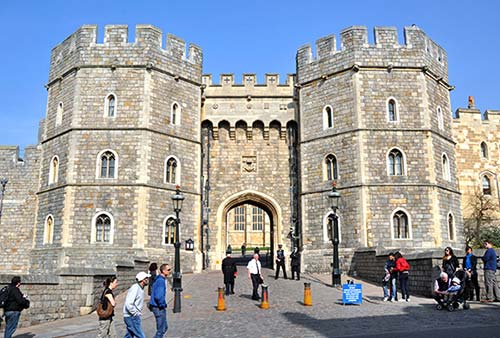
Windsor Castle, the official home of England’s royal family for more than 900 years and worth ▲▲, claims to be the largest and oldest occupied castle in the world. Thankfully, touring it is simple. You’ll see sprawling grounds, lavish staterooms, a crowd-pleasing dollhouse, and an exquisite Perpendicular Gothic chapel. Allow about two hours for a complete visit.
Cost: £31 when purchased in advance, £35 same-day (if available), includes multimedia guide.
Hours: Grounds and most interiors open Thu-Tue 10:00-17:15, Nov-Feb until 16:15, closed Tue Oct-June and Wed year-round; St. George’s Chapel closes at 16:00 and is closed Sun to tourists (but you can attend Sun services—see later). Last entry to grounds and St. George’s Chapel is 1.25 hours before closing.
Information: +44 3031 237 304, rct.uk.
Advance Tickets Recommended: Guarantee you’ll get in by purchasing tickets in advance online—morning admissions sell out first.
Crowd Control: Ticket and security lines can be long in summer. You can expect the worst crowds from opening until 13:00 any time of year, with especially long lines inside the castle at the entrances to the State Apartments and Queen Mary’s Dolls’ House.
Possible Closures: Should the King be here entertaining guests, the State Apartments close (and ticket prices are slightly reduced). Sometimes the entire castle closes. It’s smart to check the website to make sure everything is open when you want to go. While you’re at it, confirm the Changing of the Guard schedule.
Tours: The included multimedia guide covers both the grounds and the interiors. Free guided tours are sometimes offered; look for the posted schedule as you exit security.
Services at St. George’s Chapel: Visitors are welcome to attend Sunday services, when the chapel is closed to tourists; check stgeorges-windsor.org for schedule. Evensong takes place in the chapel nightly at 17:15 (free for worshippers, enter through the castle exit gate).
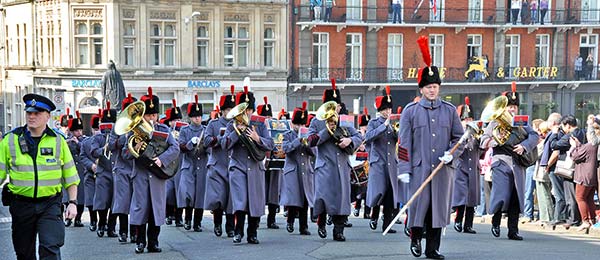
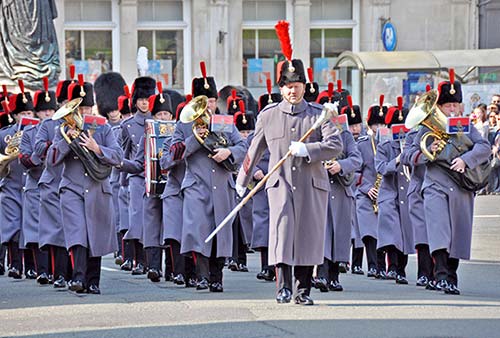
Changing of the Guard: The Changing of the Guard usually takes place Tue, Thu, and Sat at 11:00 (confirm schedule at householddivision.org.uk/guard-at-windsor-castle; canceled in very bad weather). The fresh guards, led by a marching band, leave their barracks on Sheet Street and march up High Street, hanging a right at Castle Hill, then a left into the castle’s Lower Ward, arriving at about 11:00. After about a half-hour, the tired guards march back the way the new ones came. If you want to see the ceremony from inside the castle, it’s smart to arrive as early as possible (no later than 10:30 on quiet days) to have time to clear security and stake out a spot with a clear view. If you arrive late, you could just wait for the guard to march by on High Street or on the lower half of Castle Hill.
Best Castle View: While you can get great views of the castle from any direction, the classic views are from the wooded avenue called the Long Walk, which stretches south of the palace and is open to the public.
Eating: The £ Undercroft Café, on the ground floor below St. George’s Hall, serves light food, teas, and sweets under medieval arches.
 Self-Guided Tour
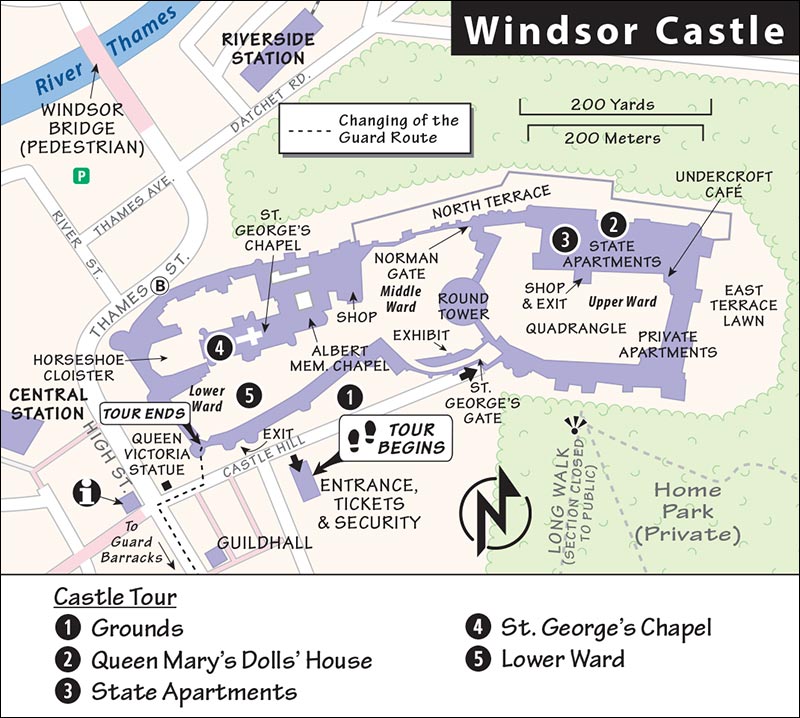
You’ll exit from security into a small courtyard (free guided tours depart from here—look for the posted schedule). Start strolling along the path through...
1 The Grounds
Head up the hill, enjoying the first of many fine castle views you’ll see today. The tower-topped conical hill on your left represents the historical core of the castle. William the Conqueror began building this motte (artificial mound) and bailey (fortified stockade surrounding it) around 1070—one of his first castles in England. Among the later monarchs who spiffed up Windsor were Edward III (flush with French war booty, he made it a palace fit for a 14th-century king), Charles II (determined to restore the monarchy properly in the 1660s), and George IV (Britain’s “Bling King,” who financed many such vanity projects in the 1820s). On your right, the circular bandstand platform has a seal of the Order of the Garter, which has important ties to Windsor (see sidebar).
Passing through the small gate, approach the stately St. George’s Gate. Peek through here to the Upper Ward’s Quadrangle, which is surrounded by the State Apartments (across the field) and the private apartments (to the right).
Then turn the corner to step into the Moat Room to pick up your multimedia guide. Take a few minutes to view the exhibit here that traces the history of the castle, including models of how the structure evolved over time and illustrations of St. George’s Hall in different historical periods.
Back outside, continue up the path. On your right, the Round Tower rises atop that original motte; running around the base of this artificial hill is the delightful, peaceful garden of the castle governor. The unusual design of this castle has not one “bailey” (castle yard), but three, which today make up Windsor’s Upper Ward (where Queen Elizabeth II once lived), Middle Ward (the ecclesiastical heart of the complex, with St. George’s Chapel, which you’ll soon pass on the left), and Lower Ward (residences for castle workers).
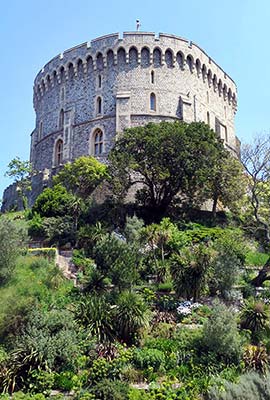
Continue all the way around this mini moat to the sturdy Norman Gate, built in the 14th century to repel attackers.
A few steps after passing through the Norman Gate, go down the staircase on the left. You’ll emerge onto the fine north terrace, whose expansive territorial views demonstrate just why this was a strategic place to build a castle. George III is said to have enjoyed strolling this terrace, mingling with the public without pomp or ceremony. That’s Eton College across the Thames. Imagine how handy it’s been for royals to ship off their teenagers to an elite prep school so close they could easily keep an eye on them...literally. The power-plant cooling towers in the distance mark the workaday burg of Slough (immortalized as the setting for Britain’s original version of The Office).
• As you wander along the terrace, you’ll encounter two lines. The long one leads to Queen Mary’s Dolls’ House, then to the State Apartments. The shorter line skips the dollhouse and heads directly to the apartments. Read the following description and decide if the dollhouse is worth the wait.
2 Queen Mary’s Dolls’ House
This palace in miniature (1:12 scale, from 1924) is “the most famous dollhouse in the world.” A gift for the adult Queen Mary (Queen Elizabeth II’s grandmother), the large dollhouse was executed with an astonishing level of detail to show off the skills of British craftsmen. The tiny pipes of its plumbing system actually have running water, and the house is wired for electricity. Each perfect fork, knife, and spoon on the expertly set banquet table is made of real silver. The doll-size adjoining garden is the work of the acclaimed landscape designer Gertrude Jekyll. But if dollhouse miniatures aren’t your cup of tea, skip ahead to the...
3 State Apartments
Dripping with chandeliers, finely furnished, and strewn with history and the art of a long line of kings and queens, these rooms are the best I’ve seen in Britain. This is where Henry VIII and Charles I once lived, and where Queen Elizabeth II wowed visiting dignitaries. Remember to take advantage of the knowledgeable docents in each room, who are happy to answer your questions.
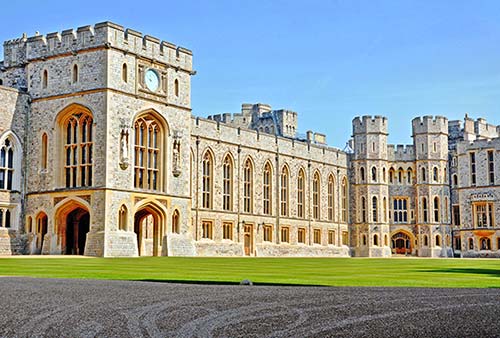
The route generally starts by passing through the China Museum, featuring exquisite place settings that were used at royal shindigs. You’ll then climb the Grand Staircase up to the peach-colored Grand Vestibule, where you’ll find exotic items gifted to British monarchs by various visitors over the past 200 years.
In the next room, the magnificent wood-ceilinged Waterloo Chamber is wallpapered with portraits of figures from the pan-European alliance that defeated Napoleon. Find General Wellington (high on the far wall, in red), who outmaneuvered him at Waterloo; and Pope Pius VII (right wall, in red and white), whom Napoleon befriended...then imprisoned.
After passing through more drawing rooms, reception rooms, and audience chambers, you’ll arrive at the Garter Throne Room. New members of the prestigious Order of the Garter are invested here (ceremonially granted their titles; see the sidebar, earlier).
Next is the Grand Reception Room. Near the window is a large malachite urn, presented to Queen Victoria in 1839 by Czar Nicholas I of Russia. It’s one of the few items that survived a fire here in 1992.
In the Queen’s Guard Chamber you’ll see more weapons and busts of English war heroes, from Nelson to Marlborough to Churchill. In the far left corner, look for the bullet that killed Lord Nelson at Trafalgar.
A highlight is St. George’s Hall, decorated with emblems representing the knights of the Order of the Garter. This is the site of some of the most elaborate royal banquets—imagine one long table stretching from one end of the hall to the other and seating 160 VIPs. At the end of the hall, at the top, notice St. George himself slaying the dragon.
At some point, you’ll pass through a series of living rooms—bedchambers, dressing rooms, and drawing rooms of the king and queen (who traditionally maintained separate quarters). Many rooms are decorated with canvases by Rubens, Van Dyck, and Holbein. You may also tour some rooms that were restored after the 1992 fire, including the “Semi-State Apartments.”
• You’ll pass by the gift shop and Undercroft Café before exiting into a courtyard near the Norman Gate. You have one more major sight to see. Head through the gate and bear left/downhill (or follow signs) to find...
4 St. George’s Chapel
Housing numerous royal tombs, most recently that of Queen Elizabeth II, this church is an exquisite example of the Perpendicular Gothic style (dating from about 1500). Enter at the bottom end, and circle the interior clockwise, finding these highlights:
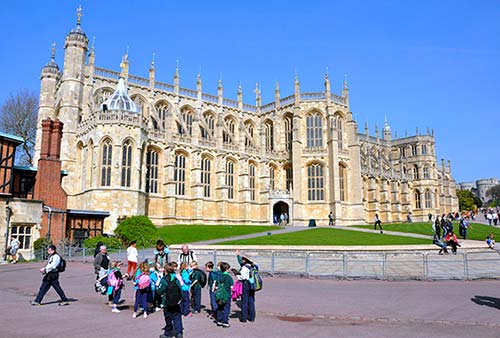
Stand at the back and look down the nave, with its classic fan vaulting spreading out from each slender pillar and nearly every joint capped with an elaborate and colorful roof boss. Most of these emblems are associated with the Knights of the Garter, who consider St. George’s their “mother church.” Under the upper stained-glass windows, notice the continuous frieze of 250 angels, lovingly carved with great detail, ringing the church.
In the back-left corner, take in the melodramatic monument to Princess Charlotte of Wales, the only child of King George IV. As she was heir to the throne, her death in 1817 (at 21, in childbirth) devastated the nation.
Head up the left side of the nave and find the simple chapel (just past the wooden gate) containing the tombs of Queen Elizabeth II; her husband, Prince Philip; and her parents, King George VI and the “Queen Mum” Elizabeth. Don’t expect to be alone here—crowds gather to see the black ledger stone inscribed with the four royal names—but there’s usually enough time for a quick peek before staff will tell you to move along. The tomb also contains the ashes of Queen Elizabeth’s younger sister, Princess Margaret (see the marble slab against the wall). Farther up the aisle is the tomb of Edward IV (on the right, past the door into the choir), who expanded St. George’s Chapel.
Stepping into the choir area, you’re immediately aware that you are in the inner sanctum of the Order of the Garter. The banners lining the nave represent the knights, as do the fancy helmets and half-drawn swords topping the spire of each wood-carved seat. These symbols honor only living knights; on the seats are some 800 golden panels memorializing departed knights.
Under your feet lies the Royal Vault, burial spot of Mad King George III (nemesis of American revolutionaries). Strolling farther up the aisle, notice the marker in the floor: You’re walking over the burial site of King Henry VIII and Jane Seymour, Henry’s favorite wife (perhaps because she died before he could behead her). The body of King Charles I, who was beheaded by Oliver Cromwell’s forces at the Banqueting House, was also discovered here...with its head sewn back on.
Exiting the choir area at the far end, you’ll be routed up a side aisle to the back of the church and the gift shop. On your way out, pause at the door of the sumptuous Albert Memorial Chapel, built in the 13th century and redecorated in 1861 after the death of Queen Victoria’s husband, Prince Albert, and dedicated to his memory.
• After exiting the chapel, you come into the castle’s...
5 Lower Ward
This area is a living town where some 160 people who work for the monarchy reside; they include clergy, military, and castle administrators. Just below the chapel, you may be able to enter a tranquil little horseshoe-shaped courtyard ringed with residential doorways—all of them with a spectacular view of the chapel’s grand entrance.
MORE SIGHTS IN WINDSOR
Legoland Windsor
Paradise for Legomaniacs, this huge, kid-pleasing park has dozens of tame but fun rides (often with very long lines) scattered throughout its 150 acres. The impressive Miniland has 40 million Lego pieces glued together to create 800 tiny buildings and a mini tour of Europe. Several of the more exciting rides involve getting wet, so dress accordingly or buy a cheap disposable poncho in the gift shop. While you may be tempted to hop on the Hill Train at the entrance, it’s faster and more convenient to walk down into the park.
Cost: £68 but varies by day, significant savings when booked online in advance, free for kids under three feet tall (90 cm).
Hours: Check website for current schedule; generally daily 10:00-17:00, often closed Wed outside of summer; closed in winter except for school holidays; +44 1753 626 416, legoland.co.uk.
Getting There: A shuttle bus (#702 & #703) runs from Windsor’s Parish Church stop on High Street (£3, 3/hour). For drivers, the park is on the B-3022 Windsor/Ascot road, two miles southwest of Windsor and 25 miles west of London. Legoland is clearly signposted from the M-3, M-4, and M-25 motorways (easy paid parking).
Eton College and High Street
Across the bridge from Windsor Castle is the most famous “public” (the equivalent of our “private”) high school in Britain. Eton College was founded in 1440 by King Henry VI; today it educates about 1,300 boys (ages 13-18), who live on campus. Eton has molded the characters of 19 prime ministers as well as members of the royal family—most recently princes William and Harry.
The college is officially closed to visitors except via once-weekly guided tours of the schoolyard, chapel, and cloisters (£15, Fri afternoons May-Sept; for details, visit etoncollege.com or email tours@etoncollege.org.uk). Eton’s several museums (Antiquities, Eton Live, Natural History) are open to the public on Sunday afternoons (free, Sun 14:30-17:00, access from Baldwin’s Shore Road).
Even if you don’t tour the college, it’s worth the few minutes it takes to cross the pedestrian bridge and wander straight up Eton’s High Street. A bit more cutesy and with more independent retailers than Windsor, Eton has a charm that’s fun to sample.
Boat Trips
Cruise up and down the River Thames for classic views of the castle, the village of Eton, Eton College, and the Royal Windsor Racecourse. Boats leave from the riverside promenade adjacent to Barry Avenue.
Cost and Hours: £13 for 40-minute tour, sailings depart every half hour mid-Feb-Oct daily 10:00-17:00, weekends only Nov-Dec, closed Jan-mid-Feb; +44 1753 851 900, frenchbrothers.co.uk.
Horse Racing
The horses race every Monday at the Royal Windsor Racecourse (£27 entry, online discounts, free for kids 17 and under with an adult, April-early Sept, 1.5 miles from Windsor on Maidenhead Road, +44 1753 498 400, windsor-racecourse.co.uk). The romantic way to get there from Windsor is by a 10-minute shuttle boat (£7.50 round-trip, frenchbrothers.co.uk). The famous Ascot Racecourse (described next) is also nearby.
NEAR WINDSOR
Ascot Racecourse
Located seven miles southwest of Windsor and just north of the town of Ascot, this royally owned track is one of the most famous horse-racing venues in the world. The horses first ran here in 1711, and the course is best known for June’s five-day Royal Ascot race meeting, famously and faithfully attended by the late Queen Elizabeth II and 299,999 of her loyal subjects. For some, the outlandish hats worn on Ladies Day (Thu) are more interesting than the horses. Royal Ascot is usually the third week in June. The pricey tickets go on sale the preceding November; while the Friday and Saturday races tend to sell out far ahead, tickets for the other days are often available close to the date. In addition to Royal Ascot, the racecourse runs the ponies year-round—funny hats strictly optional.
Cost: Tickets generally start at £39 and climb steeply from there, dress code enforced in some areas and on certain days, +44 3443 463 000, ascot.com.
Sleeping in Windsor
££££ Castle Hotel Windsor, which opened as an inn in 1528, offers 108 serene rooms and elegant public spaces in a central location just down the street from the castle. Rooms are split among the main building, the former Mews (stables), and a modern annex (air-con, elevator in main building, limited pay parking, 18 High Street, +44 1753 851 577, castlehotelwindsor.com, enquiries@castlehotelwindsor.com).
£££ Dee and Steve offer two self-catering units, each with fully equipped kitchens. Their four-bedroom place (sleeps six) is on a quiet residential street about a 10-minute walk from the castle and station. They also offer a two-bedroom apartment (The Nook) that sleeps three. The rooms are cozy, Dee and Steve are pleasant hosts, and the kitchens make it handy to eat in (169 and 173 Oxford Road, +44 1753 854 489, deeandsteve.com, dee@deeandsteve.com).
££ Park Farm B&B, bright and cheery, is most convenient for drivers. But even if you’re not driving, this beautiful place with seven well-equipped rooms is a good value and the welcome is warm; you’re unlikely to mind the bus ride into town (no children under 12, free off-street parking, 1.5 miles from the castle, £8 taxi ride from station, +44 7909 950 095, parkfarm.com, stay@parkfarm.com, Caroline Youds).
££ Crown and Cushion is a good option on Eton’s High Street, just across the pedestrian bridge from Windsor’s waterfront (a short uphill walk to the castle). While the pub it’s situated over is worn and drab, you’re right in the heart of charming Eton, and the eight creaky rooms—with uneven floors and old-beam ceilings—are nicely furnished (free parking, 84 High Street in Eton, +44 1753 861 531, thecrownandcushioneton.co.uk, info@thecrownandcushioneton.co.uk).
Eating in Windsor
Elegant Spots with River Views: Several places flank Windsor Bridge, offering romantic dining after dark. The riverside promenade, with cheap takeaway stands scattered about, is a delightful place for a picnic lunch or dinner with the swans. Eton’s High Street is also lined with characteristic eateries.
In the Tourist Zone Around the Palace: Strolling the streets and lanes around the palace entrance, you’ll find countless inviting eateries and a sampling of dependable British chains.
£££ The Ivy Royal Windsor, part of an upscale chain, is comfy and well suited for a quick bite just outside the Windsor & Eton Central station and across from the castle. If you just need a pick-me-up, they serve dessert and cream tea all day (long hours daily, open for breakfast, 31 High Street, +44 1753 983 555).
£££ À la Russe, with a cozy, woody atmosphere, serves elegant French and international dishes (two- and three-course lunch deals, Mon-Sat lunch and dinner, closed Sun, 6 High Street, +44 1753 833 009, alarusse.co.uk).
££ The Two Brewers, the oldest pub in Windsor, is a busy neighborhood place with a good selection of ales and wines. Their food is a step up from the usual grub, with a good mix of meat, fish, and salads (34 Park Street, daily, must be 18 or older to enter, +44 1753 855 426).
££ The Duchess of Cambridge, right across from the castle walls, serves up the normal grub in a pub. It’s big and modern, with an open fireplace and a hand-formed copper bar to boot. Their sticky toffee pudding gets high marks (daily, 3 Thames Street, +44 1753 864 405).
££ Al Fassia, just beyond the end of the pedestrian zone, has authentic Moroccan cuisine, including tagines, couscous, and grilled meats (Mon-Fri dinner only, Sat-Sun lunch and dinner, 27 St. Leonards Road, +44 1753 855 370).
££ Viceroy of Windsor is the local choice for Indian and Bangladeshi cuisine, with a modern interior and tasty dishes that are designed for sharing (daily lunch and dinner, 49 St. Leonards Road, +44 1753 858 005).
£££ The Carpenters Arms serves good traditional pub food in healthy portions. It’s near the castle in the cobbled-street area (daily, 4 Market Street, +44 1753 863 739).
£££ The Boatman, on the river overlooking Eton, serves classic British fare. In fine weather, choose the outdoor terrace and watch the river laze along (daily, 10 Thames Side, +44 1753 620 010).
Cambridge
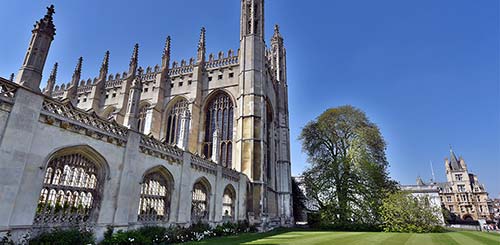
Historic Cambridge, 60 miles north of London, is world-famous for its prestigious university. William Wordsworth, Isaac Newton, Charles Darwin, Alan Turing, Jane Goodall, and King Charles III are only a few of its illustrious alumni. The university dominates—and owns—most of Cambridge, a town of about 125,000 people. It is the epitome of a university town, with busy bikers, stately residence halls, plenty of bookshops, and proud locals who can point out where DNA was originally modeled, the atom first split, and electrons discovered.
In medieval Europe, higher education was the domain of the Church and was limited to ecclesiastical schools. Scholars lived in halls on campus, which came to be known as “colleges.” The first at Cambridge, Peterhouse, was founded in the 1280s. By 1350, Cambridge had eight separate colleges, each a self-contained world in itself—enclosed behind walls, with a monastic-type courtyard, a chapel, a library, and lodgings. These colleges allied in a federation known as the University of Cambridge, an arrangement that survives to this day. Today, Cambridge has 31 colleges, with about 12,000 undergrads, scattered around the town center.
For travelers, Cambridge offers a pleasant medieval-era town, art-filled churches and museums, and—most of all—a chance to see some of the colleges (many are open to visitors—some are free and others require a ticket or a guided tour). You can usually stroll the grounds and pop into a few public areas (mainly chapels and dining halls).
The town is easy to sort out. There’s a small commercial center (traffic-free except for lots of bikes), one important museum (the Fitzwilliam), and lots of minor museums (all generally free). The River Cam has boat tours, three public bridges, and a strip of six colleges, which have gardens that basically own the river through the center of town and make it feel like an exclusive park. King’s College has a famous ornate chapel, and Trinity College has its storied Wren Library. The city is filled with students year-round—scholars throughout the regular terms and visiting students enjoying summer programs.
PLANNING YOUR TIME
Cambridge can easily be seen as a day trip from London. A good five-hour plan is to follow my self-guided walk, spend an hour on a punt ride, tour the Fitzwilliam Museum (closed Mon), and see the Wren Library at Trinity College (usually open only two hours a day Mon-Fri year-round and Sat during full term). For a little extra color, consider joining a town walking tour (these repeat much of my self-guided walk but splice in local flavor).
Your visit will be affected somewhat by the university schedule. Cambridge has three terms: Lent term (mid-Jan to mid-March), Easter term (mid-April to mid-June), and Michaelmas term (early Oct to early Dec). During exams (roughly mid-May to mid-June), the colleges are closed to visitors, which can impede access to some of the town’s picturesque little corners.
When class is in session, Cambridge bustles with students buzzing about on bikes. Between terms it’s quieter, but Cambridge is never sleepy and the main sights—King’s College Chapel and the Wren Library at Trinity College—usually stay open. On good-weather weekends, the town overflows with visitors—many of them trying their hand, unsuccessfully, at punting the Cam.
If you’re in town in the early evening, the evensong service at King’s College Chapel (Tue-Sat at 17:30, Sun at 15:30 during term) is a must. And if you like plays and music, events are always happening in this thriving cultural hub.
GETTING TO CAMBRIDGE
By Train: It’s an easy 50-minute trip from London’s King’s Cross Station (2/hour express trains). Cheaper direct trains also run from London’s Liverpool Street Station, but take longer (2/hour, 1.5 hours; nationalrail.co.uk).
By Bus: FlixBus has frequent direct service from London’s Victoria Coach Station to the Parkside stop in Cambridge (every 60-90 minutes, about 3 hours, flixbus.com), but the train from Liverpool Street Station is just as cheap, takes half the time, and runs more frequently than the bus.
Orientation to Cambridge
Cambridge has a population of about 125,000, but the area visitors enjoy seeing is compact: Everything is within a pleasant 15-minute walk. The main colleges form a north-south row, bordered on one side by the River Cam and on the other by the town. The town center, brimming with tearooms and shops, has a colorful open-air market square. The train station is about a mile to the southeast.
Tourist Information: There is no official TI in Cambridge, but a local entrepreneur offers advice and maps in the historic Guildhall just off Market Square, (daily 10:00-16:00, 11 Peas Hill, +44 1223 921 800, visitcambridge.org).
ARRIVAL IN CAMBRIDGE
By Train: Cambridge’s train station is about a mile southeast of the center. To get to Market Hill Square, it’s fastest to pay about £8-10 for a taxi. Public buses #1, #3, and #7 go to Emmanuel Street in the center from stops near the station (exiting the station, turn left, cross the street, and walk a half-block; tap-to-pay £2 as you board). If you want to stretch your legs, you can walk there in about 30 minutes (exit straight ahead on Station Road, bear right at the war memorial onto Hills Road, and follow it as it becomes Regent Street on the way into town).
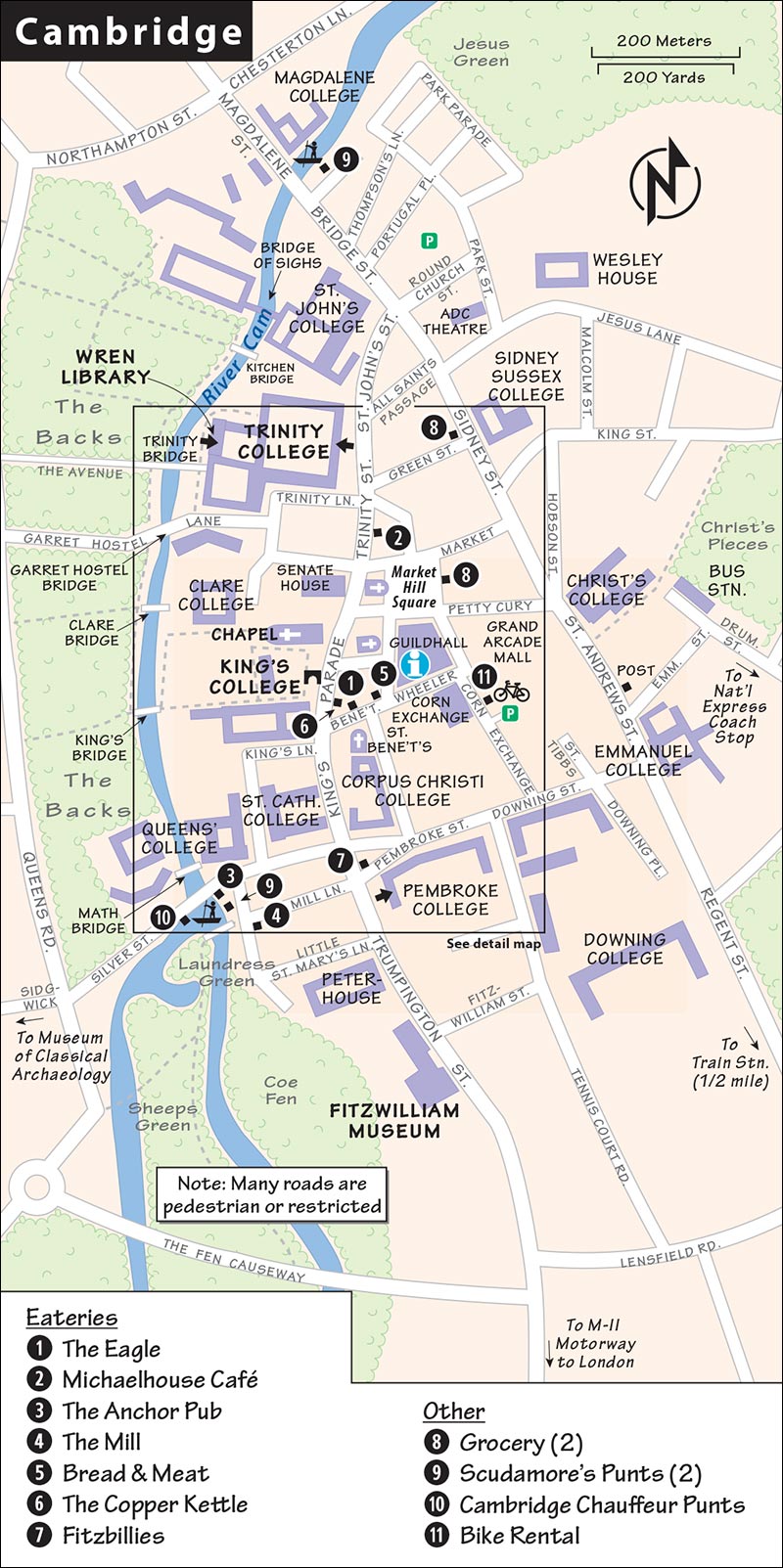
By Car: To park in the center, your best bet is the Grand Arcade Mall parking garage; follow signs from the M-11 motorway. Better yet, park for free in one of the park-and-ride lots outside the city and take the bus from there into town (cambridgeparkandride.info).
HELPFUL HINTS
- Live Theater and Entertainment: With all the smart and talented students in town, there is always something going on. Make a point of enjoying a play or concert. The Cambridge University Amateur Dramatic Club (ADC) is Britain’s oldest university playhouse, offering a steady stream of performances since 1855. It’s lots of fun, casual, and inexpensive. This is your chance to see a future Emma Thompson or Ian McKellen—alumni who performed here as students—before they become stars (on Park Street, +44 1223 300 085, adctheatre.com).
Cambridge Live Tickets handles online ticket sales for events at the Corn Exchange, Guildhall, and annual folk festival (+44 1223 357 851, cambridgelivetickets.co.uk).
- Festivals: The Cambridge Folk Festival gets things humming and strumming in late July or early August (tickets go on sale several months ahead; cambridgefolkfestival.co.uk). From mid-July through August, the town’s Shakespeare Festival attracts thousands of visitors for outdoor performances in some of the college’s gardens (cambridgeshakespeare.com).
- Bike Rental: In the Grand Arcade shopping mall, Primo Cycles rents bikes (closed Sun, 10 Corn Exchange Street, +44 1223 500 502, primocycles.co.uk).
Tours in Cambridge
▲▲Cambridge Walking Tours
A walking tour is the best way to understand Cambridge’s mix of town and gown. These walks provide a good rundown of the historic and scenic highlights of the university, some fun local gossip, and plenty of university trivia. The Society of Cambridge Tourist Guides leads tours of various lengths and topics; their 1.5-hour Cambridge Highlights tour covers a variety of city-center landmarks (see their current offerings and book at sctg.org.uk). For walking and punting tours led by current students and alumni, check out Cambridge Alumni Tours (£25, 1.5-hour highlights tour, cambridgealumnitours.co.uk).
Cambridge Town and College Walk
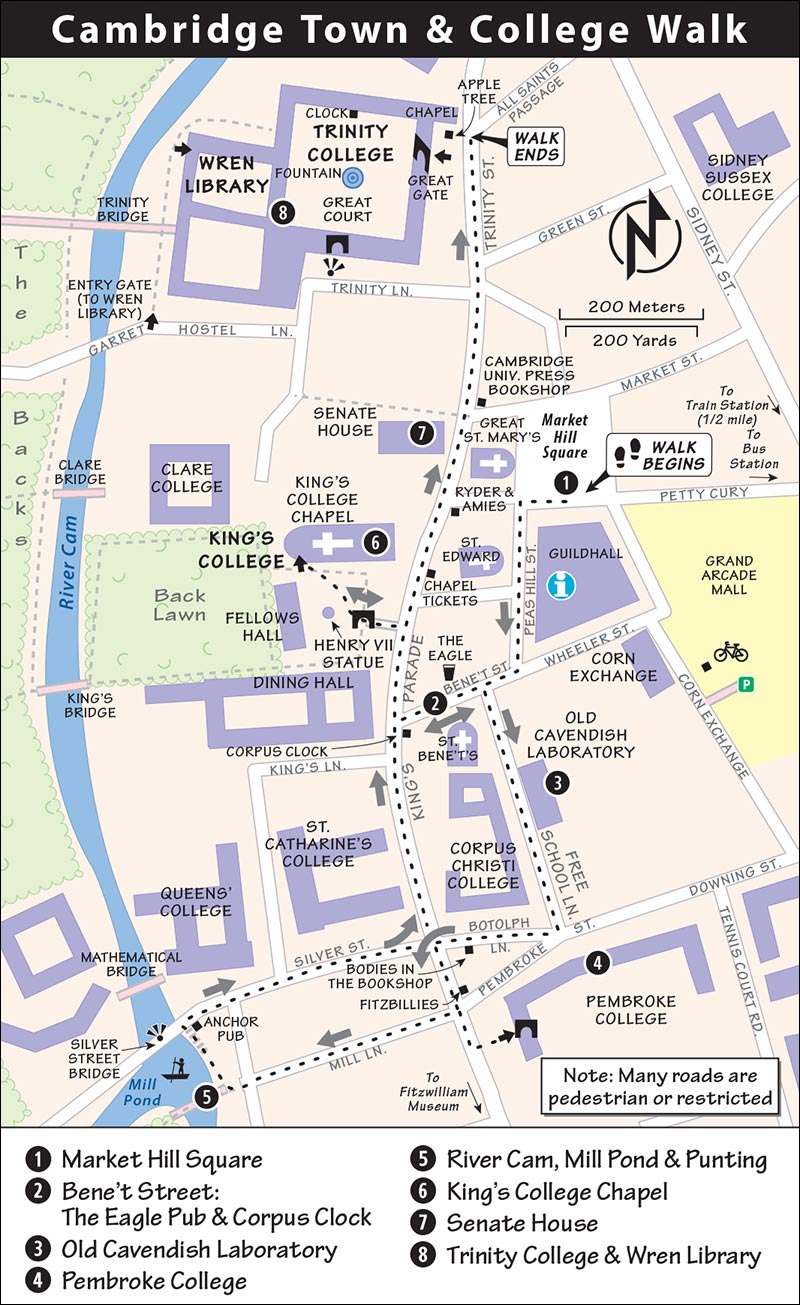
This self-guided walk covers the essential sights. We start in the old market square, see where the double helix of DNA was deciphered, visit a typical college, pause at the dreamy River Cam, enjoy the glory of King’s College Chapel, and finish at Trinity College with its famous Wren Library (hours are limited so plan accordingly; see stop #8 at the end of this walk). Although we won’t go as far as the Fitzwilliam Museum, you can easily visit it on your own (covered in “Sights in Cambridge,” later).
• Start on Market Hill Square in front of the brick Guildhall, with a big clock up top.
1 Market Hill Square
This square has been a center of commerce for more than a thousand years. At a glance, you can see the elements that combined to make Cambridge: church (Great St. Mary’s rear end), university (those modern buildings are student lodgings), and trade (the open-air market and Guildhall).
Think of the history this place has seen: Romans first built a bridge over the Cam in AD 43, Anglo-Saxons and Danes established a market here in the Middle Ages, and Normans built a castle here (now gone) in the 11th century. The city’s coat of arms (above the Guildhall door) shows medieval boats flocking to trade at the newly built bridge over the River Cam, which established “Cam-bridge.”
But the big year was 1209. After scuffles in Oxford between its scholars and townsfolk, many of Oxford’s academics fled here and started their own university. Where’s “the university”? Everywhere, mixed into the town, with the 31 individual colleges, university halls, and student dorms scattered about.
Cambridge suffered no bomb damage in World War II, so the older buildings you see are original. As you walk, notice how peaceful the town is, with almost no cars, but bikes everywhere.
The Guildhall facing this square (the seat of the city council today) overlooks market stalls. The big market on Sunday features produce, arts, and crafts. On other days, you’ll find mostly clothes and food stands (daily generally 10:00-16:00).
• Leave the market area by heading down Peas Hill Street (next to the Guildhall, with the “TI” inside). At the end of the street, turn right onto...
2 Bene’t Street: Eagle Pub and Corpus Clock
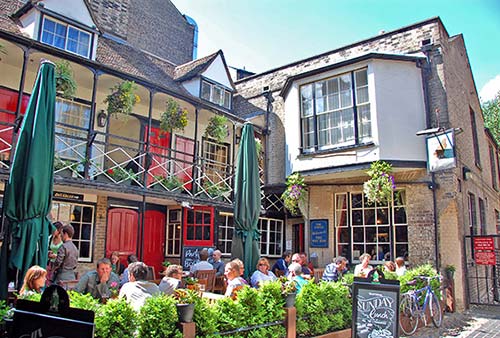
The Eagle Pub, a venerable joint, is just down Bene’t Street on the right. This is Cambridge’s oldest pub and a sight in itself. Poke into the courtyard and atmospheric rooms even if you don’t eat or drink here. From the courtyard, look up at the balcony of second-floor guest rooms that date back to when this was a coachmen’s inn as well as a pub. (It’s said that in Shakespeare’s time, plays were performed from this perch to entertain guests below.) Back inside the pub, find the fireplace with a photo and plaque that remember two esteemed regulars—Francis Crick and James Watson, the scientists who first described the structure of DNA. They announced their finding here in 1953.
At the back of the Eagle is an annex called the RAF Bar. During World War II, US Army Air Corps pilots famously hung out here before missions over Germany. The fun interior is plastered with stickers of air crews and WWII memorabilia.
St. Bene’t’s Church, across the street from the pub, is the oldest surviving building in Cambridgeshire. The rough stone tower dates from 1020. The Saxons who built the church included circular holes in its bell tower to encourage owls to roost there and keep the mouse population under control.
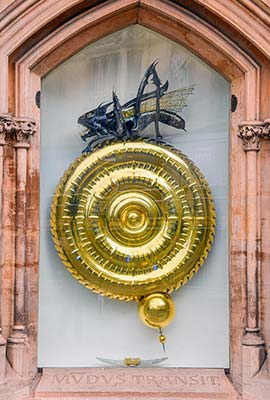
Just beyond the church, at the corner of Bene’t Street and King’s Parade, stand before the Corpus Clock. Designed and commissioned by Corpus Christi College alum John Taylor, this clock was unveiled by Cambridge physicist Stephen Hawking in a 2008 ceremony. Perched on top is the Chronophage—the “time eater”—a grotesque giant grasshopper that keeps the clock moving and periodically winks at passersby. The message? Time is passing, so live every moment to the fullest. It’s a real clock—one blue light marks the hour, the other the minutes. At the top of the hour, it chimes with the sound of rattling chains.
• Head back toward the church and turn down little Free School Lane. Pause when you reach the gold-lettered sign for...
3 Old Cavendish Laboratory
Between 1874 and 1974, some of the greatest scientific minds in the world were at work in this building, home to the university’s department of physics. Cavendish researchers confirmed the existence of the electron (1897) and the neutron (1932), and they conducted the first controlled splitting of an atom (1932). Watson and Crick may have announced their DNA findings at The Eagle, but they did their work in this lab. How successful is this research institution? It’s produced 30 Nobel laureates. (The lab may be open to visitors; look for signs.)
• Continue along Free School Lane to the end of the block, toward a whitewashed house listing in Cambridge’s notoriously marshy ground. At the house, turn right into Botolph Lane. Pass Bodies in the Bookshop (“specializing in murder”), then turn left, noticing the recommended Fitzbillies café (famous for its cinnamon rolls). Cross the next street and walk a few steps to the entrance (on the left) to...
4 Pembroke College
Founded in 1347, Pembroke is the third-oldest college in Cambridge (free, open daily). Step into the court, past the porter’s lodge—it’s polite to say hello and ask whether you can wander around. Survey the court. Ahead of you is the medieval dining hall. The fancy building with the pointed clock tower is the library (the statue in front is alumnus William Pitt the Younger—a great 18th-century prime minister), with a charming garden beyond.
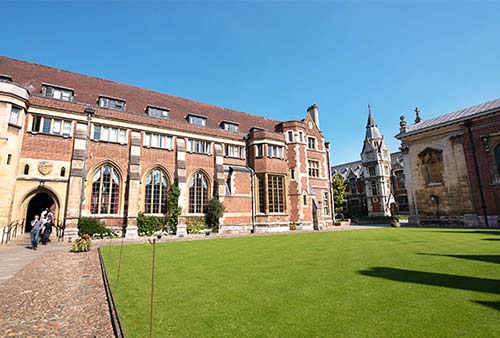
The highlight here is the chapel, to the right. It dates from about 1660 and is the first building (of any kind, anywhere) completed by famed architect Christopher Wren. He’s known for the many churches he built in the late 1600s, culminating in St. Paul’s Cathedral in London. Wren gave this his typical two-toned treatment: white walls above and wood paneling below, lit brilliantly by tall windows and topped with an ornamental plaster ceiling. Before stepping inside to enjoy the interior, pause for a moment at the somber WWI and WWII memorial under the arcade. During the Great War, one in four students and faculty was killed.
• From Pembroke College, cross King’s Parade, jog slightly right, and follow Mill Lane directly down to the River Cam and its mill pond.
5 River Cam, the Mill Pond, and Punting
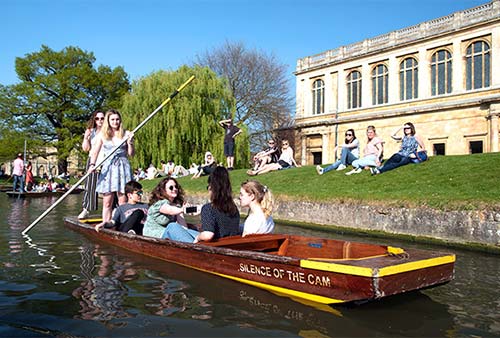
From this perch you see the “harbor action” of Cambridge. The city was an important port in medieval times: Trading vessels from the North Sea (40 miles away) could navigate to here. Today a weir divides the River Cam from one of its tributaries, sometimes called the River Granta (on the left)—which leads through idyllic countryside from the town of Grantchester. Filling the mill pond is a commotion of the iconic Cambridge boats called punts. Students hustle to take visitors on a 45-minute trip with fun commentary (see “Punting on the Cam,” later in this chapter). Skilled residents rent boats for themselves, as do not-so-skilled tourists—much to the amusement of locals who sip their beer while watching clumsy visitors fumble with the boats (which are tougher to maneuver than they look). If you’d like a detour from this sometimes-chaotic scene, simply cross the weir and walk along the River Granta into the countryside—it quickly becomes sleepy and idyllic.
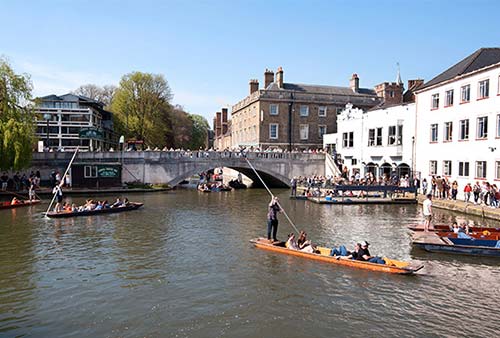
But to continue this town walk, turn right and follow the narrow walkway along the harbor past the recommended Anchor Pub, then up the stairs to the Silver Street Bridge. From the bridge, you can watch more punt action and check out the famous “Mathematical Bridge,” which links the old and new buildings of Queens’ College. This wooden bridge, although curved, is made entirely of straight boards.
Gazing upstream past the wooden bridge, you see the start of the park known as “the Backs”—the backs of six colleges that line the river, with their fine architecture and most with bridges connecting campus grounds or buildings on both sides of the river.
• Return to King’s Parade and turn left. Soon you’ll see the regal front facade of King’s College. We’ll stop here to visit...
6 King’s College Chapel
King’s College Chapel, built from 1446 to 1515 by Henrys VI through VIII, is rated ▲▲. It’s England’s best example of Perpendicular Gothic architecture—and the most impressive building in Cambridge.
Cost and Hours: £17; generally open Mon-Sat 9:30-15:00, closed Sun, hours may vary due to school events—check website for schedule; +44 1223 331 100, kings.cam.ac.uk [URL inactive]. If you didn’t buy tickets online, there’s a ticket desk at the King’s College visitors center (13 Kings Parade, across from the main entrance gate).
Evensong: When school’s in session, you’re welcome to enjoy an evensong service in this glorious space, with a famous choir made up of men and boys (free, Mon-Sat at 17:30, Sun at 15:30; confirm schedule at kings.cam.ac.uk [URL inactive]; for more on evensong, see here).
Visiting the Chapel: Enter through the grand gateway to the spacious grounds. In the courtyard, you’re surrounded by buildings from every era of the college’s long history. To the right is the famous chapel, straight ahead is the Neoclassical fellows hall, and to the left is the Neo-Gothic dining hall. The statue in the center is Henry VII, the man most responsible for the wonder we’ll see next.
Head for the chapel and step inside. Stand and look down the nave, with its tunnel-like effect that accentuates both its length (290 feet) and height. It’s exactly twice as tall (80 feet) as it is wide. Look up and marvel, as Christopher Wren did, at what was then the largest single span of vaulted roof anywhere. Built between 1512 and 1515, its 2,000 tons of incredible fan vaulting—held in place by the force of gravity—are a careful balancing act resting delicately on the buttresses visible outside the building. The round bosses in the center, each weighing nearly two tons, are what hold the structure together.
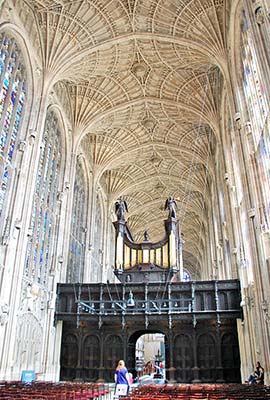
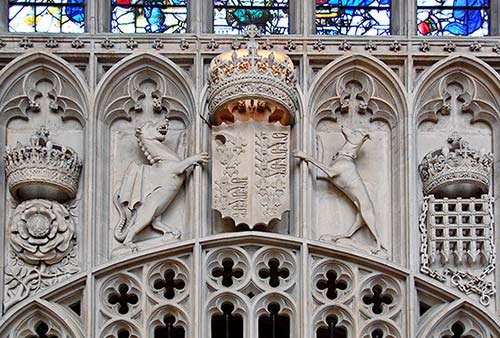
While Henry VI—who began work on the chapel—wanted it to be austere, his descendant Henry VII decided it should glorify the House of Tudor. So, lining the cream-colored walls are the personal symbols of Henry VII and his wife. There’s the giant Tudor coats of arms supported by a dragon (symbolizing Henry’s dad) and greyhound (from his mom’s side of the family). Find other iconography adorning the nearby pillars: The Tudor double rose (of red and white roses) symbolizes the end of the bitter Wars of the Roses. The depiction of a portcullis grate (seen especially in the fan vaulting) honors the Beauforts, the family of Henry VII’s mother. And the fleur-de-lis in the coat of arms kept alive the fading hope that someday they might reclaim their place as rulers of France.
The 26 stained-glass windows date from the 16th century. It’s the most Renaissance stained glass anywhere in one spot. (Most of the stained glass in English churches dates from Victorian times, but this glass is three centuries older.) The lower panes show scenes from the New Testament, while the upper panes feature corresponding stories from the Old Testament.
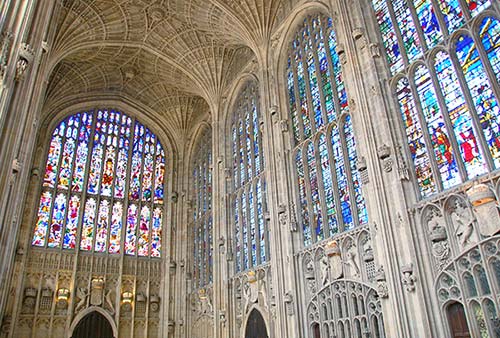
Considering England’s turbulent history, it’s miraculous that these windows have survived for half a millennium in such a pristine state. After Henry VIII separated from the Catholic Church in 1534, many such windows and other Catholic features around England were destroyed. But Henry had just paid for these windows, and he couldn’t bear to destroy them. A century later, in the days of Oliver Cromwell, another wave of iconoclasm destroyed more windows around England. Though these windows were slated for removal, they stayed put. Finally, during World War II, the windows were taken out and hidden away for safekeeping, then painstakingly replaced after the war ended. The only nonmedieval windows are on the west wall (opposite the altar). These are in the Romantic style from the 1880s; when Nazi bombs threatened the church, all agreed they should be left in place.
The choir screen that bisects the church was added by Henry VII’s son, King Henry VIII—on the medallions at eye level, see his H. R. monogram: Henry Rex. He commissioned the oak screen to commemorate his marriage to Anne Boleyn, but by the time it was finished, so was she (beheaded). Her initials had already been carved into the screen (look on the far upper left and right for R. A.: for Regina Anna—“Queen Anne”). Behind the screen is the choir area, elaborately carved with the crests of the college and university. This is where the renowned King’s College Choir performs. There’s a daily evensong (during school terms), with students in the front-row stalls, the choir in the middle, and fellows in back. On Christmas Eve, a special service is held here and broadcast around the world on the BBC—a tradition near and dear to British hearts.
At the far end of the church is Rubens’ masterful Adoration of the Magi (1634). It’s actually a family portrait: The admirer in the front (wearing red) is a self-portrait of Rubens, Mary looks an awful lot like his much-younger wife, and the Baby Jesus resembles their own newborn at the time.
Inside the chapel to the right (as you face the altar) is a memorial to those who died in the two world wars.
Finally, cross the nave to the door on the far side, with a long and fascinating series of side rooms that run the length of the nave. Dedicated to the history and art of the church, these are a great little King’s College Chapel museum.
• Back out on King’s Parade, continue down to the grand Neoclassical facade of the...
7 Senate House
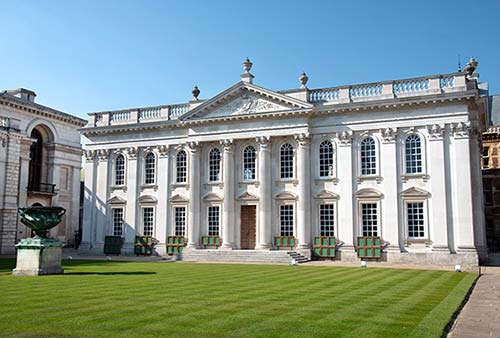
This stately classical building with triangular pediments is the ceremonial heart of the University of Cambridge. It’s where the university’s governing body meets and where degree ceremonies are held. In June, you might notice green boxes lining the front of this house. Traditionally, at the end of the term, students came to these boxes to see whether they had earned their degree; those not listed knew they had flunked. Until 2010, this was the only notification students received about their status. (These days, they get an email.)
Looming across the street from the Senate House is Great St. Mary’s Church (aka the University Church), with a climbable bell tower (£7.50, Mon-Sat 10:00-18:00, Sun 12:00-16:30, 123 stairs). On the corner nearby is Ryder & Amies (22 King’s Parade), which has been the official university outfitter for 150 years; it’s the place to stock up on academic robes and gowns. On the corner just beyond Great St. Mary’s is the Cambridge University Press bookshop: It’s the oldest bookstore site in Britain—and the press is the oldest publisher in the world (they’ve been selling books since 1581).
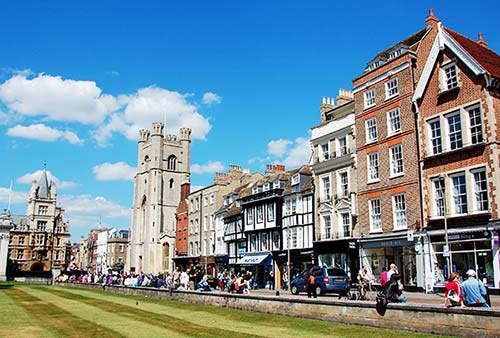
• Carry on along King’s Parade (which becomes Trinity Street) to our final stop—a five-minute walk from here. The road (and sidewalk) narrows as you squeeze between some old houses. Soon you’ll see yet another grand college on your left.
8 Trinity College and Wren Library
Of the more than 100 Nobel Prize winners affiliated with Cambridge, about a third come from this richest and biggest of the town’s colleges, founded in 1546 by Henry VIII. The college has three sights to see, together worth ▲▲: the entrance gate (always viewable), the grounds (accessible only with a guided tour), and the magnificent Wren Library (limited hours, see below). The following costs and opening hours are subject to change—call in advance and time your visit to the library’s limited open hours.
Cost and Hours: Options for your visit include a one-hour guided tour of the courts (including the Great Court)—£5, usually daily 10:00 & 14:00, must call to book a spot, trin.cam.ac.uk/about/book-guided-tours; The Backs (the grounds beside the River Cam)—free, usually daily 9:00-17:00 but may close for special events; the Wren Library—free, usually Mon-Fri 12:00-14:00, during full term also Sat 10:30-12:30, closed Sun year-round, access via Garret Hostel Lane; and the chapel—open to visitors during services most of the year, check the website; +44 1223 338 400.
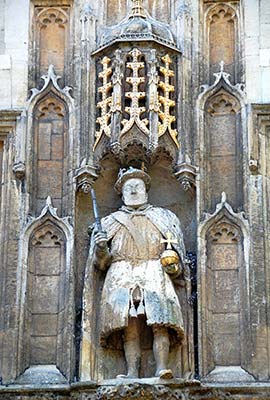
Trinity Gate: You’ll notice gates like these adorning facades of colleges around town. Above the door is a statue of King Henry VIII, who founded Trinity because he feared that Cambridge’s existing colleges were too cozy with the Church. Notice Henry’s right hand, which (for now at least) holds a gilded scepter. A century ago, student pranksters replaced the original scepter with a chair leg. Another campus yarn is the tale of some of the world’s most talented mountaineers, who enrolled at Cambridge...in one of the flattest parts of England. (Cambridge was actually a seaport until Dutch engineers drained the surrounding swamps.) Lacking opportunities to practice their skill, they began scaling the frilly facades of Cambridge’s college buildings under cover of darkness (if caught, they’d have been expelled). In the 1960s, climbers actually managed to haul an entire automobile onto the roof of the Senate House. The university had to bring in the army to cut it into pieces and remove it. Only 50 years later, at a class reunion, did the guilty parties finally fess up.
In the little park to the right of the gate, notice the lone apple tree. Supposedly, this tree is a descendant of the very one that once stood in the garden of Sir Isaac Newton (who spent 30 years at Trinity). According to legend, Newton was inspired to investigate gravity when an apple fell from the tree onto his head. This tree stopped bearing fruit long ago; if you do see apples, they’ve been tied on by mischievous students.
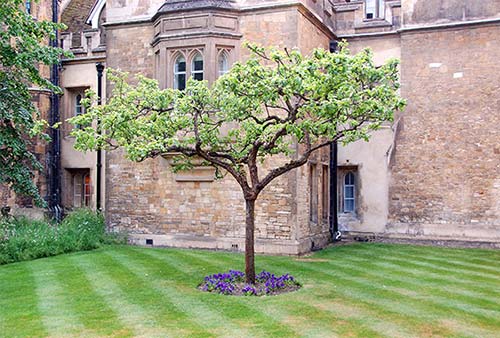
Beyond the gate are the Trinity grounds. If you don’t go in, note that there’s often a fine and free view of Trinity College courtyard from Trinity Lane—if the gate there is open (this lane leads, under a uniform row of old chimneys, to Garret Hostel Lane and the entrance to the Wren Library).
Trinity Grounds: The grounds are enjoyable to explore, though to see them you’ll need to book a tour (except for The Backs, on the River Cam side). Inside the Great Court, the clock (on the tower on the right) double-rings at the top of each hour. It’s a college tradition to take off running from the clock when the high noon bells begin (it takes 43 seconds to clang 24 times); race around the courtyard, touching each of the four corners without setting foot on the cobbles; and try to return to the same spot before the ringing ends. Supposedly only one student (a young lord) ever managed the feat—a scene featured in Chariots of Fire (but filmed elsewhere).
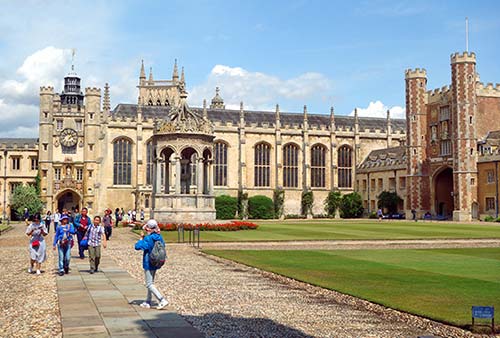
The chapel—which pales in comparison to the stunning King’s College Chapel—feels like a shrine to thinking, with statues honoring great Trinity minds both familiar (Isaac Newton, Alfred Tennyson, Francis Bacon) and unfamiliar. Who’s missing? The poet Lord Byron, who was such a hell-raiser during his time at Trinity that a statue of him was deemed unfit for Church property; his statue stands in the library instead.
• To reach the library, follow Trinity Lane to Garret Hostel Lane; at the end of the street, just before a footbridge over the river, enter the campus through the big wooden gate. From there, it’s a short walk straight ahead to the library entrance.
Wren Library: Don’t miss the 1695 Christopher Wren-designed library, with its wonderful carving and fascinating original manuscripts. While free to enter, it’s open only limited hours, so you’ll need to plan your visit carefully.
Just outside the library entrance, Sir Isaac Newton clapped his hands and timed the echo to measure the speed of sound as it raced down the side of the cloister and back. Inside, admire Wren’s design—long, white, and aglow with the bright light of the Enlightenment. Wren designed the whole ensemble, including the bookshelves topped with busts of great thinkers. (The one thing he didn’t design is the stained-glass window showing him being honored by George III.) Unlike other libraries at Cambridge, Wren designed Trinity’s on the building’s upper floor, not the damp, dark ground floor. As a result, Wren’s library is flooded with light, rather than water.
In the library’s 12 display cases (covered with protective cloth that you flip back), you’ll see a (rotating) display of medieval manuscripts, first editions, letters, and documents. You might see works by William Shakespeare, John Milton, Samuel Taylor Coleridge, and Charles Darwin, and A. A. Milne’s original Winnie the Pooh (the real Christopher Robin attended Trinity College). Don’t miss the case with Newton’s memorabilia—a lock of his hair, notebook, pocket watch, walking stick, and prism he used to see how light bent. Marvel at the first edition (1687) of Newton’s landmark Principia Mathematica, annotated with his corrections for the next printing; it forever changed the way humans viewed the physical world.
Sights in Cambridge
My self-guided walk takes you to most of the main sights in Cambridge, but not all. Here are a few other sights and activities worth your time.
▲▲Punting on the Cam
For a little levity and probably more exercise than you really want, try renting one of the traditional flat-bottom punts at the river. You’ll use a giant pole to push yourself up and down (or around and around, more likely) the lazy Cam. The water’s only about six or seven feet deep, so you move by literally pushing off from the river floor (someone in front can use a little paddle to help out). This is one of the best memories the town has to offer, and once you get the hang of it, it’s a fine way to enjoy the scenic side of Cambridge. It’s less crowded in late afternoon (and less embarrassing).
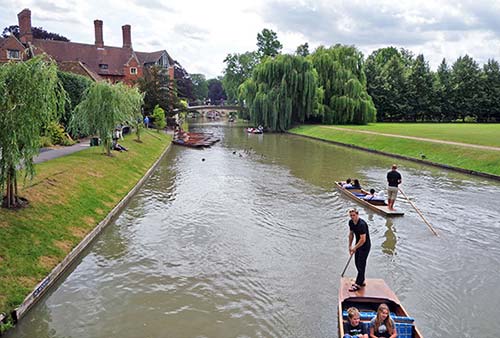
Better yet, let someone else do the punting while you enjoy the ride. The 45-minute lazy punting trips are a delight—informatively narrated by your punter, who tries to avoid the clueless tourists creating a moving, aquatic obstacle course. On a nice-weather day, there are few more relaxing activities.
Several companies rent punts and also offer tours (generally open daily 9:00-dusk when the weather’s decent). Typically you’ll pay about £32/hour to rent a punt, or £25-40/person to join a guided punt. If it’s quiet, don’t be afraid to bargain. Scudamore’s has two locations: on Mill Lane, just south of the central Silver Street Bridge; and at the less convenient Quayside at Magdalene Bridge, at the north end of town (+44 1223 359 750, scudamores.com). Cambridge Chauffeur Punts is directly across the pond and just under the Silver Street Bridge (+44 1223 354 164, punting-in-cambridge.co.uk).
▲Fitzwilliam Museum
One of Britain’s best museums of antiquities and art outside London is the Fitzwilliam. Housed in a grand Neoclassical building a 10-minute walk south of Market Hill Square, it’s a palatial celebration of beauty and humankind’s ability to create it.
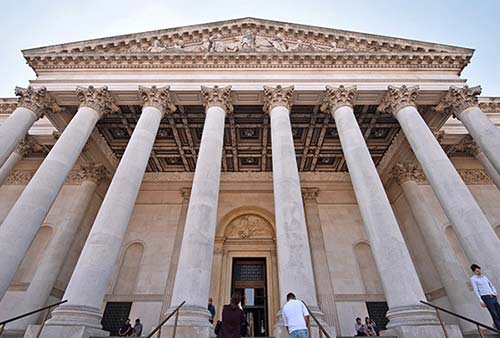
Cost and Hours: Free; Tue-Sat 10:00-17:00, Sun from 12:00, closed Mon; lockers, Trumpington Street, +44 1223 332 900, fitzmuseum.cam.ac.uk.
Visiting the Museum: The Fitzwilliam’s broad collection is like a mini British Museum/National Gallery rolled into one. The ground floor features antiquities and applied arts—everything from Greek vases, Mesopotamian artifacts, and Egyptian sarcophagi to Roman statues, fine porcelain, and suits of armor.
Upstairs is the painting gallery, with works that span art history: Italian Venetian masters (such as Titian and Canaletto), a worthy English section (featuring Gainsborough, Reynolds, Hogarth, and others), a notable array of French Impressionist art (including Monet, Renoir, Pissarro, Degas, and Sisley), and even a few small Picassos. Rounding out the collection are its literary and illuminated manuscripts, including some of Handel’s musical scores.
Museum of Classical Archaeology
Although this museum contains no originals, it offers a unique chance to study 19th-century copies of virtually every famous ancient Greek and Roman statue. More than 450 plaster casts are on display.
Cost and Hours: Free; Tue-Fri 10:00-17:00, Sat from 14:00 during term, closed Sun-Mon year-round; on Sidgwick Avenue—a five-minute walk west of the Silver Street Bridge (with all the punts), +44 1223 330 402, classics.cam.ac.uk/museum [URL inactive].
NEAR CAMBRIDGE
Imperial War Museum Duxford
This former airfield, nine miles south of Cambridge, is popular with aviation fans and WWII history buffs. Wander through seven exhibition halls housing 200 vintage aircraft (including Spitfires, B-17 Flying Fortresses, a Concorde, and a Blackbird spy plane) as well as military land vehicles and special displays on Normandy and the Battle of Britain.
Cost and Hours: £27; daily 10:00-18:00, off-season until 16:00, last entry one hour before closing; +44 2070 913 067, iwm.org.uk/visits/iwm-duxford.
Getting There: The museum is located off the A-505 in Duxford. If using public transit, consult the helpful details on their website: Mondays through Saturdays, it’s best to take the train (from London or Cambridge) to Whittlesford Parkway Station, then catch bus #7A from there (6/day, 10 minutes). On Sundays, Myalls bus #132 runs directly to the museum from Cambridge’s train station (5/day, 30 minutes). Or taxi from Cambridge for about £30 one-way.
Eating in Cambridge
££ The Eagle is the oldest pub in town. While the food is mediocre, the atmosphere is outstanding, and it’s a Cambridge institution—with a history so rich that a visit here practically qualifies as sightseeing (daily, 8 Bene’t Street, +44 1223 505 020).
£ Michaelhouse Café is a heavenly respite from the crowds, tucked into the repurposed St. Michael’s Church, just north of Great St. Mary’s Church. Besides salads, sandwiches, and soups, they have an enticing array of cakes and cookies (Mon-Sat breakfast and lunch, Sun lunch only, Trinity Street, +44 1223 319 512).
££ The Anchor Pub has a prime spot overlooking the River Cam, the Mathematical Bridge, and Queens’ College. Drop anchor here for pub fare and some of the best people-watching in town. Choose from its outdoor riverside terrace, inside bar, or more romantic upstairs restaurant (daily, on the riverfront at Silver Street, +44 1224 353 554).
££ The Mill is a lively spot with a location right on the river. The clientele is a mixture of students and tourists; the tipples are craft brews, local ales, and ciders; and the food is updated pub standards (daily, 14 Mill Lane, +44 1223 311 829).
£ Bread & Meat serves simple soups and hearty sandwiches. Grab a signature porchetta sandwich to take away or snag a rustic table in the small dining room (daily unti1 20:00, near the Guildhall at 4 Bene’t Street, +44 7918 083 057).
££ The Copper Kettle, popular for its take on Greek and Turkish classics, is beautifully situated facing King’s College on King’s Parade (all-day menu served from 8:00 daily; 4 King’s Parade, +44 1223 308 448).
££ Fitzbillies, long a favorite for its cakes and sticky Chelsea buns, offers inviting lunch and afternoon tea menus (daily 8:00 until 18:00, near Pembroke College at 51 Trumpington Street, +44 1223 261 041).
£ Street Food on Market Hill Square: For a lunch on the go, browse the food carts tucked into the tight aisles of the open-air market that fills the historic old market square (daily 10:00-16:00). There’s no real seating—just squeeze in along the wall around the fountain in the middle of the square.
Supermarkets/Picnicking: There’s a Marks & Spencer Simply Food at the train station (long hours daily). Bigger options in the center include a Marks & Spencer food hall on Market Hill Square and a Sainsbury’s at 44 Sidney Street (at the corner of Green Street). A good picnic spot is Laundress Green, a grassy park on the river, at the end of Mill Lane near the Silver Street Bridge punts. There are no benches, so bring something to sit on.
Cambridge Connections
From Cambridge by Train to: London (King’s Cross Station: 2/hour express, 50 minutes, additional departures take about 1.25 hours; Liverpool Street Station: 2/hour, 1.5 hours), York (hourly, 2.5 hours, transfer in Peterborough). Train info: +44 3457 484 950, nationalrail.co.uk.
By Bus to: London (every 60-90 minutes, about 3 hours via FlixBus, flixbus.com), Heathrow Airport (1-2/hour, nearly 3 hours). Bus info: +44 8717 818 181, nationalexpress.com.