PTUJ & MARIBOR
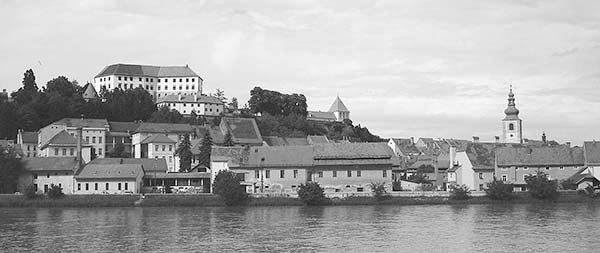
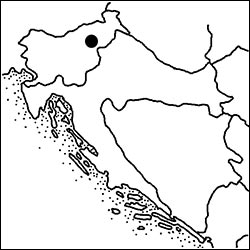
The vast majority of Slovenia’s attractions are concentrated in the western third of the country: the mountains, the sea, the capital, and the Karst. East of Ljubljana, the mountains gradually fade into cornfields, the towns and cities become less colorful, and “Oh, wow!” turns into “So what?” But there’s hope, in the form of Slovenia’s oldest town (and winner of the “funniest name” award): Ptuj (puh-TOOey—the “P” is almost silent; and yes, it really does sound like someone spitting). This small, sleepy, pleasant town boasts a creaky Old Town and a hilltop castle packed with museum exhibits. For a big-city complement to Ptuj, drop into Maribor—the country’s second city and the de facto capital of eastern Slovenia. Expect some contrasts from the more touristed parts of Slovenia. Even in this tiny country, rivalry rages between cities—and people here in the “02 Zone” (the area code-derived nickname that Slovenes use for this region) have their own dialect and identity.
PLANNING YOUR TIME
With a week or more in Slovenia and a desire to delve into the less-visited areas of the country, Ptuj deserves a look. A few hours are enough to feel you’ve mastered the town; if you’re a restless sightseer, it’s tough to fill an entire day here. Begin by touring the castle, then enjoy a wander through the Old Town and consider Ptuj’s other museums, or relax at the thermal baths across the river. If you can’t sit still that long, consider spending a few more hours on a side trip into Maribor.
Ptuj and Maribor are conveniently located on the train network and are easy to reach from Ljubljana, as well as from international destinations like Zagreb, Vienna, and Budapest.
Ptuj
With a storied past, a much-vaunted castle, and easygoing locals who act like they’ve never met a tourist, Ptuj is charming. Populated since the early Stone Age, Ptuj has a long and colorful history that reads like a Who’s Who of Central Europe: Celts and Romans, Dominican friars and Habsburg counts, Nazis and Yugoslavs...not to mention a fuzzy monster named Kurent. The people of Ptuj are particularly proud of their Roman era, when “Poetovio” was a bustling metropolis of 40,000 people (nearly quadruple today’s size). But even as it clings to its noble past, today’s Ptuj is refreshingly real, with a sleepy small-town ambience and an interesting castle/museum.
Though it hosts plenty of visitors (mostly Germans and Austrians, who call it “Pettau”), Ptuj is hardly a tourist town. Real people, not nightclubs or souvenir shops, populate the Old Town. If this makes Ptuj feel a bit less polished than the big-name sights in western Slovenia, so much the better—think of it as a diamond in the rough.
Orientation to Ptuj
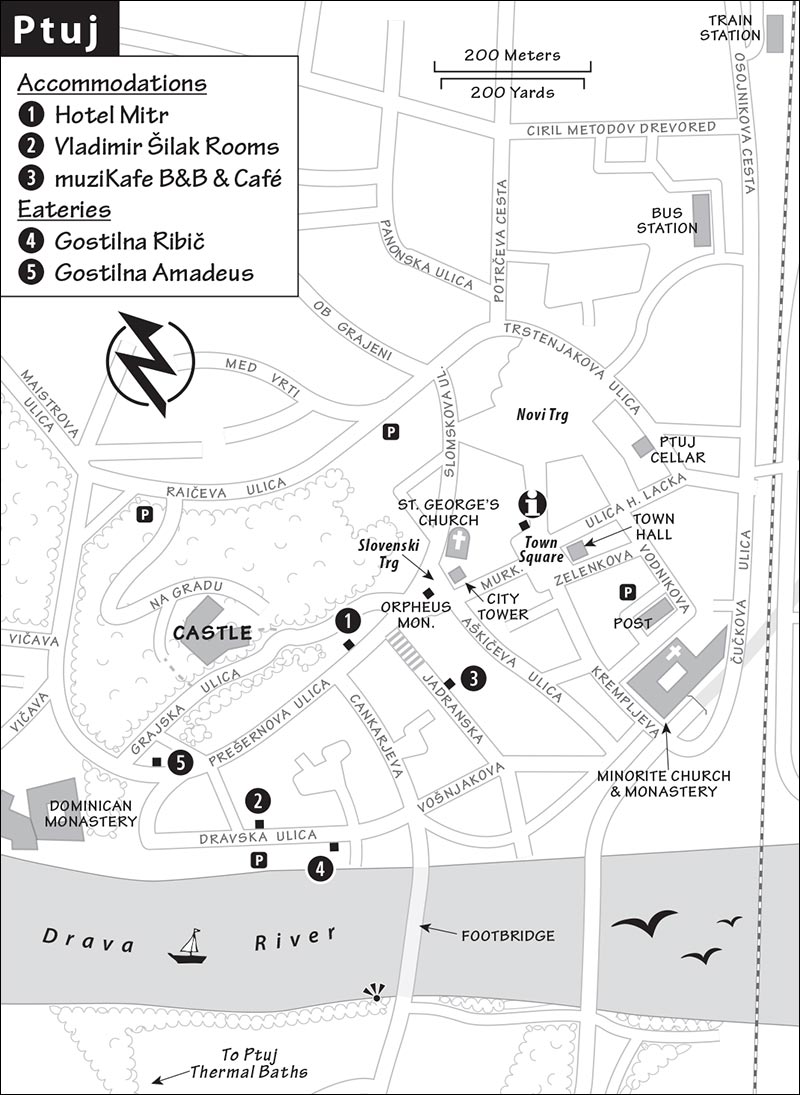
Ptuj is squeezed between its historic castle and the wide Drava River. With just 11,000 people (23,000 in greater Ptuj), it still ranks as Slovenia’s eighth-largest town. The Old Town is shaped roughly like a triangle, with the castle and two monasteries as its three points. You can walk from one end of the Old Town to the other in about 10 minutes. The town slopes gradually uphill from the river to the castle.
TOURIST INFORMATION
Ptuj’s TI has a line on local guides and runs occasional town walks in English (Mon-Sat 9:00-18:00, Sun 10:00-15:00, Mestni Trg 4, +386 2 779 6011, www.visitptuj.eu).
ARRIVAL IN PTUJ
The humble train station is about a 10-minute walk from the center. Exit the station to the left, then cross the busy road to the bus station. From the bus station, the Old Town is just on the other side of the big commercial center. If you’re driving in from the expressway, cross the big bridge into town and then watch for P signs to the left. Street parking in town is abundant and affordable—look for blue lines—but it’s limited to two hours. To visit the castle, follow brown Grad signs to twist up the road and park just below it.
Sights in Ptuj
PTUJ CASTLE (PTUJSKI GRAD)
Overlooking the town from its perch over the Drava River, Ptuj’s castle is less than thrilling from afar. But the horseshoe-shaped castle complex hosts a series of surprisingly rich and engaging exhibits, making a visit here worth ▲▲. The core of the collection shows off the lifestyles of the castle’s historic residents, while other exhibits display weapons, musical instruments, and traditional costumes used for the annual Kurentovanje festival.
Cost and Hours: €8, Tue-Sun 10:00-18:00, Oct-May until 16:00, closed Mon year-round, +386 2 748 0360, www.pmpo.si.
Getting There: The castle is about a 10-minute cobbled hike above the Old Town. Several trails lead up from the Old Town, all well marked with Grad signs (easiest to find is the lane called Grajska Ulica, near the City Tower).
 Self-Guided Tour: While good English descriptions are posted in most rooms, this tour links up the highlights. You’ll follow a one-way route. Not all of the exhibit entrances are well marked, but attendants can direct you. Touring the whole shebang takes about two hours.
• Buy your ticket in the long building just below the main part of the castle. This same building also has the castle’s highlight, the...
Collection of Traditional Carnival Masks: Ptuj’s Mardi Gras celebration, called Kurentovanje, is well known for its processions of fanciful masked characters (see sidebar). This exhibit—colorful as an episode of Sesame Street—offers an entertaining look at the complete Kurentovanje experience. The various costumes are all lined up in one long hall, as if reenacting the procession that stomps through Ptuj’s streets each spring. First come the spearmen, dressed more or less like normal folks. Soon after, the plow is used to symbolically “wake up the soil” and set the stage for a season of bountiful crops. Then you’ll see a group of striking Kurent costumes—from old homemade ones (turn an old coat inside-out to reveal the fur lining) to today’s store-bought versions (they run about €500). After the giant hen comes the bear, a reminder of times when Roma entertainers actually did bring trained bears to town. The horse (called Rusa) is taken by a farmer from house to house, trying to “sell” it to neighbors. But the horse is unruly and obnoxious—supposedly good luck for the health and fertility of livestock. The costume of the old woman carrying the old man on her back seems whimsical, but it represents a powerful theme: We carry the memory of the deceased with us always. Near the end are Jürek (swaddled in greenery, representing spring) and Rabolj (a Kurent-like monster, representing winter); these two do battle—and, of course, the spring always wins.
• Now head up into the main part of the castle, climbing the cobbled road into the courtyard. Show your ticket to go through the gate, and then climb the main stairs (on the left side of the courtyard) one floor up.
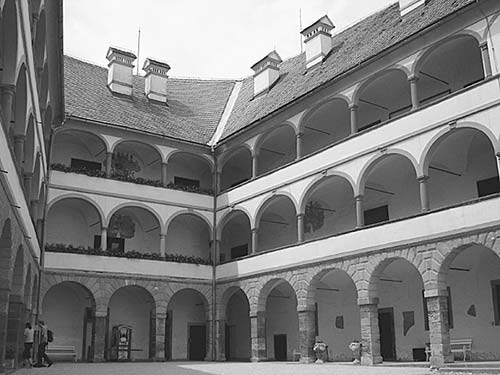
Courtyard: Look over the courtyard for this quick history lesson: In the 11th century, the archbishops of Salzburg built a fortress here. In the 12th century, the Lords of Ptuj, who watched over the Salzburgers’ land, moved in. The lords died out in the mid-15th century, and from then on, the castle changed hands frequently. Over the next several centuries, Ptuj Castle gradually acquired its current appearance: a Romanesque core (14th century, barely visible now) with a Renaissance arcaded courtyard (designed by Italian experts who came to fortify the castle against the Ottomans), accentuated by an austere Baroque addition (the outermost wing, with the decorated stone window frames). Most of what you’ll see in today’s exhibit dates from the time of the Counts of Herberstein (1873-1945).
Now look over the door at the end of the arcade to see the castle seal, a hodgepodge of symbols representing previous owners. What’s an English phrase (in the banner at the top) doing on a seal for a castle in Slovenia? It’s because of a Hungarian princess, of course. In the Middle Ages, when a princess of Hungary moved to Scotland to be with her new husband, she took with her a particularly protective chamberlain. When the chamberlain buckled the princess to her horse for a treacherous river crossing, he’d fasten her on with three belts instead of just one, and shout “Grip fast!” when they came to any rough patches. That chamberlain’s descendants took the name Leslie and eventually bought this castle in 1656. The family crest became those three buckles the chamberlain had used to protect his princess (in the left shield). You’ll spot this insignia throughout the castle.
• Going through the door, you enter the...
Feudal Dwelling Culture Collection: This exhibit displays artifacts belonging to the castle’s previous owners. The route takes you more or less clockwise in a roughly chronological order, from the 16th to the 19th century. In the first few reception halls are 17th-century tapestries from Brussels depicting the travels of Ulysses. Nearly every big room has its own ceramic stove (fed from behind the wall by servants). Look up: While some of the rooms have exposed wooden-beam ceilings, others are adorned with cake-frosting stucco work—it’s original, and nearly 300 years old. At the end of the first hall is a gallery of portraits of the Herbersteins, who furnished this wing and were eager to establish their legitimacy as a ruling family.
• Looping back to where you began, head down the hallway into the residential part of the castle (in the hall, notice the yellowed, 700-year-old Herberstein family tree on your right). The first big room is the...
Countess’ Salon: Also called the “Chinese Salon,” this room reveals the fascination many 17th- and 18th-century Europeans had for foreign cultures. But the European artists who created these works never actually visited China, instead basing their visions on stories, often specious, that they heard from travelers. The results are highly inaccurate at best and flights of pure fantasy at worst (look around for animals and instruments that never existed). This European interest in Chinese culture is known as chinoiserie. We’ll see a similar fixation on Turkish culture soon.
Ptuj is famous for its distinctive Mardi Gras celebration, called Kurentovanje (koo-rent-oh-VAWN-yeh). Locals dress up in elaborate costumes and parade through the streets, celebrating the end of winter and heralding the arrival of spring. Nearby villages have similar—though smaller and more traditional—processions.
It seems quaint today, but in the Middle Ages, Kurentovanje was deadly serious. The winter is particularly harsh here, so when spring began to approach, the peasants wanted to offer encouragement. They’d put on frightening masks and costumes and parade around making as much noise as possible to scare off the winter.
Kurentovanje’s most notable character is Kurent, a fun-loving Slavic pagan god of hedonism—sort of the Slovenian Bacchus. A Kurent is covered with fur and has a long, red tongue, horns, a snout, whiskers, red-ringed eyes, a wooden club with a spiny hedgehog skin wrapped around one end, and red or green socks. It wears a chain of five bells around its waist, and jumps around and swings its hips to get them clanging as loudly as possible. Kurents travel together in packs, so the combined noise can be deafening.
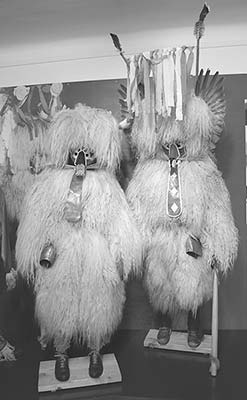
Traditionally the role of Kurent was played by young men of the village, who used it as an opportunity to catch the eye of a potential wife. (Young women still toss handkerchiefs to the Kurents as they pass by.) Each young man makes his own costume in secret—making the big reveal all the more frightening. Traditionally, they’d use the stinkiest animal hides they could find, to make the beast smell as hideous as it looked and sounded.
These processions have evolved into modern extravaganzas. Nowadays, men and women of any age buy their Kurent costumes in a store, and Kurentovanje’s daytime parades are followed by evenings of music, celebration, and general debauchery. In recent years, in a sort of “creature exchange” program, characters from Mardi Gras celebrations in other countries have come to take part in Kurentovanje.
Imagine about 350 of these hairy beasts, each one with five huge bells clanging at top volume, stomping down Prešernova street. Or come the Sunday before Ash Wednesday, and see for yourself. For details on all the festivities, check out www.kurentovanje.net. Or, to watch a segment from my TV show about the spectacle, search for “Rick Steves Woolly Beasts” on YouTube.
Kurentovanje ends at midnight on Shrove Tuesday (before Ash Wednesday), when people move into the more pensive season of Lent...confident that spring will soon return.
• Head through the next few rooms (countess’ bedroom, countess’ dressing room, old chapel, chambermaid’s room). Before entering the 14th-century core—and oldest part—of the castle, keep your head up to see a very unusual chandelier: an anatomically correct (or surgically enhanced?) female dragon. Continue into the...
Bedrooms: The first shows off what prim and proper 17th-century Europeans considered to be “erotic” art (with a mythical creature trying to woo a woman); the second is decorated in Napoleonic-era Empire-style furniture. In this room, notice the stove: Scented water was poured into the top, and fragrant steam emerged at the bottom. Fancy. The third bedroom brings the survey of furniture up to date: 19th-century Biedermeier...simple, practical, and comfortable.
• Going into the arcade, turn left to find the...
Festival Hall: Decorating the walls is Europe’s biggest collection of turqueries. Like the faux-Chinese stuff we saw earlier, this is a (usually highly inaccurate) European vision of Turkish culture. After the Habsburg armies defeated the Ottomans and forced them out of Central Europe, the two powers began a diplomatic relationship. In the late 17th century, many Austrian officers went to Turkey—returning with souvenirs and tall tales, which were patched together to form the idiosyncratic vision of the Ottoman Empire you see here.
The left wall shows Ottoman politicians of the day, many with generic European features (presumably painted by artists who’d never laid eyes on a Turkish person). Along the back wall are portraits of four sultans’ wives. Imagine how astonishing the notion of a harem must have been in the buttoned-down Habsburg days. And yet, even these unmistakably titillating paintings are appropriately repressed. The first woman (on left) wears two different layers of semitransparent clothing (what’s the point?). And the fourth woman (on right) reaches for some fruit (symbolic of...well, you know) and teasingly pulls open her dress so we can see what’s underneath, which is...more clothes.
Finally, look on the right wall, with 17th-century Eurofied visions of people from other cultures: Africans, Native Americans, and Asians, all with exaggerated features. At the far end of the Festival Hall, you can poke into the castle’s chapel.
• Exit the Festival Hall, and go straight ahead along the arcade to its end, where you’ll take the tight, medieval spiral staircase up one level. At the top, the row of sandstone dwarves leads to two skippable rooms of paintings. Instead, turn left into...
Medieval Knights, Founders, and Patrons of the Arts: This exhibit tells you more than you ever wanted to know about the Lords of Ptuj. Touring its several rooms, you’ll see family trees and crests, artifacts from lords gone by, models of local buildings, and a fine 1380 statue of St. George (Ptuj’s patron saint) slaying the dragon. The darkened rooms highlight the Middle Ages, with some precious statues by the greatest local masters of the day.
• Exit to the right, and walk to the end of the arcade.
Castle Gallery: This painting gallery features aristocratic portraits, mythological scenes, and varied landscapes from the late 16th to late 18th century. As most of these are lesser painters’ copies of famous works by great masters, you likely won’t recognize many names in here. One name in particular you won’t recognize is Johann Christian Schröder (1655-1702), a Prague court painter whose depictions of biblical scenes constitute the majority of the collection.
• Head back down to the courtyard. Ask one of the attendants to direct you (across the courtyard from the main staircase) to the...
Collection of Musical Instruments: This fun, well-presented exhibit groups instruments by type of music, which you’ll hear as you enter each room. The first section celebrates Ptuj’s civic marching band, a prized local tradition. The next section displays ancient Roman instruments. The tibia (in the display case), dating from the second century AD, is the only one ever found; it had two pipes made of bone leading to a single mouthpiece (illustrated on the wall). The next section features woodwinds and strings, including a rare, preserved lute. And the last section shows off a Bösendorfer piano and other keyboard instruments.
• As you exit, you can ask to be directed to the anticlimactic finale (to the right), the...
Collection of Arms: Squeezed into one corner of a huge, vaulted room is an armory collection spanning several centuries, from the 1400s through World War I. They’re displayed on racks, as they would have been in a real armory. Also in this hall, look for models of the castle as it appeared in 1657 and in 1812.
• Your castle visit is over. Enjoy the views, then head back down into town.
OLD TOWN
The sights in Ptuj’s Old Town are simple and quick to see.
▲Slovenski Trg
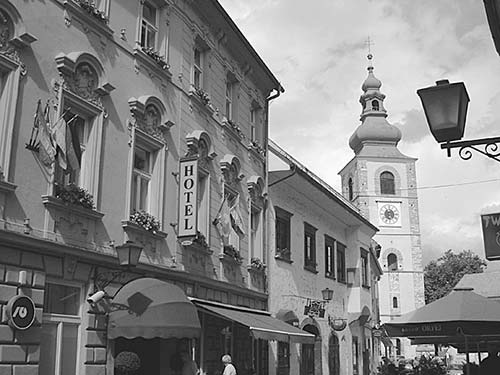
Once Ptuj’s main square, and now its most atmospheric, Slovenski Trg is fronted by the Hotel Mitra and the City Tower. Around this square are several reminders of Ptuj’s Roman past.
The white marble slab in the middle of the square, known as the Orpheus Monument, was commissioned by a Roman mayor in the second century AD to honor an esteemed figure: himself. Notice the musician playing the lyre (near the top, center of slab, below the naked woman). Since the lyre is commonly associated with Orpheus, the monument’s nickname stuck. But when Rome fell, so did many of its structures, including this one. It finally reappeared in the 16th century as the town pillory, where criminals were punished (secured by chains that were embedded in the holes you still see in the slab). In the Middle Ages, the town judge would come out onto the balcony over the door of his white house, at the top of the square (at #6), to witness justice being served.
The City Tower was built in the late 16th century to defend against Ottoman invaders (who passed by here on their way to lay siege to Vienna). After a fire, the rebuilt tower was capped with this jaunty Baroque steeple.
Embedded in the staircase at the back of the tower are more fragments from Ptuj’s Roman era. This so-called “open-air museum” is just a taste of the vast Roman material unearthed in Ptuj. In the middle of the staircase, make out the letters POETOVIONA—a longer version of Ptuj’s Roman name, Poetovio.
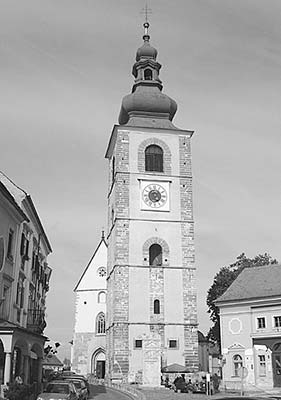
Just behind the City Tower is St. George’s Parish Church (Cerkev Svetega Jurija, daily 7:00-11:00 & 18:00-18:30), which dates back before any other building in Slovenia. The current Gothic version is packed with diverse ecclesiastical art. Inside, notice (on your left) the gorgeous circa-1380 statue of St. George, Ptuj’s patron saint, slaying the dragon. Then go to the first big pillar on the right, where you’ll see a glass-covered relief depicting throngs of admirers adoring the Baby Jes...wait—where’s Jesus? (Not to mention Mary’s hands?) Several years ago, Jesus was stolen from this pillar. To help prevent further vandalism, the priests reduced the opening times (notice the seven-hour midday break).
Prešernova Street (Prešernova Ulica)
Stretching away from the City Tower is Ptuj’s main drag and oldest street. Wider than most streets in town, it led to what was once the medieval market square (now Slovenski Trg), so merchants set up market stalls all along the street. Many of the houses here have long since been renovated in Renaissance or Baroque style, making it Ptuj’s most picturesque thoroughfare.
Town Square (Mestni Trg)
Today Ptuj’s main square, this lively people zone (just down Murkova street from Slovenski Trg) is a hub of activity, and where you’ll find the TI. Major events and festivals—including the Kurentovanje Mardi Gras festival—take place here.
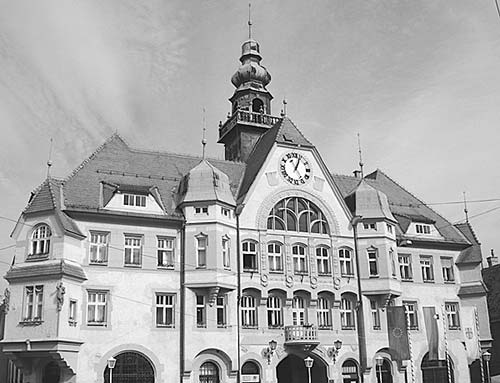
The square is watched over by the distinctive Town Hall, built by a visionary mayor a century ago. Over the left door (on the corner) are two statues commemorating Ptuj’s Roman history: on the right, Emperor Trajan, who granted Ptuj city status in the early second century AD; and on the left, St. Viktorin, a third-century Ptuj bishop and scholar who was martyred by Emperor Diocletian.
Facing the Town Hall in the middle of the square is a statue of St. Florian, who traditionally protects towns against fire. Ptuj was devastated by four fires in the late 17th and early 18th centuries. This statue is a 1993 replica of one that was built here after the fourth and final fire, in 1744 (after which they finally wised up and rebuilt with stone instead of wood). Largely as a result of Ptuj’s frequent fires, its rival Maribor (to the north) gradually supplanted it as the region’s main center of commerce and winemaking. Ptuj’s fate was sealed a century later, when the rail line between Vienna and Trieste was routed through Maribor. Today Maribor has 10 times as many people as Ptuj—and 10 times the industry, congestion, and urban gloominess.
Ptuj Cellar (Ptujska Klet)
Ptuj’s wines are well respected, and this is the main facility for the dominant producer, Pullus. Over the centuries, Celts, Romans, and Minorite monks all made wine in this area. Today this enormous cellar, branching out under the Old Town, continues this proud tradition—and holds a staggering 1.3 million gallons of wine (about 85 percent of it white). The cellar is also home to a “wine archive” with bottles dating back to 1917. The vintners are proudest of their award-winning sauvignon blanc, but their best seller—at a million bottles a year—is a local wine called Haložan (a semidry blend of four whites).
Tours and Tastings: Cellar tours and wine tastings are possible if you call ahead (€15, Mon-Sat 9:00-17:00, closed Sun, +386 41 394 896, www.pullus.si). While these are often available in English, you might wind up joining a German- or Slovene-language tour.
Shop: If you just want to pick up a bottle, stop by their wine shop, around the corner from the cellar (Mon-Fri 9:00-12:00 & 13:00-17:00, Sat 8:00-12:00, closed Sun, Vinarski Trg 1, +386 2 787 9810).
Minorite Church and Monastery (Minoritski Samostan)
This church, dedicated to Saints Peter and Paul, was one of the only buildings in town destroyed in World War II. (The Allies believed that the occupying Nazis were storing munitions here.) Only the foundation at the back end of the church survived, and it was left in ruins for decades. In 1989, friars celebrated their 750th anniversary in Ptuj by rebuilding the back part of the church. About a decade later, the front half was also reconstructed, and the statues in the niches above the door were replaced a few years after that. Step into the contemporary, minimalist interior, with its modern stained-glass windows and stations of the cross. At the altar are the original statues that once adorned the church facade. Go through the door on the right into the peaceful cloister. A handful of friars can still be seen roaming these tranquil halls, and you’re welcome to stroll here, too.
Cost and Hours: Free, daily 7:30-18:30, Minoritski Trg.
Ptuj Thermal Baths (Terme Ptuj)
This gigantic bath complex, a 15-minute walk across the river from Ptuj’s Old Town, is a fun place to splash around. The “Thermal Park” has multiple swimming pools and whirlpools—all naturally fed by thermal springs—and slides, including the “longest slide in Slovenia.” The complex also offers indoor pools, saunas, and various spa treatments. Additional indoor pools are available at the hotel across the street.
Cost and Hours: €16/all day, more on weekends but cheaper for shorter visits, daily 8:00-21:00, outdoor pools have shorter hours, towel rental available, Pot v Toplice 9, +386 2 749 4530, www.terme-ptuj.si.
Sleeping in Ptuj
Central Ptuj has only a few hotels and a handful of sobe/guesthouses. And though the options may seem limited, the rooms are generally a good value compared with the western part of the country.
$$ Hotel Mitra offers Ptuj’s nicest rooms and best location: right on its most appealing street, a few steps from the landmark City Tower. It’s the closest thing in town to a business-class hotel. Each of the 29 rooms—well-appointed, with cushy decor—has its own historical theme (air-con, elevator, limited free parking, Prešernova 6, +386 2 787 7455, www.hotel-mitra.si, info@hotel-mitra.si).
$ Vladimir Šilak rents 16 comfortable rooms around a charming courtyard in his gorgeously renovated Old Town home. The building dates from sometime between the 12th and 15th centuries, and Vladimir has lovingly restored it using quality materials. If you want to sleep in a centuries-old house with huge medieval vaults and three-foot-thick walls, this is the place. Some rooms have views, either over the river or up to the castle (family rooms, apartments with kitchenettes also available, breakfast extra in apartments, air-con, free parking, bike rental, Dravska 13, +386 2 787 7447, mobile +386 31 597 361, www.rooms-silak.com, info@rooms-silak.com).
$ muziKafe B&B rents seven fun, colorful, funky (in a good way) rooms above a lively café in the heart of the atmospheric Old Town. After traveling around the world for a year, the owners decided to open a place where fellow globetrotters could feel at home (breakfast extra, Vrazov Trg 1, +386 2 787 8860, www.muzikafe.si, info@muzikafe.si).
Eating in Ptuj
Little Ptuj isn’t known for its high cuisine. You’ll spot several breezy cafés and packed pizzerias, but high-quality eateries are in short supply.
$$$ Gostilna Ribič (“Fisherman’s Inn”) is every local’s first recommendation for a splurge dinner. One of the most popular (and expensive) places in town, it has a short menu that’s focused on fresh, local dishes, with an emphasis on fish. Sit in the classy interior or outside on the relaxing riverside terrace (Tue-Sat 11:00-22:00, Sun until 20:00, closed Mon, Dravska Ulica 9, +386 2 749 0635). If you’re ready for a break from Slovenian cuisine, the Chinese restaurant $ Kitajski Vrt across the street is quite good.
$$ Gostilna Amadeus serves up traditional Slovenian cuisine to tour groups, individual tourists, and a few locals. They’re especially proud of their štruklji (traditional Slovenian rolled dumplings). The bar, with outdoor seating and drinks only, is downstairs; to eat a meal, head upstairs to their nicely appointed dining room (Wed-Mon 12:00-22:00 except Sun until 16:00, closed Tue, Prešernova 36, +386 2 771 7051).
$ muziKafe, which also rents rooms (see earlier), is a cool hangout with an artistic spirit right in the center of the creaky Old Town. They serve drinks, light food, snacks, and cakes in a colorful, convivial atmosphere. Their vaulted cellar also hosts musical performances a few nights each week (Sun-Thu 9:00-20:00, Fri-Sat until 23:00, closed Mon-Tue in off-season, Vrazov Trg 1, +386 2 787 8860, www.muzikafe.si).
Ptuj Connections
From Ptuj by Train to: Maribor (8/day, 1 hour, additional connections possible with transfer in Pragersko), Ljubljana (2/day direct, 2.5 hours, nearly hourly with transfer in Pragersko or Maribor), Zagreb (4/day, 3 hours, transfer in Pragersko and sometimes also Zidani Most), Budapest (that’s Budimpešta in Slovene, 1/day direct, 6 hours; other connections take longer and require more changes), Vienna (that’s Dunaj in Slovene, 1/day with transfer in Pragersko, 4.5 hours; 1/day with transfer in Maribor, 6.5 hours; additional connections require more changes, 5-6 hours). For destinations in western Slovenia, first go to Ljubljana.
Maribor
The second-biggest city in Slovenia (with 158,000 people), Maribor lives forever in the shadow of its much glitzier big sister, Ljubljana. Maribor is too small to offer an exciting big-city experience and too big to be charming. But this home of industry, business, and one of Slovenia’s three universities is worth a quick look if you want to round out your Slovenian experience.
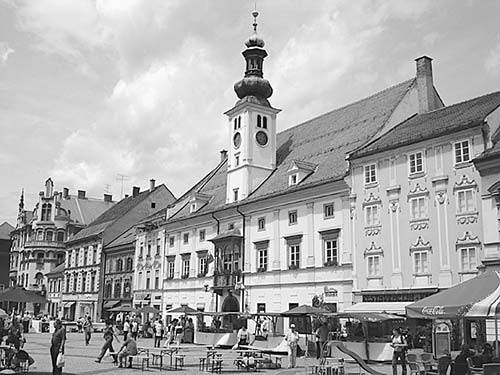
The lazy provincial town of Maribor woke up fast in 1846, when the Habsburgs built the train line from Vienna to the coast through here. It quickly modernized, losing some of its quaintness but gaining an urban, industrial flavor. However, Maribor was devastated in World War II (unlike other Slovenian cities), when it served as a headquarters for occupying Nazi forces. Since the city’s factories also produced plane engines and other war supplies, it became a “secondary target,” where Allied warplanes—mostly American—would drop their bombs if unable to hit their primary targets in Germany or Austria.
Today, rebuilt Maribor feels mellow for its size. Nestled up against a gentle vineyard-covered hill, it’s almost cozy. From a tourist’s perspective, the town is pleasant enough but pretty dull—there’s little to do other than wander its pedestrian-only streets. The city doesn’t merit a detour, but it’s worth a couple of hours for a stroll if you’re passing through or have run out of diversions in Ptuj.
The countryside surrounding Maribor—called Mariborsko Pohorje—is an inviting recreational area, with vine-strewn hills lively with hikers and bicyclists in summer and with skiers in winter. Maribor is also the center of a thriving wine-growing region—especially popular among Austrians, who flow over the border to sample wines here, then stumble home. If you have time to spare, ask the TI for details about either of these outlying activities.
Orientation to Maribor
Maribor lines up along the bank of the Drava River. At the center of its concrete sprawl is the mostly traffic-free Old Town, with a variety of delightful squares.
TOURIST INFORMATION
The main TI is at the northeast corner of the Old Town (Mon-Fri 9:00-17:00, Sat until 15:00, Sun until 13:00, Partizanska 6a—on the far side of the Franciscan Church from Trg Svobode, +386 2 234 6611, www.visitmaribor.si).
ARRIVAL IN MARIBOR
The train station (which has big lockers) is a 10-minute walk east of the Old Town. Exit the station to the left and head up busy Partizanska Cesta. Follow Partizanska as it swings right at the bus station, then continue three more blocks toward the Franciscan church, with its twin red-brick spires. The main TI is in front of the church, and the Old Town is immediately behind the church.
Maribor Walk
Maribor’s Austrian-feeling Old Town lacks big-league sights, but its squares and lanes are worth a wander. This lightly narrated self-guided walk gives you the lay of the land. You could do it in less than a half-hour, not including stops.
Entering the Old Town from the train station (on Partizanska, passing the Franciscan church with its two red-brick spires—see “Arrival in Maribor,” earlier), you find yourself on Trg Svobode. The oddly bulbous monument honors local Partisans (Yugoslav freedom-fighters) who were executed by Nazis during World War II. Wine cellars honeycomb the earth under this square.
At the end of the square, with the tall tower, is the town’s castle (Mestni Grad), which houses a good regional museum.
Adjoining Trg Svobode is a second square, Grajski Trg—Maribor’s liveliest, bustling with cafés and restaurants. At the top of the square is the venerable Café Astoria, a local landmark.
Recent-history buffs may want to take a detour from here to Maribor’s most interesting museum: the Maribor National Liberation Museum (Muzej Narodne Osvoboditve Maribor), about a five-minute walk up the street that’s at the top of Grajski Trg (between Café Astoria and the castle). The ground floor features generally good temporary exhibits. Upstairs, the permanent collection holds a hodgepodge of items from the city’s history, mostly focusing on Slovenia’s turbulent 20th century (€3, Mon-Fri 8:00-17:00, Sat 9:00-12:00, closed Sun, Ulica Heroja Tomšiča 5, +386 2 235 2600, www.mnom.si).
Back on Grajski Trg, follow lively Slovenska Ulica, lined with characteristic cafés, sweet shops, and happy al fresco diners. Take a left at Tyrševa/Gosposka, passing some fun student-oriented boutiques. Then turn right on 10 Oktobra to find the big parking-lot square called Slomškov Trg, with the city cathedral (skip the tower climb—the view is nothing special).
From the cathedral, walk straight down toward the river, cutting through Rotovški Trg. You’ll wind up on the long, narrow Glavni Trg, surrounded by historic buildings (including the City Hall) and presided over by an impressive 18th-century plague column.
If you continue down to the riverbank, you’ll find yourself in the district called Lent, where vintners traditionally offer tastings of their wines. While it’s usually pretty quiet, this area hops each summer when Maribor hosts its Lent Festival (late June-early July, www.festival-lent.si). Along this embankment, look for the locally revered “old vine” stretching along a railing—it’s supposedly 400 years old and still produces wine-worthy grapes.
Maribor Connections
From Maribor by Train to: Ptuj (8/day, 1 hour, more with transfer in Pragersko), Ljubljana (hourly, 2-3 hours, most direct, some with transfer in Zidani Most), Vienna (that’s Dunaj in Slovene, 2/day direct, 4 hours, additional connections require changes in Spielfeld-Strass and Graz).