APPENDIX
Holidays and Festivals
This list includes selected festivals in this region, plus national holidays. Many sights and banks close on national holidays. As both Croatia and Slovenia are predominantly Catholic, religious holidays—Easter, Ascension Day, Whitsunday, and Whitmonday—are a big deal, and frequent. In the Muslim areas of Bosnia (including Mostar and Sarajevo), locals observe the month of Ramadan. Before planning a trip around a festival, verify the dates with the festival website, the national tourist office in Croatia (https://croatia.hr) or Slovenia (www.slovenia.info), or my “Upcoming Holidays and Festivals” web page at RickSteves.com/europe/festivals. Unless stated otherwise, all holidays listed here apply to both Croatia and Slovenia.
| Jan 1 | New Year’s Day |
| Jan 6 | Epiphany |
| Jan 7 | Orthodox Christmas, Bosnia-Herzegovina |
| Feb 8 | National Day of Culture, Slovenia (celebrates Slovenian culture and national poet France Prešeren) |
| Feb/March | Kurentovanje Carnival, Ptuj, Slovenia (11 days leading up to Ash Wednesday, www.kurentovanje.net) |
| March 1 | Independence Day, Bosnia-Herzegovina (non-Serbian areas only; closures) |
| Varies | Ramadan (Muslim holy month): March 10-April 9, 2024; Feb 28-March 29, 2025; Bosnia-Herzegovina |
| Late March | Ski Flying World Cup, Planica, Slovenia (3 days, www.planica.si) |
| March/April | Easter and Easter Monday: March 31-April 1, 2024; April 20-21, 2025 |
| April 27 | National Resistance Day, Slovenia |
| April/May | Orthodox Easter: May 5-6, 2024; April 20-21, 2025; Bosnia-Herzegovina |
| May | Ascension: May 9, 2024; May 29, 2025 |
| May 1 | Labor Day, Croatia and Slovenia |
| May 2 | Second Labor Day, Croatia and Slovenia (some closures) |
| May 9 | Victory Day, Bosnia-Herzegovina (Serbian areas only; closures) |
| May/June | Pentecost and Whitmonday: May 19-20, 2024; June 8-9, 2025 |
| May/June | Corpus Christi: May 30, 2024; June 19, 2025 |
| Early June | Dance Week Festival, Zagreb, Croatia (www.danceweekfestival.com) |
| June 22 | Antifascist Struggle Day, Croatia |
| June 25 | National Day, Slovenia; Statehood Day, Croatia |
| Early July | Ultra Europe Music Festival, Split, Croatia (www.ultraeurope.com) |
| July-Aug | Dubrovnik Summer Festival, Croatia (www.dubrovnik-festival.hr) |
| Early July-Sept | Ljubljana Festival, Slovenia (www.ljubljanafestival.si) |
| Late July | International Folklore Festival, Zagreb, Croatia (5 days, costumes, songs, dances from all over Croatia; www.msf.hr) |
| Late July | Motovun Film Festival, Istria, Croatia (www.motovunfilmfestival.com) |
| Aug 5 | National Thanksgiving Day, Croatia |
| Aug 15 | Assumption of Mary |
| Late Aug | Diocletian Days, Split, Croatia (toga-clad celebrations) |
| October | White Truffle Days, Livade, Croatia (Istrian truffle festival, weekends only) |
| Oct 8 | Independence Day, Croatia |
| Oct 31 | Reformation Day, Slovenia |
| Nov 1 | Day of the Dead/Remembrance Day (religious festival, decorated cemeteries, some closures) |
| Nov 2 | All Souls’ Day (religious festival, some closures) |
| Nov 11 | St. Martin’s Day (official first day of wine season) |
| Dec 24-25 | Christmas Eve and Christmas Day |
| Dec 26 | Boxing Day/St. Stephen’s Day; Independence and Unity Day, Slovenia |
Books and Films
To learn more about Croatia and Slovenia past and present, check out a few of these books or films.
Books: Lonnie Johnson’s Central Europe: Enemies, Neighbors, Friends is the best historical overview of Croatia, Slovenia, and their neighboring countries. The most readable history of Croatia itself is Benjamin Curtis’s A Traveller’s History of Croatia. Rebecca West’s classic, bricklike Black Lamb and Grey Falcon is the definitive travelogue of the Yugoslav lands (written during a journey between the two World Wars). For a more recent take, Croatian journalist Slavenka Drakulić has written a quartet of insightful essay collections from a feminist angle: Café Europa: Life After Communism; The Balkan Express; How We Survived Communism and Even Laughed; and A Guided Tour Through the Museum of Communism. Drakulić’s They Would Never Hurt a Fly profiles Yugoslav war criminals. For a thorough explanation of how and why Yugoslavia broke apart, read Yugoslavia: Death of a Nation, by Laura Silber and Allan Little. Joe Sacco’s powerful graphic novel, Safe Area Goražde, describes the author’s experience living in a mostly Muslim town in Bosnia-Herzegovina while it was surrounded by Serb forces during the wars of the 1990s. Sacco’s follow-up, The Fixer and Other Stories, focuses on real-life characters he met in siege-time Sarajevo.
Films: To grasp the Yugoslav Wars that shook this region in the early 1990s, there’s no better film than the Slovene-produced No Man’s Land, which won the 2002 Oscar for Best Foreign Film. The BBC produced a remarkable five-hour documentary series called The Death of Yugoslavia, featuring actual interviews with all of the key players (it’s difficult to find on home video, but try searching for “Death of Yugoslavia” on YouTube; the book Yugoslavia: Death of a Nation, noted earlier, was a companion piece to this film). BBC also produced a harrowing documentary about the infamous Bosnian massacre, Srebrenica: A Cry From the Grave (also available on YouTube). In the Land of Blood and Honey—Angelina Jolie’s intense, difficult-to-watch directorial debut—tells the story of the Bosnian conflict through the eyes of a civilian woman held in a “rape camp.” And The Diplomat is a documentary about Richard Holbrooke, the American who negotiated the peace to end the Yugoslav Wars.
On a lighter note, a classic from Tito-era Yugoslavia, The Battle of Neretva (1969), imported Hollywood talent in the form of Yul Brynner and Orson Welles to tell the story of a pivotal and inspiring battle in the fight against the Nazis. More recent Croatian films worth watching include Border Post (Karaula, 2006), about various Yugoslav soldiers working together just before the war broke out, and When Father Was Away on Business (1985), about a prisoner on the Tito-era gulag island of Goli Otok, near Rab. Other local movies include Armin (2007), How the War Started on My Island (1996), Underground (1995), and Tito and Me (1992).
Fans of HBO’s Game of Thrones may recognize locations in Dubrovnik and other Croatian coastal towns, where much of the series was filmed (for details, see here).
Conversions and Climate
Numbers and Stumblers
• Europeans write a few of their numbers differently than we do. 1 =  , 4 =
, 4 =  , 7 =
, 7 = 
• In Europe, dates appear as day/month/year, so Christmas 2025 is 25/12/2025.
• Commas are decimal points and decimals are commas. A dollar and a half is 1,50, one thousand is 1.000, and there are 5.280 feet in a mile.
• When counting with fingers, start with your thumb. If you hold up your first finger to request one item, you’ll probably get two.
• What Americans call the second floor of a building is the first floor in Europe.
• On escalators and moving sidewalks, Europeans keep the left “lane” open for passing. Keep to the right.
Metric Conversions
A kilogram equals 1,000 grams (about 2.2 pounds). One hundred grams (a common unit at markets) is about a quarter-pound. One liter is about a quart, or almost four to a gallon.
A kilometer is six-tenths of a mile. To convert kilometers to miles, cut the kilometers in half and add back 10 percent of the original (120 km: 60 + 12 = 72 miles). One meter is 39 inches—just over a yard.
| 1 foot = 0.3 meter | 1 square yard = 0.8 square meter |
| 1 yard = 0.9 meter | 1 square mile = 2.6 square kilometers |
| 1 mile = 1.6 kilometers | 1 ounce = 28 grams |
| 1 centimeter = 0.4 inch | 1 quart = 0.95 liter |
| 1 meter = 39.4 inches | 1 kilogram = 2.2 pounds |
| 1 kilometer = 0.62 mile | 32°F = 0°C |
Clothing Sizes
When shopping for clothing, use these US-to-European comparisons as general guidelines (but note that no conversion is perfect).
Women: For pants and dresses, add 32 in Croatia and Slovenia (US 10 = Croatian 42). For blouses and sweaters, add 8 for most of Europe (US 32 = European 40). For shoes, add 30-31 (US 7 = European 37/38).
Men: For shirts, multiply by 2 and add about 8 (US 15 = European 38). For jackets and suits, add 10. For shoes, add 32-34.
Children: Clothing is sized by height—in centimeters (2.5 cm = 1 inch), so a US size 8 roughly equates to 132-140. For shoes up to size 13, add 16-18, and for sizes 1 and up, add 30-32.
Climate
First line is the average daily high; second line, average daily low; third line, average days with rain. For more detailed weather statistics for destinations in this book (as well as the rest of the world), check Wunderground.com.
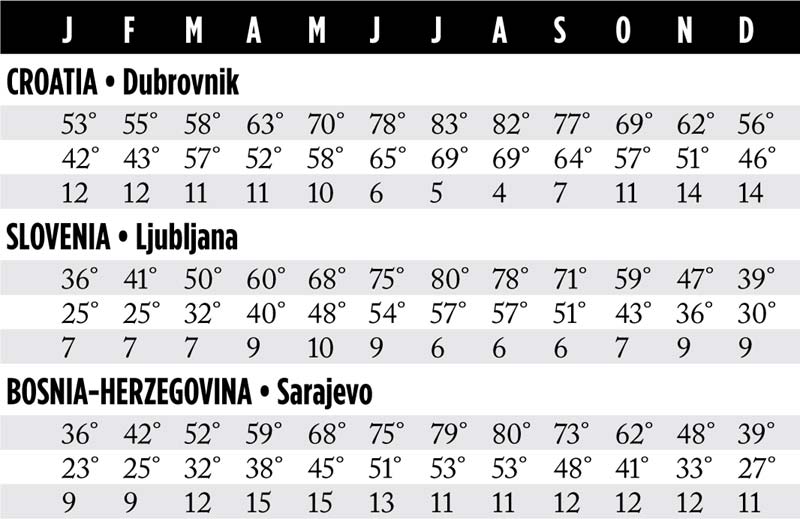
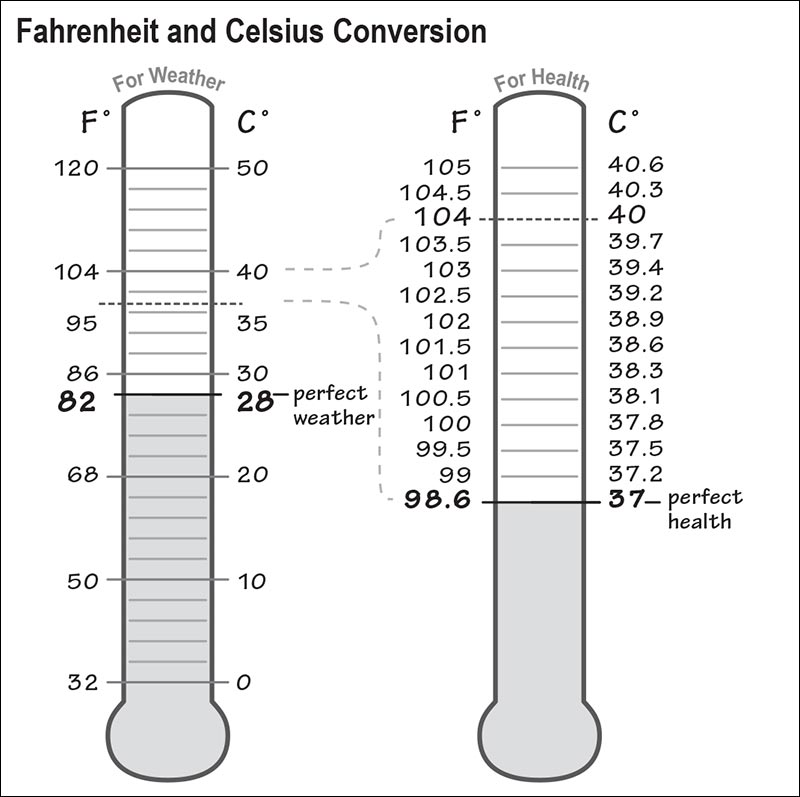
Europe takes its temperature using the Celsius scale, while we opt for Fahrenheit. For a rough conversion from Celsius to Fahrenheit, double the number and add 30. For weather, remember that 28°C is 82°F—perfect. For health, 37°C is just right. At a launderette, 30°C is cold, 40°C is warm (usually the default setting), 60°C is hot, and 95°C is boiling. Your air-conditioner should be set at about 20°C.
Whether you’re traveling for five days or five weeks, you won’t need more than this. Pack light to enjoy the sweet freedom of true mobility.
 5 shirts: long- & short-sleeve
2 pairs pants (or skirts/capris)
1 pair shorts
5 pairs underwear & socks
1 pair walking shoes
Sweater or warm layer
Rainproof jacket with hood
Tie, scarf, belt, and/or hat
Swimsuit
Sleepwear/loungewear
Debit card(s)
Credit card(s)
Hard cash (US $100-200)
Money belt
Passport
Other required ID: Vaccine card/Covid test, entry visa, etc.
Driver’s license, student ID, hostel card, etc.
Tickets & confirmations: flights, hotels, trains, rail pass, car rental, sight entries
Photocopies of important documents
Insurance details
Guidebooks & maps
Mobile phone
Camera & related gear
Tablet/ebook reader/laptop
Headphones/earbuds
Chargers & batteries
Phone car charger & mount (or GPS device)
Plug adapters
Basics: soap, shampoo, toothbrush, toothpaste, floss, deodorant, sunscreen, brush/comb, etc.
Medicines & vitamins
First-aid kit
Glasses/contacts/sunglasses
Face masks & hand sanitizer
Sewing kit
Packet of tissues (for WC)
Earplugs
Daypack
Sealable plastic baggies
Laundry supplies: soap, laundry bag, clothesline, spot remover
Small umbrella
Travel alarm/watch
Notepad & pen
Journal
Second pair of shoes (flip-flops, sandals, tennis shoes, boots)
Travel hairdryer
Picnic supplies
Disinfecting wipes
Water bottle
Fold-up tote bag
Small flashlight
Mini binoculars
Small towel or washcloth
Inflatable pillow/neck rest
Tiny lock
Address list (to mail postcards)
Extra passport photos