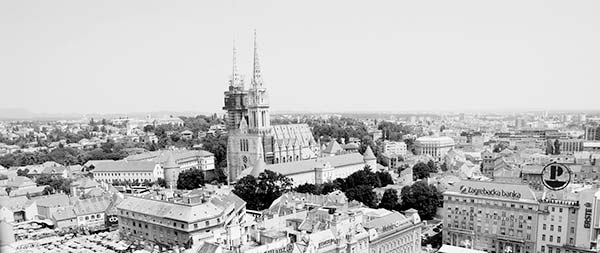
ZAGREB
PEOPLE-WATCHING AND COFFEE-SIPPING
IN THE LOWER TOWN, NEAR JELAČIĆ SQUARE
Surprise: The landlocked Croatian capital is, quite possibly, the country’s most underrated destination. In this land of time-passed coastal villages, Zagreb (ZAH-grehb) offers a welcome jolt of big-city sophistication. You can’t get a complete picture of modern Croatia without a visit here—away from the touristy resorts, in the lively and livable city that is home to one out of every six Croatians (pop. 790,000). Think of it as a palate cleanser before or after your time on the coast. And, because things here are priced for locals rather than tourists, it’s relatively affordable.
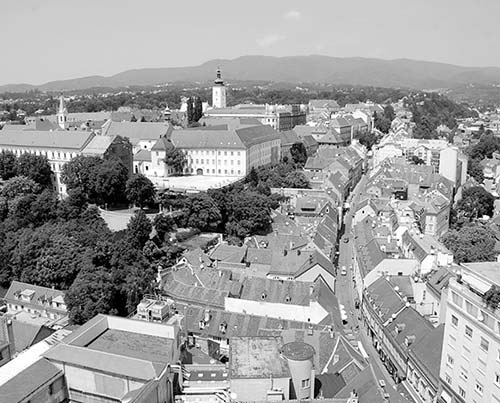
In Zagreb, you’ll find historic neighborhoods, a thriving café culture, an impressive variety of good restaurants, my favorite urban people-watching in Croatia, an almost Prague-like Old World streetscape, and relatively few tourists. The city is also the country’s best destination for museums, with wonderful collections highlighting distinctively Croatian artists (the Naive Art movement and—when open—sculptor Ivan Meštrović), a quirky exhibit telling tales of fractured relationships, and a smattering of other good options (modern art, city history, arts and crafts, and much more). Get your fill here before heading to smaller cities and towns, where worthwhile museums are in short supply.
Zagreb began as two walled medieval towns, Gradec and Kaptol, separated by a river. As Croatia fell under the control of various foreign powers—Budapest, Vienna, and Belgrade—the two hill towns that would become Zagreb gradually took on more religious and civic importance. Kaptol became a bishopric in 1094, and it’s still home to Croatia’s most important church. In the 16th century, the Ban (Croatia’s governor) and the Sabor (parliament) called Gradec home. The two towns officially merged in 1850, and soon after, the railroad connecting Budapest with the Adriatic port city of Rijeka was built through the city. Zagreb prospered. After centuries of being the de facto religious, cultural, and political center of Croatia, Zagreb officially became a European capital when the country declared its independence in 1991.
In 2020, Zagreb got hit with a triple-whammy: First, the city went into lockdown during the early stages of the Covid-19 pandemic. Then, on March 22, Zagreb was rocked by a powerful 5.3-magnitude earthquake (with its epicenter just a few miles from the city center) that damaged many buildings, killed one person, and injured 27 others. And then, on December 29—after the city had already started to rebuild—an even stronger earthquake in central Croatia sent more damaging shockwaves to Zagreb. Today, astute visitors will notice that many historic buildings are still covered with scaffolding; and multiple museums, churches (including the cathedral), and other landmarks are temporarily closed as they undergo multiyear repairs and reinforcement. The TI is fully up-to-date on what has reopened, so stop there early in your visit to confirm your sightseeing plans.
Today, while tourism is on the rise, Zagreb may be the only destination in this book that still feels largely undiscovered. The city richly rewards those who choose to visit.
PLANNING YOUR TIME
If you can only spare a few hours as you pass through Zagreb, throw your bag in a locker at the train station and zip into the center for a quick visit. Better yet, spend the night. If you enjoy urban bustle, good museums, and an engaging dining scene, you won’t regret investing some time here. One full day (with two nights) is plenty for a complete visit—but even with one overnight (and a half-day of sightseeing), you can get a good feel for the city.
If you’re very tight on time, make a beeline for Jelačić Square to follow my self-guided walk. Take the funicular up to Gradec, visit the excellent Croatian Museum of Naive Art and the Museum of Broken Relationships, and stroll St. Mark’s Square. Then wander down through the Stone Gate to the lively Tkalčićeva scene (good for a drink or meal), through the market (winds down around 14:00), and on to Kaptol and the cathedral. Depending on how much you linger, this loop can take anywhere from three hours to a full day.
With additional time, visit more of Zagreb’s museums (the Meštrović Atelier—which may be closed for renovation—and the City Museum, both in the compact Gradec zone, are worthwhile), wander the series of parks called the “Green Horseshoe” (with even more museums), pay a visit to the beautiful Mirogoj Cemetery (one of Europe’s finest final resting places), or head to the enjoyable nearby town of Samobor.
Orientation to Zagreb
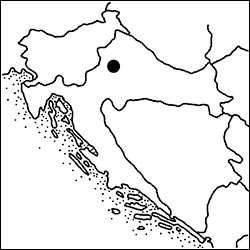
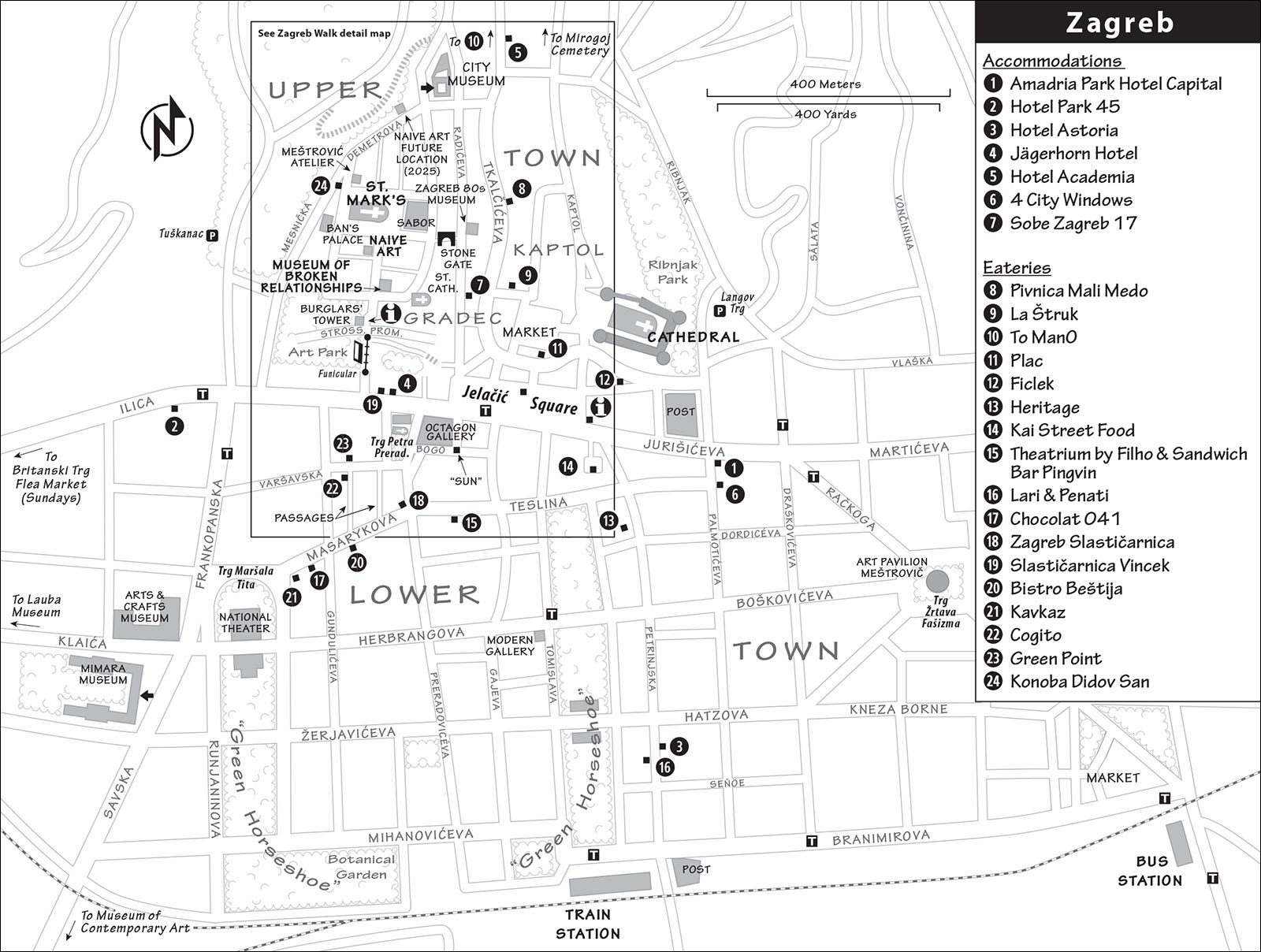
Zagreb, just 30 minutes from the Slovenian border, stretches from the foothills of Medvednica (“Bear Mountain”) to the Sava River. In the middle of the sprawl, you’ll find the modern Lower Town (Donji Grad)—centered on Jelačić Square (YEH-lah-cheech)—and the two parts of the historic Upper Town (Gornji Grad): Gradec (GRAH-dehts) and Kaptol (KAHP-tohl). To the south is a U-shaped belt of parks, squares, and museums that make up the “Green Horseshoe.” The east side of the U is a series of three parks, with the train station at the bottom (south) and Jelačić Square at the top (north).
Zagrebians have devised a brilliant scheme for confusing tourists: Street names can be given several different ways. For example, the street that is signed as Ulica Kralja Držislava (King Držislav Street) is often called simply Držislavova (Držislav’s) by locals. So if you’re looking for a street, be willing to settle for something that just has a lot of the same letters.
TOURIST INFORMATION
Zagreb has Croatia’s best-organized TI, right on Jelačić Square (Mon-Fri 9:00-20:00, Sat-Sun 10:00-18:00, Trg bana Jelačića 11, +385 1 481 4051, www.infozagreb.hr). Additional TI branches are at the airport (daily 7:00-22:00) and in the Burglars’ Tower at the top of the funicular in Gradec (Tue-Fri 9:00-20:00, Sat-Sun from 11:00, closed Mon, shorter hours off-season). Pick up the monthly events guide and the great Step by Step brochure (with a couple of good self-guided walking tours).
The Zagreb Card includes public transit and an odd assortment of museums (including the Museum of Broken Relationships and the City Museum), plus discounts on others. If you’ll be sightseeing a lot, this could save you a bit (€13/24 hours, €18/72 hours; order online and pick up at the main TI or at a few other points).
ARRIVAL IN ZAGREB
By Train: Zagreb’s main train station (Glavni Kolodvor) is a few long blocks south of Jelačić Square, at the base of the Green Horseshoe. The straightforward arrivals hall has a train information desk, ticket windows, luggage lockers (lining the hallway to the right from the main hall, as you exit the platform), ATMs (use the ATMs affiliated with real banks—not marked “free cash”), pay WCs, a Konzum grocery store, and newsstands. To reach the city center, go straight out the front door. You’ll run into a taxi stand and then the tracks for tram #6 (direction: Črnomerec zips you to Jelačić Square; direction: Sopot takes you to the bus station—the third stop, just after you turn right and go under the big overpass). You can also take tram #13 to Jelačić Square (direction: Žitnjak). For either tram, buy a 30-minute ticket from any kiosk by the tram stop, and validate it when you board—use the yellow box nearest the driver. If you walk straight ahead through the long, lush park, you’ll wind up at the bottom of Jelačić Square in 10 minutes.
By Bus: The user-friendly but inconveniently located bus station (Autobusni Kolodvor) is a few long blocks east of the main train station. Upstairs, you’ll find ticket windows and access to the buses. Tram #6 (direction: Črnomerec) takes you to the main train station, then on to Jelačić Square. Walking from the bus station to Jelačić Square takes about 25 minutes.
By Plane: Zagreb’s modern, almost futuristic Franjo Tuđman Airport is 10 miles south of the center (code: ZAG, +385 1 626 5222, www.zagreb-airport.hr). A Croatia Airlines shuttle bus connects the airport to the bus station (€6, 1-2/hour, 30 minutes); from there, you can hop on a tram into town (see “By Bus,” earlier). The public bus (#290) is cheaper (covered by 1-hour transit ticket), but it’s less frequent and slower (drops you at Kvaternikov Trg, hop on tram #11 or #12 to the center). It can be worth the convenience to pay for a 30-minute taxi ride right to your hotel (the fair metered rate is around €30, but crooked cabbies try to charge more—ask for an estimate before you get in). It’s cheaper to take a taxi from the city to the airport—closer to €20. Uber works just as well and is often cheaper; if catching one at the airport, you’ll ascend to the Departures level to meet your driver.
By Car: Parking can be tricky in the town center. Get tips from your hotel, or, if you’re dropping in for the day, aim for one of two user-friendly, underground garages near the main sightseeing zone: The Langov Trg garage is slightly more convenient, just behind the cathedral, but can fill up at very busy times; the Tuškanac garage is on the opposite (west) end of the old town center, situated in the valley at the base of the Upper Town. The two have similar rates (€1/hour, cheaper after hours; €8/24 hours—but for this rate, you’ll need to go to the office on arrival and request a daily ticket). On-street parking in the center is generally limited to two hours, so a garage is more practical.
GETTING AROUND ZAGREB
The main mode of public transportation is the tram, operated by ZET (Zagreb Electrical Transport). It’s cheap: Most rides in town are covered by a 30-minute ticket for €0.60; a longer ride—such as the public bus connection to/from the airport—is covered by a 1-hour (€1) or 1.5-hour (€1.40) ticket. You can buy tickets from a kiosk near the tram stop (ask for ZET karta—zeht KAR-tah) or from the driver (for a little bit extra). When you board, punch your ticket in the yellow box nearest the front of the tram. A day ticket (dnevna karta) costs €4. The most useful tram for tourists is #6, connecting Jelačić Square with the train and bus stations.
Taxis start at around €2, then charge about €1 per kilometer (there may be a small extra charge for each piece of baggage). To avoid getting overcharged, call one of the main companies: Radio Taxi (tel. 1717), Cammeo (tel. 1212), or Ekotaxi (tel. 1414). These can’t be dialed from a non-Croatian number, so ask your hotel or restaurant to call for you. If you hail a cab on the street, beware of corrupt cabbies; ask for an estimate up front. A typical ride within the city center shouldn’t run more than about €6-8.
Uber is active in Zagreb and typically charges lower rates than taxis. If you’re comfortable using Uber back home, it works the same way here—take advantage of it.
HELPFUL HINTS
Sight Hours: Many Zagreb museums are closed on Mondays; fortunately, the excellent Museum of Broken Relationships is open daily. The other top museum in town, the Naive Art gallery, is open Mondays but closed on weekends. On Sunday morning, the city is very active, including a bustling antique/flea market at Britanski Trg (British Square), a 15-minute walk west of Jelačić Square (Sun 8:00-14:00, along busy Ilica street—hop on tram #1, #6, or #11 from Jelačić Square to Britanski Trg). By Sunday afternoon, Zagreb is extremely quiet.
Festivals: Zagreb’s Christmas Market is becoming known internationally and attracts visitors from the end of November through mid-January. The rest of the year features a regular parade of festivals, including ones for street performers (late May/early June), animated films (June), classical music (June/July), puppet theater (Sept), and food and film (Sept). Check the TI’s website (www.infozagreb.hr) for what’s going on when you’re in town.
Changing of the Guard: Zagreb’s touristy “Changing of the Guard” ceremony enlivens the city center on some summer weekends. The 17th-century-costumed guards wear jaunty red scarves (an homage to the tale of how Croat soldiers “invented” the necktie) as they proceed through the center of town—passing landmarks such as St. Mark’s Square, Tkalčićeva street, Jelačić Square, and the statue of Mary in front of the cathedral. This happens sporadically; check with the TI or online to see if it’s on while you’re in town (summer only, typically begins at 12:00).
Tours in Zagreb
Local Guides
Darija Gotić (who also guides my tours in this part of Europe) offers a number of creative itineraries for you to choose from, ranging from a historical town walk, to a Mirogoj Cemetery walk that introduces you to several important Croatians, to a “grocery shopping” tour featuring everyday Croatian foods at the market (dolac) and local grocery stores—a handy orientation for the rest of your trip. You can do just one tour (€100/about 2.5 hours) or hire her for a full day and do several (€250/all day; +385 98 186 7719, darijagotic@gmail.com).
Neven Kamenski, a marathon runner who’s spent a lot of time in the US, is another good guide (€85/2 hours, +385 91 343 4023, neven@kamenski.us).
Walking Tours
Secret Zagreb offers several fun and informative guided walks. Popular choices are the Badass Women of Zagreb tour (€10, 2 hours, 2/week at 10:00) and the nighttime Mysterious Ghosts and Dragons walk (€10, 2 hours, 2/week at 21:00). Check their website for more details and to prebook (+385 97 673 8738, www.secret-zagreb.com).
Bike Tours
Blue Bike runs a variety of bike-tour routes through the city, starting on Jelačić Square. In addition to their Highlights tour (€30 or €50 with an e-bike, 2.5 hours, 2/day through the summer), they have a variety of themed tours (reservations required, +385 98 188 3344, www.zagrebbybike.com). They also rent bikes (€13/day; office is in the courtyard at Jelačić Square 15).
Zagreb Walk
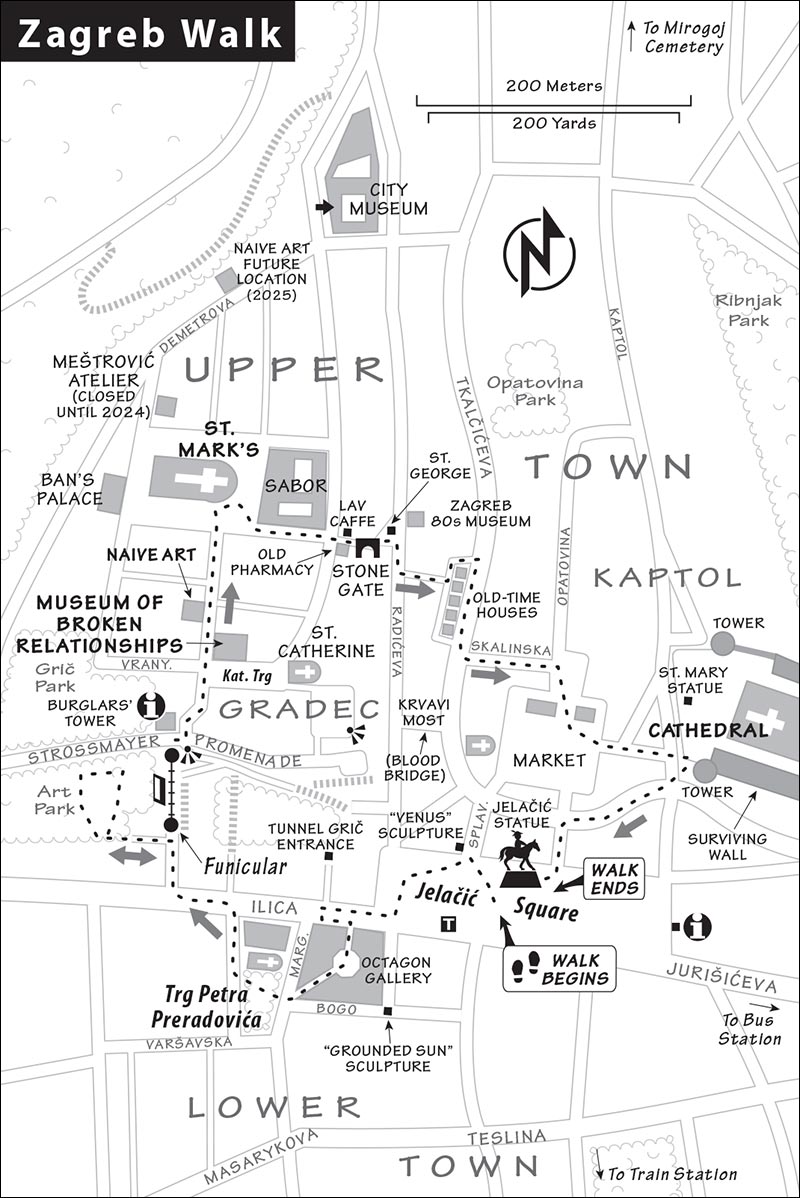
The following self-guided orientation walk, rated ▲▲, begins and ends at Jelačić Square, linking almost everything that’s worth seeing in this city, including the two hilltop towns that merged in 1850 to become Zagreb: Gradec and Kaptol. If you don’t enter any of the sights, the entire route takes about 1.5 hours. But if you take your time, you can use it as a framework for a full day of sightseeing. The city’s colorful food market—which is near the end of this walk—becomes quiet after 14:00, so you may want to tour that first (just a block away from our starting point; see here for tips on what to see there).
▲▲Jelačić Square (Trg bana Jelačića)
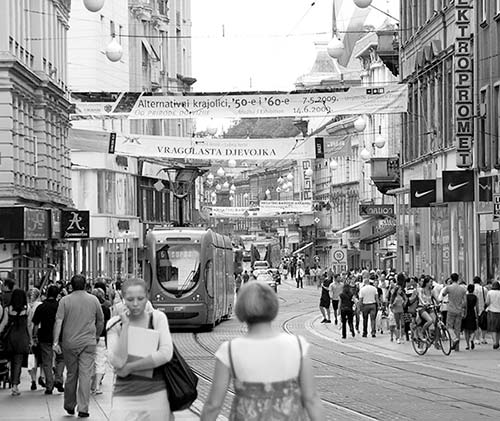
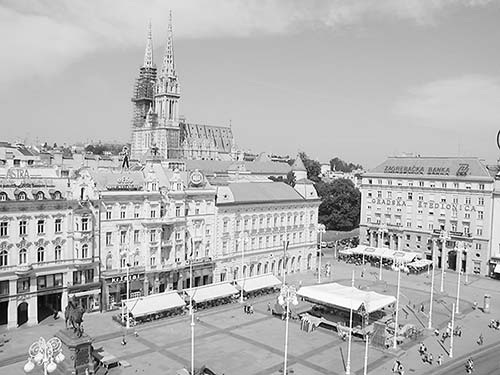
The “Times Square” of Zagreb bustles with life. Watching the crowds pile in and out of trams and seeing the city buzz with activity, you’ll feel the energy of an on-the-rise capital of a vibrant nation. This is also a popular place for any kind of special event in town—from concerts and sporting events to folk festivals, protests, and rallies. The city’s busy pedestrian scene, sense of style, and healthy mix of tourists and locals make it arguably Croatia’s best people-watching destination.
It’s hard to believe that this Donji Grad (lower town)—now so frenetic—once held the townspeople’s farm fields. Our walk takes you from here up to two towns—Gradec and Kaptol—that in 1850 combined to become the city of Zagreb. At that time, it was a small settlement of about 16,000 people. But under the auspices of the Habsburg monarchy, the newly formed Zagreb began to industrialize and grow like mad. These former fields sprouted aristocratic villas as well as low-rent housing for factory workers.
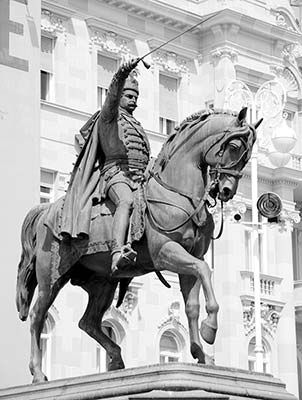
Today, the square features a prominent equestrian statue of national hero Josip Jelačić (YOH-seep YEH-lah-cheech, 1801-1859), a 19th-century governor who extended citizens’ rights and did much to unite the Croats within the Habsburg realm. In Jelačić’s time, the Hungarians were exerting extensive control over Croatia, even trying to make Hungarian the official language. Meanwhile, Budapesters revolted against Habsburg rule in 1848. Jelačić, ever mindful of the need to protect Croatian cultural autonomy, knew that he’d have a better shot at getting his way from Austria than from Hungary. Jelačić chose the lesser of two evils and fought alongside the Habsburgs to put down the Hungarian uprising. A century later, in the Yugoslav era, Jelačić was considered a dangerously nationalistic symbol, and this statue was dismantled and stored away. But when Croatia broke away in 1991, Croatian patriotism was in the air, and Jelačić returned. Though Jelačić originally faced his Hungarian foes to the north, today he’s staring down the Serbs to the south.
Get oriented. As you face Jelačić’s statue, down a long block to your left is a funicular that takes you up to one of Zagreb’s original villages, Gradec. Look for the TI to the right. If you exit the square ahead and to the right, you’ll reach the city’s other original village, Kaptol, and the cathedral (you can’t miss its huge, pointy, Neo-Gothic spires—visible from virtually everywhere in Zagreb). And if you just need a break, several lovely cafés ring the square.
Taking the small street behind Jelačić (and a little to the left) would lead you to the market (best in the morning) and the enticing café-and-restaurant street, Tkalčićeva (lively any time of day or night; we’ll circle back here later on the walk).
To see a unique bit of public art on this wide-but-short street, pause at the modern building with an arcade of blocky pillars, on the left. Look closely at the back of the first pillar (closest to Jelačić Square) and find the small silver plaque with a little ball labeled Venus (about eight feet up, facing the building). This is one piece of the 10-part work called “Zagreb’s Solar System.” Its center lies a short walk away, two blocks in front of Jelačić (on Bogovićeva street): a large spherical sculpture called The Grounded Sun. Scattered around the city are each of the nine planets, completely to scale—from the size of a marble to the size of a basketball—and each one at the appropriate distance from the “sun.” The artist did the project in secret, so Zagrebians had to seek out each of the nine planets on their own, in a kind of citywide scavenger hunt.
Watch for more planets as you wander—but for now, head up to the hill called Gradec.
Walk from Jelačić Square to Gradec
Go a long block down busy Ilica street (to the left as you face Jelačić). Watch on your right for #8 (labeled with a brown sign for Tunnel Grič—Entrance 4). This marks one of several entrance points to the Tunnel Grič, which burrows beneath Gradec, often called “Grič” for short. (The entrance is at the far end of this courtyard, between the café tables.) Townspeople used the tunnel as a shelter during World War II and again during the Yugoslav Wars of the 1990s. Now it’s been renovated and, from time to time, serves as a venue for art installations and light shows. Ask around town whether there’s anything going on in the tunnel during your visit...otherwise, there’s nothing to see (though locals sometimes use it as a cool shortcut to escape the hot summer sun).
Across the street, and slightly to the left, look for the grand entryway marked Privedna Banka Zagreb (at #5). Cross over and pop inside the Octagon shopping gallery. This was the ultimate in iron-and-glass shopping elegance a century ago and still features a few of the city’s top shops. One of these is Croata, the tie store that loves to explain how Croatian soldiers who fought with the French in the Thirty Years’ War (1618-1648) had a distinctive way of tying their scarves. The French found it stylish, adopted it, and called it à la Croate—or, eventually, cravate—thus creating the modern necktie. Croata’s selection includes ties with traditional Croatian motifs, such as the checkerboard pattern from the flag or characters from the ninth-century Glagolitic alphabet. Though pricey, these ties make nice souvenirs. You’ll see other branches of this shop around Croatia.
Walk all the way through the gallery, exiting into the inviting café-lined square called Trg Petra Preradovića. It hosts a flower market all day and inviting al fresco cafés throughout the day and into the night. Survey your options for a coffee break, then turn right and head back out to Ilica street, where you’ll turn left and continue the way you were headed.
After another short block, cross the tram tracks and turn right up Tomića, where you’ll see a small funicular (ZET Uspinjača) crawling up the hill. Dating from the late 19th century, this funicular is looked upon fondly by Zagrebians—both as a bit of nostalgia and as a way to avoid some steps. You can walk up if you want, but the ride is more fun and takes only 55 seconds. Locals claim this is the “shortest funicular in the world” (€0.70, validate ticket in yellow box before you board, leaves every 10 minutes or with demand, daily 6:30-22:00).
Before boarding the funicular, take a short detour to an interesting little pocket of funky counterculture. Facing the bottom of the funicular, look left for the little passage at Tomićeva Ulica 5 (marked with the sign for Tunnel Grič—Entrance 2, 3). Go through this passage, passing the juice bar and the youth hostel beyond. You’ll emerge into the fascinating Art Park. Once a notorious hangout for addicts, this has been transformed into a venue for local street artists, whose graffiti and other creations scamper up the steep slopes toward the Upper Town. There’s even a playground—perfect for just hanging out in an overlooked corner of the city center. There’s also an entrance for the Grič Tunnel.
When you’re done here, head back out to the funicular and ride it up.
Gradec
From the top of the funicular, you’ll enjoy a lovely panorama over Zagreb. The tall tower on the left as you exit is one of Gradec’s original watchtowers, the Burglars’ Tower (Kula Lotršćak). After the Tatars ransacked Central Europe in the early 13th century, King Béla IV decreed that towns be fortified—so Gradec built a wall and guard towers (just like Kraków and Budapest did). Look for the little cannon in the top-floor window. Every day at noon, this cannon fires a shot to commemorate a 15th-century victory over the besieging Ottomans. You can pay to climb the 116 steps to the tower, but I wouldn’t—the view is pretty similar from down here.
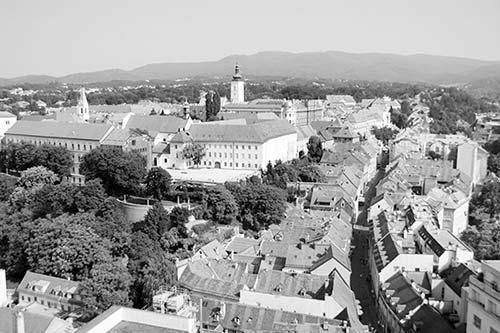
The Strossmayer Promenade runs along the top of the hill, overlooking the city. It’s nicknamed Strossmartre, a pun on “Montmartre.” This fine promenade is just the start; along the outside of Gradec is a forested greenbelt that—while only a few minutes’ walk away—feels miles from the city. It’s a favorite place for locals to go for an urban hike, walk their dogs, or get away from the asphalt heat of summer.
Head up the street to the right of the tower, entering Gradec. Although this is one of the oldest parts of Zagreb, it lacks the cutesy cobbled charm you might expect. That’s because little remains of medieval Gradec. When the Ottomans overran Europe, they never managed to take Zagreb, but the threat was enough to scare the nobility into the countryside. When the Ottomans left, the nobles came back, and they replaced the medieval buildings here with Baroque mansions.
At the first square, to the right, you’ll see the Jesuit Church of St. Catherine. It’s not much to look at from the outside, but the interior is intricately decorated—bubbly pink-and-white Baroque, dripping with stucco (only open to visitors during Mass). The same applies to several mansions on Gradec. This austere-outside, ornate-inside style is known as “Zagreb Baroque.”
As you continue up the street, notice the old-timey street signs, holdovers from the Austro-Hungarian era: in both Croatian (Gospodzka Ulica) and German (Herren Gasse).
From here, you’re a few steps from Zagreb’s most interesting museums: On the right is the Museum of Broken Relationships, and farther along on the left is the Croatian Museum of Naive Art (both listed later, under “Sights in Zagreb”; note that the Naive Art museum may be relocating soon).
In the next block, on the left, is the yellow “city parliament” building (basically the Town Hall, and a popular place for weddings on summer Saturdays). To the left of the door, look for the plaque honoring Nikola Tesla (1856-1943), the prominent scientist who championed alternating current (AC) as a better electrical system than Thomas Edison’s direct current (DC). Although Tesla was an ethnic Serb (his father was an Orthodox priest), he was born in a remote village in central Croatia, so both Serbs and Croats claim him. (Today, Tesla is a rare figure who is revered both in Zagreb and in Belgrade. Croatia even put him on their €0.10, €0.20, and €0.50 coins.) This plaque proudly trumpets that on May 24, 1892, Tesla came to this building and suggested that Zagreb become the first city in the world to build an AC power station. But the plaque fails to mention that the city parliament rejected this suggestion...so Tesla went to the US, where he successfully pitched the same idea to Buffalo, New York.
While Zagreb eventually did adopt AC, this part of town still clings to a much, much older form of lighting. Flanking the doors of the city parliament are two of the 217 old-fashioned gaslights that illuminate Gradec. These are lit and extinguished each day by two city employees. Notice that each lamp is numbered.
At the end of the block, you’ll come to St. Mark’s Square (Markov Trg), centered on the Church of St. Mark. The original church here was from the 13th century, but only a few fragments remain. The present church’s colorful tile roof, from 1880, depicts two coats of arms. On the left, the red-and-white checkerboard symbolizes north-central Croatia, the three lions’ heads stand for the Dalmatian Coast, and the marten (kuna, as seen on Croatia’s €1 coin) running between the two rivers (Sava and Drava) represents Slavonia—Croatia’s northern, inland panhandle. On the right is the seal of Zagreb, featuring a walled city.
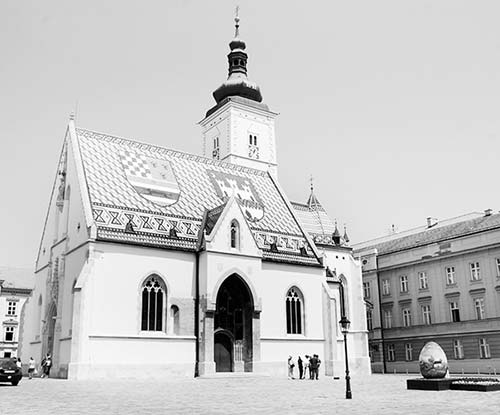
In the years since these tiles were laid, the city seal has changed in two ways (as you can see by comparing it to the city flag that flies from the city parliament building). First, while the castle doors are closed on the roof, today’s seal shows wide-open doors—to demonstrate that Zagreb is strong, but still welcoming to visitors. Second, the city color has been changed from red to blue. If you pay attention around town, you’ll notice the liberal use of Zagreb’s distinctive hue of blue—for example, on city buses and trams. And devoted fans of the immensely popular local soccer team, Dinamo Zagreb, are called the “Bad Blue Boys.”
While it would be nice to see the inside of St. Mark’s Church, you probably won’t be able to. The church was damaged in the 2020 earthquake and is likely still under reconstruction when you visit. Also, the priest doesn’t appreciate tourists, so it’s closed except during services. (If you manage to slip in, you’ll see frescoes with Bible scenes and sculptures by the talented 20th-century sculptor Ivan Meštrović: the crucifix over the main altar, a pietà on the left, and on the right, Madonna and Child sitting cross-legged, in a typical Meštrović pose.)
As you face the church, the long building on the right is the Sabor, or parliament. Since at least the 13th century, Croatian noblemen have met to make important decisions regarding their territories. This gradually evolved into today’s modern parliament. While this square used to be a congested parking lot, Zagreb’s mayor declared it a traffic-free zone; now members of parliament either have to be bused in from off-site parking lots (watch for the cute little blue bus that comes and goes periodically) or have their drivers sit tight nearby (look for unmarked black cars patiently waiting on the street in front of the city parliament).
Across the square from the Sabor (to your left as you face the church) is Ban’s Palace (Banski Dvori), today the offices for the prime minister. This was one of the few buildings in central Zagreb damaged in the war following Croatia’s independence. In October 1991, Yugoslav People’s Army pilots targeted this building in an air strike. (Notice the different-colored tiles where the roof had to be patched.) They landed a direct hit on the room where Croatian president Franjo Tuđman and his right-hand man, Stipe Mesić (who would later succeed him as president), were scheduled to meet. But coincidentally, the meeting had been moved to another location at the last minute—so Croatia’s first two presidents survived. (It’s eerie to think what might have become of this fledgling nation if its leadership had been wiped out at that early stage.)
Before moving on, consider visiting two more excellent museums, which sit just a short walk away (both described in detail later, under “Sights in Zagreb”). The talented 20th-century sculptor Ivan Meštrović’s former home and studio is now a museum of his works (though it is closed for renovation through at least 2024). It’s about a block away: Go down the street behind the church on the left, and you’ll see the museum on the right. And the extensive, well-presented Zagreb City Museum explains the story of this town from prehistoric times to the modern day. To reach it, walk along the front of the Sabor and continue straight ahead two blocks, watching for the museum on your right.
Walk from Gradec to Kaptol
For an interesting stroll from St. Mark’s Square to the cathedral, head down the street (Kamenita Ulica) to the right of the parliament building. Near the end of the street, on the right, you’ll see the oldest pharmacy in town, restored and gleaming (c. 1355, marked gradska ljekarna). Across the street is Lav Caffe Galerija, a fun, relaxing coffeehouse and art gallery; this is just one of many inviting coffee-break opportunities you’ll see between here and the end of this walk.
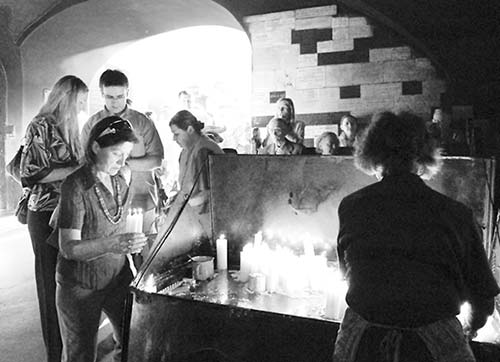
Just beyond, you’ll reach Gradec’s only surviving town gate, the Stone Gate (Kamenita Vrata). Inside is an evocative chapel. The focal point is a painting of Mary that miraculously survived a major fire in the house up above in 1731. When this medieval gate was reconstructed in the Baroque style, it was turned into a makeshift chapel. The candles (purchased in the little shop) represent Zagrebians’ prayers. Notice the soot-blackened ceiling over the forest fire of blazing candles in the big metal bin. The stone plaques on the wall say “thank you” (hvala ti) for prayers that were answered. You may notice people making the sign of the cross as they walk through here, and often a crowd of worshippers gathers, gazing intently at the painting. Mary was made the official patron saint of Zagreb in 1990.
As you leave the Stone Gate and come to Radićeva, you can either take the steps or curve down the path next to a statue of St. George slaying a dragon (which looks more like an alligator-catfish hybrid). This square is named after the Brethren of the Croatian Dragon (Braća Hrvatskoga Zmaja)—a local fraternal organization, like a Rotary club, that has an office nearby. St. George’s lance is pointing directly at the Zagreb 80s Museum, great for those wanting a time machine back to that era (see here).
Turn right on Radićeva street and begin walking downhill. Looking down to the bottom of Radićeva, you’ll see where this street is becoming a popular shopping zone, with local boutiques popping up all the time (for example, Kredenca—with three branches—has some nicely curated housewares and gifts). This can be a fun area to browse.
But for now, head just a few steps down Radićeva, then watch for the orange building at #30 on your left. Go through the big, arched entryway and bear right down the wooden steps. At the bottom of these stairs, you’ll come to a little row of old-time houses. In times past, this was one of the most popular areas in town...as home of the red light district. While prostitution is illegal now, it was once allowed and carefully regulated, with routine medical examinations for the sex workers. Legally, only a woman (over age 30) could own and operate a brothel. Locals note, with some irony, that the balconies on the opposite side of these houses of ill repute—which we’ll see in a moment—face the stern spires of the cathedral.
Turn left, walking along the row of old houses (and noticing the remains of the old Gradec town wall on your left), then turn right down the stairs. You’ve just dropped down into the middle of Zagreb’s most appealing street, Tkalčićeva (tuh-KAHL-chee-chay-vah). Do a slow spin to savor this in-love-with-life drag. The traffic-free street combines some of the most atmospheric old homes of Zagreb with some of its most enticing eateries and people-watching. (For starters, you’re literally surrounded by tables for the recommended Pivnica Mali Medo brewpub.)
If you need a break from sightseeing, Tkalčićeva is just the ticket: Pause for a coffee, beer, or meal anywhere along this street (I’ve listed several recommendations under “Eating in Zagreb,” later).
If you stood here 200 years ago, you’d be washed away by a rushing river that separated Gradec (behind you) and Kaptol (in front of you). In the Middle Ages, the two towns were at odds and sometimes fought. (“Downriver” from here is a cross street that’s still called Krvavi Most—“Blood Bridge.”) But in 1850, after the towns had long since set aside their differences, they merged to become Zagreb. The polluted, stinky river had become a nuisance, so they diverted its flow and covered over the valley to create Tkalčićeva.
Turn right and enjoy a stroll down Tkalčićeva (toward the onion-domed tower of Holy Mary Church). You’ll pass (on the right) the balconies of the brothels we saw earlier, then a fine park on the right with a genteel lady prepared for rain. (The parasol is part of the official folk costume for Zagreb.) Just beyond the park is the Mars plaque for the solar system sculpture. Directly across the street, walk up the hill toward the cathedral towers (on Skalinska, passing outdoor restaurant tables and the entrance to the recommended eatery, La Štruk).
Kaptol
As you walk uphill, you’re entering Kaptol, the second of medieval Zagreb’s twin towns.
At the top of the street, turn right and go down the stairs to find Zagreb’s lively-in-the-morning market (dolac). If you’re here at prime time, browse the market’s double-decker delights (noticing that the meat and cheese halls are beneath your feet—use the stairs or elevator in the blocky white building to get there).
When you’re done at the market, go through the gap between the buildings toward the cathedral spires. Crossing the square, you can see Croatia’s most important house of worship (described later, under “Sights in Zagreb”; it may be closed for earthquake restoration, but the exterior is worth a look). From here, you can head downhill one block to Jelačić Square, where our walk began.
Sights in Zagreb
MUSEUMS IN THE CENTER
Zagreb has more than its share of museums, and many of them are excellent—making up for the lack of great Croatian museums outside the capital. It would take you days to see all the city’s museums; I’ve selected the most worthwhile (still enough to fill a day or two—choose the ones that interest you the most). Note that many local museums and landmarks were damaged in the 2020 earthquake; some may still be closed for restoration (I’ve listed the known closures and likely—but not guaranteed—reopening dates). The TI has the latest info on what’s open and what’s not.
▲▲▲Croatian Museum of Naive Art
This remarkable collection (the Hrvatski Muzej Naivne Umjetnosti), founded in 1952 as the “Peasant Art Gallery,” is one of the most enjoyable exhibitions in Croatia. It features expressionistic paintings by untrained peasant artists, mostly Croatians, from the 1930s onward, an easily digestible sampling of the top names from the Naive Art movement. Viewing these works, it’s important to remember that they aren’t considered “folk art” or “amateur art” but top-quality works by great artists who were, by fluke or fate, never formally trained.
Cost and Hours: €6, Mon-Fri 10:00-17:00, closed Sat-Sun, Sv. Ćirila i Metoda 3, +385 1 485 1926, https://hmnu.hr.
New Location Coming: Sometime in 2025 or 2026, this collection will move to a new museum building not far away (at the far end of Gradec hill, at Demetrova 18, near the City Museum). Check the website for updates.
Visiting the Museum: Here’s an overview of some of the big names of the Naive Art movement. The museum’s specific layout changes regularly, the museum curator likes to highlight different artists and works, and the order likely will change, so you may not find all of these names.
Ivan Generalić (1914-1992): Generalić is the founder and star of Croatian Naive Art. (Look for his self-portrait, with a blue background.) Generalić was discovered in the 1930s by a Paris-trained Croatian artist. Early paintings show his evolution as an artist (and the evolution of Croatian Naive Art in general): While his early works come with a social or political agenda (such as Requisition, where two policemen repo a cow from an impoverished couple), he eventually mellows his focus to show simple, typical village scenes that gradually become more fantastical (Cows in the Forest, 1938). Eventually he strips away people entirely to focus on the land (1956’s Deer in the Forest and 1959’s Flood). In 1953, Generalić—still relatively unknown outside his homeland—did a show in Paris, sold everything, and came home rich. This put Croatian Naive Art on the international map and kick-started a new vigor in the movement.
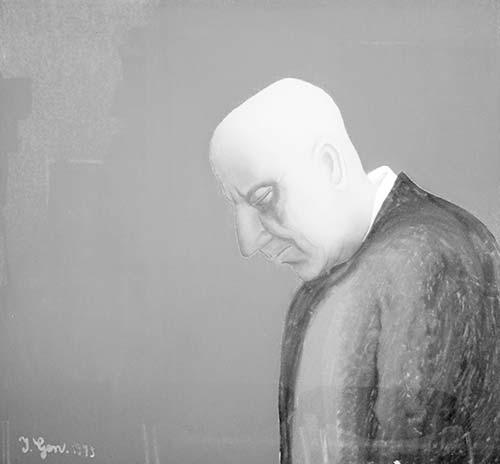
Woodcutters, from 1959, shows the next phase, as Generalić’s works became even more rich with fantasy—the peacock, the men clinging to treetops, and the trademark “coral trees.” Instead of showing, Generalić is evoking; Naive Art strove to capture the spirit and emotion of peasant life. Paintings such as this one inspired Generalić’s followers (called the “Hlebine School,” for the village where Generalić lived). In Solar Eclipse (1961), villagers cower and roosters crow as the sun is mysteriously gobbled up by a black disc. People respond in different ways: some by staging impromptu religious processionals, others by clutching their belongings close and fleeing.
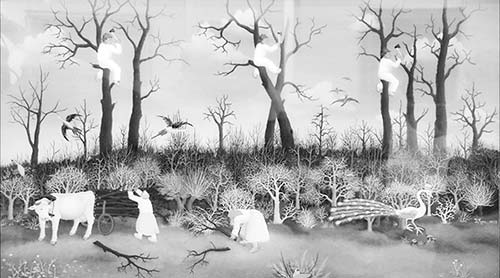
Mirko Virius (1889-1943): Virius was, along with Generalić, one of the earliest practitioners of this form. His paintings here, mainly from the 1930s, are simple farmer scenes.
Mijo Kovačić (1935-): Kovačić specializes in peasant landscapes; you may see one of his most representative works, Winter Landscape with Woman. Notice how Kovačić took a style of painting pioneered by Generalić and brought it to the next level. Kovačić especially enjoyed winter scenes for the black-and-white contrast they allowed. Like Dalí, Magritte, and other Surrealists, Kovačić juxtaposed super-realism with fantastical, almost otherworldly settings.

Ivan Večenaj (1920-2013): Večenaj focused on religious scenes (you may see his gruesome Evangelists on Calvary crucifix, or Eve Can Go No Farther, from 1962). He also painted some fine countryside scenes, such as Cows Pulling Wood (1965).
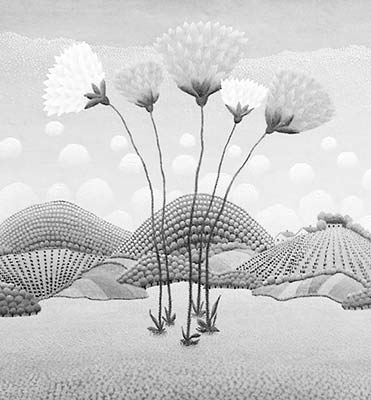
Ivan Rabuzin (1921-2008): Arguably the movement’s second most important artist (after Ivan Generalić), Rabuzin painted lyrical landscapes. Like a visual haiku, his dreamlike world of hills, trees, and clouds is reminiscent of Marc Chagall.
Ivan Lacković Croata (1932-2004): Croata painted works—often on very long, narrow, horizontal panels—that focus on different seasons. In his paintings, watch for more of those distinctively spiny, bonsai-like trees that pervade Naive works.
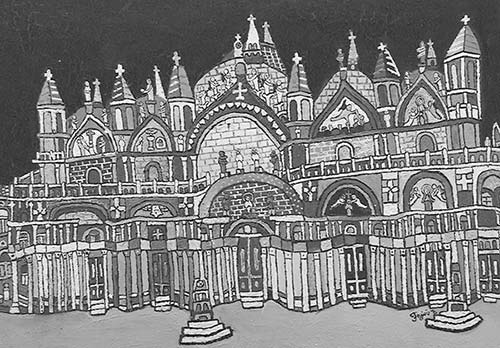
Emerik Feješ (1904-1969) specialized in colorful scenes of famous monuments from around Europe: Venice, Vienna, Milan, and so on. Feješ never traveled to any of these places—his paintings are based on romantic black-and-white postcards of the era, which Feješ “colorized” in his unique style.
Starting in the late 19th century, the art world began to broaden its definition of great art, seeking out important work originating outside the esteemed academies and salons of the day. The goal: to demonstrate that art was not simply a trained skill but an inborn talent. Intellectuals began to embrace an “anti-intellectual” approach to art. Interest grew in the indigenous art of Africa, Mesoamerica, and Polynesia (Picasso went through an African mask phase, and Gauguin went to live in Tahiti); composer Béla Bartók collected traditional folk melodies from the Hungarian countryside; the Art Brut movement preserved artwork by people deemed “insane” by mainstream society; the autodidactic (self-taught) painter Grandma Moses became well known in the US and Europe; and art by children gained acclaim.
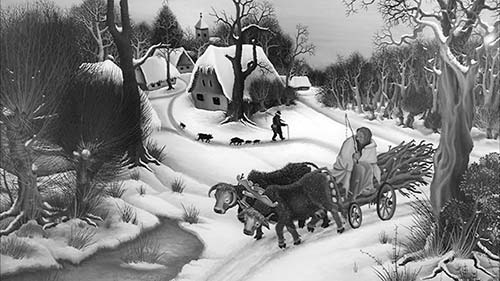
Here in Croatia in the 1930s, the focus was on art by untrained peasants. At that time, as in much of rural Europe, 85 percent of Croatians lived virtually medieval lifestyles—with no electricity or other modern conveniences—and the majority were illiterate and uneducated. These artists captured this humble reality, creating figurative works in an increasingly abstract age. By the 1950s and 1960s, Croatian Naive Art had emerged at the forefront of a Europe-wide phenomenon.
Notice that Naive artists frequently painted on glass. It was cheaper and more readily available in rural areas than art canvases, and because it required no special technique, it was an easier medium for the untrained artists to work on. Winter scenes were most common, because the peasant artists were busy working the fields the rest of the year. (Early on, such artists were sometimes called “Sunday painters,” because they had to work their “real” jobs from Monday to Saturday.)
Today, the wonderful Museum of Naive Art in Zagreb continues to introduce visitors to this unique, important, and fascinating school of art.
Matija Skurjeni (1898-1990) painted the almost crayon-like Animal World (1961). While it looks like the roll call for Noah’s ark, it’s loaded with symbolism. The dinosaur is Skurjeni’s self-portrait, the other large animals are his friends and artistic colleagues, the butterflies fluttering around represent spirituality (a new spin on the white dove of the Holy Spirit)...and the devil in the base of the tree, with wings and a crown, is one of Skurjeni’s harshest critics—who also happened to be the curator of this museum at the time.
Drago Jurak (1911-1994) painted intricate scenes that mingle a childlike, fantastical vision of the world and a remarkable attention to repeated, and slightly varied, details. Look for his City on the Water (1970) and Life on Earth (1976).
And More: Rounding out the collection (though not always on display) are works by Naive artists from Russia, Japan, France, and Poland. Sculptures—typically rough-hewn out of wood, and sometimes out of stone—bring a third dimension to this art form.
You may also see pencil sketches used by Naive artists to create their works (such as one for Generalić’s Solar Eclipse). After the sketch was complete, the artist would put it against a pane of glass to paint the scene—small details first, gradually filling in more and more of the background. After being composed essentially backward, the glass painting would be flipped over to be viewed. All works on glass you’ve seen in this collection were painted backward.
▲▲Museum of Broken Relationships
Opened in 2010 by a former couple who had recently broken up, this extremely clever museum lives up to all the attention it’s received in the international press. The museum’s mission is simple: collect true, first-person stories of broken relationships from around the world and display each tale alongside an actual item that embodies the relationship. Many of these are romantic couplings gone sour—from a tumultuous affair that ends in disaster to the slow fade of lovers who gradually grow apart. But other kinds of relationships are included as well: a father who abandons his family; a wedding dress never worn, due to the untimely death of the groom; a door with handwritten messages left to honor a deceased son; someone who can no longer eat pizza due to a gluten intolerance; a tape recorder with the voice of a departed father; tattered love letters and mysterious postcards. It’s clever, creative, funny, tragic, and absolutely reeking with humanity. The museum is small—just a few rooms—but rewards those who take the time to read each story. The collection has been such a hit, they’ve taken it on the road, garnering fans in cities worldwide. If you enjoy the collection, the €25 museum book—with the stories and photos—is a good souvenir.
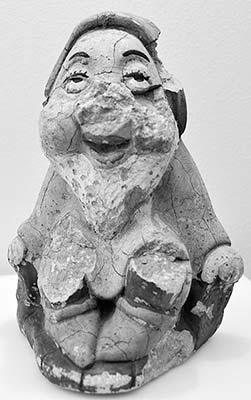
Cost and Hours: €7, daily 9:00-22:00, Oct-May until 21:00, café, Sv. Ćirila i Metoda 2, +385 1 485 1021, https://brokenships.com.
▲Ivan Meštrović Atelier
Ivan Meštrović—Croatia’s most famous artist—lived here from 1922 until 1942 (before he fled to the US after World War II). The house, carefully decorated by Meštrović himself, has been converted into a delightful gallery of the artist’s works, displayed in two parts: residence and studio. Unfortunately, the museum is likely closed for renovations through at least 2024 (behind St. Mark’s Square at Mletačka 8, +385 1 485 1123, https://mestrovic.hr). For more on Meštrović, see here.
Visiting the Museum: When it’s open, you’ll enter the high-ceilinged dining room of Meštrović’s home. He designed the crucifix on the wall (Christ being supported by an angel), the wood-carved chandeliers, and the furniture, right down to the carvings on the backs of the chairs. Overlooking the table is a sculpture of his mother, wearing the traditional headdress of her Dalmatian village homeland, legs crossed, hands clasped in intent prayer—a favorite pose of Meštrović’s. At the other end of the table is a self-portrait bust of Meštrović, head cocked quizzically. In the alcove at the bottom of the stairs, see the Madonna and Baby, tenderly kissing.
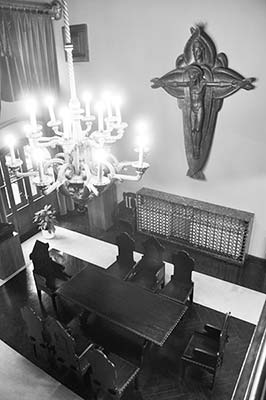
Upstairs are sketches and plaster casts Meštrović did in preparation for some of his larger works. The rooms on this floor are filled with busts and small, characteristically elongated statues, all of them expressive. In the far room, appreciate his fine ceiling frescoes; in the adjoining room, find Meštrović’s powerful sculpture depicting his mentor and friend, Auguste Rodin, furiously at work.
The top floor has several evocative pieces: Meštrović’s wife breastfeeding their son; a portrait of Michelangelo, Meštrović’s artistic ancestor, holding a chisel and hammer and portrayed with his trademark high forehead and smashed nose; a copy of the powerful pietà from St. Mark’s Church; a cowering Job; the head of an archangel; a tender portrait of a mother teaching her child to pray; a small model of one of Meštrović’s biggest and best-known works, Bishop Gregory of Nin (in Split, described on here); and a praying woman with a beehive ’do.
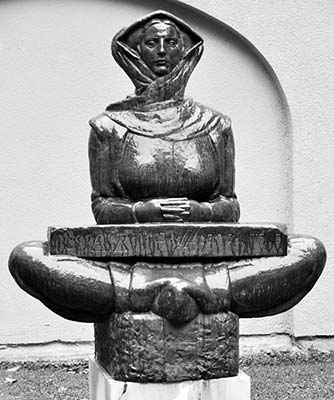
Back downstairs, cross through the garden to reach the studio. Outside are several more beautiful pieces, including another one of the museum’s top works: The History of the Croats, with a woman sitting cross-legged (remember this pose?) with a book resting on her lap. The top of the book has a unique Croatian spiral design, and along the front of it are the letters of Croatia’s Glagolitic alphabet. Elsewhere, John the Evangelist studiously takes notes, looking up for divine inspiration. And the small Prince Marko on Šarac—while clearly a Croatian theme—evokes two of Meštrović’s most famous works, the giant Native Americans on horseback that stand in Chicago’s Grant Park. Those towering sculptures were created in this very studio and later transported (in pieces) to the United States. Originally, those sculptures were commissioned to be a cowboy and an Indian...but Meštrović said, “How about two Native Americans...?”
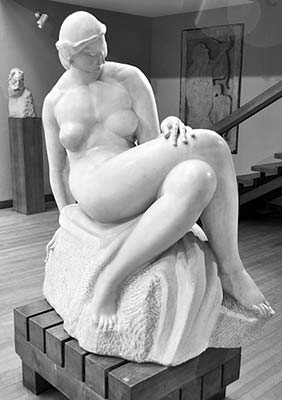
Go into Meštrović’s studio. Here you’ll likely see a skinny, Modigliani-esque sculpture of Meštrović’s first wife, Ruža, as well as two sculptures modeled after his second wife, Olga: the unfinished, walnut-carved Mother and Child, and the exquisite, white-marble Woman Beside the Sea (one of the collection’s highlights). Rounding out the collection are the Evangelist Luke—the twin of John out in the garden—and a study for the spiny-fingered hand of Split’s Bishop Gregory of Nin.
On your way back out, take a moment to linger in the courtyard—with the large Woman in Agony in the center and less-agonized women all around.
▲Zagreb City Museum (Muzej Grada Zagreba)
This collection, with a modern, well-presented exhibit that sprawls over two floors of an old convent, traces the history of the city through town models, paintings, furniture, clothing, and lots of fascinating artifacts.
Cost and Hours: €4, Tue-Sat 10:00-18:00, Sun until 14:00, closed Mon, at north end of Gradec at Opatička 20, +385 1 485 1361, www.mgz.hr.
Visiting the Museum: After buying your ticket, head through the door and turn left, then work your way up through the ages. Each display has a good English description. On the largely skippable ground floor, you’ll loop through the prehistoric and Roman periods and the medieval growth of the twin towns of Gradec and Kaptol. You’ll see city symbols and flags, a town model from 1795, statues from the main portal of the cathedral (17th-century Baroque) and other religious art, and a small collection of cleverly decorated 18th-century weathervanes.
Upstairs, the exhibit lingers on Zagreb’s boom time in the 19th century, when it was an increasingly spruced-up and genteel outpost of the Austro-Hungarian Empire. The exhibits consider various facets of society during that era. You’ll see more religious art, furniture, aristocratic portraits, another town model (from the 1860s), a life-size portrait of national hero Josip Jelačić (and his actual uniform), and colorfully painted shooting targets. One room has a giant city map on the floor, punctuated with models of key buildings. You’ll also find models of old storefronts, theater costumes, and exhibits on public utilities and social life.
The coverage of the tumultuous 20th century is perhaps most engaging, though it has an understandably bad attitude about the Serb-dominated first Yugoslav period. Propaganda posters cheer on the Tito era, while all of this historical heaviness is balanced by a lighthearted look at Zagreb’s popular cartoon industry. The finale is a room dedicated to the creation of independent Croatia, including an exhibit on damage sustained during the war and a film with clips from various landmarks in Croatian independence: a violent riot at a heated 1990 soccer match between Dinamo Zagreb and Belgrade’s Crvena Zvezda (Red Star) team; the election and arrival in parliament of the pro-independence Franjo Tuđman; and the return of the statue of Jelačić to his namesake square.
OTHER SIGHTS IN THE CENTER
▲▲Market (Dolac)
In 1930, Zagreb tore down much of Kaptol’s rickety, medieval old town to build this as-central-as-possible market. Today, it’s jammed with producers from the surrounding countryside—and all over Croatia—selling myriad fruits, vegetables, meats, cheeses, fish, and other foodstuffs. A stroll through the market offers insight into the colorful local culture and the chance to pick up a few picnic items. To reach the market easily from Jelačić Square, walk one block up the street to the left of the Jelačić statue, and climb up the stairs (open Mon-Sat 7:00-14:00, Sun until 13:00).
Visiting the Market: The market has two sections—indoor (with meat and cheese) and outdoor (produce, just above). Begin by exploring the outdoor section, then head inside. At the top of the stairs coming up from Jelačić Square, notice the statue of the kumica—a villager wearing a traditional dress (with a head scarf) and balancing a basket of produce on her head.
Filling the square is the produce market, with vendors from all around selling what’s fresh. What you’ll see changes with the season (for instance, in late summer, you’ll see plums and grapes; in fall, look for nuts and mushrooms), but there are a few mainstays. The honey (med) is a reminder that the mountain behind Zagreb is called Medvednica. In Croatian, a bear is poetically called a medved—literally “honey-seer.” So Medvednica means “place of the honey-seer.” The big red umbrellas with white, yellow, and green stripes evoke the parasols that are part of the traditional costume for the region around Zagreb. The stalls in the narrow passage behind the boxy white building (which is the entrance to the lower, indoor market) sell various components of that same costume (such as embroidered scarves); while tourists can buy them, most customers are locals. Nearby, the few “souvenir” stands (at the top part of the market, near the cathedral) show off colorful, traditional wooden toys, still made the way they have been for centuries (men do the carving, women do the painting); the wooden birds on sticks—which flap their wings when you roll them along the floor—are a favorite.
As you face the top of the market, to the left you’ll see the fragrant fish market (ribarnica). While Zagreb is far from the sea, the freshest catch is trucked in daily.
To get to the indoor market (tržnica), enter the boxy white building and descend using the stairs or elevator. You’ll pop out in the meat market. Stroll the stalls, noticing—in addition to the typical assortment of sausages, salamis, and pršut (prosciutto)—the local affection for horsemeat (from a young horse—ždrebetina, or an adult—konjetina). Also watch for piles of a local delicacy called čvarci. Vaguely similar to pork rinds, these were created as a way to use up otherwise unused bits and pieces of pork; they’d press all of the fat out of them, creating a crispy snack. While this used to be simple peasant food, these days meat production is streamlined to process pork leftovers in other ways—and so čvarci are considered a rare and expensive delicacy (prešani čvarci are even more pressed—and more expensive).
From the meat market, look for the dairy section (marked mlijenči proizvodi, on the left from where you entered). Most cheese here is cow cheese (kravlji), typically very fresh and soft, and sometimes with flavorings (such as paprika or chives) mixed in. Goat cheese (kozji) is more rare. In this area, you’ll also see some local starches. The extremely skinny noodles called rezanci are used in soups; the big, flat squares that look like tortillas (mlinci) are served with poultry—they soak up drippings to become soft and delicious.
▲▲Cathedral (Katedrala)
Zagreb’s cathedral is the most important church in a very devoutly Catholic country. Unfortunately, it was seriously damaged in the 2020 earthquake and is closed for restoration and stabilization work at least through 2023. When it’s open, you’ll see monuments to many late, great Croatians and get a taste of the faith that pervades this country.
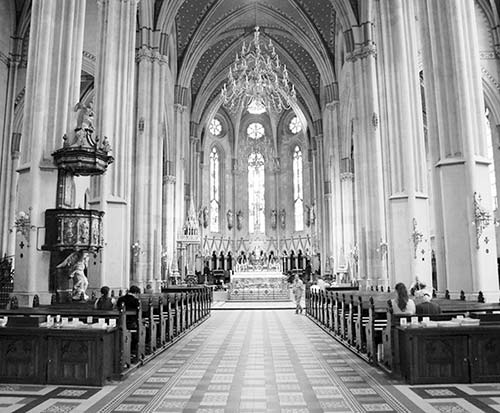
Cost and Hours: When open, typically free, usually Mon-Sat 10:00-17:00, Sun from 13:00.
Visiting the Cathedral: You can get a good look at the architecture (even if the church is closed) by standing in the square in front (near the gilded Madonna on a pillar—sculpted by the same artist who did the Jelačić statue on the main square). In 1094, when a diocese was established at Kaptol, this church quickly became a major center of high-ranking church officials. In the mid-13th century, the original cathedral was destroyed by invading Tatars, who used it as a stable. It was rebuilt and surrounded by a stout medieval wall—practically turning it into a castle to defend against potential Ottoman invasion. You can still see the pointy tops of the round guard towers on either side of the church; until a century ago, this wall ran along the road behind you, completely enclosing the building. (The St. Mary pillar stands upon the round footprint of another one of the towers.) The church was severely damaged again, this time by an earthquake, in 1880. The current version is Neo-Gothic (completed in 1902), incorporating a few original Gothic elements. Much of the wall was torn down to allow the town to grow. Its full name is the Cathedral of the Assumption of the Blessed Virgin Mary and the Saintly Kings Stephen and Ladislav (whew!)—but most locals just call it “the cathedral.”
Walking closer to the main door, look to the left to see the two spires displayed just inside the wall. The one on the left, eroded to a pathetic nub, demonstrates what happens when you use abundant—but porous—limestone to build a church in a climate with cold, freezing winters. (They can get away with using limestone on the coast, but in chilly Zagreb, it’s just not the right material.) Some part of the church likely will be covered by scaffolding during your visit—as it has been for decades, as restorers have gradually been replacing worn elements with new ones...this time, using a more durable stone.
If the cathedral is open, step inside and wander down the nave, taking in the opulence of the church. When it was completed, Zagreb was a small city of about 70,000 people; the construction of a church this finely decorated hints at the wealth of the city during its boom time. (In later times, that money dried up; the big chandeliers hanging in the nave were reportedly imported from Las Vegas—the best source for affordable glitz—in the 1970s.)
First, head to the main altar and look closely at the silver relief: a whimsical scene of the Holy Family doing chores around the house (Mary sewing, Joseph and Jesus building a fence...and angels helping out).
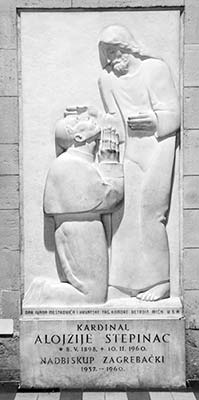
From the altar, turn left, then head to the front of the church. In the front-left corner (on the wall, between the confessionals), find Ivan Meštrović’s monument to Alojzije Stepinac. We’ll learn more about Stepinac in a moment, but for now pay attention to this beautifully carved piece of sculpture. Meštrović, the talented Croatian sculptor, worked in the early 20th century before fleeing communist Yugoslavia. Notice that this work was carved in “Detroit, Mich, USA,” where Meštrović lived out his days in a self-imposed exile. Meštrović was a close friend of Stepinac and carved this monument from half a world away.
Facing the nearby altar, look on the right for the bronze monument to Josip Jelačić, the statesman whose statue adorns Zagreb’s main square. Remember that Jelačić gained fame fighting against the Hungarians during the Habsburg era; the monument explains that his efforts allowed Zagreb to become an archbishopric, increasing its independence. But the large altar next to him celebrates three early Hungarian sainted kings, who (back when Croatia was part of Hungary, centuries before Jelačić) founded this church. You can imagine a Croat viewing this and thinking, “Those wonderful Hungarians, to whom we owe this church—thank God we defeated them.”
Walk up the steps to the area behind the main altar. Here you’ll find a glass case containing a waxy, eerily lifelike sculpture of Alojzije Stepinac. (His actual remains are below.) Stepinac was the archbishop of Zagreb during World War II, when he supported the fascist Ustaše movement, pledging his allegiance to Ante Pavelić’s Nazi puppet government in Croatia. Like many Croatians, Stepinac believed that this was the ticket to greater independence from Serbia. When Tito came to power, he put Stepinac on trial and sent him to jail for five years, before he was banished to live out his life in the remote, poor village where he was born. But Stepinac never lost his faith, and many Croatian Catholics consider him something of a martyr—and arguably the most inspirational figure of their faith. He’s also respected in the US, where some Catholic schools bear his name. But many Serbs still consider Stepinac a villain who cooperated with the genocidal activities of the brutal Ustaše.
Before leaving, pull up a pew and ponder the role of faith in contemporary Croatian life. By definition, Croats are Catholics. And, although religion was not encouraged in communist Yugoslavia, it was also not prohibited (as it was in most Warsaw Pact countries). Politicians, military officers, and civil servants (such as teachers) couldn’t publicly profess their faith, but many were privately devout. And with the breakup of Yugoslavia and the ensuing wars, Catholicism has seen a huge boost. In this part of the world, where ethnicity is tied to faith, nationalism (which is also on the rise) hews closely to religion—too closely, many impartial observers fear. The increasing influence of the Catholic Church on Croatian politics will be a hot potato here for years to come.
As you leave the cathedral, look high on the wall to the left of the door. This strange script is the Glagolitic alphabet (glagoljca), invented by Byzantine missionaries Cyril and Methodius in the ninth century to translate the Bible into Slavic languages. Though these missionaries worked mostly in Moravia (today’s eastern Czech Republic), their alphabet caught on only here, in Croatia. (Glagolitic was later adapted to become the Cyrillic alphabet—still used in Serbia, Russia, and other parts east.) In 1991, when Croatia became its own country and nationalism surged, some Croats flirted with the idea of making this the official alphabet.

ELSEWHERE IN ZAGREB
▲Mirogoj Cemetery (Groblje Mirogoj)
Of Europe’s many cemeteries, Mirogoj (MEE-roh-goy) is one of the finest, studded with great architecture and beautifully designed tombs. This peaceful spot, a short bus ride from the city center, memorializes many of the greats who built the Croatian nation. Anyone can enjoy a quiet walk here, but to provide context to your stroll, stop by the TI first for their free, thorough booklet of maps and descriptions identifying the most significant graves.
The cemetery was designed by Herman Bollé, an Austrian architect who lived and worked for most of his career in Zagreb, leaving his mark all over the city before becoming a permanent resident in this cemetery. From the stately, domed main mausoleum, a long arcade (with VIP tombs) stretches along the road in both directions, punctuated by smaller domes. Entering through the main gate, circle behind the mausoleum to find the biggest tomb here: Franjo Tuđman, the leader who spearheaded the creation of independent Croatia but left behind a questionable legacy (for more on Tuđman, see here). Continuing straight past Tuđman’s grave, you’ll reach the Central Cross, which usually has a field of flowers around it, and beyond that, a monument to the dead of World War I. In every direction, as far as the eye can see, are the final resting places of great Croatians.
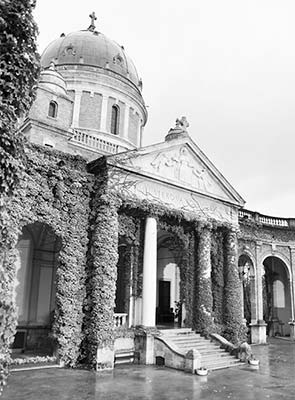
Cost and Hours: Free, daily 6:00-20:00, Oct-March 7:30-18:00.
Getting There: Catch bus #106, #203, or #226 from in front of the cathedral (3/hour) and ride six stops, or about 10 minutes, to the stop called simply “Mirogoj” (the one after the stop called “Mirogoj Arkada”). The return bus leaves from across the street.
Sights in and near the Green Horseshoe
With extra time, stroll around the Green Horseshoe—the U-shaped belt of parks and museums near the city center. The museums on and near this park aren’t as interesting as those on Gradec but may be worth a peek on a rainy day. Like most museums in Zagreb, these close early on Sundays and all day Monday. The Modern Gallery, described later, is also in this area.
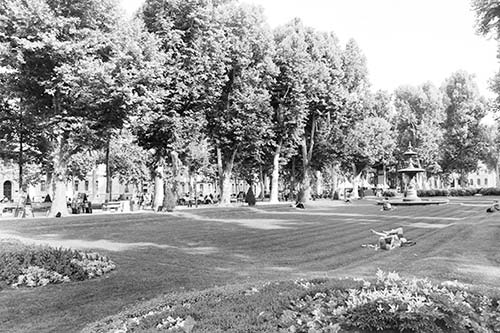
The Arts and Crafts Museum (Muzej za Umjetnost i Obrt) features furniture, ceramics, and fashion, all well displayed chronologically (likely closed for earthquake restoration—check before visiting, Trg Republike Hrvatske 10, www.muo.hr).
The Mimara Museum (Muzej Mimara) fills a grand, empty-feeling building with the eclectic art collection of a wealthy Dalmatian, ranging from ancient artifacts to paintings by European masters. While the names in the second-floor painting gallery are major—Rubens, Rembrandt, Velázquez, Renoir, Manet—the paintings themselves are minor. The first floor displays sculpture and applied arts, while the ground floor has vases, carpets, and objects from the Far East (likely closed for earthquake restoration—check before visiting, Rooseveltov Trg 5, www.mimara.hr).
The Botanical Garden (Botanički Vrt), run by the University of Zagreb, offers a back-to-nature change of pace from the urban bustle (small entry fee, closed Nov-March, at southwest corner of the Green ’Shoe, Marulicev Trg 9A).
Other Museums
The Zagreb 80s Museum offers a look at an alternate universe of 1980s pop culture and consumer goods from behind the Iron Curtain. Between Gradec and Kaptol, the small collection of objects from the waning days of Yugoslavia is hands-on, so you can flip through old cookbooks, try on dated fashions, play antiquated video games, and sit behind the wheel of a vintage car. It feels like a well-curated thrift store, but English explanations are limited—you’re essentially on your own to browse and immerse yourself in the ’80s (€6, daily 11:00-21:00, Radićeva 34, www.zagreb80.com).
In addition to the art gallery at the Mimara Museum (described earlier), art lovers may want to visit the following museums. Three different collections cover works from the 20th century through today: The National Museum of Modern Art highlights Croatian art from the early 20th century, offering a look at some talented artists—such as Vlaho Bukovac—who are underrated and well worth getting to know (a few blocks south of Jelačić Square at Andrije Hebranga 1, www.moderna-galerija.hr); the Museum of Contemporary Art focuses on midcentury art (south of the river and not as convenient to visit, avenija Dubrovnik 17, www.msu.hr); and the innovative Lauba features more cutting-edge works from the past few years, as well as frequent performances and shows (Baruna Filipovića 23A, www.lauba.hr). For details on any of these, check their websites or ask at the TI.
Sleeping in Zagreb
Zagreb is a convention and business town, so rates at business-oriented hotels are highest on weekdays mid-February through mid-July, then again from September through October. At other times of year, and weekends year-round, you’ll generally enjoy lower rates. I’ve classified my listings based on rates in spring and fall.
$$$ Amadria Park Hotel Capital is your elegant choice in the city center, an eight-minute walk east of Jelačić Square. It fills a busy corner building with 109 rooms, a restaurant, a classy café, a fitness center, and all of the high-end amenities (includes breakfast, air-con, elevator, valet parking, Juriščeva 22, +385 1 556 2700, www.amadriapark.com, hotel.capital@amadriapark.com).
$$ Hotel Park 45, filling a former bank building less than a 10-minute walk west of Jelačić Square, has no special design touches or atmosphere. But what it does, it does well: provides 45 spiffy, well-located, high-standard rooms for a reasonable rate. While the windows are well soundproofed, rooms facing busy Ilica street come with minor tram and traffic noise; others face the quieter interior courtyard, which has a big public parking garage—handy for drivers (includes breakfast, air-con, elevator, Ilica 45, +385 1 409 5999, www.hotelpark45.hr, info@hotelpark45.hr).
$$ Hotel Astoria, a Best Western, offers 100 smallish but plush rooms and a high-class lobby. It feels professional and polished, but still friendly. It’s on a humdrum street about a 10-minute walk from Jelačić Square—ideal if you want to sleep near the train station—but it’s a lesser value than others listed here (air-con, elevator, limited free parking—first come, first served, Petrinjska 71, +385 1 480 8900, www.hotelastoria.hr, sales@hotelastoria.hr).
$$ Jägerhorn Hotel enjoys an ideal location (one long block from Jelačić Square, along the busy Ilica boulevard but tucked back on a quieter courtyard). Its 18 rooms are small, and it’s a bit rough around the edges, but the location and price point make this a strategic home base. They may be closing in the near future for an ambitious renovation (air-con, free parking a few blocks away, Ilica 14, +385 1 483 3877, www.hotel-jagerhorn.hr, info@hotel-jagerhorn.hr).
$$ Hotel Academia, somewhat oddly filling the upper floors of a commercial center (above a Spar supermarket), has 53 modern rooms and all the conveniences. It sits just beyond the top end of the Tkalčićeva café and restaurant street, making this a quieter, less urban-feeling setting than most of the hotels listed here—and it comes with a short, entertaining walk into town that never gets old. Easily accessible by car and with free parking on-site, it’s also a handy choice for drivers (air-con, elevator, Tkalčićeva 88, +385 1 455 0046, www.hotelacademia.hr, recepcija@hotelacademia.hr).
$ 4 City Windows is well located just a few minutes’ walk from Jelačić Square. The four rooms are bursting with creativity, each designed by owner Tanja, who also provides a warm welcome along with her husband, Ivo (Palmotićeva 13, +385 1 889 7999, mobile +385 91 383 8110, www.4citywindows.com, tanja@4citywindows.com).
$ Sobe Zagreb 17, run by cheerful and likeable Irena, rents seven cute, colorful rooms in a conveniently located old building—just steps from Gradec, the Tkalčićeva restaurant street, and Jelačić Square (no breakfast, cash only, let her know when you’ll be arriving, air-con, laundry service, airport transfers, Radićeva 22, +385 91 170 0000, www.sobezagreb17.com, info@sobezagreb17.com).
$ InZagreb, run by Ksandro and Ivana Kovačić (who are also tour guides), rents six nicely equipped one- and two-bedroom apartments scattered around the city. Review your options on their website and check the locations—some are handier to downtown sightseeing than others. Clearly communicate your arrival time; they can arrange transfers from the train or bus stations or the airport (two-night minimum, no breakfast, air-con, laundry machine, free loaner bikes, guiding services, +385 91 652 3201, www.inzagreb.com, info@inzagreb.com).
Eating in Zagreb
As a cosmopolitan European capital, Zagreb enjoys a varied restaurant scene. It’s also a good value; while most of the touristy towns in this book suffer from inflated prices, most Zagreb diners are locals, and competition to lure value-conscious local foodies keeps things affordable. In fact, many of the $$$ options here in Zagreb are at least as good as the $$$$ choices in Split or Dubrovnik. For more advice on eating in Croatia, including ordering and tipping, see the “Eating” section of the Practicalities chapter.
Most restaurants focus on modern, international menus, but a few offer traditional Zagreb-area cuisine: hearty peasant grub—sausage, sauerkraut, potatoes, sarma (cabbage rolls)—that seems more Germanic or Central European than the seafood, pizza, and pastas of the coast. These local dishes are worth trying if you’re curious, yet it’s tempting to skip traditional food here, since the capital has an appealing variety of global cuisines that tend to be sparse (and less successful) elsewhere in the country.
Look beyond restaurants, too: Several enticing sandwich shops, chichi bakeries, burger joints, and gourmet coffee bars are scattered around the center, catering to businesspeople on their lunch breaks. Many newer places bill themselves as “bistros”—cafés serving a short menu of food. Note that many of Zagreb’s best eateries are closed on Sundays.
PEOPLE-WATCHING AND COFFEE-SIPPING
One of my favorite Zagreb pastimes is lingering over a drink or meal along its thriving people zones, watching an endless parade of fashionable locals saunter past, and wondering why they don’t create such an inviting space in my hometown. The best place is on Tkalčićeva street, Zagreb’s main café street and urban promenade rolled into one (starts a block behind Jelačić Square, next to the market; I’ve listed my favorite Tkalčićeva eateries next). Honorable mention goes to Trg Petra Preradovića, a pleasant square just steps from Jelačić Square (up Ilica street) that bustles with appealing outdoor cafés and bars.
ON OR NEAR TKALČIĆEVA STREET
Tkalčićeva has the highest concentration of inviting restaurants in town. Strolling its entire length (about a 10-minute walk), you’ll pass plenty of drinks-only cafés, but also a whole world of other options. The scene is constantly changing, and part of the fun is browsing for what looks—and smells—good: pizza, burgers, Turkish, Indian, ćevapi (grilled meat), bao sandwiches, Greek, Sri Lankan, “Black Piggy” (serving the prized black pork from Slavonia), and much more, not to mention dessert shops, ice cream, and little windows selling fritule (doughnuts).
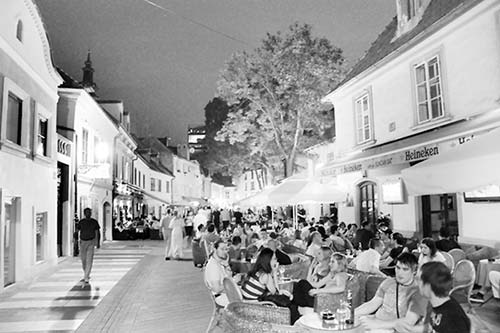
$$ Pivnica Mali Medo (“Little Bear”) anchors the middle of Tkalčićeva street. It’s a rollicking brewpub serving seven beers—plus rotating seasonal taps—from the Medvedgrad brewery (“Bear Town”—named for a fortress near Zagreb). The heavy, stick-to-your-ribs pub grub feels closer to Prague than to Dubrovnik. The outdoor seating sprawls across several storefronts right on Tkalčićeva’s most colorful stretch; the pubby interior is convivial, but less enticing (Mon-Sat 10:00-24:00, Sun from 12:00, food served until 22:00, Tkalčićeva 36, +385 1 492 9613).
Skalinska Street: This tight, steep lane connects Tkalčićeva to the market and cathedral. Tucked between the sprawling pizzerias is $ La Štruk, a great place to try several varieties of the local ravioli, called štrukli. The menu is short and simple: a variety of štrukli zapečeni (“gratinated”) baked in a small casserole and topped with gooey cheese, breadcrumbs, and other fixings, from truffles to spicy peppers (no side dishes or salads). While most eateries along here have seating out on the street, this gem has its own little oasis of a garden tucked way back inside the courtyard, through a maze of concrete corridors (Mon-Sat 11:00-23:00, Sun 11:30-22:00, at #5).
Memorable Splurge near Tkalčićeva: Foodies seeking upmarket Croatian dining will find it at $$$$ ManO, a destination restaurant in a former leather factory. The menu—offered either as a fixed-price, multicourse meal or à la carte—highlights distinctive ingredients from all over Croatia, and the ambience is refined and sophisticated without being snobby. Reservations are wise (Mon-Fri 18:00-24:00, Sat from 12:00, closed Sun, Medvedgradska 2, +385 1 466 9432, www.mano.hr). To reach ManO, walk up to the very top of Tkalčićeva, then keep going about five minutes—past a couple of upscale shopping centers.
At the Market: Zagreb’s busy market—just a block over from Tkalčićeva—lets you assemble a fresh picnic directly from the producers; for pointers on local ingredients to look for, see the market listing, earlier, under “Sights in Zagreb.” Or, for something already prepared, duck into one of the many cheap restaurants and cafés on the streets around the market. The middle level of the market, facing Jelačić Square, is home to $ Plac, a handy spot to try simple but tasty Croatian grilled-meat dishes (such as ćevapčići, the classic Balkan grilled-meat dish, described on here). You can squeeze into the tight but pretty tiled interior, or—better—sprawl out on the big terrace (Mon-Sat 9:00-23:00, Sun 11:00-18:00, up the stairs at the southeast corner of the market at Pod Zidom 1A, +385 1 487 6761).
IN THE LOWER TOWN, NEAR JELAČIĆ SQUARE
Most of these places are on dreary urban streets, and many have a few outdoor tables. You’re here not for the al fresco ambience (that’s what Tkalčićeva is for) but for good food at reasonable prices.
$$ Ficlek (FEETS-lek, meaning “little bite”) is perhaps the most accessible and enticing place to try authentic, traditional Zagreb cooking. While the space feels cozy yet modern, even hip, the menu hews closely to local classics, which tend to be meaty and hearty. Consider sampling some of the namesake ficlek—smaller tastes of some beloved dishes that might be too filling as a full portion (Mon-Sat 11:00-23:00, Sun until 17:00, Pod Zidom 5, +385 99 495 8909).
$ Heritage is an appealing, fresh-feeling little spot for sampling locally produced flavors. A tapas-style menu invites you to explore a variety of cheeses, meats, and flatbreads. It’s tiny, with only a few high-top tables inside and out (and no bathroom); consider booking ahead. This spot is handy for a light, local meal (daily 12:15-20:00, shorter hours off-season, Petrinjska 14, +385 97 684 2306).
$$ Kai Street Food, tucked down a gritty courtyard just off the bottom of Jelačić Square, is a youthful bar with some seating inside and out and a short-but-delicious menu of global dishes—from pork tacos to a katsu chicken sandwich (Tue-Sat 12:00-22:00, closed Sun-Mon, Jurišićeva 2A).
$$$ Theatrium by Filho—inside the airy courtyard of the Youth Theater, a couple of blocks from Jelačić Square—comes with a pinch of artsy pretense. But the menu—straightforward international classics, well executed—is appealing and well priced, and there are three seating zones to choose from: the dark, dramatically lit, upscale-feeling dining room; the cheery, glassed-in winter garden; or some colorful outdoor tables. The chefs work in an open kitchen behind glass, as if zoo exhibits...or theatrical performers. Book ahead (Mon-Sat 12:00-23:00, closed Sun, Teslina 7, +385 99 584 4652, https://theatrium.hr).
$$ Lari & Penati hides a couple of blocks from the train station, about a 10-minute walk from Jelačić Square. Trendy yet casual, they dish up straightforward, well-executed international dishes. Choose between the clean-white interior and the woody outdoor tables on a nondescript street (Mon-Fri 12:00-22:30, closed Sat-Sun, Petrinjska 42A, +385 1 465 5776).
Quick, Simple, and Tasty: Busy with locals dropping by for takeaway, $ Sandwich Bar Pingvin has quick, cheap, tasty sandwiches with chicken, turkey, steak, or fish. They’ll wrap it all in a pita and top it with your choice of veggies and sauces to go. Or to eat here, sit at one of the few tiny tables or stools (cash only, Mon-Sat 10:00-late, closed Sun, a couple short blocks below Jelačić Square at Teslina 7).
Ice Cream: Several places in the center offer good sladoled (ice cream). The best may be at Chocolat 041—worth the extra couple of blocks’ walk (described in the next section, at Masarykova 35). Two others are a bit more central and nearly as good: Zagreb Slastičarnica, which often features some unusual flavors (hiding behind the statue of Tesla just past the bottom of the Trg Petra Preradovića café square at Masarykova 4); and Slastičarnica Vincek, whose specialty is the chocolate-and-walnuts Vincek flavor (closed Sun, two blocks west of Jelačić Square on the busy tram-lined Ilica street at #18).
On and near Masarykova
This street, which angles from the café-jammed Trg Petra Preradovića out toward the National Theater, is a fun strip to explore. It’s lined with some appealing, high-end shops (including fashion boutiques and a wine bar), as well as a variety of eateries aimed more at locals than tourists. I’ve called out a few excellent choices, listed in the order you’ll come to them.
$$$ Bistro Beštija (Beast) is tucked down a forlorn alley, but the hip-feeling interior is inviting, and chef Ivan Barunčić’s menu of international dishes cooked creatively yet affordably makes this an enticing choice. Reserve ahead (Mon-Sat 12:00-23:00, closed Sun, Masarykova 11, +385 91 922 8861, https://bistro-bestija.com).
Gelato: Local favorite Chocolat 041 is run by a Zagrebian who played professional soccer in Milan, where he learned how to make real, Italian-style gelato. It’s some of the best in town (long hours daily, Masarykova 25).
$$$ Kavkaz, short for Kazališna Kavana (Theater Café), feels like this city’s answer to the grand cafés of Vienna or Budapest—a bit of old Zagreb sparklingly refurbished. Whether you choose the vaguely Art Deco interior or the tables out front, you’ll have lovely views of the National Theater building, across a busy road and a grassy park. The prices are in line with the quality; the seafood, pastas, and meats are all done well, or you can just come by for a nice breakfast or coffee and cake. Locals appreciate how this spot gets some of the day’s last sun in the city center—you’ll find it’s especially popular in the late afternoon (Mon-Sat 7:30-23:00, Sun 9:00-22:00, Trg Republike Hrvatske 1, +385 1 615 4868).
In the Passage near Masarykova: Coffee aficionados won’t find better third-wave coffee in Croatia than at Cogito; their most central location hides in a passageway connecting Masarykova (enter at #18) and Varšavska (Mon-Fri 8:00-20:00, Sat 9:00-19:00, closed Sun, Varšavska 11). If you’re on a scavenger hunt for Zagreb’s planet sculptures, see if you can find Earth on a nearby pillar. $ Green Point, on the same courtyard, is a hole-in-the-wall that offers veggie- and vegan-friendly burgers and salads, as well as tasty smoothies and shakes (Mon-Sat 9:00-22:00, closed Sun, Varšavska 10).
IN THE UPPER TOWN (GRADEC)
There are not many places to dine in this museum and governmental area. But for a very traditional meal, try $$$ Konoba Didov San (“Grandfather’s Dream”), offering a meat-heavy menu from the Dalmatian hinterland (specifically the Neretva River Delta, near Metković). You’ll find the normal Dalmatian specialties, plus eel, frog, and snail. Choose between the homey, old-fashioned interior—which really does feel like a remote country konoba—and the outdoor tables. Reservations are smart on weekends (daily 10:00-24:00, a few steps up from the Ivan Meštrović Atelier at Mletačka 11, +385 1 485 1154, www.konoba-didovsan.com).
Zagreb Connections
From Zagreb by Train to: Rijeka (2/day direct, 4-5 hours), Split (2-4/day, 6 hours, plus 1 direct night train, 8 hours), Ptuj (4-5/day, 3 hours, usually requires transfer in Pragersko and sometimes also Zidani Most), Ljubljana (3/day direct, 2.5 hours; as timings can be inconvenient, consider the GoOpti shared shuttle service, described on here), Vienna (1/day direct, 7 hours; more with change in Villach, 9 hours), Budapest (1-2/day direct, 6-7 hours), Lake Bled (via Lesce-Bled, 3/day, 3-3.5 hours), Munich (4/day direct, including a night train, 9 hours; more with transfer in Villach or Graz). Train info: +385 1 378 2583, www.hzpp.hr.
By Bus to: Ljubljana (8-10/day, fewer on weekends, 2.5 hours), Samobor (about 2-3/hour, 30-50 minutes), Plitvice Lakes National Park (about hourly, 2.5 hours; the best choice is the express bus operated by Prijevoz Knežević/Flixbus, which runs 3-4/day in high season—see here), Rijeka (hourly, 2-3.5 hours), Rovinj (nearly hourly, 3-6 hours), Pula (almost hourly, 4 hours), Split (at least hourly, 5-8 hours), Mostar (6-7/day, 9 hours, includes a night bus), Sarajevo (4/day, 8 hours, includes night bus), Dubrovnik (8/day including some overnight options, 10 hours), Korčula (1/day, overnight, 11 hours).
Bus schedules can be sporadic (for example, several departures clustered around the same time, then nothing for hours)—confirm your plans carefully (inquire locally, ask the TI to print schedules for you, or use the good online schedules at https://getbybus.com or www.akz.hr). Popular buses, such as the afternoon express to Split, can fill up quickly in peak season. Book ahead online. While the official site (www.akz.hr) offers online booking, you may find it easier to book on https://getbybus.com. If you don’t have a ticket, get to the station early (two hours in advance on summer days). For bus information, call +385 1 611 2789.
Near Zagreb: Samobor
This charming little town, tucked in the hills between Zagreb and the Slovenian border, is where city dwellers head to unwind, get away from the clattering trams, and gorge themselves on sausages and cream cakes. While popular with Croatian and German tourists, Samobor is virtually undiscovered by Americans. Cuddled by hiker-friendly hills, bisected by a gurgling and promenade-lined stream, favored by artists and poets, and proud of its tidy square, Samobor is made to order for a break from the big city. Samobor works as a small-town home base near Zagreb, but it’s perhaps best suited for a low-impact lunch or dinner stop en route between Zagreb and points west or north.
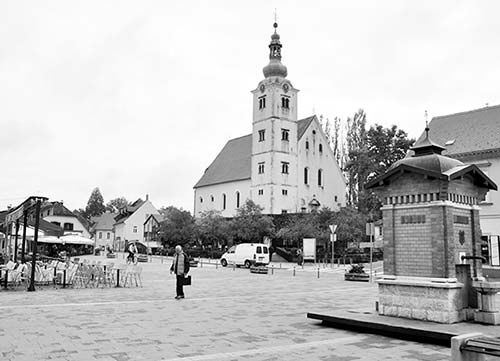
Orientation: Samobor (with 15,000 people, plus 20,000 more in the surrounding area) has a pleasantly compact tourist zone. Almost anything you’d want to see or do is within sight of its centerpiece, King Tomislav Square (Trg Kralja Tomislava). A stream called Gradna cuts through the middle of town. The TI, dead center on the main square, hands out town maps and is eager to offer hiking advice (Trg Kralja Tomislava 5, +385 1 336 0044, www.samobor.hr/en/visit).
Getting There: You can reach Samobor by bus from Zagreb’s main bus station (2-3/hour, 30-50 minutes—if possible, avoid slower buses that stop in smaller villages, such as Novaki and Rakitije). Samobor’s bus station is about a 15-minute walk from the main square: Head left along the very busy road (Grada Wirgesa), cross straight ahead through the big intersection, then turn right onto the footpath just before the little river; you can follow this pleasantly all the way into town. By car, Samobor is just off the main Zagreb-Ljubljana expressway. Exit following signs for Samobor, then follow the bull’s-eyes to the Centar. Head for the yellow steeple, then carry on past the steeple and the main square; just after the square, watch for the covered bridge on your left, which leads you to a handy pay parking lot.
Visiting Samobor: Samobor is more about ambience than sightseeing. Its main square, Trg Kralja Tomislava, is cobbled, cutesy, and ringed by pretty Baroque architecture. The town’s little river flows right past the square, covered by a variety of picturesque footbridges. It’s a delight to simply sit at a café, gaze at the surrounding hills, and contemplate a hike.
For extra credit, drop in to the sleepy Samobor Museum, an old mansion with miscellaneous bric-a-brac from the town’s history (closed Mon, across the covered bridge from the main square at Livadićeva 7, +385 1 336 1014, www.samobor.hr/muzej).
Those interested in hiking find Samobor a pleasant base for venturing into the hills that begin just west of town. One popular option is to drive up to the Šoićeva Kuća mountain lodge, then hike to a nearby peak (either Oštrc or Japetić). Another option is to walk from Samobor to Okić and back. You can get specifics and buy hiking maps at the TI.
Sleeping in Samobor: If you’d prefer a cheaper, small-town home base, Samobor is a decent alternative to Zagreb. Consider $ Hotel Livadić (21 faded-elegant rooms with a classy café and garden courtyard, right on the main square at Trg Kralja Tomislava 1, +385 1 336 5850, www.hotel-livadic.hr).
Eating in Samobor: Samobor is highly regarded among Zagrebians for its filling, rustic cuisine. First, an aperitif: Samobor’s own Bermet is a sweet red wine made with fruits and grasses from the Samobor hills. As it’s an acquired taste, start with just a sip. The local sausage, češnjovke (sometimes translated on menus as “garlic sausage”), is traditionally eaten with the town’s own mustard, camoborska muštarda (Dijon-esque but without much kick, also sold around town in little ceramic pots). Round out your meal with a piece of kremšnita cream cake (curiously similar to Lake Bled’s specialty).
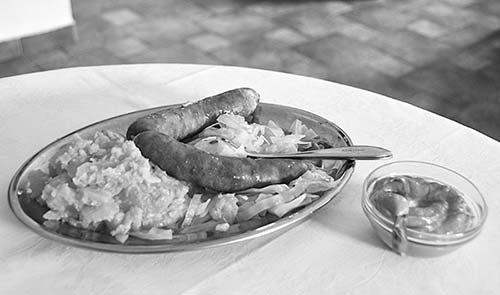
$$ Gabreku 1929, every local’s top recommendation for good Samobor cooking, serves the classics, a delicious mushroom soup, veal brains and liver, and plenty of other (mostly meat-centric) options (at far end of town, 15-minute walk from main square—head upriver on path after covered bridge then cross second bridge; closed Tue, free parking, Starogradska 46, +385 1 336 0722).
$ Pri Staroj Vuri (“By the Old Clock”), with a similar menu of regional dishes, as well as homemade štrukli (cheese ravioli), has a traditional interior with a wall of namesake old clocks and a pretty outdoor terrace in a tranquil garden (5-minute walk from square—from small fountain at intersection near end of church, head uphill for a couple of blocks, veering right at the fork; closed Mon, Giznik 2, +385 1 336 0548).
$ Samoborska Klet (“Samobor Cellar”) is the most central option, tucked in a courtyard on the main square, with a meaty menu, a modern dining room, and a more rustic tavern in the back, but no seating on the square itself (closed Sun, Trg Kralja Tomislava 7, +385 1 332 6536).