CROATIA & SLOVENIA
Top Destinations in Croatia, Slovenia, and Beyond
Map: Top Destinations in Croatia, Slovenia, and Beyond
Here in the land where the Adriatic meets the Alps, there are countless ways to have fun. Set sail to an island whose name you can’t pronounce, but whose wonders you’ll never forget. Corkscrew up mountain roads to vistas of cut-glass peaks. Lie on a beach in the hot sun, listening to waves lap against rocky breakwaters as a Venetian-style bell tower clangs out the hour. Spelunk through a mysterious cave, tightrope on an alpine trail, or hike through a fantasyland of bridal-veil waterfalls. Dine on a seafood feast and sip local wine as the sunset casts the sky and sea in purples, pinks, and reds.
Croatia and Slovenia are the rising stars of European tourism for good reason: Here you’ll find appealing towns and cities, engaging locals, spectacular natural wonders, a riveting recent history, and ample opportunities to relax, enjoy, and learn.
Croatia—home to an endless, enticing shoreline—beckons visitors with waves-to-mountains terrain, romantic old towns, and a seafaring spirit. Its dreamy islands and pebbly beaches constitute the “Eastern Riviera”—a magnet for sunseekers and holiday makers from throughout Central and Eastern Europe. And its interior holds some worthwhile gems, too, including Tuscan-style hill towns, gushing waterfalls, and the livable capital, Zagreb.
Slovenia, a diminutive alpine land squeezed between Italy and Austria, may be Europe’s best-kept secret (for now). Travelers who take a chance on Slovenia are reliably charmed by the place. They can’t decide what they enjoy more: the gregarious Slovenes, the inviting and well-groomed towns, or the eye-popping mountainscapes.
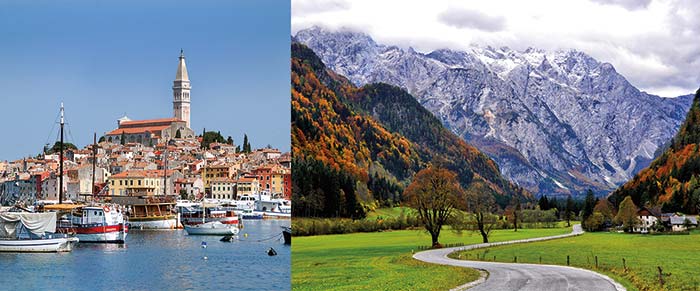
Colorful coastal town of Rovinj, Croatia; Logarska Dolina mountain valley in Slovenia
I’ve also included nearby destinations that are well worth a detour. Just south of Croatia’s Dalmatian Coast, the cinematic coastline of Montenegro—especially the Bay of Kotor—is the ultimate expression of the dramatic scenery that typifies this region.
Bosnia-Herzegovina is equal parts beautiful, impactful, and underappreciated. From Dalmatia, it’s a short trip inland to the small city of Mostar—offering a “Bosnia in miniature” look at slate rooftops, soaring minarets, and bazaars lively with the tap-tap-tap of coppersmiths. And just a couple more hours down the road is Sarajevo, with a grand setting, thriving street life, powerful museums, and poignant lessons in hardship and recovery.
For such a magnificent slice of Europe, it’s hard to know exactly what to call this region. “Western Balkans” or “former Yugoslavia”—while accurate—don’t quite do it justice. But whatever you call it, it’s a joy.
It’s tempting to fixate on the Yugoslav period here, from its larger-than-life dictator, Marshal Tito, to the Yugoslav Wars of the 1990s, which scarred the land and people and divided one big country into seven smaller ones. Learn about the “Ex-Yugo” stuff, sure. But also move past that story to discover what makes each country tick in the 21st century.
Few corners of Europe are home to such an abundance of natural beauty as Croatia, Slovenia, and their neighbors. The Dinaric Alps ruffle through the middle of the region—rising up from the Adriatic a few miles (or, in some places, feet) inland—creating a rich and varied world of burly cliffs, surging rivers, canyons, caves, and castle-guarded passes. And this splendor finds different expression in each of these countries.
Croatia is, deservedly, best known for its thousands of miles of coastline—most of it with a thrilling mountain backdrop that ends at a pebbly beach. Thanks to natural filtration through the limestone landscape, the sea is almost otherworldly in its clarity; on a calm day, boats seem to float as if on air. The seaside has its own distinctive, named winds, which locals claim affect your mood. On days when the muggy, southerly Jugo wind blows, Croatians feel sluggish and cranky. Then the refreshing Bora wind comes howling down the mountains to the sea, blowing out all that humidity.
Inland, the spine of Croatia is mountainous. On a road trip, you’ll drive on superexpressways that tunnel under peaks and span broad valleys. Deep in the Croatian uplands is perhaps the region’s single most impressive natural sight: Plitvice Lakes National Park, a spectacular canyon that thunders with waterfalls pouring over natural travertine dams, built up over centuries. Farther north, the flatter area around Zagreb and, to the east, the vast plains of Slavonia (part of the Pannonian Basin) are ideal for agriculture.
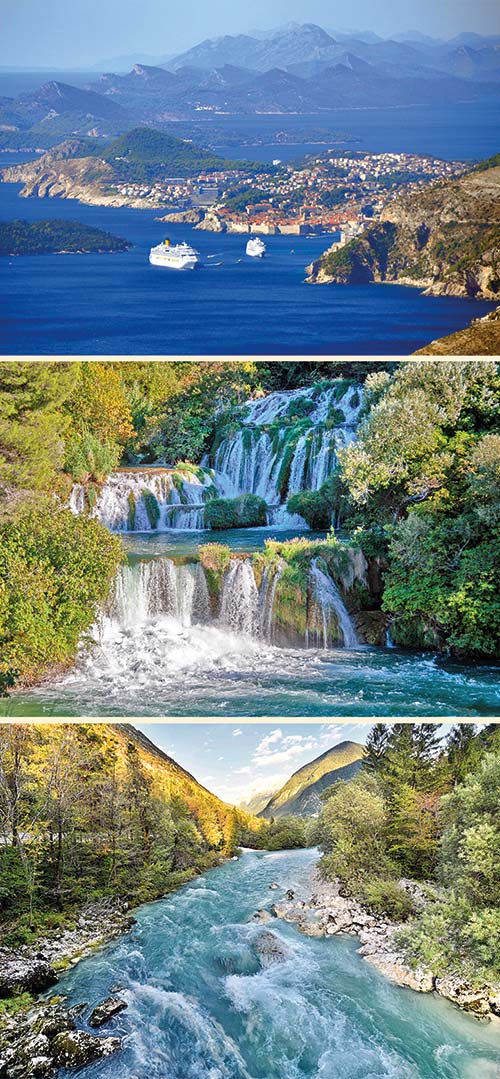
Croatia’s Dalmatian Coast (top) and Krka National Park, near Split; the Soča River in Slovenia’s Julian Alps
Slovenia is all about its Alps—soaring granite peaks between which travelers weave on twisty roads. You’ll follow churning turquoise rivers (such as the Soča) high in the Slovenian mountains, within yodeling distance of Austria and of Italy’s mighty Dolomites.
Slovenia’s Karst region—where those mountains transition to the sea—is synonymous with a “karstic” landscape: porous limestone that has been grooved out over time by the underground flow of water, creating caverns, caves, and sinkholes. The Karst has two of the most awe-inspiring caves on earth—Škocjan and Postojna—with expansive underground halls and fanciful formations.
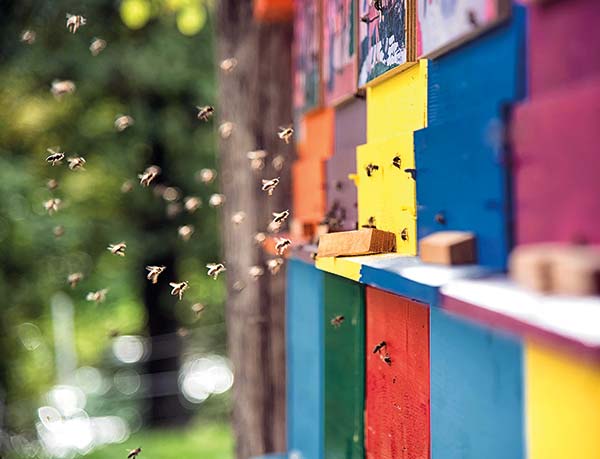
Slovenian nature excels on a small scale, too: Its hardworking honeybees are the national mascot.
Bosnia-Herzegovina is rugged, mountainous, and arid—a place where frigid, milky-white rivers carve canyons deep into stone valleys. Sarajevo hosted the Winter Olympics in 1984, and today, standing on busy urban streets surrounded by tree-blanketed foothills, you can understand why.
Even in this land of abundant beauty, Montenegro—literally, “Black Mountain”—is exceptional, with vertical cliffs that rocket up from deep Adriatic waters. While it’s pleasant enough to drive along the coastline—tightroping between those peaks and the choppy surf—adventurous drivers can spiral up potholed roads into Montenegro’s isolated, high-altitude interior.
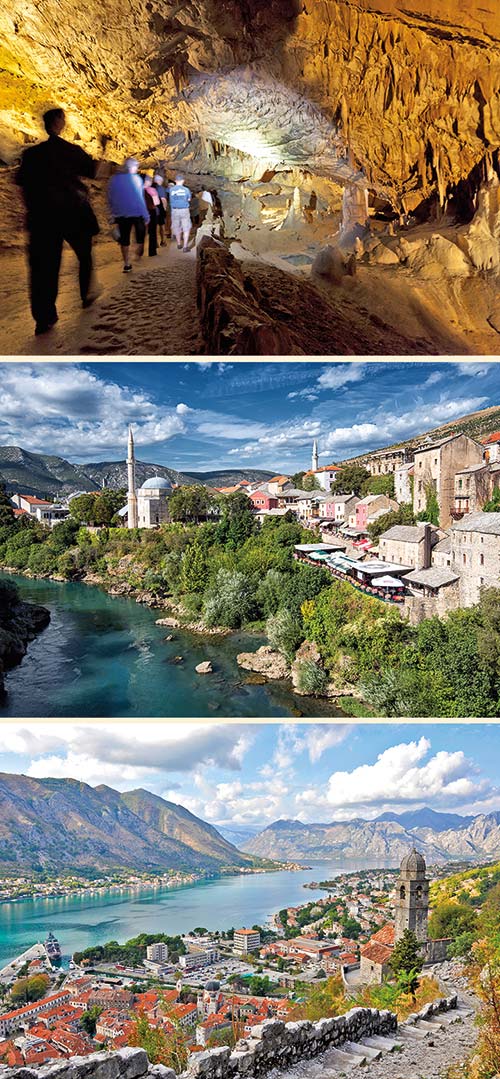
Slovenian caves in the Karst region; Mostar, Bosnia-Herzegovina; Montenegro’s Bay of Kotor
The region’s geography also gives rise to special food. Air-cured prosciutto (pršut), crumbly sheep’s-milk cheeses, and fine wines thrive in the arid, rocky terrain. Croatia’s Istrian Peninsula, with its damp oak forests, produces some of Europe’s top truffles. And Slovenian honey—made by those busy bees—is another culinary highlight from this land with flavors as remarkable as its landscape.
Sorting through the complicated history and culture of this region can be, for thoughtful travelers, an enduring trip highlight. In a single neighborhood, you might find Catholic steeples, Muslim minarets, Orthodox Christian domes, and Jewish synagogues. One thing these places do have in common is a tradition of hospitality and openness to outsiders: Locals are generally eager to chat and free with their opinions.
While you’ll find plenty of uninspired, fill-the-tank grub, increasingly this region is hopping on the foodie bandwagon. Throughout Slovenia and in Croatia’s cosmopolitan urban centers, you’ll find everything from tempting food carts to fine-dining splurges prepared by Michelin-starred chefs. Pungent truffles, melt-in-your-mouth pršut (prosciutto), cuttlefish risotto, honey-soaked baklava, rustic grilled meats with ajvar (an addictive eggplant/red pepper spread), delicate cream cakes, and top-quality wines all vie for attention on local menus.
In this land where you’re just as likely to hike a high-altitude path at Slovenia’s rooftop as you are to swim the warm waters of a Dalmatian beach, you’ll need to pack wisely. Consider hiking boots, flip-flops or water shoes, swimsuits, sunscreen, rainproof jackets, and knit hats.
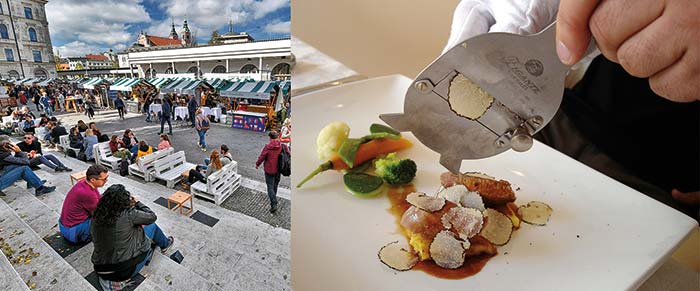
“Open Kitchen” street-food festival in Ljubljana, Slovenia; truffles in Istria, Croatia
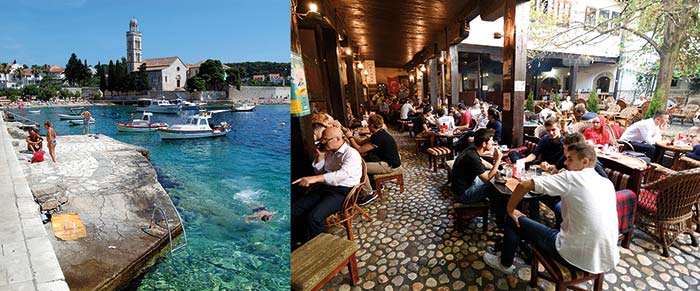
Croatia’s reputation as a budget destination is dated and misleading. Especially along the coast, prices have skyrocketed. You’ll find some decent budget choices (rented rooms and takeout food), and some top-end hotels and restaurants...but limited options for the midrange traveler. Slovenia has a wider range of sleeps and eats, and Bosnia remains truly inexpensive.
The region’s many alluring Adriatic beach towns are a big draw. While each town and island has its own personality, most are variations on a theme: a warm stone Old Town with a bell tower, a tidy boat-speckled harbor, a few hulking resort hotels on the edge of town, and sobe and apartman signs (offering rental rooms or apartments) next to every other doorbell. Beach bums, yachters, historians, partiers—every traveler has their favorite seaside destination. But don’t sweat this decision too much; you can hardly go wrong.
Resist the urge to spend your entire trip at the beach. With so many other draws—some of Europe’s most stunning natural wonders, an eclectic cultural mix, an epic history, and kind, fascinating people—Slovenia, Croatia, Montenegro, and Bosnia invite travelers to go beyond a mere vacation. It’s a fun place to be, for sure. But beyond that, a trip here rewards the thoughtful traveler with potentially life-changing epiphanies. And when you get home, you won’t be able to stop telling all your friends about this amazing place they’ve just gotta visit.
Top Destinations in Croatia, Slovenia, and Beyond
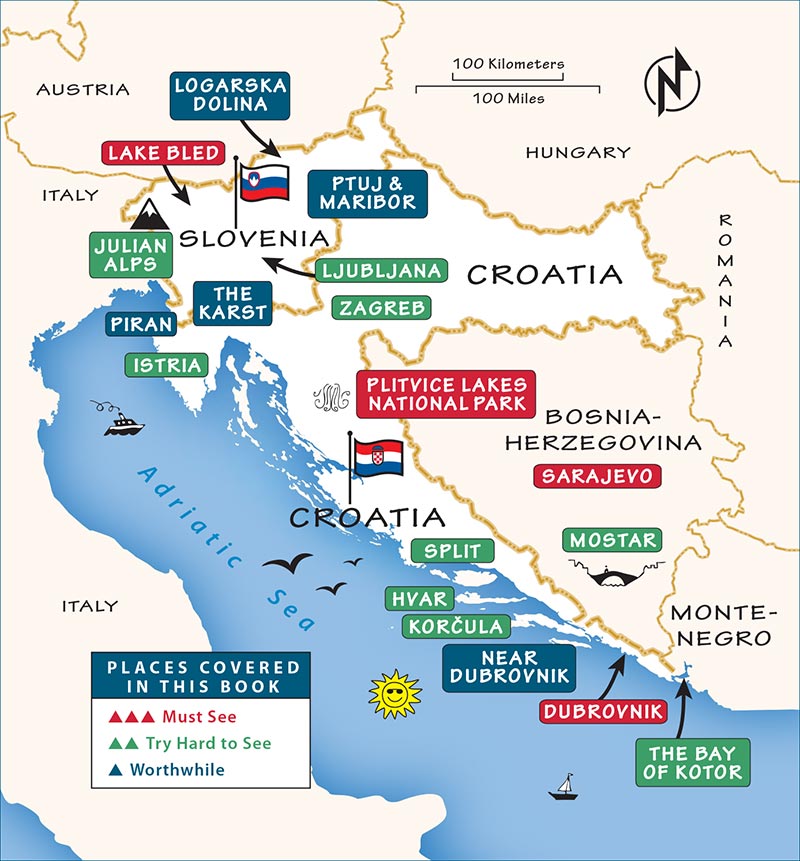
There’s a lot to see in Croatia, Slovenia, Montenegro, and Bosnia. This overview categorizes the region’s top destinations into must-see places (to help first-time travelers plan their trip) and worth-it places (for those with extra time or special interests). I’ve also suggested a minimum number of days to allow per destination.
CROATIA
▲▲Zagreb (allow 1 day)
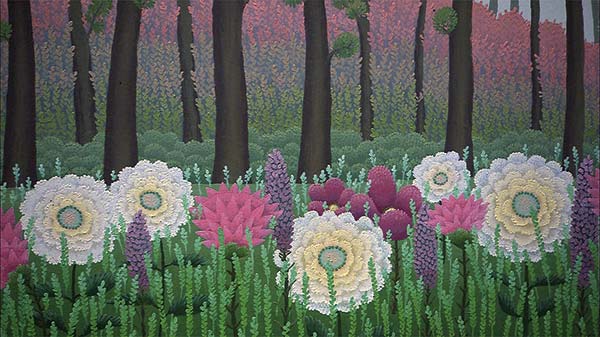
Croatia’s underrated capital is low-key and unexpectedly charming, with inviting parks and excellent museums—from Naive Art to a playful, poignant collection of broken relationships.
▲▲▲Plitvice Lakes National Park (1 day)
One of Europe’s most breathtaking natural wonders (and a handy stopover between Zagreb and the coast), Plitvice is a forested canyon filled with crystal-clear lakes, misty waterfalls, and easy-to-hike boardwalks and trails.
▲▲Istria (2-3 days)
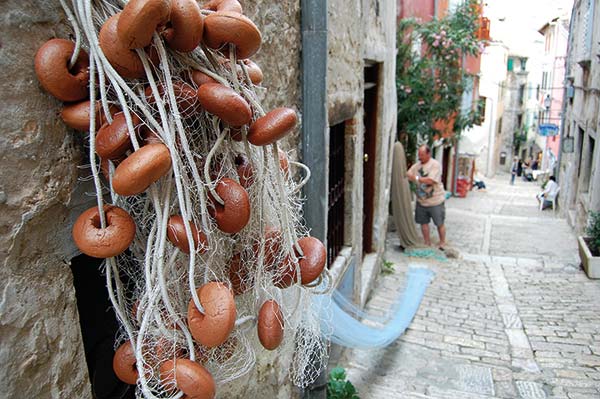
This wedge-shaped peninsula was part of Italy until the 20th century, and still feels a bit Italian. Its star is the romantic, Venetian-flavored coastal town of Rovinj. Istria is also home to remarkable Roman ruins in the city of Pula, and a rolling interior of vineyards and picturesque hill towns (most notably Motovun). Nearby is the genteel Habsburg beach resort of Opatija.
▲▲Split (1-2 days)
The Dalmatian Coast’s unofficial capital and transit hub, Split hums with a port-city urbanity. Its lived-in warren of twisting lanes sprouted from a gigantic ancient palace—with some of the best Roman ruins anywhere—and its busy seafront promenade. Nearby is the sweet, sleepy town of Trogir, the Plitvice-like waterfalls of Krka National Park, and the likewise Roman-ruin-studded midsize city of Zadar.
▲▲Hvar (1 day)
The ritziest of the Dalmatian islands (thanks to its proximity to Split—less than an hour by catamaran), Hvar mixes a sleepy fishing-town heritage and stout overhead castle with a hip jet-set cachet and high prices. For nature-seekers, Hvar also has fine beaches, a lavender-draped interior, and easy escapes to nearby islets.
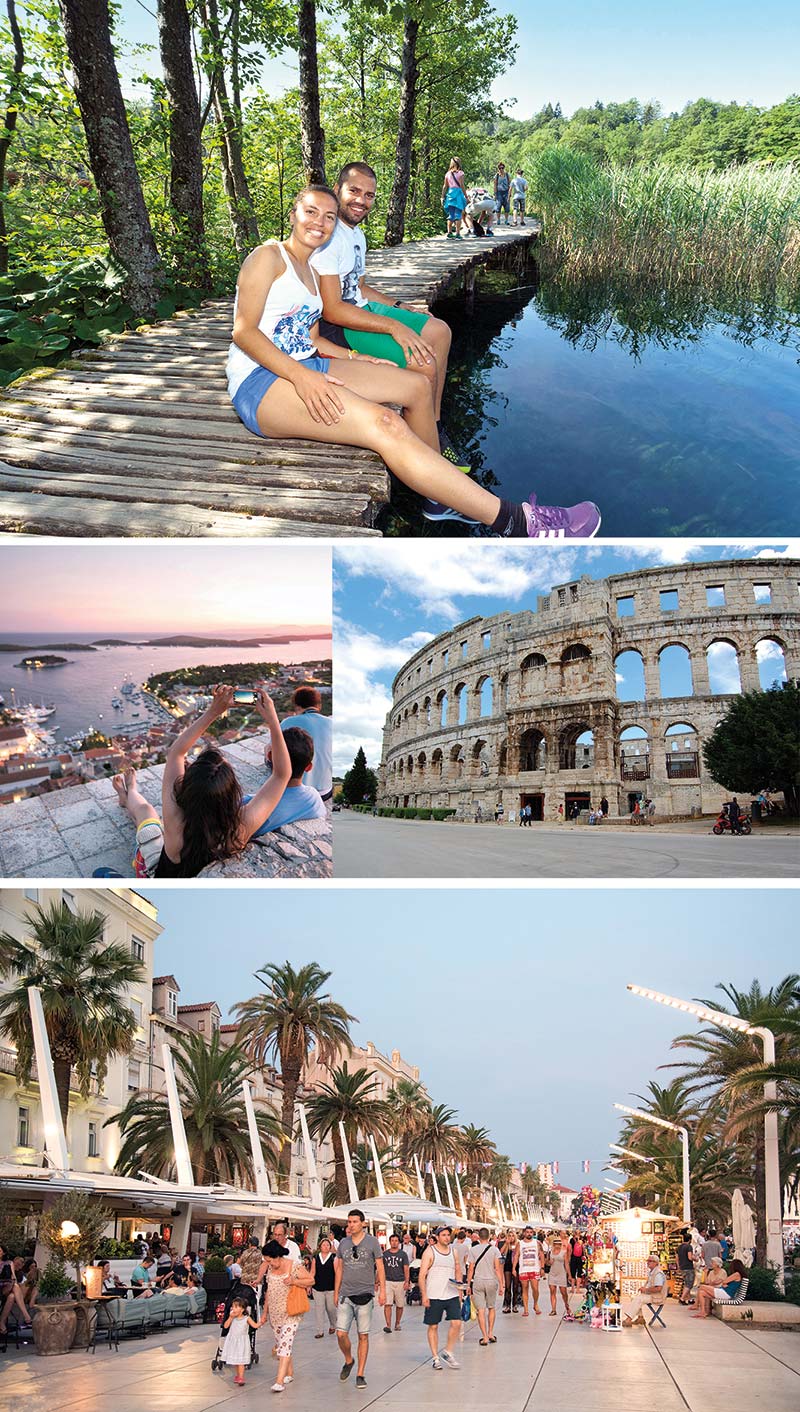
Croatian Naive Art (opposite); Plitvice Lakes; Roman amphitheater in Pula, Istria; nightly promenade on Split’s Riva; sunset from the fortress over Hvar
▲▲Korčula (1 day)
This island town—low-key, charmingly rustic, and affordable compared to Hvar—has a narrow-laned, walled Old Town that fills a peninsula and faces craggy mountains; it feels like a mini-Dubrovnik.
▲▲▲Dubrovnik (2-3 days)
The “Pearl of the Adriatic” is Croatia’s single best destination. Its giant Old City is wrapped in some of Europe’s best-preserved medieval fortifications, offering a scenic wall-top walk with views of waves and rooftops. Dubrovnik’s narrow, steep lanes are lined with characteristic stone houses, drying laundry, and modest but engaging museums. Escape the cruise crowds by riding the cable car to the mountaintop or getting out of town—to nearby beaches or the side trips described next.
▲Near Dubrovnik (1-2 days)
Low-impact excursions—from a couple of hours to all day—include boat trips from Dubrovnik’s Old Port, the art-packed resort town of Cavtat, Trsteno Arboretum, the walled town of Ston, the Pelješac Peninsula (producing some of Croatia’s finest wines), and the national park on the island of Mljet.
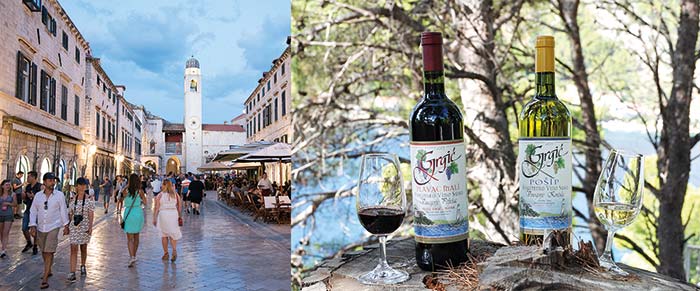
Dubrovnik’s main drag (Stradun) at twilight; wines of the nearby Pelješac Peninsula
MONTENEGRO
▲▲The Bay of Kotor (1 day)
Just a short drive south of Dubrovnik, this bewilderingly steep-walled bay on a fjord-like inlet comes with a fun variety of towns and experiences, from riding a dinghy out to a tiny island to hiking the steep walls that scamper up the cliffs above the atmospheric main town, Kotor.
With more time, twist up into the mountains for a drive through the Montenegrin heartland to Cetinje, or carry on down the coast to the beachy Budva Riviera (with the famous, but inaccessible, islet of Sveti Stefan).
BOSNIA-HERZEGOVINA
▲▲Mostar (1 day)
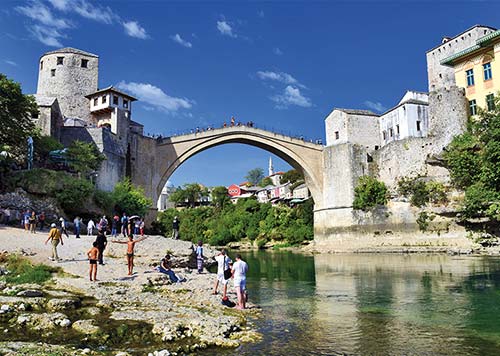
This small city offers an easy-to-appreciate taste of Bosnia-Herzegovina, with a striking setting, Muslim culture, Ottoman-style architecture, evocative war damage, and an inspiring, rebuilt Old Bridge.
On the way to or from the coast is a range of worthwhile stopovers: scenic gorge house at Blagaj, hill town of Počitelj, Roman ruins near Metković, workaday burg of Stolac, waterfalls at Kravice, and Catholic pilgrimage site at Međugorje.
▲▲▲Sarajevo (1-2 days)
Bosnia’s capital city, which fills a scenic mountain valley, has largely recovered from the brutal siege of the Yugoslav Wars. Today’s visitors learn about its dynamic history (both recent and more distant); stroll its picturesque streets, alternately Ottoman-style and Austrian-style; dig into heaping platters of hearty Bosnian cuisine; and drop into a variety of churches, mosques, synagogues, and museums.
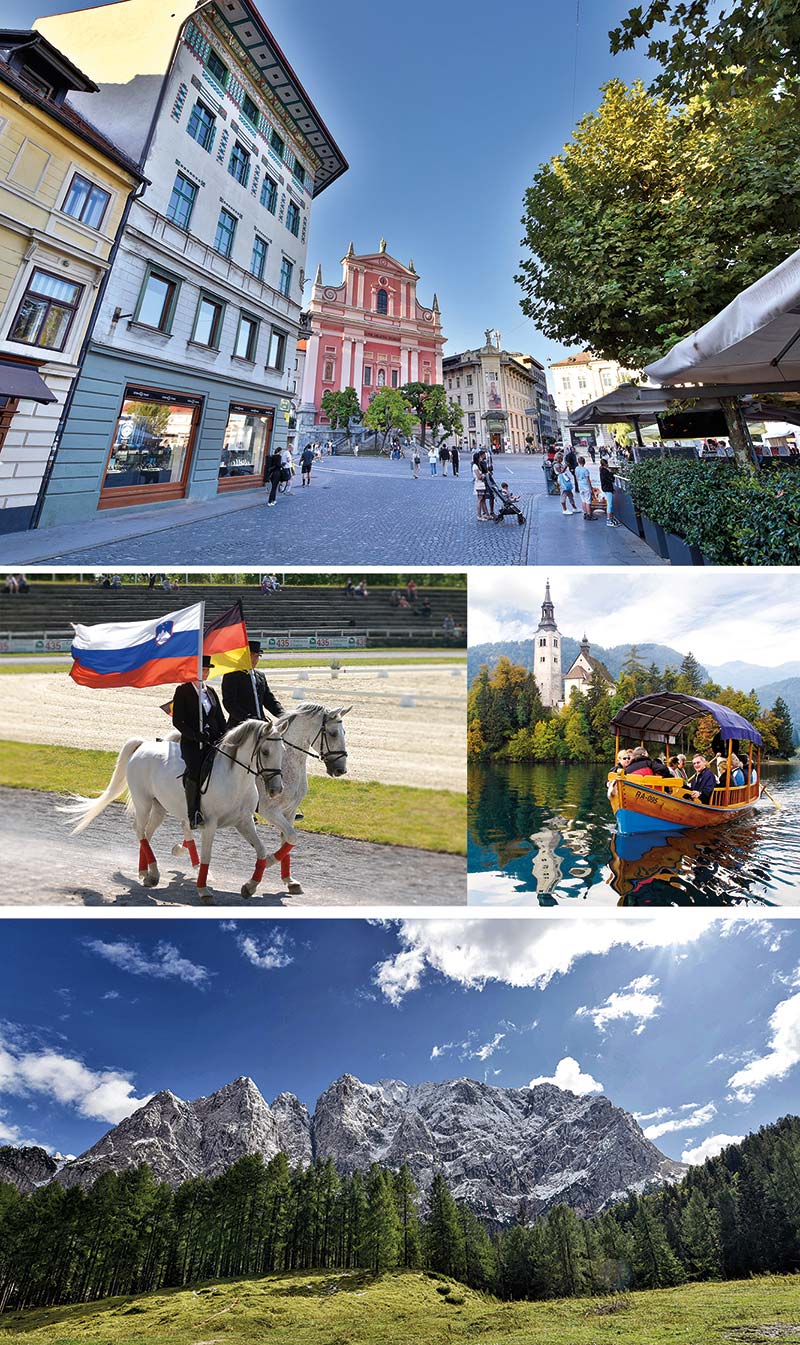
SLOVENIA
▲▲Ljubljana (1-2 days)
Slovenia’s capital is both vibrant and relaxing: Browse the riverside market, ogle the extravagant architecture, nurse a coffee along the willow-shaded promenade, and visit quirky yet artfully presented museums.
▲▲▲Lake Bled (1-2 days including side trips)
Huddled in the foothills of the Julian Alps, this lake resort is famous for its church-topped island, cliff-hanging castle, shoreline path, and tasty desserts. And there are plenty of fun side trips: the less-developed Lake Bohinj, the spectacular Vintgar Gorge, and two towns with unaccountably fascinating museums: Radovljica (beekeeping) and Kropa (ironworking).
▲▲The Julian Alps (1 day)
Slovenia’s peaks are easily conquered by a twisty, intensely scenic mountain road over the Vršič Pass, ending in the tranquil Soča River Valley—filled with gorgeous scenery, mellow mountain towns and tourist farms, whitewater rafting near Bovec, and the exceptional WWI museum in Kobarid.
▲Logarska Dolina and the Northern Valleys (1 day)
These even more remote mountain valleys—for those who really want to dig into Slovenian nature—boast grand vistas, traditional farming lifestyles, and fewer crowds.
▲Ptuj and Maribor (1 day)
Ptuj is a charming-if-sleepy historic town, known for its extravagant carnival celebrations and topped by a castle; nearby is Maribor, Slovenia’s understated second city.
▲The Karst (1 day)
This windblown limestone plateau is the place for world-class caves (Škocjan and Postojna), the Lipizzaner stallion stud farm at Lipica, and the dramatically situated Predjama Castle.
▲Piran (1 day)
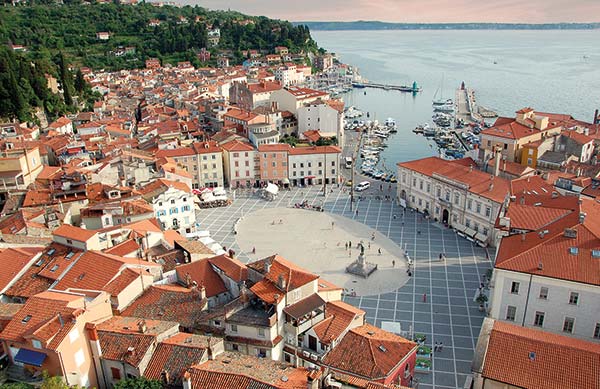
This adorable Adriatic resort town is a lesser-known gem with rocky beaches, great seafood, and an expansive marbled plaza.
Planning Your Trip
To plan your trip, you’ll need to design your itinerary—choosing where and when to go, how you’ll travel, and how many days to spend at each destination. For my best advice on sightseeing, accommodations, restaurants, and more, see the Practicalities chapter.
DESIGNING AN ITINERARY
As you read this book and learn your options...
Choose your top destinations.
My recommended itinerary (see the sidebar on here) gives you an idea of how much you can reasonably see in two weeks, but you can adapt it to fit your own interests and time frame.
This region’s best itinerary includes lots of variety. Begin with the biggies: Dubrovnik is a must; Split is an entertaining big city; and Plitvice’s waterfalls, though requiring effort to reach, rarely disappoint.
For a beach break, fold in one or two seafront villages—such as Rovinj, Hvar, Korčula, Piran, or Opatija. Since these are similar, choose just one or two to save time for places with some cultural sights.
Don’t skimp on Slovenia. Its spectacular mountain scenery, colorful capital (Ljubljana), Germanic efficiency, and friendly natives offer a welcome contrast to Croatia.
And finally, to pack the greatest variety of experiences into your trip, be bold enough to venture across borders to Mostar or Sarajevo in Bosnia-Herzegovina, or to Montenegro’s Bay of Kotor. A year from now, you’ll barely remember the difference between all the little seaside towns, but you’ll never forget the mosques of Mostar.
Decide when to go.
Choose the timing of your trip carefully; especially in the coastal destinations, tourist traffic is highly seasonal. For weather specifics, see the climate chart in the appendix.
Peak Season: Summer—especially July-August—is peak-of-peak. Boats, buses, accommodations, and restaurants are overstuffed with mostly European vacationers. Temperatures and prices soar. Visiting Croatia in summer is like spending spring break in Florida—it can be fun, but also miserably crowded and expensive.
Shoulder Season: While not quite “untrampled,” spring and fall (especially mid-May-June and Sept-early Oct) offer the best mix of good weather and fewer crowds. Late June and early September are nearly as busy as peak season (particularly on weekends), but the rush subsides the farther you get off-season. By the first week of October, some restaurants are already closing down for the winter. Shoulder season is when most of my readers are visiting, and it’s my favorite time here, too—I enjoy the milder weather and less-frenzied locals.
Off-Season: Small towns are dead as a doornail from mid-October to mid-May. Many resorts close down entirely, with only one hotel and one restaurant remaining open through the lean winter months; many residents move to the interior to hibernate; and anything that’s open keeps very limited hours (weekday mornings only). Boat and bus schedules can be dramatically reduced, and some boat connections or mountain roads (such as Slovenia’s Vršič Pass) are closed. The weather can be cool and dreary, and night will draw the shades on your sightseeing before dinnertime. If traveling in the winter, skip the smaller towns, especially on the coast (though bigger cities like Split and Dubrovnik are still viable).
Flex Pricing: Because of this region’s extreme seasonality, prices vary wildly. (A hotel receptionist once showed me a binder with hundreds of potential rates they could charge, based on room size, type, views, season, and length of stay.) Museum prices and opening times can also be volatile—and difficult for this book (or any resource) to predict with any precision. If you have your heart set on a particular place, it’s always smart to call ahead to double-check these details.
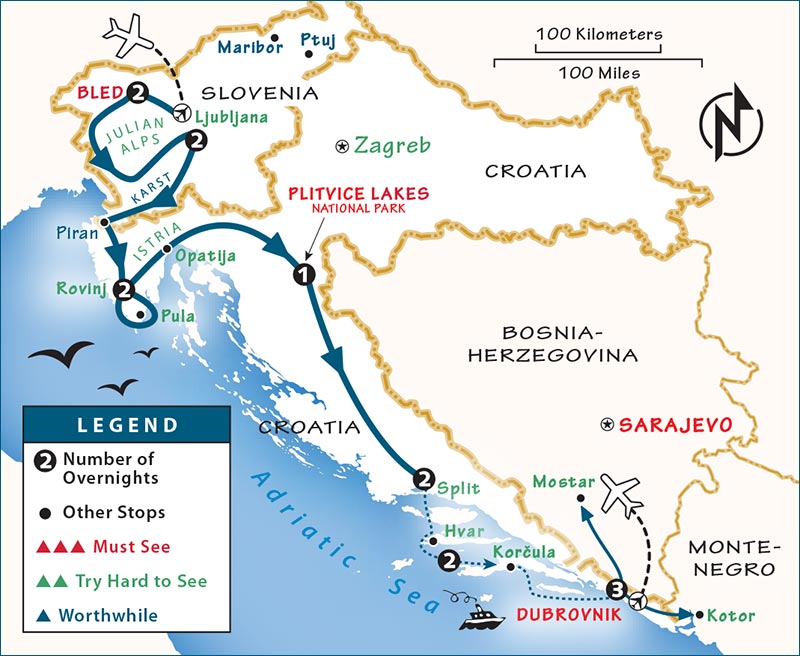
| Day | Plan | Sleep |
| 1 | Arrive at Ljubljana’s airport, take shuttle bus to Lake Bled | Lake Bled |
| 2 | Relax at Lake Bled | Lake Bled |
| 3 | Pick up car, drive through Julian Alps, end in Ljubljana | Ljubljana |
| 4 | Ljubljana | Ljubljana |
| 5 | Drive via the Karst and Piran to Rovinj | Rovinj |
| 6 | Enjoy Rovinj and consider side-tripping to Opatija | Rovinj |
| 7 | Drive to Plitvice Lakes via Istria’s hill towns and Opatija | Plitvice |
| 8 | Hike the lakes, then drive to Split and drop off car | Split |
| 9 | Split | Split |
| 10 | To Hvar or Korčula by boat | Hvar/Korčula |
| 11 | Relax on Hvar or Korčula | Hvar/Korčula |
| 12 | To Dubrovnik by boat | Dubrovnik |
| 13 | Dubrovnik | Dubrovnik |
| 14 | Rent a car or hire a driver to day-trip to Mostar or to Montenegro’s Bay of Kotor | Dubrovnik |
Car-Rental Tip: To save the substantial extra cost of picking up your car in one country and dropping it off in another, consider returning your car in Slovenia and taking public transportation to Croatia, where you can pick up a different rental car for your time there. For example, ride the bus from Ljubljana to Rovinj, then pick up a car in nearby Pula or Poreč; or take the train from Ljubljana to Zagreb or Rijeka, then pick up a car in one of those cities.
With More Time: Spend a night in Mostar, then carry on to Sarajevo; fly home from Sarajevo, or fly up to Zagreb to see that city before flying home.
By Public Transportation: This itinerary can be done by public transportation, with modifications. Skip (or hire a driver for) the Julian Alps, and take the bus from Lake Bled to Ljubljana. Skip Istria; instead, take the train from Ljubljana to Zagreb, see that city, then take a bus to Plitvice. The bus connects Plitvice to Split, and from there, you’ll continue down the Dalmatian Coast by boat or bus.
Even if you’re mostly using public transportation, choose one or two places to rent a car or hire a driver for the day; this works best for the Julian Alps, Istria, Mostar, Montenegro’s Bay of Kotor, and the Pelješac wine country near Dubrovnik.
Connect the dots.
Link your destinations into a logical route. Determine which cities you’ll fly into and out of. Begin your search for transatlantic flights at Kayak.com.
Decide if you’ll travel by car, public transportation, or a combination. A car is particularly helpful for exploring the Slovenian Alps, Istria, or Bosnia-Herzegovina, and for getting to Plitvice Lakes, but it’s less helpful in big cities (like Zagreb, Sarajevo, and Ljubljana) and on the Dalmatian Coast (which is well connected by boats and buses). I find a combination works best: Do most of your trip by public transportation, then rent a car (or hire a private driver) for a few days where it’s warranted.
To determine approximate travel times between destinations, study the maps in the Practicalities chapter or check Google Maps; visit Bahn.com for train schedules. Compare the cost of any long train ride in Europe with a budget flight; check Skyscanner.com for intra-European flights.
Write out a day-by-day itinerary.
Figure out how many destinations you can comfortably fit in your time frame. Don’t overdo it—few travelers wish they’d hurried more. Allow enough days per stop (see estimates in “Top Destinations in Croatia, Slovenia, and Beyond,” earlier). Minimize one-night stands. It can be worth taking a late-afternoon boat ride or drive to settle into a town for two consecutive nights—and gain a full uninterrupted day for sightseeing.
Don’t underestimate the long distances. If you have a week or less, focus on either the south (Dalmatian Coast—Dubrovnik, Split, and the islands—plus Mostar and Montenegro) or the north (Slovenia, Istria, and Zagreb). The worth-a-detour Plitvice Lakes are midway between these two areas (easiest by car). Sarajevo also requires a detour, but affordable flight connections with Zagreb make this more convenient than it seems.
Take sight closures into account. Avoid visiting a town on the one day a week its must-see sights are closed. Check if any holidays or festivals fall during your trip—these attract crowds and can close sights (for the latest, visit each country or city’s tourist website). Note major sights where advance reservations are smart.
Give yourself some slack. Every trip, and every traveler, needs downtime for doing laundry, picnic shopping, people-watching, and so on. Pace yourself. Assume you will return.
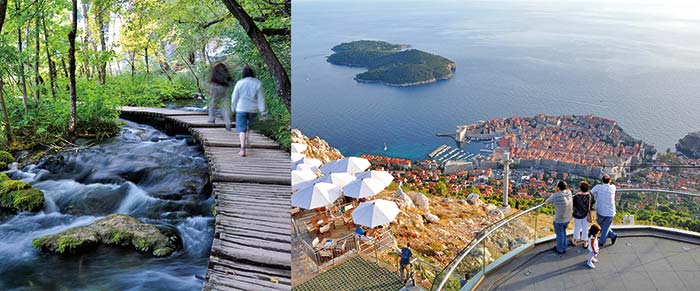
Plitvice Lakes National Park; bird’s-eye view over Dubrovnik from Mount Srđ
Run a reality check on your dream trip. You’ll have major transportation costs in addition to daily expenses.
Flight: A round-trip flight from the US to Ljubljana or Dubrovnik costs about $1,000-1,500, depending on where you fly from and when.
Public Transportation: For a two-week whirlwind trip, allow $150 per person for public transportation (train, bus, and boat tickets). Train travelers will probably save money by simply buying tickets along the way, rather than purchasing a rail pass. A short flight (for example, Sarajevo or Dubrovnik to Zagreb) can be the easiest, most affordable option for longer connections (check Skyscanner.com for intra-European flights).
Car Rental: Allow $350-500 per week (booked well in advance), not including tolls, gas, parking, and insurance.
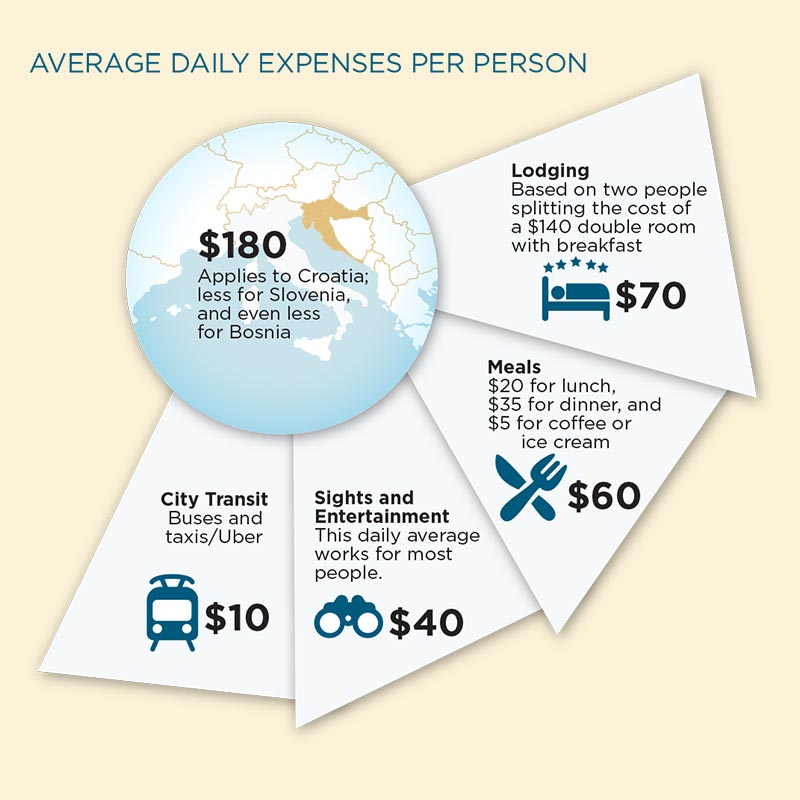
Prices in Croatia just keep going up. Your biggest cost category—and the one with the widest price gap—is lodging. Coastal resorts may offer humble budget choices (€80 or less for a double) and €300-400 luxury rooms but skip right over the midrange category. Travelers on a moderate budget should think carefully about whether to “slum” or “splurge.” Some higher-end budget options, at around €100-120, are hotelesque and a tremendous value relative to pricey boutique hotels next door—though you’ll need realistic expectations for comfort and services.
To stretch your budget, look instead for sobe or apartmani—rooms or apartments rented out by locals. I heavily favor these private accommodations in my listings.
Reserve your rooms directly with the hotel or sobe host. Some offer discounts if you pay in cash and/or stay three or more nights (check online or ask).
Lodgings are very expensive in July and August (prime European vacation season). Many places reduce their rates slightly in spring and fall (May, June, Sept, and Oct). If you’re struggling to find a room that suits your budget, consider sites like Airbnb. (I’ve recommended only places that you can book direct, not ones booked through a third party.)
Even seniors can sleep cheaply in hostels (most have private rooms) for about $30 per person. But be aware that hostels in this part of Europe tend to be a bit funkier and more loosely run than the bigger, more institutional choices you’ll find elsewhere.
Slovenia generally has a better variety of midrange sleeping options, and even top-end accommodations in Bosnia-Herzegovina are affordable by Croatian standards.
Some businesses—especially hotels and walking-tour companies—offer discounts to my readers (look for the RS% symbol in the listings in this book). To get these prices, you must book direct.
Avid sightseers buy combo-tickets or passes that cover multiple museums. If a town doesn’t offer deals, visit only the sights you most want to see, and seek out free sights and experiences (people-watching counts).
Many sit-down restaurants in Croatian resort towns have become extremely expensive in recent years. Choose carefully to stretch your budget, and alternate restaurants with affordable takeaway places, like “pizza cut” windows and bakeries serving huge hunks of the savory pastry burek (Mlinar is one ubiquitous chain). Cultivate the art of picnicking in atmospheric settings.
When you splurge, choose an experience you’ll always remember, such as a cable-car ride to a mountaintop, a boat cruise on the shimmering Adriatic, or an overpriced cocktail with a stunning sunset view. Minimize souvenir shopping; focus instead on collecting wonderful memories.
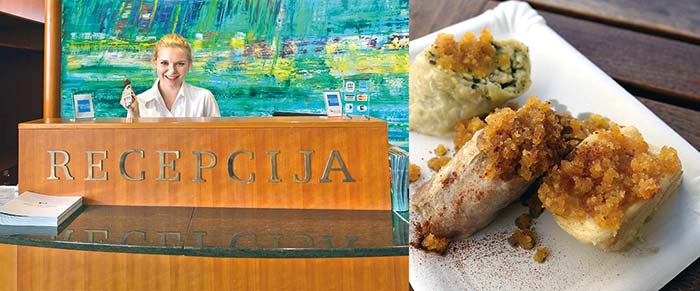
Hotel reception desk; štruklji (Slovenian dumplings)
BEFORE YOU GO
You’ll have a smoother trip if you tackle a few things ahead of time. For more details on these topics, see the Practicalities chapter and RickSteves.com, which has helpful travel-tip articles and videos.
Make sure your travel documents are valid. If your passport is due to expire within six months of your ticketed date of return, you need to renew it. Allow six weeks or more to renew or get a passport (www.travel.state.gov). Check for current Covid entry requirements.
Arrange your transportation. Book your international flights. Overall, Kayak.com is the best place to start searching for flights. Figure out your transportation options: It’s worth thinking about buying train tickets online in advance, getting a rail pass, renting a car, or booking cheap European flights. (You can wing it once you’re there, but it may cost more.) Drivers: Consider bringing an International Driving Permit (sold at AAA offices in the US, www.aaa.com) along with your license.
Book rooms well in advance, especially if your trip falls during peak season or any major holidays or festivals.
Hire guides or drivers in advance. Local guides, or private drivers for day trips, can be a great value. But the best ones book up far in advance. Don’t wait to contact them.
Consider travel insurance. Compare the cost of insurance to the cost of your potential loss. Before buying travel insurance, understand what expenses may already be covered by your credit card, or whether your existing insurance (health, homeowners, or renters) covers you and your possessions overseas.
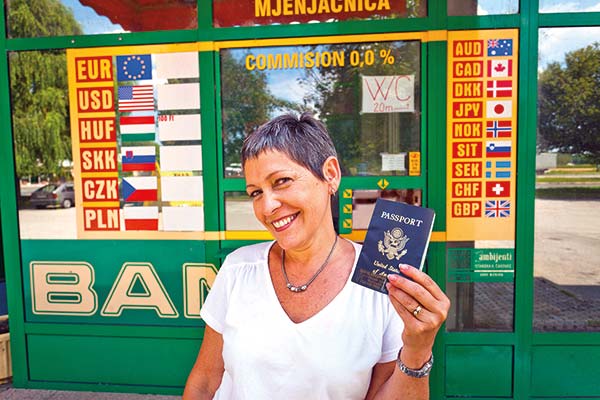
Call your bank. Alert your bank that you’ll be using your debit and credit cards in Europe. Ask about transaction fees, and, if you don’t already have one, get a “contactless” credit card (request your card PIN, too). You don’t need to bring local currency for your trip; you can withdraw money easily from cash machines in Europe.
Use your smartphone smartly. Sign up for an international service plan to reduce your costs, or rely on Wi-Fi in Europe instead. Download any apps you’ll want on the road, such as maps, translators, transit schedules, and Rick Steves Audio Europe (see sidebar).
Pack light. You’ll walk with your luggage more than you think. I travel for weeks with a single carry-on bag and a day pack. Use the packing checklist in the appendix as a guide.
Bring beach gear. Swimsuits and flip-flops are a must if you’re heading to Croatian beaches. Consider packing (or buying) water shoes: Beaches are rocky, and spiny sea urchins are not uncommon.
Travel smarter with these free, fun resources:
Rick Steves Classroom Europe, a powerful tool for teachers, is also useful for travelers. This video library contains about 500 short clips excerpted from my public television series. Enjoy these videos as you sort through options for your trip and to better understand what you’ll see in Europe. Check it out at Classroom.RickSteves.com (just enter a topic to find everything I’ve filmed on a subject).

The Rick Steves Audio Europe app makes it easy to download audio content to enhance your trip. Use the app to listen to audio tours of Europe’s top sights, plus interviews (organized by country) from my public radio show with experts from Europe and around the globe. Find it in your app store or at RickSteves.com/AudioEurope.
Travel Smart
If you have a positive attitude, equip yourself with good information (this book), and expect to travel smart, you will.
Read—and reread—this book. To have an “A” trip, be an “A” student. Because this region’s history is complicated and overlapping, points explained in one section may not be comprehensively repeated in other places where they’re relevant; read thoroughly for a broader understanding. Note opening hours of sights, closed days, crowd-beating tips, and whether reservations are required or advisable. Check the latest at RickSteves.com/update.
Be your own tour guide. As you travel, get up-to-date info on sights, reserve tickets and tours, reconfirm hotels and travel arrangements, and check transit connections. Visit local tourist information offices (TIs). Upon arrival in a new town, lay the groundwork for a smooth departure; confirm the boat, train, bus, or road you’ll take when you leave.
Outsmart thieves. Pickpockets abound in crowded places where tourists congregate. Treat commotions as smokescreens for theft. Keep your cash, credit cards, and passport secure in a money belt tucked under your clothes; carry only a day’s spending money in your front pocket or wallet. Don’t set valuable items down on counters or café tabletops, where they can be quickly stolen or easily forgotten.
Minimize potential loss. Keep expensive gear to a minimum. Bring copies or take photos of important documents (passport and cards) to aid in replacement if they’re lost or stolen. Back up photos and files frequently.
Beat the summer heat. If you wilt easily, choose accommodations with air-conditioning, start your day early, take a midday siesta, and resume your sightseeing later. Churches offer a cool haven. Take frequent breaks for sladoled (ice cream). Join the evening promenade, when locals stroll as temperatures drop.
Guard your time and energy. Taking a taxi or Uber can be a good value if it saves you a long wait for a cheap bus or an exhausting walk. To avoid long lines, follow my crowd-beating tips, which usually involve hitting popular places (such as Dubrovnik’s City Walls or cable car) at the quietest and coolest times. People who show up when things are at their hottest and busiest waste a lot of time and energy and leave disappointed.
Be flexible. Even if you have a well-planned itinerary, expect changes, strikes, closures, sore feet, bad weather, and so on. Your Plan B could turn out to be even better.
Attempt the language. Most people who live in this region speak outstanding English. But if you learn some of their language, even just a few pleasantries, you’ll get more smiles and make more friends. Apps such as Google Translate work for on-the-go translation help, but you can get a head start by practicing the survival phrases in this book (following the Croatia and Slovenia chapters).
Connect with the culture. Interacting with locals carbonates your experience. Enjoy the friendliness of the Croatian and Slovenian people. Ask questions; most locals are happy to point you in their idea of the right direction. Set up your own quest for the best bell tower, mountain vista, or scenic seafront perch. When an opportunity pops up, make it a habit to say “yes.”
Croatia and Slovenia...here you come!