LAKE BLED
GETTING AROUND LAKE BLED (LITERALLY)
NEAR KROPA: JAMNIK VIEWPOINT CHURCH
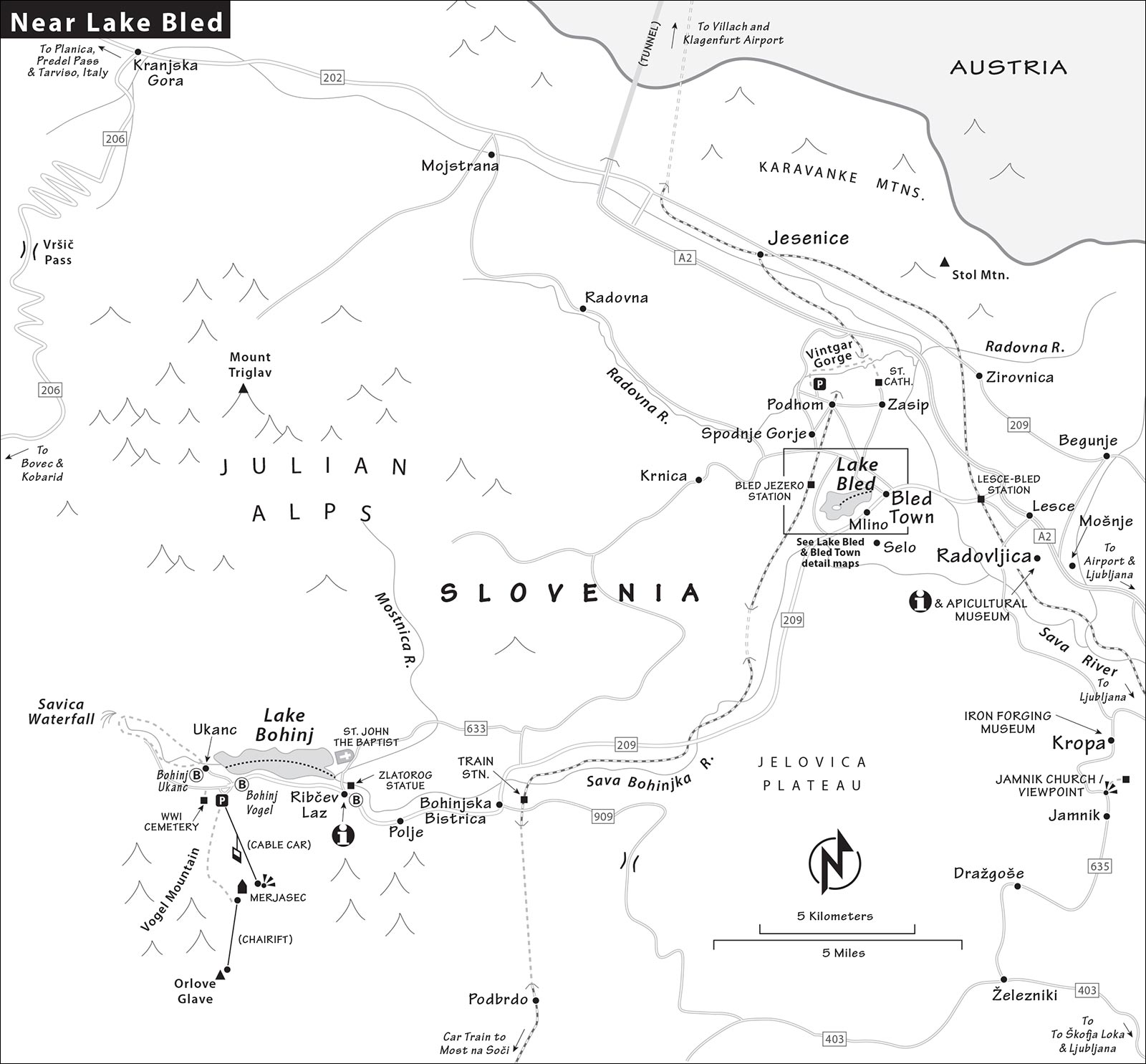
Lake Bled—Slovenia’s leading mountain resort—comes complete with a sweeping alpine panorama, a fairy-tale island, a cliff-hanging medieval castle, a lazy lakeside promenade, and the country’s most sought-after desserts. And the charms of its glorious mountain scenery and traditional folk life only crescendo as you explore the surrounding areas. Taken together, there are few more enjoyable places to be on vacation.
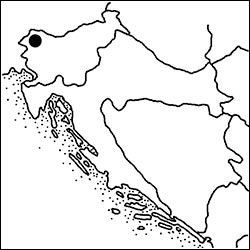
Since the Habsburg days, Lake Bled (locals pronounce it like “blade”) has been the place where Slovenes wow visiting diplomats. In the late 19th century, local aristocrats surrounded the humble lakefront village with classy villas. Tito also had one of his vacation homes here (today’s Hotel Vila Bled), where he entertained illustrious guests.
Lake Bled has plenty of ways to idle away an afternoon. While the lake’s main town, also called Bled, is more functional than quaint, it offers postcard views of the lake and handy access to the region. Hike up to Bled Castle for intoxicating vistas. Ride a traditional pletna boat out to the island, climb up to the church, ring the bell, and make a wish. Wander or bike the dreamy path around the lake. Sit on a dock, dip your feet in the water, and watch the lake’s resident swans. Then dive into some of Bled’s famous cakes while you take in the view of Triglav, Slovenia’s favorite mountain. Bled quiets down at night—there’s no nightlife beyond a handful of pubs—giving hikers and other holidaymakers a chance to recharge.
Bled is also a great jumping-off point for a car trip through the Julian Alps (see next chapter), and a wide variety of other worthwhile side trips begin right at its doorstep. These include the less-developed lake named Bohinj, even deeper in the mountains; a spectacular hike in the nearby mountain gorge of Vintgar; the pleasant Old Town of Radovljica, with its charming pedestrian zone and fascinating little beekeeping museum; and the ironworking town of Kropa.
PLANNING YOUR TIME
Bled and its neighboring mountains deserve at least two days. With one day, spend it in and around Bled (or spend a quick morning in Bled and an afternoon day-tripping). With a second day and a car, drive through the Julian Alps using the self-guided tour in the next chapter. The circular route takes you up and over the stunning Vršič Pass, then down the scenic and historic Soča River Valley. Without a car, skip the second day, or spend it doing nearby day trips: Bus or bike to Radovljica and its bee museum, hike Vintgar Gorge, or visit Lake Bohinj (all described under “Near Lake Bled,” at the end of this chapter).
Be prepared for heavy crowds in July and August, and on weekends in spring and fall (when the lake is popular with Slovenian day-trippers). The road into Bled town can get seriously backed up: The drive in from the highway, which normally takes 10 minutes, can take 40 minutes or more—and parking is scarce. Do your best to arrive early or late, and book ahead for Vintgar Gorge, which can sell out.
Orientation to Lake Bled
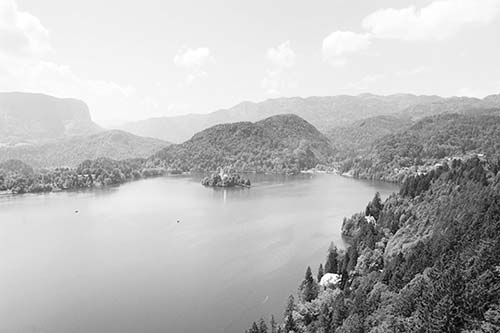
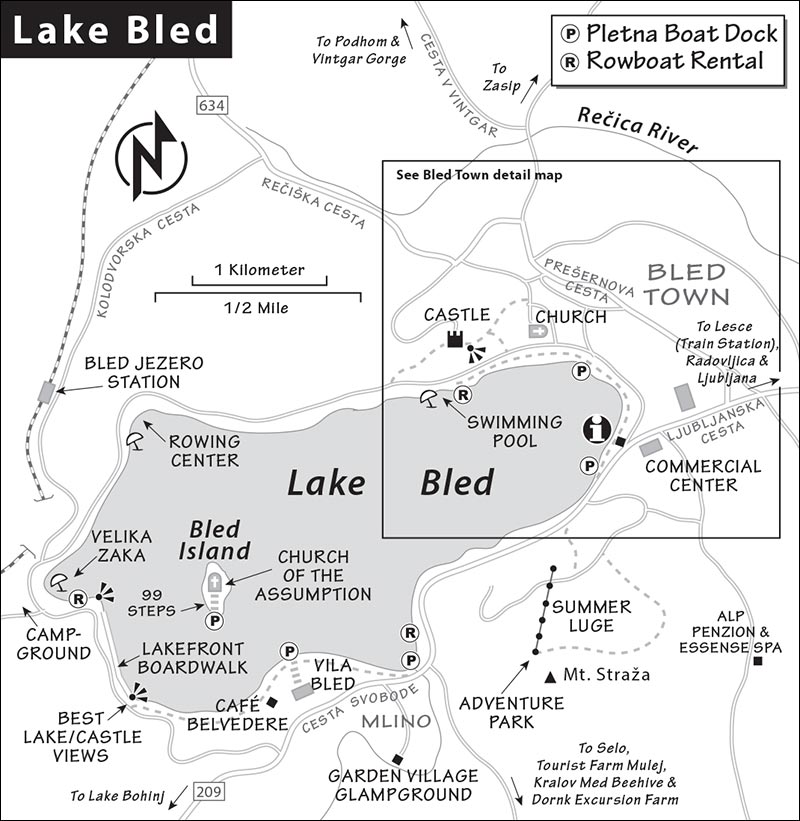
The town of Bled is on the east end of 1.5-mile-long Lake Bled. The lakefront is lined with soothing parks and boxy resort hotels. A 3.5-mile path meanders around the lake. As no motorized boats are allowed, Lake Bled is particularly peaceful.
The tourist center of Bled has two parts, which melt into each other: a simple village and a cluster of giant hotels. The main thoroughfare, called Ljubljanska Cesta, leads out of Bled town toward Ljubljana and most other destinations. Just up from the lakefront is the modern commercial center (Trgovski Center Bled), with a supermarket, ATM, shops, and a smattering of lively cafés. Nicknamed “Gaddafi,” the commercial center was designed for a city in Libya, but the deal fell through—so the practical Slovenes built it here instead.
Bled’s Old Town, under the castle, has a web of tight streets and big-but-humble old houses surrounding the pointy spire of St. Martin’s Church. In this area, you’ll find the bus station, some good restaurants, a few hostels, and more locals than tourists.
The mountains poking above the ridge at the far end of the lake are the Julian Alps, crowned by the three peaks of Mount Triglav. The big mountain behind the town of Bled is Stol (“Chair”), part of the Karavanke range that defines the Austrian border.
TOURIST INFORMATION
Bled’s most central TI is in the long, lakefront casino building across the street from the big, white Hotel Park (as you face the lake, the TI is hiding around the front at the far left end, overlooking the lake). Pick up the map with the lake on one side and the whole region on the other and the free, up-to-date Bled information booklet. Get advice on hikes and day trips, and if you’re doing any serious hiking, spring for a good regional map. They also rent bikes (mid-April-mid-Oct Mon-Sat 9:00-18:00, Sun until 17:00 plus July-Aug Mon-Sat 8:00-20:00; off-season Mon-Sat 9:00-17:00, Sun until 16:00; Cesta Svobode 10, +386 4 574 1122, www.bled.si).
The TI’s other branch—handy for drivers, on the main road out of town—conveniently shares an office with the Triglav National Park Information Center, which offers advice for those heading into the mountains. The center, with free parking, is called “Triglavska Roža” (bike rentals, maps and guidebooks for sale; daily 8:00-18:00, off-season until 16:00; Ljubljanska Cesta 27, +386 4 578 0205, www.tnp.si).
ARRIVAL IN BLED
By Train: Two train stations have the name “Bled.” The Bled Jezero (Bled Lake) station is across the lake from Bled town and is used only by infrequent, slow, tourist-oriented trains into the mountains. You’re much more likely to use the Lesce-Bled station, about 2.5 miles from Bled in the village of Lesce (pronounced lest-SEH). The Lesce-Bled station is on the main line toward Austria and has far better connections to Ljubljana and international destinations. When buying a train ticket or checking schedules, request “Lesce-Bled” rather than just “Bled.” (This is so important that I’ll remind you later.)
From the Lesce-Bled station, you can take the bus into Bled town (2-3/hour, 10 minutes, catch it across the street from the train station), or pay about €15 for a taxi. If taking the train out of Lesce-Bled, buy tickets online, at this station, or on the train—tickets are not sold in Bled town.
By Bus: Bled’s main bus station is a steep five-minute hike up from the lake in the Old Town; to reach the lake, walk straight down Cesta Svobode—the downhill street behind the station. Note that many buses also stop on the way into town, along Ljubljanska Cesta, which is handier for walking to many of my recommended accommodations (for details, see “Sleeping in Bled,” later)—be sure to ask your driver.
By Car: Coming from Ljubljana, you’ll wind your way into Bled on Ljubljanska Cesta, which rumbles through the middle of town before swinging left at the lake. Parking can be challenging. Local accommodations have a line on free parking nearby—ask when you book. If you’re here for a quick visit, you can try to find a spot in the short-term parking lot just above the commercial center (free for 1 hour, €2/2 hours, 2-hour limit). If that lot is full—as it often is—there are several small lots tucked behind the big hotels in the wooded zone between the commercial center and the bus station—carefully check signs to understand the time limits (typically €2/hour, 2-4-hour limit).
The best option is often the lot by the ice rink, Sports Hall Bled, which often has spaces when others are full; nearby, there’s a privately run lot just above and across the street from the Town Hall (on Prešernova Cesta). For longer-term parking, you’ll find cheaper lots with no time limits on Seliška street, which curves just above town (€1/hour); look for the lot at the kindergarten (vrtec), across from the big Spar and Mercator supermarkets; or for one called “Seliška 2,” which is a bit closer to the Old Town.
For more driving tips, see “Route Tips for Drivers” under “Lake Bled Connections,” later.
By Plane: For details on getting from Ljubljana’s airport to Bled, see “Lake Bled Connections,” later.
HELPFUL HINTS
Laundry: Call Anže Štalc to arrange drop-off, then pick up your clean and folded clothes 24 hours later (same-day express service available, +386 41 575 522). The Speed Queen self-service launderette, near the top of town, is surprisingly luxe, with massaging recliners (daily 6:00-21:00, Prešernova Cesta 50, +386 41 366 323).
Car Rental: The Julian Alps are ideal by car. Several companies have branches in Bled, including Europcar (+386 31 382 055), Budget (+386 41 578 0320), and Hertz (+386 4 201 6999).
Massage and Spa Treatments: If you’re here to relax, consider a visit to the Essense wellness center at the recommended Alp Penzion. This modern, classy facility—hiding in the countryside about a 20-minute walk or 5-minute taxi ride above the lake—offers a wide range of spa treatments, including pedicures and Thai massage (arrange in advance, Cankarjeva Cesta 20A, +386 40 996 666, www.essense.si [URL inactive]). You’ll also find wellness centers with massage, saunas, and whirlpools at a few of the big hotels (all open to nonguests). The biggest is the Živa spa at the Rikli Balance Hotel, with a swimming pool, lakeview hot tubs, and massages; Hotel Park’s Thai Center spa also offers good massages (info for both at www.sava-hotels-resorts.com). There are also spas at Hotel Astoria, the Bled Rose Hotel, and for guests only at the Grand Hotel Toplice and Hotel Lovec.
GETTING AROUND LAKE BLED (LITERALLY)
By Bike: You can rent a mountain bike at several points around town, including the TI (€5/hour, €13/3 hours, €17/half-day, €20/day). While walking around the lake is slo-mo bliss, biking it lets you fast-forward between the views of your choice. If you go clockwise, you’ll use the busy lakefront road for the first stretch, but after the village of Mlino, traffic thins out. The best views are from the lakefront gravel path; pedestrians have priority, but courteous cyclists are welcome. (The paved road is higher up, with not-as-good views.)
Biking is also a great way to reach Vintgar Gorge—about three mostly level miles one-way, perfect for combining a countryside pedal with a walk immersed in nature. The separated bike path to the nearby town of Radovljica (and its bee museum) is about four level miles one-way (get details at TI). And for an even more ambitious trip, ask about the long-distance bike path all the way from Bled to Kranjska Gora, at the base of the Vršič Pass. The TI can suggest other ideas.
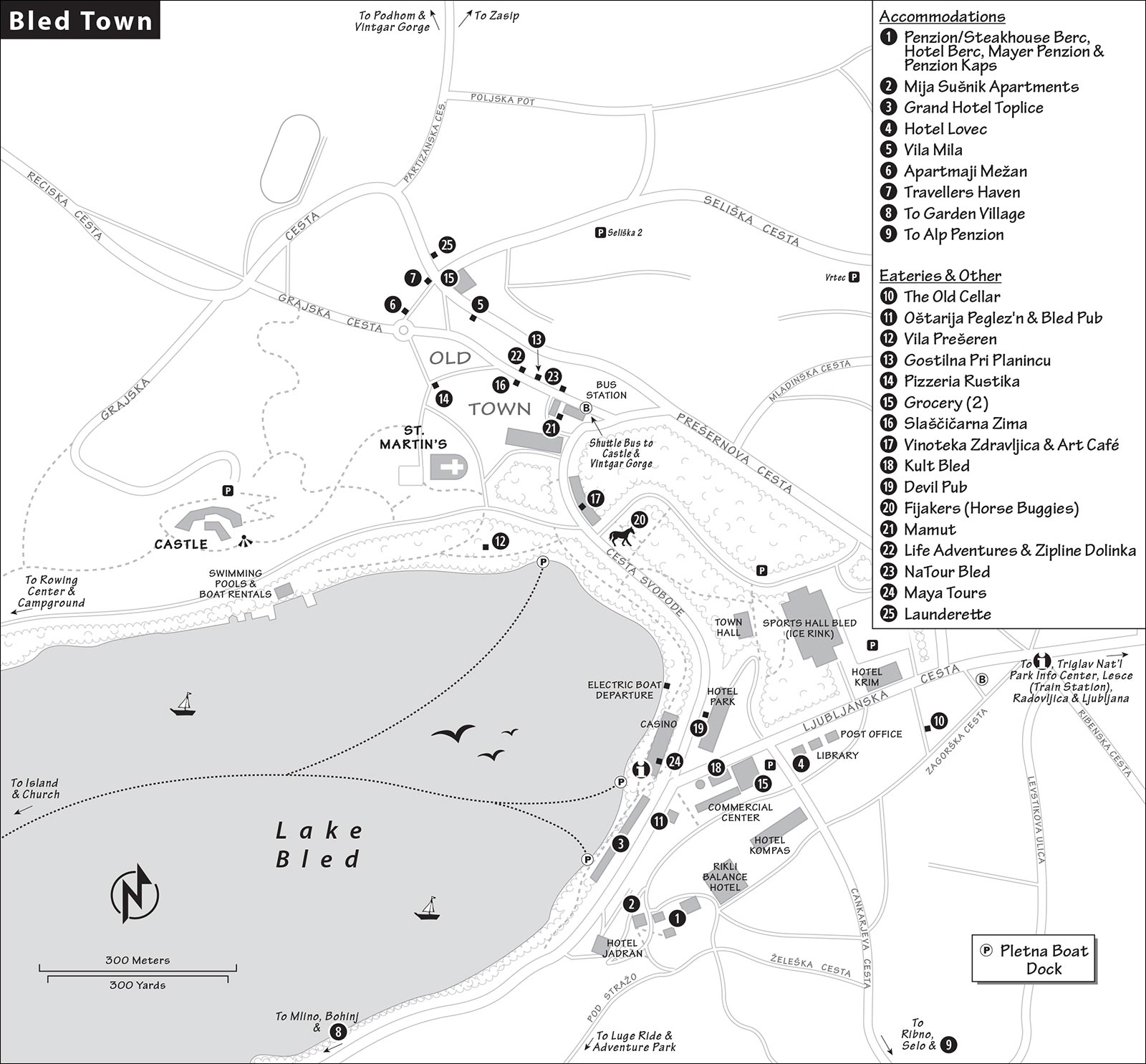
By Horse and Buggy: Buggies called fijakers are the romantic, expensive, and easy way to get around the lake. Hire one along the lakefront between Hotel Park and the castle (see the “Bled Town” map for location; around the lake—€50, one-way up to castle—€50, round-trip to castle with 30-minute wait time—€60, +386 41 710 970, www.fijaker-bled.si).
By Tourist Train: A little train makes a circuit around the lake every 40 minutes in summer (€5, look for it near the TI, weather-dependent, +386 51 337 478).
By Shuttle Bus to the Castle and Vintgar Gorge: These two destinations—both walkable—are much easier with wheels. In the summer, a handy shuttle bus starts from the main bus station, then goes up to the castle and on to the Vintgar Gorge entrance (cheap and sometimes free; 6/day mid-June-mid-Sept, get schedule at TI). Various private companies offer a similar service for €10 round-trip; though pricey, these are worth considering in spring and fall: Maya runs a shuttle from near the TI, while Mamut departs from the bus station (for details, check at each office). Each shuttle service stops both at Vintgar Gorge and the castle (same price).
By Taxi: Your hotel can call a taxi for you. Or contact Bled Tours, run by Sandi, Anže, Cvetka, and their team of English-speaking drivers (prices for up to 3 people: €12 to the castle, €18 to Vintgar Gorge, €60 to Ljubljana airport, €140 to Klagenfurt airport in Austria, other airport transfers on request). They also offer self-guided excursions that include admission, such as “Bled All-in-One,” which includes the castle, Vintgar Gorge, and a trip to the island for €100 (or you can do Bled Castle and Vintgar Gorge for €50, or a few hours in Radovljica for €35; +386 31 205 611 or +386 31 321 122, https://bledtours.si, info@bledtours.si).
By Boat: For information on renting your own boat or riding the characteristic pletna boats, see “Sights at Lake Bled,” later.
By Private Plane: If you have perfect weather, there’s no more thrilling way to experience Slovenia’s high-mountain scenery than from a small propeller plane soaring over the peaks. Private flights depart from a grass airstrip near the village of Lesce, a 10-minute drive or taxi ride from Bled. It’s expensive...but unforgettable (€100 for 15-minute hop over Lake Bled only, €210 for 30-minute flight that also buzzes Lake Bohinj, €280 for deluxe 45-minute version around the summit of Triglav, price covers up to 3 passengers, arrange at least a day in advance, +386 41 959 035, www.alc-lesce.si, info@alc-lesce.si).
Tours at Lake Bled
Local Guides
Tina Hiti and Sašo Golub, an energetic couple, are excellent guides who enjoy sharing the town and region they love with American visitors. Hiring one of them can add immeasurably to your enjoyment and understanding of Bled and the surrounding area (€90 for 2-hour walking tour of Bled, arrange several days in advance, www.pg-slovenia.com, info@pg-slovenia.com, Tina +386 40 166 554, Sašo +386 40 524 774). Tina and Sašo are especially handy for side-tripping into the countryside if you don’t want to drive yourself. I’ve spent great days with them and was thankful they were behind the wheel. Their most popular trip is a day in the Julian Alps (€280 round-trip from Bled, €50 extra to pick up or drop off in Ljubljana, extra charge for 5 or more people, €10/person extra for picnic lunch). They also offer many other options, including food tours, airport transfers, and trips in the Slovenian countryside to research your roots. As Tina and Sašo both lead tours for me in Europe, they may send you off with a well-trained substitute—sometimes Tina’s father, Gorazd, a former Yugoslav Olympian in ice hockey who brings the older generation’s perspective to the trip; or perhaps Petra, Nina, Grega, or the other Grega.
Excursions
To hit several far-flung day-trip destinations in one go, consider a package tour from Bled. Destinations range from Ljubljana and the Karst region to the Austrian Lakes to Venice. For example, an all-day Julian Alps trip to the Vršič Pass and Soča Valley runs about €90 per person (sold by various agencies around town—ask the TI). Note that two people can rent a car for the day for less than the cost of a tour and do it at their own pace using the self-guided driving tour in the next chapter.
Adventure Trips
Various Bled-based companies specialize in taking tourists on active, outdoorsy excursions into the surrounding countryside and mountains. One popular choice is an all-day white-water rafting trip on the Soča River (around €145/person including transportation from Lake Bled, or closer to €55 if you meet them there). Other options include canyoning, river tubing, mountain biking, paragliding, and rock climbing.
Three companies have offices near Bled’s bus station: Mamut (+386 40 121 900, www.slovenija.eu.com), Life Adventures (+386 40 508 853, www.lifeadventures.si), and NaTour Bled (+386 70 644 621, www.natour-bled.si). Maya Tours is near the TI, in the lakefront casino building (+386 4 020 3405, www.bledtransfers.si). Note that these companies tend to attract a young, sometimes rowdy crowd that enjoys lubricating their adventures with alcohol. Another option, Zipline Dolinka, offers a 2.5-hour zipline course (with seven runs) that zigzags over an alpine river near Bled (+386 31 845 900, www.zipline-dolinka.si).
Sights at Lake Bled
Bled doesn’t have many sights, but there are plenty of rewarding and pleasant activities.
▲▲▲Walk Around the Lake
Strolling the 3.5-mile lake perimeter is enjoyable, peaceful, and scenic. At a leisurely pace, it takes about an hour and a half...not counting stops to snap photos of the ever-changing view. Locals debate whether it’s more satisfying to circle clockwise or counterclockwise. But honestly...you can’t go wrong. For the more adventurous, hiking paths lead up into the hills surrounding the lake (ask TI for details and maps).
I’ve listed a few things to tune into as you stroll, starting in the town of Bled and going clockwise (with the lake on your right; see the “Lake Bled” map earlier in this chapter)—but you could just as easily do it in reverse. Just hold the book upside-down.
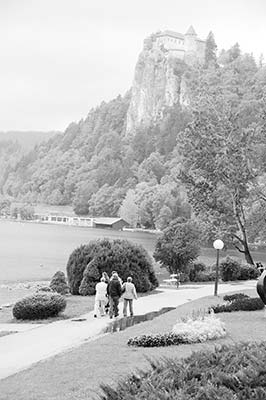
Straža and Luge Ride: Just after the big, lakeside Grand Hotel Toplice, on the inland side of the lake, is the hill called Straža. Above you (but not visible from here) is the thrilling luge ride and other adventure park activities (described later). Watch for the trail up from the lake.
Fancy Villas: On the outskirts of Bled—and all around the lake—you’ll pass some beautiful villas, mostly from the early 19th century. Many of these are now either hotels or extremely exclusive private residences. Appreciate the frilly lakefront architecture.
Mlino: This village—the only real settlement of any size on the lake beyond Bled town—is where the pletna boats originated; many of the families who run trips out to Bled’s island still live here. The town also has a couple of good restaurants (the only sit-down options you’ll see for a while) and a handy Mercator grocery store, if you’d like to stock up on snacks or drinks.
Tito’s Vila Bled: As the path passes below a wooded cliff, a grand staircase leads up to a giant hilltop mansion. This was a residence of Marshal Tito, where the dictator entertained international big shots, from Indira Gandhi to Nikita Khrushchev to Kim Il-Sung to Raúl Castro. Today it’s the fancy Hotel Bled (still relatively affordable if you can find a deal online). The hotel’s café terrace is typically open only for guests; higher on the hill is Café Belvedere—where you can enjoy beautiful views of Lake Bled along with a coffee and kremšnita cake, either inside or out on the terrace (cakes and drinks only, daily 10:00-18:00, until 20:00 in summer, closed Oct-April, walk up from Vila Bled). On the lakeside path, you’ll walk under this building—it’s the giant box on tall stilts.
Local Fisherfolk Enjoying Grand Views: The stretch between Vila Bled and Velika Zaka has perhaps the very best views on the entire lake, closer to the island than at any other point. As you walk, the island and castle shift positions, lining up in a series of beautiful compositions. Pletna boats trundle back and forth, adding to the lovely scenery. In decent weather, you’ll likely pass locals sitting along the lakeshore, napping or picnicking next to fishing poles out in the water. They’re ostensibly angling for carp...but actually, they just like the views.
Lakefront Boardwalk: Where the road pulls away from the lake a bit, don’t miss the pleasant boardwalk (accessed by stairs) that runs right along the lake—offering great views to the island.
Velika Zaka/Campground: This area—at the farthest point on the lake from town—is where rowing competitions begin (or end). It has some humble eateries, a campground, and some wooden piers popular with swimmers. This is a good place to rent a boat to row out to the island. Hikes into the hills above leave from here, too.
Rowing Center: Approaching the northwest corner of the lake, be sure to detour through the gate to the water to appreciate Lake Bled’s proud tradition of rowing. Bled has hosted multiple European and world championships. Town officials even lengthened the lake a bit (creating the divot we just passed in Velika Zaka) so it would perfectly fit standard two-kilometer laps, with 100 meters more for the turn. Lake Bled has produced many Olympic medalists—they’ve won gold in Sydney, silver in Athens, and bronze in London. You’ll likely see crews practicing out on the water, and young rowers jogging around the lake. At the rowing center, plaques in the pavement celebrate the various Olympiads where local rowers have competed, and giant billboards trumpet their achievements. This cove is another popular place for swimming.
You can’t see it from the lake, but just inland from here is Bled’s tiny “Jezero” (Lake) train station. Now used only by smaller tourist trains, it was once on the main line connecting Vienna to its port in Trieste.
Swimming Pool, Under the Castle, and Back to Town: The final stretch into Bled town is (slightly) less scenic but still an enjoyable stroll. If you’re planning to hike up to the castle, watch for trails leading up through the woods on your left (or you can wait until you’re back in town, and head up more steeply from there). Just below the castle is the town’s swimming pool, popular on hot summer days.
Coming into town, you’ll walk below the pointy spire of St. Martin’s Church, then pass the recommended Vila Prešeren restaurant, with its dreamy lakefront terrace. The inviting shoreline park between here and the big hotels is a fun place to relax and linger; near the far end, 100 yards or so before the casino/TI building, look for the relief map of the entire lake and surrounding hills.
If you haven’t made it out to the island yet, there’s a handy pletna departure point just under the TI (described next).
▲▲The Island (Blejski Otok)
Bled’s little island—capped by a super-cute church—nudges the lake’s quaintness level over the top. It has no official name; locals call it simply “The Island” (Otok). While it’s pretty to look at from afar, it’s also fun to visit.
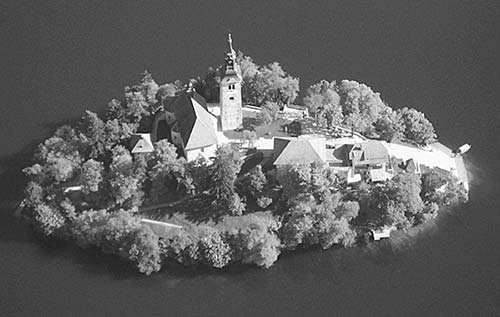
The island has long been a sacred site with a romantic twist. On summer Saturdays, a steady procession of brides and grooms, cheered on by their entourages, heads for the island. Ninety-nine steps lead from the island’s dock up to the Church of the Assumption on top. It’s tradition for the groom to carry—or try to carry—his bride up all of these steps. About four out of five are successful (proving themselves “fit for marriage”). During the communist era, the church was closed and weddings were outlawed here. But the tradition reemerged—illegally—even before the regime ended, with a clandestine ceremony in 1989.
Cost and Hours: Free to visit island; church—€12, ticket includes tower climb, May-Sept daily 9:00-19:00, April and Oct until 18:00, Nov-March until 16:00.
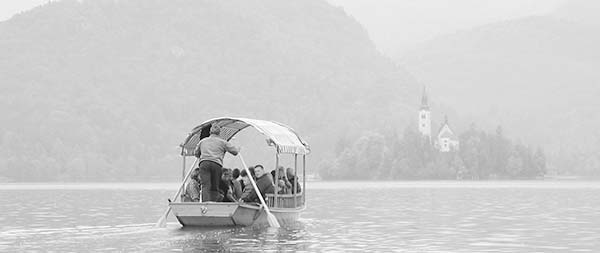
Getting There: The most romantic route to the island is a cruise on one of the distinctive pletna boats (€15/person round-trip, trip takes 20-25 minutes each way, includes 30-minute stay on the island—allow about 1.5 hours for the full experience; might have to wait for more passengers to fill the boat; boats generally run from dawn, last boat leaves one hour before church closes; replaced by enclosed electric boats in winter—unless the lake freezes, in which case you can rent ice skates; +386 31 316 575). Look for pletna boats at various spots around the lake. If you’re in town, the handiest options are directly below the TI, or in front of Grand Hotel Toplice. Farther around the lake, you can also catch a pletna in the village of Mlino; at the bottom of the grand staircase leading up to Vila Bled (it’s a shorter trip from here, but the same cost); and at the campground. For more on these characteristic little vessels, see the “Pletna Boats” sidebar. Note that pletna boatmen stick close to the 30-minute waiting time on the island—which can go very fast. Another option—cheaper but far less romantic—is to take an electric boat (€12 round-trip, departs about hourly from the lakefront below the TI). You could also rent your own boat or SUP (stand-up paddleboard) and row to the island (see “Boating” listing, later).
Visiting the Island: At the top of the stairs, the Potičnica café sells potica, the Slovenian nut-roll cake that’s traditional at Christmastime but delicious any day of the year. The attached souvenir shop is the best in Bled, well stocked with a variety of high-quality Slovenian gifts, trinkets, and keepsakes. Upstairs in the same building is an easy-to-miss art gallery, which displays changing exhibits.
The island’s main attraction is the church. An eighth-century Slavic pagan temple dedicated to the goddess of love and fertility once stood here; the current Baroque version (with Venetian flair—the bell tower is separate from the main church) is the fifth to occupy this spot. Go inside and find the rope for the church bell, hanging in the middle of the aisle just before the altar. A local superstition claims that if you can get this bell to ring three times with one big pull of the rope, your dreams will come true. Worth a try—but be careful if you’re slight of build, as the rope can take you for a ride.
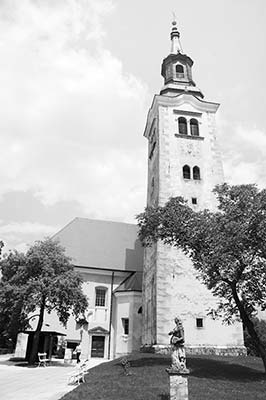
If you’re waiting for a herd of tourists to ring out their wishes, pass the time looking around the area in front of the altar. When the church was being renovated in the 1970s, workers dug up several medieval graves (you can see one through the glass under the bell rope). They also discovered Gothic frescoes on either side of the altar, including, above the door on the right, an unusual ecclesiastical theme: the bris (Jewish circumcision ritual) of Christ.
Your ticket also includes the bell tower. At 91 steps, it’s a shorter climb than the one up from the boat dock. Up top, you’ll find a restored pendulum mechanism from 1890 and sweeping lake views that are marred by a mesh covering that makes it impossible to snap a clear picture.
To descend by a different route, walk down the trail behind the church (around the right side), then follow the path around the island’s perimeter back to where your pletna boat awaits.
▲▲Bled Castle (Blejski Grad)
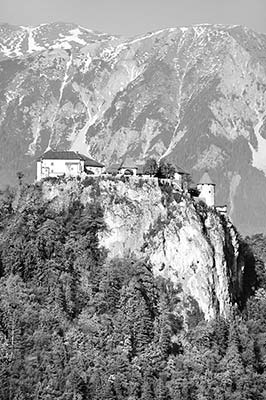
Bled’s cliff-hanging castle, dating in one form or another from 1,000 years ago, was the seat of the Austrian bishops of Brixen, who controlled Bled in the Middle Ages. Today it’s a fine tourist attraction with a little history and lots of big views. The various sights at the castle—a history museum, a frescoed chapel, an old-fashioned printing press, and a wine cellar—are more cute than interesting, but the real reason to come up here is to bask in the sweeping panoramas over Lake Bled and the surrounding mountainscapes.
Cost and Hours: €15; daily 8:00-20:00, Nov-March until 18:00, printing press and wine cellar close one hour earlier; +386 4 572 9782, www.blejski-grad.si.
Getting There: To really earn those views, you can hike up the steep hill (about 20 minutes if you’re in decent shape). The handiest trails are behind big St. Martin’s Church: Walk past the front door of the church with the lake at your back, and look left after the first set of houses for the Grad signs marking the steepest route (follow the wooden stakes all the way up the steep switchback steps); or, for a longer but less steep route, continue past the church on the same street about five minutes, bearing uphill (left) at the fork, and find the Blejski Grad - Castle - 10 Min sign just after the Penzion Bledec hostel on the left. Once you’re on this second trail, don’t take the sharp-left uphill turn at the fork toward the shed (instead, continue straight up, around the back of the hill).
If you’d rather skip the hike, you have several options. If you have a car, simply drive up (€3/hour for parking). Otherwise, consider a shuttle bus (either the official TI bus or a private shuttle; see “Getting Around Lake Bled,” earlier). A taxi runs about €12. Or—if you’re wealthy and romantic—consider a horse and buggy (€50, €10 extra for driver to wait 30 minutes and bring you back down). Note: These options take you only to the parking lot, from which it’s still a steep and slippery-when-wet five-minute hike up to the castle.
Eating: The $$$$ restaurant at the castle is pricey, but worth the splurge for the views and excellent, rotating menu featuring regional cuisine (à la carte for lunch; fixed-price multicourse dinners). Come for dinner while it’s still light out and savor the setting. The sleek, woody interior is often jammed with tour groups; in good weather, I’d rather dine on the outside terrace. Call far ahead to book a view table—they fill up quickly. If you have a reservation to dine here, it’s free to enter the castle grounds, but you’ll still pay for parking (daily in summer 12:00-22:00, shorter hours off-season, +386 4 620 3444, www.jezersek.si). Paupers can grab a basic sandwich at the simple $ café by the round tower or bring their own picnic to munch along the wall with million-dollar views over Lake Bled (buy sandwiches at one of the Mercator grocery stores before you ascend; see “Eating in Bled,” later).
The pletna is an important symbol of Lake Bled. In addition to providing a pleasant way to reach the island, these boats carry on a tradition dating back for generations. In the 17th century, Habsburg empress Maria Theresa granted the villagers from Mlino—the little town along the lakefront just beyond Bled—special permission to ferry visitors to the island. (This provided a much-needed source of income for Mlino residents, who had very limited access to farmland.) They built their pletnas by hand, using a special design passed down from father to son for centuries—like the equally iconic gondolas of Venice. Eventually, this imperial decree and family tradition evolved into a modern union of pletna oarsmen, which continues to this day.
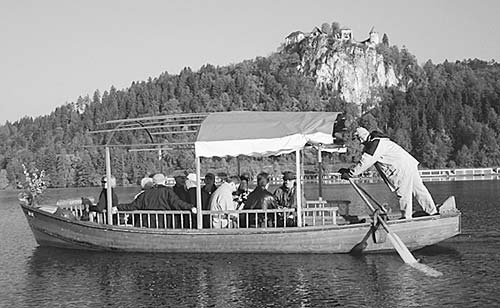
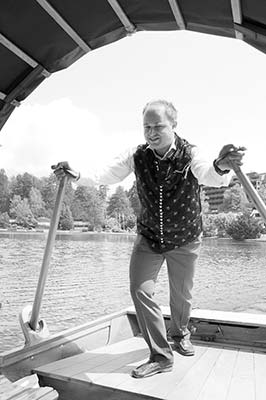
Today pletna boats are still hand-built according to that same centuries-old design. There’s no keel, so the skilled oarsmen work hard to steer the flat-bottomed boat with each stroke—boats piloted by an inexperienced oarsman can slide around on very windy days. There are 21 official pletnas on Lake Bled, all belonging to the same union. The gondoliers dump all their earnings into one fund, give a cut to the tourist board, and divide the rest evenly amongst themselves. Occasionally a new family tries to break into the cartel, underselling his competitors with a “black market” boat that looks the same as the official ones. While some see this as a violation of a centuries-old tradition, others view it as good old capitalism. Either way, competition is fierce.
Summer Performances: In July and August, the castle hosts a weekly, kid-pleasing, knights’-tournament-themed show called “Sir Lambergar’s Adventure” (likely Tue at 17:00, 30 minutes; details on castle website).
Visiting the Castle: After buying your ticket, go through the gate and huff the rest of the way up to the outer courtyard. We’ll tour the castle clockwise, starting from here. The castle is continually being spruced up, so some details may be different than described.
Turning left at the entrance, you’ll pass WCs, then the door to Mojster Janez’s working replica of a printing press (grajska tiskarna/manufaktura) from Gutenberg’s time. You can buy your own custom-made souvenir certificate using this very old technology. While this may seem like a tourist gimmick, there’s actually some interesting history here. As in many lands, the printing press was a critical tool in the evolution of Slovenia’s culture. Look above the press for a life-size mannequin of Primož Trubar (1508-1586), a Slovenian cross between Martin Luther and Johannes Gutenberg. In Trubar’s time, Slovene was considered a crude peasants’ language—not just unworthy of print, but actually illegal to print. So this Reformer went to Germany and, in 1550—using presses like this one—wrote and printed the first two books in the Slovene language: Abecedarium (an alphabet primer to teach illiterate Slovenes how to read) and Catechismus (a simplified version of the New Testament). Trubar smuggled his printed books back to Slovenia (hidden in barrels of playing cards) and, en route to Ljubljana, was briefly given refuge in this castle. (Trubar is still much-revered today, appearing on the Slovenian €1 coin.) Up the stairs is an exhibition in English about early printing methods and the importance of moveable type for advancing the Protestant Reformation, whose goal was to get the Word of God more easily into the hands of everyday people. You’ll also see one of those first Trubar books—notice it was printed in Tübingen, Germany, an early enclave of the Reformation. There’s also a small painting gallery showcasing local artists.
Just past the printing press is the castle’s oldest tower, from the 11th century, which is filled with a “Beehouse” selling various honey products and other souvenirs under a hive-like dome. Nearby is a café terrace with grand views offering reasonably priced drinks and cakes.
Begin climbing the stairs up to grander and grander views over the lake. Reaching the terrace at the very top, you’ll find the best vistas; the restaurant; a tiny chapel with 3-D frescoes that make it seem much bigger than it is (next to the museum entrance); a small shop; and the well-presented castle museum, which strains to make the story of Bled, the castle, and the surrounding region of Carniola interesting. The ground floor has exhibits about geology, prehistoric artifacts, ironworking, and the seasonal life cycle of the region; the upstairs has a cool 3-D model of the surrounding mountains, smaller models illustrating the growth of the castle structure, information about early inhabitants, and exhibits on the development of tourism at Lake Bled (including its many lovely vacation villas). While video screens and some English information are helpful, there’s only so much to say.
When you’re done up here, head down the semicircular staircase between the museum and restaurant (passing WCs). Come back down into the lower courtyard, and turn left down the ramp to find the wine cellar, where you can bottle and cork your own souvenir bottle of wine (you’re paying for the experience more than the wine). Slovenian wines are well explained by attendants who dress as monks, since winemaking was a monastic responsibility in the Middle Ages.
Before leaving the castle, climb the stairs (just past the wine cellar) up to the wooden defensive gallery for the best views in town of the mountains east of Bled. The biggest one is called Stol (Chair). In the foreground, you can see the steeple marking the town of Podhom; just to the left, the folds in the hills hide the dramatic Vintgar Gorge (described later).
Boating
You’ll find rental rowboats at various points around the lake (€25/1.5 hours). Look for them at Pension Pletna in the lakeside village of Mlino (a scenic 15-minute walk around the lake from Bled); at the swimming pool under the castle (the closest but priciest option); under Grand Hotel Toplice; and in the modern building just before the campground on the far end of the lake. You can also rent stand-up paddleboards (SUPs) in Mlino or at various points around the lake, including by the boathouse at the far end (€10-12/hour).
Swimming
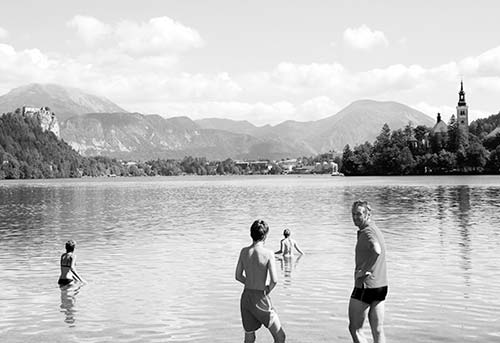
Lake Bled has several suitable spots for a swim. The swimming-pool complex under the castle uses lake water and routinely earns the “blue flag,” meaning the water is top-quality. There’s also a waterslide and an inviting cluster of sunning beds (€9 to swim all day, less for afternoon only, daily 9:00-19:00, until 20:00 at busy times, closed late Sept-mid-June and in bad weather, +386 4 578 0528). Lake Bled’s main beach is at the campground at the far end of the lake, though you can also swim near the village of Mlino.
▲Luge Ride (Poletno Sankanje)
Bled’s “summer toboggan” luge ride, atop Mount Straža overlooking the lake, allows you to scream down a steep, curvy metal rail track on a little plastic sled. This is a scary ride—speedy, with lots of tight turns, and with great views over the lake—and it’s somewhat pricey. A chairlift takes you to the top of the track, where you’ll sit on your sled, take a deep breath, and remind yourself: Pull back on the stick to slow down, push forward on the stick to go faster. You’ll drop 480 feet in altitude on the 570-yard-long track, speeding up to about 25 miles per hour as you race toward the lake.
Cost and Hours: €10/ride, cheaper for multiple rides, weather-dependent—if it rains, you can’t go. In summer, it’s open daily (July-Aug 10:00-19:00, June and early Sept 11:00-18:00); in shoulder season it opens only on good-weather weekends (mid-Sept-mid-Oct and mid-April-May 11:00-17:00). It’s closed mid-Oct-mid-April (386 4 578 0534, www.straza-bled.si).
Getting There: The base of the chairlift is on the hillside just south of town; to get there, head up to the neighborhood just above Grand Hotel Toplice, and follow Straža signs with the lake on your right (by car or by foot).
Nearby: Near the base of the chairlift are other attractions, including an airbag jump and a tubing hill (each covered by its own ticket). Up near the top of the chairlift is Adventure Park (Pustolovski Park): a series of five high-ropes courses designed for everyone age five and up. You’ll get rigged up in a safety harness and go through a training course, then be set loose on your choice of courses (€22 for adults, €18 for kids 7-14, €10 for kids under 7, similar hours to luge ride, last entry 2 hours before closing, +386 31 761 661, www.pustolovski-park-bled.si).
▲Kralov Med Beehive Demonstration
Tucked in Selo village, a long walk or short drive from Bled, this fascinating countryside sight is worth ▲▲▲ (or zzz) for fans of the apicultural arts. (Read the “Slovenian Beekeeping” sidebar, later in this chapter, before your visit.) Local beekeepers Blaž and Danijela Ambrožič have built an apiary (freestanding house of beehives) and teach visitors all about this very Slovenian form of agriculture. First you’ll see the painted panels, with bees buzzing in and out. Their prized possession is a gigantic Winnie-the-Pooh-style hive that they transplanted from a tree trunk. They’ll demonstrate how you can hold your hand within inches of the buzzing hive without getting stung, thanks to the peaceful nature of the indigenous Carniolan bee. Inside, you can watch through a big (and safe) window as they pull out the honeycomb frames from the hive and work with the bees. You’ll see the centrifuge-like device they use to safely extract honey from the comb. In another hut is an “api-therapy” room, where a specially designed bunk lets you watch and listen to the mesmerizing bees without any danger of being stung. You can also sample (and buy) different types of honey and pollen, along with other bee-related gifts. Outside is a perennial garden that demonstrates when various plants blossom, providing much-needed pollen for the bees.
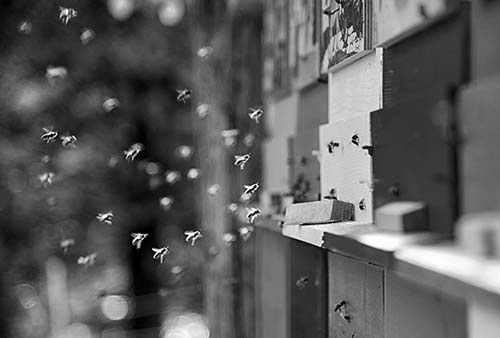
Cost and Hours: €8/person and up, call or email a few days ahead to arrange a time and establish the price, demonstrations usually last an hour plus and may run for just two people, apiary and parking are next to the house at Selo pri Bledu 42—once parked there, call Danijela at +386 41 227 407 or Blaž at +386 41 657 120 and they’ll come meet you, www.kralov-med.si, ambrozicdanijela@gmail.com.
Getting There: Blaž’s beehives are in the village of Selo, a five-minute drive or taxi ride or a 30-minute walk from Bled town. Head out of town along the lake (past Grand Hotel Toplice), then turn left (inland) at the Mercator grocery store in the village of Mlino. In the next village, Selo, look for the two colorful beehive apiaries below the main road, just above the recommended Tourist Farm Mulej.
Dornk Excursion Farm
This offbeat but endearing sight, in the village of Mlino (conveniently close to the beehive demonstration listed above), is hard to explain: It’s a country pub with homemade beer and schnapps; it’s also a folk museum/ethnography collection; but really it’s just a chance to hang out with some nice local people and see some interesting things. Monika and her family live in a typical old farmhouse with a giant barn next door. She spends the winter distilling her own schnapps and brewing six different types of beer. Then, through the summer season, she invites travelers to come for a drink (admission free but tips appreciated; typically open daily May-mid-Oct 12:00-18:00 or later; Mlinska Cesta 28, +386 40 652 527, www.dornk-bled.com).
While you’re there, they’ll invite you into the family home, which feels like a folk museum (“last renovated in 1774”)—especially the “black kitchen,” so named because the wood fire fills the top of the room with smoke (to flavor and preserve meat hanging from two giant beams) before it exits on the far side. The walls are charred with centuries’ worth of carbon; it smells like a smokehouse. They’ll also show you the “white kitchen”—the newer (but still traditional) space where they do most of their cooking today.
If you’re interested, and it’s not too busy, they’ll take you across to the barn and show you two huge rooms packed to the gills with the family’s collections—especially remarkable embroideries created by Monika’s mother Simona, plus dozens of different Nativity scenes and all manner of other bric-a-brac. Upstairs are old farm tools (“of interest only to farmers, not city slickers,” Monika explains). So, feel free to swing by. Order a beer, schnapps, or homemade juice. If you’d like a bite to eat, get the “farmer’s snack”—a plate of locally produced cold cuts and cheeses. (The “shepherd’s snack” is just the cheeses.) Sometimes they have desserts, too.
Like I said: All of this is a little hard to explain. But if it sounds like something you might like...then you’d probably like it.
Nightlife in Bled
Bled is quiet after hours. However, the town does have a few fun bars that are lively with a young crowd (all open nightly until late). Since many young people in Bled are students at the local tourism school, they’re likely to speak English...and eager to practice with a native speaker. Try a Smile, a Corona-type Slovenian lager. Šnops (schnapps) is a local specialty—popular flavors are plum (slivovka), honey (medica), blueberry (borovničevec), and pear (hruškovec).
Kick things off with the fun-loving local gang at Gostilna Pri Planincu near the bus station (described later, under “Eating in Bled”). Then head down Cesta Svobode toward the lake. On the left, you’ll come to Art Café, with a trendy ambience, then the mellow Vinoteka Zdravljica, with Slovenian wines by the glass for €3-5. Around the lake just below the commercial center, Bled Pub (a.k.a. The Cocktail Bar or Troha, for the family that owns it) is a trendy late-night spot where bartenders sling a dizzying array of mixed drinks to an appreciative, youthful crowd (between the commercial center and the lake, above the recommended Oštarija Peglez’n restaurant). If you’re still standing, several other bars and cafés percolate in the commercial center, including Kult Bled, facing the main road at the base of the round tower. Slathered with iconic film images and neon colors, it attracts a thirtysomething crowd and occasionally hosts live music. Devil is open even later (on the lower level of Hotel Park, facing the lake); a nightclub/disco is at the other end of the same complex.
Sleeping in Bled
Bled has more hotel beds per capita than anywhere in Slovenia—and most of them are in big convention hotels. I prefer staying in smaller, more characteristic, pension-type accommodations on the town’s fringe, most of them an easy walk from the lake. These places book up early, so reserve well ahead.
PENSIONS ABOVE THE LAKE
These friendly, cozy, characteristic accommodations are Bled’s best values. But it’s important to book direct—you’ll typically save around 15-20 percent compared to booking through a third-party website. These places are perched on a hilltop a 5-to-10-minute climb up from the lake (easier than it sounds). There are two ways to get here from the town center: Walk around the lake to Grand Hotel Toplice, then cross the street and go up the stairs around the right side of the Hotel Jadran. Or, from the main road into town (Ljubljanska Cesta), take the small service road just above the commercial center (in front of Hotel Lovec), and loop up around the big Kompas and Rikli Balance hotels. If arriving by bus, ask nicely if your driver will let you disembark along Ljubljanska Cesta (just above the traffic light) to avoid the long walk from the bus station. From this bus stop, you can walk down Ljubljanska Cesta and take the road just above the post office, which leads up to this area.
$$$ Penzion Berc (pronounced “berts”) is the priciest option in this area, with 11 sharp, comfortable, woody rooms—all with balconies—filling a tidy chalet. It’s well run by Miha, who charges more because he includes thoughtful touches like free loaner electric bikes and minifridges stocked with free drinks. He also runs the recommended Steakhouse Berc and arranges excursions (air-con, Želeška Cesta 15, +386 4 574 1838, www.penzion-berc.si, info@penzion-berc.si).
$$ Hotel Berc, across the street and run by Miha’s brother, Luka, has 17 nearly-as-nice rooms with balconies, loaner bikes, and lower rates (cash only, air-con, Pod Stražo 13, +386 4 576 5658, www.berc-sp.si, hotel@berc-sp.si).
$$ Mayer Penzion, next door and thoughtfully run by the Trseglav family (relatives of the Berc brothers), comes with 13 rooms (air-con in some rooms, family rooms, elevator, Želeška Cesta 7, +386 4 576 5740, www.mayer-sp.si, penzion@mayer-sp.si).
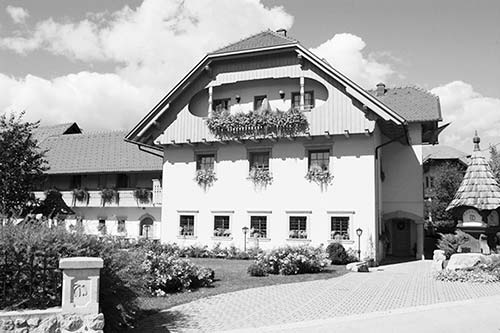
$$ Penzion Kaps, conscientiously run by Peter (whose father, Anton, is a great craftsman) and Darija, has 13 comfortable rooms with balconies, modern bathrooms, minifridges, and classic old wood carvings. The inviting breakfast room in the basement clusters around a giant ceramic stove (cash only, family rooms, air-con, laundry service, Želeška Cesta 22, +386 41 618 513, www.penzion-kaps.si, info@penzion-kaps.si).
$ Friendly Mija Sušnik rents out two comfortable two-bedroom apartments. Modern, tidy, and equipped with kitchens, these are a good budget choice for families (cash only, no breakfast, laundry service, free parking, Želeška Cesta 3, +386 4 574 1731, mobile +386 40 872 278, susnik@bled-holiday.com). It’s just toward the lake from the bigger pensions, with a big crucifix out front. Her sister Ivanka also rents apartments, but they’re farther from the lake.
ON OR NEAR THE LAKE
You’ll pay a premium to be closer to the lake—but it’s hard to argue with the convenience.
$$$$ Grand Hotel Toplice (TOHP-leet-seh) is the grande dame of Bled, with 87 high-ceilinged rooms, parquet floors, a genteel lakeview café/lounge, posh decor, all the amenities, and a long list of high-profile guests—from Madeleine Albright to Jordan’s King Hussein to Slovene-by-marriage Donald Trump (ask to see their “wall of fame”...or is it “shame”?). Once elegant, this place is a bit faded these days, but it’s still a classic. Rooms in the back are cheaper but have no lake views and overlook a noisy street—get one as high up as possible (air-con, elevator, free parking, Cesta Svobode 12, +386 4 579 1000, www.hotel-toplice.com, ghtoplice@hotelibled.com). The hotel’s name—toplice—means “spa”; guests are free to use the hotel’s swanky, natural-spring-fed indoor swimming pool (a chilly 72 degrees Fahrenheit).
$$$ Hotel Lovec (LOH-vets) sits in a convenient (but not quite lakefront) location along the main road just above the commercial center. Nicely appointed inside and out, and run by a helpful staff (including Tomaž, who enjoys offering guests free tours, lectures, and other activities), it’s professional yet welcoming. Its 61 well-designed rooms come with all the comforts, an excellent breakfast, and a respected restaurant (family rooms, air-con, elevator, free parking, Ljubljanska Cesta 6, +386 4 620 4100, www.lovechotel.com, reservations@kompas-lovec.com).
NEAR THE OLD TOWN
$$ Vila Mila rents seven one-bedroom apartments in a handsome, beautifully renovated house at the top of the Old Town. It comes with a pleasant terraced garden and an eco-friendly focus (air-con, handy parking garage, Grajska Cesta 20, +386 51 501 909, www.vilamila.si).
$$ Apartmaji Mežan, run by welcoming Janez and Saša, has four family-friendly apartments in a modern home buried in the middle of town, just uphill from the church. As it’s next to an old barn, it’s technically a tourist farm (cash only, no breakfast, Riklijeva 6, +386 41 210 290, www.apartmaji-mezan.si, sasa.mezan@gmail.com).
¢ Travellers Haven is a low-key hostel run by Colleen. The beds fill eight rooms in a nicely renovated hundred-year-old villa in the Old Town. The hangout areas are inviting, though the tight bathrooms offer little privacy and there are no lockers (Riklijeva Cesta 1, +386 41 396 545, thbled1@gmail.com).
OUTSIDE TOWN
The following listings are a bit farther out: Alp Penzion is a 20-minute walk from the lakefront, but still doable for nondrivers, while the tourist farm and “glampground” are best for drivers. See the “Lake Bled” map for locations.
$$$$ Garden Village is pricey...but very cool. Alternately billed as a “glampground” and a “green resort,” this splurge combines the closeness to nature of camping with the amenities of a hip resort. From the main lodge, restaurant, and rustic pond/pool, the complex tumbles down a ravine toward a gushing river, connected by slippery plank walks. You can stay in a tree house (with a loft and netted hammock area up top for kids); a glamping tent, with canvas walls and nestled in an abundant produce garden; a simpler pier tent on stilts over the river; or an apartment in the main building. All of these include breakfast, Wi-Fi, and other amenities, but additional charges for cleaning and shorter stays can add up (on the road toward Lake Bohinj, turn off on the left just before Vila Bled, Cesta Gorenjskega odreda 16, +386 8 389 9220, www.gardenvillagebled.com, reservations@gardenvillagebled.com).
$$ Alp Penzion makes the most of a peaceful countryside setting amid hayfields, within a 20-minute, partly uphill walk of the lake (better for drivers or for those who don’t mind the walk). With 12 rooms (some with balconies) and a hangout garden, this kid-friendly place is enthusiastically family run (air-con, free loaner bikes, Cankarjeva Cesta 20A, +386 41 350 558, www.alp-penzion.com, bled@alp-penzion.com). Next door is the relaxing Essense spa (described earlier, under “Helpful Hints”).
$$ Tourist Farm Mulej, possible for hardy walkers but much better for drivers, is a new but traditional farmhouse in a tranquil valley about a half-mile from the lake (1.5 miles from Bled town). Damjana and Jože, who run this working farm (with 140 milk cows...and their smells), also rent out eight modern rooms and two apartments—all with balconies—and serve breakfasts made with food they produce. Be sure to see the udderly fascinating, fully automated cow-milking machine called Lely, who’s practically a member of the family (RS%, cash only, family rooms, air-con, Selo pri Bledu 42a, +386 4 574 4617 or +386 4 022 4888, www.mulej-bled.si, info.mulej@gmail.com). The farmhouse is in the village of Selo—drive along the lakeside road south from Bled, then turn off in Mlino toward Selo, and look for the signs (to the right) once in the village. They also offer 10 apartments in a townhouse dating from 1662, in the center of the village.
Eating in Bled
With a finite number of restaurants, places can fill up at dinnertime—it’s best to book ahead. In addition to the places recommended here, consider the high-quality (and expensive) restaurant up at the castle, described earlier.
$$$$ The Old Cellar, a short walk up from the lakefront hotel zone, feels nicely rustic yet sophisticated, but not pretentious. The service is sharp, the seating (in a series of traditional rooms, or outside) is appealing, and the food is a satisfying combination of traditional Slovenian ingredients and modern technique—such as the “porcini cappuccino,” a delicious mushroom soup topped with a flavorful foam (Mon-Thu 17:00-22:00, Fri-Sun from 12:00, up a gravel road from busy Ljubljanska Cesta, Zagoriška 12, +386 40 412 556, www.oldcellarbled.com).
$$$$ Steakhouse Berc—just up the hill from the lakefront, at the recommended Penzion Berc—is a dreamy splurge restaurant. You’ll dine at white-tablecloth tables positioned just so on the lush lawn, or in the country-cozy interior. The menu of well-executed international dishes with a Slovenian spin will satisfy steak lovers, though the prices can add up (Mon-Sat 18:00-23:00, likely closed Sun, Želeška Cesta 15, +386 4 574 1838, www.penzion-berc.si).
$$$ Oštarija Peglez’n (The Old Iron), conveniently located on the main road between the commercial center and the lake, cooks up tasty Slovenian and Mediterranean meals, with an emphasis on fish and fun family-style shareable skillets. Choose between the delightful Slovenian cottage interior or the shady streetside terrace (daily 12:00-23:00, Cesta Svobode 19A, +386 4 574 4218).
$$$ Vila Prešeren is a handy lakeside choice, featuring international cuisine (as well as some traditional Slovenian dishes) at tables on a giant terrace reaching down to the lakefront. I’d come here only in good weather, when you can linger on the terrace over a meal, a drink, or a classic Lake Bled dessert; otherwise, skip it (daily 7:00-23:00, Veslaška Promenada 14, +386 4 575 2510, https://vilapreseren.com).
While you’re in Bled, be sure to enjoy the town’s specialty, a cream cake called kremna rezina (KRAYM-nah ray-ZEE-nah; often referred to by its German-derived name, kremšnita, KRAYM-shnee-tah). It’s a layer of cream and a thick layer of vanilla custard artfully sandwiched between sheets of delicate, crispy crust. Heavenly. Slovenes travel from all over the country to sample this famous dessert. You may also see some newfangled strawberry and chocolate kremšnita variations, but purists swear by the original.
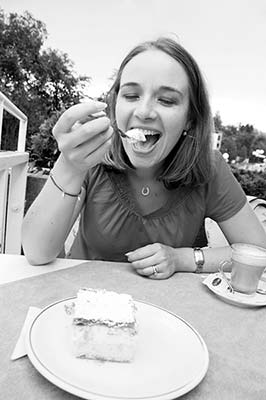
Slightly less renowned—but just as tasty—is grmada (gur-MAH-dah, “bonfire”). This dessert was developed by Hotel Jelovica as a way to get rid of their day-old leftovers. They take yesterday’s cake, add rum, milk, custard, and raisins, and top it off with whipped cream and chocolate syrup.
There’s also prekmurska gibanica—or just gibanica (gee-bah-NEET-sah) for short. Originating in the Hungarian corner of the country, gibanica is an earthy pastry filled with poppy seeds, walnuts, apples, and cheese, and drizzled with rum.
Yet another dessert is the very traditional potica (poh-TEET-sah), a walnut roll that’s usually eaten at Christmastime. While it’s rare to find this in bakeries, the café on the island in the lake sells several varieties.
Desserts are typically enjoyed with a lake-and-mountains view—the best spots are the terrace at Vila Prešeren, the Panorama restaurant by Grand Hotel Toplice, and the terrace across from Hotel Park (figure around €5 for cake and coffee at any of these places). For a more local place—but lacking a lakeview setting—consider the recommended Slaščičarna Zima (only slightly cheaper).
$$$ Gostilna Pri Planincu (By the Mountaineers) is a homey, informal bar coated with license plates and packed with fun-loving, sometimes rowdy locals. A big, dull dining area sprawls behind the small, local-feeling pub, and there’s outdoor seating out front and on the side patio. The menu features huge portions of stick-to-your-ribs Slovenian pub grub, plus Balkan grilled-meat specialties. Service is playfully opinionated and not always efficient—don’t come here if you’re in a rush (daily 12:00-23:00, Grajska Cesta 8, +386 4 574 1613, www.pri-planincu.com). Upstairs is a timbered $$ pizzeria dishing up wood-fired pies (opens at 12:00). The cartoon mural along the outside of the restaurant shows different types of mountaineers (from left to right): thief, normal, mooch (“gopher”), climber, and naked (...well, almost).
$$ Pizzeria Rustika, a cozy and convivial spot tucked deep in the Old Town, offers good wood-fired pizzas and salads. Its upstairs terrace is relaxing on a balmy evening (daily 12:00-23:00, Riklijeva Cesta 13, +386 4 576 8900).
Supermarket: The $ Mercator grocery store, in the commercial center, has the makings for a bang-up picnic. They sell €3 sandwiches to go or will make you one to order (point to what you want). This is a great option for hikers and budget travelers (Mon-Fri 8:00-19:00, Sat until 18:00, closed Sun). There’s another location closer to the Old Town and castle (Mon-Sat 7:00-21:00, closed Sun), and a much larger one on busy Seliška road just outside the town center.
Dessert: While tourists generally gulp down their cream cakes on a hotel restaurant’s lakefront terrace, residents favor the desserts at Slaščičarna Zima (a.k.a. the Brown Bear, for the bear on the sign). It’s nicely untouristy and has a small outdoor terrace, but lacks the views and atmosphere of the lakeside spots (daily 8:00-21:00, near bus station at Grajska Cesta 3, +386 4 574 1616).
Lake Bled Connections
The most convenient train connections to Bled use the Lesce-Bled station, about 2.5 miles away (see “Arrival in Bled,” earlier). Remember, when buying a train ticket to Lake Bled, make it clear that you want to go to the Lesce-Bled station (not the Bled Jezero station, which is poorly connected to the main line).
Note that if you’re going to Ljubljana, it’s better to take the bus (which leaves from Bled town itself) rather than the train (which leaves from the Lesce-Bled train station).
If traveling by bus, confirm times at the TI, on schedules posted at the Bled bus station, or online. Most buses are operated by Arriva (https://arriva.si, schedules but no tickets online). You can book tickets online at www.ap-ljubljana.si, but you’ll have to print them; otherwise, you can buy them on the bus. For buses operated by Flixbus, you can only buy tickets online, then show your QR code when you board (no ticket office, no on-bus purchase).
From Lesce-Bled by Train to: Ljubljana (roughly hourly, 40-60 minutes), Salzburg (1/day direct, 4 hours; 2/day with a change in Villach, Austria), Munich (1/day direct, 6 hours; 2/day with a change in Villach, Austria), Vienna (that’s Dunaj in Slovene, 3/day, 5.5-6 hours, transfer in Villach), Venice (only 1/day convenient option with transfer in Villach, 6 hours; consider a GoOpti minibus—see next listing), Zagreb (3/day direct, 3-3.5 hours).
By Bus to: Ljubljana (Mon-Sat 1-2/hour—usually at :30 and sometimes :00 past the hour, fewer on Sun, 1.25 hours), Radovljica (2-3/hour, fewer Sat-Sun, 15 minutes), Lesce-Bled train station (2-3/hour, fewer Sat-Sun, 10 minutes), Lake Bohinj (hourly at :20 past the hour, 40 minutes to Bohinj Jezero stop, 50 minutes to Bohinj Vogel or Bohinj Zlatorog stop), Vintgar Gorge (direct tourist bus runs 6/day mid-June-Aug, private shuttle buses at other times; also possible to take a public bus to Podhom or Spodnje Gorje and walk 15 minutes; for details, see “Vintgar Gorge,” later).
By Shared Minivan Shuttle: GoOpti can also be an efficient and affordable way to link Lake Bled to various destinations near and far, including the airport. When figuring out a long journey, be sure to compare GoOpti to your other options (www.goopti.com).
By Plane: Ljubljana Airport (code: LJU) is between Lake Bled and Ljubljana, about a 45-minute drive from Bled (for airport details, see here). To connect Bled and the airport, the best compromise of cost and speed is to book a shared minivan transfer with GoOpti, which usually runs around €15 (see here). Other Bled-based shuttle buses make the trip for around €20; to see what best matches your schedule, check with Mamut (www.slovenija.eu.com) or Maya (www.bledtransfers.si). Because these run somewhat irregularly, it’s always best to book ahead. A taxi costs around €50-60 (set price up front—since it’s outside town, they don’t use the meter; I’d book ahead with Bled Tours for a similar price—see here).
Route Tips for Drivers: Bled is less than an hour north of Ljubljana on the slick A-2 expressway. The exit is marked for Lesce, but you’ll also see signs for Bled, which will lead you directly to the lake (where the road becomes Ljubljanska Cesta). At the main roundabout, soon after exiting the expressway, a towering metal obelisk honors Slavko Avsenik, the oompah bandleader from nearby Begunje who became an international sensation. At the base of that steel stiletto is Avsenik’s name, a giant accordion, and an umbrella (part of the local folk costume in this rainy climate).
To reach Radovljica (bee museum) or Lesce (train station), drive out of Bled on Ljubljanska Cesta toward the expressway. Watch for the turnoff to Lesce on the right. They’re on the same road: Lesce first (to reach train station, divert right when entering town), then Radovljica. (Signs to Radovljica will divert you out to the main road that parallels the expressway, then back down into Radovljica; instead, follow signs to Lesce, and drive through that town for the more direct route.) Also along this road, between Lesce and Radovljica, is the well-marked turnoff to the road to Kropa (with its Iron Forging Museum).
Near Lake Bled
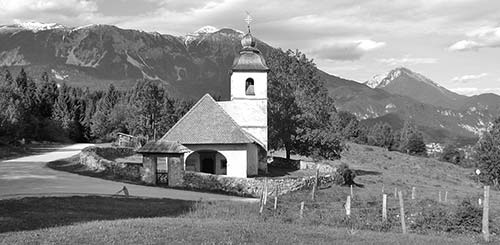
The countryside around Bled offers several day trips that can be done easily without a car (bus connection information is described in each section). The four trips listed here are the best (two small-town/museum experiences, two hiking/back-to-nature options). They’re more convenient than can’t-miss, but each is worthwhile on a longer visit, and all give you a good taste of the Julian Alps. For a self-guided driving tour through farther-flung (and even more striking) parts of the Julian Alps, see the next chapter.
Vintgar Gorge
For those seeking a spectacular walk, Vintgar (VEENT-gar), worth ▲▲, is one of my favorite low-impact hikes in Slovenia or Croatia. Just north of Bled, the River Radovna has carved this mile-long, picturesque gorge into the mountainside. Boardwalks and bridges put you right in the middle of the magic in this “poor man’s Plitvice.” Shaded and relatively cool, this is a refreshing place for a walk on a hot day (and extra cold on a cool day—bundle up).
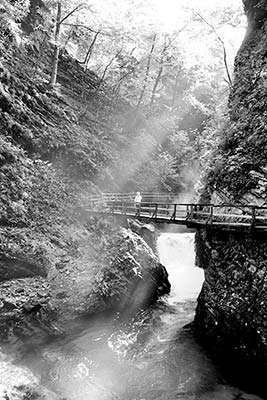
The gorge—easily reachable from Bled by bus or foot—works well for those who are itching for a hike but don’t have a car. From the entrance, allow about two hours for a round-trip hike, including time for photos (and there will be photos). Note that Vintgar has become extremely popular, so crowds can be a problem; to ensure getting in, avoid midmorning and book ahead online (see the following tips).
Cost and Hours: €10 to enter gorge; open daily in summer 8:00-18:00, longer hours July-Aug, shorter hours in shoulder season, may be closed off-season, confirm hours online; +386 4 572 5266, https://vintgar.si.
Crowd-Beating Tips: Vintgar Gorge can be crowded, and can sell out, especially in summer and on good-weather weekends in spring and fall. Buying tickets online in advance is required at certain times (typically before 13:00) and a good idea anytime. Early risers can arrive near opening to avoid the worst of the crowds, which peak late morning; otherwise, aim for later in the day. Booking is preferred, but it’s possible to prebuy tickets in person at the Mamut tour agency near Bled’s bus station.
Getting to Vintgar Gorge: The gorge is 2.5 miles north of Bled. To reach the gorge entrance, you can drive (10 minutes), walk (about an hour one-way), pedal a rental bike (about 30 minutes, easiest with an electric bike), take a shuttle bus (about 10 minutes), or take a public bus (15-minute ride plus 15-minute walk).
Drivers follow signs to Podhom, then Vintgar (see walking/cycling instructions, next), and pay €5 to park near the gorge entrance.
Walkers and cyclists leave Bled on the road between the castle and St. Martin’s Church and take the uphill (left) road at the fork. Just after the little yellow chapel, turn right on the road with the big tree, then immediately left at the Mercator grocery store. When the road swings left, continue straight onto Partizanska (marked for Podhom and Zasip; ignore the bus sign for Vintgar pointing left). At the fork just after the little bridge, go left for Podhom, then simply follow signs for Vintgar.
The easiest option for a quick visit is to take a shuttle bus to the gorge entrance. In the peak of summer (generally mid-June-Aug), the TI runs a cheap, sometimes free, shuttle bus to the gorge. At other times, you can pay €10 round-trip for a bus operated by a private agency. Mamut lets you book the shuttle bus and the gorge entry time slot at the same time (book at www.vintgarshuttle.com or at their office near Bled’s bus station); with other companies (including Maya, near the TI), you’ll book the gorge entrance separately. These round-trip shuttles conveniently retrieve you where you exit the gorge via the green trail, near the Church of St. Catherine, and return you to Bled about 2.5 hours after you leave town. Just be very clear on the location and departure time for your return shuttle.
Finally, hourly public bus connections can get you close (none Sat-Sun, 15-minute trip): Take the bus either to Podhom or Spodnje Gorje (take bus in direction of Krnica); from either of these bus stops, it’s a 15-minute walk to the gorge (follow signs for Vintgar).
Gorge Hike: Visiting Vintgar is a one-way, approximately two-hour loop: You’ll hike to the end of the gorge on boardwalks, then take your pick of routes to huff up through the woods out of the gorge and return to the starting point (or meet your shuttle home).
From the ticket booth, the boardwalk trail (sometimes a bit slippery) crisscrosses over the most dramatic and narrow stretch; you’ll tiptoe over several waterfalls and marvel at the clarity of the water. Then the gorge—and the trail—flattens out and passes under a high stone footbridge and over a scenic dam. Finally, at the end of the gorge, you’ll reach a footbridge over a plunging waterfall (next to a snack stand and WCs). For more views, continue on five minutes downhill (following the Pod Slap signs), then circle over the river again to reach a knoll where you can peer up at the waterfall and bridge you just crossed.
Returning to the Entrance: At the end of Vintgar Gorge, you have a few options for completing the loop and returning to the entrance.
The green trail takes you up to the right, to the Church of St. Catherine (Sv. Katarina). Behind the snack stand deep in the gorge, find the trail marked Pod Katarina. You’ll go uphill for 25 strenuous minutes before cresting the hill and enjoying beautiful views over Bled town and the region. There’s a handy bar next to the church for refreshments. If you booked a round-trip shuttle, you’ll generally meet it near the church (or down in the village of Zasip)—confirm specifics before you head out.
Alternatively, from St. Catherine’s, you can follow signs back to the main entrance and parking lot in about 30 minutes. Another option from St. Catherine is to continue straight down the road about 10 minutes to the typical, narrow old village of Zasip. In Zasip, you can catch a public bus back to Bled (Mon-Fri hourly, none Sat-Sun, 15 minutes; look for the bus stop near Gostilna Kurej). Otherwise, it’s about a 30-minute walk from Zasip back to Lake Bled.
The red trail, steeper but more direct, gets you back to the entrance in about 45 minutes. At the end of the gorge, head left and follow signs about 20 minutes up to the cemetery in Blejska Dobrava. From there, you’ll walk through the village to find the forest path that leads you back to the entrance.
Radovljica
The town of Radovljica (rah-DOH-vleet-sah, “Radol’ca” for short), perched on a plateau above the Sava River, has the quaint Old Town that Bled lacks. And, refreshingly, it also lacks the worst of Bled’s summer crowds. The traffic-free core of the town, once hemmed in by a stout wall (still faintly visible in some areas), is jammed with historic buildings that surround the long, skinny main square called Linhartov Trg. While you can see the entirety of Radovljica’s Old Town in just a few minutes, it’s a pleasant place to linger: Go for a stroll, nurse a coffee, or enjoy a meal. Beyond its tidy charm, the main reason to visit Radovljica is to tour its small but fascinating beekeeping museum. Skip the town on Mondays, when the museum is closed; many shops—another big draw here—are closed on Sundays.
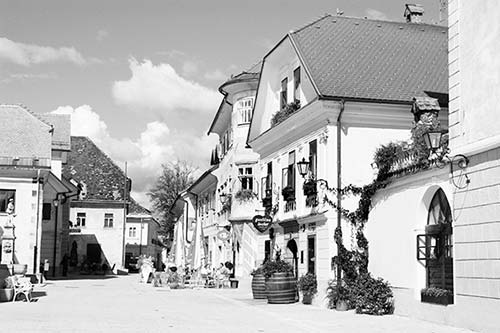
Tourist Information: The enthusiastic TI loves to help visitors appreciate the town (daily 9:00-19:00, shorter hours late Oct-early May, Linhartov Trg 1, +386 4 531 5112, www.radolca.si).
GETTING TO RADOVLJICA
Buses to Radovljica generally leave Bled at least every half-hour (fewer on weekends, buy ticket from driver, 15-minute trip). Once in Radovljica, to reach the town center and the bee museum from the bus station, leave the station going straight ahead, cross the bus parking lot and the next street, then turn left down the far street (following brown sign for Staro Mesto). In five minutes, you’ll reach the start of the pedestrianized Linhartov Trg (with the TI on the right and the start of my Old Town Stroll).
Drivers leave Bled on Ljubljanska Cesta and follow the directions under “Route Tips for Drivers” under “Lake Bled Connections,” earlier. The road dead-ends at Radovljica’s pedestrian zone, where you’ll find a parking lot (on the right; usually free for 3 hours, check signs carefully), the entrance to the Old Town, and the TI. There’s also a nice viewpoint at the end of the parking lot.
A handy bike path scenically and peacefully connects Bled with Radovljica (about 4 miles, get details at TI).
Sights in Radovljica
▲Old Town Stroll
Radovljica’s Old Town is easy and fun to explore. Begin on the big roundabout just before the entrance of town. Over your left shoulder, Radolška Čokolada makes their own chocolates (you can see their production facility inside the shop) and sells both bars and pralines with some interesting flavors (closed Mon, tastings and chocolate-making classes by arrangement, Gorenjska Cesta 4, +386 91 687 518).
Across the square, on the left as you enter the Old Town, Vinoteka Sodček is a wine bar and shop that offers a handy opportunity to purchase and learn about Slovenian wines. Their €20 tasting includes wines, cheese, and pršut (prosciutto)—call ahead to arrange (closed Sun, Linhartov Trg 8, +386 4 531 5071, Aleš).
Now head up the main street, passing the TI on your right. A bit beyond that, you’ll see Radovljica Manufaktura, which sells rustic pottery inspired by local designs (closed Sun; there’s another branch farther along on the left).
Soon after, the street opens up into Linhartov Trg, a charming square fronted by historic buildings. This end of the square has several tempting cafés and eateries (see “Eating in Radovljica,” later). If you just want to sip a coffee in the sun, Vidičeva Hiša café, on the left, serves great ice cream and cakes.
Farther along, on the right, you’ll see a monument with a student holding a big medallion image of Josipina Hočevar, a Radovljica native who later helped fund the town’s water system (see the old well nearby), as well as a school and many important buildings in Krško, near Zagreb. Next to that is the Šivičeva Hiša, an atmospheric late-Gothic house with a gallery that’s open to the public (closed Sun-Mon). If you go a block down any street to the right, you’ll come to a good valley viewpoint emphasizing Radovljica’s dramatic position on a long promontory (the best view is at the far end of the main square).
Dominating the main part of the square is the big, yellow town “castle” (actually a mansion); upstairs you’ll find the Apicultural Museum (described next), the Linhart Museum, and the Baroque Hall.
Beyond the mansion (and connected to it by a gallery) is St. Peter’s Church; to its right is its rectory, where you can dip into the pretty courtyard.
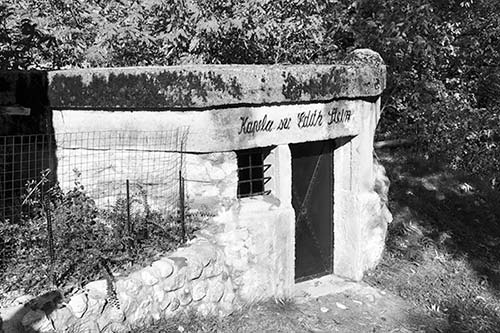
Circle all the way around the church, then go through the gate to the edge of the ravine. Burrowed into the hillside is a WWII-era bunker left behind by the Nazis. Peeking into the window of the bunker, you’ll see it’s been turned into a chapel dedicated to Edith Stein, a 20th-century Polish Jew who became a Carmelite nun but was arrested by the Nazis and executed at Auschwitz. She was later sainted by Pope John Paul II (notice the menorah and Star of David inside the chapel, on the right). Though she has no official ties to Radovljica, locals are inspired by Edith’s example.
▲▲Apicultural Museum (Čebelarski Muzej)
This museum celebrates Slovenia’s long and very proud beekeeping heritage. The earnest exhibits about the history and science of beekeeping are oddly fascinating. The highlight is the extensive collection of colorfully painted frontboard panels from beehives—one of Slovenia’s most cherished folk arts. Replicas of these panels are sold in souvenir shops nationwide, but these are the real deal. Everything is well described in English.
Cost and Hours: €8; Tue-Sun 10:00-18:00, closed Mon; upstairs at Linhartov Trg 1, handy free WCs downstairs, +386 4 532 0520, www.mro.si.
Visiting the Museum: The first room, Cultural Heritage, introduces the big players: the local Carniolan bee; beekeeper extraordinaire Anton Janša, who first developed the art and science of apiculture; and, of course, the boxlike, stacking wooden beehives (called kranjič) that are unique to this region. You’ll learn about the various members of the bee colony, and see a unique bear-shaped hive.
Next, Life of the Carniolan Bee explains the science, anatomy, and activities of our protagonist—including how members of the hive communicate with one another. There’s also an actual beehive, with bees that come and go through a hole in the nearby window (summer only).
Bees and People illustrates how Slovenian beekeepers have cleverly harnessed the skills of their buzzy minions. You’ll see different hives, from hollowed-out trunks to baskets to various other vessels more smartly engineered for the task at hand.
Across the room, survey the many tools used by beekeepers. When a new queen bee is born, the old queen takes half the hive’s bees to a new location. In the past, experienced beekeepers used the long, skinny instrument (a beehive stethoscope) to figure out when the swarm was working up a steady buzz, indicating they were ready to fly the coop. Then, once the bees had moved to a nearby tree, the beekeeper used the big spoons to retrieve the queen—surrounded by an angry ball of her subjects—from her new home before she could get settled in. (Notice the teensy little cage for the queen, which looks like it belongs in a dollhouse.) The beekeeper transferred the furious gang into a man-made hive designed for easier, more sanitary collection of honey. You’ll see scrapers and knives used to shape the honeycomb, as well as tools used to create smoke, which makes bees less aggressive. Even today, some of Slovenia’s old-fashioned beekeepers simply light up a cigarette and blow smoke on any bees that get ornery.
Since the days before Europeans had sugar, Slovenia has been a big honey producer. Slovenian farmer Anton Janša (1734-1773) is considered the father of modern beekeeping. Habsburg empress Maria Theresa brought him to Vienna to become Europe’s first official teacher of this art. And even today, beekeeping is considered a crucial part of Slovenian culture. The area around Lake Bled (Carniola) has about 6,000 inhabitants, including 65 beekeepers who manage 5,000 hives—the most bees per capita of any place in Europe.
Most Slovenian beekeepers maintain large buildings called apiaries, which hold banks of smaller hives (as opposed to beekeepers in North America, who tend to have a few separate large hives). This innovation—one of many by Janša—allows beekeepers to maximize efficiency. Hives always face southeast, to enjoy sun in the morning and shade in the afternoon. The front panel of each individual hive is painted in bright colors, often depicting creative folk scenes. This originally was designed to help both the bees and the beekeepers (who were often illiterate) distinguish the hives from one another. (While bees may not be able to tell a painting of a bear from one of a flower, they can distinguish enough patterns and colors to keep themselves from accidentally going to the wrong hive, where they’d be attacked as an outsider.)
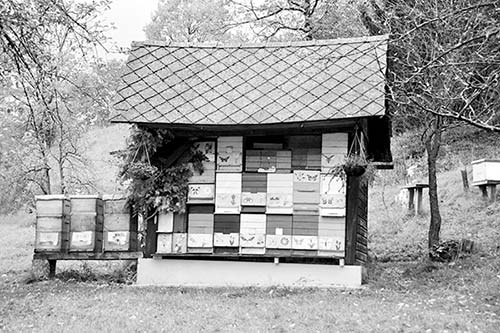
Replicas of those characteristic beehive panels are available at shops in Bled and Ljubljana and make for appealing souvenirs. Basic reproductions of the beehive panels cost around €12-15, while better-quality, hand-painted ones run €20-30 or more. When perusing your options, it helps to know the stories behind each one (see the Apicultural Museum listing for a rundown on some of the designs).
The other apian souvenir is honey. In 2013, Slovenian honey was designated as a unique product by the European Union—a certification that means only honey produced in a certain place and manner can carry that name. Taste can differ tremendously from hive to hive, and is determined by the specific flowers and blossoms a hive’s bees gather pollen from. Ideally, find a shop that will let you sample several. In general, honeys made from mixed flowers and linden blossoms (which tend to be cloudy from a natural crystallization process) have the sweetest, mildest flavor; those made from chestnut or pine trees can have a bitter aftertaste. The honeys that appear creamy are infused with flavors and are most often eaten on bread or pancakes; plain honey is more versatile.
Besides honey, beekeepers also make money by raising new queen bees. Each hive has one, and they can’t be bred—one of the larvae is simply fed special “royal jelly” that encourages her to become a leader. In the springtime, when bees are born, the beekeeper keeps a close eye on the hive to figure out whether there are any potential queens. If he finds one, he’ll move the old queen—who brings half the hive with her—to a new home (before she can find one on her own).
Slovenes still reserve an importance and affection for bees that’s rare in modern times. For example, the Slovene language has different words for “to give birth” and “to die”: one they use exclusively for humans and bees, and a different one for all other animals. If a beekeeper dies, it’s believed (with some pretty incontrovertible evidence) that the new beekeeper must formally “introduce” themselves to the hive by going there and explaining to the bees what has happened; otherwise, the bees become confused and agitated, and often die themselves.
To learn more about Slovenian beekeeping, visit the insightful Apicultural Museum in Radovljica. For an even more vivid, practical experience, call Blaž at Kralov Med, near Bled, for a demonstration (see “Sights at Lake Bled,” earlier). At either place, you’ll get a sense for just how proud Slovenes are of their bees.
You’ll also see a variety of presses used to squeeze every last drop of honey out of the comb. Look for the wooden rack, which was worn like a backpack (see the illustration): Dedicated beekeepers would trudge uphill with their hives to help the bees reach higher and higher blossoms as the summer wore on. The centerpiece of this room is a mockup of a beekeeper’s shed, where many of these items come together.
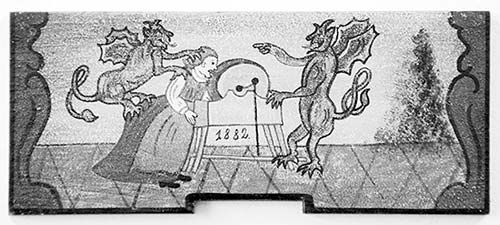
The fourth room features the museum’s highlight: whimsically painted beehive frontboards (called panjske končnice). Beekeepers, believing these paintings would help the bees find their way home, developed a tradition of decorating their hives with religious, historical, and satirical folk themes. It was also a creative way to mark their own hives. The oldest panel dates from 1758, but the practice really took off in the 19th century.
Take your time perusing these delightful illustrations, which are organized by theme. Many are biblical; others are historical, often featuring Habsburg aristocrats or awkward depictions of foreign lands (based on incomplete or faulty descriptions of the day).
But the most interesting panels capture Slovenian village life. The case marked “Craftsmen and Motifs for Everyday Life” reveals some old stereotypes: Tailors, thought to be slow and deliberate, are shown in one panel being chased by snails and in another by goats. And some stereotypes are with us still—look for the two farmers fighting over a cow, while a lawyer milks the cow. Among the “Hunting Motifs,” you’ll see a fox shaving a hunter, evoking an old Slovenian saying about “shaving the fool.” And the scene with the hunter’s funeral shows all the animals happy...except his dog.
Perhaps most memorable are panels in the case labeled “Men and Women,” which blur the line between humorous and misogynistic: Look for the devil sharpening a woman’s tongue on a wheel; the mill where old women are put in and young women are pulled out; or the man carrying a cross—and his wife—on his back. Equal-opportunity offenders, beekeepers also painted scenes of drunk men being yanked out of bars and away from card games by their wives. In another, a wife catches her husband with his mistress.
Also in this room, the life-size wooden statues were used to “guard” the beehives—and designed to look like fearsome Ottoman and Napoleonic soldiers. In one corner, behind glass, look for the frightfully realistic beehive shaped like a bear’s head.
Next up is the Room of Slovenian Beekeeping, which reverently traces the evolution of apiculture since the groundbreaking work of Anton Janša—you’ll see diagrams of his many inventions, and copies of some of his books.
The Path of the Carniolan Bee shows how this local insect—favored by beekeepers for its relatively mellow personality and fast growth in springtime—has been exported throughout the world, thanks to its adaptability to new climates. You’ll meet some of the bee merchants who helped spread the species.
Finally, Crafts and Beekeeping is a roundup of the many products—beyond just honey—that are derived from the hard work of bees, including pollen (considered by Slovenes and others to be the perfect all-purpose health aid), beeswax, honey bread, candles, and so on.
Nearby: Sharing a ticket desk with the bee museum, the skippable Linhart Museum celebrates one of Slovenia’s leading Enlightenment thinkers: Radovljica-born Anton Linhart, the 18th-century politician and historian who wrote some of the first plays in the Slovenian language, setting the stage for patriotic poet France Prešeren (€10 combo-ticket with Apicultural Museum, same hours).
Eating in Radovljica
Several Radovljica restaurants near the bee museum have view terraces overlooking the surrounding mountains and valleys.
$$$$ Hiša Linhart is the town’s big splurge and only destination restaurant—and worth booking ahead. Chef Uroš Štefelin, who grew up in the area, uses local ingredients and modern techniques to create delicious multicourse meals that highlight the very best of contemporary Slovenian cooking. The few tables out front are filled with locals drinking coffee and beer; the beautifully restored interior, classy yet comfortable, attracts foodies who’ve done their homework. While it’s quite pricey at dinner, they make a point of offering more affordable lunches—partly to also serve the local community (Tue-Sun 9:00-22:00, closed Mon, may close Sun, Linhartov Trg 17, +386 8 384 3470, www.hisalinhart.si). They also rent eight hotel rooms upstairs, run a cooking school, and host a farmers market on the first Saturday of each month on the square out front.
$$ Lectar offers hearty, very traditional Slovenian fare in a rural-feeling setting with a user-friendly menu. Their several heavily decorated rooms are often filled with tour groups, but in good weather, don’t miss the terrace out back (daily 12:00-22:00, family-friendly, Linhartov Trg 2, +386 4 537 4800). The restaurant is known for its heart-shaped gingerbread cookies (called lect), inscribed with messages of love. In the cellar, you can take a free look at their workshop and a collection of these cookies...some for sale, of course.
$$$ Gostilna Avguštin, across the street, has a simpler atmosphere and a more ambitious menu, which includes some pricey splurges. The food and service are uneven, but it works in a pinch, and their terrace in back enjoys an even better view than Lectar’s (daily 10:00-21:00, Linhartov Trg 15, +386 4 531 4163).
Kropa
Tucked in a narrow gully below the Jelovica Plateau, the modest metalworking village of Kropa has a big history as one of the earliest and most prolific industrial centers of Europe. The town symbol is the dragon...which really says it all. Kropa thrills engineers—for whom it merits ▲▲—but may leave others cold.
GETTING TO KROPA
Drivers can find the well-marked road to Kropa off the road that runs between Lesce and Radovljica; it’s about eight miles, or a 15-minute drive, from either town. Kropa is poorly connected by bus, other than sporadic weekday connections to Radovljica; skip it unless you have a car.
BACKGROUND
Beginning in the 15th century, the people of Kropa harnessed their substantial natural resources: iron ore from nearby mines; plenty of wood to keep the furnaces burning; and water from their rushing river, which they diverted into channels to power waterwheels. By the 16th century, Kropa was already known as one of the most important blacksmithing towns in Europe, and was granted a prized semiautonomous status by the Habsburg Empire. Blacksmiths here specialized in spikes and nails, producing 127 types—from small tacks for shoes to bigger nails for horseshoes to huge spikes used for major construction projects all over Europe. The romantic wooden pilings in the Venice lagoon are held together with Kropa spikes.
By the 18th century—still well before the dawn of the Industrial Age—Kropa was one of the most industrially developed places in Europe. Its 70 houses were packed with 1,400 men, women, and children, who all worked in the foundries. But by the late 18th century, local iron ore deposits were depleted, the industry collapsed, and some 800 local residents died of disease and other poverty-related causes. The 19th century saw another boost, as Kropa spikes were in demand to build the Vienna-Trieste railway. By modern times, the nail and spike industry had been replaced by decorative blacksmithing (especially at the big Uko factory across from the museum), which included items such as fancy gates and mailboxes. Today, Kropa’s 90 houses hold a more reasonable population of 200.
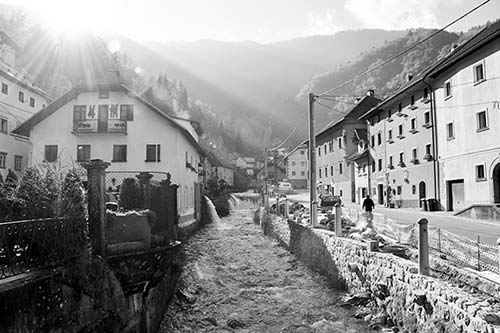
Sights in Kropa
▲Iron Forging Museum (Kovaški Muzej)
This modest but engaging exhibit traces the history of this metalworking burg. Filling two floors of a typical old Kropa house, the displays have little English explanation but capture the blacksmithing spirit of Kropa.
Cost and Hours: €4; July-Aug Tue-Sun 10:00-18:00, closed Mon; Sept-June Tue-Sat 10:00-16:00, closed Sun-Mon; Kropa 10, +386 4 533 7200, www.mro.si.
Visiting the Museum: When you buy your ticket, ask the attendant if she’s willing to show you around the museum—this really helps bring the (otherwise poorly explained) exhibits to life. If she’s busy, the following describes some things to look for on your own.
Go up to the first floor and enter the room with the big town model of Kropa as it was in the 19th century. Notice just how ingeniously the town channeled its water supply to use its raw power for its foundries. The next room shows big chunks of iron ore, and the buckets used to gather and carry it. (Many workers here farmed during the summer and were miners in the winter.) Although the big model of a blast furnace seems fairly sophisticated and modern, it was used in Kropa all the way back in the mid-15th century. A waterwheel pumped bellows onto a wood fire, superheating it to melt down the raw iron ore to create impure “pig iron.” The second, smaller chimney was a furnace that further refined the iron. Look at the blacksmiths’ tools and pass through the room with several huge bellows, then enter the room with ornamental iron gratings and other decorations. These date from Kropa’s later era of blacksmithing, between the two World Wars. Near the base of the stairs is a big music box with a piano, drums, and cymbals (ask the ticket seller to start it for you).
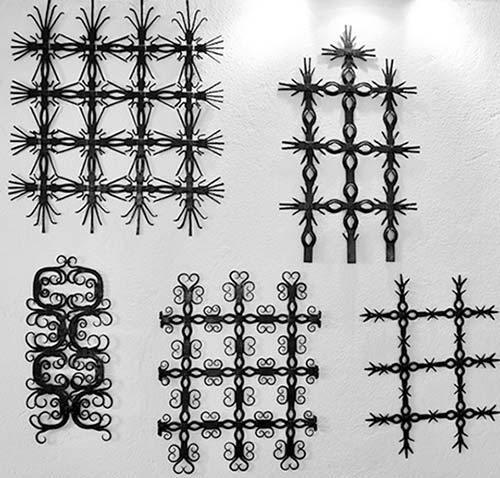
Climb the stairs to the top floor, where you’ll see a model of a typical family home, as well as mannequins of the family in period dress. The next room displays the vast range of nails and spikes that were produced here. A worker was expected to produce 2,000 of these spikes in one day.
▲Strolling the Town
Walk from the museum through this hardworking yet charming village. Notice the canals that have been split off from the main river to channel water to turn waterwheels. Across the street from the museum, just upriver from the Uko factory (near the benches interspersed with big Roadrunner-style anvils), you’ll see a gate for diverting river water, and—farther down—a replica waterwheel. Notice that the railings and lampposts along here are all handmade.
A couple of minutes’ walk uphill, the main bridge through town offers a good view up and down the thundering river—making it clear why this was an attractive place for early industry. The blocky, boldly communist-era monument next to the bridge honors the Partisans who died during World War II while evicting the Nazis from Yugoslavia. Although its aesthetic is off-putting Socialist Realism, its content—with locally made iron decorations—is unique to Kropa. Notice the Kropa resident handing over his hammer in exchange for a rifle. Locals have long enjoyed military exemption because their metalworking prowess was so valuable to the war effort. The communist Yugoslav government—always eager to celebrate industry’s role in advancing the cause of the proletariat—made Kropa Slovenia’s first town to be protected as a cultural monument, in 1953.
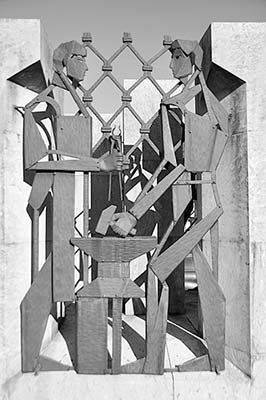
Higher up near the top of town is a traditional Spike Forge (Vigenjc Vice) with firewood stacked out front. This working facility—which still merges the power of wood, water, and a blacksmith’s arm to create spikes—is part of the Iron Forging Museum, but unfortunately, it’s rarely open to individual visitors (you can call the museum a few days ahead to book a private demonstration for €35). For most of its history, Kropa had 15 such forges.
NEAR KROPA: JAMNIK VIEWPOINT CHURCH
Drivers who continue up the road through the top end of Kropa can twist high into the mountains and (in about 10 minutes) reach a small roadside parking area for the church at Jamnik (technically called the Church of Sts. Primož and Felicijan). From here, it’s a scenic, slightly uphill walk along a narrow ridge toward a postcard-perfect church overlooking nearly 360 degrees of Slovenian splendor. While not worth a major detour, a quick walk here in sunny, clear weather is a treat for those who appreciate the alpine majesty of this little country.
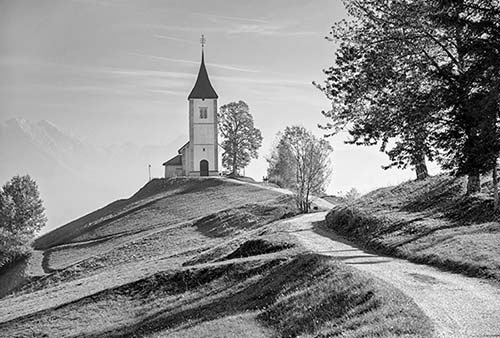
Scenic Mountain Route to Ljubljana: From Jamnik, you can follow a curvy, scenic, somewhat slower back route toward Ljubljana. First, twist over the ridge to the high-altitude town of Dražgoše, which has a somber air as the site of a tragic WWII battle between Nazi forces and local Partisans (the road passes a Yugoslav-era memorial). Farther down, reaching the valley floor below, you’ll pass through hardworking Železniki, whose name means roughly “Iron Town”—a reminder that Kropa is not the only metalworking burg in these hills, which are rich with ore deposits. From there, you can head through the medieval town of Škofja Loka (famous for its charming core and its Passion play) before continuing on to Ljubljana.
Lake Bohinj
The pristine alpine Lake Bohinj (BOH-heen), 16 miles southwest of Bled, enjoys a quieter scene and (in clear weather) even better vistas of Triglav and the surrounding mountains. This is a real back-to-nature experience, with just a smattering of hotels and campgrounds, rather than the well-oiled resort machine of Bled. Some people adore Bohinj; others are bored by it. While spectacular in clear, sunny weather, it’s disappointing in the clouds (and, because of its position deep in the mountains, it can be socked-in here even when it’s clear in Bled—locals claim Bohinj is the rainiest place in Slovenia). But if the weather is great and you’re finding Bled too touristy to allow you to really enjoy nature, go to Bohinj.
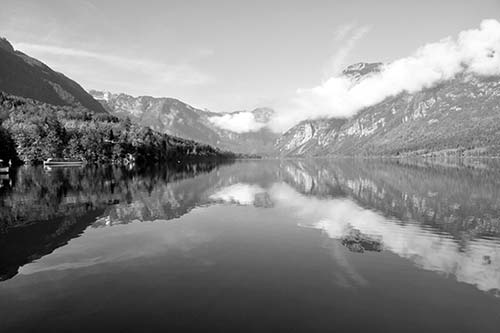
GETTING TO LAKE BOHINJ
From Bled, hourly buses depart at :20 past each hour for Bohinj, stopping at three destinations: Bohinj Jezero (the village of Ribčev Laz, 40 minutes); then Bohinj Pod Voglom (a 10-minute walk below the base of the Vogel Mountain cable car, 50 minutes); and finally a few hundred yards more to Bohinj Ukanc (the charming village area of Ukanc, with the under-construction Hotel Zlatorog and the start of a one-hour hike to the Savica Waterfall trailhead). In summer (July-Aug), one daily bus continues all the way to the Savica Waterfall trailhead. Off-season, there are fewer buses—confirm times before you depart.
By car, Bohinj is about 30 minutes from Bled (depending on traffic). Drivers leave Bled going south along the lakefront road, Cesta Svobode; in the village of Mlino, you’ll peel off from the lake and follow signs to Boh Bistrica. You’ll pass through a soteska (canyon) just wide enough for a river, a road, and a rail line; this railroad was built more than 120 years ago, by the Austro-Hungarian Empire, to connect their bustling port of Trieste (now in Italy, just over the Slovenian border) with Vienna. Once in the town of Bohinjska Bistrica, turn right, following Boh Jezero signs. The road takes you to the village of Ribčev Laz and along the lakefront road with all the attractions. From the lake, you can follow this road all the way to the Vogel cable-car parking lot; at the Vogel turnoff, you can continue straight ahead to reach the Savica Waterfall trailhead, or turn right and cross the bridge to curl around the far end of the lake and see the pristine river that feeds the lake (which flows out of the pool at the base of the Savica Waterfall).
Sights at Lake Bohinj
A visit to Bohinj has three main options: a village (offering boat trips on the lake and a picturesque church), a cable car (and nearby cemetery), and a waterfall hike. I’ve listed them as you’ll reach them along the main road from Bled, which runs along the south side of the lake. The lake’s website is helpful: www.bohinj.si.
Ribčev Laz Village
Coming from Bled, your first views of Bohinj will be from the village called Ribčev Laz (loosely translated as “Good Fishin’ Hole”) at the southeast corner of the lake. Here you’ll find a TI, a handful of hotels and ice-cream stands, and the Bohinj Jezero bus stop.
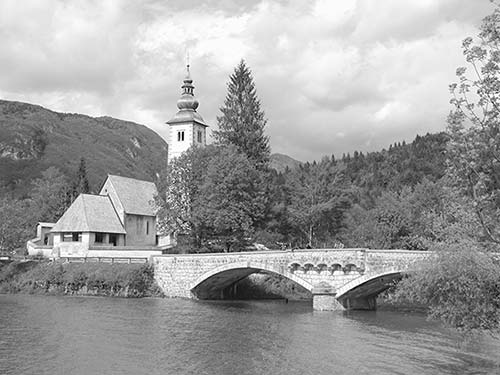
As you approach town, get oriented: The main road passes a big complex (on the left) with the TI, a Mercator supermarket, and a post office. Across the street, capping a little hill, look for the beloved statue of the four Bohinj-area mountaineers who first summited Mount Triglav on August 26, 1778.
Just beyond, where the road hits the lake, just to the right (over the stone bridge) is the village’s lakefront church, St. John the Baptist. The church is not open to visitors, but it’s still picturesque when viewed from the lakeshore—and views from the stone bridge, overlooking the lake, are grand.
But most traffic swings left at the lake and follows its south shore to reach Bohinj’s most popular activities. First, you’ll pass a dock where you can catch an electric tourist boat to make a silent circuit around the lake (one-hour round-trip-€12, 30-minute one-way trip to the far end of the lake-€9, 5/day April-Oct). The boat stop at the far end of the lake is a 10-minute walk from the Vogel cable car (described next). Across from the Ribčev Laz dock, under the trees, is a fun concrete 3-D model of Triglav.
Just past the boat dock, perched on a mini-mountain along the lakeshore, is a statue of Zlatorog, the Golden Horn—a mythical chamois-like creature native to the Julian Alps.
From there, the road follows the lakeshore to the next several sights (listed in order).
▲Vogel Mountain Cable Car
For a mountain perch without the sweat, take the cable car up to the top of Vogel Mountain (5,036 feet), offering impressive panoramic views of Mount Triglav and the Julian Alps. On a clear day, this is the best mountain panorama you can get without wings (the light is best in the morning).
Cost and Hours: €28 round-trip, daily 8:00-18:00, runs every 30 minutes in summer and continuously in winter, closed Nov, www.vogel.si.
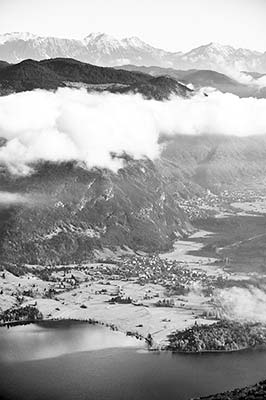
Getting There: To reach the cable-car station, drivers follow brown signs to Vogel (to the left off the main lakefront road); by bus, get off at the Bohinj Pod Voglom stop (request this stop from driver) and hike about 10 minutes up the steep road on the left (away from the lake).
Visiting the Summit: After you arrive at the top, savor the views from the metal platform where you exit the cable car...just don’t look down. Walking up through the cable-car station (past the Viharnik snack bar, with basic food and far-from-basic views), you’ll pop out at the summit, a ski-in-winter, hike-in-summer area with a pasture filled with grazing cows and smaller chairlifts to various recreation areas.
The first chairlift is designed for skiers and doesn’t run in summer, but if you hike down into the little valley, you can take the second chairlift up the adjacent summit (Orlove Glave) for views into another valley on the other side. Then, from Orlove Glave, you can hike or ride the chairlift back to where you started. With plenty of time and very strong knees, you could even hike from Orlove Glave all the way back down to Lake Bohinj.
If you need a break near the cable-car station, the alpine hut Merjasec (Wild Boar) offers tasty strudel and a wide variety of local brandies (including the notorious “Boar’s Blood”—a concoction of several flavors guaranteed to get you snorting).
World War I Cemetery
Back down below the cable car, on the main road just beyond the Bohinj Pod Voglom bus stop, look for the metal gate on the left (marked 1915-1917) that leads to the final resting place for some WWI Soča Front soldiers (see sidebar on here). No fighting occurred here (it was mostly on the other side of these mountains); injured soldiers were brought to a nearby hospital, and those who didn’t recover ended up here. Notice that many of the names are not Slovenian but Hungarian, Polish, Czech, and so on—a reminder that the entire multiethnic Austro-Hungarian Empire was involved in the fighting. (The phrase Österreich-Ungarn, “Austria-Hungary,” is marked on many graves.) The little chapel that oversees the tidy cemetery is often adorned with fresh wreathes and flowers from foreign embassies (flanked by a perimeter of spent shell casings). If you’re walking down from the cable-car station, the cemetery makes for a poignant detour on your way to the main road (look for it through the trees).
Savica Waterfall (Slap Savica)
Up the valley beyond the end of the lake is Bohinj’s final treat, a waterfall called Slap Savica (sah-VEET-sah). Hardy hikers enjoy following the moderate-to-strenuous uphill trail (including 553 stairs) to see the cascade, which dumps into a remarkably pure pool of aquamarine snowmelt.
Cost and Hours: €4 in summer, €3 in shoulder season; open daily from 8:00 until dusk, closed off-season; allow up to 1.5 hours for the round-trip hike.
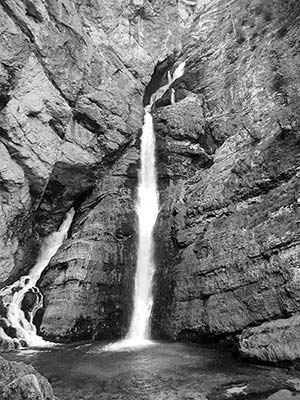
Getting There: Drivers follow the lakefront road to where it ends, right at the trailhead (€4 parking). Without a car, getting to the trailhead is a hassle. Boats on the lake, as well as most public buses from Bled, take you only as far as the Bohinj Ukanc stop—still a one-hour hike from the trailhead. However, in summer (July-Aug), one bus a day goes from Bled all the way to the Savica trailhead (likely departing Bled at 10:00, returning at 12:20). Otherwise, you can change to a local bus in the Bohinj area to reach the falls. Frankly, if the connections don’t fit your itinerary, it’s not worth the fuss.