LOGARSKA DOLINA & THE NORTHERN VALLEYS
Orientation to Logarska Dolina
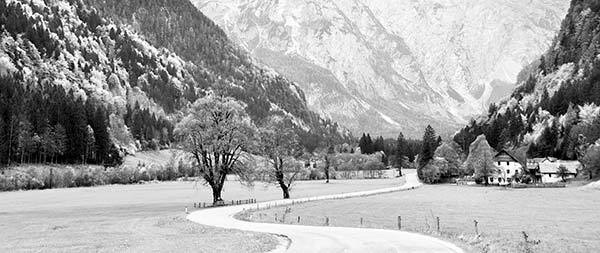
The Julian Alps around Lake Bled are Slovenia’s most accessible and most famous pincushion of peaks. But the high-mountain thrills don’t end there. Stretching to the east, along the border with Austria, is the Kamniško-Savinjske range—home to several remote valleys. One particularly inviting nook between the cut-glass peaks is the time-passed valley called Logarska Dolina. To get way, way, way off the beaten track—with gravel roads, unpasteurized milk, and the few Slovenes who still don’t speak English—head to Logarska Dolina, its surrounding valleys, and the breathtaking Panoramic Road above them all.
Logarska Dolina—very loosely translated as “Woodsman’s Valley”—thrills adventurous drivers, true back-to-nature nuts, and those intrigued by old-fashioned farming lifestyles...or, better yet, travelers who are all of the above. Most of all, Logarska Dolina is the ideal excuse for a long drive on high-mountain roads to one of Slovenia’s most traditional corners.
Traveling here, you come to appreciate the vibrant culture and history that pervades even this remote and rugged corner of a tiny country. Some 25,000 years ago, hardy Ice Age people already lived in Logarska Dolina. Archaeologists have uncovered remarkable remains from these prehistoric times—mostly tools made from bone, among them a flute and the oldest needle ever discovered. Today’s residents focus on sheep, and locally made products—from cheese to thick felt hats, vests, and slippers—are a proud Logarska Dolina symbol. Other treasured aspects of the local culture include woodcarving, marble carving, rollicking zither sing-alongs, and huge ceramic stoves that work hard to keep mountain folk warm through the frigid winter.
With some effort and a bit of extra time, you can enjoy two other interesting sights in this part of Slovenia. Between Ljubljana and Logarska Dolina is the rugged, above-it-all herders’ settlement of Velika Planina—which feels even more trapped-in-time than Logarska Dolina. And to the east, Velenje Castle has a fine little museum.
If you want to dig deep into the Slovenian mountains—like the glaciers that carved Logarska Dolina during the last Ice Age—these northern mountains are the place. Slovenes like to keep this getaway a secret; it’s one of their favorite escapes from the daily grind (and, along with Lake Bled, one of the country’s most popular places to get married). Travelers who find Lake Bled too touristy prefer Lake Bohinj (see here). But travelers who think Bohinj is too touristy love Logarska Dolina.
PLANNING YOUR TIME
A trip to Logarska Dolina can be done as a long, full-day circular drive from either Bled or Ljubljana. But to really escape to the mountains, spend the night. If you’re heading between Ljubljana/Bled and Ptuj/Maribor on the A-1 expressway, Logarska Dolina is roughly on the way (though it’s still an hour off the expressway). Velika Planina combines conveniently with Logarska Dolina, but makes for a very long day.
GETTING TO LOGARSKA DOLINA
I’d skip this region without a car: Public transportation to and between the northern valleys is time-consuming. Determined travelers can take the train to Celje, then connect by bus to Logarska Dolina (one bus each morning, 2 hours); four other daily buses go only as far as Solčava, from where you’ll have to connect by taxi (about a 10-minute trip). Even so, once you’re in Logarska Dolina, many of the region’s best attractions (such as the Panoramic Road) are unreachable without a car.
On the other hand, Logarska Dolina is made to order by car. The valley is nearly due north from Ljubljana, but because of the mountains that lie between them, you’ll need to boomerang substantially to the east to get there. From Ljubljana, take the A-1 expressway east (toward Celje) to the Šentrupert exit. From here, most of the route is well marked with brown Log Dolina signs. Head north on road 225 along the Savinja River, past Mozirje and Nazarje, then continue northwest on road 428 through Ljubno, Luče, and Solčava. (For details on getting around the valleys once you’re in Solčava, see “Route Tips for Drivers,” later.) Figure about an hour from Ljubljana to the Šentrupert exit, then another hour to Solčava.
Online maps are decent, but for those doing any hiking or exploring, a detailed print map is essential (such as the 1:50,000 Zgornja Savinjska Dolina map, available locally).
The route I just described is the most straightforward. Detailed maps will show some seeming “shortcuts” that appear to take you more directly between Ljubljana and Logarska Dolina. These are scenic...but slow. Two variations are the road through Kamnik, then over the mountains via Gornji Grad to pick up the main road into Solčava (near Ljubno); and the even more dramatic version of this route, cutting the corner from Krivčevo north through Podvolovljek to Luče, which lets you tie in a detour to Velika Planina. Another seeming shortcut via Kranj—dipping into Austria on the impossibly twisty Jezersko-Pavličevo Sedlo road, through Villach—is also possible, and also time-consuming.
Orientation to Logarska Dolina
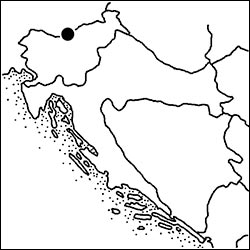
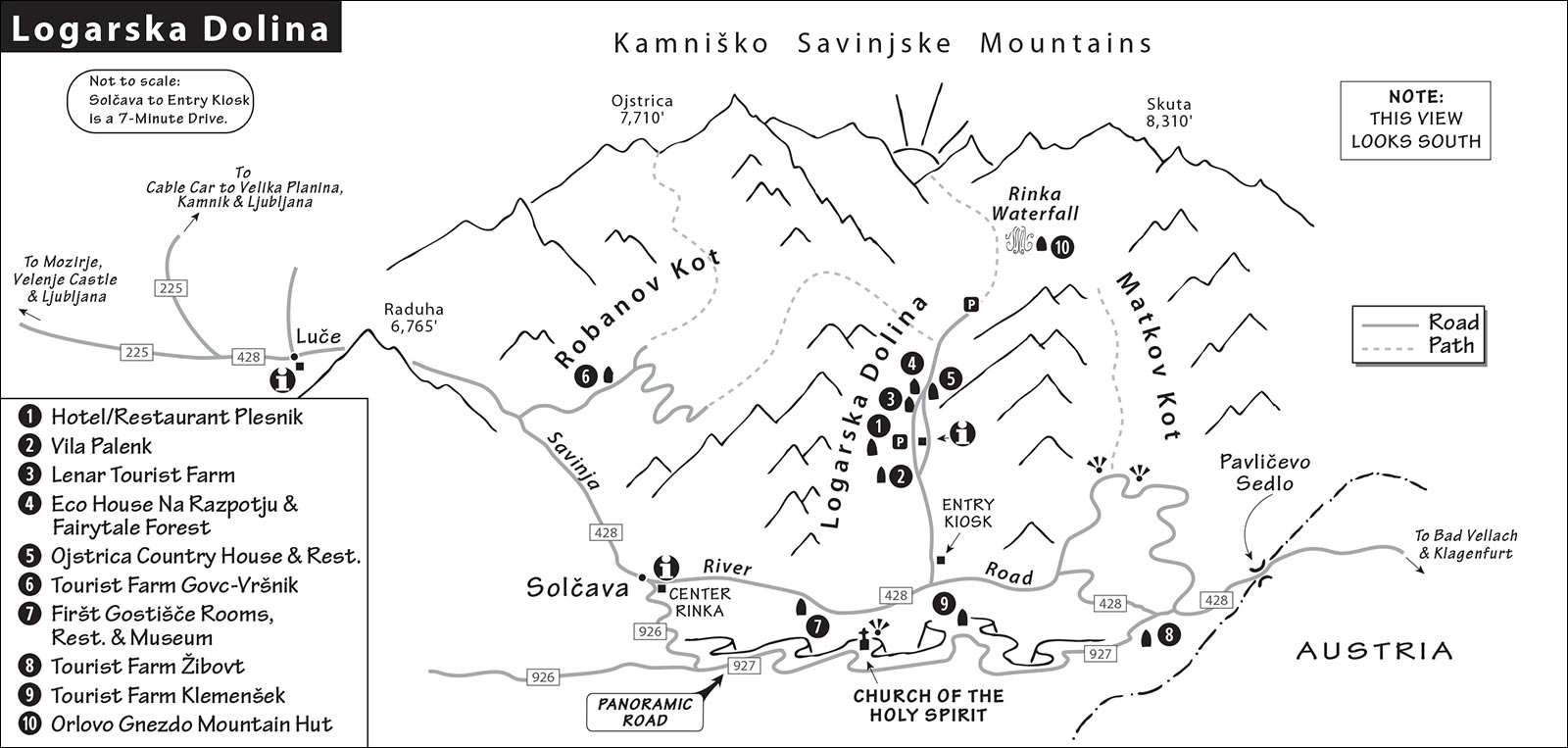
This area—also called Solčavsko—is tucked in the northern corner of Slovenia, just a few miles from Austria. Although geographically large (about 40 square miles), it has only 580 inhabitants. This chapter’s core sights branch off from an east-west axis formed by the valley of the Savinja River. The main attraction here is the valley called Logarska Dolina, which cuts through the mountainscape south from the Savinja River Valley. Roughly parallel to Logarska Dolina are two smaller valleys: gentle Robanov Kot to the east and rugged Matkov Kot to the west. (Dolina means “valley;” kot—literally “corner”—is a short valley.) Running along the top of the Podolševa ridge above the Savinja River is the rough, gravelly Panoramic Road (Panoramska Cesta), with spectacular views over the entire region.
TOURIST INFORMATION
The region’s best source of information is in Solčava, at the Center Rinka, which hands out maps and brochures, has a good exhibit about the region, can help you find a room or plan a hike, and can arrange activities such as guided hikes, bike rental, rock climbing, archery, and paragliding (daily mid-June-mid-Sept 9:00-12:00 & 13:00-17:00; spring and fall Mon-Fri 9:00-15:00, closed Sat-Sun; shorter hours off-season; Solčava 29, +386 3 839 0710, www.logarska-solcavsko.si). For more on the Center Rinka, see “Sights in Logarska Dolina,” later.
Within Logarska Dolina, there’s a modest TI kiosk across the parking lot from Hotel Plesnik (hours in summer vary with demand, likely closed in bad weather and in other seasons, take left fork to hotel after you enter Logarska Dolina to Logarska Dolina 9, +386 3 838 9004, www.logarska-dolina.si). If it’s closed, the nearby Hotel Plesnik also provides basic tourist information. There’s also a TI along the main road in Luče (+386 3 839 3555).
It’s fascinating to observe the ingenious ways that intrepid locals eke out a living in such an inhospitable land. In Logarska Dolina, farmers don’t just cultivate the valleys—they also use the land at the very tops of the hills. Especially from the Panoramic Road, you can see that the highest points of various ridges are shaved bare—like bald heads in a crowd. Cows graze even on this sharply angled land. Locals joke that these farms are so steep that cows’ front legs are shorter than their rear legs to make it easier for them to climb uphill—and dogs have to hang on to the grass with their teeth and bark through their rear ends.
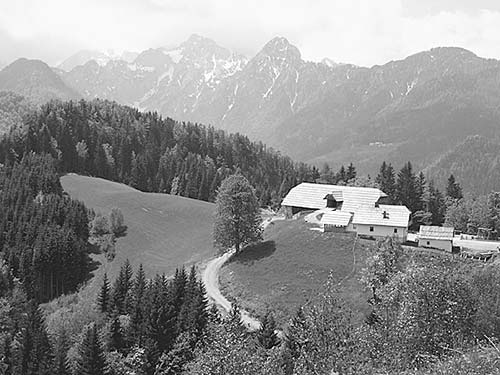
This region’s abundant traditional homes have wooden roofs and siding. These shingles are generally made of hard, durable larch wood, split by hand. In the fall, you’ll see endless stacks of neatly arranged firewood, ready to warm the family through the winter. Each house has a tiled stove for heat.
It’s a rough lifestyle. A farming family’s primary source of income is livestock—mostly cows (milk and meat), but also pigs and goats. Some of the farms in the Savinja River Valley raise yaks imported from Scotland, which are bred for their meat. A second source of income is forestry: The trees on a farm’s property can be harvested and sold. Finally, farmers make a living from travelers, in the form of overnights or meals eaten at their farms.
The many tourist farms (turistična kmetija) in this region are a recent phenomenon. During the Yugoslav era, people who lived here stopped farming and moved or commuted into nearby towns in the valley for factory work. But Slovenia’s industry was designed to work as a cog in the Yugoslav machine: Other regions provided raw materials as well as a large, ready-made market to buy the finished product. After the Slovenes declared independence, many of the factories closed, and the farmers-turned-workers returned to their ancestral farming ways. To supplement their income, many families have converted their working farms into tourist farms, inviting guests to visit, stay, and dine with them, and to appreciate their unique lifestyles. Even though many of the farms in Logarska Dolina seem generations old, some date from only the mid-1990s.
Sights in Logarska Dolina
The road running along the Savinja River and the Panoramic Road running above it are connected at both ends—forming a handy loop that allows drivers to see everything efficiently. I suggest driving the Panoramic Road first, to get a good overview of the region, then winding down along the Savinja River to dig into the valleys. (If you have bad morning weather that may clear in the afternoon, do the opposite.)
Route Tips for Drivers: The village of Solčava is the gateway to the region and has the handy and interesting Center Rinka. From Solčava, you can twist up to the Panoramic Road (follow signs to Podolševa). At the far (west) end of this sky-high road, you’ll come to a fork: Going left drops you directly down into Logarska Dolina. But for a longer detour (and more scenery), going right takes you toward the Austrian border at Pavličevo Sedlo, and a very rugged, gravelly loop around the top, then bottom, of Matkov Kot (easy to miss—follow signs for tourist farms).
After visiting Logarska Dolina, take the Savinja River road back to Solčava. If you have time, you can detour into the valley of Robanov Kot when you head south from Solčava.
▲▲▲Panoramic Road (Panoramska Cesta)
The Logarska Dolina valley (described later) is beautiful. But the region’s spectacular highlight is the Panoramic Road, twisting along the top of the cliff above it. At an altitude of around 4,000 feet (compared with about 2,500 feet in Logarska Dolina), this road offers one thrilling drive. For a sneak preview, see www.solcavska-panoramska-cesta.si.
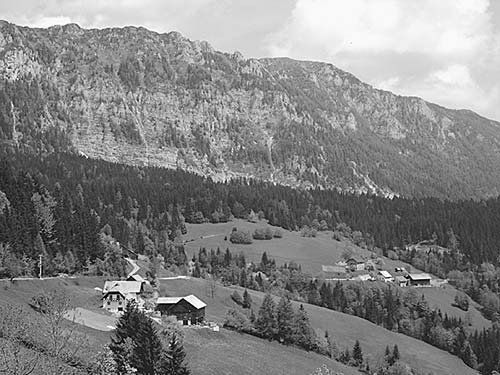
As you rattle along the rough road, all around you are vast swaths of mountain forests, broken only by hilltops covered with patches of green grass. Each of these hills is its own farm that raises grass to feed livestock (see sidebar). You’re just an avalanche’s tumble from the Austrian border. Several stretches of the Panoramic Road are what Slovenes poetically call “white roads”—that is, unpaved gravel.
About halfway along the Panoramic Road, the late-19th-century Church of the Holy Spirit (Sveti Duh) hovers on a hilltop above the hamlet of Podolševa. Climb up to the church for sweeping views over Logarska Dolina. If the church is open, duck inside and find a very unusual relief of three men representing the Holy Trinity. God is in the center, Jesus is on the left, and on the right is the Holy Spirit, depicted not as a dove but as a balding man.
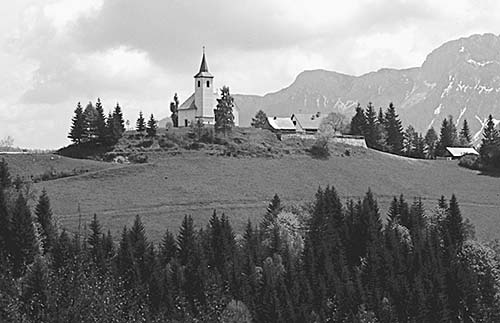
Watch for pullouts offering stunning views all along the Panoramic Road; the best stretch is between the Klemenšek and Žibovt tourist farms. Pack along a picnic, or consider stopping off at a tourist farm for a meal (Tourist Farm Klemenšek owns some of the best views in the region—listed under “Eating in Logarska Dolina,” later). Some farms serve kislo mleko, or “soured milk”...which is exactly what it sounds like. Fresh, unpasteurized milk is set out in the open air, usually in a darkened room. The fat rises to the top and forms a skin on top. The bottom of the milk is like yogurt, white and relatively flavorless. But the yellowish top layer comes with a kick: a pungent barnyard aftertaste. I tried it—once—and enjoyed it...the experience, if not the flavor.
▲▲Logarska Dolina
This valley, 4.5 miles long and about a quarter-mile wide, is the region’s main draw. A flat, broad meadow surrounded on all sides by sheer alpine cliffs, it’s an idyllic place for a drive, hike, or bike ride. Various sights—caves, waterfalls, old log cabins, and so on—surround the valley, but it’s most appealing simply as a place to commune with gorgeous Slovenian nature.
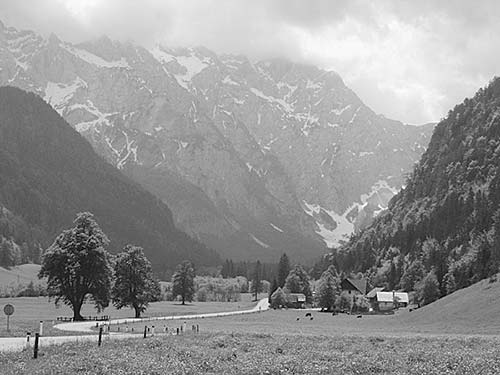
Though you can enter the valley year-round, you’ll pay a €7 entry fee per car from April through October (at other times, or if there’s bad weather and the entry kiosk is closed, it’s free). After the valley entrance, the road forks. Take the left fork to reach the TI kiosk (see “Tourist Information,” earlier) and hotels; or take the right fork to bypass them (the two forks eventually rejoin).
At the far end of the valley, you’ll find a parking lot with some snack stands. From here, you can follow the Slap Rinka—10 min signs up the moderately strenuous path to the Rinka Waterfall. This is where mountain runoff tumbles into the valley, feeding the Savinja River, which courses through the valley and region. Relax at the little mountain hut called Orlovo Gnezdo (“Eagle’s Nest”) and enjoy a drink with a view of the falls, which plunge 300 feet down from the adjacent cliffs.
With more time, Logarska Dolina is an inviting, mostly level place to go for a longer hike, surrounded by cow-filled meadows and towering peaks. The “Nature-Ethnographic Trail” is a two-hour, four-mile (one-way) hike that starts near the entrance of the valley and leads to the end of the valley; get details at local TIs.
▲Center Rinka
This sleek building sits along the main road in the village of Solčava, just 50 yards from the twisty route up to the Panoramic Road. Named for the big waterfall that feeds the Savinja River (which carved out this region’s beauty), it’s a state-of-the-art visitors center that celebrates the local landscape and culture, with an emphasis on sustainability. A small but endearing exhibition provides a good foundation for exploring the region. The center also offers a café/bar selling locally made products (meats, cheeses, and cookies), a shop with local handicrafts, and a children’s play area. A visit here is smart both in good weather (to plan your high-mountain fun) and in bad weather (to learn about the region without getting wet).
Cost and Hours: Free; mid-June-mid-Sept daily 9:00-12:00 & 13:00-17:00; spring and fall Mon-Fri 9:00-15:00, closed Sat-Sun; shorter hours off-season; Solčava 29, +386 3 839 0710, www.logarska-solcavsko.si.
Nearby: The village of Solčava is a pleasant place, hemmed in tight by alpine cliffs and capped by the picturesque Church of Christ the King.
Robanov Kot and Matkov Kot
These smaller, sleepier valleys, dotted with traditional farm buildings, flank Logarska Dolina. They offer the same surrounded-by-mountains feeling, but they’re less cultivated and less crowded than Logarska during the peak season. With extra time, poke into one or both of these minivalleys simply to enjoy the peaceful views.
Robanov Kot, near Solčava, is more gentle and accessible, with better and more level roads. This valley is well marked with a brown sign just south of Solčava; it’s home to the recommended Tourist Farm Govc-Vršnik.
The Matkov Kot road is more rugged, with cliff-hanging gravel portions that can feel like little more than tractor ruts. But the valley scenery is breathtaking (sometimes literally)—and arguably rivals the Panoramic Road. Adventurous drivers who enjoy mountain vistas will find it worth the grinding gears. It’s easy to miss this poorly marked valley—look for signs to the tourist farms (the recommended Tourist Farm Perk is on this road) and for Matkov Škaf.
Other Sights
If you have ample time here, you can consider some other offbeat attractions that are more charming than thrilling.
The Firšt Gostišče—which has a restaurant and rents rooms on the road between Solčava and Logarska Dolina—has a cave on their property called Fidova Zijalka, the residence of a 19th-century hermit and medicine man named Fida. Much higher on the hill is another cave called Potočka Zijalka, where prehistoric findings have helped advance our modern understanding of life during the last Ice Age. Honoring this heritage, the Firšt family operates their own modest, two-room museum of prehistoric cave findings and folk medicine (small entrance fee, closed Mon). They also have an “ethnographic park”: Pay a few euros and pick up the essential English guidebooklet at the main building, then hike up into the hills behind for a one-hour loop that takes you to the cave, with commentary en route about local flora, fauna, and farming lifestyles.
If you’re traveling with kids, consider paying a visit to the Fairytale Forest, next to and run by the recommended Eco House Na Razpotju in the middle of Logarska Dolina. Speckled through a gentle wood are 35 woodcarvings illustrating local fairy tales, plus natural and cultural heritage—all explained in English (small entrance fee, listed under “Sleeping in Logarska Dolina,” next).
Sleeping in Logarska Dolina
All of my listings are in Logarska Dolina or within about a 15-minute drive. Many accommodations in this region have their own restaurants, and it’s common (and typically a good value) to take “half-board” at your accommodation—dinner for a fixed additional price. There are no restaurants in this area that are worth going out of your way for, so eating where you sleep makes sense.
IN LOGARSKA DOLINA
These options sit in the valley of Logarska Dolina. They’re listed in the order you’ll reach them as you drive down the valley.
Hotel Plesnik and Vila Palenk, both part of the only big hotel outfit in the area, sit proudly in the middle of Logarska Dolina. $$$$ Hotel Plesnik, with lively public spaces and 30 modern rooms with traditional farmhouse furnishings, is a big, classy, overpriced splurge (elevator). The nearby, smaller $$$ Vila Palenk has 11 additional, slightly cheaper rooms (family room, no elevator, breakfast at the main hotel). Reservations for both are handled through the same office (dinner available at hotel restaurant, indoor swimming pool, Logarska Dolina 10, +386 3 839 2300, www.plesnik.si, info@plesnik.si). After entering Logarska Dolina, you’ll come to a fork; bear left to reach the hotel.
$$ Lenar Tourist Farm rents six rooms and three apartments with cozy farmhouse decor in two adjacent homes. This place has nice views over a small orchard and the grand valley of Logarska Dolina (apartment for up to 6 people, breakfast extra, Logarska Dolina 11, +386 41 851 829, www.lenar.si, tk.lenar@siol.net).
$$ Eco House Na Razpotju (“At the Crossroads”), with 10 rooms (all with balconies), prides itself on sustainability and on offering a relaxing getaway for busy urbanites seeking an escape to nature (a quarter-mile from Hotel Plesnik toward the far end of the valley, Logarska Dolina 14, +386 31 249 441, www.logarska-narazpotju.si, info@logarska-narazpotju.si, Andreja and Primož).
$$ Ojstrica Country House has nine simple rooms and a restaurant halfway along Logarska Dolina (dinner available, Logarska Dolina 13a, +386 3 838 9051, mobile +386 41 664 455, www.logarska-ojstrica.si, info@logarska-ojstrica.si).
NEAR LOGARSKA DOLINA
In Robanov Kot: $$ Tourist Farm Govc-Vršnik (pronounced “goats vurshnick”)—in this smaller, relaxing valley (a scenic 15-minute drive from Logarska Dolina)—is my favorite option in the region, and the most modern and accessible of my tourist farm listings. English-speaking Marjana and the Vršnik family run this farm with a soft-spoken, warmhearted hospitality. They have cows, a traditional beehive, pigs, a garden, a covered view terrace, and 10 cozy rooms with bright, woody decor (dinner available, cash only, Robanov Kot 34, +386 3 839 5016, www.govc-vrsnik.com, govc.vrsnik@siol.net). As you enter the valley of Robanov Kot (just south of Solčava), watch for signs (it’s the second tourist farm on the left).
Between Solčava and Logarska Dolina: $ Firšt Gostišče, situated along the picturesque riverside road just outside Logarska Dolina, feels like a rural rest stop, with a popular restaurant, six straightforward rooms, and a small museum about local prehistoric finds (dinner available, Logarska Dolina 1a, +386 3 839 4678, www.first-logarska.si, info@first-logarska.si).
On the Panoramic Road: $ Tourist Farm Žibovt is dramatically situated at the far end of the Panoramic Road, within sight of the Austrian border. It perches on a ledge with beautiful views of a tranquil meadow that ends at a sheer cliff plunging to the bottom of Logarska Dolina. In addition to renting six basic but cheery rooms, the Poličnik family serves meals and turns out a wide range of dairy products—including the unforgettable kislo mleko (“soured milk”). They also make traditional wooden games and have beehives that produce homemade honey; a small marble quarry is nearby (cash only, closed mid-Oct-mid-April, Logarska Dolina 24, +386 3 584 7118, www.nad1000m.si/zibovt, kmetija.zibovt@gmail.com, Žarko and Martina Poličnik). The farm is well marked at the far end of the Panoramic Road (near the Austrian border crossing at Pavličevo Sedlo).
Eating in Logarska Dolina
Many of the region’s tourist farms serve full meals to passersby in summer and light meals and snacks at other times. The food here is traditional and heavy, and no place is worth a long drive for a meal. Base your decision on convenience.
Picnics: The best option is to bring a picnic with you and eat whenever you find the scenic perch you like best. If you wait to buy your picnic until you reach the valley, you’re too late. Instead, shop at one of the small grocery stores along the main road in Luče or Solčava. Also in Solčava, the Center Rinka’s café/bar sells locally produced meats and cheeses to supplement your picnic. Spectacularly located picnic benches punctuate the Panoramic Road, including ones a few hundred yards on either side of the recommended Tourist Farm Klemenšek.
In Logarska Dolina: Several of my recommended accommodations also have food, including $$$ Hotel Plesnik (big restaurant with pricey food, daily) and $$ Ojstrica Country House (woody, convivial space with a bar frequented by locals, daily, reservations recommended). On the road between Logarska Dolina and Solčava, $$$ Firšt Gostišče serves up small bites and pricier main courses (closed Mon).
On the Panoramic Road: $$ Tourist Farm Klemenšek, set on a grassy ridge with spectacular views, has the classic Logarska Dolina setting, home cooking, and indoor and outdoor tables (daily in summer, weekends only in spring and fall, closed mid-Oct-April, halfway between Sveti Duh and the end of the Panoramic Road, +386 3 838 9024, www.nad1000m.si/klemensek).
Velika Planina
This extremely remote and rustic herdsmen’s settlement sits on a mile-high island, surrounded by 360 degrees of cut glass. Accessible only by a cable-car ride, chairlift, and short hike—or by driving on a very rough road and taking a longer hike—Velika Planina is an alpine wonderland, offering an insightful look at farming lifestyles. While it takes some effort to reach, it’s worth the trip in perfect summer weather for those lingering in the mountains. Velika Planina is also very loosely on the way between Ljubljana (or Lake Bled) and Logarska Dolina (the cable car is a five-mile detour from the Kamnik-Luče road, described earlier under “Getting to Logarska Dolina”).
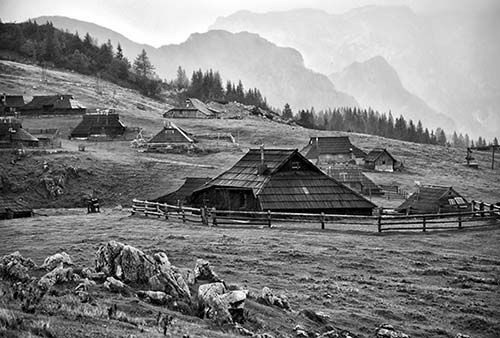
Orientation: A large meadow with houses (the literal meaning of its name), Velika Planina feels like you’re at the end of the world—and yet, on a clear day you can see Ljubljana on the horizon. The focal point for tourists is Pastirsko Naselje (Pastors’ Settlement), also known as Veliki Stan (Big Town) and Tiha Dolina (Silent Valley). This is where about 35 farmers—who live most of the year in a dozen different villages scattered throughout the valley below—bring their 400 cows for high-altitude grazing each summer (early June-mid-Sept). At other times, it’s scenic but very desolate—I’d skip it if the cows aren’t up, or if the weather is bad. For more information, and to confirm cable-car timetables, see www.velikaplanina.si.
Getting There: North of Ljubljana is the city of Kamnik, and north of that is the village of Kaminška Bistrica, where a cable car heads up into the mountains (€21 round-trip, runs about hourly in summer—more frequently with demand, +386 31 680 862; buses connect Kamnik to the cable car 3/day in summer, 15 minutes). From the top of the cable car (4,655 feet), you have various ways to get to the Pastirsko Naselje village. One option is a long 40-minute hike. But most visitors prefer to continue on to a chairlift (included in cable-car ticket, coordinated to meet arriving cable cars). From the chairlift’s first station (Zeleni rob), it’s a level 20-minute hike to the village, and from the second/top station (Gradišče, 5,472 feet), it’s a downhill 20-minute hike.
It’s also possible to drive most of the way to Velika Planina, but it requires negotiating a confusing maze of steep and unpaved roads; and because locals don’t want cars anywhere near the village (which would ruin the rustic ambience), you’ll have to park a long hike away. If you’d like to try, from the Kamnik-Luče road, near Podvoljovek, watch for the turnoff to Tiha Dolina. Once on this maze of roads, carefully track signs to Veliki Stan until you see the do not enter sign—from here, you’ll have to hike in.
Visiting Velika Planina: Here in the “big meadow,” farmers reside in unique traditional houses: tiny residential quarters in the center, surrounded by stables for the animals (which helps heat the living area), all covered by a unique oval roof. The homes are made of larch wood, which helps provide natural weatherproofing. One of the huts, the Preskar Hut, hosts a small museum of 19th-century farming lifestyles; others, including the Pri Gradišekovih (near the top of town), may be open to sell cheese and other food. Perched on a ridge just above the settlement, just enjoying the view, is the rustic, wooden Chapel of St. Mary of Snows (which was destroyed during WWII and rebuilt in 1988). A priest still comes up each Sunday throughout the summer to say Mass for this tiny community.
Velika Planina has its own very distinctive and proud culture. The farmers’ traditional costume is a cloak made of overlapping corn stalks (which resembles a giant hula skirt) and a floppy hat—both of which provide protection from the elements. While here, they produce a unique, pear-shaped cheese called trnič, which tastes like a very young Swiss cheese—mild and semicrumbly. It’s often served with a buckwheat mush called žganci and eaten with a wooden spoon that’s another one of this area’s local traditions. The soured milk (kislo mleko) from Logarska Dolina is also produced here.
Herdsmen gather and socialize in a common hut called “The Parliament.” They are keeping up with modern times: They only wear the traditional costume as a photo op for tourists, and many of the huts have been modernized (solar panels are the only source of electricity). But old-timers are concerned that the next generation isn’t eager about carrying on the tradition. High-maintenance cows require 24/7 attention, and most young people have other jobs. Visit now, while this last vestige of traditional herding still survives.
Velenje Castle
This scenic, 700-year-old, hill-capping castle seems out of place over the modern industrial town of Velenje (which was once named “Titovo Velenje” for the Yugoslav dictator, Tito). Even more unusual is the eclectic, extensive, and endearing museum it houses. While it’s not worth going far out of your way to see, a trip to the castle makes a good rainy-day activity or an interesting diversion if you’ve got extra time at the end of your Logarska Dolina day.
Cost and Hours: €4, Tue-Sun 10:00-18:00, closed Mon, Ljubljanska Cesta 54, +386 3 898 2630, www.muzej-velenje.si.
Getting There: Velenje Castle is easy to visit en route to or from Logarska Dolina, especially if you’re headed east on the expressway. From the road connecting Logarska Dolina to the expressway, you can detour east just south of Mozirje (via Gorenje) into Velenje, where you’ll look for easy-to-miss brown signs to turn off for the castle. From Velenje, you can head south straight to the expressway.
Visiting the Castle: You’ll find a surprising diversity of exhibits surrounding the tranquil castle courtyard: replicas of a circa-1930s general store and pub; a Czech professor’s three-room collection of African art and everyday items; a survey of regional history through the Middle Ages, including a replica of a countryside home; a city history overview (the town was founded only after World War II, so much of its story dates from Tito’s Yugoslav era); an exhibit on the WWII experience in the local area; various Slovenian paintings and sculptures; a movie about the city’s postwar development; and temporary exhibits. Separate buildings house a collection of Baroque church art and an exhibit on mastodons (the remains of two of these extinct tusked mammals were found near here in 1964).