SARAJEVO
▲▲THE SIEGE OF SARAJEVO: “SNIPER ALLEY”
Map: Sarajevo Hotels & Restaurants
DINING HIGH ABOVE SARAJEVO, WITH PANORAMIC VIEWS
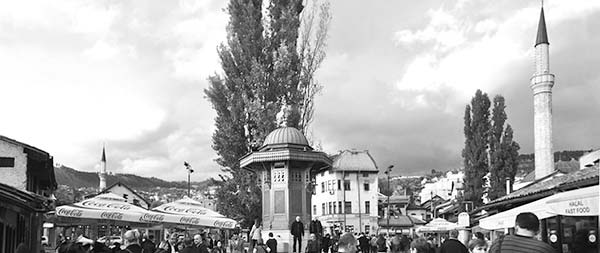
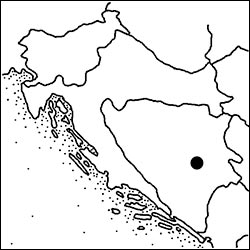
Spectacularly set in a mountain valley, blanketed with cute Monopoly houses and prickly with minarets, Sarajevo (sah-rah-YEH-voh) is a sight to behold. It’s a cruel irony that for a few short years, Sarajevo became synonymous with sectarian strife. For nearly its entire history, this beautiful city was a model of the opposite: Muslims, Catholics, Orthodox Christians, and Jews living together in cooperation and harmony. (One of its many nicknames is “Little Jerusalem.”) Squeezed into its narrow valley, Sarajevo never even had the option of splitting itself up into ethnic ghettos, so people lived side by side. To this day, there are several places in the city where you can see a mosque, synagogue, Catholic church, and Orthodox church with a turn of the head.
Sarajevo is the delightful product of a rich history. The Ottoman-style Old Town, the Baščaršija, feels transplanted here from Istanbul. Then you’ll turn a corner and suddenly feel lost in an almost Viennese cityscape. Strolling its streets is the next best thing to a time machine.
Though torn by war in the early 1990s, today Sarajevo is a comfortable and safe place to visit. Listen to the Muslim call to prayer and hear Catholic and Orthodox church bells playfully jostle above the skyline. Step into historic houses of worship from each of this region’s four major faiths, and notice the similarities. Visit the street corner where World War I began, climb up into the hills to the Olympic stadium that commanded the world’s attention in 1984, or take the cable car even higher for sweeping views over one of Europe’s most stunningly set capitals. Make friends with a gregarious Sarajevan—it’s easy to do—and ask him the best way to prepare and drink Bosnian coffee. Ponder the scars of war, hunch over to squeeze through the tunnel that was the besieged Sarajevans’ one lifeline to the world, and listen to a local relate personal stories from the harrowing time of the siege. Play a game of giant chess with the jeering old-timers in an urban park. Shop your way through the copper-laden canyons of the Turkish-style bazaar, bartering down the price of a hand-hammered Bosnian coffee set. Relax in a hidden caravanserai, take a slow drag on a šiša (water pipe spewing sweet plumes of fruity smoke), and sample some honey-dripping pastry treats. For dinner—or just a snack—nibble on some of the best burek (savory, flaky pies) and ćevapi (grilled sausages) this side of the Bosphorus. Go ahead—it’s OK to enjoy Sarajevo...and there’s a lot to enjoy.
PLANNING YOUR TIME
Sarajevo demands a minimum of a day. Side-tripping here from Mostar lets you scratch the surface, but you won’t regret having one, two, or even three nights here. With whatever time you have, begin in the characteristic Ottoman quarter, the Baščaršija.
I’ve described two self-guided walks. If you only have time for one, take the first one, which provides a good orientation to Sarajevo and takes you all the way through town, with opportunities to stop at virtually all the important sights (except the Sarajevo War Tunnel Museum, which requires a long but worthwhile detour). The second walk focuses on the urban, downtown zone called “Sniper Alley,” with some harrowing tales of the Siege of Sarajevo and a pair of museums.
Note that Sarajevo is a two-hour trip by car or train beyond Mostar, making it a logistical dead-end that’s not really on the way to other destinations in this book. To maximize your time, consider flying in or out of here (for example, Croatia Airlines has reasonably priced flights to Zagreb). But be aware that in winter, heavy morning fog sometimes grounds flights.
Orientation to Sarajevo
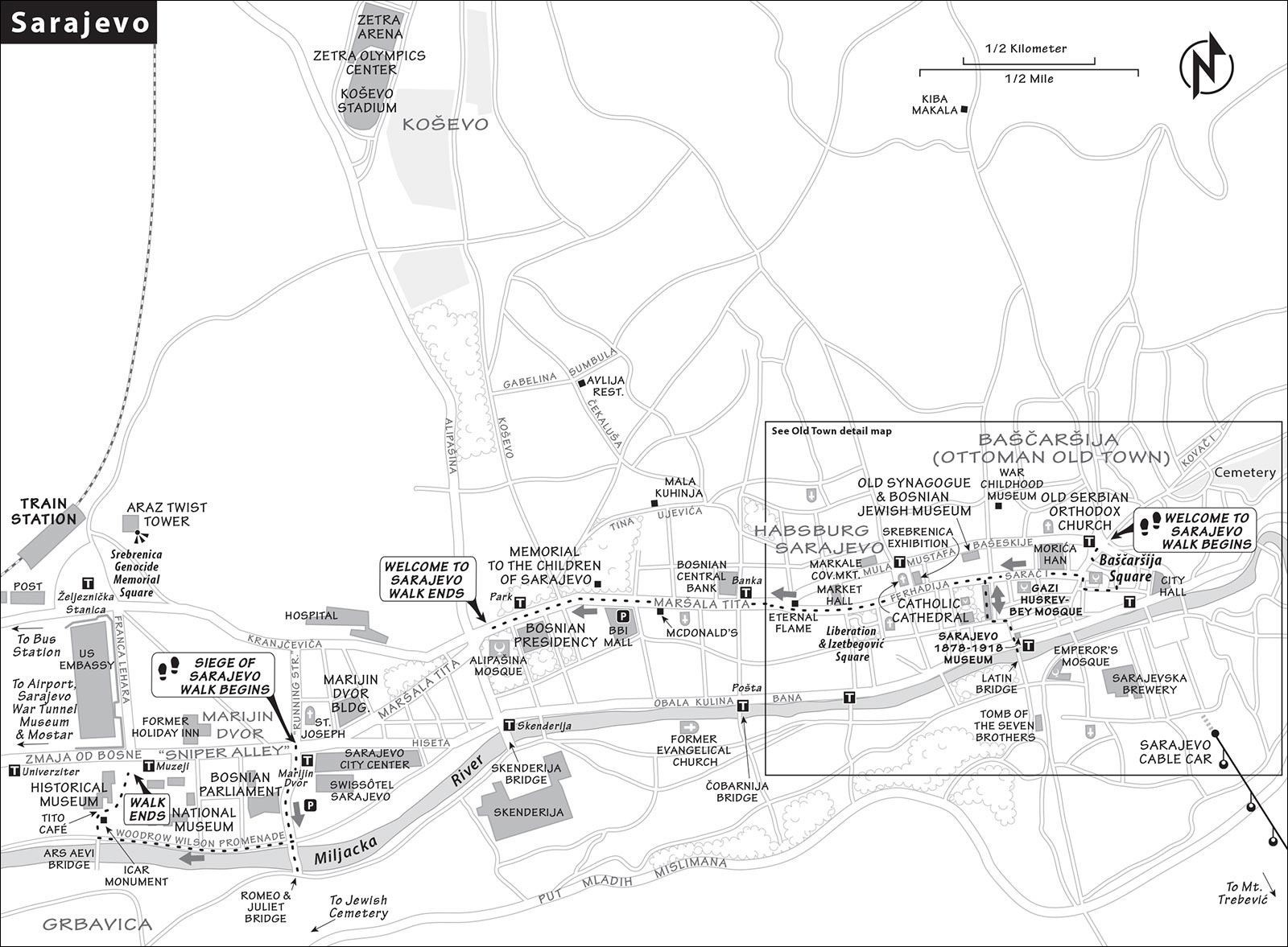
With approximately 310,000 people (660,000 in the greater Sarajevo area)—filling a city that held up to 525,000 at its prewar peak—Sarajevo is barely contained by its valley. It’s surrounded by steep mountains on all sides, with communist-concrete sprawl and cute houses scampering up the valley walls (more recently joined by wartime cemeteries occupying what once were forested parks). It’s a long, skinny city, lining up along its humble Miljacka River and main thoroughfare. You can trace the city’s historical and architectural development from east to west, starting with the historic Old Town core, called the Baščaršija. West of that is the Austrian-feeling part of town (along Ferhadija street), and beyond that, the modern, concrete skyscraper zone called Marijin Dvor. From here, the city’s busy main drag rumbles west (it’s called Zmaja od Bosne close to downtown, and Bulevar Meše Selimovića farther out; in wartime it was known as “Sniper Alley”).
Terminology: The terminology for the various parties involved in the Yugoslav Wars is particularly sensitive—and can vary depending on whom you’re talking to. During the siege, the citizens of Sarajevo were majority Muslim/Bosniak but also included Croats, Serbs, Jews, and others; many think of themselves not as a specific ethnicity but as “Sarajevans” or “Bosnians.” Meanwhile, the army surrounding the city was made up almost entirely of Serbs, but not all Serbs supported them—so to call them simply “Serbs” is incomplete. Sarajevans (conscientious not to disrespect the many Serbs who were among those besieged) prefer to call the aggressors “the Bosnian Serb Army,” “Army of Republika Srpska” (abbreviated VRS), “Karadžić’s forces,” or “Četniks.” But the term “Četnik” is a loaded one: It was first used to describe the fierce Serb fighting force that ethnically cleansed parts of Yugoslavia during World War II. The troops who surrounded the city evoked this earlier image and called themselves “Četniks,” and many Sarajevans have followed suit. However, in other contexts, calling a Serb who was not involved in the siege a “Četnik” is a serious insult.
TOURIST INFORMATION
Sarajevo’s only TI, as of this writing, is a small kiosk in front of the airport (daily 8:30-17:00, +387 33 252 000, www.visitsarajevo.ba). However, they hope to open a branch in the city center soon. In the meantime, the Insider Tours office generously answers tourist questions (see listing under “Tours in Sarajevo,” later).
ARRIVAL IN SARAJEVO
By Bus or Train: Sarajevo’s bus and train stations sit next to each other on one very long, urban block up from the Marijin Dvor area (former “Sniper Alley,” US Embassy, Holiday Inn, and museums). They’re about 2.5 miles west of the Baščaršija (Old Town, with my recommended hotels).
The train station looks out over a desolate-feeling plaza; simply walk out front, buy a tram ticket from the kiosk or the driver, and ride tram #1 to the Baščaršija. Alternatively, you can pay 6-10 KM for a taxi (plus a legitimate per-bag fee of 5 KM). Use only an official taxi (license plate starting with “TA”) and make sure the driver uses the meter.
The bus station (Autobusna Stanica Sarajevo) has a small ticket lobby, a left-luggage desk (garderoba), and a smattering of kiosks and cafés. Exit the building straight ahead, keeping the busy street on your right. Walk about 100 yards, then hook left around the big post office (near a row of cafés). You’ll wind up at the big plaza in front of the train station, with the stop for tram #1. Taxis often queue in front of the bus station.
By Car: If you’re driving into Sarajevo from Mostar, see “Route Tips for Drivers” at the end of this chapter.
By Plane: Sarajevo’s small, sleepy airport sits on the southwestern edge of town (code: SJJ, +387 33 289 100, www.sarajevo-airport.ba). A bus runs about every two hours, roughly coordinated with flight arrivals and departures, between the airport and the city center; check the airport website for specifics (5 KM). If the airport bus times are inconvenient, you could take city transit: Walk straight out the front door of the airport and continue on foot about 10 minutes directly ahead to the Dobrinja neighborhood, where you can catch bus #103 to the Latin Bridge in the Old Town, or bus #31E to near the old City Hall, also in the Old Town (both run about 3-4/hour, buy ticket from kiosk or driver). For a taxi, the fair metered rate to downtown is around 20 KM, but most taxi drivers demand 30 KM; ask for an estimate up front, avoid cabbies who suggest a highball figure—then ask your cabbie to use the meter. If you’ll be at the airport, it’s convenient to visit the nearby War Tunnel Museum (pay no more than 10 KM for the taxi ride there from the airport).
GETTING AROUND SARAJEVO
Almost everything that’s worth seeing in town (with the notable exception of the War Tunnel Museum) is within long walking distance of everything else. But you may need to make use of the city’s public transportation network, which includes trams, buses, and trolley buses. A single ticket costs 1.80 KM (buy on board or slightly cheaper at kiosk, good for one ride only—if you transfer, you must buy a new ticket; when boarding, validate your ticket by stamping it in the green box). A day ticket for 5.30 KM is good for one calendar day (sold only at the kiosk behind the Catholic cathedral). The handy tram #3 does a big loop from one end of town to the other, starting in the Old Town (several stops, including at the Latin Bridge/Latinska Ćuprija, at the City Hall/Vijećnica, at the Baščaršija stop near the main square on Kovači street, and behind the cathedral), then along the main drag (the former “Sniper Alley”) to the west end of town (Ilidža stop, a short taxi ride to the Sarajevo War Tunnel Museum), and back again (7.5 miles and 40 minutes one-way). Tram #1 is also useful, connecting the train and bus stations with “Sniper Alley” and the Old Town.
Sarajevo is an excellent taxi town, with cheap fares and generally honest cabbies. Figure 2.50 KM for the drop, then 1.50 KM per kilometer. Some companies levy a hefty 5 KM surcharge per piece of luggage. Short rides within town are typically a steal at 5-10 KM—making a taxi more appealing, for most rides, than public transit. To ensure you’re getting an official, regulated taxi, confirm that the license plate starts with the letters “TA,” and be sure the driver turns on the meter.
HELPFUL HINTS
Laundry: The centrally located LaundroLounge is just off Pigeon Square, tucked into a courtyard at Bašeskije 63; as they may be under new management, it’s smart to call first (full service only, Mon-Sat 9:00-18:00, closed Sun, shorter hours in winter, +387 61 632 344).
Local Guidebook: Look for the informative, pocket-sized book called The Siege of Sarajevo 1992-1996 (by Amir Telibećirović; see “Local Guides,” next). Designed to help visitors better understand this city’s complex and tragic wartime story, it’s concisely written, filled with powerful black-and-white photographs, and sold at bookstores around town.
Useful App: The city and local historians have teamed up to create a good app with tours for dozens of sights, offline maps, and GPS functionality to help you navigate the city. Download it for free at www.guide2sarajevo.com.
Addresses: The letters bb in an address mean “no number.”
Tours in Sarajevo
▲▲▲Local Guides
With such a powerful and challenging-to-grasp recent history, and with the ready availability of extremely good and affordable local guides, it’s almost obligatory to hire a guide for your Sarajevo time. For the price of joining an organized walking tour in many European cities, you can hire your very own Sarajevan for the day, who will likely be willing to speak frankly about their experiences during the siege. Amir Telibećirović is a journalist, siege veteran, and historian who explains Sarajevo’s sights and history—from ancient to recent—with brilliant clarity. Amir can add greatly to your Sarajevo experience (€15/person for a tour of any length, or €25 for just one person, +387 61 304 966, teleamir@gmail.com). If Amir is busy, there are other good guides. Orhan Hadžagić—also a journalist—will grudgingly take you on a typical sightseeing tour. But he’d rather hop in a taxi with you to a local neighborhood in the hills, to offer you a slice of Sarajevo life with stories about history and everyday customs (€90/3 hours for groups up to 4, +387 62 333 623, hadzagic@gmail.com). Jadranka Šuster is also worth considering for her professional, by-the-book approach (€70/2 hours, €20/extra hour, more for 4 or more people; also offers special activities such as cooking classes, food-and-drink tours, coppersmithing, and wood-burning crafts; day trips to nearby places available for about €120; +387 61 828 400, sarajevotour@gmail.com).
Insider Tours
This company runs various itineraries around the city, departing from their office near the Latin Bridge (at Zelenih Beretki 30, open Mon-Fri 8:00-18:00—or 9:00-17:00 in winter, Sat-Sun 9:00-15:00). Options include their introductory free tour (tips expected, 1.5 hours, daily at 11:30); a longer version, typically with smaller groups, called the Sarajevo Grand Tour (€12, 3 hours, daily at 10:30); Eat, Pray, Love, an experiential tour that includes some food tasting and visits to Sarajevo’s main houses of worship (€30, 4 hours, most days at 10:00); a Gastro Tour, with more of the Eat and less of the Pray and Love (€13, also at 10:00); Times of Misfortune, detailing the siege (€30, includes entrance to War Tunnel Museum, 3 hours, daily at 11:00); a more specific tour of the War Tunnel Museum (€19, includes museum admission, 2 hours, daily at 14:00); Sarajevo Assassination, focusing on Franz Ferdinand and Princip sites (€19, 3 hours); Islam You Did Not Know, designed to demystify Bosnian Muslim culture (€19, 2 hours); a side trip to Tito’s bunker in the town of Konjic (€49, half-day); and other tours available on request (such as their Jewish tour, €25, 4 hours). They also offer excursions to other parts of Bosnia, including the Srebrenica massacre site, a river-rafting trip, Olympics sights, Mostar and nearby towns, and a combo-tour of the scenic and historic towns of Jajce and Travnik (most of these are about €75). It’s important to call ahead, confirm the schedule, and book at least a day ahead (even earlier for the out-of-town trips; +387 33 534 353, mobile +387 61 190 591, www.sarajevoinsider.com).
Adventure Excursions
Sarajevo’s setting lends itself to adventure travel—hiking, mountain biking, river rafting, skiing, and so on. Green Visions can take you on an eco-friendly excursion into the spectacular Bosnian countryside (+387 61 213 278, www.greenvisions.ba).
Walks in Sarajevo
I outline here two different self-guided walks that, when taken together, provide a useful spine for visiting virtually all the sights mentioned under “Sights in Sarajevo,” later (except the War Tunnel Museum, which is farther out). The first walk covers the historic core of town, including most of the museums. The second (which begins an easy five-minute walk from where the first leaves off) focuses on the Siege of Sarajevo.
▲▲▲WELCOME TO SARAJEVO
This walk begins where most tourist visits do, in the Ottoman-influenced Old Town—the Baščaršija—then strolls through history as it traverses the Habsburg quarter.
I’ve split the walk into three parts. If you’re in a hurry and want to focus on the Old Town, just do Parts 1 (Ottoman zone) and 2 (Habsburg quarter); Part 3 takes you deeper into the workaday urban core, including some sights relating to the siege, and is designed to help you connect to the “Sniper Alley” area. Doing the entire walk without entering any of the sights could take as little as two hours—but with sightseeing stops, it can fill an entire day.
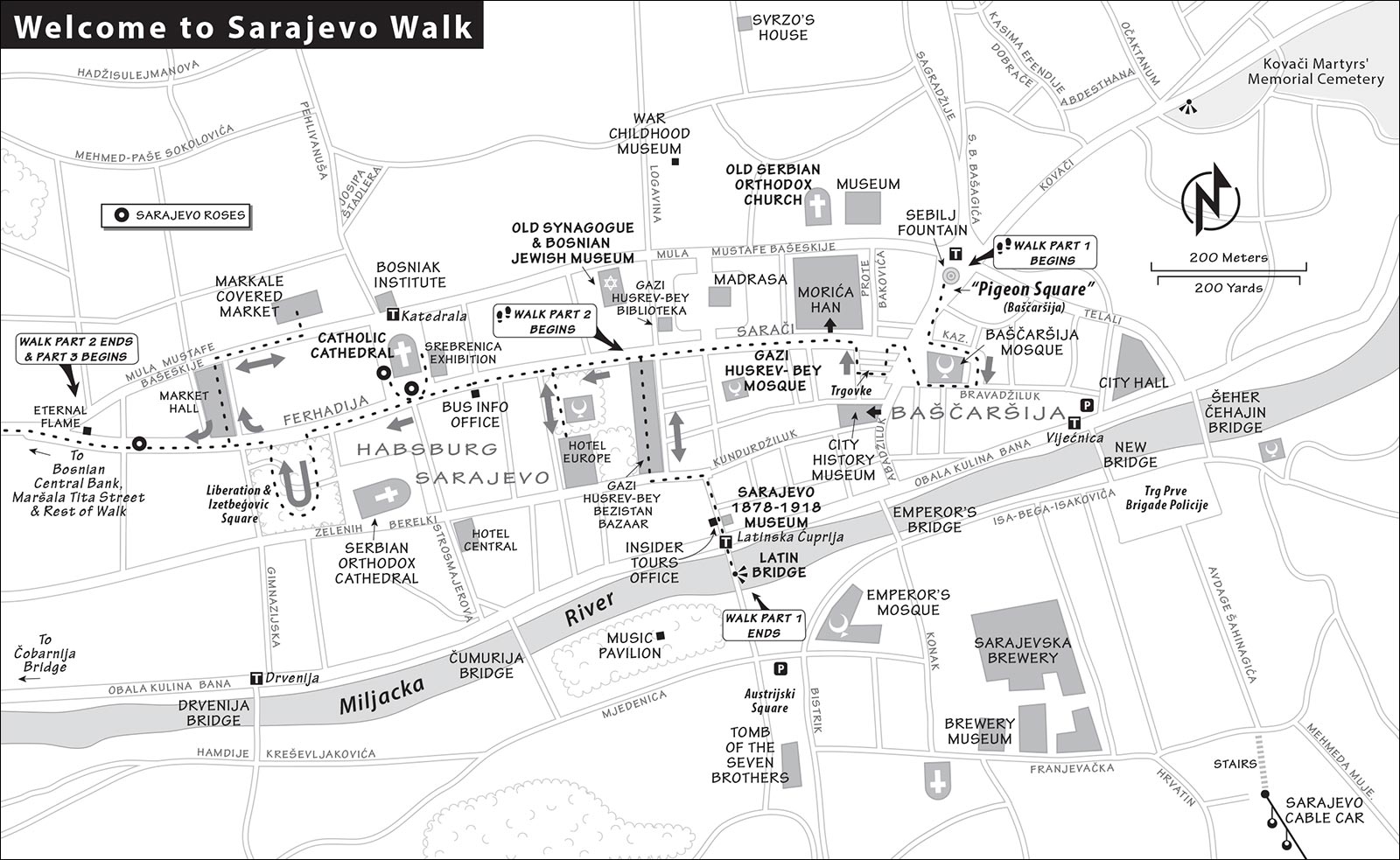
• Begin at the main square of the Old Town (Baščaršija), with the wooden fountain at the top.
Part 1: Ottoman Old Town (Baščaršija)
Pigeon Square: Though it’s nicknamed for its many winged residents, this square is officially called Baščaršija. Literally translated as “Main Marketplace,” this unmistakably Ottoman-flavored square has given its name to the entire Old Town. Sit for a while and watch kids (and kids-at-heart) play with the namesake pigeons.
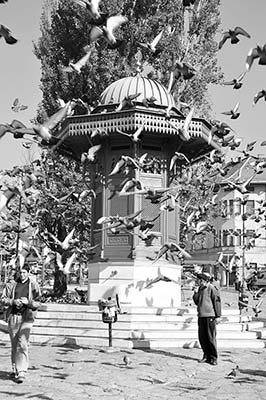
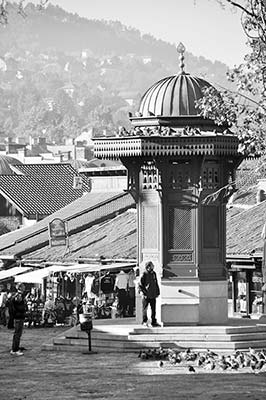
The centerpiece fountain (notice the small faucet at the base), called Sebilj, is an icon of Sarajevo. According to local legend, visitors who drink water from this fountain will return to Sarajevo someday. The original was built in 1753, but this restored version dates from the 19th century. Although it’s the centerpiece of the “Turkish” Old Town, the fountain is more Persian in style. The Ottoman Empire (of which Sarajevo was a part) enjoyed influences from throughout both the Islamic and the European cultures: art, literature, and poetry from Persia (today’s Iran); religious influence (that is, Sunni Islam) from the Arabic world; diplomacy from the Germanic world; and herbal pharmacology and music from the Jewish world.
Turn with your back to the fountain and walk down the long, narrow square. Look for the tight little lane on the left, just before the mosque. This is the wonderfully authentic Coppersmiths’ Street (Kazandžiluk), where craftspeople still carry out their work, hammering beautiful works of art out of copper—you can hear their little hammers tapping from their workshops. It’s just the place to buy a copper Bosnian coffee set that you’ll never use. This might be the most touristy street in Sarajevo, so the prices aren’t a bargain, but it’s a fun stroll.
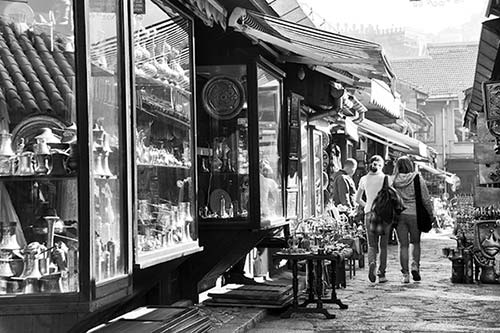
Walk all the way down Coppersmiths’ Street—jogging right with the street—until you pop out around the corner, on Locksmiths’ Street (Bravadžiluk). Locals call this lane “Ćevapi Street” for its many ćevabdžinica (shops selling the tasty minced-meat, grilled sausages called ćevapčići). You’ll also see several buregdžinica (shops selling the savory phyllo-dough pastry called burek; my favorite, the recommended Buregdžinica Sač, is just down a side lane off this street).
Look left, to the yellow-and-brown-striped building at the end of the block. This is one of the city’s main landmarks, the City Hall (Vijećnica)—the best example of Austrian Historicist-style architecture from the 40 years of Habsburg rule. It looks Islamic, but it was designed by a Czech architect who went to Morocco to find inspiration—so it has no connection at all to local culture. Later it became the City Library and was also the local Nazi headquarters during World War II. But this landmark building—along with all its books—was destroyed by shells in 1992; in 2014, it reopened after a years-long restoration. Visitors are welcome to take in its gorgeous interior (described later). This building is also the place where, on June 28, 1914, the Habsburg heir, Archduke Franz Ferdinand, began a fateful drive through town. (We’ll see where that trip ended later on this walk.)
Now turn right and walk a half-block down Locksmiths’ Street, popping out at the bottom of the square where we started this walk. On your right is the Baščaršija Mosque, the first of many we’ll see throughout town—this one is closed to the public. Kitty-corner from the mosque, notice the copper domes on the roof of the covered market hall (Brusa Bezistan). Dating from 1551, this market hall now holds the City History Museum, with a great model of late-19th-century Sarajevo and other good exhibits (worth visiting for an introduction to the city, and described later under “Sights in Sarajevo”).
• Across from the mosque’s gate, walk down the main street through town.
Sarači Street: Lined with shops, more ćevapi joints, and tempting desserts, this busy pedestrian street is a handy artery for sightseeing. Like so many streets in the Baščaršija, this is named for a type of craftsman who worked here—in this case, leathermakers. After a short block, look to your right for the lane called Prote Bakovića, crammed with characteristic (if touristy) eateries. Bakovića also leads to the Old Serbian Orthodox Church, well worth a visit (described later). None of the four Serbian Orthodox churches in Sarajevo was vandalized during the siege, though they were all damaged by shrapnel launched at nearby targets by the Bosnian Serb Army.
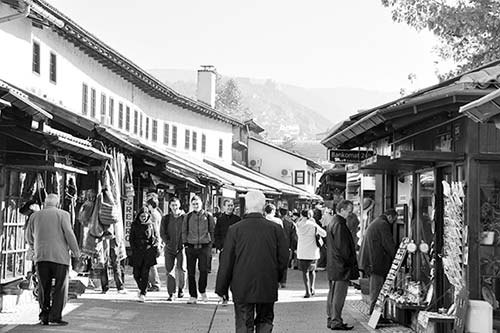
It’s easy to miss the many courtyards (han) that burrow between blocks in the Old Town. Venture down the little alley directly across Sarači street from Prote Bakovića. You’ll pop into an atmospheric courtyard called Trgovke, which is especially popular with šiša bars (also known as nargila, hookah, hubbly bubbly, or water pipe). They’re not an indigenous tradition—having been imported from the Middle East—but they’ve become popular and make an inviting scene after dark. As twilight twinkles, local twentysomethings lounge here on divans, chilling like sultans (or, at least, pashas) as they deeply inhale pungent, fruity smoke. In the corners and tucked down little alleys, miniature potbellied stoves churn day and night, providing glowing coals to power the pipes. Even without taking a direct drag, it’s like cotton candy for your lungs. While there’s no marijuana in these particular hookahs, the mellow hubbub, air rich with sickly sweet smoke, dueling music played at top volume, and floodlit minarets rocketing overhead are plenty mind-bending.
From where you entered the courtyard, turn right to find a narrow alley (next to Damask Nargila Bar) leading back out to Sarači street. Turn left and continue along Sarači. After a few steps, on the right (at #77), dip into the courtyard of the Morića Han, an old Ottoman caravanserai—like an inn, where passing merchants could find food and accommodations. It serves a similar purpose today, with several atmospheric café tables offering the chance to taste the high-octane, unfiltered “Bosnian coffee”; stop here now if you need to get caffeinated for all the sightseeing coming up. (For more on the important social ritual of Bosnian coffee, see here in the Bosnia-Herzegovina introduction.)
Head back out to Sarači. A few steps farther along, look left for Kolobara Han, a garden courtyard filled with restaurant tables.
Keep going, and soon you’ll come to (on the left) the walled courtyard of Sarajevo’s top mosque, the Gazi Husrev-Bey Mosque—definitely worth a visit, and described later. This is just the first of many mentions you’ll see of Gazi Husrev-Bey (1480-1541), a Muslim aristocrat who poured money into the local community. (Bey is an Ottoman aristocratic title, like “Lord” or “Sir.”) Many of the landmarks of the Old Town were built as part of Husrev-Bey’s vakuf, or religious endowment; you’ll notice plaques to this effect all over town. Thanks to his patronage, Sarajevo became the biggest city in the European part of the Ottoman Empire. If you’d like to pay your respects to this John-D-and-Catherine-T-style benefactor, his tomb is just to the left of the mosque (also described later).
Across the street from the mosque’s middle gate (at #33, labeled Muzej Gazi Husrev-Beg) is the Kuršumilja Madrasa, originally built as an Islamic theological school by Husrev-Bey in the 1530s. Step into the outer courtyard for a better look at the building, which has multiple chimneys poking up above the roofline. Students lived in simple dorms, each one individually heated by its own stove. You can peek into the inner courtyard from the door, or pay 3 KM to go in and peruse its interesting but dry exhibit about Husrev-Bey (including a good film about his life and legacy) and the history of the building. The main classroom, straight ahead from the entrance, has a Star of David chandelier, suggesting the deep interfaith respect through much of Sarajevo’s history (everything described in English, daily 9:00-13:00 & 13:30-20:00). The modern school next door (the yellow building, to the right) still teaches the Islamic faith.
Still in the courtyard, as you face the madrasa, look left to see the sparkling new library, Gazi Husrev-Bey Biblioteka. While local Muslim bigwigs (the modern-day versions of Husrev-Bey) don’t have the money to invest as they’d like in their home country, other Middle Eastern countries (in this case, Qatar) are keeping this tradition of endowment alive. Throughout Bosnia, many destroyed-then-rebuilt mosques and Muslim cultural institutions come with a plaque noting which Islamic country paid to resurrect it. In addition to being a fully operational archive and library, this gorgeous new complex includes a large auditorium and a museum that displays its treasures—including precious books that were hidden away in a bank vault to survive the siege (3 KM, Mon-Fri 8:00-18:00, Sat until 16:00, closed Sun, www.ghb.ba).
Head back out to Sarači street and continue a couple of short blocks. The stone building on the left is another covered bazaar, this one still functioning as a market, the Gazi Husrev-Bey Bezistan. Cut through the market hall—maybe browsing for a scarf, purse, necklace, watch, or sunglasses—and pop out at the far end, turning right to find a field (squeezed between the market and Hotel Europe) littered with ruins from a 16th-century Ottoman caravanserai, called Tašlihan. Funded by (surprise, surprise) Gazi Husrev-Bey, this caravanserai hosted passing travelers, traders, and merchants—logically, given it was located next to the bazaar—until it was badly damaged by an 1879 fire.
• Now walk back past the end of the covered market, take the first right, and walk a short block down to the...
Miljacka River: The last building on your left before the riverfront houses the Sarajevo 1878-1918 Museum (described later). The museum outlines the brief but prolific four decades of Austrian Habsburg rule here—and, more importantly, the story of how Gavrilo Princip’s assassination of the Habsburg heir, Archduke Franz Ferdinand, took place right on this corner. The shooting set off a chain reaction of allegiances and grudges that swiftly pulled all of Europe—and, eventually, much of the world—into a Great War that would end the age of empires and inaugurate a new era of modern nations. (For the full story, see “The Shot Heard ’Round the World” sidebar, later.)
Go across the street to the Latin Bridge (Latinska Ćuprija)—so named because, during Ottoman times, this was an area populated by many Catholics (who said Mass in Latin). After World War I, the bridge was renamed “Principov Most” for the assassin who had asserted Bosnian Serb nationalism against the Habsburgs. But after the 1992-1996 siege, Sarajevans decided that Princip was too controversial a figure, and went back to the old name.
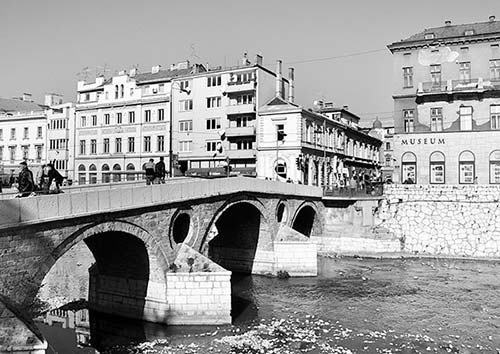
Looking down, you’ll see that the Miljacka is hardly a rushing river (like the Neretva in Mostar)—up here in the Bosnian highlands, this is still just a trickle. While not navigable for trade, the river’s current was harnessed to spur the development of the old Ottoman town. From here, you’re near three sights that may be worth a detour later. Looking across the bridge to the left, you’ll see the minaret of the copper-domed Emperor’s Mosque (Careva Džamija)—the city’s most elegant and oldest, built in 1457 to honor the Ottoman Sultan Mehmet the Conqueror (though it’s been rebuilt and expanded many times since then). Just behind the mosque, a short walk from here, is the huge Sarajevska Brewery. Because it’s fed by a natural spring, this was one of the few factories that were able to keep working through the siege. It also has an interesting little museum about the history of Sarajevsko Pivo, one of Bosnia’s top beers, and an atmospheric old beer hall serving pub grub (see “Eating in Sarajevo,” later). Those intrigued by Sarajevo’s spiritual history might consider a five-minute detour from here to the Tomb of the Seven Brothers (described later; go straight across the river and up the hill, past the park with the charming little music pavilion/tea house, to the top of the parking lot).
• Part 1 of our walk is finished. To continue with Part 2—and see a very different side of Sarajevo—backtrack all the way through the covered market (or the walkway through the caravanserai ruins) to the main drag where we started, and turn left.
This street has now changed its name from Sarači to Ferhadija. Without the slightest transition, you step from the extremely Ottoman-feeling “little Istanbul” of the Baščaršija into the Viennese-feeling Habsburg quarter. Notice the Sarajevo: Meeting of Cultures sign underfoot. You’re encouraged to stand here and snap a selfie in one direction, with an Ottoman backdrop—then turn 180 degrees and snap a selfie in the other, with an Austrian backdrop.
Part 2: Habsburg Sarajevo (Ferhadija Street)
With the precipitous decline of the Ottoman Empire in the late 1800s, the Habsburgs—who ruled the vast Austro-Hungarian Empire from Vienna—saw an opportunity to fill the vacuum left in this part of Europe. With the swirl of a pen in 1878, Bosnia went from Ottoman to Austrian rule. As they had throughout their realm, the Habsburgs stepped in and immediately began to modernize Sarajevo, rolling out new infrastructure and buildings like crazy. Although they ruled Sarajevo for only 40 years, the Habsburgs left it a far more modern city than they’d found it.
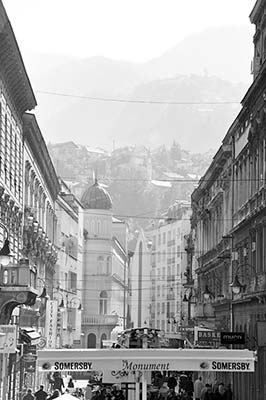
Just a couple of steps along Ferhadija, an alley on the right leads up to the Old Synagogue and Bosnian Jewish Museum (described later), offering a fascinating look at another of this city’s many faiths. Just beyond that is the wrenching War Childhood Museum (also described later).
Just a bit farther, set back from the street on the left, is the small but pretty Ferhadija Mosque. If you go around behind the mosque and duck into the Hotel Europe, at the next corner, you’ll find a genteel, chandeliered, Viennese-style coffeehouse interior. The architect who gave Sarajevo its Austrian look—including this hotel—was actually a Czech named Karel Pařík. He lived here for nearly 60 years and designed some 70 buildings in town, including the City Hall, the big Evangelical Church across the river, and the National Museum, where this walk ends.
Continuing two more blocks along Ferhadija street, on the right, you can’t miss the Catholic Cathedral (described later). Notice that this is the fourth different house of worship we’ve seen (Muslim, Orthodox Christian, Jewish, Catholic) in just the short distance since we began our walk. The silver statue out front celebrates Sveti Ivan Pavao II. “Papa”—that’s St. John Paul II—came here on April 12, 1997, Bosnia’s first-ever papal visit.
Around the right side of the cathedral is the very sobering Srebrenica Exhibition, documenting the heinous genocidal activities at that eastern Bosnian town. This sight is a must for visitors who want to better understand the atrocities that went on in this country in the 1990s.
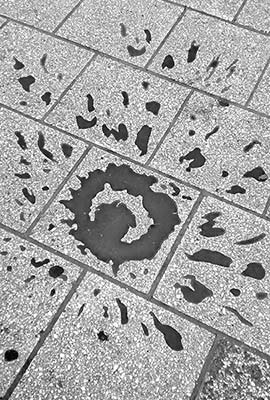
Directly in front of the cathedral’s main steps, look for the big Sarajevo rose in the pavement—a distinctive starburst indentation that’s colored in red, and carefully preserved as a memorial, even after the surrounding pavement was replaced. Immediately following the war, about 1,000 of the impact craters in the streets of Sarajevo were filled with a red resin, instantly creating a poignant memorial. As the city has rebuilt, most of these Sarajevo roses have been replaced with new asphalt. Only a few remain, and those are tended to by a local preservation group. Another one is around the left side of the cathedral, just before the side door. I’ll point out two more Sarajevo roses along this walk.
Behind the cathedral is an old Ottoman bathhouse (hammam), with telltale copper domes. Today it’s part of a private cultural center called the Bosniak Institute. It sometimes houses special exhibits; if one is going on, you can look around inside.
A block farther along Ferhadija, on the left, is a parklike square once called Liberation Square—since renamed Liberation and Izetbegović Square to honor the wartime Bosnian president. Out in the sidewalk, in front of the entrance to the square, you’ll see a stylized rectangle logo; this was the official symbol of the 1984 Olympic games (something more pleasant to recall than most of Sarajevo’s street monuments).
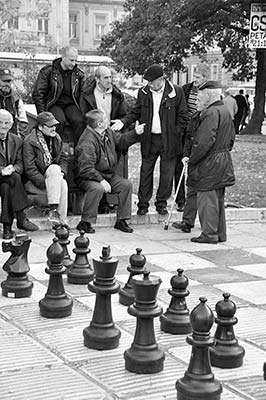
Take a detour into the square, which is ringed with busts of important Bosnian writers. The Multicultural Man Builds the World statue in the middle—of a naked man doing jumping jacks, with a highly polished member—was donated by an Italian artist to beautify the war-torn city. You’ll see many such examples of donated public art throughout Sarajevo—quite a few of them are “white elephants” not entirely embraced by the cynical, siege-hardened Sarajevans. At the far end of the square, old-timers gather to play giant-size chess, carefully strategizing while a rogues’ gallery of onlookers cheers and jeers for each move. It’s an enjoyable scene that testifies to the resilience of the Bosnian spirit—and the ability of unemployed locals to find ways to entertain themselves.
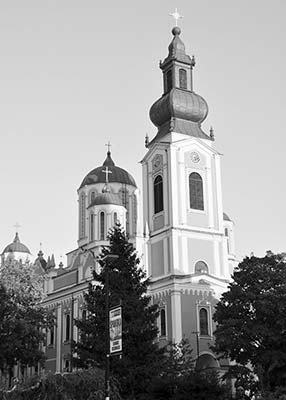
At the end of the square is yet another house of worship: The bold facade and towers of the Serbian Orthodox Cathedral. This was built from 1863 to 1869, during Ottoman rule. In this ecumenical city, the funds came from all quarters: donations from the Romanovs, Russia’s ruling family; from the Ottoman sultan; and from a Serbian prince. Like many houses of worship in this town, the church’s architecture demonstrates the mingling of faiths: It looks like an Orthodox church with a Catholic bell tower. (Bell towers are atypical enough for Orthodox churches, but this one even uses Catholic-style Roman numerals.) The interior is cavernous and lavishly decorated, with beautifully painted domes and a stirring iconostasis—it’s well worth a look for a taste of a modern Orthodox church (2 KM, daily 8:00-17:30).
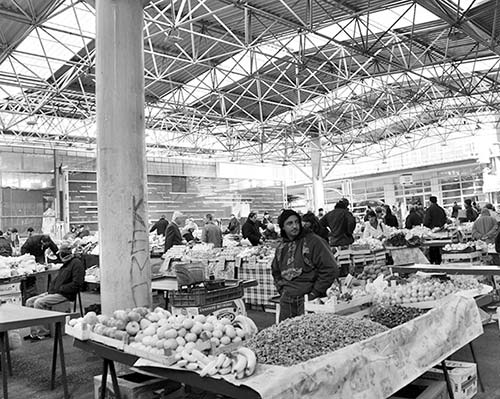
Head back out to Ferhadija and continue on your way. Notice the enticing fresh-pressed pomegranate juice stand at the corner of the park. Then, just after the park on your right is an elegant yellow market hall. Go through (or alongside) this hall and emerge on the other side, then walk to the right one block along the busy street. On the left side of this street, look for Sarajevo’s Markale covered market. Browse your way through humble tables, heavy with produce, to the back corner, where a stone plaque and names engraved on a glass wall recall a pivotal moment in the Siege of Sarajevo. This busy, completely untouristy market gained infamy as the site of two cruel bombings that targeted civilians and claimed more than a hundred innocent lives—Sarajevans who were simply shopping for paltry foodstuffs to keep their families fed and alive through impossibly tough conditions. Sixty-seven Sarajevans died during an attack on February 5, 1994 (plus another 144 wounded), and 43 more died (and 90 wounded) on August 28, 1995. (The blast pattern from one of the bombings, in the floor, is preserved as a memorial.) These ruthless bombardments were a turning point in the siege—when the international community began to sit up, pay attention, and realize that this was not simply a standard-issue war between equal parties, but a barbaric siege that was destroying the lives of countless peace-loving civilians who wanted no part of the violence. It was the 1995 attack, in part, that prompted NATO air strikes against Karadžić’s forces two days later. “Operation Deliberate Force” ultimately led to the Dayton Peace Accords, which finally ended the violence—although Sarajevans wish NATO hadn’t been quite so “deliberate” as to wait three and a half years before taking action.
Head back to the main walking street, Ferhadija, and continue on your way. As you walk, look for another Sarajevo rose in the pavement in front of the Parfois shop (at #12, on the left; this one was reconstructed after the street was repaved). The plaque next to the door of the shop explains that on May 27, 1992, 26 Građana Sarajeva (citizens of Sarajevo) were killed by an artillery shell while waiting in line to buy bread at a bakery here.
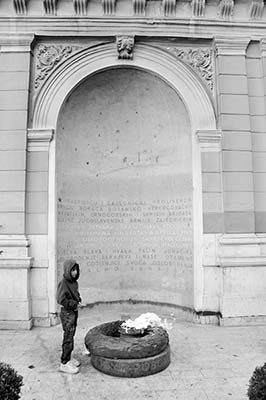
The street angles and takes you up to an intersection with the busy Maršala Tita street, named for the WWII Partisan military hero and president-for-life of communist Yugoslavia—Marshal Tito. On the right at the corner is an eternal flame honoring Partisan fighters. If you’re here in cold weather, you may notice that the practical Sarajevans—who learned during the lean years of the siege never to waste resources—use it to warm up as they pass by.
• Part 2 of our walk is finished. If you’re pooped, or just want more time to check out the sights in this part of town, now’s the time to bail out. But if you want to continue, Part 3 will send you in the direction of “Sniper Alley” (the map on here shows the routes for both Part 3 of this walk, and for my other self-guided walk, “The Siege of Sarajevo”).
Part 3: Maršala Tita Street
Crowded with cars, trucks, trams, and buses, this artery feels more urban and less atmospheric than the Ottoman and Austrian zones we just left. During the siege, this was one of the safest major boulevards in town, since it’s relatively narrow and well protected from snipers by tall buildings. The exposed side streets were blocked off to create what was called a “Road of Life,” where people could walk without fear of being picked off by distant gunmen. We’ll follow this street several blocks to ground zero of the former war zone.
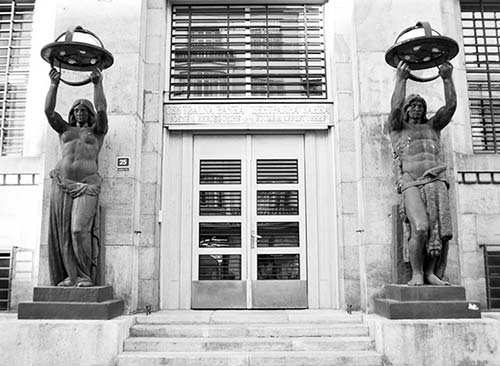
After a block, on the right, his-and-hers Atlases flank the doors of the imposing, angular Bosnian Central Bank building—where the nation’s convertible mark currency is administered.
Farther along, on the left, is McDonald’s, which caused an uproar when it finally opened here in July 2011. The opening was delayed for four years, as local ćevapi vendors—scandalized by the notion of a multinational conglomerate challenging the loyalty of Bosnian palates—did whatever they could to block it. For weeks after it opened, there were long lines down the street of Sarajevans curious to try the American burgers. But within a few weeks, the furor died down, the crowds dispersed, and the ćevapi sellers were satisfied that Bosnians wouldn’t abandon the grilled meats they’ve enjoyed for centuries.
One block later, the street opens up. On the left is the slick BBI Centar shopping mall. On the right is a fine park with some powerful monuments. First, look for the life-size statue of a man shouting. This recalls one of the most painful moments of the Srebrenica genocide (described in the sidebar on here), in which a father named Ramo was instructed by Serb soldiers to shout to his son, Nermin, who had already escaped into the hills. (This event was captured on film, which has elevated it to cult status.) Nermin believed his father, came out of hiding, and both were taken prisoner. Later, the remains of both men were found in a mass grave.
Horrific as that story is, it’s merely a warmup for perhaps the most emotionally devastating memorial in this tragedy-laden city: the Memorial to the Children of Sarajevo. Look closely at the symbolism-packed fountain. The glass sculpture in the middle represents a sandcastle, but one that is not—and never will be—finished...the innocent play of a child cut short by an untimely death. The footprints embedded in the concrete basin belong to the young siblings of children who were killed in the war. The silver pillars to the left can be spun to see names of young victims of the fighting. Nearly 1,600 children were among those killed during the siege.
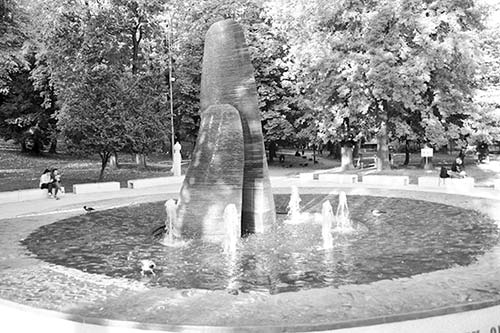
Scattered in the hillsides of the park beyond the fountain, notice a few Ottoman-style gravestones, shaped like turbans—the earliest dating from the early 17th century. In the pavement at the far end of this park—about 30 yards before the giant #sarajevo letters—look for a Sarajevo rose.
Leave the park, and continue down the busy street. The brown-and-orange building on the left is the Bosnian Presidency (the local “White House”). During the early days of the war, this building was the focus of street-by-street fighting; if the Bosnian Serb forces had claimed it, they could have declared victory. At one point, they were within 50 yards of this building, but the defense held. As part of the compromise to end the war, today Bosnia’s “Presidency” is made up of a committee of three members: one Bosniak, one Croat, and one Serb, with a rotating chairmanship. Difficult as it is to get things done with one president, imagine how impossible the situation is when you need agreement among three people who are predisposed to mistrust each other. While critical for ending the war, this compromise has made it even more difficult to move forward with postwar recovery.
In the park beyond the Presidency is the 16th-century Alipašina Mosque. A long walk directly up the hill from here (with your back to the mosque, about a mile up Alipašina street) would take you to the Zetra Olympics Center (not worth a detour now, but worth considering if you’re curious and have time later). This complex includes Koševo Stadium, which held the opening ceremony for the 1984 Olympics (and, in 1997, hosted visits by both Pope John Paul II and the band U2—both of whom spoke out in support of the besieged Sarajevans); and Zetra Arena, which was used for Olympic skating events (this is where ice dancers Jayne Torvill and Christopher Dean thrilled the world with their “Bolero” routine) and for the closing ceremony. Today the complex houses a museum about those games. Poignantly, the stadium that once commanded the world’s attention is now surrounded by a vast field of headstones—mostly of Sarajevans killed during the siege. The ice arena’s basement was used as a makeshift morgue, and its wooden seats were used to build coffins for the deceased.
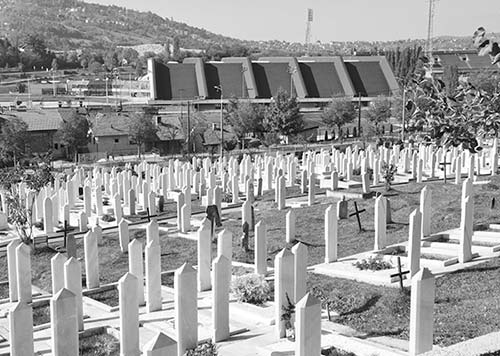
• Our walk is finished. From here, you can circle back to any of the sights you haven’t yet seen. If you have stamina and interest left, you can continue directly on to the next walk, which covers the main sights of the Siege of Sarajevo. The starting point is a level five-minute walk away: Simply continue following Maršala Tita street, jogging left with the road and passing another park (with a conspicuously modern sculpture that was another artist’s “white elephant” gift to Sarajevo). Soon after, you’ll reach the major intersection with the huge, glassy Sarajevo City Center shopping mall on your left. Here Maršala Tita becomes the city’s main thoroughfare (Zmaja od Bosne)—where the next walk begins.
▲▲THE SIEGE OF SARAJEVO: “SNIPER ALLEY”
This walk, which leads you through the broad boulevards and skyscraper jungle of modern Sarajevo, is designed to help you appreciate some of the key sites of the Siege of Sarajevo, and to provide an interesting way to get to the Historical Museum (which further illustrates the way people lived during the siege) and the National Museum. The walk begins in the shadow of the Bosnian Parliament building, which you can reach by walking five minutes from the end of the previous self-guided walk or by riding a tram to the Marijin Dvor tram stop (to trace the route of this walk, see the map on here). This neighborhood is officially called Marijin Dvor (roughly “Maria’s Castle,” after a nearby palace that was built for an aristocrat’s wife)—a strangely romantic name for a modern downtown-turned-war zone. These days it’s better known as “Sniper Alley,” the nickname given by foreign journalists who covered the besieged city.
• Begin your visit to this part of Sarajevo with a...
“Sniper Alley” Spin-Tour: Stand near the engraved medieval tomb at the corner of the big intersection in front of the Bosnian Parliament (the tall, glassy building). Look up to the hillside across the river. Midway up that hill, the patch of land with the grave markers is the city’s main Jewish cemetery; during the siege, Karadžić’s snipers found this an ideal position from which to rain bullets down on the innocent civilians below. People would cross this street only at night, by cover of darkness, or occasionally by running behind a moving UN armored vehicle that provided cover. Three decades ago, if you stood here long enough to read this paragraph, you’d be dead.
Spin to the right to see the blocky glass skyscraper—the Bosnian Parliament, rebuilt after being utterly destroyed during the war.
Looking farther to the right, up the big boulevard, you’ll see the prominent, bright-yellow facade of the Holiday Inn (now labeled Hotel Holiday). When it was built for the 1984 Olympics, this was the premier hotel in Sarajevo, fit for visiting dignitaries. But less than a decade later, the first shots of the Bosnian War were fired right here. As tensions were rising throughout Bosnia-Herzegovina, tens of thousands of peace protesters filled this street on April 5, 1992. Karadžić instructed snipers positioned in the hotel to open fire on the unarmed crowd, killing six and wounding many others. Later, the hotel housed foreign journalists and dignitaries, and was therefore virtually the only safe space in the entire city center—though even this enclave suffered its share of incidental damage. (It’s been renovated since the war.)
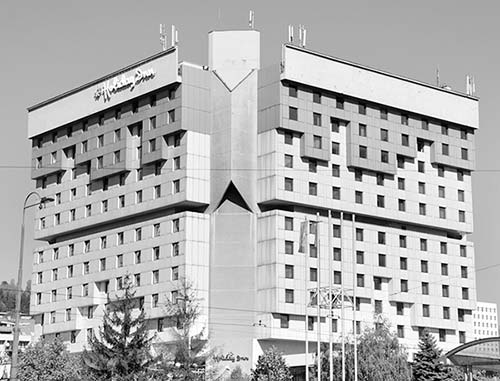
Turning to the right, you see the Catholic Church of St. Joseph (another building designed by the Czech architect Karel Pařík). The street to the left of the church, with a clear view from the sniper’s nest in the Jewish cemetery, is called Tršćanska (Trieste Street)—but locals began calling it Trćanska, or “Running Street,” when it was deadly to walk at a normal pace. Behind the church stands a hospital. While the side of the hospital facing away from the hillside sniper’s nest was a safe place for injured and ill Sarajevans to recover, the side facing the hill was exposed to sniper fire...a lesson learned in the worst possible way when snipers shot through the windows to kill patients lying in their beds.
Finally, look to the right and you’ll see the gigantic Sarajevo City Center (SCC) shopping mall—super-modern and exclusive-feeling, this seems to trumpet to the world that Sarajevo’s recovery is well underway. It was built (like so much in modern-day Sarajevo) by investors from the Middle East, who view Sarajevo as a comfortably Muslim enclave in the heart of Europe.
• From here, if you want to go straight to the Historical Museum, continue up the main street past the Bosnian Parliament, then carry on two long blocks to reach the museum (on your left). But for a more interesting approach—dotted with significant siege locations—take the scenic back way along the river. With your back to the church, walk three minutes down the street to the river and the...
“Romeo and Juliet Bridge”: This span was originally named Vrbanja Bridge, but now it’s officially called Suada Dilberović and Olga Sučić Bridge for the two young women who were the first documented victims of the Siege of Sarajevo. Dilberović was a Dubrovnik-born Bosniak pursing her medical degree at the University of Sarajevo, and Sučić was a Croat resident of Sarajevo; both were killed by sniper bullets while standing on this bridge during the Holiday Inn peace-rally massacre. But this bridge is better known internationally as “Romeo and Juliet Bridge,” for two other victims of the war. Two young Sarajevans—Admira Ismić (a Bosniak) and Boško Brkić (a Serb)—were lovers who wanted to escape to a better life together. Brkić used his connections with Serb officials to obtain promise of safe passage out of the city. On May 19, 1993, the couple made it as far as this bridge before snipers opened fire; both were hit and fell to the ground. Boško died instantly; Admira crawled to her beloved, and died clutching his body in her arms. The bodies could not be retrieved and buried for fear of further sniper attacks, so they lay on the bridge for another week, locked in a heart-wrenching embrace. After four days, American war correspondent Kurt Schork issued a dispatch describing the corpses, grabbing the attention of people around the world with this example of the horrifying conditions in the Bosnian capital. The ill-fated “Romeo and Juliet of Sarajevo” have been immortalized in film, song, and news accounts. Sarajevans embrace the couple for the way they embodied a united Sarajevo—with people of various ethnicities living together under siege. As Ismić’s father said in Schork’s dispatch, “Love took them to their deaths. That’s proof this is not a war between Serbs and Muslims. It’s a war between crazy people, between monsters.”
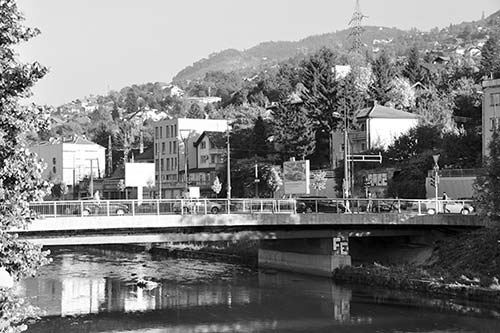
Directly across this bridge is the Grbavica neighborhood, the closest Bosnian Serb forces got to the city center during the siege—which is why the area we just passed through was so deadly. The snipers were just a couple of blocks away. Notice the bullet holes that still pockmark the buildings facing Grbavica.
• Now stroll along the river for a couple of blocks, with the river on your left, along the...
Woodrow Wilson Promenade (Vilsonovo Šetalište): Though this was a deadly no-man’s-land a few decades ago, today it’s a pleasant, tree-lined riverside park. But here in Sarajevo, even a pretty park has a sinister edge: The trees here survived only because they were too close to enemy lines to safely cut down for fuel.
• Enough siege talk. Stow your guidebook and just enjoy this romantic walk for a while. I’ll meet you at the next bridge.
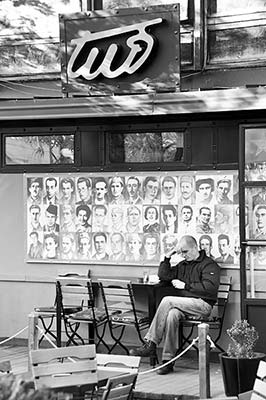
The Ars Aevi Bridge was designed by Paris’ Pompidou Centre architect Renzo Piano. At this bridge, turn right and head away from the river, through a field. Just beyond the field, tucked into the back wall of the Historical Museum, are the outdoor tables of the Tito Café. This kitschy hangout celebrates the dictator of communist Yugoslavia with preachy red flags, lots of old photos, camouflage stools, and a bust of the beloved leader, as well as an old jeep and other Yugoslav military vehicles scattered out front. (The tank you’ll see out front is a WWII-era relic, which was put into use again during the siege.) Some people genuinely miss Tito; others are here ironically; and still others have embraced Tito more recently, not as a symbol of communism but as an antifascist (since his Partisans defeated the fascist Ustaše). While nursing a drink here, read the “Tito” sidebar on here.
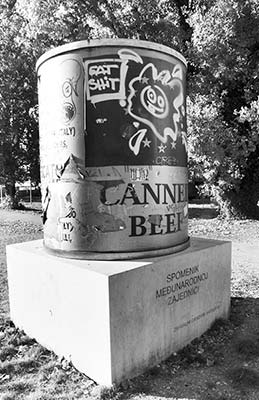
Backtrack a bit into the park between the café and the river, looking for the golden monument shaped like a giant tin can with an ICAR label. This is a (somewhat ironic) “thank you” for international relief supplies sent to Sarajevo during the siege, including the canned meat that sometimes appeared in care packages from the European Community. Understandably, Sarajevans have a love-hate nostalgia for this “siege Spam.”
From the big can, take the sidewalk through the park toward the main drag. On the left, look for another ironic monument, a big stone slab, on the left (next to the stairs to the Historical Museum). This reads, “Under this stone there is a monument to the victims of the war and cold war.”
The stairs next to this slab lead up to the gloomy concrete home of the Historical Museum, with a quirky but interesting collection of everyday items used by Sarajevans to survive the siege (described later).
Exiting the Historical Museum, you’re facing the side of the genteel mansion housing the National Museum. Across the street from the Historical Museum, you can see the sleek, low-slung US Embassy building, which fills a huge walled complex in the heart of downtown—keeping a cautious eye on a city that has seen more than its share of turmoil over the past generation or two. Hovering just beyond the embassy is the 580-foot-tall Avaz Twist Tower, which has a great view from its 36th floor (see “City Views,” later in this chapter).
• Our walk is finished. From here, you can visit the Historical Museum; walk or ride a tram (#2, #3, or #5) back to your starting point in the Old Town; or, for perhaps the most poignant siege sight in town, take a taxi or tram #3 (plus a short taxi ride) out to the War Tunnel Museum (described later).
Sights in Sarajevo
IN THE OTTOMAN OLD TOWN (BAŠČARŠIJA)
▲City History Museum (in Brusa Bezistan Covered Market)
▲▲Gazi Husrev-Bey Mosque (Gazi Husrev-Begov Džamija)
▲▲Sarajevo 1878-1918 Museum and Archduke Franz Ferdinand Assassination Site
NEAR THE OLD TOWN (BAŠČARŠIJA)
Cemeteries and Viewpoint Just Above the Baščaršija
▲▲Old Synagogue (Stari Hram) and Bosnian Jewish Museum (Muzej Jevreja BIH)
▲▲War Childhood Museum (Muzej Ratnog Djetinstva)
Catholic Cathedral of the Sacred Heart (Katedrala Srca Isusova)
▲▲Srebrenica Exhibition (Memorijalna Galerija 11/07/95)
▲Historical Museum of Bosnia-Herzegovina (Historijski Muzej BiH)
National Museum (Zemaljski Muzej)
▲▲Sarajevo War Tunnel Museum (Sarajevski Ratni Tunel)
▲▲Sarajevo Cable Car (Sarajevska Žičara)
I’ve organized Sarajevo’s main sights as you’ll reach them while you follow my self-guided walks.
IN THE OTTOMAN OLD TOWN (BAŠČARŠIJA)
City Hall (Vijećnica)
This Karel Pařík-designed masterpiece of Neo-Moorish style was one of the main landmarks of Habsburg-era Sarajevo. Destroyed during the siege, it was meticulously rebuilt thanks partly to donations from Spain, Austria, and Hungary (the three big Habsburg countries). It once again houses the City Hall and a library, and invites visitors to step inside and ogle its stunning interior atrium, with hand-painted details under colorful stained glass. In the basement, you’ll find an exhibit on the history of the building and of Sarajevo, as well as temporary exhibits. While Sarajevo has better history museums, this is worth a visit if you’re an aficionado of opulent Habsburg-era architecture.
Cost and Hours: 10 KM, daily 9:00-17:00, www.sarajevo.ba.
▲City History Museum (In Brusa Bezistan Covered Market)
Filling a big indoor silk bazaar just off old Sarajevo’s main square, this good museum features a giant model of the city in 1878, at the apex of the Ottoman period and just before the new Austrian rulers renovated and expanded Sarajevo. The rest of the collection offers a good historical overview of the city in English, with ample artifacts, traditional costumes, and an interesting video tracing Sarajevo’s story (with English subtitles).
Cost and Hours: 3 KM, Mon-Fri 9:00-16:00, Sat until 14:00, closed Sun, Abadžiluk 10, +387 33 239 590, www.muzejsarajeva.ba.
Visiting the Museum: As you enter, you’ll first circle clockwise around the ground floor for a quick look at prehistoric, Roman, and medieval Sarajevo. In the middle is a big Sarajevo model—handy for orientation to the Old Town. Near the end of this section (back near the entrance, in the corner), notice the two big Bogomil tombstones (from the medieval Bosnian Christian civilization)—an older, horizontal one and a later, vertical one. The vertical tomb is a transitional piece that demonstrates how Bogomil culture began to take on Turkish customs after the arrival of the Ottomans. The tomb has been rotated upright (in keeping with the Muslim tradition) and displays a Muslim-style crescent moon. A man with a bow and arrow is a common motif on Bogomil tombstones. Here, we see the bow and arrow (on the left side), but not the man—in keeping with the Muslim ban on depicting living things in art. But, in a sort of compromise, it does feature an animal. Nearby is an unusual wooden sarcophagus, which may have held the remains of an important person.
Upstairs, do another clockwise loop, beginning with the origins of the city of Sarajevo. One display case demonstrates the religious diversity of this city—from Orthodox Easter eggs, to a Torah and menorah, to a copy of the Old Testament. The traditional clothing exhibit shows how local styles were influenced by Venetian, Slavic, and Turkish trends; the exhibit on crafts and trade features items you may have found for sale in the bazaars. Under Ottoman rule, the city saw a flourishing of the arts (see the calligraphy) and education, but as that empire began to decline, illiteracy skyrocketed, and Bosnia’s neighbors sensed weakness (exemplified by the case full of weapons). Ultimately Bosnia became part of the Austro-Hungarian Empire (see the new flag of Sarajevo up above), which changed local lifestyles and fashions. Notice the paintings of Bosnian Muslims of this era, who wore Austrian-style suits, but with fezzes and turbans. The remaining exhibits show architecture and decorative arts from the Habsburg period, when the very Ottoman-style Old Town was surrounded by a Viennese urban zone.
▲Old Serbian Orthodox Church
While fully Orthodox inside and out, this 16th-century church has features that resemble a synagogue or a mosque—hinting at the mingling of faiths that has characterized Sarajevo for most of its history.
Cost and Hours: 3 KM, includes church and museum, Mon-Sat 8:00-17:00, Sun until 16:00, Mula Mustafe Bašeskije 59.
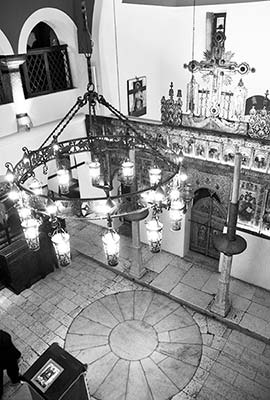
Visiting the Church: Step inside and notice that the church (which was built on the site of an even earlier one) is set about three feet below street level. Because the Ottomans wouldn’t allow churches to be taller than mosques, the builders went down instead of up. Also notice how—with its split-level design and upstairs gallery—it feels like a synagogue with an iconostasis. Upstairs in the gallery, you may see worshippers making a fuss over a small coffin, which contains the body of a child; this is believed to have healing power, especially for infertile women.
Across the small courtyard is a museum with old icons, incense burners, vestments, and manuscripts in Cyrillic. Look for the document in squiggly Arabic script: It’s a written confirmation from the Ottoman sultan permitting worshippers to practice the Orthodox Christian faith here. The wine shop keeps up the Bosnian tradition of Orthodox monks doubling as vintners.
▲▲Gazi Husrev-Bey Mosque (Gazi Husrev-Begov Džamija)
Called “Begova Mosque” for short, this is Sarajevo’s most important and most historic mosque.
Cost and Hours: Outer courtyard—free, mosque—3 KM (or 5 KM combo-ticket with Kuršumilja Madrasa courtyard across the street); buy ticket at little house to the right as you enter courtyard; opening times vary depending on prayer schedule and are posted at ticket office—generally May-Oct daily 9:00-12:30 & 14:00-15:00 & 16:00-17:30, Nov-April daily 9:00-11:00, longer hours in peak of summer and shorter hours during Ramadan; Sarači, +387 33 573 151, www.vakuf-gazi.ba.
Visiting the Mosque: Start in the outer courtyard. The fountain in the middle (with water piped in from the mountains three miles away) is for washing before prayer. Around the left side, look for the two freestanding mausoleums (you can’t enter them, but you can peek through the windows around the side). The larger one holds the remains of the mosque’s founder and namesake, Gazi Husrev-Bey, a governor of Bosnia who donated vast sums in the 16th century to improve Sarajevo. The smaller mausoleum holds his assistant and secretary, a highly educated Croat named Tardić who had been captured in a battle. He accepted Gazi Husrev-Bey’s offer of a job, a precondition of which was that he convert to Islam, and went on to become the governor’s most trusted adviser. The cemetery behind the mausoleums has graves both old and new; one of the most recent holds the remains of the imam from the destroyed mosque in Banja Luka, a Serb stronghold in northern Bosnia.
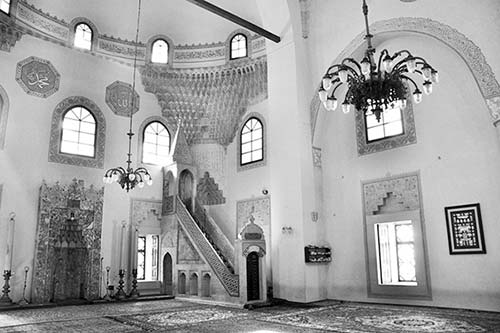
Now, let’s go inside. At the far corner of the courtyard is the ticket office. The long wooden shed nearby is used for ablution (washing before prayer). Buy your ticket, then step into the mosque’s interior (women must cover their heads, but visitors can keep their shoes on). You’ll see many of the same elements found in other Bosnian mosques. Appreciate the remarkably spacious-feeling architecture. Many of the carpets are gifts from Muslim nations and date from the Tito era. As an anchor of the nonaligned world, which included many Muslim countries (in North Africa and the Middle East), Tito had particularly good relations with Islamic leaders. The electric lighting—the world’s first in a mosque—was installed by the Habsburg rulers in 1898 (the same year they lit up Vienna’s Schönbrunn Palace), suggesting how deeply the Habsburgs respected the local Islamic faith. The besieging Bosnian Serb forces in the 1990s didn’t share this respect, and used the mosque’s minaret for target practice. Looking through the windows, you can see the walls are six feet thick—which helped save the mosque from utter destruction. The mosque was badly damaged, and was renovated in 1996 using funds largely from Saudi Arabia; the interior—while covered in fine calligraphy—is still less ornately decorated than it once was.
Nearby: The clock tower across the narrow street is also part of the mosque complex; notice that its “noon” lines up with sunset—critical in establishing the five times each day that Muslims pray. Under the clock tower you’ll find a pay WC and—tucked back in the courtyard—a little hole-in-the-wall bakery that’s open late.
▲▲Sarajevo 1878-1918 Museum and Archduke Franz Ferdinand Assassination Site
Worth ▲▲▲ and ample goose bumps to historians with vivid imaginations, and interesting to anyone, this is the nondescript street corner where the heir to the huge but declining Austro-Hungarian Empire met a bloody fate at the hands of a Bosnian Serb separatist, plunging Europe into the War to End All Wars (until the next war). The shots were fired as Franz Ferdinand and his wife Sophie sat, JFK-and-Jackie style, in an open-top car during a visit to the Bosnian capital (for the full story, see the sidebar). The street corner where it happened, across from the Latin Bridge (Latinska Ćuprija), is now home to a plaque and a humble one-room museum, which shows a good video montage in its window that helps illustrate the story. The Sarajevo 1878-1918 Museum traces the four decades when this city was part of the Vienna-ruled Austro-Hungarian Empire, with a special emphasis on the assassination. Just inside the entrance, look for the symbolic footprints of the assassin, Gavrilo Princip. Beyond that, the museum holds one well-presented room featuring the trappings of the age, a map showing the sites relating to the assassination, life-size mannequins of Franz Ferdinand and Sophie, and clips from a 1970s-vintage Yugoslav film about the assassination, all with English labels.
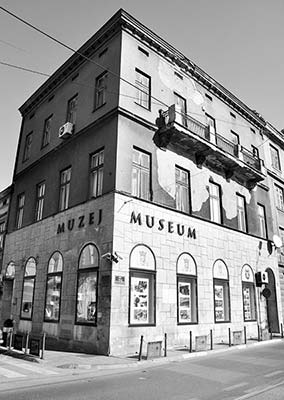
Cost and Hours: 4 KM, Mon-Fri 10:00-18:00, Sat until 15:00, closed Sun, Zelenih Beretki 1, +387 33 533 288, www.muzejsarajeva.ba.
NEAR THE OLD TOWN (BAŠČARŠIJA)
Tomb of the Seven Brothers
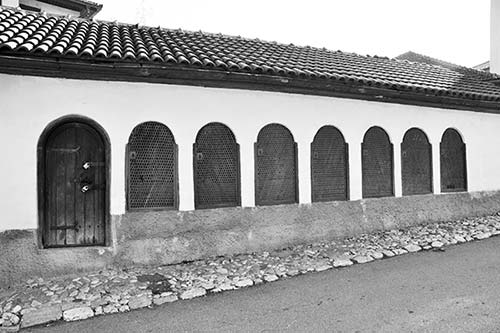
This nondescript mosque, at the top of the parking lot across the Latin Bridge from the Old Town, is a favorite spot for Sarajevo superstition. Along the right, outer wall of the mosque are a door and seven windows marking tombs of (according to legend) innocent people who were unjustly sentenced to death; a strange light was reported to be emanating from their graves at night. It’s believed that if you put a coin of the same value in each of these eight slots, you can make a wish or a request. Then you are supposed to walk around the top of the mosque, turn left, and walk down the little lane. Listen carefully—the first words you hear as you walk along this street will help you divine the answer you seek. Interestingly—but not surprisingly for this ecumenical town—even non-Muslim Sarajevans come here when they are searching for enlightenment.
Cemeteries and Viewpoint Just Above the Baščaršija
If you walk about 10 minutes up Kovači street from the Sebilj fountain, you’ll come to a good viewpoint over the Old Town, as well as some large, thought-provoking cemeteries from the siege years. Looking even higher in the hills, you’ll see more sprawling cemeteries blanketing the hillsides. People were buried in these places either at night or in heavy fog, when gravediggers could be safe from snipers.
At the top of Kovači street, the Kovači Martyrs’ Memorial Cemetery is worth a pensive wander. The billboard near the entrance labels each grave. High on the hill is the ceremonial metallic-domed grave of wartime president Alija Izetbegović, surrounded by a crescent-shaped fountain that feeds a stream that trickles downhill between the other headstones. (Just uphill, inside an old tower from the city wall, is a small museum dedicated to Izetbegović.)
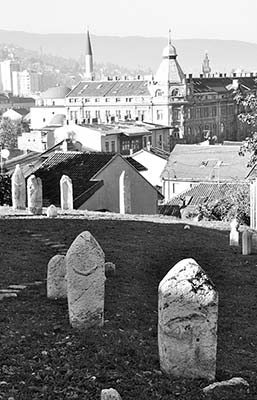
Just above this area is a neighborhood called Vratnik (roughly “Gateway”), the oldest part of town.
Svrzo’s House (Svrzina Kuća)
If you’d like to tour a traditional home from the Ottoman period, hike five minutes uphill from the Old Town to see this well-preserved, sprawling estate, built in the 17th century by a wealthy local Bosniak family. It’s similar to the “Turkish houses” you’ll see in Mostar—except that it’s made of wood, as is typical of Bosnia, whereas Herzegovinian homes (like those in Mostar) are made of stone.
Cost and Hours: 3 KM, 5 KM guidebook, Mon-Fri 10:00-18:00—off-season until 16:00, Sat until 15:00, closed Sun, Glođina 8, +387 33 535 264, www.muzejsarajeva.ba.
Visiting the Museum: First, you’ll head upstairs to see the men’s sitting room (halvat). Cut through this room to find a much larger wing. First you’ll pass the small WC (with a triangular hole in the floor), then the women’s room (where the ladies of the house did their embroidery) and the dining room (where guests sat on the floor around the low table, or up on the long divans all around the room). The kamarija (balcony) overlooks the inner courtyard, with its garden and well. Then head downstairs to see the big kitchen and large halvat—for big family gatherings.
IN THE HABSBURG QUARTER
Immediately west of the Ottoman quarter is the more modern part of town, built at the end of the 19th century after Bosnia became part of the Austro-Hungarian Empire. While several of the sights scattered through this area are much older, most of the buildings here are evocative of those in Vienna, the capital at the time.
▲▲Old Synagogue (Stari Hram) and Bosnian Jewish Museum (Muzej Jevreja BiH)
Combining a classic old 16th-century synagogue (modeled after a synagogue in Toledo, Spain) with an excellent and insightful museum chronicling the Jewish faith in this country, this is one of the most interesting Jewish sites in southeastern Europe.
Cost and Hours: 3 KM, mid-April-mid-Oct Mon-Fri 9:00-17:00—off-season 10:00-16:00, Sun 9:00-12:00, closed Sat year-round, Josipa Štadlera 32, +387 33 535 688, www.muzejsarajeva.ba.
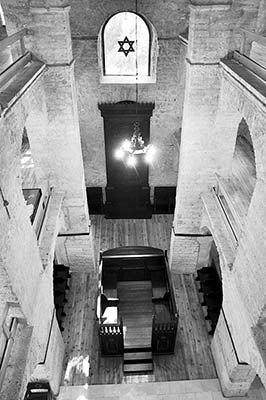
Background: Soon after the Jews were expelled from Spain in the late 15th century, Sephardic Jews made their way to Bosnia, which they found to be an unusually tolerant place (typical of its entire history). Unlike many Central and Eastern European cities, Sarajevo did not relegate its Jews to a ghetto; they lived amid their non-Jewish neighbors. Local Sephardi used “Ladino,” a unique language mixing Spanish and Hebrew (even today, rabbis here greet each other not with Shalom but with Buenos días).
Visiting the Synagogue and Museum: Buy your ticket and step into the central hall, with the bema (altar-like raised area) in the center and the wooden doors that hold the Torah. Women, who in accordance with Jewish tradition worship separately from men, stand up in the arcades ringing the hall. In the central hall, look for the replica of the important Sarajevo Haggadah book (see sidebar).
Near the stairs on the ground floor, you’ll see a tombstone from a Jewish cemetery on the hill across the river, which is the second-biggest in Europe (after Prague’s) and was tragically used as a sniper’s nest during the siege; and a model of the original appearance of this synagogue.
Head upstairs to see exhibits of more Jewish religious items, and illustrations of how local Jews adopted local culture (for example, you’ll see Jews wearing Muslim-style fezzes). The replica of an Ottoman-era “pharmacy” with herbal cures is a reminder that such businesses were typically run by Jewish Sarajevans.
The top floor focuses on the dark 20th century, including the Holocaust. Hanging from the ceiling is a giant book listing the 12,000 Jewish Sarajevans who were killed. The exhibit also profiles Bosnians who were designated as “Righteous Among the Nations”—an honorific for non-Jews who risk their own lives to save their Jewish neighbors. Among these is Derviš Korkut, the Muslim museum curator who saved the Sarajevo Haggadah from Nazi investigators. Some Jewish women were smuggled out of Nazi-occupied areas by disguising themselves in Muslim veils. You’ll also see Nazi-mandated armbands identifying Jews, photos of resistance fighters, and an exhibit on the odious Jasenovac concentration camp on today’s Bosnian-Croatian border—where Jews, Serbs, Roma (Gypsies), antifascist Muslims and Croats, communists, and other enemies of the Ustaše-controlled state were savagely executed. Jasenovac lacked the “high-tech” gas chambers of other Nazi camps, so they resorted to more medieval methods, murdering their victims by knife, sword, or even a hammer to the skull. And yet, even through that dark history, Sarajevo remained a place where cultures could coexist side by side.
▲▲War Childhood Museum (Muzej Ratnog Djetinstva)
On the hill behind the synagogue and Bosnian Jewish Museum, a few minutes’ walk up Logavina street, you’ll find this small, poignant museum that thoughtfully documents how children experience war. Though the memories here center on the Yugoslav Wars, you’ll also find stories from children caught in other conflicts, such as those in Syria, Afghanistan, and Palestine. It’s a deeply touching place worth visiting for its personal, human perspective on the impact of mass violence.
Cost and Hours: 10 KM, daily 11:00-19:00, Logavina 32, +387 33 535 558, www.warchildhood.org.
Visiting the Museum: The museum holds items that people have donated from their own experiences growing up in war, each one explained with a short English description. The collection is constantly changing, so what you see might differ from what’s described here. Heart-wrenching items include a wooden swing a grandfather built for his granddaughter, which brought her happiness in a very difficult time; a mangled jungle gym, hit by a grenade that killed four children; a red Pony bike, which Emina and her sister used to escape a bombing; a Sebastian messenger bag, which was the must-have item for the 1991-1992 school year...and later was used to pack up and escape bombs; and a collection of humanitarian food aid. Filip recalled that humanitarian aid was something new to Yugoslavia, since they had thought of themselves as a rich country. He remembers people saying, “Come on; by Monday everything will be back to normal”—no one initially believed that neighbors would be killing neighbors. You’ll likely see items pockmarked from shrapnel.
Each child’s story stands without naming the war from which it came, driving home the point that the experiences are sadly universal: Children everywhere have suffered from violence—and continue to do so today.
Catholic Cathedral of the Sacred Heart (Katedrala Srca Isusova)
Dating from 1884 to 1889, this Historicist structure mingles different architectural styles typical of Viennese buildings of that age: a Neo-Gothic exterior and a Neo-Byzantine/Neo-Baroque interior. Notice the big gap across the street, offering a fine view of the adjacent hillside. During the siege, the church’s front door was dangerously exposed—not only to snipers, but to antiaircraft machine guns, which were periodically used to spray bullets randomly over the town. Inside, the red-and-white-striped ribs—a Neo-Moorish style element—are rare in a Catholic church but seem to fit here in ecumenical Sarajevo. Inside and on the left, look for the grave of the church’s Croat founder, Joseph Stadler, and a plaque commemorating Pope John Paul II’s 1997 visit.
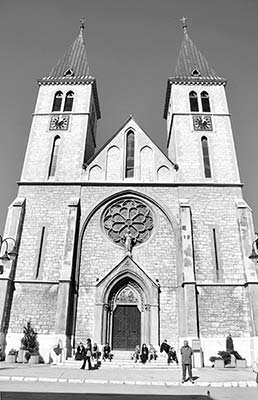
Cost and Hours: Free, Tue-Sun 9:00-17:30, closed Mon, no shorts, Trg Fra Grge Martića 2.
▲▲Srebrenica Exhibition (Memorijalna Galerija 11/07/95)
Worth ▲▲▲ for anyone who wants to better understand the atrocities in Bosnia’s late-20th-century history, this important, emotionally exhausting exhibition uses photographs and video clips to tell the story of the remote Bosnian village that experienced the worst massacre on European soil since World War II.
Cost and Hours: 12 KM, daily 9:00-21:00, Nov-May 10:00-18:00, Trg Fra Grge Matića 2/III, +387 33 953 170, www.galerija110795.ba.
Tours: You can walk through the exhibition on your own, or pay 4 KM to rent a good 40-minute audioguide that explains the basics.
Visiting the Exhibition: Because of the horrifying massacre that took place there (described in the sidebar), the name “Srebrenica” has become synonymous with some of the worst crimes against humanity in recent memory. The date you’ll see everywhere—11/07/95—commemorates July 11, 1995, when Bosnian Serb forces invaded Srebrenica, beginning their genocidal attack. This exhibit, consisting mostly of haunting photographs by Tarik Samarah, documents the process of piecing together exactly what happened there. Photos show the faces of just 640 of the more than 8,000 victims; conditions in the refugee camps where survivors lived after the massacre; the process of exhuming, documenting, and investigating the many mass graves that have been discovered (mass funerals are held on July 11 each year to honor victims who were identified during that year); and some graphic and unsettling graffiti by UN troops from the Netherlands, which suggests that they felt more contempt than sympathy for the people they were assigned to protect.
Despite their hardships during the siege, many Sarajevans consider themselves fortunate not to have met the same fate as many of the Bosniaks living in eastern Bosnia during the war. These areas, bordering Serbia proper and intertwined with Serb-dominated parts of Bosnia, were aggressively targeted by the vicious military and paramilitary forces of Bosnian Serb President Radovan Karadžić. While many towns along the Foča River Valley were brutally besieged and overrun, the most notorious site of ethnic cleansing was in the town of Srebrenica.
Before the war, Srebrenica (SREB-reh-neet-seh, meaning “silver mine”) was a mining center and spa town of about 36,000 people, which sat near the geographical center of Yugoslavia. While three-quarters of the population was Bosniak, it also had a large Serb community. There was nothing unique about Srebrenica that made it prime to become the poster child for ethnic cleansing—it simply got in the way of Karadžić’s battle plans.
In 1993, as reports surfaced of Karadžić’s forces using ethnic cleansing in multiple Bosniak villages in eastern Bosnia, the United Nations designated safe areas where civilian refugees could take shelter. Srebrenica was the first one. The UN dispatched a protection force (UNPROFOR) to these areas. But those UNPROFOR troops—including 400 Dutch soldiers sent to watch over Srebrenica—soon feared for their own lives as much as for those they were intended to guard. The UN demanded that their troops remain completely neutral, even when directly attacked—dooming them to an ultimately pointless mission.
Conditions in the “safe areas” swiftly deteriorated, and by 1995, Srebrenica had become a highly vulnerable refugee-crammed island in a tight bottleneck valley, entirely surrounded by Bosnian Serb forces. In July, the noose began to close around Srebrenica, as General Ratko Mladić invaded. On the afternoon of July 11, 1995, Mladić marched triumphantly through the town, claiming Srebrenica for the Serb people. Most of the estimated 50,000 to 60,000 people living in the town fled.
Approximately 25,000 refugees—mostly women, children, ill or injured people, and the elderly—showed up in desperation at the UN peacekeeping base at the nearby village of Potočari. The terrified Dutch troops there, unable to provide for either the safety or the basic nutritional needs of so many, took in only about 5,000 of the refugees (predominantly mothers with babies), leaving the rest to fend for themselves.
Both at Potočari and in Srebrenica, Bosnian Serb forces culled out any men between the ages of 12 and 77. In that moment, families were ripped apart forever, as husbands, fathers, and sons were taken away to be summarily executed. Many survivors still don’t know exactly what happened to their relatives; they simply never came back. In some cases, troops walked through the throngs of refugees, murdering Bosniak men right out in the open, then tossing their bodies into a pile. Bosniak women were forcibly raped in front of dozens of witnesses. Crying children who couldn’t be silenced were slaughtered. Two days later, the Dutch forces evicted the rest of the refugees from inside their camp, including more than 200 men, dooming them to certain death. (The Dutch role in Srebrenica remains a matter of deep guilt in the Netherlands.)
Late in the evening of July 11, approximately 12,000 Bosniak men—about half of them military, and half civilian—headed into the hills surrounding town, with the intention of hiking through the mountains to the free city of Tuzla, 35 miles away. A human chain eight miles long trudged slowly across the difficult terrain. Mladić shelled the hillsides, killing many. Others died of malnutrition or exhaustion from hiking through sweltering summer heat. Some committed suicide. The next day, the column was split in half, and one large group was surrounded by Bosnian Serb forces, bombarded with artillery (and, some allege, chemical weapons), and told to surrender. Thousands did...and were executed. After five days, survivors finally stumbled into safety in the town of Tuzla. Others wandered in the mountains for months.
Captured Bosniak men were sometimes killed on the spot, but more typically they were taken to holding areas (often schools, warehouses, or soccer fields) until they could be moved to remote areas for a systematic, mass execution—often by lining them up, blindfolding them, shooting them or slitting their throats, and then bulldozing them into mass graves.
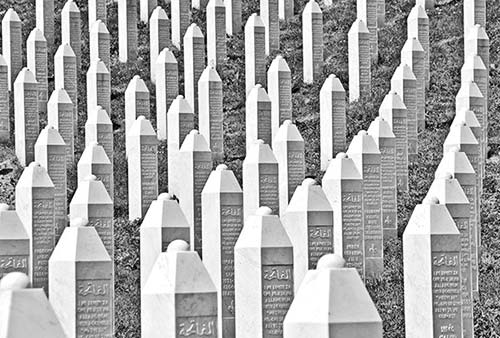
All told, at least 8,000 people, mostly men, were murdered by the forces of Karadžić and Mladić over the course of just a few days. Mass graves are still being discovered. The remains of people who once called Srebrenica home are dutifully pulled out of the ground, identified through DNA testing, and given a proper burial in a collective funeral each year on July 11.
There’s no silver lining, no happy ending to the tale of Srebrenica. The best that victims’ families can hope for is that their loved ones’ remains will someday be identified so they can bury them properly. The World War II concentration camp memorials, museums, and documentation centers around Europe all share the same message: Never again. Srebrenica tells us that, despite the best efforts of civilized people, that message still falls on deaf ears. Appallingly, many people in the former Yugoslavia still try to deny or justify the events at Srebrenica. Visiting the Srebrenica Exhibition in Sarajevo helps deflect that bogus propaganda with facts. And various companies in Sarajevo (including Sarajevo Insider) run educational tours to Srebrenica.
Perhaps the most powerful parts of the exhibit are the wrenching movies that are shown at the far end of the exhibition hall. There are two screens—one with movies about Srebrenica, and another about the Siege of Sarajevo (both movies alternate on a loop). Most powerful is Srebrenica Massacre, a 27-minute video that outlines (with English subtitles) the harrowing chain of events that led to the fall of Srebrenica and the ruthless murders of so many of its residents. Another good film is Miss Sarajevo (30 minutes), about life in Sarajevo during the siege.
Maps on the wall identify the locations of mass graves that have been found so far. Out in the hallway, a 50-foot-long wall lists the name and date of birth of each of the 8,372 victims who have been identified; the alphabetical list makes it clear that entire extended families were wiped out. Nearby, touchscreens with headphones let you view individual testimonials from survivors and victims’ relatives (subtitled in English). For even more information, sit at one of the terminals in the first room, where you can click through more than four hours of video documentation. The quote on the wall reminds visitors of a lesson that, it seems, needs to be repeated again and again: “All that is necessary for the triumph of evil is that good men do nothing.”
Nearby: Within a block or so of the Srebrenica Exhibition, you may see advertised the Museum of Crimes Against Humanity and Genocide. This private venture, cramped but packed with information, has its heart in the right place but isn’t as thoughtfully presented as the Srebrenica Exhibition.
NEAR “SNIPER ALLEY”
For the most interesting approach to this area from the Old Town (Baščaršija), see Part 3 of my self-guided “Welcome to Sarajevo” walk, earlier.
Historical Museum of Bosnia-Herzegovina (Historijski Muzej BiH)
Filling a hulking, Tito-era building next to the National Museum, this museum was founded in 1945 as the Museum of the Revolution, with the mission of documenting the Partisans’ victory over the forces of fascism. But these days, the main reason to come here is for its permanent exhibit explaining the Siege of Sarajevo—worth ▲ if you’re interested in that period or if you can get a local to come with you to explain the objects (English labels are sparse). For those curious about Yugoslav history, the museum still shows off items from its WWII and socialist-era collections—either in well-presented temporary exhibits, or in the basement “depot,” which is open to visitors.
Cost and Hours: 7 KM, downloadable audioguide app, daily 9:00-19:00, until 21:00 in summer, Zmaja od Bosne 5, +387 33 226 098, www.muzej.ba.
Visiting the Museum: Inside, just past the ticket desk, the building’s stairwell still features Socialist Realist mosaics from the communist period. A larger-than-life statue of Tito stands in the inner courtyard.
Head upstairs to see the permanent exhibit about the Siege of Sarajevo. This seems constantly in flux—and, on occasion, it may even be replaced by temporary exhibitions. But it always tells the story of the siege through photographs, news clippings, shells and weapons used in combat, and many actual items that show how Sarajevans improvised ways to carry on. You’ll be inspired by the desperate ingenuity of the besieged Sarajevans.
As you explore, keep an eye out for these items:
The mockup of a typical siege-time apartment is packed with details. The TV, telephone, refrigerator, and other appliances were useless without electricity. (The power might come on sporadically, but never for very long.) Look around at the so-called “Sarajevo inventions,” created by desperate, clever people to keep going. A bag is made out of a plastic tarp donated by the international community.
In the apartment is a makeshift stove, and a collection of several other, smaller stoves is nearby. During the frigid Sarajevo winters, trees were cut down to fuel fires. When the trees were gone, firewood was in short supply, so residents burned their furniture, shoes, old toys—anything flammable. And they bundled up in as many clothes as possible.
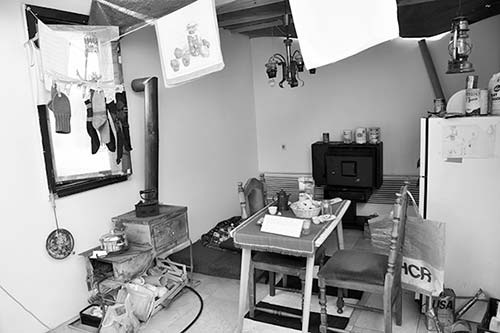
The display of cigarettes explains how smokes were used as a sort of currency; even through the siege, the local cigarette factory kept working, though the product sometimes had to be packaged in makeshift wrappers (such as bundled-up in newspapers).
Another display shows the various ways people created light, including a candle made of pork fat with a wick made from carpet fibers. After 1994, natural gas was available in some areas; notice the recycled IV tube (still bloody inside) used to power the gas lamp.
Peruse the paltry foodstuffs that Sarajevans considered themselves lucky to find during wartime. Imagine picking over these meager offerings—rusty canned goods, military rations, plastic bags stuffed with grains—and trying to figure out how to use them to feed your family. Sarajevans learned how to stretch a “one-day ration” for up to two weeks. (Many nations sent old military rations—Sarajevans sometimes found themselves eating leftover US rations from the Vietnam War.) Lawns were converted into makeshift produce gardens. Everyone came up with “siege recipes,” replacing unavailable ingredients with whatever they could. For example, during a time when rice was relatively plentiful, they’d mix it with flour to make bread, or use it as filling for burek (savory pastries). Instead of spinach filling for a burek, they might use greens from buttercup flowers. And when they had a taste for coffee, they’d burn rice, grind it, and mix it with hot water; they swear the taste was similar...even if it was missing the caffeine kick.
The elaborate satellite telephone was, for a time, the only way Bosnian president Alija Izetbegović could communicate with the outside world.
The market kiosk is stocked with a woefully sparse selection of items: humble woolens, a few grains, and pathetic twigs of firewood. There was very little to buy, and in order to buy it, you’d have to use a Monopoly-like money that was the city’s ersatz legal tender during the siege.
Scattered throughout the displays are children’s items—a heartbreaking reminder that not only “militants” were among the besieged in Sarajevo (though the Museum of War Childhood offers a better look at this aspect). Kids continued going to school, where many were injured by artillery attacks.
In other parts of the exhibition hall, you’ll generally find excellent temporary exhibits. And there’s one more attraction, which you may need to ask about at the ticket desk: The museum often lets visitors take a peek in its basement depot—a storage room for items that are not on public view. For example, you might see some of the batons created each year for the Day of Youth (May 25); these were carried on an Olympic torch-style relay all around Yugoslavia. Or you may see items related to the Antifascist Women’s Front, an organization of female Partisans.
National Museum (Zemaljski Muzej)
This humble museum does a reasonable job of covering the colorful history of this fascinating nation. The dusty collections of archaeology, natural science, and ethnology are not hugely thrilling, but they are generally well described in English, and they’re a good reminder that Bosnia is about more than just war. However, the main reason to visit is to peek at one of the world’s most precious books, the Sarajevo Haggadah (see sidebar, earlier). The Haggadah room is open just a few hours each month, and the book can be unexpectedly in storage, so if you have your heart set on seeing it, call first to be sure it’s on view.
Cost and Hours: 8 KM, Tue-Fri 10:00-19:00, Sat-Sun until 14:00, closed Mon, Zmaja od Bosne 7, +387 33 262 710, www.zemaljskimuzej.ba. The Haggadah room is open Tue, Thu, and every first Sat of the month from 12:00 to 13:00. Outside of those times, you can try to arrange a special viewing, which costs 150 KM.
Visiting the Museum: The large museum—filling four buildings surrounding a central garden—can be seen quickly. From the entrance, turn right into the Archaeology section. On the ground floor, look for third-century mosaics from Stolac. Then head upstairs, go through the left door, and look left (through the glass door with blue light); at limited times, visitors can enter this room to see the Sarajevo Haggadah in a display case. If you’re fortunate enough to be here for this, you can pick up a replica book and flip through it. The rest of the upstairs has items from the Middle Ages.
Head out into the central botanical garden and turn left to find the Ethnology section, which is like an open-air Bosnian folk museum moved inside—with six authentic, mostly wooden interiors from buildings around the country. The rooms are arranged to emphasize how the various cultures that lived here influenced one another. You’ll learn about traditional Bosnian lifestyles: how people would sit on the floor around a table to eat, sharing one very long napkin, and how backyards were often connected so that Muslim women could pass between houses without covering up. In the garden out front are stećaks, large engraved tombstones from the Bogomil times of the 12th to the 14th century (the best collection of these is on the outskirts of Stolac).
The Natural History section (in the building directly across the garden from the main building) displays vast collections of butterflies and bugs, plant life, birds, and rocks.
OUTER SARAJEVO
▲▲Sarajevo War Tunnel Museum (Sarajevski Ratni Tunel)
In the countryside on the southwestern outskirts of Sarajevo, near the airport, is a small but fascinating museum celebrating the ingenuity and determination of the besieged Sarajevans to continue supplying their city. Here you can walk through a small stretch of the actual half-mile supply tunnel they dug to stay alive during the siege. The still-battle-scarred house that marks its entrance holds an exhibit displaying actual items used in the tunnel. A short film about the tunnel, and a longer stretch of replica tunnel that you can crouch through, round out your visit.
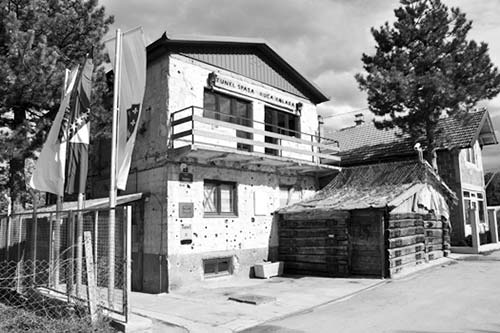
Cost and Hours: 10 KM, daily 9:00-17:00, Nov-March until 16:00, Tuneli 1, +387 33 778 670, www.tunelspasa.ba.
Getting There: The tunnel is a long detour from anyplace else in town. Therefore, the most convenient option is to take a guided tour that includes transportation from downtown and a clear explanation of what happened here. Various companies offer these tours, including Insider Tours (see “Tours in Sarajevo,” earlier). If you’d like to go on your own, by taxi, the fair metered rate from downtown is 20-25 KM one-way—just tell them “tunel.” Alternatively, you can take tram #3 from the Old Town to the end of the line (Ilidža stop, about 40 minutes one-way), then walk 2.5 miles or pay 5-10 KM one-way for a taxi from there. (Bus #32 from Ilidža gets you pretty close.) If you’re flying into or out of the city, the museum combines well with your trip to the airport. If you’re driving from Mostar to Sarajevo, it makes sense to stop and tour the tunnel on your way into town (pay parking lot nearby).
Background: With the city almost entirely surrounded by the Bosnian Serb Army, the Sarajevans’ lone connection to the outside world was a mountain pass. But between them and that pass was the city’s airport—which couldn’t be crossed by either side because it was controlled by the impartial UN. So, rather than go through the airport, they went beneath it, digging a half-mile-long tunnel under the runway. Coal-mine engineers spent four months and four days in 1993 digging a passageway that was about five feet tall and three feet wide. Once it was completed, Sarajevans could enter the basement of an apartment building, hunch over and hike through thickly humid air for 20 minutes, and emerge at a house on the other end. (After a heavy rain, the tunnel would fill with water, making the hike even more unpleasant.) From the house, they could hike over the mountains to get supplies. While money was scarce, people could trade cigarettes produced at Sarajevo’s factory for what they needed, carrying their goods back over the mountains and through the tunnel. Eventually the tunnel was wired to also supply electricity and natural gas into the city, and was equipped with rails to more efficiently transport goods on wheeled carts. The tunnel was open to any Sarajevan—and people used it to shuttle back and forth, day and night—but it was carefully monitored for smugglers who might use it to profit from the tragedy inside the city. While the besieging enemy knew about the tunnel, its nonlinear course underground made it impossible for them to know exactly where it was—and even if they had, to destroy it they’d have had to go through the UN-controlled airport. The best they could do was to relentlessly bombard the tunnel’s entrances.
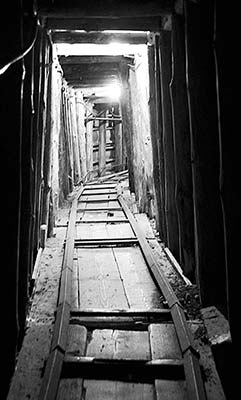
Visiting the Museum and Tunnel: After buying your ticket, turn right to find the small museum. In the first room are tools used to dig and maintain the tunnel. Look for a model of the airport runway in relation to the tunnel. See the handwritten lists, used to keep track of who was coming and going. Video screens show the tunnel in active use.
In the passage leading to the next room, look for the chair on wheels used to push the ailing President Izetbegović through the tunnel—hardly presidential transport, but the only way he could safely get in and out of the city for diplomatic meetings.
In the next room is a reconstruction of the tunnel, which was used both by the military and by civilians. Notice the various types of carts used to transport food, weapons, and injured people. The cables and pipes along the back wall are a reminder that the tunnel was used not only for people and supplies but also for electricity and gas.
Leaving the museum, you’ll pass a guestbook and photographs of the tunnel’s many, many famous visitors (including actor “Stiv Bushemi”). Then walk down the steps and turn right to reach the tunnel itself. Before entering, you’ll pass an artillery shell still embedded in the cement floor. Down a few more steps is another museum room, with two uniforms that show how the initially improvised Bosnian defense forces evolved as the war went on: At first, they wore jeans and tennis shoes, while later they had real uniforms and boots.
Now climb down the tight stairs and squeeze through an actual 80-foot-long stretch of the tunnel. Imagine yourself walking, crouched over, 30 times this far from one end to the other. If you’d like, you can hike through the tunnel wearing a backpack loaded with 65 pounds—roughly the amount that women typically carried through the tunnel (men would carry more than double that much).
Emerging at the far end, you’ll peer into a mock-up of a siege-era apartment. Lighting was often as simple as oil and water in a glass jar with a wick. The broken glass window illustrates the absurdity of trying to keep warm through a frigid winter when basic insulation was an impossibility. Outside this mock apartment is an improvised generator, built from a car engine, used to provide intermittent electricity to Sarajevans.
The gift shop anchors a long building with three rooms showing the same, good 16-minute film that illustrates the construction and use of the tunnel. Posted around the site is a map of the besieged city—superimposed, not without irony, over a map from the 1984 Olympic Games.
Back in the middle of the courtyard—between the museum entrance and the gift shop—find the stairs leading down to a much longer, 425-foot-long stretch of replica tunnel. Easier to walk through than the original one, this still helps convey the claustrophobia that siege-time Sarajevans experienced while carrying out routine errands. Remember: This is still less than one-seventh as long as the complete tunnel.
You’ll emerge at the far end of the tunnel into a quiet lawn area, facing the airport runway. Nearby, look for the re-created “minefield” embedded with land mines, shells, and other artillery. While these have been defused, this area was bombarded with more than 300 grenades daily, with 3,777 being launched here in one day alone.
Before leaving, take a quiet moment to look out over the airport and imagine what life was like back then. Locals say that when they saw a UN plane taking off—likely carrying international officials to safety—they knew trouble was brewing. In 1993, for the first time, Bosnia-Herzegovina selected a band to represent the newly independent country at the Eurovision Song Contest (a Europe-wide TV extravaganza somewhat like the American Idol finale). The band, Fazla, was trapped in Sarajevo by the siege. Determined to make it to the show in Ireland, they ran across the UN-controlled airport runway with their instruments, which they then carried over the mountains to freedom. By the time the band returned, the siege tunnel under the airport was finished, and they were able to easily sneak back into the city. Many people who managed to leave Sarajevo chose to return and remain under siege with their families and neighbors, rather than abandon their unique city and way of life.
▲▲City Views
This vertical city’s gorgeous setting is best seen from high up. Fortunately, a cable car (described next) offers visitors a sweeping view of Sarajevo, and a variety of other vistas are available.
One easy option is to walk from the Old Town up Kovači street—lined with characteristic bars and a mix of local and touristy artisans—for a decent (if not sky-high) view over town. Bus tours around Sarajevo include at least one panoramic viewpoint to enjoy one of Europe’s most spectacularly set cities. You might also take a taxi up to the popular viewpoint called White Bastion (Bijela Tabija), at an old fortress (a taxi from the Old Town should cost about 10 KM round-trip). A bit lower on the hill is the Yellow Bastion (Žuta Tabija), which has beautiful views as well as a café. For this one, you’ll take a steep hike uphill from the Old Town (though a taxi can take you partway).
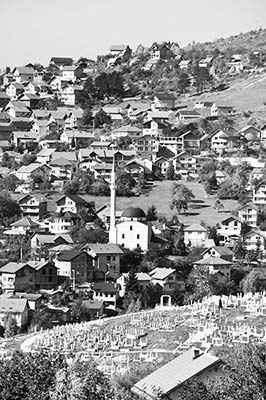
Closer to the modern downtown, the Avaz Twist Tower (next to the train station) has a sky-high café—just head inside and ride the elevator to floor 35 (cheap drinks, daily 8:00-22:30). You can drop a coin in the turnstile to walk up one more flight of stairs to an outdoor view terrace.
Two recommended restaurants—Kibe Mahala and Park Prinčeva—also offer great views over the Old Town area (see “Eating in Sarajevo,” later).
▲▲Sarajevo Cable Car (Sarajevska Žičara)
The cable car provides the best views in town—and it’s worth ▲▲▲ for outdoorsy types who’d like to hike back down rather than riding round-trip. You’ll glide 15 minutes up the slopes of Mt. Trebević for a panorama of Sarajevo’s mountain scenery—arguably best at sunset, but enjoyable any time of day. The valley station is located on the south side of the river, a little farther up the hillside behind the brewery. To reach it, walk toward the brewery, then look for the signs for žičara, and climb up several flights of stairs.
Cost and Hours: 15 KM one-way, 20 KM round-trip, daily 9:00-21:00, until 19:00 in shoulder season, until 17:00 in winter, Hrvatin bb, +387 33 292 800, www.zicara.ba.
Visiting the Cable Car: On the ride up, gawk with abandon at the city growing smaller beneath you. You’ll get a good overview of the Ottoman, Habsburg, and 20th-century neighborhoods, their little houses spreading up the slopes. The big, destroyed building on a hill overlooking the Old Town is the Jajce Barracks. Originally built in 1914 (toward the end of Habsburg rule), it was used by one military or another until the 1990s, when it was destroyed in the Yugoslav Wars. Higher above looms the older fortress known as the White Bastion (Bijela Tabija). And to the left, the field scattered with white is a siege-era cemetery.
At the cable car’s top station (about 3,800 feet above sea level), there’s a little café and a few viewpoints. From here, it’s a relatively easy walk downhill to see the ruined bobsled track from the 1984 Olympics. Follow the signs for Bob staza and you’ll come to the crumbling, mossy, graffiti-covered track. Take a moment to imagine when this was a world-class venue, and Sarajevo was in the global spotlight for positive reasons. At the far end of the trackside road is the Pino Nature Hotel, with some bold, wooden, angular architecture and a more serious restaurant.
From the bobsled track, you can either head back uphill to the cable car or hike down into town. The route down isn’t well signed, but it’s not hard to figure out: Just go downhill. The path sticks to a road part of the way, diverts across some fields, and eventually ends up on steep city streets. Figure an hour or two to walk back to the city center, depending on your pace. One word of warning: Stay on the trodden paths, since bushwhacking can get you in trouble here. Sarajevo’s mountainsides were mined during the war, and though the mines have been cleared, it’s better to be safe than sorry.
Sleeping in Sarajevo
The city enjoys a wide variety of good accommodations, ranging from budget hostels to cozy and warmly run little pensions to plush hotels. All my listings (except the first one) are in or very near the Old Town (Baščaršija). Places that are actually in the Baščaršija come with some nighttime noise. And if you’re near a mosque, you’ll hear the (amplified) call to prayer in the wee hours.
$$$ Swissôtel Sarajevo is the clear choice for those seeking a huge, modern, international hotel with all the predictable services: valet parking, swimming pool, spa and wellness center, and so on. With 218 rooms, it towers next to the Sarajevo City Center (SCC) shopping mall in the modern city center (what was once called “Sniper Alley”). This means it’s a long walk or a short taxi ride from the Old Town and most of the sights—but that area doesn’t have any hotels of this size or standard (air-con, elevator, Vrbanja 1—see map on here for location, +387 33 588 000, www.swissotel.com, info@swissotel-sarajevo.com).
$$ Isa Begov Hamam Hotel is the place for those who want to be transported back to Ottoman times. With 15 rooms filling part of a classic bathhouse next to the modern mosque, it feels close to Istanbul. The bathhouse is fully functioning and open to guests—at a discount—and to nonguests (cash preferred, includes breakfast, air-con, across the river from the Old Town at Bistrik 1, +387 33 570 050, www.isabegovhotel.com, info@isabegovhotel.com).
$ Hotel Central is an affordable splurge—at the upper end of this price range—conveniently located in the heart of the Old Town. The public areas and 32 rooms are decorated in a very snazzy style. Given the central location, request a quiet room (breakfast extra, air-con, elevator, pool/sauna, nearby pay parking, Ćumurija 8, +387 33 561 800, www.hotelcentral.ba, info@hotelcentral.ba).
$ Hotel Story, tucked down a traffic-free, pub-lined lane just off Ferhadija, has nine sleek, modern, stylish rooms, as well as three apartments nearby (air-con, elevator, pay parking nearby, Saliha H. Muvekita 4, +387 33 551 555, www.story-hotel.com, info@story-hotel.com).
$ Halvat Guest House—named for the cozy sitting room, or halvat, found in traditional Bosnian homes—is tight but homey, offering six stylish-for-the-price rooms and one apartment squeezed into a modern shell. It’s on a busy urban street that’s a short walk above the heart of the Old Town. The staff, led by Valida and Mumo, are welcoming (breakfast extra, cash only, air-con, free parking, Kasima Efendije Dobrače 13, +387 33 237 715, mobile +387 61 248 048, www.halvat.com.ba, halvat@bih.net.ba).
$ Hotel Old Town, tidy and businesslike, has 15 fresh, modern rooms that are a bit small for the price but right in the heart of the Old Town (air-con, elevator, free parking—but reserve ahead, Mali Čurćiluk 11A, +387 33 574 200, www.hoteloldtown.ba, info@hoteloldtown.ba).
$ Hotel Ornament, in an 1880s villa overlooking the embankment where Archduke Franz Ferdinand was assassinated in 1914, has 10 classy rooms. It’s just across the river from the Old Town in a pleasantly uncrowded neighborhood (air-con, free parking, Obala Isa Bega Isakovica 1, +387 61 096 190, https://hotelornament.com, contact@hotelornament.com).
$ Kandilj Pension (“Candle”) has 10 simple, small-yet-comfortable rooms in a traditional Ottoman-style house with a snug breakfast cellar. With a cozy and pleasant old-fashioned feel, it’s up a gentle hill and next to the Tomb of the Seven Brothers, across the river from the Old Town (air-con, Bistrik Potok 4, +387 33 572 510, mobile +387 62 652 884, https://kandilj.com, kandilj@outlook.com).
Eating in Sarajevo
Cosmopolitan Sarajevo boasts a wide array of good eateries, serving not only traditional Bosnian food (which is delicious) but also a range of international flavors. I’ve focused my recommendations on the area in and near the Old Town (Baščaršija).
TRADITIONAL BOSNIAN FOOD
The Baščaršija is crowded with tourist-oriented eateries slinging good Bosnian fare. For a primer, see the “Balkan Flavors” sidebar on here. Note that, after the first set of eateries, most of these qualify as “street food.” You could easily just graze your way through town, assembling a progressive meal that mixes and matches several delicious Bosnian flavors.
Old-School Traditional Bosnian Restaurants: Several obvious choices line the street called Prote Bakovića, which juts up from the main drag just a block over from Pigeon Square. Along here are a variety of crowd-pleasing eateries, including $ Dveri (with a cozy interior), $ Dženita (a straightforward, cheap option with lots of outdoor tables), and the slightly more upmarket and stuffy $$ Pod Lipom (which loves to show off big photos of when Bill Clinton ate here). Comparison-shop menus and take your pick. But first read up on the cheaper options that follow. Another traditional place, in a slightly less touristy location, is a few short blocks south: $ Nanina Kuhinja, serving a nice variety of traditional dishes you might not see elsewhere in town (Kundurdžiluk 35). All of these are open long hours daily.
Burek: These delicious “Bosnian pies,” made with flaky phyllo dough and savory fillings, are available throughout the Balkans. There are several choices in the Baščaršija; my favorite is $ Buregdžinica Sač, a hole-in-the-wall where they’re made with fresh ingredients and baked the traditional way, under a metal lid that’s covered with hot coals (ispod sača). Order at the counter, then take away or grab a table outside—this is Sarajevo’s best quick meal. Choose between spinach, meat, tangy cheese, or potato—or ask for a mix of all four (daily 8:30-20:00, in the alley off Bravadžiluk street called Bravadžiluk Mali).
Ćevapčići: Around every corner in the Baščaršija, you’ll run into a $ ćevabdžinica—a cheap eatery selling tasty little sausage-shaped minced-meat patties. Bosnians agree that this is the best place in the country to get the local answer to hot dogs and hamburgers. While you can barely go wrong here, the highest concentration of excellent options is along Bravadžiluk street, including Mrkva (Carrot), a slick and more modern-feeling place that’s part of a local chain (Bravadžiluk 15); and the more traditional Petica (Five), run by the Ferhatović family (just off Bravadžiluk at Oprkanj 2). Another good spot, a bit closer to the river, is Željo, named for a local soccer team (Kundurdžiluk 12).
Aščinica: An $ aščinica is a Turkish-style cafeteria, where you survey your options at the display case and point to what you want. It’s an efficient, affordable, and relatively untouristy way to get a taste of Bosnian cooking. The aščinica called ASDž is a good choice on a nondescript Old Town street (daily 9:00-19:00, Mali Čurčiluk 3, +387 33 238 500). For a completely untouristy experience, head for Aščinica “H.E.M,” a remarkably cheap, country-cutesy lunch counter near the workaday Markale Market (limited English—point to what looks good, Mon-Sat 7:00-16:00, closed Sun, Bašeskije 21).
Kajmak (Bosnian Cream Cheese): $ Kod Punice “Brajlović” lets you try two Bosnian specialties in one cheap, portable package: First, they pull a puffy lepinje flatbread pocket straight out of the oven. Then they slather it with the soft cheese kajmak, which begins to melt and fill in all the little grooves. If you want something heartier, you can pay a bit extra to stuff it with flavorful smoked beef...a delicious mobile feast. It’s also available in sweet versions, such as with honey (open long hours daily, Sarači 9).
Baklava and Other Treats: Especially in the Baščaršija, you’ll see several cafés and pastry shops selling baklava (original walnut, pistachio, and other innovations), kadaif (made with shredded wheat), and other delicious honey-soaked sweets. You can order one to sit out and enjoy with a coffee, or get an assortment to go.
Bosnian Coffee (Bosanska Kafa): Known elsewhere as Turkish coffee, this thick, unfiltered, highly caffeinated sludge (which leaves a layer of “mud” at the bottom of your cup) is a Sarajevo staple. For tips on the proper ritual for drinking your Bosnian coffee—which is an integral part of Bosnian culture—see here. Choose any Baščaršija table with a view that you enjoy, or poke into the atmospheric Morića Han courtyard, a former caravanserai. Or, for a more typically urban-Bosnian setting, head up the little lane toward the Old Synagogue to Rahatlook, with ample indoor and outdoor seating jammed with a mostly local clientele (Ferhadija 41). See more ideas under “Cafés,” later.
OTHER OPTIONS
$$ Žara Iz Duvara (“The Singing Nettle”) is a cozy place with just a few tables, located behind Markale Market. On the diverse menu you’ll find some traditional Bosnian specialties rarely seen elsewhere in Sarajevo; try the sahan—a platter with stuffed grape leaves, vegetables, and meatballs—or anything made with nettle. For those with special dietary requirements, everything is clearly labeled vegan, vegetarian, and lactose- or gluten-free (Mon-Sat 12:00-23:00, closed Sun, Dženetića Čikma, +387 62 147 300).
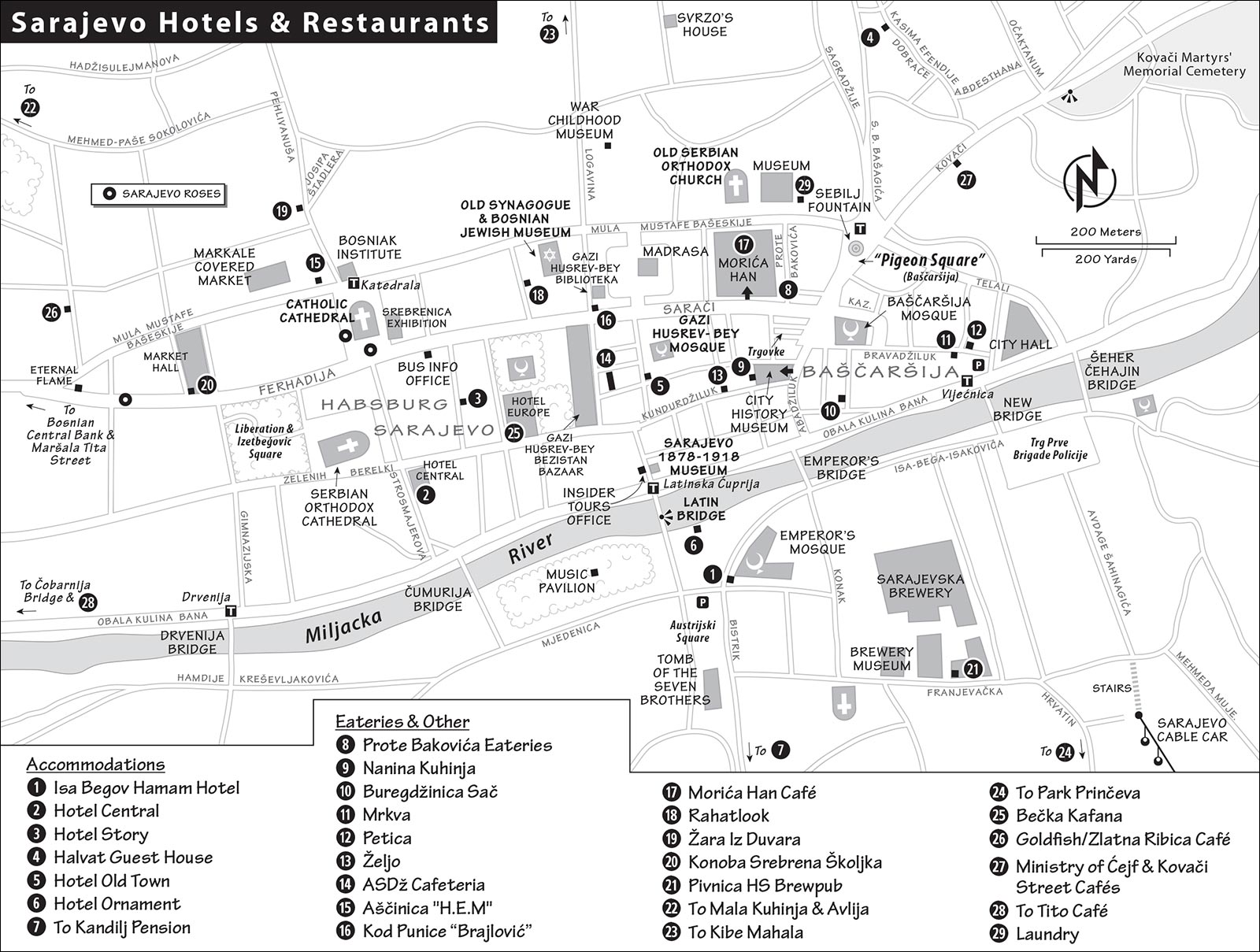
$$ Mala Kuhinja (“Little Kitchen”) sits on an urban street a 10-minute walk above the main part of town (for its location, see the “Sarajevo” map, earlier). Chef Rasim has a menu, but it’s really just a guideline; your server will talk you through some options, depending on your choice of meat (chicken, beef, or fish) and sauces. They call it “fusion cuisine,” but it’s more idiosyncratic than that...it’s Rasim cuisine, distinctive and very tasty. They also cater to vegetarian, vegan, and gluten-free diners. Reservations are strongly encouraged (Mon-Sat 12:00-23:00, closed Sun, Tina Ujevića 13, +387 61 144 741, https://malakuhinja.ba). It’s a short, steep walk directly up from the Maršala Tita main drag (most direct is to take the stairs up at Pruščakova street).
$ Konoba Srebrena Školjka (“Silver Shell”) is a no-frills, homey place for traditional Bosnian cooking. But, rather than tucked down some back lane in the Baščaršija, it’s perched at the upper level of the covered market hall right on Ferhadija (enter through the left door and don’t miss the stairs on your left). The ambience is old-fashioned and a touch genteel, and the clientele is mostly local (daily 7:00-23:00, Ferhadija 7, +387 33 205 358).
Sarajevska Brewery’s $ Pivnica HS brewpub is a big, rollicking beer hall that also manages to feel cozy. Tucked in the back of the sprawling, spring-fed Sarajevska complex, this place has two levels of diners, a double-decker bar, and a long menu of pub grub. Although their regular Sarajevska lager is available anywhere, beer pilgrims come to the brewery to tap into the unfiltered wheat beer (sold only here) and the rare dark beer (Mon-Sat 11:30-23:30, closed Sun, can be closed for special events—consider calling ahead, Franjevačka 15, +387 33 239 740). Next door is the brewery’s little museum—one well-presented room with old barrels, bottles, steins, photographs, and vintage ads (small entry fee, Tue-Sun 12:00-18:00, closed Mon, www.pivnicahs.com).
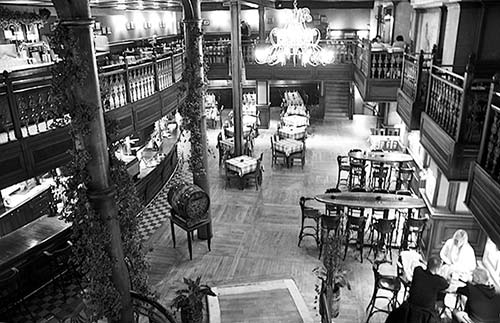
$ Avlija (meaning roughly “Front Yard”) sits in an unassuming, untouristy neighborhood a short walk above Maršala Tita street (and about 10-15 minutes from the Old Town). This very local-feeling hangout fills its namesake courtyard with bright, funky colors, rustic wooden tables, and happy drinkers and diners. The cuisine is a mix of Bosnian and international (Mon-Sat 8:00-23:00, closed Sun, Sumbula Avde 2—see map on here for location, +387 33 444 483).
DINING HIGH ABOVE SARAJEVO, WITH PANORAMIC VIEWS
Two good options sit in the residential hills above the Old Town, overlooking a stunning sunset and the twinkling hillsides at twilight. In each case, it’s a long, steep hike up from town—or a quick, cheap taxi ride (figure around 5-7 KM each way). One feels fancy, the other is more casual, but you’ll want to reserve at either one before making the trip.
$$ Kibe Mahala is elegant, with sleek decor, a Sinatra soundtrack, and a romantic, glassed-in terrace. While service can be uneven, it’s affordable even though it feels luxurious. Their specialty is lamb roasted on a spit; if you’d like to splurge on this Balkan classic, order it when you reserve your table (Mon-Sat 11:00-23:00, closed Sun, Vrbanjuša 164—see map on here for location, +387 33 441 936, www.kibemahala.ba).
$$ Park Prinčeva is more old-school. It feels like a big beer garden, with long picnic tables overlooking the city, roving musicians, traditionally dressed servers, and a menu of hearty Bosnian food. With point-blank views of City Hall and the Sarajevo hillsides, it’s a memorable setting. It may not be high cuisine, but it’s high-up cuisine (long hours daily, Iza Hrida 7, +387 61 222 708, www.parkprinceva.ba).
CAFÉS
Being at the intersection of two cultures famous for enjoying a cup of coffee (Viennese and Ottoman), Sarajevo has more than its share of cozy cafés. Explore the streets—both in the Old Town and in the modern areas—to find just the right spot.
For Ottoman atmosphere in the Baščaršija, peruse your options along both Sarači (Leathermakers’ Street) and Bravadžiluk (Locksmiths’ Street)—or just cut to the chase and head for the Morića Han courtyard (see here). Bosnians prefer the more local-feeling Rahatlook, a few steps away, on the little lane leading to the Old Synagogue.
For Viennese-style splendor, you’ll stumble on many good options, but likely none as impressive as the chandeliered Bečka Kafana (“Viennese Café”) inside the Hotel Europe.
Many modern cafés line lively Ferhadija street, which is great for people-watching. For a claustrophobic, cluttered old room that feels like the hipster version of Antiques Roadshow, head for the quirky, wildly decorated Goldfish/Zlatna Ribica (Kaptol 5).
Several funky, tourist-oriented eateries line Kovači street, which angles up into a residential zone from Pigeon Square; it’s fun to comparison-shop here, but my favorite is the Ministry of Ćejf (at #26), with both Bosnian coffee and espresso drinks (for an explanation of ćejf, see here).
And if you’re nostalgic for the Red old days, it’s obligatory to visit Tito Café behind the Historical Museum (see here).
Sarajevo Connections
From Sarajevo by Bus to: Mostar (8/day, 3 hours), Split (3/day, 7.5-8 hours), Dubrovnik (2-3/day, 6 hours; there may also be a night bus in summer), Zagreb (4/day, 8 hours, includes night bus), Ljubljana (1/day, usually overnight, 12 hours). Various companies run buses from Sarajevo; most (but not all) are operated by Centrotrans/Eurolines (www.centrotrans.com). The website https://getbybus.com catches most of your options. The general number for bus information at the main station is +387 33 213 100. For information or tickets, you can also stop by the Centrotrans office in downtown Sarajevo (Ferhadija 16, closed Sun). A few additional buses depart from the predominantly Serb area of East Sarajevo (info +387 57 317 377).
By Train: The bus is generally preferable, but a new train line from Sarajevo to Mostar is faster and cheaper (typically 2/day—but timings can be inconvenient, 2 hours, www.zfbh.ba).
ROUTE TIPS FOR DRIVERS
From Mostar to Sarajevo
Whether you’re driving or taking the bus, you’re in for a scenic journey that also takes you past some interesting sights of historical note. The road is in excellent repair, and the glorious mountain views and intriguing villages will make you want to come back and stay longer in Bosnia. Even if you’re not stopping along the way, keep track of these landmarks as you roll.
You’ll begin by heading up the dramatically scenic Neretva River Canyon, which surrounds a thrusting river that powers four hydroelectric dams. The scenery crescendos as you twist your way through the canyon.
The first major town you pass is Jablanica, famous among Bosnians as the best place to enjoy spit-grilled lamb. On the road approaching the town, look for a string of rustic restaurants lining the river side of the road; one good choice is $$ Kovačević, a nicely rustic spot with tables overlooking the river.
Jablanica is also known as the site of the WWII Battle of Neretva, which demonstrated Tito’s brilliance as a military tactician. Tito arrived here with his Partisan army, including some 4,000 injured troops and a squadron of desperate villagers and civilian refugees who had joined their ranks. Surrounded by his dual foes—Nazis and Četniks—Tito got clever: First, his troops destroyed five bridges across this river, leaving the clear impression that the Partisans planned to push away from the river. Then, as the Nazis redeployed their troops, Tito’s men quickly repaired one of the bridges overnight. This allowed the Partisans—including all of their wounded and hangers-on—to cross the river, destroy the bridge again, and swing around to catch the Nazis off guard. Tito’s victory at the Battle of Neretva—and especially his pledge, “Wounded people we shall not leave”—still echoes in the collective memory of former Yugoslavs. In 1969, the victory was immortalized in the Oscar-nominated Battle of Neretva, which featured Yul Brynner, Orson Welles, and other big names lured by the Yugoslav government’s generous funding.
To learn more about the battle, turn off at the brown museum sign in Jablanica (on the right—watch for this carefully) to reach the Museum of the Battle for the Wounded at Neretva (Muzej Bitka za Ranjenike na Neretvi). This huge, abandoned-seeming building was erected overlooking the gorge and the site of the famous bridge in 1978...and, it seems, hasn’t been renovated since. In one grand hall, you’ll see dusty old exhibits including original helmets and rifles; life-size dioramas of the wounded being evacuated; and a model showing how they used the wreckage of the original bridge to support their new, makeshift one. Huge windows look over the river gorge, where you can see a replica of the bridge that was built for the movie and kept here as a memorial. A second room features life-size models of Bosnian village life (2 KM, April-Oct Mon-Fri 8:00-16:00, Sat-Sun 9:00-16:00, July-Aug until 18:00; Nov-March closed Sat-Sun; +387 36 752 705, www.muzej-jablanica.com).
Leaving town, soon you’re driving along the shore of Lake Jablanica, which feeds the Neretva; it’s ringed by attractive homes and holiday resorts.
After leaving the lake, the next major town is Konjic, known for its traditional woodworking. The mountains above Konjic are a popular place for whitewater rafting. Also in those mountains, Tito had a failsafe bunker—one of many such complexes throughout Yugoslavia where he could retreat in case of invasion or worse. This one has been opened as a museum, but it requires a reservation (call the Konjic TI at +387 36 728 123). Konjic’s old bridge, which you’ll see on the right as you drive over the modern bridge, dates from the same era as Mostar’s Old Bridge. Both Jablanica and Konjic were held by Muslim forces during the Yugoslav Wars, which made them relatively safe havens, especially compared to Mostar or Sarajevo.
From Konjic, the road climbs up to Ivan Planina mountain, the geographical boundary between Herzegovina and Bosnia. Along this rugged road, you’ll pass the deserted village of Bradina; soon after, just before the tunnel, is a huddle of abandoned homes. This is the birthplace of Ante Pavelić—the Bosnian Croat who led the ruthless Nazi-puppet Ustaše forces during World War II.
Passing through the Ivan Tunnel (nearly a half-mile long), you enter Kanton Sarajevo (kanton, based on the Swiss canton model, roughly means “county”). In addition to separating Herzegovina from Bosnia, this tunnel marks a dramatic weather divide—from the balmy, Mediterranean climate around Mostar to the cooler, continental climate of Sarajevo.
Soon after exiting the Ivan Tunnel, around Tarčin, you may see an opportunity to hop onto the new A-1 expressway. Still under construction and towering high over the old road in the valley below, this toll road speeds you a bit more quickly into Sarajevo. (Depending on traffic, it may not save you much time for the price; many buses still follow the old road.) This is a key link in an expressway being built to connect Budapest all the way to Ploče, on the Croatian coast, by way of Sarajevo.
Winding down into the plain around Sarajevo, you’ll enter the city limits. Just before the Hotel Radon Plaza (on the right) is a pink, destroyed student building—marking what was the front line of the besieged area of wartime Sarajevo. Everything you’ll pass from here on was under constant sniper fire for three and a half years (you’re driving straight up what was called “Sniper Alley”). As you continue into town along the main drag, watch for these landmarks: on the left, the national TV headquarters (with a huge antenna array on the roof); on the right, a huge new mosque built with donations from Malaysia (one of 10 in town financed by wealthy investors from the Muslim world); on the left, the distinctive, blue, and aptly named Avaz Twist Tower, hosting the offices of Bosnia’s main newspaper (Dnevni Avaz, “Daily Voice”—you can ride the elevator up for a grand view); also on the left, the US Embassy, followed by the famous Holiday Inn (built for the 1984 Olympics, and later a safe refuge for wartime journalists, now labeled Hotel Holiday); across the street from the Holiday Inn, the restored Bosnian Parliament building; and then the swanky Sarajevo City Center shopping mall. From here, keep following the river into the city center—going through the Austro-Hungarian part of town, passing the place where Archduke Franz Ferdinand was assassinated, and winding up at Sarajevo’s Old Town, the Baščaršija.
It’s important to find secure parking in Sarajevo. Most hotels have parking, and small public lots are scattered around the Old Town area; for a bigger, more secure garage, head for the BBI Centar shopping mall (on Maršala Tita street—see the “Sarajevo” map on here).