MOSTAR AND NEARBY
Mostar • Blagaj • Počitelj • Metković • Stolac • Međugorje
ON THE EMBANKMENT, WITH OLD BRIDGE VIEWS
ROUTE TIPS FOR DRIVERS FROM DUBROVNIK TO MOSTAR
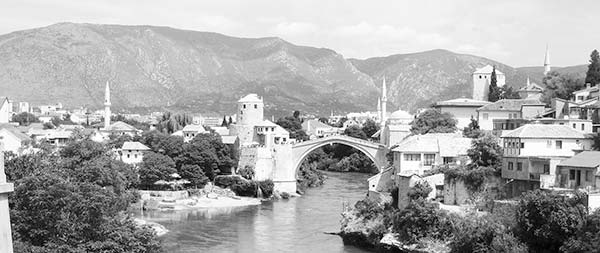
Mostar (MOH-star) offers the most accessible and enticing first taste of Bosnian culture. Ideally located a short drive from the Dalmatian Coast, this charming, manageably compact small city—with a scenic setting, beautiful Turkish-style architecture, a dynamic history, and an iconic bridge—feels like Bosnia with training wheels.
During the Tito years, Mostar’s residents—Catholic Croats, Orthodox Serbs, and Muslim Bosniaks—enjoyed an idyllic mingling of cultures, all living together in harmony. Their differences were spanned by an Old Bridge that epitomized an optimistic vision of a Yugoslavia in which ethnic differences were accepted and celebrated. But then, as the country unraveled in the early 1990s, Mostar was gripped by a gory three-way war among those same peoples...and that famous bridge crumbled into the Neretva River.
Mostar is still rebuilding, and the few remaining bullet holes and destroyed buildings are ugly reminders that the last time you saw this place, it was probably on the nightly news. Western visitors may also be struck by the immediacy of the Muslim culture that permeates Mostar, where minarets share the horizon with church steeples. After the Ottomans’ 400-year control of this region, they left behind a rich architectural, cultural, and religious legacy that has forever shaped Mostar. Five times each day, loudspeakers on minarets crackle to life, and the call to prayer warbles through the streets. In parts of the city, you’d swear you were on an old Ottoman street in Turkey.
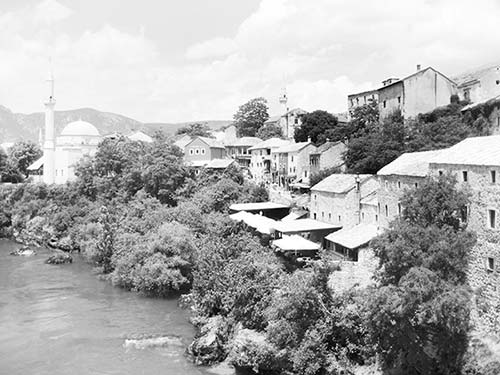
Scars of war aside, Mostar’s setting is stunning: straddling the banks of the gorgeous Neretva River, with tributaries and waterfalls carving their way through the rocky landscape. The sightseeing—mosques, old Turkish-style houses, and that spine-tingling Old Bridge—is more engaging than much of what you’ll find in Croatia or Slovenia. And it’s cheap: Hotels, food, and museums cost less than half of what you’ll pay in Dubrovnik, Zagreb, or Ljubljana.
In this chapter, I’ve also included some worthwhile attractions near Mostar: the river spring and whirling dervish house at Blagaj; the striking fortified hill town of Počitelj; and workaday Stolac, which sits upon some impressive history. The top Croat sights in Bosnia-Herzegovina are Međugorje, where Catholic pilgrims flock from around the world to hear tales of a Virgin Mary apparition, and the waterfalls at Kravice, handy for a little dose of nature. All of these places are within a half-hour’s drive of Mostar; take your pick of detours on the journey between Mostar and the coast.
A visit to Mostar gets more uplifting all the time: Mostarians are rebuilding at an impressive pace, tentatively reintegrating, and working hard to make Mostar tourist-friendly.
PLANNING YOUR TIME
Bosnia-Herzegovina is a major cultural detour on your Dalmatian vacation—but it’s easy to reach, just a three-hour drive or four-hour bus ride from Dubrovnik or Split. To fit a Mostar overnight into your itinerary, consider a round-trip plan that takes you south along the coast, then back north via Bosnia-Herzegovina (for example, Split-Hvar-Korčula-Dubrovnik-Mostar-back to Split).
Mostar’s Old Town is packed with day-trippers at midday but empty in the morning and evening. You can get a good feel for Mostar in just a few hours, but a full day—and, ideally, an overnight—gives you time to linger and ponder. My self-guided walk provides a framework for a visit of any duration. With extra time, venture to the western (Croat) part of the city, which most tourists miss.
If you’re day-tripping from Dubrovnik (a common plan), the easiest option is to hire a driver or take a package excursion with a company based in Dubrovnik. If you have your own car, Mostar is a fairly easy side trip (with the option of going down and back by different routes, outlined in this chapter)—or it works great on the way to Sarajevo, or even for those heading overland to Split. Bus schedules may not allow a round-trip visit from Dubrovnik to Mostar in a single day, though sometimes this is possible in the summer—check your options at https://getbybus.com.
GETTING AROUND HERZEGOVINA
By Car: Coming with your own car gives you maximum flexibility, and a number of interesting routes connect Mostar to the coast (for detailed route information, see “Route Tips for Drivers,” later). If you do plan to drive here, let your car-rental company know in advance, to ensure you have the appropriate paperwork (the “green card” proof of insurance) for crossing the border.
If you’re not up for driving yourself, consider splurging on a driver to bring you here (for drivers based in Dubrovnik, see the Dubrovnik chapter; for a Mostar-based driver, see “Helpful Hints,” later). Drivers like to include some viewpoints and fun local snack stops, which are a nice bonus. They may also suggest some detours en route. Do your homework to know which ones interest you (for example, Međugorje isn’t worth the extra time for most visitors; Kravice Waterfalls are a nice bit of nature but time-consuming, and redundant if you’re also going to Plitvice or Krka). Don’t hesitate to say that you want to just max out on time in Mostar itself.
By Bus: Public buses connect Mostar with destinations on the Dalmatian Coast (particularly Split and Dubrovnik). Remember, bus schedules typically don’t allow a same-day round-trip from Dubrovnik to Mostar, but it may be possible in the summer—check schedules at https://getbybus.com. Otherwise, you’ll need to pay for an excursion, drive yourself, or spend the night. For bus details, see “Mostar Connections,” later.
By Package Tour: Taking a package excursion from a Dalmatian resort town sounds like an efficient way to visit Mostar or Međugorje. But it has its cons: Count on lots of hours on a crowded bus; listening to a lackluster, multilingual tour guide reciting a dull script; and precious little time in the destinations themselves. Many excursions tend to push other sights in the Croat areas of Herzegovina. I’d pick an itinerary focusing on Mostar and avoid tours that include a pointless boat trip on the Neretva River or time in Međugorje. Those that add a quick visit to the worthwhile town of Počitelj, while less common, are a better deal. Kravice Waterfalls are another popular add-on; though pretty, these steal precious time away from Mostar. Ask for details at any travel agency in Dalmatia.
Orientation to Mostar
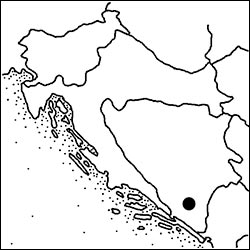
Mostar (pop. 105,000) fills a basin surrounded by arid mountains and split down the middle by the emerald-green Neretva River. Bosniaks live mostly on the east side of the river (plus a strip on the west bank) and Croats in the modern sprawl to the west—though the populations are beginning to mix again. Almost all the sights are in the Bosniak zone, but visitors move freely throughout the city and don’t even notice the division. The cobbled, Turkish-feeling Old Town (called “Stari Grad” or “Stara Čaršija”) surrounds the town’s centerpiece, the Old Bridge.
The skyline is pierced by the minarets of various mosques, but none are as big as the two major Catholic (Croat) symbols in town, both erected after the Yugoslav Wars: the giant white cross on the hilltop (marking the place from where Croat forces shelled the Bosniak side of the river, including the Old Bridge); and the enormous (almost 100-foot-tall) bell tower of the Franciscan Church of Sts. Peter and Paul. Higher on the hill, across the river, stands a monumental Orthodox cathedral; this, too, was destroyed in the war and only recently rebuilt.
A note about safety: You’ll see bombed-out buildings everywhere, even in the core of the city. A few are marked with Warning! Dangerous Ruin signs. For safety’s sake, never wander into any building that appears damaged or deserted. Also, pickpockets operate in the tourist zone; watch your valuables, especially around the Old Bridge.
TOURIST INFORMATION
The nearly worthless TI hands out a free town map and a few brochures on Mostar and Herzegovina (sporadic hours, a block from the Old Bridge at Rade Bitange 5, +387 36 580 275, www.turizam.mostar.ba).
ARRIVAL IN MOSTAR
By Bus or Train: The main bus station sits next to the giant but mostly deserted train station, north of the Old Town on the east side of the river. At the bus station, you’ll find ticket windows and a left-luggage counter in the Autoprevoz lobby facing the bus stalls. You can check schedules and buy tickets in this office for most buses except the many connections operated by Globtour and Flixbus, whose offices are nearby (exit Autoprevoz, turn left, and walk to the end of the bus-station area). It’s a long, very uninteresting walk to the town center: Go through the bus stalls and parking lot and turn left at the big road, which leads you to the Old Town area in about 15 to 20 minutes. Better yet, taxis are standing by to take you into town (the fair metered rate is about 5-10 KM).
It’s possible (though unlikely) that you’ll arrive at Mostar’s secondary bus station, called Kolodvor, on the west/Croat side of town. From here, it’s a dreary 20-minute walk into town: Turn right out of the bus station area, turn left down the busy Dubrovačka street, and head straight to the river (which you can follow south into the Old Town). Globtour/Flixbus buses that stop at Kolodvor will likely continue to the main bus station; those run by other companies probably won’t (in either case, ask).
For details on both stations and ticket information, see “Mostar Connections,” later.
By Car: There are two good options for parking close to the Old Town as you approach on the main drag called the Bulevar. For both options, be ready to turn just before the giant church tower. The cheaper, slightly farther option is the “Campanile” parking lot: Turn left on Franjevačka just before the church, then turn right immediately after the bell tower. This takes you to a cheap parking lot (2 KM all day), with pay WCs and café. The nearby church is also the starting point for my self-guided walk.
For a speedy, targeted visit, you can pay more for a parking lot closer to the Old Bridge: Approaching on the Bulevar, just before the church, turn right on Onešćukova and go two short blocks to where it dead-ends at the Old Town cobbles; on the left is a large pay lot (3 KM/hour, 24 KM/24 hours).
For tips on driving to Mostar from the Dalmatian Coast, see “Route Tips for Drivers,” later.
HELPFUL HINTS
Local Cash: Need convertible marks (KM)? There are plenty of ATMs around town; a convenient one is to the left of Fortuna Tours (see next) on Coppersmiths’ Street. But on a short visit, you can generally skip a trip to the ATM, as many vendors here also accept euros. (If going deeper into Bosnia-Herzegovina, such as to Sarajevo, you’ll need KM.)
Travel Agency: The handy Fortuna Tours travel agency, right in the heart of the Old Town (at the top of Coppersmiths’ Street), can book a local guide, arrange a transfer, and answer basic questions (long hours daily, Kujundžiluk 2, +387 36 551 887, www.fortuna.ba, fortuna_oldtown@bih.net.ba).
Local Guides: Hiring a guide is an excellent investment to help you understand Mostar. I’ve enjoyed working with Alma Elezović, a warm-hearted Bosniak who loves sharing her city and her wartime stories with visitors (€30/person, up to €80-100/group for 2-3-hour tour, +387 63 282 142, http://almasguidedtours.blogspot.com, aelezovic@gmail.com). If Alma is busy, she may send you with her son, Jaz (pronounced “yahz”), who speaks perfect English and offers a younger generation’s perspective. Ask them about the “Mostarian nights” Ottoman-themed evenings they sometimes organize, which include dinner at a Turkish house.
Another good guide is sharp, funny Adisa Ibrulj Muhić (same prices as Alma, +387 61 271 623, adisaibrulj@gmail.com).
Local Driver: Ermin Elezović, husband of local guide Alma, is a gregarious, English-speaking driver who enjoys taking visitors on day trips from Mostar. You can also hire him for a transfer between Mostar and destinations anywhere in Croatia (prices for 2 people: €150 for one-way transfer to Sarajevo, €200 one-way to Dubrovnik or Split with a few brief sightseeing stops on the way; he can also drive you to Split airport or the Korčula ferry and is available for longer trips for around €1.50/kilometer—contact Ermin and Alma for help planning a multiday itinerary; +387 61 908 597, elezovicermin@gmail.com).
Sights in Mostar
▲Franciscan Church of Sts. Peter and Paul
▲Crooked Bridge (Kriva Ćuprija)
▲▲Coppersmiths’ Street (Kujundžiluk)
▲Koski Mehmet-Pasha Mosque (Koski Mehmet-Paša Džamija)
Museum of Herzegovina (Muzej Hercegovine)
▲Museum of War and Genocide Victims 1992-1995 (Muzej žrtava rata i genocida 1992-1995)
▲Bišćević Turkish House (Bišćevića Ćošak)
▲Karađozbeg Mosque (Karađozbegova Džamija)
CENTRAL MOSTAR
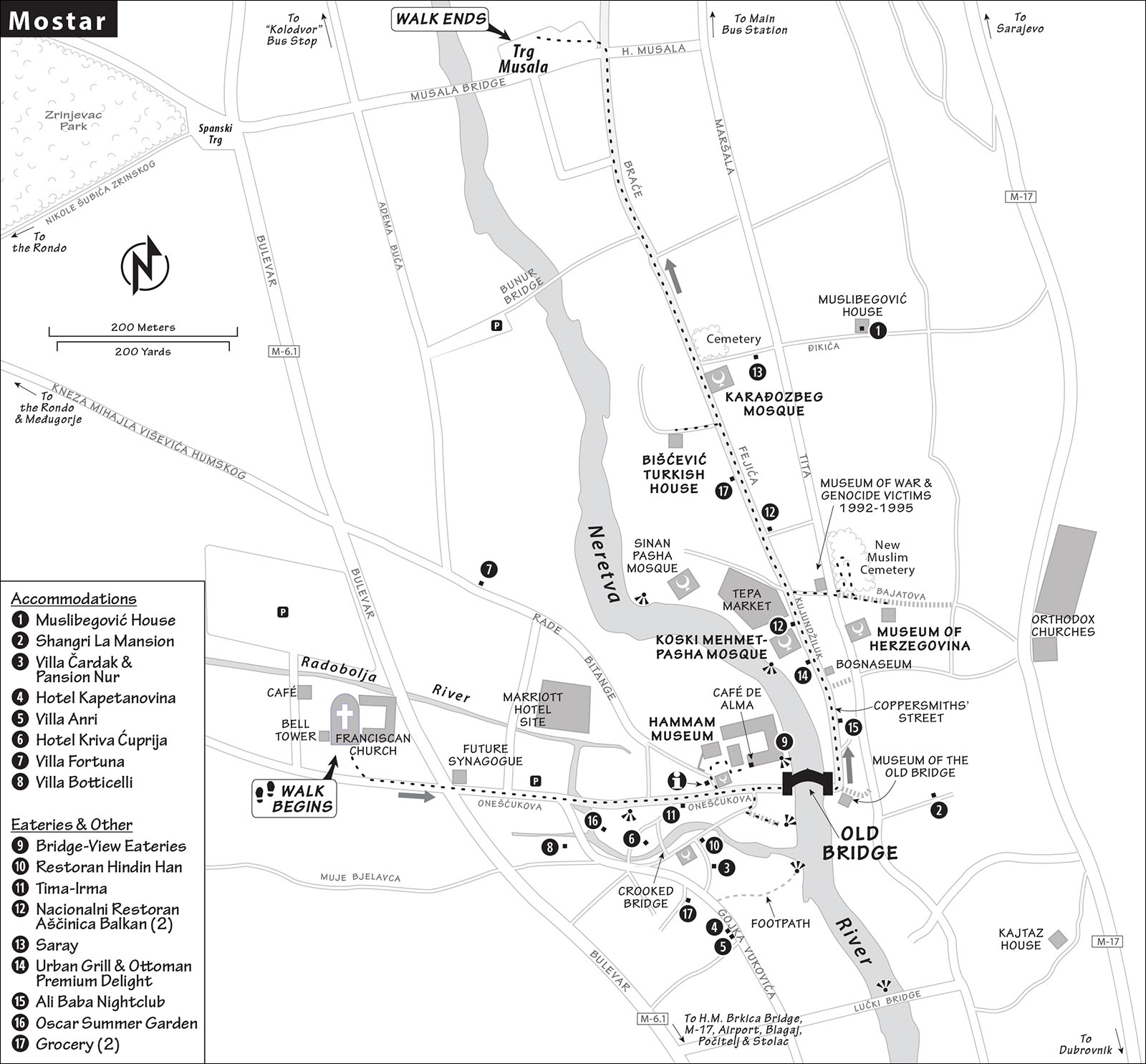
Mostar’s major sights line up along a handy L-shaped axis. I’ve laced them together as an enjoyable orientation walk: From the Franciscan Church, you’ll walk straight until you cross the Old Bridge (see map for starting point). Then you’ll turn left and walk basically straight (with a couple of small detours) to the big square at the far end of town. This walk is designed to help you see both the main tourist zones and the parts of workaday Mostar that many visitors miss.
• Begin at the...
▲Franciscan Church of Sts. Peter and Paul
In a town of competing religious architectural exclamation points, the spire of this church is the tallest. The church, which adjoins a working Franciscan monastery, was built in 1997, after the fighting subsided (the same year as the big cross on the hill). The tower, which looks like a minaret on steroids, is modeled after typical Croatian/Venetian campanile-style bell towers.
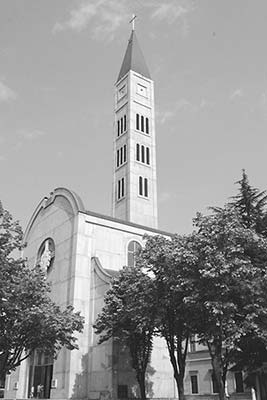
Step inside the church to see the cavernous interior, still not fully decorated. (Sunday Mass here is an inspiration.) Downstairs—but often closed to the public—is another sanctuary, with naked concrete walls that make it feel like a bomb shelter, as well as a small museum documenting the history of Franciscans in Mostar. Seeing photos of older versions of this church—one destroyed by WWII fighting in 1945 (when many friars were killed by communists), and the other destroyed by the Yugoslav Wars in 1992—is a reminder that Mostarians of all stripes have suffered loss over time.
It’s possible to ascend the church’s 350-foot-tall bell tower—called the Mostar Peace Bell Tower. You’ll ride the elevator up about 250 feet, then hike up 148 steps around the bells (some of which were salvaged from the original church) to reach good views over the city. On the way up, you’ll see information panels about various interesting sights around Herzegovina (6 KM, Mon-Sat 9:00-17:00, closed Sun and Nov-March).
• The church is a short walk from the busy boulevard called the...
▲Bulevar
“The Boulevard” was once the modern main drag of Mostar. In the early 1990s, this city of Bosniaks, Croats, and Serbs began to fracture under the pressure of politicians’ propaganda. In October 1991, Bosnia-Herzegovina—following Croatia’s and Slovenia’s example, but without the blessing of its large Serb minority—began a process of splitting from Yugoslavia. Soon after, the Serb-dominated Yugoslav People’s Army invaded. Mostar’s Bosniaks and Croats joined forces to battle the Serbs and succeeded in claiming the city as their own, forcing out the Serb residents.
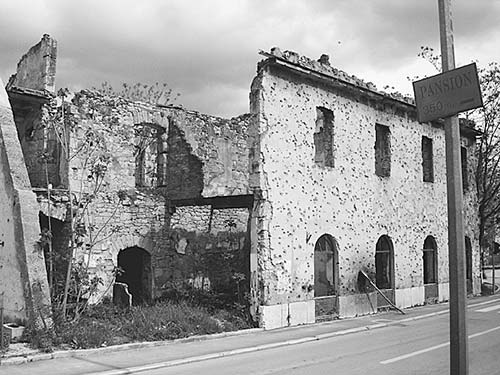
But even as they fended off the final, distant bombardments of Serb forces, Mostar’s Bosniaks (Muslims) and Croats (Catholics) turned their guns against each other. This street became the front line—and almost all its buildings were destroyed. The area to the east of here (toward the river) was held by Bosniaks; the western part of town was Croat territory.
While many of the buildings along here have been rebuilt, some damage is still evident. Stroll a bit, imagining the hell of a split community at war. Neighbors, friends, and even families fought among themselves. During those dark war years, the Croats on the hill above laid siege to the Bosniaks on the other side, cutting off electricity, blocking roads, and blaring Croatian rabble-rousing pop music and propaganda speeches from loudspeakers. Through 1993 and 1994, when the Bosniaks dared to go out, they sprinted past exposed places, for fear of being picked off by a sniper. Local Bosniaks explain, “Night was time to live”—cloaking themselves in black clothes, under cover of darkness. When people were killed along this street, their corpses were sometimes left here for months, because it wasn’t safe to retrieve the bodies. Tens of thousands fled, many taking refuge elsewhere in Europe, the US, and Canada.
The stories are shocking, and it’s difficult to see the war impartially. But looking back on this complicated war, I try not to broadly cast one side as the “aggressors” and another as the “victims.” Bosniaks were victimized in Mostar, just as Croats were victimized during the siege of Dubrovnik. And the Serbs also took their turn as victims. Every conflict has many sides, and it’s the civilians who often pay the highest toll—no matter their affiliation.
Head down Onešćukova street, across the Bulevar from the church. At this corner is a vacant lot with a menorah-ornamented metal fence. Someday this will be the Mostar Synagogue. While the town’s Jewish population has dwindled to a handful of families since World War II, many Jews courageously served as aid workers and intermediaries when Croats and Bosniaks were killing each other. In recognition of their loving help, the community of Mostar gave them this land for a new synagogue.
Continue past the synagogue site, walking two short blocks along a row of modern storefronts. The hulking building on your left is (or was supposed to be) Mostar’s Marriott Hotel—the first and only high-class international hotel in the city, perfectly located alongside the Old Town, no less. It may be open for business by the time you read this, but more likely, upon closer inspection, you’ll see that it’s still unfinished...mostly complete on the outside, but empty inside. Local gossip swirls around exactly what happened, but most accounts concern an investor who failed to follow through with the necessary financing (leaving local workers unpaid), with the Covid-19 pandemic being the final nail in the coffin. I said to a local, “It’s a little embarrassing to have this big, unfinished hotel looming over your Old Town.” He gestured to a nearby building, still destroyed and abandoned after the war, and gently chided me: “Maybe. But at least the outside is intact. Better than a war ruin!”
• Soon, you’ll enter the Old Town and follow the canyon of the...
Radobolja River Valley
Around the time you reach the big parking lot on your left, you’ve crossed the small river called Radobolja (which passes under the road here)—perhaps without even noticing it. You’ll hear its water gushing on your right side as it tumbles into a canyon. This river winds over waterfalls and several mills on its way to join the Neretva.
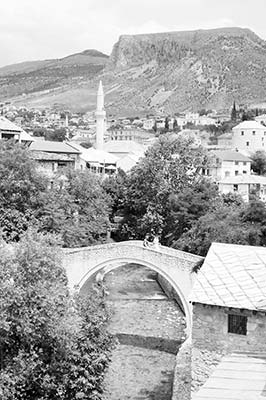
This is also where you step upon the smooth, ankle-twisting river stones of the Old Town—instantly becoming immersed in the Turkish heritage of Mostar. Around you are several fine examples of Mostar’s traditional heavy limestone-shingled roofs. From the arrival of the Ottomans all the way through the end of World War II, Mostar had fewer than 15,000 residents—this compact central zone was pretty much all there was to the city. It wasn’t until the Tito years that it became industrialized and grew like crazy. As you explore, survey the atmospheric eateries clinging to the walls of the canyon—and choose one for a meal or drink later in the day (I’ve noted a couple under “Eating in Mostar,” later). By the way, the cobbled areas of Mostar also come with crowds and pickpockets, so keep a close eye on your valuables.
Walk straight ahead until you reach a break in the buildings on your right. Belly up to the wall (you may have to squeeze between souvenir stands). The mosque you see across the river is one of 10 in town. Before the Yugoslav Wars there were 36, and before World War II there were even more (many of those damaged or destroyed in World War II were never repaired or replaced, since Tito’s communist Yugoslavia discouraged religion). But the recent war inspired Muslims to finally rebuild. Each of the town’s reconstructed mosques was financed by a Muslim nation or organization (this one was a gift from an international association for the protection of Islamic heritage). Some critics (read: Croats) allege that these foreign Muslim influences—which generally interpret their faith more strictly than the historically progressive and laid-back Bosniaks—are threatening to flood the country with a rising tide of Islamic fundamentalism. For more on this debate, see here.
• Look upriver. Spanning the river below the mosque (partly obscured by trees) is the...
▲Crooked Bridge (Kriva Ćuprija)
This miniature Old Bridge was built nearly a decade before its more famous sibling, supposedly to practice for the real deal. Damaged—but not destroyed—during the war, the original bridge was swept away several years later by floods. The bridge you see today is a reconstruction. It’s fun to explore the various paths that twist down into this canyon, past multilevel terraced houses, to cross this bridge.
• Continue on the same street deeper into the city center. After a few steps, take a detour to the left, to the area I like to call...
“Hammam Square”
Heading up this relatively calm eddy off the rushing river of the main tourist strip, you’ll emerge into a small square. The glimmering domes mark the hammam, or bathhouse, built in the classical Ottoman style some 400 years ago. Destroyed during World War II, it was rebuilt a few years ago by a Turkish organization (as if restaking their original Ottoman claim here). It sometimes houses a small museum, which may or may not be open during your visit. When open, it displays artifacts once used in baths like this one—soaps, tea sets, artfully crafted copper soap boxes, towels, and so on—with helpful English explanations of Turkish bathing culture.
As you face the hammam, notice the long building to your right. If you go in the door near the left end of this building, then cross straight through the courtyard, you’ll pop out at a terrace where various restaurants offer mediocre food with stunning views of the Old Bridge—a great spot for a floodlit dinner.
Near the right end of that same long building is one of Mostar’s best-kept secrets. At Café de Alma, soulful Jaz (“yahz”) loves to explain the rich heritage and traditions around Bosnian coffee (which you may think of as “Turkish coffee”). For 5 KM, he’ll show you his coffee roaster (the only one in Mostar), then grind and pour you a cup of Bosnian coffee. The coffee is good, but learning about this important facet of Bosnian life is even better. He also has teas and handmade syrups for refreshing drinks, sells bags of his coffee (either beans or ground), and can organize coffee workshops to get you in touch with Bosnian culture (daily 9:00-18:00, closed Mon in winter and sporadically at other times).
• Head back to the main drag and continue toward the bridge, passing several more market stalls. Because the bridge can be crowded, I’d hike down to the riverbank below to read the following description while enjoying a dramatic view of the stunning structure. To get there, hook right at the Šadrvan restaurant, then watch for the steps down to the river on your left.
▲▲▲Old Bridge (Stari Most)
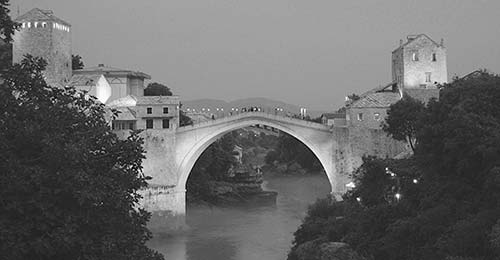
One of the most evocative sights in the entire former Yugoslavia, this iconic bridge confidently spanned the Neretva River for more than four centuries. Mostarians of all faiths love the bridge and speak of “him” as an old friend. Traditionally considered the point where East meets West, the Old Bridge is as symbolic as it is beautiful. Dramatically arched and flanked by two boxy towers, the bridge is stirring—even if you don’t know its history.
Before the Old Bridge, the Neretva was spanned only by a rickety suspension bridge, guarded by mostari (“watchers of the bridge”), who gave the city its name. Commissioned in 1557 by the Ottoman Sultan Süleyman the Magnificent, and completed just nine years later, the Old Bridge—the longest single-span stone arch on the planet—was a technological marvel for its time. Because of its graceful keystone design—and the fact that there are empty spaces inside the structure—it’s much lighter than it appears. And yet, nearly 400 years after it was built, the bridge was still sturdy enough to support the weight of the Nazi tanks that rolled in to occupy Mostar. Over the centuries, it became the symbol of the town and region—a metaphor in stone for the way the diverse faiths and cultures here were able to bridge the gaps that divided them.
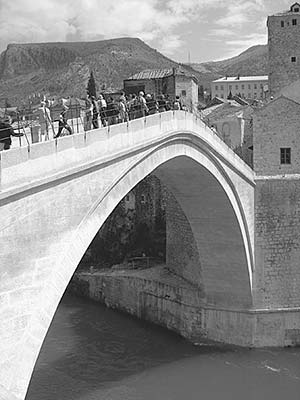
All of that drastically changed in the early 1990s. Beginning in May 1993, as the city became engulfed in war, the Old Bridge frequently got caught in the crossfire. Old tires were slung over its sides to absorb some of the impact from nearby artillery and shrapnel. In November 1993, Croats began shelling the bridge from the top of the mountain (where the cross is now). The bridge took several direct hits on November 8; on November 9, another shell caused the venerable Old Bridge to lurch, then tumble in pieces into the river. The mortar inside, which contained pink bauxite, turned the water red as it fell in. Locals said that their old friend was bleeding.
The decision to destroy the bridge was partly strategic—to cut off a Bosniak-controlled strip on the west bank from Bosniak forces on the east. (News footage from the time shows Bosniak soldiers scurrying back and forth over the bridge.) But there can be no doubt that, like the Yugoslav Army’s siege of Dubrovnik, the attack was also partly symbolic: the destruction of a bridge representing the city’s Muslim legacy.
After the war, city leaders decided to rebuild the Old Bridge. Chunks of the original bridge were dredged up from the river. But the limestone had been compromised by soaking in the water for so long, so it couldn’t be used (you can still see a few chunks of the old Old Bridge on the riverbank below). Having pledged to rebuild the bridge authentically, restorers cut new stone from the original quarry, and each block was hand-carved. Then they assembled the stones with the same technology used by the Ottomans 450 years ago: Workers erected wooden scaffolding and fastened the blocks together with iron hooks cast in lead. The project was overseen by UNESCO and cost over $13 million, funded largely by international donors.
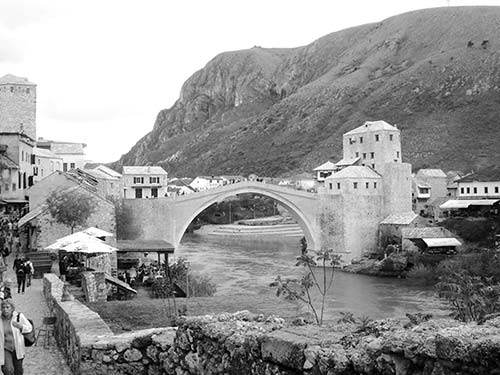
It took longer to rebuild the bridge in the 21st century than it did to build it in the 16th century. But on July 23, 2004, the new Old Bridge was inaugurated with much fanfare and was immediately embraced by both the city and the world as a sign of reconciliation.
Since its restoration, another piece of bridge history has fully returned, as young men once again jump from the bridge 75 feet down into the Neretva (which remains icy cold even in summer—while difficult to prove, locals love to brag that this is the “coldest river in the world”). Done both for the sake of tradition and to impress girls, this custom carried on even during the time when the destroyed bridge was temporarily replaced by a wooden one. Now the tower on the west side of the bridge houses the office of the local Divers Club, a loosely run organization that continues this long-standing ritual. On hot summer days, you’ll see divers making a ruckus and collecting donations at the top of the bridge. They tease and tease, standing up on the railing and pretending they’re about to jump...then get down and ask for more money. (If he’s wearing trunks rather than a Speedo, he’s not a diver—just a teaser.) Once they collect about €30, one of them will take the plunge. Recently, this custom has gotten even more attention: Each autumn the bridge becomes the venue for a Red Bull-sponsored cliff diving contest.
Notice the modern diving tower that has been erected just downriver. This is used for younger divers to train—to work their way slowly up, up, up to the vertiginous heights of the Old Bridge.
By the way, if you’d like to get out on the river yourself, down on the riverbank you may see inflatable motorboats offering a 10-minute cruise for 10 KM per person (2-person minimum).
Now begin to walk across the Old Bridge. Watch your footing—the big, chunky steps, spaced at awkward intervals to provide traction, seem instead designed to trip up distracted tourists. From the top of the bridge, see how many of the town’s 10 mosques you can spot (I count seven minarets).
Looking up the hill across town, you’ll also see a Serbian Orthodox church. This was destroyed in the same war that toppled the original Old Bridge and was rebuilt only recently—after three decades. The church looks pristine, but that’s slightly misleading; for appearances, the exterior of the church was completed before its interior...which still may be under construction when you read this. However, this church’s return to the city skyline was greeted (by those seeking to move forward, at least) as yet another long-delayed signal of reconciliation.
Once across the bridge, you’ll begin to pass some shops. Tucked back in the corner on the right are stairs leading up to the Museum of the Old Bridge (Muzej Stari Most). Sporadically open, this museum shows off archaeological findings and tells the story of the bridge’s reconstruction—though it’s a bit too dense for the casual tourist.
• After the Old Bridge, the street swings left and leads you along...
▲▲Coppersmiths’ Street (Kujundžiluk)
This lively strip, with the flavor of a Turkish bazaar, offers some of the most colorful shopping this side of Istanbul. You’ll see Mostar’s characteristic bridge depicted in every possible way, along with blue-and-white evil eyes (believed in the Turkish culture to keep bad spirits at bay), old Yugoslav Army kitsch (including spent bullet and shell casings engraved with images of Mostar), and hammered-copper decorations—continuing the long tradition that gave the street its name. Partway up, the homes with the colorfully painted facades double as galleries for local artists. The artists live and work upstairs, then sell their work right on this street. Pop into the atelier d’art Đul Emina on the right (under wooden beams) to meet Sead Vladović and enjoy his impressive iconographic work. This is the most touristy street in all of Bosnia-Herzegovina, so don’t expect any bargains. Still, it’s fun.
Cresting the hill, look back over your left shoulder for lovely views of the Old Bridge. Continuing uphill, the red house at the top and on the left is the office for Fortuna Tours, with two different ATMs (for different banks)—a handy place to get convertible marks, if you need some.
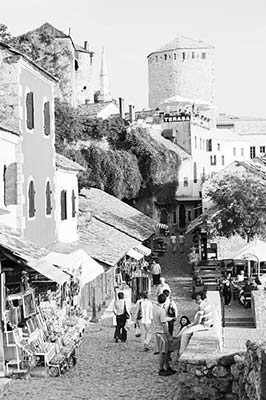
Just beyond, on the left, notice the enticing Ottoman Premium Delight shop selling some delectable local sweets: baklava and other honey-soaked treats (you can get a box to go or a little tray to eat now), as well as gift boxes of Turkish delight candies and a variety of teas. A couple of doors down, after the recommended Urban Grill (with its grand bridge-view terrace), notice the Turkish consulate.
• Directly opposite the sweet shop and Urban Grill is the easy-to-miss entrance to the next sight; it looks like a shopping mall, marked with a sign for War Photo Exhibition.
▲Bosnaseum
This earnest museum, filling an old shopping gallery, has a mixture of ethnographic and historical exhibits that showcase Bosnia’s cultural diversity and complex history. There are few explanations, but you can ask at the main desk if a guide will take you through the museum. (Without a guide, the exhibits may seem pretty inert—best saved for a hot or rainy day.) The museum admirably avoids any sort of nationalist perspective; it pays respect to the three major religious groups and their shared history.
Cost and Hours: 10 KM, daily 9:00-22:00, progressively shorter hours off-season, +387 67 114 9968.
Visiting the Museum: Ask to watch the stirring seven-minute film with footage of Mostar from before the war; the destruction of the 1990s, including the death of the Old Bridge; and the bridge’s later reconstruction. Then stroll past a series of rooms, the most interesting of which are essentially life-size dioramas re-creating the dwellings of Muslim, Serb, and Croat families in Herzegovina. One room focuses on a typical Muslim house from the 14th through the 19th centuries, while another shows a home from a Croat village. You’ll also see exhibits on national and regional costumes from around the country; traditional crafts such as copperwork, blacksmithing, and woodworking; and old photos and artifacts from both the Ottoman and Austro-Hungarian periods. One room is dedicated to Tito’s Yugoslavia, with a bust of the marshal himself, along with iconography of the various Yugoslav republics (including Bosnia-Herzegovina). And there are two different rooms that try to capture the horrors of Mostar at war: One displays photographs; the other is a wraparound diorama that captures what it felt like to walk the streets of the war-torn city. Toward the end you’ll come across a large model of a “typical” Herzegovinian village, which is impressive for its painstaking intricacy.
• Farther ahead, after the street levels out, about halfway along the street on the left side, look for the entrance (at #16) to the...
▲Koski Mehmet-Pasha Mosque (Koski Mehmet-Pašina Džamija)
Step into this courtyard for a look at one of Mostar’s many mosques. Dating from the early 17th century, this mosque is notable for its cliff-hanging riverside location, and because it’s particularly accessible for tourists.
Cost and Hours: 8 KM to enter mosque, 14 KM includes minaret climb, open to visitors daily year-round from 9:00 until sunset. If this one seems crowded with tour groups, you can enter a very similar mosque later on this walk instead (which has most of the same features).
Visiting the Mosque: The mosque displays the essential elements of all Islamic places of worship. The fountain (šadrvan) in the courtyard allows worshippers to wash before entering the mosque, as directed by Islamic law. This practice of ablution is both a literal and a spiritual cleansing in preparation for being in the presence of Allah. It’s also refreshing in this hot climate, and the sound of running water helps worshippers concentrate.
The minaret—the slender needle jutting up next to the dome—is the Islamic equivalent of the Christian bell tower, used to call people to prayer. In the old days, the muezzin (prayer leader) would climb the tower five times a day and chant, “There is no god but God, and Muhammad is his prophet.” In modern times, loudspeakers are used instead. Climbing the minaret’s 89 claustrophobic spiral stairs is a memorable experience, rewarding you at the top with the best views over Mostar—and the Old Bridge—that you can get without wings.
Because this mosque is accustomed to tourists, you don’t need to take off your shoes to enter (but stay on the green carpet), and it’s fine to take photos inside. Women are encouraged (but not required) to cover their heads, and women wearing shorts are requested to use a shawl as a skirt.
Once inside, you’ll stand in the area with protected floors just inside the door; farther in, you’ll see some of the small, overlapping rugs that are beneath this covering (reserved for shoes-off worshippers).
Look around and notice the traditional elements of the mosque. The niche (mihrab) across from the entry is oriented toward Mecca—the direction all Muslims face to pray. The small stairway (mimber) that seems to go nowhere is symbolic of the growth of Islam—Muhammad had to stand higher and higher to talk to his growing following. This serves as a pulpit for the cleric. No priest ever stands on the top stair, which is symbolically reserved for Muhammad.
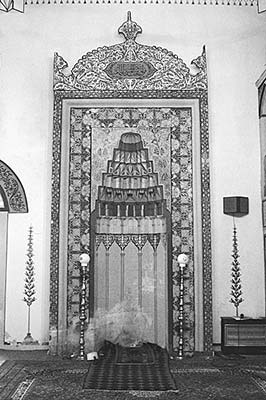
The balcony just inside the door (on your right) is traditionally where women worship. Historically, Muslim men decided prayer would go better without the distraction of bent-over women between them and Mecca. (Muslims rationalize this—and the custom of covering a woman’s hair and knees—as a gesture of “respect” toward women; some Westerners, and even some Bosniak women, consider these features of Islam misogynistic.) These days, women can also pray on the main floor with the men, but they must avoid physical contact.
Muslims believe that capturing a living creature in a painting or a sculpture is inappropriate. (In fact, depictions of Allah and the prophet Muhammad are strictly forbidden.) Instead, mosques are filled with ornate patterns and Arabic calligraphy (of the name “Muhammad” and important prayers and sayings from the Quran). You’ll also see some floral and plant designs, which you’d never see in a more conservative Middle Eastern mosque.
Muslims have been an integral part of Bosnia’s cultural tapestry for centuries. During the more than 400 years under Ottoman rule, the Muslim Turks did not forcibly convert their subjects (unlike some Catholic despots at the time). But many local Slavs were persuaded to become Muslims, for lower taxes and better business opportunities. Within 150 years of the start of Ottoman rule, half of the population of Bosnia-Herzegovina was Muslim. These people constitute an ethnic group called “Bosniaks,” and many of them are still practicing Sunni Muslims today. Most Bosniaks are Slavs—of the same ethnic stock as Croats and Serbs—but some have ancestors who married into Turkish families.
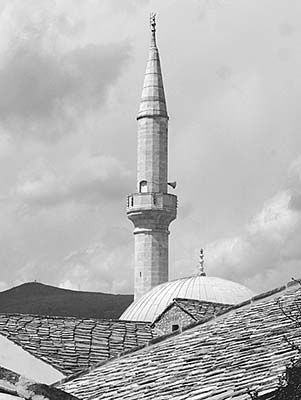
The actions of a small but attention-grabbing faction of Muslim extremists have burdened Islam with a bad reputation in the Western world. But judging Islam based on ISIS and al-Qaeda is a bit like judging Christianity based on the Oslo gunman and the Ku Klux Klan. Visiting Mostar is a unique opportunity to get a taste of a fully Muslim society, made a bit less intimidating because it wears a more familiar European face.
Here’s an admittedly simplistic outline designed to help travelers from the Christian West understand a very rich but often misunderstood religion that’s worthy of respect:
Muslims, like Christians and Jews, are monotheistic. They call God “Allah.” The most important person in the Islamic faith is Muhammad, Allah’s most important prophet, who lived in the sixth and seventh centuries AD. Jesus is also one of the most revered prophets in Islamic tradition.
The “five pillars” of Islam are the same among Muslims in Bosnia-Herzegovina, Turkey, Iraq, the US, and everywhere else. Followers of Islam should:
1. Say and believe this basic statement of faith: “There is no god but God, and Muhammad is his prophet.”
2. Pray five times a day.
3. Give to the poor (annually about 2.5 percent of one’s income).
4. Fast during daylight hours through the month of Ramadan. Fasting develops self-control and awareness, and is a step toward achieving selflessness.
5. Make a pilgrimage (hajj) to Mecca. Muslims who can afford it and are physically able are required to travel to Mecca at least once in their lifetimes.
Before leaving, ponder how progressive the majority of Mostar’s Muslims are. Most of them drink alcohol, wear modern European clothing (you’ll see few women wearing headscarves or men with beards—and those you do see are likely tourists from the Middle East), and rarely visit a mosque to pray. In so many ways, these people don’t fit our preconceived notions of Islam...and yet, they are Muslims all the same. That said, over two decades of visits, I’ve observed some Bosnian Muslims becoming more traditional—some argue because of the influence of wealthy Muslim nations in the Middle East. Seeing a Bosniak woman with her hair covered in public used to be extremely rare; now it’s not uncommon. For more on this topic, see the sidebar on here.
The mosque’s courtyard is shared by several merchants. When you’re done haggling, head to the terrace behind the mosque for the best view in town of the Old Bridge (entrance included in mosque ticket).
• Just beyond this mosque, the river-stone cobbles of the Old Town end. Take a right and leave the cutesy tourists’ world. Walk up one block to the big...
▲▲New Muslim Cemetery
In this cemetery, which was a park before the Yugoslav Wars, every tomb is dated 1993, 1994, or 1995. As the war raged, more exposed cemeteries were unusable. But this tree-covered piece of land was relatively safe from Croat snipers. As the casualties mounted, locals buried their loved ones here under cover of darkness. Many of these people were soldiers, but some were civilians. Muslim graves typically don’t display images of the deceased, but here you’ll see photos of war dead who were young members of the Muslim community. The fleur-de-lis shape of many of the tombstones is a patriotic symbol for the nation of Bosnia.
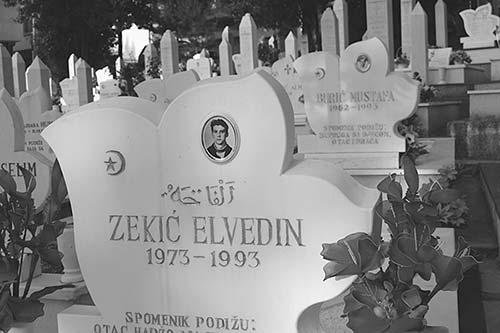
• For an optional sightseeing stop, you can head up the wide stairs to the right of the cemetery (near the mosque). At #4 (on the right, just before and across from the bombed-out tower), you’ll find the...
Museum of Herzegovina (Muzej Hercegovine)
This humble little museum is made worthwhile by a deeply moving film that traces the history of the town through its Old Bridge: fun circa-1957 footage of the diving contests; harrowing scenes of the bridge being pummeled, and finally toppled, by artillery; and a stirring sequence showing the bridge’s reconstruction and grand reopening in 2004—with high-fives, Beethoven’s Ode to Joy, fireworks, and more divers. (This includes much of the same footage as the similar film at the Bosnaseum, described earlier, which could make visiting both redundant.)
The museum displays fragments of this region’s rich history, including historical photos and several items from its Ottoman period. There are sparse English descriptions, but without a tour guide the exhibits are a bit difficult to appreciate. Topics include the Turkish period, Herzegovina under the Austro-Hungarian Empire, village life, and (in the basement) local archaeology. One small room commemorates the house’s former owner, Džemal Bijedić, who served as prime minister of Yugoslavia for several years until he was killed in a mysterious plane crash in 1977. (If Bijedić had lived, some wonder whether he might have succeeded Tito...and succeeded in keeping Yugoslavia together.)
Cost and Hours: 5 KM museum entry includes 12-minute film, no narration—works in any language, ask “film?” as you enter; Mon-Fri 8:00-16:00, closed Sat-Sun; Bajatova 4—walking up these stairs, it’s the second door that’s marked for the museum, under the overhanging balcony, +387 36 551 602, www.muzejhercegovine.com.
• Backtrack to where you left the Old Town. If the sight of the Muslim cemetery has you in a pensive mood to learn more about the horrors of the Yugoslav Wars, consider dropping into the museum you’ll pass on the right as you cross the street.
▲Museum of War and Genocide Victims 1992-1995 (Muzej žrtava rata i genocida 1992-1995)
Bosnia is about more than just the 1990s Yugoslav Wars—there are mountain landscapes, a fascinating mix of cultures, hearty food, and friendly people. But if Mostar is the only place you visit in the country, then this museum is an insightful stop to learn about the violent disintegration of the former Yugoslavia. Be warned: This exhibit confronts the visitor with the worst realities of war, including appalling stories of good people’s lives cut short, grisly images of human remains, and deeply disturbing footage of executions.
Cost and Hours: 12 KM, daily 9:00-22:00, progressively shorter hours off-season, Maršala Tita 130, +387 60 333 3579.
Visiting the Museum: From the entrance, head upstairs and circle through the exhibits (which continue on the main floor). The museum focuses on the individual stories of people who suffered and died during the war in Bosnia. Testimonies, all translated into English, are often linked to an item—such as a jacket, letters to family, or a diary—that belonged to a victim. Good descriptions explain the complicated demographics of Yugoslavia and provide biographies of convicted war criminals whose bloodthirsty attempt to change those demographics drove the conflict. Exhibits include a section on how people were tortured and information on Srebrenica—the Bosnian town where mass graves were later discovered and are still being excavated (for details, see here). Other exhibits explore forensic research carried out to identify bodies from those mass graves. In the basement is a wartime cellar, offering a glimpse into how the people in besieged Mostar lived.
While a visit here can be disturbing, the museum makes the war meaningful for people who didn’t live through it. Its personal, poignant exhibits help remind us that one of the first steps toward mass atrocities is dehumanizing people—and that this dehumanization is ongoing today.
• Continue back down past the museum; you’ll run into the Tepa Market—with locals buying clothing and produce—in the area just beyond the pedestrian zone.
Now continue into the modern town, with the market on your left (bear right at the fork). You’ll head along the lively street called Braće Fejića. (There’s no sign, but the street is level and busy with cafés.) You’re in the “new town,” where locals sit out in front of boisterous cafés sipping coffee while listening to the thumping beat of distinctly Eastern-sounding music. Stroll down this street for a few blocks. On the left, just after the handy Konzum supermarket (a block or so before the big minaret), side-trip a block to the left to reach...
▲Bišćević Turkish House (Bišćevića Ćošak)
Mostar has three traditional Turkish-style homes that are open for tourists to visit. The Bišćević House is the oldest, most interesting, and most convenient for a quick visit, but two others are described at the end of this listing. Dating from 1635, the Bišćević House is typical of old houses in Mostar that mix Oriental style with Mediterranean features.
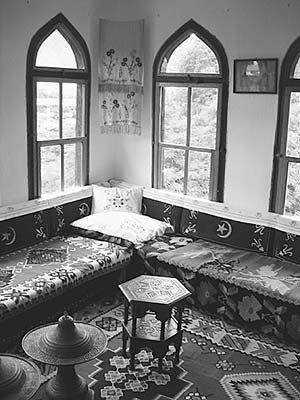
Cost and Hours: 4 KM, daily 9:00-19:00, generally closed Dec-Feb—but you can arrange a visit by calling ahead to Fortuna Tours at +387 36 552 197; house is at Bišćevića 13.
Visiting the House: First you’ll step through the outer (or animals’) garden, then into the inner (or family’s) garden. This inner zone is surrounded by a high wall—protection from the sun’s rays, from thieves...and from prying eyes, allowing women to take off the veil they were required to wear in public. Enjoy the geometrical patterns of the smooth river stones in the floor (for example, the five-sided star), and keep an eye out for the house’s pet turtles. It’s no coincidence that the traditional fountain (šadrvan) resembles those at the entrance to a mosque—a reminder of the importance of running water in Muslim culture. The little white building is a kitchen—cleverly located apart from the house so that the heat and smells of cooking didn’t permeate the upstairs living area.
Buy your ticket and take off your shoes before you climb up the wooden staircase. Imagine how a stairway like this one could be pulled up for extra protection in case of danger (notice that this one has a “trapdoor” to cover it). The cool, shady, and airy living room is open to the east—from where the wind rarely blows. The overhanging roof also prevented the hot sun from reaching this area. The loom in the corner was the women’s workplace—the carpets you’re standing on would have been woven there. The big chests against the wall were used to bring the dowry when the homeowner took a new wife. Study the fine wood carving that decorates the space.
Continue back into the main gathering room (divanhan). This space—whose name comes from the word “talk”—is designed in a circle so people could face one another, cross-legged, for a good conversation while they enjoyed a dramatic view overlooking the Neretva. The room comes with a box of traditional costumes—great for photo fun. Put on a pair of baggy pants and a fez and really lounge.
Other Turkish Houses: If you’re intrigued by this house, consider dropping by Mostar’s two other public Turkish houses. The newer Muslibegović House (Muslibegovića Kuća) dates from 1871, just a few years before the Ottomans left town. This homey house—which also rents out rooms to visitors (see “Sleeping in Mostar,” later)—has many of the same features as the Bišćević House. If they’re not too busy, Gabriela, Nejla, or another guide can give you an English tour (4 KM, mid-April-mid-Oct daily 11:00-18:00, closed to visitors off-season, two blocks uphill from the Karađozbeg Mosque at Osman Đikića 41, +387 36 551 379, www.muslibegovichouse.com). To find it, go up the street between the Karađozbeg Mosque and the cemetery, cross the busy street, and continue a long block uphill on the alley. The wall with the slate roof on the left marks the house.
The Kajtaz House (Kajtazova Kuća), hiding up a residential alley a few blocks from the Old Bridge, feels lived-in because it still is (in the opposite direction from most of the other sights, at Gaše Ilića 21).
• Go back to the main café street and continue along your way. On the right, look for a kiosk selling fresh-squeezed pomegranate juice. Soon you’ll reach the large...
▲Karađozbeg Mosque (Karađozbegova Džamija)
The city’s main mosque was completed in 1557, the same year work began on the Old Bridge. This mosque, which welcomes visitors, feels less touristy than the one back in the Old Town. Stepping inside the courtyard, you’ll see that this mosque has most of the same elements as the Koski Mehmet-Pasha Mosque (described earlier), but some of these decorations are original. Across the street is another cemetery with tombstones from that terrible year, 1993.
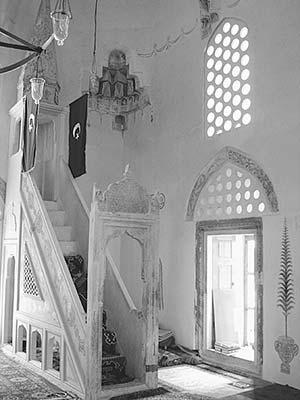
Cost and Hours: 6 KM to enter mosque, 10 KM includes minaret climb—94 steps, daily 9:00-18:00, Oct-April 10:00-16:00. You’ll need to remove your shoes, and women are asked to cover their hair and (if wearing shorts) put on a makeshift skirt.
• Now leave the tourists’ Mostar and continue into modern, urban Mostar along the street in front of the Karađozbeg Mosque. This grimy, mostly traffic-free street is called...
▲Braće Fejića
Walking along the modern town’s main café strip, enjoy the opportunity to observe this workaday Bosniak town. Notice that many cafés serve drinks but no food. People generally eat at home before going out to nurse an affordable drink. (Café Palma 2 has good cakes and ice cream; the upstairs is a popular pizza hangout for students and families.)
At the small mosque on the left, obituary announcements are tacked to the stone wall on the corner, listing the bios and funeral times for locals who have recently died. A fig tree grows out of the mosque’s minaret, just an accident of nature illustrating how that plant can thrive with almost no soil (somehow, the Bosniaks can relate).
Near the end of the pedestrian zone, watch on the right (through gaps in buildings) for the building set back from the street, with communist-era reliefs of 12th-century Bogomil tomb decor—remembering the indigenous culture that existed here even before the arrival of the Ottomans.
When you finally hit the big street (with car traffic), head left one block to the big Trg Musala (literally “Place for Prayer”). Historically, this was where pilgrims gathered before setting off for Mecca on their hajj. This is a great scene on balmy evenings, when it’s a rendezvous point for the community. The two busts near the central fountain provide perfect goal posts for budding soccer stars.
• For a finale, you can continue one block more out onto the bridge to survey the town you just explored. From here, you can backtrack to linger in the places you found most inviting. Or you can venture into...
WESTERN (CROAT) MOSTAR
Most tourists stay on the Bosniak side of town. But for a complete look at this city, it’s well worth strolling to the west side. While there’s not much in the way of sightseeing, and much of this urban zone isn’t particularly pretty, it does provide an interesting contrast to the Muslim side of town. As this is the location of some of Mostar’s new shopping malls, this area feels more vital each year, and a few of the tree-lined streets are downright elegant.
Crossing the river and the Bulevar, the scarred husks of destroyed buildings begin to fade away, and within a block you’re immersed in concrete apartment buildings. When the city became divided, the Muslims holed up in the original Ottoman Old Town, while the Croats claimed this modern Tito-era sprawl. The relative lack of war damage here makes it clear which side of town had the upper hand. Also notice that there are more pizza and pasta restaurants than ćevapčići joints—even the food over here is more Croat than Bosniak.
Look at a map, and you’ll notice that many streets here are named for Croatian cities (Dubrovačka, Splitska, Vukovarska) or historical figures (Kneza Branimira, Kralja Tomislava, and Kralja Petra Krešimira—for the dukes who first united the Croats in the ninth and tenth centuries). This side of town also has several remnants of Mostar’s brief period of Habsburg rule (1878-1918). During this time, the empire quickly expanded what had been a sleepy Ottoman backwater, laying out grand boulevards and erecting genteel buildings that might seem at home in Vienna.
All streets converge at the big roundabout (about a 15-minute walk from the Old Town) called the Rondo, which is a good place to get oriented to this neighborhood. Overlooking this lively intersection is the stately Hrvatski Dom (“Croatia House”) cultural center. Notice how even the street signs are politically charged: Centar signs pointedly direct traffic away from the (Bosniak) Old Town, and many road signs point toward Široki Brijeg—a Croat stronghold in western Herzegovina.
The adjacent Park Zrinjevac, a pleasant place to stroll, was the site of an infamously ill-fated attempt at reconciliation. In the early 2000s, idealistic young Mostarians formed the Urban Movement of Mostar, which searched for a way to connect the still-feuding Catholic and Muslim communities. As a symbol of their goals, they chose Bruce Lee, the deceased kung-fu movie star, beloved by both Croats and Bosniaks for his characters’ honorable struggle against injustice. A life-size bronze statue of Lee was unveiled with fanfare in this park in November 2005, but was almost immediately vandalized. The statue was repaired and may or may not have been returned to its pedestal (which you’ll still find in the park).
Several interesting sights lie close to this roundabout. A block toward the Old Town from the Rondo (on Kralja Višeslava Humskog), look for the big Muslim cemetery with tombstones from the early 1990s. These are the graves of those killed during the first round of fighting, when the Croats and Bosniaks teamed up to fight the Serbs.
If you head from the Rondo down Kneza Branimira (across from the park), you’ll enjoy an inviting boulevard shaded by plane trees. When first built, this street was called Štefanijino Šetalište—“Stéphanie’s Promenade,” after the Belgian princess who married Austria’s Archduke Rudolf (the heir apparent of the Habsburg Empire until he died in a mysterious murder-suicide pact with his mistress).
If you head up Kralja Petra Krešimira IV from the Rondo, after two long blocks on the left you’ll see a derelict park leading you to a gigantic Partisan Cemetery and Monument. This socialist-style monument spreads all the way up the hill. It oozes with symbolism trumpeting the pivotal WWII Battle of the Neretva, when Tito and his Partisan Army turned the tables on Nazi forces (just 30 miles north of here—see here). It was designed by Bogdan Bogdanović, who created many such monuments and memorials throughout Yugoslavia, and dedicated by Tito himself in 1965. From the terrace at the top, which is scattered with symbolic gravestones for those who gave their lives to free Yugoslavia from the Nazis, small streams once trickled down to the large enclosure at the bottom, ultimately flowing beneath a stylized broken bridge representing the Bridge at the Neretva.
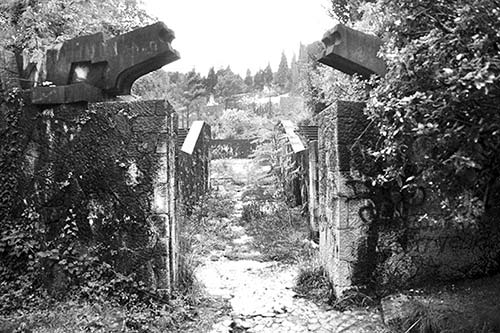
Today the monument is overgrown, ignored, and often vandalized—a tragic symbol of post-Tito ethnic discord. Local Croats have little nostalgia for the Yugoslav period, which they now view as a time of oppression. This formerly hallowed ground is a mess of broken concrete and a popular place for drunken benders, garbage dumping, and drug deals (be careful if you decide to explore—and avoid it after dark). A stroll here comes with a poignant reflection on how one generation’s honored war dead can become the next generation’s unwanted burden.
Nightlife in Mostar
Though Mostar is touristy, it’s also a real urban center with a young population looking for fun. The courtyard next to the Hammam Museum (on “Hammam Square”) is a fun place to observe them in action. The Old Bridge is another popular meeting place for locals as well as tourists. A stroll from the Old Bridge down the café-lined Braće Fejića boulevard to the modern Trg Musala at the far end of town (described earlier) offers a great peek at Mostarians socializing away from the tourists. Wherever you wind up, order a cocktail or try a Turkish-style hubbly-bubbly (šiša, SHEE-shah). Ask to have one of these big water pipes fired up for you and choose your flavored tobacco: apple, cappuccino, banana, or lemon.
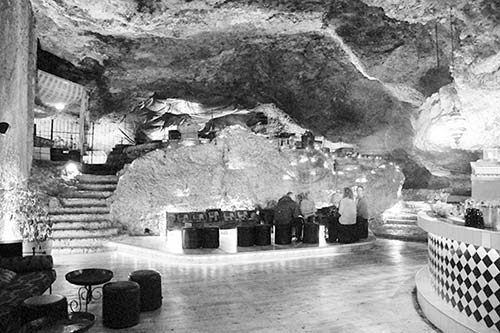
Ali Baba is an actual cave featuring a fun, atmospheric, and mellow hangout scene (look for the low-profile entrance along Coppersmiths’ Street, just down from the Old Bridge—watch for signs tucked down a rocky alley).
Oscar Summer Garden is a caravanserai for lounge lizards—an exotic world mixing babbling streams, terraces, lounge chairs, and big sofas where young and old enjoy cocktails and šiša (open “nonstop” as long as the weather is good—usually June-mid-Sept, closed off-season, up from the Old Bridge on Onešćukova street, near the Crooked Bridge at the end of the pedestrian zone).
Sleeping in Mostar
Most of my listings are small, friendly, accessible, affordable guesthouses in or very near the Old Town. Prices are deceptively low here—don’t overlook my lowest-priced listings, which are essentially as comfortable as the pricier ones. Many hotels and pensions in town promise “parking,” but it’s often street parking out front—private lots are rare. Mostar’s Old Town can be very noisy on weekends, with nightclubs and outdoor restaurants rollicking into the wee hours. If you’re a light sleeper, consider Villa Fortuna, the Muslibegović House, or Shangri La, which are quieter than the norm. If you’re looking for something more luxurious, check online to see if the new Marriott near the Old Bridge has opened.
The $$ Muslibegović House, a Bosnian national monument open to tourists during the day, is in an actual Turkish home dating from 1871. The 10 homey rooms and two suites combine classic Turkish style (elegant and comfortable old beds, creaky wooden floors with colorful carpets, lounging sofas, shoes left at the outer door) with modern comforts (air-con, flat-screen TVs). Situated on a quiet residential lane just above the bustle of Mostar’s main pedestrian drag and Old Town zone, this is a memorable experience (includes a tour of the house, closed Nov-March, 2 blocks uphill from the Karađozbeg Mosque at Osman Đikića 41, +387 36 551 379, www.muslibegovichouse.com, reservationmuslibegovic@gmail.com; Gabriela, Nejla, and stoic boss Tađudin).
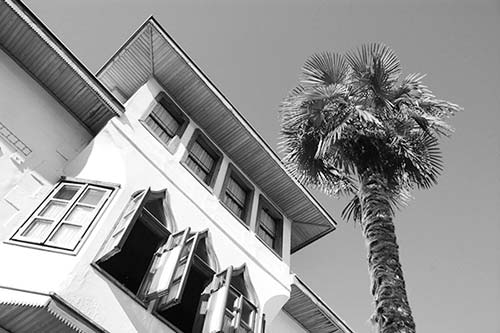
$ Shangri La Mansion fills a gorgeously restored Austro-Hungarian building on a hill above the Old Town, accessed by a steep driveway next to a war ruin. The 12 rooms come in different sizes, but they’re all modern and nicely appointed. Thoughtfully run with modern flair by Nermin, it also has a beautiful rooftop garden that’s ideal for relaxing (cash only, breakfast extra, air-con, parking, Kalhanska 10, +387 61 169 362, www.shangrila.com.ba, info@shangrila.com.ba).
$ Villa Čardak, run by kind and gregarious Suzana and Neđad Kasumović, has seven pleasant rooms sharing a kitchen in a stone house set just back from the bustling Crooked Bridge area (cash only, breakfast extra at nearby restaurant, air-con, pay parking, Jusovina 3, +387 36 578 249, mobile +387 61 385 988, www.pansion-cardak.com, info@pansion-cardak.com).
$ Hotel Kapetanovina, while still simple, feels bigger and more hotel-esque than my other listings. It has 23 modern rooms on a residential street between the Old Town and the Bulevar (air-con, elevator, pay street parking, Gojka Vukovića bb, +387 36 558 360, www.kapetanovina.com, info@kapetanovina.com).
$ Villa Anri, next door, has a stony facade that hides eight rooms (six with balconies) that combine old Herzegovinian style and bright colors. The big draw is the rooftop terrace, on which you can enjoy grand views over the Old Bridge area (cash only, breakfast extra, air-con, free parking, Braće Đukića 4, +387 63 259 534, https://villa-anri.business.site, villa.anri@gmail.com).
$ Hotel Kriva Ćuprija (“Crooked Bridge”), by the bridge of the same name, is tucked between waterfalls in the picturesque gorge a few steps from the Old Bridge. The 26 rooms are stylish (though many suffer from nearby nightlife noise), and their restaurant has atmospheric outdoor seating (air-con, call to reconfirm if arriving after 19:00, enter at Onešćukova 23 or Kriva Ćuprija 2, +387 36 360 360, mobile +387 61 915 915, www.hotel-mostar.ba, krivacuprijamostar@gmail.com, Sami and Jasna). They also have three big apartments in a building across the river.
¢ Villa Fortuna is an exceptional value, located in a nondescript urban neighborhood a few minutes’ walk farther away from the Old Bridge. Owner Nela Bijavica rents eight tasteful, modern rooms plus six apartments above the main office of Fortuna Tours. The courtyard in front offers free, secure parking, and in back there’s a pleasant garden with a traditional Herzegovinian garden cottage (RS%, breakfast extra, nonsmoking, air-con, Rade Bitange 34, +387 36 580 625, mobile +387 63 299 189, www.villafortuna.ba, info@villafortuna.ba).
¢ Pansion Nur, run by Niyaz and his son, Feđa, has four simple rooms—three with balconies—and a shared kitchen (no breakfast, air-con, free parking, Jusovina 8b, +387 62 160 872, www.pansion-nur.com, info@pansion-nur.com).
¢ Villa Botticelli, overlooking a charming waterfall garden just up the valley from the Crooked Bridge, has five colorful rooms at affordable prices (breakfast extra, air-con, free parking but reserve when you book, Muje Bjelavca 6, enter along the street facing the Crooked Bridge, +387 63 319 057, www.villabotticelli.com, info@villabotticelli.com, sweet Snježana and Zoran).
Eating in Mostar
Mostarians rarely dine out in the historical center where you’ll be spending your time, so most restaurants cater mainly to tourists. If you walk anywhere that’s cobbled, you’ll stumble onto many tempting eateries charging the same reasonable prices and serving rustic, traditional Bosnian food. The menus are nearly identical, though quality varies. As little distinguishes these places, don’t be too focused on a particular spot; find one with an ambience or view that you enjoy. Grilled meats are especially popular—read the “Balkan Flavors” sidebar, on here, before you dine. Most local wines are made with one of two indigenous grapes: blatina (literally “muddy”; a thick, heavy, earthy red) and žilavka (literally “root”; a bright, fairly acidic white).
ON THE EMBANKMENT, WITH OLD BRIDGE VIEWS
For the best atmosphere, find your way into the several levels of restaurants that clamber up the riverbank and offer perfect views of the Old Bridge. This is the most memorable setting for dining in Mostar—but the quality of the food is uniformly low, and prices are relatively high (figure 12-25 KM for a meal). If you want a good perch, drop by earlier in the day and reserve the table of your choice.
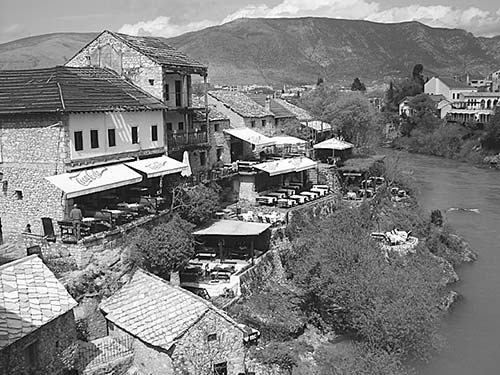
To reach two of the most scenic eateries, go over the Old Bridge to the west side of the river, and bear right on the cobbles until you get to the Hammam Museum. To the right of the old Turkish bathhouse is the entrance to a lively courtyard surrounded by cafés. Crossing straight through the courtyard, you’ll find stairs leading down to several riverfront terraces belonging to two different restaurants: $$ Babilon (my choice for better food) and $$ Teatar. Poke around to find your favorite bridge panorama before settling in for a drink or a meal. Two other places (including a pizzeria) are a bit closer to the bridge—to reach these, look for the alley on the left just before the bridge tower.
IN AND NEAR THE OLD TOWN
While they lack the Old Bridge views, these places are just as central as the others I’ve listed and serve food that’s generally a step up.
$ Restoran Hindin Han is pleasantly situated on a woody terrace over a rushing stream. It’s respected locally for its good cooking—with a wide variety, from grilled meats to seafood—and fair prices (Sarajevsko beer on tap, daily 11:00-24:00, Jusovina 10, +387 36 581 054). To find it, walk west from the Old Bridge, bear left at the Šadrvan restaurant, cross the bridge, and you’ll see it on the left.
$ Tima-Irma, run by the frenetic one-woman show Irma, grills up the best ćevapčići and other meats that I’ve had in Mostar. Its touristy, very scenic location—along the main shopping drag, a couple of blocks from the Old Bridge—belies the quality of the food (long hours daily, Onešćukova bb, +387 66 905 070).
$ Nacionalni Restoran Aščinica Balkan (“Balkan National Restaurant/Cafeteria”) is a convenient cafeteria-style eatery with two handy locations. They serve up tasty, home-cooked Bosnian specialties, with a wider variety than is typical in Mostar. You can order from the menu, but it’s more fun to order a “mix” (mješanac) plate from the display case—the small plate is plenty for a light meal (Bosnian coffee, tempting dessert display case, daily 7:00-24:00, one location right at the end of the Old Town cobbles before the market, the other a couple of blocks away on the new town’s main drag at Braće Fejića 57, +387 36 551 8686).
$ Saray is an untouristy, nondescript little eatery just uphill from the Karađozbeg Mosque in the modern part of town. They have a basic menu of very inexpensive and tasty grilled meats—specializing in the classic ćevapčići—and outdoor seating overlooking a playground that offers good people- and kid-watching while you eat (daily 7:00-23:00, Karađozbegova 3, +387 62 322 962).
$ Urban Grill’s food is nothing special—it has basically the same menu as other places in town—but its terrace enjoys one of Mostar’s best unobstructed views of the Old Bridge (Bosnian coffee, daily 8:00-22:00, enter along the main cobbled Old Town drag at Mala Tepa 22, +387 62 286 788).
In the West (Croat) Side of Town: Though less charming and romantic, a stroll to the west side of town offers an interesting contrast to the cutesy Old Town—and a completely different array of restaurants. Here you’ll find more pizza and pasta than grilled meats, as well as shiny new shopping centers with modern food courts. For more on this neighborhood, see “Sights in Mostar,” earlier.
Mostar Connections
BY BUS
Mostar’s main bus station (Autobusna Stanica)—sometimes listed as “Mostar (East)” on schedules—is on the east/Bosniak side of the river, about a 15- to 20-minute walk north of the Old Town (for details, see “Arrival in Mostar,” earlier). Most buses you’re likely to take use this station; for information on a secondary station (on the west/Croat side of town), with a few additional options, see the end of this section.
Schedules and Tickets: At the main station, two primary companies operate independent offices, providing schedule information and tickets only for their own buses. Because of this, tracking down complete and reliable schedule information is tricky, but https://getbybus.com usually succeeds in listing most of your options. (It can’t hurt to also check the two main company websites, listed next.) You may be able to purchase tickets online, but for some journeys, you’ll have to print out a paper ticket (unlike in Croatia, where e-tickets are typically no problem).
As you face the bus station, near the left end is the Bosniak company Autoprevoz (+387 36 551 900, www.autoprevoz.ba); they also sell tickets for a few smaller companies. Near the right end is the Croat-owned Globtour (+387 63 321 206, www.globtour.com), which sells tickets for its own buses, plus Flixbus and Arriva. Local and regional connections (which I don’t list) are operated by Mostar Bus, whose buses depart across the street from the main bus station (www.mostarbus.ba). Note that buses to seasonal destinations (such as along the Dalmatian Coast) run more frequently in peak season, roughly June through mid-September.
From Mostar’s Main Bus Station: Both Autoprevoz and Globtour operate buses to Sarajevo (6/day on Autoprevoz, 2/day on Globtour, 3 hours), Zagreb (4/day on Autoprevoz, 2-3/day on Globtour, 9 hours, includes a night bus), and Split (3/day on Autoprevoz, 2/day on Globtour, 4 hours). Only Globtour handles buses to Međugorje (4/day, 40 minutes) and Dubrovnik (2/day, 3-4 hours).
That important Dubrovnik connection is tricky: Recently, all Dubrovnik-bound buses have departed early in the day, making an afternoon return from Mostar to Dubrovnik impossible. However, in the past, during the summer (June-Aug) there was an afternoon option as well—making a same-day side trip from Dubrovnik possible. Ask or check schedules online to see if this works (but don’t count on it).
There are also buses, operated by both companies, to Montenegro’s Bay of Kotor. Be clear on the route your bus takes. Some go via Dubrovnik, which is scenic but requires two border crossings (Bosnia-Croatia and Croatia-Montenegro) and often arrives quite late. Others take the inland route, via Herzegovina and Trebinje, passing only one border; this takes longer but is more likely to be on time. However, be warned that some of these connections via Trebinje first go inland to the Montenegrin capital, Podgorica, before looping back to the coast at Budva and finally to Kotor—an extremely long journey.
From Mostar’s West/Croat Bus Station: A few additional buses, mostly to Croatian destinations and to Croat areas of Bosnia-Herzegovina, depart from the west side of town. These use a makeshift “station” (actually a gravel lot behind a gas station) on Vukovarska street, called “Kolodvor.” It’s about a 15-minute walk due west of the main bus station. Most buses using the Kolodvor station are operated by the Euroherc company. In addition to one daily bus apiece to Zagreb, Split, and Sarajevo, this station has several departures to Metković (at the Croatian border, with additional connections to Croatian destinations) and Međugorje. Additionally, some Croat buses leave from a bus stop near the Franciscan church. But because the connections are sparse, the location is inconvenient, and the “station” is dreary, I’d stick with the main bus station and ignore this option unless you’re desperate.
BY TRAIN
While the bus is preferable for almost every destination, there is a train to Sarajevo that makes the connection faster and costs less. While you’ll enjoy a higher vantage point for this scenic journey, the train spends more time in tunnels—so you’ll wind up seeing less (generally 2/day but at inconvenient times, about 2 hours, check the schedule at www.zfbh.ba).
ROUTE TIPS FOR DRIVERS FROM DUBROVNIK TO MOSTAR
You have two options for the drive between Dubrovnik and Mostar: easy and straightforward along the coast, or adventurous and off-the-beaten-path through the Herzegovinian mountains. I’ve narrated each route coming from Dubrovnik to Mostar, but you can do either one in reverse. (For driving directions from Mostar to Sarajevo, see the end of the Sarajevo chapter.)
Option 1: Main Coastal Road
The vast majority of traffic from Dubrovnik to Mostar follows the coastal road north, then cuts east into Bosnia. Because this is one of the most direct routes, it can be crowded (allow about 2.5 hours, not counting photo and sightseeing stops or border delays).
Crowd-Beating Tip: At busy times—particularly in the peak of summer (July-Aug), and especially on weekends—traffic can get backed up at the Metković border. If busy borders have been the norm (you can try asking savvy locals—but it’s hard to predict), try leaving Dubrovnik earlier (before 8:00) or later (around 10:00) than most other day-trippers. Or leave earlier but make some stops—such as Trsteno or Ston—en route; your goal is to reach the border after 11:00.
Another way to beat the crowds is to take the lesser-known border crossing between the Croatian town of Slano (“Salty”) and the Bosnian town of Ravno (“Flat”)—you’ll meet up with my “Rugged-but-Scenic” route, described later, near the Vjetrenica cave (see “Near Dubrovnik” map on here).
The Drive Begins: Head north out of Dubrovnik, driving along some scenic coves and past the Trsteno Arboretum (described in the Near Dubrovnik chapter). (Past Trsteno, about 30 minutes after crossing the bridge out of Dubrovnik, you’ll curve around the bay town of Slano, where you can take the alternate border crossing to Ravno, Bosnia.)
The main road carries on straight to the Bosnian coastal town of Neum, but you’ll take the left turnoff, marked for Split, Ston, Korčula, and Mljet. A few miles later, a turnoff on the right makes an easy visit to Mali Ston, with its oyster farms; carrying on straight past this, you’ll drive through the town of Ston, with its dramatic fortifications (on the right), which were designed to protect its precious salt flats (watch for these on the left). (Both Ston and Mali Ston are described in the Near Dubrovnik chapter.) Note that a planned bypass around the town of Ston may change these details—just follow signs for Split.
Soon after leaving Ston, a turnoff on the right leads to road 414 to Metohija; skip this unless you’d like a slow, scenic meander (parallel to the main road) past some great wineries, described in the Pelješac Peninsula section of the Near Dubrovnik chapter. You’ll stick on the main road and merge left to follow signs for Split. Farther along, you’ll stay straight for Split and Ploče.
The road goes through a couple of tunnels and eventually over the new 1.5-mile-long Pelješac Bridge, opened in 2022 to connect the area around Dubrovnik to the rest of Croatia, while bypassing the tiny stretch of Bosnian coastline at Neum—and its two border stops. (For more on this bridge, see the sidebar on here.) Notice the wind baffles on either side of the bridge, which allows it to remain open even when the battering Bora winds are blowing.
Soon after the bridge, the main coastal road jogs away from the coast and around the striking Neretva River Delta—the extremely fertile “garden patch of Croatia,” which produces a significant portion of Croatia’s fruits and vegetables. The Neretva is the same river that flows under Mostar’s Old Bridge upstream—but in Metković, it spreads out into 12 branches as it enters the Adriatic, flooding a vast plain and creating a bursting cornucopia in the middle of an otherwise rocky and arid region. Historically, this was a reedy swampland where little could grow. But in the early Yugoslav period, channels were dug to properly irrigate the land, creating the abundant farming you see today.
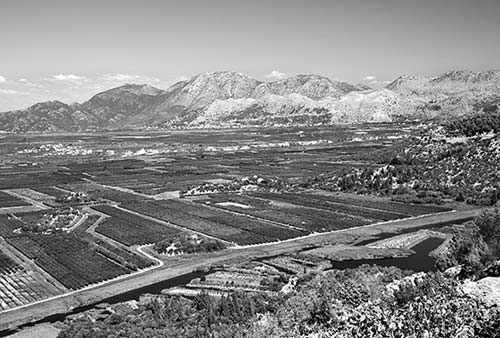
You’ll come into the hardworking town of Opuzen, where you’ll cross a wide canal, then turn off on the right for the border town of Metković (also marked for Mostar and Sarajevo). If you’re interested in Roman ruins, it’s worth a brief detour to see the Narona Archaeological Museum in Vid (see listing later in this chapter); the Kravice Waterfalls are also most easily reached by way of the border just beyond Vid.
Otherwise, just carry on straight through Metković to reach the border into Bosnia-Herzegovina, then continue straight on the main road (M-17) directly into Mostar. As you drive, you’ll see destroyed buildings and occasional roadside memorials bearing the likenesses of fresh-faced soldiers who died in the Yugoslav Wars of the mid-1990s.
Along the way are a few interesting detours, all described later in this chapter: In Čapljina, you can turn off to the left to reach Međugorje. If you stay on the main road, keep your eyes peeled soon after the Čapljina turnoff for a mountaintop castle tower (on the right side of the road), which marks the medieval town of Počitelj. With extra time, just before Mostar (in Buna), you can detour a few miles along the Buna River into Blagaj.
Approaching Mostar on M-17, you’ll pass the airport, then carry on straight toward Sarajevo. Be warned that GPS doesn’t have a good handle on Mostar, so follow these directions instead: Skip the first turnoff for Centar, when you’re still far from town. Rather, stay on the main Sarajevo-bound road, and then, as you begin to enter Mostar’s urban sprawl, take the left turn for Centar and Posušje. When you come to the traffic light, you can turn right to reach the east side of the river (if you’re sleeping at the Muslibegović House or Shangri La); or continue straight and then bear right onto the Bulevar to reach the west side of the river (for my other accommodations or parking near the Old Bridge—see “Arrival in Mostar,” earlier).
Once in town, signage can be confusing; if you get lost, try asking for directions to “Stari Most” (STAH-ree most)—the Old Bridge.
Option 2: Rugged-but-Scenic Backcountry Journey Through Serb Herzegovina
While the coastal route I just outlined is the most common way to connect Dubrovnik to Mostar, I enjoy getting out of the tourist rut by twisting up the mountains behind Dubrovnik and cutting across the scenic middle of Herzegovina. This route feels much more remote, but the roads are good and the occasional gas station and restaurant break up the journey. It takes approximately the same amount of time as the main route.
I find this route particularly interesting because it offers an easily digestible taste of the Republika Srpska part of Herzegovina—controlled by the country’s Serb minority, rather than its Bosniak and Croat majorities. You’ll see Orthodox churches and monasteries, the Cyrillic alphabet, and various symbols of the defiantly proud Serb culture (such as the red, white, and blue flag with the four golden C’s). You can’t get a complete picture of the former Yugoslavia without sampling at least a sliver of Serb culture. (Because this road goes through the Serbian part of Herzegovina, it’s not popular among Bosniaks or Croats.) If you want a little taste of Republika Srpska, consider just day-tripping into Trebinje—especially on Saturday, when the produce market is at its liveliest.
The Drive Begins: From Dubrovnik, head south toward Cavtat, the airport, and Montenegro. Shortly after leaving Dubrovnik, watch for—and follow—signs on the left directing you to Brgat Gornji. (Signage ignores the large Serb town of Trebinje, just past this obscure border village.) As you climb up over the mountains and cross the border into Bosnia-Herzegovina, notice the faint remains of a long-abandoned rail line cutting sharp switchbacks up the slope. This once connected Dubrovnik to Mostar and Sarajevo.
Carry on across the plateau, where you may begin to notice Cyrillic lettering on signs: You’ve crossed into the Republika Srpska. About 20 minutes after the border, you’ll come upon Trebinje (Требиње)—a pleasant and relatively affluent town that’s a good place to stretch your legs, get some convertible marks (ATMs are scattered around the town center), and maybe nurse a coffee while people-watching on the big, leafy, inviting main square. Out on the square, a smattering of humble open-air market stalls sell local produce (Saturday is the biggest market day, but there’s always some action). From the bottom of the square, you can stroll through the fortified gate into the sleepy, almost completely untouristy Old Town (called Kaštel), with more cafés and the town mosque (vengefully demolished during the war, but later rebuilt). The Trebišnjica River is spanned by the graceful, Ottoman-built Arslanagica Bridge.
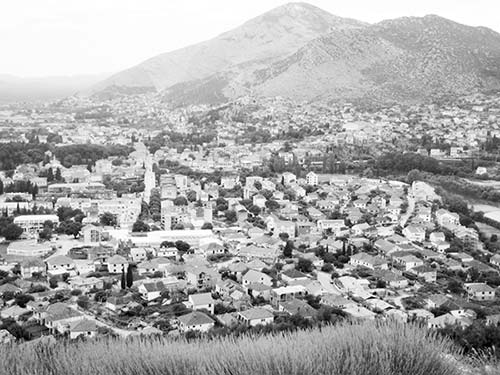
Overlooking the town from its hilltop perch is the striking Orthodox Church of Nova Gračanica, built to resemble the historically important Gračanica Monastery in Kosovo. If you have time, drive up to the church’s terrace for great views over Trebinje and the valley, and step inside the church to immerse yourself in a gorgeously vibrant world of Orthodox icons.
Whether you stop in Trebinje or not, from here, you’ll follow signs for Mostar and Ljubinje. You’ll trace the course of the Trebišnjica River into a high-altitude karstic basin, where evocative old waterwheels power a primitive irrigation system. From here, the river flows down to the coast—providing hydroelectric power for Dubrovnik—before detouring south and emptying into the sea near Herceg Novi, Montenegro...one river, three countries, in just a few miles. This area is blanketed with vineyards and dotted with old monasteries. Passing the village of Mesari (“Butchers”), you’ll also see flocks of sheep. In this part of the Balkans, Croats were traditionally the city-dwellers, and Serbs were the farmers. There used to be sheep like these in the pastures near Dubrovnik, but when the Serbs left during the war, so did the sheep.
Pull over at one of the humble, slate-roofed Orthodox chapels by the road. (There’s one in Staro Slano.) In the cemeteries, many of the gravestones are from 1991—when soldiers from this area joined the war effort against Dubrovnik.
The large, flat, sunken field you’re driving along is called Popovo Polje (“Priests’ Field”). Watch for the turnoff to Vjetrenica (near Zavala), a karstic cave. It’s less spectacular than the famous caves in Slovenia, but it has interesting water features that may be worth touring for spelunkers with time to kill (www.vjetrenica.ba).
At the fork, carry on toward Ljubinje (Љубиње), twisting up through even higher mountains. In this humble burg, roadside stands with med signs advertise homegrown honey. Also keep an eye out for drying tobacco. The partially built houses you’ll see are a form of “savings” in the Balkans, where people don’t trust banks: Rather than deposit money in an account, they spend many years using any extra funds to gradually add on to a new house.
Continuing toward Mostar, you’ll pass through more desolate countryside, then your ears will pop (and you’ll pass a red, white, and blue sign marking the “border” of Republika Srpska) as you drop down into the town of Stolac (Столац); the town’s mosque minaret tells you that you’ve crossed from Serb territory into Bosnia’s Muslim-Croat Federation. Stolac is home to some fascinating history and worth a stroll if you have the time (see later in this chapter). Leaving Stolac toward Mostar, keep an eye out (on the left, just before the Poprati sign) for its interesting necropolis—a cluster of centuries-old traditional Bosnian tombstones (worth a quick photo-op stop, and described later).
Past Stolac, you’ll climb up the hill, going through the village of Poprati. Soon you’ll have the option of either turning off to the right to head directly to Mostar or continuing along the main road to reach Čapljina, where you’ll turn right to go past Počitelj on your way into Mostar. Either way, Blagaj (described next) is worth considering as a detour before ending in Mostar. (If you want to go to Međugorje—described later—go through Čapljina and follow signs.)
Near Mostar
There’s plenty to see within a short drive of Mostar. Ideally try to splice one or two of these stops into your trip between Mostar and the coast (see my “Route Tips for Drivers” for tips on linking them up).
These sights cluster, both geographically and culturally, in two areas: The Bosniak part of Herzegovina, along the main road from Metković to Mostar, has sights that are more closely tied to the country’s Muslim heritage; the Croat part of Herzegovina—on a parallel road just to the west—includes a major Catholic pilgrimage site, some pretty waterfalls, and (just over the Croatian border) a Roman museum. Note that these two “clusters” are in different directions—which ones you can easily reach depends on which route you take to or from the Dalmatian Coast.
Sights in Bosniak Herzegovina
BLAGAJ
Blagaj (BLAH-gai, rhymes with “pie”) was the historical capital of this region until the arrival of the Ottomans. This is the site of a mountain called Hum, which is topped by the ruins of a hilltop castle that once belonged to Herzog (“Duke”) Stjepan, who gave Herzegovina its name.
Deep in Blagaj is an impressive cliff face with a scenic house marking the source of the Buna River. The building, called the Tekija, is a former monastery for Turkish dervishes (an order that emphasizes poverty and humility, famous for the way they whirl in a worshipful trance). Built in the 15th century, the house is surrounded by a modern visitors-center complex with a café, a gift shop, and WCs. For a small entry fee, you can look around the Tekija, which feels similar to the tourable Turkish houses in Mostar (for a description, see the Bišćević Turkish House listing under “Sights in Mostar”). You’ll take your shoes off and tiptoe across a patchwork of small rugs from room to room. Gazing out the windows at the towering cliff stretching to heaven, and hearing the constant, steady flow of water, it’s easy to imagine how this could be considered a very spiritual place.
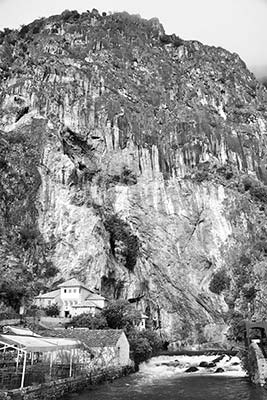
After seeing the house, stroll a bit along the river, which is crossed by several footbridges offering a grand view back on the Tekija and cliff. A handful of sprawling, touristy restaurants—with open-air terraces right along the refreshing river—serve up traditional Bosnian food, including trout pulled from their own river-fed ponds.
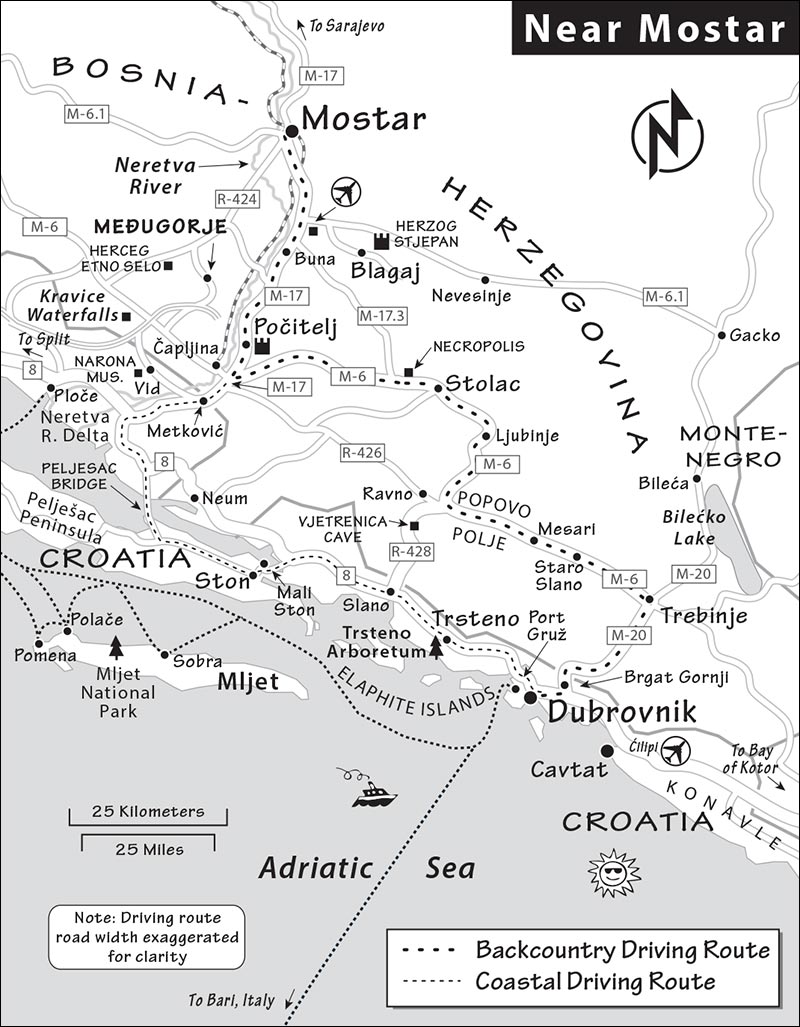
Getting There: Blagaj is easiest to see on the way to or from Mostar—just turn off from the main road and follow the Buna River, following tekija signs to the big parking lot.
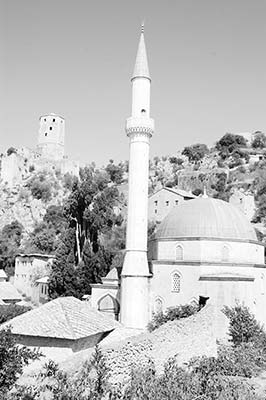
POČITELJ
Počitelj (POTCH-ee-tell) is an artists’ colony filled with a compelling mix of Christian and Muslim architecture. Ideally situated right along the main Mostar-to-Croatia road, it’s one of the most popular rest stops for passing tour buses, so it’s hardly undiscovered. But it’s still worth a stop for its dramatically vertical townscape and beautifully restored Ottoman architecture.
Park your car and hike across the river-stone cobbles to the open square at the base of town, with a handy restaurant, lots of gift shops, and aggressive vendors. The multidomed building is an old hammam (bathhouse). Then hike up the steep stairs (dodging costumed vendors and enjoying good aerial views on those hammam domes) to reach the mosque. You can pay a small fee to enter (women must cover their heads). The interior is bigger, though not necessarily better decorated, than the mosques in downtown Mostar (for a description of a typical Bosnian mosque interior, see the Koski Mehmet-Pasha Mosque listing under “Sights in Mostar”). A photo on the porch shows the building circa 1993, destroyed to its foundation.
Continue up the steep stairs behind the mosque, which lead you all the way up to the fortress, which was originally built in the 15th century by Hungarian King Mátyás Corvinus (who pushed the Ottomans back, briefly reclaiming some territory—including this region—for the forces of Christian Europe). There’s not much to see inside (the stairs inside the tower are extremely steep and narrow—tread carefully), but the views are sensational. The best views are from the flat terrace out front. It’s clear just how strategic this location is, between steep cliffs and with perfect views up and down the Neretva Valley.
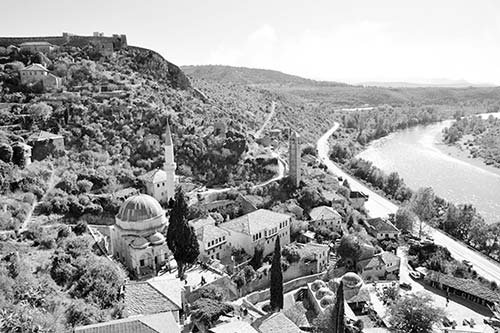
STOLAC
One of the most historic spots in Herzegovina, Stolac (STOH-lats) was a cradle of early Balkan civilization. Unless you’re fascinated by archaeology, Stolac isn’t worth a long detour—but since it’s on the way between Mostar and Dubrovnik (on the back-roads route), consider stopping off if you have time to spare.
About 15,000 to 16,000 years ago—long before the Greeks or Romans arrived in this region—the Illyrians lived in this area’s caves, where they left behind some drawings. On a hill above the modern town are the overgrown remains of the once-fearsome dry-stone Illyrian fortress that watched over this strategic road in the third and fourth centuries BC. The Romans were later supplanted by the local Bogomil civilization, an indigenous Christian society. Stolac’s most impressive attraction dates from this era: On the outskirts of town (on the road toward Mostar), you’ll find a necropolis with a bonanza of giant tombstones called stećaks (from the 13th-15th century), engraved with evocative reliefs. Soon after these were erected, the Ottomans arrived, and conversions to Islam followed.
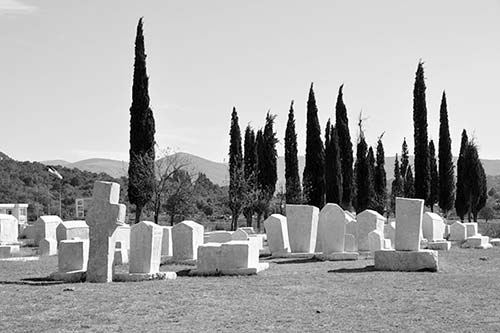
Archaeological treasures aside, today’s Stolac is a workaday village with little tourism—it trudges along, largely oblivious to the ancient treasures embedded all around. The town was particularly hard-hit during the Yugoslav Wars, when it was taken over by Croat forces and its majority Muslim residents forced to flee to Mostar. The war-crimes tribunal in The Hague had an entire division devoted to “Stolac Crimes”—at least 80 civilians were killed here. The mosque and surrounding area were completely leveled; it’s now rebuilt, and the town’s population is divided evenly between Croats and Bosniaks. Tension still hangs heavy in the air. Local Croats have erected crosses in front of several buildings in town, and the main square features a giant monument engraved with the names of Croats killed in the fighting here. The new, super-modern Catholic church spire rockets up over town, evoking the one-upmanship of the similar steeple in Mostar. And yet, many locals are working hard toward reconciliation and integration. Progress is slow, but it’s happening.
Local Guides: If you’re interested in learning more, it’s well worth hiring local guide Sanel Marić, who works for a local organization that strives to help the people of Stolac transcend the scars of the war. He can show you some of the ancient sights around town and fill you in on recent events (€40 for a tour around town, +387 61 071 830, sanel.marich@gmail.com). If Sanel is busy, his colleague Edin Buzaljko also gives great tours of Stolac (same price, +387 61 308 476, edobuzz@gmail.com).
Eating in Stolac: To grab a bite here, consider two traditional eateries. $ Restoran Han is right in the heart of town, while $ Old Mill occupies a beautiful setting overlooking waterfalls on the road up the Bregava River.
Sights in Croat Herzegovina
I’ve listed these in the order you’d reach them as you come from Croatia toward Mostar.
METKOVIĆ
This dusty and depressed Croatian border town—which sits where the lush Neretva River Delta meets a wall of limestone hills—is best known as the place where most people cross the border into Bosnia. There’s nothing to see in Metković itself, but if you’re interested in ancient ruins, the nearby Narona Archaeological Museum is worth a short detour.
▲Narona Archaeological Museum (Arheološki Muzej Narona)
In Roman times, the province of Dalmatia (roughly today’s Croatia and Bosnia) was sparsely populated. There were only two real towns of note. The main city was Salona, the birthplace of Diocletian, near today’s Split. The second city was Narona, which stood on a plain at the foot of the mountains, powered by tributaries of the Neretva River.
Today Narona is mostly unexcavated, sitting under a tiny village called Vid near Metković. In the 1990s, archaeologists discovered a treasure trove of Roman statues in a dilapidated barn here. They carefully excavated this cache—the largest collection of marble Roman statues from this period—and built a state-of-the-art museum to show them off in situ (with English explanations). The centerpiece is the foundation of a temple of Augustus, dating from around 10 BC, with 15 Roman statues. You’ll also see plenty of Roman carvings, pottery fragments, and good descriptions. Out front, under glass, is a mosaic floor. The museum is in a blocky, can’t-miss-it building that stands at the entrance to the otherwise ramshackle hill town of Vid. (The square in front of the museum was the site of Narona’s forum.)
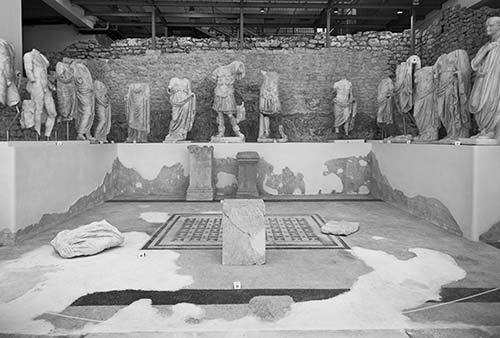
Cost and Hours: €6; June-Sept Tue-Sun 9:00-19:00; Oct-May Tue-Fri until 16:00, Sat until 17:00, Sun until 13:00; closed Mon year-round; Naronski Trg 5 in Vid, +385 20 691 596, www.a-m-narona.hr.
Getting There: Driving through Metković toward the Bosnian border, turn left over the last bridge before you reach the checkpoint. At the next roundabout, turn right, following signs for Vid. After you cross the river in Vid, the museum is straight ahead. It’s less than 10 minutes from the main road.
Eating: Across the street from the museum, the rustic $$ Đuđa i Mate specializes in local Neretva River cuisine—frogs and eels (though they also have an extensive menu of typical Croatian dishes). There’s a covered terrace near the restaurant, but I prefer the covered seating down by the river (daily 8:00-23:00, +385 20 687 500).
KRAVICE WATERFALLS
Kravice (KRAH-veet-seh, literally “Calves”) is a modest collection of gushing waterfalls, worth ▲, filling a small canyon in the middle of nowhere. Though pleasant to explore, this so-called “Oasis in Stone” pales in comparison to the similar (but far more elaborate) Plitvice Lakes National Park or Krka National Park, both farther north. But if this is your handiest opportunity to see some waterfalls, you could do worse than to visit Kravice. (You’ll see the falls heavily advertised by tour companies in Dubrovnik and Split offering excursions to Mostar. This doesn’t necessarily reflect the worthiness of the falls, so much as that they’re in the Croat part of Herzegovina, and therefore appealing for Croatian companies to pair up with Mostar and/or Međugorje.)
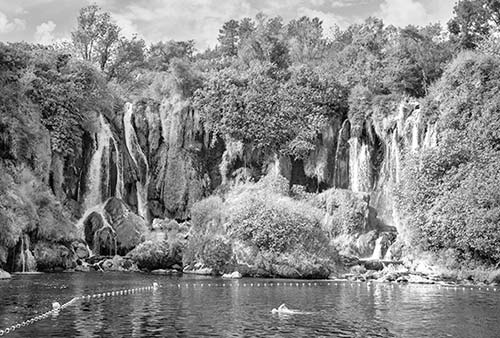
Visiting the Falls: A visit to Kravice is fairly straightforward: You’ll pay a small fee (2 KM/hour, 6 KM/all day) to park at the upper lot; buy a ticket (a hefty 20 KM/person); then make a fairly easy downhill hike on a well-surfaced sidewalk with lots of stairs to the lagoon below (less than 10 minutes). To save a little sweat, you can pay 2 KM to hitch a ride on the tourist train, which makes the trip about every 15 minutes.
Kravice is a lagoon that’s constantly filled by a tributary of the Neretva River. Along one wall of the canyon, a series of beautiful bridal-veil falls tumble into the river. It doesn’t take long to see the area (you can get the gist with a quick swivel of the neck), but there are a few very short trails that get you closer to some of the falls. One of the big draws is that you can swim in the lagoon—though barriers prevent you from getting very close to the falls themselves. You can also hire a boatman to take you out on a little rowboat trip, or—on the other side of the lagoon—a motorboat trip down the outlet river. Several cafés with all the predictable Bosnian dishes (ćevapčići and other grilled meats) line up along the lagoon for those who want to linger over a drink or a lunch.
Getting There: It’s most straightforward to first go to the town of Ljubuški—between Međugorje and the border—and then follow brown Kravice signs south from there; this road dead-ends at the parking lot.
MEĐUGORJE
Međugorje is an unassuming little village “between the hills” (as its name implies) that ranks with Lourdes, Fátima, and Santiago de Compostela as one of the most important pilgrimage sites in all of Christendom. To the cynical non-Catholic, it’s just a strip of crassly commercial hotels, restaurants, and rosary shops leading up to a dull church, all tied together by a silly legend about a hilltop apparition. But if you look into the tear-filled eyes of the pilgrims who’ve journeyed here, it’s clear that to them the power of this place is real. Strolling through the grounds, you can hear the hushed sounds of prayer whispering through the bushes.
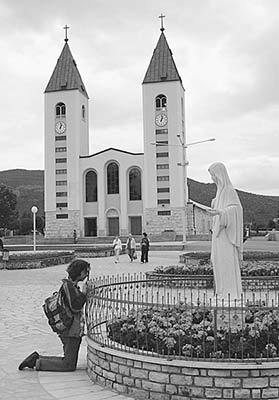
For true believers, Međugorje represents a once-in-a-lifetime opportunity to tread on sacred soil: a place where, over decades, the Virgin Mary has appeared to six local people, and where hundreds of thousands of Catholics visit each year. More than 30 million pilgrims have visited Međugorje since the sightings began—summer and winter, war (which didn’t touch Međugorje) and peace, rain and shine.
Planning Your Time: Unless you’re a pilgrim (or think you might be a pilgrim), skip Međugorje—it’s an experience wasted on nonbelievers. The only “attractions” are an unexceptional modern church, a couple of hilltop hikes, and pilgrim-spotting.
If you do go, the easiest way is to take a day-trip excursion from the Dalmatian Coast (sold from Split, Dubrovnik, and Korčula). By public bus, you can day-trip into Međugorje from Split, but not from Dubrovnik. Consider spending the night here, or sleep in Mostar two nights and day-trip into Međugorje.
Orientation to Međugorje: Međugorje (MEDGE-oo-gor-yeh, sometimes spelled “Medjugorje” in English) is basically a one-street town—most everything happens in the half-mile between the post office (where the bus stop is) and the main church, St. James (Crkva Sv. Jakova). On the hills behind the church are two trails leading to pilgrimage sites. Many travel agencies line the main strip; at any of these, you can find a room, rent a car, or hire a local guide.
Sights in Međugorje: The center of pilgrim activity is St. James’ Church, which was built before the apparitions. The interior, like the outside, is modern and monochromatic—with a soothing yellow color and stained-glass windows lining the nave. Out front are maps that are useful for getting oriented and a white statue of the Virgin Mary that attracts a lot of attention from pilgrims. Notice the long row of multilingual confessional booths.
As you face the church, you’ll see two trails leading up into the hills. Behind and to the left of the church is Apparition Hill (at Podbrdo), where the sightings occurred (a one-mile hike, topped by a statue of Mary). Directly behind the church is the Great Hill (Križevac, or “Cross Mountain”), where a giant hilltop cross, which predates the visions, has become a secondary site of pilgrimage (1.5-mile hike). If you wonder why they don’t make these rocky paths easier to climb, remember that an act of pilgrimage is supposed to be challenging. In fact, pilgrims often do one or both of these hikes barefoot, as an act of penitence.
What compels millions to flock to this little village in the middle of nowhere? The official story goes like this: On the evening of June 24, 1981, two young women were gathering their sheep on the hillside above Mostar. They came across a woman carrying a baby who told them to come near. Terrified, they fled, only to realize later that this might have been a vision of the Virgin Mary. They returned the next night with some friends and saw the apparition again.
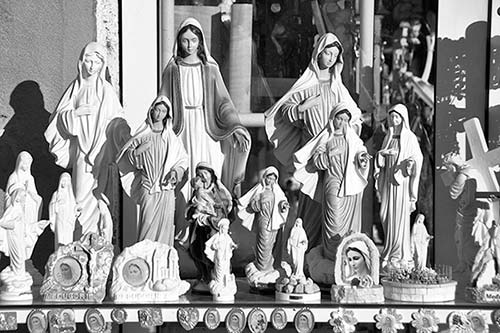
In the three-plus decades since, six different locals (including the two original seers) claim to have seen the vision, and some of them even say they see it regularly to this day. They also say that Mary has given them 10 secrets—predictions of future events that will portend Judgment Day. Written on a piece of parchment, these are kept safely at the home of one of the seers. They have said they will reveal each of these secrets 10 days before the event occurs to the local parish priest, who will then alert the world.
Doubting Thomases aren’t convinced. One cause for suspicion is that the six seers, before witnessing the visions, were sometimes known to be troublemakers. (In fact, they later admitted that they went up the hill that fateful night not to chase wayward sheep, but to sneak a smoke.) One investigator suggested that they invented the story as a prank, only to watch it snowball out of control once they told it to the local priest.
For decades, the Vatican declined to confirm the sightings as miraculous in nature. (Priests were allowed to accompany pilgrimages to Međugorje, but not to lead them.) But in 2019, Pope Francis officially authorized Međugorje as a pilgrimage site.
Around back of the church is a makeshift amphitheater with benches used for outdoor services. Beyond that is a path lined with scenes from the life of Jesus. Farther along, on the right, is an elongated, expressionistic statue of the Resurrected Savior (Uskrsli Spasitelj), also known as the “Weeping Knee.” Miraculously (or not), the statue’s right knee is always wet—go ahead and touch the spot that’s been highly polished by worshippers and skeptics alike.
Believers and nonbelievers alike appreciate the parade of kitsch that lines the main street leading up to the church. Rosaries are clearly the big item, but you can get basically anything you want stamped with Catholic imagery (Mary is particularly popular, for obvious reasons).
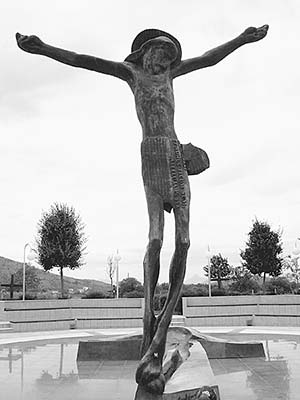
Sleeping and Eating in Međugorje: In town, the main street is lined with straightforward, crank-’em-out eateries catering to tour groups. For something a little more atmospheric and fun, head for $$ Gardens Restaurant (near the post-office end of the main drag), with a drinks-only bar, a classy upstairs dining room, and a garden terrace (Pape Ivana Pavla II 62, +387 36 650 499).
Just outside town, Herceg Etno Selo is an appealing “ethno-village” of new-but-old-looking Bosnian dry-stone buildings wedged between industrial areas and office parks. With slate roofs, inviting ponds, playgrounds, a vineyard, a small farm, and a big amphitheater, this sprawling complex includes an industrial-size $$ restaurant (well-executed Bosnian and Croatian food) and a 71-room $ hotel (Tromeđa bb, +387 36 653 400, www.etno-herceg.com, info@etno-herceg.com). Leaving town, follow signs for Split/Ljubuški, and look for it on the left between warehouses.