BOSNIA-HERZEGOVINA
In the 1990s, Bosnia-Herzegovina became synonymous with war, sectarian violence, and genocide. That’s a shame, because for so much of its history this remarkable land has represented exactly the opposite. While skittish travelers may never experience it for themselves, Bosnia-Herzegovina boasts a unique mix of cultures and faiths, kind and welcoming people who pride themselves on their hospitality—and some of the most captivating sightseeing in southeastern Europe.
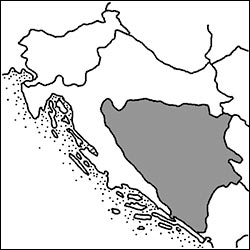
Bosnia-Herzegovina is a small country with three faiths, three languages, and two alphabets. While the rest of Yugoslavia has splintered into countries dominated by one ethnicity, Bosnia remains a mix of scattered communities, with large contingents of all three major Yugoslav groups: Muslim Bosniaks, Eastern Orthodox Serbs, and Catholic Croats—erstwhile enemies, now inching toward reconciliation.
A visit here offers a fascinating opportunity to sample the cultures of these three major faiths within a relatively small area. On the same day, you can inhale incense in a Serbian Orthodox church, hear the subtle clicking of rosary beads in a Roman Catholic church, and listen to the Muslim call to prayer echo across a skyline pricked by minarets. Few places in Europe cram so much diversity into such a small area.
About half the people in Bosnia are “Bosniaks”—that is, Muslims. And that makes travel in Bosnia an illuminating and unique foray into a culture that’s both devoutly Muslim and fully European. Here, just a short drive from the touristy Dalmatian Coast, you can step into a mosque and learn about Islam directly from a Muslim. The country also holds one of the most important pilgrimage sites of the Roman Catholic world: Međugorje, where six residents have reported seeing visions of the Virgin Mary.
Bosnian coffee (bosanska kafa) is not just a drink but a complex ritual that captures this culture’s deliberate, stop-and-smell-the-tulips approach to life. Similar to what you might call “Turkish coffee,” this unfiltered brew is prepared—and enjoyed—according to a very specific routine: The fine grounds are stirred with water in a small copper-plated kettle with a long, straight handle (called a džezva). When it’s ready to drink, it’s done slo-o-o-owly: Carefully decant the coffee—easy now, don’t pour off too many grounds—into a small ceramic cup. If you take sugar, put the sugar cube in the cup first, then pour the coffee over it. Sip your coffee gradually, and swirl the cup periodically to agitate and recaffeinate your brew. (If it’s prepared—and drunk—properly, you won’t wind up with “mud” at the bottom of the cup.) Nibble on the Turkish delight candy (rahatlokum) that usually accompanies Bosnian coffee, and take time to chat with your travel partner or a new Bosnian friend. The point is not to slam down caffeine but to have an excuse to slow your pulse and focus on where you are and who you’re with.
Bosnian coffee is just one of the many facets of local culture that were adopted from the Ottomans (from today’s Turkey), who ruled here for centuries. Thanks largely to this influence, Bosnian culture is permeated with a soulfulness that’s rare in Europe. The Bosnian language features an entire lexicon of words that have no clear translation in other tongues or cultures.
Sarajevans embrace the concept of raja, meaning an unpretentious humility that stems from being one with a community or a circle of friends. Merak is enjoyment, particularly a relaxed atmosphere that arises when you’re among friends—perhaps while listening to sevdah music (explained next) and sipping Bosnian coffee. Enjoying the company of friends while going out for snacks is called mezetluk (related to the Greek mezedes, or tapas-like small plates). And the insult papak (literally “hoof”) means primitive, naive, tacky, or generally “outsider”—such as wearing white socks with dark shoes (a stereotypical Bosnian faux pas).
My favorite Bosnian word is ćejf (pronounced “chayf”), which means a sense of well-being while engaged in a highly idiosyncratic routine. These rituals—from the way someone spins their worry beads, to their own unique procedure for preparing and drinking coffee or smoking a water pipe, to a dervish whirling in a worshipful trance—might be considered “OCD” (or simply annoying) by many Americans...but Bosnians understand that it’s simply ćejf. As long as your ćejf is not hurting anyone, it’s tolerated—because everyone has one.
Sevdah—sometimes called “the Bosnian blues”—is a traditional folk music that mingles powerful emotions: sad and happy, convivial and nostalgic. Bosnians explain how the passionate, mournful strains of sevdah (which sounds distinctly Eastern) pair perfectly with falling in love, drinking with friends, or contemplating loss. Sevdah is also the word for a poignant, melancholic mood—sort of the counterpoint to merak. Balancing these moods, Bosniaks explain, is key to emotional satisfaction.
To strike up a conversation, ask your new Bosnian friend to tell you more about what any of these terms means. All of them are examples of how Bosnians celebrate the “little things” that make life worth living...things that mainstream American and European cultures, all too often, see as barriers to progress.
In keeping with their generally relaxed culture, Bosnians are known for their gregarious sense of hospitality and their sharp sense of humor. Even during the darkest days of the war, they found ways to joke about the horrors unfolding around them, and today they manage to chuckle about the continued headaches of a poorly functioning government and a shambolic economy. One Bosnian friend quipped: “Just our luck. Bosnia has so many Muslims—but no oil.”
This unique Muslim culture seems fitting in this porous and mountainous land, where streams and rivers trickle endlessly. After all, the name “Bosnia” comes from a term that means “running water” or “saturated”—and Muslim culture prizes constantly flowing water. While Christians bless still water and call it holy, for Muslims, the power of nature is in its movement; they prefer water to be continually flowing, cleansing, replenishing, circulating. Just as a dervish whirls to connect with the spirituality of the earth and the heavens, so, too, should water be in motion.
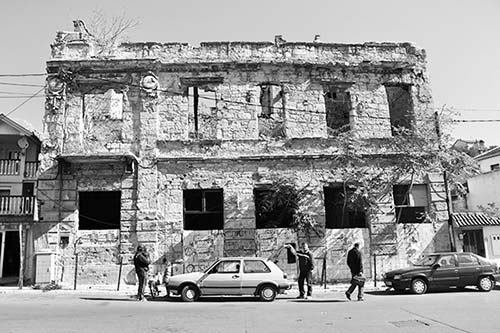
While repairs are ongoing, you’ll still be confronted by vivid and thought-provoking scars of the Yugoslav Wars, especially outside the tourist zones. Poignant roadside memorials to fallen soldiers, burned-out husks of buildings, unmistakable starburst patterns in the pavement, and bullet holes in walls are a constant reminder that the country is still recovering—physically and psychologically—three decades after a three-way war tore this community apart. Driving through the countryside, you’ll pass between Muslim, Croat, and Serb towns—each one decorated with its own provocative sectarian symbols. Bosnia teaches an essential lesson about how real—and destructive—war and interethnic strife truly are.
Of all the former Yugoslav states, Bosnia is where you’ll sense the most nostalgia for communist-era leader Marshal Tito (at least, in the Bosniak-dominated parts of Bosnia, like Mostar and Sarajevo). This is likely because Bosniaks suffered the most from the breakup of Yugoslavia. It was only under Tito—for whom ethnic division mattered less than Yugoslav unity—that Bosniaks felt protected and respected.
And there’s another throwback to the past here: In Bosnia, you’ll be exposed to more cigarette smoke than in most of Europe. Hotels and restaurants permit smoking to an unusual degree.
While Croatian prices have increased exponentially in recent years, Bosnia remains an excellent budget destination. Even in cities, it can be impossible to find a true splurge hotel or meal. If you’re on a very tight budget, one reasonable plan might be to rush through Croatia and linger in Bosnia.
In this book, I focus on a few user-friendly Bosnian destinations within easy reach of the Dalmatian Coast: the Turkish-flavored city of Mostar (with its restored Old Bridge—one of Europe’s most inspiring sights), some nearby attractions offering a more complete view of Herzegovina (Kravice Waterfalls, Blagaj, Počitelj, and Stolac), the Catholic shrine at Međugorje, and—just over the Croatian border—an excellent Roman museum near Metković. A longer trip from Dalmatia—and well worth the trek—is the Bosnian capital of Sarajevo, with a spectacular mountain-valley setting, a multilayered history, powerful wartime stories, and a resilient populace of proud Sarajevans eager to show you their city.
Bosnia is highly recommended as a detour—both geographical and cultural—from the Croatian and Slovenian mainstream. In fact, it’s possible that this wonderful land with ruggedly beautiful terrain is Europe’s single most underrated destination. Inquisitive visitors come away from a visit to Bosnia with a more nuanced understanding of the former Yugoslavia. And Bosnia offers a warmer welcome than you’ll find on the Croatian coast. Overcome your jitters and dive in.
BOSNIAN HISTORY
Thanks to its mountainous landscape, less accessible than the more mainline areas of the western Balkans, Bosnia’s evolution has followed a unique course. Even in the present day, the people of Bosnia struggle with being outsiders—afloat on an oddball cultural island flanked by the Roman Catholic West (Croatia) and the Orthodox East (Serbia), borrowing elements from both but not fully belonging to either.
After periods of rule by the Illyrians and the Romans, Bosnia fostered its own thriving Slavic civilization during the Middle Ages. The local Bogomils were a homegrown branch of Christianity that was neither Catholic nor Orthodox—and was viewed with suspicion by both sects. Literally “dear to God,” the Bogomil faith was simple, ascetic, and somewhat mystic, combining elements of Slavic, Illyrian, and Celtic traditions. The Bogomils—who comprised a majority of the population of medieval Bosnia—had a thriving civilization. Vivid artifacts of the Bogomil kingdom still survive, such as their engraved burial grave markers, called stećaks (some of the best-preserved are in Stolac, near Mostar—see here).
When the Ottomans (from today’s Turkey) took over this land in the 15th century, they tolerated different faiths but offered generous economic and political incentives to those who converted to Islam. In negotiating their religious freedoms with the sultans, Bosnia’s Roman Catholics (who identified as Croats) and Eastern Orthodox (who identified as Serbs) both had the support of larger church hierarchies outside Bosnia. But the Bogomils had no bargaining power and were more likely to swap one monotheistic faith for another, creating the Muslim South Slav ethnicity that would come to be known as “Bosniak.”
Under the Ottomans, Bosnia flourished. The Ottoman sultans invested in infrastructure (primarily bridges—including Mostar’s Old Bridge—and fountains) and architecture, including many mosques, hammams (baths), caravanserais (inns), madrasas (theological schools), and so on. Bosnian Muslims rose through the ranks of the empire, becoming military generals, religious leaders, beloved poets, and even grand viziers (advisers to the sultans).
After four centuries of rule, the Ottoman Empire entered a steep decline. The Bosniak military hero Husein Gradaščević—nicknamed “The Dragon of Bosnia” (Zmaj od Bosne)—led an armed uprising in the 1830s. Though he died in battle, his movement eventually brought about the end of the archaic Ottoman system of rule in Bosnia, leading to a greater degree of autonomy.
But Bosnia was bound for even bigger changes. Unable to manage their vast holdings, in 1878 the Ottomans passed control of Bosnia-Herzegovina to their Habsburg rival, the Austro-Hungarian Empire (which already controlled neighboring Croatia and Slovenia). The Habsburgs quickly moved to modernize Bosnia, erecting buildings and investing in infrastructure. Sarajevo, Mostar, and many other Bosnian cities still show the impressive results of these efforts, which pulled Bosnia into the modern world. Habsburg rule piped in mainstream European culture for the first time. Now Bosnian urbanites and aristocrats exchanged their ornate Turkish gowns for snazzy Austrian business suits...which they wore with their old fezzes and turbans.
Of course, not everybody bought what the Habsburgs were selling. Fierce underground resistance movements—such as the Black Hand—were determined to bring about self-rule for the South Slavs. Just 40 years after the Habsburgs took over, their empire began to topple—losing a Great War that began when the Habsburg heir, Archduke Franz Ferdinand, was assassinated in Sarajevo (see sidebar on here).
Following World War I, Bosnia was swept up in the movement to create a union of the South Slavs. The original incarnation of Yugoslavia, called “the Kingdom of the Serbs, Croats, and Slovenes,” ignored the Bosniaks both in name and in political influence—they were merely along for the ride.
During World War II, Bosnia was part of the so-called “Independent State of Croatia” (run by the Nazis’ puppet Ustaše government). Hitler’s right-hand man, Heinrich Himmler, came to Bosnia to assess where the Bosniaks might fit into the Führer’s ethnic vision. He determined that they were “Croats with Muslim culture”—that is, Aryans who would be conscripted to fight. The Nazis created an SS Hanjar/Handschar unit (named for a Turkish knife), issuing the conscripts a Germanic-style uniform with a ceremonial fez. The unit fought fiercely against Tito’s Partisan Army and participated in the Ustaše’s genocidal efforts against Serbs, Jews, and other “undesirables.” But as the war wore on, more and more of these troops became disillusioned with the Nazi cause and deserted in large numbers.
It was in the rugged mountains of Bosnia-Herzegovina that Tito and his compatriots holed up, got organized, and led the Partisan movement to reestablish an independent Yugoslavia. Many of the most dramatic WWII battles between the Partisans and the Ustaše (Nazis) took place here in Bosnia. One of the most famous was the Battle of the Neretva, in which Tito ingeniously saved more than 4,000 of his wounded troops—effectively turning the tide of the war (for more on this battle, see here).
Tito’s new incarnation of Yugoslavia was born in the Bosnian town of Jajce on November 29, 1943, when Partisan generals met to outline the future of a hoped-for post-Nazi state. When that state was founded in 1945, many Bosniaks still felt like second-class citizens. Local Muslims recall that Yugoslav government-issued textbooks reinforced negative stereotypes. For example, they might say, “Sasha [a typically Serb name] is working,” but “Mujo [a typically Muslim name] is a bad boy.”
Even after the outbreak of violence between breakaway republics Slovenia and Croatia and Serb-dominated Yugoslavia in 1991, things stayed strangely calm in Bosnia. But when the Bosnian conflict finally erupted in 1992, it was war of the most brutal kind. A three-way war exploded between Bosnian Croats (supported by Croatia proper), Bosnian Serbs (supported by Serbia proper), and Bosniaks (who, caught in the crossfire, realized they had no real European allies). The early-to-mid-1990s saw the worst human, architectural, and cultural devastation in Bosnian history. Sarajevo, Srebrenica, and Mostar became synonymous with sectarian strife, horrific sieges, and shocking genocide. (For more details on the war, see here of the Understanding Yugoslavia chapter.)
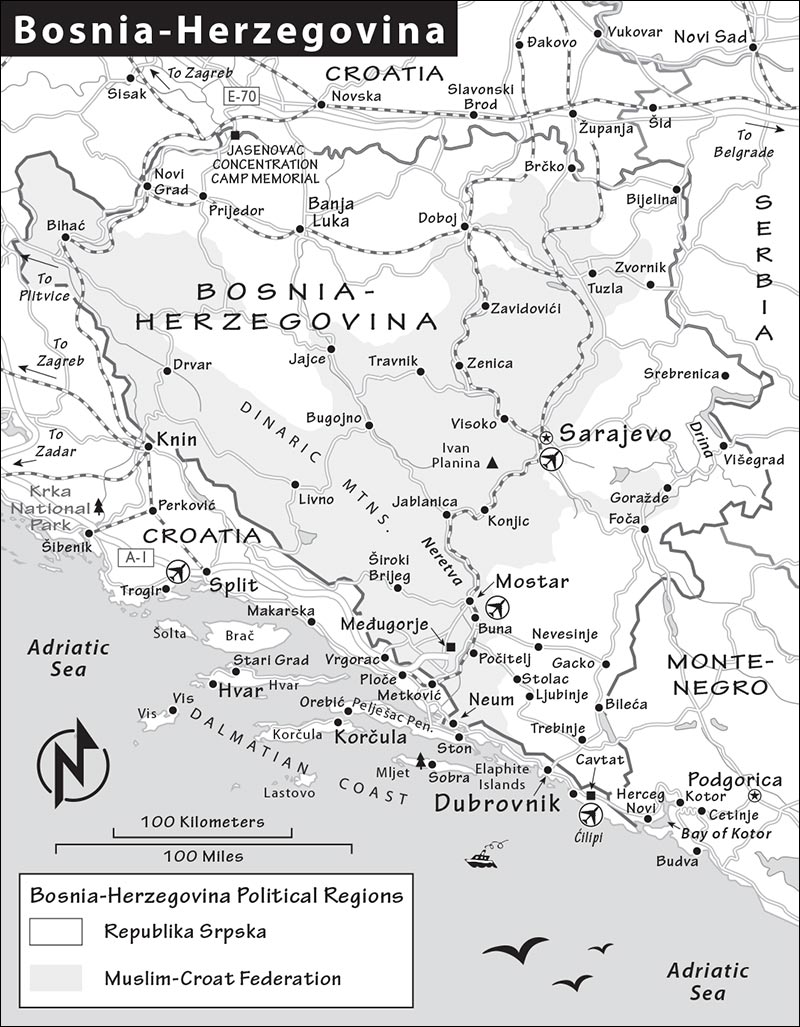
The Dayton Peace Accords that ended the conflict here in 1995 gerrymandered the nation into three separate regions: the Federation of Bosnia and Herzegovina (FBiH, shared by Bosniaks and Croats, roughly in the western and central parts of the country), the Republika Srpska (RS, dominated by Serbs, generally to the north and east), and the Brčko District (BD, a tiny corner of the country, with a mix of the ethnicities). While necessary to end the war—and successful—this new system hampered both economic progress and reconciliation. To this day, each of the three native ethnic groups stays mainly in its own region—but tourists can move freely.
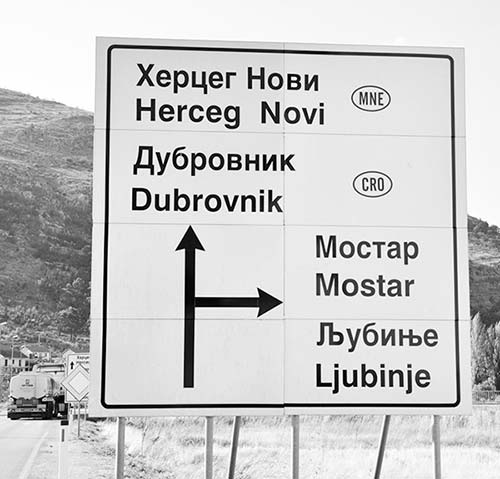
On your visit, try to tune in to the many subtle artifacts of this compromise designed to allow (or force) the Bosniaks, Croats, and Serbs of Bosnia to coexist peacefully. To satisfy the country’s various factions, the currency uses both the Roman and Cyrillic alphabets, and bills have different figureheads and symbols (some bills feature Bosniaks, others Serbs). Until recently, the alphabet used on road signs changed with the territory: Roman in Muslim and Croat areas, Cyrillic in Serb lands. Now all road signs throughout Bosnia-Herzegovina are required to appear in both alphabets—though vandals often spray-paint over the one they don’t like. License plates also used different alphabets, but this led to vandalism. Today’s license plates use only letters that are common to both alphabets.
Some towns with mixed populations are either effectively divided in half, or have buildings clearly marked with symbols indicating the ethnicity of the occupant. Until very recently, small-town schoolhouses operated “two schools under one roof,” with separate entrances and staggered shifts for the Bosniak and Croat kids...who, from birth, were constantly reminded they were very different from each other. In some towns still today, a beautifully restored Orthodox church sits across from the battered footprint of a long-gone mosque, or vice versa.
Bosnia has a central government, which guarantees representation of each of the three main groups. There’s not a single president but a group of three elected politicians—one Bosniak, one Serb, and one Croat—who collectively form the Bosnian presidency and take individual turns as the “chairperson.” (In an Orwellian twist, this position used to be called the “president of the presidency.”)
Further, each population group also has its own autonomous government and subagencies, resulting in four essentially redundant bureaucracies. The country is also divided into 10 state-like cantons, each of which has some governmental authority. Meanwhile, Bosnia-Herzegovina is still supervised from afar by a “Peace Implementation Council,” which appoints a High Representative to make sure the Dayton Accords are properly observed. Imagine the inefficiency. On top of all this, Bosnia is still navigating the complex transition from communism to capitalism, and rebuilding from a devastating war. It’s a miracle that things here work at all.
Nearly three decades later, these delicate compromises that were necessary to end a horrifying war have become almost too complicated to maintain. For Bosnia-Herzegovina to fully recover, all three groups must learn to truly set aside their differences and work together. Pessimists (who are abundant in this region) don’t like Bosnia’s chances, and Bosnian Serbs still talk loudly about secession (Republika Srpska’s president, Milorad Dodik, is an outspoken separatist).
But others see signs of hope, such as the young people from the three faiths now beginning to cautiously intermingle, as their ancestors did for centuries. Intermarriages are more and more common, and the younger generation—for whom the war is a faint childhood memory, or even just something from a history book—increasingly seems to understand that the only way forward is to leave the past behind. In the elections of 2022, the old-school, incumbent candidates of all three members of the presidency were voted out of office. It seems, for now at least, that Bosnians are eager for change.
BOSNIAN FOOD
Bosnia-Herzegovina dines on grilled meat, stewed vegetables, soft cheeses, and other foods you may think of as “Turkish” or “Greek.” On menus, look for the word domaća—“homemade.” Another key term is pod sača, which means “under the bell” (similar to peka in Croatia); this means that it has been slow cooked under a metal baking lid covered with hot coals. For a rundown of the most common items you’ll eat in Bosnia—and throughout the Balkans—see the “Balkan Flavors” sidebar.
When Bosnians, Croatians, Slovenians, or Serbs have a backyard barbecue, they don’t grill up burgers and brats. Instead, it’s ćevapi, ražnjići, and pljeskavica. These are just three of the distinctive flavors you’ll enjoy throughout the Balkan Peninsula, from Slovenia to Greece. Here are a few more:
Burek (BOO-rehk) is a savory phyllo-dough pastry typically filled with meat, cheese, or spinach. This is the go-to for a cheap lunch throughout the Balkans—burek rivals pizza-by-the-slice as the most popular takeaway snack food in southeastern Europe. The ubiquitous Croatian chain Mlinar is a handy place to sample burek, but try to find a hole-in-the-wall bakery for a homemade one. The very best burek is pod sača—cooked under a baking lid, and easiest to find in Sarajevo.
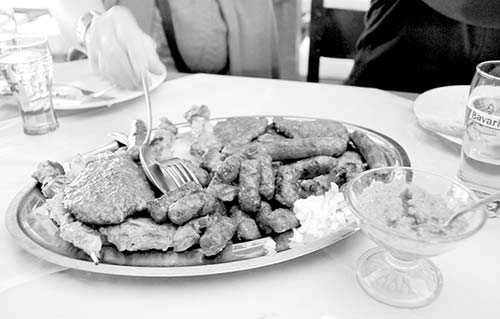
Grilled meats are a staple of Balkan cuisine. You’ll most often see ćevapčići (cheh-VAHP-chee-chee), or simply ćevapi (cheh-VAH-pee)—minced meat (typically a mix of lamb and beef) formed into a sausage-link shape, then grilled. There are variations: Sarajevo-style (sarajevski ćevapi), the most common form, is typically eaten with grilled onions and stuffed into a pita-like flatbread called somun. Banja Luka-style (banjalučki ćevapi) is one long, continuous ćevap with hot peppers on the side.
Ražnjići (RAZH-nyee-chee) is small pieces of steak on a skewer, like a shish kebab. Pljeskavica (plehs-kah-VEET-suh) is similar to ćevapčići, except the meat is in the form of a hamburger-like patty. It’s not always red meat: Pileći is chicken, and piščančje is grilled chicken breast. Sudžukice are sausages, and ćufte are meatballs.
You can’t eat any of this stuff without the ever-present condiment ajvar (EYE-var). Made from roasted sweet red peppers and eggplants, ajvar is like ketchup with a kick. Some visitors even pack home a jar of this distinctive sauce to remember the flavors of the Balkans. (You may be able to find it at specialty grocery stores in the US—look for “eggplant/red pepper spread.”)
Particularly in Bosnia, another side dish you’ll see is the soft, spreadable—and tasty—cheese called kajmak. Lepinje is a pita-like grilled bread, which is often wrapped around ćevapčići or pljeskavica to make a sandwich. Uštipci is a fry bread that’s especially popular throughout Bosnia-Herzegovina.
Ajvar, kajmak, lepinje, and diced raw onions are the perfect complement to a “mixed grill” of various meats on a big platter—the quintessence of Balkan cuisine on one plate.
Dolma is a bell pepper stuffed with minced meat, vegetables, and rice. A sarma, or sarmica, is similar, but stuffed in cabbage leaves rather than in a pepper, while japrak is stuffed grape leaves. Begova čorba (“nobleman’s stew”) is a meaty vegetable soup. Grah is bean soup. And one Bosnian institution—which you’ll see at roadside truck stops—is the whole lamb grilled on a spit.
While Balkan cuisine favors meat, a nice veggie complement is đuveđ (JOO-vedge)—a spicy mix of stewed vegetables, flavored with tomatoes and peppers. And the best salad option is šopska salata—a Greek-style salad of tomatoes, cucumbers, onions, and peppers, smothered in grated feta-like sirene cheese. Srpska salata (“Serb salad”) is often the same thing, but may have extra cheese.
Bosnian desserts—typically sweetened with honey rather than sugar—are another local treat. Drop by a sweets shop and peruse your options. Baklava, a phyllo-dough pastry with nuts and honey, is a familiar choice. Kadaif is similar, but made with shredded sheets of dough. Tulumba is a pastry cylinder drenched in honey, and tufahija is an apple stuffed with walnuts, soaked in honey, and topped with whipped cream. Smokvača is a dense, very sweet fig pie. You’ll also see blocks of nougat-like halva, made from sesame paste. And every cup of Bosnian coffee comes with a Turkish delight candy (rahatlokum), which you can also buy in gifty boxes at shops.
Bosnia produces wine, but it’s mostly consumed domestically. Sarajevso Pivo, brewed in the capital, is the favored brand of beer. In Bosnia, “coffee” is kafa (not kava, as in Croatia and Slovenia). While you can easily get espresso-style coffee, bosanska kafa (unfiltered “Bosnian coffee”) is more local—and more fun to drink. (For tips on this ritual, see earlier.)
BOSNIAN LANGUAGE
Technically, Bosnia-Herzegovina has three languages—Bosnian, Serbian, and Croatian. But all three are mutually intelligible variants of what was until recently considered a single language: Serbo-Croatian. The Croatian survival phrases on here will work just fine throughout Bosnia-Herzegovina. Bosniaks and Croats use basically the same Roman alphabet we do, while Serbs use the Cyrillic alphabet. You’ll see both alphabets on currency, official documents, and road signs, but the Roman alphabet predominates in virtually every destination covered in this book. Most people also speak English.