DUBROVNIK
Map: Old Town Hotels & Restaurants
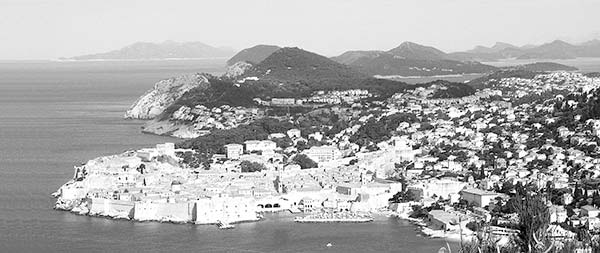
Dubrovnik is a living fairy tale that shouldn’t be missed. It feels like a small town today, but 500 years ago, the city was a major maritime power with the third-biggest navy in the Mediterranean. Still jutting confidently into the sea and ringed by thick medieval walls, Dubrovnik deserves its nickname: Pearl of the Adriatic. Within the ramparts, the traffic-free Old Town is a fun jumble of steep alleys, low-impact museums, al fresco cafés, and kid-friendly squares. After all these centuries, the buildings still hint at old-time wealth, and the central promenade (Stradun) remains the place to see and be seen.
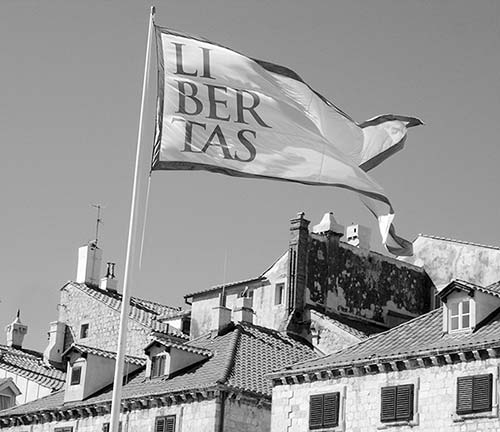
The city’s charm is the result of its no-nonsense past. Busy merchants, the salt trade, and shipbuilding made Dubrovnik rich. But Dubrovnik’s most valued commodity was always its freedom—even today, you’ll see the proud motto Libertas displayed all over town (see “Libertas” sidebar).
Dubrovnik flourished in the 15th and 16th centuries, but an earthquake (and ensuing fire) destroyed nearly everything in 1667. Most of today’s buildings in the Old Town are post-quake Baroque, although a few palaces, monasteries, and convents displaying a rich Gothic-Renaissance mix survive from Dubrovnik’s earlier golden age. Dubrovnik remained a big tourist draw through the Tito years, bringing in much-needed hard currency from Western visitors. Consequently, the city never acquired the hard socialist patina of many other Yugoslav cities.
As Croatia violently separated from Yugoslavia in 1991, Dubrovnik became the only coastal city to be pulled into the fighting (see “The Siege of Dubrovnik” sidebar, later). Imagine having your youthful good memories of romping in the surrounding hills replaced by visions of tanks and warships shelling your hometown. The city was devastated, but Dubrovnik was repaired with amazing speed. The only physical reminders of the war are lots of newer, bright-orange roof tiles. Locals are often willing to talk openly about the experience with visitors—offering a rare opportunity to grasp the realities of war from an eyewitness perspective.
Libertas—liberty—has always been close to the heart of every Dubrovnik citizen. Dubrovnik was a proudly independent republic for centuries, even as most of Croatia fell under Venetian or Hungarian rule.
For most of its history, this bicultural city went by two names: Ragusa (the Latin/Italian name, likely derived from Greek) and Dubrovnik (the Slavic/Croatian name, derived from “oak”). As the settlement grew in size, affluence, and influence, it became a powerful city-state, declaring itself a republic in the 12th century. (While I call this golden age the “Republic of Dubrovnik,” you could just as accurately call it the “Republic of Ragusa.”)
Through the Middle Ages, the Republic of Dubrovnik bought its independence from whichever power was strongest—Byzantium, Venice, Hungary, the Ottomans, the Vatican—sometimes paying off more than one at a time. Dubrovnik’s ships flew whichever flags were necessary to stay free, earning the derisive nickname “Town of Seven Flags.” It was sort of a medieval Hong Kong or Singapore—a spunky, trade-oriented statelet that maintained its sovereignty while being surrounded by an often-hostile mega-state (the Ottoman Empire). Dubrovnik persevered partly because the sultans were always susceptible to bribery (or “tribute”): They were more than happy to let Dubrovnik thrive...provided they got their cut.
As time went on, Dubrovnik’s status grew. Europe’s big-league nations were glad to have a second major seafaring power in the Adriatic to balance Venice, especially when Venetian ports were blockaded by the Ottomans.
In 1808, Napoleon invaded and abolished the Republic of Dubrovnik. After Napoleon’s defeat, Dubrovnik’s delegate was denied a seat at the Congress of Vienna. The more powerful nations, perhaps fed up after years of being sweet-talked by Dubrovnik, didn’t want to reestablish it as an independent player. Instead, the city became a part of the Habsburg Empire and entered a long period of stagnation.
Libertas still hasn’t died in Dubrovnik. In the heady days of the early 1990s, when Yugoslavia was reshuffling itself, a movement for the creation of a new Republic of Dubrovnik gained some momentum. But now that the dust has settled, today’s residents are content and proud to be part of an independent Croatia.
Today the crowds are most decidedly back—far exceeding prewar levels. In fact, Dubrovnik’s biggest downside is its popularity. When several cruise ships are in town, it can be mobbed. And, with more and more locals priced out of the Old Town and moving to the suburbs, the center can feel, at times, like a very pretty but soulless theme park. But those who dig deeper find that the city still has a strong sense of identity and community, plus a lovable personality. Like Venice, Dubrovnik rewards those who get off the beaten path and savor the town early and late, when cruisers and day-trippers have cleared out. If you haven’t discovered your own secluded, laundry-draped back lane...then you haven’t looked hard enough.
For many, Dubrovnik makes an ideal home base. Build some slack into your Dubrovnik stay for a wide array of worthwhile side trips (outlined in the Near Dubrovnik, Montenegro, and Mostar chapters).
PLANNING YOUR TIME
Dubrovnik’s museums aren’t major draws; the real attraction here is the Old Town, with its relaxing, breezy ambience. While Dubrovnik could easily be “seen” in a day, a second or third day to unwind (or even more time, for side trips) makes the long trip here more worthwhile. I enjoy staying at least three or four nights, for maximum day-tripping flexibility.
To hit all the key sights in a single day, start at the Pile Gate, at the entrance to the Old Town. Walk around the city’s walls to get your bearings (before it gets too hot and crowded), then work your way down the main drag (following my “Dubrovnik Walk”). As you explore, drop in at any museums or churches that appeal to you. Ride the cable car to the top of Mount Srđ for the sunset, then descend to the Old Town for dinner. With a second day, spread out these activities, hit the beach, or take a boat excursion from the Old Port (Lokrum Island, just offshore, requires the least brainpower). With even more time, take side trips to a pair of particularly striking international destinations: Bosnia-Herzegovina’s Mostar and Montenegro’s Bay of Kotor. Wine lovers may want to spend some time exploring the vineyards and wineries of the Pelješac Peninsula; see the Near Dubrovnik chapter.
Orientation to Dubrovnik
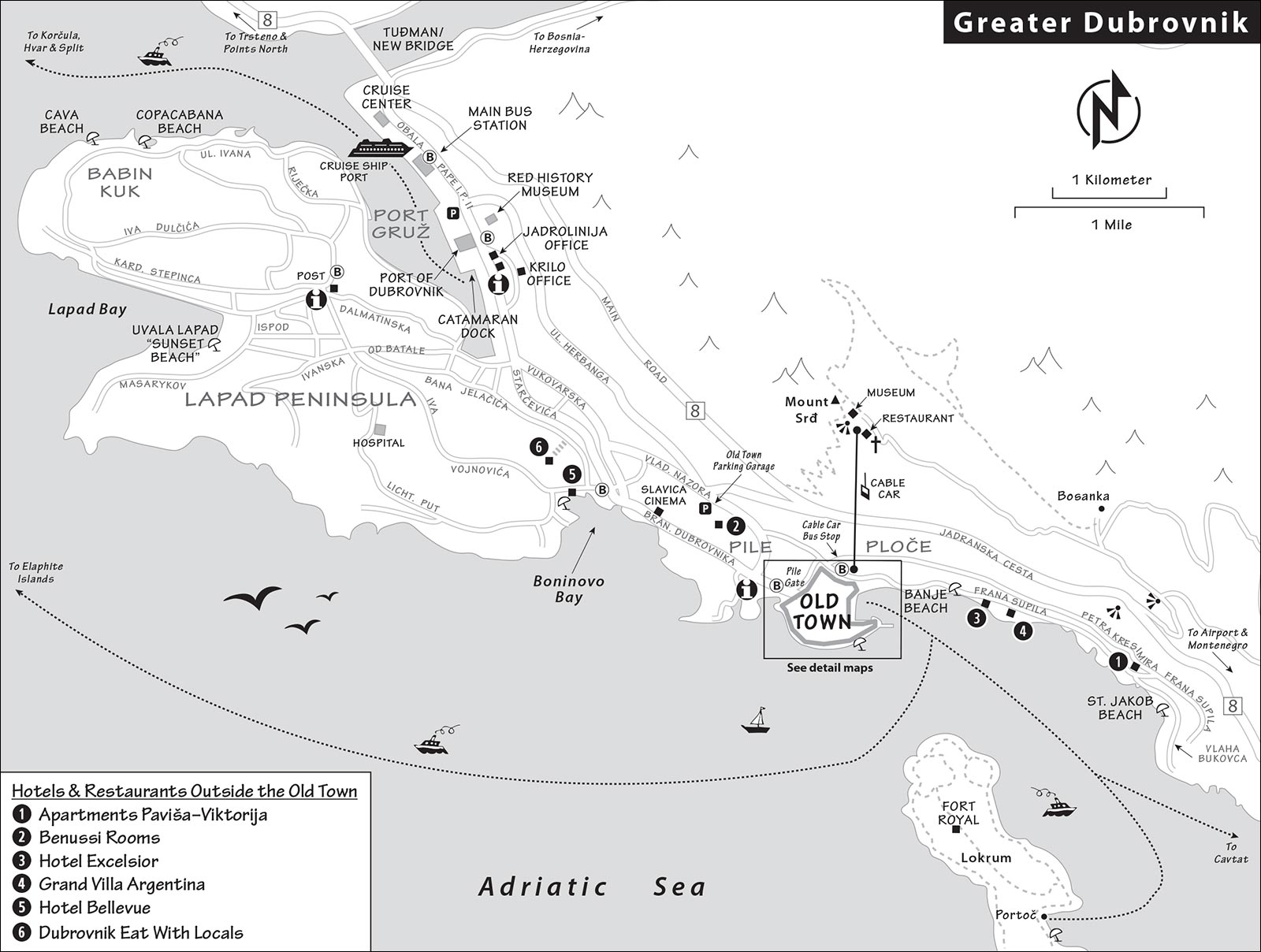
Nearly all of the sights worth seeing are in Dubrovnik’s traffic-free Old Town (Stari Grad, STAH-ree grahd) peninsula, surrounded by the City Walls. The main pedestrian promenade through the middle of town is called the Stradun (STRAH-doon); from this artery, the Old Town climbs steeply uphill in both directions to the walls. The Old Town connects to the mainland through three gates: the Pile Gate, to the west; the Ploče Gate, to the east; and the smaller Buža Gate, at the top of the stepped lane called Boškovićeva. The Old Port (Gradska Luka), with leisure boats to nearby destinations, is at the east end of town. While greater Dubrovnik has about 50,000 people, the population within the Old Town is around 1,500; most property owners here have converted their homes into tourist apartment rentals.
The Pile (PEE-leh) neighborhood, a pincushion of tourist services, is just outside the western end of the Old Town (through the Pile Gate). In front of the gate, you’ll find the main TI, ATMs, a post office, taxis, buses (fanning out to all the outlying neighborhoods), a bus-ticket kiosk, and a Konzum grocery store. This is also the starting point for my “Dubrovnik Walk.”
A mile or two away from the Old Town are beaches peppered with resort hotels. The closest area is Boninovo Bay (a 20-minute walk or 5-minute bus trip from the Old Town), but most cluster farther out, on the lush Lapad Peninsula to the west (a 15-minute bus trip from the Old Town). Across the bay from the Lapad Peninsula is Port Gruž, with the main bus station, ferry terminal, and main cruise port, plus some accommodations and local-style eateries. (Additional cruise ships tender to the Old Port.)
Sleeping at Lapad or Port Gruž has its advantages: more space, easier beach access, fewer stairs, and generally lower prices. However, you’re a good distance from the idyllic Old Town, and you’ll be competing with lots of other day-trippers (and cruise passengers) on your daily “commute” into your sightseeing. For this reason, all of my recommended accommodations and restaurants are inside, or within walking distance of, the City Walls.
TOURIST INFORMATION
Dubrovnik’s main TI is just outside the Old Town’s Pile Gate, near the inbound bus stop (daily 8:00-20:00, June-Sept until 21:00, off-season until 19:00 and shorter hours on Sun; Brsalje 5, +385 20 312 011, www.tzdubrovnik.hr). There are also locations at Port Gruž, across the street from the Jadrolinija ferry dock (same hours except closes earlier in off-season, Obala Ivana Pavla II, +385 20 417 983); in the Lapad resort area, at the head of the main drag (Masarykov put 2, in the Dvori Lapad building, +385 20 437 460); on two of the Elaphite Islands, Lopud (Obala Iva Kuljevana 12, +385 20 322 322) and Šipan (Luka bb, +385 20 758 084); and at the arrivals area of the airport. Although not an official TI, the handy Cultural Information Desk (at the base of the Bell Tower, on Luža Square) is more central and can answer many questions (long hours daily). All TIs hand out the annual Dubrovnik Riviera Info booklet.
Sightseeing Passes: If you’ll be doing any sightseeing at all, choose between Dubrovnik’s two passes.
Assuming you’re climbing the City Walls—Dubrovnik’s top attraction—you might as well buy the Dubrovnik Pass. This covers several major museums, the City Walls, and unlimited public transit within the city. It also offers discounts on a variety of other attractions, tours, concerts, and touristy restaurants (€35/1 day, €45/3 days, €55/7 days). Buy the pass online (www.dubrovnikpass.com), then download it to your phone. Before riding transit, you’ll need to show your QR code at a Libertas bus-ticket kiosk (the handiest one is in front of the Pile Gate) to get a paper ticket good for unlimited travel for the duration of the pass.
If you’ll be visiting multiple museums, but not walking the City Walls, the €20 “nine museum ticket”—which includes the Rector’s Palace and a few lesser sights—is good for a week. Or you can pay €10 individually for any of the sights that the ticket includes (or €15 for any two).
ARRIVAL IN DUBROVNIK
Most of Dubrovnik’s arrival points—ferry dock, cruise terminal, bus station—are at Port Gruž, about 2.5 miles northwest of the Old Town. To get into town, hop on a bus (#1a, #1b, #3, or #8) or take a taxi or Uber (around €10-12) to the Pile Gate, at the entrance to the Old Town.
By Boat
Passenger catamarans and car ferries all arrive at Port Gruž. On arrival, simply walk straight to the busy cross street. Taxis line up on your left (or you can order an Uber). For a bus, walk just two minutes to the right, along the water, to find the nearest stop. Along this strip, you’ll also find ticket offices or kiosks for the three main boat companies (Jadrolinija, Krilo, TP Line) and a TI.
Some cruise ships anchor just offshore from the Old Port, then send their passengers into the Old Town on tenders. Others put in just beyond the bus station at Port Gruž, where you can catch a bus or taxi to the Old Town.
By Bus
Dubrovnik’s main bus station (Autobusni Kolodvor) is just beyond the ferry terminal along the Port Gruž embankment. On arrival, walk straight ahead through the bus stalls then bear right at the main road to the city bus stop, or hop in a taxi.
Alternate Bus Stop for Outbound Buses: For buses that are leaving Dubrovnik toward regional destinations to the south (such as the airport or Cavtat), there’s another bus stop that’s much closer to the Old Town, saving you the long journey out to the main bus station. The “cable car” bus stop (officially called Krešimira) is just uphill from the Buža Gate, overlooking the old wall, directly in front of the ticket office for the cable car up to Mount Srđ.
By Plane
Dubrovnik’s small airport (zračna luka) is near a village called Čilipi, 13 miles south of the city (code: DBV, +385 20 773 333, www.airport-dubrovnik.hr). A bus meets arriving flights for most major airlines and takes you to the main bus station (€10, 40 minutes), with public-bus connections to the Old Town. Legitimate cabbies charge around €45 for the 30-to-40-minute taxi ride between the airport and the center, though some cabbies charge far more; for a fixed price and a no-stress arrival, consider arranging your transfer in advance with one of the drivers listed under “Tours in Dubrovnik—Private Drivers” or through your soba host (most have a reliable driver they enjoy working with).
To get to the airport, you can take the same bus, which is coordinated with many flights (ask the TI for the current schedule, or check www.platanus.hr and click on “Shuttle Bus”). The airport-bound bus departs from the main bus station and stops at the “cable car” bus stop just above the Old Town’s Buža Gate (see “By Bus,” earlier).
By Car
Coming from the north, you’ll drive over the modern Tuđman Bridge (which many locals call simply “the New Bridge”).
To Port Gruž: To get to the most affordable long-term parking option (described later), main bus station, ferry terminal (with some car-rental drop-off offices nearby), and Lapad Peninsula, take the left turn just after the bridge, wind down to the waterfront, then turn left and follow this road along the Port Gruž embankment.
To the Old Town: Continue straight after the bridge. You’ll pass above the Port Gruž area, then take the right turnoff marked Dubrovnik (with the little bull’s-eye). You’ll go through a tunnel, then turn left for Grad/Old City. This road passes the big Old Town parking garage (described later), then twists around over the top of the Old Town, until you can see the lower station for the cable car. Here you have two choices, which will determine which one-way loop you’ll get stuck in: If you want to reach the Pile Gate (at the eastern end of the Old Town), make a sharp right turn just before the cable car (watch for Grad/Old City signs), then turn right again to curl around the back of the City Wall and pop out at the Pile Gate (with a small, incredibly pricey parking lot), then back up out of town toward Boninovo Bay and Lapad. Or, if you want to head east of the Old Town, continue straight past the cable-car station for a long, scenic drive above the Viktorija area, then (after a sharp right turn) past luxury hotels and to the Ploče Gate.
Parking: Near the Old Town, parking costs are exorbitant—maybe even more than you’re paying for accommodations (rates are constantly in flux and may exceed what’s listed here; prices are typically somewhat lower Oct-April). Ideally, make Dubrovnik either the first or last stop of your car rental, so you won’t have to pay to park here. But if you must, ask your soba host for their best advice (many have a line on relatively reasonable options, though they may be distant).
The most economical option is to park your car in the long-term lot next to the Jadrolinija ferry terminal at Port Gruž. While less convenient—you’ll have to take a taxi or public bus to reach the Old Town—it’s far less expensive (€3/hour, €30/day) than the alternatives. Two lots flank the ferry terminal—a smaller one toward the Old Town, and a much bigger one only slightly farther out, toward the port entrance. There’s talk of building a new parking garage even farther out, beyond the New Bridge.
If you want to park near the Old Town, you’ll pay dearly. Much of the parking immediately surrounding the City Walls is reserved for locals (though you may find some legit, very expensive spaces here—check signs carefully). The small Parkiralište Pile (Pile Parking Lot), just outside the Pile Gate, is open to the public—look for it on the right as you curl around the back of the walls, just before you reach the bustling Pile Gate area. However, its astronomical prices (€10/hour, €200/24 hours) make it practical mainly for dropping off your bags, then heading for more affordable long-term parking elsewhere.
Your compromise option—still within walking distance of the Old Town, very pricey but a bit less exorbitant—is the Old Town parking garage that you’ll pass on the right, along Zagrebačka Ulica, as you drive toward the Old Town area (€7/hour, €70/24 hours; see “To the Old Town,” earlier, for directions). Important: If you’ll be staying overnight, request a daily ticket (dnevna karta) at the ticket office within 15 minutes of when you park—this is essential to avoid paying the much higher hourly rates for your entire stay. From this garage, it’s about a 10-minute downhill walk to the Old Town—and a much steeper, 20-minute hike back up.
HELPFUL HINTS
Festivals: Dubrovnik’s annual Summer Festival includes about six weeks of theater and musical performances (July 10-Aug 25, www.dubrovnik-festival.hr). This is quickly followed by the Late Summer Festival, designed to continue the festivities into September.
Crowd-Beating Tips: Cruise ships bring more than one million passengers to Dubrovnik each year. While the city has recently begun limiting arrivals, things can still pile up; on very busy days, there may be four ships in at once, sending 6,000-plus passengers ashore. (If that sounds excessive, consider the biggest day ever—before they began imposing limits—when nine ships brought 25,000 passengers to town.) Cruise-ship crowds descend on the Old Town roughly between 8:30 and 14:00 (the streets are most crowded 9:00-13:00). Bad-weather days are a perfect storm, when people who’d otherwise hit the beach instead sightsee in the Old Town, along with all the cruise passengers. On busy days, try to avoid the big sights—especially walking around the City Walls—during these peak times, and hit the beach or take a siesta midday, when the town is hottest and most crowded. It can also make sense to schedule out-of-town side trips for the busiest cruise days; check the day-by-day cruise schedule at www.portdubrovnik.hr (look for arrivals under the “Traffic” tab on its menu).
Laundry: Dubrovnik’s laundry services tend to rack up bad reviews and go out of business. One place that has stuck around is the pricey, self-service Laundry Spin, a steep hike up above the Old Town in the tunnel just outside the Buža Gate (daily 8:00-20:00, Iza Grada bb—see “Dubrovnik’s Old Town” map, earlier, +385 20 456 855).
Car Rental: The big international chains have offices at the airport. In addition, the many travel agencies closer to the Old Town also have a line on rental cars. Be sure the agency knows whether you’re crossing a border (such as Bosnia-Herzegovina or Montenegro) to ensure you have the proper paperwork.
Best Views: Walking the City Walls late in the day, when the city is bathed in rich light, is a treat. The cable car up to Mount Srđ provides bird’s-eye panoramas over the entire region, from the highest vantage point without wings. The Fort of St. Lawrence, perched above the Pile neighborhood cove, has great views over the Old Town. The panoramic cruises that loop around the Old Town are another good choice. A stroll up the road east of the walls offers nice views back on the Old Town (best light early in the day). Better yet, if you have a car, head south of the city in the morning for gorgeously lit Old Town views over your right shoulder; various turnoffs along this road are ideal photo stops. The best one, known locally simply as “panorama point,” is where the road leading up and out of Dubrovnik meets the main road that passes above the town (look for the pullout on the right, usually crowded with tour buses). Even if you’re heading north, in good weather it’s worth a quick detour south for this view.
GETTING AROUND DUBROVNIK
If you’re staying in or near the Old Town, everything is easily walkable. But those sleeping in outlying areas will want to get comfortable using the buses. Once you understand the system, commuting to the Old Town is straightforward (though the buses can be very crowded).
By Bus: Libertas runs Dubrovnik’s public buses. Tickets, which are good for an hour, are slightly cheaper if you buy them in advance from a newsstand or your hotel (€1.75, ask for autobusna karta, ow-toh-BOOS-nah KAR-tah) than if you buy them from the bus driver (€2). A one-day ticket costs €5.30 (sold only at special bus-ticket kiosks, such as the one near the Pile Gate bus stop). Tickets are issued on cards that you’ll tap against an electronic reader as you board—watch locals and imitate. If you have a Dubrovnik Pass, get your (included) transit pass at a ticket kiosk before you ride—you can’t use the Dubrovnik Pass itself to board the bus.
All buses stop near the Old Town, just in front of the Pile Gate (buy tickets at the newsstand). Arriving buses drop off in front of the TI, on the water-facing side of the square; departing buses use the stop across the street, in front of the Konzum grocery. From here, buses #1a, #1b, #3, and #8 go to Port Gruž (cruise port, ferry terminal, affordable long-term parking), and buses #4 and #6 head for the resort cove at Lapad. For more information, visit www.libertasdubrovnik.hr.
By Taxi: Taxis start at about €3.50, then charge €1 per kilometer. The handiest taxi stand for the Old Town is just outside the Pile Gate. The biggest operation is Radio Taxi (+385 20 411 411). Uber, which is often cheaper, works well in Dubrovnik.
Tours in Dubrovnik
Walking Tours
A changing lineup of companies—including Dubrovnik Walks (www.dubrovnikwalks.com) and Dubrovnik Walking Tours (www.dubrovnik-walking-tours.com)—offer similar 1.5-hour walking tours of the Old Town several times daily (€18). I’d skip these tours—they’re pricey and brief, touching lightly on the same information explained in this chapter. Both companies (and others) also offer themed tours covering Game of Thrones locations, wartime Dubrovnik, and the historic Jewish quarter. For the latest offerings, pick up their fliers or check their websites.
Dubrovnik Food Tours, run by friendly Hamo (who used to live in Southern California) and his team, offer combination history/food walking tours as well as day trips into the countryside (www.dubrovnikfoodtours.com).
Local Guides
For an in-depth look at the city, consider hiring your own local guide; most charge around €120 for a two-hour introductory tour. Roberto de Lorenzo is a warm and wonderful local who’s enthusiastic about telling evocative stories from medieval Dubrovnik, including some off-the-beaten-path stops tailored to your interests (+385 91 541 6637, dubrovnikgardens@gmail.com). Štefica Curić Lenert is a sharp professional guide who offers a great by-the-book tour and an insider’s look at the city (stefica.curic.lenert@gmail.com). If these guides are busy, they can refer you to another good guide.
From Dubrovnik
For information on tour boats and guided big-bus excursions from Dubrovnik to nearby destinations, see the next chapter.
Private Drivers
Many visitors to Dubrovnik enjoy hiring a private driver for day trips. All the drivers I recommend speak good English, are fun to get to know, and take pride in working with my readers. While this is a splurge, many visitors find it worthwhile for the convenience. Driving yourself is definitely workable (following this book’s self-guided driving tours), but it’s more relaxing to let someone else take the wheel (not to mention the high cost of parking a car near the city center). Prices are per carload, not per person, and most drivers can fit three or four passengers—sometimes more, for a higher price (double-check when you book).
While these drivers can take you anywhere, three destinations are especially popular for all-day excursions: a sightseeing loop around Montenegro’s Bay of Kotor; a day trip to Mostar with some sightseeing en route in Bosnia-Herzegovina (this can also be done as a one-way transfer, if Mostar is your next stop); and a wine-tasting tour north to the Pelješac Peninsula. Most drivers depart around 8:00 and return in the early evening, but drivers may suggest a slightly different plan if roads are expected to be crowded (especially in July-Aug). To avoid traffic jams, border delays, and other headaches, trust their advice. It’s also smart to prebook an airport transfer with these drivers (or one of their associates) to avoid the price-gouging taxi drivers waiting out front.
Pepo Klaić, easygoing and personable, has a knack for making your experience both informative and meaningful. Ask about what it was like growing up inside the walls of Dubrovnik’s Old Town (around €275 for Montenegro’s Bay of Kotor or Mostar, airport transfer for about €40—cheaper than a taxi, +385 98 427 301, www.dubrovnikshoretrip.com, pklaic@gmail.com). Be sure to confirm plans with Pepo at least one day before your scheduled trip.
Robi Anđušić, who’s both a driver and a licensed tour guide, has a big personality and an infectious enthusiasm for sharing the area with visitors—and he enjoys including a few (edible) extras in his trips (€300 for an all-day trip to Mostar, Montenegro’s Bay of Kotor, or Pelješac Peninsula, €40 for an airport transfer, +385 98 512 846, www.dubrovniktravelexperience.com, randusic@gmail.com).
If your destination is Mostar, likable Bosnian driver Ermin Elezović will happily pick you up for less than the Dubrovnik-based drivers (€200 for one-way transfer from Dubrovnik to Mostar with a few brief sightseeing stops en route, more for round-trip to Mostar with same-day return to Dubrovnik; for contact information and details, see here).
Petar Vlašić does all the standard day trips for comparable prices to the others listed here, and specializes in wine tours to the Pelješac Peninsula (+385 91 580 8721, www.dubrovnikrivieratours.com, info@dubrovnikrivieratours.com).
Private Wine Tours: If you’re serious about wine, Sasha Lušić, a gregarious Aussie-Croat who runs D’Vino Wine Bar, offers in-depth yet relaxed winery tours of the Pelješac Peninsula. Sasha prides himself on taking you to a variety of carefully selected vintners who represent the best of what’s happening in the region. Sasha’s tours, which change each day based on his customers’ interests and stamina, can go well into the evening; most include a memorable lunch or dinner (prices depend on group size and stops—email for a quote, you might get one of his well-trained associates, www.dvino.net, sasha@dvino.net).
Dubrovnik Walk
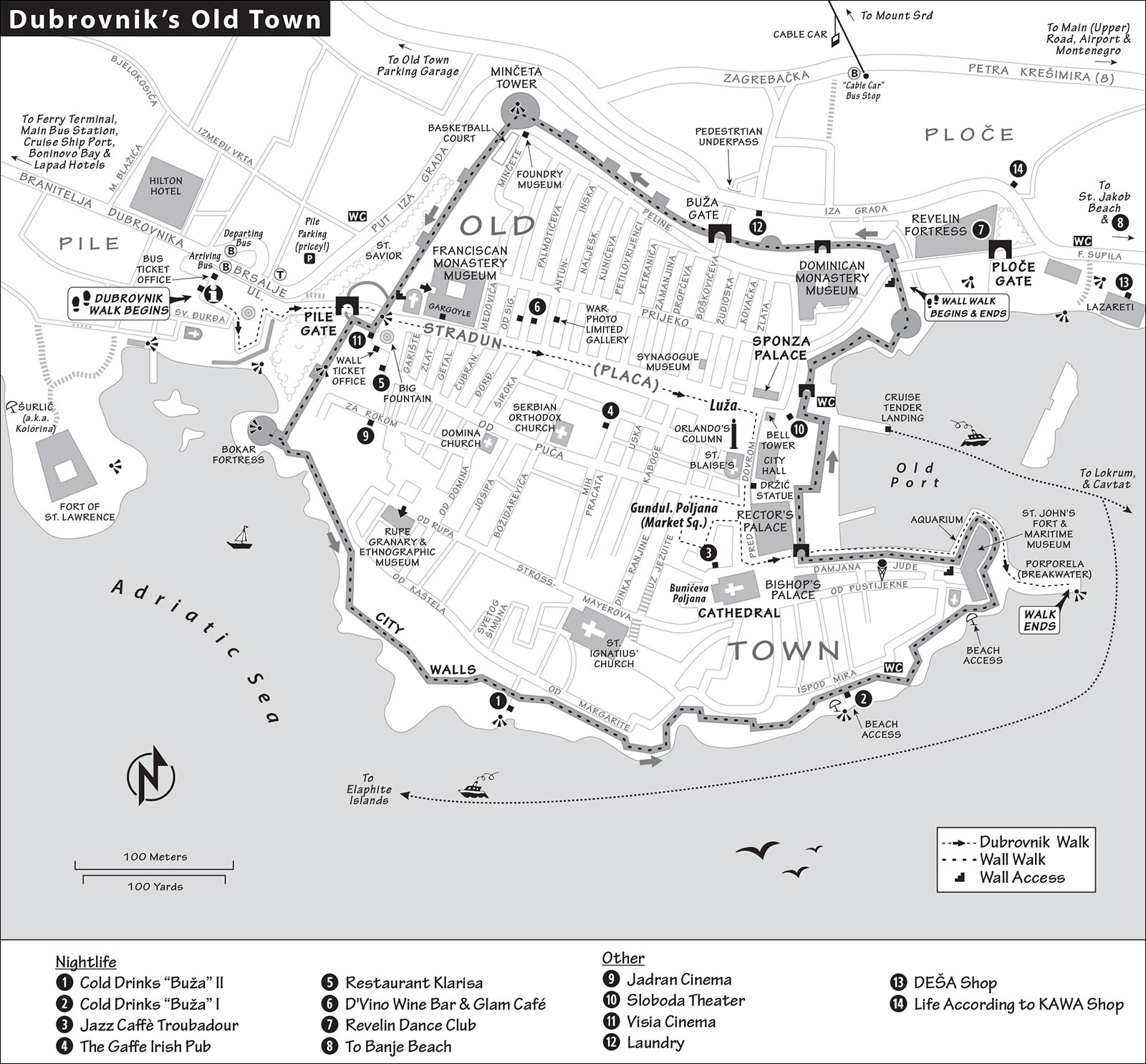
Running through the heart of Dubrovnik’s Old Town is the 300-yard-long Stradun promenade—packed with people and lined with sights. This self-guided walk (rated ▲▲▲) offers an ideal introduction to Dubrovnik’s charms. It takes about an hour, not counting sightseeing stops, and it ends near a less-crowded entrance for walking atop the City Walls. For the route, see the “Dubrovnik’s Old Town” map, later.
• Begin at the busy square in front of the west entrance to the Old Town, the Pile Gate.
Pile Neighborhood
This bustling area is the nerve center of Dubrovnik’s tourist industry—it’s where the real world meets the fantasy of Dubrovnik. It can be quite chaotic: swarming with buses, taxis, and walking tour groups clogging the sidewalks (for details on services offered here, see “Orientation to Dubrovnik,” earlier).
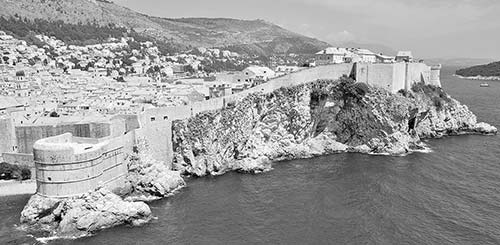
For a break from the crowds, find your way to the wide, leafy café terrace that stretches toward the water between the TI/bus stop and the City Walls. Wander to the balustrade at its far end to take in the imposing walls of the Pearl of the Adriatic. (Game of Thrones fans might feel a twinge of déjà vu for Blackwater Bay.) The huge, fortified peninsula just outside the City Walls and to the right is the Fort of St. Lawrence (Tvrđava Lovrijenac), Dubrovnik’s oldest fortress. Imagine how this fort and the stout walls worked together to fortify the little harbor—and the gate just behind you. You can climb 208 steps up to this fortress for great views over the Old Town (€15, or covered by City Walls ticket within 72 hours; also covered by Dubrovnik Pass)...or just hike up to the little terrace in front of the door, which has views that are nearly as good. The view from up top offers a perfect illustration of how Dubrovnik’s walled Old Town has a V-shaped contour—with two formerly separate hill towns joined by a covered-over canal.
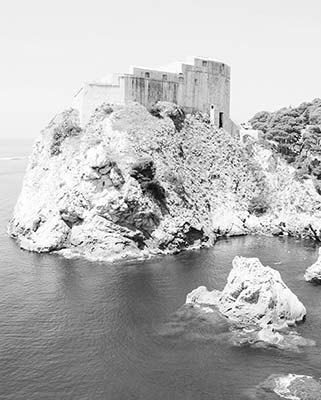
If you’d like to see a quiet, scenic, pebbly beach zone—either now or later—you can go down the stairs near the bus stop marked Ulica Svetoga Đurđa. Follow this little lane as it winds down to the water, on a tranquil bay with the Fort of St. Lawrence looming overhead.
• Back along the busy main drag, head toward the stout, round, stony entrance to the Old Town. Pause before entering the flow of visitors crossing the drawbridge for a good a look at...
Pile Gate (Gradska Vrata Pile)
This is one of three land entrances to the heavily fortified Old Town. From here, you have a great view of the stout walls, including the massive Minčeta Tower that caps the hill on your left.
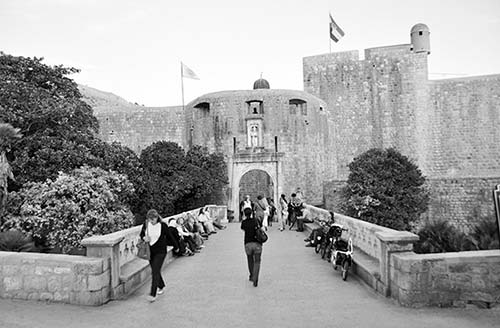
Dubrovnik is protected not only by its walls and a multistage gate but by saintly intervention: At the top of the gate, look for a statue of St. Blaise (Sveti Vlaho in Croatian) cradling Dubrovnik in his arm. You’ll see a lot more of Blaise, the protector of Dubrovnik, during your time here—he is to Dubrovnik what the winged lion of St. Mark is to Venice.
Now cross over the drawbridge. (It’s so crowded that there are usually “one-way” lanes for entering and exiting the Old Town.) As you shuffle across, look down to notice the shady park filling the moat-like area below you. You can head to this quiet, green oasis now (I’ll point out the entrance in a moment), or anytime you need a respite from the crowds.
Crossing the bridge and entering the inner part of the gate, dead ahead you’ll see another image of St. Blaise. You can head straight down the steps, under Blaise, to continue into town. Or, to find the park, veer to the left and head down the ramp instead. Make your way through the little hole-in-the-wall where the ramp turns back to enter a tranquil playground park, where locals play with their toddlers in serenity (surrounded by tourists).
Back inside the gate, look for the white map (next to the tourist map) that shows where each bomb dropped on the Old Town during the 1991-1992 Siege of Dubrovnik. Once inside town, you’ll see very few signs of the war—a testament to the townspeople’s impressive resilience in rebuilding so well and so quickly.
• Continue down the ramp and pass the rest of the way through the gate. On the other side, you’ll find a lively little square surrounded by landmarks.
St. Savior Square
The giant, round structure in the middle of the square is Onofrio’s Big Fountain (Velika Onofrijea Fontana). In the Middle Ages, Dubrovnik had a complicated aqueduct system that brought water from the mountains seven miles away. The water ended up here, at the town’s biggest fountain, before continuing through the city. Three things helped make little, independent Dubrovnik very siege-resistant: this plentiful supply of water, large reserves of salt (a key source of Dubrovnik’s wealth, from the town of Ston—see here), and a massive granary (now the Rupe Granary and Ethnographic Museum, described later).
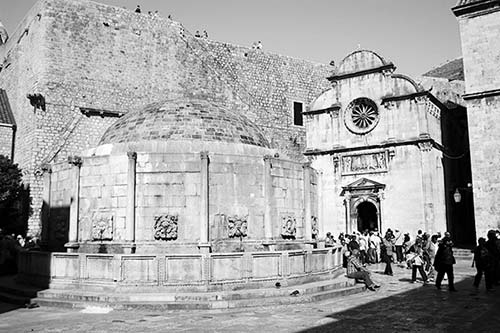
Stand with your back to the fountain and face the small Church of St. Savior (Crkva Svetog Spasa). Townspeople built this votive church to thank God after Dubrovnik made it through a 1520 earthquake. When the massive 1667 quake destroyed the city, this church was one of the only buildings left intact—its Renaissance interior stands at odds against the predominantly Baroque styles in other town churches. And during the Yugoslav Wars, the church survived another close call when a shell exploded on the ground right in front of it (you can still see faint pockmarks from the shrapnel).
To the left of the church, a steep stairway leads up to Dubrovnik’s best activity, walking around the top of the City Walls (tickets are sold across the square)—but this walk ends near a better, less crowded entry point.
The big building to the right of the Church of St. Savior is the Franciscan Monastery Museum. This tourable building has a delightful cloister and one of Europe’s oldest continually operating pharmacies (described later; enter through the gap between the small church and the door of the big church).
Historically, the monastery’s Franciscan Church was the house of worship for Dubrovnik’s poor people, while the Dominican Church (down at the far end of the Stradun, where our walk ends) was for the wealthy. Services were staggered by 15 minutes to allow servants to drop off their masters there, then rush up the Stradun for their own service here. If you peek inside the church, you’ll find a Baroque interior—typical of almost all of the town’s churches rebuilt after the 1667 quake.
Back outside, still with your back to the round fountain, look up and notice the bell tower of the Franciscan Church—with its rounded top—which is integrated into the structure of the building. If your travels have taken you beyond Dubrovnik, you’ll notice the difference from other Croatian towns, where church steeples follow Venetian convention: set apart from the church, and with a pointy top. This is just the first of many contrasts we’ll see between Dubrovnik and Venice—two powerful, rival maritime republics.
Finally, notice the stubby little shin-high, mustachioed gargoyle embedded in the wall, just left of the Franciscan Church’s door. You may see a commotion of tourists trying to balance on the small, slippery surface of the gargoyle’s head. Tour guides enjoy spinning a variety of tall tales about this creature—for instance, if you can balance on one leg for three seconds, your fondest wish comes true—but these are a recent invention.
• When you’re finished taking in the sights on this square, continue along...
The Stradun
Dubrovnik’s main promenade—officially called the Placa, but better known as the Stradun—is alive with locals and tourists alike. This is the heartbeat of the city: an Old World shopping mall by day and sprawling cocktail party after dark, when everybody seems to be doing the traditional evening stroll...flirting, ice-cream-licking, flaunting, and gawking. A coffee and some of Europe’s best people-watching in a prime Stradun café is one of travel’s great bargains.
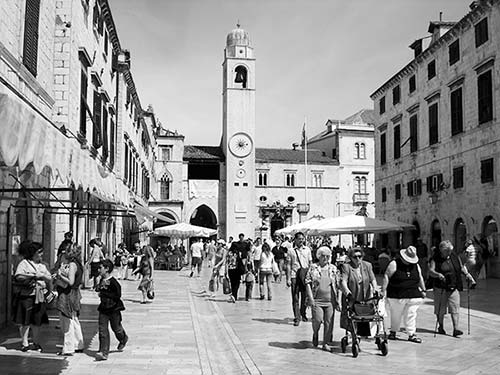
When Dubrovnik was just getting its start in the seventh century, this street was a canal. Romans fleeing from the invading Slavs lived on the island of Ragusa (on your right), and the Slavs settled on the shore. In the 11th century, the canal separating Ragusa from the mainland was filled in, the towns merged, and a unique Slavic-Roman culture and language blossomed. While originally much more higgledy-piggledy, this street was rebuilt in the current, more straight-arrow style after the 1667 earthquake. (The quake triggered a fire that raged for three weeks and consumed much of the city.)
The distinctively shaped doors—with P-shaped shop windows built right in, to provide maximum views of goods, but minimum access—indicate that this was—and still is—the terrain of the merchants.
Notice the uniform austerity of Dubrovnik’s main drag. Rather than lavishing funds on ostentatious palaces, as in Venice, Dubrovnik seems to downplay its wealth. For much of its history, Dubrovnik paid a hefty tribute to the sultan of the Ottoman Empire to maintain its independent status. Flaunting wealth would have raised Ottoman eyebrows...and, likely, Ottoman taxes. Think about the stark contrast between restrained Dubrovnik and its rival Venice, which was desperate to impress. Venice was surrounded by Italians, Austrians, Germans—some allies, some rivals, but all Christian. Dubrovnik sat five miles from the frontier of the Ottoman Empire; leaving the city felt like leaving the known world and the safety of what we’d today call “Western Civilization.”
Let me guess—the Stradun is crowded, right? When multiple cruise ships drop anchor, their passenger excursions into town feel more like incursions. But try some attitude adjustment: The maritime republic of Dubrovnik has always been a crossroads of merchants, sailors, and other travelers from around the world. While today they may be following their tour guides’ numbered flags rather than trading exotic spices, the legions of visitors are still part of the city’s tapestry of history.
If you’re here on a summer evening (June-Sept), you might hear the rat-a-tat-tat of a drum echoing through the streets from the Stradun. This means it’s time to head for this main drag to get a glimpse of the colorfully costumed “town guards” parading through (and the cavalcade of tourists running alongside them, trying to snap a clear picture). You may also see some of these characters standing guard outside the town gates. Begun only recently, this “tradition” is part of the local tourist board’s efforts to make their town even more atmospheric.
• Branching off from this promenade are several museums and other attractions. But for now, just enjoy strolling to the far end of the Stradun, to lively Luža Square. Its centerpiece is the 20-foot-tall...
Orlando’s Column (Orlandov Stup)
Dubrovnik erected this column—a northern European symbol—in 1417, soon after it had shifted allegiances from the oppressive Venetians to the Hungarians. Whenever a decision was made by the Republic, the town crier came to Orlando’s Column and announced the news. The step he stood on indicated the importance of his message—the higher up, the more important the news. It was also used as the pillory, where people were publicly punished. The thin line on the top step in front of Orlando is exactly as long as the statue’s forearm. This mark was Dubrovnik’s standard measurement—not for a foot, but for an “elbow.”
• Now stand in front of Orlando’s Column and orient yourself with a...
Luža Square Spin-Tour
Orlando is looking toward the Sponza Palace (Sponza-Povijesni Arhiv). This building, from 1522, is the finest surviving example of Dubrovnik’s golden age of the 15th and 16th centuries. It’s a combination of Renaissance (ground-floor arcade) and Venetian Gothic (upstairs windows). Houses up and down the main promenade once looked like this, before the 1667 earthquake and fire. This used to be the customs office (dogana), but now it’s an exhaustive archive of the city’s history, with temporary art exhibits and a war memorial. The poignant Memorial Room of Dubrovnik Defenders (inside and on the left) has photos of dozens of people from Dubrovnik who were killed fighting Yugoslav forces in 1991. A TV screen and images near the ceiling show the devastation of the city. Though the English descriptions are pointedly slanted to the Croat perspective, it’s compelling to look in the eyes of the brave young men who didn’t start this war...but were willing to finish it (free, long hours daily in peak season). Beyond the memorial room, the impressive courtyard, which hosts temporary exhibits, is worth a peek (sometimes free, sometimes for a fee; generally free after-hours).
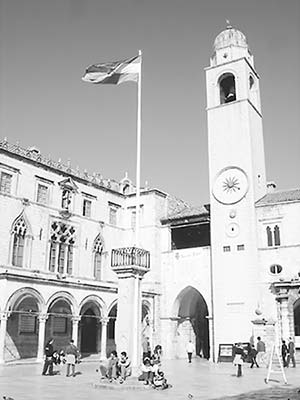
To the right of Sponza Palace is the town’s Bell Tower (Gradski Zvonik). The original dated from 1444, but it was rebuilt when it started to lean in the 1920s. The big clock may be an octopus, but only one of its hands tells time. Below that, the golden circle shows the phase of the moon. At the bottom, the old-fashioned digital readout tells the hour (in Roman numerals) and the minutes (in five-minute increments). At the top of each hour (and again three minutes later), the time is clanged out on the bell up top by two bronze bell-ringers, Maro and Baro. (If this all seems like a copy of the very similar clock on St. Mark’s Square in Venice, locals are quick to point out that this clock predates that one by several decades.)
The clock still has to be wound every two days. Notice the little window between the moon phase and the “digital” readout: The clock-winder opens this window to get some light. The Krasovac family was in charge of winding the clock for generations. During the siege, their house was destroyed—with the winding keys inside. For days, the clock bell didn’t run. But then, miraculously, the keys were discovered lying in the street. Excited Dubrovnik citizens came together in this square and cheered as the clock was wound and the bell chimed, signaling to the soldiers surrounding the city that they hadn’t won yet.
By the way, if you went through the gate at the bottom of the Bell Tower—directly under Maro and Baro—you’d enter a stony corridor that would eventually lead you to the Old Town’s south-facing Ploče Gate (PLOH-cheh). Along the way, you’d pass, on the right, an entrance to the Old Port (we’re heading there another way soon); beyond that, the huge building on the left, up a grand staircase with a “modesty” railing, houses the Dominican Monastery Museum (described later, under “Sights in Dubrovnik”). And just beyond that, at the teensy chapel burrowed into the wall on the right, is the best entrance for climbing the City Walls (also described later, including timing strategies).
Behind Orlando is St. Blaise’s Church (Crkva Sv. Vlaha), dedicated to the patron saint of Dubrovnik. You’ll see statues and paintings of St. Blaise all over town, always holding a model of the city in his left hand. According to legend, a millennium ago St. Blaise came to a local priest in a dream and warned him that the up-and-coming Venetians would soon attack the city. The priest alerted the authorities, who prepared for war. Of course, the prediction came true. St. Blaise has been a Dubrovnik symbol—and locals have resented Venice—ever since.
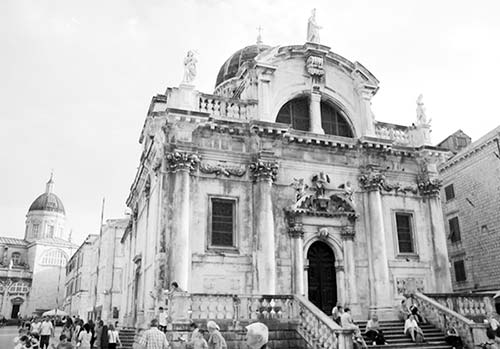
The church, like most churches in this city, was built following the 1667 earthquake and fire. And, while we’ve heard plenty on this walk about Dubrovnik’s rivalry with Venice, there’s no denying that the Venetians were some of Europe’s top cultural trendsetters at that time. So Dubrovnik invited a Venetian architect to design the church dedicated to their favorite saint. That’s why St. Blaise’s looks like it would be at home reflected in a Venetian canal...right down to its bulbous dome, which seems to have been transplanted here from the top of St. Mark’s.
In June 1991, Croatia declared independence from Yugoslavia. Within weeks, the nations were at war (for more on the war, see the Understanding Yugoslavia chapter). Though warfare raged in the Croatian interior, nobody expected that it would reach Dubrovnik.
As refugees from Vukovar (in northeastern Croatia) arrived in Dubrovnik that fall, telling horrific stories of the warfare there, local residents began fearing the worst. Warplanes from the Serb-dominated Yugoslav People’s Army buzzed threateningly low over the town, as if to signal an impending attack.
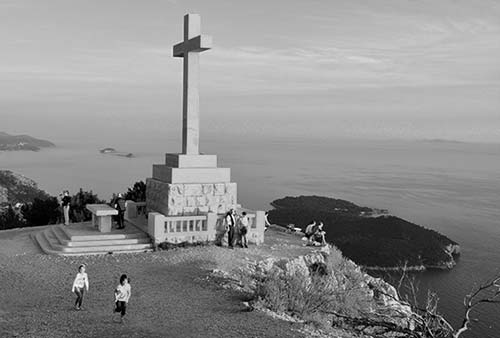
Then, at 6:00 in the morning on October 1, 1991, Dubrovnik residents awoke to explosions on nearby hillsides. The initial attacks were focused on Mount Srđ, high above the Old Town. First the giant cross was destroyed, then a communications tower (both have been rebuilt and are visible today). This first wave of attacks cleared the way for Yugoslav land troops—mostly Serbs and Montenegrins—who surrounded the city. The ragtag, newly formed Croatian army quickly dug in at the old Napoleonic-era fortress at the top of Mount Srđ, where just 25 or 30 soldiers fended off a Yugoslav takeover of this highly strategic position.
At first, shelling targeted military positions on the outskirts of town. But soon, Yugoslav forces began bombing residential neighborhoods, then the Pearl of the Adriatic itself: Dubrovnik’s Old Town. Defenseless townspeople took shelter in their cellars, and sometimes even huddled together in 15th-century forts along the city’s walls—the first time in Dubrovnik’s long history that the walls were used to defend against an attack.
The people of Dubrovnik refused to flee their town. Though severely outgunned and outnumbered, Dubrovnik’s defenders managed to hold the fort atop Mount Srđ, while Yugoslav forces controlled the nearby mountaintops. All supplies had to be carried up to the fort by foot or by donkey. Dubrovnik wasn’t prepared for war, so its citizens had to improvise their defense. Many brave young locals lost their lives when they slung old hunting rifles over their shoulders and, under cover of darkness, climbed the hills above Dubrovnik to meet Yugoslav soldiers face-to-face.
After eight months of bombing, Dubrovnik was liberated by the Croatian army, which attacked Yugoslav positions from the north. By the end of the siege, 100 civilians were dead, as well as more than 200 Dubrovnik citizens who lost their lives actively fighting for their hometown (much revered today as “Dubrovnik Defenders”); in the greater Dubrovnik area, 420 “Defenders” were killed, and another 900 wounded. More than two-thirds of Dubrovnik’s buildings had been damaged, and more than 30,000 people had to flee their homes—but the failed siege was finally over.
Why was Dubrovnik—so far from the rest of the fighting—dragged into the conflict? Yugoslavia wanted to catch the city off-guard, gaining a toehold on the southern Dalmatian Coast so they could push north to Split. They also hoped to ignite pro-Serb passions in the nearby Serb-dominated areas of Bosnia-Herzegovina and Montenegro. But perhaps most of all, Yugoslavia wanted to hit Croatia where it hurt—its proudest, most historic, and most beautiful city, the tourist capital of a nation dependent on tourism. It seems their plan backfired. Locals now say, “When Yugoslavia attacked Dubrovnik, they lost the war”—because images of the historic city under siege swayed international public opinion against Yugoslavia.
The war initially devastated the tourist industry. Now, to the casual observer, Dubrovnik seems back to normal. Aside from a few pockmarks and bright, new roof tiles, there are scant reminders of what happened here more than three decades ago. But even though the city itself has been repaired, the people of Dubrovnik are forever changed. Imagine living in an idyllic paradise, a place that attracted and awed visitors from around the world...and then watching it gradually blown to bits. It’s understandable if Dubrovnik’s citizens are a little less in love with life than they once were.
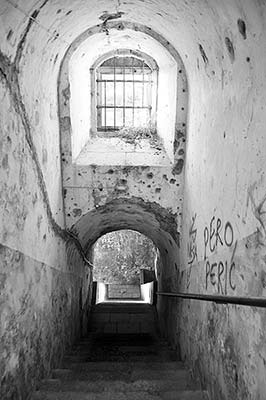
It’s clear that in the case of this siege, the Croats of Dubrovnik were the largely innocent victims of a brutal surprise attack. But keep in mind the larger context of the war: The cousins of these Croats, who were defending the glorious monument that is Dubrovnik, bombarded another glorious monument—the Old Bridge of Mostar. It’s just another reminder that the “good guys” and “bad guys” in these wars are far from clear cut.
Dubrovnik has several low-key attractions related to the siege, including the museum in the ruined fortress atop Mount Srđ and the Memorial Room of Dubrovnik Defenders in the Sponza Palace on Luža Square. Another sight, War Photo Limited, expands the scope to war photography from around the world.
• Facing the Bell Tower, turn right and walk along the wide street.
Pred Dvorom: Rector’s Palace and Cathedral
This street (its name means “In Front of the Palace”) connects the Stradun to the historic residence of the Republic of Dubrovnik’s rulers, known as rectors.
Just past the Bell Tower, you’ll see the entrance to the Sloboda theater (marked Luža Centar), which hosts cultural events (such as folk-dancing shows) in the summer and movies year-round. There’s also the helpful Cultural Information Desk inside. Next to that, Onofrio’s Little Fountain (Mala Onofrijeva Fontana) is the little brother of the one at the other end of the Stradun.
The big building beyond the fountain is the City Hall (Vijećnica). The terrace at the near end of City Hall is occupied by the Gradska Kavana, or “Town Café.” This hangout—historically Dubrovnik’s favorite spot for gossiping and people-watching—has seating all the way through the wall to the Old Port.
Just beyond the café terrace, notice the statue of Dubrovnik poet Marin Držić (1508-1567). This beloved bard’s most famous work concerns “Uncle Maro,” an aristocrat who’s as stingy as he is wealthy. His son cleans out his savings account and goes on a bender in Rome...until his father gets wind of it and comes calling. The shiny lap and bright nose of this statue might lead you to believe it’s good luck to rub his schnoz—and, sure enough, you’ll see a steady stream of tourists doing just that. But the truth is that when the statue went up in 2008, local kids were drawn to his prominent proboscis and couldn’t resist climbing up on his lap and grabbing it. Tourists saw the shine and assumed they were supposed to do it, too. This is how legends are born.
Past the Držić statue, the Rector’s Palace is marked by its austere yet grand arcaded entryway. In the Middle Ages, the Republic of Dubrovnik was ruled by a rector (similar to a Venetian doge). The rector, who was elected by the nobility, lived upstairs in this palace. To prevent any one person from becoming too powerful, the rector’s term was limited to one month. Most rectors were in their 50s—nearing the end of the then-average life span, when they were less likely to shake things up. The palace’s exterior is decorated in the Gothic-Renaissance mix (with particularly finely carved capitals) that was so common in Dubrovnik before the 1667 earthquake.
Above the entrance is the message Obliti privatorum publica curate—loosely translated, “Forget your personal affairs and concern yourself with the affairs of state.” This was a bold statement in a feudal era before democracy, when aristocrats were preoccupied exclusively with their self-interests. (It also feels tragically relevant today.)
Standing at the main door, get a free look at the palace’s impressive courtyard—a venue for the Summer Festival, hosting music groups ranging from the local symphony to the Vienna Boys’ Choir. During Dubrovnik’s golden age, this courtyard was open to the public. People would wander in and out—gossiping, washing their laundry in the fountain (on the left), and bringing food to family members imprisoned in the cells.
In the courtyard stands the only secular statue created during the centuries-long Republic. Dubrovnik republicans, mindful of the dangers of hero-worship, didn’t believe that any one citizen should be singled out. They made only one exception—for Miho Pracat (a.k.a. Michaeli Prazatto), a rich citizen who donated vast sums to charity and willed a fleet of ships to the city. Notice that Pracat’s statue is displayed in here behind closed doors, not out in public.
If you pay to enter the Rector’s Palace (described later, under “Sights in Dubrovnik”; also covered by the Dubrovnik Pass), you’ll get a closer look at that statue, see the original Maro and Baro bell-ringers, wander through the rectors’ apartments, and explore some other exhibits about historic Dubrovnik. In keeping with the Republic of Dubrovnik’s preference for practicality over glitz, and because it’s been plundered over time, the interiors aren’t particularly striking—probably skippable unless you’re interested in the city’s history.
At the end of the street looms the huge dome of Dubrovnik’s cathedral. According to legend, Dubrovnik’s original 12th-century cathedral was funded largely by the English king Richard the Lionheart. On his way back from the Third Crusade, Richard was shipwrecked nearby. He promised God that if he survived, he’d build a church on the spot where he landed—which happened to be on Lokrum Island, just offshore. At Dubrovnik’s request, Richard agreed to build his token of thanks inside the city instead. It was the finest Romanesque church on the Adriatic...before it was destroyed by the 1667 earthquake. This version was built in the 18th century, in a Baroque style that now seems determined to compete with Rome as well as Venice. It’s free to enter the interior, which isn’t too exciting; you can pay a small fee for a good look at the overstuffed treasury (described later, under “Sights in Dubrovnik”).
• Standing in front of the Rector’s Palace and facing the cathedral, turn right and go up the short street into...
Gundulićeva Poljana: Dubrovnik’s Market Square
The largest square in the Old Town feels much smaller than it is, because it’s usually packed. Find a quiet corner to get your bearings, then do a little exploring. On this piece of incredibly valuable real estate in the very heart of Dubrovnik, locals still do their shopping—especially early in the morning, before the cruise-ship crowds descend. (If you’re an early riser, begin your day with a stroll here. There’s a handy Mlinar bakery where you can buy a pastry and takeaway coffee.)
The main street you entered on is lined with souvenir stands under red-and-white umbrellas selling lavender sachets, dried fruits, liquors, and other edible and drinkable gifts. But if you venture just a bit deeper, you’ll find rickety tables where farmers sell what they pulled out of the ground or plucked off the bush this morning. The selection varies greatly by season, but keep an eye out for grapes, plums, citrus fruits, green beans, pomegranates, figs, eggplants, and blitva (greens).
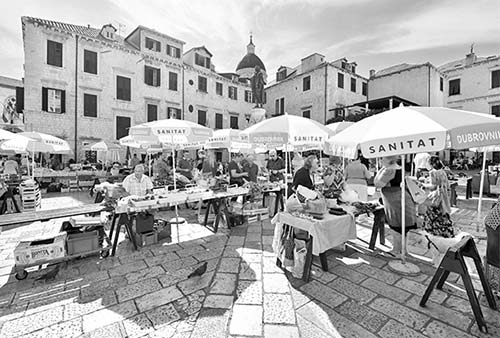
In the middle is a statue of the square’s namesake, the great Baroque poet Ivan Gundulić (1589-1638). His greatest work, the epic poem Osman, includes a line known to all Croatians: O liepa, o draga, o slatka slobodo (“Oh beautiful, oh beloved, oh sweet liberty”). While Catholic, Gundulić did not consider himself either a Croat or a Serb, but simply a Slav. However, as tensions grew over time, both groups tried to claim him. And when this statue was unveiled in 1893, rival Croat and Serb contingents attended the ceremony—hinting at the tensions that would boil over in the decades to come.
Beyond the market stalls is a handy Konzum—the only relatively “cheap” grocery store inside the City Walls. On the corner next to the Konzum entrance is an old stone fountain for washing produce.
If you continue up to the top end of the square, past the many restaurant tables, the street narrows and runs into a grand staircase leading to the Jesuit church and its dramatic facade. Like the cathedral, this was built after the 1667 earthquake to inject some Baroque drama into Dubrovnik. It’s a lovely space (with a fine gravelly square at the top, including the recommended Kopun restaurant). But more recently, these stairs have become clogged with Game of Thrones pilgrims who clang a handbell and shout “Shame! Shame! Shame!” (Locals report that, during the peak of Dubrovnik’s GoT mania, late at night, some tourists even stripped naked for a risqué photo op on the stairs.)
• Retrace your steps (preferably clothed) back to the cathedral area, and continue straight ahead, going through the arched passage opposite the cathedral’s main facade. You’ll emerge at the...
Old Port
The picturesque Old Port faces away from what was Dubrovnik’s biggest threat, the Venetians. Here, you can haggle with captains selling excursions to nearby towns and islands (described in the next chapter) and watch cruise-ship passengers coming and going on their tenders.
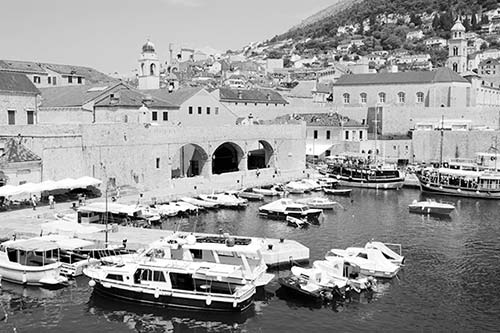
At the far end of the port, St. John’s Fort (Tvrđava Svetog Ivana) pokes out into the water—providing a twin for the St. Lawrence Fort we saw at the start of this walk.
Follow the narrow walkway around the right side of the port, lined with inviting benches and wrapping almost all the way around in a backward C. You may see people walking the City Walls above you. You can enter the wall walk near here, but it’s better to enter at the Ploče Gate near the big tower across the port from here.
Pause at the port’s far end—standing below St. John’s Fort—and look back for a mini spin tour of the city. You can see the triple-arched arcades marking the Arsenal, now a grand café. To the right and above, see the chess piece-like Minčeta tower, which marks the highest point of the City Walls. Hovering above is an even loftier fortification, atop Mount Srđ—accessible by cable car from the hill just above the City Walls (if you squint, you may spot the cable car trundling up and down).
Now pan to the right, back at sea level. The huge church across the port, with the bell tower, is the Dominican Monastery (with a museum). Past that is the Revelin tower, yet another part of the Ploče Gate’s extensive fortifications.
Now continue around the bend and look farther out, past the mouth of the port. The long, bulky stone building that stretches just above the water is the Lazareti, once the medieval quarantine house. In those days, all visitors were locked in here for 40 days before entering town to ensure they weren’t bringing disease into Dubrovnik. (In Italian, 40 is quaranta, which is where we get the word “quarantine.”) Today the Lazareti hosts events, including a lively folk-dancing show (see “Entertainment in Dubrovnik,” later).
• Now keep following the walkway, leaving the Old Port behind. Soon, stretching out before you, you’ll see the...
Breakwater (Porporela)
Climb the stairs and find a spot on a bench along this stunning viewpoint. Long considered one of Dubrovnik’s most romantic spots, this was where young couples would sneak out for some privacy after dark. (If a young local asked their lover to “go to the Porporela” together, and they agreed, it meant they were going steady.)
Look back at the huge wall towering above you; notice people walking on top, making their way around the City Walls. High up, find yet another statue of St. Blaise, like the one we saw at the beginning of our walk. You’ll likely also see hardy swimmers taking a dip at the base of the wall here. From the far tip of the breakwater, you can see one corner of the Cold Drinks “Buža” I cocktail bar (described later, under “Entertainment in Dubrovnik”)—which, in addition to serving drinks with amazing views, is another popular place to take a swim.
For more luxurious beaches, with pebbles instead of rocks, turn 180 degrees and visually follow the coastline past the Lazareti building, looking for umbrellas and towels. This marks Banje Beach, with stunning views back on the Old Town. Much farther out—barely visible from here—is St. Jakob Beach, which requires a long walk but is less crowded and also has great (distant) Old Town views. Both are described later, under “Activities in Dubrovnik.” If you followed the road in this direction, you’d reach the resort town of Cavtat, Dubrovnik’s airport, and before long, Montenegro.
For yet more swimming opportunities, turn your attention to the forested Lokrum Island, which hovers just offshore. It doesn’t look like much from here, but in addition to offering several popular swimming spots, this island is a fun place to go for a wooded walk and simply escape the crowded city. Boats depart regularly from the Old Port, just behind you.
Finally, do another slow 360-degree spin, thinking about how we’ve walked from one end of old Dubrovnik to the other, and through its entire history. Now...go make your own.
• Your walk is finished. From here, you’ve got plenty of sightseeing options (all described next), including an old synagogue, an Orthodox church, a modern exhibit of war photography, the medieval granary, the ruins of an old foundry, the Dominican Monastery Museum, and, of course, a walk on the City Walls.
Sights in Dubrovnik
▲▲▲CITY WALLS (GRADSKE ZIDINE)
Foundry Museum (a.k.a. Gornji Ugao Tower)
▲Franciscan Monastery Museum (Franjevački Samostan-Muzej)
▲Rector’s Palace (Knežev Dvor)
Bishop’s Palace (Biskupska Palača)
▲Dominican Monastery Museum (Dominikanski Samostan-Muzej)
NEAR THE OLD PORT (STARA LUKA)
Maritime Museum (Pomorski Muzej)
BETWEEN THE STRADUN AND THE MAINLAND
▲Synagogue Museum (Sinagoga-Muzej)
BETWEEN THE STRADUN AND THE SEA
▲Serbian Orthodox Church (Srpska Pravoslavna Crkva)
▲Rupe Granary and Ethnographic Museum (Etnografski Muzej Rupe)
▲▲▲Mount Srđ
Keep in mind that many of Dubrovnik’s museums require you to have either a “nine museum ticket” or a Dubrovnik Pass (which also covers the City Walls and public transit); for details on both options, see “Tourist Information,” earlier.
▲▲▲CITY WALLS (GRADSKE ZIDINE)
Dubrovnik’s single best activity is strolling the scenic mile-and-a-quarter around the City Walls. As you meander along this lofty perch—with a sea of orange roofs on one side and the azure sea on the other—you’ll get your bearings, peer into secluded gardens, and snap pictures like mad. Bring your map, which you can use to pick out landmarks and get the lay of the land. Speed demons can walk the walls in about an hour; strollers and shutterbugs should plan on longer.
Cost: €35 to enter walls, cheaper Nov-Feb, also includes the Fort of St. Lawrence outside the Pile Gate, covered by Dubrovnik Pass.
Hours: From April through October, the walls open daily at 8:00; the closing time depends on the season (April-May and early Sept until 18:30, June-July until 19:30, Aug until 19:00, late Sept until 18:00, Oct until 17:30). Off-season (Nov-March), the walls are open daily 9:00-15:00. The “closing time” indicates when the walls shut down, not the last entry. Attendants begin circling the walls 30 minutes after the posted closing time to lock the gates, so if you want to make it all the way around, ascend at least 30 minutes before the posted closing if you’re speedy, and an hour or more before if you want to linger.
Entrances and Strategies: There are three entry points for the wall (see “Dubrovnik’s Old Town” map), and wall walkers are required to follow the one-way route counterclockwise. One good strategy is to begin at the far side of the Old Town, using the entrance near the Ploče Gate and Dominican Monastery (this is where my self-guided tour of the walls begins). This entrance is the least crowded, and you’ll tackle the steepest part (and enjoy some of the best views) first. The most popular—and most crowded—entrance is just inside the Pile Gate, next to the Church of St. Savior (for this location, you must buy your tickets at the desk across the square from the stairway entry). If you manage to arrive before the hordes, it can make sense to enter here and explore this (most congested) section first. Finally, there’s a small entrance near St. John’s Fort overlooking the Old Port (next to the Maritime Museum). You can’t leave and reenter the wall later on the same ticket; you have to do it all in one go. If you have a Dubrovnik Pass—even a multiple-day one—you can only use it once to ascend the walls.
Avoiding Crowds: Because this is Dubrovnik’s top attraction, it’s extremely crowded. Your best strategy is to avoid the walls when cruise ships are in town. During busy times, try to hit the walls around 8:00, or just before 17:00 (to avoid both the worst heat and the worst crowds). Crowds are worst from about 9:30 until 11:00, then decrease ever so slightly. They pick up again in the late afternoon (around 17:00), peaking about an hour before closing time (18:30 in high season).
Heat Warning: The walls can get deliriously hot—all that white stone and seawater reflect blazing sunshine something fierce, and there’s virtually no shade (except at a few wall-top cafés). It’s essential to bring sunscreen, a hat, and water (the Onofrio public fountains are near both the Pile and Ploče entrances). A few shops and cafés along the top of the wall (mostly on the sea side) sell drinks, but it’s cheaper to bring what you’ll need with you. Pace yourself: There are several steep stretches, and you’ll be climbing up and down the whole way around. Particularly on the hottest days (commonly in July-Aug), the walls are best avoided between about 9:00 and 16:00—those first-aid workers you’ll see stationed near the entry points aren’t just hanging out for fun. If you have trouble with heat, save the walls for a cloudy day.
Background: There have been walls here almost as long as there’s been a Dubrovnik. As with virtually all fortifications on the Croatian Coast, these walls were beefed up in the 15th century, when the Ottoman navy became a threat. Around the perimeter are several substantial forts, with walls rounded so that cannonballs would glance off harmlessly. These stout forts intimidated would-be invaders during the Republic of Dubrovnik’s golden age and protected residents during the 1991-1992 siege.
 Self-Guided Tour: It’s perfectly fine to just wander the walls and take in the views over Dubrovnik rooftops. But this brief tour should help give you bearings to what you’re seeing, as you read Dubrovnik’s unique and illustrious history into its street plan.
Part 1—Ploče Gate to Pile Gate: Begin by ascending near the Ploče Gate. (Go through the gate under the Bell Tower, walk along the stoutly walled passageway between the port and the Dominican Monastery, and look for the wall entrance on your right—next to the tiny chapel embedded in the wall.) Buy your ticket, then head up, turn left, and start walking counterclockwise. After climbing some stairs, you’ll walk with Mount Srđ and the cable car on your right. After passing the roofline of the Dominican Monastery’s cloister on the left, you’re walking above what was the poorest part of medieval Dubrovnik, the domain of the craftsmen—with narrow, stepped lanes that had shops on the ground floor and humble dwellings up above. Peering down all of the tight lanes, look for the many little stone ledges sticking out next to windows. These were used to hang banners during the city’s golden age.
As you walk, keep an eye on the different-colored rooftops for an illustration of the damage Dubrovnik sustained during the 1991-1992 siege. It’s easy to see that nearly two-thirds of Dubrovnik’s roofs were replaced after the bombings (notice the new, bright-orange tiles—and how some buildings salvaged the old tiles but have 20th-century ones underneath). The pristine-seeming Old Town was rebuilt using exactly the same materials and methods with which it was originally constructed.
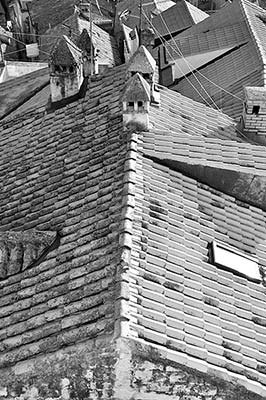
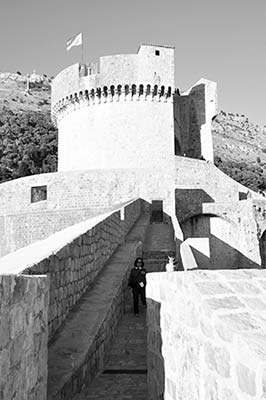
The path you’re on alternates between straight stretches and stairs; as you walk you’re rewarded with higher and higher views. Nearing the summit, you pass a juice bar (you can use the WCs if you buy a drink). At the very top, enjoy the best possible view of the Old Town—you can see the rooftops, churches, and the sea. While stuck behind a traffic jam of selfie sticks, ponder the increasing narcissism of our age...then snap a selfie to post to Instagram. For an even better view, it’s worth hiking up 63 crowded stone stairs to the top of Minčeta Tower. From either viewpoint, observe the valley-like shape of Dubrovnik. It’s easy to imagine how it began as two towns—one where you are now, and the other on the hilly island with the church spires across the way—originally separated by a seawater canal. Notice the relatively regular, striped pattern of houses on this side, and the more higgledy-piggledy arrangement on the far side (a visual clue that the far side is older).
The sports court at your feet is a reminder that Dubrovnik is a living city. (Anyone can play here—B.Y.O. ball.) Underneath the sports court are the remains of a medieval foundry—the centerpiece of Dubrovnik’s least-known museum. (You can visit the Foundry Museum, described later, after you’ve descended the walls.)
Around 1,500 people currently reside within these walls, but that number used to be much higher. Nowadays, renting out your house to tourists is far more lucrative than living there yourself. And life is much easier in the suburbs—imagine the challenges that come with living in such a steep medieval townscape well into the 21st century. Delivery trucks rumble up and down the Stradun early each morning, and you’ll see hardworking people delivering goods on handcarts throughout the day.
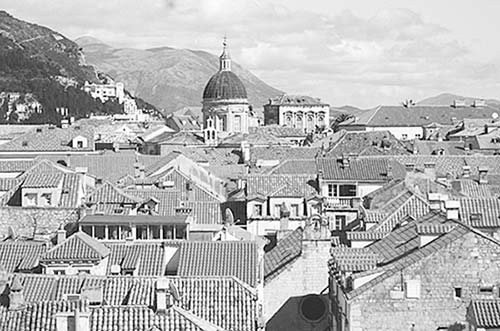
Look up at the fortress atop Mount Srđ—seemingly custom-made for keeping an eye on a large swath of coastline—and the strategic position of Dubrovnik is clear. Independent Dubrovnik was not just this walled city, but an entire region.
Now continue downhill (you’ve earned it), noticing views on your right of the bustling Pile Gate area and the Fort of St. Lawrence (we’ll reach better views of these soon). As the wall walk levels off, you’ll pass an exit (on the left); if you’re bushed and ready to head back to town, you can leave here—but once you leave, you can’t reenter on the same ticket, and some of the best views lie ahead. It’s much better to carry on straight for part 2.
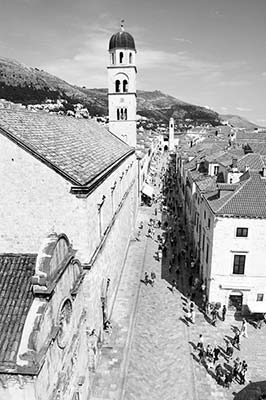
Part 2—Pile Gate to Old Port: This is the most crowded section, where many people enter—so be patient. While you’re waiting, pause to enjoy the full-frontal view of the Stradun, barreling right at you. In the Middle Ages, merchants lined this drag, and before that, this was a canal. At your feet is Onofrio’s Big Fountain, which supplied water to a thirsty town (piped in from the mountains). From here, you can see a wide range of church steeples representing the cosmopolitan makeup of a thriving medieval trade town (from left to right): Dominican, Franciscan (near you), the town Bell Tower, St. Blaise’s (the round dome—hard to see from here), Serbian Orthodox (twin domed steeples), cathedral, and (high on the hill) Jesuit St. Ignatius. Just watch the river of humanity, flowing constantly up and down one of Europe’s finest main streets. Now do a 180 for a good view of the Pile Gate chaos, with a steady stream of buses lumbering up and down the hill, tethering the Old Town to Port Gruž and the Lapad resort zone.
Carry on through the guard tower and along the wall, climbing uphill again. Looking to the wall ahead of you, notice that—after you pass along a straighter, lower stretch—this wall scampers up a mighty foundation of solid rock. You’ve left the canal that once separated the two parts of Dubrovnik, and now you’re ascending what used to be a separate, very steep, rocky island. This stretch tickles Game of Thrones fantasies—many King’s Landing scenes were filmed along here.
Climbing higher and looking to your left, into town, you’ll see that this area is still damaged—not from the 1991-1992 siege, but from the 1667 earthquake. Notice that, unlike the extremely dense construction on the poorer far side of town, this area has more breathing space and larger gardens. Originally this was also densely populated, but after the quake, rather than rebuild, the wealthy folks who lived here decided to maximize green space. Grates cover the openings to old wells and grain stores that once supplied homes here—essential for surviving a siege.
As the walkway summits and levels out, you reach a drink stand (charging triple what you’ll pay at a grocery store in town). On the right are stunning views of the Fort of St. Lawrence, which worked in concert with these stout walls to make Dubrovnik nearly impenetrable. (That fort is also climbable, and covered by the same ticket as the walls.)
Past the drink stand, you’ll stroll past locals’ backyards, peering into their inviting gardens and checking the status of their drying laundry. Farther along, at the picturesque little turret, is a popular juice bar. Look outside the wall just past this turret, and you’ll spot tables and umbrellas clinging to the rocks at the base of the wall, plus a roped-off swimming area. This is the recommended Cold Drinks “Buža” II, the best spot in town for a scenic drink. (You can’t enter from atop the wall—you’ll have to wait until later.) On the horizon is the isle of Lokrum and—often—cruise ships at anchor, sending passengers to and fro on tenders. After passing Buža, look down on the left to see another sports court wedged between the walls—the best they can do in this vertical town.
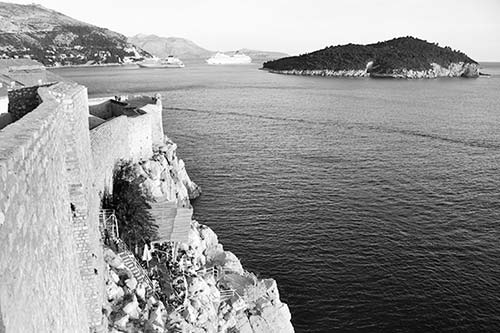
Soon after passing the little turret, you’ll see the other Buža (nicknamed “Little Buža”); just above it, notice the little statue of St. Blaise, Dubrovnik’s patron, enjoying some shade under the next turret.
Rounding the bend over Little Buža, look left to see the facade of the Jesuit St. Ignatius Church. Notice that the homes in this area are much larger. These are aristocratic palaces—VIPs wanted to live as close as possible to the cathedral and Rector’s Palace, which are just below—and this also happens to be the oldest part of town, where “Ragusa” was born on a steep offshore island.
Continue around the wall, passing two more snack bars (the second is more elaborate, with a better menu, more shade, and pay WCs). Behind the second snack bar are more quake-ruined houses. Eventually you pop out at a high plateau, where The City Walls—Continuation signs lead you down to the next part. From here you could drop down to the exit (though the final stretch of our wall walk is a snap—at the fork, go right, through the hole in the wall). In the little plant-filled square at the bottom of the next staircase is a sweet cat hospice, with a donation box for feeding some homeless feline residents.
Part 3—Old Port to Ploče Gate: At the start of the next stretch, you’ll come to the entrance of the Maritime Museum. If you have a museum ticket or a Dubrovnik Pass, here’s a chance to escape the sun, use a clean WC, and learn about Dubrovnik’s 2,500-year seafaring past (see description, later).
Next, walk along the top of the wall overlooking the Old Port. Imagine how this heavily fortified little harbor (facing away from Dubrovnik’s historic foes, the Venetians) was busy with trade in the Middle Ages. Today it’s still the economic lifeline for town—watch the steady stream of cruise-ship tenders injecting dose after dose of tourist cash. The Old Port is so charming partly because they prohibit huge, glitzy yachts from mooring here. All boats here must be under a certain size, and the humble fishing and pleasure craft belong to locals.
After circling your way to the middle of the port, immediately above the main pier, the path turns sharply left and heads straight for the Bell Tower—you’ll climb some stairs to get a good glimpse of the bell ringers, Maro and Baro. Continuing, you’ll look down into the inner passage that insulated the wall from the town center. On the sea side, look for the outdoor tables of the unsigned 360°, a cocktail bar/restaurant catering to high rollers. Gussied-up jet-set diners enjoy coming here for extremely expensive, Michelin-starred fare.
Just past 360°, you’ll come face-to-face with the vertical walls of the Dominican Church before finding the stairs back down to where you started this wall walk. Nice work. Now head on down and reward yourself with an ice-cream cone...and some shade.
The “Other” Wall Climb: Your ticket for the City Walls also includes the Fort of St. Lawrence just outside the Old Town (valid within 72 hours; fort described on here). If you’ve already bought a ticket there, show it when buying your main wall ticket and you’ll pay only the difference.
Foundry Museum (a.k.a. Gornji Ugao Tower)
This easy-to-miss sight, tucked high up below the City Walls’ tallest tower, offers a glimpse at a medieval foundry that was established in 1545. Used to produce cannonballs and gunpowder (essential elements of an independent ministate), the foundry was intentionally located at the very top of town—still barely within the walls, but a safe distance from most residents. Damaged in the great 1667 quake, it was buried under a garbage dump and then under a playground, until it was finally excavated in 2008. Explanations are sparse, and it can be difficult to make sense of what you’re seeing, so a visit here is best for archaeology buffs.
Cost and Hours: Covered by City Walls ticket or €7 on its own, same hours as City Walls, closed Nov-March, last entrance one hour before closing.
Getting There: You’ll enter the complex through the base of the Minčeta Tower, at the top (northernmost) point of the Old Town (follow any of the stepped lanes all the way up to the landward side of town, turn left, and walk along the inside of the wall until you can’t walk anymore).
Visiting the Foundry: Visitors walk through the inside of Minčeta Tower, including two levels of casements, then along a private little inner stretch of the City Wall. Below the tower, look for the foundry’s foundations, including its four furnaces, molds for church bells and gigantic cannonballs, and a pile of original casting sand (a volcanic material imported from Italy, essential for the working of any foundry). Exhibits include a few of the original items that were cast here, such as buckles, keys, needles, horseshoes, and musket shot.
NEAR THE PILE GATE
▲Franciscan Monastery Museum (Franjevački Samostan-Muzej)
In the Middle Ages, Dubrovnik’s monasteries flourished. As a part of their charity work, the monks at this monastery took on the responsibility of serving as pharmacists for the community. Visiting here today, you’ll stroll through a delightful cloister and walk through a one-room museum with an old pharmacy.
Cost and Hours: €6, daily 9:00-18:00, Nov-March until 14:00, Placa 2, +385 20 321 410.
Visiting the Museum: Enter through the gap between the small church and the big monastery. Just inside the door (before the ticket-seller), a century-old pharmacy still serves residents; it’s one of the world’s oldest continually operating pharmacies (closed Sun). Notice the antique jars, advertisements (including one of the first known aspirin ads), and other vintage pharmacist gear.
After the ticket desk, turn left and walk clockwise to explore the peaceful, sun-dappled cloister. Examine the capitals at the tops of the 60 Romanesque-Gothic double pillars. Each one is different. Notice that some parts of the portals inside the courtyard are made with a lighter-colored stone—these had to be repaired after being hit during the 1991-1992 siege. The damaged 19th-century frescoes along the tops of the walls depict the life of St. Francis, who supposedly visited Dubrovnik in the early 13th century. If you look closely, in a few panels you may see two layers of (different) scenes; beneath the 19th-century frescoes, restorers have found even more precious fragments of some early-18th-century paintings; where possible, these are also being resurrected.
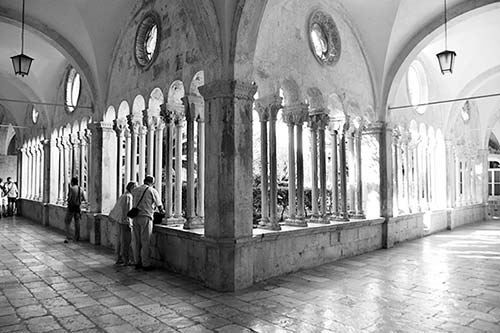
In the far corner stands the monastery’s original medieval pharmacy, opened in 1317. The Franciscans have been operating a pharmacy here ever since. On display are jars, pots, and other medieval pharmacists’ tools. Notice the display of old pharmacists’ books from the 16th, 17th, and 18th centuries—expertise imported from as far away as Venice, Frankfurt, Amsterdam, and Bologna. The sick would come to get their medicine at the little window (on the left side), which limited contact with the pharmacist and reduced the risk of passing on disease. On the right wall, look for the glass case marked venena—where poisons were locked away and carefully doled out, with a record of who had what.
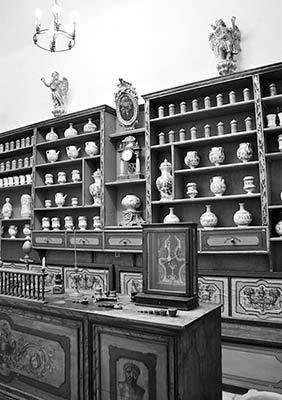
Around the room, you’ll also find some relics, old manuscripts, and a detailed painting of early-17th-century Dubrovnik as it looked before the devastating 1667 earthquake. In the painting, notice the chapel atop Mount Srđ—the highly strategic locale where Napoleon built a fortress that was later pivotal during the 1991 siege (see “The Siege of Dubrovnik” sidebar, earlier). Though Dubrovnik was always heavily fortified, they avoided putting a fortress on the mountaintop—fearing it might seem overly provocative to the Ottoman Empire that surrounded them, and upon whose favor they depended for their autonomy.
Leaving the museum room, turn left and walk to the end of this corridor. Look up to see a tomb with a privileged position, affixed high on the wall. The Gučetić-Gozze family donated vast sums to help rebuild the monastery after the earthquake. As thanks, the Franciscans helped them get that much closer to God when they passed on, offering them this final resting place that was elevated...in every sense.
NEAR LUŽA SQUARE
These sights are at the far end of the Stradun (nearest the Old Port). As you stand on Luža Square facing the Bell Tower, the Rector’s Palace and cathedral are up the wide street called Pred Dvorom to the right, and the Dominican Monastery Museum is through the gate by the Bell Tower and to the left.
▲Rector’s Palace (Knežev Dvor)
This was the home of Dubrovnik’s ever-rotating ruler (for more on the rectors, see my “Dubrovnik Walk,” earlier). Because it’s been plundered twice (most recently by Napoleon’s forces, who stole all the furniture), this museum isn’t as interesting as most other European palaces. What little you’ll see was donated by local aristocrats to flesh out the pathetically empty complex. The palace collection (with good English explanations) is skippable, but it does offer a glimpse of Dubrovnik in its glory days. The palace’s exterior and courtyard are viewable at no charge.
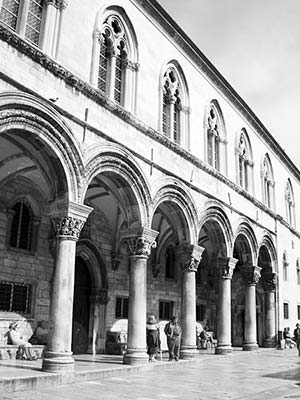
Cost and Hours: €10, covered by “nine museum ticket” and by Dubrovnik Pass; Thu-Tue 9:00-18:00, Nov-March until 16:00, closed Wed year-round; Pred Dvorom 3, +385 20 322 096.
Visiting the Palace: Once inside, you’ll ramble through a few rooms of dull paintings on the ground floor, then go into the lime-green-stucco courtroom (with explanations of the Republic’s unique judiciary system, and portraits and bios of some of its key politicians). Next, you’ll see one of the palace’s highlights: the original bronze bell-ringers from the town Bell Tower (Maro and Baro). Like antique robots (from the Renaissance, 1477-1478), these eerily lifelike sculptures could pivot at the waist to ring the bell. Nearby you’ll see stonework that used to decorate city buildings. In the next room, massive iron chests (including a few with elaborate locking mechanisms) are displayed inside some old prison cells, which supposedly were placed within earshot of the rector’s quarters, so he would hear the moans of the prisoners...and stay honest. Leaving the prison, you’ll enter the courtyard described earlier, where you can get a better look at the Pracat statue.
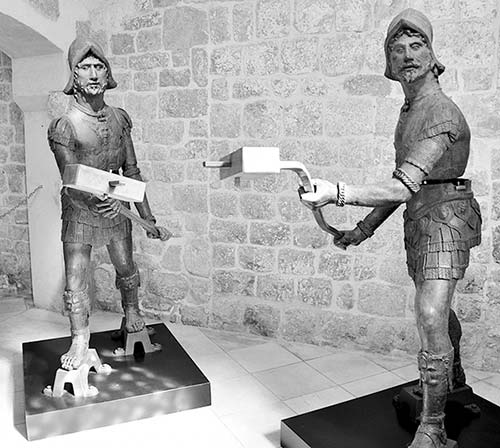
On the mezzanine level (stairs near the main entrance, above the prison—notice the “hand” rails), you’ll find a decent display of furniture, beautiful 18th-century sedans used to tote around V.I.R.s (Very Important Ragusans), a wimpy gun exhibit (remember, this was a city of traders and diplomats, not fighters), votive offerings (mostly silver), an 18th-century coin collection (with magnifying glasses to make out the detail), and an interesting painting of “Ragusa” in the early 17th century—back when its stout walls were surrounded by a moat and a canal ran down its middle.
Head back down to the courtyard and ascend the grand stairway to the upper floor (with more “hand” rails). Upstairs, you’ll explore old apartments that serve as a painting gallery. The only vaguely authentic room is the red room in the corner, decorated more or less as it was in 1500, when it was the rector’s office. Facing the rector’s desk, Mihajlo Hamzić’s exquisite Baptism of Christ painting, inspired by Italian painter Andrea Mantegna, is an early Renaissance work from the “Dubrovnik School” (see “Dominican Monastery Museum” listing, later). This area also often displays temporary exhibits.
Back in the courtyard, you can go up the smaller stairs to the Domus Christi collection of old pharmacist tools and pots.
Handy WCs are just off the courtyard next to the shop, through which you’ll exit.
Cathedral (Katedrala)
Dubrovnik’s cathedral (this Roman-style Baroque structure dates from the 18th century) has a towering dome and a fairly austere interior. It’s free to step inside, but you’ll pay a small fee to see the church’s most interesting feature, its jam-packed treasury.
Cost and Hours: Church—free, treasury—€4 or €10 combo-ticket with Bishop’s Palace (see next); Mon-Sat 9:00-17:00, Sun from 11:30, treasury typically open until 16:00, shorter hours off-season.
Visiting the Cathedral: Inside, you’ll find a painting from the school of Titian (Assumption of the Virgin) over the stark contemporary altar.
Behind the altar is a quirky treasury (riznica) packed with 187 relics (buy your ticket to the right of the altar; the treasury is on the left). Notice that there are three locks on the treasury door—the stuff in here was so valuable, three different VIPs (the rector, the bishop, and a local aristocrat) had to agree before it could be opened. On the table near the door are several of St. Blaise’s body parts (pieces of his arm, skull, and leg—all encased in gold and silver). In the middle of the wall directly opposite the door, look for the crucifix with a piece of the True Cross. On a dig in Jerusalem, St. Helen (Emperor Constantine’s mother) discovered what she believed to be the cross that Jesus was crucified on. It was brought to Constantinople, and the Byzantine emperors doled out pieces of it to Balkan kings. Note the folding three-paneled altar painting (underneath the cross). Dubrovnik ambassadors packed this on road trips (such as their annual trip to pay off the Ottomans) so they could worship wherever they traveled.
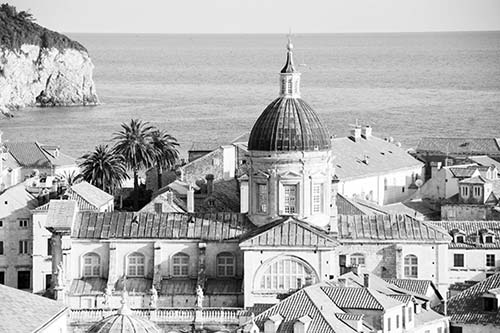
On the right side of the room, the tarnished silver casket supposedly holds the actual swaddling clothes of the Baby Jesus. Dubrovnik bishops secretly passed these clothes down from generation to generation...until a nun got wind of it and told the whole town. Pieces of the cloth were cut off to miraculously heal the sick, especially new mothers recovering from a difficult birth. No matter how often it was cut, the cloth always went back to its original form. Then someone tried to use it on the wife of a Bosnian king. Since she was Muslim, it couldn’t help her, and it never worked again. True or not, this legend hints at the prickly relationships between faiths (not to mention the misogyny) here in the Balkans.
Bishop’s Palace (Biskupska Palača)
Just across the plaza from the cathedral’s main entrance, this building once belonged to an illustrious family, but was taken over by Dubrovnik’s bishops in the 19th century. After many decades of restoration, it’s now one of the only places in town where you can get an idea of how Dubrovnik’s aristocracy once lived.
Cost and Hours: €7, or €10 combo-ticket with cathedral treasury, irregular hours—likely the same as the cathedral and probably closed Oct-April.
Visiting the Palace: The bishop still occupies the upper floors of the house; the lower floors display the bishopric’s art collection. The medieval, Renaissance, and Baroque paintings mostly appeal to art lovers, but the historic interiors are the real draw here. Notice the frescoes in the entrance hall, then climb the stairs to the tourable rooms. Branching off to the right from the main staircase, you can see an arched Gothic ceiling—one of the few that survived the 1667 earthquake. Notice the charming details, such as the faces carved in the stonework at the bottom of door arches on the first floor. The standout is the room with the spectacular, Renaissance-era wooden ceiling; it also survived the earthquake and is one of the only such ceilings on the eastern Adriatic.
Dominican Monastery Museum (Dominikanski Samostan-Muzej)
You’ll find many of Dubrovnik’s art treasures—paintings, altarpieces, and manuscripts—gathered around the peaceful Dominican Monastery cloister inside the Ploče Gate. It’s most worth visiting if the church interior is open to visitors (currently closed for renovation at least until 2024); ask at the entrance before you buy your ticket.
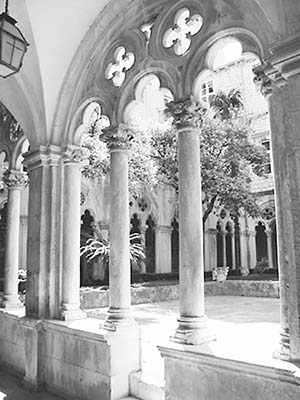
Cost and Hours: €5, daily 9:00-18:00, Nov-March until 17:00, may close earlier in bad weather or at quiet times, +385 20 322 212.
Visiting the Museum: As you climb the stairs up to the monastery, notice that the spindles supporting the railing are solid up until about two feet above the ground. This was to provide a modicum of modesty to ladies on their way to church—and to prevent creeps down below from looking up their skirts.
Buy your ticket, then turn left and work your way clockwise around the cloister. The room in the far corner contains paintings from the “Dubrovnik School,” the Republic’s circa-1500 answer to the art boom in Florence and Venice. Though the 1667 earthquake destroyed most of these paintings, about a dozen survive, and five of those are in this room. Just inside the door, on the right, don’t miss the triptych by Nikola Božidarović with St. Blaise holding a detailed model of 16th-century Dubrovnik (left panel)—the most famous depiction of Dubrovnik’s favorite saint. You’ll also see reliquaries shaped like the hands and feet that they hold.
Continuing around the courtyard, duck into the next room. At the far end of the room is a dim painting by Titian depicting St. Blaise, Mary Magdalene, and the donor who financed this work.
At the next corner of the courtyard is the entrance to the striking church at the heart of this still-active monastery. This is the most important part of the exhibit, but it’s been closed for renovation for a long time. If it’s open, step inside and face the altar. The interior is decorated with modern stained glass, a beautiful 13th-century stone pulpit that survived the earthquake (reminding visitors of the intellectual approach to scripture that characterized the Dominicans), and a precious 14th-century Paolo Veneziano crucifix hanging in the arch above the altar. Perhaps the finest piece of art in the church is the Miracle of St. Dominic, showing the founder of the order bringing a child back to life (to the left as you face the main altar). Behind the altar, find the Vukovar Cross, embedded with panels painted by different artists from the Croatian school of Naive Art—offering an enticing taste of this unique and fascinating style (for more on Naive Art, see here). It was painted in the Realist style (late 19th century) by Vlaho Bukovac.
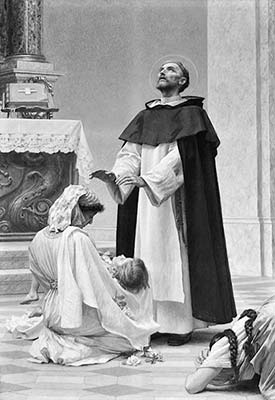
NEAR THE OLD PORT (STARA LUKA)
Maritime Museum (Pomorski Muzej)
In the 15th century, when Venice’s nautical dominance was peaking, Dubrovnik emerged as another maritime power and the Mediterranean’s leading shipbuilding center. The Dubrovnik-built “argosy” boat (from “Ragusa,” an early name for the city) was the Cadillac of ships, even mentioned by Shakespeare. This worthwhile museum built into Dubrovnik’s walls fits in tidily with a wall walk. It traces the long history of Dubrovnik’s most important industry with contracts, maps, paintings, navigational devices, and models—all well described in English.
Cost and Hours: Covered by “nine museum ticket” and Dubrovnik Pass; hours flex on demand—usually Thu-Tue 9:00-18:00, Nov-Feb until 16:00, closed Wed year-round; good WCs at entry, upstairs in St. John’s Fort, at far/south end of Old Port, +385 20 323 904.
Visiting the Museum: The main floor covers the period of the Republic of Dubrovnik through the 18th century. Find the map showing the consulates of Dubrovnik (which was an independent and influential city-state) across the centuries, from Lisbon and Tangier to Odessa and Alexandria. The intimidating cannons are a reminder that Dubrovnik was truly a maritime power in its heyday. The easy-to-miss upstairs covers the 19th and 20th centuries and features a kids’ zone, lots of paintings of ships, some shipmaking tools, and a few mastheads.
Aquarium (Akvarij)
Dubrovnik’s old-school aquarium, housed in the cavernous St. John’s Fort, has 31 tanks on one floor. A visit here allows you a close look at the local marine life and provides a cool refuge from the midday heat.
Cost and Hours: €8, kids-€4, daily July-Aug 10:00-19:00, progressively shorter hours off-season, English descriptions, ground floor of St. John’s Fort, enter from Old Port, +385 20 323 978.
BETWEEN THE STRADUN AND THE MAINLAND
The first two museums are a few steps off the main promenade toward the mainland.
▲Synagogue Museum (Sinagoga-Muzej)
When the Jews were forced out of Spain in 1492, a steady stream of them passed through here en route to today’s Turkey. Finding Dubrovnik to be a flourishing and relatively tolerant city, many stayed. Žudioska Ulica (“Jewish Street”), just inside the Ploče Gate, became the ghetto in 1546. It was walled at one end and had a gate (which would be locked at night) at the other end. Today, the same street is home to the second-oldest continuously functioning synagogue in Europe (after Prague’s), which contains Croatia’s only Jewish museum.
Cost and Hours: €7, daily 9:00-20:00, mid-Nov-April until 15:00, Žudioska Ulica 5, +385 20 321 204.
Visiting the Synagogue: The top floor houses the synagogue itself. Notice the lattice windows that separated the women from the men (in accordance with Orthodox Jewish tradition). Below that, a small museum with good English descriptions gives meaning to the various Torahs (including one from 14th-century Spain) and other items—such as the written orders (naredba) from Nazi-era Yugoslavia, stating that Jews were to identify their shops as Jewish-owned and wear armbands. (The Ustaše—the Nazi puppet government in Croatia—interned and executed not only Jews and Roma but also Serbs and other people they considered undesirable; see here.) Of Croatia’s 24,000 Jews, only 4,000 survived the Holocaust. Today Croatia has about 2,000 Jews, including a dozen Jewish families who call Dubrovnik home.
▲War Photo Limited
The brainchild of photojournalist Wade Goddard, this thought-provoking museum attempts to show the ugly reality of war through raw, often disturbing photographs taken in the field around the world (not just Dubrovnik). Use the loaner guide to understand the well-displayed images on two floors; a small permanent exhibit (on the top floor) captures the Yugoslav Wars through photography and video footage. Each summer, the gallery also houses various temporary exhibits.
Cost and Hours: €10, daily 10:00-22:00, April and Oct until 17:00, closed Nov-March, Antuninska 6, +385 20 322 166, www.warphotoltd.com.
BETWEEN THE STRADUN AND THE SEA
▲Serbian Orthodox Church (Srpska Pravoslavna Crkva)
Round out your look at Dubrovnik’s major faiths (Catholic, Jewish, and Orthodox) with a visit to this house of worship—one of the most convenient places in Croatia to learn about Orthodox Christianity. Remember that people from the former Yugoslavia who follow the Orthodox faith are, by definition, ethnic Serbs. With occasional lingering hard feelings about the Yugoslav Wars, this church serves as an important reminder that not all Serbs are aggressors.
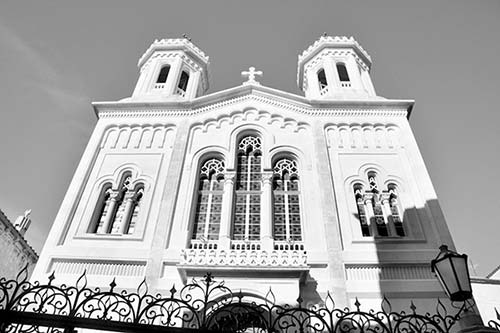
Dubrovnik never had a very large Serb population (an Orthodox church wasn’t even allowed inside the town walls until the mid-19th century). During the Yugoslav Wars, most Serbs fled, created new lives for themselves elsewhere, and saw little reason to return. But some old-timers remain, and Dubrovnik’s dwindling, aging Orthodox population is still served by this church. The candles stuck in the sand (to prevent fire outbreaks) represent prayers: The ones at knee level are for the deceased, while the ones higher up are for the living. The person selling candles encourages you to buy and light one, regardless of your faith, so long as you do so with the proper intentions and reverence. To better appreciate this church, read “The Serbian Orthodox Church” sidebar. If you’re interested to see even more, ask about the nearby Icon Museum, which has been closed for years but may reopen.
Cost and Hours: Free but donations accepted; daily 8:00-21:00, Oct-April until 18:00, liturgy Sun 10:00-11:00; Od Puča.
▲Rupe Granary and Ethnographic Museum (Etnografski Muzej Rupe)
This huge, 16th-century building was Dubrovnik’s biggest granary, and today houses the best folk museum I’ve seen in Croatia. Rupe means “holes”—and it’s worth the price of entry just to peer down into these 15 cavernous underground grain stores, designed to maintain the perfect temperature to preserve the seeds (63 degrees Fahrenheit). These stores of grain were part of Dubrovnik’s defenses, making the city very siege-resistant. Upstairs is the well-presented Ethnographic Museum that celebrates local folk culture and customs. While it’s a great exhibition, the lack of English descriptions is disappointing.
Cost and Hours: Covered by “nine museum ticket” and Dubrovnik Pass; Thu-Tue 9:00-18:00, Nov-March until 16:00, closed Wed year-round; Od Rupa 3, +385 20 323 013. The museum hides several blocks uphill from the main promenade, toward the sea (climb up Široka—the widest side street from the Stradun—which becomes Od Domina on the way to the museum).
Visiting the Museum: As you enter, look for the helpful video that illustrates the way this building was used in the Middle Ages. Then look down through the hefty grates to see the massive grain-storage compartments bored deep into the rock. When the grain had to be dried, it was moved upstairs—where museum exhibits now show off Dubrovnik’s many traditions and festivals, and display tools, jewelry, clothing, instruments, painted eggs, and other folk artifacts from its colorful history.
OUTSIDE THE OLD TOWN
See the “Greater Dubrovnik” map for the locations of these sights.
▲▲▲Mount Srđ
After adding Dubrovnik to his holdings, Napoleon built a fortress atop the hill behind the Old Town to keep an eye on his new subjects (in 1810). During the city’s 20th-century tourism heyday, a cable car was built to effortlessly whisk visitors to the top so they could enjoy the views from the fortress and the giant cross nearby. Then, when war broke out in the 1990s, Mount Srđ (pronounced like “surge”) became a crucial link in the defense of Dubrovnik—the only high land that locals were able to hold. The fortress was shelled and damaged, and the cross and cable car were destroyed. Minefields and unexploded ordnance left the hilltop a dangerous no-man’s-land. But since then, the mountain’s fortunes have reversed. The landmines have been removed, and in 2010, the cable car was rebuilt to once again connect Dubrovnik’s Old Town to its mountaintop. Visitors head to the top both for the spectacular sweeping views and to ponder the exhibits in a ragtag museum about the war.
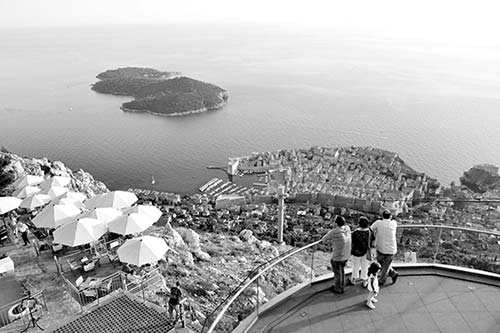
Warning: While this area has officially been cleared of landmines, nervous locals remind visitors that this was once a war zone. Be sure to stay on clearly defined paths and roads.
Getting to the Top: The cable car is the best option for reaching the summit of Mount Srđ (€27 round-trip, €15 one-way; at least 2/hour—generally departing at :00 and :30 past each hour, more frequent with demand, 3-minute ride; daily from 9:00, June-Aug until 24:00, Sept until 22:00, May until 21:00, April and Oct until 20:00, Feb-March and Nov until 17:00, Dec-Jan until 16:00; doesn’t run in Bora wind or heavy rain, last ascent 30 minutes before closing, may close in winter for maintenance; +385 20 325 393, www.dubrovnikcablecar.com). The lower station is just above the Buža Gate at the top of the Old Town (from the main drag, huff all the way to the top of Boškovićeva, exit through gate, and climb uphill one block, then look right). You may see travel agencies selling tickets on your walk up to the station, but there’s no advantage to buying ahead (and you may wind up paying more, due to the agencies’ unfavorable exchange rate). There may be a short ticket-buying line at the station, but it moves fast; the longer line isn’t for buying tickets, but to ride up. Read on for tips on avoiding a long wait.
If you have a car, it’s possible to drive up to the top of Mount Srđ—though the road can be crowded. From the high road above the Old Town, watch for the turnoff to Bosanka, which leads you to that village, then up to the fortress and cross—follow signs for Srđ (it’s twisty but not far—figure a 20-minute drive from the Old Town area). If you’re coming south from the Old Town, once you reach the main road above, you’ll have to turn left and backtrack a bit to reach the Bosanka turnoff. For hikers, a switchback trail (used to supply the fortress during the siege) connects the Old Town to the mountaintop—but it’s very steep and provides minimal shade. (If your knees are solid and it’s not too hot, you could ride the cable car up, then hike down.)
Crowd-Beating Tips: The cable car has a limited capacity, and lines can get long when several cruise ships are in town. On busy days, it’s best avoided entirely in the morning, especially 9:30-11:00. Things may quiet down in the mid- to late afternoon. But then there’s another rush before sunset—which is, understandably, the most popular time to ascend, and the line to descend on the cable car stacks up as soon as the sun goes down (see “Sunset Tips,” later).
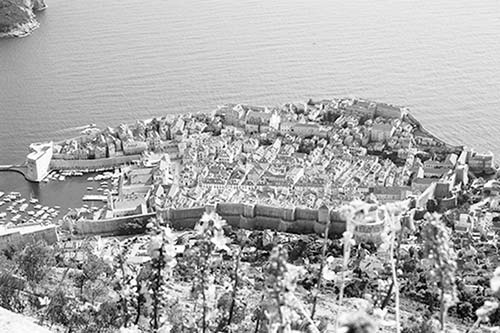
Mountaintop: From the top cable-car station, skip the first viewpoint and head up the stairs to the panoramic terrace. The bird’s-eye view is truly spectacular, looking straight down to the street plan of Dubrovnik’s Old Town. From this lofty perch, you can see north to the Dalmatian islands (the Elaphite archipelago, Mljet, and Korčula, plus the Pelješac Peninsula and beyond), south to Montenegro, and east into Bosnia-Herzegovina. Gazing upon those looming mountains that define the border with Bosnia-Herzegovina—which, centuries ago, was also the frontier of the huge and powerful Ottoman Empire—you can appreciate how impressive it was that stubborn little Dubrovnik managed to remain independent for so much of its history.
The cross was always an important symbol in this very Catholic town. (Your view may be blocked by trees—it’s down near the restaurant tables.) After it was destroyed in the siege, a temporary wooden cross was erected to encourage the townspeople who were waiting out the war. During a visit in 2003, Pope John Paul II blessed the rubble from the old cross; those fragments are now being used in the foundations of the city’s newest churches. Nearby stands a huge red, white, and blue flagpole—the colors of the Croatian flag.
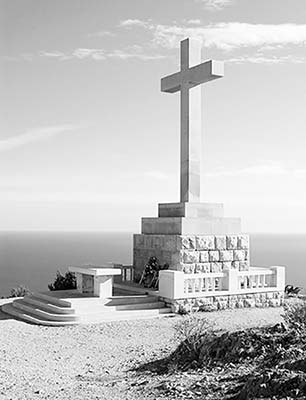
To reach the museum in the old fortress, walk behind the cable-car station along the rocky red soil toward the gigantic antenna.
Fort and Museum: The Napoleonic-era Fort Imperial (Trđava Imperijal) houses the Homeland War Museum (€4, daily in high season 9:00-20:00, shorter hours off-season). While interesting (and occupying an important location, where the Dubrovnik Defenders burrowed in to fight for their city), the museum’s descriptions are rabble-rousing and one-sided. Still, it offers an insightful look at the conflict.
At the entrance is a timeline of events. The hallway to the right leads to a changing photo exhibition showing slices of life during the siege. The hallway on the left has the permanent exhibits, where photos, documents, and artifacts tell the story (with English descriptions) of the overarching war with Yugoslavia and how the people defended this fortress. The descriptions are too dense and tactical for casual visitors, but you’ll see lots of photos and some actual items used in the fighting: primitive, rusty rifles (some dating from World War II) that the Croatians used for their improvised defense, and piles of spent mortar shells and other projectiles that Yugoslav forces hurled at the fortress and the city. Look for the wire-guided Russian rockets. After reaching their target, the rockets would burrow into a wall, waiting to be detonated once their operators saw the opportunity for maximum destruction. Look for the photo of Orlando’s Column (the Luža Square landmark) covered in a wooden box and sandbags. The tattered Croatian flag seems soaked in local patriotism. A video screen shows breathless international news reports from the front line during the bombings.
After seeing the exhibit, climb up a few flights of stairs from the entry hall to the rooftop for arguably the best view from anywhere on Mount Srđ. The giant communications tower overhead flew the Croatian flag during the war to inspire the besieged residents below. You might see some charred trees around here—these were claimed not by the war, but more recently by forest fires. (Fear of landmines and other explosives prevent locals from fighting the wildfires as aggressively as they might otherwise, making these fires more dangerous than ever.)
Activities: Near the upper lift station, you’ll see a couple of adventure activities: a zipline course and “buggy safari” off-road trip (see “Activities in Dubrovnik,” later).
Sunset Tips: Mount Srđ is a popular vantage point for enjoying the sunset over the Dalmatian islands. There are two viewpoints at the cable-car station: one at the cabin level and another upstairs. Another good vantage point is from near the cross (where some people scramble down onto the dangerously steep, rocky slope below). But if you’re going to tour the museum at the fort anyway, consider timing your visit to be on its rooftop for sunset. It tends to be less crowded and has beautiful views over the islands. The only disadvantage is that you’re farther away from the cable car—and as soon as the sun sets, the line back down begins to form. While the line moves quickly, you may be in for a wait. It can get cool on this arid and breezy mountaintop once the sun sets, so bring a sweater.
Eating: Boasting undoubtedly the best view in Dubrovnik, $$$$ Restaurant Panorama has drop-dead views over the rooftops of the Old Town and to the most beautiful parts of three different countries. While there’s glassed-in seating inside, in good weather I’d find the outdoor terrace—the Old Town floats just under your nose. Prices are high, but you can dine affordably if you stick to the “light lunch” menu (available before 18:00). If riding the cable car late in the day, this is a great place for a breezy dinner; it’s often cooler up here than down in the Old Town, and the views can’t be beat. There’s a rush on seating just after sunset, so it’s smart to reserve a table if that’s your plan (open same hours as cable car, +385 20 312 664).
▲▲Red History Museum
This well-done museum is somewhat inconveniently located in the Port Gruž area, but it’s worth the trip for a crash course on 20th-century Croatian (and Yugoslav) history. Focusing on socialism in theory and practice through accessible explanations and everyday objects, the exhibits also address the repressive aspects of living in the Yugoslav socialist regime. Overall, while there’s a lot of reading and most of the exhibits aren’t very interactive, the museum offers a good intellectual counterpoint to a sea-and-sun itinerary.
Cost and Hours: €9; daily 10:00-19:00, Nov-April Wed-Mon 11:00-17:00, closed Tue; Svetog Kriza 3, +385 91 540 1704, www.redhistorymuseum.com. It’s straightforward to get here with public transportation: from Pile Gate, take bus #1a, #1b, or #3, get off at the Luka Gruž bus stop (across from the ferry terminal), and continue walking straight ahead about five minutes, looking for the big, blocky Hotel Petka. The museum is just up the street, next to the hotel.
Visiting the Museum: The visit begins with a dry, data-heavy, but informative overview to set the stage. Concise but smart English explanations chart the rise of socialist/communist ideas in the territory of former Yugoslavia, then their eventual dominance thanks to Tito and the Partisans’ victory in World War II. The museum does a particularly good job integrating political and social history to show how society developed—for example, through the urban planning that created whole new sections of cities and guaranteed modern housing for everyone.
The next part (called “Socialism in Practice”) is more engaging: You’ll walk through several re-created rooms of a typical family home. Spend some time in the kitchen, featuring cupboards stacked with former Yugo products that have a lot of nostalgic value today, including Jugokeramika (ceramics from Zaprešić, Croatia, which were found in virtually every home). You can sample a “refreshing” Bronhi candy, learn how the American soap operas Peyton Place and Dynasty were all the rage on Yugoslav TV, and open wardrobes to find both the latest Yugo fashions and uniforms of the Yugoslav National Army. A calendar lists socialist holidays invented along with the new nation of Yugoslavia, from the Day of Youth Labor Activities (April 1) to Marshal Tito’s Birthday (which doubled as Youth Day, May 25) to Yugoslav Army Day (Dec 22).
As you browse, you may have some assumptions challenged as you learn how good life could be in socialist Yugoslavia. The country had the world’s second-fastest-growing economy (after Japan’s) starting in the 1950s, and many citizens saw their standard of living increase dramatically. One exhibit details the 14-day “required vacations” for every worker, which spurred the creation of many new (government-run) Adriatic resorts that are still popular with visitors today. This was quite an adjustment for many poor or rural people, who had never had a vacation in their lives. The museum also explores the cultural side of socialist Yugoslavia, such as education, film, pop music, and sports (the tall Yugoslavs were—and remain—a basketball powerhouse).
The museum doesn’t shy away from the dark side to the regime. The secret police were a powerful force, and political freedoms were tightly curtailed. One room tells about Goli Otok, the Alcatraz of Tito’s Yugoslavia, using filmed recollections of two men who spent time at the prison.
The exhibits finish up with a long corridor of old photos and individuals’ memories—both positive and negative—of living under socialism. These snapshots humanize a complicated and fascinating period in this region’s history and serve as a poignant reminder that even as regimes come and go, people are people. For many, Yugo life was the only life they knew...and it could be a happy one.
For the grand finale, you’ll see some Yugoslav inventions: the K67 kiosk, designed in Slovenia and still often spotted on the streets of Europe; the Fićo Zastava 101, a car designed in conjunction with Fiat; and the Yugo 45, the famous Yugoslav-built automobile that was aggressively introduced to the American market in 1985, only to become a punchline with its low price point ($3,900) and dubious build quality.
Activities in Dubrovnik
Swimming and Sunbathing
If the weather’s good and you’ve had enough of museums and churches, spend a sunny afternoon at the beach. There are no sandy beaches on the mainland near Dubrovnik, but there are lots of suitable pebbly options, plus several concrete perches.
The easiest, most atmospheric place to take a dip is right off the Old Town. From the Old Port and its breakwater, uneven steps clinging to the outside of the wall lead to a series of great sunbathing and swimming coves (and even a showerhead sticking out of the town wall). Another delightful rocky beach hangs on to the outside of the Old Town’s wall (at the bar called Cold Drinks “Buža” I; for more on this bar, and how to find it, see “Entertainment in Dubrovnik,” later).
A more convenient—and crowded—public beach is Banje, just outside the Ploče Gate, east of the Old Town. This beach (watched over by an upscale bar/restaurant/lounge) is ideal for sunbathing and wading, with a spectacular backdrop of Dubrovnik’s Old Town. To reach the beach, leave the Old Town through the Ploče Gate, walk about five minutes gradually uphill on the main road, then watch for the staircase marked Banje Beach (although the stairs pass through the bar, it is public access). The bar itself is slick and swanky, serving pricey food and drink. You can also rent a very expensive sun bed, but it’s much more affordable to bring your own towel and find a comfy patch of pebbles. Pay showers are nearby.
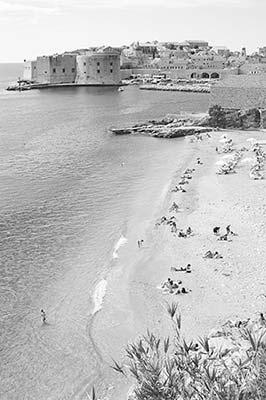
My favorite hidden beach—St. Jakob—takes a lot longer to reach, but if you’re up for the hike, it’s worth it to escape the crowds. Figure about a 25-minute walk (each way) from the Old Town. Go through the Ploče Gate at the east end of the Old Town and walk along the street called Frana Supila as it climbs uphill above the waterfront. At Hotel Argentina, take the right (downhill) fork and keep going on Vlaha Bukovca. Eventually you’ll reach the small church of St. Jakob. You’ll see the beach—in a cozy protected cove—far below. Curl around behind the church and keep an eye out for stairs going down on the right. These stairs are effectively unmarked, so it might take some trial and error to find the right ones. (If you reach the rusted-white gateway of the old communist-era open-air theater, you’ve gone too far.) Hike down the very steep stairs to the gentle cove, which has rentable chairs and a small restaurant for drinks (and a WC). Enjoy the pebbly beach and faraway views of Dubrovnik’s Old Town.
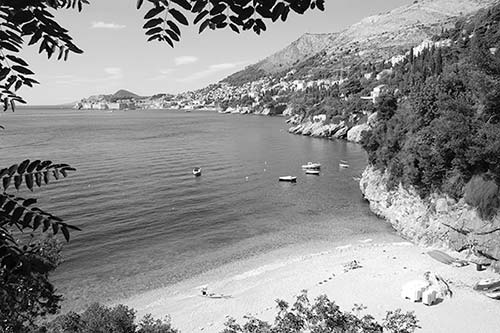
Other, even more distant, beaches are worth considering. If you’re staying at—or visiting—the resort zone of Lapad Bay, you’ll find beaches there: Uvala Lapad, a.k.a. “Sunset Beach,” is in the crook of the bay. Along the northern edge of Lapad are the private and pricey Copacabana Beach and Cava Beach, flanking the Coral Beach Club.
Locals prefer to swim on Lokrum Island because there are (relatively) fewer tourists. While there are no sandy or even pebbly beaches, there are several rocky ones, with ladders to lower yourself gingerly into the water. As the rocks here can be particularly jagged, you’ll want to wear good water shoes, and beware of uneven footing (both underwater, and on your way to the ladders). For details on taking a boat to Lokrum, see the next chapter.
Finally, for the best sandy beach in this part of Croatia, you’ll have to take a boat to the island of Lopud, then hike (or ride a golf cart) across the spine of the island to the gorgeous Šunj Beach. Making an all-day trek out here (by public ferry) is worth doing only if you’re desperate for a long, lingering day at the beach. If you’re cruising the Elaphite Islands, you’ll likely stop on Lopud for two or three hours—enough time for a quick dip at Šunj. For more on Lopud and Šunj Beach, see the next chapter.
Sea Kayaking
Paddling a kayak around the outside of Dubrovnik’s imposing walls is a memorable experience. Several outfits in town offer half-day tours (most options around €40); popular itineraries include loops along the City Walls, to secluded beaches, and around Lokrum Island; many include a break for snorkeling (they provide goggles), and some are timed to catch the sunset while bobbing in the Adriatic. Full-day and multiday tours are also available. Well-established companies include Adriatic Kayak Tours (www.adriatickayaktours.com), X-Adventure (www.kayak-dubrovnik.com), Fenix Adventure (www.fenixadventure.com), and Outdoor Croatia (https://outdoorcroatia.com)—but new companies pop up all the time...check online or look for fliers.
Adventure Activities
Several newer outfits are introducing adrenaline-fueled activities to the Dubrovnik area. While these tend to be quite pricey, they can be good fun for thrill-seeking travelers. For example, there’s a super-scenic zipline course at the top of Mount Srđ (www.ziplinedubrovnik.com); “buggy safari” off-road trips around the mountaintop over town (www.buggydubrovnik.com); and bungee-jumping off the New Bridge just north of town (www.bungee-jumping-dubrovnik.com). Get the latest at the TI.
Shopping in Dubrovnik
Most souvenirs sold in Dubrovnik—from lavender sachets to plaster models of the Old Town—are pretty tacky. Whatever you buy, prices are much higher along the Stradun than on the side streets.
Jewelry: A classy alternative to the knickknacks is a type of local jewelry called Konavoske puce (“Konavle buttons”). Sold as earrings, pendants, and rings, these distinctive and fashionable filigree-style pieces consist of a sphere studded with small posts. Though they’re sold around town, it’s least expensive to buy them on Od Puča street, which runs parallel to the Stradun two blocks toward the sea (near the Serbian Orthodox Church). The high concentration of jewelers along this lane keeps prices reasonable. You’ll find the “buttons” in various sizes, in both silver (affordable) and gold (pricey).
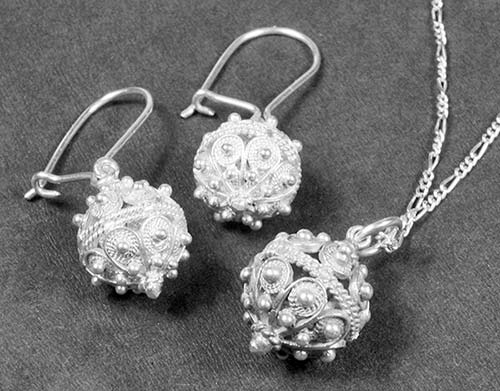
You’ll also see lots of jewelry made from red coral, which can only be legally gathered in small amounts from two small islands in northern Dalmatia. If you see a particularly large chunk of coral, it’s likely imported. To know what you’re getting, shop at an actual jeweler instead of a souvenir shop; Clara Stones, just a few steps off the Stradun at Nalješkovićeva 3, is reputable.
Local Arts and Crafts: Run by a humanitarian organization that supports people in rural areas around Dubrovnik, DEŠA is a nice place to buy traditional crafts like embroidery, treats such as candied almonds and oranges, and cosmetics. Their shop is in the Lazareti, the old quarantine house just outside the Ploče Gate (Mon-Fri 10:00-18:00, closed Sat-Sun, shorter hours off-season; see “Dubrovnik’s Old Town” map, earlier, for location).
A shop called Life According to KAWA, also outside the Ploče Gate, is a great place to browse for characteristic, hipster-aesthetic local souvenirs and handicrafts. They’ve got everything from artisanal sea salt and jewelry to ceramics and Dubrovnik-themed ironic T-shirts. They also stock a fridge full of local microbrews and some carefully selected local wines and foods (daily 9:00-21:00, shorter hours off-season, Maestra Đela Jusića 2—see “Dubrovnik’s Old Town” map, +385 20 696 958).
Along Zlatarska street in the Old Town, you can find a couple of shops with clothes and accessories made by local designers.
Gift-Shop Chains: Several gift shops in Dubrovnik (with additional branches throughout Dalmatia) hawk fun, if sometimes made-in-China, items. Look for these chains, which are a bit classier than the many no-name shops around town: Aqua sells pleasant nautical-themed gifts, blue-and-white-striped sailor shirts, and other gear. Bonbonnière Kraš is Croatia’s leading chocolatier, selling a wide array of tasty candies. Uje has artisan olive oils and other boutiquey edibles.
Entertainment in Dubrovnik
MUSICAL EVENTS
Dubrovnik hosts a full schedule of events for its annual Summer Festival (July 10-Aug 25, www.dubrovnik-festival.hr), which is quickly followed by its Late Summer Festival. But the town also works hard to offer traditional music outside of festival time. The Cultural Information Desk, inside the Sloboda theater lobby at the bottom of the Bell Tower on Luža Square, is a handy source of information on events (long hours daily)—or ask at the TI.
Here are a few good choices:
Spirited Linđo folk-music concerts are performed for tourists twice weekly in the Lazareti (former medieval quarantine building), just outside the Ploče Gate (usually Tue and Fri at 21:30, www.lindjo.hr).
The Dubrovnik Symphony Orchestra performs crowd-pleasing classics twice weekly in summer (and once weekly through winter). In good weather, concerts are typically in the courtyard of the Rector’s Palace; otherwise, they’re usually at the Marin Držić Theater next door, or in the Franciscan or Dominican church (www.dso.hr).
Various historic churches around town host touristy but enjoyable concerts (each hosts about 3/week at 21:00, +385 98 244 264). Venues include St. Savior, just inside the Pile Gate; the simpler Domina Church, just up Od Domina street from the Stradun; and the little Rosario Church near the Dominican Monastery at the Ploče Gate.
Also consider the folk dancing and market each Sunday morning at Čilipi, a small town near the airport (see the next chapter). Dubrovnik-based companies offer excursions that include transportation there and back.
NIGHTLIFE
Dubrovnik’s Old Town is one big, romantic parade of relaxed and happy people out strolling. The main drag is a fun scene, brightly lit and packed with shops, cafés, and bars, all open late. And if you walk away from the crowds or out on the port, you’ll be alone with the magic of the Pearl of the Adriatic. Everything feels—and is—very safe after dark.
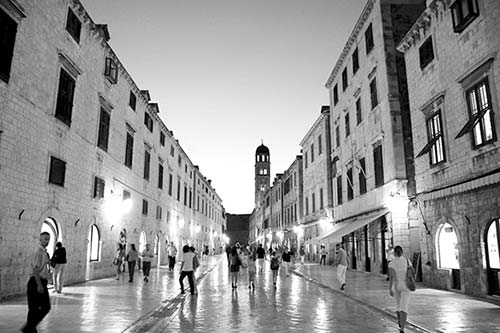
If you’re looking for a memorable bar after dark, consider these:
▲▲▲Drinks with a View
“Buža” offers, without a doubt, the most scenic spot for a drink. Perched on a cliff above the sea, clinging like a barnacle to the outside of the City Walls, this is a peaceful, shaded getaway from the bustle of the Old Town...the perfect place to watch cruise ships disappear into the horizon. Buža means “hole in the wall”—and that’s exactly what you’ll have to go through to reach these places. There are two different Bužas, both open every day in summer from 9:00 until the wee hours (closed in bad weather and off-season; both have drinks for around €6-8, cash only). Buža II (nicknamed “Big Buža”) is the older, more appealing of the pair. Filled with mellow tourists and bartenders pouring wine and beer into plastic cups, Buža II comes with castaway views and Frank Sinatra ambience. When the seats fill up—as often happens around sunset—you can order a drink at the bar and walk down the stairs to enjoy it “on the rocks”...literally. Buža I—also called Mala (Little) Buža—plays hip or edgy rather than romantic music, with concrete stairs leading down to a beach on the rocks below. While lacking Buža II’s shade, Buža I is less claustrophobic and often a bit less crowded, making it a viable alternative.
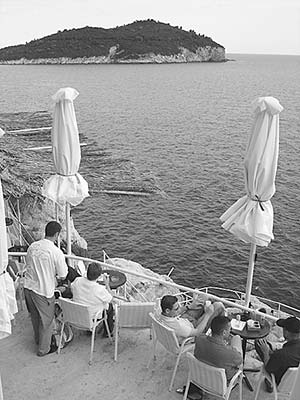
Getting There: Both Bužas are well away from the bustle of the main drag, along the seaward wall. To reach them from the cathedral area, hike up the grand staircase to St. Ignatius’ Church, then go left to find the lane that runs along the inside of the wall. To find the classic Buža II, head right along the lane and look for the Cold Drinks sign pointing to a literal hole in the wall. For the hipper Buža I, go left along the same lane, and locate the hole in the wall with the No Toples No Nudist graffiti.
Other Watering Holes (Some with Live Music)
Bunićeva Poljana, the little square tucked behind the cathedral, is jammed with tables from a half-dozen cafés, which fill up with tourists and locals each evening. Live jazz is provided nightly by Jazz Caffè Troubadour, but as their drink prices are high, most people prefer to sit at a nearby place...you can hear the music just as well from there (or from anywhere in this part of the Old Town, for that matter).
The Gaffe Irish Pub, with a chummy, pubby interior and a small courtyard, is a rollicking spot to drain a pint and watch some rugby or listen to live music (Miha Pracata 4, +385 20 640 152).
Restaurant Klarisa, tucked in a tight back corner of the Old Town (behind St. Claire’s Convent, just up Garište Ulica from Onofrio’s Big Fountain), has live jazz outside on weekends (typically Thu-Sat). You can pay for an overpriced meal or drink, or—better yet—just join the crowd leaning against a nearby wall to loiter and enjoy (Poljana Paska Miličevića 4, +385 20 413 100).
D’Vino Wine Bar is an ideal place to nurse a drink while learning about Croatian wine, nibbling local tapas, and socializing (plus listening to occasional live music—see www.dvino.net for details); also see full listing under “Eating in Dubrovnik,” later. Glam Café, just across the street, has a similar vibe and stocks about 50 different microbrews—mainly Croatian—with four beers on tap (daily 9:00-late, Mateo).
Nightclubs
Two nightspots are just beyond the Ploče Gate at the east end of town. Head under the Bell Tower, up the street past the Dominican Monastery. After crossing the bridge, look (on the left) for the entrance to Revelin—a dance club that fills one of the city wall’s fortress towers (opens at 22:30, www.clubrevelin.com). Then continue up the street until you reach Banje Beach, a bar/lounge/dance club overlooking one of the city’s most scenic beaches (www.banjebeach.com). Note that some exclusive bars and clubs charge admission on weekends.
MOVIES
The Old Town has a variety of movie theaters showing American blockbusters (usually in English with Croatian subtitles, unless the film’s animated or for kids; for the schedule, see www.kinematografi.org). While you can go to the movies anywhere, it’s fun to take part in the Croatian outdoor movie experience in good summer weather (typically late June through mid-Sept, shows begin shortly after sundown). At the outdoor Jadran cinema, you can lick ice cream (B.Y.O.) while you watch a movie with a Dubrovnik-mountaintop backdrop. This is a cheap, casual, and very Croatian scene, where people smoke and chat, and the neighbors sit in their windowsills to watch the movie (in the Old Town near the Pile Gate). Another outdoor movie venue, Slavica, is farther out of town, on the road leading away from the Pile Gate (for location, see the “Greater Dubrovnik” map, earlier). There are also two very central, indoor cinemas with comfortable seating: the Sloboda, right under the Bell Tower on Luža Square; and Visia, just inside the Pile Gate.
Sleeping in Dubrovnik
You basically have three options in Dubrovnik: a simple but comfortable, centrally located room in a private home (soba); a resort hotel on a distant beach; or a splurge on one of the few fancy hotels near the Old Town. Dubrovnik hotels are generally a poor value, and a hotel beyond the Old Town means commuting on a crowded bus to the sights. For these reasons, I heavily favor a central soba.
No matter where you stay, prices are much higher mid-June through mid-September, and highest in July and August. Reserve well ahead for these peak times.
SOBE (PRIVATE ROOMS)
In Dubrovnik, you’ll almost always do better with a soba or an apartment than with a hotel. Before you choose, carefully read the information on here. My favorite sobe are run by friendly English-speaking Croatians and are inside or within easy walking distance of the Old Town.
All my listings are air-conditioned and come with private facilities, and most have kitchenettes. A few are in family homes, but you can be as anonymous as you like. These sobe accept cash only (no credit cards), and you’re on your own for breakfast—I’ve listed some suggestions later, under “Eating in Dubrovnik.”
My four longtime personal favorites here are Dubrovnik Gardens, Jadranka Benussi, Van Bloemen Apartments, and Villa Ragusa. These all enjoy conscientious management, a great location, and good value for the price. Book these early—they’re often full. I’ve also listed several almost-as-good options.
You can also search for accommodations on the regular booking sites (such as Airbnb or Booking.com)—but if you want to stay at one of the places I’ve listed here, please book direct (by sending them an email), which saves both you and your host money. These hosts respond to email quickly, and many will offer you a discounted rate for direct bookings.
In the Old Town, Above the Stradun Promenade
These options are located at the top of town, high above the Stradun, just far enough away from nighttime noise. Expect a very steep hike up several flights of stairs from the main drag. Most of these are within a few steps of one another, on a lane officially called Žudioska Ulica but nicknamed “Rickova Ulica”; the rest are on similar lanes, a few blocks over. If you don’t mind the many steps, you’ll find this area to be a handy home base. When one of these places is full, they work together to find space for you. Because all these hosts live off-site, be sure to let them know when you’ll arrive so they can let you in.
$ Villa Ragusa offers a good value in the Old Town. Pero Carević renovated a 600-year-old house at the top of town. The five comfortable, modern, tight, but well-equipped rooms come with wooden beams and antique furniture. There are three doubles with bathrooms (including a top-floor room with rooftop views over the Old Town for no extra charge—request when you reserve) and two singles that share a bathroom (extra for breakfast at an atmospheric café just up the stairs, Žudioska Ulica 15, +385 98 765 634, www.villaragusadubrovnik.com, villa.ragusa@hotmail.com). Pero is often happy to drive his guests on day trips around Dubrovnik, for a similar cost to the drivers listed earlier in this chapter; ask when you book.
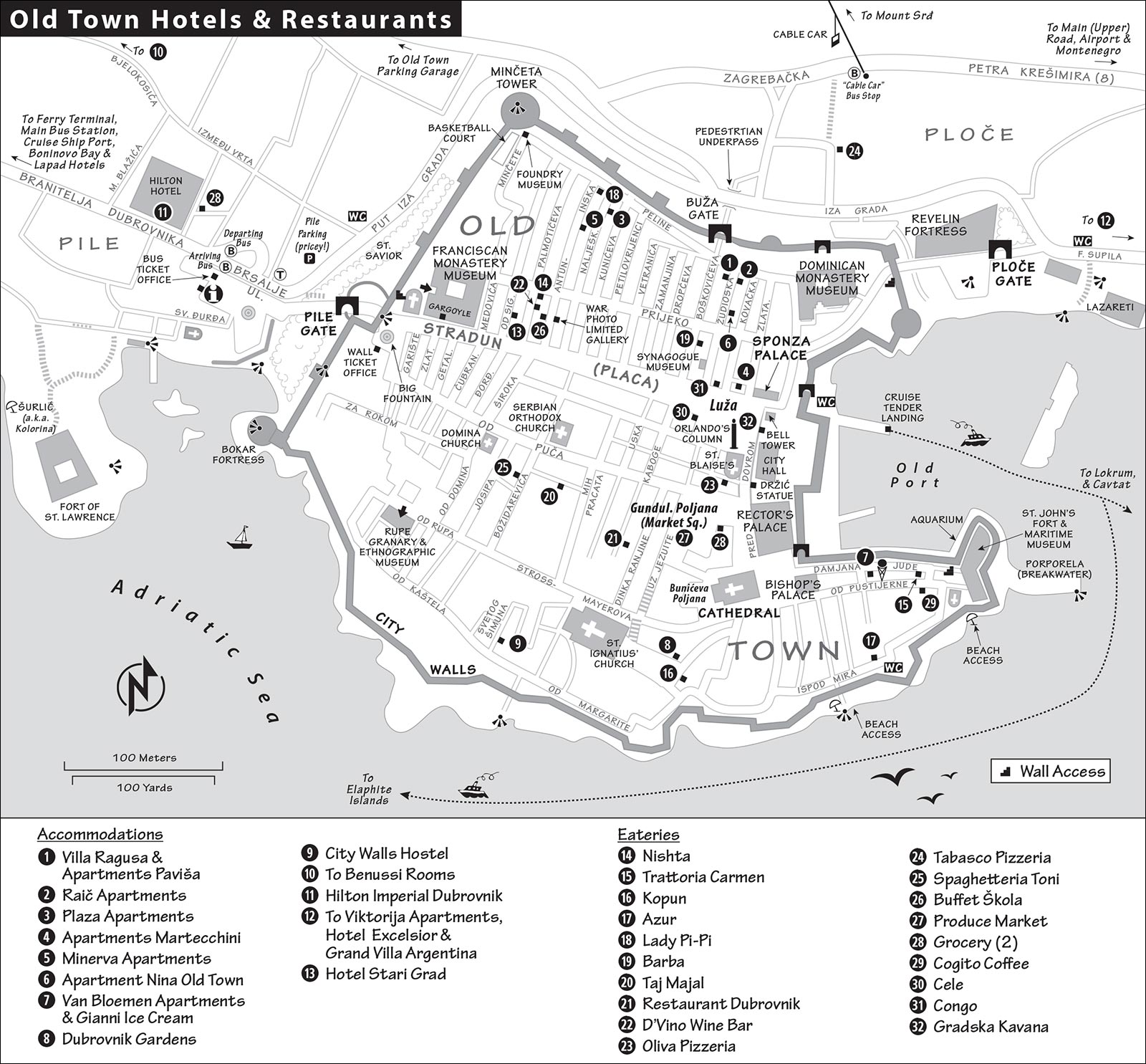
$ Apartments Paviša, next door to Villa Ragusa and run by Pero Paviša, has three good, older-feeling rooms (Žudioska Ulica 19, +385 98 427 399, pero.pavisa@gmail.com). Pero also rents two more rooms in the Viktorija neighborhood, about a 15-minute uphill walk east of the Old Town. While it’s a long but scenic walk into town, the views from these apartments are spectacular (a few euros more than in-town rooms, Kralja Petra Krešimira IV 60, bus stop nearby).
$ Ivana and Anita Raič are sisters renting four simple, well-priced apartments with kitchenettes and modern, stylish, pastel flourishes (Žudioska Ulica 16, Ivana’s mobile +385 98 996 0858, ivanaraic@gmail.com).
$ Plaza Apartments, run by Lidija and Maro Matić, is a notch less expensive than the alternatives and just as nice—making it an excellent value. These three well-appointed apartments are along a delightfully plant-filled lane, and Lidija’s sweet personality is reflected in the cheerful rooms (RS%, all apartments have kitchenettes and laundry machines, climb the stairs past Dolce Vita gelato shop to Nalješkovićeva 22, +385 20 321 493, mobile +385 91 517 7048, lidydu@yahoo.com).
$ Apartments Martecchini, run by Pero Paviša’s daughter Monika, has three units closer to the main drag (Kovačka 2, +385 98 177 1281, www.apartmentsmartecchini.com, monika.pavisa@gmail.com).
$ Minerva Apartments has three cozy, budget-priced units in the home of Dubravka Vidosavljević-Vučić (laundry machine, Antuninska 14, +385 91 252 9677, duvivu@gmail.com).
$ Apartment Nina Old Town is a bright and modern apartment, with simple furnishings, a small kitchen, and lots of stairs...which reward you with a top-floor terrace and fantastic views (RS%, Žudioska Ulica 14, +385 92 118 5053, ninamatic8@gmail.com).
In the Old Town, near the Cathedral and St. John’s Fort
The following places are south of the Stradun, mostly clustering around the cathedral and St. John’s Fort, at the end of the Old Port.
$$$ Van Bloemen Apartments are well run by a Brit named Marc and his Croatian wife, Silva, who offer four welcoming apartments just inside the big fort. Although a bit pricey, the apartments are roomy, well equipped, and homey, each with a bathroom and kitchen. The decor is eclectic but tasteful, drawing from Marc and Silva’s extensive art collection; the stairwell has a virtual mini-museum of historic Dubrovnik maps and documents (RS%, near the aquarium at Bandureva 1, +385 20 323 433, mobile +385 98 619 282, www.vanbloemen.com, mvanbloe@gmail.com). To find it from the cathedral, walk toward the big fort tower along the inside of the wall (follow signs for akvarji), and watch for the little stairs up on the right.
$$ Dubrovnik Gardens, conscientiously run by Roberto (also a recommended tour guide—see “Tours in Dubrovnik,” earlier), is unique and a top value. You’ll climb the grand staircase up to the Jesuit St. Ignatius Church, then enter through a door on the left (next to the Kopun restaurant tables) to reach a rare private garden—a peaceful oasis smack-dab in the heart of the bustling city. Two units have their own exclusive slice of the garden: a cozy freestanding cottage (can work for a family of up to four) and an elegant, bright, spacious, artistically appointed studio apartment. You can even order food from the neighboring restaurant...very cool, particularly in a city with very little green space. Roberto also has a bigger, antique-furnished, two-room apartment (garden views but no access, up several flights of stairs, sleeps up to four; all units have kitchenette, self-check-in possible, Buniceva Poljana 1, +385 91 541 6637, www.dubrovnikgardens.com, dubrovnikgardens@gmail.com).
¢ City Walls Hostel is a good budget option in the Old Town. The 18 bunks (two 6-bed dorms, one 4-bed dorm, and a double room) sit above a tight common area. Located at the very top of Dubrovnik just inside the City Walls, this bright and cheery place is a steep hike up from the main drag (closed Nov-March, includes breakfast, lockers, kitchenette, Svetog Šimuna 15, +385 91 416 1919, www.citywallshostel.com, citywallshostel@gmail.com).
Outside Pile Gate, West of the Old Town
While the area in front of the Pile Gate is a congested tourist hub, one of my favorite Dubrovnik lodgings sits high on the hill above the chaos, offering a warm welcome to travelers hardy enough to make the hike.
$$$ Jadranka Benussi rents two apartments in a quiet, traffic-free neighborhood. Her delightful stony-chic home, complete with a leafy terrace, is a steep 10-minute hike above the Old Town—close enough to be convenient, but far enough to take you away from the bustle and into a calm residential zone. Jadranka speaks good English, enjoys visiting with her guests, and gives her place a modern Croatian class unusual for a soba. This is one of your most comfortable home bases in Dubrovnik, if you don’t mind the walk (kitchenettes, Miha Klaića 10—see “Greater Dubrovnik” map earlier, +385 20 429 339, mobile +385 98 928 1300, www.dubrovnik-benussi.com, jadranka@dubrovnik-benussi.com). To find Jadranka’s house, first go to the big Hilton hotel just outside the Pile Gate. Walk up the little stepped lane called Marijana Blažića at the upper-left corner of the Hilton cul-de-sac. When that lane dead-ends, go left up Ulica Don Iva Bjelokosića (more steps) until you see a little church on the left. Jadranka’s house is just before this church.
HOTELS
For those seeking a “real hotel” in Dubrovnik, you’ll pay a premium (figure €400-500 in high season) to be within walking distance of the Old Town; for this reason, many travelers stay a bus ride away, at the more affordable lodgings at Boninovo Bay, Lapad, or near Port Gruž. While there are good options there, the places listed here are closer and allow you to do your sightseeing by foot.
$$$$ Hilton Imperial Dubrovnik, just outside the Pile Gate, offers international-style, business-class rooms a short walk from the Old Town. It has 109 rooms plus 40 more in a historic villa across the cul-de-sac. It’s on a bustling street, surrounded by inviting gardens and has an indoor pool (air-con, elevators, pay parking garage, Marijana Blazica 2, +385 20 320 320, www.dubrovnik.hilton.com, sales.dubrovnik@hilton.com).
$$$$ Adriatic Luxury Hotels is a chain with several plush hotels in Dubrovnik. Location-wise, the most enticing are Hotel Excelsior (Frana Supila 12) and Grand Villa Argentina (Frana Supila 14)—which are a scenic 10-minute walk outside the Ploče Gate, east of the Old Town—as well as the Hotel Bellevue (on Boninovo Bay, a short bus ride or long walk west of the Old Town; see “Greater Dubrovnik” map, earlier). Browse their options at www.adriaticluxuryhotels.com.
$$$$ Hotel Stari Grad is petite, boutique, and rather pretentious; it appeals to those with deep pockets. It has eight stylish rooms and three suites a half-block off the Old Town’s main drag. The rooftop breakfast terrace enjoys an amazing view over orange tiles (air-con, lots of stairs, Od Sigurate 4, +385 20 322 244, www.hotelstarigrad.com, info@hotelstarigrad.com).
Eating in Dubrovnik
Dubrovnik’s restaurant scene is hit-or-miss, and the stakes (and prices) are high. Many places are in business only to extract money from people who are passing through on a cruise ship. Something that’s great one year suffers the next. In general, I’ve found that the best options, with the most consistent food and service, have the fewest tables. These places are hardly a secret, so they book up well in advance. Consider reserving a few meals before you arrive, or, at a minimum, stroll around early in your stay and pick some spots to reserve for the remainder of your visit. Procrastinators are left to choose from among the many mediocre (or worse) also-rans...I speak from experience. In general, seafood restaurants are good only at seafood; if you want pasta, go to a pasta place.
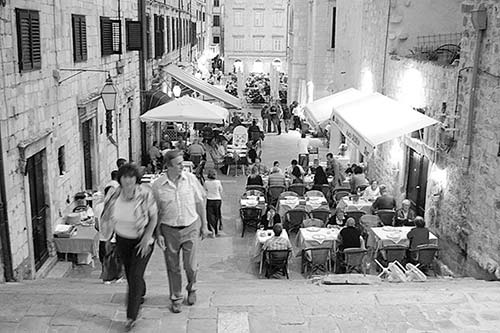
All my recommendations are in or near the atmospheric Old Town. Anywhere you dine, breezy outdoor seating is a no-brainer, and scrawny, adorable kittens beg for table scraps. One local dish popping up on many menus is šporki makaruli—“dirty” macaroni-like noodles served with a cinnamon-infused beef stew.
$$ Nishta (“Nothing”), featuring a short menu of delicious vegan-fusion cuisine with Asian, Indian, and Mexican flair, offers a welcome change of pace from the Dalmatian seafood-pasta-pizza rut. Busy Swiss owner/chef Gildas and his staff cheerfully serve a steady stream of return diners. This tiny place—which has been a reliably delicious and improbably affordable crowd-pleaser for years—has just a few cramped indoor and outdoor tables. Even if you’re a carnivore, it’s worth a visit; reserve a day ahead in peak season (Mon-Sat 11:30-22:00, closed Sun and possibly Jan-Feb, on the restaurant-clogged Prijeko street—near the Pile Gate end of the street, +385 20 322 088).
$$$ Trattoria Carmen, run by the Raguz family (Ivana and Damir), feels small, intimate, and personal—a contrast to the glitzy, crank-’em-out places in the central streets. As they have only a few indoor and outdoor tables, reservations are essential (daily 11:00-23:00, closed off-season, Kneza Damjana Jude 10, +385 20 301 337). To find it, follow the skinny lane on the inside of the Old Port wall, all the way past the gritty café where locals hang out; it’s just before the aquarium.
$$$$ Kopun just feels special, with an off-the-beaten-path setting on a gravelly square facing the Jesuit St. Ignatius Church. They serve up regional specialties with a touch of class. Seafood is a forte, and several dishes make use of the restaurant’s namesake, kopun—a rooster that’s castrated young and plumps up. Your options range from affordable, light lunches to set-price, multicourse meals (daily 11:00-23:00, Poljana Ruđera Boškovića 7, +385 20 323 969, www.restaurantkopun.com).
$$$ Azur, tucked high up near the Buža bars just inside the City Walls, offers a break both from standard regional fare and from the crowds in the heart of town. The menu presents Mediterranean cuisine with an Asian twist (for example, swordfish in a black curry sauce). The owners, brothers Vedran and Darko, have created a hit with discerning locals and travelers alike with careful preparation. Book ahead for an outside table (daily 12:00-23:00, Pobijana 10, +385 20 324 806, www.azurvision.com).
$$$ Lady Pi-Pi, named for a comical, anatomically correct, and slightly off-putting statue out front, sits high above town, barely inside the wall. Because this restaurant is part of a family home (the owners live downstairs), it has lower rent and more reasonable prices than many other places in town. The clientele skews a bit younger, and many of the tasty dishes are prepared over an open grill. Several tables overlook the rooftops of Dubrovnik, but these fill up fast, and they don’t take reservations—come early or be prepared to line up. The tables on the stony, vine-strewn terrace are nice but have no view (daily 12:00-15:00 & 17:00-21:00, closed Oct-April and in bad weather, Peline bb, +385 20 321 154).
$$ Barba is a fun and innovative option, just a short block off the main drag. They offer “sea food and street food” at a few indoor and outdoor tables, or for takeaway. Their specialty is the octopus burger—a patty of flavorfully seasoned octopus, fried and slapped on a big bun—or the gigantic sampler plate for a little bit of everything (daily 11:00-22:00, Boškovićeva 5, +385 91 205 3488).
$$$$ Taj Mahal is the place for upmarket Bosnian cuisine using quality ingredients and modern preparations. The quality is higher than what you can get in most of Bosnia (and at prices that would make a typical Bosnian recoil in horror). The restaurant fills a series of convivial, colorfully tiled rooms and a long back alley lined with inviting tables. It’s smart to book ahead (daily 10:00-24:00, Nikole Gučetića 2, +385 20 323 221, www.tajmahal-dubrovnik.com). For a primer on Bosnian cuisine, see here.
$$$$ Restaurant Dubrovnik, well regarded for its Dalmatian and international cuisine, is the place for a fine-dining experience without blowing your entire budget. And in good weather, the setting is gorgeous: Their expansive terrace is tucked deep in the Old Town, under floodlit old houses and drying laundry (though when they close the roof in bad weather, it loses much of its appeal). Reserve ahead (daily 12:00-23:00, open for dinner only July-Aug, Marojice Kaboge 5, +385 99 258 5871, www.restorandubrovnik.com).
Wine Bar with Food: Just a few steps off the main drag, $$$ D’Vino Wine Bar has a relaxed atmosphere and a smart, easygoing approach to Croatian wines. Run by gregarious Aussie-Croat Sasha and his capable staff (including his cheerful “work wife,” Anita), this cozy bar encourages you to slow down and really be on vacation. Their user-friendly menu describes more than 40 wines by the glass and highlights small producers. The various three-taste flights make a good introduction to Croatian wines, and when they’re not too busy, they can do full-blown tastings (customized to your schedule and interests—ask). Their tasty appetizers—cheese-and-meat and antipasti plates—pair perfectly with the wines and can easily add up to a tasty lunch or light dinner; the smoked duck or swordfish plates go well with the reds. Sit in the get-to-know-your-neighbor interior or linger at the sidewalk tables. Reservations are smart after about 18:00, or in bad weather (daily 10:30-late, Palmotićeva 4a, +385 20 321 130, www.dvino.net). D’Vino often has fun special events, either here or in their Lapad Peninsula tasting room and events space (near Sunset Beach at Masarykov put 3; for the latest, see their website). Sasha also offers all-day wine tours to the Pelješac Peninsula (see “Tours in Dubrovnik,” earlier in this chapter).
Pizza: Dubrovnik seems to have a pizzeria on every corner. Little separates the various options—just look for a menu and outdoor seating option that appeals to you. $$ Oliva Pizzeria, just behind St. Blaise’s Church, puts out consistently good food (Lučarica 5, daily 10:00-23:00, +385 20 324 594); around the side is a handy takeout window for slices. Close to the Old Town, but just far enough away to be frequented mostly by locals, $$ Tabasco Pizzeria is tucked at the corner of the parking lot beneath the cable-car station. Unpretentious and affordable, this is the place to come if the pizza is more important than the setting—though the outdoor terrace does have views of the City Walls...over a sea of parked cars (daily 10:00-23:00, Hvarska 48A, +385 20 429 595). A few other lowbrow places (good for diners on a budget) line Hvarska downhill from here.
Pasta: While it’s nothing fancy, $$$ Spaghetteria Toni is a reliable standby that offers good pastas (including a few creative choices) at reasonable prices. Choose between the cozy 10-table interior or the long alley filled with outdoor tables (daily in summer 11:00-23:00, closed Sun in winter, closed Jan, Nikole Božidarevića 14, +385 20 323 134).
Sandwiches: Just a few steps off the Stradun, unpretentious $ Buffet Škola serves takeaway or sit-down sandwiches on homemade bread, plus salads. Squeeze into the hole-in-the-wall interior or sit at one of the outdoor tables (skip the overpriced ham-and-cheese boards, daily 8:00-24:00, lunch only off-season, Antuninska 1, +385 20 321 096).
Ice Cream: Dubrovnik has lots of great sladoled, but my far-and-away favorite is the top-quality, artisan stuff at Gianni. They also make delicious cakes and pastries, and have vegan options, too (daily 10:00-23:00, shorter hours off-season, Kneza Damjana Jude bb, +385 95 392 6323, www.gianni-dubrovnik.com).
The Old Town’s “Restaurant Row,” Prijeko Street: The street called Prijeko, a block toward the mainland from the Stradun promenade, is lined with eateries, many with a huckster out front trying to lure in diners. Don’t be sucked into this vortex of mediocre food at inflated prices. The only place worth seeking out here is Nishta (described earlier). Still, it can be fun to take a stroll along here—the atmosphere is lively, and the sales pitches are entertainingly desperate.
Dinner Experience: For a memorable splurge, skip the restaurants and head to Marija and Zlatko’s house. $$$$ Dubrovnik Eat with Locals features a delicious, traditional, home-cooked dinner on their rustic patio. Come hungry: You’ll join your hosts and a few other guests for an all-inclusive, whole-evening feast with several courses of food and drink, usually including a main dish prepared peka-style (under a metal baking dish covered with hot coals). While the price tag is steep (€150/person), this is some of the best, most delicious traditional Croatian food I’ve had anywhere—cooked with love and served with real insight, rather than cranked out for tourists (reservations required, can accommodate dietary restrictions, +385 95 385 5344, www.dubrovnikeatwithlocals.com, marija.papak@gmail.com). Their place is in the Montovjerna neighborhood, a long walk or easy taxi ride from the Pile Gate (they can arrange a taxi for you)—climb the stairs next to Jelačića 27 (see “Greater Dubrovnik” map, earlier).
Picnic Tips: Dubrovnik’s high restaurant prices make it a perfect place to picnic. You can shop for fresh fruits and veggies at the open-air produce market (each morning near the cathedral, on the square called Gundulićeva Poljana). Supplement your picnic with basic supplies from Konzum grocery store (one location on the market square near the produce vendors, another near the bus stop just outside Pile Gate, both open Mon-Sat 7:00-21:00, Sun 8:00-13:00). Good picnic spots include the shaded benches overlooking the Old Port; the Porporela breakwater (beyond the Old Port and fort—comes with a swimming area, sunny no-shade benches, and views of Lokrum Island); and the green, welcoming park in what was the moat just under the Pile Gate entry to the Old Town.
Gourmet Coffee: If you’re craving something a notch above the standard bijela kava, head for Cogito Coffee—an artisanal coffee shop (part of a Zagreb-based chain), tucked under a little tunnel near the bottom of the Maritime Museum stairs, near the Old Port (daily 9:00-19:00, Pustijerne 1).
BREAKFAST
When you’re sleeping in a soba, you’ll likely be on your own for breakfast. Fortunately, you have plenty of cafés and pastry shops to choose from, and your host probably has a favorite to recommend. The Mlinar chain, which you’ll see all over Croatia, is a handy place to pick up a to-go pastry and coffee; there’s one right on the Gundulićeva Poljana market square and another along the Stradun near the Franciscan Church.
For something more substantial, several restaurants in inviting locations serve up pricey, eggy breakfasts for around €10-12. Choose a perch along the Stradun and pay a bit too much for the privilege of watching the town wake up and the cruise passengers file in. Cele, at Placa 1, has comfortable seating; Congo, across the street at #6, is a slightly better vantage point, but the tall stools are less appealing for lingering. Locals who meet along here each morning—catching up with their friends as they stroll by—call this their low-tech version of Facebook.
Another scenic spot is just around the corner: Gradska Kavana, tucked between the Bell Tower and Rector’s Palace (served daily 8:00-11:30, Pred Dvorom 1). If you’d like an even wider menu of affordably priced breakfast options—in a less atmospheric setting—try The Gaffe Irish Pub (served daily 9:00-11:00, listed earlier under “Entertainment in Dubrovnik—Nightlife”; see map on here).
Dubrovnik Connections
By Catamaran: Speedy catamarans, departing several times each day through the summer, connect Dubrovnik’s Port Gruž to points north: Korčula (2 hours), Hvar (3 hours), and Split (4-5 hours). A couple of these also stop en route at Mljet National Park (1.5 hours; use the Polače or Pomena docks—not Sobra; for details, see the Mljet section in the Near Dubrovnik chapter). Frequency can be significantly less off-season.
Catamarans are operated by three different companies: Jadrolinija (www.jadrolinija.hr), Krilo (www.krilo.hr), and TP Line (www.tp-line.hr). Schedules can fluctuate; check https://getbyferry.com for current options. Once you’ve found the right connection, book direct on the ferry line’s website. Boats sell out: Purchase tickets online at least a day or two ahead, or longer at very busy times. (There may be limitations on buying Jadrolinija tickets online for same-day journeys. In a pinch, you can buy tickets in person at the port, assuming they’re not sold out.)
By Bus to: Split (roughly hourly, less off-season, 4-5 hours), Korčula (3/week, 3.5 hours), Zagreb (8/day, overnight options, 8.5-10 hours), Kotor in Montenegro (6/day in summer, less off-season, 2-3 hours—or can take much longer due to border delays), Mostar (3-4/day in summer, less off-season, 3-4 hours), Sarajevo (1-2/day, 7 hours, may include a night bus). Schedules are subject to change—confirm locally before making the trip to the bus station. You can check schedules and buy tickets at https://getbybus.com. For additional bus information, check www.libertasdubrovnik.com.
By Plane: To connect remote Dubrovnik with the rest of your trip, consider a cheap flight. For information on Dubrovnik’s airport, see “Arrival in Dubrovnik—By Plane,” earlier.
By Car: For tips on driving along the Dalmatian Coast between Dubrovnik and Split, see here.
Can I Get to Greece from Dubrovnik? Your best bet is to fly. There are direct flights to Athens on Aegean and Croatia Airlines. Even though Croatia and Greece are nearly neighbors, no direct boats connect them, and the overland connection is extremely long and rugged.
What About Italy? Flying is the easiest option, though there are only a few direct flights (to Rome, Venice, or Naples). You can take a direct night boat from Dubrovnik to Bari, or head to Split for more boat connections (for more on these boats, see here). The overland connection is too long (figure 5 hours to Split, then 5 hours to Zagreb, then 7 hours to Venice).