KORČULA
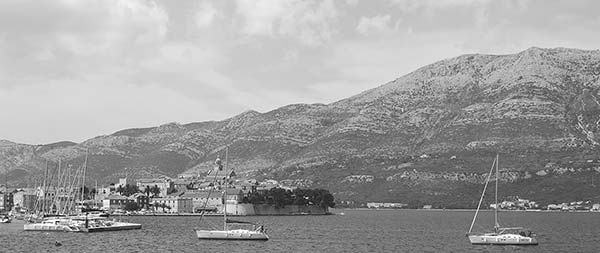
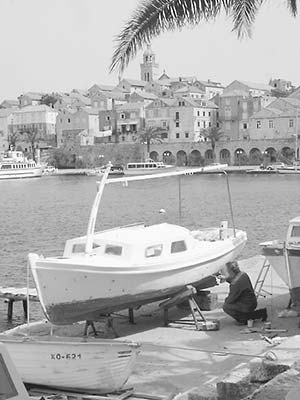
The island town of Korčula (KOHR-choo-lah) boasts an atmospheric Old Town, a smattering of fine little museums, and a dramatic, fjord-like mountain backdrop. Humbler than its glitzy big sister Hvar, Korčula—while certainly on the tourist trail—has an appealing (and occasionally frustrating) backwater charm. At its heart, Korčula is a traditional, blue-collar, salt-of-the-earth shipbuilding town with a dim patina of tourism. This helps keep the glitz, the crowds, and the prices at bay. All things considered, Korčula is the most enjoyable Back Door stopover between Rovinj and Dubrovnik.
Like some other small Croatian coastal towns, Korčula was founded by the ancient Greeks. It became part of the Roman Empire and was eventually a key southern outpost of the Venetian Republic. The town’s “mini-Dubrovnik” vibe isn’t an accident: Venice would have liked to claim the real Dubrovnik, but when that failed, they fortified Korčula instead...as if to create a Dubrovnik of their own. Korčulans take great pride in the (dubious) claim that Marco Polo was born here in 1254—the explorer remains the town’s poster boy. Korčula is also known for its traditional Moreška sword dance.
You’ll discover that there are two Korčulas: the tacky seaside resort and the historic Old Town. Savvy visitors ignore the tourist sprawl and focus on Korčula’s medieval quarter, which pokes into the sea on a picture-perfect peninsula. Tiny lanes branch off the modest main drag like ribs on a fishbone, a street plan that’s designed to catch both the breeze and the shade. All in all, this laid-back island village is an ideal place to take a vacation from your busy vacation.
PLANNING YOUR TIME
For tips on choosing between the two main Dalmatian islands—or squeezing in both via a short stopover on Hvar—see the “Hvar vs. Korčula: Which Island to Choose?” sidebar on here.
Ideally, Korčula deserves the better part of a day. Spend the morning wandering the medieval Old Town and exploring the handful of tiny museums. In the afternoon, kick back at a café or restaurant and bask on the beach. If you’re here on a Thursday, be sure to catch the performance of the Moreška dance (also Mon in height of summer). With a second day, unwind longer or consider an excursion—either a trip around the island or a side trip to Mljet Island and its national park (sold by various travel agencies around town).
While Korčula is reasonably well connected to the rest of Dalmatia in the summertime, things get more challenging off-season. If planning a trip in shoulder season, check your transportation options carefully.
Orientation to Korčula
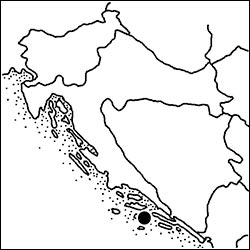
The long, skinny island of Korčula runs alongside the even longer, skinnier Pelješac Peninsula. The main town and best destination on the island—just across a narrow strait from Pelješac—is also called Korčula.
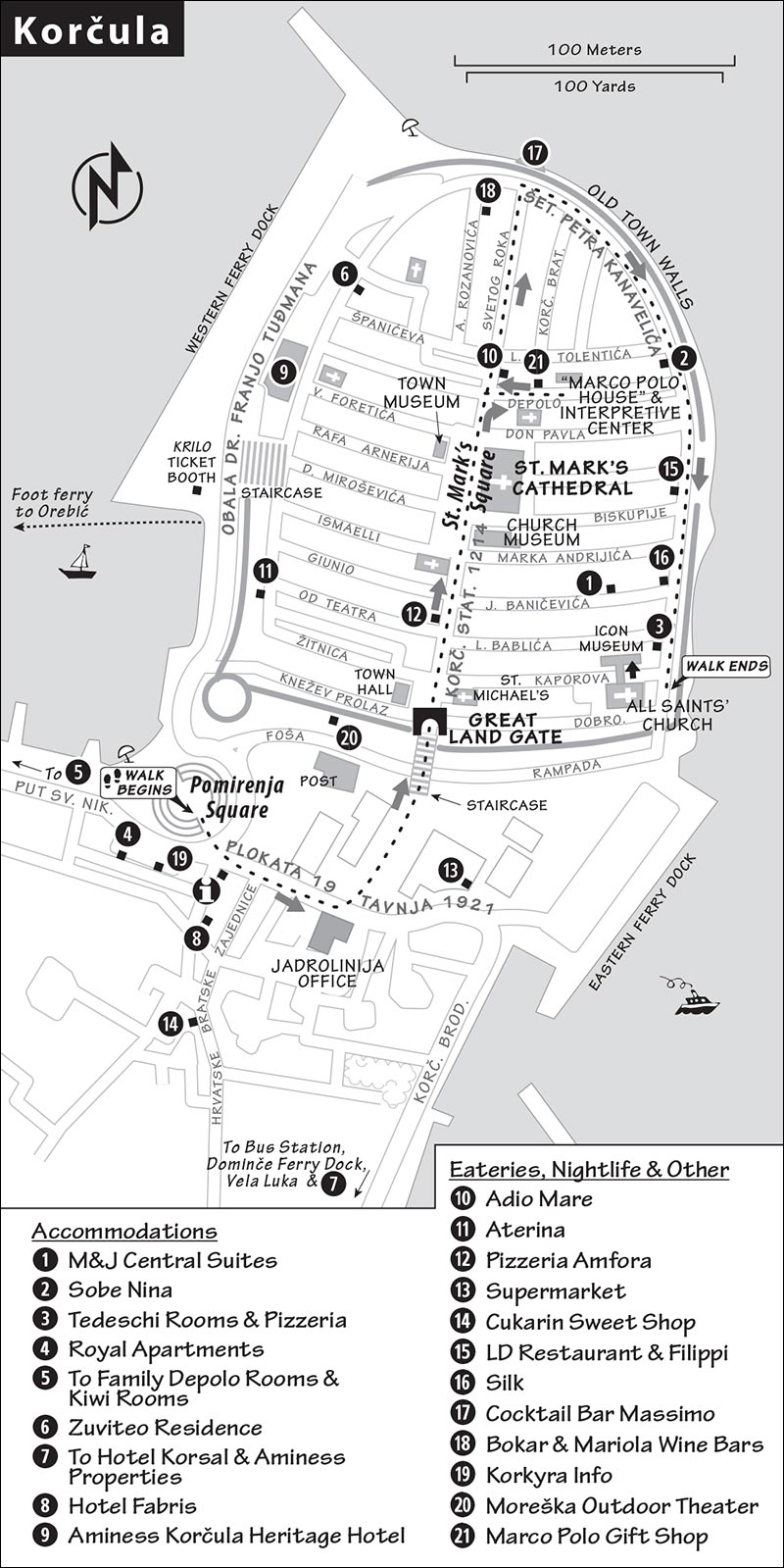
Korčula town is centered on a compact Old Town peninsula, which is connected to the mainland at a big staircase leading to the Great Land Gate. In the zone in front of this staircase, you’ll find the TI, ATMs, travel agencies, the Jadrolinija ferry office, the Konzum supermarket, an occasional outdoor produce market, and other handy tourist services.
Stretching to the south and east of the Old Town is Shell Bay, surrounded by a strip of tourist shops and resort hotels. There’s not much of interest in this zone except for two pebble beaches and a little path with some pleasant swimming and sunning places along the rocks.
To the west of the Old Town is the serene waterfront street Put Svetog Nikole, where you’ll find a few sobe (including some recommended ones), inviting swimming areas, great views of the fortified Old Town peninsula, benches placed just so, and more locals than tourists.
TOURIST INFORMATION
Korčula’s TI is on the main street in front of the entrance to the Old Town. They can help decipher your various ferry options, and they hand out an excellent hiking and biking map, which is also available on their website (daily 8:00-21:00, May and Oct until 17:00, Nov-April until 15:00, may be closed weekends off-season; Ulica Plokata 19 Travnja 1921 #40, +385 20 715 701, www.visitkorcula.eu; Hana, Milijana, and slyly smiling Smilija).
ARRIVAL IN KORČULA
By Boat: The fast catamarans to Korčula town dock at the embankments on either side of the Old Town peninsula—which side depends on current conditions. From either catamaran landing, it’s just a two-minute walk to where the peninsula meets the mainland and the services described above.
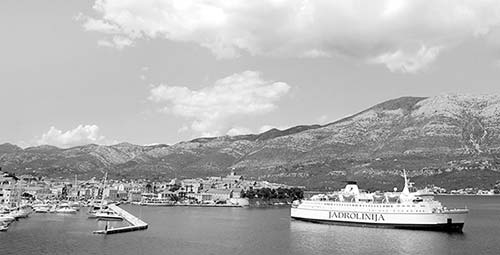
Car ferries use the Dominče dock two peninsulas east of Korčula, about a five-minute drive (or 30-minute walk) from town. Taxis (about €15) and regular buses (less frequent Sat-Sun) connect this dock with Korčula town.
Additional boats from Split and Hvar town arrive at Vela Luka, at the far end of Korčula Island. Most boats arriving at Vela Luka are met by a bus waiting to bring travelers to Korčula town (about 1 hour; confirm bus connection before taking this boat).
By Bus: The bus station is a short stroll from the Old Town. If you leave the station with the bay on your right, you’ll reach the town center. If you leave with the bay on your left, you’ll get to hotels Korsal, Liburna, Park, and Marko Polo.
By Car: See “Route Tips for Drivers” at the end of this chapter. Once in Korčula town, you can find affordable parking on top of the big Tommy supermarket. From here, you can ride the elevator down and walk straight out the front door into town (5-10-minute downhill walk). There’s another affordable parking lot up by the cemetery above town; in summer, they may be offering a free electric shuttle bus into town. There is pay parking closer to town along the marina, but it’s pricey and jammed.
HELPFUL HINTS
Boat Tickets: Don’t dawdle buying your boat tickets to leave Korčula—they can sell out. All three of the major boat companies serving Korčula (Jadrolinija, Krilo, and TP Line) let you buy tickets online. For details, see “Korčula Connections,” later.
Travel Agencies: Korčula has several travel agencies where you can book an excursion, browse shelves of books and souvenirs, and get information about car rental and other activities. The dominant company is Korkyra Info, which offers a wide variety of activities and services (such as car, bike, and kayak rental). Popular options include wine-tasting trips around Korčula Island. They’re also the local sales point for the TP Line catamaran (though you can also book those tickets online). Look for their main office on the little circular square facing the Old Town (Trg Petra Šegedina 3A, +385 91 571 4355, www.korkyra.info).
Transfers: An “Electric Car Transfer” service (that is, a golf cart) can take footsore tourists to distant hotels or parking lots (about €12/group of up to 4), or on a little panoramic loop for some high-up views down over Korčula (€15/person). To summon them, call +385 99 321 9160.
Laundry and Baggage Storage: Conveniently located at the bus station, you can drop off your laundry at Na 90° for full-service wash/dry; they also offer bag storage (generally Mon-Sat 8:00-19:00, Sun 8:00-12:00 & 16:00-19:00, may be open longer in peak times, +385 98 417 415).
Local Guide: Korčula native Toni Lozica from Spirit of Dalmatia is an excellent private guide who loves sharing the stories of his home turf with visitors. You can hire him for an in-depth guided town walk that goes beyond the silly tour-guide stories (about €150 for 1-2 hours), or he can take you on an all-day drive or boat trip to visit other parts of the island, sample local wines, and have some food (figure €750 for 2 people). He’s especially passionate about sharing local wines—both from Korčula and from the Pelješac Peninsula, just across the channel. Contact Toni to sort out exactly what you’d like to do (+385 99 286 2268, www.spiritofdalmatia.com, toni@spiritofdalmatia.com).
Korčula Walk
This brief self-guided walk is designed to introduce you to low-impact Korčula, linking up all of its sights. The walk might take up to an hour if you dillydally; dipping into some of the little museums and churches along the way extends your adventure.
• We’ll begin just outside the Old Town, at the big circular plaza facing the sea called...
Trg Pomirenja
This circular square—with its marble seating and kids’ soccer nets at either end—is a popular hangout space both for locals and for visitors eager to escape the claustrophobic lanes of the Old Town. It’s a good spot to get oriented to Korčula and its surroundings before heading into the Old Town.
Named “Reconciliation Square,” this monumental space was built in 1987—the waning days of Yugoslavia—to honor the WWII victims of fascism. But it also celebrates local culture. Take a moment to appreciate some of the monument’s symbolism: A sailboat pokes out into the square. Three flagpoles fly the flags of the EU, Croatia, and the town flag of Korčula (with a fortified tower—we’ll get a better look at this later). And four panels ringing the big circle represent four traditional industries of Korčula (quarrying stone, fishing, winemaking, and shipbuilding).
Go for a spin around the outside of the circle to see each interpretive panel, starting with the one facing the big round tower of the town wall and working clockwise. The town of Korčula was primarily focused on shipbuilding—in fact, the space you’re standing in was once a bustling arsenal shipyard that cranked out wooden boats for the Republic of Venice. Stone was quarried mainly on the offshore islet of Vrnik (many of the building blocks for Korčula town and its wall came from here); winemaking was a smaller industry, mainly in the interior of the island; and most of the fishing was based at the far end of the island, closer to the most abundant waters, in Vela Luka.
From here, you have great views out to sea; in fact, a popular children’s beach is right in front of you, and all along the waterfront street called Put Svetog Nikole, you’ll find sunbathing perches and swimming ladders tucked between bobbing boats.
The huge mountains looming beyond the Old Town mark the Pelješac Peninsula—a long, skinny strip of land that connects to the mainland north of Dubrovnik. Some of Croatia’s best wines come from this zone, and it also provides Korčula with a dramatic backdrop.
• Now let’s head for the Old Town. Turn your back to the sea and walk slightly uphill over the saddle of land connecting the Old Town to the rest of Korčula. You’ll pass the TI and Jadrolinija ticket office on your right. Imagine how this now-wide-open zone once was jammed with higgledy-piggledy buildings; all car traffic had to weave through openings barely big enough for a single vehicle.
Watch on your left for the gap in the buildings where you can see a grand staircase leading up to a ceremonial tower. Go there.
Great Land Gate (Veliki Revelin)
From the base of the stairs, take a moment to appreciate the beefy fortifications that surround Korčula. For several centuries, strategic Korčula was one of the most important southern outposts of the Venetian Republic. The Republic of Dubrovnik began at the Pelješac Peninsula, just across the channel. Korčula’s original town walls date from at least the 13th century, but the fortifications were expanded over several centuries to defend against various foes of Venice—mostly Ottomans, pirates, and Ottoman pirates.
By the late 19th century, Korčula had become an unimportant Habsburg beach town, and the walls had no strategic value. The town decided to quarry the top half of its old walls to build new homes (and to improve air circulation inside the city). Though today’s walls are approximately half as high as they used to be, the town has restored many of the towers, giving Korčula its fortified feel.
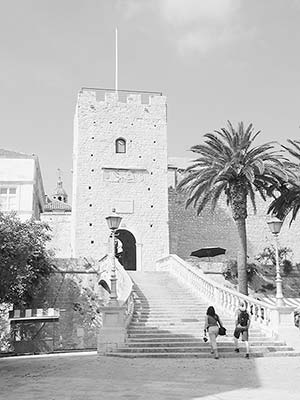
The grand staircase dates from 1863, when Austro-Hungarian Emperor Franz Josef came to visit his Dalmatian holdings. The staircase—built for drama, to impress the Emp, rather than for practicality—gives the impression that the Old Town is easy to enter. But if you mentally erase those stairs, replace it with a wooden drawbridge, and make the walls higher, you’ll understand how nearly impossible Korčula would have been to invade from land.
By the way, you’re also near the location of one of Korčula’s top events: the Moreška sword dance, which fills a little outdoor theater just to the left of here, along the base of the wall (performs 1-2 times/week; see listing under “Sights in Korčula,” later). In this endearingly small-town folk presentation, a good king and a bad king do battle, clashing swords as they dance for the honor of a maiden in distress.
Gaze up at the tower topping the staircase, which is loaded with symbolism. Like all the town’s towers, it’s adorned with the Venetian winged lion and the coats of arms of the doge of Venice (left) and the rector of Korčula when it was built (right). You may be able to climb the tower to visit a small exhibit with costumes and photos from the Moreška dance, then head up to the top level to enjoy panoramic town views (€4, unpredictable hours; find the stairs around the left side).
• Now climb up the grand staircase and go through the gate into the...
Town Square
Officially named for Franjo Tuđman, the first president of post-Yugoslavia Croatia, this square is layered with history. On the left is the 16th-century Town Hall and Rector’s Palace. The seal of Korčula (over the center arch) symbolizes the town’s importance as the southernmost bastion of the Venetian Republic: St. Mark standing below three defensive towers.
Across from that, on the right, a blocky building sticks out into the square. This is the House of the Surgeon, built after a particularly nasty period when illness claimed half of Korčula’s population. This claustrophobic town engineered ways to remove waste (by flushing it down gutters and out to sea) and to collect rainwater in underground cisterns for drinking and cooking. Unfortunately, the two systems sometimes became intermingled, and cholera and other diseases were rampant, so a surgeon was invited to solve the problem. To build him fittingly grand lodgings, Korčulans sacrificed a chunk of this square in the heart of town.
To the left of the surgeon’s house, the little church is dedicated to St. Michael (Crkva Sv. Mihovila). Throughout Croatia, many towns have churches dedicated to St. Michael just inside the town gates, as he is believed to offer saintly protection from enemies. Notice that a passageway connects the church to the building across the street—home to the Brotherhood of St. Michael, one of Korčula’s many religious fraternal organizations. (Another such organization, located farther down this street, hosts the Icon Museum, described later.)
Now turn back and face the inside of the gate. You’ll see a ceremonial arch honoring Leonardo Foscolo, a Venetian commander who led the fight against the Ottomans in the Cretan War of the 17th century and later served as the Protector of Dalmatia. Foscolo was beloved here in Korčula, which was home to his aide de camp. But after Foscolo lost an election to become the doge of Venice, his rivals destroyed his reputation. Not long after, a thin-skinned doge decreed that private citizens should no longer be honored by statues in public spaces...so this one was removed, leaving an empty niche. The other niche once held a winged lion of St. Mark, removed in 1943 as Tito’s Partisan forces were reclaiming Yugoslavia from various occupying forces. At that moment in history, the winged lion was seen as a symbol of Italy, and of unwanted overlords in general...so one night, under cover of darkness, locals trashed it.
• With the Great Land Gate at your back, walk straight ahead up the narrow...
Street of the Korčulan Statute of 1214 (Ulica Korčulanskog Statuta 1214)
This street is Korčula’s backbone in more ways than one: Whereas most medieval towns slowly evolved with twisty, mazelike lanes, Korčula was carefully planned to resemble a fish skeleton. The streets to the west (left) of this one are straight, to allow the refreshing northwesterly Maestral winds into town. To the east (right), they’re curved (notice you can’t see the sea) to keep out the bad-vibe southeasterly Jugo winds. As in Croatia’s other seafaring towns, the various winds—and weather in general—are highly important to locals.
The street’s complicated name honors a 1214 statute—the oldest municipal legal document of any Croatian town—with regulations about everyday life and instructions on maintaining the city walls, protecting nature, keeping animals, building a house, and so on. The statute was a civilizing influence on the Korčulans; for instance, it outlawed piracy, which had been practiced here since antiquity. It also supposedly outlawed slavery, but this only applied to Christian slaves; Muslims and Bogomils (“pagan” Christians from Bosnia) were still trafficked here.
Pause after a couple of very short blocks at the recommended Pizzeria Amfora, on the left. Look up at the building it occupies to see an amazing mishmash of architectural styles dating back centuries: pointy Gothic windows on the upper floors; more austere Renaissance arches lower down; fancy Baroque protuberances upstairs, which were used to support balconies; and plain, boxy doors at street level, from the 19th century.
As you explore Korčula, notice how tight the housing is. The typical footprint of a home is about 15-by-15 feet because that was the maximum distance floor joists made of local cypress trees could safely span. Over time, some houses have merged, while others have kept their original modest size—but all of the town’s buildings have gone through periods of architectural evolution. For example, most started as simple raw stone, but after about four or five centuries, that stone tended to become slightly porous, leading to water intrusion. So, half a millennium in, most of these facades were plastered over for further protection. Some still sport that look, but modern techniques have allowed old houses to go back to the original raw stone and still be sealed effectively against moisture.
• Now continue the rest of the way up the street to...
St. Mark’s Square (Trg Sv. Marka)
A far cry from the “big” Piazza San Marco in Venice, this square demonstrates how Korčula wasn’t really “conquered” unwillingly by Venice—in fact, it benefitted from its connection to the powerful maritime republic.
As you enter the square, you’ll pass (on the left) a small chapel, the Church of Our Lady (Crkva Gospojine). Poke inside to see the gravestones of aristocrats in the floor. This practice of the ultra-wealthy wanting to be buried closer to God, literally inside the church, is the origin of the expression “stinking rich.” It’s rare to see this in Croatia, where Napoleon decreed that graves should be removed from inside churches for sanitary reasons. The fine mosaic around the altar, dating only from 1965, is the work of Dutch artist Louis Schrikkel. During Yugoslav times, Tito imported Western artists to beautify his country. While visiting Korčula, Schrikkel came to this church, felt inspired, and offered to decorate its altar area.
Head back outside and up to the middle of the square, facing St. Mark’s Cathedral (Katedrala Sv. Marka). This grand building—as well as much of Korčula’s town walls and towers—is the work of Marko Andrijić (1470-1507), an architect, engineer, and stonemason who left his mark all over town.
On the tympanum above the main door, you’ll see another Venetian statue of St. Mark. Notice that he’s depicted here as a bishop (rather than as an evangelist, as is more typical in Venice). This demonstrates Korčulans’ acceptance of Venetian rule as well as a desire to put their own local spin on their identity. Stone tabs jut out on either side, each one topped with a fierce lion protecting a lamb (a symbol of Jesus). And underneath each lion, see the unclothed statues of Adam and Eve—a reminder that we are all naked before God. These tabs would normally have been at street level, but when this was built, big buildings jutted into the square, allowing only a narrow passage in front of this door—so they were moved up to allow passersby to walk beneath them.
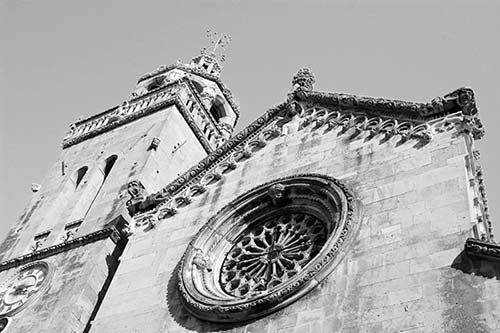
In most Croatian towns, churches follow the Venetian style of setting the campanile (bell tower) apart from the main building. That used to be the case here, too. But when the church was expanded, it made use of all available space, effectively absorbing the tower into its facade. The cohesiveness of the complete ensemble is a credit to Andrijić’s fine work.
Look at the buildings facing the church. Notice the starkness of the one immediately opposite the entrance, with a rough-textured outer wall. In fact, this was originally an inner wall. Some local bigwigs who wanted an ornate mausoleum got as far as knocking down part of their house to create space for it, but they couldn’t agree with the local bishop on a design—so it was never built. Notice the complete lack of any adornments; even the door and window placement seems random. Compare that with the one just to the right, which has a very pleasing facade. On that house, notice the very faint red outline of a long cannon on the upper floor. While there are plenty of quirky tour-guide stories about this, most likely it was simply the home of the military officer responsible for the cannoneers.
Facing the church, get oriented to some sightseeing options, since most of the town’s sights are within a few steps of here: You can pay to enter the church interior (through the main door); to climb the tower (enter just to the left); or visit the Church Museum (the building to the right of the church, combo-ticket with church interior). Over your right shoulder is the Town Museum, worth a look if you’d like to learn more about Korčula’s history. All of these are described in detail later, under “Sights in Korčula.”
• If you’d like to do some sightseeing, you can wrap up the walk here. Otherwise, we’ll continue a few more minutes to the end of town. First, carry on straight through St. Mark’s Square, with the cathedral on your right. You’ll pass the upstairs terrace of the recommended Adio Mare restaurant (the entrance is just ahead). The next narrow lane on the right is called Ulica Depolo. You’ve entered...
“Marco Polo’s Korčula” (or, More Likely, Not)
Let’s get this out of the way: Was Marco Polo born here in Korčula? Probably not. It’s possible...but not likely. All we know for sure is that he came from Dalmatia, and that the name “Polo” (or “Depolo”) is associated with Korčula. But there’s no hard evidence tying the explorer specifically to here. (For more on this question, see the sidebar.)
However, that ambiguity doesn’t stop the town from gleefully touting the connection. The so-called Marco Polo House (Kuća Marka Pola) down this side street is actually a more recent building on the site of what may have been the property of the adventurer’s family, if his family were from Korčula, which they may well not have been. This facility has recently been renovated as an “Interpretive Center” about the life of the great explorer. If it’s open, check it out.
Across the street from the house’s entrance, you’ll find a Marco Polo gift shop selling various items related to the explorer—herbs, brandies, honey, and so on. Each one comes with a little tag telling a legend about M.P.—for example, how the word “million” was based on his middle name, Emilio (because no existing word was superlative enough for his discoveries). This is one of several such shops you’ll see all over town.
• Keep following the lane you were on before (Ulica Sv. Roka) as it heads downhill toward the water. Soon you’ll pop out at...
Korčula’s Seawall
We’ve gone from the Old Town’s base to its tip. While the stout wall that once protected the city from attack is mostly gone, a few imposing towers remain. The one you’re looking at is today, of all things, a delightful cocktail bar called Massimo. If you don’t mind climbing some steep stairs (“ladders” may be a more accurate description), this is an incredibly scenic place to nurse a drink. There are also a couple of wine bars just around the corner (described later, under “Nightlife in Korčula”).
Turn right and begin walking along the seawall. This zone, once sleepy, is now jammed with busy restaurants. Prices are high, but you’re paying for the view, and the quality is generally good. In fact, LD Restaurant (in the Lešić Dimitri Palace, a top-end luxury hotel) owns a Michelin star and a sterling reputation. Some copycat but good-quality alternatives—such as Cupido and Filippi—are strategically located nearby. Farther along are Silk (Asian fusion) and Tedeschi (a lowbrow local pizzeria, and the only true budget option along here). Enjoy comparing menus and views and consider pausing for a meal...or reserve your favorite for later tonight.
• Reaching the end of Korčula’s seawall “restaurant row,” we’re close to where we began. If you’d like to check out the Icon Museum, you’re very close—it’s on one of the last lanes of the seawall, on the right (see listing under “Sights in Korčula”).
From here, you can explore all the little cross-lanes through town—it’s fun to try to get lost in this town (but actually impossible, since you’re never more than a few steps from a landmark or the sea). Or, if you’d like to head back out of town, keep going past the end of the seawall, taking a modern walkway over an old round tower, and wind your way down to the touristy zone around the base of the Great Land Gate. From here, everything in Korčula is within just a few minutes’ walk.
Sights in Korčula
▲St. Mark’s Cathedral (Katedrala Sv. Marka)
Church Museum (Opatska Riznica)
Korčula’s few sights cluster close to one another in its historic core. They’re listed in the order you’ll reach them on my self-guided town walk. Museums are officially closed from around November through April, but most will usually open by request (ask the TI to call for you...or just try knocking on the door).
▲▲Moreška Dance
Lazy Korčula snaps to life when locals perform a folk dance called the Moreška (moh-REHSH-kah). The dance dates back to at least the mid-17th century, and the current troupe has been performing it since the 1960s. With local dancers all dressed up in traditional costume and the action interspersed with live music, it’s a fun evening out...a bit of small-town community theater that keeps an age-old custom alive.
As the seating (metal chairs on concrete steps) has poor visibility, it’s worth showing up a bit early to snare a good seat, close to the action. The program can vary, but usually kicks off with a jaunty musical piece performed by a local band, often followed by a brief performance of some hauntingly beautiful klapa songs by a choir. Then the Moreška begins: The evil king enters, clutching a fair maiden against her will. The good king challenges him, some amateur acting ensues, both kings’ armies file in, and before long, the armies begin circling each other. After much clashing of swords, one side prevails...and a good time is had by all.
Cost and Hours: €18, June-late Sept every Thu at 21:00, July-Aug also Mon, in outdoor theater next to the Great Land Gate—to the left as you face the gate, or in a nearby congress center in bad weather; buy tickets from travel agency, at your hotel, or at the door.
▲St. Mark’s Cathedral (Katedrala Sv. Marka)
Korčula became a bishopric in the 14th century. In the 19th century—36 bishops later—the Habsburgs decided to centralize ecclesiastical power in their empire, and they removed Korčula’s bishop. The town still has this beautiful “cathedral”...but no bishop. For a description of the cathedral’s exterior, see my town walk, earlier; for the interior, read on.
Cost and Hours: €3 to enter cathedral, €5 combo-ticket also includes Church Museum next door, daily 9:00-19:00, closed during church services, generally closed Nov-April but may be open Mon-Fri 9:00-12:00 after Easter.
Visiting the Church: Inside, notice the pointed Gothic arches on the ground floor and the rounded Romanesque arches above. Churches like this were commonly built entirely in the Romanesque style but later retrofitted with some pointed arches for better support. In the 18th century, the church was “Baroque-ized” before—in modern times—finally being restored closer to its original condition.
The focal point and highlight of the interior is the exquisite ciborium—the canopy over the main altar—designed by Marko Andrijić and recently restored to its original glory. Appreciate its delicacy and its fine details, especially the stairstep pyramid top, like lace hewn from stone. The figures on the top represent the Annunciation. The two balustrades flanking the ciborium—now set farther apart—used to be part of the main structure.
Under the ciborium and over the altar is an original Tintoretto painting. The central figure is, of course, St. Mark. As with the tympanum outside, he’s depicted as a bishop rather than as an evangelist. Recent X-ray analysis revealed that the figure was actually altered later to add the bishop gear, presumably after the people of Korčula requested this change. Mark is flanked by St. Bartholomew (patron saint of Korčula Island) and St. Jerome (Dalmatia).
The reliquary beneath the ciborium and painting holds neither of these saints, but rather St. Theodore—Korčula’s second patron saint, who’s responsible for good health.
Look up. The multitalented Marko Andrijić was also a shipbuilder—and the (original) wooden ceiling is essentially an overturned galley.
Now turn your attention to the left side of the church—which, you may notice, feels grafted on to the main nave. In fact, this was tacked on later. At the front of this section (directly to the right of its altar), look for the ornately carved stone door with St. George slaying the dragon above it. This originally led outside to the graveyard—which is now the large chapel of St. Rok (better known by his Italian name, San Rocco). Over the altar in this chapel, find the statue of St. Rok pointing to a wound in his leg. This French saint is very popular in Croatia; it’s believed he helps cure disease.
As you leave, notice the weapons on the wall near the door, which were used in pivotal battles near strategically situated Korčula.
Tower Climb: To huff up 96 stairs for great views over town, you can pay €4 to climb the bell tower (separate ticket—not covered by cathedral or museum entry; entrance left of main door, typically open later than the church itself).
Church Museum (Opatska Riznica)
This small museum has an eclectic and fascinating collection. Go on a scavenger hunt for the following items: 12th-century hymnals, a coin collection (including a 2,400-year-old Greek coin minted here in Korčula), some Croatian modern paintings, a bishop’s throne, three amphora jugs, and two framed reliquaries with dozens of minuscule relics. The most unusual item is a ceremonial necklace that Mother Teresa (who came from North Macedonia, then part of Yugoslavia) received as part of her Nobel Peace Prize. Through Catholic Church connections, she came here to Korčula, visited this museum, and deemed it an appropriate home for her prize. Lovers of clay pots and old kitchen stuff should ask at the gift shop to see the kitchen.
Cost and Hours: €5 combo-ticket with cathedral, €5 guidebook covers both museum and cathedral; Mon-Sat 9:00-19:00, sometimes open Sun morning, same off-season hours as cathedral.
▲Town Museum (Gradski Muzej)
Housed in the beautifully restored Gabrielis Palace, an old mansion facing the cathedral, this museum does a good job of bringing together Korčula’s various claims to fame. The house is arranged like a traditional Dalmatian home: shop on the ground floor, living quarters in the middle floors, kitchen on top. The exhibits are fresh, modern, and well described in English.
Cost and Hours: €6; Mon-Sat 9:00-21:00, Sun 15:00-20:00; Oct-June Mon-Fri 10:00-14:00, closed Sat-Sun; +385 20 711 420. If it’s locked, try knocking.
Visiting the Museum: First, down in the basement you’ll find a collection of first-century Roman amphora jugs, other vessels from antiquity, and the jawbone of a rhinoceros. Then head up the stairs, eyeing the timeline on the wall as you progress through the building.
The first floor has a helpful model of the Old Town with light-up landmarks, as well as stone fragments of Korčula’s past, drawings and maps of the town, and an exhibit on Korčula’s long-standing shipbuilding industry. You’ll see models of both old wooden and modern steel ships built here; the town still produces ship parts today.
The second floor has portraits of city leaders, an exhibit on the Moreška sword dance, and the mansion’s “piano nobile” lounge, with fine original furniture. Just across the hall is a small collection of works by modern artists from the island. And up on the third (top) floor is a kitchen. This was a smart place for the kitchen—if it caught fire, it was less likely to destroy the whole building. Notice the little WC in the corner. A network of pipes and gutters took kitchen and other waste through town and out to sea.
▲Icon Museum (Zbirka Ikona)
Korčula is known for its many brotherhoods—centuries-old fraternal organizations that have sprung up around churches. The Brotherhood of All Saints has been meeting every Sunday after Mass since the 14th century, and they run a small but interesting museum of icons. These golden religious images were brought back from Greece in the 17th century by Korčulans who fought the Ottomans on a Venetian warship.
Brotherhoods’ meeting halls are often connected to their church by a second-story walkway. Use this one to step into the Venetian-style All Saints’ Church (Crkva Svih Svetih). On the rafters under the loft in the back of the church, you’ll see models of boats and tools donated by Korčula’s shipbuilders. Above the loft, notice the KKK-like white cloaks of the brotherhood. Look closely at the painting to the right of the altar. See the guys in the white robes kneeling under Jesus? That’s the Brotherhood, who commissioned this painting.
Cost and Hours: €4, hours are wildly unpredictable but likely 10:00-15:00, can be longer in peak season and shorter in shoulder season, closed off-season—but try ringing the bell, on Kaprova Ulica at the Old Town’s southeast tip—look for Ikone sign.
ACTIVITIES IN KORČULA
Beaches in Town
The water around Korčula is clean and suitable for swimming. You’ll find pebbly beaches strewn with holidaygoers all along Put Svetog Nikole, the embankment that runs west from the Old Town. (The big, circular plaza where the embankment meets the Old Town is a pebbly kids’ beach.) While this shoreline doesn’t have much flat land for sunning yourself, you can generally find a relatively comfy rock to recline on. Other good swimming spots are at the tip of the Old Town peninsula, or southeast of town around Shell Bay. A newer beach facility called La’Banya, with a popular beach bar, is in Žrnovo, less than two miles west of the Old Town. Ask at the TI about “aqua parks” for kids.
Farther-Flung Beaches
To really commit some quality time to a beach, get out of town. The TI is helpful in sorting through your options. Most popular are these four good choices, which are fairly easy to reach by boat (see the end of this section):
Lumbarda, a nearby small town, has some good beaches and can be reached by bus, taxi, or boat (described later, under “More Sights on Korčula Island”).
Stupe Island, farther east of Korčula town, is home to the trendy Moro restaurant, which presides over a fine beach. When Leonardo DiCaprio came to Korčula on his yacht, he rented out this entire island.
Badija Island, immediately offshore from the boat dock at Dominče, is a fun place either to relax at the beach or go for a one-hour hike. The island also has a 14th-century Franciscan monastery and a gallery of local artwork.
Vrnik Island, between Badija and Lumbarda, was historically Korčula’s quarry island—much of the stone to build the town and its walls came from here. Today it has some nice pebbly beaches and a historic schoolhouse you can peek into.
Getting There: Two different companies ferry swimmers and sunbathers to each of these four points—either one hop at a time (typically €6-8 per trip), or as part of a “hop-on, hop-off” ticket that allows you to mix and match all day long. Taxi Boat Korčula, with traditional older boats, does a loop to all of these except Stupe (€16 all-day ticket, +385 95 895 2204, www.taxi-boat-korcula.com). The pricier Korčula Water Taxi uses slicker, faster boats and charges more (€27 all-day ticket, +385 91 444 8886, www.korculawatertaxi.com).
Boating
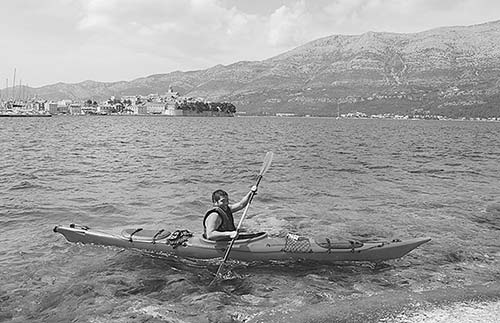
Oreb Club, along Shell Bay a short walk east of the Old Town, rents kayaks, stand-up paddleboards (SUP), and other vessels (+385 99 534 1369, www.oreb-sailing.com).
Excursions
Various companies offer day-long excursions, including trips around the island (either by car or by boat) and side trips to Dubrovnik. Korkyra Info is the dominant outfit (see “Helpful Hints,” earlier), but several other companies offer trips. There are also tour companies offering more active excursions, including canoe trips, snorkeling, kayaking, and other adventures—look for fliers around town.
Other Activities
All over town, you’ll see travel agencies where you can rent a car, bike, scooter, or anything else you want for some vacation fun. Local captains take tourists on cruises to nearby bays and islands to get out on the water, swim, and enjoy a local-style “fish picnic.” Inquire at any travel agency, or simply talk to a captain at the harbor (near the eastern ferry dock, at Shell Bay). If you’re a wine lover, consider hiring Toni Lozica (listed earlier, under “Helpful Hints”) to take you on a tour of Korčula Island, including stops at some wineries (the TI and travel agencies have lists of other guides, too).
MORE SIGHTS ON KORČULA ISLAND
Korčula Island mingles rugged mountains, lush forests, picturesque and tasty vineyards, hidden beaches, and an almost Hawaiian ambience. If you have a car, the island is worth a half-day spin. Or, for a quick glimpse of the island away from its main town, you can easily take the bus or a taxi boat to Lumbarda.
▲Lumbarda
For a break from Korčula town, venture about three miles southeast to Lumbarda, a tranquil, tidy, end-of-the-road resort village. Lumbarda may lack the stirring, fortified old-town vibe of Korčula town, but it offers a lazy vacation personality that encourages visitors to linger.
There’s not much to see in the town itself; most visitors come to hit the beach. While you can swim around Lumbarda’s wide harbor, it’s worth venturing farther out of town to one of its pleasant and pristine beaches. The best two cling to the little peninsula that juts out east of town: the pebbly Bilin Žal (literally “White Stone”) to the north and the sandy Vela Pržina (Old Sand) to the south. Both beaches are about a 20- to 30-minute walk (or a short drive) from Lumbarda. If you’re coming on the bus from Korčula town, stay on the bus through Lumbarda’s town-center stop, and carry on one more stop to the end of the line, which is a bit closer to the beaches. With your back to Lumbarda, walk right for sand, left for pebbles (ask locals—or other beachgoers—for specific directions).
Lumbarda is also known for its wine—specifically the grk white wine, the grapes for which grow only in this village’s unique climate. It’s named for the Greeks who introduced it. Several wineries drape the hillsides above Lumbarda; my favorite for a visit and tasting is Bire (BEE-reh; drivers will see the turnoff on the right just before entering the town of Lumbarda). The setting is beautiful: a series of stone buildings bunny-hopping down the hill toward town, with an inviting tasting room. You can sample their grk, plavac, and rosé wines for a small fee (Mon-Sat 10:00-12:00 & 16:00-18:00, closed Sun, generally closed Oct-May, +385 98 344 712, www.bire.hr).
Getting There: From Korčula town, you can get to Lumbarda by water taxi (€12 round-trip; details under “Farther-Flung Beaches” listing, earlier) or by bus (hourly Mon-Sat in summer, fewer buses Sun, 15 minutes). A land taxi costs about €20 one-way.
North Coast
On the road that hugs the island’s northern coast, from Korčula town to the village of Račišće, you’ll find a series of beautiful tableaux over tranquil coves and tiny offshore islands, with the looming Pelješac Peninsula as a dramatic backdrop.
Korčula Island Spin
If you’d like to see more (beyond Lumbarda and the coastal zones), head west and drive the length of this long, skinny island (29 miles by just 5 miles).
Driving up and out of Korčula (pausing for grand views at the pullout just above the Tommy supermarket), you’ll pass through Žrnovo and eventually twist your way up to humble Pupnat. This oldest village on the island has a Tito-era Partisan monument and a cluster of old 12th- and 13th-century slate-roof houses. From here, you can continue along the main road, or wind down the steep side road to the tranquil and gorgeous bay of Pupnatska Luka, with an inviting pebbly beach fronted by beach bars. Ponder how the ancient Greeks—impressed by the thick forests here—called this island “Black Korkyra.”
Farther west are two of Korčula Island’s main wine-growing towns: Čara, an otherwise nondescript concrete town, overlooks a broad basin striped with vineyards. Farther along, Smokvica is also all about grapes. In both towns, you’ll spot several wineries that invite passersby in for a sample. Korčula produces mostly white wines, using local grapes called pošip (which tend to produce dry wines), korčulanka, and rukatac (smaller grapes that produce sweeter wines).
From Smokvica, detour down along the south coastal road, via Brna (deep yet sheltered, this stunning cove is a favorite spot for super-wealthy yachters to drop anchor) and then Prižba. The scenic road passes the parking pads of cantilevered rental villas that are a popular place for Czechs, Poles, and other Central Europeans to set up for a week or two of fun in the Adriatic sun. A string of tiny islets hovers just offshore, and farther behind is the big island of Lastovo. Facing the open sea, this area is popular for fishing.
Then twist your way back up into the interior (passing old terraces), dropping down into the island’s biggest town, Blato—filling a low-slung valley and huddled around the base of a small hill. Its atmospheric tree-lined streets take you through a landlocked, workaday town that seems blissfully oblivious to the tourism all around it. Literally “Mud,” Blato is named for its surrounding flood plain, now efficiently drained and used for abundant agriculture.
The road ends at Vela Luka, a working-class town surrounding a picturesque harbor. Enjoy a coffee, wine, or beer as you watch the bobbing fishing vessels, then head back across the island to Korčula town—unless you’re catching the car ferry to Split, which leaves from here.
Nightlife in Korčula
This town is much sleepier than Hvar, but you’ll still find a fair number of late-night discos in the summertime (including one near the eastern base of the Old Town peninsula and others—such as VHF Bar—east of town, along the waterfront toward the resort hotels). Two places near the Old Town often have live music outside: Caffe Bar Step (just below the Great Land Gate) and Servantes (a bit farther afield, tucked across the park from the bus station).
The best setting for drinks is at Cocktail Bar Massimo, perched in a city-wall tower at the very tip of the Old Town peninsula. You can have a drink on one of three levels: the downstairs bar, the main-floor lounge, or the tower-top terrace (terrace is only for cocktail-sippers—no beer or wine; climb the ladder at your own risk). If you’re up top, notice the simple dumbwaiter for hauling up drinks (daily 11:00-16:00 & 17:00-24:00, closed off-season, +385 20 715 073).
For a no-stress opportunity to sample local wines right in the Old Town, you’ll find Bokar Wine Bar near the tip of the peninsula (just steps from Massimo). They have a tight interior, fun sidewalk tables on an atmospheric lane, a small selection of wines, and knowledgeable servers who enjoy offering suggestions, plus cheese and meat plates to nibble on (daily 10:00-24:00, closed off-season, Antuna Rozanovića, +385 99 404 1052, Peter). A few steps up the same lane is Mariola Wine Bar, with a similar approach (daily 17:00-24:00, closed off-season, at #13).
Sleeping in Korčula
SOBE
Korčula has a wide variety of sobe; they’re fairly basic but affordable and very local. Unless otherwise noted, these places have air-conditioning, accept only cash (no credit cards), and don’t provide breakfast. Apartments come equipped with kitchens, and sobe often have refrigerators and kettles. For something more substantial, several cafés in town offer a basic breakfast for around €6-10; ask your soba host for suggestions.
In the Old Town
Sleeping in the Old Town nestles you squarely in the historic heart of Korčula, in immediate proximity to all the sights. The likely trade-offs: steep, tight staircases, small rooms in centuries-old houses, and (with a few exceptions) no sea views. For a more luxurious choice in the Old Town, consider Zuviteo Residence, described later.
$$ M&J Central Suites, run by Marko and Jelena, are cozy and central. Their four tight but nicely appointed and well-equipped apartments (three of which come with laundry facilities—washing machine and drying lines) fill a nicely renovated house right in the middle of the Old Town (near Konoba Marko Polo restaurant at Jakova Baničevića 13, +385 98 160 9644, mjcentralsuites@yahoo.com).
$ Sobe Nina offers four simple rooms and a few pricier apartments (some with views) in a building along the seawall. It’s a lesser value, worth considering if you’re in a pinch (cheap self-serve washing machine, Šetalište Petra Kanavelića 3, +385 98 912 7638, matekurtovic@yahoo.com).
$ Ivo and Katja Tedeschi, who also run a recommended pizzeria, rent three small, simple rooms (two with views) and a big, low-ceilinged, top-floor seaview apartment up lots of steep stairs just inside the seawall (RS%, Don Iva Matijace 26, +385 20 711 354, mobile +385 91 566 6924, acc.tedeschi@gmail.com).
West of the Old Town
The pleasant residential neighborhood west of the Old Town, along the waterfront drag called Put Svetog Nikole, comes with an easy, level walk into town and gorgeous views of the peninsula. The main advantages to sleeping here are a bit more space and (in many cases) sea views. I’ve listed places in the order you’ll reach them as you walk along the water—from one minute (the first listing) to 10 minutes (last listing) away from the Old Town.
$$ Royal Apartments, spacious and hotelesque, are conscientiously run by Zvonko and Marija Jelavić, who enjoy socializing with their guests in the small square out front. It’s nicely situated facing a little beach, just steps from the Old Town peninsula (closed mid-Oct-mid-April, look for green awning just west of Old Town at Trg Petra Šegedina 4, +385 98 184 0444, www.korcularoyalapartments.com, royalapt@ica.net).
$ Family Depolo Rooms is owned by gregarious Rezi Depolo (possibly a distant relative of Marco), who lives downstairs, and managed by Marija. They rent four comfy, good-value rooms on the bay west of the Old Town. Three of the rooms offer beautiful views, and the five-minute stroll into town is pleasant and scenic (walk along waterfront from Old Town with bay on your right to the yellow house at Put Svetog Nikole 28—it’s set back from the street but well signed; +385 20 711 621, mobile +385 98 964 3687, www.family-depolo.com, rezi.depolo@gmail.com).
¢ Kiwi Rooms, run by Marica Andrijić, has two bright, tight, and nicely decorated rooms with gorgeous seaview balconies facing the monastery steeple (Put Svetog Nikole 42, +385 91 543 8265, kiwirooms@yahoo.com).
HOTELS
These hotels—the only ones not run by the big hotel chain (see “Aminess Hotels,” next)—are the compromise between sobe and big hotels.
$$$$ Zuviteo Residence, an annex of the Hotel Korsal (listed next), has five plush rooms in a historic townhouse out near the tip of the Old Town peninsula. Of the places within the Old Town, this is the most luxurious...and the most expensive (Sv. Barbare 11, +385 95 388 1439, www.zuviteo-residence.com, info@zuviteo-residence.com).
$$$ Hotel Korsal, a charming and locally owned small boutique hotel, has 19 rooms filling three buildings just above the touristy promenade connecting the Old Town to the resort area, a 10-minute walk from downtown. The staff is professional and friendly, and the decor is bright, colorful, and nautical; you can choose between seaview rooms and “comfort garden” rooms, which are bigger and have private decks but lack views (includes breakfast, closed Nov-April, Šetalište Frana Kršinića 80, +385 20 715 722, www.hotel-korsal.com, info@hotel-korsal.com, Brkičić family).
$$$ Hotel Fabris, beautifully located overlooking a little beach where the Old Town peninsula meets the picturesque waterfront promenade, has 10 tight but well-equipped rooms with stone walls, varnished wood, and lots of stairs. They also have 10 additional, similar but larger rooms in an annex just across the street, a few steps closer to the Old Town (more for seaview balcony, Hrvatske Bratske Zajednice 6, +385 20 716 755, http://thefabris.com, info@thefabris.com, Zlatko).
Aminess Hotels
This company owns Korčula’s big hotels. While (mostly) distant from the historic heart of Korčula, they have high capacity and all the big-hotel amenities. But in keeping with the low-key, working-class ethos of Korčula, these hotels—while pleasant—are not as swanky as the big chain hotels in places like Hvar or Rovinj. You can reserve rooms at any of them through their website or main office (includes breakfast, +385 52 858 600, www.aminess.com, reservations@aminess.com).
$$$ Aminess Korčula Heritage Hotel has by far the best location, right on the waterfront alongside the Old Town. It has a nice seaside terrace restaurant and friendly staff. The 20 rooms are on two floors: The more expensive “first-floor” rooms (actually on the third floor) have big windows and views; the cheaper “second-floor” rooms (actually on the fourth) have tiny windows and no views (reception +385 20 726 900). Two more Aminess hotels are a 15-minute walk away, around the far side of Shell Bay. While relatively inconvenient to the Old Town, they share a nice beach: $$$ Hotel Marko Polo has 94 rooms, an elevator, and a big pool; and $$$ Hotel Liburna, with a clever split-level design that reflects the skyline of the Old Town, has 109 rooms, most of them accessible by elevator. About 15 minutes’ walk farther (30 minutes total) is the recently spiffed-up $$$ Port 9 Resort; while distant, it’s a fun place to be on vacation, and it is connected to town by boats and a shuttle service (www.port9resort.com).
Eating in Korčula
Korčula lacks the burgeoning culinary scene of Hvar; while a few top-end places try to lure the yachting crowd, most options are interchangeable konobas—simple restaurants serving pastas and seafood dishes. Note that almost all these places close from mid-October to Easter (if you’re here off-season, call ahead or ask around to find out what’s open). Skip the eateries around Shell Bay, east of the Old Town.
$$$$ Adio Mare, with good seafood and friendly service, is a local fixture and the best of Korčula’s many traditional restaurants. You’ll step into a stone tavern-like dining room sporting long, shared tables and a thick vine scaling one wall. But if the weather’s nice, ask to sit in the enchanting rooftop garden terrace, where you’ll dine romantically above the fray below (Mon-Sat 12:00-23:00, Sun from 17:00, on the main drag just past Marco Polo’s House, +385 20 711 253).
$$$ Aterina, with a youthful spirit and a waitstaff that enjoys singing along to the music when the spirit grabs them, fills a hidden little square just inside the Old Town walls. It’s deservedly proud of its original recipes, fresh products, and warm welcome (compliments of Nataša). Here you can assemble small plates of local Dalmatian bites (mostly seafood-based, though usually with some good vegetarian options) or order full courses. The “little bit of everything” sampler plate makes a great meal. Ask about the day’s specials (daily 12:00-24:00, Trg Korčulanskih Klesara i Kipara 2, +385 98 986 1856).
$$$ Pizzeria Amfora, on a side lane off the people-parade up Korčula’s main drag, features some pricey pastas, fish, and meat dishes; less successful wok dishes; and affordable pizzas. The food is nothing special, but the pizzas are a good value if you’d like to squeeze into an outdoor lane in the very heart of the Old Town (daily 11:00-15:00 & 18:00-23:00, Ulica od Teatra 4, +385 20 711 739).
Picnics: Just outside the main gate, you’ll find a lively produce market and a big, modern, air-conditioned Konzum supermarket (Mon-Sat 7:00-21:00, Sun 8:00-20:00). A short stroll from there down Put Svetog Nikole takes you to rocky seafront perches with the best Korčula views. There are also many inviting picnic spots along the Old Town embankment.
Sweet Shop: Find tasty traditional treats at Cukarin, where offerings include the delicious flourless (and gluten-free) amareta almond cake, the Marko Polo cake (flourless chocolate cake with buttercream), and the walnut-cream-filled klašun. They also sell homemade wine, liqueur, honey, and jam (Mon-Sat 8:30-13:00 & 17:00-20:00, closed Sun and Nov-March, a block behind the Jadrolinija office on Hrvatske Bratske Zajednice, +385 20 711 055).
Along the Seawall
A wide variety of restaurants line up scenically along the Old Town’s eastern seawall, providing al fresco dining with salty views. Their tables, spilling out along the wall and overlooking the water, are ideal for romantic harborside meals. Dine here if it’s hot, as there’s often a pleasant breeze.
$$$$ LD Restaurant (in the Lešić Dimitri Palace boutique hotel) has a Michelin star and the best reputation (and highest prices) on the island. Chef Marko Gajski puts out beautifully presented dishes of Dalmatian and Mediterranean cuisine, either à la carte or on a tasting menu. Reserve well ahead (daily 12:00-22:30, closed off-season, Don Pavla Poše 1, +385 20 601 726, www.ldrestaurant.com).
$$$$ Filippi serves a limited but enticing menu of quality Dalmatian and international cuisine, but with warm service that skips the snobby pretense of some of its rivals (assemble your own wine flight from the wine list, daily 12:00-24:00, closed Nov-March, +385 98 275 701, www.restaurantfilippi.com).
For something less expensive (though still pricey, thanks to the grand views), consider $$$ Silk—named for the Silk Road explorations of Marco Polo—with solid Asian fusion dishes (daily 11:30-23:00, Baničevića 17, +385 20 721 111).
The only “budget” option along here is the refreshingly lowbrow, reasonably priced $$ Pizzeria Tedeschi, which serves good pizzas closer to the base of the peninsula (daily 9:00-24:00, +385 20 711 586).
Korčula Connections
Korčula is tethered to the rest of the Dalmatian Coast mainly through catamarans operated by three different companies: Jadrolinija, Krilo, and TP Line. Research connections at https://getbyferry.com, then book your ticket direct on the ferry company’s website (each company also has a ticket office in town). Occasionally sailings become sparse off-season; if you’re here during a lull in the schedule, buses (which make the short crossing on the Dominče-Orebić ferry) are your ticket out of town. For an overview of boat routes, see the “Dalmatian Coast” map on here.
BY BOAT
Fast Passenger Catamarans
For most travelers, the key connections are the fast passenger catamarans: Jadrolinija (www.jadrolinija.hr), Krilo (www.krilo.hr), and TP Line (www.tp-line.hr). Buy tickets on each company’s website, ideally, a day or two ahead (or even earlier in peak season). Boats sell out at busy times, and Jadrolinija sometimes does not allow same-day ticket purchase on their website. Each company also has a sales point in Korčula: Jadrolinija’s well-marked ticket office is right where the Old Town peninsula meets the mainland; Krilo has a ticket kiosk on the western embankment; and TP Line sells tickets through the Korkyra Info travel agency (see “Helpful Hints,” earlier). These offices can close unexpectedly; if so, book online.
Departure Point: On most days, before 17:00, the speedy catamarans depart from the eastern embankment. After 17:00, and somewhat randomly at other times, they may use the western embankment instead. Ask in the morning which dock your catamaran uses.
Catamarans from Korčula Town North to Hvar and Split: Several times each day through the summer, all three companies run fast catamarans north to Hvar town (1 hour), terminating at Split (2.5 hours). Off-season, the frequency is reduced.
Catamarans from Korčula Town South to Mljet and Dubrovnik: All three companies also make the run south to Dubrovnik (2 hours) a few times each day in summer. If you want to get to Mljet National Park, Krilo and TP Line each typically run a Dubrovnik-bound morning catamaran that stops at the Pomena dock on Mljet; the Krilo option, departing earlier, is handier for day-tripping or for stopping off at Mljet on your way to Dubrovnik. TP Line’s afternoon departure to Dubrovnik, which uses the Polače dock on Mljet, may work for those spending the night at the national park. If heading to Mljet, avoid boats to Sobra—a ferry port a long distance from the main attractions (see the Near Dubrovnik chapter for details).
Other Boats
In addition to the catamarans, Korčula Island has an assortment of other boat connections. The first one leaves from Korčula town, while the rest depart from other points on the island.
Passenger Ferry from Korčula Town to Orebić: G&V Line boats leave from the Old Town’s western embankment, connecting Korčula with Orebić on the Pelješac Peninsula in 15 minutes (€4, hourly July-Aug, 10/day in June and Sept, 7/day in Oct and March-May—but less on Sat-Sun, www.gv-zadar.hr). This is handy mostly for those meeting a driver at Orebić for a wine-tasting Pelješac drive on the way to Dubrovnik.
Car Ferry from Dominče (near Korčula Town) to the Mainland: The island of Korčula is connected to the mainland by a small car ferry that runs between Dominče—about a mile east of Korčula town—and Orebić, across the channel on the Pelješac Peninsula (15-minute crossing, departs Dominče at the top of most but not all hours—check carefully in Korčula, departs Orebić at :30 past most hours).
Boats from Vela Luka North to Hvar Town and Split: Additional boats connect to points north, but they depart from the port at Vela Luka, an hour away from Korčula town, at the opposite end of the island. A Jadrolinija fast catamaran goes daily from Vela Luka to both Hvar town and Split; unfortunately, on most days it departs extremely early, with no bus connection from Korčula to get you there in time—if you’re desperate, you could pay about €70 for an early-morning taxi or sleep overnight in Vela Luka (Mon-Sat departs at 5:30, Sun at 8:05; 45 minutes to Hvar, 2 hours to Split). A daily car ferry also travels from Vela Luka to Split—it’s slower but generally departs at a more convenient time; at least one daily connection is coordinated with a bus from Korčula (2/day, 3 hours, no stop at Hvar town). Getting to Vela Luka from Korčula town is a hassle, so carefully confirm these boat schedules at the Korčula TI or Jadrolinija office and understand all of your options before you get up early to make the trip.
BUS CONNECTIONS
All buses from Korčula town (except those to Vela Luka) first drive to Dominče, where they meet the car ferry to cross over to Orebić, on the Pelješac Peninsula. Once across, it takes just over an hour to drive the length of the Pelješac Peninsula and meet the main coastal road. Check https://getbybus.com to see all bus company schedules before booking on the company’s own website.
From Korčula Town by Bus to: Dubrovnik (3/week on Mon, Wed, and Fri at 6:45, more departures may be added—check); Vela Luka (at far end of island, Mon-Fri 6/day, Sat 5/day, Sun 3/day, 1 hour). An inconveniently timed bus departs Korčula nightly at 19:45, stopping in Split (5 hours, arrives after midnight) and then continuing overnight to Zagreb (arrives around 7:00 the next morning).
ROUTE TIPS FOR DRIVERS
If you’re returning to the mainland, you’ll first cross on the car ferry from Dominče to Orebić (described earlier), which is on the vineyard-strewn Pelješac Peninsula. Consider dropping into a winery as you traverse the long, narrow Pelješac Peninsula (about a one-hour drive to the main coastal road). Where the peninsula meets the mainland, you’ll see the cute little “Great Wall of Croatia” town of Ston. For more on the Pelješac Peninsula and Ston—including several recommended wineries—see here.
Approaching the base of the Pelješac Peninsula, if you’re heading south to Dubrovnik, the coastal road zips you right there (about an hour from Ston). If you’re heading north to Split, watch for your turnoff (several miles before Ston) to head north over the new Pelješac Bridge, then onward via the main coastal road along the Neretva River Delta and Makarska Riviera.
Remember, to avoid the long drive between Split and Korčula, you can take the longer car ferry the whole way between Split and Vela Luka, at the far end of Korčula Island (described earlier; allow 1 hour for the drive between Korčula town and Vela Luka). The scenic and relaxing three-hour boat ride between Vela Luka and Split saves you more than that much driving time.