SPLIT
Map: Split Hotels & Restaurants
IN VAROŠ, WEST OF THE OLD TOWN
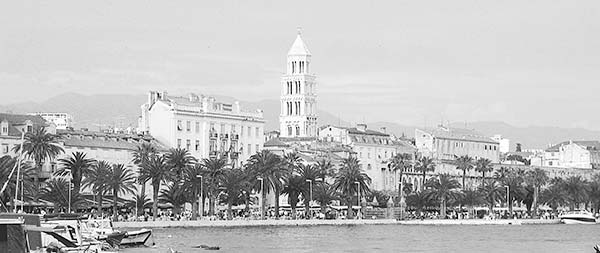
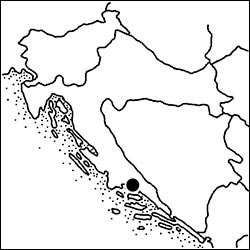
Dubrovnik is the darling of the Dalmatian Coast, but Split (pronounced as it’s spelled) is Croatia’s second city, bustling with 178,000 people. If you’ve been hopping along the coast, landing in Split feels like a return to civilization. While most Dalmatian coastal towns seem made for tourists, Split is real and vibrant—a shipbuilding city with ugly sprawl surrounding an atmospheric Old Town, which teems with Croatians living life to the fullest. And life here is good indeed: Few cities match Split’s combination of urban flair, wonderful climate, mountains, and beaches...as its waves of visitors are finding out.
Though today’s Split throbs to a modern, youthful beat, its history goes way back—all the way to the Roman Empire. Along with all the trappings of a 21st-century city, Split has some of the best Roman ruins this side of Italy. In the fourth century AD, the Roman emperor Diocletian (245-313) retired in his native Dalmatia and built a huge palace here. The palace continued to host the Roman elite until the fall of the empire. Then, in the seventh century, locals fleeing Slavic invaders moved in and made themselves at home, and a medieval town sprouted from the rubble of the old palace. In the 15th century, the Venetians took over the Dalmatian Coast. They developed and fortified Split, slathering the city with a new layer of Gothic-Renaissance architecture.
But even as Split grew, the nucleus remained the ruins of Diocletian’s Palace. To this day, 2,000 people live or work inside the former palace walls. A maze of narrow alleys is home to boutiques and galleries, wonderfully atmospheric cafés, and Roman artifacts around every corner.
For years, Split had a split personality: Was it a no-nonsense, metropolitan transit point; an impressive destination in its own right, with sights to rival Dubrovnik’s; or both? While largely lacking Dubrovnik’s over-the-top romance, Split settles for being nobody’s “second-best.” It is its own city, the antidote to all that’s quaint and cutesy in Dalmatia. Today Split is stepping up to its role as both an urban hub and another tourist gem on Croatia’s sun-splashed coast—so on a busy day, when a cruise ship or two is in town, it can be jammed.
PLANNING YOUR TIME
Split deserves at least a full day. Begin by touring Diocletian’s Palace, then take a coffee break along the Riva promenade or have lunch in the Old Town. In the afternoon, visit a couple of museums (the Meštrović Gallery, which is a long walk or short bus or taxi ride from the Old Town, is tops), hike on the Marjan peninsula, or hit the beach. As the sun sinks low, promenade along the Riva with the natives and nurse a drink at an atmospheric open-air café.
With a second day (or on your way into or out of town), you could spend some time in nearby Trogir—an enjoyable Dalmatian seaside village just to the north. If you’re connecting to points north on the expressway, you can take a short detour to stroll through the interesting coastal city of Zadar or wander through waterfalls at Krka National Park. All of these are described at the end of this chapter.
Orientation to Split
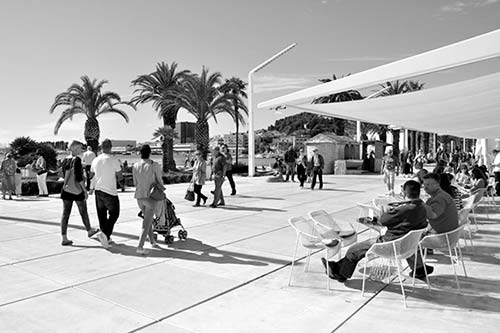
Split sprawls, but almost everything of interest to travelers is close to the City Harbor (Gradska Luka). At the top of this harbor is the Old Town (Stari Grad). Stretching out between the Old Town and the sea is the Riva, a waterfront pedestrian promenade lined with cafés and shaded by palm trees. The main ferry terminal (Trajektni Terminal) juts into the harbor from the east side. Along the harborfront embankment between the ferry terminal and the Old Town are the long-distance bus station (Autobusni Kolodvor), the forlorn little train station (Željeznička Stanica), and various berths for fast passenger catamarans to the islands. West of the Old Town, poking into the Adriatic, is the lush and hilly Marjan peninsula. Spreading up the hillside between Marjan and the Old Town are the characterful little lanes of the Varoš neighborhood.
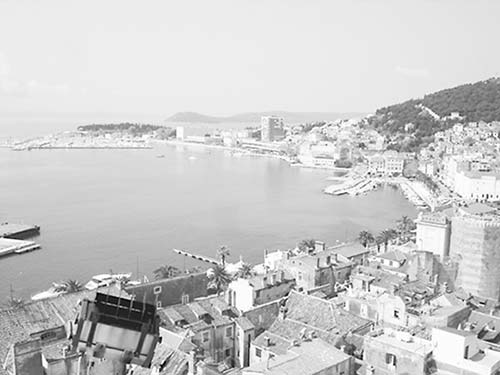
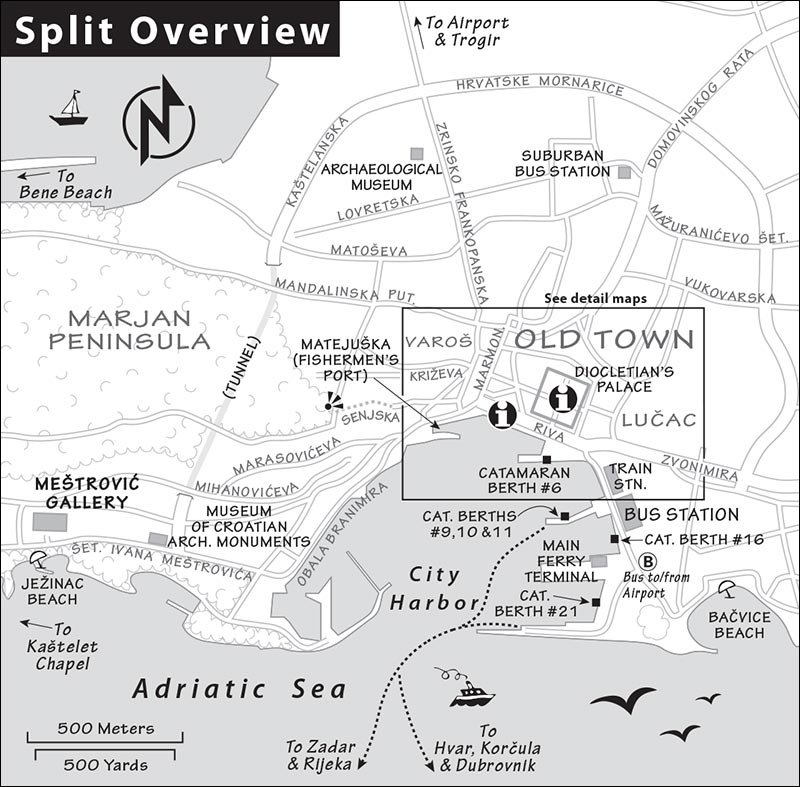
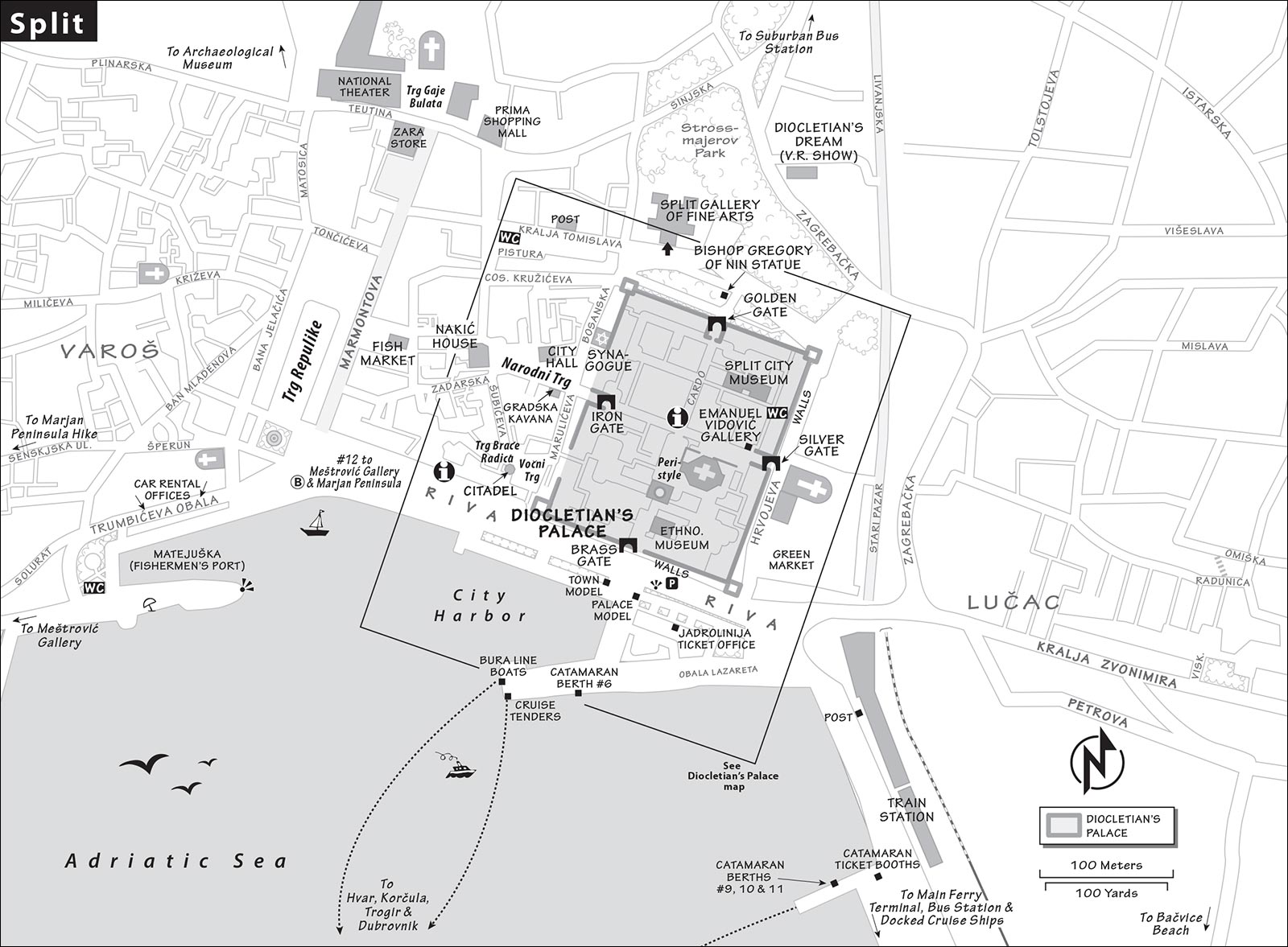
Split’s domino-shaped Old Town is made up of two square sections. The east half was once Diocletian’s Palace, and the west half is the medieval town that sprang up next door. The shell of Diocletian’s ruined palace provides a checkerboard street plan, with a gate at each end. But the streets built since are anything but straight, making the Old Town a delightfully convoluted maze (double-decker in some places). At the center of the former palace is a square called the Peristyle (Peristil), where you’ll find the TI, cathedral, and highest concentration of Roman ruins.
TOURIST INFORMATION
Split has two TI locations: One is in the little chapel on Peristyle square, in the very center of Diocletian’s Palace; the other—less crowded and therefore more helpful—is on the Riva at #9, facing the harbor (same hours for both: June-Sept daily 8:00-20:00; off-season Mon-Sat 8:00-17:00, Sun from 12:00; Peristyle +385 21 345 606, Riva +385 21 360 066, www.visitsplit.com). Helpful handouts include the Discover Split newspaper (with a detailed map), plus Split in Your Pocket guidebooks and maps.
ARRIVAL IN SPLIT
By Boat, Bus, or Train: Split’s ferry terminal (Trajektni Terminal), main bus station (Autobusni Kolodvor), and train station (Željeznička Stanica) all share a busy and practical strip of land called Obala Kneza Domagoja, on the east side of the City Harbor. Strolling along here, you’ll pass travel agencies, baggage-storage offices, people trying to rent out rooms, a post office, shops, cafés, and all manner of other little tourist-oriented businesses.
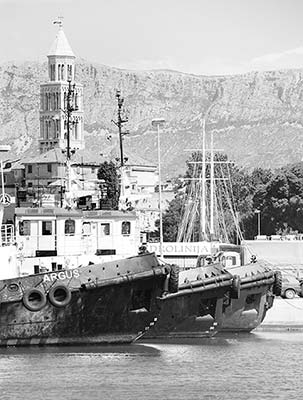
Boats arrive at various piers. The most convenient—used mainly by Jadrolinija passenger catamarans to and from Hvar and Korčula—is berth #6, which is along the Obala Lazareta embankment, right in front of the Old Town. Most of the other passenger catamarans (including those operated by Krilo and TP Line) use berths #9, #10, and #11 along the first pier that juts out along the harbor, called Gat Sv. Petra (about a five-minute walk farther from town). A few other boats may use berths #16 or #21, which are farther out still. Bigger car ferries use various docks along the harbor.
Regardless of where you’re arriving, you’ll see the big bell tower marking the center of the Old Town—just walk toward it.
By Cruise Ship: Ships either dock along the main harbor in front of the Old Town or anchor in the harbor and send tenders into the harbor. Either way, it’s an easy 5-to-15-minute walk to town.
By Plane: Split’s airport (Zračna Luka Split-Kaštela) is across the big bay, 15 miles northwest of the center, near the town of Trogir (code: SPU, +385 21 203 555, www.split-airport.hr [URL inactive]). Exiting the airport, turn left to find the airport bus, which departs every 30 minutes or so (€7, drops you at the main bus station, described earlier). Near the bus stop is a taxi stand, but most cabbies charge a hefty €45-50 between the airport and downtown Split; Uber can be a somewhat more affordable alternative.
By Car: For details on arriving in Split by car, driving between northern Croatia and Split, and driving south to the rest of the Dalmatian Coast, see “Route Tips for Drivers,” near the end of this chapter. Dropping rental cars at the airport rather than downtown is wise, as navigating Split’s one-way street grid is challenging.
HELPFUL HINTS
Festivals: The summer is busy with special events. The huge Ultra Europe music festival, with big-name DJs and electronic music acts, overtakes the city for a weekend in early July (everything’s booked up and more expensive—if you’re not here for the music, stay away; www.ultraeurope.com). From mid-July through mid-August, the mellow Split Summer Festival hosts a variety of plays and concerts at indoor and outdoor venues around town (www.splitsko-ljeto.hr/en).
Luggage Storage: The strip between the bus station and downtown is lined with a half-dozen luggage storage kiosks, and you’ll also find services at the bus and train stations. Just west of the Old Town, Modrulj Launderette (described next) also has a left-luggage service.
Laundry: Conveniently located in the Varoš neighborhood at the west end of the Old Town, Modrulj Launderette offers full and self-service (air-con; April-Oct daily 8:00-20:00; Nov-March Mon-Sat 9:00-17:00, closed Sun; Šperun 1, +385 21 315 888). At the other end of town, hidden in the Green Market (the end nearest Zagrebačka street), Lushiya is a simple place that offers speedy, affordable, same-day service for laundry (no self-service, Mon-Fri 8:00-20:00, Sat until 18:00, closed Sun, Stari Pazar 3A). You’ll find a few other options along the strip leading to the bus station and ferry dock.
Bike Rental: There are plenty of choices for bike rentals in Split. One good—if moderately strenuous—option for a ride is a loop around the nearby Marjan peninsula, with a stop at a beach. The city also has a bike-share program (www.nextbike.hr), which is straightforward to use.
Who’s Hajduk?: You’ll see the word Hajduk (HIGH-dook), and a distinctive red-and-white checkerboard circle design (or red-and-blue stripes), all over town and throughout northern Dalmatia. Hajduk Split is the fervently supported soccer team, named for a band of highwaymen bandits who rebelled against Ottoman rule from the 17th to 19th century. Most locals adore Hajduk as much as they loathe their bitter rivals, Dinamo Zagreb.
GETTING AROUND SPLIT
Most of what you’ll want to see is within walking distance, but some sights (such as the Meštrović Gallery) are more easily reached by bus or taxi.
By Bus: Local buses, run by Promet, cost €1.80 per ride (or €1.20 if you buy a ticket on the app or at a newsstand or Promet kiosk—ask for a putna karta; zone I is fine for any ride within Split). Validate your ticket in the machine or with the driver as you board the bus. Suburban buses to towns near Split (such as Trogir) generally use the suburban bus station (Prigradski Autobusni Kolodvor), a dreary 10-minute walk due north of the Old Town on Domovinskog rata. Bus information: www.promet-split.hr.
By Taxi: Taxis start at around €2, then cost around €1 per kilometer. Figure €8-10 for most rides within the city (for example, from the ferry terminal to most hotels)—but it can be faster to walk rather than ride from one end of the Old Town to the other. To call for a taxi, try Radio Taxi (+385 21 473 737). Uber is also active in Split and is often cheaper than a traditional cab.
Tours in Split
Walking Tours
Split’s Old Town, with fragments of Diocletian’s Palace, is made-to-order for a walking tour, and Split has dozens upon dozens of tour guides leading cruise-ship excursions around town. My self-guided walk (described next) covers basically the same information you’ll get from a guide. But if you’d like to hear it live, join a tour. This is a constantly changing scene, but various fiercely competitive companies offer dueling 1.25-hour walks, leaving regularly throughout the day and into the evening (generally around €15).
Local Guides
You can hire an insider to show you around. Maja Benzon is a smart and savvy local guide who leads good walking tours through the Old Town (€120/up to 2 hours, €150/3 hours, +385 98 852 869, maja.benzon@gmail.com). Charming Nives Fabečić Bojić is also good and takes your learning seriously (similar rates, +385 98 904 3366, nfabecic@yahoo.com). You can also hire a guide through the guides association (www.guides.hr, info@guides.hr).
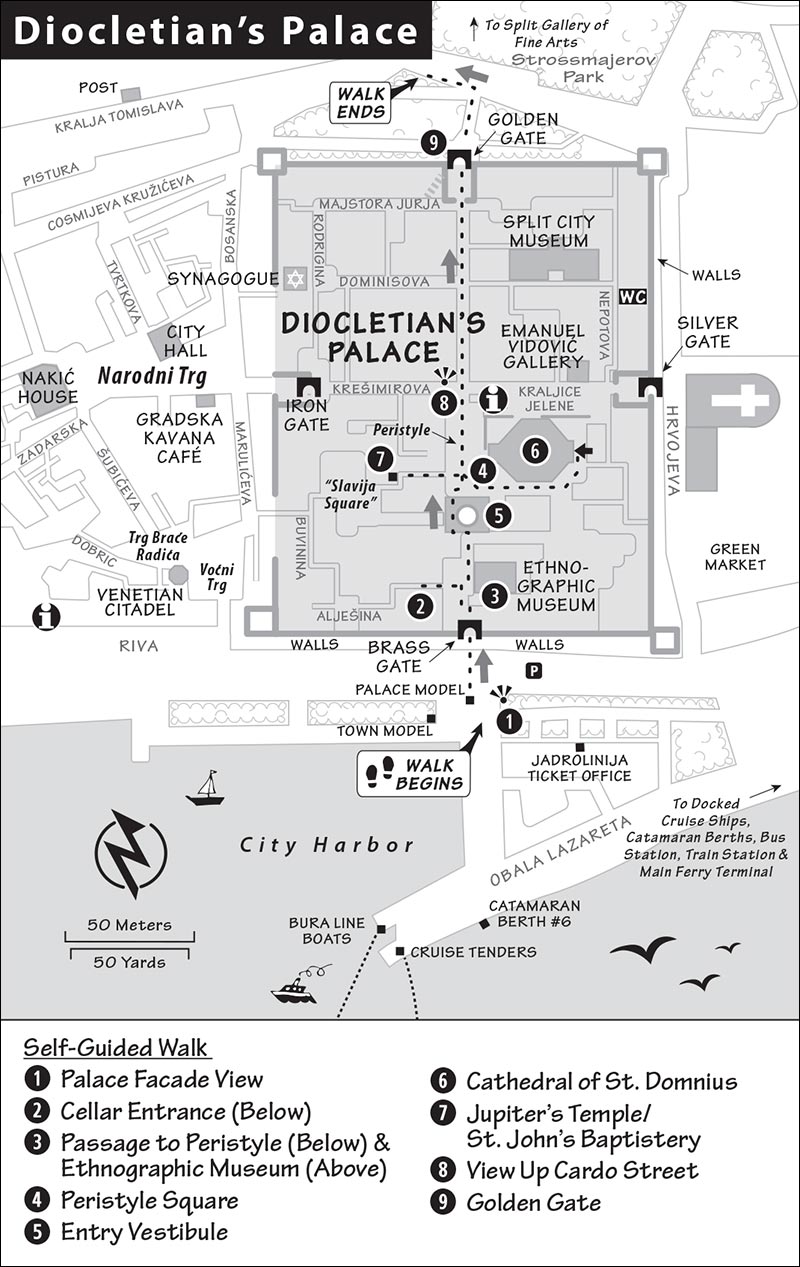
Diocletian’s Palace Walk
Split’s only must-see sight is touring the scattered remains of Roman emperor Diocletian’s enormous retirement palace (Dioklecijanova Palača), which sits along the harbor in the heart of the city. This monstrous complex was two impressive structures in one: luxurious villa and fortified Roman town. My self-guided walk (worth ▲▲▲) takes you through Diocletian’s back door and hits the main landmarks before leaving through what was the palace’s front entrance. The ruins themselves are now integrated with the city’s street plan, so exploring them is free—except for the cellars and the cathedral sights, which you’ll pay to enter. Cruise-ship groups typically all arrive right around 9:00, which can make for a terrible crush in the cellars—it can be better to wait until afternoon to visit. Also note that various smaller museums (including the Ethnographic Museum, Emanuel Vidović Gallery, and Split City Museum) are inside the palace walls; these are described later, under “Other Sights in Split.”
Background
Diocletian grew up just inland from Split, in the town of Salona (Solin in Croatian), which was then the capital of the Roman province of Dalmatia. He worked his way up the Roman hierarchy and ruled as emperor for the unusually long tenure of 20 years (AD 284-305). Despite all of his achievements, Diocletian is best remembered for two questionable legacies: dividing the huge empire among four emperors (which helped administer it more efficiently but began a splintering effect that arguably contributed to the empire’s decline); and torturing and executing Christians, including thousands right here on the Dalmatian Coast. Diocletian’s successor, Constantine, not only legalized Christianity but made it the official religion of the empire—effectively making Diocletian’s purges some of the last in Roman history.
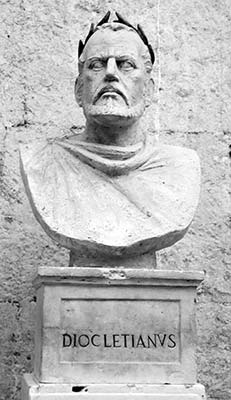
Diocletian—the only Roman emperor to “retire” (at least, voluntarily)—decided to return to his homeland for his golden years. Because he was in poor health, the medicinal sulfur spring here was a big plus. His massive palace took only 11 years to build—and this fast pace required a big push (more than 2,000 slaves died during construction). Huge sections of his original palace still exist, modified by medieval and modern developers alike.
• Start in front of the palace, at the east end of the Riva. Near the corner of the harbor, you’ll find a car-size model of today’s Old Town, which is helpful for orientation. Across the street and a few steps closer to the harbor, find the smaller bronze model of the fully intact Diocletian’s Palace. Compare that to the version you see today, looking across the street to the...
Palace Facade
The “front” of today’s Split—facing the harbor—was actually the back door of Diocletian’s Palace. There was no embankment in front of the palace back then, so the water came right up to this door—sort of an emergency exit by boat. Looking out to the water, appreciate the palace’s strategic location: It’s easy to fortify, and to spot enemies approaching either by land or by sea.
Visually trace the outline of the gigantic palace, which was more than 600 feet long on each side. On the corner to the right stands a stumpy, rectangular guard tower (one of the original 16). To the left, the tower is gone and the corner is harder to pick out (look for the beginning of the newer buildings). Mentally erase the higgledy-piggledy two-story houses added 200 years ago, which obscure the grandeur of the palace wall.
Halfway up the facade, notice the row of 42 arched window frames (mostly filled in today). Diocletian and his family lived in the seaside half of the palace. Imagine him strolling back and forth along this fine arcade, enjoying the views of his Adriatic homeland. The inland half of the palace was home to 700 servants, bodyguards, and soldiers who had no grand view.
• Now cross over and go through the door in the middle of the palace (known as the Brass Gate, which is easy to miss between the cafés—just follow the tourists, who swarm like ants to the entrance). You’ll step down into a cool, dark underground passage. You can carry on straight ahead up the passage for free, but it’s worth paying to see the best portion of...
Diocletian’s Cellars (Podrumi)
Since the palace was constructed on land that sloped down to the sea, these chambers were built to level out a foundation for the massive structure above (like a modern daylight basement). The cellars were filled with water from three different sources: a freshwater spring, a sulfur spring, and the sea. Later, medieval residents used them as a dump. Rediscovered only in the last century, the cellars enabled archaeologists to derive the floor plan of some of the palace’s long-gone upper sections. These underground chambers now house a strip of souvenir stands, but a particularly well-preserved stretch immediately to the left as you enter the long corridor skips the touristy clutter and offers the best look in town at Roman engineering.
Cost and Hours: €7; June-Sept daily 8:00-20:00; May and Oct Mon-Fri 9:00-20:00, Sat-Sun until 18:00; progressively shorter hours off-season.
Visiting the Cellars: Just past the ticket seller, notice the big topographical map of the Split area, clearly showing the city’s easily defensible location: a natural harbor sheltered by tall mountains. You’ll see the former Roman city of Salona, Diocletian’s birthplace, just inland.
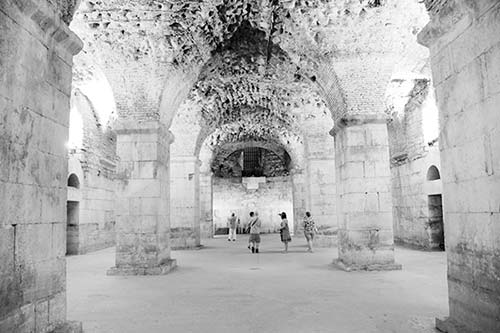
Across from the map, step into the complex’s vast, vaulted main hall—the biggest space in the cellars, with stout pillars to support everything upstairs. When those first villagers took refuge in the abandoned palace from the rampaging Slavs in 641, the elite lived upstairs, grabbing what was once the emperor’s wing. They carved the rough holes you see in the ceiling to dump their garbage and sewage. Over the generations, the basement (where you’re standing) filled up with layers of pungent waste that solidified, ultimately becoming a precious bonanza for 19th- and 20th-century archaeologists. These days this hall is used for everything from flower and book shows to fashion catwalks—and it was a filming location for Game of Thrones (it’s where Daenerys Targaryen locked up her dragons).
From here, explore the cellars. Enjoy a scavenger hunt looking for the following items:
In many rooms, look overhead to see the holes midway up the walls that once held beams to support floorboards, creating an efficient two-story space.
In one large room are two petrified beams, like the ones that once filled those double-decker holes. In the same room, you’ll see an unexcavated wing—a compost pile of ancient lifestyles, awaiting the tiny shovels and toothbrushes of future archaeologists.
One small room displays a stone olive oil press, set behind a gate. It’s a reminder of a local industry that has remained much the same since Roman times.
Keep an eye out for the bust of Diocletian (or is it Sean Connery?), which helps you visualize the emperor who left his mark on Split—and on the entire empire.
Near the WCs, look for original Roman sewer pipes—square outside and round inside—designed to fit into one another to create long pipes.
When you’re finished, your ticket gets you into a whole other, easy-to-miss labyrinth of chambers on the opposite side of the main corridor—mostly with their ceilings missing, so they’re open to the air. These eastern cellars have smaller rooms displaying stone fragments. One room (with a marble sarcophagus) displays four headless, pawless black granite sphinxes—just a few of 13 that Diocletian brought home from Egypt. The most intact one is on display on the Peristyle—we’ll see it soon.
• When you’re finished, head back to the main gallery. Ignore the tacky trinket shops as you head down the passage and up the chunky stairs into the...
Peristyle (Peristil)
This square was the centerpiece of Diocletian’s Palace. As you walk up the stairs, the entry vestibule into the residence is above your head, Diocletian’s mausoleum (today’s Cathedral of St. Domnius) is to your right, and the street to Jupiter’s Temple (supported by wooden beams) is on your left. The TI is in the small chapel at the end of the square on the right. Straight ahead, beyond the TI/chapel, is the narrow street that leads you to the palace’s former main entrance, the Golden Gate.
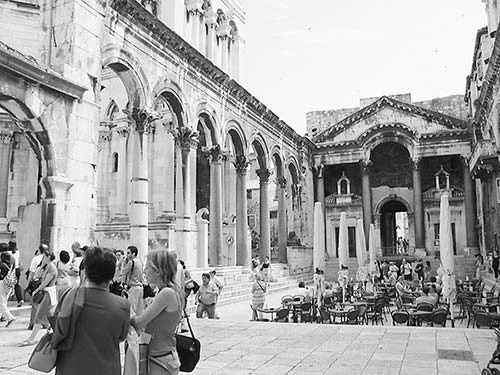
Go to the middle of the square and take it all in. The red granite pillars—which you’ll see all over Diocletian’s Palace—are from Egypt, where Diocletian spent many of his preretirement years. Imagine the pillars defining the arcades—now obscured by medieval houses. The black sphinx is the only one of Diocletian’s collection of 13 that’s still (mostly) intact.
“Roman soldiers” pose for tips, and every day at noon in summer (mid-June-mid-Sept), an actor playing Diocletian appears at the top of the stairs to address the crowd in Latin for a few minutes.
Without realizing it, you’re also standing in the middle of one of Split’s most inviting bars, Luxor. The red cushions on the steps ringing the square belong to the bar; if you want to sit on one, you have to buy a drink. To really lounge in Roman style, this is well worth paying for—especially in the cool of the evening, when the Peristyle is less crowded and there’s often live music. Come back tonight for a pre- or post-dinner drink.
• Climb the stairs (above where you came in) into the domed, open-ceilinged...
Entry Vestibule
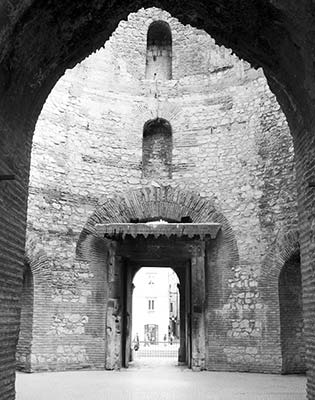
Impressed? That’s the idea. This was the grand entry to Diocletian’s living quarters, designed to wow visitors. Emperors were believed to be gods. Diocletian called himself “Jovius”—the son of Jupiter, the most powerful of all gods. Four times a year (at the changing of the seasons), Diocletian would stand here and overlook the Peristyle. His subjects would lie on the ground in worship, praising his name and kissing his scarlet robe. Notice the four big niches at floor level, which once held statues of the four tetrarchs who ruled the unwieldy empire after Diocletian retired. The empty hole in the ceiling was once capped by a dome (long since collapsed), and the ceiling itself was covered with frescoes and mosaics.
In this grand space, you’ll likely run into an all-male band of klapa singers, performing traditional a cappella harmonies. Just stand and enjoy a few glorious tunes—you’ll rarely find a better group or acoustics. A klapa CD (or a flash drive loaded up with songs) is the perfect souvenir.
• Now go back into the Peristyle and turn right, facing the...
Cathedral of St. Domnius (Katedrala Sv. Duje)
The original octagonal structure was Diocletian’s elaborate mausoleum, built in the fourth century. But after the fall of Rome, it was converted into the town’s cathedral (the Venetian-style bell tower was added in the 13th to 16th century). Before you go inside, notice the sarcophagi ringing the cathedral. In the late Middle Ages, this was prime postmortem real estate: Being buried closer to a cathedral improved your chances of getting to heaven.
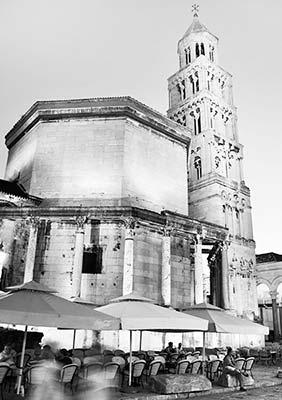
Cost and Hours: There’s a staggering variety of color-coded tickets, depending on which items you’d like to see—skim your options and decide. The €12 purple ticket covers everything, including the tower climb, but may be overkill for a casual look. For a more focused visit, consider the €7 blue ticket covering the cathedral interior, the crypt, and the baptistery across the way. To see only the cathedral interior, it’s €4. Tickets for all sights are sold at the centralized ticket office, across the small Peristyle square from the cathedral. All the sights are open similar hours (Mon-Sat 8:00-19:00, Sun 12:30-18:00, cathedral often closed Sat afternoons for weddings; winter daily 9:00-17:00)—but the cathedral can close unexpectedly for services.
Visiting the Cathedral: First, stop in at the ticket office, across from the cathedral, to survey your ticket options and buy the one that suits your interests.
Some tickets include the modest treasury/museum, just past the ticket office and upstairs. While skippable for most, if you decide to tour this, you’ll see big screens reconstructing the original structure, chips of mosaics, stone fragments, and grave markers. Upstairs are paintings, chalices, reliquaries, monstrances, vestments, and other ecclesiastical gear. It’s all explained in English.
To reach the main attraction—the cathedral—cross the square, climb up the stairs, and show your ticket to step into the tiny but evocative cathedral interior. This is the oldest—and likely smallest—building used as a cathedral anywhere in Christendom. Imagine the place in pre-Christian times, with Diocletian’s tomb in the center. The only surviving pieces of decor from those days are the granite columns and the relief circling the base of the dome (about 50 feet up)—a ring of carvings heralding the greatness of the emperor. The small red-marble pillars around the top of the pulpit (near the main door) were the only thing scavenged from Diocletian’s sarcophagus—his actual remains have never been found.
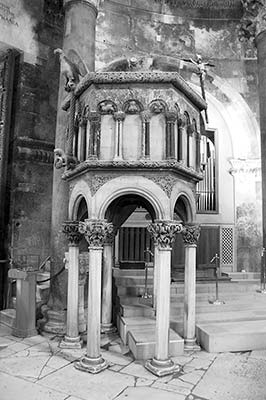
Diocletian brutally persecuted his Christian subjects. Just before he moved to the Dalmatian Coast, he had Bishop Domnius of Salona killed, along with several thousand Christians. When Diocletian died, there were riotous celebrations. In the seventh century, his mausoleum became a cathedral dedicated to the martyred bishop. Posthumous poetic justice: Now Christian saints are entombed in Diocletian’s mausoleum...and Diocletian is nowhere to be found.
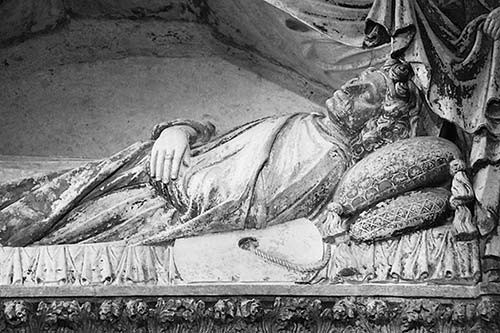
The sarcophagus of St. Domnius (to the right of the altar, with early-Christian carvings) was once the cathedral’s high altar. To the left of today’s main altar is the impressively detailed, Renaissance-era altar of St. Anastasius, who is lying on a millstone that is tied to his neck. On Diocletian’s orders, this Christian martyr was drowned in AD 302. To the left of St. Anastasius’ altar is the “new” altar of St. Domnius; his relics lie in the 18th-century Baroque silver reliquary, above a stone relief showing him about to be beheaded.
As you exit, take a moment to study the 13th-century main doors, one of the treasures of Romanesque sculpture in Croatia. Carved in walnut wood, the 14 panels on each of the two wings depict 28 scenes from the life of Christ.
Just outside the church, you’ll see the entrance to the bell tower. Climbing its 183 steep steps rewards you with sweeping views of Split, but it’s not for claustrophobes or those scared of heights.
To visit the easy-to-miss crypt (kripta), exit the main door of the cathedral, go down the stairs just before the tiny pillar, and loop left to find its low-profile entrance. This musty, domed cellar (with eerie acoustics) was originally used to level the foundation of Diocletian’s mausoleum. Later, Christians turned it into another chapel, dedicated to the Italian Saint Lucia, who was martyred by Diocletian and is honored with a colorful statue at a small altar. (The legend you’ll likely hear about Diocletian torturing and murdering Christians in this very crypt is probably false.) Ponder the contrast of this dark and gloomy space with Santa Lucia, whose name means “light.” Notice the freshwater well in the middle of the room. Because this water was believed to have healing properties, the faithful would wash their eyes with it (Santa Lucia is also the patron saint of eyesight).
• Return to the middle of the Peristyle square. Remember that Diocletian believed himself to be Jovius (Jupiter, Jr.). As worshippers exited the mausoleum of Jovius, they would look straight ahead to the temple of Jupiter. (Back then, there were none of these medieval buildings cluttering up the view.) Make your way through the narrow alley (directly across from the cathedral entry) to explore the small...
Jupiter’s Temple/St. John’s Baptistery
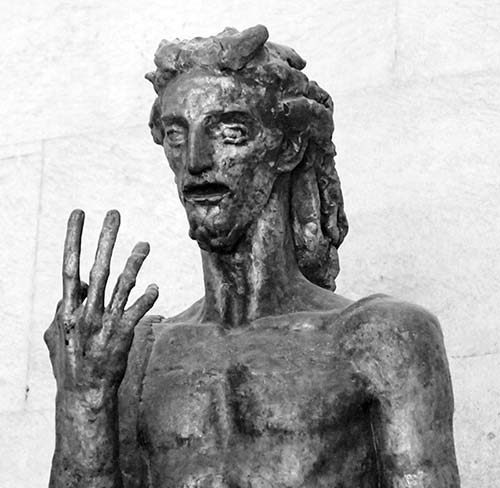
About the time the mausoleum became a cathedral, this temple was converted into a baptistery (covered by some of the cathedral tickets, same hours). Inside, the big 12th-century baptismal font—large enough to immerse someone (as was the tradition in those days)—is decorated with the intricate, traditional woven-rope pleter design that evokes Croatia’s nautical heritage. Observant travelers will see examples of this motif all over the country. On the font, notice the engraving: a bishop (on the left) and the king on his throne (on the right). Literally under the feet of the bishop is a submissive commoner—neatly summing up the social structure of the Middle Ages. Standing above the font is a statue of St. John the Baptist counting to four, by the great Croatian sculptor Ivan Meštrović (see here). The half-barrel-vaulted ceiling, completed later, is considered the best preserved of its kind anywhere. Every face and each patterned box is different.
• Back at the Peristyle, stand in front of the TI/chapel with your back to the square. The small street just beyond the chapel (going left to right) connects the east and west gates. If you’ve had enough Roman history, head right (east) to go through the Silver Gate and find Split’s busy, open-air Green Market. Or head to the left (west), which takes you to the Iron Gate and People’s Square (see “Other Sights in Split,” later) and, beyond that, the fresh-and-smelly fish market. But if you want to see one last bit of Roman history, continue straight ahead up the...
Cardo
A traditional Roman street plan has two roads: Cardo (the north-south axis) and Decumanus (the east-west axis). Split’s Cardo street was the most important in Diocletian’s Palace, connecting the main entry with the heart of the complex. As you walk, you’ll pass several noteworthy sights: in the first building on the right, a bank with modern computer gear all around its exposed Roman ruins (look through window); at the first gateway on the left, the courtyard of a Venetian merchant’s palace (a reminder that Split was dominated by Venice from the 15th century until Napoleon); farther along on the right, an alley to the City Museum (likely closed through 2023 and described later, under “Other Sights in Split”); and, beyond that on the right, Nadalina, an artisan chocolatier selling mostly dark chocolate creations with some innovative Dalmatian flavors—such as dried fig and prosecco.
At the end of the street, just before the Golden Gate, detour a few steps to the left along covered Majstora Jurja street, lively both day and night. Near the start of this street, just after its initial jog, about 40 stone stairs climb to the minuscule St. Martin’s Chapel, burrowed into the city wall. Dating from the fifth century, this is one of the earliest Christian chapels anywhere. St. Martin is the patron saint of soldiers, and the chapel was built for the troops who guarded this gate, though it’s now run by Dominican nuns (€1, daily 9:00-12:00 & 13:00-17:00).
• Backtrack to the main drag and go inside the huge...
Golden Gate (Zlatna Vrata)
This great gate was the main entry of Diocletian’s Palace. Its name wasn’t literal—rather, the “gold” suggests the importance of this gateway to Salona, the Roman provincial capital at the time. Standing inside the gate itself, you can appreciate the double-door design that kept the palace safe. Also notice how this ancient building has been repurposed: Above, on the outer wall, you can see the bricked-in windows that contain part of a Dominican convent. And at the top of the inner wall is somebody’s garden terrace.
Go outside the gate and look back at the fortification. This mostly uncluttered facade helps you visualize how the palace looked before so many other buildings were grafted on. Four miles straight ahead as you exit this gate was Salona, which was a major city of 60,000 (and Diocletian’s hometown) before there was a Split.
The big statue that appears to be taking a selfie at the top of the stairs, facing the gate, is Bishop Gregory of Nin, a 10th-century Croatian priest who tried to convince the Vatican to allow sermons during Mass to be said in Croatian, rather than Latin. This dynamic statue is another one by Ivan Meštrović, the local sculptor who peppered this country with monuments to great Croatians. People rub Gregory’s toe for good luck (though only nonmaterial wishes are given serious consideration).
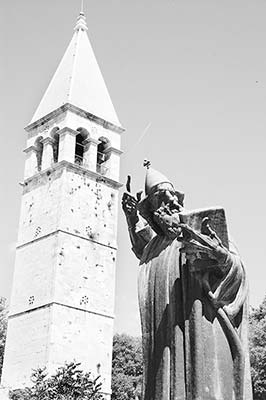
• Your tour is finished. Beyond the statue, you’ll find Split’s Gallery of Fine Arts and the Diocletian’s Dream virtual-reality show (both described later). Most of the other sights are behind you, in the Old Town.
Other Sights in Split
▲▲▲The Riva
▲People’s Square (Narodni Trg)
Radić Brothers Square (Trg Braće Radića)
Ethnographic Museum (Etnografski Muzej)
Split City Museum (Muzej Grada Splita)
Split Gallery of Fine Arts (Galerija Umjetnina Split)
Archaeological Museum (Arheološki Muzej)
IVAN MEŠTROVIĆ SIGHTS, WEST OF THE OLD TOWN
▲▲Meštrović Gallery (Galerija Meštrović)
OLD TOWN PUBLIC SPACES
My self-guided walk took you through Diocletian’s Palace, which doubles as the heart of Split. But just a few steps away are some more delightful public zones that are worth exploring.
▲▲▲The Riva
The official name for this seaside pedestrian drag is the “Croatian National Revival Embankment” (Obala Hrvatskog Narodnog Preporoda)—but locals just call it the Riva (REE-vah, Italian for “harbor”). This is the town’s promenade, an integral part of Mediterranean culture. After dinner, Split residents collect their families and friends for a stroll on the Riva. It offers some of the best people-watching in Croatia; make it a point to be here for an hour or two in the evening. The stinky smell that sometimes accompanies the stroll (especially at the west end) is a reminder that the town’s medicinal sulfur spas have attracted people here since the days of Diocletian.
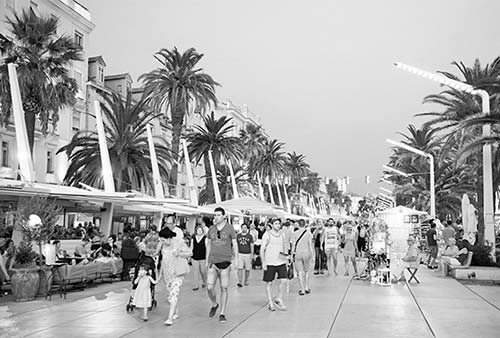
At the west end of the Riva, the people-parade of Croatian culture turns right and heads away from the water, up Marmontova. Although it lacks the seafront cachet, this drag is equally enjoyable and feels more local. As you walk up Marmontova, on the left is the plain-Jane outer facade of the arcade that defines Trg Republike, a grand and genteel Napoleonic-era square. Duck through the passage across from the fish market to bask in its “poor man’s St. Mark’s Square” ambience, and maybe to linger over a drink at the recommended Bajamonti café. A bit farther up Marmontova, on the right, look for the whimsical fountain nicknamed “The Teacup,” with a hand sporadically squirting water across the sidewalk into a funnel.
At the top of Marmontova are some department stores, a lively café square, and the Croatian National Theater (Hrvatsko Narodno Kazalište, HNK). If you head up the little passage between the theater and the modern church, you’ll discover an entirely different—and fully local—convivial meeting and eating scene, in the “Behind the Theater” neighborhood.
▲People’s Square (Narodni Trg)
Locals call this lively square at the center of the Old Town “Pjaca,” pronounced the same as the Italian piazza. Stand in the center and enjoy the bustle. When Diocletian lived in his palace, a Roman village popped up here, just outside the wall. By the 14th century, a medieval town had developed, making this the main square of Split.
The square has some quirky decorative flourishes. On the wall just to the right of the lane leading to the Peristyle, look for the life-size relief of St. Anthony. Notice the creepy “mini-me” clutching the saint’s left leg—depicting the sculptor’s donor, who didn’t want his gift to be forgotten. Above this strange statue, notice the smaller, faded relief of a man and a woman arguing.
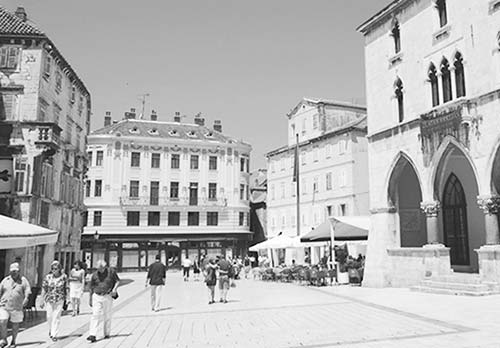
Turn around and face the square. On your left is the city’s grand old café, Gradska Kavana, which has been a venerable meeting point for generations. Today it’s both a café and a restaurant, with disappointing food but some of the best outdoor ambience in town. (The food at nearby Bepa is better—see “Eating in Split,” later.)
Across the square, the white building with the three pointed arches was once the City Hall, and now houses temporary exhibitions. The loggia is all that remains of the original Gothic building.
At the far end of the square is the out-of-place Nakić House, built in the early-20th-century Viennese Secession style—a reminder that Dalmatia was part of the Habsburg Empire, and ruled by Vienna, from Napoleon’s downfall through World War I.
The lane on the right side of the Nakić House leads to Split’s fish market (Ribarnica), where you can see piles of the still-wriggling catch of the day. Why no flies? It’s thanks to the sulfur spring in the nearby spa building (with the gray statues, on the corner). Just beyond the fish market is the pedestrian boulevard, Marmontova (described earlier).
Radić Brothers Square (Trg Braće Radića)
This little piazza hides just off the Riva, between the two halves of Split’s historic core. Overhead on the water side of the square is a Venetian citadel. After Split became part of the Venetian Republic, there was a serious danger of attack by the Ottomans, so octagonal towers like this were built all along the coast. But this imposing tower had a second purpose: to discourage citizens of Split from thinking about rebellion. At its base is a juice bar, invoking the more popular nickname of the square—Voćni Trg (Fruit Square), for the produce that was once sold here.
In the middle of the square is a studious sculpture by Ivan Meštrović of the 16th-century poet Marko Marulić, who is considered the father of Croatian literature. Marulić was the first to publish poetry in the Croatian vernacular, which before then had generally been considered a backward peasants’ tongue.
▲Green Market
This lively open-air market bustles at the east end of Diocletian’s Palace. Its placement is logical: Historically, this was where the main road entered Split from the countryside (whereas the fish market, at the opposite end of town, faces the Matejuška fishermen’s port). Most vendors set up in the early morning, then stick around until 12:00 or 13:00; a few stay open later but raise their prices.
The market is big, sprawling, and surprisingly easy for a tourist to miss. It’s ringed by souvenir and clothing stands, as if to camouflage the intensely local produce market. Be sure to delve in to find the long tables piled high with grapes, figs, greens (especially blitva, Croatia’s version of Swiss chard), veggies, and so on. Explore the area, and you’ll find flower stands, dried fruits and nuts (handy to pick up a snack), air-cured ham and local cheeses (good for a picnic), jars of pickled vegetables, honey, butchers, and more. A few simple eateries serve up hot roasted meat. Look for the gigantic wheels of dense, chewy bread cooked under a peka (copper baking dish), which stay fresh for a few days (buy a wedge for your picnic).
Matejuška Fishermen’s Port
While Split’s harborfront Riva is where the beautiful people stroll, the city’s fishermen roots still thrive just to the west. The neighborhood called Matejuška—at the little harbor where the Varoš district hits the water (a five-minute walk beyond the end of the Riva, with the water on your left)—has long been Split’s working fishermen’s harbor. The enclosed harbor area is filled with working fishing boats and colorful dinghies that bob in unison. Along the breakwater, notice the fishermen’s lockers, where people who earn their living from the Adriatic still keep their supplies. You’ll see the most fishing action here in the mornings.
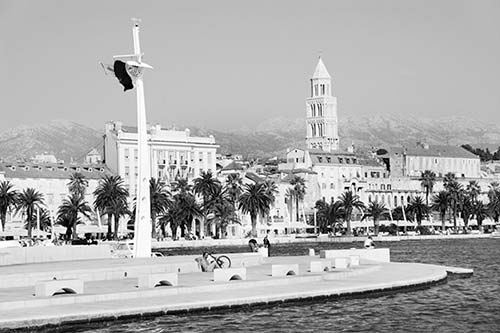
The far side of the breakwater—all glitzy white marble—is another world, with a pebbly beach, an attractive plaza, and some of the best views looking back on the Riva. This jetty is a popular after-hours hangout for young people. Like Split itself, this is a place where two worlds coexist: the grizzled fishermen mending their nets, and the teenagers laughing and flirting.
Beyond Matejuška, the harborfront embankment (which runs toward the Marjan peninsula) has also been rejuvenated and is now spiffed up with cafés facing moored sailboats, creating a relaxing, scenic, largely tourist-free zone. The boxy, sleek, modern building is the top-end Hotel Ambassador. (Ignore the eyesore of an abandoned skyscraper looming in the distance like a tombstone. Corruption and intrigue swirl around this prime real estate—formerly the Hotel Marjan—which is the biggest political hot potato in town.)
MUSEUMS AND OTHER SIGHTS
Ethnographic Museum (Etnografski Muzej)
This museum shows off the culture, costumes, furniture, tools, jewelry, weapons, and paintings of Dalmatia, all with good English explanations. The modest but vibrant collection, with a confusing treehouse floor plan, is displayed in an early medieval palace (parts of which once formed the private residential halls of Diocletian). You’ll find it in the upper level of the Old Town, behind Diocletian’s entry vestibule.
Cost and Hours: €3; Mon-Sat 9:30-19:00, Sun 10:00-14:00; Nov-April Mon-Fri 10:00-15:00, Sat until 14:00, closed Sun; Severova 7, +385 21 344 164, www.etnografski-muzej-split.hr.
Visiting the Museum: At the entrance to the courtyard, check out the artsy “golden fleece” gate. The ground floor sports the remains of a seventh-century church, with temporary exhibits. Exploring the rest of the museum, have a look at the old photographs—evocatively preserving now-vanished customs—and an array of traditional folk dress. Your ticket also includes access to the roof of the vestibule (find the stairs outside at the far end of the museum); while it’s not high enough to be thrilling, it provides a nice view over the rooftops of Split, and you can peer into the top of the vestibule.
Split City Museum (Muzej Grada Splita)
This museum—which has been closed for renovation but may reopen in time for your trip—traces how the city grew over the centuries, helping you better appreciate the layers of history you’re seeing in the streets.
Cost and Hours: Check www.mgst.net for the latest on cost and hours; Papalićeva 1, +385 21 360 171.
Visiting the Museum: The exhibit is organized into chronological sections. The Roman collection includes coins from the days of Diocletian and a model of the Peristyle during his time. But the highlight of this section—and the whole museum—is a semicircular marble table (called a “mensa”) that was actually used by the Romans. As depicted in Hollywood movies, the Romans ate lying down (multiple people would lounge and feast, while servants dished things up from the straight side). This table has been painstakingly reconstructed from shards and splinters discovered in the cellars. The Middle Ages section features a beautifully restored Gothic ballroom, medieval weapons, and a terrace displaying carved stone monuments.
The 15th-century Papalić Palace, which houses the City Museum, is a sight all its own. At the end of the palace, near Cardo street, look up to see several typical Venetian-style Gothic-Renaissance windows. The stone posts sticking out of the wall next to them were used to hang curtains.
Emanuel Vidović Gallery
This small, somber museum celebrates the work of Split native Emanuel Vidović (1870-1953), who gained fame as a Post-Impressionist painter. Located just a few steps off the Peristyle, it’s an easy opportunity to get to know an unfamiliar but locally respected artist.
Cost and Hours: €4, Mon-Fri 9:00-20:00, Sat until 14:00, closed Sun, shorter hours off-season, Poljana Kraljice Jelene bb, +385 21 360 155, www.galerija-vidovic.com.
Visiting the Museum: Buy your ticket and head upstairs to the first floor, where you’ll see the reconstruction of Vidović’s cluttered studio, filled with objects he created or that inspired him. Elsewhere on the first floor—and upstairs—hang many of his works: hazy, Turner-esque landscapes; church interiors; shimmering street and village scenes from Split and around Dalmatia; and paintings of bizarre dolls. Pause on the top floor to watch an informative video about the artist’s life.
Split Synagogue
The tiny, modest synagogue of Split is hidden down a small side street, not coincidentally located just outside the walls of Diocletian’s Palace. Dating from 1510, this is said to be the third-oldest practicing synagogue in Europe (after ones in Prague and Dubrovnik). Ring the bell and climb the stairs to step into the unassuming, lived-in religious home of Split’s Sephardic Jewish community, which numbered around 300 before the Holocaust. (About 2,000 Jews live in today’s Croatia, three-quarters of them in Zagreb and about a hundred here in Split. A rabbi visits from Zagreb a few times each year, and there’s a cultural center downstairs.) On the table in front of the ark, look for a replica of a little clay oil lamp that was used to light the menorah. This was discovered in the ruins of ancient Salona, indicating that the Jewish presence here goes back to Roman times.
Cost and Hours: Free but donations requested, loaner yarmulkes; Mon-Fri 10:00-14:00, closed Sat-Sun; go down the small passage off Bosanska street near People’s Square to Židovski Prolaz 1; +385 21 345 672, www.zost.hr.
Split Gallery of Fine Arts (Galerija Umjetnina Split)
This collection, beautifully displayed in a finely restored old hospital just behind Diocletian’s Palace, features mostly Croatian artwork from the 14th to the 21st century. Although it’s a hodgepodge with few famous works, it provides a nice overview of Croatian artists—heavy on the 20th century and most interesting to art lovers. Cross through the courtyard, climb up the stairs, and follow the one-way route through the chronologically displayed collection.
Cost and Hours: €6, more for special exhibits, Tue-Sun 10:00-18:00, Thu until 21:00, shorter hours off-season, closed Mon, café, go straight out the Golden Gate and a bit to the left—behind the statue of Gregory of Nin—to Kralja Tomislava 15, +385 21 350 110, www.galum.hr.
Diocletian’s Dream
This attraction offers a 15-minute virtual reality visit to Diocletian’s Palace in the days of the emperor. You’ll sit on a bench and strap in to a headset that gives you a 360-degree view as Roman Split is resurrected. Fun for kids, interesting for adults, and rooted in real historical research, this can add a new dimension to your visit...though the price is steep.
Cost and Hours: €12 or €8 for children, daily 10:00-20:00, shorter hours Oct-May, a block behind the Golden Gate at the back of the Old Town through the park at Zagrebačka 1, +385 2126 3040, www.diocletiansdream.com.
Archaeological Museum (Arheološki Muzej)
If you’re intrigued by all the big stuff from Split’s past (buildings and ruins), consider paying a visit to this collection of its little stuff. A good exhibit of artifacts (mostly everyday domestic items) traces this region’s history chronologically, from its Illyrian beginnings through its notable Roman period (items from Split and Salona) to the Middle Ages. About a 10-minute walk north of the Old Town, it’s worth the trip for archaeology fans. Don’t confuse this with the less-interesting Museum of Croatian Archaeological Monuments, on the way to the Ivan Meštrović Gallery.
Cost and Hours: €6; June-Sept Mon-Sat 9:00-14:00 & 16:00-20:00, closed Sun; Oct-May shorter hours on Sat, closed Sun; Zrinsko Frankopanska 25, +385 21 329 340, www.mdc.hr/split-arheoloski/eng/index.html.
Skippable Sights
Split has a couple of high-profile amusements that are overpriced, tacky, and best avoided. One of them, the (in-no-way-official) “Game of Thrones Museum,” is an assortment of replica props and costumes (and a few originals) from the TV show, plus dioramas of pivotal scenes. It might be fun for superfans, but the ticket is outlandishly overpriced. As for Froggyland, it’s an inexplicably popular exhibit of hundreds upon hundreds of taxidermied frogs in a variety of poses and settings. The heavy advertising may make you curious whether it’s worthwhile, so...now you know.
IVAN MEŠTROVIĆ SIGHTS, WEST OF THE OLD TOWN
The Meštrović Gallery and nearby Kaštelet Chapel are just outside the Old Town. Both sights are covered by the same ticket and have the same hours.
Cost and Hours: €7; May-Sept Tue-Sun 9:00-19:00; Oct-April Tue-Sat 9:00-16:00, Sun until 15:00; closed Mon year-round; +385 21 340 800, www.mestrovic.hr.
Getting There: Both sights are located along Šetalište Ivana Meštrovića. You can take bus #12 from the little cul-de-sac at the west end of the Riva (departs 1-2/hour, schedule posted in the blue shelter; get off at the Galerija Meštrović stop in front of the gallery, just after your bus passes a museum prominently marked Muzej Hrvatskih Arheoloških Spomenika). You can also walk (about 30 minutes from the center): Follow the harbor west of town toward the big marina, swing right with the road, and follow the park until you see the gallery on your right (at #46). A taxi or Uber from the west end of the Old Town to the gallery costs about €6-8 (much more from the east end of the Old Town).
To reach the chapel, it’s a five-minute walk past the gallery down Šetalište Ivana Meštrovića to #39 (on the left, in an olive grove).
Visitor Information: At the information desk, confirm the departure time for the return bus and ask for the brochure explaining the Kaštelet Chapel (which may not be available once you get there).
▲▲Meštrović Gallery (Galerija Meštrović)
Split’s best art museum is dedicated to the sculptor Ivan Meštrović, the most important of all Croatian artists. Many of Meštrović’s finest works are housed in this palace, designed by the sculptor himself to serve as his residence, studio, and exhibition space. If you have time, it’s well worth the trek.
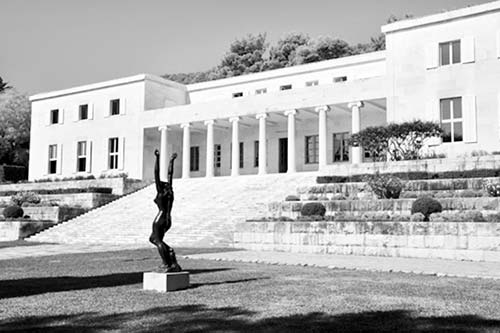
Visiting the Gallery: Each work is labeled, but there’s very little description otherwise (and the guidebook is overkill for most visitors).
The following tour will help you navigate the highlights. Before you begin, read the sidebar for background on Meštrović’s life; while the collection is presented thematically rather than chronologically, knowing the artist’s journey will help you make sense of what you’ll see.
From the ticket office, climb the stairs toward Meštrović’s house, pausing in the garden to admire a smattering of sculptures. On the right, see Persephone reaching skyward for freedom—an idea that came to Meštrović while he was imprisoned by the Ustaše in World War II. Beyond her, you’ll see Cyclops struggling to hurl a giant shot put, in keeping with Meštrović’s theme of the struggles of great men. Tucked behind the trees nearby is an eagle, which was a study for Lovćen, the mountaintop mausoleum of the Montenegrin king Petar II Petrović-Njegoš (see here). To the left as you face the building is a statue of a woman playing a lute, and reliefs of women playing a lute and harp flank the door of the villa. Much as he enjoyed depicting the travails of men, Meštrović also often sculpted women serenely engaging in music.
Go up another set of stairs to reach the Entrance Hall. The sculptures here evoke some of Michelangelo’s nudes and were fittingly carved from that great sculptor’s favorite medium: Carrara marble. The head of a woman glancing pensively out a window is Meštrović’s second wife, Olga, who was one of his favorite models. Notice the smaller black sculptures by the two staircases: on the left, representing birth, and on the right, representing death (a classic pietà pose). Meštrović strove to capture the full range of human experience in his work.
Go to the left to find a pyramid of maternal love called Madonna and Children. While the woman is clearly garbed in the head scarf of the Virgin Mary, she cradles not one but two children; these are Olga and Meštrović’s first two kids.
Now enter the Dining Room at the end of the main floor. This is the most intimate space in the villa—the only room that still feels even a little bit lived-in. It’s decorated with more sculptures of Meštrović and his family. Go straight ahead to the windows, then do a clockwise loop around the room. First look for the two busts on the cabinets flanking the central window: a self-portrait of Meštrović, and a woman in a traditional Dalmatian head scarf—this is Meštrović’s mother, another one of his favorite models. At the fireplace, notice that the two giant caryatids carved from Dalmatian stone (embedded with fragments of seashells) are also clad in this traditional garb. On the wall to the right of the fireplace, you’ll see two painted portraits of Meštrović—one as a young man (by his contemporary, Vlaho Bukovac), and another shortly before his death. Other busts in the room depict Meštrović’s children. A painting of the Last Supper hangs in virtually every Dalmatian dining room, and Meštrović’s is no exception—he painted this version himself, on wood. He also designed the furniture in this room.
Now climb the stairs. On the landing, look for a large bronze relief panel called Artist of My People. The old man and the young boy are linked by the gusle, a traditional Balkan stringed instrument. Here, Meštrović uses the gusle to represent the oral transmission of history (and specifically, the story of the pivotal Battle of Kosovo in 1389—a date etched into the minds of all Yugoslavs, particularly Serbs). Much as Meštrović dresses his women in traditional peasant clothes, he deeply believes in the regeneration of culture and customs over time. Meštrović’s detailed drawings in this room—including some inspired by Dante’s Divine Comedy—are worth a look.
Ivan Meštrović (EE-vahn MESH-troh-veech), who achieved international fame for his talents as a sculptor, was Croatia’s answer to Rodin. You’ll see Meštrović’s works everywhere in the streets, squares, and museums of Croatia.
Meštrović grew up in a family of poor, nomadic farm workers just inland from Split. At an early age, his drawings and wooden carvings showed promise, and a wealthy family took him in and made sure he was properly trained. He eventually went off to school in Vienna, where he fell in with the Secession movement and found fame and fortune. He lived in Prague, Paris, and Switzerland, fully engaged in the flourishing European artistic culture at the turn of the 20th century (he counted Rodin among his friends). After World War I, Meštrović moved back to Croatia and established an atelier, or workshop (now a museum), in Zagreb.
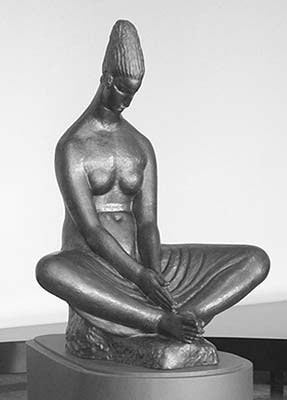
Later in life—like Diocletian before him—Meštrović returned to Split and built a huge seaside mansion (today’s Meštrović Gallery). The years between the World Wars were Meštrović’s happiest and most productive. It was during this time that he sculpted his most internationally famous works, a pair of giant Native American warriors on horseback (The Bowman and The Spearman) in Chicago’s Grant Park. But when World War II broke out, Meštrović—an outspoken supporter of the ideals of a united Yugoslavia—was briefly imprisoned by the anti-Yugoslav Ustaše (Croatia’s Nazi puppet government).
After his release, Meštrović fled to Italy, then to the US, where he lectured at prominent universities, including Notre Dame and Syracuse. (President Eisenhower personally handed Meštrović his new US passport in 1954.) After the war, the Yugoslav dictator Tito invited Meštrović to return, but the very religious artist refused to cooperate with an atheistic regime. (Meštrović was friends with the Archbishop Alojzije Stepinac, who was imprisoned by Tito.) Meštrović died in South Bend, Indiana.
As you view Meštrović’s works, his abundant talent is evident. He worked in wood, plaster, marble, and bronze, and dabbled in painting. Meštrović’s figures typically have long, angular fingers, arms, and legs. Whether whimsical or emotional, Meštrović’s expressive, elongated faces—often with prominent noses—powerfully connect with the viewer.
Here are a few themes you’ll see recurring in Meštrović’s works as you tour his museum:
Religion: Meštrović was a devout Catholic.
Dalmatian Traditions: Meštrović felt a poignant nostalgia for the simple lifestyles and customs of his home region of Drniš, and he used his art to elevate them to be on par with religious and mythological themes. This is most evident in the angular scarves many of his female subjects wear around their heads.
Yugoslav Symbolism: Meštrović was a strong supporter of the first (interwar) incarnation of Yugoslavia. He created sculptures not only in Croatia, but also throughout Yugoslavia, many of them honoring heroes of Yugoslav tradition.
The Secession: Living and studying in Vienna in the early 20th century, Meštrović was exposed to the slinky cultural milieu of the likes of Gustav Klimt.
Struggling Men, Serene Women: While Meštrović frequently sculpted both male and female nudes, they often carry starkly different tones: Meštrović’s ripped men tend to be toiling against an insurmountable challenge; his smooth and supple women are celebrating life, often through the medium of music (dancing, singing, playing instruments, and so on).
Tumult: Meštrović’s life coincided with a time of great turmoil in Europe. He lived through World War I, the creation of the first Yugoslavia, World War II, the postwar/communist Yugoslavia, and the dawn of the Atomic Age in the United States. This 20th-century angst—particularly surrounding his arrest and exile during World War II—comes through in his work.
Meštrović’s works can be found throughout Split, Croatia, and the former Yugoslavia. In Split, in addition to the Meštrović Gallery and Kaštelet Chapel, you’ll find his statues of Marko Marulić, Gregory of Nin, and John the Baptist. Zagreb has another atelier/museum of Meštrović’s works, and the seaside village of Cavtat, just outside Dubrovnik, has one of the sculptor’s most cohesive and poignant works, the Račić Mausoleum. And sitting high above Montenegro is the mountaintop Njegoš monument at Lovćen...just to name a few.
Next, turn right into the Secession Room. Two of the finest works in this room—Little Girl Singing and The Katunarić Family—show the influence of Meštrović’s contemporary, Rodin: smoothed rather than angular features, which make the final product less strictly lifelike, but also more expressive and visually pleasing. Other pieces in this room include several small studies for larger statues, some of which were never completed.
Go back across the landing into the Long Hall, lined with life-size figures and a view terrace. The Vestal Virgin, sitting with her knees apart and feet together, is demonstrating a favorite pose of Meštrović’s. And, once again, we see women finding solace and joy in music: dancing (while playfully tossing her hair), playing a lute, and so on. For contrast, look at the facing wall to see sketches of male nudes. Step out onto the terrace to enjoy the Dalmatian views that inspired the artist.
At the end of the hall—past another small landing with drawings—is the Study Room, filled with miniature sculptures Meštrović created to prepare for larger-scale works: Moses, Prometheus (the figure tied to a rock, to be eaten by birds for eternity), and Cyclops (a large version of which we saw outside). Notice the small study of Job, then go into the small side room to see the much larger final version.
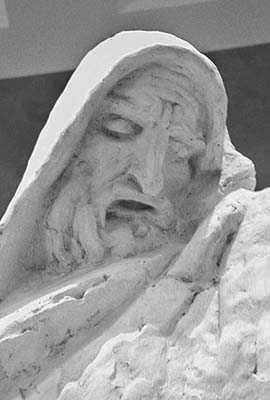
Meštrović carved one of his most powerful works, Job—howling with an agony verging on insanity—while in exile, as his country was turned upside down by World War II. Like Picasso’s Guernica, it’s a silent scream against the inanity of war. The curator has intentionally placed it in a separate room to emphasize the feeling of alienation. Meštrović sketched his inspiration for this piece (displayed on the wall) while he was imprisoned by the Ustaše.
Head down the stairs and make a U-turn left into the Sacral Room. Meštrović was very religious, and here you can see some of his many works depicting biblical figures. The giant, wood-carved Adam and Eve dominate the room. Also notice the wood-carved relief panels of Merry Angels and Grieving Angels. (These are similar to the panels you’ll see at the Kaštelet Chapel down the road.) Smaller statues around the room include four evangelists (Matthew, John, and two Lukes—but no Mark), Moses, a pietà, and bronze and wooden heads of Christ.
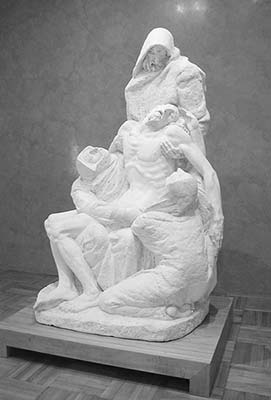
The smaller side room displays another of the gallery’s highlights: the quietly poignant Roman Pietà. Meštrović follows the classical pyramid form, with Joseph of Arimathea (top), Mary (left), and Mary Magdalene (right) surrounding the limp body of Christ. But the harmony is broken by the painful angles of the mourning faces. Also notice how Jesus’ oversized, ruined body drags down those trying to support his dead weight; if he stood up, he’d be towering over all of them. For Meštrović, Christ’s suffering was personal: The women wear those traditional Dalmatian head scarves, the features of Joseph are a self-portrait, and Mary Magdalene is modeled after Meštrović’s daughter Marija. This sculpture is plaster; there’s a bronze version at the Vatican and a marble one on the campus of the University of Notre Dame in the US. On the wall are several studies—both drawings and sculptures—for this masterwork.
To Kaštelet Chapel: To reach the last part of the Meštrović experience, head down the stairs to the road, cross the street, turn right, and walk about five minutes with the water on your left. (En route, you’ll pass above the enticing Ježinac beach—enjoy the views.) You’ll see the low-profile entrance to the chapel on the left, through a doorway marked 39, in an olive grove.
▲▲Kaštelet Chapel
If you’re enjoying Meštrović’s works, don’t miss the nearby Kaštelet Chapel (“Chapel of the Holy Cross”), which brings a new dimension to his oeuvre. Meštrović bought this 16th-century fortified palace to display his 28 wood reliefs of Jesus’ life.
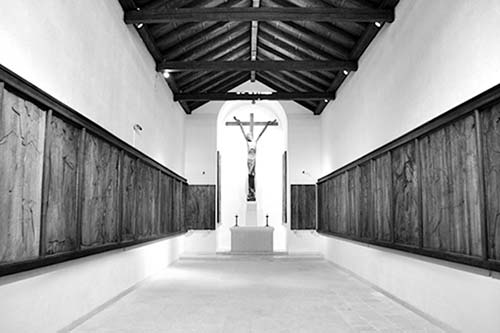
You can see how Meštrović’s style changed over time, as he carved these over a nearly 30-year span, completing the last 12 when he was in the US. (However, he didn’t carve the reliefs in chronological order; the gallery’s ticket office has a booklet dating each one.) Whereas the earlier pieces are carefully composed and powerful, the later ones seem more hastily done, as Meštrović rushed to complete his opus. He started with the crucifix in 1916. His last two panels, completed in 1953, are on the right as you face the crucifix (the second one, showing the Deposition; and the fourth, showing the Last Supper).
From the door, do a slow, clockwise loop around the room, tracing the life of Christ. Notice that some of the Passion scenes are out of order (a side effect of Meštrović’s nonlinear schedule). The beautiful pietà back near the entrance still shows some of the original surface of the wood, demonstrating the skill required to create depth and emotion in just a few inches of medium. Dominating the chapel is an extremely powerful wooden crucifix, with Christ’s emaciated arms, legs, fingers, and toes bent at unnatural angles—a typically expressionistic flair Meštrović used to exaggerate suffering.
The building’s courtyard displays a sculpture of John the Evangelist, and a small door leads out to a walkway with a view over the sea.
Activities in Split
▲Hiking the Marjan Peninsula
This huge, hilly, and relatively undeveloped spit of parkland feels like a chunk of Dalmatian island wilderness, a stone’s throw from the big city. With out-of-the-way beaches and miles of hiking trails, the Marjan (MAR-yahn) peninsula is where residents go to relax. Most locals have their favorite hidden paths and beach coves, so ask around for tips.
From the Varoš neighborhood at the west end of the Old Town, you can hike to various lookout points. If you’re in shape, figure about an hour to hike to the top viewpoint, then another 45 minutes back down.
Start by climbing the stairs past the recommended Šperun Restaurant, and continue straight up Senjska Ulica. Follow the stairs all the way up for 15 steep minutes to reach a spectacular view terrace (with sweeping vistas over Split), next to a little café/eatery.
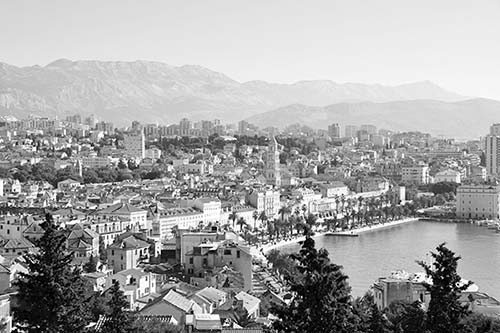
These are the best views of the Old Town, though if you like, you can keep ascending for different views: Curl around past the café and follow the steep pathway up to the small chapel of St. Nicholas. From the chapel, more stairs continue higher to a broad path that cuts through the woods; for the highest viewpoint, follow the steps to the terrace. This top-of-the-world perch offers a 360-degree panorama of Split’s urban sprawl, receding layers of jagged and majestic mountains, offshore islands, and the bay behind the Marjan peninsula.
From the top, either head back down the way you came, or—to extend your hike—continue down the stairs at the far end of the view terrace. A path takes you along the length of the peninsula, mostly through trees (read: no views). A series of switchbacks leads you back down to the main road running along the perimeter of Marjan; from here, you can turn left to get back to town, or right for an even longer walk around the far end of Marjan.
The peninsula also has some good beaches for a post-hike dip (described next).
Hitting the Beach
Since it’s more of a big city than a resort, Split’s beaches are less scenic (and less peaceful) than small towns elsewhere along the coast. I’d use my Split time for city sights and culture. However, if the weather’s great and you want to go for a dip, here are a few ideas.
East of the Old Town: The most popular, most crowded beach is Bačvice, in a pebbly cove just a short walk east of the main ferry terminal. As it’s very shallow, it’s often unpleasantly jammed with kids. After dark, it becomes a hopping meat-market nightlife zone for older “kids.” Less crowded beaches lie just to the east of Bačvice. Each cove has its own little swimming zone; the fourth cove over, called Trstenik, is perhaps the most inviting. A pebbly beach—with free access—flanks the big deck in front of the Radisson Blu Resort, where you can rent a chair, buy a drink at the bar, and use the showers.
West of the Old Town (on Marjan Peninsula): Marjan, the peninsular city park, is ringed with several sunbathing beaches. Along the southern edge of Marjan, and reachable on bus #12, are a couple of good options. First, just below the Meštrović Gallery is a rocky but more local-feeling and less crowded beach called Ježinac (Croatian for “sea urchin”...be sure to wear water shoes; this is also called Obojena Svjetla). Beyond that is Kašjuni, also known as Joe’s Beach for the touristy beach bar that dominates it. This long, skinny, peninsular beach is angled to receive maximum sun late in the day.
Another popular choice, Bene Beach, is even farther out, along the northern edge of Marjan—so it offers more shade. You can get to Bene Beach by bus #12, bike, or foot (about a 45-minute walk from the Old Town).
Boat Excursions
Various companies offer boat excursions that link offshore beaches, coves, and swimming spots. Tour boats line up along the Riva each morning and evening, hawking trips to nearby islands that are in vogue with the Instagram crowd. Well-regarded operators include Blue Travel, which uses speed boats (www.boattourssplit.com), and Korsaro, which uses an old-fashioned “pirate” boat with glass-bottom panels (www.korsaroboat.tours).
Popular tours include the following:
The Blue Cave (or Blue Grotto), on the little island of Biševo, is a natural sea grotto with shimmering colors (like the famous Blue Grotto on Capri) that can be entered only on a small motorboat. You’ll be taken ashore (at a beach bar) to buy your ticket and wait your turn to head into the grotto. (Note that entering the Blue Cave depends on tides and weather and can be impossible when conditions aren’t right.) The Blue Cave is usually bundled with several other nearby stops: snorkeling at the isolated Stiniva Bay on Vis Island; seeing the Green Cave, a larger, less impressive, but easy-to-visit craggy sea grotto, also on Vis Island; the turquoise lagoon of Budikovac Bay on the island of the same name; and time ashore at Palmižana on the Pakleni Islands and/or Hvar Town (these last two are described in the Hvar chapter). These tours are often billed as something like “Five Islands Tour” (depending on how many of these stops they make).
The Blue Lagoon is a shallow, gorgeously colorful bathing area between the island of Drvenik Veli and the tiny offshore islet Krknjaši. Tours to the Blue Lagoon—often described as a “Three Islands Tour”—may stop at the village of Maslinica (on the island of Šolta) and in a bay on Šolta called Nečujam, where you can snorkel down to see a shipwreck called the Kontesa.
Zlatni Rat (“Golden Cape” or “Golden Horn”) is just outside the town of Bol on the island of Brač. This long, pointy, sandy beach is a postcard-famous place to sunbathe or go for a swim. You can take a boat excursion here from Split, but in the summer it’s straightforward to do on your own by public catamaran to Bol (operated by Krilo Shipping Company, www.ksc.hr). From Bol, you can take a taxi or walk about 20-30 minutes to the beach.
Aside from these standard side trips, there are a few more interesting or adventurous alternatives—from jet-ski tours (www.jetskisafarisplit.com) to the Summer Blues catamaran “sail ‘n’ swim” cruises with swimming stops, dancing, food, and lots of drinks (www.summer-blues.com). Various companies also offer kayaking tours.
Bus Excursions
Popular land-based excursions include the town of Trogir, the Roman ruins of Solin (ancient Salona), whitewater rafting on the Cetina River, the pilgrimage site at Međugorje, Dubrovnik, and the waterfalls at Krka National Park or Plitvice Lakes National Park. As these can sell out (and many leave quite early in the day), it’s best to book at least a day or two before.
Nightlife in Split
The Riva
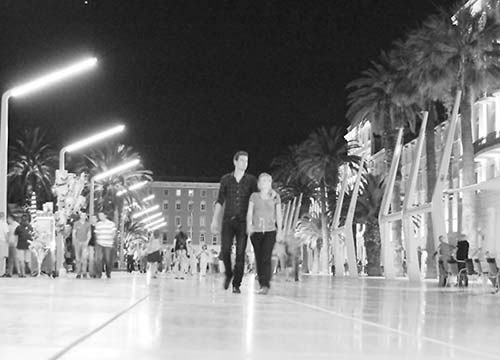
Every night, a flood of humanity laps against the walls of Diocletian’s Palace along the town’s pedestrian promenade. The Riva is something that makes Split special: It is one of Europe’s great public spaces, threaded between Roman ruins and the sea. Find somewhere to sit and watch life go by, ideally over a drink at one of the many outdoor cafés (which are basically interchangeable—just pick one that looks good). Live music enlivens the Riva nightly through the summer.
Old Town Bars
The labyrinthine lanes of the Old Town are packed with al fresco bars and cafés featuring pleasant tables crammed between ancient stone buildings under a starry Croatian sky. Even if you’re not interested in drinking, make it a point to wander some of these areas after dark just to people-watch and take in the hubbub in these otherwise hidden pockets. Prices and menus are similar at most places (beer, wine, cocktails, coffee drinks); ordering something simply gives you an excuse to sit in a gorgeous outdoor space, nurse a drink, and focus on your travel partner. The action at these places really gets rolling around 22:00 and peaks around 23:00 or 24:00. Bars are supposed to close their outdoor seating areas at 2:00.
On the Peristyle: The obvious choice, particularly for the not-so-young set, is right on the main square of the Old Town, Diocletian’s former entry hall. All day long, the Peristyle steps serve as makeshift café tables for the bar called Luxor, with red cushions and small tables scattered along the steps. If you sit on a cushion, you’re expected to order a drink (but you can sit or stand elsewhere for free). In the evening—as twilight encroaches and floodlights transform the square into one of the most atmospheric public spaces in Europe—live music breaks out (generally starting between 20:00 and 21:00 and continuing until around midnight). The smooth marble tiles of the Peristyle—worn to a slippery sheen by two millennia of visitors—becomes a dance floor, as people salsa, foxtrot, or pop-and-lock their way around the majestic space. Where else can you cut a rug in the grand entry hall of a Roman palace?
“Slavija Square”: This is my own nickname for the tight, stepped area that’s squeezed in front of Hotel Slavija, near Radić Brothers Square (Trg Braće Radića; from the square’s statue of Marulić, enter the Old Town and bear right, following the beat). This area is more youthful, with throbbing techno music and cocktails that flow freely. As you approach this area, you’ll see the outdoor patio for Aquarelle Bistro; go up the narrow lane along the left side of this area, climbing the stairs and looping around to the right. Near the top of the stairs are tables for Leopold’s Craft Beer Bar. Just around the corner is one of Split’s funkiest nightspots (in the enclosed courtyard on the right), Ghetto, sporting a sailors’ bordello-theme interior, with heart-shaped chairs, red velvet, and vivid graffiti.
Behind the Loggia: For the youngest, trendiest action, head for the zone locals call Iza Lođa (Behind the Loggia). From the grand People’s Square, follow the beat behind the former City Hall. Here you’ll find a pair of restaurants (Gaga and the nautical-themed La Linea—which locals call simply “Taverna”), with lively outdoor seating tucked just off the busy square.
Other Areas: Along the north edge of Diocletian’s Palace, Majstora Jurja street (just inside the wall) is lined with a mellow gaggle of youthful hangouts. Some mood music plays, but the soundtrack here is mostly chatting, laughing, and flirting.
Clubbing at Bačvice Beach
This family-friendly beach by day becomes a throbbing party area for young locals late at night. Since all Old Town bars have to close by 2:00 in the morning, night owls hike on over to the Bačvice crescent of clubs. The three-floor club complex is a cacophony of music, with the beat of one club melting into the next—all with breezy terraces overlooking the harbor.
Sleeping in Split
Accommodations in and near Split’s Old Town have proliferated like crazy over the past few years—and most are aimed at a wealthy clientele. I’ve listed a few good splurges, and some old-school sobe for those on a tighter budget. Split also has a longer season than most places in coastal Croatia (it’s busy from late April all the way through October), extending the period when accommodations are priced at a premium. Given the fast-changing scene and the high prices, checking Airbnb or other property-rental sites can turn up some good alternatives.
Split suffers from perhaps the worst nighttime noise of any destination in this book—bring earplugs, and always ask for a quiet room (if possible).
Many less-expensive Split accommodations, especially outside the Old Town, don’t offer breakfast. But just about every café and restaurant in town (including most of my recommendations) sells breakfast; figure around €5 for a basic continental breakfast (croissant, juice, coffee) or €12 for a heartier one (with eggs—Hotel Peristil’s terrace, open even to nonguests, is a nice spot for this).
INSIDE THE OLD TOWN
While the Old Town is convenient and atmospheric, it’s also a happening nightlife zone, so you’re likely to encounter some noise (especially on weekends). Consider my higher-priced listings in this expensive district only if money is truly no object; those on a budget should give the sobe and apartments a careful look.
$$$$ Palača Judita enjoys an ideal location—right on the appealing People’s Square, in the heart of town—but it has good windows (to block out most of the noise) and attentive service; Andrija and Marija take great care of their guests. Its 19 lovely rooms are housed in a 16th-century Renaissance palace (includes breakfast, air-con, lots of stairs to the entrance but an elevator goes to the rooms, free porter service—call to be picked up on arrival in Split, Narodni Trg 4, +385 21 420 220, www.juditapalace.com, booking@juditapalace.com).
$$$$ Marmont Hotel is a sophisticated oasis offering four-star comfort, with 21 top-end rooms in a quiet corner of the Old Town. The slight aroma you may notice is from the fish market, just around the corner (includes breakfast, air-con, elevator, spa terrace, Zadarska 13, +385 21 308 060, www.dlhv.hr, marmont@dlhv.hr).
$$$$ Cornaro Hotel is a well-polished, five-star, business-class hotel. Its 156 rooms sprawl through a huge building just north of the Old Town walls, with generous public areas and a wonderful sixth-floor view bar terrace that’s open to nonguests. This is a good pick for drivers who want big-hotel comforts, but very close to the action (includes breakfast, air-con, elevator, pay parking, small rooftop pool and wellness center, entrances at Sinjska 6 and Kralja Tomislava 9, +385 21 644 200, www.cornarohotel.com, booking@cornarohotel.com).
$$$ Palace Suites, a boutique hotel right on the lovely People’s Square, has 14 rooms with stone walls, mahogany floors, and contemporary furnishings. There’s a rare elevator, and the prices are reasonable for this location and level of comfort (includes breakfast, air-con, Narodni Trg 13, +385 21 339 040, mobile +385 91 444 4065, http://palacesuites-split.com, info@palacesuites-split.com).
$$$ Hotel Peristil, a lesser value at the top of this price range, has 12 classy rooms over a restaurant. It’s wonderfully situated just steps from the couldn’t-be-more-central square of the same name, and some of the rooms have a view of the cathedral. Run by the Caktaš family, it’s homey and convenient (includes breakfast, air-con, stairs with no elevator, some noise from nearby bars, just behind TI and inside the Silver Gate at Poljana Kraljice Jelene 5, +385 21 329 070, www.hotelperistil.com, booking@hotelperistil.com).
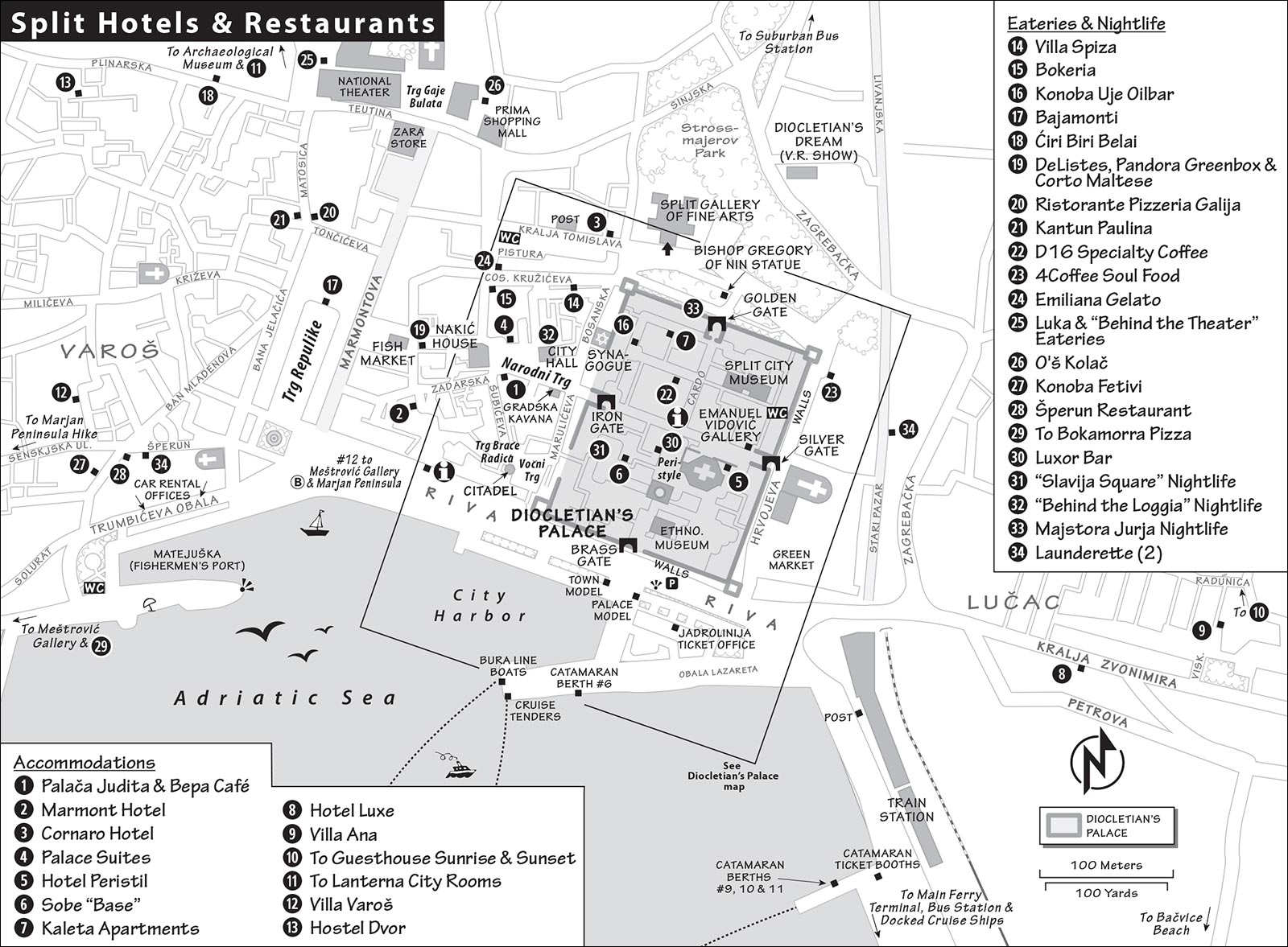
$$ Sobe “Base” faces a hallway from Diocletian’s Palace, with moderately priced accommodations. All three rooms overlook the front steps of the cute little Jupiter’s Temple. Although this place is in the midst of some bustling bar action, the double-paned windows provide reasonable peace (no breakfast, clearly communicate your arrival time if arriving early or late, air-con, Kraj Svetog Ivana 3, +385 21 317 375, mobile +385 98 361 387, www.base-rooms.com, mail@base-rooms.com; Tina, dad Ivo, and Anita).
$ Kaleta Apartments, run by the Raić family, consists of several tastefully decorated apartments in various settings. Two of the comfortable apartments, with stone walls and beamed ceilings, are squeezed between cafés in a 700-year-old building along a lively area at the back of the Old Town (the good windows do a heroic job of keeping noise to a minimum); there’s also a two-bedroom apartment in the attic. Some of their other apartments are slightly farther away—survey your options on their website, and be clear on the location when you book (air-con, Majstora Jurja 4, +385 99 509 4299, www.kaletaapartments.com, info@kaletaapartments.com).
OUTSIDE THE OLD TOWN
These good values are within a five-minute walk of the Old Town. They’re nearly as convenient as the options there, but less expensive. Of these places, only Hotel Luxe has a full-time reception desk; for the others, clearly communicate your arrival time in advance.
East of the Old Town
The Lučac neighborhood—which lines up along the busy street called Kralja Zvonimira—feels urban and a bit gritty, but it’s handy to the Old Town. This area also works relatively well for drivers.
$$$ Hotel Luxe, a modern hotel with a blingy lobby and 30 upscale-mod rooms, combines a convenient location (near the Old Town) with sea views—rare in this city. While it fronts a dreary, busy street, all of its rooms face the quieter back side, and most have views over the harbor. Even though it’s not directly inside the Old Town, it’s close enough and offers a solid value considering its polish and professionalism. You’ll pay extra for a view and/or a balcony (includes good breakfast, air-con, elevator, small gym, whirlpool bath, free parking, Kralja Zvonimira 6, +385 21 314 444, www.hotelluxesplit.com, reservations@hotelluxesplit.com).
$$ Villa Ana has five spacious, comfortable rooms with hotelesque amenities in a smart little freestanding stone house (includes breakfast next door, air-con, Vrh Lučac 16, +385 21 482 715, www.villaana-split.hr, info@villaana-split.hr, Danijel Bilobrk). With a few free (and tight) parking spots out front, it’s handy for drivers but a little tricky to find at first (and its address often doesn’t work on GPS): It’s two long blocks east of the Old Town along busy Kralja Zvonimira. Look for the skinny, driveway-like lane opposite the lonely skyscraper.
$ Guesthouse Sunrise & Sunset (a.k.a. Aspalathos Arka) are two nicely appointed, modern, simple rooms rented by Nada (who speaks just enough English) and her fluent daughter, Linda. They’re tucked in a sleepy residential area just uphill from the main road, and a short walk from the Old Town (no breakfast but kitchenette, air-con, free parking, Omiška 3, +385 98 957 8069, aspalathosarka@gmail.com).
West of the Old Town
This area includes the atmospheric, inviting, and steep Varoš neighborhood, with twisty lanes climbing up toward the forested peak of the Marjan peninsula. I’ve listed some well-established options here, but if you’re searching for accommodations on Airbnb or Booking.com, this is a good area to focus on. It works especially well for nondrivers and those who don’t mind a steep hike. Varoš also has a couple of recommended eateries and the self-service Modrulj Launderette.
$$ Lanterna City Rooms hides in a little alley behind the National (HNK) Theater. With a small patio and five cozy, stone-walled rooms at the top of this price range, it’s a convenient choice to be close to the action but away from the bustling palace area (breakfast extra, air-con, Ujevićeva poljana 13, +385 98 954 8013, www.lanternarooms.com, booking@lanternarooms.com).
$$ Villa Varoš, run with class by Croatian American Gregory, has seven rooms and one apartment (with a private terrace) on a residential lane just beyond the restaurant-lined Šperun street. Thin walls and echoey halls can make for a noisy night (no breakfast, air-con, stairs with no elevator, Miljenka Smoje 1, +385 21 483 469, mobile +385 99 215 9538, www.villavaros.hr, info@villavaros.hr).
¢ Hostel Dvor is classier than your average hostel, with a stylish, white-mod aesthetic and a tranquil atmosphere. It has three private rooms, and even the dorms come with their own en suite bathrooms (no breakfast, air-con, Radmilovićeva 71, +385 21 785 908, www.hosteldvor.com, hosteldvor@gmail.com).
Eating in Split
Split’s restaurant scene has transformed in recent years, as more and more visitors have driven up quality, variety...and prices. The Old Town, while delightfully atmospheric, is an expensive place to dine—most of the “budget” options are takeout joints. I’ve suggested a few better-value places there as well as in the Varoš district, just a couple of blocks west. Reservations are wise at almost all of these restaurants, especially for dinner.
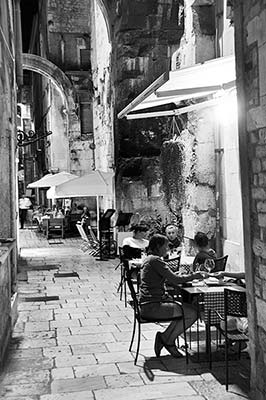
IN AND NEAR THE OLD TOWN
$$ Villa Spiza is a popular, well-run little restaurant serving local cooking from a handwritten menu at unusually reasonable prices considering its Old Town location. It feels fresh, youthful, and energetic, with only counter seating in the very tight interior and a couple of sidewalk tables. As they don’t accept reservations and are justifiably popular, come at a slow time or plan to wait (cash only, daily 13:00-24:00, Petra Kružića 3, +385 91 152 1249).
$$$$ Bokeria is Split’s trendiest foodie hotspot. The bright, spacious, modern bistro atmosphere—with a wall of Aperol bottles and ham hocks hanging over the bar—feels closer to Barcelona than to Split. But the beautifully presented cuisine is a smart melding of Croatian classics with international technique, and the wine list is long. It’s a bit too popular for its own good, and the service can be uneven, but it satisfies those looking for a change of pace from traditional konobas. Reserve ahead (daily 9:00-24:00, Domaldova 8, +385 21 355 577).
$$$ Bepa is simple but stylish, and probably the best-value dining option with outdoor tables on the glorious People’s Square. Their menu is brief but eclectic, with a mix of local and international influences—burgers, pastas, big salads, main courses—and it’s family-friendly (daily 8:00-24:00, Narodni Trg 1, +385 21 355 546, www.bepa.hr).
$$$$ Konoba Uje Oilbar is the flagship restaurant of Croatia’s popular chain of upscale olive oil boutiques. Tucked away in a hidden corner of the Old Town, it serves simple plates and boards of Dalmatian pršut (prosciutto), cheeses, olives, and, of course, olive oils—50 different types. You can either assemble a filling meal out of a variety of these nibbles, or order a main course—either way, the bill adds up. But the rustic-mod interior, pleasant outdoor seating, and refreshingly good-quality local flavors can make for a memorable meal (also olive oil tastings, daily 12:00-24:00, Dominisova 3, +385 95 200 8008, www.oilbar.hr).
$$$ Bajamonti is the best of the eateries on the beautiful, arcaded square Trg Republike, just off the west end of the Riva. This place has a certain grand-café class, with a checkerboard-tiled, split-level interior—but the best seating is on the square out front, facing the sea. The price sometimes exceeds the quality—for a budget option, get a pizza—but the outside setting is worth paying for (daily 7:30-24:00, Trg Republike 1, +385 21 341 033, www.restoran-bajamonti.hr).
$$$ Ćiri Biri Bela, attached to a hostel in a quieter area of the Old Town, is popular for its menu of Dalmatian dishes fused with international influences, charcuterie plates, tartes flambées (like thin-crust pizzas), and good desserts. While the pricey food can be hit-or-miss, the service is attentive, and the outdoor dining ambience (either in front of or behind the main restaurant) is memorable (Tue-Sun 8:00-14:00 & 18:00-24:00, closed Mon, at the top corner of the Old Town at Plinarska 6, +385 91 970 3052, www.ciri-biri-bela.com).
Near the Fish Market: A little cluster of three trendy places huddles on a lane (called Obrov) tucked behind the Fish Market, a few steps off Mormontova. Each is quite different, so survey your choices and pick the one that appeals. $$$ DeListes is a hole-in-the wall with a couple of tables both inside and out, serving traditional Dalmatian dishes with a modern sensibility from a handwritten menu (daily 12:00-24:00, Obrov 8, +385 97 778 6917). $$$$ Pandora Greenbox, next door, features high-end vegetarian dishes from an international menu that also takes inspiration from local flavors (daily 9:00-23:00, Obrov 4, +385 21 236 120). And the crowd-pleasing $$$$ Corto Maltese promises “freestyle food,” turning the salty old fishermen’s konoba on its head; its extensive cocktail list and menu are creatively described and fun to peruse. While some of the descriptions are a bit cheeky, if not outlandish, ultimately this is solid local Mediterranean fare presented with a modern spin (daily 8:00-24:00, Obrov 7, +385 21 587 201).
Pizzerias: At the west end of the Old Town, $$ Ristorante Pizzeria Galija has a boisterous local following and good wood-fired pizzas, pastas, and salads. They have a woody interior and a terrace (daily 10:00-24:00, air-con, just a block off Marmontova at Tončićeva 12, +385 21 347 932). For takeaway, you’ll see uninspired “pizza cut” (by the slice) windows all over town. For higher-end, modern, trendy pizza, check out Bokamorra, just outside the Old Town and described later.
Takeaway Grilled Meats: Find perhaps the best budget meal in Split at $ Kantun Paulina (Paulina’s Corner), a local favorite for takeaway ćevapčići—Balkan grilled meats. Everything’s fresh, from the lepinja flatbread to the meat. This is a great place to try this favorite Balkan street food (Mon-Sat 8:30-24:00, Sun from 10:30, Matošića 1). For descriptions of your options, see the “Balkan Flavors” sidebar on here.
High-End Coffee: Coffee snobs seeking something a notch above the standard bijela kava enjoy a pair of gourmet coffee shops: D16 Specialty Coffee (daily 7:00-22:00, Dominisova 16) and 4Coffee Soul Food (Mon-Fri 7:00-15:00, Sat until 18:00, Sun until 13:00, Hrvojeva 9).
Gelato and Other Sweets: The Old Town teems with interchangeable, uninspired places serving bland ice cream. For something better, Emiliana, facing the trendy Bokeria restaurant, has deep flavors, rich and creamy texture, and fresh-made waffle cones...and the line outside can be understandably long (Cosmijeva 1). For another high-quality, more local choice a short walk away—usually with a shorter wait—venture north to Luka, which attracts locals with homemade quality and interesting flavors, such as lavender or rosemary (Svačićeva 2; to find it, see “More Options Behind the Theater,” next). Nearby, tucked up a lane left of the modern Prima shopping center, is the genteel little shop called O’š Kolač—with a delectable variety of top-end cakes (Mon-Sat 8:00-22:00, closed Sun, Ćiril-Metodova 4, +385 21 480 444).
More Options Behind the Theater: To leave most of the tourists (and charm) behind, head up to the top of Marmontova pedestrian boulevard and keep going. In the big square, poke up the little covered lane between the yellow National (HNK) Theater and the blocky modern church. You’ll pop out in a refreshingly modern, urban zone. The excellent Luka gelato and pastry shop is on your right, and more locals-oriented cafés, bars, “pizza cut” windows, and other eateries are just beyond. Wander a few minutes up the street across the little square from Luka, keeping an eye out for Stari Plac (with dessert crêpes); a bit farther up that same street is $$ Sexy Cow, where you can order from a tempting menu of decadent top-end hamburgers and wraps (daily 11:00-24:00, Zrinsko Frankopanska 6, +385 21 780 782).
IN VAROŠ, WEST OF THE OLD TOWN
$$$ Konoba Fetivi is the locals’ choice for unpretentious, quality local food at fair prices just around the corner from several touristy eateries. You can sit in the air-conditioned interior or in the larger inner courtyard. As this place is popular with foodies, book far ahead (Tue-Sun 17:00-23:00, closed Mon, Tomića Stine 4, +385 21 355 152).
$$$ Šperun Restaurant has a cozy, Old World ambience and a passion for good Dalmatian food. Owner Damir Banović serves a mix of Croatian and eclectic Mediterranean fare, specializing in seafood (daily 9:00-23:00—but likely closed Mon Nov-March, air-con, a few sidewalk tables, reservations wise in summer, Šperun 3, +385 21 346 999).
$$ Bokamorra is a hip, fresh, modern pizzeria, offering pies a notch above and more international than the Croatian norm. Operated by the people behind trendy Bokeria (described earlier), it’s a short walk beyond the Old Town along the picturesque Matejuška fishermen’s port. In addition to the creative menu of tasty (yet reasonably priced) wood-fired pizzas, they have a fun cocktail list, a hip contemporary interior, and a few outdoor tables (daily 12:00-24:00, tucked behind the big and blocky Hotel Ambassador at Obala Ante Trumbića 16, +385 99 417 7191).
Split Connections
BY BOAT
Split is the transport hub for the Dalmatian Coast, with boats fanning out to nearly anywhere you want to go. In addition to the map in this chapter, you’ll find a color map of the Dalmatian Coast at the back of the book. Routes and schedules can change, so confirm anything listed here before you make your plans.
Boat Companies: Three major companies run routes from Split. Jadrolinija, the national ferry company, runs all car ferries and some high-speed passenger catamarans (+385 21 338 333, www.jadrolinija.hr). Two privately run competitors, Krilo (+385 21 645 476, www.krilo.hr) and TP Line (+385 20 313 119, www.tp-line.hr), also operate catamarans on similar routes. All three companies have ticket kiosks along the pier called Gat Sv. Petra, halfway along the harbor, which is where many of these boats depart. Jadrolinija also has an office at the corner of the harbor, across from the entrance to Diocletian’s Palace; their main office is in the large terminal building at the far end of the port.
Checking Schedules and Buying Tickets: Because the three competing companies don’t cooperate, you have to do a little homework to figure out all of your options for a given journey. Here’s the best strategy: First check https://getbyferry.com to figure out the best option, then book directly on that company’s website. Most booking these days is done online—you’ll be emailed a ticket to show or scan on your phone as you board the boat—though you can also buy paper tickets at the ticket kiosks for each company. Jadrolinija may have restrictions on buying same-day tickets online (even more reason to prebook). You can’t buy tickets on board.
Ticket Tips: Tickets for the fast passenger catamarans (Jadrolinija, Krilo, or TP Line) sell out quickly in peak season; to avoid disappointment, book at least a day or two in advance (or even further ahead on summer weekends). The first departures of the day—ideal for day-trippers—tend to sell out the fastest, and weekends are the busiest days. If catamaran tickets do sell out, slower Jadrolinija car ferries ply each route with unlimited room for walk-on passengers. However, this is a less-than-ideal alternative, since car ferries drop you off at ports that are not convenient to the main town on each island (Stari Grad on Hvar, Vela Luka on Korčula), which means an additional bus trip to your final destination. The ticket seller can advise you on alternatives.
While adding a dash of Italy to your Croatian vacation is a romantic notion, it can be more complicated than it sounds. Most sea crossings are overnight, and the Italian towns best connected to Croatia—Ancona, Pescara, and Bari—are each a lengthy train ride away from Italy’s top sights.
Split is the primary hub for boats to Italy, but there are sometimes also connections from Dubrovnik or Zadar. (Note that in Italian, Split is called “Spalato”—which is also the sound you hear if seasickness gets the best of you.) Almost all boats go to Ancona, Italy, which is on the calf of Italy’s “boot.” Others may go to Pescara, about 100 miles south of Ancona (the “cankle”), and to Bari, near the southeastern tip of Italy (the “heel”). Most trips are overnight and last 8-10 hours; faster daytime catamarans run sporadically. Note that these connections are highly subject to change; do an internet search to be confident you know all your options.
Slow Night Boats: The lineup of companies that operate night boats to Italy changes from year to year. The most reliable companies are the Italian-based SNAV (www.snav.it) and the Croatian national ferry company, Jadrolinija (www.jadrolinija.hr). Figure about €40-60 per person for one-way deck passage (about 10-20 percent more in July-Aug, sometimes even more on weekends). Onboard accommodation costs extra (about €40 per person for a couchette in a 4-berth compartment, €60-75 per person in 2-bed compartment with private shower and WC, up to €100 per person in a seaview double).
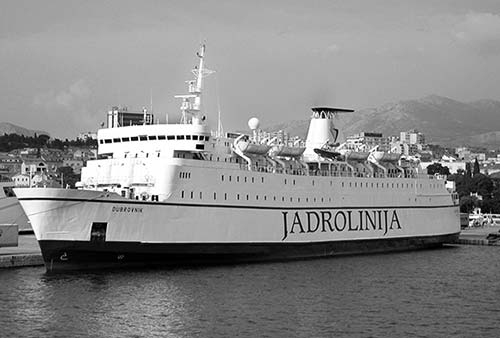
Trains Within Italy: From Ancona, trains zip to Florence (3 hours, change in Bologna), Venice (4 hours, change in Bologna), and Rome (4 hours). From Pescara, it’s about 4.5 hours to either Rome (direct) or Florence (via Bologna). And from Bari, you can hop a train to Naples (4 hours, most transfer in Caserta), Rome (4 hours direct), or Florence (7 hours, most transfer in Bologna). For timetables, check www.trenitalia.com or www.bahn.com.
Northern Italy/Croatia: If you’re heading to Istria (in northern Croatia), you may find it’s easier to side-trip from there to Venice than it is to head across the Adriatic from Dalmatia. Venice is connected by boat to several seaside towns in northern Croatia and Slovenia. For details, see here.
Finding Your Boat: To find your boat in the sprawling port area, check your ticket or look for the big electronic schedule boards. Many Jadrolinija catamarans conveniently depart from berth #6 at the handy Obala Lazareta embankment just in front of the Old Town. Most Krilo and TP Line catamarans use berth #9, #10, or #11, which line up along the first big pier poking out into the harbor, called Gat Sv. Petra. A few other boats may depart from points that are farther out—berth #16, which is between Gat Sv. Petra and the main terminal building (facing the bus station), or berth #21, which is beyond the terminal.
On the catamarans, boarding typically begins 30 minutes before departure; arrive early in peak season to snare a window seat and find a place to stow your bag.
Big car ferries can arrive or depart from all along the harbor (electronic boards display which dock each boat leaves from).
Fares: Walk-on passage for both catamarans and ferries is affordable. The passenger fare on a trip from Split to Hvar or Korčula costs around €16-20 in summer; all the way to Dubrovnik is about €40. (By comparison, a car ferry from Split to Hvar is about €45 for the car and €8 per walk-on passenger.) Prices are lower outside of peak season.
Weather Disruptions: Catamarans are the quickest way to the islands, but they’re also the most susceptible to inclement weather. In very rough or windy weather, cancellations are possible (decisions are made a couple of hours before departure—ask at the ticket booth what time you should come back to check). In questionable weather, the Krilo is more stable (and provides a more comfortable ride) than Jadrolinija’s catamarans; if you have a choice, go with Krilo. If the catamarans aren’t running, the slower car ferries go in almost any weather.
Car Ferry Notes: If you’re driving onto a car ferry, it’s smart to book a space online well ahead—especially in peak season (www.jadrolinija.hr). Unfortunately, there are currently no inter-island connections for cars (for example, from Hvar to Korčula); you’ll either have to go back through Split, or take a ferry to the mainland and connect from there, taking another ferry to get to your next island.
Getting from Split to Dalmatian Destinations
I’ve roughly explained your options next, but the details change from year to year. The only way to know for sure what works for your trip is to search for your preferred journey at https://getbyferry.com, then get more details and book online at the official company websites: www.jadrolinija.hr, www.krilo.hr, and www.tp-line.hr.
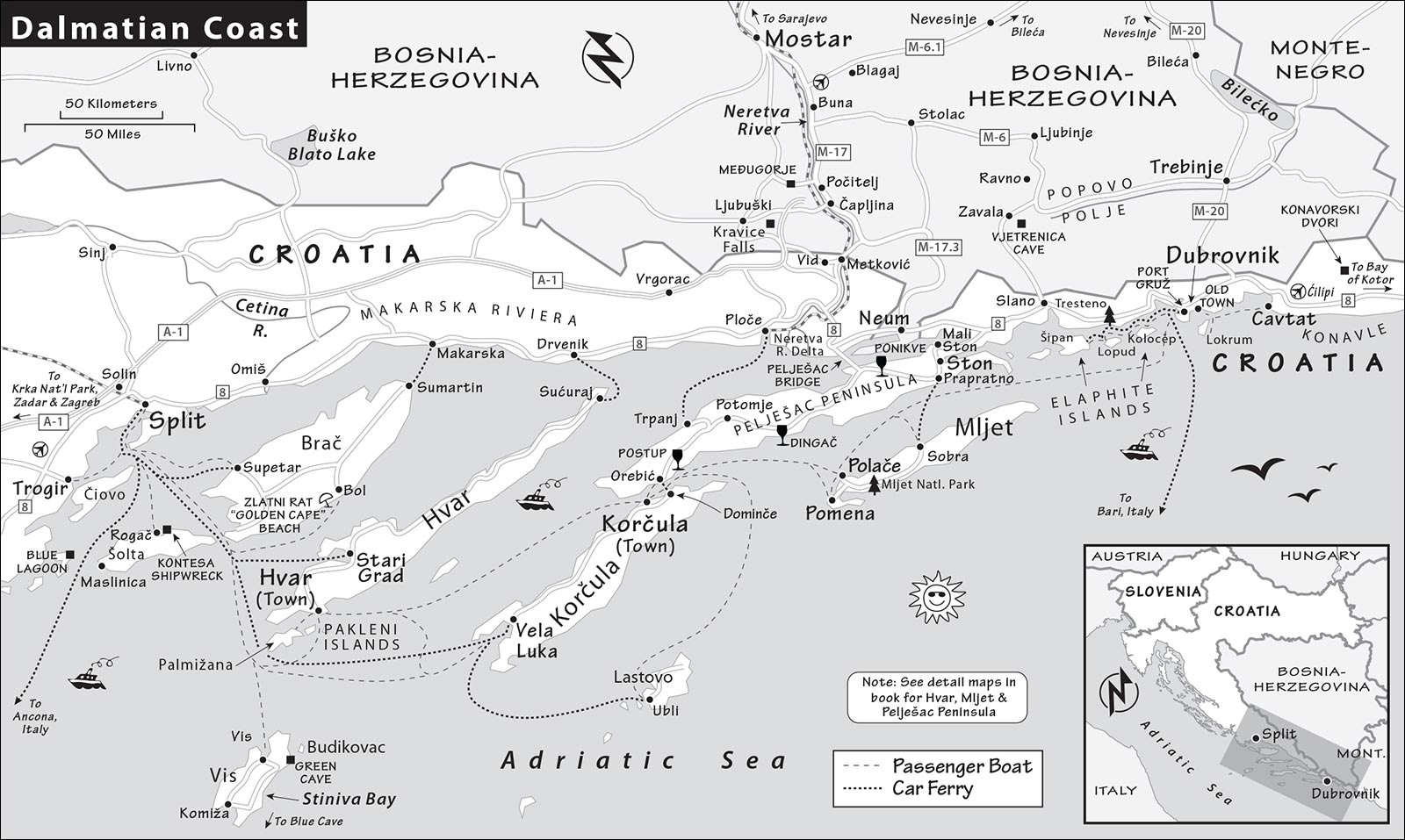
To Hvar Island: Note that Hvar Island has two commonly used ports; you want simply “Hvar” (that is, Hvar town), rather than “Stari Grad.” Catamarans operated by Jadrolinija, Krilo, or TP Line zip several times each day from Split to Hvar town in about an hour (fewer departures off-season). Alternatively, you can reach Hvar Island on a local car ferry from Split (7/day in summer, 4/day in winter, operated by Jadrolinija). These car ferries are frequent but take twice as long (2 hours) and are less convenient, since they take you to the town of Stari Grad. From Stari Grad, it’s a 25-minute bus ride across the island to Hvar town (public buses generally meet most arriving ferries).
To Korčula Island: As with Hvar, it’s important to pay attention to which port on Korčula Island your boat uses: “Korčula” (that is, Korčula town) is far more convenient than “Vela Luka,” at the opposite end of the island (a 1-hour bus ride away). To reach Korčula town from Split (about 2.5 hours), the most convenient options are the direct catamarans, operated by the same three companies, which run several times each day through the summer (less off-season). If you’re desperate, additional boats head to Vela Luka, including one of the Jadrolinija catamaran routes (generally 1/day, 2 hours) or Jadrolinija’s slower local car ferries (2/day, 2-3 hours).
To Dubrovnik and Mljet National Park: Some of the catamarans heading to Hvar and Korčula continue all the way to Dubrovnik—about 4.5 hours total. And some of the Dubrovnik catamarans also stop en route at Pomena, handy for Mljet National Park (3 hours)—most likely an early morning option on Krilo, and a slightly later option on TP Line.
BY BUS
Each of the following routes is served by multiple companies. To figure out the best connection for your journey, either check https://getbybus.com (then book either there—for a 5 percent extra service fee—or directly on the bus company’s website) or ask at the bus station. The generally English-speaking staff at Split’s bus station gives out handy little schedules for popular journeys. As with boats, popular buses can sell out in the busy summer months (particularly on weekends); it’s smart to book a day or two ahead. (Bus info: +385 60 327 777, www.ak-split.hr.) Note that any buses operated by Flixbus can only be booked online (www.flixbus.com) and the information desk is at the train station—not the bus station.
By Bus to: Zagreb (at least hourly, 5-8 hours depending on route), Dubrovnik (nearly hourly, less off-season, 4-5 hours), Korčula (1 night bus leaves at 1:00 in the morning and arrives around 6:00), Trogir (1-2/hour, virtually any bus bound for Šibenik can stop at Trogir, 30 minutes), Zadar (at least hourly, 3 hours), Mostar (5/day, 4 hours), Međugorje (4/day, 3 hours), Sarajevo (3/day, 7.5-8 hours), Rijeka (6-8/day, 7 hours). Zagreb-bound buses sometimes also stop at Plitvice Lakes National Park (confirm with driver and ask to stop at the park entrance; about 7/day in summer, 4-6 hours; the best are the direct 4-hour connections with Prijevoz Knežević/Flixbus, described on here; otherwise 4/day in winter, 4-6 hours).
BY TRAIN
From Split, trains go to Zagreb (2-4/day, 6 hours; 1 direct night train, 8 hours); in Zagreb, you can transfer to Ljubljana (4/day, 9 hours total). Train info: +385 21 338 525, www.hzpp.hr.
ROUTE TIPS FOR DRIVERS
Driving in the city center can be challenging. Split is split by its Old Town, which is welded to the harbor by the pedestrian-only Riva promenade. This means drivers needing to get 300 yards from one side of the historic core to the other must drive 15 minutes around the center, which can be clogged with traffic. A semicircular ring road and a tunnel under the Marjan peninsula relieve the situation a bit. If you are driving to the ferry, be warned that traffic in the port can hit a standstill; allow plenty of time to reach your designated ferry queue.
Arriving in Split: Drivers are treated to the ugly side of Split as they approach town (don’t worry—it gets better). From the expressway, you’ll pass through an industrial zone, then curl through a few tunnels as you twist your way down into Split’s striking, bowl-like setting. As you approach downtown on Ulica Domovinskog Rata—just before you reach the outermost part of the city wall—you’ll come to a fork where you’ll have to decide which side of town you want to drive to (east or west); ask your hotel in advance for directions and be ready for your turn. (While many hotels are signposted at the fork, it’s a long list and hard to read quickly as you zip past.)
At the main fork, turning to the right (marked with Centar signs) takes you along Sinjska street to the west end of the Old Town, including the Varoš neighborhood. Or, if you continue straight (marked Trajekt—ferry) on Zagrebačka street, you’ll eventually reach other Centar signs and the east end of the Old Town, with the ferry terminal, the bus and train stations, and the Lučac neighborhood. You’ll pop out right at the southeast corner of Diocletian’s Palace (by the Green Market). For handy but expensive parking, when the road swings left to the ferry terminal, bear right into a little lot just outside the palace walls. I’d park here only to unload and find my hotel, then ask about cheaper long-term parking elsewhere.
Connecting Split with Destinations to the North: Thanks to Croatia’s A-1 super-expressway, the road trip from Zagreb to Split takes less than five hours. Simply drive up out of the city’s bowl-like setting and follow signs to the A-1 expressway north (toward Zagreb; if you’re going to Plitvice, get off at Gornja Ploča and drive north from there).
Connecting Split with Destinations to the South: If you’re heading to Dubrovnik, other Dalmatian Coast destinations, or Mostar, you have two options: the scenic coastal road or the speedy A-1 expressway.
The main coastal road twists slowly but scenically along some fantastic scenery, in an area dubbed the “Makarska Riviera.” (Along this road is the town of Drvenik, where you can take a ferry to Sućuraj on Hvar Island; from Sućuraj, a long and twisty road traverses the length of the island to Hvar town. If you’re going to Hvar Island, taking a car ferry directly from Split to Stari Grad is much faster.) Continuing south, you’ll wind up in the town of Ploče.
To save some time, most travelers prefer to take the expressway part of the way. To do this, as you leave Split, follow blue expressway signs to Dubrovnik. You’ll take A-1 south as it cuts inland from the sea, running behind the tall coastal mountain range, near the Bosnian border, all the way to the city of Ploče. (If you’re headed to Mostar, stay on the expressway and cross the border at Nova Sela, then follow signs to Mostar from there.)
Ploče has a ferry that runs to the town of Trpanj, on the landward side of the Pelješac Peninsula—not far from Orebić, where another boat plods across to Korčula town. If you’re headed to Korčula and plan your timing to catch this ferry, it could save you some driving.
Ploče is also where the A-1 expressway ends. Here you’ll transfer to a two-lane highway the rest of the way to Dubrovnik. Just south of Ploče is the dramatic Neretva River Delta, a scenic and lush zone of farmland. Halfway along the delta, you’ll see the turnoff to Metković, the gateway town on the main, heavily touristed road between Croatia and Mostar.
South of the Neretva River Delta—after twisting up to a high perch overlooking the delta—you’ll cross the new-in-2022 Pelješac Bridge over the Bay of Mali Ston, then along the base of the Pelješac Peninsula. Shortly after the bridge, you can turn off to head farther along the peninsula to the port town of Orebić, which has a ferry over to Korčula; along the way, you’ll pass some of Croatia’s best wine-growing areas (Potomje, Postup, and—through a little tunnel—Dingač). If you’re not heading to Korčula, just stay on the highway as it passes the walled town of Ston and the smaller oyster-farming town of Mali Ston—either of which could be worth a stop if you have a little extra time. For information on the new bridge, wineries, and more, see the “Pelješac Peninsula” section of the Near Dubrovnik chapter.
After Ston, the road rejoins the main coastal road south to Dubrovnik—you’ll be there in about an hour. Along the way, you’ll have good views of Mljet and the Elaphite Islands. As you near Dubrovnik, you’ll pass through the town of Trsteno, which has a good arboretum. When you cross the giant, modern bridge, you’ll know Dubrovnik is just around the bend; for arrival tips, see here.
Near Split
Two destinations are easy, worthwhile side trips from Split: the small town of Trogir and the waterfalls at Krka National Park. A bit farther afield, the small city (with a big history) of Zadar makes an interesting coastal detour between Split and points north.
Trogir
Just 12 miles northwest of Split, across a giant bay, is Trogir—a tiny, medieval-architecture-packed town surrounded by water. This made-for-tourists village is appealing, though it lacks the real-world heart and soul of Split. Trogir is popular with yachters; the proud masts of tall ships line the harbor three deep. Although Trogir is nothing to jump ship for, it’s an easy day trip for those looking to get away from urban Split.
GETTING THERE
The easiest option in summer is to take the Bura Line boat, which avoids traffic and includes a fun Adriatic minicruise. The boat departs Split from the end of the little pier directly in front of the Riva (€6 one-way, 4/day mid-May-mid-Oct only, 1 hour, stops at Čiovo Island en route, www.buraline.com).
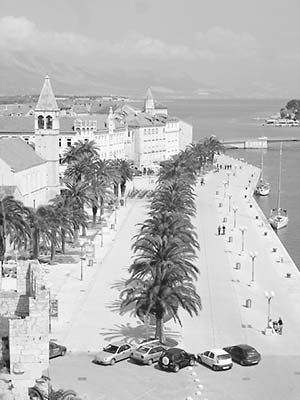
Alternatively, you can take the bus (around €4 one-way, 30 minutes). Your best bet is to head to Split’s main bus station (along the harbor) and hop on a northbound bus (for example, to Šibenik, Zadar, or Rijeka—just go to the ticket window and ask for the next bus that stops at Trogir). Be warned that this doesn’t always work well: Occasionally these buses show up already full, and during the busiest summer months, long-distance bus drivers may prefer to sell your seat to someone paying for a longer trip. If you’re desperate, it’s possible to take local bus #37, but I wouldn’t—you have to catch it at the inconveniently located suburban bus station, a boring 10-minute walk north of the Old Town, and its frequent stops between there and Trogir mean it’s a very long journey (at least an hour).
Drivers find Trogir an easy stopover. There’s a handy pay parking lot on the left just before Trogir; you can walk into town in five minutes (pass the bus station and cross the bridge).
Orientation to Trogir
Trogir is a small island wedged between the mainland and the much bigger Čiovo Island. Busy bridges connect it to the rest of the world at its east end, and a big soccer field squeezed between imposing watchtowers anchors the west end. In the middle is a tight medieval maze of twisty marble-stone lanes.
Tourist Information: At the main square, named for Pope John Paul II (Trg Ivana Pavla II), you’ll find the TI (open long hours daily except closed Sun off-season, +385 21 885 628).
Arrival in Trogir: Buses drop you off at the mainland market, just across the canal from the island. Cross the bridge into town and wander straight ahead for two blocks (bearing left); you’ll run into the main square.
Sights in Trogir
On the main square is the town’s centerpiece, the Cathedral of St. Lawrence (Katedrala Sv. Lovre). Built from the 13th to 17th century, the cathedral drips with history. The bell tower alone took 200 years to build, leaving it a textbook lesson in Dalmatian architectural styles: straightforward Gothic at the bottom, Venetian Gothic in the middle, and Renaissance at the top. The cathedral’s front entryway—the ornately decorated, recently restored Radovan’s Portal—is worth a gander. Inside, it’s dark, very old-feeling, and packed with altars. The treasury features some beautiful 15th-century carved-wood cabinets filled with ecclesiastical art and gear.
The town’s other sights are the Town Museum (Muzej Grada), a few blocks north (toward the mainland) from the main square; and the Monastery of St. Nikola (Samostan Sv. Nikole), a few blocks south (toward Čiovo Island).
But Trogir isn’t for museum going; it’s for aimless strolling. And the best place for that is the wide, beautifully manicured harborfront promenade along the southern edge of town (Obala bana Berislavića). Lined with expensive restaurants and clogged with giddy, ice-cream-licking tourists, this promenade is the highlight of a visit to Trogir. Often the enormous yachts of the rich and famous stern-tie into the good life here, giving wanderers something to gaze at and yak about. At the far end of the promenade, the Kamerlengo Fortress has a lookout tower with views over the town and region.
Sleeping in Trogir
Some travelers prefer sleepy Trogir to bustling Split. It’s also very close to the Split airport. Here are some good options: $$$ Hotel Pašike is a family-run boutique hotel with 13 rooms, lots of character, and over-the-top traditional formality (Splitska 4, +385 21 885 185, mobile +385 91 484 8434, www.hotelpasike.com, Buble family).
$ Palaća Stafileo has six apartments in a 15th-century Venetian palace buried in a quiet part of town (Subićeva 7a, +385 21 885 680, mobile +385 98 131 3171, www.trogironline.com/stafileo).
Krka National Park
While Plitvice has Croatia’s best waterfalls, they’re not the only option. An hour north of Split, an easy detour off the expressway, is the glittering canyon of Krka National Park, with its shimmering blue waters and forested bluffs. This sprawling park—where the Krka (pronounced KUR-kah) River spreads out and splits into many fingers cut deep into the parched limestone—could occupy a nature lover for days. But its claim to fame is easy to reach and enjoy in just a few hours: the multitiered Skradinski Buk waterfall. Although not as magical or as expansive as Plitvice’s cascades, Skradinski Buk is bigger (a single grand run, rather than sprinkled throughout a canyon).
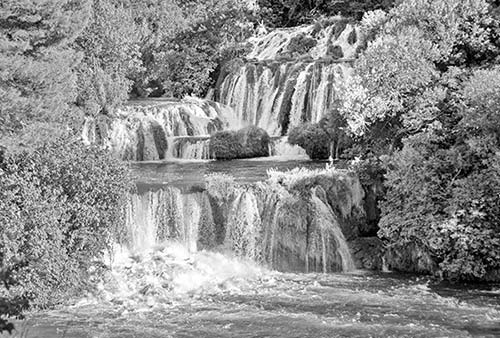
Cost and Hours: The ticket price changes by season—€40 in June-Sept, €20 in April-May and Oct, €7 in Nov-March—and includes the boat from Skradin to Skradinski Buk and the shuttle bus from Lozovac to Skradinski Buk, but not boats or shuttle buses to other parts of the park. The park is open daily June-Aug 8:00-20:00, May and Sept until 19:00, April and early Oct until 18:00, shorter hours off-season. The last boat from Skradinski Buk back to Skradin departs 30 minutes before closing time.
Information: +385 22 771 688, www.npkrka.hr.
Crowd-Beating Tips: In high season (especially July-Aug), crowds can be a problem and it would be best to visit the park either first thing in the morning or in the late afternoon, after most of the day-trippers have left. It’s also possible to book tickets online before your visit, to avoid ticket-buying lines.
Getting There: By car, it’s easy—about an hour north of Split, just off the expressway (see exit information for both major park entrances below). By public transportation, the easiest option is to take the direct bus from Split to Skradin, where you can buy your park ticket and hop on the boat to Lozovac and the waterfalls (8/day in summer, first departure around 7:00, 1.5 hours; you can ride the boat back to return on this same bus, or you can take the bus from Lozovac to Šibenik and return to Split from there). The other option is to first take the bus from Split to the city of Šibenik; from there, buses go to both the Skradin entrance (for the boat trip) and the Lozovac entrance (closer to the waterfalls). Check the specifics for any of these connections locally (at the Split TI or bus station). Alternatively, consider paying for an excursion from Split (or other cities in Dalmatia), which includes door-to-door transportation and the park entrance fee; this often doesn’t cost much more than doing it on your own, but you’ll have to stick to a set itinerary.
Visiting the National Park: The national park sprawls over 42 square miles, with five entrances; assuming your interest is the Skradinski Buk waterfall, you can ignore all but two of them. The most efficient entrance for drivers is the Lozovac entrance (Šibenik exit from A-1 expressway, then a seven-mile, 15-minute drive). Here you’ll find a large, free parking lot, and you can take a shuttle bus straight down to the waterfall area (leaves every 15 minutes or so, 10-minute ride on a very twisty and steep road). If you have more time and would prefer to approach the falls by boat—or if you’re coming to the area by public bus—you can use the Skradin entrance (Skradin exit from A-1, then a three-mile drive). From the glassy Skradin visitors center, you can hop on an hourly boat for the 20-minute trip to Skradinski Buk (included in your park ticket; boats depart every 2 hours off-season, Oct-April).
Because of increased crowds, visitors must follow a one-way route through the Skradinski Buk area. If coming by boat, you’re not allowed to head straight for the waterfalls—you’re required to first hike up to the top of the complex, at the Ethno Village, then loop back down around to the waterfalls. If coming from the Lozovac parking lot, the shuttle bus drops you off near the Ethno Village.
At the Ethno Village area (with a few houses displaying traditional lifestyles) is a large terrace with WCs and grand views down over the falls. From here, a roughly circular, 1.5-mile waterfall boardwalk path takes you up, down, and around the various cascades, through forests, over gurgling streams, and to a variety of thrilling viewpoints. Near the bottom of the falls—close to the boat dock from Skradin—is a pay WC, a large outdoor eating area (mostly table-service restaurants and a few snack stands), and the bridge that cuts across the bottom of the falls.
Other Excursions in the Park: Aside from hiking, another popular attraction at Krka is its variety of excursions by boat or minibus to farther-flung parts of the park. These excursions are not covered by the entrance ticket. Options include a two-hour cruise to Visovac Island, with its picturesque Franciscan monastery; a 3.5-hour cruise to Visovac Island and Roški Slap (another, less striking waterfall where you can swim); and a 2.5-hour trip to the Krka Monastery and ruins of two fortresses. Other excursions take you to the ancient Roman ruins (amphitheater and military camp) at Burnum.
Zadar
The city of Zadar (ZAH-dar, pop. 75,000), about a two-hour drive north of Split, marks the northern end of the Dalmatian Coast. An important trading port in Roman times, Zadar was unusually hard-hit by World War II, and its Old Town is a mix of atmospheric old buildings and Yugoslav-era concrete blight. While this makes it hard for Zadar to compete with more idyllic Dalmatian towns and cities, many Croatia aficionados have a special spot in their hearts for the city. They appreciate its user-friendly urban core, its abundant reminders of the Roman and Byzantine eras, its refreshing lack of overpromotion, and its unique Sea Organ—an art installation that howls and moans eerily as waves roll in from the islands. If you’re passing near Zadar on your way to points north or are looking for a side trip from Split that rounds out your look at urban coastal Croatia, Zadar offers an enjoyable few hours.
Orientation: While the city sprawls, everything of interest is contained within Zadar’s large, rectangular Old Town peninsula, which pokes out into the Adriatic. The square called Forum, at the center of this peninsula, is a handy jumping-off point for visitors. From the Forum, it’s a five-minute walk north to the tip of the peninsula and the Sea Organ, or a five-minute walk south toward the peninsula’s base, along the main shopping street (Široka), to Narodni Trg and the TI nearby (just a short walk to Jurja Barakovića 5, +385 23 316 166, www.zadar.travel).
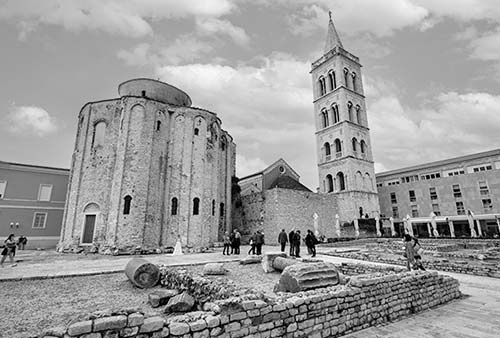
Arrival in Zadar: From the expressway exit, it’s about a 30-minute drive into the town center. Approaching town, follow the road that runs along the eastern/northern embankment of the peninsular Old Town, and take your pick of several pay-and-display parking lots along the water. (If you reach the tip of the peninsula, near the Sea Organ, you’ve gone too far—but it’s easy to circle back the way you came to find parking.) Once parked, head through one of the gates in the old city wall and find your way to the central square (just ask people, “Forum?”). Frequent buses (2.5-3 hours) also connect Split to Zadar’s main bus station, about a 15-minute walk from the Old Town peninsula.
Visiting Zadar: Begin on the big square called Forum, which was also the forum (main square) of ancient Zadar. This peninsula—a prime location for a busy trade port—was first settled by the Liburni as early as the ninth century BC. In 59 BC, “Iadera” (as it was called) officially became part of the Roman realm. The largest Roman forum on this side of the Adriatic was originally established here by Emperor Augustus in the third century. While most of its original buildings are gone and only sparsely labeled foundations survive, try to mentally resurrect the rubble of what was, two millennia ago, a bustling trading post.
The boxy, modern building fronting the square is the Archaeological Museum, with three floors of artifacts from prehistoric, Roman, and medieval Zadar. The section on antiquity helps revive Roman Iadera, including the Nin Imperial Group—statues of four major emperors discovered in the nearby town of Nin (open long hours daily, www.amzd.hr).
Dominating the square is the Romanesque, Byzantine-era Church of St. Donatus, built in the ninth century AD and worth ▲. Pay to step inside and see how the round structure is built upon ancient fragments gathered from the Forum. Notice the chunks of pillars, columns, capitals, and other ancient bits and pieces embedded in the bases of the six huge stone pillars—plus two intact Roman-style columns. Gaze up to appreciate the austere architecture of this skinny, 90-foot-tall space, which is often used for concerts.
The bell tower next to St. Donatus actually belongs to the adjacent, 13th-century Cathedral of St. Anastasius. You can pay to climb the bell tower for a view over town, then walk alongside the building (on the main drag, here called Jurja Bijankinija) to the little square in front of its main entrance. Step inside the cathedral, and you’ll find a classic Romanesque interior: dark, with rounded edges, and under a timber ceiling.
From here, it’s a short walk to one of Zadar’s signature attractions. Exiting the cathedral, walk straight ahead up Bijankinija street until you pop out at a little park. Angle left to get out to the tip of the peninsula. If the sea is rough, you’ll begin to hear the unmistakable sounds of Zadar’s famous Sea Organ (Morske Orgulje)—worth ▲▲. Installed by artist Nikola Bašić in 2005, the Sea Organ looks like a long bank of marble benches that stairstep unevenly down toward the water’s edge. Take a closer look; you’ll notice slots on the seaward sides of the “steps”—like a stack of gigantic harmonicas. As the surf hits the side of the organ, it alters the air pressure of the resonating cavity within the structure, blowing against 35 musical pipes. The result is a haunting, discordant, undulating, constantly changing sound that varies in pitch and loudness depending on the surf. It sounds otherworldly, ethereal, yet totally organic. It’s the song of playful whales deep under the sea; it’s angels singing; it’s aliens attempting to communicate. When big boats pass by, the wake strikes up quite the symphony. On a nice day, people sprawl all over the many levels of the Sea Organ, mesmerized, just...listening.
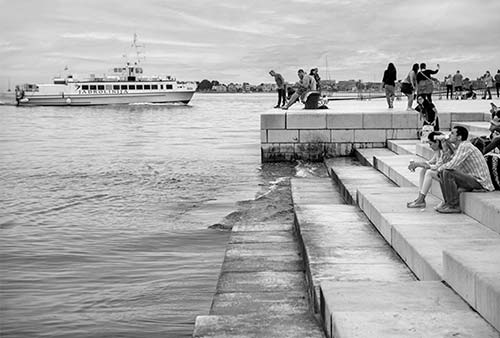
Near the Sea Organ is Greeting to the Sun, designed by the same artist to do with light what the Sea Organ does with sound. While not too exciting by day—it resembles a gigantic, 70-foot-wide, round solar panel consisting of 300 glass plates—it puts on a light show after dark. The smaller circles in the pavement nearby represent the planets of the solar system.
From here, you can retrace your steps back to the Forum. Better yet, walk along the town’s southern embankment—called the Riva, like the promenade in Split—to reach the Forum with the sea at your side.
Either way, once back at the Forum, head the opposite direction (toward the base of the peninsula) on the main drag—here called Široka Ulica (“Wide Street”). Walking along this street, you’ll notice how—compared with many other Croatian coastal towns—Zadar feels less like a prettified time-warp theme park and more like a real community. That’s because the Ustaše-held city was bombed by the Allies in World War II, then rebuilt with a harsh Yugoslav aesthetic. (As a silver lining, those bombs also revealed, for the first time in centuries, some of the ancient ruins that Zadar now prizes.) The result: Today’s Zadar has a Roman, Byzantine, and medieval core that’s woven through with brutalist midcentury architecture—a striking mix. Along Široka, blocky arcades line a pleasant walking street; the fast-food stands feel like they cater more to locals (or, at least, to Croatians on vacation) than to international tourists.
Soon you’ll reach Narodni Trg (“People’s Square”), Zadar’s modern centerpiece, ringed by classic facades. From here, you could turn left on Jurja Barakovića to reach the TI; just beyond, you’ll see stairs leading up to the top of the town wall—a beautifully landscaped park and promenade, offering good views over both the Old Town and the surrounding harbor. Strolling here is a nice way to wrap up your visit to Zadar.