ISTRIA
Rovinj • Pula • The Brijuni Islands • Poreč • Hill Towns • Opatija and Rijeka
Hill Towns of the Istrian Interior
Map: Hill Towns of the Istrian Interior
Idyllic Istria (EE-stree-ah; “Istra” in Croatian), at Croatia’s northwest corner, reveals itself gradually and seductively. Pungent truffles, Roman ruins, striking hill towns, quaint coastal villages, carefully cultivated food and wine, and breezy Italianate culture all compete for your attention. Although not as famous as its southern rival (the much-hyped Dalmatian Coast), the wedge-shaped Istrian Peninsula gives Dalmatia a run for its money.
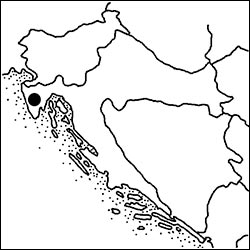
The Istrian coast, with gentle green slopes instead of the sheer limestone cliffs found along the rest of the Croatian shoreline, is more serene than sensational. It’s lined with pretty, interchangeably tacky resort towns, such as the tourist mecca Poreč (worthwhile only for its mosaic-packed Byzantine basilica). But one seafront village reaches the ranks of greatness: romantically creaky Rovinj, my favorite little town on the Adriatic. Down at the tip of Istria is big, industrial Pula, offering a bustling urban contrast to the rest of the time-passed coastline, plus some impressive Roman ruins (including an amphitheater so remarkably intact, you’ll marvel that you haven’t heard of it before). Just offshore are the Brijuni Islands—once the stomping grounds of Marshal Tito, whose ghost still haunts a national park peppered with unexpected attractions.
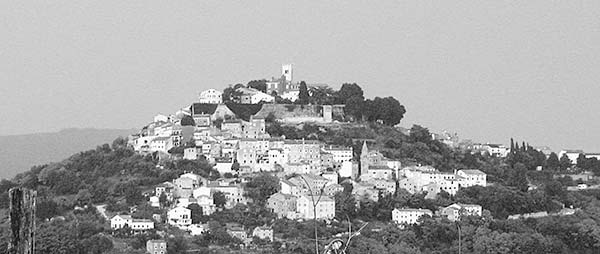
But Croatia is more than the sea, and diverse Istria offers some of the country’s most appealing reasons to head inland. In the Istrian interior, between humble towns crying out for a paint job, you’ll find vintners painstakingly reviving a delicate winemaking tradition, farmers pressing that last drop of oil out of their olives, trained dogs sniffing out truffles in primeval forests, and a smattering of fortified medieval hill towns with sweeping views over the surrounding terrain—including the justifiably popular village of Motovun.
PLANNING YOUR TIME
Istria offers an exciting variety of attractions compared with the relatively uniform, if beautiful, string of island towns farther south in Dalmatia. Logistically, Istria is easy to reach and to explore by car. Just a quick hop from Venice or Slovenia, this peninsula is made-to-order for an efficient road trip.
With a car and two weeks to spend in Croatia and Slovenia, Istria deserves two full days, divided between its three big attractions: the coastal town of Rovinj, the hill towns of the interior, and the Roman ruins at Pula. Ideally, make your home base for two nights in Rovinj or in Motovun, and day-trip to the region’s other attractions. Go for a joyride, touring some hill towns, sampling the vintages at a local winery, and sniffing out a truffle feast for lunch or dinner. The mosaic-slathered basilica in Poreč and the fun-but-time-consuming Brijuni Islands merit a visit only if you’ve got ample time.
GETTING AROUND ISTRIA
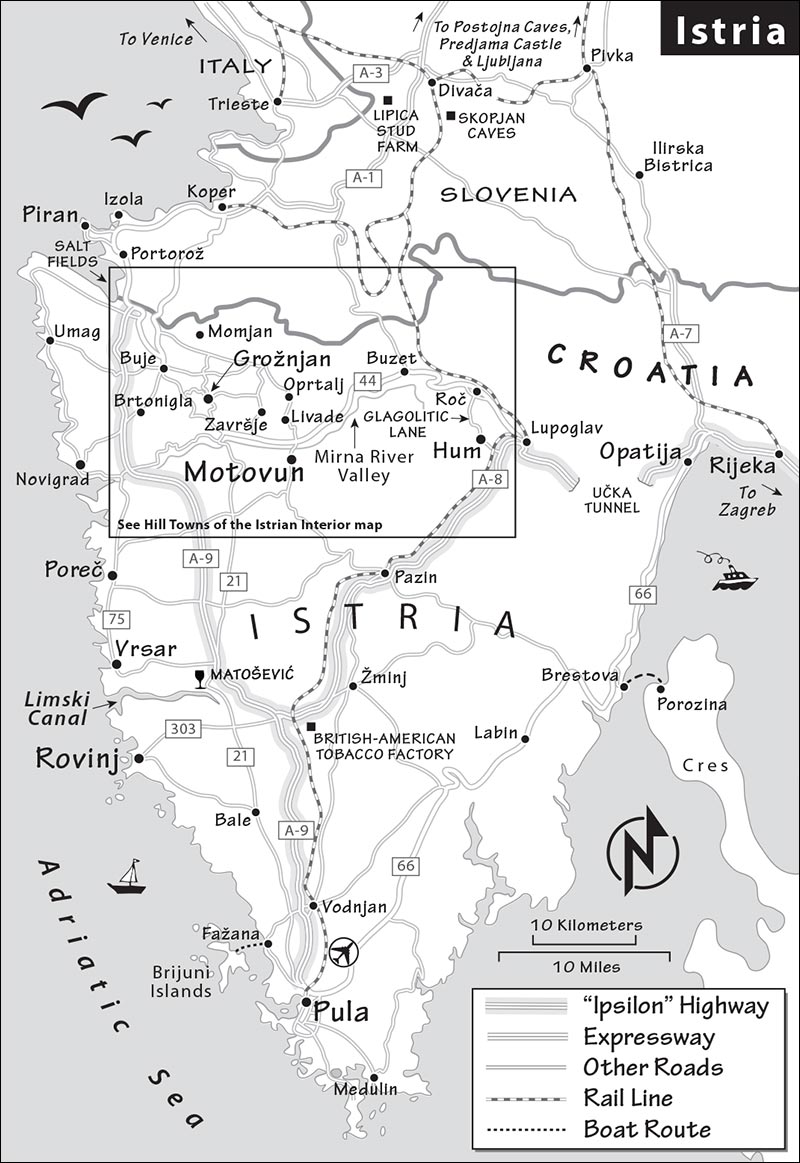
Drivers find distances short and roads and attractions well marked. Summer traffic, however, can be miserable (especially on weekends), and parking can be tricky—and expensive—in some towns (especially Rovinj and Motovun). Istria is neatly connected by a speedy highway nicknamed the ipsilon (the Croatian word for the letter Y, which is what the highway is shaped like). One branch of the “Y” (A-9) runs roughly parallel to the coast from Slovenia to Pula, about six miles inland; the other branch (A-8) cuts diagonally northeast to the Učka Tunnel (leading to Rijeka). Tollbooths accept cash or credit cards. Following road signs here is easy (navigate by town names), but if you’ll be driving a lot, pick up a good map to more easily navigate the back roads.
If you’re relying on public transportation, Istria can be frustrating: Certain highlights, such as Rovinj and Motovun, are not easy to reach. Linking up the coastal towns by bus is doable if you’re patient and check schedules carefully, but the hill towns probably aren’t worth the hassle. Even if you’re doing the rest of your trip by public transportation, consider renting a car for a day or two in Istria—or just focus on Rovinj.
By Boat to Venice, Piran, or Trieste: Various companies connect Venice by sea with Rovinj, Poreč, and Pula (about three hours). While designed for day-trippers from Istria to Venice, these services can be used for one-way travel. As the companies and specific routes change from year to year, check each of these websites to see what might work for your itinerary: Venezia Lines (www.venezialines.com), Adriatic Lines (www.adriatic-lines.com), and Commodore Cruises (http://commodore.fwd.hr). Liberty Lines (www.libertylines.it) connects Rovinj and Poreč to Piran (Slovenia), then Trieste (Italy).
Foodies consider Istria the best part of Croatia. The fertile soil of green Istria bursts with a cornucopia of ingredients. Like the Istrian people, Istrian cuisine is a mix of cultural influences, including Italian-style elements, farmer fare, game, and seafood. And perhaps the defining ingredient of Istrian cuisine is locally foraged truffles (see here).
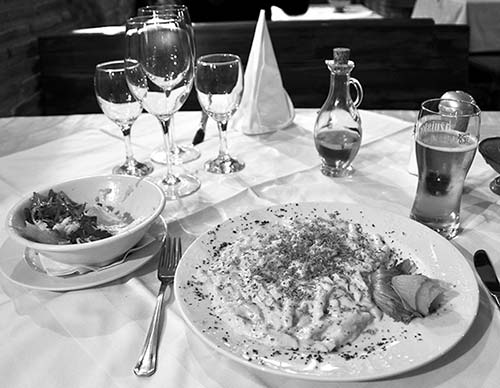
For pastas, you’ll see familiar dishes such as gnocchi and risotto, but Istria also adds some unique noodles. Fuži are little pasta squares that are rolled up to create hollow noodles, roughly shaped like penne; pljukanci are short, thick, nearly transparent twists (similar to Italian trofie).
Pršut is the air-cured ham that is Istria’s answer to prosciutto. You’ll often find game on the menu, as well as boškarin—the meat of indigenous Istrian longhorn cattle. Ombolo is pork loin. And the local cheese called Veli Jože (“Old Joe”)—named for a mythical giant—is made from cow’s milk. Younger versions are creamy, if pungent, and melt in your mouth; more aged versions are hard, crumbly, and best for grating (similar to grana padano).
Istria is also a major wine-growing region, which is beginning to gain international renown. Relatively few Istrian wines are exported (though the number is growing), so this region gives wine lovers a good opportunity to discover some new bouquets.
About 80 percent of Istrian wines are white, many made with the grape called malvazija (mahl-VAH-zee-yah; known to English-speakers as malvasia)—producing a delicious, light white wine that can be either sweet (slatko) or dry (suho). Malvazija wines are produced throughout Europe, but Istria’s malvazija is indigenous. Malvazija comes in several forms: “fresh” (table wine, aged in stainless steel) or aged in barrels (often in French oak or in local Istrian acacia; look for barrique on the label). White blends (usually including some malvazija) are also common.
Red wines are made from the teran grape, which produces a “big” wine that you can chew on. Because teran is full-bodied, it’s often blended with merlot or other grapes, resulting in some softer, lovely flavors and a finer wine. Teran pairs well with pršut and red meat.
For more on Istrian wines—including wineries where drivers can stop off for a taste—see the sidebar on here. If you’re carless, ask about local wines as you explore your nightlife and dining options in Rovinj.
Rovinj
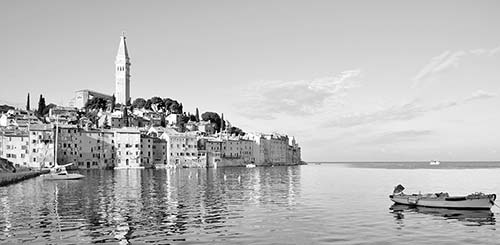
Rising dramatically from the Adriatic as though being pulled up to heaven by its grand bell tower, Rovinj (roh-VEEN; in Italian: Rovigno/roh-VEEN-yoh; pop. 14,000) is a welcoming Old World oasis, worth ▲▲▲. Among the villages of Croatia’s coast, there’s something particularly romantic about Rovinj—the most Italian town in Croatia’s most Italian region. Rovinj’s streets are delightfully twisty, its ancient houses are characteristically crumbling, and its harbor—lively with real-life fisherfolk—is as salty as they come. Like a little Venice on a hill, Rovinj is the atmospheric setting of your Croatian seaside dreams.
Rovinj was prosperous and well fortified in the Middle Ages. It boomed in the 16th and 17th centuries, when it was flooded with refugees fleeing both the Ottoman invasions and the plague. Because the town was part of the Republic of Venice for five centuries (13th to 18th century), its architecture, culture, and even language are strongly Venetian. The local folk groups sing in a dialect that’s considered more Venetian than what the Venetians themselves speak these days.
After Napoleon seized the region, then was defeated, Rovinj became part of the Habsburgs’ domain. The Venetians had neglected Istria, but the Austrians invested in it, bringing the railroad, gas lights, and a huge Ronhill tobacco factory. (This factory was recently replaced by an enormous, state-of-the-art facility labeled “British-American Tobacco” that you’ll pass on the highway farther inland.) The Habsburgs tapped Trieste and Pula to be the empire’s major ports (shipping and military, respectively)—cursing those cities with pollution and sprawl, while allowing Rovinj to remain timeless and quaint.
Tourism came to Rovinj in the late 1890s, when a powerful Austrian baron bought one of the remote, barren islands offshore and brought it back to life with gardens and a grand villa. Soon another baron bought another island...and a tourist boom was underway. In more recent times, Rovinj has become a top destination for nudists (keep your eyes peeled for the letters FKK, international shorthand for nudism). The resort of Valalta, just to the north, is a popular spot for those seeking “southern exposure,” as a very revealing brochure at the TI illustrates (www.valalta.hr).
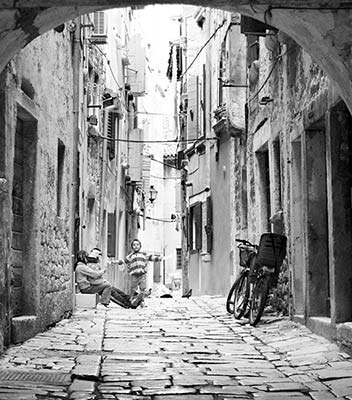
Rovinj is the most atmospheric of all of Croatia’s small coastal towns. Maybe that’s because it’s always been a real town, where poor people lived. You’ll find no fancy old palaces here—just narrow streets lined with skinny houses that have sheltered humble families for generations. Rovinj retains the soul of a fishing village. It’s rougher around the edges than Dubrovnik, and many people still live in cramped Old Town apartments. But things are changing, and a snazzy new yacht harbor is beginning to attract a deep-pocketed clientele to the town. Enjoy Rovinj now before it changes too much. It will.
PLANNING YOUR TIME
Give Rovinj the better part of a day. You can get the gist of the town in a one-hour wander. The rest of your time is for enjoying the ambience, savoring a slow meal, or pedaling a rental bike to a nearby beach. When you’re ready to overcome your inertia, there’s no shortage of day trips (the best—a half-day each in Pula and Motovun—are outlined in this chapter). Be aware that much of Rovinj (like other small Croatian coastal towns) closes down from mid-October through Easter.
Orientation to Rovinj
Rovinj’s Old Town is divided into two parts: a particularly charismatic chunk on the oval-shaped peninsula, and the rest on the mainland (with similarly time-worn buildings but fewer tourists). The mainland meets the peninsula at the broad, bustling Tito Square (Trg Maršala Tita). The Old Town peninsula—traffic-free except for the occasional moped—is topped by the massive bell tower of the Church of St. Euphemia.
TOURIST INFORMATION
You’ll find Rovinj’s TI on the Square at the Bridge (May-Oct Mon-Sat 8:00-20:00, Sun until 16:00; Nov-April Mon-Fri 8:00-16:00, Sat until 13:00, closed Sun; Trg na Mostu 2, +385 52 811 566, www.rovinj-tourism.com).
ARRIVAL IN ROVINJ
By Car: While it’s workable, parking is one of the biggest headaches about visiting Rovinj—especially during busy times. Only local cars are allowed to enter the Old Town area, and competition can be fierce for spaces nearby. If you’re sleeping here, get specific advice from your accommodations. Some higher-end lodgings inside the Old Town have dedicated lots elsewhere, often with golf-cart shuttle service into town. If you’re sleeping outside the Old Town, your place may have on-site (or nearby streetside) parking.
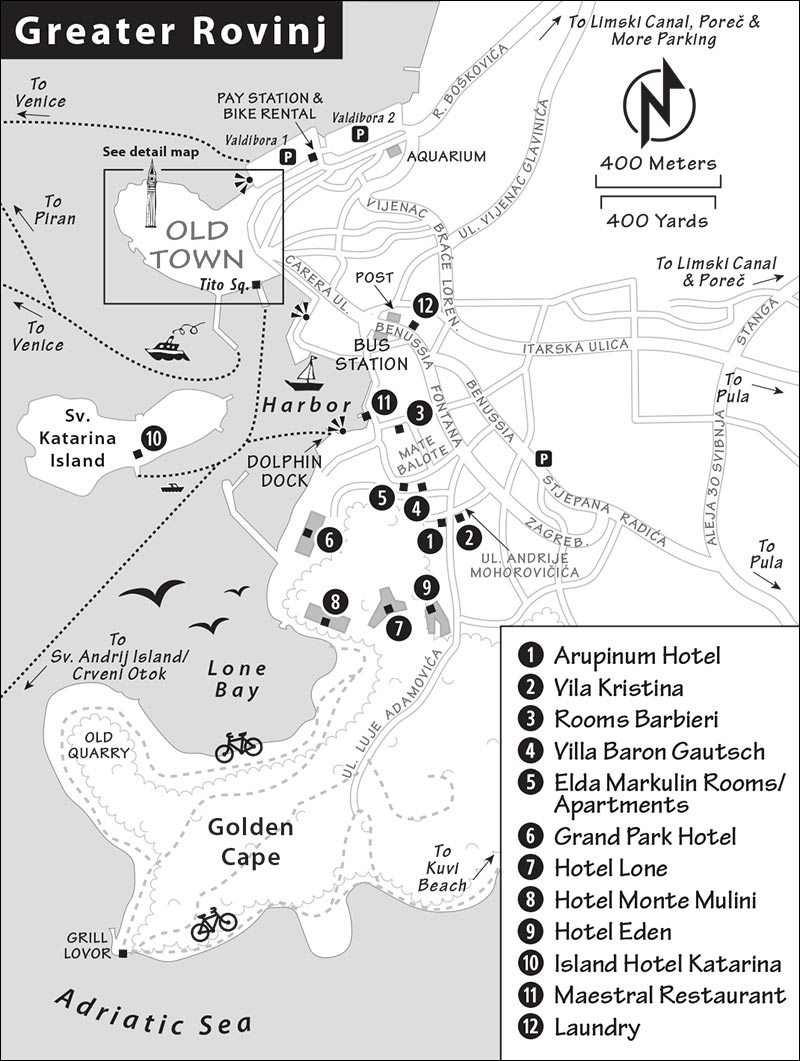
If you’re just visiting for the day—or if you’re on your own to find parking—the most convenient option is the big waterfront Valdibora parking lots just north of the Old Town, which come with the classic Rovinj view (€1.10/hour, about double in July-Aug and half-price off-season). As you drive in from the highway through the outskirts of Rovinj, the road forks, sending most hotel traffic to the left (turn off here if you’re staying outside the Old Town); but if you want to reach the Old Town, go right instead, then follow Centar signs, which eventually lead you directly to the two Valdibora lots: Valdibora 2 (a.k.a. Little/Mala Valdibora, farther from the Old Town), then Valdibora 1 (a.k.a. Big/Velika Valdibora, closer to the Old Town).
During busy times, one or both of the Valdibora lots may be reserved for residents, or simply full. In this case, you’ll be pushed to another pay lot farther out called Nova Hladnjača, along the bay northwest of the Old Town (same rates). There are other, smaller lots scattered around the city; the TI website has detailed maps and rates. Even if the Valdibora lots are available, budget-oriented drivers may prefer these cheaper outer lots—the cost adds up fast if you’re parking over several nights (rates in the big lots are charged 24/7—there’s no overnight discount).
By Bus: The bus station is on the south side of the Old Town, close to the harbor. Leave the station to the left, then follow the bustling, traffic-free Carera street directly into the center of town (and the entrance of the Old Town) in less than 10 minutes. If you’re sleeping in the mainland zone southeast of the Old Town, you’ll go in the opposite direction (see the “Greater Rovinj” map).
By Boat: The few boats connecting Rovinj to Venice, Piran, and Trieste may dock along the Valdibora parking lots north of the Old Town, or at the long pier protruding from the south side of the Old Town peninsula. Either way, it’s an easy stroll into town.
HELPFUL HINTS
Laundry: Smack-dab in the center, the coin-op Self-Service Laundry Rovinj is handy (daily 8:00-21:00, Zdenac 21, +385 99 450 9889). A full-service launderette, Galax, hides up the street beyond the bus station. You can usually pick up your laundry after 24 hours, though same-day service is possible if you drop it off early enough in the morning (Mon-Fri 8:00-15:00, Sat until 12:00, closed Sun; in July-Aug can have much longer hours; up Benussia street past the bus station, on the left after the post office, +385 52 816 130).
Local Guide: Pula-based Mariam Abdelghani can come meet you for a tour in Rovinj (see listing in the Pula section later in this chapter).
Best Views: The town is full of breathtaking vistas. Shutterbugs are very busy in the magic hours of early morning and evening, and even by moonlight. The postcard view of Rovinj is from the parking lot embankment at the north end of the Old Town (at the start of the “Rovinj Ramble,” next)—the light is best here in the morning. For a different perspective on the Old Town, head for the far side of the harbor on the opposite (south) end of town. The church bell tower provides an almost aerial view of the town and a grand vista of the outlying islets.
Rovinj Ramble
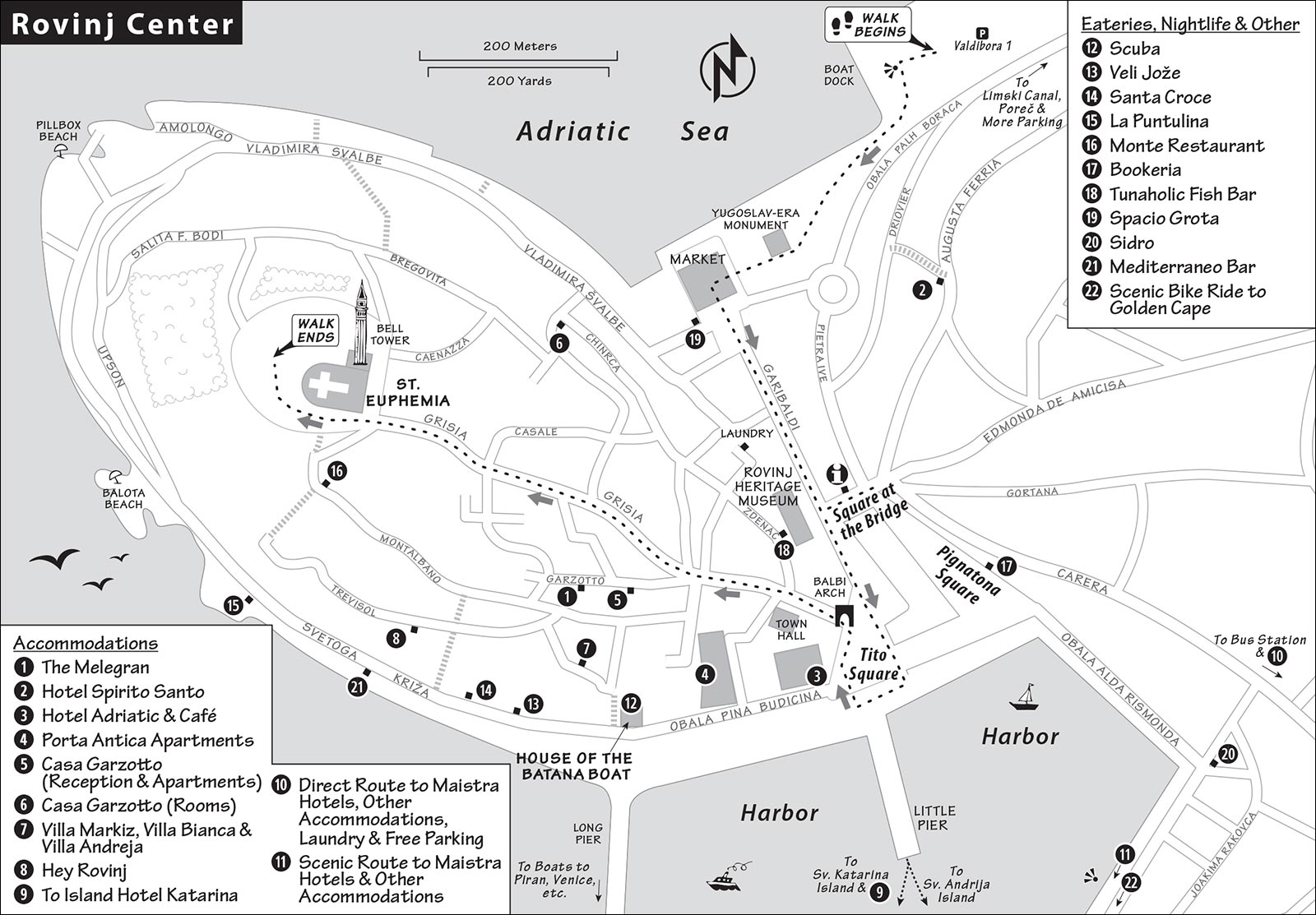
This self-guided walk, rated ▲▲▲, introduces you to Rovinj in about an hour. Begin at the Valdibora 1 parking lot just north of the Old Town. Stand at the end of the lot that faces the...
Old Town View
Many places offer sweeping views of Rovinj’s Old Town, but this is the most striking. Boats bob in the harbor, and behind them Venetian-looking homes seem to rise from the deep.
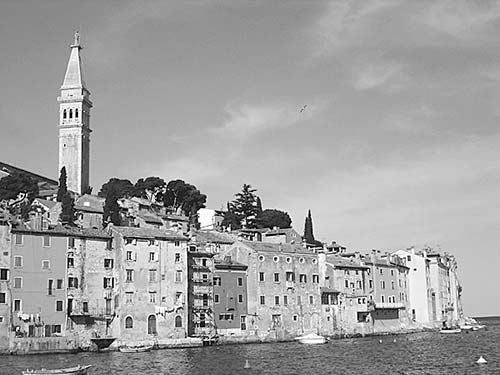
The Old Town is topped by a church, whose bell tower is capped by a weathervane in the shape of Rovinj’s patron saint, Euphemia. Local fishermen look to this saintly weathervane for direction: When Euphemia is looking out to sea, it means the stiff, fresh Bora wind is blowing, bringing dry air from the interior...a sailor’s delight. But if she’s facing the land, the humid Jugo wind will soon bring bad weather from the sea. After a day or so, even a tourist learns to look to St. Euphemia for the weather forecast. (For more on Croatian winds and weather, see “The Bora” sidebar near the end of this chapter.)
As you soak in this scene, ponder how the town’s history created its current shape. In the Middle Ages, Rovinj was an island surrounded by a double wall—a protective inner wall and an outer seawall. Because it was defended so well against pirates and other marauders (and carefully quarantined from the plague), it was extremely desirable real estate. And yet, it was easy to reach from the mainland, allowing it to thrive as a trading town. With more than 10,000 residents at its peak, Rovinj became immensely crowded, which explains today’s pleasantly claustrophobic Old Town.
Over the centuries—as demand for living space trumped security concerns—the town walls were converted into houses, with windows grafted on to their imposing frame. Gaps in the wall, with steps that seem to end at the water, are where fishermen would pull in to unload their catch directly into the warehouses on the bottom level of the houses. (Later you can explore some of these lanes from inside the town.) Today, if you live in one of these houses, the Adriatic is your backyard.
• Now head into town. In the little park near the sea, just beyond the end of the parking lot, look for the big, blocky...
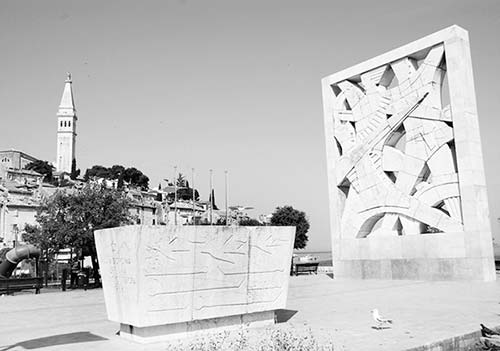
Yugoslav-Era Monument
Dating from the time of Tito, this bulky monument celebrates the Partisan Army’s victory over the Nazis in World War II and commemorates the victims of fascism. The minimalist reliefs on the ceremonial tomb show a slow prisoners’ parade, the victims prodded by a gun in the back from a figure with a Nazi-style helmet. Notice that one side of the monument is in Croatian, the other Italian.
• Now walk a few more steps toward town and past the playground, stopping to explore the covered...
Market
The front part of the market, near the water, is for souvenirs. But natives delve deeper, to the produce stands. In both areas, merchants aggressively push free samples. Everything is local and mostly homemade. Consider this snack-time tactic: Loiter around, joking with the farmers while sampling their various tasty walnuts, figs, cherries, grapes, olive oils, honey, rakija (the powerful fruit brandy popular throughout the Balkans), and more. If the sample is good, buy some more for a picnic. In the center of the market, a delightful and practical fountain from 1908 reminds locals of the infrastructure brought in by their Habsburg rulers more than a century ago. The fish market labeled Ribarnica/Pescheria at the back of the market is where locals gather ingredients for their favorite dish, brodet—a stew of various kinds of seafood mixed with olive oil and wine. It’s slowly simmered and generally served with polenta.
• Continue up the broad street, named for Giuseppe Garibaldi—one of the major players in mid-19th-century Italian unification. Imagine: Even though you’re in Croatia, Italian patriots are celebrated in this very Italian-feeling town (see the “Italo-Croatia” sidebar later in this chapter). After one long block, on your left, you’ll come to the wide cross street called...
Square at the Bridge (Trg na Mostu)
This marks the site of the medieval bridge that once connected the fortified island of Rovinj to the mainland (as illustrated in the small painting above the door of the Kavana al Ponto—“Bridge Café”). Back then, the island was populated mostly by Italians, while the mainland was the territory of Slavic farmers. But as Rovinj’s strategic importance waned and its trading status rose, the need for easy access became more important than the canal’s protective purpose—so in 1763, it was filled in. The two populations integrated, creating the bicultural mix that survives today.
Notice the breeze? Via Garibaldi is nicknamed Val di Bora (Valley of the Bora Wind) for the constant cooling wind that blows here. On the left side of Trg na Mostu is the TI; on the right is the Rovinj Heritage Museum (described later, under “Sights in Rovinj”). Next door, the town’s stately, yellow cultural center posts lovingly hand-lettered signs in Croatian and Italian announcing upcoming musical events (generally free, designed for locals, and worth noting and enjoying). Next to that is an outlet of Bonbonnière Kraš, Croatia’s favorite chocolate company.
Nearby (just past Kavana al Ponto, on the left), the Viecia Batana Café—named for Rovinj’s unique, flat-bottomed little fishing boats—has a retro interior with a circa-1960 fishermen’s mural that evokes an earlier age. The café is popular for its desserts (the chocolate cake is tasty).
• Now proceed down Garibaldi to the little fountain in the middle of the square, facing the harbor.
Tito Square (Trg Maršala Tita)
This wide-open square at the entrance to the Old Town is the crossroads of Rovinj. The fountain, with a little boy playing a fish like a bagpipe, celebrates the government-funded water system that finally brought running water to the Old Town in 1959. Walk around the fountain, with your eyes on the relief, to see a successful socialist society at the inauguration of this new water system. Despite the happy occasion, the figures are pretty stiff, in accordance with the idealized aesthetic of Socialist Realism.
Now walk out along the concrete pier, called the Mali Molo (Little Pier). From here, you’re surrounded by Rovinj’s crowded harbor, with fishing vessels and excursion boats that shuttle tourists out to the offshore islands. If the weather’s good, a boat trip can be a fun way to get out on the water for a different angle on Rovinj.
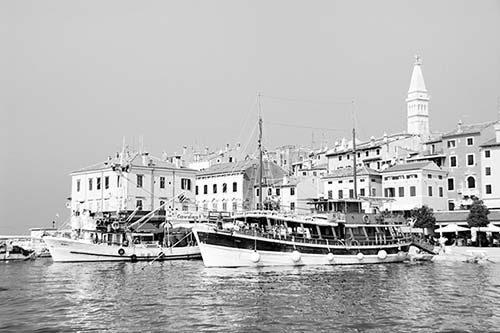
Scan the harbor. Slowly pan across the rainbow-striped houses on the inland side. At the end of this row, look for the building marked MMC, the local meeting and concert hall. Looking farther right, you’ll see the Grand Park Hotel, a posh, five-star resort with its own glitzy yacht harbor. A recommended bike path starts just past this area, leading into a nature preserve and the best nearby beaches. For more on boat trips and bike rentals, see “Activities in Rovinj,” later.
Now head back to the base of the pier. A short walk to the left are the House of the Batana Boat museum and a delightful restaurant row with several tempting places for a drink or a meal. Fishermen pull their boats into this harbor and carry their catch across the street to a waiting restaurateur.
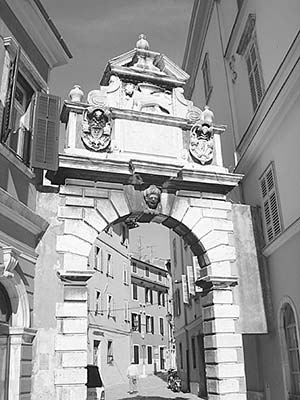
But for now, we’ll head up into the heart of town. Go straight past the fountain (backtracking a bit), then look left to find the Old Town entrance gate, called the Balbi Arch, tucked next to the Hotel Adriatic. On top, the winged lion of St. Mark is a reminder that this was Venetian territory for centuries.
Apart from its tangible attractions, one of Istria’s hallmarks is its biculturalism: It’s an engaging hybrid of Croatia and Italy.
Like most of the Croatian coast, Istria has been controlled by Romans, Byzantines, Slavs, Venetians, and Austrians. After the Habsburgs lost World War I, most of today’s Croatia joined Yugoslavia—but Istria became part of Italy. During this time, the Croatian vernacular was suppressed, while the Italian language and culture flourished. But this extra chapter of Italian rule was short-lived.
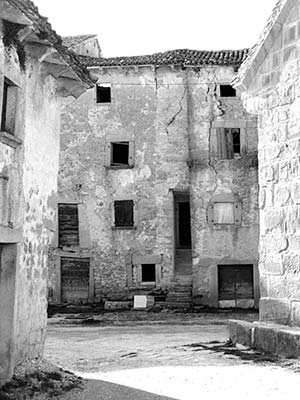
After World War II, Istria joined Yugoslavia, and Croatian culture and language returned. What followed was a so-called Italian exodus, during which many Istrian Italians were forced to relocate to Italy—leaving behind hill towns, valley villages, and farm estates that are abandoned even to this day.
The Istrians who stayed behind were saddled with an identity crisis. Many people here found it difficult to abandon their ties to Italy, and continued to speak the language and embrace the culture. Today, depending on whom you ask, Istria is the most Italian part of Croatia...or the most Croatian part of Italy. Istria pops up on Italian weather reports. Former Italian prime minister Silvio Berlusconi once declared that he still considered Istria part of Italy—and he wanted it back. When I wrote an article about Istria for a newspaper, some Italian readers complained that I made it sound “too Croatian,” while some Croatians claimed my depiction was “too Italian.”
People who actually live here typically don’t worry about the distinction. Locals insist that they’re not Croatians and not Italians—they’re Istrians. They don’t mind straddling two cultures. Both languages are official (and often taught side by side in schools), street signs are bilingual, and most Istrians dabble in each tongue—often seeming to foreign ears as though they’re mixing the two at once.
As a result of their tangled history, Istrians have learned how to be mellow and take things as they come. They tend to be gregarious and open-minded, and sometimes seem to thrive on chaos. A twentysomething local told me, “My ancestors lived in Venice. My great-grandfather lived in Austria. My grandfather lived in Italy. My father lived in Yugoslavia. I live in Croatia. My son will live in the European Union. And we’ve all lived in the same town.”
• Head through the gate into the Old Town. Inside and on the left is the red...
Town Hall
On the old Town Hall, spot another Venetian lion, as well as other historic crests embedded in the wall. Notice that the building flies a cacophony of flags: Rovinj, Istria, Croatia, the EU...and Italy. The building also faces a square named for Giacomo Matteotti, a much-revered Italian patriot.
Continue a few more steps into town. You’ll find another little square, which once functioned as a cistern (collecting rainwater, which was pulled from a subterranean reservoir through the well you see today). The orange-ish building on your left is the Italian Union—yet another reminder of how Istria has an important bond with Italy.
• Now begin walking up the street past the Italian Union, bearing right, then left, up...
Grisia Street
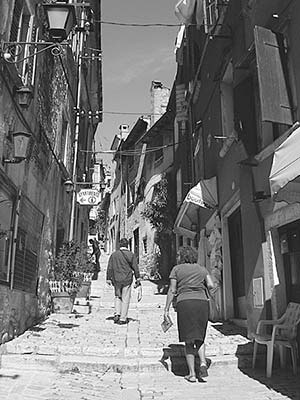
The main “street” (actually a tight lane) leading through the middle of the Old Town is choked with tourists during the midday rush and lined with art galleries and souvenir kitsch.
As you walk, keep your camera ready, as you can find delightful scenes down every side lane. Remember that, as crowded as it is today, little Rovinj was even more packed in the Middle Ages. Keep an eye out for arches that span narrow lanes (such as Arsenale street, on the right near the top). Many of these additions created hidden little courtyards, nooks, and crannies that make it easy to get away from the crowds and claim a corner of the town for yourself. The distinctive chimneys poking up above the rooftops are another sign of Rovinj’s overcrowding. These chimneys, added long after the buildings were first constructed, made it possible to heat previously underutilized rooms...and squeeze in even more people.
• Continue up to the top of Grisia. Capping the town is the can’t-miss-it...
▲Church of St. Euphemia (Sv. Eufemija)
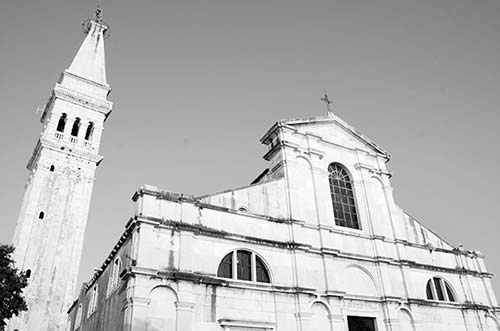
Rovinj’s landmark Baroque church was completed in 1736. It’s watched over by an enormous 190-foot-tall campanile, a replica of the famous bell tower on St. Mark’s Square in Venice. A copper weathervane with the weather-predicting St. Euphemia, the church’s namesake, tops the tower.
Cost and Hours: Free, generally open April-Oct daily 10:00-18:00, off-season open only for Mass and with demand.
Visiting the Church: Enter the church through its right transept. The vast, somewhat gloomy interior boasts some fine altars of Carrara marble (a favorite medium of Michelangelo’s). Services here are celebrated using a combination of Croatian and Italian, suiting the town’s mixed population.
To the right of the main altar (follow sarkofag signs) is the church’s highlight: the chapel containing the relics of St. Euphemia. Before stepping into the chapel, notice the altar featuring Euphemia—depicted, as she usually is, with her wheel (a reminder of her torture) and a palm frond (symbolic of her martyrdom), and holding the fortified town of Rovinj, of which she is the protector.
Now circle around behind this altar to find a gigantic tomb, and above, two large paintings that illustrate significant events from the life of this important local figure. Euphemia was the virtuous daughter of a prosperous early-fourth-century family in Chalcedon (near today’s Istanbul). She used her family’s considerable wealth to help the poor. Unfortunately, her pious philanthropy happened to coincide with anti-Christian purges by the Roman emperor Diocletian. When she was 15 years old, Euphemia was arrested for refusing to worship the local pagan idol. She was brutally tortured, her bones broken on a wheel. Finally she was thrown to the lions as a public spectacle. But, the story goes, the lions miraculously refused to attack her. You can see this moment depicted in one of the paintings above—as a bored-looking lion tenderly nibbles at her right bicep, while another benignly licks her ankle.
Flash forward to the year 800, when a gigantic marble sarcophagus containing St. Euphemia’s relics somehow found its way into the Adriatic and floated all the way up to Istria, where Rovinj fishermen discovered it bobbing in the sea. They tugged it back to town, where a crowd gathered. The townspeople realized what it was and wanted to take it up to the hilltop church. But nobody could move it...until a young boy with two small calves showed up, and said he’d had a dream of St. Euphemia. In the second painting, see the burly fishermen looking astonished as the boy succeeds in moving the giant sarcophagus to its present location. Note the depiction of Rovinj fortified by a double crenellated wall—looking more like a castle than like the creaky fishing village of today. At the top of the hill is an earlier version of today’s church.
Now turn your attention to Euphemia’s famous sarcophagus. The front panel (with the painting of Euphemia) is opened with much fanfare every September 16, St. Euphemia’s feast day, to display the small, withered, waxen face of Rovinj’s favorite saint.
• If you have time and energy, consider climbing the...
Bell Tower
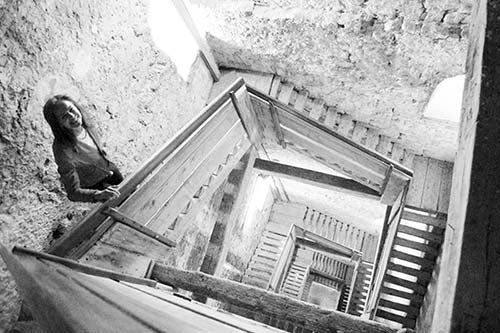
Scaling the church bell tower’s creaky wooden stairway requires an enduring faith in the reliability of wood. It rewards those who brave its 189 stairs with a commanding view of the town and surrounding islands. The climb doubles your altitude, and from this perch you can also look down—taking advantage of the quirky little round hole in the floor to photograph the memorable staircase you just climbed.
Cost and Hours: €3, same hours as church, enter from inside church—to the left of the main altar.
• Leave the church and head out to the plaza in front of the bell tower, overlooking the Adriatic. Your walk is over. A peaceful café on a park terrace (once a cemetery) is just ahead of and below you. Just to the right, a winding, cobbled lane leads past the café entrance and zigzags down toward the water, then forks. A left turn here takes you past a WWII pillbox (under the little lighthouse), passes the popular Balota Beach (i.e., chunky rocks with sunbathers and swimmers), and leads along the restaurant row, where you can survey your options for a drink or a meal (see “Eating in Rovinj,” later). A right turn curls you down along the quieter northern side of the Old Town peninsula. Either way, Rovinj is yours to enjoy.
Sights in Rovinj
▲House of the Batana Boat (Kuća o Batani)
Rovinj has a long, noble shipbuilding tradition, and this humble-but-endearing museum gives you the story of the town’s distinctive batana boats. The flat-bottomed vessels, favored by local fishermen for their ability to reach rocky areas close to shore that are rich with certain shellfish, are an important local symbol. This is a good option for a rainy day, to escape the blazing sun, or for anyone who enjoys vivid examples of local folk culture.
Cost and Hours: €4; daily May-Sept 10:00-13:00 & 18:00-21:00, June-Aug until 23:00; Oct-Nov and March-April 10:00-16:00; closed Dec-Feb; Obala Pina Budicina 2, +385 52 812 593, www.batana.org, Ornella.
Visiting the Museum: The modern exhibit, essentially one big room of display cases, tells the story of the batana and the community it represents. The centerpiece is an engrossing vertical film that depicts fishermen paddling out to sea, spearing fish from their boat, and eventually bringing in their catch. You’ll enjoy some beautiful bitinada—local music with harmonizing voices that imitate instruments (similar to Dalmatian klapa)—while they bring in the catch and organize their nets. Upstairs, look for a listening station where you can hear a poem, a children’s song, and a folk tune in the local dialect.
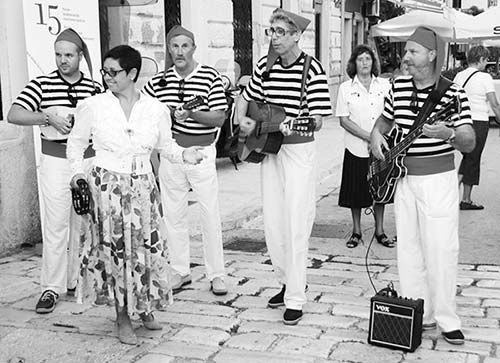
Activities: The museum, which serves as a sort of cultural heritage center for the town, also presents a variety of engaging batana-related activities. For details, see “Nightlife in Rovinj,” later.
Rovinj Heritage Museum (Zavičajni Muzej Grada Rovinja)
This museum, filling an old mansion right where the Old Town meets the mainland, is closed for an extensive renovation, likely through 2024. It combines obscure art, exhibits on local history, and sometimes tourist-baiting temporary exhibits on big-name international artists (Dalí, Miró, etc.) that have nothing to do with Rovinj. Ask at the TI or drop in to see whether the museum has reopened, and what the current exhibits might be (Trg Maršala Tita 11, www.muzej-rovinj.hr.).
Activities in Rovinj
Boat Trips
For a different view of Rovinj, consider a boat trip. The scenery is pleasant rather than thrilling, but the craggy, tree-lined coastline and offshore islets are a lovely backdrop for an hour (or a few) at sea. You’ll see captains hawking boat excursions at little shacks all along Rovinj’s harbor. The most common option is a loop around the Golden Cape (Zlatni Rt) and through Rovinj’s own little archipelago (usually about €15, or €20 at sunset). A two-hour “dolphin safari” costs around €20. Or, for a longer cruise, consider the four-hour sail north along the coast and into the underwhelming Limski Canal (a.k.a. Limski Fjord), where you’ll have one to two hours of free time (€25-30). Dolphin sightings on this trip are not unusual, and some outfits throw in a “fish picnic” en route for extra. Stroll the harbor and comparison-shop.
You can also take a boat to one of the larger offshore islands. This lets you get away from the crowds and explore some relatively untrampled beaches. These boats—run by the big hotel chain with branches on those islands—depart about hourly from the end of the concrete pier (known as the Mali Molo, or Little Pier) in the Old Town. The two choices are Sveti Katarina (“St. Catherine”—the lush, green island with a recommended hotel, just across the harbor, about a 5-minute trip, €8) and Sveti Andrija (“St. Andrew,” which locals also call Crveni Otok, or “Red Island”—farther out, about a 15-minute trip, boats may be marked “Hotel Istra,” €11). Boats also depart for both of these islands regularly from what locals call the “Dolphin Dock,” around the harbor near the Grand Park Hotel (same prices; see “Greater Rovinj” map, earlier).
▲Swimming and Sunbathing
Rovinj doesn’t have any sandy beaches—just rocky ones. (The nearest thing to a sandy beach is the small, finely pebbled beach on the island of Sv. Andrija/Crveni Otok.) The most central spot to swim or sunbathe is at Balota Beach, on the rocks along the embankment on the south side of the Old Town peninsula, just past La Puntulina restaurant (no showers, but scenic and central, with nice afternoon sun). On good-weather days, Balota can get crowded; if you continue around Rovinj’s peninsula to the tip, just before the old WWII pillbox, you’ll find the more secluded Pillbox Beach, where steep steps lead you down to a cluster of more secluded rocks. Valentino cocktail bar, along the restaurant row closer to the heart of town, becomes a small, rocky beach during the day, when the bar itself is closed.
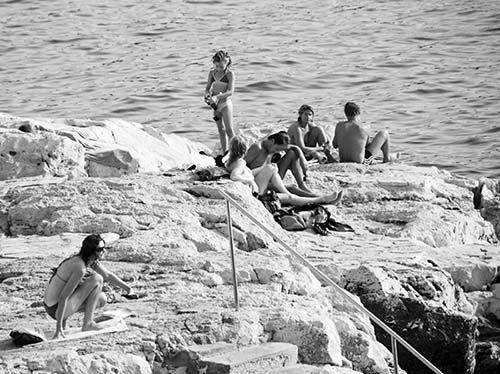
For bigger beaches, go—perhaps by bike (see next)—to the wooded Golden Cape (Zlatni Rt) south of the harbor (past the big, waterfront Grand Park Hotel). This cape is lined with walking paths and beaches, and shaded by a wide variety of trees and plants. For a scenic sunbathing spot, choose a perch facing Rovinj on the north side of the Golden Cape. Another beach, called Kuvi, is beyond the Golden Cape. Or, to get away from it all, take a boat to an island on Rovinj’s little archipelago (see previous listing).
▲Bike Ride
The TI’s free, handy biking map suggests a variety of short and long bike rides. The easiest and most scenic is a quick loop around the Golden Cape (Zlatni Rt). You can do this circuit and return to the Old Town in about an hour (without stops). Start by biking south around the harbor and past the waterfront Grand Park Hotel, where you leave the cars behind and enter the wooded Golden Cape. Peaceful miniature beaches abound, and the bike path sticks to the coast. (For an optional detour, look for the lane that climbs up to a quarry—much of Venice was paved with Istrian stone—where you might see novice rock climbers inching their way up and down.) Circling the peninsula, you hit the Grill Lovor (with drinks and light meals, open only in summer)—a cute little restaurant housed in the former stables of the Austrian countess who planted what today is called Wood Park. From there, you can continue farther along the coast or return to town (backtrack two minutes and take the right fork through the woods back to the waterfront path).
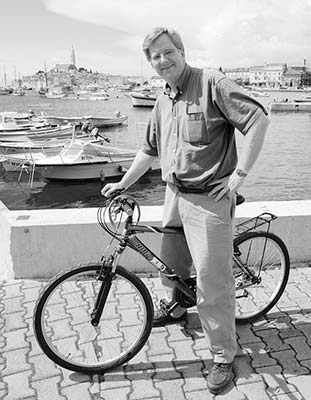
For a more ambitious, inland pedal, ask the TI (or your bike-rental shop) about the Štrika Ferata, a rails-to-trails bike path that leads 13 miles inland; or the 12-mile Staza Basìlica loop that connects several old churches.
Bike Rental: Bikes are rented at subsidized prices from the city parking-lot kiosk (€1.10/hour, open 24 hours daily but no rentals off-season). Various travel agencies around town rent bikes for much more (closer to €5/hour); look for signs—especially near the bus station—or ask around.
Nightlife in Rovinj
Rovinj is a delight after dark. Views that are great by day become magical in the moonlight and floodlight. The streets of the Old Town are particularly inviting when empty and starlit.
Concerts
Lots of low-key musical events take place right in town (ask at the TI, check the events calendar at www.rovinj-tourism.com, and look for handwritten signs in Croatian and Italian on Garibaldi street near the Square at the Bridge, across from the TI). Groups perform at various venues around town: right along the harborfront (you’ll see the bandstand set up); in the town’s churches (especially St. Euphemia and the Franciscan church); in the old cinema/theater by the market; at the pier in front of the House of the Batana Boat (described earlier, under “Sights in Rovinj”); and at the Multi-Media Center (a.k.a. the MMC, which locals call Cinema Belgrade—its former name), in a cute little hall above a bank across the harbor from the Old Town.
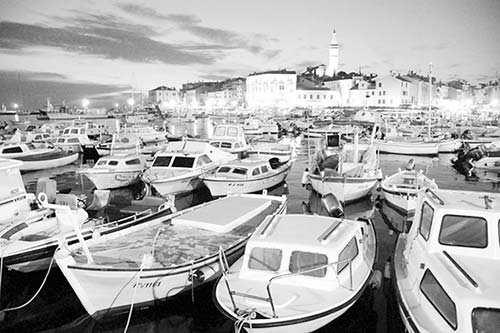
Waterfront Bars “On the Rocks”
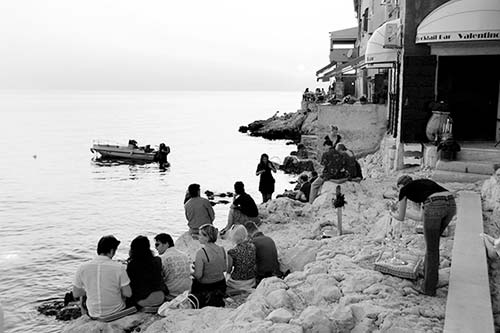
Rovinj’s restaurant row includes some bars with tables scattered along the rocky seawall. At sunset or just after, this can be an impossibly romantic and memorable place to sip an overpriced drink. Wander along this strip and see which spot catches your eye. The chichi Valentino feels snobby, exclusive, and very expensive, so I prefer Mediterraneo. It’s easy to miss—look for the orange doorway that seems to end at the Adriatic. The drinks are more affordable (€8-15 beer, wine, and cocktails) and the vibe is welcoming and mellow (daily 9:00-late, closed Oct-Easter, +385 91 532 8357). Or consider La Puntulina, out at the end of this strip, with a similarly rocky ambience and higher prices (listed later, under “Eating in Rovinj”).
Batana Boat Activities
In summer, the House of the Batana Boat (described earlier) often hosts special events. On some summer evenings, you can take a batana boat trip, accompanied by traditional music, from the pier near the museum. The boat circles the end of the Old Town peninsula and docks on the far side, where a traditional wine cellar has a fresh fish dinner ready, with local wine and more live music (June-mid-Sept, boat trip costs €15 and runs nightly around 19:30, dinner available twice weekly—usually Tue and Thu—and costs €35 extra, visit or call the museum the day before to reserve). Also on some summer evenings, you can enjoy an outdoor food market with traditional Rovinj foods and live bitinada music. The centerpiece is a batana boat being refurbished before your eyes (in front of museum, light food, mid-June-mid-Sept generally Tue, Fri, and Sun 20:00-23:00). There’s also a flurry of special activities on the weekend before St. Euphemia Day (Sept 16).
Sleeping in Rovinj
Don’t show up here without a room in August, when Rovinj is packed (and when one-night stays may not be possible). Locating these places may challenge even the ablest of route finders. Just ask—locals are happy to point you in the right direction.
IN THE OLD TOWN
While it’s a time-warp delight to sleep deep in the center of Rovinj, it also comes with some unique challenges: steep, sometimes stepped lanes; tricky-to-find locations; musty smells; cramped old buildings with tight staircases; and the likelihood of some nighttime noise (the town can be quite rowdy in July and August—try requesting a quieter room...and bring earplugs). Sleeping here also requires parking off-site (your accommodations should have some advice, or even a golf-cart shuttle into town; ask when you book, and see “Arrival in Rovinj—By Car,” earlier). But it’s hard to resist this central and oh-so-atmospheric location. My first three listings are fancy, borderline-posh hotels, suitable for a splurge; the rest are simpler and more characteristic (and quirky).
$$$$ The Melegran is owned by Londoners, and you can tell: The 17 rooms (in three buildings) blend a respect for Rovinj tradition with posh polishes that appeal to a young, international clientele. There’s also a fun little “speakeasy” bar, and those who book direct get several extras: free parking with shuttle service, free breakfast, free bike rental, and so on (air-con, Garzotto 14, +385 5230 5099, https://melegran.com, heretohelp@melegran.com).
$$$$ Hotel Spirito Santo offers high-end comfort in the less crowded, off-the-beaten-path mainland part of the Old Town—just a few minutes’ walk from the bustle of Rovinj. It fills three old 1920 buildings with seven mod rooms, plus four suites in a nearby house (includes breakfast, air-con, elevator for suites but not rooms, free parking and shuttle service, Augusta Ferrija 44—head down the little stepped lane on the left to find reception, +385 99 435 4333, https://hotel-spiritosanto.com, info@hotel-spiritosanto.com).
$$$$ Hotel Adriatic features 18 rooms overlooking the main square, where the peninsula meets the mainland. The only Old Town branch of the big chain of Maistra hotels (described later), this is a four-star splurge with an unbeatable location (includes breakfast, air-con, elevator, free parking, Trg Maršala Tita, +385 52 803 512, www.maistra.hr, adriatic@maistra.hr).
$$$ Porta Antica rents 21 comfortable, traditionally decorated apartments in six buildings around the Old Town (all but two are on the peninsula; some suffer from nighttime noise)—but conveniently, all are managed from a single reception. The five rooms in the main building include breakfast and feel more like a cohesive guesthouse. Review your options on their website and be specific in your request (air-con, reception and main building on Obala Pina Budičina between Hotel Adriatic and the House of the Batana Boat museum, +385 99 680 1101, www.portaantica.com, rovinj@portaantica.com, Claudia and Petra).
$$-$$$ Casa Garzotto is loosely and gregariously run, with five apartments and five rooms in three Old Town buildings. Rooms in the main building are more expensive and include breakfast in the atmospheric time-warp lounge, while the annex buildings are cheaper. All strive to re-create an appealingly old-timey personality (antique furniture, historic family portraits), though with modern facilities—the owner is pointedly “anti-IKEA” and determined to retain a traditional character (lots of stairs, reception and most apartments are at Garzotto 8, others are a short walk away, free valet parking, free loaner bikes, +385 52 811 884, mobile +385 99 800 7338, www.casa-garzotto.com, casagarzotto@gmail.com).
$$-$$$ Villa Markiz, Villa Bianca, and Villa Andreja are three side-by-side townhouses, buried on a quiet street in the Old Town, run by Milica (sounds like “Melissa”). Lodgings range from small budget rooms with barely a window to a lavish multiroom penthouse apartment with sea views. Milica’s husband, Andrej, has designed the stylish rooms—most accessed via narrow, steep stone steps—to maximize every square inch...so your window might look out over your neighbor’s patio. While this can feel tight, it accurately captures life in the antique center of Rovinj, where the quarters have always been close. Be clear on which room you’re requesting, based on your price point and preference of space and amenities (air-con, Pod Lukovima 1, +385 91 909 8480, https://markizrovinj.com, info@markizrovinj.com).
$ Hey Rovinj, at the top of town, feels fresh, creative, and youthful, with four apartments and two rooms—all of them nicely equipped and a great value (Trevisol 54, +385 91 614 3006, www.heyrovinj.com, booking@heyrovinj.com).
ON THE MAINLAND, SOUTHEAST OF THE OLD TOWN
To escape the high prices, nighttime noise, and parking headaches of Rovinj’s Old Town, consider the resort neighborhood just south of the harbor. These are a 10-to-20-minute walk from the historic center along the very scenic harborfront—hardly an unpleasant commute. While the big Maistra hotels are an option, I prefer better-value alternatives in the same area. Given the cost and inconvenience of parking for those sleeping in the Old Town (see “Arrival in Rovinj,” earlier, for details), accommodations in this area are handy for drivers. Unless otherwise noted, breakfast is not provided. For locations, see the “Greater Rovinj” map, earlier.
Guesthouses and Small Hotels
These are a bit closer to the Old Town than the Maistra hotels, and offer much lower rates and more personality. The first two sit up on the hill behind the big resort hotels; the rest are farther down toward the Old Town.
$$$ Arupinum Hotel is an inviting splurge that—in terms of price and comfort—fills a niche between most of my guesthouse listings and the fancy Maistra hotels described later. It has a classy lobby/breakfast room, a small private swimming pool with some poolside tables, and 20 rooms (big discounts for direct bookings, includes breakfast, air-con, elevator, free parking, Luje Adamovića 29, +385 52 853 750, www.arupinum-rovinj.com, hotelarupinum@providus.hr).
$$ Vila Kristina, conscientiously run by Kristina Kiš and her family, is a guesthouse renting 10 modern, stylish rooms and five apartments (most with balconies) in a solidly built home along a busy road (air-con, no elevator, Luje Adamovića 16, +385 52 815 537, www.vila-kristina.com, vilakristina1@gmail.com).
$ Rooms Barbieri, run by outgoing Haidi and her mother, Vilma, are a few steps from the waterfront but secluded amid the trees. There are five simple-but-comfy rooms, most with a nice terrace (breakfast extra, cash only, free parking, behind Tommy supermarket at Obala Vladimira Nazora 4, +385 98 976 4482, www.barbieri-rovinj.com [URL inactive], vilmabarbieri@yahoo.it).
$ Villa Baron Gautsch, named for a shipwreck, is a German-owned pension with 16 tight, cozy rooms. It’s nothing fancy, but it comes with an inviting shared terrace (includes breakfast, cash only, air-con, closed late Oct-Easter, Ronjgova 7, +385 52 840 538, www.villabarongautsch.com, baron.gautsch@gmx.net, Sanja).
$ Elda Markulin rents three rooms and four apartments in a modern house a short walk up from the main harborfront road. This is a good option for simple, affordable lodgings (cash only, free parking, Mate Balote 12, +385 52 811 018, mobile +385 95 900 8654, markulinelda@gmail.com). To reach it from the Old Town, walk along the waterfront; after you pass the recommended Maestral restaurant on your right, turn left just before the park onto the uphill Mate Balote and follow the road as it curves.
Maistra Hotels
The local hotel conglomerate, Maistra, has several extremely expensive hotels in the lush parklands just south of the Old Town and on nearby islands. Maistra hotels have extremely slippery pricing, based on the type of room, the season, how far ahead you book, the length of your stay, and little hairs on the back of the manager’s neck standing up. (For specific rates, plug your dates into the form at www.maistra.hr.) All hotels have air-conditioning and elevators, and include breakfast in their rates; most have free parking and close during the winter. (The only Maistra hotel in the Old Town—$$$$ Hotel Adriatic—is described earlier.)
$$$$ Grand Park Hotel is the chain’s flagship and its most convenient for walking into town, via a 10-minute stroll entirely along the stunning harborfront promenade. Completely rebuilt in 2019, it has 209 five-star rooms overlooking a yacht harbor, plus a waste-of-space atrium with gobsmacking views toward the Old Town. It’s the kind of hotel you just want to wander around and ogle, even if you can’t afford to sleep here.
$$$$ Hotel Lone (LOH-neh), with 248 rooms, comes in a close second on the “most impressive hotels” list; the soaring atrium feels like a modern art museum, and room rates can soar here, too.
$$$$ Hotel Monte Mulini is a “design hotel” with five stars, 99 rooms and 14 suites (all with seaview balconies), a beautiful atrium with a huge glass wall overlooking the cove, and an infinity pool.
$$$ Hotel Eden offers four stars and 325 upscale, imaginatively updated rooms with oodles of contemporary style; it’s a smidge less expensive than most of the chain’s hotels.
$$ Island Hotel Katarina is the castaway’s choice, with 110 rooms occupying the hotel’s own little island just offshore from the Old Town—complete with a park, beaches, and a swimming pool. It’s connected by an hourly boat (free for guests) to the Old Town pier. Some find this inconvenient, but most who opt to sleep here consider it romantic (and a nice escape from the crowds and noise of the Old Town). Note that it may be closed for renovation in the near future, but for now, it’s Maistra’s most affordably priced branch. The chain has other branches, but I wouldn’t consider them.
Eating in Rovinj
Interchangeable restaurants cluster where Rovinj’s Old Town peninsula meets the mainland, and all around the harbor. The quality is generally good, and you’ll find truffle dishes on most menus (see the “Istrian Food and Wine” sidebar, earlier); I’ve selected places that are well established or offer something unique. Be warned that most eateries—like much of Rovinj—close for the winter (roughly mid-Oct to Easter). If you’re day-tripping into the Istrian interior, consider dining at one of the excellent restaurants in or near Motovun (see here), then returning to Rovinj after dark.
IN THE OLD TOWN
Prices are a bit higher inside the Old Town, but the atmosphere is marvelous.
Along Rovinj’s Restaurant Row
The easiest dining option is to stroll the Old Town embankment overlooking the harbor. Window-shop the eateries along here, each of which has its own personality: Some have sea views, others are set back on charming squares, and still others have atmospheric interiors. I’ve listed these in the order you’ll reach them (all open daily for lunch and dinner, unless otherwise noted; most are closed in the winter).
$$ Hotel Adriatic, the swanky hotel smack in the middle of town and at the start of this strip, operates a café with cushy outdoor seating and affordable sandwiches, salads, and snacks. If you’d like to nibble a light meal while people-watching, this is the place. They also have a pricier restaurant menu, but I’d skip it (breakfast 7:00-12:00, full menu 12:00-23:00, Trg Maršala Tita).
$$$ Scuba is closest to the harbor—so, they claim, they get first pick of the daily catch from arriving fishing boats. They serve both seafood and tasty Italian dishes at reasonable prices in a plain contemporary interior or at outdoor tables with partial harbor views (Obala Pina Budičina 6, +385 98 219 446).
$$$ Veli Jože—named for a mythical Istrian friendly giant—has a smattering of outdoor tables (no real views) and a rollicking, folksy interior decorated to the hilt. They offer a wide variety of pastas and tasty, traditional Istrian cuisine (Sv. Križa 1, +385 52 816 337).
$$$$ Santa Croce, with tables scattered along a scenic terraced incline that looks like a stage set, is well respected for its seafood and pastas. Classy and sedate, and with attentive service, it attracts a slightly older clientele (no sea views, Sv. Križa 11, +385 52 842 240).
$$$$ La Puntulina, at the end of the row, is the most scenic option. This upscale restaurant/wine bar features Istrian, Italian, and Mediterranean cuisine served in the contemporary dining room or outside—either on one of the many terraces, or at tables scattered along the rocks overlooking a swimming hole. As the outdoor seating is deservedly popular, reserve ahead (closed Wed, on the Old Town embankment past the harbor at Sv. Križa 38, +385 52 813 186, https://puntulina.eu, Miriam and Giovanni). You can also order just a drink to sip while sitting down on the rocks.
Elsewhere in the Old Town
$$$$ Monte Restaurant, perched at the top of town (just below the cathedral’s bell tower), landed Croatia’s first Michelin star a few years back. And it’s still going strong: With tables strewn around a covered terrace, this atmospheric place features inventive cuisine that melds Istrian products with international techniques. Come here only if you value a fine dining experience, polished service, and the chance to learn about local food and wines without regard for price. Reservations are a must (daily 18:30-23:00, Montalbano 75, +385 52 830 203, www.monte.hr, Đekić family).
$$$ Bookeria, tucked along a broad but quiet street just off the harbor, tries to be inventive despite their humdrum location. They embrace their book theme, and have mismatched-antique furniture and a fun-to-explore menu of Croatian and international dishes—all imaginatively presented. While dinners can get expensive, it’s a fun spot for breakfast—offering more variety than the run-of-the-mill Rovinj places—and is especially appealing at lunch, when they have a more affordable menu of sandwiches, burgers, and big salads (daily 9:00-23:00, Trg Pignaton, +385 91 219 0007).
$$ Tunaholic Fish Bar, tucked on a less-trampled side lane in the heart of the Old Town, offers a fresh spin on Croatian street food: a tasty and innovative variety of “tuna burgers,” other fishy sandwiches, and fish-and-chips using creative ingredients (shrimp, shark). Peruse the fascinating menu and order at the counter. They have only a few sidewalk tables, so if it’s busy, consider getting food to take away and enjoy with a water view (daily 10:00-22:00, Zdenac 11, +385 95 816 0315).
$ Spacio Grota is a local-feeling hole-in-the-wall at the back of Rovinj’s bustling covered market, with a few outdoor barrel tables (look for the yellow outdoor counters shaped like fishing boats). It’s a handy spot to sample a glass of local wine and have a small sandwich—or they can assemble a plate of local meats and cheeses, which works as a small meal or a big snack (Mon-Sat 7:00-21:00, Sun until 15:00, Trg Valdibora 7, +385 98 506 968).
AROUND THE HARBOR
Rovinj’s harbor is lined with eateries offering decent food, high prices, and great views. These are the only two worth seeking out. Sidro is closer to the Old Town, while Maestral is worth the (very scenic) longer walk.
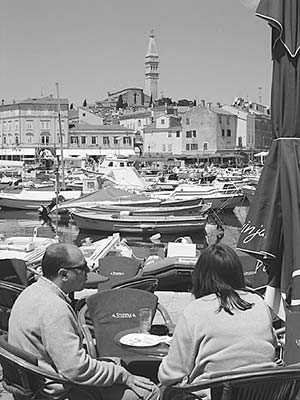
$$ Maestral combines affordable, straightforward seafood, pastas, and pizzas with Rovinj’s best view. Fish lovers might enjoy the “fishermen’s pie,” savory dough filled with anchovies and onions. If you want an outdoor table overlooking bobbing boats and the Old Town’s skyline—without breaking the bank—this is the place. It fills a big building on the embankment, surrounded by workaday shipyards, about a 10-minute walk from the Old Town, around the harbor toward Grand Park Hotel (daily 9:00-24:00, closed Oct-March, Obala Vladimira Nazora bb, +385 52 830 565). For location, see the “Greater Rovinj” map, earlier.
$$ Sidro, around the harbor with views back on the Old Town, has a typical crank-’em-out menu of pasta and fish. I’d pass on those (you’ll get better renditions elsewhere), but there are two reasons to come here: first, for the nice view, especially if you can get a table out on the seawall; and second, for their menu of Balkan specialties that are harder to come by at Rovinj’s tourist restaurants—such as ćevapčići and a spicy pork-and-onion stew called mućkalica. With a long tradition (run by three generations of the Paoletti family since 1966), it’s also a popular local hangout (daily 11:00-23:00, closed Nov-Feb, harborfront at Rismondo 14, +385 52 813 471).
BREAKFAST
Most rental apartments come with a kitchenette handy for breakfasts (stock up at a neighborhood grocery). Cafés and bars along the waterfront serve little more than an expensive croissant with coffee. The best budget breakfast (and a fun experience) is a picnic. Within a block of the market, you have all the necessary stops: mini-grocery stores (juice, milk, drinkable yogurt, and so on); market stalls (cherries, strawberries, walnuts, and more, as well as an elegant fountain for washing); a bread kiosk, Pekarna Laste, between the market and the water...plus benches with birds chirping, children playing, and fine Old Town views along the water.
To let someone else do the cooking, several cafés (including the recommended Hotel Adriatic and Bookeria) offer good breakfasts in a memorable setting; figure about €6-8 for an egg dish or other substantial breakfast.
Rovinj Connections
BY BUS
Multiple companies operate buses from Rovinj. Most domestic connections are by Arriva/Autotrans (+385 60 888 611, www.arriva.com.hr), with a few—mainly to Pula—by Brioni (+385 52 365 536, www.brioni.hr). Flixbus handles most of the international routes (online booking required at www.flixbus.com), with a few others by Pula-based Fils (www.fils.hr, +385 52 383 000). The all-Croatia website (https://getbybus.com) should catch most of the various connections.
The time-warp station is a bit confusing, as there are no electronic signboards showing upcoming buses or where they depart from, and the sales clerks aren’t particularly helpful. But it’s also quite small—there are really just two or three departure stalls, along the curb out front, so people just mill around until their bus pulls up. Ticket lines can be long, so it’s handy to prebuy tickets online (available on most operators, and required on Flixbus; you’ll be emailed a QR code the driver will scan as you board). Be aware that bus schedules are dramatically reduced on Saturdays and especially on Sundays, as well as (in some cases) off-season.
From Rovinj by Bus to: Pula (about hourly, 45 minutes), Poreč (5-7/day, 1 hour), Rijeka (5-7/day, 2-3.5 hours), Zagreb (nearly hourly, 3-6 hours).
To the Dalmatian Coast: It’s a long haul. An Arriva/Autotrans overnight bus departs Rovinj every evening at 19:00 for the Dalmatian Coast, arriving in Split at 6:00 and Dubrovnik at 11:00. On most days, there’s also an early-morning departure at 4:40. Additional options are possible with a change in Pula or Rijeka.
To Slovenia: In general, connections to Slovenia are tricky, especially to Piran—it’s easier, and often not much more expensive, to use the GoOpti shared shuttle service (described on here). For public buses, Flixbus is your best bet; they typically run one or two buses each day to Ljubljana (4-5 hours). If you want to reach Piran try changing in Portorož (check schedules and prebook at www.flixbus.com). Another site to check for the limited Slovenia connections is www.ap-ljubljana.si).
To Venice: Fils runs buses to Venice, typically leaving early (around 6:30) and going all the way to Piazzale Roma, on the island of Venice, in about five hours. In peak times, there may also be an afternoon connection to the train station in Mestre—or you could use the GoOpti shared shuttle service.
ROUTE TIPS FOR DRIVERS
Near Rovinj—Limski Canal: Just north of Rovinj, on the coastal road to Poreč, you’ll drive briefly along a seven-mile-long inlet dubbed the Limski Canal (Limski Kanal—sometimes called Limski Fjord, but only to infuriate Norwegians). Named for the border (Lim-it) between Rovinj and Poreč, this jagged slash in the landscape was created when an underground karstic river collapsed. Keen-eyed arborists will notice that the canal’s southern bank has deciduous trees, and the northern bank, evergreens. Many Venetian quarries once pulled stone from the walls of this canal to build houses and embankments. Supposedly the famed pirate Captain Morgan was so enchanted by this canal that he retired here, founding the nearby namesake town of Mrgani. Local tour companies sell boat excursions into the fjord, which is used to raise much of the shellfish that’s slurped down at local restaurants. While the canal isn’t worth going out of your way to see, you may skirt it anyway. Along the road above the canal, you’ll pass kiosks selling grappa (firewater, a.k.a. rakija), honey, and other homemade concoctions. The recommended Matošević winery is a two-minute drive away (see here).
Driving from Rovinj to Rijeka (and the Rest of Croatia): Istria meets the rest of Croatia at the big port city of Rijeka (described at the end of this chapter). There are two ways to get to Rijeka: The faster alternative is to take the ipsilon road via Pazin to the Učka Tunnel, which emerges just above Rijeka and Opatija (for Rijeka, you’ll follow the road more or less straight on; for Opatija, you’ll twist down to the right, backtracking slightly to the seashore below you). Or you can take the slower but more scenic coastal road from Pula via Labin. After going inland for about 25 miles, this road jogs to the east coast of Istria, which it hugs all the way into Opatija, then Rijeka.
From Rijeka, you can easily hook into Croatia’s expressway network (for example, take A-6 east to A-1, which zips you north to Zagreb or south to the Dalmatian Coast). For more driving tips, see the end of this chapter.
Pula
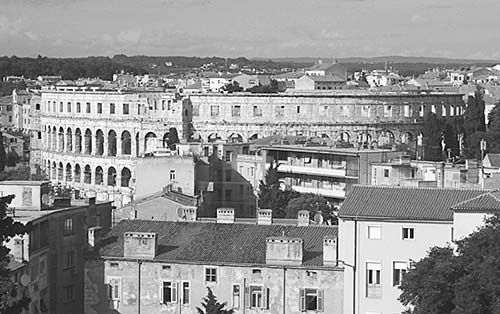
Pula (POO-lah, Pola in Italian)—Istria’s biggest city, with 56,000 inhabitants—is an industrial port town with traffic and sprawl...but it has the soul of a Roman poet. While it lacks Rovinj’s romance and vacation vibe, Pula offers far more substantial and satisfying sightseeing—making it a great side trip (and is worth ▲▲). Between the shipyards and the concrete apartment blocks, you’ll discover some of the top Roman ruins in Croatia, including a stately amphitheater: a fully intact mini-Colosseum that marks the entry to a charmingly scruffy Old Town with ancient temples, arches, and columns.
Strategically situated at the southern tip of the Istrian Peninsula, Pula has long been a center of industry, trade, and military might. After the Romans conquered the local Histrians in 177 BC, veterans of that war founded the city of Pola, which gradually became an important outpost of the Roman Empire. It was destroyed during the wars following Julius Caesar’s death, then rebuilt by Emperor Augustus. Many of Pula’s most important Roman features—including its amphitheater—date from this time, in the early first century AD. But as Rome fell, so did Pula’s fortunes. The town changed hands repeatedly, caught in the crossfire between greater powers—Byzantines, Venetians, and Habsburgs. After being devastated by Venice’s enemy, Genoa, in the 14th century, Pula gathered dust as a ghost town...still of strategic military importance, but otherwise abandoned.
In the mid-19th century, Italian unification forced the Austrian Habsburgs—whose navy had been based in Venice—to look for a new home for their fleet. In 1856, they chose Pula, and over the next 60 years, the town’s population grew thirtyfold. (Despite the many Roman and Venetian artifacts littering the Old Town, most of modern Pula is essentially Austrian.) By the dawn of the 20th century, Pula’s harbor bristled with Austro-Hungarian warships, and it had become the crucial link in a formidable line of imperial defenses that stretched from here to Montenegro.
As one of the most important port cities of the Austro-Hungarian Empire, Pula attracted royalty, naval officers (including Captain Georg von Trapp, whose wife’s death here helped convince him to take his musical clan back to Salzburg)...and a young Irishman named James Joyce, who was on the verge of revolutionizing the literary world.
Today’s Pula, while no longer quite so important, remains a vibrant port town and the de facto capital of Istria. It offers an enjoyably urban antidote to the rest of this stuck-in-the-past peninsula.
PLANNING YOUR TIME
Pula is an ideal half-day to full-day side trip from elsewhere in Istria. The city’s sights, while top-notch, are close together and quickly exhausted. Two or three hours should do it: Visit the amphitheater, stroll the circular Old Town, and maybe head up to the castle or tour a museum or two. As it’s less than an hour from Rovinj or Motovun, there’s no reason to spend the night.
Orientation to Pula
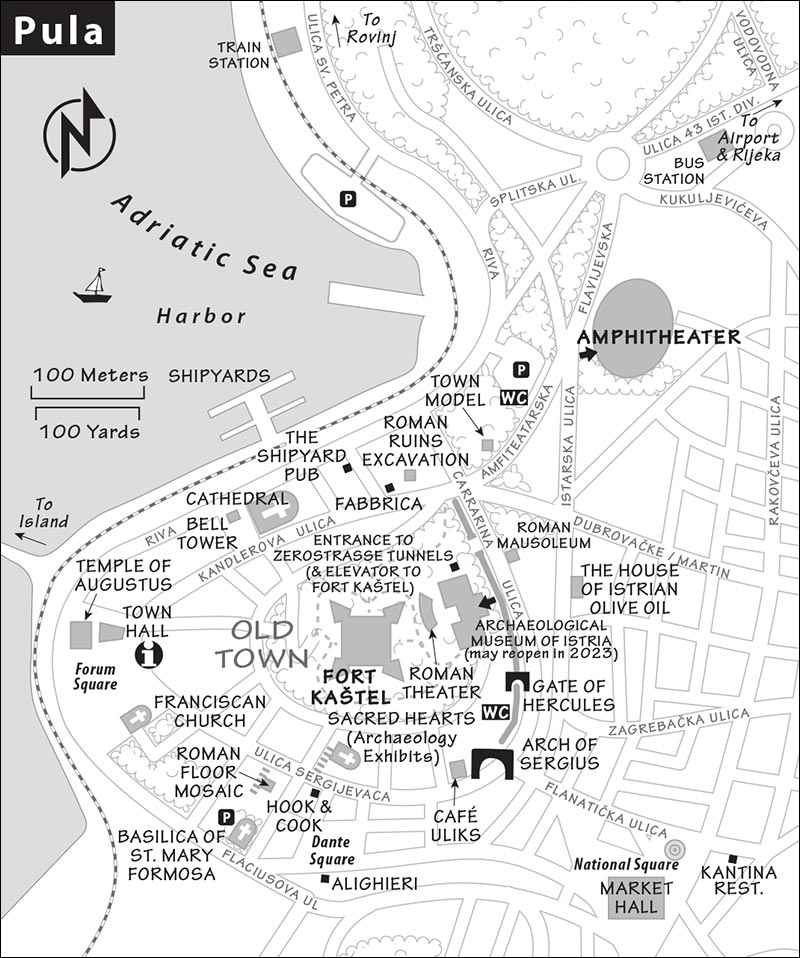
The tourist’s Pula is compact: the amphitheater and, beside it, the ring-shaped Old Town circling the base of an old hilltop fortress. I’ve outlined a simple, circular visit that ties it all together (see “Pula Walk,” later).
TOURIST INFORMATION
Pula’s indifferent TI sits on the main square (Mon-Fri 8:00-20:00, Sat-Sun 10:00-22:00, typically open later in summer and less off-season, Forum 3, +385 52 219 197, www.pulainfo.hr).
ARRIVAL IN PULA
By Car: Pula is about a 45-minute drive south of Rovinj. Approaching town, follow Centar signs, then watch for the amphitheater. Do yourself a favor and park at the big lot between the amphitheater and the waterfront (€4/hour, pay as you exit). There’s also street parking throughout Pula, marked with blue lines. But spaces near the sights cost as much as the big lot and often have a two-hour limit, forcing you to return periodically to feed the meter (for street parking, read instructions on the meter carefully).
By Bus: As you exit the bus station, walk toward the yellow mansion, then turn left onto the major street (Ulica 43 Istarske Divizije); at the roundabout, bear left again on Flavijerska (Via Flavia), and you’ll be headed for the amphitheater (about a 10-minute walk total).
By Train: The train station is a 15-minute walk from the amphitheater, near the waterfront. Leave the station and walk with the coast on your right until you approach the amphitheater and Old Town.
By Plane: Pula’s small airport, which is served by various low-cost airlines, is about 3.5 miles northeast of the center (code: PUY, +385 52 550 926, https://airport-pula.hr). A handy shuttle bus departs 20 minutes after many flights arrive (€4 to downtown Pula). Some buses even go all the way to Rovinj for €18 (run by two companies—check schedule and book at www.brioni.hr or www.fils.hr). The fair rate for a taxi into town is around €15, but most taxis waiting at the airport charge exorbitant rates; you’ll do better using Uber or calling Cammeo Taxi (+385 52 313 313).
HELPFUL HINTS
Car Rental: All of the big rental companies have their offices at the airport (see airport info above); the TI has a list of a few local outfits with offices downtown.
Local Guide: If you’d like a guide to help you uncover the story of Pula, Mariam Abdelghani leads great tours of the major sites. She also leads tours all around Istria (€100 for a 2-hour city tour, €220 for an all-day tour of Istria in your car, +385 98 419 560, mariam.abdelghani@gmail.com).
Hop-On, Hop-Off Bus: This route offers a look at some of Pula’s sights beyond the center, including the neighborhood of Austrian naval officers’ villas, the forested beach areas, and the coastal forts on the outskirts of town (€16, bus begins at the top of each hour next to the amphitheater, doesn’t run Nov-March, www.pulacitytour.com).
Pula Walk
This self-guided walk hits Pula’s most interesting attractions: the Roman amphitheater, the circular Old Town, and the view from the hill-topping castle. Give it about two hours total, without entering any sights (other than the amphitheater). More time can be spent sipping coffee al fresco or dipping into museums.
• Begin at Pula’s main landmark, its...
▲▲Amphitheater (Amfiteatar)
Of the dozens of amphitheaters left around Europe and North Africa by Roman engineers, Pula’s is the sixth-largest (435 feet long and 345 feet wide) and one of the best-preserved anywhere. This is the top place in Croatia to resurrect the age of the gladiators.
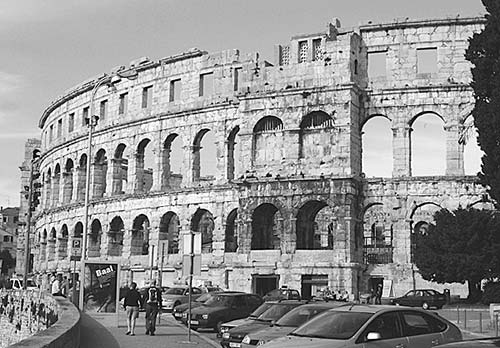
Cost and Hours: €10, daily May-Sept 8:00-21:00—often later June-Aug and for special events, April and Oct until 20:00, off-season 9:00-17:00, last entry one hour before closing.
Visitor Information: The €7 audioguide, available at the kiosk inside, narrates 20 stops with 30 minutes of flat, basic data on the structure.
Gladiator Shows: About twice weekly in the summer, costumed gladiators reenact the glory days of the amphitheater in a show called Spectacula Antiqua (€15, late June-mid-Sept, www.spectaculaantiqua.com).
Best Views and Budget Tip: There’s a good park on the amphitheater’s south end (facing town). If you follow this up and around, you can walk all the way behind the giant structure for views inside. As the site doesn’t contain any particularly riveting exhibits, this peek may be plenty for budget-minded visitors.
Visiting the Amphitheater: Go inside and explore the interior, climbing up the seats as you like. An “amphi-theater” is literally a “double theater”—imagine two theaters, without the back wall behind the stage, stuck together to maximize seating. Pula’s amphitheater was built over several decades in the first century AD under the reign of three of Rome’s top-tier emperors: Augustus, Claudius, and Vespasian. It was completed around AD 80, about the same time as the Colosseum in Rome. It remained in active use until the beginning of the fifth century, when gladiator battles were outlawed. The location is atypical but sensible: It was built just outside town (too big for tiny Pula, with just 5,000 people) and near the sea (so its giant limestone blocks could be transported here more easily from the quarry six miles away).
Notice that the amphitheater is built into the gentle incline of a hill. This economical plan, unusual for Roman amphitheaters, saved on the amount of stone needed and provided a natural foundation (notice how the upper seats incorporate the slope). It may seem like the architects were cutting corners, but they actually had to raise the ground level at the lower end of the amphitheater to make this work. The four rectangular towers anchoring the amphitheater’s facade are also unique (two of them are mostly gone). These once held wooden staircases for loading and unloading the amphitheater more quickly—like the massive corkscrew ramps in many modern stadiums. At the top of each tower was a water reservoir, used for powering fountains that sprayed refreshing scents over the crowd to mask the stench of blood.
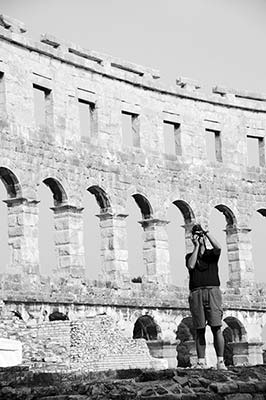
And there was plenty of blood. Imagine this scene in the days of the gladiators: More than 23,000 cheering fans from all social classes filled the seats. The Romans made these spectacles cheap or even free—distracting commoners with a steady diet of mindless entertainment prevented discontent and rebellion. Canvas awnings rigged around the top of the amphitheater shaded many seats. The fans surrounded the “slaying field,” which was covered with sand to absorb blood spilled by man and beast, making it easier to clean up after the fight. This sand (harena) gave the amphitheater its nickname...arena.
The amphitheater’s “entertainers” were gladiators (named for the gladius, a short sword that was tucked into a fighter’s boot). Some gladiators were criminals, but most were prisoners of war from lands conquered by Rome, who dressed and used weapons according to their country of origin. A colorful parade kicked off the spectacle, followed by simulated fights with fake weapons. Then the real battles began. Often the fights represented stories from mythology or Greek or Roman history. Most ended in death for the loser. Sometimes gladiators fought exotic animals—gathered at great expense from far corners of the empire—which would enter the arena from the two far ends (through the biggest arches). There were female gladiators, as well, but they always fought other women.
While the life of a gladiator seems difficult, consider that it wasn’t such a bad gig—compared to, say, being a soldier. Gladiators were often better paid than soldiers, enjoyed terrific celebrity (both in life and in death), and only had to fight a few times each year.
Ignore the modern seating, and imagine when the arena (sandy oval area in the center) was ringed with two levels of stone seating and a top level of wooden bleachers. Notice that the outline of the arena is marked by a small moat (now covered with wooden slats)—just wide enough to keep the animals off the laps of those with the best seats, but close enough so that blood still sprayed their togas.
After the fall of Rome, builders looking for ready-cut stone picked apart structures like this one—scraping it as clean as a neat slice of cantaloupe. Sometimes the scavengers were seeking the iron hooks used to connect the stone; in the centuries after the fall of Rome, the material and know-how for smelting iron from ore was hard to come by. Most of this amphitheater’s interior structures—such as steps and seats—are now in the foundations and walls of Pula’s buildings...not to mention palaces in Venice, across the Adriatic. In fact, in the late 16th century, the Venetians planned to take this entire amphitheater apart, stone by stone, and reassemble it on the island of Lido on the Venetian lagoon. A heroic Venetian senator—still revered in Pula—convinced them to leave it where it is.
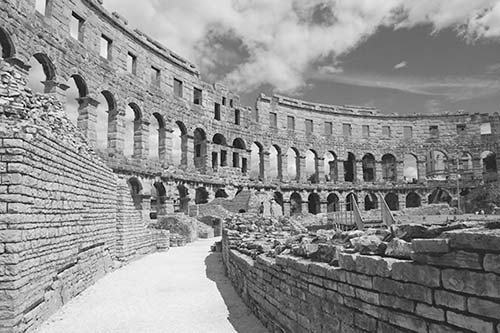
Despite these and other threats, the amphitheater’s exterior has been left gloriously intact. The 1999 film Titus (with Anthony Hopkins and Jessica Lange) was filmed here, and today it is still used to stage spectacles—from Andrea Bocelli to the Foo Fighters—with seating for about 5,000 fans. The loudest concerts have been banned, because the vibrations were damaging the old structure.
Before leaving, don’t miss the museum exhibit (in the subterranean hall—follow exhibition signs down the chute marked #17). This takes you to the lower level of the amphitheater, where gladiators and animals were kept between fights. When the fight began, gladiators would charge up a chute and burst into the arena, like football players being introduced at the Super Bowl. As you go down the passage, you’ll walk on a grate over an even lower tunnel. Pula is honeycombed with tunnels like these, originally used for sewers and as a last-ditch place of refuge in case of attack. In the exhibit, check out the extensive collection of amphorae (see sidebar), find your location—Pola—on the replica of a fourth-century AD Roman map (oriented with east on top), and ogle the gigantic grape press and two olive oil mills.
In museums, hotels, and restaurants all along the Croatian coast, you’ll see amphorae. An amphora is a jug that was used to transport goods when the ancient Greeks ruled the seas, through about the second century BC. Later, the Romans also used their own amphorae. These tall, skinny ceramic jugs—many of them lost in ancient shipwrecks—litter the Adriatic coastline.
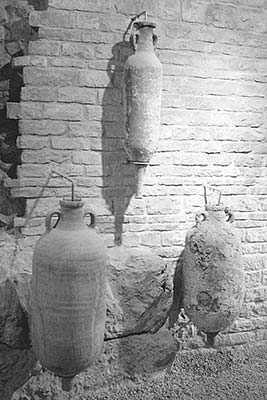
Amphorae were used to carry oil, wine, and fish on long sea journeys. They’re tapered at the bottom because they were stuck into sand (or placed on a stand) to keep them upright in transit. They also have a narrow neck at the top, often with two large handles. In fact, the name comes from the Greek amphi pherein, “to carry from both sides.” The taller, skinnier amphorae were generally used for wine, while the fat, short ones were for olive oil. Because amphorae differ according to their purpose and nationality, archaeologists find them to be a particularly useful clue for dating shipwrecks and determining the country of origin of lost ships. This is made easier by later Roman amphorae, which are actually stamped with the place they came from and what they held.
• There’s a fine olive oil museum, tasting room, and shop just down the street from here (to the left), in case you’d like to visit now or at the end of our walk—since we’ll finish nearby (see “The House of Istrian Olive Oil,” later).
Otherwise, let’s head into town. From the amphitheater, it’s just a short walk to Pula’s Old Town, where more Roman sights await. Exit the amphitheater, cross the street, turn left, and walk one long block along the low wall (overlooking the parking lot) down the street called Amfiteatarska Ulica. When you reach the park on your right, look for the car-sized...
Town Model
Use this handy model of Pula to get oriented. Next to the amphitheater, the little water cannon spouting into the air marks the pale-blue house nearby, the site of a freshwater spring (which makes this location even more strategic). The big star-shaped fortress on the hill is Fort Kaštel, designed by a French architect during the Venetian era (1630). Read the street plan of the Roman town into this model: At the center (on the hill) was the castrum, or military base. At the base of the hill (the far side from the amphitheater) was the forum, or town square. During Pula’s Roman glory days, the hillsides around the castrum were blanketed with the villas of rich merchants. The Old Town, which clusters around the base of the fortress-topped hill, still features many fragments of the Roman period, as well as Pula’s later occupiers. We’ll take a counterclockwise stroll around the fortified old hill through this ancient zone.
The huge anchor across the street from the model celebrates Pula’s number-one employer, until recently—its shipyards.
• Continue the way you were going and cross the street. At the fork, bear right (on Kandlerova Ulica—level, not uphill). Notice the Roman ruins in the field on your right. Just about any time someone wants to put up a new building in Pula, they find ruins like these. Work screeches to a halt while the valuable remains are excavated. At this site, they’ve discovered three Roman houses, two churches, and 2,117 amphorae—the largest stash found anywhere in the world. (The harbor is just behind, which suggests this might have been a storehouse for offloaded amphorae.) In this case, plans for the new parking garage were scuttled completely. You’ll also see some benches inscribed with quotations from the likes of Mark Twain, Oscar Wilde, Nikola Tesla, and Isak Dinesen: These are nods to Pula’s main library, the yellow building nearby.
One block farther along, on the right, Sv. Teodora street has some good sit-down restaurants (including Fabbrica, marked by the towering, can’t-miss-it chimney, and a pubby burger joint just down the way—see “Eating in Pula,” later). Or wait until the market we’ll visit later on this walk.
Continue along the main street as it curves a couple more blocks through gritty, slice-of-life Pula. Soon, on your right, you’ll see the...
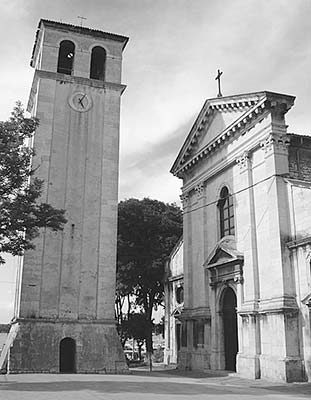
Cathedral (Katedrala)
This church combines elements of the two big Italian influences on Pula: Roman and Venetian. Dating from the fifth century AD, the Romanesque core of the church (notice the skinny, slit-like windows) marks the site of an early Christian seafront settlement in Pula. The Venetian Baroque facade and bell tower are much more recent (early 18th century). Typical of the Venetian style, notice how far away the austere bell tower is from the body of the church. The bell tower’s foundation is made of stones that were scavenged from the amphitheater. The church’s sparsely decorated interior features a classic Roman-style basilica floor plan, with a single grand hall—the side naves were added in the 15th century, after a fire.
Cost and Hours: Free, generally open daily 10:00-14:00.
• Keep walking through the main pedestrian zone. This part of Pula is an odd mix of seedy, hole-in-the-wall shops; unbelievably tacky tourist traps and bulk candy stores; and some classy, high-end wine-and-truffles gourmet boutiques.
After a few more blocks, you emerge into the...
Forum
Every Roman town had a forum, or main square. Twenty centuries later, Pula’s Forum not only serves the same function but also still uses the old Roman name.
Two important buildings front the north end of the square, where you enter. The smaller building (on the left, with the columns) is the first-century AD Temple of Augustus (Augustov Hram). Built during the reign of, and dedicated to, Augustus Caesar, this temple took a direct hit from an Allied bomb in World War II. After the war, the Allied occupiers rebuilt it as a sort of mea culpa—notice the patchwork repair job. It’s the only one remaining of three such temples that once lined this side of the square. There’s not much to see inside, other than a few fragments of ancient sculptures (€2, May-Sept Mon-Sat 9:00-18:00, Sun until 15:00, shorter hours Oct-April, English labels). The surviving torso from a statue of Augustus, which likely stood on or near this spot, dates from the time of Christ. Other evocative chips and bits of Roman Pula include the feet of a powerful commander with a pathetic little vanquished barbarian obediently at his knee (perhaps one of the Histri—the indigenous Istrians that the Romans conquered in 177 BC).
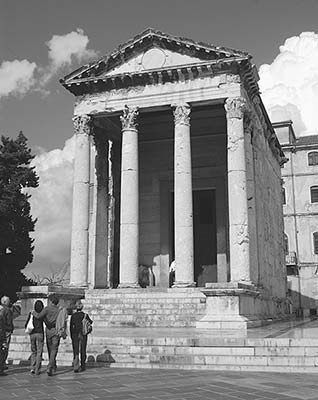
Head back out to the square. As Rome fell, its long-subjugated subjects in Pula had little respect for the former empire’s symbols, and many temples didn’t survive. Others were put to new use: Part of an adjacent temple (likely dedicated to Diana) was incorporated into the bigger building on the right, Pula’s medieval Town Hall (Gradska Palača). If you circle around behind this building, you can still see Roman fragments embedded in the back. The Town Hall encapsulates many centuries of Pula architecture: Romanesque core, Gothic reliefs, Renaissance porch, Baroque windows...and a few Roman bits and pieces. Notice the interesting combination of flags above the door: Pula, Croatia, Istria (with its mascot goat), Italy (for the large ethnic minority here), and the European Union.
• Consider dropping by the TI on this square before continuing our stroll down the main drag, Sergijevaca. As you head down that street, you’ll pass by a small park on your right (behind the café umbrellas). For an optional detour to Byzantine times, angle through this park and find a parking lot. Near the end of the lot, on the left-hand side, is a fenced-off grassy field. At the far end of the field is the small...
Basilica of St. Mary Formosa (Kapela Marije Formoze)
We’ve seen plenty of Roman and Venetian bric-a-brac, but this chapel survives from the time of another Istrian occupier: Byzantium. For about 170 years after Rome fell (the sixth and seventh centuries AD), this region came under the control of the Byzantine Empire and was ruled from Ravenna (now in Italy, across the Adriatic, south of Venice). Much of this field was once occupied by a vast, richly decorated basilica. This lonely chapel—which was one small section of the right-most of three tall, long naves—is all that’s left. It’s rarely open to visit, but you can see the footprint of the entire church in the grass, and part of the left-most wall on the far side of the field.
From here you can look out to sea for a good view of the towering cranes that rise up from the shipyards that until recently employed some 2,000 Pulans. One of the last surviving major shipyards in Croatia, Pula’s finally succumbed to the same forces that shut down others: an inability to compete with the lower costs of shipbuilding in Asia. The shipyards were a major part of the identity and economy of the city; any time a new ship was christened, the entire town turned out for a celebration. If you’re intrigued by all things maritime, you could walk along the embankment for a better look (after our walk). After dark, those cranes are enlivened by a light show (at the top of every hour 21:00-24:00) created by a local architectural lighting designer who has since gained international fame.
• Turn your back to the shipyards and walk (with the basilica ruins on your right) toward the yard with trees and bushes. Follow Rimski Mozaik signs through a dusty parking lot and into a small yard. Walk to the metal grille and look down to see the...
Roman Floor Mosaic (Rimski Mozaik)
This hidden mosaic is a great example of the Roman treasures that lie beneath the old center of Pula. Uncovered by locals who were cleaning up from WWII bombs, this third-century floor was carefully excavated for display right where it was laid nearly two millennia ago. (Notice that the Roman floor level was about six feet below today’s.) The centerpiece of the mosaic depicts the punishment of Dirce. According to the ancient Greek legend, King Lykos of Thebes was bewitched by Dirce and abandoned his pregnant queen. The queen gave birth to twin boys, who grew up to kill their deadbeat dad and tie Dirce to the horns of a bull, to be bashed against a mountain. This same story is famously depicted in the twisty Toro Farnese sculpture partly carved by Michelangelo (on display in Naples’ Archaeological Museum).
• Find your way through the adjacent passage (ignore the cut-rate clothing vendors; their stalls look like a private shop, but it’s a public passage) to return to the main drag, Sergijevaca. Turn right and continue through Pula’s most colorful (and most touristy) neighborhood.
Sergijevaca and Dante Square (Danteov Trg)
After a block, the stepped lane on the left leads you up to the deconsecrated Church of the Sacred Hearts (Sv. Srca), which is now a museum space housing temporary exhibits from the Archaeological Museum of Istria. Beautifully restored and repurposed as a modern exhibition space, and with good English descriptions, the church is arguably a more satisfying home for the collection. Historians will want to check out the latest exhibits (www.ami-pula.hr).
A block and a half farther, on the right, Clerisseauova street leads you to the pleasant Dante Square (Danteov Trg). Its centerpiece is a 1930s, Italian-built fountain that resembles a fasche, or bundle of sticks—the symbol and namesake for Mussolini’s Fascist movement. The irregular dots scattered around the inside of the fountain once supported the names of important Italian fascists, and the big, white, blocky post office across the square is a classic Italian Fascist-style building. Remember that from 1918 until 1943—in other words, Mussolini’s heyday—Istria was part of Italy.
• Continuing along Sergijevaca, in a few short blocks you’ll arrive at the...
Arch of Sergius (Slavoluk Sergijevaca)
This triumphal arch, from the first century BC, was Michelangelo’s favorite Roman artifact in Pula. Marking the edge of the original Roman town, it was built to honor Lucius Sergius Lepidus. He fought on the side of Augustus in the civil wars that swept the empire after Julius Caesar’s assassination. The proto-feminist inscription proudly explains, “Silvia of the Sergius family paid for this with her own money.” Statues of Silvia’s husband, Lucius, plus her son and her brother-in-law, once stood on the three blocks at the top of the arch. (Squint to see the Sergivs name on each block.) On the underside of the arch is a relief of an eagle (the symbol of Rome) clutching an evil snake in its talons.
• Before going under the arch, look to your left to see a famous Irishman appreciating the view from the terrace of...
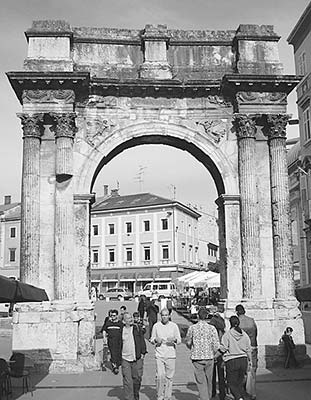
Café Uliks
In October 1904, a young writer named James Joyce moved from Dublin to Pula with his girlfriend, Nora Barnacle. By day, he taught English to Austro-Hungarian naval officers at the Berlitz language school (in the yellow building next door). By night, he imagined strolling through his hometown as he penned short stories that would eventually become the collection Dubliners. But James and Nora quickly grew bored with little Pula and moved to Trieste in March 1905. Even so, Pula remains proud of its literary connections. This café—where Joyce likely enjoyed sitting from time to time—carries the Croatian name of his masterpiece, Ulysses.
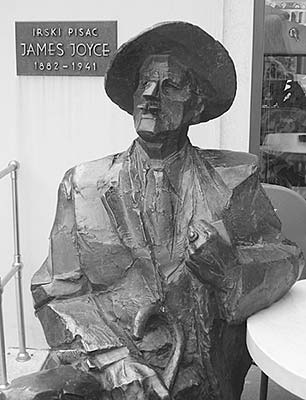
• Now pass through the arch, into a square next to some remains of the town wall. Cross the street and continue straight ahead for two bustling blocks, along the traffic-free Flanatička street, to...
National Square (Narodni Trg) and Market Hall
Pula’s market hall was an iron-and-glass marvel when inaugurated in 1903. This structure is yet another reminder of the way the Austro-Hungarian Empire modernized Pula with grace and gentility. You’ll find meats, cheeses, and smelly fish on the ground floor (Mon-Sat 7:00-13:30, Sun until 12:00), and an inviting food circus upstairs (Mon-Fri 7:00-15:00, Sat until 14:00, sleepy on Sun). All around is a busy and colorful farmers market that bustles until about 13:00, when things quiet down.
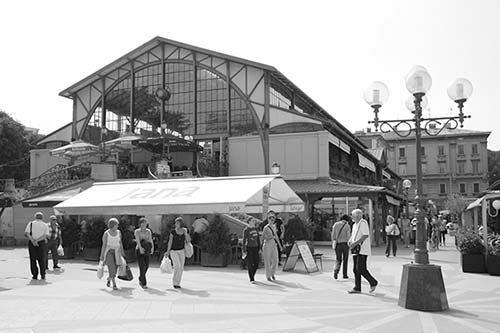
• If you’re ready for lunch, consider one of the cheap options inside or near the market hall, or walk one block to Kantina (see “Eating in Pula,” later).
When you’re done here, backtrack to the town wall. As you face the Arch of Sergius, take a right and walk uphill under the leafy canopy next to the wall. On our way back to our starting point, we’ll pass the...
City Wall and More Monuments
Circling the outside of the old wall to where we began, keep an eye out for more Roman remains and other landmarks.
After about 150 yards, you’ll pass (on your right) a stern, blocky, Fascist-style building from 1941—with classic white stone and iron, and a little balcony that seems custom-made for delivering rabble-rousing speeches.
Take the left fork around this building, and soon, on your left, you’ll reach the Gate of Hercules (Herkulova Vrata), with its single, intact stone arch—the oldest surviving monument in town (from the first century BC). If you look carefully, you can pick out the very faded carving of Hercules’ head and his club along the top of the arch. Up the steps just under the gate, the purplish building is the local Italian Cultural Center, a resource for the local cultural minority whose ancestors—from the Romans to Mussolini—so shaped this town.
From here you’ll pass more stretches of city wall—though most of what you see here is not the original Roman wall but fortifications that were beefed up in the 15th and 16th centuries. Soon you’ll reach the Twin Gates (Porta Gemina), on your left. Before going through them, turn your attention across the street to find a large, round structure that’s set deeply into the ground. This is a first-century-AD Roman mausoleum, which once stood 25 feet higher (see the illustration on the nearby plaque). During Roman times, people would be buried just outside the city walls.
• Through the Twin Gates, the giant yellow building in the garden is the...
Archaeological Museum of Istria (Arheološki Muzej Istre)
By the time you visit, this museum should have wrapped up an ambitious, years-long renovation (possibly in 2023)—check ahead. When completed, the renovated museum promises a state-of-the-art look at the city’s stunning wealth of ancient monuments. The facility is expected to anchor a new campus of artifacts that will finally showcase Pula’s magnificent ancient heritage with the careful attention it deserves.
Up the hill around the right side of the museum—and likely not fully accessible during the renovation (but if you’re curious, check)—are the remains of a Roman Theater (Rimsko Kazalište). If it’s not closed off, it’s free to visit the ruins. Part of the stage is still intact, along with the semicircle of stone seats (some of which are still engraved with the names of the wealthy theatergoers who once sat in them).
• There’s one more attraction nearby...which leads to yet another attraction. The entrance is immediately to the right (at street level) of the Archaeological Museum. Look for the easy-to-miss tunnel entrance marked Zerostrasse.
▲Austro-Hungarian Tunnels (Zerostrasse) and Fort Kaštel Viewpoint
Our walk has circled the base of the hill that constitutes the centerpiece of Pula, old and new. As you’ll recall from the model where we began our walk, the hill is capped by a military fortress. But the fortifications extend all the way down to street level, connected by a series of tunnels that were dug by the Austro-Hungarian authorities before World War I to further fortify and supply their key naval base. Today, you can enter these tunnels, which lead to an elevator that takes you, sweat-free, all the way to the top of the fortress for a sweeping grand finale view of your Pula visit.
Cost and Hours: €6, daily 9:00-21:00, Oct-March until 17:00, +385 52 211 566.
Visiting the Tunnels and Fort: Entering the tunnel, you’ll pass a board that explains how there are four entrances—at four corners of the hill’s base—to this network, which was used for shelter, storing munitions, and ensuring communications in the event of war. Follow the long tunnel to a central hub, where giant, stout pillars support the substructure, and other tunnels stretch off in each direction. (These halls often display interesting special exhibits.)
Near this central hub, at the entrance to the tunnel across from where you entered, look for the elevator that zips you all the way up to the top of Fort Kaštel. (You’re on level 0; level 1 lets you explore some of the WWI-era tunnels; and level 2 is the top.) Exiting, scan your ticket at the turnstile to enter the fort’s courtyard, then climb up onto the top of the wall and circle around for the view. Keep an eye out for landmarks, from the amphitheater to the burly shipyards. Circle all the way around to the white observation tower (where you can climb some tight, twisting metal steps for an even better view...or just enjoy what you see from the ramparts). Here you can appreciate the highly strategic location of Pula—surrounded by a nearly 360-degree bay. Illustrating why so many powerful visitors—from the Romans to the Habsburgs—chose to develop this southern tip of Istria, it’s a fitting conclusion to our walk.
• When you’re done with the views, ride the elevator back down and try to remember which of the four tunnels you entered through (choose wisely, as some of them lead to dead ends). Back out at the street near the Archaeological Museum, turn left and continue in the direction we were walking before this detour. Just another block past the Twin Gates, you’ll pop out at the park with the city model. The amphitheater is just to the right. If you’d like to finish your Pula day with an olive oil tasting, The House of Istrian Olive Oil, described next, is a half-block away.
More Sights in Pula
This delicious attraction is just a few steps away from the amphitheater, at the start (or end) of our walk.
▲The House of Istrian Olive Oil (Kuća Istarskog Maslinovog Ulja)
This shop/museum/tasting room celebrates Istria’s excellent artisanal olive oil scene. For foodies, doing a tasting here is worth ▲▲. Considering the lovingly curated shop and helpful advice, this is also an enticing place to stock up on edible Istrian souvenirs.
Cost and Hours: Museum—€7, museum plus basic “green” tasting—€12, museum plus “gold” tasting with top-end oils—€18; open daily 10:00-18:00, until 19:00 or 20:00 in summer; Istarska 30, +385 52 661 235, www.oleumhistriae.com.
Visiting the Museum: You’ll enter a well-stocked shop, showcasing more than 30 local producers of high-end olive oil (as well as cosmetics and some fascinating locally produced brandies).
Beyond that is a thoughtful museum, with a few artifacts and lots of reading (much of it also narrated by the included 30-minute audioguide). Exhibits explain the rich history of olive oil production in this region—going back to the Romans—and explains the procedure in ancient, medieval, and modern times. Enjoy the mesmerizing five-minute movie about the production process.
They also offer enjoyable and insightful 20-minute olive oil tastings, which succinctly and effectively train your palate to distinguish top-quality extra virgin olive oil from cut-rate “virgin” and “lampante”-grade olive oil. You’ll learn why EU-certified “extra virgin olive oil” isn’t always what it’s advertised to be...and how to tell the difference.
Eating in Pula
AT THE MARKET HALL
The most vivid lunch options are in and near the town’s market hall, toward the end of my self-guided walk. The top floor of the market is a food circus with a number of cheap and tempting eateries with both indoor and terrace seating. Back outside, around the right side of the market hall, you’ll find a pair of fiercely competitive bakeries serving fresh batches of cheap and delicious burek, the savory phyllo-dough pastry: Pekarna Centar is built into the market hall itself, and Pekara Corona faces it from across the market square. Remember, in Croatia it’s fine to bring your own food to an outdoor café to enjoy at their tables, as long as you buy a drink (and assuming they don’t serve food of their own). Browse for some food in the market area, then take your pick of al fresco cafés anywhere in town.
If you prefer a real restaurant, $$$ Kantina Restaurant, a block away from the market, serves good lunches (including veggie options) and hearty, creative salads in an elegant vaulted cellar and on a lazy, shady terrace. The service can be slow—if you’re in a rush, eat at the market hall instead (Mon-Sat 7:00-24:00, Sun 12:00-23:00—except closed Sun off-season, at the end of the pedestrian zone at Flanatička 16, +385 52 214 054).
ELSEWHERE IN PULA
I’ve listed these in the order you’ll reach them as you follow my walk.
Closer to the Amphitheater: These two places are a half-block apart, near the start of the Old Town—just look for the giant former industrial chimney of the first one. $$ Fabbrica, in a onetime factory (as its name implies), serves up pizzas, barbecue, burgers, and a few pastas at pleasant outdoor tables or in the modern interior in a less-seedy part of the Old Town (daily 12:00-24:00, Kandlerova 35, +385 52 894 6249). Just down the stairs on the same street, $$ The Shipyard Pub—huge, boisterous, and trendy—has sidewalk tables, a vast and pubby interior, and a huge interior garden, all serving a long list of drinks and gourmet burgers (daily 10:00-23:00, Svetog Teodora 1, +385 91 200 9116).
Along the Main Drag: $$ Hook & Cook is a fresh, modern-feeling place that offers simple and tasty “street seafood” dishes along the main drag, just steps from the Forum (daily 11:00-21:00, Sergijevaca 18, +385 99 216 6373).
On Dante Square: $$ Alighieri, located on its namesake Dante Square, is a convenient, pleasant spot that does a decent job cranking out Italian classics (daily 7:30-23:00, Danteov Trg 3, +385 52 381 984).
Pula Connections
Various companies run buses from Pula, including Arriva/Autotrans (+385 60 888 611, www.arriva.com.hr), Brioni (+385 52 365 536, www.brioni.hr), Fils (+385 52 383 000, www.fils.hr), and—for international buses—Flixbus (online booking only at www.flixbus.com). These companies don’t cooperate with one another, so short of visiting each bus line’s ticket window, the best place to check all of them at once is https://getbybus.com.
By Bus from Pula to: Rovinj (almost hourly, 45 minutes), Poreč (almost hourly, 1.5 hours), Opatija (almost hourly, 2 hours), Rijeka (nearly hourly, 2-2.5 hours), Zagreb (almost hourly, 4 hours), Split (5/day, 10 hours), Venice (2/day usually in the early morning, 4 hours). To reach Slovenia, bus schedules seem always in flux but there are usually options from Pula to Ljubljana on Flixbus (4-5 hours); to reach Piran, you’ll likely take the Flixbus to Portorož and change there. The GoOpti shared shuttle is perhaps the most straightforward choice for destinations in Slovenia or Italy (www.goopti.com; for details, see here). In the summer, be aware that bus connections are more frequent on weekdays (fewer departures Sat-Sun). Bus info: +385 60 304 090.
By Train: Trains from Pula are almost always slower than the bus; check the Croatian Railways website (www.hzpp.hr) for schedules.
The Brijuni Islands
The Brijuni Islands (bree-YOO-nee, Brioni in Italian)—an archipelago of 14 islands just offshore from the southern tip of the Istrian Peninsula—were a favorite haunt of Marshal Tito, the leader of communist Yugoslavia. The main island, called Great Brijuni (Veli Brijun; rated ▲), was where Tito liked to show off the natural wonders of his beloved Yugoslavia to visiting dignitaries and world leaders. Today the island is a national park that combines serene natural beauty with quirky Yugoslav sights, offering a strange but enjoyable time capsule of the Tito years. It’s also a particularly bike-friendly destination, with gentle inclines, well-groomed bike paths, and few cars. Though it can get busy in the summer season, at its heart this remains a tranquil, low-key getaway: not a must-see if you have limited time in Istria, but still rewarding, especially if you can’t make it to any other of Croatia’s bevy of beautiful islands.
Tito wasn’t the first to fall in love with Brijuni; visitors see the remains of many previous occupants (Romans, Byzantines, Venetians, Austrians—even dinosaurs). Between the World Wars, a health resort here hosted many notables, from Douglas Fairbanks and John D. Rockefeller to Richard Strauss and Emperor Hirohito. But when Tito took power, he made Brijuni his summer residence from 1949 until 1979—hosting a steady stream of VIP visitors from the East, the West, and the nonaligned world (see sidebar). Brijuni opened to the public as a national park in 1983, just three years after Tito’s death.
Getting There: You can get to Great Brijuni Island only on one of the national park’s boats. These depart from the town of Fažana, five miles north of Pula and 20 miles south of Rovinj. From Rovinj, drive southeast to Bale, where you’ll get on the ipsilon highway and continue south. In Vodnjan, watch for the easy-to-miss turnoff (on the right) marked for Fažana and Brijuni. Once in Fažana, follow brown Brijuni signs and park along the water (confirm with park ticket office that your parking spot is OK).
Cost and Information: The entrance ticket, which includes the boat trip and a tour of the island, costs €40 June-Sept and €30 off-season. During peak summer season, it’s wise to buy tickets in advance online (www.np-brijuni.hr; +385 52 525 882).
Hours: From June through September, there are 12 boat departures each day (first boat departure from Fažana at 9:00, last trip at 22:00, last return from Brijuni at 23:00); April-May and Oct, 11/day; Nov-March, 4/day.
English Tour: You’re supposed to go to the island with a four-hour guided tour, part of which is spent on a little tourist train. While there’s no regularly scheduled English tour, they do happen frequently with demand. It’s essential to call or check online a few days ahead to find out whether any English tours are planned, and to reserve a space (+385 52 525 883, izleti@np-brijuni.hr).
If you can’t make it on the English tour, you’re welcome to join any tour you like (Croatian, German, Italian, etc.). Joining a tour is a good idea especially if you have limited time, as there’s lots of ground to cover. It may seem like park officials don’t want you to slip away and explore the island on your own, but it’s perfectly fine—and, in fact, Brijuni is great for a slow, scenic wander. (If you strike out alone, download the official national park app, called Brijuni Pocket Guide.)
It’s possible to rent bikes on the square where the boat puts in. This is a tempting option for cyclists, as the traffic-free island is a delight to explore on two wheels.
Visiting the Island: After a 15-minute crossing from the mainland town of Fažana, visitors arrive at the island’s main harbor, which is a hub of activity and the site of its two hotels.
Many visitors to the former Yugoslavia mistakenly assume this country was part of the Soviet Bloc. It most decidedly wasn’t. While the rest of “Eastern Europe” was liberated by the Soviets at the end of World War II, Yugoslavia’s own, homegrown Partisan Army forced the Nazis out themselves. This allowed the country—and its new leader, the war hero Marshal Tito—a degree of self-determination following the war. Though the new Yugoslavia was socialist, it was not Soviet-style socialism. After formally breaking ties with Moscow in 1948, Tito steered his country toward a “third way” between the strict and stifling communism of the East and the capitalist free-for-all of the West. (For more on Tito’s system, see the Understanding Yugoslavia chapter.)
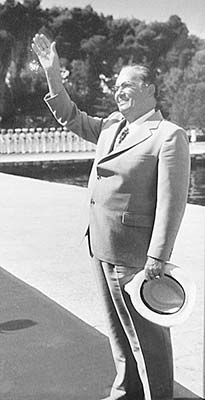
Many other countries also didn’t quite fit into the strict East-versus-West dichotomy embraced by the US, USSR, and most of Europe. On July 19, 1956, the Brijuni Declaration—signed by Tito, Jawaharlal Nehru of India, and Abdel Nasser of Egypt—created the Non-Aligned Movement (NAM). Members recognized each other’s sovereignty and respected each leader’s right to handle domestic issues however he or she saw fit.
As Tito’s international prominence grew, so did the list of visitors to his Brijuni Islands hideaway. In addition to Nehru and Nasser, Tito hosted Haile Selassie (Ethiopia), Yasser Arafat (Palestine), Fidel Castro (Cuba), Indira Gandhi (India), Muammar al-Gaddafi (Libya), Queen Elizabeth II (Great Britain), Willy Brandt (West Germany), and Leonid Brezhnev (USSR)...not to mention Elizabeth Taylor (US) and Sophia Loren (Italy).
In principle, the NAM was envisioned as a competitor of NATO and the Warsaw Pact. But as the world’s politics have changed, many NAM members are now closely allied with other, more powerful nations. And when Yugoslavia broke up, most of the countries that emerged preferred to join NATO and the EU.
So whatever happened to the rest of the NAM? It’s still going strong, with 120 member states encompassing virtually all of Africa, the Middle East, Southeast Asia, and Latin America. While the US, China, and the EU wrestle for bragging rights as the world’s superpower, the NAM represents more than half of the world’s population.
The Boathouse hosts a high-tech permanent exhibit about the history of Brijuni, which offers a good overview of the island; the tours typically spend time here before boarding the return boat. You’ll learn about the archipelago’s geology, fauna, and flora, and step into a simulated submarine. The exhibit emphasizes the fragility of Brijuni and the need for sustainable tourism.
Outside the harbor area, the island is largely undeveloped. There are virtually no cars—most people get around by bike, golf cart, or the little tourist train you’ll board to begin your tour. As you spin around the island, you’ll enjoy views over its endlessly twisty coast, with cove after tranquil cove. Your guide will impart both dry facts and eye-rolling legends while you putter past several intriguing sights, periodically giving you a chance to get off the train and explore a few of them up close.
For 20th-century history buffs, the island’s highlight is the “Tito on Brijuni” exhibit. Dating from 1984—four years after his death, but before the end of Yugoslavia—this exhibit celebrates the cult of personality surrounding the head of this now-deceased nation. The museum (with English descriptions) features countless photos of Tito in every Brijuni context imaginable—strolling, sunbathing, skeet shooting, schmoozing with world leaders and movie stars, inspecting military officers, playing with camels given to him by Muammar al-Gaddafi, and so on. (For more on Tito, and why the dictator remains so beloved in his former lands, see the sidebar on here.)
Another high point of the island tour is the safari, featuring a diverse menagerie of animals (or their descendants) brought here for Tito as gifts by visiting heads of state. Because many of the nonaligned nations are in Africa, Asia, or other non-European regions, many of these beasts are exotic. Aside from the Istrian ox and Istria’s trademark goat, you might see llamas, Somali sheep, Shetland ponies, chamois, and more. There once were elephants, camels, cheetahs, ostriches, monkeys, bears, and bobcats as well, but most of these have gone to the great nonaligned safari in the sky; their bodies are now preserved at the “Tito on Brijuni” exhibit.
Other attractions you may see on Brijuni: an ancient, gnarled olive tree supposedly dating from the fourth century AD; the remains of a mostly first-century-AD Roman villa rustica (country estate); the ruined street plan of a Byzantine fort; a 15th-century Gothic church with an exhibit on frescoes and Glagolitic (early Croatian) script; an Austro-Hungarian naval fort (Brijuni was strategically important back when Pula was Austria’s main naval base); and footprints left by a dinosaur who vacationed here 120 million years before Tito.
Birders can look for some of the 250 avian species that live on the island in the summer. Gardeners may spot some exotic, nonnative plant species (more gifts, to go along with all those animals), such as Australian eucalyptus. And Republicans can drool over the golf course, a reminder that Brijuni is attempting to cultivate a ritzy image.
Poreč
Poreč (poh-RETCH, Parenzo in Italian), the tourist capital of the Istrian coast, is the kind of resort that brags about how many hotel beds it has, rather than how many museums or churches pack the cobbled streets of its Old Town. (Think of it as the Croatian Cancún.) The town is too big to be charming, but too small to be exciting. The only reason to come is to see its landmark basilica, slathered with exquisite mosaics. But if you’re in a hurry or churched out, I’d skip it.
Getting There: Surrounding Poreč’s peninsular Old Town are miles of hotels-and-concrete sprawl. Drivers follow Centar and blue P signs to the big pay parking lot, then head up to the big boulevard called Zagrebačka (with the grass median). This leads past the TI (Zagrebačka 9, +385 52 451 293, www.myporec.com) to the spacious square named Trg Slobode. From here, Decumanus street marches straight through the middle of the Old Town. To find the basilica, look for the archway with gold mosaics down Sv. Eleuterija street.
▲Euphrasian Basilica (Eufrazijeva Bazilika)
This sixth-century church is a gold mine for fans of Byzantine mosaics.
Cost and Hours: €7, basilica open June-Sept daily 9:00-21:00, until 18:00 or 19:00 in shoulder season, less off-season, can close for services, no shorts; museum and tower open April-Sept daily 10:00-17:00, likely closed Oct-March; www.zupaporec.com.
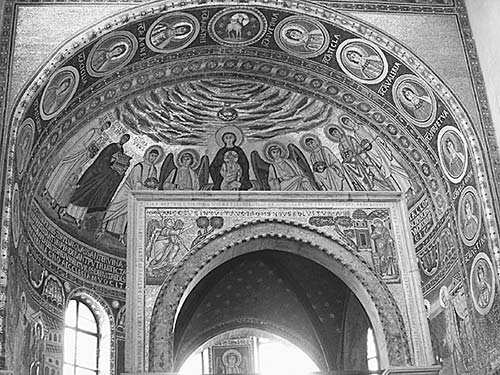
Visiting the Basilica: The interior is dominated by gorgeous, glittering mosaics in the apse surrounding the main altar. The top row depicts Jesus surrounded by the 12 apostles, the medallions around the arch celebrate 12 female martyrs, and front and center are Mary and Jesus surrounded by angels and martyrs—including Bishop Euphrasius, holding his namesake basilica in his arms (second from left). These date from the 170-year period after the fall of Rome (roughly AD 530-700), when Istria was part of the Byzantine Empire and was ruled from Ravenna (near Venice, across the Adriatic). The more recent (13th-century) canopy over the altar was inspired by the one in St. Mark’s Basilica in Venice. Don’t miss another set of mosaics in the floor just inside the door.
For more mosaics, drop into the attached museum, with several mosaic fragments scattered around two floors. Or climb the bell tower to get a bird’s-eye view of Poreč. Both are included in the basilica ticket.
Hill Towns of the Istrian Interior
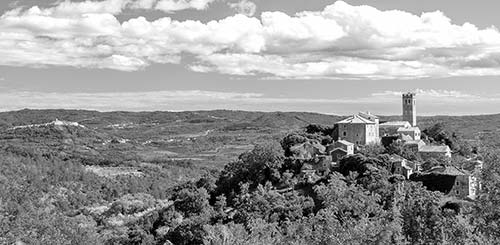
Most tourists in Croatia focus on the coast. For a dash of variety, head inland. Some of the best bits of the Croatian interior lie within an hour’s drive from Rovinj. Dotted with sleepy, picturesque hill towns, speckled with wineries and olive oil farms, embedded with precious truffles, and grooved by meandering rural roads, the Istrian interior is worth a detour. Tucked below, between, and on top of the many hills are characteristic stone-walled villages, designed to stay cool in summer and warm in winter. Visitors find themselves seduced by the malvazija wine, truffles, picturesque tableaus, and laid-back ambience of the Istrian hill towns.
For a quick visit, focus on the best hill town: Motovun, a popular little burg with sweeping views. With more time, consider venturing deeper into the smaller villages that sit above the Mirna River Valley: the scenic, deserted, lost-in-a-time-warp village of Završje; the rugged, relatively untrampled artists’ colony of Grožnjan; or the bigger burgs of Buje and Oprtalj. Farther east—on the way to Rijeka—is the remote and minuscule, yet touristy, hamlet of Hum.
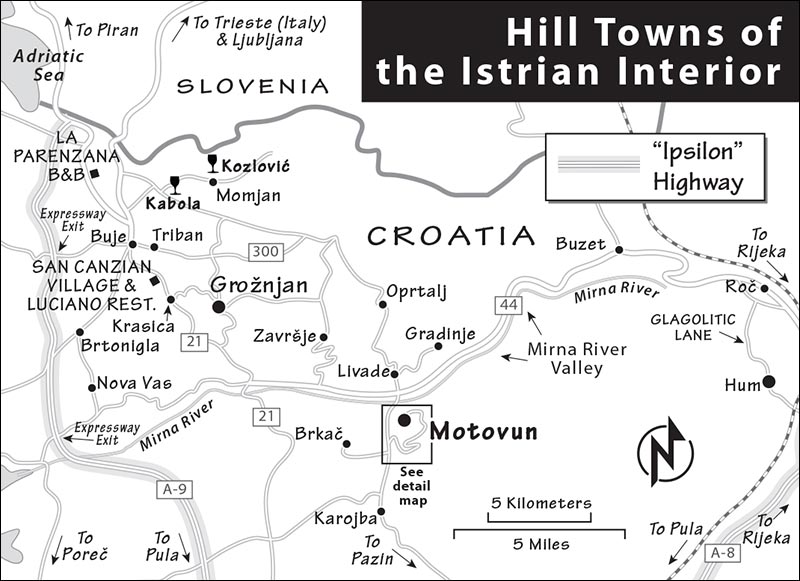
One of the interior’s main draws is its cuisine—especially the truffles that are found right here, as fresh as you can get. While Rovinj has some fine restaurants, it’s worth planning your day around having lunch or dinner (or both) in the interior. Review my restaurant options, especially if you want a memorable truffle feast.
During the glory days of the Austro-Hungarian Empire, a twisty railway called La Parenzana (Porečanka in Croatian) connected Trieste to Poreč by way of many of northwest Istria’s hill towns. While the train itself is long gone, part of its route has been converted to a rails-to-trails path (you’ll see signs for this around the area, and a small museum in Livade). The many bridges and tunnels engineered to make the train line possible have become nostalgic icons of an earlier age. While Croatia hasn’t yet developed a serious bicycle-tourism culture, La Parenzana is an impressive first effort. While there, ask for the free, EU-funded map of La Parenzana’s route, which spans three countries (Italy, Slovenia, and Croatia).
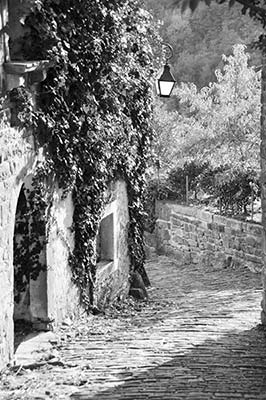
Istrian hill towns can be rough and rugged. Many are abandoned, only recently having been rediscovered by artists. Remember that after Istria shifted from Italy to Yugoslavia following World War II, the “Italian exodus” saw many local peasants leave their homes behind and move into Italy proper—one reason many of these towns are still in such disrepair. Stumbling over cobbles between desolate buildings in a village that was once humming with life, thoughtful travelers are mindful of the dire consequences of forced population shifts.
As you explore, you’ll see signs for wineries, olive oil producers, truffle shops, and agroturizams. Like Italian agriturismi or Slovenian tourist farms, these are working farms that try to involve tourists in a meaningful way—sometimes just for a meal or overnight stay, but occasionally with actual participation in the daily workings of the farm. For more information, visit www.istra.hr.
As you drive, keep an eye out for characteristic stone igloos called kažun. Formerly used as shelters by shepherds and farmers, the few surviving structures—sometimes built right into a dry-stone wall—are now mostly a symbol of Istrian pride.
GETTING AROUND THE ISTRIAN INTERIOR
By Public Transportation: It’s possible to see some parts of inland Istria by public transportation, but the rewards are not worth the headaches. The large hill town of Pazin is the region’s transit hub, with buses to Rovinj, Pula, Poreč, and Motovun—but not the smaller villages.
By Car: The region is ideal by car. For a quick visit to only the best hill town (Motovun), just zip on the ipsilon highway (A-9) to the Nova Vas exit, and take the mercifully flat road 44 along the Mirna River Valley straight to Motovun. But for a full day of hill-town hopping in the Istrian interior, follow my suggested route in the “More Hill Towns” section, later.
Motovun
Dramatically situated a thousand feet above vineyards and a truffle-filled forest, Motovun (moh-toh-VOON, Montona in Italian, pop. roughly 1,000) is the best known and most touristed of the Istrian hill towns, worth ▲▲. And for good reason: Its hilltop Old Town is particularly evocative, with a colorful old church and a rampart walk with the best spine-tingling vistas in the Istrian interior. It’s hard to believe that race-car driver Mario Andretti was born in such a tranquil little traffic-free hamlet. Today Motovun’s quiet lanes are shared by locals, tourists, and artists—who began settling here a generation ago, when it was nearly deserted.
Orientation to Motovun
Motovun is steep. Most everything of interest to tourists is huddled around its tippy-top. From its little main square, you’re just about two blocks in every direction from a sheer drop-off. This hilltop zone is circled by an old rampart offering a scenic stroll. Motovun has a very modest TI, which serves mainly as a ticket desk for the ramparts (see hours later; www.tz-motovun.hr). If they’re not open, the reception desk at Hotel Kaštel kindly dispenses tourist information and town maps.
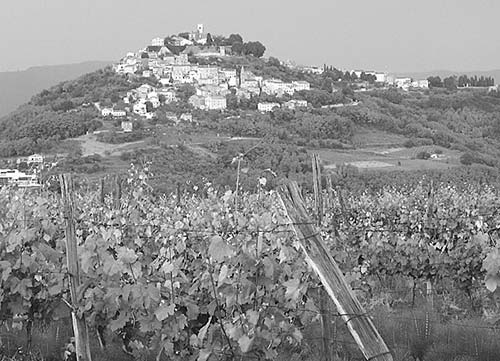
ARRIVAL IN MOTOVUN
Motovun’s striking hilltop setting comes with a catch: Visitors usually have to hike up part of the way. A steep, twisty road connects the base of the hill with the Old Town up top. Where you’re directed to park depends on how busy the town is that day (regardless, parking costs €1.50/hour, €14/day). On very busy days, you’ll park in the lot at the bottom of town and ride a shuttle bus up. If it’s less crowded, they’ll let you twist most of the way up the hill and park at the upper traffic barrier (or along the road nearby)—a steep 10-minute hike up to the main part of town. If you’re staying at Hotel Kaštel, you can usually drive almost all the way to the top and park on the narrow lane just below the town wall (follow the procedure explained under “Sleeping in Motovun,” later). If you’re staying elsewhere in town, ask your soba host for advice.
Motovun Walk
The following commentary will bring some meaning to your self-guided hilltop stroll. The walk begins at the traffic barrier partway up the hill (the highest you can drive unless you’re sleeping at Hotel Kaštel).
The main drag leading up into town is lined with wine-and-truffle shops. One of the first you’ll see is the Lanča family’s Etnobutiga ČA (just above the parking barrier on the right, at Gradiziol 33). This restored 17th-century house has a beautiful view terrace and a wide selection of local wines, brandies, and truffle products, plus a good restaurant with grand views ($$$ Pod Napun).
Hike several steep minutes farther up the hill, passing more shops with local products and truffles, jewelry boutiques, even a coffee roaster. Soon you’ll reach yet another traffic barrier at the base of the town’s wall (and the recommended Mondo Konoba restaurant). Continuing straight up past the barrier, you’ll earn grand views on the right—the little town across the valley floor is Livade, the heart of all that truffle commerce—then go through the first of two defensive gateways. Inside this passage (under the fortified gate), notice the various insignias from Motovun’s history lining the walls: Look for the Venetian lion, the Latin family tombstone, and the seal of Motovun (with a pyramid of five towers being watched over by an angel). The attic above the gate was a storehouse for weapons in the 15th century, when Motovun first flourished.
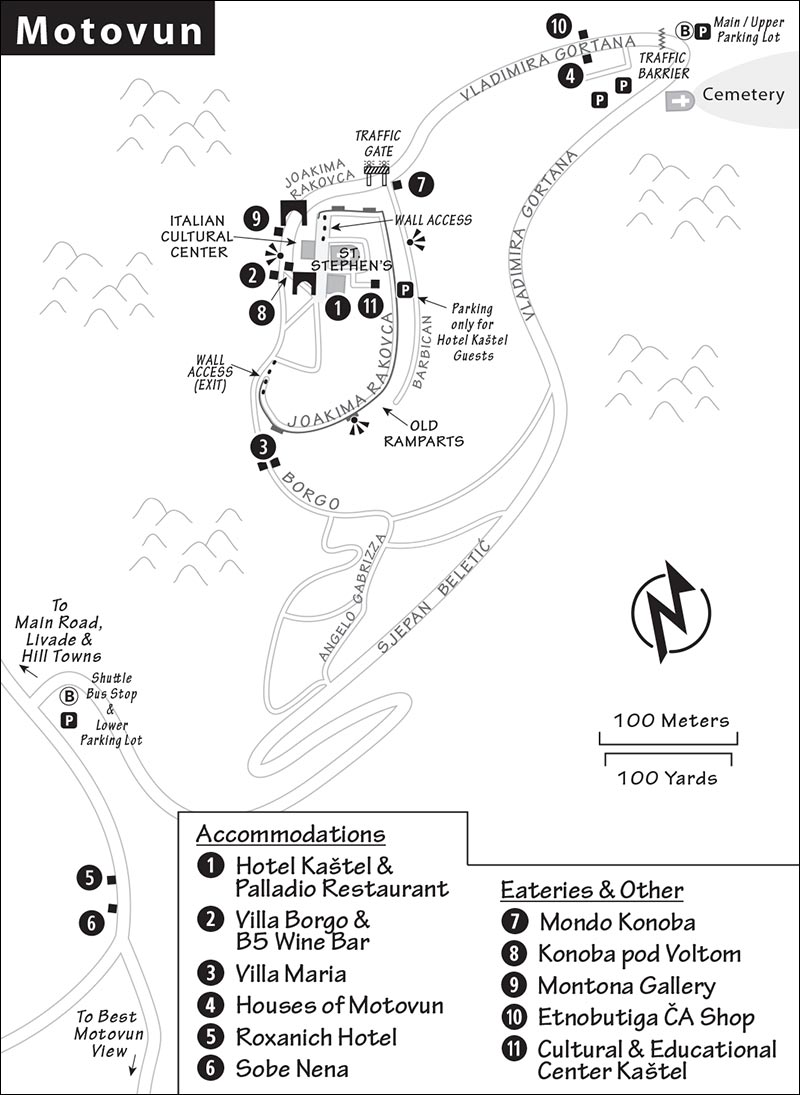
Emerging from the gateway, you’re greeted by more sweeping views of the valley below on the right. (A coffee or meal with this view is unforgettable.) Just up and to the left, you’ll find another defensive gateway, which is the main entrance into the heart of the Old Town. Continue hiking on up through this gate, passing yet another recommended restaurant inside, Konoba pod Voltom.
To your left as you come through the main gate is the yellow town church, St. Stephen’s. The crenellated tower is a reminder of a time when this hilltop town needed to be defended. While unassuming from the outside, this austere house of worship has an impressive pedigree: It’s based on designs by the famous Venetian architect Andrea Palladio (1508-1580), who greatly influenced the Neoclassical architecture of Washington, DC. The interior is a little gloomy but refreshingly lived-in—used more by locals than by tourists (free, sporadic hours, generally open daily 10:00-18:00 in summer, less off-season).
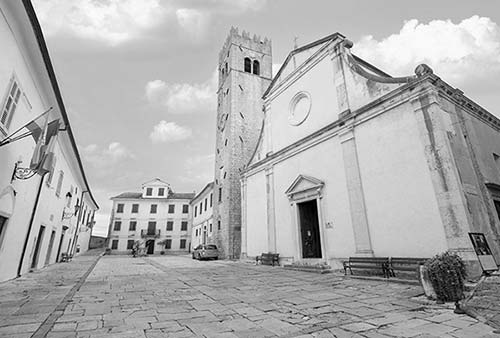
As you stand on the square in front of the church, imagine Motovun during its annual film festival, when it’s filled with 20,000 movie lovers from throughout the region and around the world—often including a minor celebrity or two. This square fills to capacity, and films are projected on a giant screen at the far end (generally late July or early Aug, www.motovunfilmfestival.com).
Facing the church is the Italian Cultural Center, which plays an important role in this very Italian corner of Croatia. While the building is not open to the public, if your timing is right you’ll enjoy beautiful music spilling out from its windows and filling the square. The local klapa troupe—with men’s voices harmonizing a cappella—practices here with the windows open, filling the square with music. If you happen to hear them, grab a bench and enjoy the concert.
At the other end of the square is a leafy little piazza dominated by the big, pink Hotel Kaštel—the main industry in town.
Head up the little lane between the church and Hotel Kaštel. After a few steps, look on the right for the Cultural and Educational Center Kaštel, a thoughtful, modern, well-presented museum all about Motovun that’s worth ▲ (free, daily 10:00-18:00, shorter hours or possibly closed off-season, Trg Andrea Antico 7). Circle the courtyard clockwise, checking out a series of strangely fascinating exhibits. You’ll learn about the busy watermills that used to churn in the Mirna Valley down below; Josef Ressel, the Czech inventor who lived in Motovun and revolutionized the design of the propeller; and the Parenzana rail line that once connected the isolated villages of Istria to the rest of the world. A small cinema shows off clips from the Motovun Film Festival (founded in 1999 and still going strong), while the room dedicated to Motovun native Mario Andretti has a race-car simulator, one of his racing uniforms, and a touching interview where he talks about his early years in this village. You’ll also learn about Veli Jože, a legendary Paul Bunyan-type gentle giant tied to Motovun (who’s immortalized by a fun wooden sculpture in the courtyard) and see a small diorama of rural life created by local schoolchildren. Taken together, it’s an endearing, and surprisingly engaging, celebration of local pride.
There’s one more sight in town, and it’s worth ▲: doing a quick circle around the town ramparts. Head back out into the square and buy your ticket at the TI, across from the church (€4, daily 9:00-20:00, off-season until 17:00, outside these hours it’s free). Then, as you face the church, go to the far-left end of the square and look for the turnstile to enter the walls. The lovely walk takes only about five minutes. As you breathe in the stunning panorama from above Istria’s rolling hills, notice that well-defended Motovun has been fortified three times—two layers of wall up top, and a third down below.
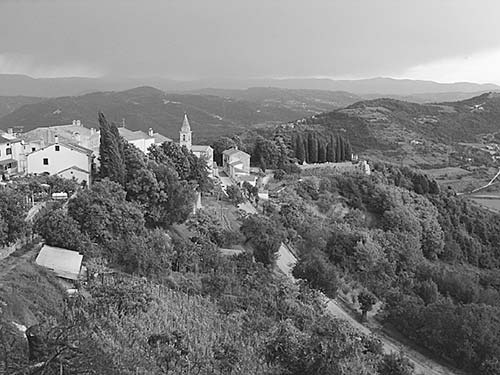
While most of Croatia is overrun by stray cats, Motovun seems populated by dog lovers. If you see or hear dogs in people’s backyards, it’s a safe bet that they are trained to hunt for truffles in the surrounding forest.
Sleeping in Motovun
Except for the big hotel, all of the places here keep the same rates all year long. Some Motovun accommodations lack air-conditioning; thick old walls and a nice breeze generally keep things cool.
$$ Hotel Kaštel, dominating Motovun’s hilltop (and its tourist industry), is can-do, ideally located, and the only real hotel in this little burg. Most of the 33 colorful, simple but comfortable rooms have views. True to its name, the building used to be a castle, so the floor plan can be confusing (RS% for room and spa, includes breakfast, air-con, elevator, laundry service, bike rental, Trg Andrea Antico 7, +385 52 681 607, www.hotel-kastel-motovun.hr, info@hotel-kastel-motovun.hr). Guests have free access to a beautiful indoor pool (and my readers enjoy a discount at the spa, offering a wide range of massages). On arrival at the traffic barrier, tell the attendant there that you have a reservation at Hotel Kaštel; if there’s room on top, he’ll let you drive up. Otherwise he’ll tell you where to park and call the hotel, which will send down a free car to shuttle you up; either way, it’s smart to call ahead to the hotel to figure out your options.
$$ Villa Borgo, conveniently located next to the loggia just below Motovun’s uppermost gate, has 16 simple but stylish rooms in two buildings; some have views, and all of them have access to a spectacular view terrace (RS%, air-con, staffed until 20:00—call ahead if arriving later, closed Dec-Feb, Borgo 4, +385 52 681 708, mobile +385 98 434 797, www.villaborgo.com, info@villaborgo.com, Slaven).
$ Villa Maria, in the Sviličić family home, is a good value. They rent two nice rooms with view terraces, a third nonview room, and a studio apartment with access to a little garden. It’s on a quiet back lane a steep five-minute walk below the main part of town (breakfast extra, cash only, air-con, facing the defensive gate turn right and go down and around to Borgo 32, +385 91 533 2020, lorenasvilicic@gmail.com, Lorena speaks a little English). Ask them about going on a truffle hunt.
$ Houses of Motovun, just above the parking barrier partway up the hill, has five idiosyncratic rooms that work in a pinch (no breakfast, air-con, check in across the street at Etnobutiga ČA at Gradiziol 33, +385 52 681 767, mobile +385 98 955 7978, www.antique-motovun.com.hr, info@antique-motovun.com.hr).
At the Base of Town: These places, at the base of Motovun’s hill and across from the little gas station, lack the charm of being right in the center of the Old Town (you have to take the shuttle bus up from the parking lot for €3). But they have other advantages. $$$$ Roxanich Hotel is the fanciest place to stay for miles around. Billing itself as a “wine hotel,” it’s located inside a luxuriously renovated wine cellar from the 19th century. The aesthetic is industrial-chic, and the 32 rooms have colorful, eccentric interiors, many with lovely views over vineyards. The fancy bar comes with grand views (includes breakfast, air-con, elevator, outdoor pool, parking extra, Kanal 30, +385 52 205 700, www.roxanich.hr, reservations@roxanich.hr). ¢ Sobe Nena, while right next door (just uphill), is at the other end of the price spectrum. Run by Nevija, it’s a good budget option in a tidy house. The two rooms are old-fashioned and basic, sharing a bathroom, but there’s a lovely garden to relax in. Nevija speaks very basic English, but she can call her daughter Doris to translate (no breakfast, cash only, Kanal 32, +385 52 681 719, mobile +385 99 609 0883, sobe.nena@gmail.com).
Eating in Motovun
This small hill town has just a few real restaurants, and most of them are exceptional (particularly the first two). These price rankings don’t reflect top-end truffle splurges—as they fresh-grate white truffles on your pasta or steak, they’re also adding $’s. But keep in mind that truffle dishes are a better investment when truffles are in season and the flavors are pungent (see sidebar). Remember, there are also several excellent restaurants in the countryside near Motovun, especially just across the valley in Livade—if you’re serious about food, be sure to peruse your options in the “More Hill Towns” section, later.
$$$ Mondo Konoba, run by a Croatian-Italian hybrid family and located just below the lower town gate (at the base of the wall), serves up straightforward, satisfying Istrian cuisine that ranks with any restaurant in the region. Most diners skip the unpretentious, pastel-blue dining room in favor of the inviting little outdoor terrace tucked on the upper level, with additional tables across the street at the base of the town wall. The Mondo family’s pack of truffle-hunting dogs occasionally pays a visit (daily 12:00-15:30 & 18:00-22:00, closed Jan, Barbakan 1, +385 52 681 791).
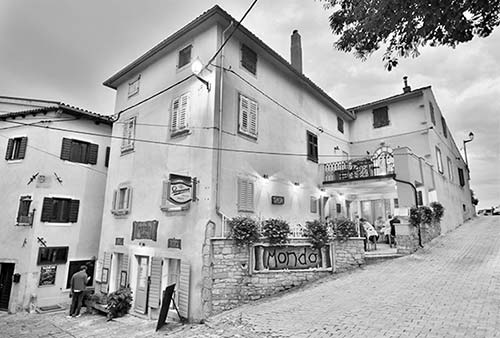
$$$ Konoba pod Voltom is inside the town’s upper, main gate (on the right). Motovun’s most traditional eatery serves excellent, well-presented Istrian food in a cozy dining room. In good weather (June-Sept only), it’s hard to beat their view loggia, just below and outside the gate (daily 12:00-22:00, closed Jan, +385 52 681 923, Martina).
Cheap Food with a View: For more affordable food with million-dollar views, look for $$ Montona Gallery, a café with tables along the rampart between the two gates. They serve drinks, ice cream, snacks, pizzas, pastas, burgers, and some Istrian cuisine (daily 9:00-22:00, +385 52 681 754).
On the Main Square: Hotel Kaštel’s $$$ Palladio Restaurant has ambitiously executed (if hit-or-miss) food and delightful seating right on the leafy main square—but I’d skip the dull interior (RS%, daily 7:00-22:00; also listed under “Sleeping in Motovun,” earlier).
Local Wine, Beer, and Snacks: B5 Wine Bar, across the atmospheric lane from the recommended Villa Borgo (and run by the same owners), is a rustic hangout where you can try wine from local Motovun vintners or Istrian microbrews, plus plates of local cheese, prosciutto, and sweets (daily 10:00-22:00, just below the top entry gate and around the corner, Borgo 5, +385 52 681 708).
A mysterious fungus with a pungent, unmistakable flavor is all the rage in Istria. Called tartufi in both Croatian and Italian, these precious tubers have been gathered here since Roman times and were favored by the region’s Venetian and Austrian rulers. Later on, local peasants ate them as a substitute for meat (often mixed with polenta) during the lean days after World War II.
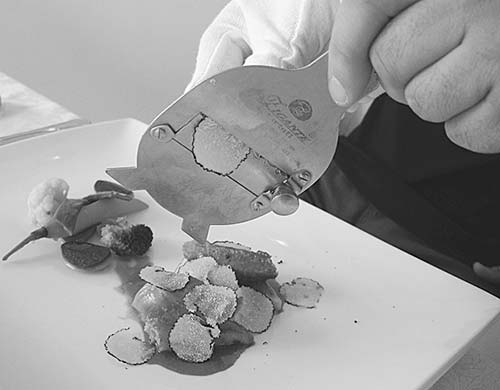
In 1999, local entrepreneur Giancarlo Zigante discovered a nearly three-pound white truffle. In addition to making Zigante a very wealthy man, this giant truffle legitimized Istria on the world truffle scene. Today, Istria rivals France’s Provence and Italy’s Piedmont in truffle production. Most of Istria’s truffles are concentrated in the Motovun Forest, the damp, oak-tree-filled terrain surrounding Motovun, Livade, and Buzet.
A truffle is a tuber that grows entirely underground, usually at a depth of eight inches, near the roots of oak trees. Since no part of the plant grows aboveground, they’re difficult to find...and, therefore, extremely expensive. Traditionally, Istrian truffle gatherers use specially trained dogs to find truffles. This is best done at night, when the dog must rely more on its sense of smell.
There are two general types of truffles: white (more valuable and with a deeper and more pungent flavor—Tuber magnatum, known as the “Queen of the Truffles”) and black. Each type of truffle has a season when its scent is released, making it easier to find (May-Nov for black, mid-Sept-Jan for white). Once dug up, they look like a tough, dirty pinecone.
Thanks to their powerful and distinctive kick, truffles are often used sparingly for flavor—grated like parmesan cheese, or infused in truffle oil that’s sprinkled over a dish. But you’ll also find them in cheese, salami, olive oil, tapenade, pâté, and even ice cream. Truffle is commonly served with pasta—sometimes in a rich cream sauce, and other times more simply, just with olive oil. Truffle soufflé and truffle frittata (scrambled eggs) are also popular. Some people find that the pungent, musty aftertaste follows them around all day...and all night, when its supposed aphrodisiac qualities kick in.
If you’re a truffle nut, you’ll be in heaven here; if not, you may still appreciate the chance to sample a taste. While you do that, ponder how one giant tuber changed the economy of an entire region.
More Hill Towns
While Motovun is the top hill town, a charm bracelet of appealing villages sits close by. Dropping by several as you drive can make for a lovely countryside day. Some are better for exploring (Grožnjan, Završje), others better for a meal (Brtonigla, Livade), and others worth a quick stop if you’re passing through (Buje, Oprtalj, Hum). I’ve listed these roughly in the order you’ll reach them, coming from the highway and working your way east toward Motovun. While you’ll traverse some slow and windy roads, this entire trip is quick—you could do the full circle (not counting Hum) without stops in less than two hours. This route is just a rough framework. Venture off it. Run down leads from locals. Follow intriguing signs to wine tastings, restaurants, and agroturizams. Sniff out some truffles in the Motovun Forest. You will see some other tourists, but this area isn’t overrun...yet.
• From Rovinj, take the fast ipsilon highway (A-9) north. You have two exit options for this area. If you want to enjoy a meal in Brtonigla, take the Nova Vas exit, drive through the middle of Nova Vas, then follow signs for five minutes into Brtonigla. But if you want to head straight to the other towns, take the exit for Buje and skip down to that section.
BRTONIGLA
Brtonigla (bur-toh-NEEG-lah, Verteneglio in Italian, literally “black soil”) is a tiny wine village surrounded by vineyards. It’s a bit closer to the sea than the other hill towns in this chapter, and sits above gentle slopes rather than on a dramatic hilltop. This empty-feeling place is home to a luxurious hotel/restaurant and a well-regarded local eatery, but if you’re not eating or sleeping here, give it a pass. Once in town, you’ll find just a handful of haphazard streets.
Sleeping and Eating in Brtonigla: The family-run $$$ San Rocco Hotel and Restaurant is suitable for a splurge. Not long ago, this was the abandoned shell of a traditional Istrian house. Now it’s a cushy, elegant hotel with traditional beams-and-stone decor and all the modern amenities. With 13 rooms, an outdoor pool, a big indoor hot tub and sauna, and distant views of the Adriatic, it’s a welcoming retreat (air-con, elevator, loaner bikes, Srednja Ulica 2, +385 52 725 000, www.san-rocco.hr, info@san-rocco.hr, Rita and the Fernetich family). Its well-regarded, upmarket $$$$ restaurant—open to guests and nonguests alike—features Istrian cuisine served with a modern twist, in a dressy dining room or outside, with poolside elegance (daily 13:00-22:00).
$$ Konoba Astarea, along the main road toward Buje, is a local favorite for traditional, relaxing Istrian cuisine with a focus on fish and lamb. While this isn’t gourmet cooking (truffles are an afterthought), it’s rustic food done very, very well. Alma Kernjus and her son Ivan cultivate a convivial atmosphere that feels like a well-worn neighborhood hangout. Choose between the warmly cluttered, borderline-kitschy dining room huddled around the blazing open fire, where Alma does a lot of the cooking; the cool and welcoming terrace with faraway sea views; or the relaxing back garden. It’s smart to reserve ahead (Thu-Tue 11:00-23:00, closed Wed and Nov-Dec, +385 52 774 384, www.konoba-astarea.com).
• From Brtonigla, simply follow signs into...
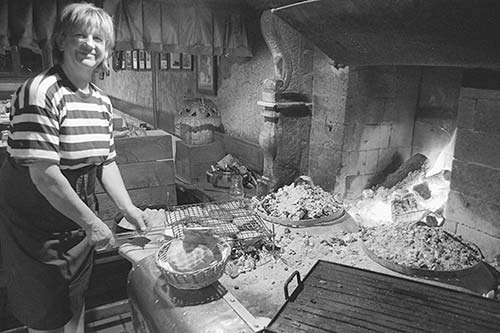
BUJE
Close to the Slovenian border, Buje (BOO-yeh, Buie in Italian) is big and striking from afar, but functional up close. Still, it’s worth a visit if you’re passing through and curious to take a stroll through a hill town that feels more alive and workaday than the norm. Just above the parking lot are the small TI and the town museum (facing each other across the street), and higher up is another parking-lot plaza in front of Buje’s pastel-yellow Church of Our Mother of Mercy (marked in Latin, Mater Misericordiae). From the nearby terrace, you have (distant) views of the sea. From this square, you can hike on cobbles through everyday neighborhoods. Up and to the left you’ll find the squat remains of a mid-15th-century octagonal defensive tower, the small Sv. Martin church with its evocative graveyard, and a viewpoint overlooking the countryside. Up and to the right from the main square is the main Sv. Servol Church, whose big bell tower—visible from miles around—dominates the hilltop. With a rough, unfinished facade, the church shares a lovely little piazza with the local elementary school.
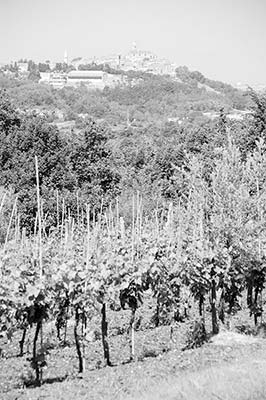
Sleeping and Eating North of Buje: In Volpia, a nondescript village five minutes outside Buje (toward Slovenia), you’ll find a charming stone country house offering reasonably priced rooms and good food. $$ La Parenzana, named for the long-extinct Istrian rail line, rents 16 woody, simple-but-comfortable, Germanic-feeling rooms (no air-con, rental bikes, Volpia 3, +385 98 434 748, www.laparenzana.com, info@parenzana.com.hr, Jozo) and also runs a $$$ restaurant serving up truffle specialties and other dishes cooked over an open fire (daily 12:00-15:00 & 18:00-23:00). The former route of the Parenzana rail line—now a handy hiking and biking trail—runs just behind the property, and the hotel has a sweet little minimuseum about that nostalgic train trip. To get here from Buje, leave town following signs for Trieste and Koper, then turn off toward Plovanija, Portorož, and the Slovenian border; after a couple of minutes, watch for Casa Parenzana signs to the right.
Sleeping and Eating South of Buje: About a five-minute drive south of Buje, $$$$ San Canzian Village & Hotel is one of the most appealing top-end splurges in this part of Istria. The entire village of Mužolini Donji has been renovated into one big plush hotel, with 28 rooms scattered through several traditional buildings (brought fully up to modern standards), plus a modern addition—which blends perfectly with the old homes and the landscape—that has a gourmet restaurant, a spa, a delightful outdoor swimming pool, distant Adriatic views, and lots of cushy extras. If you want to settle into a posh cocoon for a few days, this is the place (air-con, Mužolini Donji 7, Buje, +385 52 853 897, https://san-canzian.hr, info@san-canzian.hr). Also on the premises is $$$$ Luciano Restaurant, serving upmarket, beautifully presented dishes that showcase locally sourced ingredients (including olive oil produced in the grove the restaurant overlooks). The modern, almost industrial dining room feels upscale, but I prefer the terrace with views over Istrian hills and a sliver of Adriatic horizon. Nonguests are welcome, but it’s smart to book ahead (daily 13:00-16:00 & 18:00-22:00).
• If you’re interested in a wine-tasting detour to two of Istria’s swankiest wineries (Kabola and Kozlović, both described later), now’s your chance: Continue past Buje on the main road, heading at first toward Koper, then watch for signs on the right to Momjan/Momiano. Take this road through the village of Kremenje; soon after, you’ll pass Kabola on the right. Kozlović is across the valley around the far side of Momjan.
To skip the wines and continue on our route, leaving Buje, look for signs that take you along a twisty, narrow road (via Triban) right to Grožnjan.
GROŽNJAN
Grožnjan (grohzh-NYAHN, Grisignana in Italian) is your trapped-in-a-time-warp Istrian hill town. Artfully balanced on the tip of a vine-and-olive-tree-covered promontory, Grožnjan—rated ▲—is fun to wander and explore. Its stony, leafy, rough-cobbled lanes are lined with art galleries and truffle-and-olive-oil shops. While there are no “sights” to speak of, it’s the kind of place that invites you to get lost and leave your itinerary on your dashboard. Not long ago, Grožnjan was virtually forgotten. But now several artists have taken up residence here, keeping it Old World but with a spiffed-up, bohemian ambience.
Visiting Grožnjan: All roads lead to a visitors parking lot, a short, level walk from the traffic-free village; there are also a few pay-and-display spaces along the road a bit closer (both options are the same price).
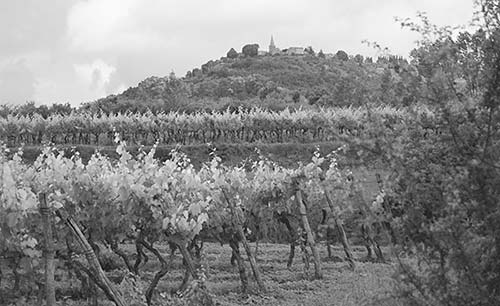
Begin your visit at the view terrace next to the church, with distant Adriatic views. A small statue celebrates an artist rather than a war hero: Aleksandar Rukavina (1934-1985), a prominent sculptor and painter who lived and taught in Istria and, in 1964, founded an art colony here in Grožnjan.
The church’s bell tower is the town’s only real landmark. Inside the church, the big painting over the altar shows angels intervening in the Pula amphitheater to save Christians who were thrown to the lions and tigers.
To get the lay of the land, take a 10-minute town wander: Facing the church’s front door, go left and loop clockwise through town. Walking along the main street, Ulica Umberta Gorjana, you’ll pass the first of several truffle shops, then the TI (which doesn’t have a lot to do; Gorjan 3, +385 52 776 131, www.tz-groznjan.hr). Just past the TI, on the left (through the gate below the loggia), you’ll find the first of two scenic little cafés selling overpriced drinks and cakes with a smashing view.
Back in town, follow the street to the shaded square with two of the town’s restaurants. From here, explore and follow your nose until you wind up back at the church and view terrace (with another view café). At the restaurants, the road forks: The left (downhill) street leads to another view terrace; the right (uphill) takes you deeper into stony cuteness and attractive side streets. Don’t worry about addresses or finding a particular place; you’ll find yourself walking in circles, following tempting lanes that end at a sheer drop-off, and quickly seeing what there is to see. Let your pulse slow and enjoy being a castaway on this isolated, tranquil hilltop. Marinate in the artistic spirit of the place: brightly painted shutters and windowsills; discarded old bikes placed just so as design elements; carefully selected plants and flowers; and more art galleries, per capita, than just about anywhere in Croatia.
Istrian wines are getting some attention on the world stage. A few high-class restaurants in New York and London are adding vintages ending in -ić to their wine lists, and German, Austrian, and Italian tourists are discovering Istria’s wine roads (even if the French remain aloof).
A few local wineries have classy tasting rooms that invite passing motorists in for a sample. As this is an emerging scene, serious wine lovers should do their homework before arriving. But if you simply want to splice a few sips into your itinerary, these options are worth considering. At most places, you can drop by for a few free tastes, though they’d like you to buy a bottle or two for your picnic (most have bottles in the $8-12 range). They understand that it’s tough for Americans to carry wine home, so producers that are exporters hope you’ll look for their wines back in the US. It’s good form to call ahead and let them know you’re coming (hotels can help), particularly if you want to pay for a more serious visit, with a guided tour of the cellar, and local cheeses and other bites paired with each wine. I’ve organized the wine-tasting options by area within Istria.
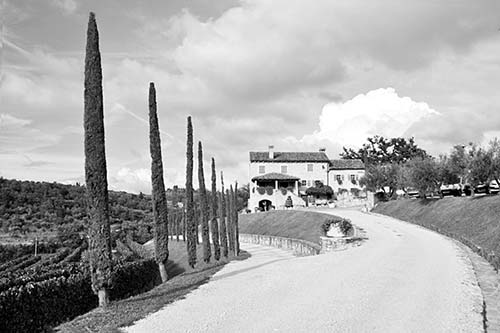
Near Momjan, just north of the Hill Town Loop: An easy 10-minute detour from my recommended hill-town driving loop is the village of Momjan, which is surrounded by some of the most striking vineyards I’ve seen here. While humble Momjan itself doesn’t have much to see, it’s flanked by two well-regarded wineries with state-of-the-art tasting facilities. Traditional Kabola, near the village of Kremenje (just toward Buje from Momjan), owns the best setting, with a cypress-lined driveway leading to a cluster of picture-perfect stone buildings overlooking gorgeous vineyard tableaus that feel like Provence. Kabola produces a wide variety of whites, including several made from malvazija istarka and muscat momjanski. They also have a full palette of reds—100 percent teran and teran blends with cabernet sauvignon and merlot. (They also make a 100 percent cabernet sauvignon that’s very nice.) Try the rosé made with teran (reserve ahead, Mon-Sat 11:00-17:00, closed Sun, Kanedolo 90, +385 52 779 208, www.kabola.hr). Kozlović has a sophisticated, modern tasting facility, dramatically perched on a hill overlooking the valley behind Momjan. Arguably Istria’s most well-regarded winery, they produce mostly whites (about 85 percent, including lots of malvazija and some muscat). But they also make exquisite reds (teran and blends that knocked my socks off). The staff is more formal, and you must call ahead to make an appointment—tastings are all prearranged to match with light foods (Mon-Sat 10:00-19:00, closed Sun, shorter hours off-season, Vale 78, +385 52 779 177, mobile +385 99 277 9177, www.kozlovic.hr).
Between Rovinj and Poreč: Just a minute’s drive off the Limski Canal (described under “Rovinj Connections,” earlier in this chapter), in the village of Krunčići, Ivica Matošević turns out well-respected wines and offers tastings in a humble space without pretense (it’s a working facility rather than a snazzy showroom). Its proximity to Rovinj makes it an easy choice if you want a winery visit without scouring the back lanes. Matošević corks up mostly whites, with several varieties of malvazija (which they call Alba—Italian for “dawn”), as well as a red blend of teran, merlot, and cabernet sauvignon called Grimalda (after the place where the grapes are grown). Their basic tastings are free if you buy a bottle, or you can call or email a day ahead to arrange a cellar tour and a more elaborate tasting paired with local snacks (Mon-Fri 9:00-18:00, Sat-Sun 10:00-18:00, possibly later in summer, less off-season, Krunčići 2, +385 52 448 558, www.matosevic.com, office@matosevic.com). From Rovinj, head up to the Limski Canal (look for this turnoff on the left before you get to the highway). After driving along the rim of the canal, then heading inland, watch for the turnoff on the right for Krunčići and Matošević.
Eating in Grožnjan: The village has no “destination” restaurant, but if you happen to be here at mealtime, two very different places share a leafy terrace right in the middle of town (both open daily 8:00-23:00). $$ Café Pintur has straightforward food and lower prices (Mate Gorjana 9, +385 52 776 397, mobile +385 98 586 188). $$$ Bastia is a bit more modern and comfortable, with its own lovely courtyard and a menu focusing on truffles (1 Svibnja 1, +385 52 776 370).
• From Grožnjan, backtrack the way you came, keeping an eye out for big, brown signs to Završje. Turn right and follow these signs about 10 minutes to the next stop.
ZAVRŠJE
If you’d like to visit a nearly deserted hill town, Završje (ZAH-vur-shyeh) is your place. Called “Piemonte d’Istria” in Italiano, this mini-Motovun seems to have more truffle-hunting dogs than people. One of the smallest, most compact, and most picturesque hill towns in the area, Završje was once just a double-walled fortress clinging to the top of its bulbous hill. Over time it sprawled just a bit outside its original walls, but it was deserted after World War II and remains almost uninhabited today; only a few locals live here, and virtually all of the buildings are abandoned skeletons. There’s very little to see or do—no museums, no restaurants, and a sporadically open church with a leaning tower and a colorfully painted Baroque altar. But the EU has taken notice of this precious little burg and invested in restoring its pretty pink schoolhouse (at the base of the hill, near the parking lot) and posting informative English descriptions around town. Walk up through the village on the main cobbled lane, peering into ruined stone houses and pondering their potential. If I were an entrepreneurial Istrian restaurateur, I’d set up a fancy truffle restaurant here posthaste.
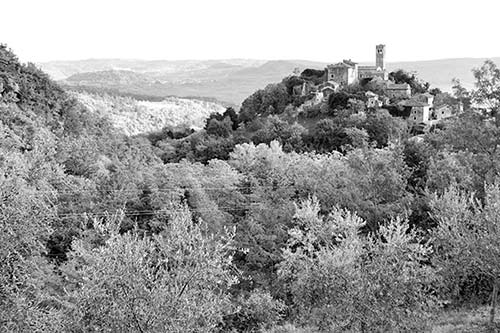
• If you want to head directly to Motovun, you can simply proceed on the road past Završje and twist down into the valley, on an unpaved road with chunky gravel. You’ll pop out on the valley highway just west of Motovun.
Better yet, for an easier, more scenic approach, backtrack the way you came for a couple of minutes, turning right to follow signs to Oprtalj.
OPRTALJ
Oprtalj (oh-per-TAL; Porotole in Italian) has a particularly scenic approach, along a twisting driveway lined with pointy cypress trees. As a place to visit, the town is midway between cutesy Grožnjan and still-abandoned Završje, with few sights but plenty of atmosphere. Oprtalj lines up along a plateau with a busy road ripping through its middle. Like Motovun, it has a pink loggia across from its main gate, containing an old stone-carved winged lion of St. Mark and other stony fragments from the town’s history. If you poke up through the gate and wander the town, you’ll find the faintest brush of tourist trappings in what is otherwise an authentic, quiet little burg. Near the gate is the town’s konoba, with seating under a tree out on the view terrace across the street. The fancy yellow building at the Motovun end of town is the elementary school, named for local hero Milan Šorgo, a Partisan who was killed during the fighting to retake his native Istria from the Nazis.
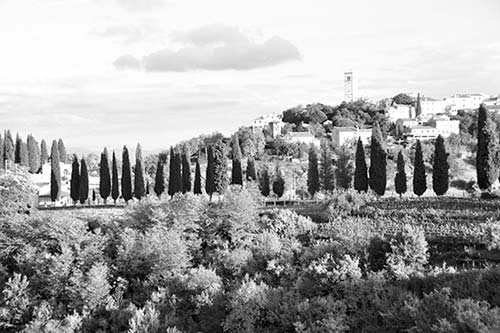
• The road through Oprtalj leads directly down into Livade, then across the valley highway to Motovun.
LIVADE, ISTRIA’S “TRUFFLE TOWN”
The flat, little crossroads village of Livade, sitting in the valley facing the back of Motovun’s hill, is home to the first and last name in Istrian truffles. In 1999, Giancarlo Zigante unearthed the biggest white truffle the world had ever seen—2.9 pounds, as verified by The Guinness Book of World Records. (The current record holder, found in central Italy in 2014, weighed nearly 4 pounds.) Zigante’s massive hunk—revered as if it were a religious relic—kicked off a truffle craze that continues in Istria today (see “Truffle Mania” sidebar, earlier). Today Zigante has a virtual monopoly on Istria’s truffle industry, producing a wide range of truffle goodies. If you’re a connoisseur, or just curious, make a pilgrimage to this truffle mecca. Livade’s White Truffle Days take place on weekends from mid-September through early November; white tents are filled with local producers showing off their truffles, wines, olive oils, and more. While here, try dropping into Livade’s little museum about La Parenzana, the railway that once linked these hill towns (sporadic hours, often open weekends).
Eating in Livade: Zigante’s large facility here is divided into two parts: The Zigante Tartufi shop offers shelves upon shelves of both fresh and packaged truffle products (plus local wines, olive oils, brandies, and more). There’s also a little tasting table where you can sample the precious goods (daily 9:00-21:00, off-season 10:00-17:00, Livade 7, +385 52 664 030, www.zigantetartufi.com). The attached $$$$ Restaurant Zigante is the place to splurge on truffles if money is no object. The decor—inside or out on the terrace—is white-tablecloth classy, the service is deliberate but friendly, and the truffles, as if on a cooking game show, are prepared in a dizzying variety of ways (daily 12:00-23:00, Livade 7, +385 52 664 302, www.restaurantzigante.com).
More affordable and less pretentious, $$$ Konoba Dorjana is across the roundabout and just down the street from Zigante. This family-run eatery has a cozy old-fashioned dining room around a giant fireplace, an inviting terrace covered by a canopy of ivy, and plenty of truffle options (Thu-Tue 11:00-22:00, closed Wed, Livade 4A, +385 52 664 093).
Eating near Livade, in Gradinje: A five-minute drive east of Livade, in the hamlet of Gradinje, is a rustic, unpretentious eatery serving up the most affordable truffle dishes around. $$ Konoba Dolina (Valley Inn) has a nondescript interior and a pleasant terrace out front. Because it’s just beyond the tourist trail, the prices are reasonable and the ambience feels authentic...and the food is utterly delicious. If you want to sample good, hearty, local truffle cuisine with zero pretense, this place is worth the drive. It’s been discovered by truffle pilgrims, so you should book ahead (cash only, Wed-Mon 12:00-21:00, closed Tue, +385 91 893 2847). First make your way to Gradinje (go into Livade and turn right at the main roundabout, then drive through the countryside for a few minutes). Once in Gradinje, go all the way through town, then look for signs on the left.
• Motovun (described earlier in this chapter) hovers on the hill just across the valley from Livade. Once you’ve seen this area, if you have more time and interest, you can carry on another 40 minutes to reach Hum (follow the main valley road east to Buzet, then to Roč, then look for the turnoff on the right to Hum, along the Glagolitic Lane). Most people won’t find the Hum detour worth the miles, but it works great if you’re headed east anyway (such as to Opatija or Rijeka).
HUM
According to its marketing plan, Hum (pronounced “hoom,” Colmo in Italian) is the “smallest town in the world.” Despite its tiny population of 16 people, Hum has a Town Hall, church, school, post office, and all the other trappings of a “town.” Smart gimmick. Unfortunately, Hum is also, per capita, the most touristy town in the world—crammed with visitors who come to stroll through its streets, drop some euros in its souvenir shops, or dine at its lone restaurant, $$ Humska Konoba, with fine outdoor terrace seating (+385 52 660 005). But despite its quirks and its one-trick commercialism, Hum is engaging. At the far corner of Istria—just up the road from Mount Učka, which forms the natural boundary with the neighboring Kvarner Gulf—Hum feels incredibly remote, rugged, and (if you don’t run into any tour buses) forgotten by modern times.
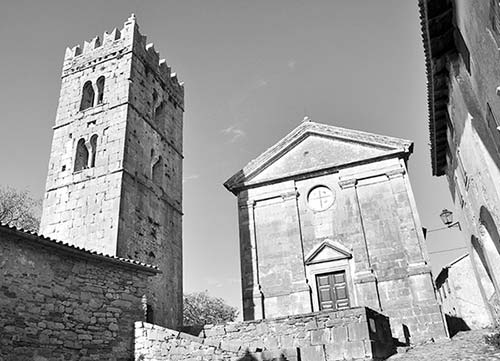
Getting There: From Motovun, follow the Mirna Valley road east. After you go through Buzet, you’ll pass under the village of Roč; watch for the turnoff to Hum on the right. From here, you’ll follow the Glagolitic Lane (described next) through the wilderness to Hum.
Nearby: The road between Hum and the Mirna Valley—called the Glagolitic Lane (Aleja Glagoljaša)—commemorates a ninth-century alphabet once used for written Croatian. Driving here, watch for giant Glagolitic characters and a sort of “Rosetta Stone” on top of a hill comparing the Glagolitic, Cyrillic, and Roman alphabets. While Glagolitic was abandoned centuries ago in most of Croatia, the area around Hum used it well into modern times. And since the rise of Croatian nationalism during the Yugoslav Wars, the Glagolitic alphabet has been in vogue—schoolchildren even have Glagolitic poetry contests and spelling bees.
• From Hum, you’re very close to the northeast branch of the ipsilon highway (A-8). You can take this either west to Rovinj (via Pazin), or east to the Učka Tunnel, Opatija, and Rijeka.
Near Istria
The towering Mount Učka separates Istria from the rest of Croatia. And just on the other side of that mountain is a pair of former Habsburg towns that offer a dose of variety (and convenient pit stops on the way to other Croatian towns). Shot through with the faded elegance of an upper-crust history, Opatija, worth ▲, is a welcome change of pace from the salty, stony towns along the rest of the Croatian coast. Its elegant Viennese-style cafés delight coffee sippers, its parks tickle gardeners, and its beaches lure sunbathers. Nearby, the big industrial port city of Rijeka is an important transit hub; if you wind up changing buses or boats here, consider a quick stroll through its gentrifying urban core.
Opatija
Opatija (oh-PAH-tee-yah) is not your typical Croatian beach town. In the late-19th-century golden age of the Austro-Hungarian Empire, this unassuming village was transformed into the Eastern Riviera—one of the swankiest resorts on the Mediterranean. While the French, British, and German aristocracy sunbathed on France’s Côte d’Azur, the wealthy elite from the eastern half of Europe—the Habsburg Empire, Scandinavia, and Russia—partied in Opatija. Neo-Baroque, Neoclassical, and Art Nouveau villas popped up along its coastline as it became a sunny aristocratic playground.
Though the Habsburgs are long gone, Opatija retains the trappings of its genteel past. Most of Croatia evokes the time-passed Mediterranean, but Opatija whispers “belle époque.” Most people don’t come to Croatia for this sedate scene. But if rustic seaside villages are wearing on you, cosmopolitan Opatija—which hosts equal numbers of tourists and convention-going businesspeople—is a pleasant return to high-class civilization. You’ll notice the clientele here skews a bit older than in other beach towns.
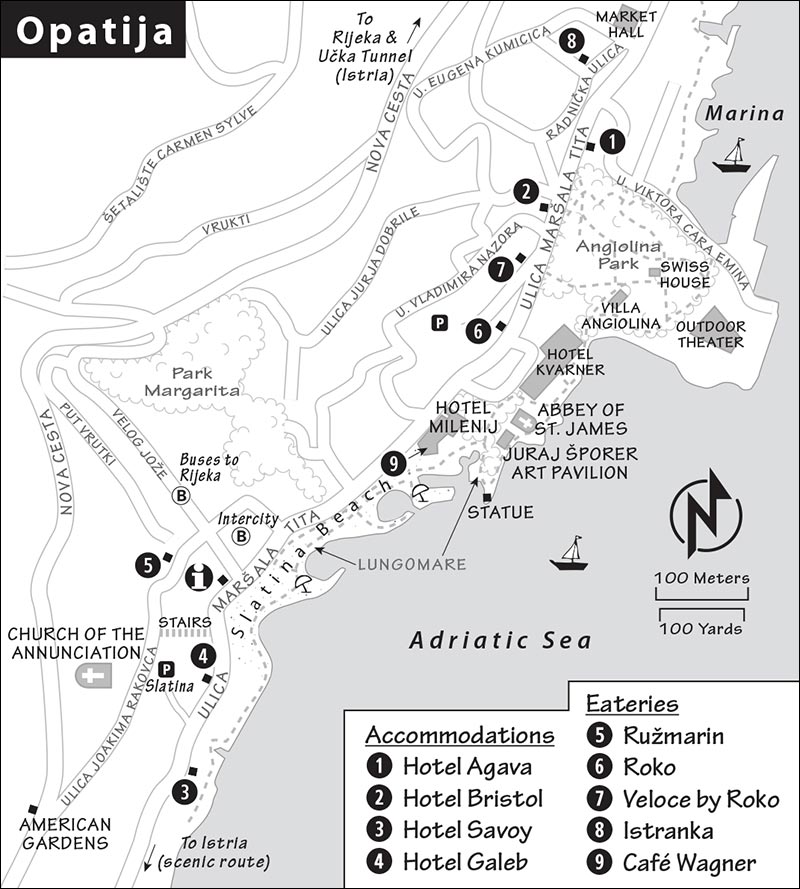
The town is also strikingly situated: tucked beneath thickly forested mountains, with a view across the bay of Rijeka’s sprawl. Thanks to its sheltered location nestled under towering peaks, Opatija is protected from the Bora wind, enjoying instead a light, refreshing breeze. This gives Opatija a particularly mild climate—the perfect match for its refined ambience.
Orientation to Opatija
Opatija (pop. 11,600) is basically a one-street town: Ulica Maršala Tita, lined on both sides by stately hotels, follows the seafront. Steep, wooded hills, cluttered with cantilevered houses, climb up from there. The town’s focal point is its beach area, called Slatina. You can walk from one end of the tourist zone to the other in about 20 minutes. (For a handy loop, walk along the bustling main street in one direction, then back along the waterfront promenade—or vice versa.)
TOURIST INFORMATION
Opatija’s TI is just a block off Slatina (July-Aug daily 8:00-21:00, until 20:00 in spring and fall, shorter hours and may be closed Sun off-season, Maršala Tita 146, +385 51 271 310, www.visitopatija.com).
ARRIVAL IN OPATIJA
Driving in from either Istria or Rijeka, just follow Opatija and bull’s-eye signs and switchback down, down, down to the water. The handiest place to park is the big, modern Slatina garage, perched just up the hill at the west end of town: When the road dead-ends at the waterfront drag, follow signs to the right, then watch for the garage entrance on your right (€2/hour). There’s also slightly cheaper street parking (blue-lined spaces), but the meters take only coins and small bills. If you’re sleeping here, your hotel likely has parking.
Sights in Opatija
Begin at Opatija’s centerpiece, the waterfront beach-and-park area called Slatina, with sweeping sea views, a marbled Croatian “Walk of Fame” (with one or two names you might recognize), and a seawater swimming pool. From here, Opatija lines up along its main drag, Ulica Maršala Tita, still fronted by ornate villas that would seem more at home in Vienna than they do in Croatia. Vacationers stroll here hand-in-hand, taking in the views, dipping into pricey boutiques, and snapping photos of the fancy facades as they go. Joining them, you, too, may soon find yourself thinking of this place as the “Monte Carlo of Croatia.” (Sure, it’s a stretch. But you’re on vacation.)
A few steps toward the sea, extending in either direction along the waterfront, is a scenic promenade called the Lungomare. This is another wonderful spot for rocky seafront strolling, and it offers striking views across the bay to Rijeka (which looks much better from afar). Walking from Slatina with the water on your right, partway along the Lungomare you’ll encounter one of Opatija’s trademarks: a statue of a woman surrounded by seagulls, called Greetings to the Sea. Much as I’d like to relay some romantic legend about this evocative monument, the truth is that there’s no story behind it—like Opatija itself, it’s just pretty to look at. Farther along, you’ll pass the Juraj Šporer Art Pavilion, which hosts temporary art exhibitions (same ticket and hours as the Museum of Tourism).
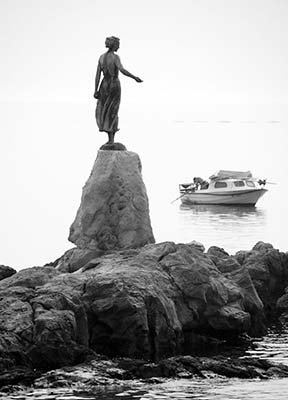
Nearby, also along the Lungomare, drop into the opatija (abbey) that gave the town its name, the Abbey of St. James (Opatija Sv. Jakov). On the dome above the altar is a strangely eerie relief showing St. James standing in a boat, cradling this church in his arm, accompanied by his trademark gourd-on-a-stick, and flanked by palm trees.
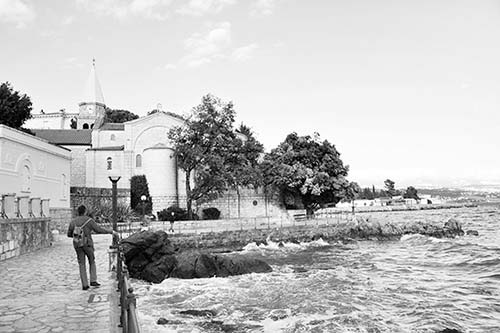
Beyond the abbey, you’ll pass the Hotel Kvarner, the resort that put Opatija on the map for the fin-de-siècle rich and famous. Then the Lungomare winds toward the brand-new, upper-crust Angiolina bathing facility (where you can pay royally to rent a chair or umbrella, or enjoy an overpriced drink or meal; www.angiolinaopatija.com).
Just above sprawls Angiolina Park—the most inviting of Opatija’s many manicured parks. Inside the park are two small museums. The first, closer to the water, is located in the Villa Angiolina, a mansion with a gorgeous lobby (free to view). The villa is wrapping up an extensive renovation and may still be closed during your visit; when open, it houses the mildly interesting Croatian Museum of Tourism (www.hrmt.hr). Just uphill through the same garden is Swiss House, a separate venue with changing exhibits (may also be closed, or possibly open weekends only). Downhill (toward the water) from both of these, you’ll find an outdoor theater that shows movies or hosts concerts nightly in peak season. Opatija’s harbor is just beyond the park.
To add a bit of uphill cardio to your stroll, head back toward Slatina, with the water on your left. Following the road, look for the address 154 Maršala Tita (on the right); you’ll see stairs with signs for Crkva Marijina Nevještenja (the church) and Amerikanski vrtovi (the gardens). At the top of the stairs, go left along the street and soon you’ll see another sign for the Church of the Annunciation, a Neo-Romanesque structure from the very end of Opatija’s glory days. Pop inside to see the cavernous interior, or have a seat on the benches out front to admire the view of Kvarner Bay.
A few minutes farther up the road, over the curving pedestrian bridge, you’ll come to the American Gardens (free entry, closed Mon). Created in the 1920s by a rich Hungarian paprika merchant and his wife—who was an illegitimate child of a Habsburg archduke (long story)—the gardens got their name because the pair had once lived in the US. While pleasant to wander around, the real reason you come here is for the views.
The surrounding area has plenty of hiking trails and inviting beaches; if you’re looking to kill even more time here, seek advice at the TI.
Sleeping in Opatija
Opatija is chock-a-block full of swanky resort-slash-business hotels. With so many beds—and because Opatija lacks the allure of places like Dubrovnik and Rovinj—prices are relatively low for the quality.
Big Chain Hotels: These have the most striking Habsburg facades in town, and both have luxurious rooms with all the amenities (air-con, elevator, big buffet breakfast included, pay parking garage). $$$ Hotel Agava, part of the Amadria Park chain, has an impressively restored old shell with a handsome lobby and café, and 75 businesslike rooms (Maršala Tita 89, +385 51 278 200, www.amadriapark.com, hotel.agava@amadriapark.com). $$ Hotel Bristol, part of the OHM group, also has 75 rooms. It maintains its late-19th-century decor inside and out—mixing modern comfort with period moldings, chandeliers, and a cheery yellow facade (gorgeously restored coffee shop in lobby, Maršala Tita 108, +385 51 706 300, www.hotel-bristol.hr, info@hotel-bristol.hr).
Smaller and Family-Run: These two small hotels, run by the Brko family, are well located a few steps from the lively Slatina scene (to the right as you face the water; both have air-con, elevators, and a pay parking garage). While they’re a lesser value, they feel more personal than the chain hotels. $$$ Hotel Savoy, overlooking the water, comes with four stars, 32 nicely appointed rooms, an enticing swimming pool with a great view, a private beach, and higher prices. Request the type of room you want when you reserve: Most rooms have balconies and sea views for no extra charge, but many of these face a noisy nightclub; for more quiet, you can request a back (nonview) room facing the street (Maršala Tita 129, +385 51 710 500, www.hotel-savoy.hr, info@hotel-savoy.hr). Across the street is $$ Hotel Galeb, with 26 spacious rooms, three stars, and plenty of character. Guests at the Galeb have access to the pool and beach at the Savoy (closed Oct-April, Maršala Tita 160, +385 51 271 177, www.hotel-galeb.hr, info@hotel-galeb.hr).
Eating in Opatija
For a good sit-down meal, consider one of the following options. Unless otherwise noted, they are open daily for lunch and dinner.
$$$ Ružmarin, tucked in a residential zone just behind and above a row of big hotels, is a sane and stylish oasis with an inviting covered terrace, a modern dining room, and good pizzas, pastas, and other dishes (up the road behind Grand Hotel Palace at Veprinački put 2, +385 51 712 673).
$$ Roko has two popular places side by side along the busy main drag. The restaurant is a bit more upscale, but I prefer the cheaper pizzeria at #114, with a cozy stone-and-brick interior, a small terrace, and a busy wood-fired oven turning out tasty Italian meals. If you find this place calming, it may be because it was the home of Opatija native Leo Henryk Sternbach, who invented Valium (Maršala Tita 112/114, +385 51 711 500). A block up the street is yet another branch, called $ Veloce by Roko, with takeaway slices, sandwiches, and other fast food (at #110).
$$$ Istranka does solid regional cuisine, including pastas, truffles, soups, meat, and seafood. Their seasonal specialties are particularly enticing, such as porcini mushrooms in autumn (closed Mon, hides uphill behind Maršala Tita 83, +385 51 271 835).
Picnic: To browse for your own picnic, drop by the old-fashioned indoor market hall (tržnica, on the left a 10-minute walk up Maršala Tita from Slatina). There’s also a convenient Tommy supermarket in the Slatina parking garage, as well as Konzum grocery stores on the main drag.
Grand Cafés: Several hotels also have refined Vienna-style coffeehouses with late-19th-century appeal. Café Wagner at the Amadria Park Hotel Milenij is a favorite for its genteel interior and its nice outdoor terrace.
Opatija Connections
Intercity buses leave Opatija from near the big Slatina square, just above the beach (next to Grand Hotel Palace). Most buses leave from the big bus parking lot tucked behind the trees—except buses to Rijeka, which leave from the easy-to-miss bus stop just up the street, in front of the Romero Burger Bar. As there’s no physical ticket office for intercity buses, you’ll have to book online (the TI may be able to help if you’re in a pinch); for local buses to Rijeka, you can buy tickets at a tobacco shop or on board. Multiple companies run buses from here (including Arriva/Autotrans, Brioni Pula, and Flixbus), so check all schedules at https://getbybus.com.
From Opatija by Bus to: Rijeka (hourly on bus #32, 30 minutes), Pula (almost hourly, 2 hours), Rovinj (2/day, 3 hours, direct or via Pula), Zagreb (3/day direct, 3 hours, more with change in Rijeka). To reach Split or Dubrovnik, you’ll likely need to change in Rijeka. Info: +385 60 888 619, www.autobusni-kolodvor.com.
Rijeka
The industrial city of Rijeka (ree-YAY-kah; it translates as “River”) became Croatia’s biggest port under Austro-Hungarian rule. It’s dainty little Opatija’s bigger, burlier brother, with a population of 129,000. Remember, this was the primary industrial port of the Hungarian half of the Austro-Hungarian Empire (and the proud birthplace of the torpedo in 1866). Like Opatija, much of Rijeka’s architecture is reminiscent of the glory days of the Habsburgs. But unlike Opatija, most of Rijeka’s buildings outside the gentrifying urban core haven’t been renovated—giving much of its sprawl a seedy, gritty, past-its-prime feel.
Rijeka also holds the dubious distinction of being the first-ever fascist state in Europe—in the early 1920s, back when Istria belonged to Italy, this area became the “Free State of Fiume” (its Italian name) as a diplomatic buffer between Italy and Yugoslavia. The charismatic poet and early fascist leader Gabriele D’Annunzio managed to take power in the city, proclaiming its independence...for just 15 months, until he was forced out.
Because Rijeka is a major transportation hub, there’s a good chance you’ll pass through. While not quite ready for prime time as a tourist destination, it offers an intriguing contrast to the big-name towns that Croatia connoisseurs may enjoy.
Orientation to Rijeka
The bus station, train station, and ferry terminal are within a few blocks of each other in a bustling waterfront business zone. The sector is crossed by two one-way streets (going in opposite directions): Ivana Zajca (or the Riva, along the waterfront, runs west to east) and Adamićeva (which changes its name a few times as it cuts east to west through town). A block above these two streets is the Korzo, an almost-charming pedestrianized zone packed with shops, restaurants, and the TI (Korzo 14, +385 51 335 882, www.visitrijeka.hr).
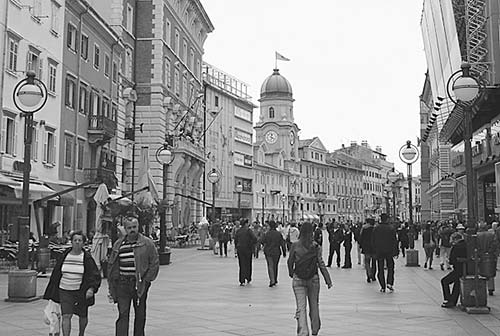
Sights in Rijeka
If you have time to kill in Rijeka, you can spend it wandering the Korzo promenade. The domed yellow tower marks the entrance to the “Old Town,” which survives in name only—this area has been heavily rebuilt in modern style and lacks charm. At the top of the Old Town stands Rijeka’s Cathedral of St. Vitus. A bit higher on the hill and just to the west is the city’s museum cluster, with a trio of forgettable collections (maritime, city history, and natural history); a contemporary and modern art museum is in the streets below.
The area of Rijeka perhaps most worth exploring is its lively waterfront market area, about a 10-minute walk down from the Korzo (head to the waterfront, turn left, and make your way between the burly buildings). Tucked between bustling open-air produce stands are genteel old Habsburg-era market halls selling fresh fish and meat.
A very steep hike (or drive) above town, you’ll find Rijeka’s old fortress (with some nearby historic churches), called Trsat. And yet one more attraction lies underfoot in the city center: Rijeka has renovated a network of underground tunnels, constructed by Italians in the 1930s. While there’s not much to see, the tunnels can be fun to explore and provide a handy shortcut in case of rain or excessive heat.
Rijeka Connections
BY TRAIN OR BUS
The train station is a few blocks west of the Korzo (on arrival, exit the station to the right and walk 10 minutes to the water). The bus station is a big parking lot in the middle of the chaos, near the west end of the Korzo. And the ferry terminal is at the east end of the waterfront. The Jadrolinija ticket office is at Riva 16. Major car-rental companies also have offices here.
From Rijeka by Train to: Zagreb (3/day direct, 4-5 hours), Ljubljana (2/day direct, 3 hours).
From Rijeka by Bus to: Opatija (local bus #32, hourly, 30 minutes; buy ticket at tobacco shop or on board, leaves not from main bus station but from a stop at the east end of the Korzo—at Jelačić Square), Senj (hourly, 1.5 hours), Pula (nearly hourly, 2-2.5 hours), Rovinj (5-7/day, 2-3.5 hours), Zagreb (hourly, 2-3.5 hours), Split (6-8/day, 7 hours), Ljubljana (2/day, fewer off-season, 2.5 hours). For schedules, see https://getbybus.com or www.arriva.com.hr, or call +385 51 213 821.
ROUTE TIPS FOR DRIVERS
Between Northern Croatia and Dalmatia
The long stretch of Croatian coast from Istria to Dalmatia—between the cities of Rijeka and Zadar—offers twisty seaside roads, functional port towns and fishing villages, some of the country’s most rugged scenery, and no real knockout sights. South of Opatija and Rijeka, the Kvarner coastline is stark and desolate—most traces of settlement have been long since blown away by the battering Bora wind (see sidebar). Offshore, sheltered from the elements, are several islands—Krk, Cres, Lošinj, Rab, and Pag—each with its own character and appeal. Still, coastal Croatia offers more bang for your buck to the north (Istria) and the south (Dalmatia).
If you’re driving between northern Croatia (Zagreb, Plitvice, Istria, or Opatija) and the Dalmatian Coast (Zadar, from where the expressway zips to Split), you have two options: Use the fast inland A-1 expressway, or follow the slow Kvarner Gulf coastal road all the way down.
The A-1 expressway option is pretty dull but far faster—unless you’re looking for a long, scenic joyride, this is your best bet. If you’re coming from Zagreb, just take A-1 directly to Split; from Plitvice, drive south through Korenica to access A-1 at Gornja Ploča. From Istria or Opatija, you have two options for accessing A-1: The slightly faster and more straightforward option is to head east (inland) from Rijeka on A-6 to join A-1. Or you can follow just part of the Kvarner coastal road (described next), going as far south as Senj, then twisting up and over the mountains inland to Otočac, where you can get on A-1. This route gives you a little taste of Kvarner coastal scenery, but it’s more challenging to drive (curves and switchbacks) and adds about 30 minutes to the journey. I’d take this route only if the weather is good, traffic isn’t too heavy, and you’re not in a rush.
The two-lane Kvarner coastal road (national road #8, a.k.a. E-65) is the very twisty, very slow way to get from northern Croatia to Dalmatia. You’ll lose at least an hour compared with taking the A-1 expressway (more if coming from Zagreb), but you’ll follow the Adriatic almost the entire way (rather than zipping through the relatively dull interior). To find this road from Rijeka, just follow signs for Split and Zadar (being careful not to get on the expressway).
It’s striking how desolate it feels as you drive along the Kvarner coastal road. The most appealing spot for a break is Senj (pronounced “sehn”—the j is mostly silent, but has a slight y sound). Senj has a little harbor and a modest square with a jumble of outdoor cafés. The town is watched over by the boxy fortress of a band of pirates called the Uskoks. These were Serb and Croat refugees forced out of their homes in the interior when the Ottomans invaded in the 16th century. After resettling here in Senj, they became pirates and began terrorizing the Adriatic coastline. While they claimed to target only Ottoman ships, they also harassed anyone who traded with the Ottomans—including the Venetians. Finally, the Austrians—bowed by political pressure from Venice—put down the Uskoks. Today Senj is the best jolt of civilization along this road, with busloads of tour groups constantly dropping off here for a coffee-and-WC break. This means that the natives of Senj—perhaps recalling their pirate ancestors—are adept at overcharging and shortchanging visitors; check your bill carefully.
Senj is also the easiest point where the Kvarner coastal road connects to the speedy A-1 expressway that runs parallel to the coast inland. From Senj, a serpentine but well-traveled road cuts away from the coast and soon begins twisting up the coastal mountain range. After about an hour, you’ll arrive at the A-1 expressway, followed by the war-scarred town of Otočac (described on here).
Otherwise, you can just keep going south on this remote-feeling coastal road all the way to Zadar. En route, you’ll pass the islands of Rab, then Pag (and the ferries tethering them to the mainland). Near Zadar, this road meets up with the A-1 expressway, offering a much faster trip onward to Split and beyond. Frankly, this leg of the road is a bit of a slog; having done both, I’d prefer to get a nice taste of Kvarner between Rijeka and Senj, then cut up to A-1 to make better time the rest of the way to Dalmatia. But if you’ve got oodles of time and enjoy mellow coastal drives, stick with this road all the way to Zadar and the expressway.