PRACTICALITIES
RESERVATIONS AND ADVANCE TICKETS
TAXIS AND RIDE-BOOKING SERVICES
This chapter covers the practical skills of European travel: how to pay for things, sightsee efficiently, find good-value accommodations, eat affordably but well, use technology wisely, and get between destinations smoothly. For more information on these topics, see RickSteves.com/travel-tips.
Travel Tips
Travel Advisories: Before traveling, check updated health and safety conditions, including restrictions for your destination, at Travel.State.gov (US State Department travel pages) and CDC.gov (Centers for Disease Control and Prevention). The US embassy website for Belgium is another good source of information (see later).
ETIAS Registration: The European Union may soon require US and Canadian citizens to register online with the European Travel Information and Authorization System (ETIAS) before entering Belgium and other Schengen Zone countries (quick and easy process). For the latest, check Travel-Europe.europa.eu/etias_en.
Tourist Information: National tourist offices in the US can be a wealth of information. Before your trip, request or download any specific information you may want, such as city maps and schedules of upcoming festivals.
For Brussels and French-speaking Wallonia, go to VisitBelgium.com [URL inactive]; for Dutch-speaking Flanders, check out VisitFlanders.com. At either website, you can access hotel and city guides, brochures for ABC (antiques, beer, and chocolate) lovers, maps, and information about WWI and WWII battlefields.
Local tourist information offices (abbreviated TI in this book) can be hit-or-miss. Their advice can be influenced by partnerships with local businesses, but they’re still a handy place to pick up a town map, browse brochures, and ask basic questions. If the TI falls short, you can also get local information from your hotelier or even staff at sights and other businesses.
Holidays and Festivals: For a list of festivals and national holidays observed throughout Belgium, see RickSteves.com/europe/festivals. Before planning a trip around a festival, verify the dates with the festival website or the national tourist office.
Emergency and Medical Help: For any emergency service—ambulance, police, or fire—call 112 (operators typically speak English). If you get sick, do as the Belgians do and go to a pharmacist for advice. Or ask at your hotel for help—they’ll know the nearest medical and emergency services.
Theft or Loss: To replace a passport, you’ll need to go in person to the US Embassy and Consulate (see next). If your credit and debit cards disappear, cancel and replace them (see “Damage Control for Lost Cards” on here). File a police report, either on the spot or within a day or two; you’ll need it to submit an insurance claim, and it can help with replacing your passport or credit and debit cards. For help with a lost phone, see “Damage Control for Lost Phones” on here. For more information, see RickSteves.com/help.
US Embassy and Consulate: Brussels +32 2 811 4000 (Boulevard du Régent 27, https://be.usembassy.gov).
Canadian Embassy: Brussels +32 2 741 0611 (Avenue des Arts 58, www.international.gc.ca/country-pays/belgium-belgique).
Time Zones: Belgium, like most of continental Europe, is generally six/nine hours ahead of the East/West Coasts of the US. If you have cell service, your phone should update to the local time zone when you arrive in Europe (if not, look under “Settings” and “Date and Time” or “Clock” to do it manually). For a handy time converter, use the world clock app on your phone.
Watt’s Up? Europe’s electrical system is 220 volts, instead of North America’s 110 volts. All electronics and most appliances (hair dryers, CPAP machines) convert automatically, so you won’t need a converter, but you will need an adapter plug with two round prongs, sold inexpensively at travel stores in the US.
Rip Up This Book! Turn chapters into mini guidebooks: Break the book’s spine and use a utility knife to slice apart chapters. Reinforce the chapter spines with clear wide tape, use a heavy-duty stapler, or make or buy a cheap cover (see the Travel Store at RickSteves.com), swapping out chapters as you travel.
Discounts: Discounts for sights are generally not listed in this book. However, seniors (age 65 and over), youths under 18, and students and teachers with proper identification cards (obtain from www.isic.org) can get discounts at many sights—always ask. Some discounts are available only to European citizens.
Online Translation Tips: Google’s Chrome browser instantly translates websites. The Google Translate app converts spoken or typed English into most European languages (and vice versa) and can also translate text it “reads” with your phone’s camera. Before your trip, it’s a good idea to download the Dutch and French dictionaries in the app so it can translate even if you’re offline.
Going Green: There’s plenty you can do to reduce your environmental footprint while traveling. When practical, take a train instead of a flight within Europe, and use public transportation within cities. In hotels, use the “Do Not Disturb” sign to avoid daily linen and towel changes (or hang up your towels to signal you’ll reuse them). Bring a reusable shopping tote and refillable water bottle (Europe’s tap water is safe to drink). Skip printed materials that you don’t plan to keep—get your info online instead. To find out how Rick Steves’ Europe is offsetting carbon emissions with a self-imposed carbon tax, go to RickSteves.com/about-us/climate-smart.
Money
Here’s my basic strategy for using money wisely in Europe. I pack the following:
Credit Card: You’ll use your credit card for purchases both big and small. Many European businesses have gone cashless, making a card your only payment option. A “tap-to-pay” or “contactless” card is widely accepted and simple to use.
Debit Card: Use this at ATMs to withdraw a small amount of local cash. Wait until you arrive to get euros (European cities have plenty of ATMs); if you buy euros before your trip, you’ll likely pay bad stateside exchange rates. While many transactions are by card these days, cash can help you out of a jam if your card randomly doesn’t work and can be useful to pay for things like tips and local guides.
Backup Card: Some travelers carry a third card (debit or credit; ideally from a different bank) in case one gets lost or simply doesn’t work.
Stash of Cash: I carry $100-200 in US dollars as a cash backup, which comes in handy in an emergency.
BEFORE YOU GO
Know your cards. In Europe, Visa and Mastercard credit cards are universal, while American Express and Discover are less common. Debit cards with a Visa or Mastercard logo will work in any European ATM.
Go “contactless.” Contactless pay options are now standard in much of Europe. Check if you already have—or can get—a tap-to-pay version of your credit card (look on the card for the tap-to-pay symbol—four curvy lines) and consider setting up your smartphone for contactless payment (see next section).
Know your PIN. Make sure you know the numeric PIN for each of your cards, both debit and credit. Request it if you don’t have one, as it may be required for some purchases. Allow time to receive the information by mail—it’s not always possible to obtain your PIN online or by phone.
Report your travel dates. Some banks want to know that you’ll be using your cards overseas, specifically when and where you’re headed. Depending on your bank, you can do this either online or over the phone.
Check your ATM withdrawal limit. Find out how much you can withdraw daily and ask for a higher limit if you want to get more cash at once. Note that European ATMs will withdraw funds only from checking accounts, not from savings accounts.
Find out about fees. For any purchase or withdrawal made with a card, you may be charged a foreign transaction fee (1-3 percent). Shop around; you can compare credit cards on Bankrate.com. Some cards offer lower international fees than others—and some don’t charge any at all. Most credit unions and some airline loyalty cards have low or no foreign transaction fees.
IN EUROPE
Using Credit Cards and Payment Apps
Tap-to-Pay or Contactless Cards: If your card has a contactless symbol, you can simply tap it against a contactless reader to make a purchase. A PIN or signature is generally required only as a security measure for larger purchases. This is by far the easiest way to pay and is available in much of Europe. Some small businesses (such as market stalls or food stands) accept only tap cards.

Payment Apps: Just like at home, you can tap to pay with your smartphone or smartwatch by linking a credit card to an app such as Apple Pay or Google Pay. If you’ve arrived in Europe without a tap-to-pay card, you can easily set up your phone with a payment app.
Will my US card work? Usually, yes. Rarely, a self-service payment machine (such as a transit-ticket kiosk, tollbooth, or fuel pump) may not accept older chip-and-PIN or swipe cards. Have some cash handy or look for a cashier who can process your payment manually. In some countries, gas stations sell prepaid gas cards, which you can purchase with any US card. When approaching a toll plaza or ferry ticket line, use the “cash” lane.
Always choose to pay in the local currency: During a credit-card transaction, the payment terminal will sometimes ask whether you want to pay in US dollars or in the local currency. Always refuse the conversion and choose the local currency. While this “service”—called Dynamic Currency Conversion (DCC)—offers the illusion of convenience, it comes with a poor exchange rate and/or higher fees, and you’ll wind up losing money.
Using Cash
Cash Machines: European cash machines work just like they do at home—except they spit out local currency instead of dollars. In Europe, the universal term for an ATM is “bankomat”; in Belgium, ask for a geldautomaat (Dutch) or a distributeur (French).
Look for an ATM operated by a local bank, ideally one just outside a brick-and-mortar bank (in the rare event that you have any issues). If you can’t find a bank-operated ATM in Belgium (Belgian banks have largely gotten rid of them), your best option will likely be an ATM marked “Bancontact Cash.”
Beware of cash machines run by exchange or money-transfer companies, which have less-favorable rates and higher fees than banks. These can be marked Euronet, Travelex, Your Cash, or Cashzone—or simply marked generically, as “bankomat” or “ATM.” Rip-off exchange ATMs are often the only option at airports and train stations. On arrival, consider using a cashless payment option to get downtown, then find a reputable ATM near your hotel.
If your debit card doesn’t work, try a lower amount—your request may have exceeded your withdrawal limit or the ATM’s limit. If you still have a problem, try a different ATM or come back later. When offered the choice to process your transaction in US dollars or the local currency, always choose the local currency.
Exchanging Cash: Minimize exchanging money in Europe; it’s expensive (you’ll generally lose 5 to 10 percent). In a pinch, you can find exchange desks at major train stations or airports. Banks generally do not exchange money unless you have an account with them.
Security Tips
Pickpockets target tourists. Keep your passport and backup cash and cards secure in your money belt (or your hotel-room safe) and carry only a day’s spending money and one card in your wallet.
Before inserting your card into an ATM, inspect the front of the machine. If anything looks crooked, loose, or damaged, it could be a sign of a card-skimming device.
Don’t use a debit card for purchases. Because a debit card pulls funds directly from your bank account, potential charges incurred by a thief will stay on your account while your bank investigates.
If accessing your accounts online while traveling, be sure to use a secure connection (see the “Tips on Internet Security” sidebar, later).
Damage Control for Lost Cards
If you lose your credit or debit card, report the loss immediately to your bank (using a secure app) or the following global customer-assistance centers: Visa (+1 303 967 1096), Mastercard (+1 636 722 7111), and American Express (+1 336 393 1111).
You’ll need to provide the primary cardholder’s identification-verification details (such as birth date, mother’s maiden name, or Social Security number). You can generally receive a temporary card within two or three business days in Europe (see RickSteves.com/help for more).
If you report your loss within two days, you typically won’t be responsible for unauthorized transactions on your account, although many banks charge a liability fee.
TIPPING
Tipping in Belgium isn’t as automatic and generous as it is in the US. For special service, tips are appreciated but not expected. In general, if someone in the tourism or service industry does a good job for you, a small tip of a euro or two is appropriate...but not required.
Restaurants: Belgian restaurants include a service charge, although it’s common to round up the bill. European credit-card receipts typically do not have a tip line—request to add a tip before they run your card or leave a tip in cash. For more details on tipping in restaurants, see here.
Taxis: For a typical ride, round up your fare a bit (for instance, if the fare is €4.50, pay €5). If the cabbie hauls your bags and zips you to the airport to help you catch your flight, you might want to toss in a little more.
Services: For local guides, private drivers, or others who spend several hours with you—and significantly improve the quality of your trip—a healthy tip (of around 10 percent) is not extravagant. In hotel rooms, leaving a tip of €1-3 per night is standard. If you’re not sure whether (or how much) to tip, ask a local for advice.
GETTING A VAT REFUND
Wrapped into the purchase price of your Belgian souvenirs is a value-added tax (VAT) of about 21 percent. You’re entitled to get most of that tax back if you purchase more than €50 worth of goods at a store that participates in the VAT-refund scheme. Typically, you must ring up the minimum at a single retailer—you can’t add up your purchases from various shops to reach the required amount. (If the store ships the goods to your US home, VAT is not assessed on your purchase.)
Getting your refund is straightforward...and worthwhile if you spend a significant amount.
At the Merchant: Have the merchant completely fill out the refund document (they’ll ask for your passport; a photo of your passport usually works). Keep track of the paperwork and your original sales receipt. Note that you’re not supposed to use your purchased goods before you leave Europe.
At the Border or Airport: Process your VAT document at your last stop in the European Union (such as the airport) with the customs agent who deals with VAT refunds (allow plenty of extra time for this process and have your purchased items easily accessible for inspection). At some airports, you’ll go to a customs office to get your documents stamped and then to a separate VAT-refund service (such as Global Blue or Planet) to process the refund. Elsewhere, a single VAT desk handles the whole thing, or you may be able to do it at a self-validation kiosk. (Note that refund services typically extract a 4 percent fee, but you’re paying for the convenience of receiving your money in cash immediately or as a credit to your card.) Otherwise, you’ll need to mail the stamped refund documents to the address given by the merchant.
CUSTOMS FOR AMERICAN SHOPPERS
You can take home $800 worth of items per person duty-free, once every 31 days. Many processed and packaged foods are allowed, including cheeses, dried herbs, jams, baked goods, candy, chocolate, oil, vinegar, condiments, and honey. Fresh fruits and vegetables and most meats are not allowed, with exceptions for some canned items. As for alcohol, you can bring in one liter duty-free (it can be packed securely in your checked luggage, along with any other liquid-containing items).
To bring alcohol (or liquid-packed foods) in your carry-on bag on your flight home, buy it at a duty-free shop at the airport. You’ll increase your odds of getting it onto a connecting flight if it’s packaged in a “STEB”—a secure, tamper-evident bag. But stay away from liquids in opaque, ceramic, or metallic containers, which usually cannot be successfully screened (STEB or no STEB).
For details on allowable goods, customs rules, and duty rates, visit Help.cbp.gov.
Sightseeing
Sightseeing can be hard work. Use these tips to make your visits to Belgium’s finest sights meaningful, fun, efficient, and painless.
MAPS AND NAVIGATION TOOLS
Your best navigation tool is on your phone. Google Maps (and similar mapping apps) offers turn-by-turn directions for walking and driving, as well as detailed public transit instructions in most big cities. Simply plug in a destination and instantly get detailed directions for reaching it on foot or by subway, bus, or tram—including where to catch it, how long it takes, where to get off, and how far you’ll walk at the other end.
To conserve data, most mapping apps let you download maps in advance (do this when you’re on strong Wi-Fi). However, offline maps may not include every feature, such as real-time traffic updates (most in-city public transit navigation doesn’t work offline). For more on using your phone during your trip, see here.
The maps in this book are concise and simple, designed to help you locate recommended destinations, sights, hotels, and restaurants. In Europe, simple paper maps are generally free at TIs and hotels; maps with more detail are sold at newsstands and bookstores.
PLAN AHEAD
Set up an itinerary that allows you to fit in all your must-see sights. For a one-stop look at opening hours, see this book’s “At a Glance” sidebars for Bruges, Brussels, Antwerp, and Ghent.
Don’t put off visiting a must-see sight—you never know when a place will close unexpectedly for a holiday, strike, or restoration. Opening days and hours can fluctuate; confirm the latest at the sight’s official website (listed throughout this book).
Many museums are closed or have reduced hours at least a few days a year, especially on major holidays (see RickSteves.com/europe/festivals for a list of European holidays). In summer, some sights may stay open late. Off-season hours may be shorter.
Going at the right time helps avoid crowds. This book offers tips on the best times to see specific sights. Try visiting popular sights very early or very late. Evening visits (when possible) are usually more peaceful, with fewer crowds. Late morning is usually the worst time to visit a popular sight.
If you plan to hire a local guide, reserve ahead by email. Popular guides can get booked up.
Study up. To get the most out of the self-guided tours and sight descriptions in this book, read them before you visit. The Groeninge Museum is much more entertaining if you’ve boned up on your Flemish Primitives the night before.
RESERVATIONS AND ADVANCE TICKETS
Many popular sights in Europe come with long ticket-buying lines. Visitors who buy tickets online in advance (or who have a museum pass covering key sights) can skip the line and waltz right in. Advance tickets are generally timed-entry, meaning you’re guaranteed admission on a certain date and time.
For some sights, buying ahead is required (tickets aren’t sold at the sight and it’s the only way to get in). At other sights, buying ahead is recommended to skip the line and save time. And for many sights, advance tickets are available but unnecessary: At these uncrowded sights, you can simply arrive, buy a ticket, and go in.
Don’t confuse the reservation options: available, recommended, and required. Use my advice in this book as a guide. Note any must-see sights that sell out long in advance and be prepared to buy tickets early. If you do your research, you’ll know the smart strategy.
Given how precious your vacation time is, I’d book in advance both where it’s required (as soon as your dates are firm) and where it will save time in a long line (in some cases, you can do this even on the day you plan to visit).
You’ll generally be emailed a digital ticket that you’ll store on your phone to scan at the entrance (if you prefer, you can print it out). At the sight, look for the ticket-holders line rather than the ticket-buying line; you may still have to wait in a security line.
Sightseeing Passes: Some cities offer sightseeing passes that include free or discounted admission to several sights. Do the math to determine if a sightseeing pass makes sense for your visit. Even with a sightseeing pass, you’ll often still need to make reservations for the most popular sights.
AT SIGHTS
Every sight or museum offers more than what is covered in this book. Use the information I provide as an introduction—not the final word. Here’s what you can typically expect at sights:
Entering: You may not be allowed to enter if you arrive too close to closing time. And guards start ushering people out well before the actual closing time, so don’t save the best for last.
Many sights have a security check. Allow extra time for these lines. Some sights require you to check day packs and coats. (If you’d rather not check your day pack, try carrying it tucked under your arm as you enter.)
Photography: If the museum’s photo policy isn’t clearly posted, ask a guard. Generally, taking photos without a flash or tripod is allowed. Some sights ban selfie sticks; others ban photos altogether.
Audioguides and Apps: Some sights offer audioguides with excellent recorded descriptions in English. Often you’ll use free Wi-Fi to scan a QR code and access the tour on your phone (A+ students can check ahead and download audioguides before their trip). Bring your own earbuds to make listening easier. Less frequently you’ll borrow or rent a device preloaded with the audio content.
Expect Changes: Artwork can be on tour, on loan, out sick, or shifted at the whim of the curator. Pick up a floor plan as you enter and ask museum staff if you can’t find a particular item.
Services: Important sights usually have a reasonably priced on-site café or cafeteria (handy and air-conditioned places to rejuvenate during a long visit). The WCs at sights are free and generally clean.
Sleeping
One of my joys as a guidebook writer is connecting my readers with the small-hotel owners I’ve come to know over the years. Even if you’re willing to spend more, you’ll have a far richer trip if you stay in places with a strong sense of local character.
My best tips for booking rooms: Book direct, and book early. While third-party sites and room-booking services may seem convenient, booking directly with my recommended hotels puts you in contact with your host and can sometimes save you money.
Reserve your accommodations as soon as your itinerary is set, especially if you want to stay at one of my top listings or if you’ll be traveling during busy times. See RickSteves.com/europe/festivals for a list of major holidays and festivals in Belgium.
FINDING AND RESERVING ROOMS
Curated and opinionated listings of good-value rooms are a major feature of this book’s Sleeping sections. Rather than list accommodations scattered throughout a town, I choose hotels in my favorite neighborhoods that are convenient to sights.
My recommendations run the gamut, from dorm beds to luxurious rooms with all the comforts. I like places that are clean, central, relatively quiet at night, reasonably priced, friendly, small enough to have a hands-on owner or manager, and run with a respect for Belgian traditions. I’m more impressed by a handy location and fun-loving philosophy than oversized TVs and a fancy gym. Most of my recommendations fall short of perfection. But if I can find a place with most of these features, it’s a keeper.
RATES AND DEALS
I’ve categorized my recommended accommodations based on price, indicated with a euro-sign rating (see sidebar). Room prices can fluctuate significantly with demand and amenities (size, views, and so on), but relative price categories remain constant. Cities in Belgium all charge a hotel tax; it’s calculated differently everywhere, but assume you’ll pay a few extra euros per person, per night.
Booking Direct: Once your dates are set, compare features and prices at several hotels. Start with the recommendations in this book, then use hotel websites, booking sites such as Hotels.com or Booking.com, and user-review sites such as TripAdvisor to narrow your options.
After you’ve zeroed in on your choice, book directly with the hotel itself—on the hotel’s website or by email or phone.
While big booking sites are convenient for travelers, they’re both a blessing and a curse for small, independent, family-run hotels. Without a presence on these sites, small hotels become almost invisible. But to be listed, they must pay a big commission...and promise that their own website won’t undercut the price on the booking-service site.
When you book directly with the hotel, the price may be the same as via a booking site, but more of your money goes to the hotel, not agency commissions. In exchange, ask if they can give you a nicer room or a free breakfast (if it’s not already included). Booking direct also increases the chances that your hotelier will be able to accommodate special needs or requests (such as shifting your reservation).
Getting a Discount: Some hotels extend a discount to those who pay cash or stay longer than three nights. And some accommodations offer a special discount for Rick Steves readers, indicated in this book with the abbreviation “RS%.” Discounts vary: Ask for details when you reserve. Generally, to qualify for this discount, you must book direct (not through a booking site), mention this book when you reserve and show it upon arrival, and sometimes pay cash or stay a certain number of nights. In some cases, you may need to enter a discount code (which I’ve provided in the listing) in the booking form on the hotel’s website. Understandably, discounts do not apply to promotional rates.
TYPES OF ACCOMMODATIONS
Hotels
In this book, the price for a double room ranges from $65 (very simple, toilet and shower down the hall) to $250 (maximum plumbing and more), with most clustering at about $130. You’ll pay more at Brussels hotels and less at Bruges B&Bs. A hearty breakfast with cereal, meats, local cheeses, fresh bread, yogurt, juice, and coffee or tea is generally included, though you often can opt out for a cheaper room rate.
Some hotels can add an extra bed (for a small charge) to a double; some offer larger rooms for four or more people (I call these “family rooms” in the listings). If there’s space for an extra cot, they’ll cram it in for you. In general, a family room is cheaper than the cost of a double and a single.
Arrival and Check-In: Hotels and B&Bs are sometimes located on the higher floors of a multipurpose building with a secured door. In that case, look for your hotel’s name on the buttons by the main entrance and ring the bell.
Hotel elevators are common, though small, and some older buildings still lack them. If stairs are unavoidable, ask the front desk for help carrying your bags up.
Most European countries require hotels to collect your name, nationality, and passport number. At check-in, the receptionist might ask for your passport and may keep it for a few hours. If you’re not comfortable leaving your passport at the desk, bring a copy to hand over instead.
If you’re arriving early in the morning, your room probably won’t be ready. Check your bag safely at the hotel and dive right in to sightseeing.
Some hotels now offer self-check-in. You’ll receive instructions before you arrive with a code for your room (and sometimes for the building’s front door).
Checking Out: While it’s customary to pay for your room upon departure, it’s smart to settle your bill the day before, when you’re not in a hurry.
Hotelier Help: Hoteliers can be a good source of advice. Most know their city well and can assist you with everything from public transit and airport connections to finding a good restaurant, the nearest launderette, or a late-night pharmacy.
Hotel Hassles: Even at the best places, mechanical breakdowns occur: Sinks leak, hot water turns cold, toilets may gurgle or smell, the Wi-Fi goes out, or the air-conditioning dies when you need it most. Report your concerns clearly and calmly at the front desk.
If you find that night noise is a problem (if, for instance, your room is over a nightclub or facing a busy street), ask for a quieter room in the back or on an upper floor. To guard against theft in your room, keep valuables out of sight. Some rooms come with a safe, and other hotels have safes at the front desk. I rarely bother to use one and, in a lifetime of travel, I’ve never had anything stolen from my room.
For more complicated problems, don’t expect instant results. Above all, keep a positive attitude. Remember, you’re on vacation. If your hotel is a disappointment, spend more time out enjoying the place you came to see.
Bed-and-Breakfasts
B&Bs offer double the cultural intimacy and—often—nicer rooms for a good deal less than most hotel rooms. Hosts usually speak English and are interesting conversationalists.
Belgium has a variety of cozy, funky, affordable B&Bs well run by gregarious entrepreneurs and typically located up a flight or two of steep, narrow stairs. Local TIs have lists of B&Bs, and there’s always Booking.com, but you’ll save money by booking directly with the B&B itself.
Short-Term Rentals
Short-term vacation rentals offered through Airbnb and other services can be cost-effective, especially if you plan to settle in one location for several nights or are traveling as a group. Keep in mind that European apartments, like hotel rooms, tend to be small by US standards. But they often come with laundry facilities and small, equipped kitchens, making it easier and cheaper to dine in.
Many places require a minimum stay and have strict cancellation policies. And you’re generally on your own: There’s no reception desk, breakfast, or daily cleaning service.
Finding Accommodations: Websites such as Airbnb, FlipKey, Booking.com, and Vrbo let you browse a wide range of properties. Alternatively, rental agencies such as InterhomeUSA.com and RentaVilla.com can provide a more personalized service (their curated listings are also more expensive).
Before you commit, be clear on the location. I like to virtually “explore” the neighborhood using Google Street View. Consider the proximity to public transportation, and amenities that are important to you (elevator, air-con, laundry, Wi-Fi, parking, etc.). Reviews from previous guests can help identify trouble spots.
Think about the kind of experience you want: just a key and an affordable bed...or a chance to get to know a local? Some hosts offer self-check-in and minimal contact; others enjoy interacting with you. Read the description and reviews to help shape your decision.
Confirming and Paying: Many places require payment in full before your trip, usually through the listing site. Be wary of owners who want to take your transaction offline; this gives you no recourse if things go awry. Never agree to wire money (a key indicator of a fraudulent transaction).
Other Options: Swapping homes with a local works for people with an appealing place to offer (don’t assume where you live is not interesting to Europeans). A good place to start is HomeExchange.com.
Hostels
A hostel provides cheap beds in dorms where you sleep alongside strangers, usually for under $50 per night. Travelers of any age are welcome, and family and private rooms are often available. Most hostels offer kitchen facilities, guest computers, Wi-Fi, and a self-service laundry. Hostels almost always provide bedding, but the towel’s up to you (though you can usually rent one).
Independent hostels tend to be easygoing, colorful, and informal (no membership required; www.hostelworld.com). You may pay slightly less by booking directly with the hostel. Official hostels are part of Hostelling International (HI) and share a booking site (www.hihostels.com). HI hostels typically require that you be a member or else pay a bit more per night.
Eating
Belgians are among the world’s leading carnivores and beer consumers. Belgium is where France meets northern Europe, and you’ll find a good mix of both Germanic and French influences here. The Flemish were ruled by the dukes of Burgundy and absorbed some of the fancy French cuisine and etiquette of their overlords. (The neighboring Dutch, on the other hand, were ruled by the Spanish for 80 years and picked up nothing.) And yet, once Belgian, always Belgian: They cook with beer rather than wine.
RESTAURANT PRICING AND HOURS
I’ve categorized my recommended eateries based on the average price of a typical main course, indicated with a euro-sign rating (see sidebar). Obviously, expensive specialties, fine wine, appetizers, and dessert can significantly increase your final bill.
The categories also indicate the personality of a place: Budget eateries include street food, takeaway, order-at-the-counter shops, basic cafeterias, and bakeries selling sandwiches. Moderate eateries are nice (but not fancy) sit-down restaurants, ideal for a pleasant meal with good-quality food. Most of my listings fall in this category—great for a taste of the local cuisine at a reasonable price.
Pricier eateries are a notch up, with more attention paid to the setting, presentation, and (often inventive) cuisine. Splurge eateries are dress-up-for-a-special-occasion-swanky—typically with an elegant setting, polished service, and pricey and refined cuisine.
Most of my restaurant listings are open daily for lunch and dinner; I’ve noted exceptions.
DINING TIPS
For listings in this book, I look for restaurants that are convenient to your hotel and sightseeing. When restaurant-hunting, choose a spot filled with locals, not tourists. Venturing even a block or two off the main drag leads to higher-quality food for a better price.
Belgians eat lunch when we do, but they eat dinner later. If you dine earlier than 19:30 at a restaurant, you’ll eat alone (or with other tourists). For cheaper alternatives, consider eating at one of Belgium’s affordable chain restaurants, a fry shop, or a bar, café, or brasserie (all described next).
Note that there’s no free tap water in Belgium. While a glass of water comes with a smile in the Netherlands, France, and Germany, that’s not the case in Belgium, where you’ll either pay for water, enjoy the beer, or go thirsty.
Tipping: At Belgian restaurants that have waitstaff, tax and service are included, although it’s common to round up the bill after a good meal (usually 5-10 percent; so, for an €18.50 meal, pay €20). If you order your food at a counter, don’t tip. If paying with a card, note that European credit-card receipts typically do not have a tip line—request to add a tip before they run your card or leave a tip in cash.
Chain Restaurants
While excellent restaurants abound in Belgium, several local chains offer affordable, quick, and predictably good meals. Keep an eye out for these convenient choices.
EXKi tries hard to be healthy in a country famous for its deep-fried foods and beer-based sauces. Their prepared meals (soups, salads, wraps) emphasize fresh produce, and while the food can be hit-or-miss, it’s a handy break from heavy Belgian fare.
Le Pain Quotidien (“The Daily Bread”) began as an artisanal bakery in Brussels...before its relentless march toward world domination. Although it now has 200 locations in more than a dozen countries, it’s still considered a local shop among Belgians. It’s a reliable fallback for fresh breads, pastries, and sandwiches.
Balls & Glory is a small, fun Flemish chain offering tasty, hand-crafted, softball-sized meatballs. Each day their rotating menu highlights different flavors of meatball.
Cafés, Bars, and Brasseries
For a more casual meal, or drinks only, try a bar, café, or brasserie. If you go to one of these places, in general, you can seat yourself, but avoid tables with a sign saying “reservé” or “voorbehouden.” Unlike cafés in Italy or France, Belgian cafés charge the same amount at the bar, at a table, or outside on the terrace. If all you want is a drink, you can wait for the server to come around or order directly from the bar. You generally pay for drinks as you go (especially if you’re sitting outside), unless you specify you want to open a tab. If you’re also ordering food, you pay for everything—drinks and your meal—at the end, as you would at a restaurant.
Fast Food Fry Shops
Just like every village in England has its “chippy” (for fish-and-chips), and every German burg has its Wurst stand (for sausages), every Belgian town has a favored frituur (fry shop) or frietkot (fry shack). While the pinnacle is the fried potato, there’s a wider variety of deep-fried treats than you might expect, such as sausages and meatballs (described later, under “Belgian Cuisine”).
Belgian-style fries (frieten) taste so good because they’re deep-fried twice—once to cook them and once to brown them. Traditionally, fries are generously topped with sauces (sausen). These can be mayo, tartar sauce, curry ketchup, currysaus (without the ketchup), or another flavored sauce (see list below). Ketchup is sometimes available. You’ll generally pay extra (typically less than €1) for any sauce—including mayo.
Américaine: Mayo with herbs and a dash of Tabasco
Joppiesaus: Sweet yellow curry and onion sauce
Pickles: Mayo with pickle relish
Provencaalse: Sweet-and-sour tomato flavor
Samuraisaus/samoeraisaus: Mayo with spicy chili flavor and a hint of tomato
Stoofvlees: Rich Belgian beef stew made with beer; there’s also a mayo-based sauce infused with stoofvlees flavor
BELGIAN CUISINE
Although this book’s coverage focuses on the Flemish part of the country, people speak French first in Brussels—so both languages are given here (Dutch/French). If I’ve listed only one word, it’s used nationwide. While the French influence is evident everywhere, it’s ratcheted up around Brussels.
Meat Appetizers and Snacks
These can be served at a frituur or frietkot (described above) or sometimes at bars or restaurants as appetizers. Many of these meat dishes are fried.
Ballekes in tomatensaus: Meatball dish with tomato sauce
Bicky Burger: Mystery-meat patty (a combination of pork, chicken, and horse meat) sold at snack stands nationwide; typically deep-fried and topped with a sweet ketchup, a brown spicy sauce, and a secret yellow “Bicky Dressing” (made with mayonnaise, mustard, cabbage, onion, and other vegetables)
Bitterballen (petites croquettes): Meat croquettes, battered in breadcrumbs and deep-fried; typically served as bar snacks, along with a drink made with bitters
Boulet, Balleke, Frikadel, or Gehaktbal (boulette): Various terms for meatballs, which can be fried, boiled, or grilled. Some meatballs are filled with a surprise; for example, vogelnestje—see below
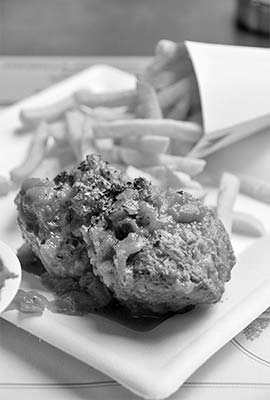
Frikandel (fricandelle): Minced-meat sausage, usually deep-fried; the basic Belgian wiener
Frikandel speciaal: Frikandel served with mayo, ketchup, and chopped onions (sometimes called a curryworst—not to be confused with a German Currywurst)
Kippenworst: Chicken sausage; anything that starts with kip or includes de poulet indicates it’s made with chicken
Viandel: Variation of Frikandel—skinny, deep-fried, often with a crunchy, herbed crust
Vleeskroketten: Similar to Bitterballen but bigger
Vogelnestje (“bird’s nest”): Meatball stuffed with a hard-boiled egg
Traditional Dishes
Here are some classic Belgian dishes that may appear on menus. If you see the term à la flamande, that means it’s cooked “in the Flemish style” (for instance, made with beer or smothered in a sauce of butter, chopped parsley, and crumbled hard-boiled egg).
Biersoep/soupe à la bière: Beer soup
Filet américain: Similar to steak tartare, this raw beef dish is named for the American meat grinder it was widely made with after World War II
(Gentse) Waterzooi: Creamy stew made with chicken, eel, or fish; originated in Ghent
Konijn met pruimen/lapin à la flamande: Marinated rabbit braised in onions and prunes
Luikse ballekes/boulets à la liégeoise: Meatballs made in Liège sauce (a dark syrup made from apples, pears, and dates)
Luikse salade/salade liégeoise: A warm salad of green beans, potatoes, tomatoes, and bacon
Stoofvlees/carbonnade: Rich beef stew flavored with onions, beer, and mustard; similar to French bœuf bourguignon but often sweetened with brown sugar or gingerbread
Vol-au-vent: A rich and creamy chicken stew made with meatballs and lots of butter, typically used as the filling for a puff pastry sandwich
Seafood
Belgium is known for its mussels (mosselen/moules). They can be served plain (natuur/nature), with white wine (witte wijn/vin blanc), with shallots or onions (marinière), in a mushroom cream sauce (à la crème), or in a tomato sauce (provençale). You get a big-enough-for-two bucket and a pile of fries. Go local by using one empty shell to tweeze out the rest of the mosselen. From about mid-July through April, you’ll get the big Dutch mussels (most are from the coastal Zeeland area). Locals take a break from mussels in May and June, when only the puny Danish kind are available.
Here are some other popular seafood dishes:
Caricoles/escargots (de mer): Sea snails. Very local, seasonal, and hard to find—usually sold hot by street vendors
Garnaalkroket/croquettes de crevettes: Minced North Sea shrimp and Béchamel stuffed in a breaded, deep-fried roll
Noordzee garnalen/crevettes grises: Little gray shrimp caught off the North Sea coast
Paling in ’t groen/anguilles au vert: Eel in green herb sauce; this classic dish isn’t always available, as good-quality eel is in short supply
Tomaat garnaal/tomattes crevettes: North Sea shrimp served inside a carved-out tomato
Vegetables and Side Dishes
Asperges: White asparagus, available only in spring, and usually served in cream sauce
Rode kool/chou rouge à la flamande: Red cabbage with onions and prunes
Spruitjes/choux de Bruxelles: Brussels sprouts (often served in cream sauce)
Stoemp: Mashed potatoes and vegetables
Witloof/chicorée or chicon: Bitter, coarse endive—the classic Belgian vegetable—served both raw and cooked
Snacks
Popular snacks include fries (frieten; described earlier) and cheese. While the French might use wine or alcohol to rub the rind of their cheese to infuse it with flavor, the Belgians use (surprise, surprise) beer. There are 350 types of Belgian cheeses. From Flanders, look for Vieux Brugge (“Old Bruges”) and Chimay (named for the beer they use on it); from Wallonia, Remoudou and Djotte de Nivelles are good. Here are some other popular snacks:
Croque monsieur: Grilled ham-and-cheese sandwich
Pistolet: Puffy, round bread-roll sandwich
Tartine de fromage blanc: Open-face cream-cheese sandwich, often enjoyed with a lambic beer (described later) and found mostly in traditional Brussels bars
Desserts and Sweets
Belgium is famous for chocolate. The two basic types of Belgian chocolates are pralines (what we generally think of as “chocolates”—a hard chocolate shell with a filling) and truffles (a softer, crumblier shell with filling). For more on chocolates, see here. A dame blanche is a chocolate sundae.
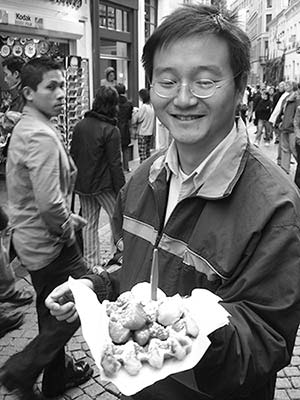
Another Belgian specialty is waffles. You’ll see little windows, shops, and trucks selling wafels/gaufres—either plain (for Belgians and purists) or topped with fruit, jam, chocolate sauce, ice cream, or whipped cream (for tourists). Belgians recognize two general types of waffles. The common takeout version, sold around the clock, is the dense, sugar-crusted, and very sweet Liège-style waffle (Luikse/liégeois), usually served warm. Brussels-style waffles (Brusselse) are lighter and fluffier, dusted with powdered sugar and sometimes topped with marmalade. Though Americans think of “Belgian” waffles as a breakfast food, Belgians generally have them (or pancakes, pannenkoeken) as a late-afternoon snack. Brussels-style waffles are less widely available to go, though you may find them at teahouses or cafés in the afternoon (from about 14:00 until 18:00).
Another popular sweet is speculoos, spicy gingerbread biscuits served with coffee. For the Belgian answer to peanut butter or Nutella, look for speculoos spread—thick, creamy, and with the flavor of gingerbread cookies. (Trader Joe’s sells this in the US with a “Cookie Butter” label.) Speculoos is also a delicious ice cream flavor—worth trying.
BEVERAGES
Belgian Beers
Belgium has hundreds of varieties and brands of beer, more than any other country—the locals take their beers as seriously as the French do their wines. Even small café menus include six to eight varieties; specialty bars stock hundreds. Connoisseurs and novices alike can be confused by the many choices, and casual drinkers probably won’t like every kind offered, since some varieties don’t even taste like beer. Belgian beer is generally yeastier, sweeter, less bitter, and higher in alcohol content than beers in other countries. You must be 16 years old to legally enjoy a good Belgian beer (18 to drink wine and hard liquor).
To bring out their flavor, different beers are served cold, cool, or at room temperature, and each has its own distinctive glass. Whether wide-mouthed, tall, or fluted; with or without a stem; tulip-shaped or straight, the glass is meant to highlight a particular beer’s qualities. The choice of glass is so important that if, for some reason, a pub doesn’t have the proper glass for a particular beer, they will ask the customer if a different glass will be acceptable—or if they’d like to change their beer order.
To get a basic draft beer in Flanders (Bruges, Antwerp, or Ghent), ask for een pintje (ayn pinch-ya; a pint); in Brussels, where French prevails, request une bière (oon bee-yair).
But don’t insist on beer from the tap. The only way to offer so many excellent beers and keep them fresh is to serve them bottled. In fact, because many specialty beers ferment in the bottle, some of the most famous brews come only in bottles. Increasingly, though, bars are adding a few high-end brands to their draft menus.
Belgians pair beer with food, much as the French pair wine. In general, lighter-colored beers (blonde or Tripel) go well with chicken or pork, darker beers pair nicely with beef, and wheat beers complement seafood.
Specialty Beers
Specialty beers can be much more alcoholic than what you’re used to back home, and tourists often find themselves overwhelmed by a single pint of Belgian brew. Bottles (and often menus) list the alcohol percentage of each type of beer. For comparison, most mass-market American beers are 4-6 percent alcohol by volume (ABV), while a heavy Belgian ale can run 7-9 percent—and a few powerful beers can be 10-12 percent, or even higher.
Monk-run Trappist breweries have given the beer world the terms Enkel, Dubbel, and Tripel (single, double, triple). While originally these indicated the amount of malt used to gain a higher alcohol content (described later), these days they have more to do with the style of beer: Enkel is a very light (nearly “lite”) blonde ale; Dubbel is a dark, sweet beer; and Tripel is a very strong, golden-colored pale ale. The less commonly used term Quadrupel is a gimmick to emphasize a beer’s alcohol content—usually more than 10 percent.
Some beer producers have returned to their medieval roots, flavoring their beer with a secret mix of spices called gruit. This can result in some surprising bouquets that charm and puzzle beer aficionados.
Beers by Type
Here’s a breakdown of types of beer, with some common brand names. This list is just a start, and you’ll find many beers that don’t fall into these neat categories.
Ales (Blonde/Red/Amber/Brown): Easily recognized by their color. Try a blonde or golden ale (Leffe Blonde, Duvel), a rare and bitter sour red (Rodenbach), an amber (Palm, De Koninck), or a brown (Leffe Bruin). Saison beers are “seasonal” (summer-brewed), lightly alcoholic pale ales.
Lagers (Pils): Light, sparkling, Budweiser-type beers. Popular brands include Jupiler, Stella Artois, and Maes.
Lambics: Wild-yeast beers. Lambics—popular in Brussels—get their start in open vats, where they’re exposed to naturally occurring wild yeasts in the air. Some brand names include Cantillon, Lindemans, and Mort Subite (“Sudden Death”).
Lambics are often blended with fruits to counter their sour flavor. Fruit lambics include cherry (kriek), raspberry (frambozen), peach (pêche), or blackcurrant (cassis). People who don’t usually enjoy beer tend to like these tart but sweet varieties, similar to a dry pink champagne. Gueuze—a dry, sour, double-fermented lambic nicknamed “Brussels champagne”—is more of an acquired taste.
White (Witte or Witbier): Milky-yellow summertime beers made from wheat. White beer, similar to a Hefeweizen, is often flavored with spices such as orange peel or coriander.
Trappist and Abbey Beers: Heavily fermented, malty, monk-brewed beers. For centuries, between their vespers and matins, Trappist monks have been brewing beer. Three typical ones are Tripel, with a blonde color, served cold with a frothy head; Dubbel, dark, sweet, and served cool; and Enkel, made especially by the monks for the monks, and considered a fair trade for a life of celibacy. These styles originated at the Westmalle monastery; other official Belgian Trappist monasteries are Rochefort, Chimay, Orval, Achel, and Westvleteren (the last one’s brews are often voted the “best in the world” and are hard to find). “Abbey beers” (abdijbier) emulate the Trappist style but are produced at other monasteries or by commercial brewers; St. Bernardus is one popular abbey beer. Try the Trappist Chimay Blauw/Bleu—extremely smooth, milkshake-like, and complex.
Strong Beers: The potent brands include Duvel (“devil,” because of its high octane, camouflaged by a pale color), Verboden Vrucht (“forbidden fruit,” with Adam and Eve on the label), and the not-for-the-fainthearted brands of Judas, Satan, and Lucifer. Gouden Carolus is good, and Delerium Tremens speaks for itself.
Mass-Produced Beers: Connoisseurs say you should avoid the mass-produced labels (Leffe, Stella, and Hoegaarden—all owned by AB InBev, which owns Budweiser in America) when you can enjoy a Belgian craft beer (such as Westmalle or Chimay) instead.
Other Alcoholic Drinks
Belgians drink a lot of fine wine, but it’s almost all imported. In general, Flanders prefers Bordeaux wines (which used to be delivered to the busy Flemish ports of Bruges and Antwerp), while inland Wallonia prefers Burgundy wines (which were delivered overland).
The distilled grain alcohol jenever (yah-NAY-ver) is spiced with juniper berries and often called “continental gin” or “Dutch gin” in English. (English traders eventually created a similar drink and called it simply gin.) Jonge jenever (young) is sharp and served chilled; oude jenever (old) is mellow and more commonly poured at room temperature (the terms refer to whether they use the older or newer distilling technique). I prefer oude jenever, which is smooth and soft, with a more mature flavor—like a good whisky. Jenever can be sipped, or it can be chugged with a pils chaser (this combination is called a kopstoot—headbutt; or you can sink the shot of jenever into the beer to create a duikboot—submarine).
Nonalcoholic Drinks
Belgian restaurants typically charge for tap water or refuse to serve it. Since you’re paying anyway, you might as well spring a bit more for mineral water, still or sparkling (Spa brand is popular). Many cafés/bars have a juicer for making fresh-squeezed orange juice.
Belgians love their coffee, enjoying many of the same drinks (espresso, cappuccino) served in American or Italian coffee shops. Coffee usually comes with a small speculoos spice cookie. A koffie verkeerd (fer-KEERT, “coffee wrong”) is an espresso with a lot of steamed milk—the closest thing to a latte.
Staying Connected
Your mobile phone is an indispensable tool for efficient travel. Fortunately, staying connected in Europe gets easier (and less expensive) each year. You can use your devices much like you do at home, by either getting an international plan or connecting to free Wi-Fi whenever possible. Another option is to buy a European SIM card for your mobile phone. More details are at RickSteves.com/phoning.
USING YOUR PHONE IN EUROPE
Here are some budget tips and options.
Prepare your phone. Before your trip, stock your device with any content or apps you’ll want on the road. Helpful tools include Google Translate, Google Maps, your airline’s app, public transit apps for your destinations, and sight-specific apps (such as museum audioguides). Also download maps if you plan to use offline navigation, and TV shows or movies to watch on the plane or during downtime.
Sign up for an international plan. To stay connected at an affordable cost, sign up for an international service plan through your carrier. Most providers offer a simple bundle that includes calling, messaging, and data. Your normal plan may already include international coverage (for example, T-Mobile’s covers unlimited text and low-speed data, plus reasonable per-minute voice calls).
Use free Wi-Fi whenever possible. In Europe, look for and use Wi-Fi for most online tasks. Most accommodations in Europe offer free Wi-Fi. Many cafés (including Starbucks and McDonald’s) offer hotspots for customers; ask for the password when you buy something. You may also find Wi-Fi at TIs, city squares, major museums, public transit hubs, and airports, and aboard trains and buses.
Here’s how to dial from anywhere in the US or Europe, using the phone number of one of my recommended Bruges hotels as an example (050 615 852). If a number starts with 0, drop it when dialing internationally (except when calling Italy).
Phone numbers in this book are presented exactly as you would dial them from a US mobile phone. For international access, press and hold 0 (zero) to get a + sign, then dial the country code (32 for Belgium) and phone number.
 To call the Bruges hotel from any location, dial +32 50 615 852.
Replace + with 011 (US/Canada access code), then dial the country code (32 for Belgium) and phone number.
To call the Bruges hotel from your home landline, dial 011 32 50 615 852.
Replace + with 00 (Europe access code), then dial the country code (32 for Belgium, 1 for the US) and phone number.
To call the Bruges hotel from a French landline, dial 00 32 50 615 852.
To call my US office from a Belgian landline, dial 00 1 425 771 8303.
To place a domestic call (from a Belgian landline or mobile), drop +32 and dial the phone number (including the initial 0).
To call the Bruges hotel from Brussels, dial 050 615 852.
Local Numbers: European phone numbers and area codes can vary in length and spacing, even within the same country. Mobile phones use separate prefixes (for instance, in Belgium, mobile prefixes have four digits and begin with 04).
Toll and Toll-Free Calls: It’s generally not possible to dial European toll or toll-free numbers from a US mobile or landline (although you can sometimes get through using Skype). Look for a direct-dial number instead.
Calling the US from a US Mobile Phone, While Abroad: Dial +1, area code, and number.
More Phoning Help: See HowToCallAbroad.com.
Minimize the use of your cellular network. The best way to make sure you’re not accidentally burning through data is to put your device in “airplane mode” (which also disables phone calls and texts) and connect to Wi-Fi as needed. Turn on your cellular network (or turn off airplane mode) only when you can’t find Wi-Fi.
Save large-data tasks for Wi-Fi. If your included data is slow or metered, wait until you’re on Wi-Fi to make video calls, download audio tours or apps, stream videos, or do other megabyte-greedy tasks. Navigation apps such as Google Maps require lots of data; download maps when you’re on Wi-Fi, then use the app offline.
Limit automatic updates. By default, your device constantly checks for a data connection and updates app content. Check your device’s settings menu for ways to turn this off.
Use Wi-Fi calling and messaging apps. FaceTime, Skype, and Google Meet are great for making free or low-cost calls or sending texts over Wi-Fi worldwide. WhatsApp is especially popular throughout Europe and is often the easiest way to communicate with guides, drivers, or other local contacts.
Consider buying a European SIM or eSIM card. Both give you a European phone number and access to local calling and data rates; if you’re traveling to other countries within the EU, there are no additional roaming fees. Physical SIM cards can be purchased at mobile-phone shops and inserted into your (unlocked) phone; electronic SIM cards (or eSIMs) can be purchased online and downloaded.
Damage Control for Lost Phones: Losing your phone can be a significant inconvenience. Before you leave home, make sure your device is set up for automatic cloud backups, and enable the “find my phone” feature (make sure you have access to it from another device, like your travel partner’s phone or a laptop). Familiarize yourself with your phone’s “lost and lock” mode, which you can enable from another device if your phone goes missing. Report the loss to your mobile carrier; if your phone remains lost, use the “wipe” feature to erase its data.
For details on sending packages to your own home or to others, visit CBP.gov, then select “Travel” and “Know Before You Go.” The Belgian postal service works fine, but for quick transatlantic delivery (in either direction), consider services such as DHL (www.dhl.com).
Transportation
Figuring out how to get around in Europe is one of your biggest trip decisions. Cars work well for two or more traveling together (especially families with small kids), those packing heavy, and those delving into the countryside. Trains and buses are best for solo travelers, blitz tourists, city-to-city travelers, and those who want to leave the driving to others. Short-hop flights within Europe can creatively connect the dots. Be aware of the potential downside of each option: A car is an expensive headache in any major city; with trains and buses, you’re at the mercy of a timetable; flying entails a trek to and from a usually distant airport and leaves a larger carbon footprint.
Because of the short distances and excellent public transportation systems in Belgium, I recommend connecting Antwerp, Ghent, Bruges, and Brussels by train. Frequent trains connect each of these cities faster and easier than you could by driving. But for other destinations, a car could be a good alternative. Arrange to pick up your car in the last big city you’ll visit, then use it to lace together small towns and explore the countryside. For more detailed information on transportation throughout Europe, see RickSteves.com/transportation.
TRAINS
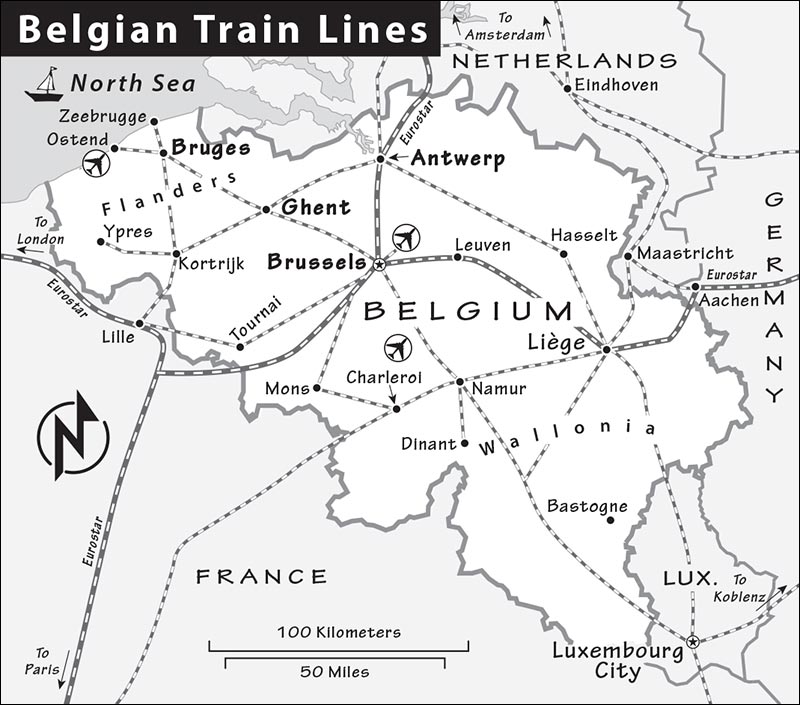
The easiest way to reach nearly any Belgian destination is by train. Connections are fast and frequent. Because Belgium is bilingual, the rail system has a complicated identity; it’s NMBS in Dutch but SNCB in French (luckily, it has a good English website—www.belgiantrain.be). InterCity (IC) trains are speedy for connecting big cities, and the high-speed Eurostar is the fastest (the speed comes at a price; see “High-Speed International Trains,” later). InterRegio (IR) trains connect smaller towns and make more stops along the way.
Schedules
To get train schedules in advance, consult the Belgian rail site: BelgianTrain.be. The German Rail (Deutsche Bahn) website is also useful and has comprehensive schedules for almost anywhere in Europe (www.bahn.com).
At train stations, check the TV screens listing upcoming departures. The direction of the train is identified by its final station. If you can’t find your train, or are unclear on departure details, visit an information booth or enlist the help of any official-looking employee.
Tickets
Buying Tickets: It’s easy to buy etickets for Belgian trains. You can download the SNCB app and buy tickets as you go (using your US credit card; etickets appear in the app immediately after purchasing). Or you can purchase tickets online at BelgianTrain.be (you’ll be emailed a PDF that you can print or download to your phone). Ticket machines and ticket windows at Belgian train stations also take US credit cards.
Ticket Deals: If you’re not traveling with a rail pass, consider the country’s money-saving deals. Those under age 26 can get a Youth Multi ticket (€62 for 10 rides anywhere in Belgium, shareable). A similar Standard Multi deal is available for anyone 26 or over for €102 (cheaper in the app). Youths and seniors (age 65+) can get a same-day round-trip ticket to anywhere in Belgium for about €7.50 or €8.30, respectively (but the senior version is not valid before 9:00 on weekdays). Up to four kids under 12 travel free with each paying passenger 12 or older. There are also weekend discounts for round-trips (50 percent off, valid Fri after 19:00). For more information, visit BelgianTrain.be.
Bike Fees: If you’re traveling with a bike, you’ll pay extra to bring it on the train (€4 for a one-way trip, consult the conductor on where to stash it).
High-Speed International Trains
Fast Eurostar trains connect Brussels with Amsterdam, Cologne, Paris, and London (www.eurostar.com). French TGV trains link Brussels with Charles de Gaulle Airport, outside Paris, in under two hours (www.sncf-connect.com).
When traveling to Dutch cities (such as Amsterdam or Rotterdam), you have two options: Eurostar trains are faster and more expensive (potentially double or even triple the cost); IC (InterCity) trains are a better value unless you’re in a huge rush. For example, a standard ticket from Antwerp to Amsterdam might take almost two hours and cost €21, €31, or €44 on an IC train; on Eurostar, you can shave off about 30 minutes, but the ticket can cost €45, €65, or €79 (depending on how early you purchase, with limited seats at the lower prices). If you have a rail pass, Eurostar requires expensive seat reservations, while IC trains don’t require them—see “Reservations for Rail Pass Holders,” below. Before you book, pay close attention to your options for train types—and the cost implications.
Will you be better off buying a rail pass or point-to-point tickets? It pays to know your options and choose what’s best for your itinerary.
A Eurail Benelux Pass lets you travel by train in Belgium, the Netherlands, and Luxembourg for three to eight days (consecutively or not) within a one-month period. All three countries are also covered (along with most of Europe) by the classic Eurail Global Pass.
Discounted rates are offered for seniors (age 60 and up) and youths (ages 12-27). Up to two kids (ages 4-11) can travel free with each adult-rate pass (but not with senior rates). All passes offer a choice of first or second class for all ages.
While most rail passes are delivered electronically, it’s smart to get your pass sorted before leaving home. For more on rail passes, including current prices and purchasing, visit RickSteves.com/rail.
If you’re taking just a couple of train rides, buying individual point-to-point tickets may save you money over a pass. Use this map to add up approximate pay-as-you-go fares for your itinerary, and compare that to the price of a rail pass plus reservations. Keep in mind that significant discounts on point-to-point tickets may be available with advance purchase.
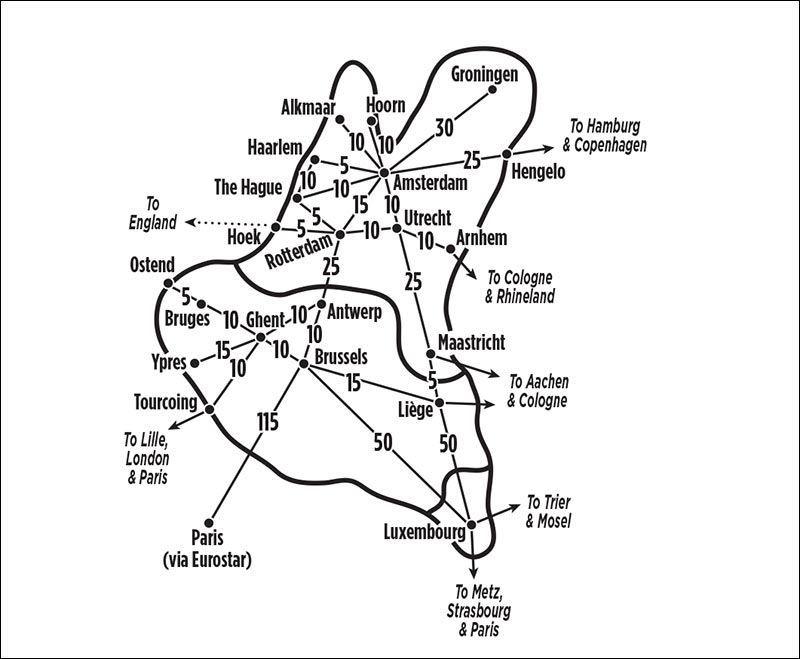
Map shows approximate costs, in US dollars, for one-way, second-class tickets on faster trains.
While Eurostar and TGV trains are expensive, they do offer significant price discounts, with restrictions, on tickets reserved in advance (most three months ahead, Eurostar available six months ahead). Each company sells tickets online or through US agents such as RickSteves.com/rail. In Europe, you can buy tickets at any major train station in any country or at any travel agency that handles train tickets (expect a booking fee). Note that Eurostar tickets between Brussels and London can qualify you for a discounted regional train connection in Belgium. For more on these trains, see here.
Rail Passes
All rail passes that cover Belgium also cover the Netherlands and Luxembourg. Collectively, they’re called “Benelux,” and they count as one country as far as rail passes are concerned. Most visits to Benelux don’t cover enough miles to justify a rail pass, but if your itinerary extends beyond this relatively small region, a Eurail Global rail pass could make sense.
For more detailed advice on figuring out the smartest rail pass options for your train trip, visit RickSteves.com/rail.
Reservations for Rail-Pass Holders: For the most part, you can hop on nearly any Belgian train with just your rail pass. But the fast Eurostar trains that run between Brussels and Amsterdam, Cologne/Dortmund, Paris, and London do require paid reservations and a rail pass that covers both ends of the trip. On Brussels–Amsterdam and Brussels–Cologne/Dortmund trains, you can avoid this extra cost simply by choosing a regular non-Eurostar train, which doesn’t require seat reservations. The Brussels–Paris and Brussels-London direct routes, however, are served only by Eurostar trains and are not covered by the Benelux rail pass—reserve as far ahead as possible for those routes.
BUSES
While you’ll mostly use trains to travel in this region, you can also consider buses. There’s no unified national bus company for Belgium—various destinations are served by different companies. Flanders is served largely by De Lijn (www.delijn.be), while French-speaking areas have TEC (www.letec.be). Flanders has one set price for city bus tickets—€2.50 for one hour. If you plan to use city buses and trams in Bruges, Ghent, and Antwerp, consider getting a 10-ride ticket for €17—it’s good all over Flanders. Flixbus buses connect Belgium to other European cities (www.flixbus.com).
TAXIS AND RIDE-BOOKING SERVICES
Most European taxis are reliable and cheap. Often, two people can travel short distances by cab for little more than the cost of bus or subway tickets.
Uber and other ride-booking apps operate in some parts of Europe, and rides can be cheaper than taxis. However, the details may differ from location to location. In some places, Uber works just like back home; in others, the app looks the same, but it hails a regular taxi rather than a private car. Uber is banned in some cities and countries, though sometimes similar companies operate where Uber cannot.
RENTING A CAR
It’s cheaper to arrange most car rentals from the US, so research and compare rates before you go. Most of the major US rental agencies (including Avis, Budget, Enterprise, Hertz, and Thrifty) have offices throughout Europe. Also consider the two major Europe-based agencies, Europcar and Sixt. Consolidators such as Auto Europe (www.autoeurope.com—or the sometimes-cheaper www.autoeurope.eu) compare rates at several companies to get you the best deal.
Wherever you book, always read the fine print. Check for add-on charges—such as one-way drop-off fees, airport surcharges, or mandatory insurance policies—that aren’t included in the “total price.”
Rental Costs and Considerations
If you book well in advance, expect to pay roughly $350-500 for a one-week rental for a basic compact car. Allow extra for supplemental insurance, fuel, tolls, and parking.
Manual vs. Automatic: Cars with manual transmission are more common in Europe and generally cheaper than automatic. If you need an automatic, it’s wise to book well in advance. When selecting a car, don’t be tempted by a larger model, as it won’t be as maneuverable on narrow, winding roads or when squeezing into tight parking lots.
Age Restrictions: Some rental companies impose minimum and maximum age limits. Young drivers (25 and under) and seniors (69 and up) should check the rental policies and rules section of car-rental websites.
Choosing Pickup/Drop-off Locations: Always check the hours of the locations you choose: Many rental offices close from midday Saturday until Monday morning and, in smaller towns, at lunchtime. When selecting an office, confirm the location on a map. A downtown site might seem more convenient than the airport but could actually be in the suburbs or buried deep in big-city streets. Pedestrianized and one-way streets can make navigation tricky when returning a car at a big-city office or urban train station. Wherever you select, get precise details on the location and allow ample time to find it.
Crossing Borders in a Rental Car: Be aware that international trips—say, picking up in Brussels and dropping off in Amsterdam—can be expensive if the rental company assesses a drop-off fee for crossing a border.
Always tell your car-rental company which countries you’ll be entering. Some companies levy extra insurance fees for trips taken in certain countries with certain cars (such as BMWs, Mercedes, and convertibles). Double-check with your rental agent that you have all the documentation you need before you drive off.
Picking Up Your Car: Before driving off in your rental car, check it thoroughly and make sure any dents or scratches are noted on your rental agreement (or take a photo of the damage). Rental agencies in Europe tend to charge for even minor damage, so be sure to mark everything. Find out how your car’s gearshift, lights, turn signals, wipers, GPS, and fuel cap function, and know what kind of fuel the car takes (diesel or unleaded). When you return the car, make sure the agent verifies its condition with you.
Car Insurance Options
When you rent a car in Europe, the price typically includes liability insurance, which covers harm to other cars or motorists—but not the rental car itself. To limit your financial risk in case of damage to the rental, choose one of these options: Buy a Collision Damage Waiver (CDW; also called “loss damage waiver” or LDW by some firms) with a low or zero deductible from the car-rental company (roughly 30-40 percent extra), get coverage through your credit card (essentially “free,” but more complicated if you need to use it), or get collision insurance as part of a larger travel-insurance policy.
Basic CDW costs $15–30 a day and typically comes with a $1,000-2,000 deductible, reducing but not eliminating your financial responsibility. When you reserve or pick up the car, you’ll be offered the chance to “buy down” the deductible to zero (for an additional $10–30/day; this is sometimes called “super CDW” or “zero-deductible coverage”).
If you opt for credit-card coverage, you must decline all coverage offered by the car-rental company—which means they can place a hold on your card to cover the deductible. In case of damage, it can be time-consuming to resolve the charges. Before relying on this option, quiz your card company about how it works. If you’re already purchasing a travel-insurance policy for your trip, adding collision coverage can be an economical choice. Both of these options are typically valid everywhere in Europe except the Republic of Ireland and Italy.
For more on car-rental insurance, see RickSteves.com/cdw.
Navigation
Using Your Phone: The mapping app on your phone works fine for navigating Europe’s roads. Remember to bring your phone’s car charger. In newer rental cars, you can plug your phone directly into a USB port (or connect with Bluetooth) and display GPS directions on the car’s dashboard screen.
To save on data, most mapping apps allow you to download maps for offline use (do this before you need them, when you have a strong Wi-Fi signal). Some apps—including Google Maps—provide offline route directions, but you’ll need data access for current traffic.
Dashboard GPS: Some rental cars come with their own dashboard GPS system. Ask about enabling this in advance; it’s sometimes an add-on cost (usually about $15-20/day).
Paper Maps and Atlases: Even when navigating primarily with GPS, I always have a paper map, ideally a big, detailed regional road map. It’s invaluable for getting the big picture, understanding alternate routes, and filling in if my phone’s GPS stops working. It’s smart to buy a good map before you go or pick one up at a local TI, gas station, bookshop, newsstand, or tourist shop.
DRIVING
Road Rules: Traffic cameras are everywhere in Belgium; speeding tickets for even a few kilometers over the limit are common. Kids under age 12 (or less than about 5 feet tall) must ride in an appropriate child-safety seat. Seat belts are mandatory for all, and two beers under those belts are enough to land you in jail. Be aware of typical European road rules; for example, many countries require headlights to be on at all times, and nearly all forbid handheld phone use. In Europe, you’re not allowed to turn right on a red light unless a sign or signal specifically authorizes it, and on expressways it’s illegal to pass drivers on the right. Ask your car-rental company about these rules, or check the “International Travel” section at Travel.State.gov (enter Belgium in the “Learn About Your Destination” box, then click “Travel and Transportation”).
Fuel: Gas (benzine in Dutch, essence in French) is expensive—about $6 per gallon. Diesel (diesel or dieselolie in Dutch, gazole in French) is about the same—$6 per gallon—but diesel cars get better mileage, so try to rent a diesel to save money. Be sure you know what type of fuel your car takes before you fill up. Some pumps are color-coded: Unleaded pumps are green and labeled “E,” while diesel pumps (often yellow or black) are labeled “B.” Gas is most expensive on freeways and cheapest at big supermarkets. Some of the filling stations in Belgium are unmanned, and your US credit cards should work at self-service gas pumps if you have a chip and a PIN code. If not, look for stations with an attendant or be sure to carry sufficient cash in euros.
Parking: Finding a parking place can be a headache in larger cities. Ask your hotelier for ideas, and pay to park at well-patrolled lots (blue P signs direct you to parking lots). Parking structures usually require that you take a ticket with you and pay at a machine on your way back to the car. These machines accept euro coins (and sometimes bills); US credit cards should work.
FLIGHTS
To compare flights, begin with a search engine: Easy-to-use Google Flights is the top site for flights to and within Europe, Kayak has price alerts, and Skyscanner includes many inexpensive flights within Europe. Before you book, be sure to read the small print about change or cancellation policies and the costs for “extras” such as reserving a seat, checking a bag, or printing a boarding pass.
Flights to Europe: Start looking for international flights about four to six months before your trip, especially for peak-season travel. Depending on your itinerary, it can be efficient and no more expensive to fly into one city and out of another.
Flying Within Europe: Flying between European cities is surprisingly affordable, though it leaves a larger carbon footprint than a train or bus. Before buying a long-distance train or bus ticket, check the cost of a flight on one of Europe’s airlines, whether a major carrier or a no-frills outfit like EasyJet or Ryanair, along with Brussels Airlines (www.brusselsairlines.com). Be aware that flying with a discount airline can have drawbacks, such as minimal customer service, hidden fees (read the fine print), and time-consuming treks to secondary airports.
EU Air Passenger Rights: Tourists are covered by Europe’s generous consumer protections for airline passengers. For any flight within the EU—and for flights into and out of the EU operated by European airlines—you’re entitled to compensation for delays of three or more hours (or if your flight is canceled or rescheduled, or a connection is missed). The service FlightRight.com walks you through the steps to apply for compensation.
Resources from Rick Steves
Begin Your Trip at RickSteves.com
My expansive website is the place to explore Europe in preparation for your trip. You’ll find thousands of fun articles, beautiful photos, videos, and radio interviews; a wealth of money-saving tips for planning your dream trip; travel news dispatches; a video library of travel talks; our latest guidebook updates (RickSteves.com/update); and the free Rick Steves Audio Europe app. You can also follow me on Facebook, Instagram, and other social media channels.
To add context to your trip, we’ve compiled a list of recommended books, films, and TV shows that feature Belgium. See RickSteves.com/europe/books-movies.
Our Travel Forum is a well-groomed collection of message boards where our travel-savvy community answers questions and shares their personal travel experiences—and our well-traveled staff chimes in when they can be helpful (RickSteves.com/forums).
Our online Travel Store offers bags and accessories that I’ve designed to help you travel smarter and lighter. These include my popular carry-on bags (which I live out of four months a year), money belts, totes, toiletries kits, adapters, guidebooks, and planning maps (RickSteves.com/shop).
Our website can also help you find the perfect rail pass for your itinerary and your budget, with easy, one-stop shopping for rail passes, seat reservations, and point-to-point tickets (RickSteves.com/rail).
Rick Steves’ Tours, Guidebooks, TV Shows, and More
Small-Group Tours: Want to travel with greater efficiency and less stress? We offer more than 40 itineraries reaching the best destinations in this book...and beyond. Each year about 30,000 travelers join us on about 1,000 Rick Steves bus tours. You’ll enjoy great guides and a fun bunch of travel partners (with small groups of 24 to 28 travelers). You’ll find European adventures to fit every vacation length. For all the details, and to book a tour, visit RickSteves.com or call us at +1 425 771 8303.
Books: This book is just one of many in my series on European travel, which includes country and city guidebooks, Snapshots (excerpted chapters from my bigger guides), Pocket Guides (full-color little books on big cities), “Best Of” guidebooks (condensed, full-color country guides), and my budget-travel skills handbook, Rick Steves Europe Through the Back Door. A complete list of my titles—including phrase books, cruising guides, and travelogues on European art, history, and culture—appears near the end of this book.
TV Shows and Video Library: My public television series, Rick Steves’ Europe, covers Europe from top to bottom with over 100 half-hour episodes—and we’re working on new shows every year. Watch full episodes for free (RickSteves.com/tv). My free online video library, Rick Steves Classroom Europe, offers a searchable database of short video clips on European history, culture, and geography (Classroom.RickSteves.com).
Monday Night Travel Talks: To raise your travel IQ, join our virtual travel party every Monday, featuring travel experts discussing European destinations, art, culture, food, travel tips, and more. Stream the live events or check out the video recordings (RickSteves.com/mnt).
Audio Tours on My Free App: I’ve produced 60 free, self-guided audio tours of the top sights in Europe. For those tours and other audio content, get my free Rick Steves Audio Europe app, an extensive online library organized by destination. For more on my app, visit RickSteves.com/audioeurope.
Radio: My weekly public radio show, Travel with Rick Steves, features interviews with travel experts from around the world. It airs on 500 public radio stations across the US. An archive of programs is available at RickSteves.com/radio.
Podcasts: You can enjoy my travel content via several free podcasts. The podcast version of my radio show brings you a weekly, hour-long travel conversation. My other podcasts include a selection of video clips from my public television show and video recordings of my travel classes (RickSteves.com/podcasts).