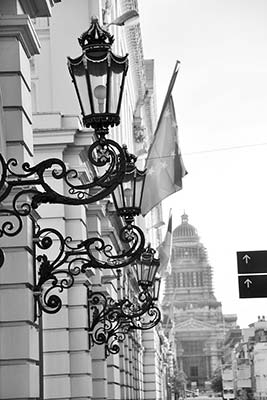
UPPER TOWN WALK
3 Royal Palace (Palais Royale)
6 Palace of Justice (Palais de Justice)
7 Viewpoint from Place Poelaert
10 Tour d’Angle
11 Place de la Vieille Halle aux Blés
The Upper Town has always had a more aristocratic feel than the medieval, commercial streets of the Lower Town. It’s the Brussels of the late 1800s, when it was a cosmopolitan European city and capital of a colonial empire. With broad boulevards, big marble buildings, palaces, museums, and so many things called “royal,” it also seems much newer and a bit more sterile. But the Upper Town has plenty to offer and even a bit of personality poking out from behind its stuffy veneer.
Use this walk to get acquainted with this less-touristed part of town, sample some world-class museums, see the palace, explore art galleries, and get the lay of the land from a panoramic viewpoint. The tour starts at Place Royale, a half-block from the one essential art sight in town, the Royal Museums of Fine Arts of Belgium—consider a visit while you’re here (see the next chapter). The Musical Instruments Museum is also in the neighborhood.
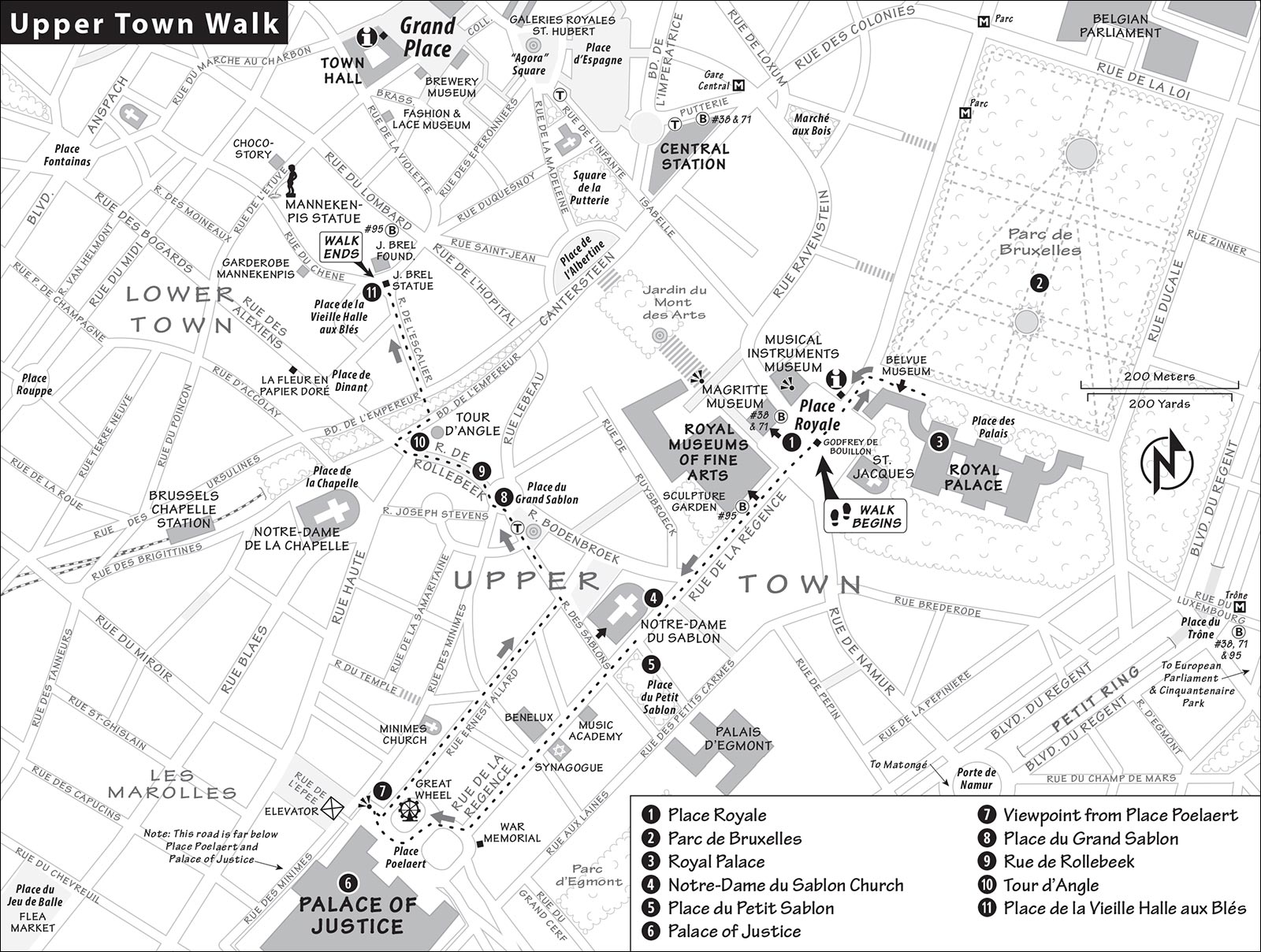
From Place Royale, we’ll walk south along the ridge; pop into a stained-glass-filled Gothic church; continue on to the towering Palace of Justice (next to the best view of the city); descend through the well-worn tapestry of the Sablon quarter’s antique stores, art galleries, and cafés; and end in the Lower Town at a homey little square right near the Manneken-Pis, the pride and joy of Brussels.
Orientation
Length of This Walk: Allow 1.5 hours.
Getting There: The walk begins at Place Royale in the Upper Town. You have several ways to get there: Walk uphill (about 15 minutes from the Grand Place); catch a taxi (about €19 from Rue Orts, near Place de la Bourse); ride frequent bus #38 or #71 to Royale/Koning (direction: Héros/Helden or Delta) or bus #95 (direction: Wiener); or take a hop-on, hop-off bus tour (hop off at Place Royale).
Royal Museums of Fine Arts of Belgium: €10 for Old Masters or Magritte, €15 combo-ticket covers both; free first Wed of the month after 13:00; open Tue-Fri 10:00-17:00, Sat-Sun 11:00-18:00, closed Mon.
Musical Instruments Museum: €15, Tue-Fri 9:30-17:00, Sat-Sun from 10:00, closed Mon.
BELvue Museum: €10, Mon-Fri 9:30-17:00, Sat-Sun and July-Aug 11:00-19:00.
Notre-Dame du Sablon Church: Free, Mon-Fri 10:00-18:00, Sat-Sun from 9:00.
Giant Wheel: €9, daily 11:00-23:00.
The Walk Begins
1 Place Royale
At the crest of the hill sits Place Royale (Koningsplein), encircled by cars and trams and enclosed by white Neoclassical buildings forming a mirror image across a cobblestone square. (Construction is ongoing to make this square more pedestrian-friendly.) A big, green statue of a horseman stands in the center.
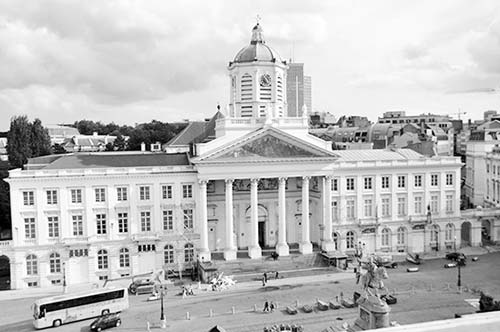
The statue depicts local hero Godfrey de Bouillon, one of the leaders of the First Crusade (in 1096). The ultimate Catholic knight, he rides forward with his flag, gazing down on the Town Hall spire. Godfrey, a patriarch of the House of Flanders, established his family’s rule over what would become Belgium. This statue dates from 1830—the year of Belgian independence. It was one of a class of statues designed to celebrate (or dream up) deep roots of the Belgian people to give their new nation legitimacy. (Today, about the only thing that stirs Belgian nationalistic sentiment is a victory by the Belgian soccer team.)
This hilltop in Brussels became home to the region’s rulers. In the 12th century, a castle called the Coudenberg Palace was built (over Godfrey’s right shoulder, just outside the square). Today, it’s the Royal Palace, where modern Belgium’s king still lives.
Behind Godfrey is the Church of St. Jacques-sur-Coudenberg, with its imposing cupola, dominating the square’s ring of buildings. This building (from 1787) stands on the spot of the original church built here next to the 12th-century castle. Locals remember that it was on the porch of the Church of St. Jacques, on July 21, 1831, that their first king took the oath that established modern Belgium.
In the 1870s, as Belgium industrialized and modernized, this tight ensemble of buildings and squares was given a makeover. It signaled that Brussels had arrived as a world capital. Old buildings were refurbished and new ones built to create a planned neighborhood on a grand scale. If Godfrey turned and looked left down Rue de la Régence, he’d see the domed Palace of Justice at the end of the boulevard. This Neoclassical look—broad vistas down wide boulevards, ending at gleaming white, Greek-columned monuments—was all the rage, seen not only here but also in Paris, London, and Washington, DC.
The square has several worthwhile museums. The main entrance to the Royal Museums of Fine Arts of Belgium is a half-block to the right (for a tour, see the next chapter). The Musical Instruments Museum is straight downhill from the square—if Godfrey spurred his horse straight ahead, he’d pass it on his right (for details on visiting, see here). It’s housed in an early-20th-century iron-and-glass former department store whose Art Nouveau facade was a deliberate attempt to get beyond the retro Greek columns and domes of the Place Royale.
• Before heading south, exit Place Royale on the north side, which opens up to the large, tree-lined...
2 Parc de Bruxelles
Copying Versailles, the Habsburg empress Maria Theresa of Austria (Marie-Antoinette’s mom) had this symmetrical park laid out in 1776 (she ruled, but never visited, the city). This is just one of many large parks in Brussels, which started with an awareness of the importance of city planning.
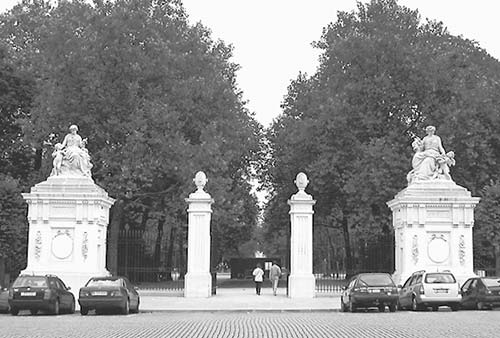
At the far (north) end of the park (directly opposite the Royal Palace, no need to actually walk there) is the Parliament building. Which parliament? The city hosts several: the European Parliament, the Belgian Parliament, and several local, city-council-type parliaments. This is the Belgian Parliament, seen on nightly newscasts as a backdrop for talking heads and politicians.
In 1830, Belgian patriots rose up and converged on the park, where they attacked the troops of the Dutch king. This was the first blow in a short, almost bloodless revolution that drove out the foreign-born king and gave the Belgians “independence”...under a different foreign-born king.
• The long building facing the park (to your right) is the...
3 Royal Palace (Palais Royale)
Belgium struck out twice trying to convince someone to be its new king. Finally, Leopold I (r. 1831-1865), a nobleman from Germany, agreed to become “King of the Belgians.” Leopold was a steadying influence as the country modernized. His son rebuilt this palace—near the site of earlier palaces, dating back to the 10th century—by linking a row of townhouse mansions with a unifying facade (around 1870).
Leopold’s great-great-great-great-grandnephew, King Philippe (b. 1960), today uses the palace as an office. (His head is on Belgium’s euro coins.) Philippe and his wife, Queen Mathilde, live in a palace north of here (near the Atomium), at several country estates, and on the French Riviera. If the Belgian flag (black-yellow-red) is flying from the palace, the king is somewhere in Belgium.
Philippe is a figurehead king, as in many European democracies, but he serves an important function as a common bond between bickering Flemish and Walloon citizens. The king—regarded by some as awkward and standoffish—is not as popular as Queen Mathilde, also a Belgian native. Their daughter, Elisabeth, born in 2001, is first in line to become the next Belgian monarch. When it came time for her to attend university, she faced a dilemma: The Walloons would feel slighted if she attended a Dutch-speaking university, and the Flemish would take offense if she attended a French-speaking one. She went to study in the UK.
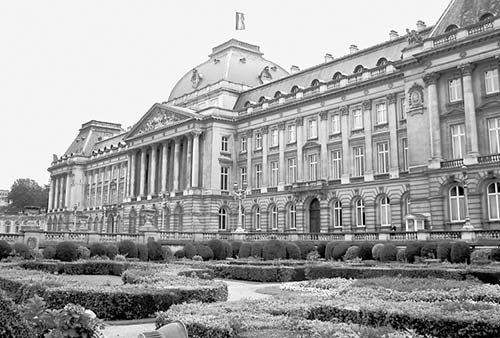
The palace is off-limits to tourists except from late July through August (visit the TI website at www.visit.brussels to book advance tickets). The adjacent BELvue Museum has a well-presented exhibit on Belgian history (see here).
• Return to Place Royale, then continue south along Rue de la Régence, passing the main entrance to the Royal Museums of Fine Arts of Belgium complex. This grand boulevard—cut through a tangle of medieval buildings in the 19th century—connects the Royal Palace with the grand Palace of Justice at the far end. Continue ahead, passing grand government administration buildings (including those that ran the affairs of Belgian colonies), to the Gothic church (on the right).
4 Notre-Dame du Sablon Church
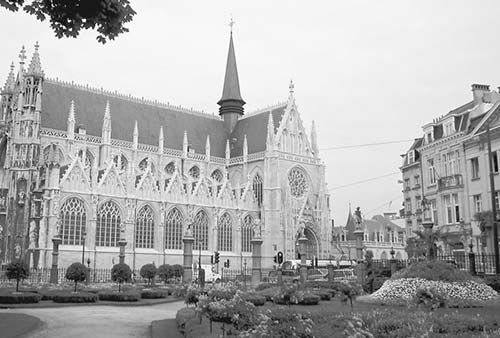
This is the Church of the Archers, built in the 14th century in the Flamboyant Gothic style. In the Middle Ages, archers and crossbowmen were vital defenders of the realm, and the royals made sure they were taken care of very well. While the church was built six centuries ago, the exterior highlights were added in the 1880s and are Neo-Gothic. It’s worth a look inside.
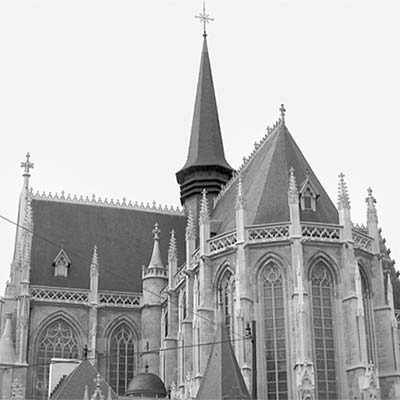
Visiting the Church: The church is made of simple gray stone lit by the warm light of the stained-glass windows. The windows in the nave (which date from the 19th and 20th centuries) are notable for their symmetry—rows of saints in Gothic niches topped by coats of arms. The glorious apse behind the altar—bathed in colorful light from some original 15th-century windows—is what Gothic is all about.
Midway up the nave is an artistically carved pulpit, supported by an angel and animals, the symbols of the Evangelists. The left transept has relics of the last Habsburg emperor, Karl I (1887-1922). Karl’s legendary Catholic devotion inspires many devoted people to pray here, and he was beatified in 2004.
The church’s claim to fame is next to the altar—a small wooden statue of Mary dressed in white with a lace veil. The statue is near and dear to the hearts of the people of Brussels. This is a copy, but the original statue was thought to have had miraculous powers that saved the town from plagues. In 1348, the statue spoke to a godly woman named Beatrix, prompting her to steal the statue away from Antwerp on a boat. (That’s why the church is decorated with several images of boats, including the small wooden boat high up in the right transept.) When the citizens of Antwerp tried to stop Beatrix, the Mary statue froze them in their tracks.
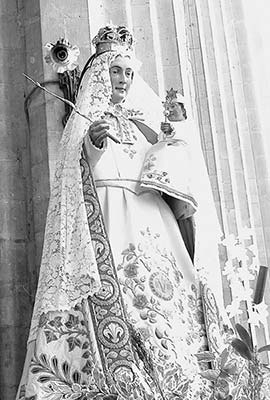
When Beatrix and the statue arrived here, the Bruxellois welcomed Mary with a joyous parade—the Ommegang. Now, every summer, the citizens re-create the procession by dressing up in tights and flamboyant costumes and parading the streets with colorful banners and large puppets. The Ommegang begins here, threads downhill, and culminates in a climax on the Grand Place.
• Exiting the church, head to the other side of Rue de la Régence from the church, where you’ll find a leafy, fenced-off garden called the...
5 Place du Petit Sablon
Step into this charming little park, a pleasant refuge from the busy street and part of why this neighborhood is considered so livable. Its central fountain, a fine example of 19th-century Romanticism, honors two local nobles who were executed because they promoted tolerance during the Inquisition. Good friends, one Catholic and the other Protestant, they were beheaded on the Grand Place in 1568.
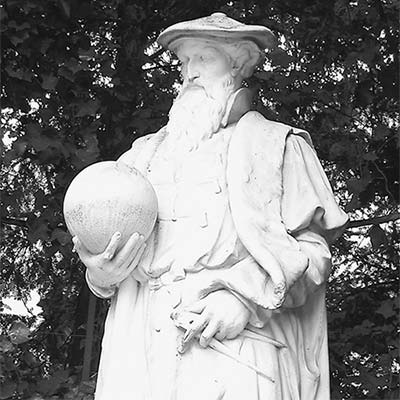
Check out the other statues. The 48 small figures atop the wrought-iron fence represent the craftsman guilds—weavers, brewers, and butchers—of 16th-century Brussels. And inside the garden, the 10 large statues represent hometown thinkers of the 16th century—a time of Humanism and great intellectual accomplishments in Brussels. Gerardus Mercator (1512-1594), the Belgian mapmaker who devised a way to more accurately show the spherical earth on a flat surface, holds a globe.
This collection of statues is a reminder that, although Belgium was never a great power, Belgians have much to be proud of as a people. From here, look back at the church and enjoy its flamboyant Neo-Gothic lines.
• Continue along Rue de la Régence. You’ll pass (on the left) the Music Academy and Brussels’ main synagogue, with its towering facade and tight security (notice the closed front entrance and protective bollards). Across the street is the Benelux building, three flags flying. Benelux, which integrated the trade and industry of Belgium, the Netherlands, and Luxembourg in the late 1940s, was the nucleus of today’s European Union. Both have a similar mission: to promote the trade, security, and well-being of their member states. Continue another block to reach the long-scaffolded...
6 Palace of Justice (Palais de Justice)
This domed mountain of marble sits on the edge of the Upper Town ridge, dominating the Brussels skyline. Built in wedding-cake layers of Greek columns, it’s topped with a dome taller than St. Peter’s in Rome, rising 340 feet. Covering more than six acres, it’s the size of a baseball stadium and extends seven floors underground.
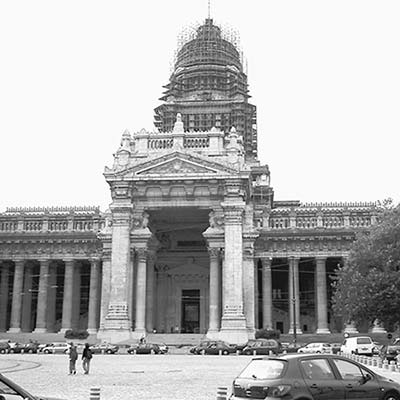
The palace dates from the late 19th century, when tiny Belgium was a global power. It was built under King Leopold II (son of Leo I, r. 1865-1909) and epitomizes the brassy, showy grandeur of his reign. Leopold became obscenely wealthy by turning Africa’s Congo region—80 times the size of Belgium—into his personal colony. Whip-wielding Belgian masters forced enslaved Congolese people to tend lucrative rubber plantations, exploiting the new craze for car tires. Leopold spent much of this wealth expanding and beautifying the city of Brussels.
Today the building (which stands on the historic site of the town gallows) serves as a Hall of Justice, where major court cases are tried. If you pop in to the lobby, you may see lawyers in black robes buzzing about. The building is perennially scaffolded—for more than 20 years so far and likely a decade more. At the end of World War II, the Nazis set fire to it as they left town, compromising the cupola’s structure, and the palace has never quite recovered.
Notice the rack of city bikes. Like many European cities, Brussels subsidizes a public-bike system, designed for riders to pick up a bike in one part of town and drop it off anywhere else. But these bike racks are often empty, since this is a popular place to grab a bike for the easy ride back down to the Lower Town.
• One of the best views of Brussels awaits from a perch immediately to the right of the Palace of Justice (to get even higher, ascend the 180-foot-tall Great Wheel Ferris wheel).
7 Viewpoint from Place Poelaert
Place Poelaert is 200 feet above the former Senne River Valley. Gazing west over the Lower Town, pan the valley from right (north) to left:
Near you is the stubby clock tower of the Minimes Church. To the left of that, in the distance past a tall square skyscraper, is the lacy, white Town Hall spire (marking the Grand Place).
Twinkling in the far distance, six miles away, you can see one of the city’s landmarks, the Atomium. (No doubt, someone atop it is looking back at you.) The Atomium’s nine shiny steel balls form the shape of an iron molecule that’s as tall as the Palace of Justice behind you. Built for the 1958 World’s Fair, it’s now a middle-aged symbol of the dawn of the Atomic Era.
Next (closer to you) rises the black clock tower of Notre-Dame de la Chapelle. The great painter Pieter Bruegel the Elder is buried here, in the city’s oldest church (from 1134, with a tower that starts Gothic and ends Baroque). On the distant horizon (behind the spire), see four boxy skyscrapers, part of the residential sprawl of this city of more than a million, which now covers 62 square miles. Breaking the horizon to the left is a green dome, which belongs to the Basilica of Koekelberg (fourth-biggest church in the world). And finally (panning quickly to the left), you see a black glass skyscraper marking the Midi/Zuid train station, where you can catch high-speed train lines, such as the Eurostar to London.
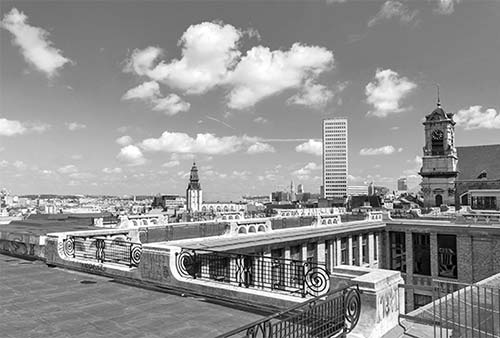
At your feet lies the Marolles neighborhood. Once a funky, poor place where locals developed their own quirky dialogue, today it can be either seedy or colorful, depending on the time of day and your perception. The area is famous for its sprawling flea market (daily 7:00-14:00, best on weekends). Two of the streets just below you—Rue Haute and Rue Blaes—are lined with secondhand shops. A free elevator (see the skywalk entry on your left) connects Place Poelaert with the Marolles neighborhood, which is worth a 10-minute detour to its café-lined square.
Gazing off into the distance to the far left (south), you can’t quite see the suburb of Waterloo, 10 miles away. It was there that the tide of 19th-century European history turned: Napoleon suffered a crushing defeat on the Waterloo battlefield, his rule of Europe ended, and Belgium was placed under a Dutch king—until the Belgians won their independence in the 1830 revolution.
Behind you, in Place Poelaert, is a memorial to the two world wars. Both conflicts slashed through Belgium with deadly force, and both were tragic. In World War II the blitzkrieg blew through Belgium. But World War I, with its trenches and mustard gas, took a bigger toll on this country and left greater scars.
• Backtrack east, descending by walking down Rue Ernest Allard and turning left onto Rue des Sablons. Passing lots of antique shops and galleries, you’ll eventually reach Place du Grand Sablon, the square below the Notre-Dame du Sablon Church. (For a light meal, €€ Le Pain Quotidien—on the square at Rue des Sablons 11—offers a fine value with delightful seating and baked goods right out of the oven.)
8 Place du Grand Sablon
The Sablon neighborhood that surrounds this square and its church features cafés and restaurants, antique stores, and art galleries. Every weekend, there’s an antique market on the square. The 1740 statue celebrates how Brussels gave refuge to Catholics who fled Protestant England.
On warm summer evenings, the square sparks magic, as sophisticated locals sip aperitifs at the café tables. Chocolatier Wittamer (on the far side of the square, at #12) often has elaborate window displays. And at the bottom of the square is the shop of the innovative celebrity choco-chef Pierre Marcolini—one of the world’s top chocolatiers.
• Sloping Place du Grand Sablon funnels downhill into the pedestrian-only street called...
9 Rue de Rollebeek
Today it’s a delightful traffic-free lane lined with sidewalk cafés, art galleries, shops, midrange restaurants, and boutiques—a pleasant place to press “Pause” before returning to the bustle of Brussels. This is an easy place to comparison-shop for a drink or meal. About 100 yards down the street, a few surviving brick buildings give you a taste of the city before its 1695 bombardment by France’s Louis XIV (during the Nine Years’ War—fought between France and just about all the rest of Europe).
• Rue de Rollebeek leads down to the busy Boulevard de l’Empereur. To the right on the boulevard, just past the bowling alley, is the...
10 Tour d’Angle
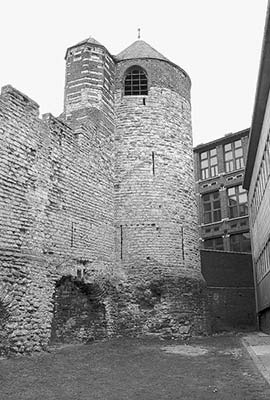
The “Corner Tower,” also known as Tour Anneessens, is a rare surviving section of Brussels’ medieval city wall. It stood over one of seven gates along the 2.5-mile-long wall that enclosed 13th-century Brussels. Notice the slash through the city here that marks where underground trains connect Central station (to your right) and Midi station (to your left, with the black skyscraper). Six tracks under you are kept busy with about a thousand trains a day. This ambitious bit of city infrastructure was a project started in 1902 and not finished until 1952—two occupations by Germany slowed things down. Notice the charm of the 1950s-era buildings that lined this street after the completion of the Métro line. Across the street from the bowling alley (with red window decorations and lots of slogans) is the Socialist Party headquarters building. Part of its mission: finding a way for the two leading socialist parties—representing Flemish- and French-speaking Belgians, respectively—to work together for their shared liberal values. (Brussels is historically an island of liberalism amid more conservative small towns and countryside.)
• Cross the street, head right, and take the first left at Rue de l’Escalier, which leads downhill to a pleasant square at the T-intersection.
11 Place de la Vieille Halle aux Blés
Do a 360-degree sweep from the center of this little square—circled by nice apartments and lined with cafés that hum on a sunny day. Imagine what a delight it would be to call this neighborhood home. A few decades ago, this was a derelict slum—a good reason why Brussels was famous as a fine place to work but a lousy place to live. People were moving out, leaving the down-and-out downtown. But in 1989 Brussels became its own political region and got its own government. Since then, its policy has been to revitalize the center of town; tearing down homes to build office space is no longer allowed. Consequently, new construction is reserved for residences, and people have moved into the area again. As in so many European cities, government policies are spurring the revitalization of old town centers.
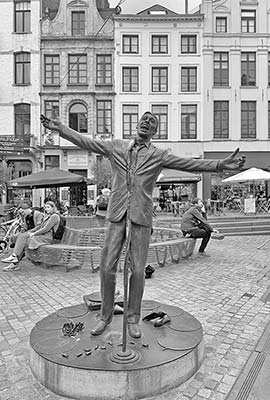
The statue in the middle of the square celebrates Jacques Brel, a beloved singer-songwriter. You could say he was to the Belgians what Edith Piaf was to the French. Brel, a Frank Sinatra-like crooner from the 1950s, sang in French but was beloved by both the Dutch- and French-speaking communities. The Jacques Brel Foundation, across the street, works to protect and promote his legacy.
• Your walk is finished. From here, the Manneken-Pis is about a five-minute walk, and his costume collection at GardeRobe MannekenPis is along the way (both described in the Sights in Brussels chapter). The Grand Place is about a 10-minute walk. If you’re hungry or thirsty, return to Rue de Rollebeek, with several options for a meal, or settle in for a drink or snack at the nearby La Fleur en Papier Doré, a classic Belgian café where René Magritte was a regular—he even held his wedding reception here (daily, Rue des Alexiens 55).