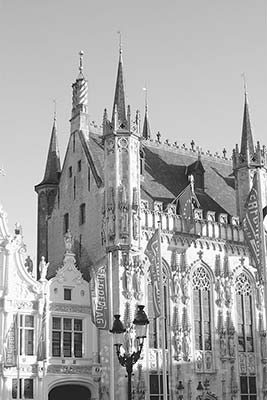
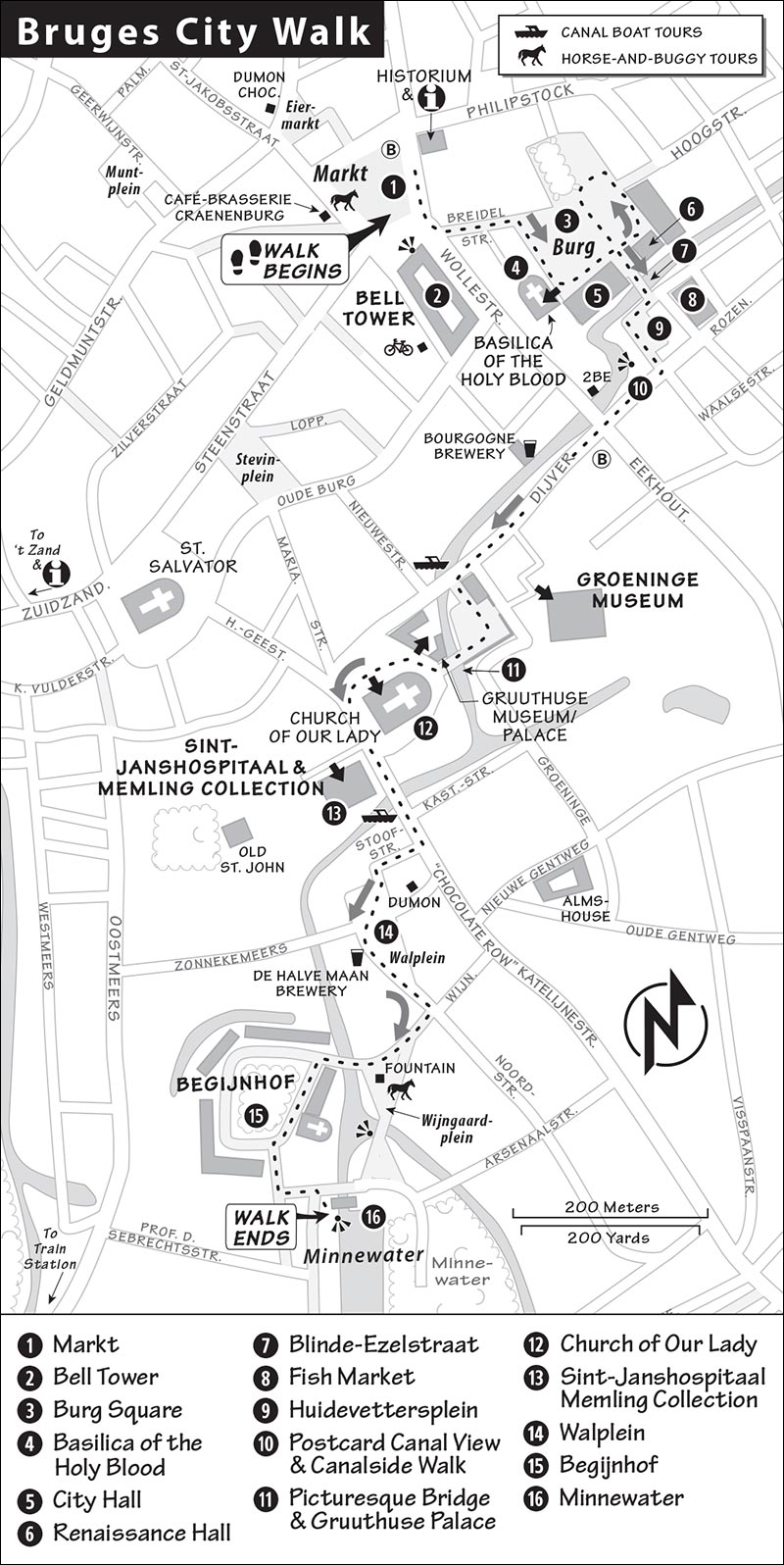
BRUGES CITY WALK
6 Renaissance Hall (Brugse Vrije)
10 Postcard Canal View and Canalside Walk
11 Picturesque Bridge and Gruuthuse Palace
12 Church of Our Lady (Onze-Lieve-Vrouwekerk)
13 Sint-Janshospitaal (St. John’s Hospital)
14 Walplein
15 Begijnhof
16 Minnewater
Bruges is made for walking. In just a couple of hours, you can get the lay of the land, pop in to a few sights, and mentally bookmark others to come back to later. On this walk, we’ll get a sampling of what makes Bruges, Bruges. It’s a city with a thousand years of history, and its citizens preserve their buildings and carry on their traditions with pride.
We’ll start on the vast square with a towering bell tower that shows off the golden age of the 1400s, when Bruges was one of the richest cities on earth. We’ll see art by Memling and Michelangelo, oak pilings from Bruges’ foundations, the pious home of cloistered women, and maybe even a few drops of Christ’s blood. Along the way you can sample local beer, watch swans glide beneath willow trees, and enjoy postcard views of a tranquil city reflected in a quiet canal.
Orientation
Length of This Walk: Allow two hours for the walk, plus more time for touring sight interiors.
Sightseeing Tips: If you’re planning to visit all the sights listed on this walk, consider buying the Musea Brugge Card, either online or at City Hall, near the start of the walk (see here).
Bell Tower: €15—advance online booking recommended during peak times; open daily 9:00-20:00, Nov-March 10:00-18:00, last entry one hour before closing.
Basilica of the Holy Blood: Church-free, treasury-€5, daily 10:00-17:15.
City Hall and Renaissance Hall: €8; City Hall open daily 9:30-17:00, Renaissance Hall Sat-Sun only.
Church of Our Lady: Free to glance down the nave, €8 to see art-filled apse and choir; Mon-Sat 9:30-17:00, Sun from 13:30.
Sint-Janshospitaal and Memling Collection: €15, Tue-Sun 9:30-17:00, closed Mon.
De Halve Maan Brewery Tour: €16, tours run Sun-Wed 12:00-16:30, Thu-Sat until 17:30 (smart to book ahead).
Begijnhof: Courtyard free to enter, daily 7:30-20:30 (closes earlier off-season), vespers service at 16:30.
The Walk Begins
1 Markt (Market Square)
Ringed by the frilly-spired county hall and post office, lots of restaurant terraces, great old gabled buildings, and the massive bell tower, this is the modern heart of the city.
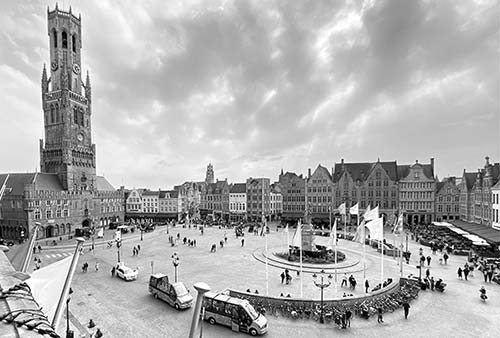
The square is adorned with flags: There’s the lion flag of Bruges (red, white, and blue) and the lion flag of Flanders (yellow and black)—Bruges is the capital of the region of West Flanders. There’s also the flag of Belgium (black, yellow, and red) and the flag of the European Union (blue with yellow stars). Visitors from all over Europe and the world roam the square, in peak season often including large groups of cruise passengers (from the port 10 miles away) following the numbered Ping-Pong paddles of their guides.
Imagine this square back in the 1300s, during Bruges’ glory days as a trading city. Back then (before the geography changed), Bruges itself was a major seaport, with a harbor that connected it to the open sea. Here on the Markt, a canal came right up to the square. Boats once moored next to where the Historium and TI stand today.
Cranes (powered by humans in hamster wheels) loaded and unloaded the boats. Right next to the dock, there was a vast warehouse where businessmen from all nations stored and traded goods. Most of the old buildings are gone, but on the opposite side of the square, locate the rectangular-shaped house with the modern gold ball on top—this is Bruges’ oldest house (15th century). In former times, farmers shipped their cotton, wool, flax, and hemp to the port at Bruges. The industrious locals would spin, weave, and dye it into a finished product, then load it onto boats to ship throughout the known world.
By 1400, Bruggians were trading more refined goods such as trendy clothes, tapestries, chairs, jewelry, and cotton-rag paper—a relatively new innovation (replacing parchment) made in Flanders. One of the Continent’s first bookmakers worked here in Bruges.
The statue depicts two friends, Jan Breydel and Pieter de Coninck, who helped put this city on the world map. It’s the year 1302, and clutching sword and shield, they look toward France, preparing to lead the citizens of Bruges against their French oppressors. The rebels identified potential French spies by demanding they repeat two words—schild en vriend (shield and friend)—only Flemish locals (or foreigners with phlegm) could pronounce them. As you can see in the reliefs, the French knights, thinking that fighting these Flemish peasants would be a cakewalk, wore their dress uniforms into battle. But the Flemish cleverly used hooks to pull the knights from their horses, scoring the medieval world’s first victory of foot soldiers over cavalry, and of common people over nobility. The peasants had a field day afterward scavenging all the golden spurs from the fallen soldiers. And with that, Flanders won its freedom in what came to be called the Battle of the Golden Spurs.
Want a coffee? Consider the Café-Brasserie Craenenburg on the Markt (at #16). The building has been here since the 15th century, and it’s been a café since 1905. Most of the square’s “typical” old buildings were actually rebuilt in the 19th century. As Bruges recovered from centuries of decline, the city fathers wanted to return it to its former medieval glory. They built in an exaggerated medieval style called Neo-Gothic, full of spiky spires, fanciful towers, lacy stonework, and leering gargoyles. The result is a medieval-era town that actually looks medieval—or “more Gothic than Gothic,” as Bruges is often described.
• Turn your attention to the...
2 Bell Tower (Belfort)
This bell tower has stood over the Markt since 1300. The octagonal lantern was added in 1486, making it 290 feet high. The tower displays many architectural elements: medieval crenellations, pointed Gothic arches, round Roman arches, flamboyant spires, and even a few small flying buttresses (two-thirds of the way up).
At the base of the tower is another compelling feature—Belgian fries. While locals are fiercely loyal to one stand or the other, you can stay out of the fray and just try some from either of the takeout stands. While the fries come with an array of exotic sauces, traditionally Belgians dip in mayonnaise—not ketchup!
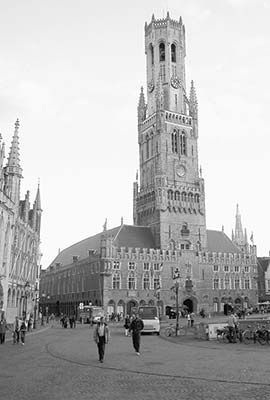
Enter the courtyard. The public sits on benches here to enjoy free carillon concerts (several times a week—see the posted schedule and photos under the arch where you entered). A pay WC is in the courtyard.
The tower has 47 bells that chime periodically. Every 15 minutes, the carillon plays a little ditty. This is done mechanically, through the action of a giant barrel and movable tabs (like a barrel organ or player-piano roll). At other times, there’s a human carillonneur who plays concerts, using a keyboard and foot pedal (like an organist). In fact, playing the carillon is so strenuous that the musician needs to use fists and feet, rather than fingers.
You can climb the tower (though the entry fee is steeper than its 366 steps). Just before you reach the top, peek into the carillon room to see the mechanisms. Be there on the quarter hour, when things ring (the bell experience is best at the top of the hour). Atop the tower, survey Bruges. On the horizon, you can see the towns along the North Sea coast.
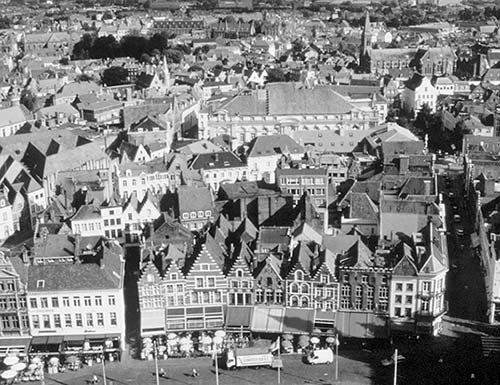
• Back out on the square, get oriented. Steenstraat, the people-packed main shopping street, stretches from in front of the belfry to the big ’t Zand Square and eventually all the way to the train station. Geldmuntstraat, a block northwest of the square, has fun shops and eateries you might check out later.
Now, facing the bell tower, turn left (east) onto Breidelstraat, and thread yourself through the lace and waffles to...
3 Burg Square
For over a thousand years, this opulent square has been Bruges’ historical birthplace, political center, and religious heart. Today it’s still the place where the citizens of Bruges carry on timeless traditions in local festivals and parades.
Pan the square counterclockwise to see six centuries of architecture. You’ll go from Romanesque (the interior of the fancy, gray-and-gold Basilica of the Holy Blood, in the corner), to the pointed Gothic arches and prickly steeples of the white sandstone City Hall, to the well-proportioned windows of the Renaissance Hall (next door, under the gilded statues). Continue spinning, past the park, until you reach the elaborate 17th-century Baroque Provost’s House (at the head of Breidelstraat).
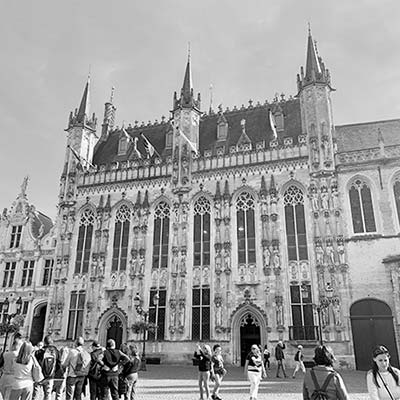
Dominating the square is City Hall, a symbol of Bruges’ proud independence. The facade’s 49 statues feature several key figures in Bruges’ history. Baldwin I (bottom row, fourth statue from left) built a fort here in the ninth century, founding Bruges. Thierry of Alsace (in the upper-right tower) grabs his sword, hoping to secure the holy relic that would put Bruges on the pilgrimage map.
• Let’s go see the relic. Approach the gray building decorated with gold statues in the corner of Burg Square.
4 Basilica of the Holy Blood
The gleaming knights and ladies on the church’s facade remind us that this church was built (c. 1150) by a brave Crusader to house the drops of Christ’s blood he’d brought back from Jerusalem. The relic is still here today, and it still connects the people of Bruges to their roots.
Visiting the Basilica: Start by entering the ground-level lower chapel through the door labeled St.-Basiliuskapel.
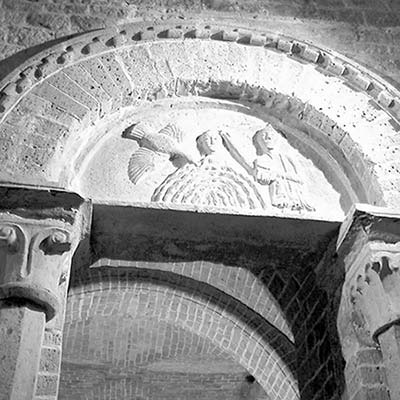
Lower Chapel: The stark and dim decor reeks of the medieval piety that drove crusading Christian Europeans to try to free the Holy Land from Muslim rule. With heavy columns and round arches, the style is pure Romanesque. Step into the annex to see somber statues of Christ being tortured and entombed, plus a 12th-century relief panel over a doorway—it shows St. Basil (a fourth-century scholar-monk) being baptized by a double-jointed priest, and a man-size dove of the Holy Spirit. Now let’s visit the place where the holy relic is kept.
• To reach the upper chapel, go back outside and up the staircase.
Upper Chapel: This chapel is as bright and cheery as the lower one was dim. After being gutted by secular-humanist French revolutionaries in 1799, the upper chapel’s original Romanesque decor was redone by 19th-century Romantics in a Neo-Gothic style. The nave is colorful, with a curved wooden ceiling, painted walls, a round pulpit carved from a single massive oak, and stained-glass windows of the dukes who ruled Flanders, along with their duchesses.
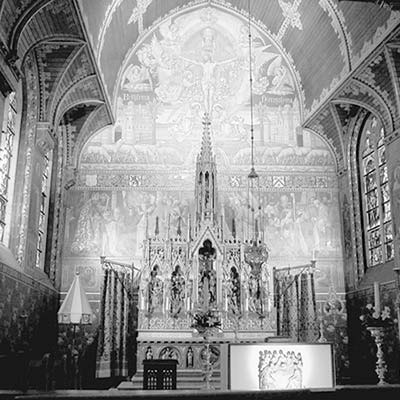
The big painting stretching behind the main altar tells the story of how the Holy Blood got here. Find Thierry of Alsace, count of Flanders (kneeling at lower left), the Crusader knight who brought the relic here. Having helped defend Bethlehem (Bethlema) and Jerusalem (Hierosolyma) from Muslim incursions, he kneels before the grateful Christian patriarch of Jerusalem, who rewards him with the relic. Thierry returns home (right) and kneels before Bruges’ bishop to give him the vial of blood. This church was built to display the relic for the hordes of believers who flocked to see it and feel its miraculous powers.
The relic itself—some red stuff preserved inside a clear, six-inch tube of rock crystal—is kept in the adjoining room (through the three arches). It’s in the tall, silver tabernacle on the altar. (The tabernacle’s doors are typically open daily from noon to 16:00 so you can actually see the vial of blood.) On holy days, the relic is shifted across the room and displayed on the throne under the canopy.
• For more on the relic, step into the adjoining treasury (requires a ticket).
Treasury: Here you can see the impressive gold-and-silver, gem-studded, hexagonal reliquary (c. 1600, left wall) that the vial of blood is paraded around in on feast days (one such procession plays on a nearby screen). The vial is placed in the “casket” at the bottom of the three-foot-tall structure. Flanking the shrine are paintings of the Brotherhood of the Holy Blood. For centuries, this 31-member fraternity has tended the shrine and organized the pageantry. The Brotherhood is still in action today, and it’s their job to carry the reliquary on their shoulders, parading it through the city streets on special occasions.
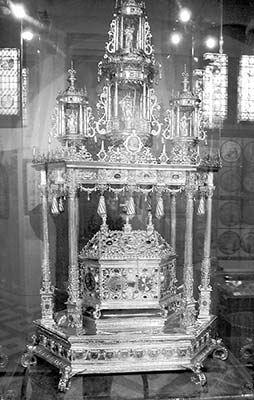
Elsewhere in the room are the Brotherhood’s ceremonial objects: necklaces, chalices, and so on. A centuries-old hunting horn is used to sound the alarm every year on the anniversary of the murder of a Flemish nobleman 100 yards from here, back in 1127 (which coincidentally allowed Thierry to take power). Open a lid to see a beautifully painted 15th-century psalter, with early music notation. You may also see a fine tapestry, a remnant of Bruges’ glory days of textile manufacture.
Finally, find the small lead box holding a broken glass tube. This is a replica of the precious rock-crystal vial that holds the blood of Christ. The lead box once protected the vial of blood from Protestant extremists (1578) and French revolutionaries (1799) bent on destroying what, to them, was a glaring symbol of Catholic mumbo jumbo.
• Go back out into the square.
5 City Hall (Stadhuis)
Built in about 1400, when Bruges was a thriving bastion of capitalism with a population of 35,000, this building served as a model for Town Halls elsewhere, including Brussels. The white sandstone facade is studded with statues of knights, nobles, and saints with prickly Gothic steeples over their heads. A colorful double band of coats of arms represents the towns of Flanders. The building is still the City Hall, so it’s not unusual to see couples arriving here to get married.
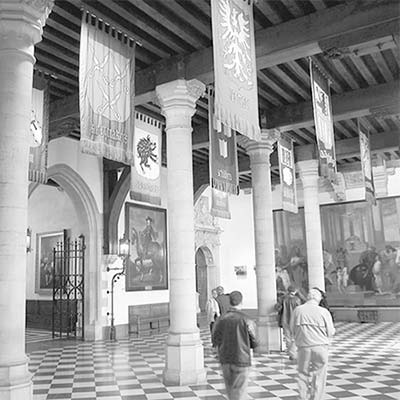
Visiting City Hall: The ground-level lobby and picture gallery (free, open daily) are hung with scenes and portraits from Belgium’s history, from the Spanish king to the arrival of Napoleon, shown meeting the mayor here at the City Hall in 1803. A free, informative audio-guide (streamed to your phone) covers this area as well as the rooms upstairs. Don’t miss the two paintings (behind glass) that show the Markt and Burg Square in the 1600s. The mayor’s office is at the end of the hallway.
• You can pay to climb the stairs for a look at the...
Gothic Room: Some of modern democracy’s roots lie in this ornate room, where, for centuries, the city council has met to discuss the town’s affairs (as it still does monthly). In 1464, one of Europe’s first parliaments, the Estates General of the Low Countries, convened here. The fireplace at the far end is inscribed with a 1305 proclamation: “All the artisans, laborers...and citizens of Bruges are free—all of them.”
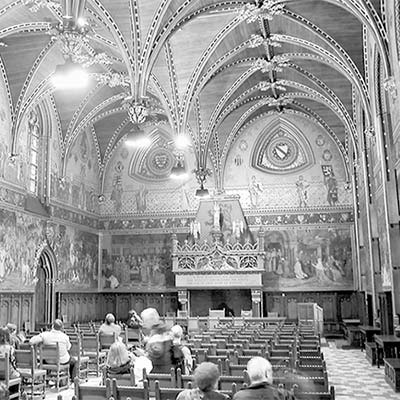
The elaborately carved and painted wooden ceiling (a Neo-Gothic reconstruction from the 19th century) features tracery in gold, red, and black. Five dangling arches (“pendentives”) hang down the center, now adorned with modern floodlights.
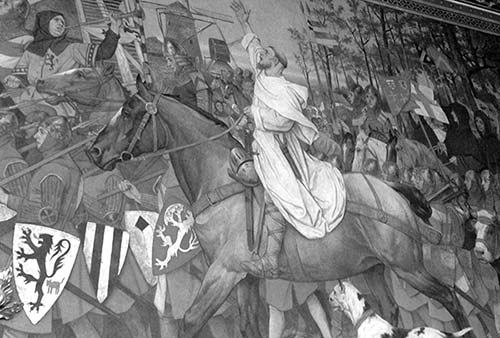
The late-19th-century Romantic wall murals depict episodes in the city’s history. (Info sheets tell the stories scene by scene.) For a few highlights, start with the largest painting along the left wall and work clockwise.
In the big painting on the left wall, everyone cheers, flags wave, trumpets blare, and dogs bark as Bruges’ knights, dressed in gold with black Flemish lions, return triumphant after driving out French oppressors and winning Flanders’ independence. The Battle of the Golden Spurs (1302) is remembered every July 11.
Next, the painting on the fireplace wall shows cardinals in red flocking to this elaborate ceremony. In what may have been Bruges’ high-water mark, Philip the Good of Burgundy (seated, in black) assembled his court here in Bruges and solemnly founded the knightly Order of the Golden Fleece (1429).
Next, the Crusader knight, Thierry of Alsace, returns from the Holy Land and kneels at the entrance of St. Basil’s Chapel to present the relic of Christ’s Holy Blood (c. 1150).
On the back wall, it’s a typical market day at the Halls (the courtyard behind the bell tower). Arabs mingle with Germans in fur-lined coats and beards in a market where they sell everything from armor to lemons.
And finally, a bishop blesses a new canal (1404) as ships sail right by the city. This was Bruges in its heyday, before the silting of the harbor. At the far right, the two bearded men with moustaches are the brothers who painted these murals.
Adjoining Room: Old paintings and maps show how little the city has changed through the centuries. A well-known map (in pale white, aqua, and gold) shows in fascinating detail the city as it looked in 1562. Find the bell tower, the Church of Our Lady, and Burg Square, which back then was bounded on the north by a cathedral. Notice the canal (on the west) leading from the North Sea right to the Markt. A moat encircled the city with its gates, unfinished wall, and 28 windmills (four of which survive today). The mills pumped water to the town’s fountains, ground grain, made paper, and functioned as the motor of the Middle Ages. Many locals own a copy of this map that shows how their neighborhood looked 400 years ago.
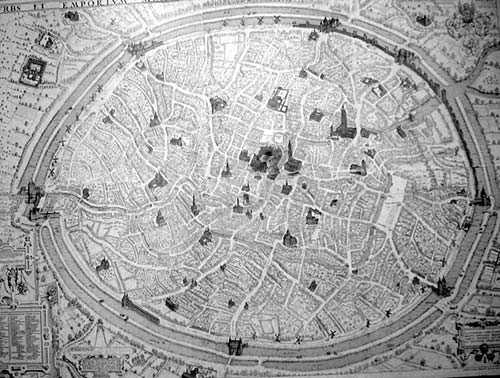
The centerpiece of this room is a dynamic illuminated table map, linked to the audioguide, that tells the story of Bruges as a prosperous center of trade—until it wasn’t. In the 16th century, as the River Zwin silted up and critical connections to the sea were lost, excavations were undertaken, canals were dug...but Bruges dwindled to a backwater.
• Leaving City Hall, turn right, and if it’s open, go to the corner of the square to enter...
6 Renaissance Hall (Brugse Vrije)
This elaborately adorned mansion has served Bruges as a governing palace, a courthouse, and (today) as the city archives. The white facade with gold and red trim dates from the 1720s. Notice the crowned heads, each with its unique personality.
Visiting the Hall: Go inside to find the elaborately decorated Renaissance Hall. If you’re into heraldry, it’s fascinating. If not, you’ll wonder where the rest of the museum is.
This ornate room was where the town’s burghers met. They’d sit on the green benches around the perimeter, under a lavish wood-beamed ceiling and surrounded by tapestry-covered walls. The big green table at one end is where they played medieval snooker. (Actually, it was the dais for the presiding bigwigs.)
The highlight of the room is the grand fireplace mantelpiece carved from oak by Bruges’ Renaissance Man, Lancelot Blondeel, in 1531. In the center of it stands the most powerful man in Europe—Holy Roman Emperor Charles V. His crown, sword, and orb symbolize his power—as does his bulging codpiece.
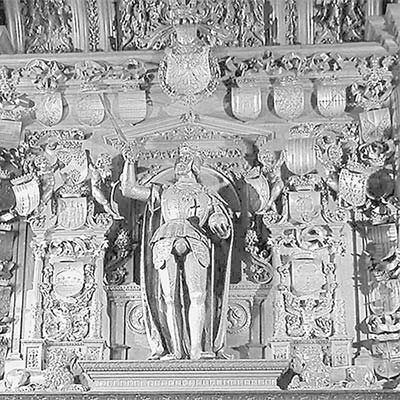
Charles had recently freed Bruges (yet again) from French rule, making the city part of his pan-European Habsburg empire, so the city fathers honored him here. They also included their hometown duke (to the left), who was related to Charles. The duke’s crown, orb, and codpiece mirror those of Charles, indicating the family jewels were well-guarded. By making the connection to the Holy Roman Emperor clear, this carved family tree helped substantiate the power of Bruges’ nobility. You’ll also see the double-eagle emblem (above Charles and elsewhere in the room), the Habsburg family symbol. The other coats of arms belong to the many European nobles under Charles’ powerful reign. Check out the expressive little cherubs.
Notice the painting that stands nearby. It depicts this very same hall you’re standing in: There’s the fireplace, the same paneled walls, and the raised green table where justices sat in judgment. The painting shows the room in action in 1659, as the lace-collared judges hear the pleas of a repentant man before deciding his punishment. One of the judges is about to pull that long chain to ring a bell and seal his fate.
• Back on Burg Square, find the passageway by Renaissance Hall. This alley is called...
7 Blinde-Ezelstraat
At the alley’s entrance—on the corner of City Hall—is a statue of the Virgin Mary known to locals as Our Lady of the Inkpot. In past times, locals nodded to the statue as they passed, and she is still the protector of the town council.
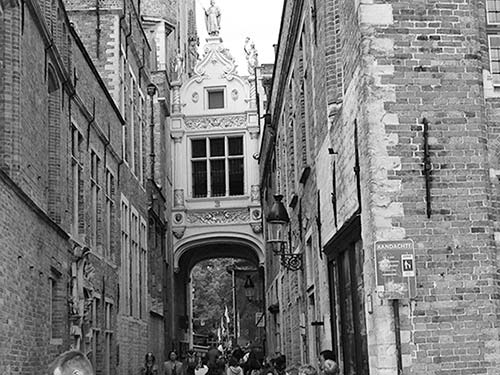
Head down the alley. Midway down on the left side (thigh level), see an original iron hinge from the city’s south gate, back when the city was ringed by a moat and closed nightly at 22:00. On the right wall, at eye level, a square black patch shows you just how grimy the city had become before a 1960s cleaning. Despite the cleaning and a few fanciful reconstructions, the city today looks much as it did in centuries past.
The name “Blinde-Ezelstraat” means “Blind Donkey Street.” Perhaps in medieval times, the donkeys, carrying fish from the North Sea on their backs, were stopped here so that their owners could put blinders on them. Otherwise, the donkeys wouldn’t cross the water between the old city and the fish market.
From the end of the alleyway, look back and up for a nice photo op of the Goldfinger family standing atop the alley’s sky bridge.
• Step onto the bridge over one of Bruges’ many canals. This particular canal was the 13th-century city moat around the old town. Crossing the bridge, ahead on your left you can see the arcades of the...
8 Fish Market (Vismarkt)
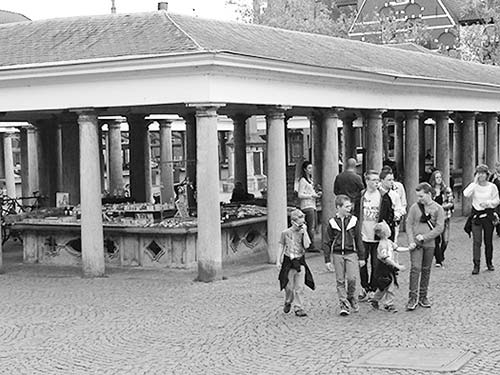
The North Sea is just about 10 miles away, and until a generation ago, this was a thriving fish market. Its fine arcades were built in the 17th century with Tuscan pillars. Locals loved the shrimp—cooked on the boat before arriving at the market. Today, one stall still sells fish, the rest sell mostly crafts and souvenirs...and tourists are the big catch.
• Take an immediate right (west), entering a courtyard called...
9 Huidevettersplein
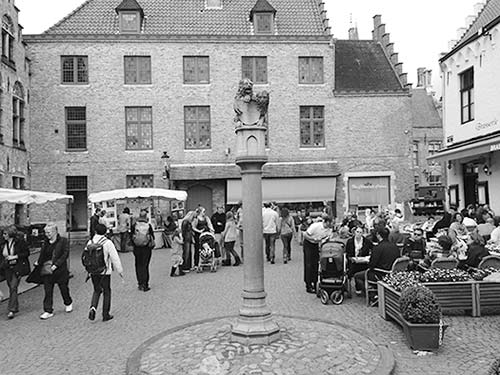
This tiny, picturesque, restaurant-filled square was originally the headquarters of the town’s skinners and tanners. The lions atop the square’s lone column hold the tanners’ logo. On the facade of the Hotel Duc de Bourgogne, four old relief panels above the windows show scenes from the leather trade—once a leading Bruges industry. First, tan the hide in a bath of acid; then, with tongs, pull it out to dry; then beat it to make it soft; and, finally, scrape and clean it to make it ready for sale.
• Continue a few steps to Rozenhoedkaai street, where you can look back to your right and get a great...
10 Postcard Canal View and Canalside Walk
The bell tower reflected in a quiet canal lined with old houses—this view is the essence of Bruges. (When I told a local friend “It looks just like Amsterdam,” she said, “No, Amsterdam looks just like Bruges.”) Seeing buildings rising straight from the water makes you understand why this has also been called the Venice of the North. Can you see the bell tower’s tilt? It leans about four feet. The tilt has been carefully monitored since 1740, but no change has been detected.
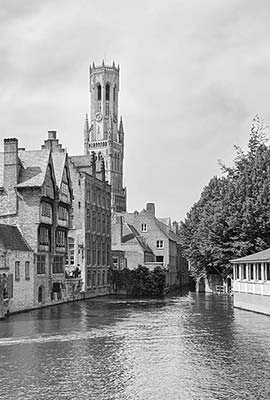
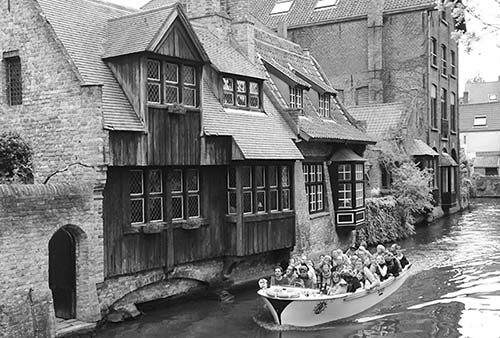
The tourist boat landing below originally served salt merchants and fishermen with goods for the market. All of these canals were a practical necessity as the city was built upon a swamp with a high water table. And through the centuries, shipping was actually cheaper and safer by boat than over land.
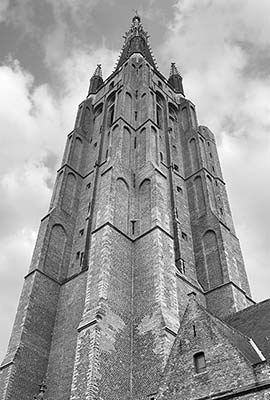
As you face the view, to your left (west) down the Dijver canal (past a weekend flea market) looms the huge spire of the Church of Our Lady, the tallest brick spire in the Low Countries. Between you and the church is Europa College, a prestigious post-graduate institution that has produced many well-known “Eurocrats”—diplomats, lawyers, and economists who run the European Union.
Walk ahead, toward the steeple of Our Lady. Beer lovers can detour over the first bridge: The first door on the right leads to the 2Be bar with its “beerwall” (described on here); the first left lane leads to the Bourgogne des Flandres Brewery (described on here).
Back on Dijver, about 100 yards ahead on the left, is the copper-colored sign that points the way to the Groeninge Museum. This sumptuous collection of paintings highlights Bruges’ own Flemish Primitives, with all their glorious detail ( see the Groeninge Museum Tour chapter).
Walking another half-block past the Groeninge Museum, at Dijver 16 turn left into a quiet courtyard. The building on the right, called Salon Arents, is a space for temporary exhibitions, and the courtyard often hosts local events. Notice the two old pillars on either side of the cobblestone path. These were unearthed in the early 20th century during reconstruction of the grand county hall and post office building (Provinciaal Hof) on the Markt. In the Middle Ages, when boats traveled as far as the Markt, these columns supported the central port building, known as the Waterhall. They were brought here to this city gathering place as reminders of Bruges’ illustrious trading history.
• Continue through the courtyard to the far-right corner, where you’ll find a...
11 Picturesque Bridge and Gruuthuse Palace
Standing atop this tiny stone bridge over a little canal, take in the scene and savor its beauty. Start with the back end of the church, admiring Our Lady’s big buttresses and round apse. Panning clockwise, find a teeny-tiny window at the corner of a building—a tollkeeper’s lookout. Below that, at canal level, you could snap a photo of your travel partner at the iron bars. Continue panning until you find the old relief panel of a boat (directly behind you) celebrating the work of the fishermen’s guild. Next comes the old wooden house along the canal. The city was once made of wood like this. Fires were a big problem, so brick rather than wood became the norm—both safer and a symbol of wealth.
Cross the bridge and veer to the right down a narrow path to the courtyard (on the right) of the Gruuthuse palace. Above the door, find a carving of the first great Gruuthuse on a horse from 1415—with his motto below, which roughly translates to “Don’t underestimate yourself.” Tickets to the fine Gruuthuse Museum and the Church of Our Lady are sold at the modern ticket booth in this courtyard (for museum details, see here).
• Exiting the courtyard, walk along around the side of the church to find the entry to the...
12 Church of Our Lady (Onze-Lieve-Vrouwekerk)
This towering brick church stands as a memorial to the power and wealth of Bruges in its heyday. Step inside. While you can stand in the back and marvel at its interior for free, to get a close-up look at its historic tombs and art—including a Michelangelo sculpture—you’ll need to pay for a ticket.
Visiting the Church: Enter and stand in the back to admire the Church of Our Lady—whitewashed walls below, gray stone midway up, and a red-brick ceiling above. Its 14th- and 15th-century stained glass was destroyed by iconoclasts, so the church is lit more brightly today than originally. Like most churches in Belgium, this one is Catholic. The medieval-style screen (topped with the organ) once divided the clergy from the commoners who gathered here in the nave. Worshippers are still attended by 12 Gothic-era statues of apostles, each with his symbol, and by a grandiose Baroque wooden pulpit, with a roof that seems to float in midair. It was from this fancy perch that the priest would interpret the word of God.
If you have a ticket for the complete visit, there is plenty of interest to see, and explanations are posted everywhere in English. Here are the highlights:
Tombs at the High Altar: The altar features the Passion Triptych from 1534 with five dramatic scenes culminating in the crucifixion. Two statues lying atop coffins mark the tombs of the last local rulers of Bruges: Mary of Burgundy and her father, Charles the Bold. The dog and lion at their feet are symbols of fidelity and courage. Underneath the tombs are the actual excavated gravesites with mirrors to help you see the well-lit, centuries-old tomb paintings.
These tombs represent the point in time when the city began its slow, four-century decline. Charles the Bold died prematurely, in war, in 1477. And in 1482, 25-year-old Mary tumbled from her horse and died. She left behind a toddler son and a husband who was heir to the Holy Roman Empire. The twin deaths meant Bruges now belonged to Austria and would soon be swallowed up by the empire and ruled from Vienna by Habsburgs—who didn’t understand or care about its problems. Meanwhile, Bruges’ North Sea port silted up, and trade routes shifted to nearby Antwerp and Amsterdam. The city was eventually mothballed—until this sleeping beauty of Flemish towns was rediscovered by modern-day tourists. The first tourists were Americans and Canadians who came in the wake of World War I to visit the graves of loved ones in nearby cemeteries.
To the left of the altar is a wooden balcony on the wall. It’s part of the Gruuthuse mansion next door (now a museum), and once provided that noble family with prime seats for Mass.
To the right of the altar is a side chapel with fascinating 14th-century tombs found during excavations. Some are painted with images of Mary as Queen of Heaven (on a throne, carrying a crown and scepter) and Mother of God (with the Baby Jesus on her lap). Since Mary is in charge of advocating with Jesus for your salvation, she’s a good person to have painted on the wall of your tomb. The tombs also show lots of angels—generally patron saints of the dead person—swinging incense burners.
Madonna and Child by Michelangelo: This small marble Michelangelo statue is an artistic highlight in this city of art. It’s the only Michelangelo statue to leave Italy in the artist’s lifetime, bought in Tuscany by a wealthy Bruges businessman, who’s buried in the same chapel (to the right).
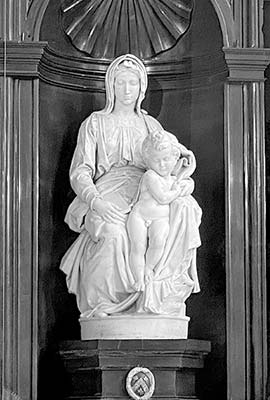
As Michelangelo chipped away at the masterpiece of his youth, David, he took breaks by carving this one in 1504. Mary, slightly smaller than life-size, sits while young Jesus stands in front of her. Their expressions are mirror images—serene, but a bit melancholy, with downcast eyes, as though pondering the young child’s dangerous future. Though they’re lost in thought, their hands instinctively link, tenderly. The white Carrara marble is highly polished, something Michelangelo only did when he was certain he’d gotten it right.
• Taking a left out of the church and then another left on Mariastraat brings you to the entrance to perhaps the city’s most visit-worthy museum.
13 Sint-Janshospitaal (St. John’s Hospital)
The former wards and church of Sint-Janshospitaal are home to a museum with two delightful elements: a look at the one-time hospital’s main hall, filled with thoughtful displays on medicine from the medieval era through the present; and a collection of masterpieces by Hans Memling, the German painter who made his artistic mark in Bruges.
See the Sint-Janshospitaal & Memling Collection Tour chapter.
• Leaving the museum, turn right and go about 30 paces to enjoy a fine canal view. Before you is one of many canal tour boat companies. The canal here was once part of the city moat. Standing here in the 15th century, you would have just left town through the Maria Gate.
Continue 50 yards down Katelijnestraat, then turn right and go down a tiny lane, Stoofstraat. This was “Stove Street”—where the neighborhood’s public bathhouse stood—which in times past served (like ancient Roman baths) as a place to bathe, work out, and socialize. Stoofstraat leads into the pleasant square called...
14 Walplein
Leafy Walplein square was the original brewing center of Bruges. Ahead on the right, De Halve Maan Brewery is one of two breweries in town still giving tours. On busy days, tours can fill up, so you may want to reserve a spot online or call in advance (see here).
A half-block to your left down Walstraat at #6 is the recommended Dumon chocolate shop.
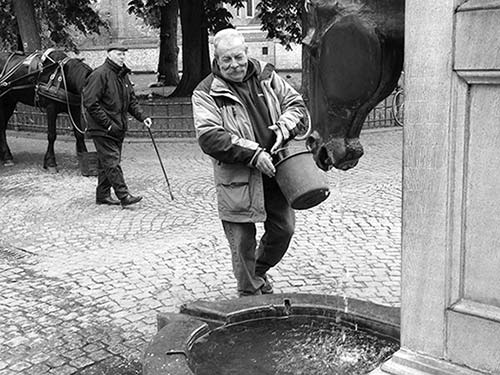
• Leaving the leafy square at the far end, turn right on Wijngaartstraat. You’ll reach a horse-head fountain, where the horse-and-buggy horses stop to drink. From the fountain, turn right and pause in the center of a picturesque pedestrian bridge. Before you, above the gate, a sign reads Sauve Garde—you are entering the protection of the sisters and leaving the jurisdiction of the city. The relief above shows St. Elizabeth taking care of people with disabilities. Walk through the gate (open until 18:30) and, as the lacy charm of Bruges crescendos, enter the...
15 Begijnhof
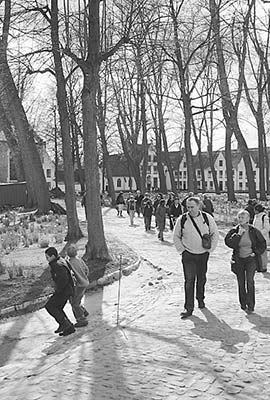
Begijnhofs (buh-HINE-hof) were built to house women of the lay order, called Beguines. Though obedient to a mother superior, they did not have to take the vows of a nun. They spent their days deep in prayer, spinning wool, making lace, teaching, and caring for the sick. The Beguines’ ranks swelled during the golden age, when so many women were widowed or unwed due to the hazards of war and overseas trade. The order of Beguines offered such women a dignified place to live and work. When the order died out, many begijnhofs were taken over by towns for subsidized housing. Today, single religious women live in the small homes. A few Benedictine nuns still live in a building on the far side.
In the church, enjoy the peaceful interior, with its carved pulpit and tombstones on the floor. The altar has corkscrew columns and a painting of the Beguines’ patron, St. Elizabeth of Hungary. On the right wall is an 800-year-old gilded statue of Mary. The rope that dangles from the ceiling is yanked by a nun to announce a sung vespers service. The Benedictine nuns gather at 16:30 daily for this worship service, which includes the sisters singing and chanting a cappella in the choir of the church. The public is welcome.
• Exiting the church, turn left, and leave the Begijnhof courtyard. Take your first left, through the gate, to a view of the lake known as...
16 Minnewater
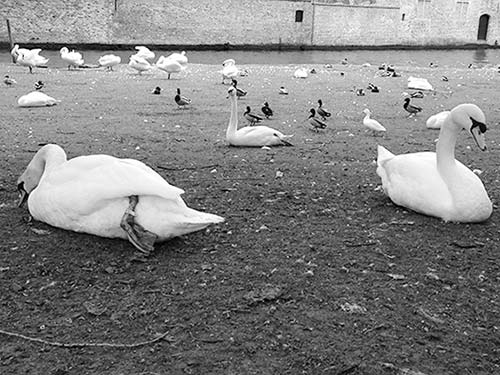
Just south of the Begijnhof is Minnewater (“Lake of Love”), a peaceful, lake-filled park with canals, weeping willows, and swans. This was once far from quaint—it was a busy harbor where small boats shuttled cargo not from seagoing vessels but from shipping on the inland canal system (mostly from Ghent) onto smaller barges. From this point, the cargo was transferred to flat-bottomed boats that went through the town’s canals to their respective warehouses and to the Markt. Today, Minnewater is actually a reservoir designed to regulate the water level of Bruges’ canals and control flooding.
When locals see swans gliding on the water here, they recall the 15th-century mayor—famous for his long neck—who collaborated with the Austrians. The townsfolk beheaded him as a traitor. The Austrians warned them that similarly long-necked swans would inhabit the place to forever remind them of this murder. And they do. With this sweet little murder story, we end our tour of perhaps the cutest town in Europe.
• You’re a 5-minute walk from the train station or a 15-minute walk from the Markt. If you walk back to the town center, consider a detour along Nieuwe Gentweg to visit one of about 20 almshouses in the city. At #8, go through the door marked Godshuis de Meulenaere 1613 into the peaceful courtyard (free). This was a medieval form of housing for the poor. The rich would pay for someone’s tiny room here in return for lots of prayers.