GROENINGE MUSEUM TOUR
Groeningemuseum
In the 1400s, Bruges was northern Europe’s richest, most cosmopolitan, and most cultured city. New ideas, fads, and painting techniques were imported and exported with each shipload. Beautiful paintings were soon an affordable luxury, like fancy clothes or furniture. Internationally known artists set up studios in Bruges, producing portraits and altarpieces for wealthy merchants from all over Europe.
Understandably, the Groeninge Museum has one of the world’s best collections of the art produced in the city and surrounding area. Early Flemish art is less appreciated and understood today than the Italian Renaissance art of the same era. This chapter highlights several masterpieces to give you an introduction to this subtle, technically advanced, and beautiful style. Hey, if you can master the museum’s name (HROON-ih-guh), you can certainly handle the art.
As you wander, notice that many artists, having lived and worked in Bruges, included scenes of the picturesque city in their pieces, proving that it looks today much as it did way back when. Enjoy the many painted scenes of old Bruges as a slice-of-life peek into the city and its people back in its glory days.
Orientation
Cost: €15.
Hours: Thu-Tue 9:30-17:00, closed Wed.
Information: +32 50 448 743, www.museabrugge.be.
Getting There: The museum is at Dijver 12, near the Church of Our Lady.
Tours: The museum offers a free audioguide for your phone.
Length of This Tour: Allow one hour.
Starring: The meticulous details and limpid atmosphere of Flemish Primitive art; Jan van Eyck’s Canon Joris and Portrait of Margareta van Eyck; and Rogier van der Weyden’s Duke Philip the Good.
The Tour Begins
The collection fills 10 rooms on one easy floor, arranged chronologically from the 15th to the 20th century. As the collection is far bigger than the actual gallery, some paintings featured here may be rotated out or in a different location. English information cards are available in each room.
GOLDEN AGE MASTERS
In Rooms 1-3, look for the following paintings—the core of the collection.
Jan van Eyck, Madonna with Canon Joris van der Paele, 1436
Jan van Eyck (c. 1390-1441) was the world’s first and greatest oil painter, and this is his masterpiece—three debatable but defensible assertions.
Mary, in a magnificent red gown, sits playing with her little baby, Jesus. Jesus glances up as St. George, the dragon-slaying knight, enters the room, tips his cap, and says, “I’d like to introduce my namesake, George (Joris).” Mary glances down at the kneeling Joris, a church official dressed in white. Joris takes off his glasses and looks up from his prayer book to see a bishop in blue, St. Donatian, patron of the church he hopes to be buried in.
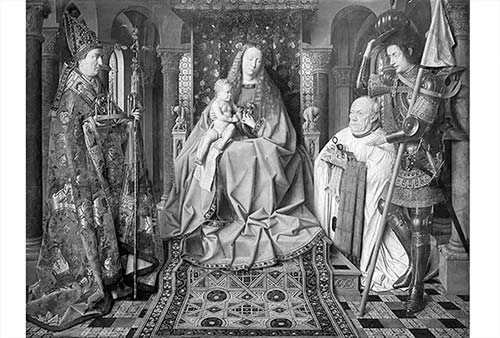
Canon Joris, who hired Van Eyck, is not a pretty sight. He’s old and wrinkled, with a double chin, weird earlobes, and bloodshot eyes. But the portrait isn’t unflattering; it just shows unvarnished reality with crystal clarity.
Van Eyck brings Mary and the saints down from heaven and into a typical (rich) Bruges home. He strips off their haloes, banishes all angels, and pulls the plug on heavenly radiance. If this is a religious painting, then where’s God?
God’s in the details. From the bishop’s damask robe and Mary’s wispy hair to the folds in Jesus’ baby fat and the oriental carpet to “Adonai” (Lord) written on St. George’s breastplate, the painting is as complex and beautiful as God’s creation. The color scheme—red Mary, white canon, and blue-and-gold saints—are Bruges’ city colors, from its coat of arms.
Mary, crowned with a jeweled “halo” and surrounded by beautiful things, makes an appearance in 1400s Bruges, where she can be adored in all her human beauty by Canon Joris...and by us, reflected in the mirror-like shield on St. George’s back.
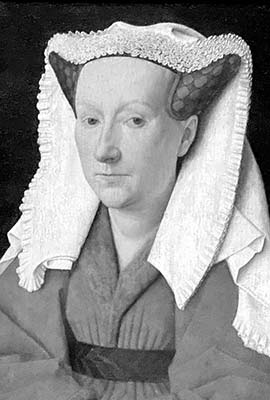
Jan van Eyck, Portrait of Margareta van Eyck, 1439
At 35, shortly after moving to Bruges, Jan van Eyck married 20-year-old Margareta. They had two kids, and after Jan died, Margareta took charge of his studio of assistants and kept it running until her death. This portrait (age 33), when paired with a matching self-portrait of Jan, was one of Europe’s first husband-and-wife companion sets.
She sits half-turned, looking out of the frame. (Jan might have seen this “where-have-you-been?” expression in the window late one night.) She’s dressed in a red, fur-lined coat, and we catch a glimpse of her wedding ring. Her hair is invisible—very fashionable at the time—pulled back tightly, bunched into horn-like hairnets, and draped with a headdress. Stray hairs along the perimeter were plucked to achieve the high forehead look.
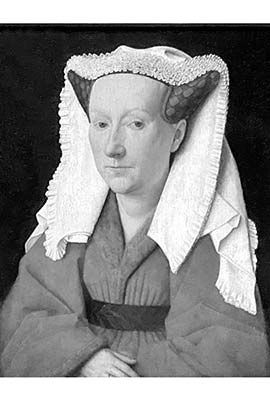
This simple portrait is revolutionary—one of history’s first individual portraits that wasn’t of a saint, a king, a duke, or a pope, and wasn’t part of a religious work. It signals the advent of humanism, celebrating the glory of ordinary people. Van Eyck proudly signed the work on the original frame, with his motto saying he painted it “als ik kan” (ALC IXH KAN)...“as good as I can.”
Rogier van der Weyden, St. Luke Drawing the Madonna, c. 1500
Rogier van der Weyden (c. 1399-1464), the other giant among the Flemish Primitives, added the human touch to Van Eyck’s rather detached precision. He is thought to have created the original of this composition for the chapel of St. Luke’s Guild in Brussels.
As Mary prepares to nurse her child, Baby Jesus can’t contain his glee, wiggling his fingers and toes, anticipating lunch. Mary, dressed in everyday clothes, doesn’t try to hide her love as she tilts her head down with a proud smile. Meanwhile, St. Luke (the patron saint of painters, who was said to have experienced this vision) looks on intently with a sketch pad in his hand, trying to catch the scene. These small gestures, movements, and facial expressions add an element of human emotion that later artists would amplify.
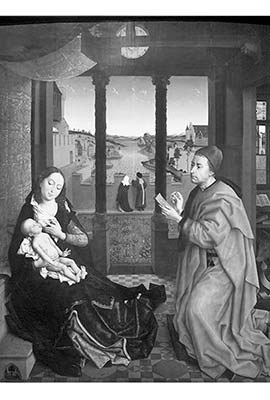
The painting is neatly divided by a spacious view out the window, showing a river stretching off to a spacious horizon. Van der Weyden experimented with 3-D effects like this one (though ultimately it’s just window-dressing).
Rogier van der Weyden, Duke Philip the Good, c. 1450
Tall, lean, and elegant, this charismatic duke transformed Bruges from a commercial powerhouse to a cultural one. In 1425, Philip moved his court to Bruges, making it the de facto capital of a Burgundian empire stretching from Amsterdam to Switzerland.
Philip wears a big hat to hide his hair, a fashion trend he himself began. He’s also wearing the gold-chain necklace of the Order of the Golden Fleece, a distinguished knightly honor he gave himself. He inaugurated the Golden Fleece in a lavish ceremony at the Bruges City Hall, complete with parades, jousting, and festive pies that contained live people hiding inside to surprise his guests.
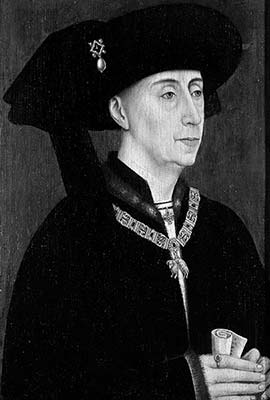
As a lover of painting, hunting, fine clothes, and many mistresses, Philip was a role model for Italian princes, such as Lorenzo the Magnificent—the uomo universale, the Renaissance Man.
Hugo van der Goes, Death of the Virgin, c. 1470
The long deathwatch is over—their beloved Mary has passed, and the disciples are dazed with grief, as though hit with a spiritual two-by-four. Each face is a study in sadness, all coping differently—lighting a candle, fidgeting, praying, or just staring off into space. Blues and reds dominate, and there’s little eye-catching ornamentation, which lets the lined faces and expressive hand gestures do the talking.
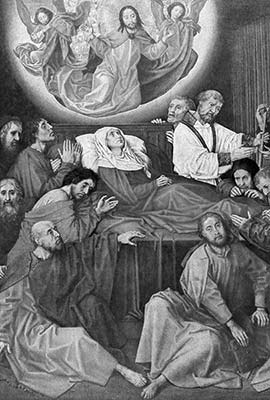
Hugo van der Goes (c. 1430-c. 1482) painted this, his last major work, the same year he attempted suicide. He had built a successful career in Ghent, then abruptly dropped out to join a monastery. His paintings became increasingly emotionally charged, his personality more troubled.
Above the bed floats a heavenly vision, as Jesus and the angels prepare to receive Mary’s soul. Their smooth skin and serene expressions contrast with the gritty, wrinkled death pallor of those on earth. Caught up in their own grief, the disciples can’t see the silver lining.
Hans Memling, The Moreel Triptych, 1484
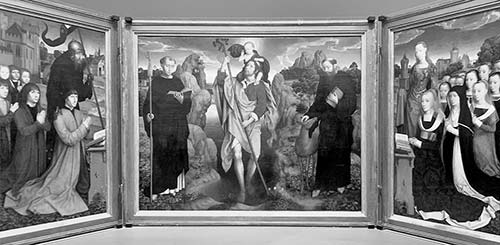
Memling (c. 1430-1494), though born in Germany, became Bruges’ most famous painter. This triptych (three-paneled altarpiece) fuses the detail of Van Eyck with the balanced compositions of (his probable teacher) Rogier van der Weyden, while introducing his own innovations.
This is perhaps the art world’s first group portrait, and everything about it celebrates the family of Willem Moreel, the wealthy two-term mayor of Bruges. In the center is St. Christopher—patron saint of seafarers—who brought wealth to the merchant Moreel family. He’s shown (according to the traditional legend) as a gentle giant graciously carrying Baby Jesus across a river. Christopher is flanked by St. Maurus (the black-robed monk with staff and book) and St. Giles (a hermit whose only companion was a red deer). These two saints represent the family names of Moreel (from Maurus) and his wife.
The true stars of the triptych are not the saints but the earthbound mortals who paid for it. Moreel (left panel) kneels in devotion along with his five sons (and St. William, who was Willem’s patron saint). Barbara (right) kneels with their 13 daughters (and her patron saint, Barbara). Memling’s skills as a portraitist capture 20 different personalities in this large family. He sets all the figures in a single landscape—note that the horizon line stretches across all three panels. Saints and mortals mingle in this unique backdrop that’s both down-to-earth (the castle, plants, and St. Barbara’s stunning dress) and ethereal (the weird rock formations and unnaturally pristine light). The glowing Christ child sits at the peak of this balanced composition. Memling creates a motionless, peaceful world that invites meditation. It was perfect for where the triptych originally stood—in the Moreel burial chapel.
Jan Provoost, Death and the Miser, c. 1515
A Bruges businessman in his office strikes a deal with Death. The grinning skeleton lays coins on the table and, in return, the man—looking unhealthy and with fear in his eyes—reaches across the divide in the panels to give Death a promissory note, then marks the transaction in his ledger book. He’s trading away a few years of his life for a little more money. The worried man on the right (the artist’s self-portrait) says, “Don’t do it.”
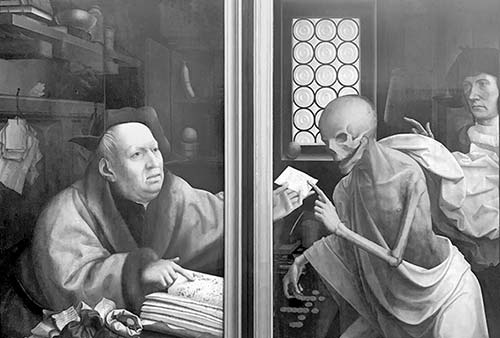
Jan Provoost (also known as Provost; c. 1465-1529) worked for businessmen like this. He knew their offices, full of moneybags, paperwork, and books. Bruges’ materialistic capitalism was at odds with Christian poverty, and society was divided over whether to praise or condemn it. Ironically, this painting’s flip side is a religious work bought and paid for by...rich merchants.
Gerard David, Judgment of Cambyses, 1498
That’s gotta hurt.
A man is stretched across a table and skinned alive in a very businesslike manner. The crowd hardly notices, and a dog just scratches himself. According to legend, the man was a judge arrested for corruption (left panel) and flayed (right panel), then his skin was draped (right panel background) over the new judge’s throne.
Gerard David (c. 1455-1523), Memling’s successor as the city’s leading artist, painted this for the City Hall. City councilors could ponder what might happen to them if they abused their offices.
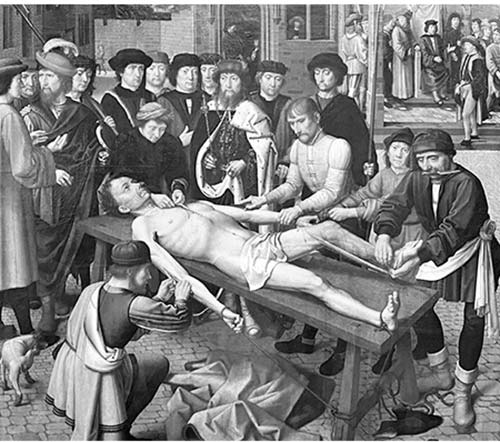
By David’s time, Bruges was in serious decline, with a failing economy and struggles against the powerful Austrian Habsburg family. The Primitive style also was fading. Italian art was popular, so David tried to spice up his retro-Primitive work with pseudo-Renaissance knickknacks—putti (baby angels, over the judgment throne), Roman-style medallions, and garlands. But he couldn’t quite master the Italian specialty of 3-D perspective. We view the flayed man at an angle from slightly above, but the table he lies on is shown more from the side.
Hieronymus Bosch, Last Judgment, c. 1500
It’s the end of the world, and Christ descends in a bubble to pass judgment on puny humans. Little naked people dance and cavort in a theme park of medieval symbolism, desperately trying to squeeze in their last bit of fun. Meanwhile, some wicked souls are being punished, victims either of their own stupidity or of genetically engineered demons. The good are sent to the left panel to frolic in the innocence of paradise, while the rest are damned to hell (right panel) to be tortured under a burning sky. Bosch paints the scenes with a high horizon line, making it seem that the chaos extends forever.
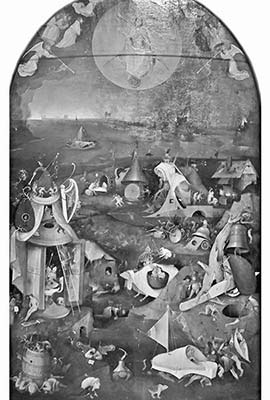
The bizarre work of Bosch (c. 1450-1516)—who, by the way, was not from Bruges—is open to many interpretations, but some see it as a warning for the turbulent times. He painted during the dawn of a new age. Secular ideas and materialism were encroaching, and the pious, serene medieval world was shattering into chaos. Be aware that this masterpiece is often out on loan; ask the attendant if you can’t find it.
REST OF THE MUSEUM
Breeze through the final rooms to get a quick once-over of Flemish art after Bruges’ golden age. (The displays in these rooms change often.) As Bruges declined into a cultural backwater, its artists simply copied the trends going on elsewhere: Italian-style Madonnas, British-style aristocrat portraits, French Realist landscapes, Impressionism, and thick-paint Expressionism.
• After fast-forwarding through the centuries, you may encounter a couple of Belgium’s 20th-century masters.
Paul Delvaux, Serenity, 1970
Perhaps there’s some vague connection between Van Eyck’s medieval symbols and the Surrealist images of Paul Delvaux (1897-1994). Delvaux gained fame for his pale nudes, dreamily sleepwalking through moonlit, videogame landscapes.
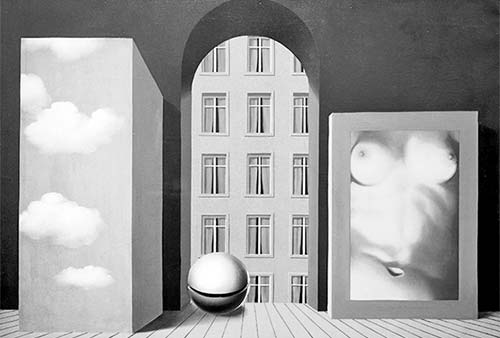
René Magritte, The Assault, c. 1932
Magritte (1898-1967) had his own private reserve of symbolic images. The cloudy sky, the female torso, windows, and a horse bell (the ball with the slit) appear in other works as well. They’re arranged here side by side as if they should mean something, but they—as well as the title—only serve to short-circuit your thoughts when you try to make sense of them. Magritte paints real objects with photographic clarity, then jumbles them together in new and provocative ways.