ROYAL MUSEUMS OF FINE ARTS TOUR
Musées Royaux des Beaux-Arts de Belgique
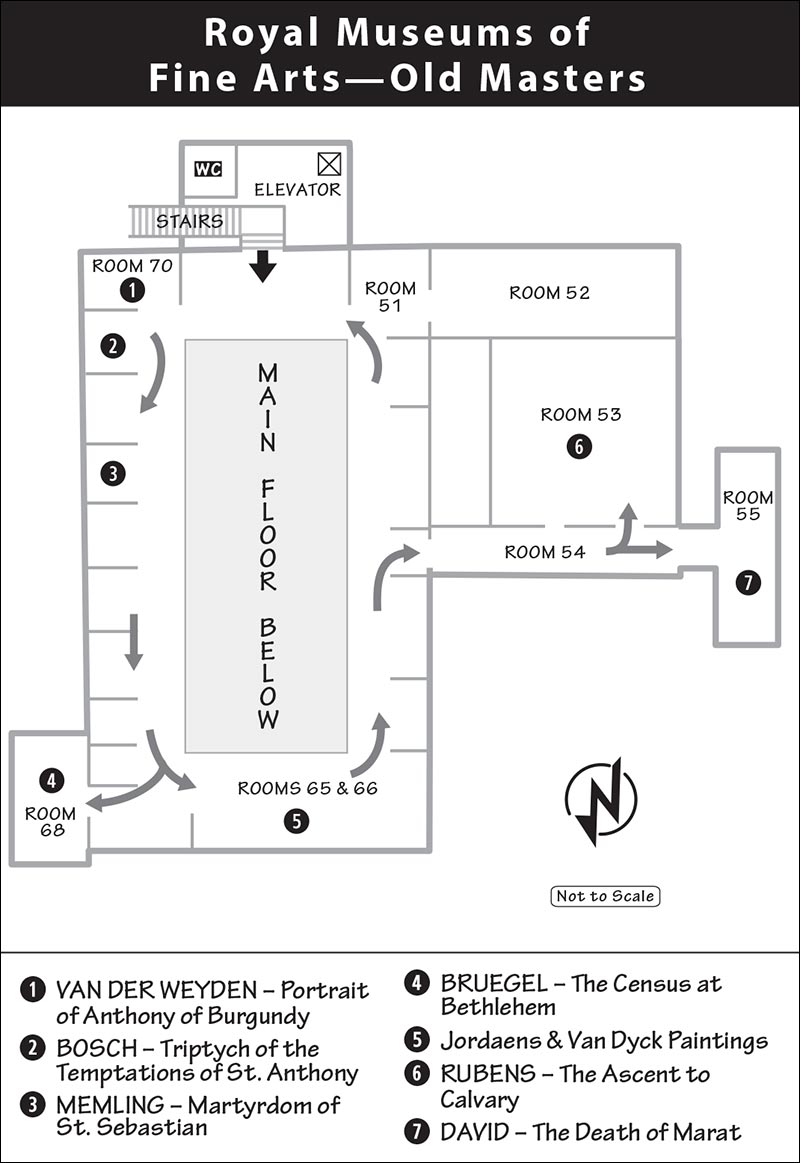
Map: Royal Museums of Fine Arts—Old Masters
The Struggling Artist, 1898-1929 (Level +3)
Recognition—and the War, 1930-1950 (Level +2)
Mature Years, 1951-1967 (Level +1)
This museum complex, spread throughout three large buildings, covers much of the history of Western painting and includes a trio of interconnected museums: the Old Masters Museum (pre-1850); the Magritte Museum, which celebrates the work of the popular Belgian Surrealist painter; and the Fin-de-Siècle Museum (1850-1910), which is currently closed for renovation. The collections, while enjoyable, can be overwhelming, so this chapter describes some highlights. But don’t limit your visit to these works—let the museums surprise you.
Orientation
Cost: €10 each for Old Masters and Magritte, €15 combo-ticket covers both. Entry is free the first Wed of the month after 13:00.
Hours: Both museums are open Tue-Fri 10:00-17:00, Sat-Sun 11:00-18:00, closed Mon.
Information: +32 2 508 3211, www.fine-arts-museum.be or www.musee-magritte-museum.be.
Avoiding Lines: To skip the line at the main entrance, buy your ticket online and enter through the Magritte Museum at Place Royale 2.
Getting There: The main entrance is at Rue de la Régence 3 in the Upper Town, a five-minute walk uphill from Central/Centraal station, or take bus #38 or #71 from Putterie street. Bus #38 or #95 connects this area with the European Parliament, and #71 continues to Matongé.
Keep Your Magrittes Straight: Don’t confuse this Magritte Museum with the much smaller René Magritte Museum, located in the artist’s former home on the outskirts of Brussels. This is clearly the place to enjoy his art.
Tours: Consider the €4 audioguides for either museum (they’re helpful here).
Length of This Tour: Allow one hour for each.
Starring: Bruegel’s Census at Bethlehem; paintings by Rubens, Bosch, Van der Weyden, and Memling; and mind-bending works by Magritte.
The Tour Begins
Enter at Rue de la Régence 3, buy your ticket, and proceed into the large entrance hall—or, if you’ve bought your ticket online and entered through the Magritte Museum, a passageway on the lowest level will lead you to stairs and an escalator up to this main hall. The Old Masters Museum is on level 1 (in the galleries you can see above you); reach it through the doorway directly ahead.
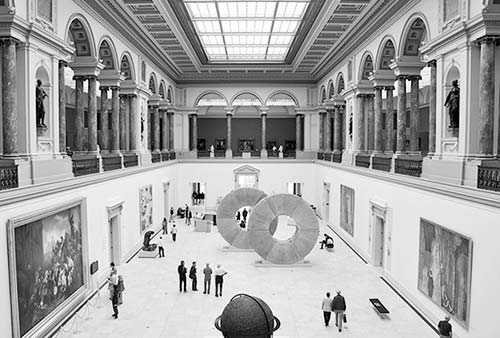
Pause at the information desk to pick up a free map and consider renting an audioguide. Now let’s dive in.
Old Masters Museum
• Ascend the large, winding marble staircase. If you have time and interest, visit the “Dutch School” rooms on the way up—they celebrate the Dutch golden age with artists such as Rembrandt and Frans Hals. Proceed to level 1, walk through the doors to your right, and enter a large, open, rectangular gallery. The art is displayed in (roughly) chronological order, working counterclockwise. So, turn right, enter the corner room (70), and find a small canvas with a portrait.
1 Rogier van der Weyden, Portrait of Anthony of Burgundy, c. 1456-1465
Anthony and his cultured family—the dukes of Burgundy—are largely responsible for the art we’re about to see in this first museum.
In this sensitive portrait, young Prince Anthony of Burgundy wears a black cloak, a bowl-cut hairdo, and a dark-red cap, with his pale face and hand emerging from a dark background. Anthony was a well-known Renaissance Man—soldier, scholar, and patron of the arts—whose sense of style impressed other European princes, like Florence’s young Lorenzo the Magnificent.
In the 1400s, Anthony and the dukes of Burgundy helped make Brussels one of the richest and most progressive cities in Europe, rivaling Florence and Venice. They built the Coudenberg Palace (100 yards from here) and the magnificent Town Hall (on the Grand Place), and turned a gangly collection of French- and Dutch-speaking provinces into the nation we know today as Belgium. The Burgundian court attracted Europe’s greatest artists, who chronicled this aristocratic family so famous across Europe.
Van der Weyden (c. 1399-1464), Brussels’ official portrait painter, captures the prince in all his glory. Anthony fingers an arrow like a bowstring, indicating his renown as a great archer. From his gold necklace dangles a Golden Fleece, one of Europe’s more prestigious knightly honors. You can even see the wrinkles in Anthony’s neck and the faint shadow his chin casts on his Adam’s apple. Anthony gazes into the distance, his clear, sad eyes lit with a speckle of white paint.
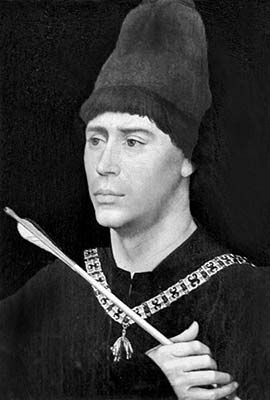
Anthony was known in his day as the Great Bastard, the brave and distinguished (but illegitimate) son of Philip the Good. Compare this portrait with that of Philip, whom Van der Weyden had also painted—see the photo on here. The two men’s long, elegant faces and full lips are a mirror image—pretty convincing DNA evidence in a paternity suit.
• Continue counterclockwise around the central gallery. As you head up the long right side, stop in the first section and find...
2 Hieronymus Bosch, Triptych of the Temptations of St. Anthony, c. 1501
The explosion of art in the Low Countries produced the eccentric and visionary artist named Hieronymus Bosch. He added a fanciful strain to the sober realism of Flemish art.
In the center panel, find the central figure of St. Anthony—the Christian hermit who withdrew to the desert, where he was haunted by demonic apparitions. Anthony (in gray robe and beard) looks out with an expression that says, “What have I gotten myself into?”
All around are bizarre supernatural creatures who try to divert Anthony from his faith. There are humans with animal heads, animals with human heads, boats that look like fish, and birds that look like boats. In the right panel, a haggard-looking Anthony tries to block the visions out by reading his Bible. In the left panel, he’s carried off by airborne devils (above) and tended to by friends (below). According to legend, Anthony persevered through it all to become an inspiration to others plagued by demons of the mind.
• Continue up the long right side to the third section.
3 Hans Memling, Martyrdom of St. Sebastian (Le Martyre de Saint Sébastien), c. 1475
Memling’s Sebastian is as placid as Bosch’s Anthony is turbulent. Sebastian—an early-Christian killed by pagans—looks peaceful as he’s punctured with arrows by a serene firing squad in a serene landscape. (In fact, Sebastian miraculously survived, so they clubbed him to death.)
Hans Memling (c. 1430-1494) was a student of Rogier van der Weyden and his “Flemish Primitive” style (for more, see the sidebar on here). Memling purposely disregarded the 3-D realism so admired in Italy at the time. For example, Sebastian’s arm is tied to a branch that’s not arching overhead, as it should be, but instead is behind him. And an archer aims slightly behind, not at, Sebastian. The other archer strings his bow in a stilted pose.
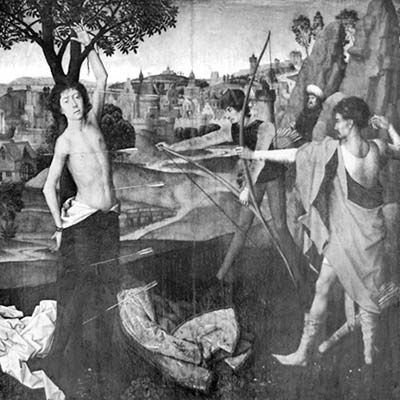
Nevertheless, Memling is clearly a master of detail. He freezes this dramatic scene so we can admire the colorful costumes, expressive faces, hazy landscape, and the cityscape in the background. Altogether it creates a meditative mood appropriate to where the painting originally stood—in a church in Bruges.
• Next, head for the far-right corner of the gallery and find Room 68, where paintings by Pieter Bruegel the Elder are displayed.
4 Pieter Bruegel the Elder, The Census at Bethlehem (Le Dénombrement de Bethléem), 1566
Bruegel sets a Bible scene—the birth of Jesus—in a typical snow-covered village near Brussels. Perched at treetop level, you have a bird’s-eye view over the action. Kids throw snowballs and sled across the frozen canals. A crowd gathers at the inn (lower left), where a woman holds a pan to catch blood while a man slaughters a pig. Most everyone has their back to us or head covered, so the figures speak through poses and motions.
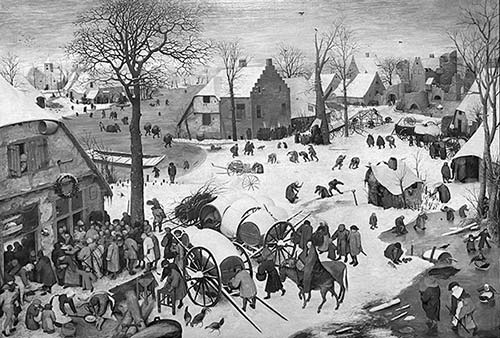
Into the scene rides a woman on a donkey led by a man—it’s Mary and husband Joseph. They’re hoping to find a room at the inn (or at least a manger), because they didn’t reserve ahead and now Mary’s going into labor.
The year is 1566—the same year that Protestant extremists throughout the Low Countries were vandalizing Catholic churches and tearing down “idolatrous” depictions of the Virgin Mary. In a similar vein, Bruegel brings Mary down to earth—she’s in the humble here and now. The busy villagers put their heads down and work, oblivious to the future Mother of God and the wondrous birth about to take place.
Enjoy the other works here by Bruegel I (c. 1527-1569). He’s famous for his crowds of everyday peasants going about their daily lives. He also dabbled in flights of bizarre fancy and obscure symbolism in the style of Bosch. You may also see works by his less famous sons—Pieter Brueghel the Younger (who copied his dad’s style and even some exact paintings) and Jan the Elder (who did glossy still-life paintings of flowers).
• Continue your counterclockwise circuit around the gallery of the Old Masters collection, passing works by Flemish artists 5 Jacques Jordaens and Anthony van Dyck. After rounding the corner, head partway up the other long side, walk through Room 54, and then turn left into Room 53, full of large paintings by Rubens, including the massive...
6 Peter Paul Rubens, The Ascent to Calvary (La Montée au Calvaire), c. 1636
Life-size figures scale this 18-foot-tall canvas on the way to Christ’s Crucifixion. The scene ripples with motion, from the windblown clothes to steroid-enhanced muscles to billowing flags and a troubled sky. Christ stumbles—he might get trampled by the surging crowd. Veronica kneels to gently wipe his bloody head.
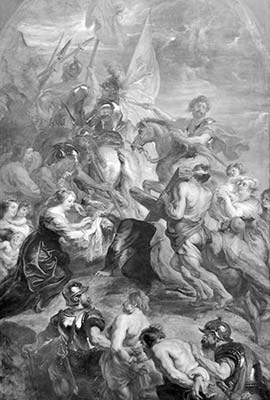
This 200-square-foot canvas was manufactured at Rubens’ studio in Antwerp. Hiring top-notch assistants, Rubens (1577-1640) could crank out large altarpieces for the area’s Catholic churches. First, Rubens himself did small-scale sketches and studies in oil (like the studies you may see in Room 60). His assistants would reproduce them on the large canvas, and Rubens would then add the final touches.
This work is from late in Rubens’ long and very successful career. He got a second wind in his fifties, when he married 16-year-old Hélène Fourment. She was the model for Veronica, who consoles the faltering Christ in this painting.
• Backtrack to Room 54, turn left, and enter Room 55, where you’ll find...
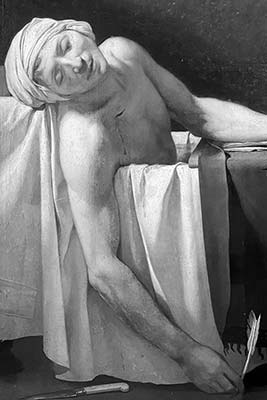
7 Jacques-Louis David, The Death of Marat (Marat Assassiné), 1793
In a scene ripped from the day’s headlines, Jean-Paul Marat—a well-known crusading French journalist—has been stabbed to death in his bathtub by Charlotte Corday, a conservative fanatic. Marat’s life drains out of him, turning the bathwater red. With his last strength, he pens a final, patriotic “Vive la Révolution” message to his fellow patriots. Corday, a young noblewoman angered by Marat’s campaign to behead the French king, was arrested and guillotined three days later.
Jacques-Louis David (1748-1825), one of Marat’s fellow revolutionaries, set to work painting a tribute to his fallen comrade right after the 1793 assassination. (He signed the painting: “À Marat”—“To Marat.”)
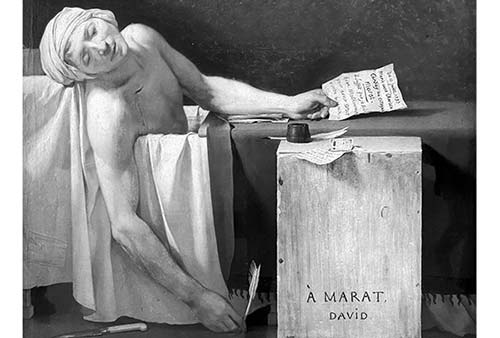
David makes it a secular pietà, with the brave writer portrayed as a martyred Christ in a classic dangling-arm pose. Still, the deathly pallor and harsh lighting pull no punches, creating in-your-face realism.
David, the official art director of the French Revolution, supervised propaganda and the costumes worn for patriotic parades. A year after finishing this painting, in 1794, his extreme brand of revolution (which included guillotining thousands of supposed enemies) was squelched by moderates, and David was jailed. He emerged later as Napoleon’s court painter. When Napoleon was exiled in 1815, so was David, spending his last years in Brussels.
• To get to the Magritte Museum, return to the ground floor and the large main entrance hall, and take the stairs or escalator down to the passageway leading to the other building. At the end of the passageway, turn right to find Magritte.
Magritte Museum
Bowler hats, clouds, birds...these are the iconic images that have become associated with Belgium’s great Surrealist, René Magritte.
Magritte’s puzzling works are perhaps best described in his own words: “My paintings are visible images which conceal nothing. They evoke mystery, and indeed, when one sees one of my pictures, one asks oneself this simple question: ‘What does that mean?’ It does not mean anything, because mystery means nothing either, it is unknowable.” If that brainteaser titillates you, you’ll love this museum.
The exhibits take you on a chronological route through Magritte’s life and art. Each of the three floors is devoted to a period of his life. Timelines (in English) put the art in its historical context, and perplexing films play on each floor at the entrance to the rooms. Fascinating quotes from Magritte are posted around the museum (but only in French, so pick up the English translation as you enter). The audioguide is helpful.
The following tour follows the layout of the museum, but it’s not really intended as a room-by-room analysis. It’s best to read this tour ahead of time for background, then enter the darkened rooms and let Magritte transport you to his world.
• From the entrance, you’ll take an elevator up to level +3.
The Struggling Artist, 1898-1929 (Level +3)
Born to a middle-class Belgian family, Magritte moved to Brussels at age 17. He studied at the Academy, where he learned to draw meticulously and got a broad liberal arts education. In the 1920s, he eked out a living designing advertisements, posters, and sheet music. Meanwhile, he wrote for the avant-garde 7 Arts magazine (you’ll see samples posted). He explored various styles—Post-Impressionism, Futurism, Cubism—in search of his own voice.
In 1922, he married his childhood sweetheart, Georgette, who became his lifelong companion, artist’s model, and muse. It’s said that all the women he would paint were versions of Georgette. (It’s touching to think that he found a soul mate who could truly understand and encourage his weirdness.)
Influenced by the Dada and Surrealist movements coming out of Paris (Salvador Dalí, Marcel Duchamp, Giorgio de Chirico), Magritte became intrigued with the idea of painting dreamscapes that capture an air of mystery.
For Magritte, 1927 was a watershed year, when he painted his first truly Surrealist work—The Man from the Sea. It featured a man on a beach with a wood-block head, pulling a lever.
Together, René and Georgette mingled in sophisticated, bohemian circles. He and his friends took photographs, striking wacky tableaux and distorted poses.
Magritte began writing words on paintings. This culminated in his most famous work, of a tobacco pipe (in the Los Angeles County Museum of Art, though there’s a similar version here). On the picture, Magritte wrote (in French), “This is not a pipe.” Of course it’s not a pipe, Magritte always insisted—it’s a painting of a pipe. It forces the viewer to ponder the relationship between the object and its name—between the “signified” and the “signifier,” to quote the deconstructionist philosophy that Magritte’s paradoxical paintings inspired. Some credit this work for planting the seeds of Postmodernism. By the way, two decades later, Magritte did another version with the message: “This is still not a pipe.”
• Head downstairs to the next phase of Magritte’s life.
Recognition—and the War, 1930-1950 (Level +2)
After a time in Paris, Magritte returned to Brussels, where he struggled through the Depression years by doing ad work and portraits.
René Magritte (1898-1967) is Belgium’s most famous 20th-century artist. He trained and worked in Brussels, but also lived for a time in Paris, where he connected with other Surrealist painters. Though he’s well known now, it took decades before his peculiar brand of Surrealism caught on. He painted real objects with photographic clarity, and then jumbled them together provocatively. Or he confounded the viewer’s expectations by presenting ordinary items as something altogether different (as in his iconic painting of a smoker’s pipe, which he labeled “This is not a pipe”).
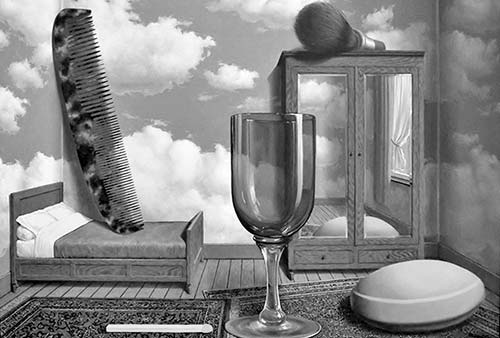
Magritte had his own private reserve of symbolic images. You’ll see clouds, blue sky, open windows, the female torso, men in bowler hats, rocks, tobacco pipes, spheres with slits (sleigh bells), birds, castles, and turtles. All of these are placed side by side as if the arrangement means something. He heightens the mystery by making objects unnaturally large or small. People morph into animals or inanimate objects. The juxtaposition short-circuits your brain only when you try to make sense of it. Magritte’s works are at once playful and disorienting...and, at times, disturbing.
He now had his signature style: combining two arresting images to disrupt rational thought and produce an emotion of mystery. The paintings have his now-familiar motifs, such as clouds and bowler hats. The background and foreground seem to shift.
The paintings’ weird titles—Forbidden Literature, God Is No Saint—added another layer of disruption. These were intentional nonsequiturs, which he and his Surrealist friends made up during regular Sunday-night get-togethers.
Then came World War II, and Brussels was under Nazi occupation. Magritte began using birds as a metaphor for the longing to be free.
He also dabbled in a variety of styles: Impressionistic colors and rough brushwork, tongue-in-cheek “portraits” of animals, a Technicolor nude of Georgette. He went through a childlike period of comic-book-inspired paintings (like the green man with a long nose), which are quite different from his normal photorealistic style.
• Continuing to the final floor, note that it has two different sections, with two different entrances from the landing.
Mature Years, 1951-1967 (Level +1)
These two rooms are like a victory lap for all of the symbols and styles we’ve seen. Nearing the end of his prolific life, Magritte had a quiver full of artistic arrows to shoot at the canvas. He mixed his trademark symbols—doves, clouds, balls, open windows, forlorn landscapes—in recombinant ways.
The collection culminates at his Empire of Lights. This painting of a typical bourgeois home at twilight suggests that even well-scrubbed suburbia can possess an ominous air of mystery. Magritte loved night-sky tones. He often created several versions of the same work, which explains why there are several Empire of Lights canvases in the world.
By the end of his life, Magritte was well known, especially in America. His use of everyday objects and poster-art style inspired Pop Art. His mix of words and images inspired Postmodernist philosophers. His bizarre imagery inspired the psychedelia of the ’60s. And the mystery his canvases evoke is timeless.
• From here you can find your way either back to the Old Masters entrance hall (where the Magritte shop is) or to the exit...and reality.