GHENT
Gent • Gand
FAST, AFFORDABLE LUNCHES IN THE CENTER
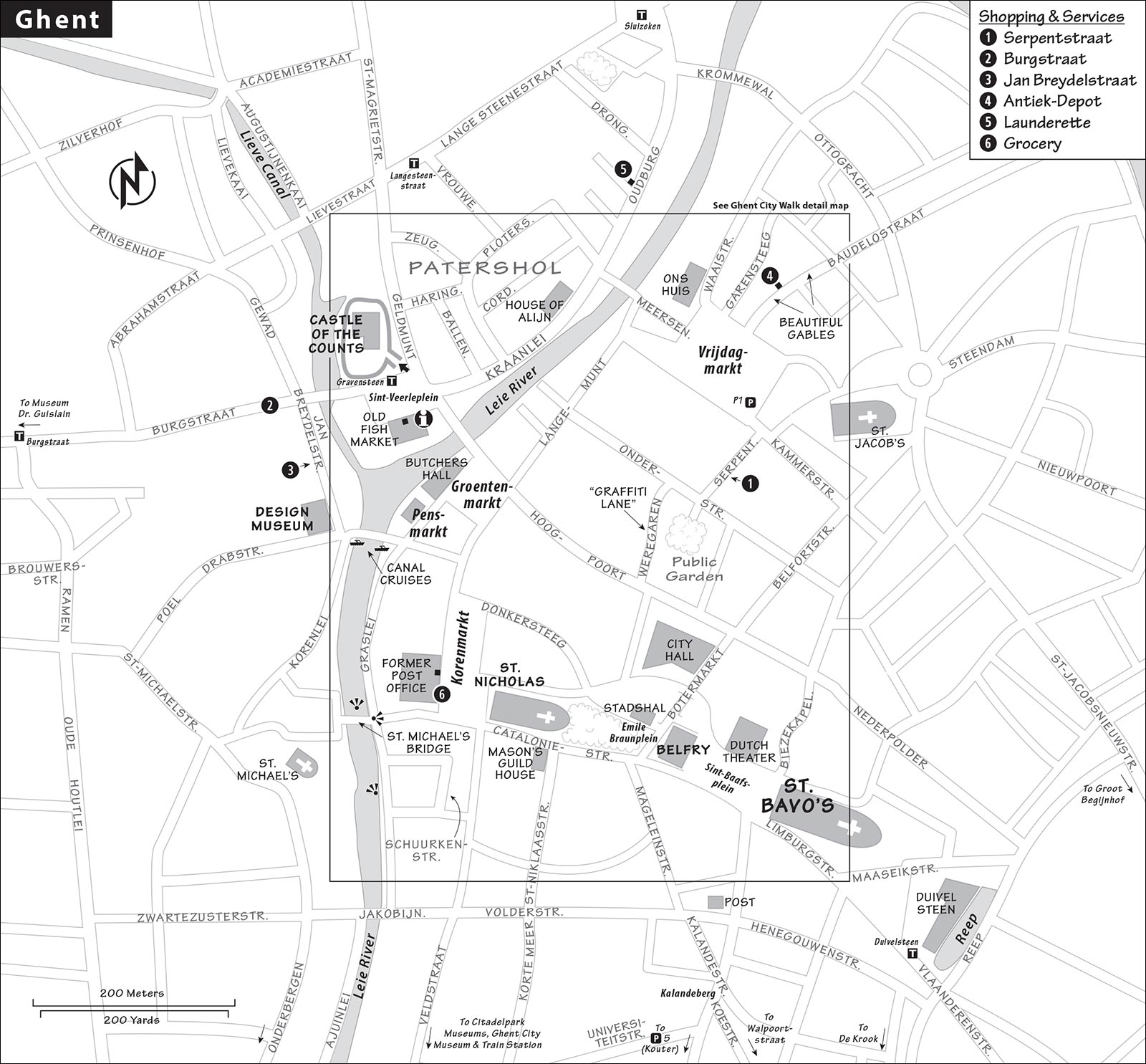
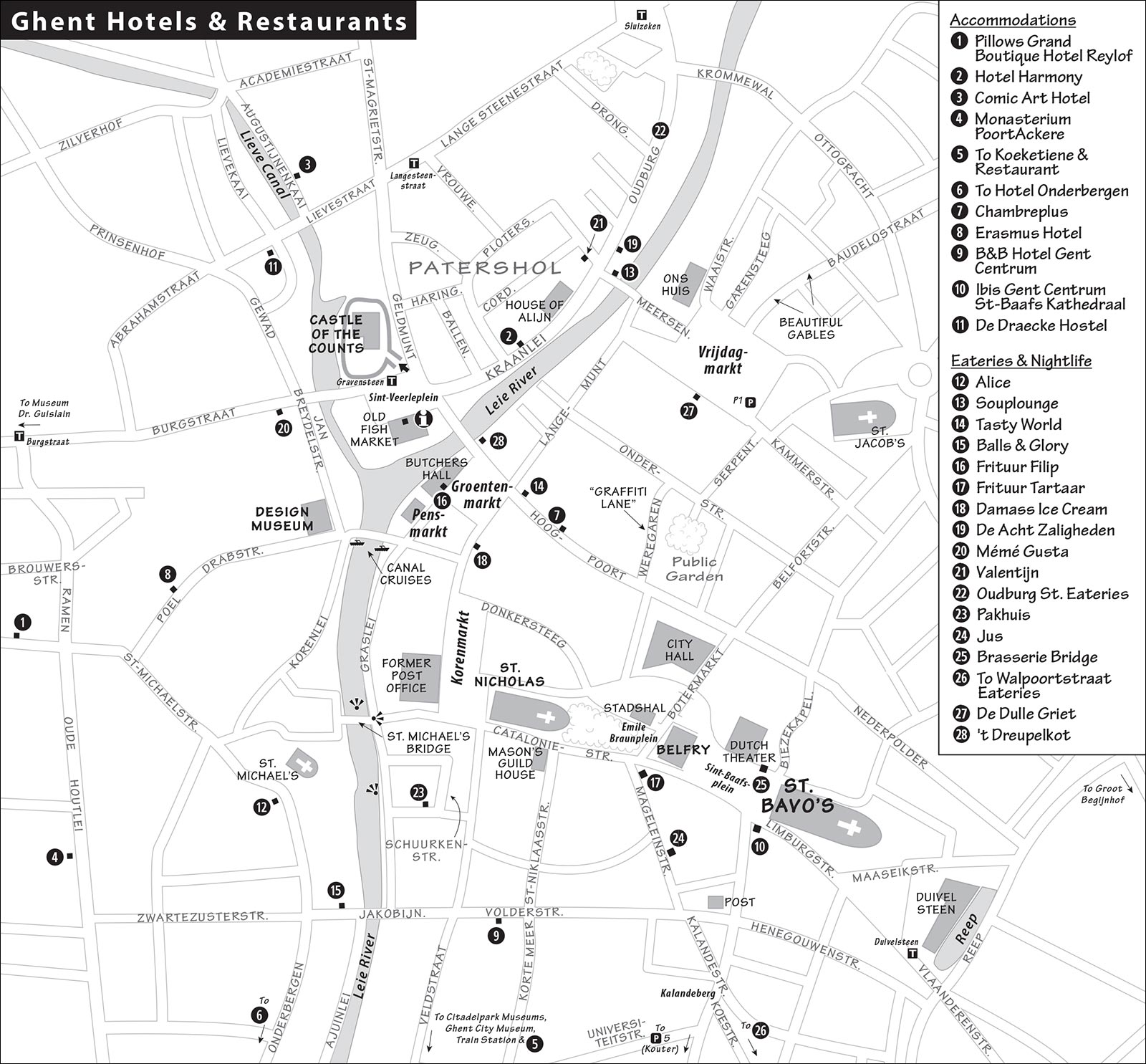
Map: Ghent Hotels & Restaurants
ACROSS THE RIVER, IN PATERSHOL
Made terrifically wealthy by the textile trade, medieval Ghent was a powerhouse, once one of the biggest cities in Europe. Ghent erected grand churches and ornate guild houses to celebrate its resident industry. It was a gathering spot for VIPs and the birthplace of Holy Roman Emperor Charles V (known as Charles I in Spain), who would become one of the most powerful people in Europe. But like its rival Bruges, eventually Ghent’s fortunes fell, leaving it with a well-preserved historic nucleus surrounded by a humdrum modern shell.
Ghent offers a quieter, more subtle charm than Bruges. It has cobbled streets, centuries-old architecture, and picturesque canals—all of which glow in the evenings with thoughtfully installed uplighting thanks to a multiyear city design project. But it’s also a living place—home to one of Belgium’s biggest universities and a vibrant student population. Ghent enjoys just the right amount of urban grittiness, with a welcome splash of creative hipster funkiness. And it’s a shopper’s delight, with a wide range of characteristic stores that aren’t aimed squarely at the tourist crowds.
Explore the historic quarter, ponder the breathtaking Van Eyck altarpiece in the massive cathedral, tour an impressive art museum, stroll picturesque embankments, bask in finely decorated historic halls, and prowl the lively Patershol restaurant quarter. Ghent is the kind of town where you might spend a few hours but find yourself wishing you had a few days.
PLANNING YOUR TIME
Ghent, about halfway between Brussels and Bruges and a half-hour from either, is ideally located for day-tripping. It’s easy to get the gist of the town in a few hours. Either toss your bag in a locker at Ghent’s train station on your way between those two cities, or side-trip here from either one. With limited time, focus on the historical center: Follow my self-guided walk, tour the cathedral, and dip into a museum or two. With more time or a strong interest in art, also visit the art museums in Citadelpark, closer to the train station. Museums are closed either Mondays or Wednesdays (though the cathedral and other churches remain open).
Ghent also makes a handy home base for side-tripping to the other destinations in this book, and overnighting here allows time for evening strolls along softly lit streets and reflective canals. Watch as the buildings assume an entirely new character when darkness falls and the city’s special illumination comes on.
Blitz Tour of Ghent
Day-trippers to Ghent can use my Ghent City Walk to weave together the main sights in as little as three hours. From the train station, take a tram or bus to Korenmarkt, where the walk begins. Stop along the way to visit whichever sights interest you: Climb the belfry, tour St. Bavo’s with the Ghent Altarpiece (reserve ahead), browse the House of Alijn Museum, and scramble up the ramparts of the Castle of the Counts. Then hop on a tram from in front of the castle to connect back to the station.
Orientation to Ghent
Although it’s a midsized city (pop. 265,000), Ghent’s historic core is appealingly compact—you can walk from one end to the other in about 15 minutes. The train station (with several museums nearby) is less than 30 minutes south of the center by public transit. Its Flemish residents call the town Gent (gutturally: hent), while its French name is Gand (sounds like “gone”).
TOURIST INFORMATION
Ghent’s helpful TI (which also maintains a very useful and up-to-date website) is in the Old Fish Market (Oude Vismijn) building next to the Castle of the Counts (daily 10:00-17:00, may stay open later in summer, +32 9 266 5660, www.visit.gent.be).
Busy sightseers might save a few euros with the CityCard Gent, but on a day-trip blitz with this book, it’s probably not worth it (€42/48 hours, €48/72 hours, includes entrance to most major museums, €10 discount on the Ghent Altarpiece, public transit, bike rental, and the canal cruise).
ARRIVAL IN GHENT
By Train: Ghent’s main train station, Gent-Sint-Pieters, is about 1.5 miles south of the city center. A long renovation has things in flux. The station has lockers in the main hall. Or you can drag your bags into town to the recommended De Draecke hostel, a few minutes’ walk from the Castle of the Counts (free storage; tips are appreciated).
On arrival at the train station, make your way to the main hall, and be sure to look up at the meticulously restored frescoes celebrating great Flemish cities and regions.
It’s a dull 30-minute walk to the city center. Instead, take the tram or bus (€2.50, 15-25 minutes). Tram line #1, the most direct route to the center, is undergoing major repairs and may be out of service when you visit. Check your navigation app or ask at the Lijnwinkel transportation office at the station for directions—a replacement bus may be running. It’s easy to pay as you board a tram or bus by simply tapping your contactless credit card, which then acts as your ticket and is good for an hour, including transfers. (You won’t be charged for any more taps.) You can also buy tickets from the Lijnwinkel office or at ticket machines at main tram stops. (Once on board, validate your ticket by tapping it against the yellow machine.) If you’re going to Antwerp and/or Bruges and will be using public transportation there as well, consider the 10-ride ticket for €17. It’s good in all three cities (and anywhere else in Flanders), and you can share the ticket with others. There’s also a €7.50 day pass. Both can be purchased at the Lijnwinkel office or at ticket machines, but not on board. You might also consider downloading the De Lijn app—another easy way to buy tickets within Flanders (www.delijn.be).
Figure at least €20 for a taxi or Uber into town.
By Car: Exit the E-40 expressway at the Gent Centrum exit, then follow the P-route (parking route) to various pay garages in town; the most central include P1 (Vrijdagmarkt) and P5 (Kouter). Note that Ghent is a “low-emission zone,” so certain higher-polluting cars are not permitted to enter, and cars with foreign license plates are required to register. Check the TI website for details; your rental-car company should be able to advise. Several park and rides on the outskirts of Ghent offer free parking and easy access to tram or bus lines to the center. The TI website has good information (www.visit.gent.be).
HELPFUL HINTS
Market Days: Weekends are the main market days in Ghent, with small markets filling squares around town: a flower market at Kouter; secondhand books along Ajuinlei and Predikherenlei; and clothes, pets, and food on Vrijdagmarkt. The TI website has good information on these and other markets.
Festivals: Ghent is proud of its Gentse Feesten (Ghent Festivities), which last for 10 days and begin around the city holiday of July 21 (www.gentsefeesten.be). This open-air music festival features everything from jazz to techno in venues around town, and lots of boozing. Book hotels during this period well in advance. Other events include a jazz festival (the week before the big festival) and a film festival in mid-October.
Laundry: A handy coin-op launderette is in the heart of the Patershol restaurant neighborhood (long hours daily, corner of Oudburg and Zwaanstraat—for location see the “Ghent” map earlier, +32 473 977 173).
Bike Rental: The city’s “bike embassy,” De Fietsambassade Gent, rents bikes at the train station and under the De Krook library (+32 9 266 7700, www.fietsambassade.gent.be).
Bookstore: Atlas & Zanzibar, between Citadelpark and the City Museum, sells English-language books, including my guidebooks (closed Sun, Kortrijksesteenweg 19, +32 9 220 8799, www.atlaszanzibar.be).
Tours in Ghent
Local Guide
Cheerful Mieke Thienpont is devoted to sharing her city’s history and charm (€135/2 hours, €35/additional hour, +32 49 751 6528, miekethienpont@gmail.com).
Walking Tours
Ghent Guides runs historic city walks and themed tours. You can book them for a private tour (€115/2 hours), or just show up at the TI on Saturday at 14:00 for a group tour in English and Dutch (€10, €8 if you book online up to an hour in advance, +32 9 233 0772, www.gentsegidsen.be, info@gentsegidsen.be).
▲Canal Cruises
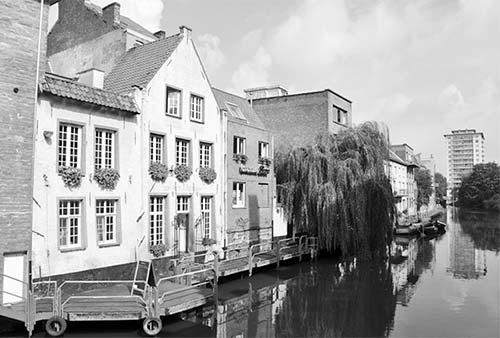
Lazy little tour boats, jammed with tourists listening to a live guide’s spiel in several languages, cruise Ghent’s waterways. On a sunny day, this can be a fun way to get a mellow introduction to the city. You’ll cruise up and down the main embankments—places you’ll see on foot anyway—but the boats take you farther afield for a grand view of the Castle of the Counts; the former site of the palace where Charles V was born; and the stout, fortified, twin-turreted tower called Het Rabot. Several companies offer essentially the same tour for the same price; boats line up along the Korenlei or Graslei embankments—take your pick and hop on the one departing soonest (€10, covered by CityCard, about 45 minutes).
During the high season, a hop-on, hop-off water tram connects some of the major sights (€15.50/1 day, €21/2 days, covered by CityCard, April-Oct daily 10:30-18:15, www.hoponhopoff.be).
Ghent City Walk
2 St. Michael’s Bridge (Sint-Michielsbrug)
3 Church of St. Nicholas (Sint-Niklaaskerk)
6 St. Bavo’s Square (Sint-Baafsplein)
7 St. Bavo’s Cathedral (Sint-Baafskathedraal)
9 Graffitistraatje (“Graffiti Lane”)
10 Vrijdagmarkt
11 Patershol
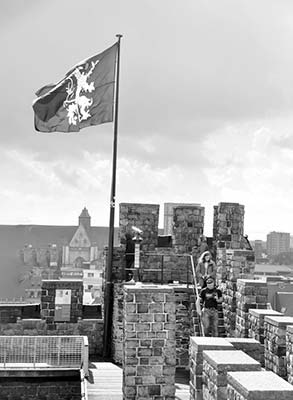
12 Castle of the Counts (Gravensteen)
The heart of Ghent still looks much like it did circa 1500, when this was one of Europe’s greatest cities: bristling with skyscraping towers, rich with art, and thronged with upscale citizens.
This self-guided walk starts at the former harbor, where this city of clothmakers plugged in to the global economy. Next we pass by the towers for which the city became known. The grandest is the soaring steeple of St. Bavo’s, home to the main art sight in town, Van Eyck’s famous altarpiece. Then it’s down main street (Hoogpoort) through the heart of town, where these shops make clear that this city of traders lives on. The last part of the walk winds along small lanes, making its way through the trendy residential district. We’ll end with the fun-to-tour Castle of the Counts and several photogenic squares.
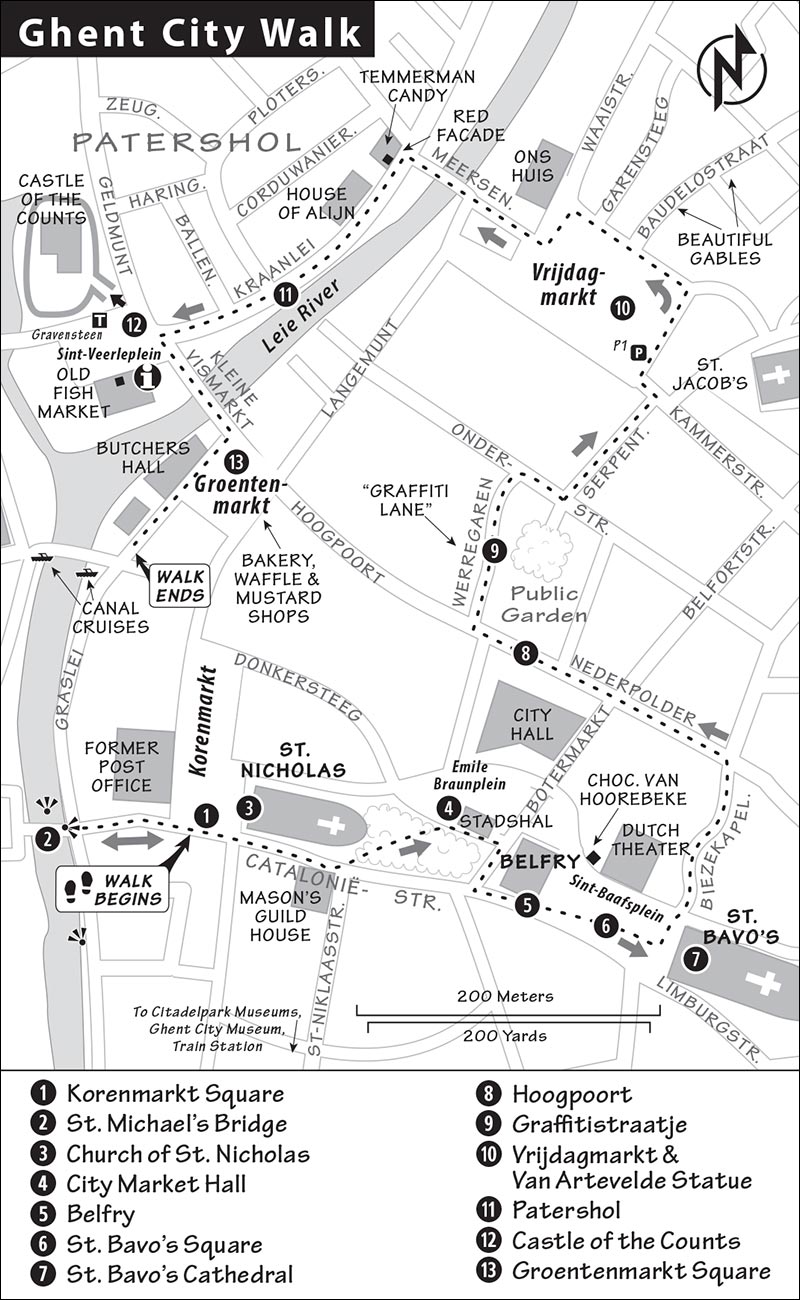
Length of This Walk: Allow 1.5 hours to traverse this mile-long walk, plus more time to go inside sights along the way. You can see it all in about three hours. With limited time, end the walk at the Castle of the Counts, then take a tram or bus back to the station.
 SELF-GUIDED WALK
• From the train station, catch a tram or bus to Korenmarkt (for details, see “Arrival in Ghent,” earlier). Our walk begins at this bustling square.
1 Korenmarkt Square
You’re at the center of historic Ghent. The square is enclosed by the big gray-stone church, a prickly medieval-looking facade, and several historic townhouses with classic gables. The scene captures the glory of Ghent in its heyday.
The city boomed in the Middle Ages, when the wool trade made it wealthy. By the 14th century, Ghent’s population was around 65,000—positively massive in an age when most of Europe was rural farmland (north of the Alps, only Paris was larger). Two-thirds of the city’s population were textile workers, making Ghent arguably Europe’s first industrial city. Imagine Ghent at its peak around the year 1500, flush with guilders from weaving high-fashion cloth and shipping it around Europe. With its wealth, Ghent became a proud city of soaring towers. In fact, Ghent was so big that, unlike lesser cities in Belgium, it didn’t have just one single “Great Market” (Grote Markt). It had many squares, each specializing in a different trade. For instance, this square, the “Grain Market,” was where citizens flocked to buy food.
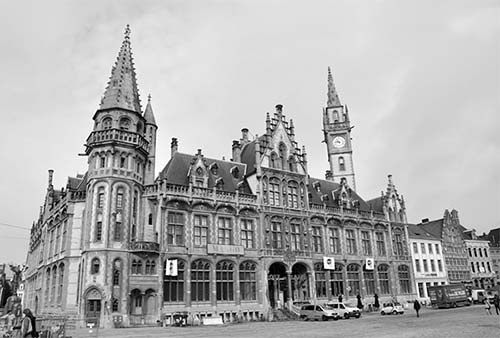
The big building with prickly steeples (opposite St. Nicholas) is the former post office, now transformed into a ritzy shopping complex. While it seems medieval, it’s actually much newer—eclectic Neo-Gothic and Neo-Renaissance, completed in 1910. Ghent was thriving once again and used this retro style that captured the feel of its glory days. Over the entrance you’ll see symbols glorifying Belgium, Flanders, Wallonia, and the Belgian Congo. In the window friezes you can find the coat of arms of all the Belgian provinces and major cities. The busts over the windows are leaders of all the nations who joined the International Postal Union—a big deal back when the global economy was laced together by letters and mailed documents. On the side of the building, you can find a bust of Florence Nightingale, the famed English nurse of the Victorian era.
• Circle around the left side of the post office building, and out onto...
2 St. Michael’s Bridge (Sint-Michielsbrug)
The city was founded at the confluence of two rivers: the Lys (Leie in Dutch) and the Scheldt (Schelde in Dutch, to the south of here). The waterway under your feet—now plied by tourist-laden boats—was the city’s busy harbor. Lining the embankment are several ornately decorated guild houses—meeting halls for the town’s boatmen, grain traders, and weighers.
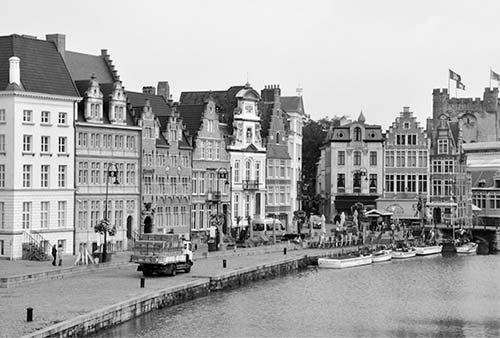
This viewpoint offers Ghent’s best 360-degree panorama. At one end of the canal, find the imposing tower of the Castle of the Counts, rising above the Old Fish Market. That’s where we’ll end this tour.
Now turn 90 degrees right and look back down Cataloniëstraat. View the spires of Ghent’s three main buildings: the rectangular tower of the Church of St. Nicholas, the belfry (with a dragon rather than a cross on top), and St. Bavo’s Cathedral. We’ll see all three, then circle around through town to the Castle of the Counts.
• Return to the Korenmarkt and turn your attention to the big gray church.
3 Church of St. Nicholas (Sint-Niklaaskerk)
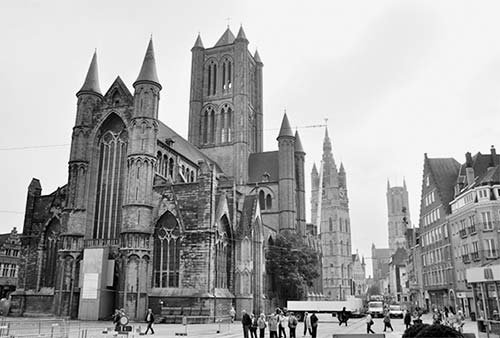
This stout church was built mostly during the 13th century, a boom time for Ghent. It’s dedicated to St. Nicholas, the patron saint of sailors, so it was only natural that it became the favorite of the river traders who sold their goods on the Korenmarkt. The church is a textbook example of Scheldt Gothic style, which marks the transition from Romanesque to Dutch Gothic: bluish-gray stone, turrets, and a single tower in the center (rather than twin towers on the facade).
The church’s exterior is a microcosm of Ghent’s rise and fall. The bluish-gray limestone of its tower tells you it was built before 1400, when Ghent was rolling in wool money and could afford to float the valuable stone down the Scheldt River from the distant city of Tournai. The yellow sandstone of one of the portals along the right side dates this section to between 1400 and 1500, when the economy was slowing and builders quarried local stone. The red brick along the church’s right wall was locally produced after 1500, when competition from Brussels and England, combined with a conservative guild leadership that was slow to adapt to changing markets, caused Ghent’s economy to tank. (Proud Ghent natives gleefully point out that their rival, Bruges, is built mostly of brick—indicating that city’s lowlier economic status in medieval times.)
Cost and Hours: Free, daily 10:00-16:00, on Cataloniëstraat at the corner of Korenmarkt, +32 9 234 2869.
Visiting the Church: Enter through the side door facing the tram stop. You can tell the church was built from the front to the back, as the stone transitions from the blue-gray limestone used first to the yellow sandstone used later.
While the building itself is Gothic, the decorations inside—like most in Ghent—are much newer. As this region was at the forefront of the Protestant Reformation in the 16th century, the interior of Ghent’s churches suffered at the hands of the iconoclasts—Calvinist Protestants who stripped Catholic churches of all adornments to mark their difference from Catholic “idolatry” and wealth. The church interior was redecorated during the Counter-Reformation with the very Baroque altar of corkscrew columns (painted wood, not marble) and in the 19th century with an impressive organ. Iconoclasts destroyed essentially all the medieval glass in Ghent—the modern stained glass above represents the seven sacraments.
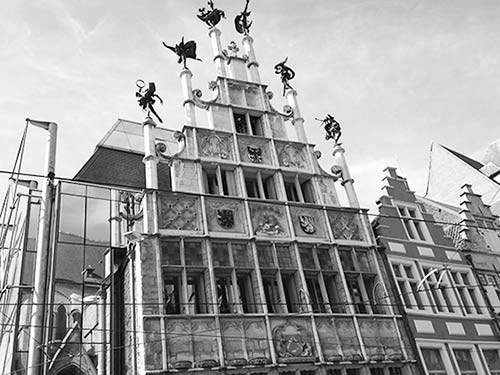
• Exiting the church, look across the street and notice the statue-topped gable of the Masons’ Guild House. This 15th-century facade was only revealed in 1976, when renovators discovered the old facade behind a brick wall. During the renovation, they added the six statues of twirling dancers.
Turn left and head down Cataloniëstraat (away from the river). Beyond St. Nicholas (across the plaza to your left) stands the big, wooden roof of the...
4 City Market Hall (Stadshal)
Just a few years ago, this space was an ugly parking lot. But city leaders decided to beautify this prime real estate, turning it into a 21st-century social hub. Now there’s a public square, partially sheltered by a modern twin-gabled timber roof meant to evoke the rooftops of medieval Ghent. While many residents embrace the new market hall, some hate it (especially as it obscures the view of City Hall) and have dubbed it the “Sheep Shed” and the “Hall of Shame.” Take a moment to wander beneath the gables, where light filtering in through hundreds of slits scatters in ever-changing patterns. On the lower level are a café, free WCs, and a bicycle parking garage. You’ll also see an original 17th-century bell from the adjacent belfry. Nearby cafés, wine bars, and (often) food trucks cater to office workers on their lunch breaks.
• The next tall building is the...
5 Belfry (Belfort)
This tower has stood here since the 14th century, built to house and protect the parchment record of Ghent’s favored privileges, granted to the city by the counts of Flanders in exchange for financial support. The Neo-Gothic spire (from the gargoyles up) was added when Ghent proudly hosted the World’s Fair in 1913. The dragon at the top symbolizes not the devil (as was typical in the Middle Ages) but a protector who never sleeps as it watches over the city’s rights. It was also a fire watchtower, represented by the four sentries positioned at the corners. The carillon in the tower plays a snippet every 15 minutes and a longer tune (often from a Belgian popular song) at the top of the hour. There are concerts on Sunday mornings year-round (11:00-12:00), and on Saturday evenings in July and August—ask locally about times. The long building at the base of (and behind) the belfry is the Cloth Hall, which was important to this textile center.
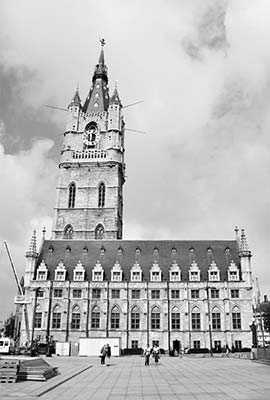
Cost and Hours: €11, daily 10:00-18:00, last entry one hour before closing, book in advance to skip the line, Sint-Baafsplein, +32 9 233 3954, www.belfortgent.be.
Visiting the Belfry: You can ascend the belfry for a decent, if not stunning, view over town. It’s just a couple of flights of stairs, then an elevator most of the way. The entrance is on the side facing the tram tracks: Buy your ticket in the shop below the staircase, then head up the stairs to enter. Ogle the gorgeous wall painting of old Ghent in the main hall, then explore the tower. For crowd-control reasons, they may ask you to take the elevator up to the top floor first, then walk down, stopping along the way to see various exhibits. Here’s some of what you’ll see:
Level 0 shows off models of the former spires that topped the tower (including an original dragon from 1380).
Level 1 includes a bell museum with a film about how bells are cast.
Level 2 displays the giant bell called “Roland.”
Level 3 contains a big rotating drum with pegs used to program short carillon melodies.
• The square beyond the belfry is...
6 St. Bavo’s Square (Sint-Baafsplein)
This square became a symbolic battleground between Belgium’s Dutch-speaking and French-speaking factions during the 1800s and 1900s. Belgium was dominated by the French-speaking bourgeoisie, even though Dutch speakers were in the majority. So, when the ornate Dutch Theater (Koninklijke Nederlandse Schouwburg, or NT Gent) was built in 1899, it finally gave the town’s Dutch speakers a place to perform plays of their own. By embracing Dutch as a language worthy of theater, the spunky Flemish were asserting their cultural legitimacy. The golden mosaic depicts Apollo returning to Mount Parnassus, much as the Flemish felt they were coming home to their ancestral language.
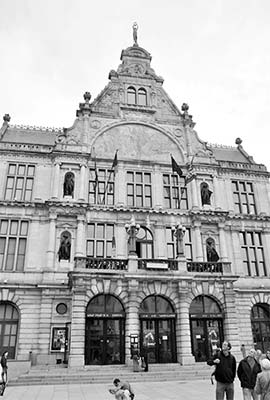
The statue in the middle of the square—of a muscular man and comely woman—also celebrates the resurrection of the Dutch language here. Notice the lion, a symbol of Flanders, on their flag. The relief on the base (facing the theater) depicts Jan Frans Willems, one of the founders of the Flemish revival.
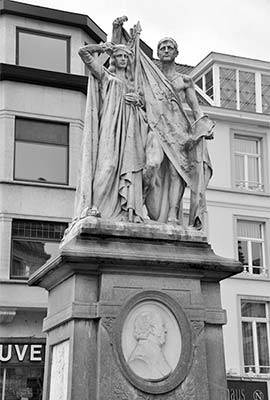
By the way, it took a full century before Ghent’s prestigious university was allowed to teach courses in Dutch, rather than in French and Latin. To protest the change, the French-speaking industrialist who owned the local electric company spitefully cut power to mourn, in his eyes, the university’s rejection of enlightened thinking. For more on the Flemish-Walloon conflict, see the sidebar on here in the Belgian: Past & Present chapter.
To the left of the theater is Chocolatier Van Hoorebeke, a producer of fine pralines. To see the chocolate makers hard at work, look through the glass floor inside the shop.
• At the end of the square is Ghent’s top sight.
7 St. Bavo’s Cathedral (Sint-Baafskathedraal)
Ghent’s Gothic cathedral can claim plenty of history (Holy Roman Emperor Charles V was baptized here), and it has a beautifully carved pulpit and a Rubens altar painting. But the showstopper is the monumental Adoration of the Mystic Lamb altarpiece by Jan van Eyck and his brother, Hubert. For details on visiting the cathedral and altarpiece, see the self-guided tour later, under “Sights in Ghent.”
• Facing the cathedral, turn left and head down the curving street called Biezekapelstraat. You’ll pass the medieval turrets and arcades of the back of the Achtersikkel mansion—the former home of a powerful family of patricians, now restored to house a music academy (you may hear students rehearsing). Exiting this street, turn left on Nederpolder. You’re now heading up the main street of medieval Ghent.
8 Hoogpoort
This “High Gate” street connects Ghent’s two rivers. As you walk, notice you’re on a slight hill; Ghent was founded at a high point between the rivers, which people made ample use of for trade.
Crossing Belfortstraat, you’ll see the giant, slightly run-down City Hall (Stadhuis) on your left. As Ghent in its heyday had negotiated special privileges from the counts of Flanders, the City Hall was a prestigious symbol, serving as a monument to self-rule. Notice how it’s been augmented over the years. The ornate Gothic core (along Hoogpoort) dates from the early 16th century. The blocky, black-and-gold-columned Neoclassical section (down Botermarkt) was added a century later, following the fashion of the time.
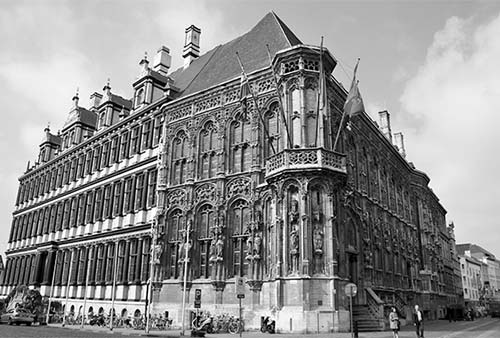
• Continue along Hoogpoort, observing the many facets of this one building—Gothic statues, then banded columns. A few steps beyond the end of City Hall (across from the Novotel), find the narrow passageway on the right called Werregarenstraat. It’s better known as...
9 Graffitistraatje (“Graffiti Lane”)
Once used to drain water away from this high ground, this passageway now has a different purpose and an apt nickname: “Graffiti Lane.” Walk down the lane, enjoying the artwork provided by the people of Ghent. This is a typically pragmatic Belgian solution to a social problem: Rather than outlawing graffiti entirely, the police have designated this one street to give would-be artists a legal, controlled outlet for their impulses. (There may even be a shop selling artists’ works—ask around.) Halfway down the lane, notice the beautiful fenced-in garden on your right. This restful, city-owned, picnic-perfect space is open to the public. (The entrance is farther ahead, at Onderstraat #22.)
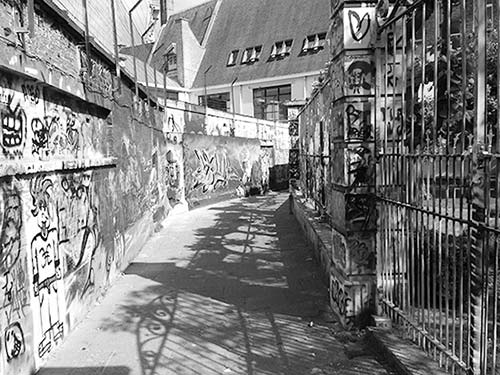
• Emerging from Graffitistraatje, turn right on Onderstraat—passing the green door where you can enter that pretty park—then take the next left, down narrow Serpentstraat. This street is lined with some fun boutiques and colorful shops. (For details, see “Shopping in Ghent,” later.) At the end, turn left and you’ll be in...
10 Vrijdagmarkt
This large square represents Ghent as a city of the common people. Traditionally the big town market was on a Friday (“Vrijdag”) as the square’s name indicates. Today, Vrijdagmarkt hosts markets on Fridays and Saturdays. On any day, it’s a great place to pause for a beverage at one of the cafés ringing the spacious square. On weekends, a number of different market locations around the old center are lively with antiques, secondhand books, food, and crafts. (See “Helpful Hints,” earlier, and the TI website.)
The statue in the square depicts Jakob van Artevelde, a clever businessman who saved the day in the 14th century, when Ghent was caught between powerful France (which controlled the city) and England (which provided it with wool). Van Artevelde—not an aristocrat, but an ordinary citizen—boldly negotiated directly with the king to keep Ghent neutral in the conflict and keep the wool coming in. Van Artevelde’s memory was resurrected during the nationalism of the late 19th and early 20th centuries, as a symbol of the Flemish people of Ghent asserting their independence from the Francophones. Today he’s still celebrated by the people of Ghent, who sometimes call their city “Artevelde-Stad.”
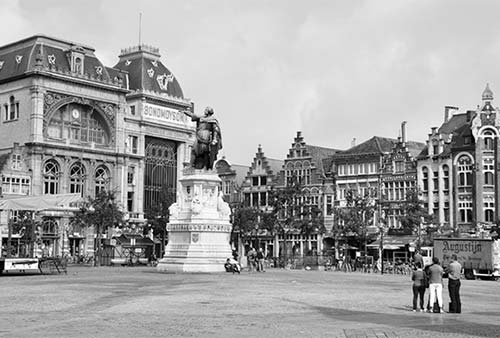
Directly behind the Van Artevelde statue is Baudelostraat, a street worth a peek for some particularly beautiful gables dating to the early 20th century. It’s also home to a fun antique mall. (See “Shopping in Ghent,” later.)
Towering in a corner of the square is the eclectic Ons Huis (“House of the People,” with the sign for Bond Moyson—a socialist health insurance); it’s the headquarters for the region’s socialist movement. Not surprisingly for a city with a long industrial heritage, Ghent is a hotbed of left-leaning politics and the birthplace of the original Belgian Labor Party. Above the door, notice the rooster—crowing to wake up the workers.
• Exit the square down the narrow street just left of the workers’ hall (Meerseniersstraat). In a block you reach a bridge. As you cross the bridge, notice the walkways that line the riverbank, allowing you a scenic and uncrowded stroll just above the water. Now, enter the district called...
11 Patershol
Once a run-down and dangerous district, today this neighborhood is one of Ghent’s trendiest. And though it’s predominantly residential, Patershol is also a great place for restaurant hunting. (See “Eating in Ghent,” later.)
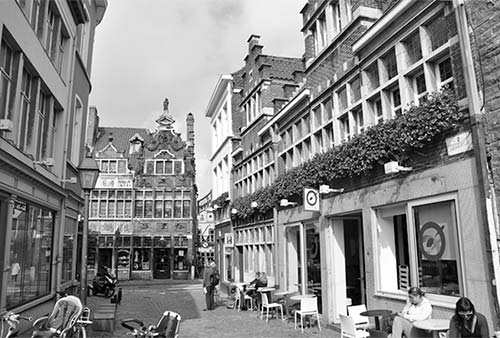
As you cross the bridge, you’ll see two particularly fine (if well-worn) gabled facades. The red facade features panels with figures symbolizing the five senses: monkey = taste, eagle = sight, deer = hearing, dog = smell, and humans = touch (since we have no hair on our hands). The other building has panels demonstrating six virtuous acts (the seventh—burying the dead—was deemed too gruesome to depict, so it’s symbolized by the urn on top). The ground floor of this building houses a favorite old-fashioned candy shop, Temmerman, with some unique Ghent treats (closed Mon). Wippers are toffee with a sugar coating, marshmallowy Lieve Vrouwkes are shaped like the Virgin Mary, and cone-shaped Cuberdons—the local favorite—are filled with raspberry syrup.
• Turn left and walk along Kraanlei, passing the House of Alijn (with a tourable interior—see “Sights in Ghent,” later). Continue along the pleasant canal, curving right with the road. You arrive at a square called Sint-Veerleplein, dominated by the imposing...
12 Castle of the Counts (Gravensteen)
Built in 1180 by Philip of Alsace, this rough-stone fortress was designed not to protect the people of Ghent but to intimidate the city’s independence-minded citizens. It was modeled on the Krak des Chevaliers in Syria, which Phillip visited during the Second Crusade. At the time, it was outside the city walls. Today, you can tour the castle. (See details under “Sights in Ghent,” later.)
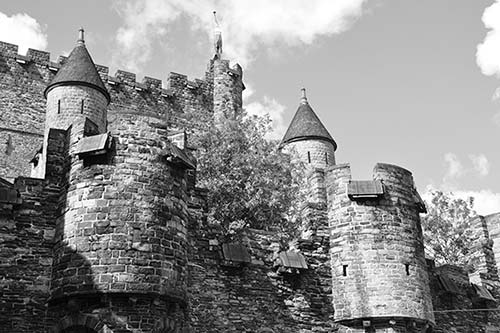
This castle was inhabited only briefly; the counts of Flanders moved to what would later become the (more comfortable) palace of Holy Roman Emperor Charles V. In 1540, Charles V (who was born in Ghent but ruled from Spain) demanded a huge tribute. When the citizens refused, he came here personally to crush the rebellion. The leaders of Ghent had to pay the money and then beg forgiveness, on their knees with nooses around their necks. Today, you’ll see many allusions to the noose around town, in particular the very popular beer called ’t Stropke—“The Noose.” The people of Ghent are often called “noose bearers” (Stroppedragers).
Also on the square is the fancy, sculpture-adorned entrance to the Old Fish Market (Oude Vismijn), home of the TI and a separate events space. Study the facade: That’s Neptune on top; below him are Ghent’s two rivers: the Scheldt (male) and the Lys (female). It’s said that Ghent is the child of these two rivers. Notice how this fish market sits directly across the river from the meat market (Butchers Hall, next stop).
• If you’d like to end this walk early, you could catch a tram in front of the Castle of the Counts to connect to the train station.
Otherwise, to continue to a pleasant square, exit Sint-Veerleplein down Kleine Vismarkt street. Cross the bridge to one final stop.
13 Groentenmarkt Square
As you cross the bridge to the Groentenmarkt (“Vegetable Market”), look for the long, medieval Butchers Hall (Groot Vleeshuis) to the right. The hall may be under renovation when you visit, so you may not be able to peek inside to see its impressive wooden vault (built entirely without nails, and clearly employing shipbuilders’ expertise). For hygienic reasons, until the 19th century, this was the only place in town allowed to sell meat. (During renovations, a shop usually located here that sells specialty products from East Flanders can be found at Goudenleeuwplein 3, near the City Market Hall, which we passed earlier on this walk.)
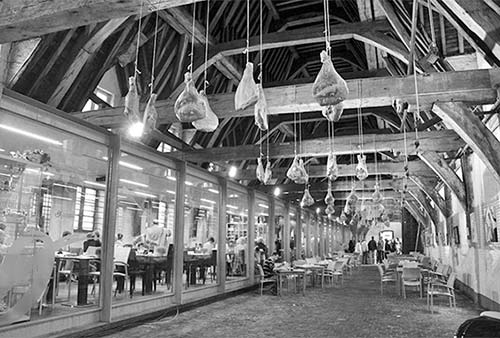
Outside, the lean-to shacks once sold offal and sausages, giving the adjacent square its name: Pensmarkt (“Sausage Market”). For a snack stop on the square, look for Belgian-fries purveyor Frituur Filip. Across the square from the Butchers Hall is a good traditional bakery (Himschoot); next to that, a café sells delicious takeaway waffles, and to the right of that is the Tierenteyn Verlent mustard shop (at #3, closed Sun). Made in the cellar, then pumped into a barrel in the back of the shop, the mustard is some of the horseradish-hottest you’ll ever sample. They use no preservatives, so you’ll need to refrigerate it—or use it for today’s picnic.
• Head to the far end of the Butchers Hall, then the building beyond it. The bridge here affords another good view of Ghent’s canals. Near this bridge, various companies sell cruises along the canals of Ghent (see “Tours in Ghent,” earlier). Or you can backtrack (turn right along the river) to the Castle of the Counts or the House of Alijn. Korenmarkt, where we started our tour, is just a block and a half away. In fact, most of what’s worth seeing in Ghent is within a few steps of here. Enjoy.
Sights in Ghent
ST. BAVO’S CATHEDRAL AND GHENT ALTARPIECE
7 Augmented Reality in the Crypt
8 Peter Paul Rubens: St. Bavo Entering the Monastery of Ghent
9 Ghent Altarpiece: Van Eyck’s Adoration of the Mystic Lamb
OTHER SIGHTS IN THE HISTORIC CENTER
House of Alijn (Huis van Alijn)
▲Castle of the Counts (Gravensteen)
▲Ghent Design Museum (Design Museum Gent)
MUSEUMS NEAR THE TRAIN STATION
▲Fine Arts Museum (Museum voor Schone Kunsten)
Stedelijk Contemporary Art Museum (Stedelijk Museum voor Actuele Kunst, a.k.a. SMAK)
▲Ghent City Museum (Stadsmuseum Gent, a.k.a. STAM)
Most of Ghent’s sights, including its top sight—the cathedral—cluster either in the historic city center (easily accessible on foot) or south of the core, near the train station.
ST. BAVO’S CATHEDRAL AND GHENT ALTARPIECE
The main church of Ghent, St. Bavo’s Cathedral (Sint-Baafskathedraal) houses the greatest art treasure in the city (and perhaps the country—maybe tied with the Manneken-Pis): the exquisite Van Eyck Adoration of the Mystic Lamb altarpiece, widely known as the Ghent Altarpiece. Besides this great work of art, the church is also home to a soaring Gothic nave, an elaborately carved pulpit, an altar painting by Rubens depicting the town’s patron saint (and the church’s namesake), and more. A visit to the cathedral and altarpiece is worth ▲▲.
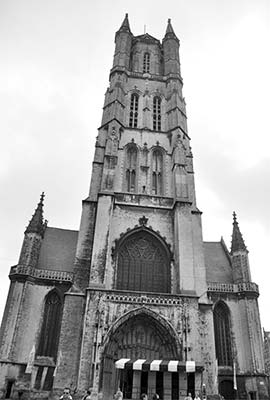
The fuss that the people of Ghent make over Van Eyck’s altarpiece can feel out of proportion. But when you see it in person—meticulously restored and lovingly presented all by itself in a darkened chapel—you realize it’s truly a world-class masterpiece. This is where modern oil painting was born. It’s where invaders—from kings to conquerors to Nazis—have come to steal this potent symbol of civilization. It’s where art pilgrims journey to admire the sensuous detail and provocative symbolism of a work that signals a medieval world awakening to the new age of the Renaissance.
Cost and Hours: Free to enter church; €12.50 to see original Ghent Altarpiece, choir, and Rubens painting; €16 to add augmented reality (AR) crypt visit; church open daily 8:30-17:30; altarpiece viewable Mon-Sat 10:00-17:00, Sun from 13:00; Sint-Baafsplein, +32 9 225 1626, www.sintbaafskathedraal.be.
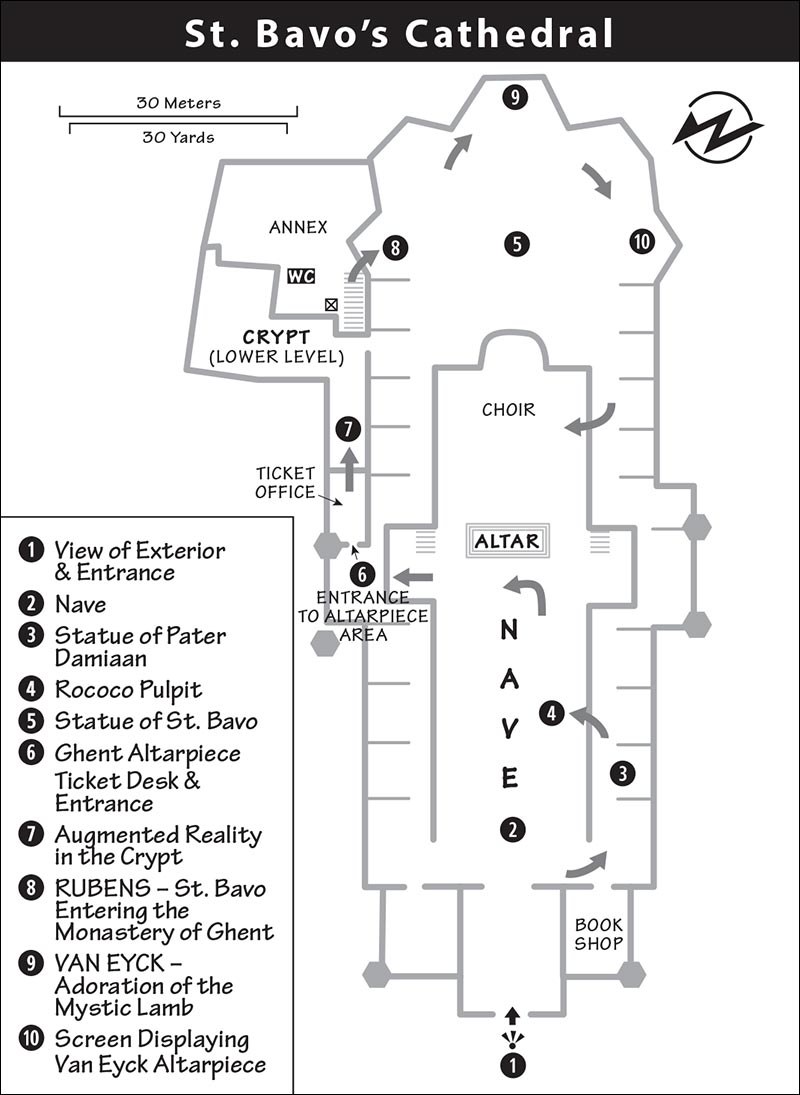
Buying Tickets and Crowd-Beating Tips: Once inside the church, you can buy tickets and enter the paid area in the left transept (just left of the altar). The altarpiece zone can be unpleasantly crowded with long lines on weekends (Fri-Sun) and any day in summer (July-Aug). Try to visit on a weekday; if you must come at a busy time, prebook your ticket online for no extra charge.
Crypt Visit: While I was skeptical about the AR headset, I appreciated its additional context and information—it truly helps set the stage for seeing the amazing altarpiece. But you can have a completely satisfying altarpiece experience without the AR show.
To figure out if you want to add the crypt, read my “Augmented Reality in the Crypt” description (stop #7 on the tour below). There are two options (same price): The “40 Minute” version (includes 20-minute AR show) is enough for the casual visitor; the “60 Minute” version doubles the amount of content (some is interesting, but about half is pointless trivia).
Length of This Tour: A quick spin through the church interior takes about 20 minutes; the altarpiece deserves at least 30 minutes (longer if you opt for the AR show in the crypt).
SELF-GUIDED TOUR
Church
• Begin by standing in the square in front of the cathedral’s main entrance.
1 Exterior View: Take in the cathedral’s sheer bulk, with its jowl-stretching view up the 292-foot tower. The church was erected from about 1350 until 1559 on the site of earlier structures dating back to 942. It’s named for St. Bavo (Baaf in Flemish), a Ghent-area nobleman who gave up his materialistic existence to help the poor and establish a monastery here. (The massive St. Bavo Church—or Grote Kerk—in Haarlem, in the Netherlands, is named for the same saint.)
• Step inside and look down the...
2 Nave: Appreciate the sheer volume of this structure, with its spacious 100-foot-high ceiling, Gothic arches, and stained glass. Notice three telltale materials: red brick (the nave walls), yellow stone (the pillars, also the exterior tower), and—for the valuable area around the altar—the gray stone of the choir. As in the Church of St. Nicholas, all the interior decorations and stained glass date from the 19th century (following the iconoclasm of the 16th century, when much of the church’s Gothic ornamentation was destroyed).
• Head for the right aisle and follow it up to the front of the church. On your way, pause at the second chapel and look for a statue of...
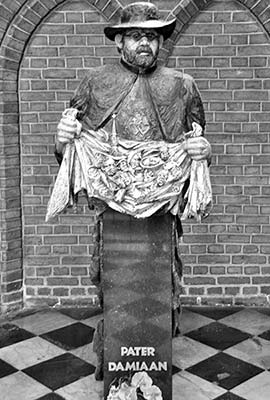
3 Pater Damiaan: Father Damien (1840-1889) was a Flemish missionary who went to Hawaii to care for lepers, but after 16 years died of leprosy himself. Canonized in 2009, he’s a rare saint with a connection to the US, and an important figure both to Belgians and to Hawaiians.
• Take a few steps into the nave to admire the remarkable...
4 Rococo Pulpit: This elaborately carved pulpit was made in the 1740s from white stone and carved wood, with golden highlights. The scene represents the tree of life and the tree of knowledge. The Carrara marble statues just beneath the pulpit drive home a Counter-Reformation message: The woman with the sun on her bosom (representing the power of her faith) wakes up the winged old man on the left (representing time). It’s time to wake up to the Catholic faith. The smug frat-boy angels at the bases of the staircases offer a lesson in appropriate worship. The angel on the left watches the pulpit intently, and the one on the right points up to the pulpit while glancing scoldingly to the back of the church: Hey, you in the back row—pay attention! Up above, notice the two hard-working cupids struggling to raise the cross. Finally, on the very top, notice the golden serpent. Follow its winding body to find the pudgy, winged baby (a sure sign of Rococo) prying the apple of sin from the snake’s mouth.
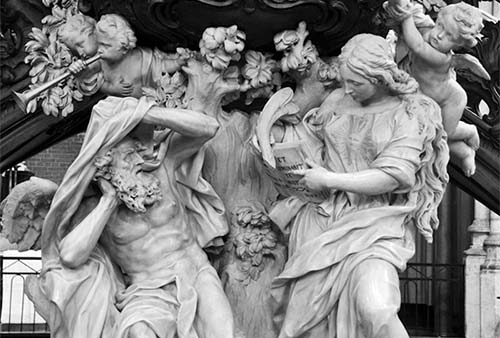
• Now walk up the middle of the nave as far as you can. In the distance, above the main altar, find the white statue backed by a golden sunburst.
5 Statue of St. Bavo: The beloved local saint is on his way to heaven. This seventh-century saint was once a wealthy and rambunctious young soldier but became a born-again Christian after the death of his wife. Bavo rejected his life of materialism and became a hermit-monk, living for a time in a hollow tree. He is also the patron saint of Haarlem, in the Netherlands.
Altarpiece Area
It’s been free to visit everything you’ve seen until this point. The famous Ghent Altarpiece is treated as a separate sight within the church. When you pay to see the altarpiece, you also gain access to areas around the choir (behind the altar)—including a closer look at that statue of St. Bavo and a fine Rubens altar painting.
Find the 6 ticket desk and entrance in the left transept and buy your altarpiece ticket, then proceed into the next zone of the church. On your right, stairs lead down to the crypt; if you’re skipping the crypt, continue to stop #8.
7 Augmented Reality in the Crypt
After descending into the crypt, you’ll be given an augmented reality (AR) headset and quick instructions on how to use it. The headset lets you see the real world, while superimposing additional information on top of it (rather than replacing it entirely, as in virtual reality). You’ll get used to it, but move slowly at first and watch your step.
The headset provides running commentary as it directs you to various points where illustrations and characters appear on the vaults and altars to tell you the story of the Ghent Altarpiece. You’ll “meet” several of the big names behind this masterpiece and learn about how this famous work has been stolen and returned, again and again.
Without the AR headset, the crypt is skippable: Romanesque foundations, tombs of bishops, and faint traces of 15th-century paintings that were whitewashed over by Calvinists, then rediscovered in the 1930s. One worthwhile sight down here, almost ignored by the commentary, are the clothed 19th-century replicas of Van Eyck’s famous nude Adam and Eve paintings from the Ghent Altarpiece. It wasn’t Adam and Eve’s nakedness that was offensive—it was the unflinching realism of Adam’s hairy legs, Eve’s bulging stomach, and their spindly legs. They were just too different from the idealized nudes of the classical world.
• Whether or not you toured the crypt, once you’re inside the altarpiece paid zone, make your way up (by stairs or elevator) to floor 2. (Good WCs are on level -1.) You’ll enter a small chapel. Before proceeding ahead, look right to notice...
8 Peter Paul Rubens: St. Bavo Entering the Monastery of Ghent
This work depicts the moment the bad boy turned saint started on his righteous course. Bavo, in the red cloak, kneels before the abbot to become a monk. (Rubens portrayed himself as Bavo.) The lower grouping shows Bavo’s estate manager distributing his master’s belongings to the poor. He’s watched, on the left, by Bavo’s daughter and her servant. Rubens modeled them after his two wives—his older first wife (in the giant hat) and his much younger, more voluptuous second wife, Hélène Fourment, in the red dress. (The Flemish like to say, with a wink, “An old billy goat loves a young leaf.”) For more about Rubens, see the sidebar on here.
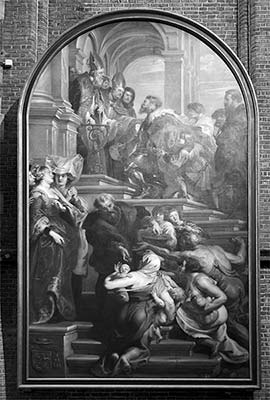
Notice the complex composition. Above, Bavo and the bishop form a diagonal line along the staircase. Below, the women and poor people form another diagonal line, perfectly parallel. Keep this dynamic Baroque canvas (1624), pregnant with motion, in mind—it’s quite the contrast with the very static composition of the medieval altarpiece we’re about to see.
• Proceed out of the chapel and into the ambulatory (the area that rings the outside of the choir). Turn left and head to the back of the church. There, in a big chapel, gorgeously lit and displayed in a giant glass case, is the...
9 Ghent Altarpiece: Van Eyck’s Adoration of the Mystic Lamb
The highlight of the church (and of all Ghent, for art lovers) is Jan and Hubert van Eyck’s Adoration of the Mystic Lamb (known as the Ghent Altarpiece, and as “Lam Gods” in Dutch). It’s been called the most influential painting in art history, as it was the first masterpiece done in the new medium of oil, and the first to portray the unidealized realism of the everyday world.
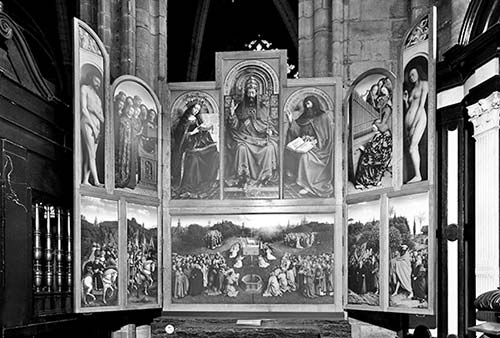
Hubert van Eyck (c. 1385-1426) began the painting, but after his death, his better-known younger brother Jan (c. 1390-1441) picked up the brush and completed his vision. Finished in 1432, this altarpiece represents a monumental stride in Northern European art from medieval stiffness to Renaissance humanism. The first work signed by Jan van Eyck, it’s also considered one of the first works of the Flemish Primitives, characterized by a precise dedication to detail (if imperfect mastery of perspective).
The work is monumental: 15 feet wide and 11 feet tall, composed of a dozen separate panels, depicting hundreds of figures, and weighing more than a ton. It challenges visitors with its complex symbolism, multitude of rich details, and sheer scale, but it rewards those willing to invest the time to take it all in. And thanks to a recently completed restoration on the lower panels, the colors glow. Notice the nose smudges on the glass case—from art lovers who just couldn’t resist getting closer...closer...closer...to examine the details.
Upper Panels: The original panels may still be absent when you visit—they are undergoing a restoration at the Fine Arts Museum. If so, replica panels will be displayed in their place. Either way, here’s what you’ll see:
God—in a rich red robe and three-tiered crown—presides over the scene, raising his hand in a solemn blessing. He’s flanked by Mary in her traditional blue and John the Baptist in a green robe over his ascetic camel-hair shirt. Though holy, these figures are obviously modeled on flesh-and-blood people with individualized traits, such as God’s jug ears, John’s scraggly hair, and Mary’s parted lips as she reads along from her book. Ogle the incredible richness of the jewels they wear. The hem of God’s robe has an inscription written in pearls, one of the numerous quotes woven into the altarpiece (for instance, “King of Kings” and “Behold the Lamb of God”).
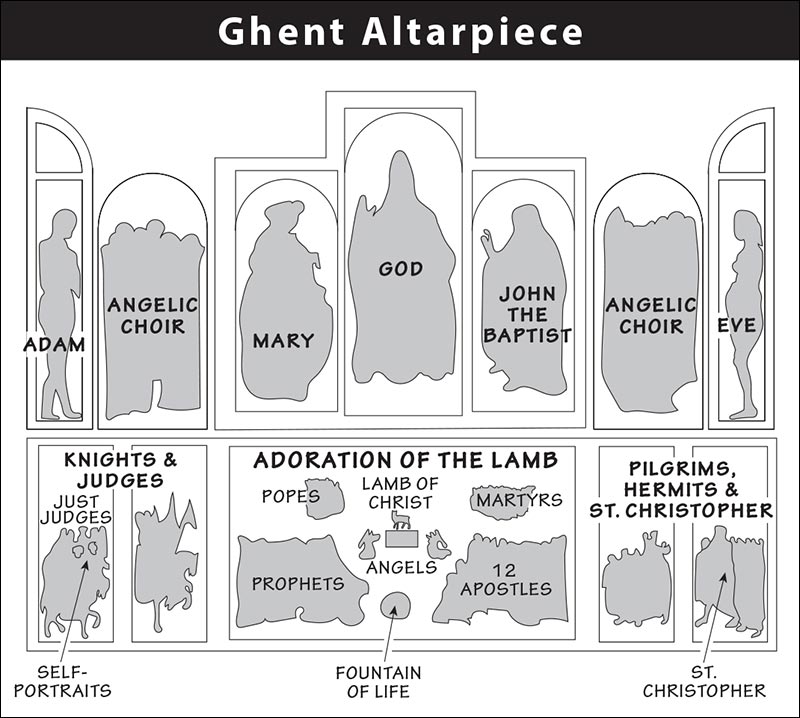
Serenading God from either side is a heavenly choir. Unlike earlier altarpieces, these musical angels don’t play harps, but rather a 15th-century organ. They have no wings or halos, and each face is unique. Hymnals of the time indicated which face a singer should make when singing a particular note; today’s experts can guess which notes the angels are singing from their expressions.
The outermost panels, depicting Adam and Eve, are probably the first Renaissance-era nudes painted north of the Alps. Though Eve still has the big belly and high waistline typical of medieval Eves, Adam steps boldly forward. His toes break the plane of his niche, a revolutionary example of (still not quite perfect) Italian-inspired perspective. You can actually see each hair on Adam’s legs. (And notice how Adam really does look a good bit like his creator, who, after all, made Adam in his own image...there’s a definite family resemblance.)
Lower Panels and the Adoration: The main scene, playing out across five separate panels, depicts the adoration of the Lamb—that is, Jesus, the sacrificial victim who saved the world from sin. The symbolic ungulate poses proudly atop an altar in the middle of a green field. It’s the end of days (as described in Revelation 14:1), and everyone has traveled to the New Jerusalem (the towers in the background) to worship the Lamb of God. Angels kneel around the altar; popes, cardinals, confessors, and abbots wave palm branches (upper left); a legion of female martyrs gathers (upper right); Old Testament prophets read from their books (lower left); the 12 apostles and Church fathers assemble (lower right); and assorted saints, pagan writers, and Jewish prophets put in an appearance before their savior.
The adoration party spills over into the side panels, as still more worshippers arrive. To the right are groups of pilgrims and hermits, led by the giant St. Christopher (in red). To the left are figures on horseback—knights and judges. Focus in on the bottom-left panel, called the Just Judges. It likely has self-portraits of Hubert and Jan van Eyck (the third and fourth figures in), but the painting you see is a copy—the original panel was stolen in 1934 (see the sidebar).
Throughout the lower Adoration panels, notice the diversity of the people assembled, wearing all different styles of clothing and headwear—from Asia, India, and the rest of the known world at the time.
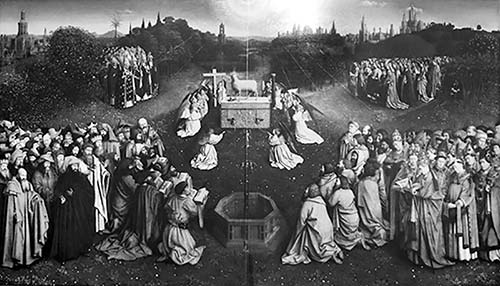
Now return to the main panel of the Lamb. A dove (the Holy Spirit) hovers overhead, from which lasers of light stream out over the pristine, shadowless landscape. In the foreground, the Fountain of Life spews water into a jeweled trough.
The Lamb of Christ at the center of the work had special meaning here in Ghent, whose wool trade put it on the map. It’s too bad that the animal itself—which scholars suspect was later retouched by a lesser artist—isn’t particularly well-depicted. He looks more like a fully grown sheep...and is that an extra ear I see?
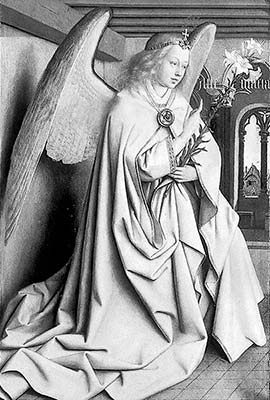
Exterior Panels: Historically, the wings of the hinged altarpiece were typically folded shut, revealing the simpler paintings on the outside panels (the dazzling altarpiece interior was opened for viewing only for feast days and worship). You can see these recently restored panels now by circling around the back side. The top panels depict the Annunciation, when an angel (on one panel) came to Mary (on the other) to tell her she would bear God’s child. The angel’s announcement—“Hail Mary, full of grace”—is written in Latin across the panel. Mary replies, “I am the servant of the Lord.” Notice that Mary’s words are upside-down—they’re intended for God above. Through the windows of Mary’s chamber, we get a glimpse of medieval Ghent. Below, kneeling in the lower panels, are the donors who commissioned the work—the mayor of Ghent and his wife. Accompanying them are two St. Johns—the Baptist and the Evangelist.
A Final Look: Before leaving, take a moment to review the entire altarpiece and consider what it all means. Scholars mull over the various symbols, the inscriptions, and the cast of saints. The keystone is clearly the venerated lamb at the center of the work. The animal is positioned on a vertical line that descends from God to dove to lamb to fountain. So—in symbolic terms—God sent the Holy Spirit to Christ on earth who gave his life to bring the faithful the waters of eternal life. John the Baptist is prominently featured on the altarpiece because it was he who proclaimed the arrival of God on earth: “Ecce Agnus...Behold the Lamb of God who takes away the sins of the world.” (At the time the altarpiece was built, the church was dedicated not to St. Bavo but to John the Baptist.)
But forget the theology and simply bask in the astonishing level of detail. The countryside scenes are decorated with dozens of different identifiable species of plants and flowers. The feathered wings of the angels around the lamb can be matched to a variety of actual birds (peacocks, pigeons, swallows). And in the jeweled amulet around the neck of the singing angel (in the scene next to Adam), you can see a faint reflection of the window that decorated the chapel where this altarpiece originally stood. All these lush details—faces, robes, jewels, plants, human flesh—reinforced a theological message that was new to Europe: The hand of God could be found in the beauty of everyday things.
• From here, you’ll exit the chapel to the left and continue circling around the ambulatory to the main nave of the church. In the second chapel on your left, you will see a 10 Screen Displaying the Van Eyck Altarpiece. It zooms in to focus on individual sections of the painting.
Finally, you’ll exit through the choir area. Stand in front of the altar for a closer look at the statue of St. Bavo that we saw from a distance earlier.
Now go in peace, feeling fortunate you’ve laid eyes on the Ghent Altarpiece...just in case it gets stolen once again.
OTHER SIGHTS IN THE HISTORIC CENTER
Besides the cathedral, there are several worthwhile sights in this area. Note that the Church of St. Nicholas and the belfry are covered earlier, in my Ghent City Walk.
House of Alijn (Huis van Alijn)
This small museum re-creates scenes from Belgian daily life through the last few centuries. All in all, it’s a mildly intriguing collection of bric-a-brac, from dishes, toys, cribs, and kitchen appliances to a statue of a woman wiping a baby’s bum.
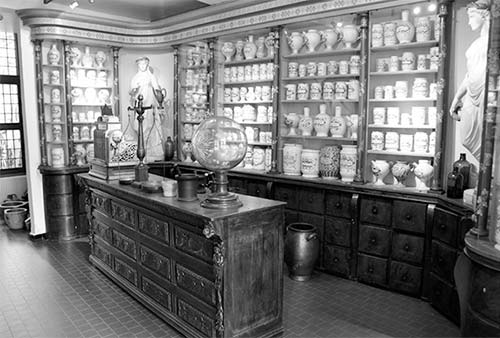
Cost and Hours: €9; Mon-Tue and Thu-Fri 9:00-17:00, Sat-Sun 10:00-18:00, closed Wed; Kraanlei 65, +32 9 235 3800, www.huisvanalijn.be.
Visiting the Museum: The rooms guide you through a calendar year, showcasing customs, holidays, and rites of passage—some universal and some specific to Belgium. You’ll see rooms devoted to birth, showing Belgian christening dresses and the “pink box” of childcare products the government distributes to new mothers. One room features teenage memorabilia—cringe at the 1970s and 1980s fashions. The room on getting older explains how Belgians mourn after the death of a loved one.
You’ll see 19th-century antiques like wooden toy soldiers and 20th-century antiques like rotary telephones and Atari consoles. There are few labels or descriptions, but the objects (and their time periods) speak for themselves. The tranquil courtyard of what used to be an almshouse (a refuge for poor elderly women) hosts a little café.
▲Castle of the Counts (Gravensteen)
Though it dates from 1180, this fortress has morphed over the centuries, and much of it is rebuilt and restored. While impressive from the outside, it’s mostly bare inside. Still, it’s a fun opportunity to get a feel for the medieval world as you twist through towers and ramble over ramparts.
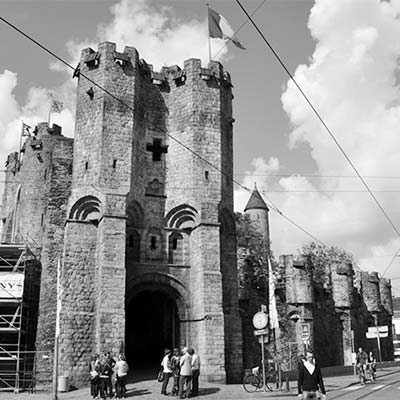
Cost and Hours: €13, includes audioguide, daily 10:00-18:00, last entry 1.5 hours before closing, +32 9 266 8500, Sint-Veerleplein 9, www.gravensteengent.be.
Visiting the Castle: Take advantage of the included audio-guide, which attempts to inject a little levity into this very dry sight (available in English, it’s narrated by well-known Belgian comedian Wouter Deprez).
Gravensteen has all the parts of a typical castle: courtyard and keep, throne room, chapel, 18-foot-deep dungeon, and ramparts. There are displays of authentic swords and suits of armor. You’ll learn a bit about the lives of Philip of Alsace, 12th-century count of Flanders, and his wife, Elizabeth. They married as teenagers but didn’t settle here until they were nearly 40 and Philip had gotten one Crusade out of his system. You’ll see the room where prisoners waited to learn their fates. This was a time when punishment was very literal. For example, a thief’s hand would be cut off, and a person who spoke poorly of the count might lose his tongue. You’ll learn more than you may want about the count’s private potty, which was poised strategically above the river. If you climb to the top of one of the towers (lots of claustrophobic stairs), you’ll get good views—and the feeling that you’re the ruler of your own castle.
▲Ghent Design Museum (Design Museum Gent)
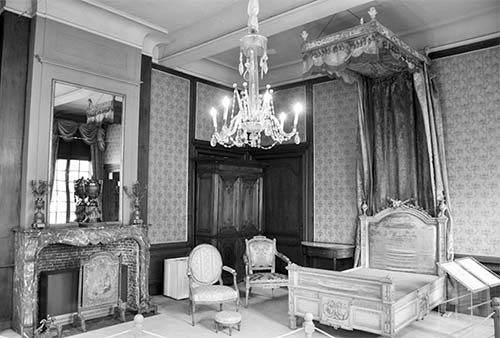
This collection celebrating the Belgian knack for design is closed until 2026 for an extensive renovation and expansion. When open, it’s enjoyable for everyone, but especially worthwhile for those interested in 17th-to-21st-century decorative arts: furniture, glass, ceramics, and jewelry. Check the website for updates (Jan Breydelstraat 5, +32 9 267 9999, www.designmuseumgent.be).
MUSEUMS NEAR THE TRAIN STATION
Several museums are closer to the train station than to the historical center, which makes them ideal to visit on your way in or out of Ghent. The Fine Arts Museum and the Stedelijk Contemporary Art Museum are located at Citadelpark, while the Ghent City Museum is a bit farther north of the station.
▲Fine Arts Museum (Museum voor Schone Kunsten)
This museum—Belgium’s oldest—offers a good, representative look at Northern European art. It’s one of the most user-friendly collections of Low Countries art you’ll find in Belgium, with lesser-known yet fun works by artists such as Bosch, Rubens, Van Dyck, Ensor, and Magritte—making it worth ▲▲ for art lovers. The upper panels from the Ghent Altarpiece may still be under restoration here when you visit; on weekdays you may be able to watch restorers at work.
Cost and Hours: €13, includes audioguide; Tue-Fri 9:30-17:30, Sat-Sun 10:00-18:00, closed Mon; €€ brasserie, in Citadelpark along Fernand Scribedreef street, +32 9 323 6700, www.mskgent.be.
Getting to the Citadelpark Museums: To reach Citadelpark and its museums from the train station (about a 10-minute walk), exit the main hall and walk along the right side of the circular plaza. Turn right on Koningin Astridlaan and walk about five minutes up this tree- and bike-lined street, then cross the road and enter Citadelpark. Walk straight ahead, then curl around the right side of the big, modern building at the center of the park (the city’s convention center, which may be undergoing renovation when you visit). Follow signs to Museum voor Schone Kunsten. When you reach a small street, turn left and walk along it about 200 yards until you see the Neoclassical entrance to the Fine Arts Museum on the right and the Stedelijk Contemporary Art Museum (with a large S.M.A.K. sign over the entrance) on the left.
Visiting the Museum: You’ll enter a large central hall used mainly for temporary exhibits. To the immediate right (in numbered rooms) are older works, and to the left (in lettered rooms) are temporary exhibits. Farther back on each side, in rooms with higher numbers and letters, are more temporary exhibits and works primarily from the 19th and 20th centuries. To take a loosely chronological spin though the collection, turn right from the entrance and go counterclockwise. Watch for the pieces I’ve highlighted here. Several works are well described by posted English plaques, and the included audioguide provides even more insight. Note that the collection shifts around frequently through themed rooms, works (especially modern ones) are sometimes pulled into temporary exhibitions, and some works may not be on view.
Room 1: In Rogier Van der Weyden’s The Virgin of the Carnation (1480), the Baby Jesus makes a benediction gesture with his little hand. This small painting was designed as a focal point for personal meditation.
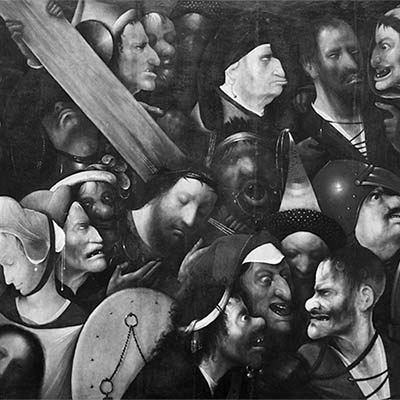
Room 2: A jarring work by Hieronymus Bosch, Christ Carrying the Cross (c. 1510-1516) features a severe-looking Jesus surrounded by grotesque faces. Typical of the Middle Ages, Bosch believed that evil was ugly—and all but three faces on this canvas (forming a diagonal, from lower left to upper right) are hideous. The serene woman to the left of Christ is Veronica, who has just wiped his face. In the upper right, with an ashen complexion, is the stoic good thief, flanked by a doctor and a taunting monk. Meanwhile, in the lower right, the orange-tinged unrepentant thief sneers back at his hecklers.
Nearby, Bosch’s c. 1485-1495 portrait of St. Jerome—who was his personal patron saint (“Hieronymus”)—shows the holy hermit having discarded his clothes. Just above his legs, notice the owl (representing evil) sinisterly eyeing a titmouse (good).
Room 5: In here you’ll find Peter Paul Rubens’ altar painting (c. 1635) depicting St. Francis of Assisi receiving the stigmata—the wounds of the crucified Christ—from a six-winged angel, whose own hands and feet are fastened to a cross. Francis’ brother Leo stares in amazement from below. From here, enter Room 7 (in this room of portraits, don’t miss James Ensor’s Old Lady with Masks, from 1889), then turn right to find the next room.
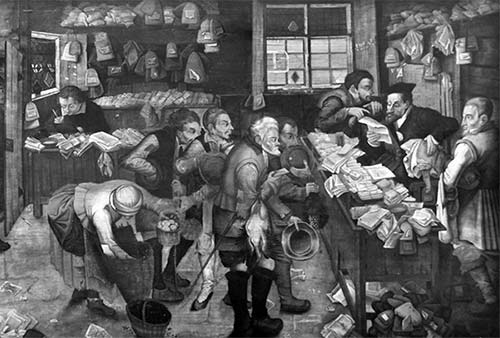
Room 6: This room features Pieter Brueghel the Younger’s 1616 copy of his more famous father’s much-loved Peasant Wedding in a Barn. The elder painter trained his kids to carry on the family business—and the younger Brueghel became a talented painter in his own right. In his Village Lawyer (1621), displayed to the right, we see the attorney behind a desk piled with papers, as peasants bring items to barter for his services. Go up the stairs in this room, enter Room 13, then turn right into the circular room.
Room 14: Rubens’ student Anthony van Dyck depicts the mythological story of Jupiter and Antiope (c. 1620)—a horned-and-horny god about to inseminate a sleeping woman. This problematic theme is thoughtfully handled by the posted description, which notes that it can either be taken as dated and old-fashioned, or as “a reminder that misogyny is still alive and well.”
Rest of the Museum: From here, you can continue through rooms displaying works from the 18th and 19th centuries, and circle along the back to the lettered wing, which displays more modern works.
Or if you’re ready for a fresh perspective now, you can head back to the main entry hall and cross directly over into the modern wing. You’ll find works by homegrown Belgian modernist René Magritte, whose clever Perspective II—part of a larger series—wryly replaces the four subjects on Edouard Manet’s famous Balcony painting with coffins. You will likely see similar surrealist works by Paul Delvaux, a Belgian artist who studied, worked, and taught in Brussels. Delvaux became famous for his surrealistic paintings of nude women, often in weirdly lit landscapes. They cast long shadows, wandering bare breasted among classical ruins. Also look for works by Frits van der Berghe (The Singing Statue, 1928), whose style is reminiscent of Max Ernst’s Expressionism; and pieces by turn-of-the-20th-century Belgian artist James Ensor. This museum has a particularly good collection of his prints and drawings.
The museum also introduces you to some lesser-known Belgian representatives of various modern styles, including abstract artists Jules Schmalzigaug, Georges Vantongerloo, Pierre-Louis Flouquet, and Jozef Peeters. Survey the works by Gustave de Smet, Frits van der Berghe (again), Constant Permeke, and others.
George Minne, born in Ghent, is well represented here with engravings and sculptures that point toward Expressionism. And Expressionism reestablishes the international context: Look for the Portrait of Physician Ludwig Adler by Viennese Secessionist painter Oskar Kokoschka. The artist uses dynamic, expressionistic brushstrokes to capture the personality, rather than a precise reproduction, of his subject. See also the works by Kokoschka’s contemporaries Ernst Ludwig Kirchner and Erich Heckel, who went in their own directions but kept the same general aesthetic.
And there’s much more to see, including Belgium’s answer to the Impressionists and Post-Impressionists (there’s a substantial display of the pointillist works of Théo van Rysselberghe). Just explore and enjoy the opportunity to get to know some great Belgian artists who are largely unknown outside of their homeland.
Stedelijk Contemporary Art Museum (Stedelijk Museum voor Actuele Kunst, a.k.a. SMAK)
This art gallery is constantly changing both the “permanent” collection and many temporary exhibits. Worth a visit only for art lovers, it’s conveniently located just across the street from the Fine Arts Museum.
Cost and Hours: €13 (more during special exhibits), Tue-Fri 9:30-17:30, Sat-Sun 10:00-18:00, closed Mon, +32 9 323 6001, www.smak.be. For directions on how to reach the museum, see “Getting to the Citadelpark Museums,” earlier.
▲Ghent City Museum (Stadsmuseum Gent, a.k.a. STAM)
This cutting-edge museum, housed in a beautiful 14th-century Gothic abbey complex called Bijloke, explains the history of Ghent with all the bells and whistles you’d expect in this fashion-forward city. The permanent exhibit traces the city’s history in high-tech treatments mixed with historic artifacts. Everything is explained in English.
Cost and Hours: €11; Mon-Tue and Thu-Fri 9:00-17:00, Sat-Sun 10:00-18:00, closed Wed, last entry one hour before closing; Godshuizenlaan 2, +32 9 267 1400, www.stamgent.be.
Getting There: From the train station, it’s a 15-to-20-minute walk. Or you should be able to ride a tram to the Bijlokehof stop. (Check your navigation app for which line to take or to get walking directions, or ask at the Lijnwinkel office at the station.) From the stop, walk along busy Godshuizlaan toward the Leie River, and the museum will be a few hundred yards ahead on the left.
Visiting the Museum: Begin in the modern annex, where you’ll buy your ticket on the ground floor, then head upstairs to the first floor. In the first room, you can walk across a giant aerial photograph of the modern city sprawl. (Watch families with children eagerly trying to locate where they live.)
Cross over to the old abbey complex. You can peer down into the old abbey church, where the altar area at the back remains preserved. (The rest is used for temporary exhibits.) The first room you enter is the former nuns’ dormitory, now displaying the history of Ghent from the Iron Age until about 1200—including early artifacts of the cloth trade that made Ghent so prosperous. Then, on your way down the stairs, stop in the refectory, topped by a 14th-century barrel vault and decorated with murals from about 1350. Notice that this dining hall is somewhat oddly placed a floor above the rest of the abbey. That’s because Christ’s Last Supper was also said to have taken place on the first floor (that is, on the first floor above the main floor—what Americans call the second floor). This meant that the nuns should also take the stairs with their heavy bags of potatoes and other goods.
After the refectory, continue down the stairs to the ground floor, where you’ll slowly circle the courtyard for a clockwise, chronological loop that traces the story of Ghent. The last room is a re-creation of the 17th-century Town Hall treasury, complete with coins, silver, and florid leather-and-gold wallpaper.
OUTER GHENT
Museum Dr. Guislain
Just west of the town center, this museum—set in Belgium’s first mental hospital—traces the history of medical achievements in psychiatry. You’ll see displays of instruments, research milestones, and art from the time mental illness was considered demonic possession up until our time of contemporary treatment.
Cost and Hours: €10; Tue-Fri 9:00-17:00, Sat-Sun from 13:00, closed Mon, last entry one hour before closing; Jozeph Guislainstraat 43, +32 9 398 6950, www.museumdrguislain.be.
Getting There: You should be able to take a tram (direction: Wondelgem) to the Guislainstraat stop—consult your navigation app, or ask locally (at the TI or Lijnwinkel office at the train station or on Korenmarkt). Look for the Dr. Guislain Psychiatric Center (with decorative 19th-century brickwork), follow the cloister to the right, and then follow signs to the museum.
Groot Begijnhof
Begijnhofs were homes for communities of laywomen: places to live, pray, and serve society without taking religious vows. Unlike most Flemish cities with just one begijnhof, Ghent has three. Groot Begijnhof is the largest—and its Flemish Gothic Revival architecture differs greatly from the begijnhof in Bruges (described in the Sights and Experiences in Bruges chapter).
Cost and Hours: Free, daily 6:00-23:00, main office at Groot Begijnhof 67, +32 9 228 2308, www.grootbegijnhof.be.
Getting There: From Korenmarkt you should be able to take bus #12 (direction: Achtendries or Varendriesstraat), get off at the Schoolstraat stop, turn right on Schoolstraat, and look for the arched gateway at the end of the next side street (confirm bus line and directions on your navigation app).
Sleeping in Ghent
A convention town, Ghent is busiest in spring (April-June) and fall (Sept-mid-Dec); things are quieter (and prices lower) in early July (before the Ghent Festivities) and August, and even more so in the winter. Except for Koeketiene, these listings are near the town center, which is a 30-minute walk or a 15-minute tram ride from the train station; see “Arrival in Ghent,” earlier, for details.
In addition to the places listed here, the TI’s website (www.visitgent.be) lists dozens of options for B&Bs.
€€€€ Pillows Grand Boutique Hotel Reylof is the city’s splurge, with 156 plush rooms and an elegant lobby. It’s on a workaday street, a short walk west of the town center (air-con, Hoogstraat 36, +32 9 235 4070, www.pillowshotels.com/ghent, ghent@pillowshotels.com).
€€€ Hotel Harmony is a classy, four-star, family-run boutique hotel with 40 chic contemporary rooms ideally located on the embankment in the town center (air-con, heated outdoor pool in summer, Kraanlei 37, +32 9 324 2680, www.hotel-harmony.be, info@hotel-harmony.be).
€€€ Comic Art Hotel, the brainchild of a comics collector but run by the owners of Hotel Harmony, offers 38 modern, delightful rooms behind a historically preserved facade in the regal Prinsenhof neighborhood (where Emperor Charles V was born in 1500). Each room has a different comic theme, and some have views of the peaceful, willow-lined canal (air-con, Augustijnenkaai 2, +32 9 310 3090, www.comicarthotel.be, info@comicarthotel.be).
€€€ Monasterium PoortAckere, a monastery until 1998, is now a no-frills hotel with rooms that still evoke the aura of monks, seminarians, and visiting clergy. The 109 rooms—spread across several buildings—are all different; some are fresh and modern, while others feel barely updated since the last monks checked out. Breakfast costs extra (air-con and elevator for most rooms, limited pay parking, Oude Houtlei 56, +32 9 269 2210, www.monasterium.be, info@monasterium.be).
€€ Koeketiene, between the train station and Citadelpark, has three artistically designed rooms with high ceilings and wood floors above a charming recommended restaurant, all lovingly run by Maarten and Fran—who live on the premises with their young family (book well in advance, breakfast extra, no elevator, steep stairs, Koningin Astridlaan 55, +32 9 330 5773, www.koeketienegent.be, hello@koeketienegent.be).
€€ Hotel Onderbergen, down a quiet street just a 10-minute walk from St. Bavo’s Cathedral, has a friendly staff and 24 elegant rooms done up in deep, bold colors with some original wood beams (breakfast extra, no elevator, Onderbergen 69, +32 9 223 6200, www.hotelonderbergen.be, info@hotelonderbergen.be).
€€ Chambreplus rents four rooms with modern design. The garden suite, which costs a little more, includes a private hot tub and fireplace. While the rooms are comfy, they’re run as an afterthought to the ground-floor travel agency—you’ll be largely on your own after checking in (two-night minimum for weekends, air-con, no breakfast, no elevator, steep stairs except for garden suite, Hoogpoort 31, +32 9 226 3181, www.chambreplus.be; Kris, Indira, and Jeroen).
€€ Erasmus Hotel, capably run by Peter, has 12 well-maintained rooms around a creaky wooden staircase in a classic 400-year-old building a short walk from the embankment. A cluttered hallway gives access to a museum-like breakfast room and a delightful Renaissance garden. Staying here feels like visiting a charming time warp (no elevator, Poel 25, +32 9 224 2195, www.erasmushotel.be, info@erasmushotel.be).
€€ B&B Hotel Gent Centrum, part of a French chain, offers 114 bright, pleasant, minimalist rooms in a super-central location, and the staff is friendly (air-con, breakfast extra, Voldersstraat 17, +32 9 396 6130, www.hotel-bb.com/hotel/gent-centrum, gent.centrum@hotelbb.com).
€€ Ibis Gent Centrum St-Baafs Kathedraal offers affordable, cookie-cutter, chain-hotel comfort in 120 rooms right next to the cathedral (breakfast extra, Limburgstraat 2, +32 9 233 0000, www.ibishotel.com, h0961@accor.com).
¢ De Draecke, Ghent’s very institutional hostel with a helpful staff, has 119 beds (including some in private rooms) in a charming residential zone a short walk from the castle (Sint-Widostraat 11, +32 9 233 7050, www.jeugdherbergen.be, gent@vjh.be).
Eating in Ghent
My Ghent dining recommendations are within a 10-to-15-minute walk of the three spires downtown (Belfry, St. Bavo’s, and St. Nicholas). For the nicer dinner places, reservations are wise.
FAST, AFFORDABLE LUNCHES IN THE CENTER
€ Alice, a tearoom tucked on a side street near St. Michael’s Bridge, serves simple lunches, soups, and sandwiches in a delightful candy-box interior or in the garden (closed Sun-Mon, Onderbergen 6, +32 9 277 9235).
€ Souplounge is basic, but cheap and good. They offer four daily soups, along with salads. Eat inside or at the outdoor tables overlooking one of Ghent’s most scenic stretches of canal (closed Mon, Zuivelbrugstraat 4, +32 9 223 6203).
€ Tasty World serves up decent veggie burgers with various toppings, plus a wide range of fresh fruit juices and salads (closed Sun, Hoogpoort 1, +32 9 225 7407).
€€ Balls & Glory, a small Belgian chain that got its start in Ghent, specializes in gigantic meatballs—four flavors per day are noted on the chalkboard menu. Get yours to go or pay a few euros more to eat in their modern dining room at shared stainless-steel tables or out on the sidewalk (closed Sun, Jakobijnenstraat 6, +32 486 678 776).
€ Frituur Filip, a fry shack attached to the Butchers Hall on the Pensmarkt, serves real Belgian frites cooked twice in ox fat. Try them with Filip’s homemade stoofvleessaus—the sauce skimmed off his Flemish stew (closed Wed).
€ Frituur Tartaar, facing the belfry, is another central standby that locals swear by for frieten and other deep-fried Belgian munchies (closed Mon-Tue, Emile Braunplein 12).
Dessert: At the popular Damass ice cream shop, you can hang out and people watch, or get a cone and stroll (at the north end of Korenmarkt, #3B, closed Tue).
Grocery Stores: You’ll find a well-supplied Albert Heijn below the former post office on Korenmarkt (Mon-Sat until 20:00, Sun until 11:45, Korenmarkt 16; for location see the “Ghent” map on here).
ACROSS THE RIVER, IN PATERSHOL
This former sailors’ quarter—a very short walk across the river from the historical center—is one of Ghent’s most inviting neighborhoods for dining. Stroll the streets to find a place that looks good. Peek into courtyards, many of which hide restaurant and café tables. It’s hard to go wrong in Patershol, but here are some well-regarded favorites:
€€€ De Acht Zaligheden (“The Eight Beatitudes”) prides itself on its regional and seasonal dishes with an always-innovative presentation. Their fixed-price dinners are a good value (Fri-Sun lunch and dinner, Wed-Thu dinner only, closed Mon-Tue, Oudburg 4, +32 9 224 3197, www.deachtzaligheden.be).
€€€ Mémé Gusta, a few steps from the Castle of the Counts, has ramshackle-chic decor, a welcoming and easygoing vibe, and a tempting menu of Belgian classics. The owners were the winners of a reality TV show (My Popup Restaurant), giving the place a certain celebrity cachet among Belgians (Tue and Thu-Sat lunch and dinner, Wed dinner only, closed Sun-Mon, Burgstraat 19, +32 9 398 23 93, www.meme-gusta.be).
€€€€ Valentijn, in the heart of Patershol, has a romantic, dressy interior and a no-fuss menu of classics. On Saturday, they serve only a four-course fixed-price dinner (Mon-Wed and Fri-Sat dinner only, Sun lunch only, closed Thu, reservations recommended, Rodekoningstraat 1, +32 9 225 0429, www.restaurantvalentijn.be).
Oudburg Street: This street is worth a stroll, at lunch or dinner, to survey a wide range of options. Every other address seems to be a sushi restaurant, but you’ll also find Indian, Portuguese, Turkish (Ankara at #44 is good), Naples-style pizza, vegetarian, traditional Belgian (Aba-Jour, at #20), and even a tiki bar. A few of the places on the right side of the street have seating along the canal. De Acht Zaligheden and Valentijn, both recommended above, are also at the start of this street.
NEAR THE CATHEDRAL
The areas described above are cute, cobbled, fairytale Ghent—and on a short visit, it makes sense to focus your time there. But if you’d like to get into a more workaday part of town—with some interesting, contemporary-feeling eateries—explore the area around St. Bavo’s.
€€€ Pakhuis is a gorgeously restored, late-19th-century warehouse now filled with a classy, lively brasserie and bar. In this airy, two-story, glassed-in birdhouse of a restaurant, they serve up good traditional Belgian food with an emphasis on locally sourced and organic ingredients. It’s tucked down a nondescript brick alley a few steps off the river but worth a slight detour (good lunch deals, fixed-price dinners available, closed Sun, reserve ahead, Schuurkenstraat 4, +32 9 223 5555, www.pakhuis.be).
€€€ Jus feels upscale but not pretentious, with elevated, modern Belgian dishes served in a sophisticated interior or outside on a pedestrian shopping zone a couple of blocks south of the cathedral. Reservations are smart (fixed-price meals available; Tue-Fri lunch and dinner, Sat dinner only, closed Sun-Mon; Mageleinstraat 43, +31 9 286 37 63, https://jusgent.be).
€€€ Brasserie Bridge, at the base of St. Bavo’s Cathedral, is as much a local institution as it is an ideal tourist spot. Enjoy well-prepared Belgian dishes and a good selection of draft beers in an unbeatable location, either in the spacious and friendly interior or outside on the square (closed Tue-Wed, reservations smart for dinner, Sint-Baafsplein 21, +32 9 223 6167, www.brasseriebridge.be).
SOUTH OF THE CENTER
Walpoortstraat and De Krook: About a 10-minute walk south of the cathedral, you leave the touristy core of Ghent behind and reach lively, local Walpoortstraat, with a fun variety of design shops and eateries. A block over is the city’s super-modern library building, called De Krook—a striking, multilevel structure with a bike garage underneath and a lovely canal-front embankment on three sides. It’s fun to simply wander over here (for the most interesting route, see the walking directions under “Shopping in Ghent,” later), then browse for lunch. On Lammerstraat, which connects Walpoortstraat to De Krook, you’ll find €€ Aywa, with good, takeaway Lebanese dishes (closed Sun-Mon, at #12), and—across the street—€€ Soep Plus, with a variety of healthy, flavorful soups and salads; their outdoor seating, in back, is on the plaza facing De Krook (closed Sat-Sun, at #33).
Between the Train Station and Citadelpark: €€€ Koeketiene, below one of my recommended hotels, feels like a friend’s house—it’s a cheerful, relaxing little spot with antique green trim, flowers on the tables, and a garden patio out back. The menu changes every couple of weeks to focus on fresh local ingredients. Reservations are smart—but you can also stop in for a coffee on your way to the Fine Arts Museum (Wed-Sun breakfast and lunch, also open Sat for dinner, closed Mon-Tue, Koningin Astridlaan 55, +32 9 330 5773, www.koeketienegent.be).
GHENT’S BAR SCENE
Two touristy bars in the center are worth considering if you want to sample a wide range of Belgian favorites: beer or gin.
De Dulle Griet (“Mad Maggie,” named after the large red cannon nearby) on Vrijdagmarkt serves up 500 types of beer in a cozy, sprawling bar with beer glasses hanging from the ceiling. There’s also ample seating out on the square (Mon-Sat until late, Sun until 19:30, Vrijdagmarkt 50, +32 9 244 2455).
’t Dreupelkot, guarded by Blackie the white dog, is a cozy little bar along the river offering more than 200 types of Dutch and Flemish gin, or jenever (daily until late, Groentenmarkt 12, +32 09 224 2120).
Shopping in Ghent
Ghent has an enjoyable real-world feel that makes it a fun place to browse—not for souvenirs, but for interesting, design-oriented items. While not as urbane as Brussels or as cutting-edge as Antwerp, Ghent is creative, yet still accessible. Here are some interesting places to browse:
Serpentstraat
This little pedestrian street, buried deep between the cathedral and Vrijdagmarkt square (described in my Ghent City Walk), has a fun, funky collection of creative shops. The street kicks off with a Nathalie Engels clothing boutique on the left. Woven along the rest of the street are design stores, a funky record shop, boutiques for fashionable kids, creative greeting card purveyors, shoes and jewelry, and other intriguing shops.
Streets near the Castle of the Counts
The busy, tram-lined Burgstraat, just across the bridge from the castle, is an enjoyable place to window-shop at several furniture and home-decor shops and art galleries. The side street Jan Breydelstraat has an eclectic array of clothing, linens, jewelry, design, and chocolate shops.
Walpoortstraat and Nearby
Walpoortstraat and the adjoining Sint-Pietersnieuwstraat, about a 10-minute stroll southeast of the cathedral, have some of Ghent’s most creative and interesting shops.
Shopping Your Way from the Belfry to Walpoortstraat: There are several ways to reach Walpoortstraat from the center, but this route, which strings together mostly pedestrianized shopping streets, is especially pleasant. Beginning at the elongated square at the belfry, the middle of Ghent’s three big towers, head south along the pedestrianized Mageleinstraat, with restaurants (including the recommended Jus), tearooms, upscale shoe stores, and midrange international clothing shops. After two short blocks, you’ll pop out at a fine little square ringed by interesting old buildings. Continue straight ahead down Kalandestraat to the handsome Kalandeberg square—with a gurgling fountain, outdoor seating, and a pair of inviting café/bakeries with sidewalk tables. Angle left at the bottom of the square to continue down Koestraat, which takes you to busier Kortedagsteeg. Here the shops and clientele gradually morph from mainstream middle-aged to creative hipster. As you cross the bridge, look left to see the bold modern library building, De Krook. You’re now on Walpoortstraat, and the transformation is complete.
Shops Around Walpoortstraat: The blocks in which Walpoortstraat becomes Sint-Pietersnieuwstraat are fun and picturesque. Wedged between enticing cafés and restaurants are clothing boutiques, vintage and secondhand stores, and some cool design depots (including Axeswar Design Trendshop at #12). Closer to the canal, at Yuzu, chocolatier Nicolas Vanaise decorates pralines with shiny metallic finishes and infuses them with creative flavors—including Asian elements (closed Sun-Mon, Walpoortstraat 11A).
Antiques near Vrijdagmarkt
Antiek-Depot is a sprawling antique mall made for browsing. It sits along a postcard-perfect gabled street just north of Vrijdagmarkt square (closed Tue, Baudelostraat 15).
Ghent Connections
From Ghent by Train to: Brussels (3/hour, 35 minutes), Brussels Airport (1/hour direct, 1 hour), Bruges (4/hour, 30 minutes), Antwerp (3/hour, 1 hour), Ypres/Ieper (hourly, 1 hour), Paris (2/hour, 2.5 hours, change at Brussels Midi/Zuid/South to Eurostar train), Amsterdam (hourly, 2.5 hours, transfer in Antwerp; cheaper on slightly slower IC/InterCity trains than on the pricey Eurostar trains), Delft (2/hour, 2.5 hours, two transfers). For train information, see Belgiantrain.be; see also the “Transportation” section of the Practicalities chapter.