SINT-JANSHOSPITAAL & MEMLING COLLECTION TOUR
Located in one of Europe’s oldest surviving hospital buildings, this museum has two parts. First, you walk through displays describing the work of the former hospital, which operated from about 1150 until 1850. You get a glimpse into medicine from the medieval era onward, with displays of surgical instruments, archival documents, and devotional objects for spiritual healing. Paintings and sculptures from the 16th through 19th century illustrate themes of caregiving, vocation, and faith. Contemporary artworks and reflections by doctors, artists, and caregivers of today ask viewers to consider the relationship of societies to the sick or dying, and the role of those tasked with healing or comforting them. Then you work your way to the collection’s climax: several of Hans Memling’s glowing masterpieces.
Memling’s art was the culmination of Bruges’ Flemish Primitive style (see sidebar on here). His serene, soft-focus, motionless scenes capture a medieval piety that was quickly fading. The popularity of the style made Memling (c. 1430-1494) one of Bruges’ wealthiest citizens, and his work was gobbled up by visiting Italian merchants, who took it home with them, cross-pollinating European art.
Orientation
Cost: €15, includes entry to the skippable old pharmacy (Apotheek) in a nearby building and loaner folding chairs (if you’d like to sit and study the paintings).
Hours: Tue-Sun 9:30-17:00, closed Mon.
Information: +32 50 448 713, www.museabrugge.be.
Getting There: The museum is at Mariastraat 38, across the street from the Church of Our Lady. Walk through the arched passageway into a courtyard, and continue to the left to find the museum entrance.
Tours: A free audioguide is available for your phone.
Length of This Tour: Allow one hour.
Starring: The expansive hospital hall (with thoughtful displays on caregiving through the centuries) and Memling’s St. John Altarpiece.
The Tour Begins
• After showing your ticket, enter a vast hall partitioned into themed sections that connect the work of Sint-Janshospitaal (St. John’s Hospital) to caregiving work today. In former days, this hall was the...
HOSPITAL
Take in the great hall with its sturdy wood-beamed ceiling, stone pillars, and brick walls. Some 500 years ago, this place would have been bustling with doctors and nurses (that is, monks and nuns) attending to the sick. As Bruges was a large city and a major destination for pilgrims (who came to see the Holy Blood relic), the building had to accommodate a lot of patients.
This hall was lined with beds filled with the sick and dying. At the far end was the high altar, which once displayed Memling’s St. John Altarpiece (which we’ll see). Bedridden patients could gaze on this peaceful, colorful vision and gain a moment’s comfort from their agonies.
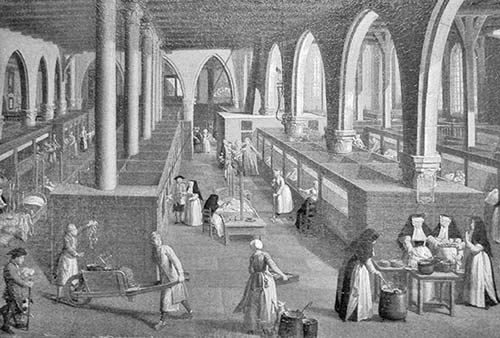
Browse the displays exploring community, faith, self-care, and grief, from the Middle Ages through the modern era. Old paintings show the hospital in former times and honor the nuns who devoted their lives to caring for the sick. Portraits depict its Isaac Newton-looking doctors. One painting by Jan Beerblock—Zicht op de Oude Ziekenzalen (1778)—gives an intimate peek at “the old sick hall” in action: Notice that the soup’s on, dogs are welcome, a nun administers last rites, and a sedan chair ambulance taxi awaits a patient. (An actual sedan chair ambulance still stands nearby.) Snacks and drinks are served in bed. The floor needs mopping. A VIP clergyman drops in to see that all’s OK.
Farther along are displays of medical implements. There are scalpels, medical books, flasks for testing urine, screws, syringes, and devices more appropriate to a hardware store. It makes you glad for modern medicine. It’s clear that medicine of the day was well intentioned but very crude. In many ways, this was less a hospital than a hospice, helping the dying make the transition from this world to the next.
Religious art was therapeutic, addressing the patients’ mental and spiritual health. The numerous Crucifixions reminded the sufferers that Christ could feel their pain, having lived it himself. Paintings of saints gave the suffering hope for a miracle. Visions of heaven offered the terminally ill a light at the end of the tunnel.
That’s where Memling came in. The hospital hired him to paint works that could bring serenity to the sick.
• After working your way through the partitioned displays, step up into the altar area of the adjoining church, with a black-and-white marble floor. Contemplate the large sculpture by Berlinde De Bruyckere, completed in 2023 and titled Liggende-Arcangelo II. Inspired by a Renaissance painting of the dead Christ supported by an angel, it affirms that caregivers—even if they’re archangels—need to rest sometimes. Turn to the right, toward the altar, and locate a painted box displayed in a free-standing glass case.
St. Ursula Shrine, c. 1489
On October 21, 1489, the mortal remains of St. Ursula were brought here to the church and placed in this gilded oak shrine, built specially for the occasion and decorated with paintings by Memling. Ursula, a Christian said to have been martyred by the Huns in the late fourth century, became a sensation in the Middle Ages when builders in Germany’s Cologne unearthed a huge pile of bones believed to belong to her and her 11,000 slaughtered cohorts.
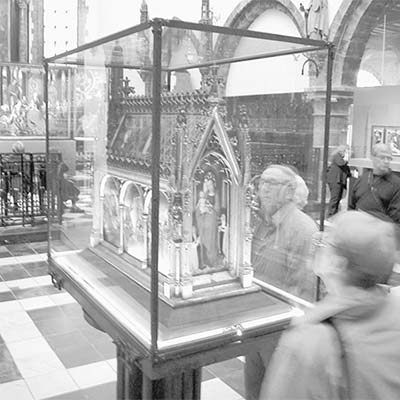
The church-shaped shrine, carved of wood and covered with gold, has “stained-glass windows” of Memling paintings describing Ursula’s well-known legend.
• “Read” the shrine’s story counterclockwise, beginning with the...
Left Panel: Ursula—in white and blue—arrives by boat at the city of Cologne and enters through the city gate. She’s on a pilgrimage to Rome, accompanied by 11,000 (female) virgins. That night (look in the two windows of the house in the background, right), an angel appears and tells her this trip will mean her death, but she is undaunted.
Center Panel: Continuing up the Rhine (which Memling knew well, having grown up on it), they arrive in Basel and prepare to cross the Alps (background, right). Memling condenses the 11,000 virgins to a more manageable 11, making each one pure enough for a thousand.
Right Panel: They arrive at the gates of Rome, where Ursula falls to her knees before the pope. Kneeling behind Ursula is her fiancé. Ursula has agreed to marry him only if he becomes a Christian and refrains from the marriage bed long enough for her to make this three-year pilgrimage as a virgin (making him, I guess, virgin number 11,001).
Opposite Side—Left Panel: They board ships to head back home, now joined by the pope. Memling’s crowd scenes are hardly realistic—more like a collage of individual poses and faces—but they capture the pomp and ceremony Memling would have seen in Bruges parades.
Middle Panel: Back in Cologne, a surprise awaits them—the city has been taken over by vicious Huns. They grab Ursula’s hubby and stab him, and he dies in Ursula’s arms.
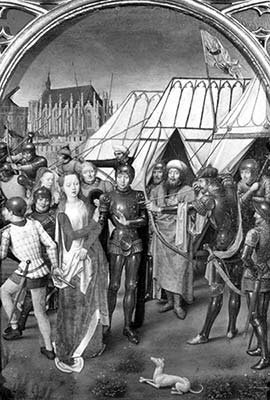
Right Panel: The Hun king (in red with turban and beard) woos Ursula, placing his hand over his heart, but she says, “No way.” So, a Hun soldier draws his arrow and prepares to shoot her dead. Even here, at the climax of the story, there are no histrionics. Even the dog just sits down, crosses his paws, and watches. The whole shrine cycle is as posed, motionless, and colorful as the tableaux vivants that may have inaugurated the shrine here in this church in 1489.
In the background, behind Ursula, a Bruges couple looks on sympathetically. This may be Memling himself (in red coat with fur lining) and his wife, Anna, who bore their three children.
• After admiring the altar area, where Memling’s St. John Altarpiece once stood (and now adorned with an altarpiece by 17th-century Bruges painter Jacob van Oost), backtrack past the St. Ursula Shrine and the resting archangel, and continue past ominous slabs marking graves of prominent nuns and friars who worked here. Head for the glass enclosure, whose shape was inspired by the St. Ursula Shrine.
MEMLING COLLECTION
• Six works by Hans Memling are displayed in this special glass-enclosed room. Dominating the space is the large, three-paneled...
St. John Altarpiece, a.k.a. The Mystical Marriage of St. Catherine, 1474
When this colorful triptych sat atop the church’s high altar, sick and dying patients could look over at it from their beds in the hospital. The piece was dedicated to the hospital’s patron saints, John the Baptist and John the Evangelist (see the inscription along the bottom of the frame), but Memling broadened the focus to take in a vision of heaven and the end of the world.
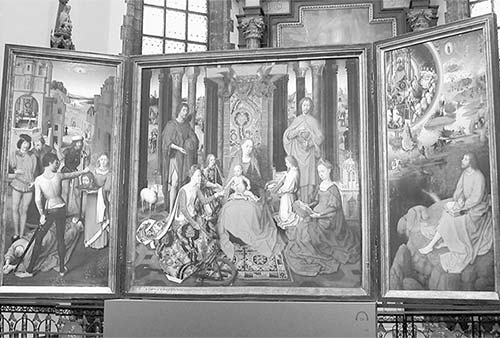
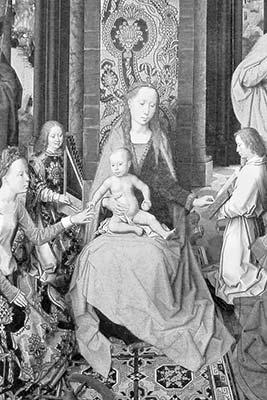
Central Panel: Mary, with Baby Jesus on her lap, sits in a canopied chair, crowned by hovering blue angels. It’s an imaginary gathering of conversing saints (Sacra Conversazione), though nobody in this meditative group is saying a word or even exchanging meaningful eye contact.
Mary is flanked symmetrically by the other saints: John the Baptist (to the left) and John the Evangelist (in red); an organist angel (left) matched by a book-holding acolyte; and St. Catherine (left) balanced by book-reading St. Barbara. Behind them, classical columns are also perfectly balanced left and right.
At the center of it all, Baby Jesus tips the balance by leaning over to place a ring on Catherine’s finger, sealing the “mystical marriage” between them.
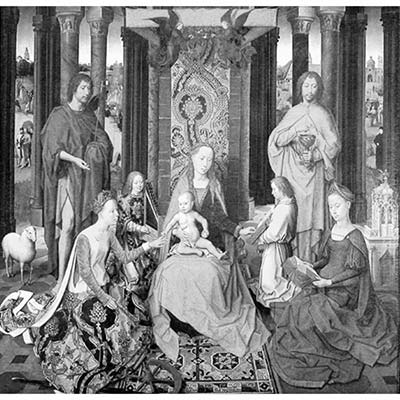
St. Catherine of Alexandria, born rich, smart, and pagan to Roman parents, joined the outlawed Christian faith. She spoke out against pagan Rome, attracting the attention of the emperor, Maxentius, who sent 50 philosophers to talk some sense into her—but she countered every argument, even converting the emperor’s own wife. Maxentius killed his wife, then asked Catherine to marry him. She refused, determined to remain true to the man she’d already “married” in a mystical vision—Christ.
Frustrated, Maxentius ordered Catherine to be stretched across a large, spiked wheel (the rather quaint-looking object at her feet), but the wheel broke, so they just cut her head off, which is why she has a sword, along with her “Catherine Wheel.”
Looking through the columns, we see scenes of Bruges. Just to the right of the chair’s canopy, the wooden contraption is a crane used to hoist barrels from barges on Kraanplein.
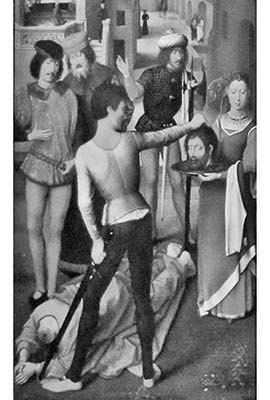
Left Panel: Even this gruesome scene, showing the beheaded John the Baptist with blood still spurting from his severed neck, becomes serene under Memling’s gentle brush. Everyone is solemn, graceful, and emotionless—including both parts of the decapitated John. Salomé (in green) receives the head on her silver platter with a humble servant’s downcast eyes, as if accepting her role in God’s wonderful, if sometimes painful, plan.
Right Panel: John sits on a high, rocky bluff on the island of Patmos and, in a vision of the Apocalypse, sees the end of the world as we know it...and he feels fine.
Overhead, in a rainbow bubble, God appears on his throne, resting his hand on a sealed book. A lamb steps up to open the seals, unleashing the awful events at the end of time. Standing at the bottom of the rainbow, an angel in green gestures to John and says, “Write this down.” John picks up his quill, but he pauses, absolutely transfixed, experiencing the Apocalypse now.
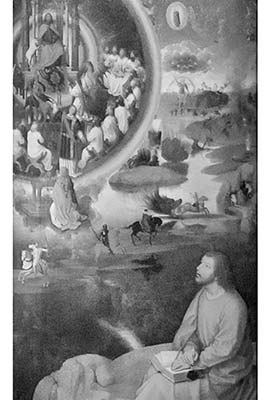
He sees wars, fires, and plagues on the horizon; the Virgin in the sky rebuking a red dragon; and many other wonders. In the center ride the dreaded Four Horsemen, wreaking havoc on the cosmos (galloping over either islands or clouds). Horseman number four is a skeleton, followed by a human-eating monster head. Helpless mortals on the right seek shelter in the rocks, but find none.
Memling has been criticized for building a career by copying the formulas of his predecessors, but this panel is a complete original. Its theme had never been so fully expressed, and the bright, contrasting colors and vivid imagery are almost modern. In the St. John Altarpiece, Memling shows us the full range of his style, from medieval grace to Renaissance symmetry, from the real to the surreal.
• Peruse the other Memlings reverently displayed in this quiet, glass space, including...
Diptych of Martin van Nieuwenhove, 1489
Three-dimensional effects—borrowed from the Italian Renaissance style—enliven this two-panel devotional painting. Both Mary and Child and the 23-year-old Martin, though in different panels, inhabit the same space within the painting.
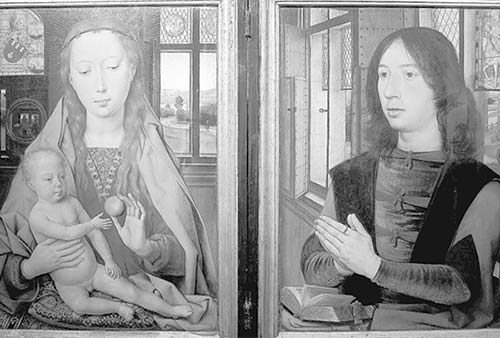
Stand right in front of Mary, facing her directly. If you line up the paintings’ horizons (seen in the distance, out the room’s windows), you’ll see that both panels depict the same room—with two windows at the back and two along the right wall.
Want proof? In the convex mirror on the back wall (just to the left of Mary), the scene is reflected back at us, showing Mary and Martin from behind, silhouetted in the two “windows” of the picture frames. Apparently, Mary makes house calls, appearing right in the living room of the young donor Martin, the wealthy, unique-looking heir to his father’s business.
Portrait of a Young Woman, 1480
Memling’s bread-and-butter was portraits created for families of wealthy businessmen (especially visiting Italians and Portuguese). This portrait takes us right back to that time.
The young woman looks out of the frame as if she were looking out a window. Her hands rest on the “sill,” with the fingertips sticking over. The frame is original, but the banner and Van Eyck-like lettering are not.
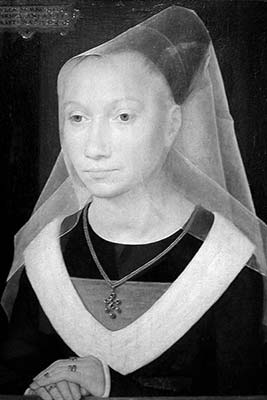
Her clothes look somewhat simple, but they were high class in their day. A dark damask dress is brightened by a red sash and a detachable white collar. She’s pulled her hair into a tight bun at the back, pinned there with a fez-like cap and draped with a transparent veil. She’s shaved her hairline and plucked her brows to get that clean, high-forehead look. Her ensemble is animated by a well-placed necklace of small stones.
Memling accentuates her fashionably pale complexion and gives her a pensive, sober expression, portraying her like a medieval saint. Still, she keeps her personality, with distinct features like her broad nose, neck tendons, and realistic hands. She peers out from her subtly painted veil, which sweeps down over the side of her face. What’s she thinking? (My guess: “It’s time for a waffle.”)
• If you can wait a little longer for that waffle, consider heading upstairs to the attic, where multimedia displays based on recent research into Memling’s paintings allow you to fully immerse yourself in his world.