ANTWERP
Antwerpen • Anvers
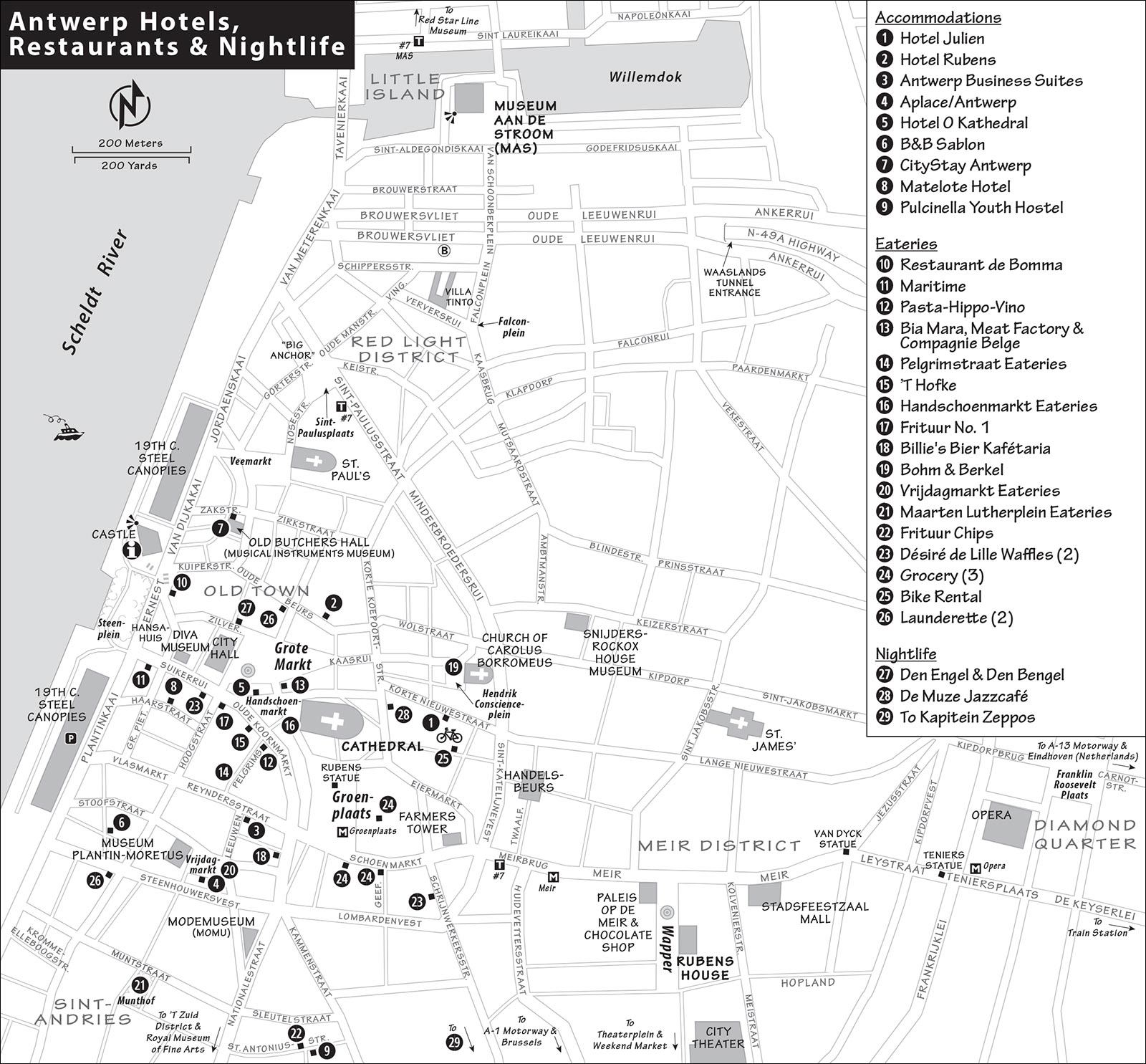
Map: Antwerp Hotels, Restaurants & Nightlife
MORE CHARACTERISTIC SPOTS IN THE CENTER
Antwerp (Antwerpen in Flemish, Anvers in French) is Belgium’s up-and-coming “second city” after Brussels, with a half-million people. Where Brussels dominates French-speaking Wallonia, Antwerp is the biggest city and de facto (if not official) capital of Dutch-speaking Flanders.
Antwerp has enjoyed an illustrious history. Once Europe’s most important trading city, it later was the hometown of accomplished painter Peter Paul Rubens. It was partially destroyed during World War II and then rebuilt. The drab air of heavy industry has been supplanted by an edgy, creative spirit. Like Barcelona, Liverpool, and Rotterdam, it’s been reborn as a city of tech and European fashion.
Antwerpenaars (as locals are called) have a love of life, and the city has a funky urbanity. Antwerp’s big-city bustle is the yang to Bruges’ cutesy-village yin. And while Brussels has become international, Antwerp has retained more of a local identity—it’s an honest, what-you-see-is-what-you-get place that feels more Flemish.
Antwerp has an especially strong “pop-up” culture: The people here love spontaneity and see everything as temporary. Here more than in most places, restaurants come and go, and major museums close for multiyear renovations with little notice. Expect changes to some things described in this book, confirm hours online, and be prepared for new discoveries.
The sights here are easily on par with the best in Belgium. Antwerp is renowned for the art of Rubens (and fellow Flemish artists Anthony van Dyck and Pieter Bruegel), a soaring cathedral, several other interesting churches packed with great art, and a red light district that boxes puritan ears. Historians enjoy the Museum Plantin-Moretus, art lovers savor the Snijders-Rockox House, fashionistas love the window shopping (and MoMu, a museum of fashion and design), children of immigrants are moved by the Red Star Line Museum, and architecture fans drool over the building housing the Museum aan de Stroom (Museum on the River, or MAS for short).
Antwerp is equally enjoyable without a sightseeing agenda, offering fun-to-explore neighborhoods, abundant al fresco café tables, and an inviting main market square with a carillon that jingles the hour.
PLANNING YOUR TIME
You could easily fill two days touring all the sights here, but selective visitors can see the highlights in a few hours as a day trip by train from Bruges (1.5 hours) or Brussels (45 minutes), or on the way between other Belgian and Dutch destinations.
On a quick visit of just a few hours, take parts 1 and 2 of my Antwerp City Walk from the train station to the Old Town, tour the cathedral, ogle the Grote Markt, and add any sights that intrigue you (if you’re really short on time, skip straight to part 2). Then zip back to the train station on underground trams known as the “Metro.”
With more time, follow all three parts of my Antwerp City Walk and dip into more of the museums. Antwerp’s diverse restaurant scene and lively nightlife make it well worth spending a night. And with a variety of quirky boutiques and cafés on each street, it’s a delightful place to simply linger.
As in most of Belgium, sights tend to be closed on Mondays (though that day may change, so confirm current hours online). Many sights are free the last Wednesday of the month.
Orientation to Antwerp
Antwerp sits along the east bank of the Scheldt River (Schelde in Flemish). The main tourist area is fairly compact. On a quick trip, narrow your focus to these main zones: the Old Town along the river; the train station area and Diamond Quarter to the east, and the Meir shopping district between the Old Town and train station; the rejuvenated Little Island (Eilandje) zone and the red light district to the north; and, to the south, the Sint-Andries fashion district and, beyond that, the happening nightlife zone aptly called ’t Zuid (“The South”). All these areas are within about a 30-minute walk (or a quick tram or taxi ride) of one another.
TOURIST INFORMATION
Antwerp’s TI has two branches: inside the train station (at the head of the tracks, on level 0, daily 9:00-17:00); and in the waterfront castle, or Het Steen, near Grote Markt, where you can walk up to floor 3 for a panoramic view of the city and river (daily 10:00-18:00; +32 3 221 1333, phone answered Mon-Fri only, www.visitantwerp.be). The Antwerp City Card—which includes transit, museum admissions, and additional discounts—can be a good value for very busy sightseers; grab a brochure and do the math (€45/24 hours, €55/48 hours, €65/72 hours).
ARRIVAL IN ANTWERP
By Train: Antwerp’s Central rail station (Antwerpen Centraal)—with a refurbished grand century-old shell and modern underground zone—feels like a cathedral of travel. (Some people stop off here just to see one of Europe’s most impressive train stations.) While big, it’s fairly easy to navigate, with three well-signed levels of tracks connected by escalators and elevators.
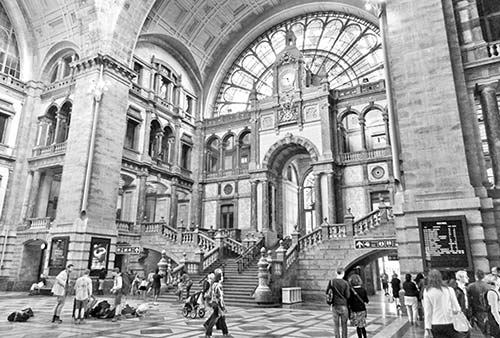
Level 0 is the hub of activity, where you’ll find a TI and luggage lockers tucked under the stairs. Continuing straight ahead, you’ll pass through the gorgeously restored great hall (with ticket windows). Exiting out the front door puts you in the vast Koningin Astridplein, with the city’s zoo on your immediate right.
To reach the city center by foot—following my Antwerp City Walk—turn left and walk down busy De Keyserlei boulevard. It’s about 20 minutes to the Grote Markt. (To easily find De Keyserlei from inside the station’s main hall, face the ticket offices, turn left, and pass by the pharmacy to exit under the Centrum sign.)
For a speedier trip, take the Metro (actually a series of underground trams): From next to the TI, take the escalator marked Metro down to the Diamant stop. Take tram #9 or #15 (direction: Linkeroever or Regatta). You can buy a ticket from the machines in the passageway (validate your ticket when you board); alternatively, you can buy a ticket on the tram by simply tapping your contactless card at a machine on board. Ride three stops to Groenplaats for the Grote Markt and the historical center.
HELPFUL HINTS
Tours: Erwin Liekens and his team from Taste the City lead food-and-drink tours in Antwerp as well as Brussels (minimum of 4 people, prices vary with size of group, see tour options at www.tastethecity.be). Erwin also gives private tours (€280/3 hours, €80 per additional hour, +32 3 318 3586, info@tastethecity.be).
Markets: The most entertaining markets are on Saturdays and Sundays, when Theaterplein (by the giant city theater), Oudevaartplaats, and surrounding streets are enlivened by food stalls and other vendors (Sat 8:00-16:00, Sun until 13:00). The Sunday market includes birds, which has become a bit controversial. At the charming square called Vrijdagmarkt—“Friday Market”—secondhand items are auctioned off in Flemish (Fri 9:00-13:00).
Laundry: The most central launderette is just off the Grote Markt (daily 7:00-22:00, Wisselstraat 2, +32 03 825 4427). Wassalon Oase is not far away, just southwest (daily 7:00-21:00, Oever 6, +32 477 693 434).
Bike Rental: Antwerp by Bike, just off Groenplaats, rents bikes and offers tours (Vleminckstraat 15A, +32 497 18 53 45, www.antwerpbybike.be).
GETTING AROUND ANTWERP
By Public Transportation: Sprawling Antwerp is walkable, but using the city’s public transit network saves time and sweat (operated by De Lijn, www.delijn.be).
Visitors make good use of the Metro, which is actually a series of underground trams. The handiest lines are #9 and #15, which run under the city’s main east-west axis, with key stops at Diamant (train station; so named for the surrounding Diamond Quarter), Opera (at east end of Meir shopping street), Meir (at west end of Meir shopping street), and Groenplaats (near the cathedral and Grote Markt). If you’re heading from the train station to the Old Town, look for Linkeroever or Regatta; in the opposite direction, from the Old Town to the train station, look for Silsburg or Boechout. Surface trams and buses can be useful for reaching zones to the north (Little Island/Eilandje) and south (’t Zuid).
A single ticket costs €2.50 and is good for an hour (including a transfer). Buy tickets at the machines in the passages near the platforms, or simply tap your credit card when you enter the tram or bus. Continue to tap as you transfer (you won’t be charged if it’s within the one-hour period). If you’re going to Bruges and/or Ghent and plan to use public transportation there as well, consider the shareable 10-ride ticket for €17—valid on local transit throughout Flanders. Other options are a day pass (€7.50) and a three-day pass (€15). Validate your ticket when you board. Day passes need validation only once.
Antwerp City Walk
PART 1: FROM THE TRAIN STATION TO THE OLD TOWN
2 Upper Main Drag: Train Station to Rubens House
4 Lower Main Drag: Rubens House to Cathedral
PART 2: FROM THE CATHEDRAL TO THE RIVERFRONT
PART 3: FROM THE RIVERFRONT TO THE RED LIGHT DISTRICT AND OLD DOCKYARDS
13 Falconplein
14 Old Dockyards and MAS (Museum aan de Stroom)
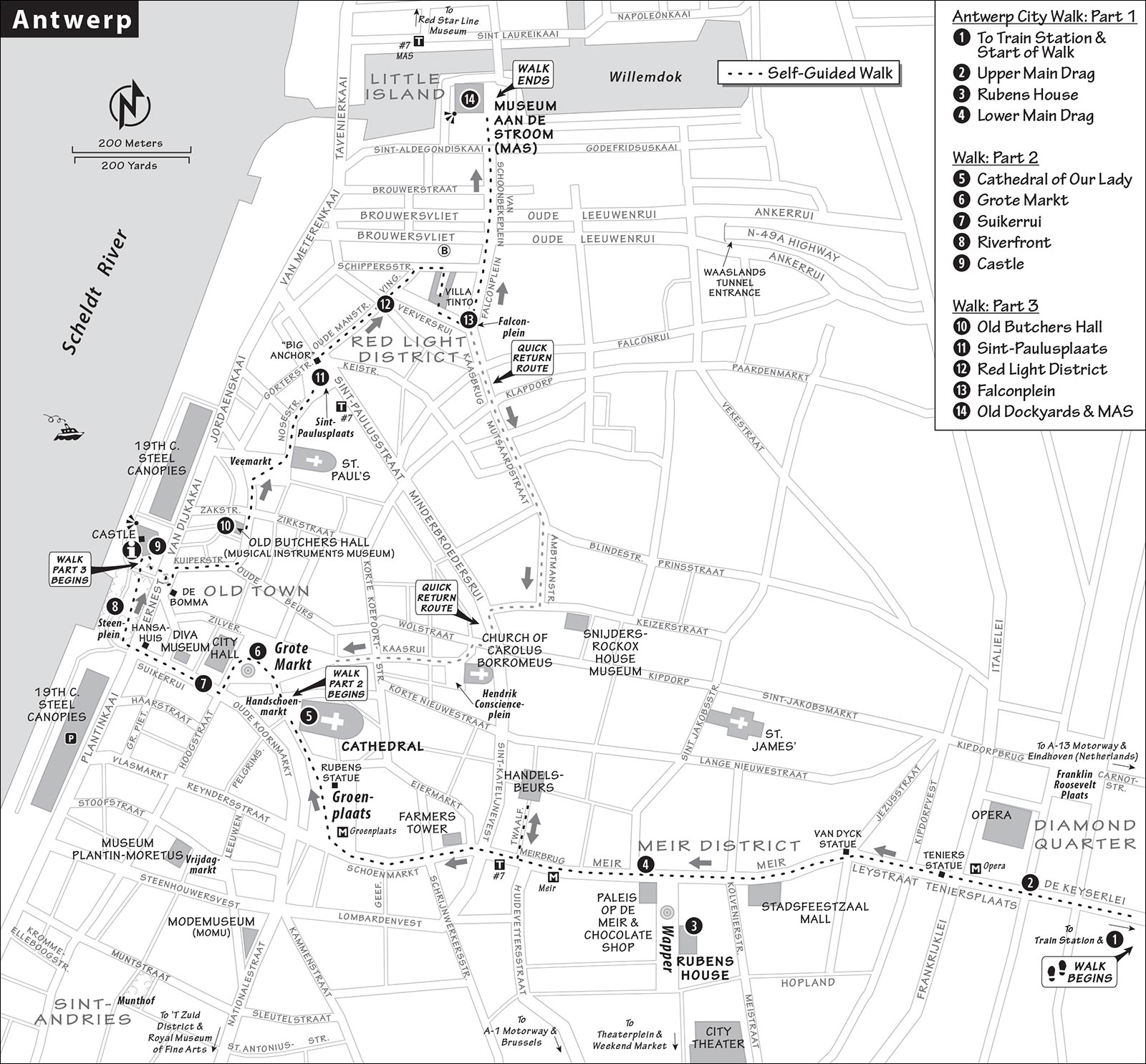
This three-part, L-shaped walk starts at the train station, turns right at the Old Town, and ends at the harbor to the north (follow the route on the “Antwerp” map, earlier). With this walk, you can say you’ve “seen” Antwerp, as it laces together many of the city’s main sights. It’s ideal for day-trippers who want to see everything in a few hours’ blitz from the train station.
You can also enjoy the different parts at your leisure, and in any order: Part 1 of the walk is an easy stroll from the train station down a modern, pedestrian-friendly shopping street to the heart of town. Part 2 covers the historic core—the towering cathedral, the Grote Markt, and the riverfront where the city was born. Part 3 takes you where fewer tourists go—through a residential neighborhood, the red light district, and to the modern dockyards, with two great museums.
Along the way, you’ll see the city’s historic architecture, youthful citizens, trendy restaurants, and a high-tech brothel. You can also take this opportunity to stop in and tour several sights, including the cathedral or the Museum aan de Stroom (MAS). The walk ends with a view back over the towers, steeples, cranes, and skyscrapers of this teeming city.
Length of This Walk: The whole walk covers two miles. Allow at least 30 minutes for each part, plus another 20-30 minutes to return to your starting point. Budget additional time if you go inside any sights along the way. With limited time, skip to Part 2 by riding the Metro directly from the train station to the Old Town (Groenplaats stop). You could also skip Part 3 and visit the MAS separately.
PART 1: FROM THE TRAIN STATION TO THE OLD TOWN
1 Antwerp’s Train Station
• Start on level +1—the highest level of tracks (under the 19th-century steel-and-glass arch). The tracks dead-end just before the ornate old-timey clock.
The city’s central train station is not merely a convenient transportation hub, it’s a work of art and a loud-and-clear comment on a confident new age. Built between 1895 and 1905 and expanded a century later, it’s an eclectic mix of historical art styles: Industrial Age meets Art Nouveau, giddy with steel and glass.
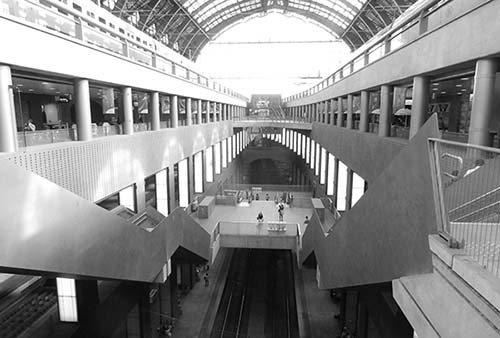
Look down through the center of the station to see the various levels of train tracks. The original station was all on one level—you’d walk from your wheezing steam train directly to the place you’re standing now. But dead-end stations are just too slow for today’s express trains, so they’ve excavated these several layers of tracks. Today’s fastest trains, on the lowest level, pass straight through a tunnel beneath the station—connecting Antwerp with Amsterdam or Paris in just an hour or two.
Look up at the vintage clock in the center of the hall. Set into a facade of gray marble and gold trim, towering high above the tracks, this is a temple of time. Timekeeping was crucial in the age of train schedules. Belgium was a busy new colonial power, speeding into the modern age fueled by ivory and rubber from its colony in Congo. The station is the work of the “builder king” Leopold II. You’ll see his L monogram everywhere.
The Royal Café, to the left of the big clock, is first class, yet economical and elegant...a fine place for a quiet cup of coffee or light bite.
• Let’s start walking. Pass underneath the big clock and head down some stairs into the main lobby, with even more grandiose architecture. Antwerpen Centraal may be the best-decorated train station in Europe.
Facing the ticket office, turn left, passing by the pharmacy to exit under the Centrum sign. Once in the open air, you can see our route: From here, we’ll walk basically straight ahead on the Keyserlei pedestrian mall, past the ugly skyscraper, all the way to the Old Town. Your destination is in the distance—the lacy spire of the cathedral.
2 Upper Main Drag: Train Station to Rubens House
Stroll three blocks slightly downhill on the bustling, sand-colored boulevard called De Keyserlei, lined with chain restaurants and shops. Following European trends, this boulevard is becoming a bike-and-pedestrian zone.
You’ll pass by a few diamond and jewelry stores. This area is known as the Diamond Quarter—one of the world’s top centers where diamonds are sold wholesale and cleaved into smaller pieces to prepare them for cutting. While you could explore more of the “Diamond Square Mile” (stretching to the left, in the old Jewish Quarter), it’s mostly just more diamond shops and extremely casual-looking people with briefcases handcuffed to their wrists.
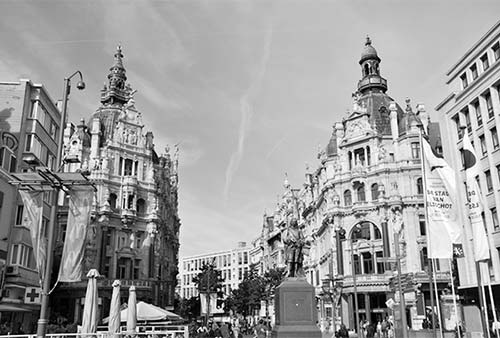
When you cross the tram tracks at Frankrijklei (marking the former town wall), you’re also crossing a massive highway underfoot (notice the offramp to your left). This was moved underground, then covered up, just a few years ago. Over your right shoulder, look for the glorious opera house, no longer engulfed in ugly traffic.
Just beyond, a noble bronze statue of David Teniers—one of several big Antwerp painters—marks a classic Antwerp street scene, bookended with grand facades built in the late-19th-century style called Historicism. This style cobbled together all the best, most bombastic bits and pieces from past styles to wow the viewer.
Passing the statue of Anthony van Dyck (1599-1641)—another talented Antwerp artist who worked with Rubens—you reach the pleasant pedestrian shopping street (and neighborhood) called the Meir (pronounced “mare”). This showcase shopping zone was built, like the train station, in the boom times around 1900.
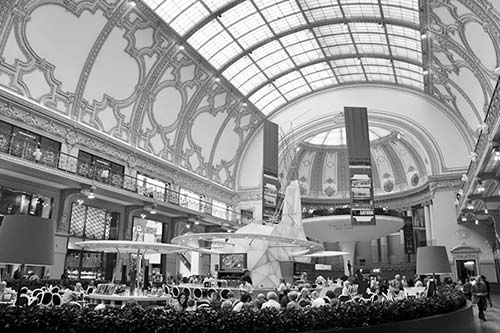
A long block ahead on the left is the grand Stadsfeestzaal shopping mall (with the gold niche over the door). Venture inside for a glimpse at its astonishing interior.
Back out on the Meir, keep strolling; it’s great for people-watching. Antwerp is diverse, and more than half its population has heritage from outside of Belgium. Along with the biggest Jain temple outside India and a sizable Buddhist community, about 40 mosques call Antwerp home. Antwerp also has many Black residents. Some came here generations ago from former colonies (the Belgian Congo, 1908-1960; Rwanda and Burundi, 1916-1962); others are more recent arrivals.
One block later, look left down Wapper Square, featuring (a block down) one of the city’s top sights, the 3 Rubens House. This former home of Peter Paul Rubens introduces visitors to the artist’s work and lifestyle. However, it’s closed for an extensive multiyear renovation. For the latest on its expected reopening date, ask locally.
4 Lower Main Drag: Rubens House to Cathedral
Just past Wapper Square is an ornate gray building on the left—the Paleis op de Meir. This gorgeous Rococo palace, built in 1745, was later purchased by Napoleon, who decorated it in Empire Style. With Belgium’s independence in 1830, this became one of the official residences of the king of the Belgians.
But what really matters is chocolate. At the Paleis entrance, step into the Chocolate Line shop. Notice the grisailles—the monochrome illustrations that look like 3-D carved reliefs but are actually flat paintings. Here, you can see the creative work of the crazy “shock-o-latier” Dominique Persoone (€4.50 for your choice of three wacky flavors). Past the shop, you can see a kitchen where truffles are being made.
Farther along, the Meir opens up. Continue about 150 yards and, nearing the end of the street (just before you cross to the corner with the giant skyscraper), turn right up the little lane called Twaalfmaandenstraat (between the first and second underground staircases to the Metro). Straight ahead at the end of the block, the building marked Anno 1872 is the Handelsbeurs. If it’s open, step inside (free, likely daily 10:00-18:00 in summer, often open unexpectedly at other times—just give the door a try, www.handelsbeursantwerpen.be).
Translated as “Stock Exchange,” the Handelsbeurs evokes Antwerp’s glory days as a trading power. This genteel hall—rebuilt after fires in 1583 and in 1858—feels like a gigantic vaulted cloister covered by a glass-and-steel roof, which bathes the space in light. (The current Neo-Gothic structure dates from 1872, with some very early echoes of Art Nouveau.) Historically, this was where Belgians would bring VIPs, including Winston Churchill, who visited after World War II. It later fell into disuse; locals recall the time when this neglected space was seedy and dangerous. Now fully restored as a public meeting and events space, it’s a fun place to wander around and simply take in the sparkling details. Ninety-six columns (each with a unique pattern—I checked) support two layers of galleries. Under the arcades, peruse the highly detailed maps, painted in oil by an actual sea captain in the 1870s. Even the wrought-iron ceiling supports are lacy with delicate floral motifs.
Back out on the Meir, cross the tram tracks and continue straight toward the Art Deco, Gotham City-style skyscraper called the Farmers Tower (or Boerentoren, though it’s officially named after its current occupant, KBC—a bank). Completed in 1932, this was considered the first Chicago-style skyscraper in Europe. It held the title of Europe’s tallest skyscraper for 20 years.
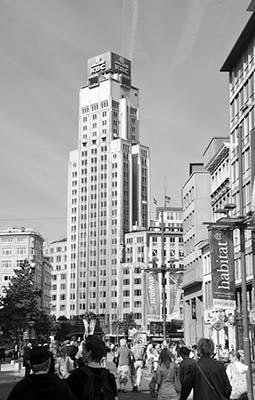
At the Farmers Tower, bear left along Schoenmarkt. This leads to the square called Groenplaats. Here you’ll find a handy Metro stop, a statue of Rubens—the third Antwerp artist we’ve seen on this walk—and the cathedral spire hovering just beyond. The high-fashion district is to your left, and the Old Town is beyond the cathedral.
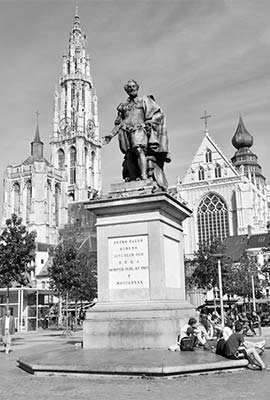
• Stroll through the square toward the cathedral. Bear left up a narrow street of restaurants (Jan Blomstraat) known as “Little Italy Lane.” It spills out at Handschoenmarkt in front of the cathedral. You’ve arrived at the historic center of Antwerp.
PART 2: FROM THE CATHEDRAL TO THE RIVERFRONT
5 Cathedral of Our Lady
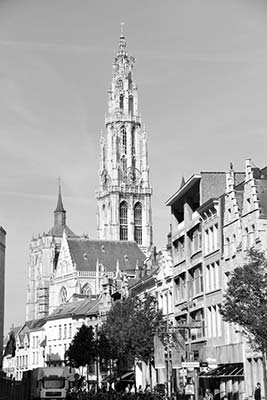
Antwerp’s biggest church, with its lacy 400-foot-tall spire—still the tallest structure in the city—dominates the Old Town. Its mismatched towers tell Antwerp’s story in a nutshell. The church was begun in 1352 and consecrated in 1521, when Antwerp was at its peak, and there were grandiose plans to make the already huge church even bigger—the biggest on earth. But then a 1533 fire gutted the church, and in 1576, the Spanish Catholics sacked the city, causing Protestants to flee (mostly to Amsterdam) and Antwerp’s fortunes to plummet. The church was left with only one completed tower—once the tallest in the Low Countries; the other is a stump of thwarted dreams.
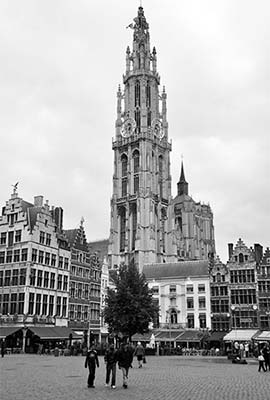
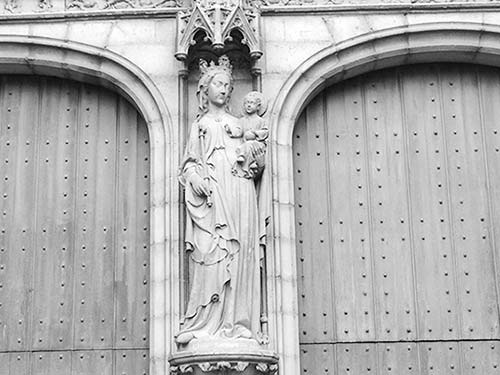
Though much of the facade was left undecorated, the tympanum (archway) over the main door is remarkable. It’s the Last Judgment, and Christ raises his hand to divide the righteous from the wicked. Below him, St. Michael weighs souls. One naughty lady is led away by a gleeful demon to be tormented for eternity. Farther down (between the doors) is a statue of Mary—“Our Lady”—who smiles, willing to save us from that grim fate.
The church’s richly ornamented interior is packed with fine art, including four masterpieces painted by Peter Paul Rubens (for details on visiting the church interior, see the listing under “Sights in Antwerp,” later).
• Now, as you face the church, turn left and exit the square by walking up Maalderijstraat. You’ll emerge in the...
6 Grote Markt
Antwerp’s main square is dominated by the stately City Hall (Stadhuis). Dating from Antwerp’s golden age (16th century), it’s adorned with flags from many different countries—representing the importance of international trade to the city. The central tower sports the golden coats of arms of great medieval powers that shaped Antwerp: the lion of the Duchy of Brabant, the gilded coat of arms of the city’s Spanish rulers, and the two-headed eagle of the Habsburgs.
The other buildings fronting the square are guild houses, celebrating the trade associations of each of the city’s industries. Each one is topped with a golden statue, which usually represents that guild’s patron saint. There’s a man on a rearing horse, a cat (or is it a wolf?), and (between those) a saint with a migraine. Some of these are over-the-top, exaggerated rebuilt versions from the Romantic period in the 19th century. The many ground-floor cafés (especially the venerable Den Engel and Den Bengel, which catch the most sun) are inviting places for a drink with a view. Locals say that when the outdoor terraces open up, they know summer has arrived in Antwerp.
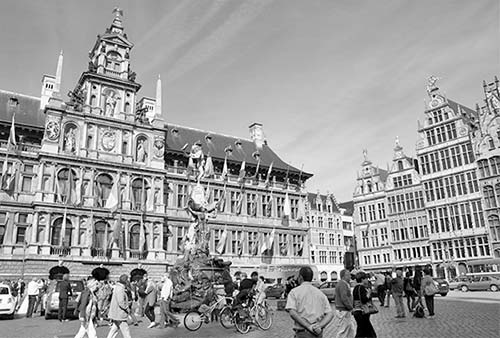
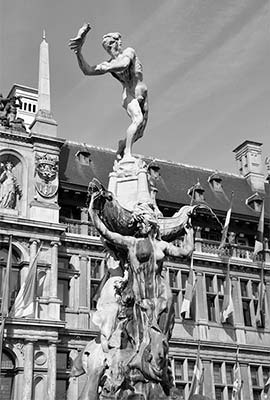
The unusual fountain in the middle of Grote Markt illustrates a gruesome story from Flemish folklore. Supposedly, a giant named Druon Antigoon collected tolls along the Scheldt River. If someone was unable or unwilling to pay, the giant would sever their hand. His reign of terror finally ended when a brave young Roman soldier named Silvius Brabo defeated Antigoon, then cut off the giant’s hand. Here we see Brabo in his wind-up, ready to toss Antigoon’s blood-spouting hand into the river. (You can circle around behind to see the giant’s bloody stump.) Tour guides love to explain that hand werpen (“to throw a hand”) evolved into “Antwerpen”...though scholars prefer less glamorous alternatives: “Antwerp” probably comes from an ’t werf, “on the wharf”; or ando verpis, “where land is thrown up against land” (because the river deposits sludge along the bank here).
• From the Grote Markt, exit the square along the left side of the City Hall. Now head toward the river up the big street called...
7 Suikerrui
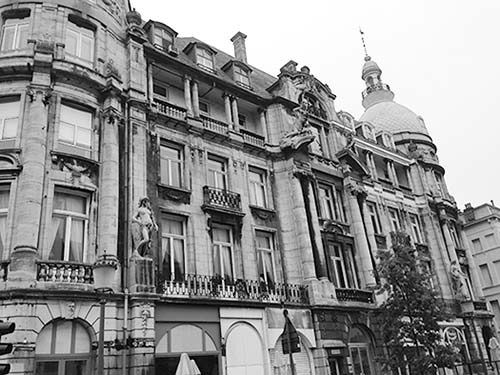
Along Suikerrui you get your first sense of Antwerp’s origins as a river-trading port town. Today’s paved street was once an open canal that flowed to the river. You’ll pass the much-loved statue of the unknown dockworker, whose insolent pose is both carefree and defiant. Created in 1890 by Constantin Meunier, it was put here after World War II to symbolize the heroic workers who kept the harbors open during the war (Arbeid Vrijheid means “Work Is Freedom”). It instantly became a symbol of the city. Midway down the block on the right, you’ll pass the entrance to the DIVA Museum, featuring exhibits on diamonds and silver (described later, under “Sights in Antwerp”). Farther along on the right, near the river, the building at #5 is adorned with big green statues. This is the former Hansahuis, where the German guild of traders had their regional headquarters.
• Suikerrui street leads to the...
8 Riverfront
Antwerp was born on the Scheldt River. The river flows northward 200 miles, from France to Belgium, before it bends westward through the Netherlands toward the North Sea. The city began right along the riverbank back in Roman times. Antwerp’s location was perfect for commerce: where the river trade to the interior met the oceangoing trade to the North Sea. The port was fortified with a castle, which, as you can see, still stands nearby.
During Antwerp’s golden age (early 1500s), the Scheldt brought more than a hundred ships a day, carrying goods from all over the world: sugar and silver from America, pepper and cinnamon from Asia. The city was completely cosmopolitan, full of international businessmen. But when Antwerp fell to the Spanish in 1585, everything changed suddenly. The Dutch gained control of the Scheldt’s river trade and Antwerp declined. It wasn’t until Belgium gained its independence in the 19th century that sea trade recovered.
Cross over to the riverfront walkway and turn right to head toward the castle. As you walk, you may see a waist-high concrete retaining wall that runs along the busy street. Because the Scheldt is a tidal river, there’s a huge risk of flooding—made more serious by rising sea levels. This retaining wall is equipped with orange steel doors that can roll along railroad tracks to open or close. The construction in this area represents the last phase of Antwerp’s project to control flooding and revitalize the riverfront by building raised parklike dikes with wide pedestrian walkways, sports courts, and playgrounds. (The area just south of the city center is already completed.)
• Straight ahead, you can’t miss the...
9 Castle (Het Steen)
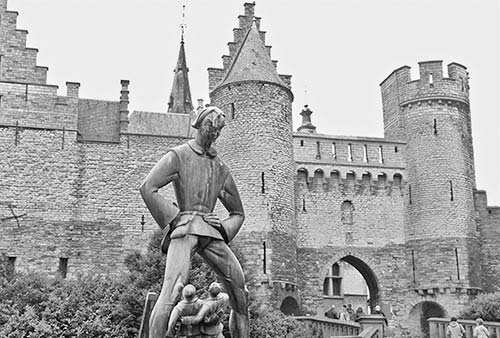
Once part of a city wall that fortified the heart of town, this is all that’s left from the medieval era. Billed as “Antwerp’s oldest building,” it was begun in the 800s, and parts of today’s structure date from the 1200s. Today it houses a sprawling gift shop with TI counters and an overpriced high-tech exhibit called “The Antwerp Story” (see description later). At the entry ramp into the castle, notice the statue of the legendary giant intimidating two poor traders. (Or perhaps he’s being diagnosed by a pair of medieval urologists.)
When the TI is open (daily 10:00-18:00), you can walk upstairs for a panoramic view (follow signs): Take the stairway up two floors, cross a courtyard to a small tower, and ascend another short stairway to a little terrace, where you can look out over the spires and rooftops of Antwerp in one direction, and the river in the other. Today, the port of Antwerp is Europe’s second largest—but you’d hardly know it standing here, because the main docks have moved to the north (see the forest of cranes in the distance to the right). The steel canopies on either side of the castle are former 19th-century warehouses, today used for covered parking or to shelter old boats. Cruise ships dock along the canopies north of the castle to disgorge their passengers into town. (If the TI is not open, look for a path behind the castle where you can walk out toward the water.)
On the way back down from the panoramic view, notice the “Antwerp Story” exhibit on floor 1 (€7, same hours as TI). The exhibit features an impressive modern tapestry illustrating Antwerp’s history with a series of comic-book-like panels; a celebration of the city’s diversity, inviting you to see Antwerp through the eyes of nine residents from different walks of life; exhibits on the city’s fashion, design, and diamond industries; and a chance to virtually “fly” over the rooftops of Antwerp (projected onto the floor). While lightly entertaining, the experience feels like paying to watch a slickly produced chamber of commerce video promoting other sights in town. Feel free to skip it. Outside the exhibit, however, there’s an interesting interactive display that allows you to move ships around a map of the river to learn more about Antwerp’s history.
• Part 2 of our walk is finished. If you’re short on time and want to do some sightseeing in the Old Town, feel free to bail out now. Or, to return to the train station, make your way back to the cathedral and Groenplaats, and hop on tram line #9 or #15.
If you stick with Part 3, you’ll wander through Antwerp’s generally safe and well-patrolled red light district before reaching the rejuvenated old dockyards, with super-modern buildings. (If you’d like to see the dockyards, but not the red lights, simply walk north along the riverbank for about 15 minutes, then turn right at the harbor.)
PART 3: FROM THE RIVERFRONT TO THE RED LIGHT DISTRICT AND OLD DOCKYARDS
• From the castle, find the modest little staircase that takes you up and over the concrete retaining wall (or use the orange gates, farther along). Cross the busy street at the crosswalk and climb the stairs by the recommended Restaurant de Bomma. At the top of the stairs, turn left, walk 20 yards (enjoying a nice view of the castle), then turn right on Kuipersstraat. Follow Kuipersstraat as it curves through brick row houses. After two blocks, turn left on Vleeshouwersstraat to find a big old building.
10 Old Butchers Hall
This hall was built in 1504 to house one of Antwerp’s guilds—the butchers. The impressive red-and-white stone structure (which locals say reminds them of bacon) was the neighborhood meat market. If not closed for renovation during your visit, you can tour the Musical Instruments Museum here (see listing later, under “Sights in Antwerp”).
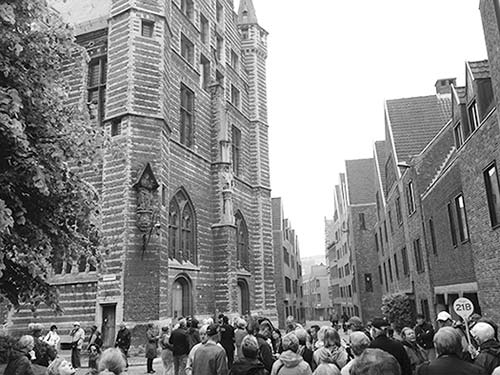
Notice that the building stands on something quite rare in Antwerp: a small hill. As the hill was always a desirable place to live, this is one of the oldest neighborhoods. But the area today is mostly modern, sterile brick buildings. It was bombed heavily by Nazi V-2 rockets in World War II. Only the Old Butchers Hall survived. Then in the 1970s, whatever remained was replaced by these modern, brick “projects”—subsidized housing. Notice there are no pubs or shops in this poor neighborhood. But if you poke around, you’ll discover pleasant public courtyards tucked back inside many of these buildings, with benches that are inviting on a sunny day (and sinister on a cold, dark night).
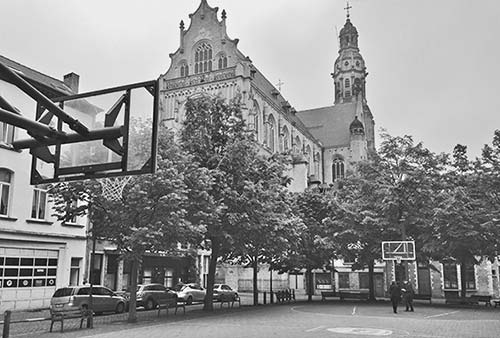
• With the Old Butchers Hall on your left, head gently downhill on Vleeshouwersstraat. Walk two blocks. At a pleasant residential square (Veemarkt), cut diagonally across the basketball court, turn left, and continue on Nosestraat, passing St. Paul’s Church. Angle right to reach the square called...
11 Sint-Paulusplaats
This used to be a medieval harbor, then a bustling sailors’ quarter with red lights in the windows. The area now has its share of trendy, youth-oriented restaurants.
At this point, you could cut this walk short and opt out of the red light district. Follow the tram tracks to the Sint-Paulusplaats stop, where tram #7 (direction: Mortsel) can take you back to the Old Town.
If you’re continuing into the red light district, take a few minutes to read ahead (especially the directions) before tucking your book away and walking boldly through.
• The route through the red light district is simple: It’s basically a straight shot—two long blocks. So, start walking past the big anchor and over the tram tracks, up the pedestrian street Oudemanstraat, which becomes Vingerlingstraat, and into the heart of the red light district. Follow the road as it curves to the right (through another block of the red light district) and eventually spills out on peaceful Falconplein. See you there.
12 Red Light District
Enter Antwerp’s red light district—Belgium’s biggest hub of legalized prostitution. There are sex shops, sleazy bars, peep shows, and sex workers shimmying in windows. (It feels more comfortable during the day but is livelier after dark.) City leaders believe that legalizing prostitution and concentrating it here makes things safer for sex workers, their clients, and city residents at large.
In the 19th century, Antwerp’s red light district was notorious the world over; these days, it’s a much tamer place, but still provocative. Most people who come here aren’t “lookie-loos”—they’re all business. You’ll see a few rowdy “stag parties” making a racket, but mostly lonely men silently prowling the pedestrian zone.
Near the end, on the right, is an alleyway marked Villa Tinto—essentially a shopping mall of ladies in windows. Designed by prominent artist Arne Quinze, it’s a state-of-the-art brothel. It has a high-tech system of “panic buttons” that sex workers can use to call for help and a police station right in the middle. If a prostitute needs help, it’s considered better that a police officer answers the call than a pimp.
• You’ll pop out on a long, narrow square called...
13 Falconplein
Falconplein is a nice landing spot after the sleaze of the red light district. It used to be pretty seedy—dubbed “Red Square” for its Russian mafia-style thugs—but city leaders cracked down and gentrified the space.
• At Falconplein, turn left. Cross busy Brouwersvliet (a former canal where cargo ships unloaded their goods). Continue straight ahead, on Van Schoonbekeplein, toward the red buildings with our final sight: the museum called MAS. Had enough? No MAS? You could end the walk now and return to the center of town (for details, see the end of the walk).
14 Old Dockyards and MAS (Museum aan de Stroom)
You’ve reached Antwerp’s old industrial port area—once thriving, then dreary, and now revitalized. The port was built by Napoleon in the early 1800s and became the world’s first Industrial Age harbor. It was a bustling area of brick warehouses and towering cranes. But by the 1950s and 1960s, the city’s shipping industry relocated to larger ports farther north, and it fell into decline. In the mid-1980s, city leaders decided to reclaim and gentrify this prime real estate.
Today it’s home to a tidy little yacht marina, a row of desirable condos, some trendy restaurants, and a state-of-the-art museum in an eye-catching tower. A few masted ships and old floating cranes keep alive the memory of this harbor’s 19th-century heyday.
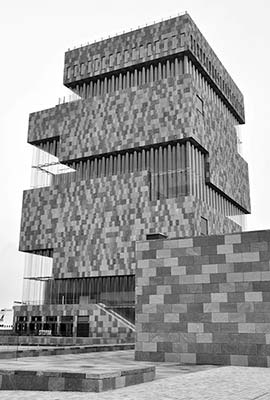
The Museum aan de Stroom (Museum on the River), or MAS for short, is housed in a 210-foot-tall blocky tower, encased in hand-cut red stone and speckled with silver hands (the symbol of Antwerp). Designed to resemble the spiraling stacks of goods in an old maritime warehouse, the museum emphasizes the way Antwerp’s status as a shipping center has made it a crossroads for people from around the world. Since you’ve made it this far, it would be a shame not to check it out. The building itself is free to enter and wander around in (but you need to buy a ticket if you want to enter the exhibit). It’s free to ride the escalators up 10 stories to the museum’s rooftop. It takes a while, but the view is good. (Visitors with disabilities can ascend by elevator.) After this long walk, you’ve earned a look back over all you’ve traversed. For a description of the view, the building, and the museum exhibits, see “Sights in Antwerp,” later.
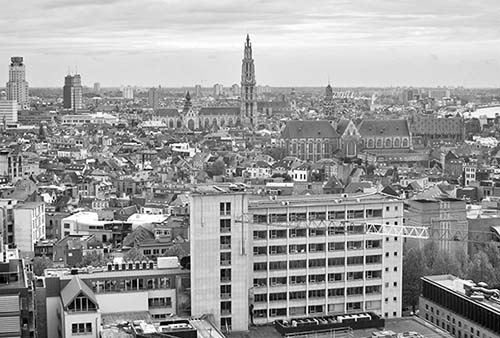
The museum’s global focus is a fitting end to this walk through Antwerp—a city built on global trade.
• You’re done. The Red Star Line Museum (with its impressive coverage of emigration from here to America) is a 10-to-15-minute walk beyond the MAS (see “Sights in Antwerp,” later).
Getting Back to the Center: To walk back to the Old Town, the quickest route (15 minutes, see the “Antwerp” map, earlier) is to return to Falconplein and exit the square at the far end, heading south down Kaasbrug street, which quickly becomes Mutsaardstraat. After about four blocks, you reach an intersection at a small square. Turn right on Minderbroedersstraat and begin following signs to the Grote Markt (or jog straight from the intersection another block to reach the Snijders-Rockox House—see “Sights in Antwerp,” later).
To return to the Old Town or train station by tram, cross the water on the pedestrian bridge north of the MAS and turn left, where you’ll find the MAS stop for tram #7. Hop on and get off five stops later at Meirbrug, where you can transfer to the Metro (Meir station, lines #9 or #15).
To return to the train station by bus, backtrack from the MAS to the wide Brouwersvliet, cross it, and look for the bus stop on your right. From here you can catch bus #17 (direction: UZA) to the train station.
Sights in Antwerp
▲▲Cathedral of Our Lady (Onze-Lieve-Vrouwekathedraal)
Musical Instruments Museum at the Old Butchers Hall (Museum Vleeshuis)
DIVA (Diamond and Silver Museum)
▲Snijders-Rockox House Museum (Snijders&Rockoxhuis)
AT THE OLD DOCKYARDS, NORTH OF DOWNTOWN
▲Royal Museum of Fine Arts (Koninklijk Museum voor Schone Kunsten Antwerpen, or KMSKA)
Antwerp offers an eclectic array of sightseeing, so if you have just one day (or less), you’ll need to be selective. Every sight is either in the old center or within walking distance, and many are stops on my Antwerp City Walk.
OLD TOWN
▲▲Cathedral of Our Lady (Onze-Lieve-Vrouwekathedraal)
Antwerp’s biggest church has a spire that shoots like a Gothic rocket 400 feet up from the middle of the Old Town. Its cavernous interior is packed with fine artwork, including four paintings by Rubens.
Cost and Hours: €12, Mon-Fri 10:00-17:00, Sat until 15:00, Sun 13:00-17:00, Handschoenmarkt, +32 3 213 9951, www.dekathedraal.be.
Tours: Free English tours are sometimes offered—ask or check the website.
 Self-Guided Tour: Stepping inside, notice how remarkably wide the cathedral is (250 feet), with three aisles on either side of the nave.
• Take a seat in the nave.
Nave: Looking up, you’ll see that the Gothic design is also dramatically vertical—everything stretches upward (90 feet) toward heaven. The stained-glass windows (some of them original) colorized the light emanating from inside, drawing worshippers like moths to a flame. After dark, in medieval times, the interior was filled with countless candles, and this was the only place to find bright light.
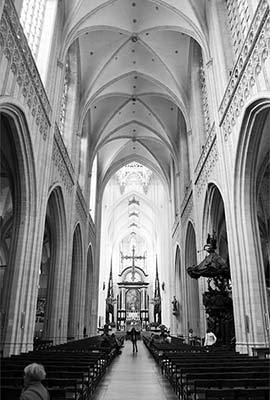
Sitting here, ponder the cathedral’s troubled history: It was gutted by the fire of 1533, then stripped of its medieval decoration by iconoclastic Protestants (in 1566). A few fragments of colorful murals remain on the underside of the vaults, where the iconoclasts couldn’t reach. After the Catholics came to power (1585), they redecorated the church in bubbly Baroque, including several pieces by Rubens. Napoleon’s troops (late 18th century) turned the church into a stable and carried off several Rubens paintings (returned from Paris much later). Church leaders redecorated with a hodgepodge of ecclesiastical art brought here from elsewhere.
One of these later additions, along the right side of the nave, is the Rococo pulpit (1713)—a riot of birds, foliage, and cupids symbolizing the spread of the faith and the word. All that amazing carving is supported by four figures: allegories of the four main continents, with Europe in front and Africa around back...pointedly in the dark.
• Cross over to the left side of the nave, where a long, skinny chapel fills the left aisle.
Chapel: Step in and walk to the far end to see a 16th-century devotional statue depicting the “Madonna of Antwerp”—one of many depictions of St. Mary you’ll find inside her namesake church. Notice, in the ceiling above this chapel, some of the surviving decorations from pre-iconoclast times.
Back outside the chapel, along the wall, look at the life-size wood figures, which were relocated here from a countryside church. There are two dozen figures in all, all mixed together: the 12 apostles, as well as 12 female figures that transition from vice to virtue, by way of confession and repentance. Try to figure out which vice or virtue is which, and notice how the woman ages as she evolves from bad to good—a poignant reminder that self-improvement is a lifelong journey, and time is limited.
• Now walk up the left aisle (with the Madonna of Antwerp chapel on your left) until you reach the transept. Here you’ll find two of the church’s four paintings by hometown boy Peter Paul Rubens. The first one you reach—face to face, in the left transept—is the...
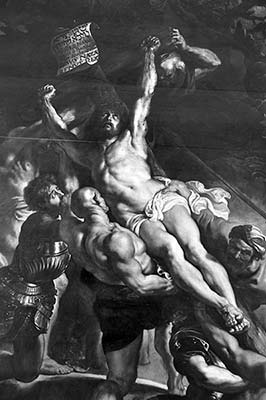
Raising of the Cross (1610-1611): Biblical bodybuilders strain to upright the cross, which is heavy with the swooning body of Christ. The painting is emotive, sumptuous, and almost sensual. Rubens had just returned from eight years in Italy, and the influence is obvious—Michelangelo’s twisting poses and bulky musculature and Caravaggio’s light-dark contrast. Notice how lifelike Jesus’ skin appears—a Rubens forte. The bold diagonal composition, thickly muscled bodies in motion, bright (almost garish) colors, and illusion of movement are vintage Rubens. The painting is the inner panel of a hinged altarpiece; it was normally kept closed, and opened to reveal this scene only on special occasions—when its color and motion must have been even more striking to churchgoers unaccustomed to this sort of spectacle. Even the baby (lower left) looks up from the important work of breastfeeding to take it all in.
Born in Germany in 1577, Rubens at age 12 moved with his family to Antwerp, where he was apprenticed to a local painter. During his twenties, he studied in Rome, where he picked up the Italian fad of painting giant compositions on huge canvases. He returned to Antwerp in 1608, married, and settled down, buying today’s Rubens House in 1610. He would live and work there for the remainder of his life, churning out painting after painting.
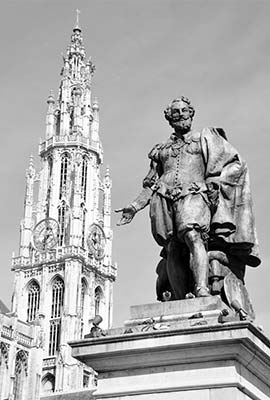
Rubens’ paintings run the gamut, from realistic portraits to lounging nudes, Greek myths to Catholic altarpieces, pious devotion to rough sex. Rubens painted anything that would raise your pulse: battles, miracles, hunts, rapes, and especially, fleshy “Rubenesque” women with dimples on all four cheeks. An expert of composition, Rubens could arrange a pig pile of many figures into a harmonious unit. Each painting was powered with an energy that people called his “fury of the brush.”
Everything is on a larger-than-life scale in Rubens’ work. Many canvases almost fill entire walls—you can see the seams where the cloth pieces were stitched together—and approximately 2,500 canvases bear his name. How could he paint so many enormous canvases in one lifetime? He didn’t. His house was an art factory, designed to mass-produce masterpieces. As was standard at the time, his assistants did much of the work: After he laid out a painting, his apprentices painted the background and filled in minor details. Rubens orchestrated the production from a balcony, and before a painting was carried out his tall, narrow door, he would put on the finishing touches, whipping each figure to life with a flick of his furious brush.
Rubens’ fascination with plus-size models, and his skill at capturing their rippling folds of fat, are the reasons we now describe certain figures as “Rubenesque.” The sweet faces and ample proportions of the damsels he painted were inspired by Hélène Fourment, 37 years Rubens’ junior, whom the artist married after his first wife died.
Rubens distinguished himself as a smart businessman who knew how to provide wealthy benefactors with exactly what they wanted. In his long career, he was rich, famous, well traveled, and the friend of kings and princes. A true Renaissance Man in the Baroque Age, Rubens was even an accomplished diplomat—he helped to negotiate peace between England and Spain (and was knighted by the kings of both countries in appreciation).
• Cross over to the other side of the nave. In the right transept is Rubens’...
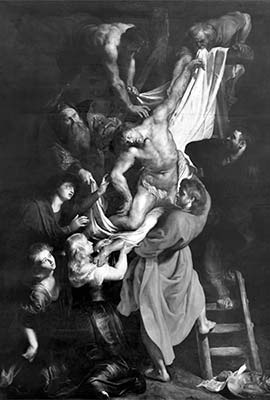
Descent from the Cross (1612-1614): This diagonal composition—the mirror image of Raising of the Cross—is a freeze-frame of an action-packed moment...just as workers strained to erect the cross with Christ’s limp body, now they struggle to lower him from it. But at this somber moment, everyone seems to be moving more slowly, methodically. Notice the pallor of Christ’s dead skin—a strong contrast to the lifelike luster of the other painting. The details make the poignancy of this moment come to life: the man in the top-right corner who’s holding on to the shroud with his teeth; Mary’s outstretched arm, in a tender matronly effort to comfort her son even in death; and, in the lower-right section, a blood-filled bronze basin holding the crown of thorns and the nails. This main canvas is flanked by side panels showing people “carrying” Christ in two very different ways: on the left, a pregnant Mary, and on the right, presenting the Baby Jesus at the temple. You may see Japanese tourists admiring this painting, as it figured into a novel that’s popular in Japan.
• To continue the story through the eyes of Rubens, proceed farther up the right aisle, next to Descent from the Cross (with the altar and choir area on your left). Enter the second chapel on the right side. Look right to see—on the back wall of the chapel—Rubens’...
Resurrection (1611-1612): A radiant Christ strides vigorously out of the tomb, offering hope of revival to the deceased. Rubens painted this for some prominent Antwerpenaars buried here. Note the names on the plaque: Plantin and Moretus, of the well-known printer families (whose names also adorn the city’s best history museum).
• Back in the ambulatory, head a few steps farther toward the back of the church, then go up the stairs on your left into the elevated choir/altar area. Here we find Rubens’ final chapter.
The Assumption (1626): Rubens captures the moment that Mary—the cathedral’s namesake, in a position of honor over the altar—was brought up to heaven. Beneath Mary are the 12 apostles (after the Resurrection, the faithful disciple Matthias replaced Judas) and the three women who were present at her death. The role of Mary in church doctrine was one of the major dividing lines between Catholics and Protestants; whereas the Catholic Church considered her a saint to be venerated, the Protestants embraced the notion that she was an ordinary woman called to do God’s work. The gauzy heroine-worship of this canvas makes it clear who finally controlled the turf here.
• Head back the way you came.
More Sights in the Church: You can cross over to the sacristy, with historic portraits of the church’s 21 local bishops; nearby, you can descend to the crypt to see foundations of earlier structures, as well as five old brick tombs, some painted with red crosses, uncovered during excavation.
On your way out of the church, pause in the middle of the transept and gaze up to the painted dome of the cupola high above the center (which looks domed yet is flat) for one last image of the saint to whom the church is dedicated...Mary.
Finally, as you exit the church toward the shop (with a WC to the left), you can’t miss the glittering Man Who Bears the Cross (2015), which ponders that challenge of balancing one’s faith in a complicated, modern, increasingly secular world.
Musical Instruments Museum at the Old Butchers Hall (Museum Vleeshuis)
This restored brick palace, home to Antwerp’s butchers during the city’s glory days, has more recently housed a collection of musical instruments. Renovations may be underway when you visit; if so, displays may be smaller or different than what’s described below, or may have moved temporarily to the Museum aan de Stroom (MAS; see listing later).
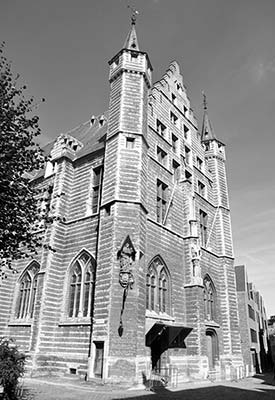
The collection shows off a variety of instruments, including medieval bagpipes, hurdy-gurdies, drums, sackbuts, church bells and carillons, unusual early versions of modern instruments, classic harpsichords, pianos, and even a glass harp. Many of these instruments come with audio so you can hear what they sound like. The collection also features re-creations of a foundry for making church bells and a brass-instrument workshop.
Cost and Hours: If open, likely €8, Thu-Sun 10:00-17:00, closed Mon-Wed, Vleeshouwersstraat 38, +32 3 292 6101, www.museumvleeshuis.be.
DIVA (Diamond and Silver Museum)
Antwerp has long been a center of the diamond trade—and over the years, a variety of exhibits and museums have attempted to tell the story of the silver, gold, and gemstones that have passed through the city. The latest iteration, called DIVA, begins in the mines and then explores valuation, fraud detection, ethical mining, and centuries of history. Finally, visitors wind up in glittering rooms displaying dining sets, jewelry, and other precious items.
Cost and Hours: €12, includes audioguide; Thu-Tue 10:00-18:00, closed Wed; Suikerrui 17, +32 3 360 5253, www.divaantwerp.be.
▲Snijders-Rockox House Museum (Snijders&Rockoxhuis)
Nicolaas Rockox (1560-1640) was a mayor of Antwerp and a friend of Peter Paul Rubens. His neighbor was Frans Snijders, a painter of still lifes and also a friend of Rubens. Today their adjoining houses—buried amid a residential zone a 10-minute walk northeast of the cathedral and Grote Markt—have been transformed into a lovely museum. Exploring here, it’s amazing to think of the interplay of personalities and ideas in 17th-century Antwerp. You’ll get a truly authentic look at aristocratic homes from the period (unlike the Rubens House, which was rebuilt) while viewing impressive artwork, furniture, and a beautiful garden courtyard. Exhibits draw from the men’s vast personal art collections and include works by Rubens, Van Dyck, and Breughel.
Cost and Hours: €10, Tue-Sun 10:00-17:00, closed Mon, Keizerstraat 10, +32 3 201 9250, www.snijdersrockoxhuis.be.
Visiting the Museum: The paintings are not labeled or described; rather, you’ll be given a tablet computer that you can point at any item to get more information. If you wear the provided headphones, an audio track (narrated by various characters associated with the house) will also begin with each room you enter. Here’s a quick orientation to the collection to help you find your way.
Most of the works are in the Rockox house. But first you’ll cross next door into the Snijders house, to begin in...
Room 1: This hall displays some large-scale still lifes, including one of an impressive hanging dead deer. This is the work of Frans Snijders, noted for his realistic animals. You’ll also find biographical sketches of the two men who gave this museum its name. Head back through the ticket area and go up a few stairs into...
Room 2: You’re introduced to the world of Antwerp in the 1600s by several portraits. Over the fireplace, Rockox is shown from the ruff-collar up. Nearby, a portrait by Rubens shows two more ruff-wearers: Albert and Isabella, the Habsburg (Spanish) rulers of the Low Countries. The portrait of Antwerp’s bishop is by Anthony van Dyck.
Room 3: Appreciate Rockox’s fine fireplace and beautiful art cabinets, where he kept his collection of curios. He would bring these objects out at dinner parties as conversation pieces. Van Dyck’s Study of a Man’s Head demonstrates the artist’s skill in bringing ordinary people to life.
Pass through Room 4, then cross the courtyard to...
Room 5: Spend some time with Pieter Brueghel the Younger’s fun The Proverbs. This is one of 20 copies he made of his father’s famous work. The painting makes literal more than a hundred Flemish sayings and figures of speech. There’s your basic “banging your head against a wall” (lower left). Find other well-known proverbs: “the die is cast” (in the window, upper left), “don’t cry over spilled porridge” (lower right), “the blind leading the blind” (upper right), and “casting pearls (roses) before swine” (lower middle). Some scenes have multiple meanings; one in the lower left is a three-fer, with “armed to the teeth,” “bell the cat,” and “not a cat to handle without gloves.” Others don’t make literal sense, but you get the drift: “He’s so rich he tiles his roof with tarts” (upper left) or “He’s so poor he’s stretched between two bread loaves” (lower right). And many more make no literal sense at all, like the unfaithful wife (lower middle) who cuckolds her husband by “putting on the blue cloak.” And, “Who knows why the geese go barefoot?” To learn more, use the touchscreen.
Room 6 has an old rifle, a rather grotesque portrait of a moneylender (a popular subject early in the 16th century, when capitalism was taking hold), and a scene from Homer’s Iliad painted by Antwerp artist Jacob Jordaens. Strongly influenced by the slightly older Rubens, Jordaens was one of the great Flemish artists working after Rubens’ death.
Room 7 displays an art cabinet resembling a miniature theater, and Room 8 (the former kitchen) has a small but insightful portrait of an old woman by Rubens.
Finally, go upstairs (Rooms 9-10, in the neighboring Snijders house) for a look at the music room and a collection of period instruments. Here Rockox, Snijders, Rubens, and Van Dyck might have gathered to enjoy good music and the fruits of the golden age. You can listen to a selection of pieces, including one by local composer Leonora Duarte, who was part of a prominent musical family in Antwerp.
▲▲Rubens House (Rubenshuis)
This museum is closed through at least 2030 for an extensive renovation. When open, the museum offers Europe’s best look at the artist Peter Paul Rubens. By touring the house he lived and worked in (more a replica than “authentic”), you get a sense of both the man and his art. For updates on the renovation project and possible temporary exhibits, see Rubenshuis.be.
AT THE OLD DOCKYARDS, NORTH OF DOWNTOWN
The dockyards—an easy 15-minute walk north from the Grote Markt—have been boldly redeveloped and now house a pair of fine museums: the Museum aan de Stroom (MAS) and the Red Star Line Museum. For the most interesting approach here, through Antwerp’s red light district, see Part 3 of my Antwerp City Walk (earlier). Otherwise, from the train station, take Metro lines #9 or #15 (direction: Linkeroever or Regatta) to the Meir stop. Go above ground there and take tram #7 (direction: Eilandje); get off at MAS, which is the final stop. If you’re short on time, the Red Star Line Museum is more worthwhile than the Museum aan de Stroom.
▲Museum aan de Stroom (MAS)
The Museum aan de Stroom (Museum on the River)—housed in a strikingly modern building—hosts an eclectic collection that’s fitting for this global-crossroads city. In addition to exhibits on Antwerp, you’ll see pre-Columbian stone heads (world-class, but probably not what you came to Antwerp to see), African masks, Polynesian fertility statues, weapons, and an array of temporary exhibits. In this city of excellent museums, this collection is nothing special, but the building itself and its roof terrace—which are free to enter—make it worth the trip. Exhibits change frequently, so what’s described here may be gone when you visit.
Cost and Hours: Building—free to enter and explore, Tue-Sun 9:30-24:00, off-season until 22:00, closed Mon; exhibits—€10, extra for temporary exhibits, open Tue-Sun 10:00-17:00, closed Mon, last entry one hour before closing; informative English booklets in most rooms; top-floor top-class restaurant (by reservation only) and ground-floor casual café, 15-minute walk north of Groenplaats at Hanzestedenplaats 1, +32 3 338 4400, www.mas.be.
Visiting the Museum: In the lobby, buy your ticket (if you want to enter the exhibits) and pick up information brochures, then ride the escalators up, up, up through 10 levels. The escalators and hallways often feature free exhibits such as poems celebrating Antwerp or photographs of the city’s people and history.
The museum’s permanent exhibits are on floors 4-8. The first three are dedicated to Antwerp: “City at War” (on floor 4) explores the impact of World War II on Antwerp; in “Antwerp à la Carte” (floor 5), you learn the story of food in this busy port town; and “Freight” (floor 6) displays models of the many kinds of ships that docked here and traces the evolution of the port through videos and photos. Floor 7 has an exhibit for children called “Anybody Home?” that considers what “home” means. And finally, floor 8 is an excuse to show off the museum’s exquisite collection of pre-Columbian artifacts.
Finish your visit by ascending to the rooftop panorama (floor 10). Find the soaring spire of the Cathedral of Our Lady. To the left of that is the unmistakable Farmers Tower skyscraper. To the right of the cathedral is the Scheldt River. And around you is the harbor—the huge cranes, barges, container ships, tugs, and vast warehouses. It stretches into the distance and is one of the busiest ports in the world.
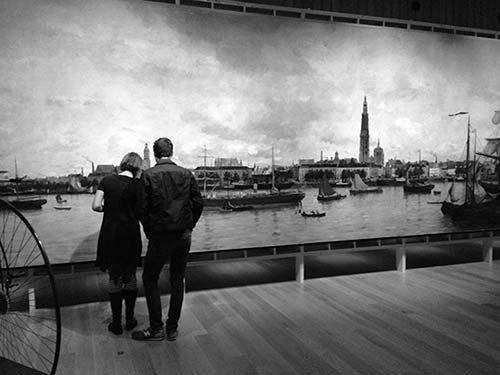
Nearby: The low-lying, long building just in front of the MAS houses a small, free exhibit on the Port of Antwerp, where you can put on virtual-reality glasses and walk across a blown-up aerial view of the sprawling port area for a sense of its astonishing scale (Tue-Sun 9:00-17:00, closed Mon).
▲Red Star Line Museum
This cutting-edge museum tells the story of the Red Star shipping line that brought European emigrants to the Americas from 1873 to 1935. The route passed through the port of Antwerp, and many emigrants were processed in the very hall where the exhibits now stand. The museum combines personal stories with high-tech presentation to detail the “other end” of the Ellis Island experience. This sight is rated ▲▲ for any North Americans descended from European immigrants, and it is worth the 10-to-15-minute walk beyond the MAS.
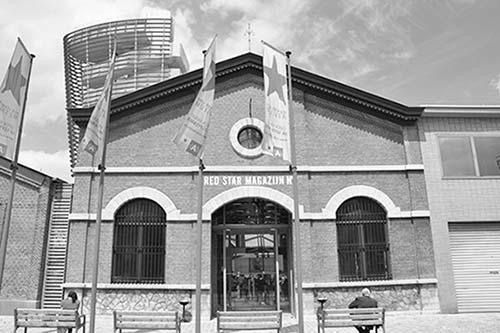
Cost and Hours: €10, more for temporary exhibits, Tue-Sun 10:00-17:00, closed Mon, Montevideostraat 3, +32 3 298 2770, www.redstarline.be.
Getting There: From the MAS, cross the drawbridge and head up Nassaustraat, past the two-tone green skyscrapers. Just after those buildings, turn left down Montevideostraat. This part of Antwerp’s docklands is still being redeveloped, so it’s not easily accessible by public transportation.
Background: In the late 19th century, Europe was changing. The Industrial Revolution, the end of traditional peasant lifestyles, and a tremendous population boom led to political instability and economic turmoil. Across the Atlantic, the United States and Canada symbolized a hope for a better life. And during the great migration between 1873 and 1935, the Red Star shipping line brought some two million emigrants from Antwerp to New York City. This was the point of exit not only for Belgians but also for people from all over Europe—especially Germany and Eastern Europe—who rode in rickety trains all the way across the Continent to get here. (By the 1930s, many of the emigrants were Jews fleeing the Nazi regime in Germany.) The 10-day steamer journey transported cargo, luxury travelers, and “steerage-class” peasants alike. In these red-brick warehouses, emigrants underwent humiliating health exams and nervously waited while clerks processed their paperwork. (Because arriving passengers who were ill were immediately deported at the shipping line’s expense, screening procedures were stringent.)
Visiting the Museum: Your visit is a one-way route: ground floor, upstairs, and then the elevator to the view terrace. The displays have good English information, and there’s a free info booklet.
First up is a powerful exhibit—using wraparound video screens—that drives home the point that immigration is as common today as it was in the heyday of Ellis Island. Displays profile different kinds of immigrants through history—from the first humans who left Africa in 40,000 BC to Ellis Island to the migrant workers of today.
Next, you follow in the footsteps of individuals who passed through this very building to board ships for the prospect of a new start in the New World. A 10-minute video introduces you to some of the Red Star Line’s passengers, and touchscreens let you zoom in on stories in the emigrants’ own words (including Albert Einstein’s). You’ll see the (deceptively) glossy brochures that the shipping lines used to lure customers. A map of Europe demonstrates how far many immigrants had to travel by train even before stepping on the ship. And there are period photos of Antwerp—the last European city many of these soon-to-be-former-Europeans would ever see.
The next section details the invasive processing procedures for passengers before they were allowed on board: They were stripped of their baggage and clothes—which were disinfected—then required to shower and be inspected for lice and disease.
Upstairs, you’ll learn about the actual voyage. With steam power replacing sails, the trip to America went from 40 days down to 10. You’ll see models of various Red Star Line ships through the years. Some were floating cities of 2,500 passengers. You’ll also see the harsh contrast between life in first class and the miserable world in steerage.
The museum culminates with the stirring moment when immigrants first saw the Statue of Liberty. The final room emphasizes that Antwerp today is a city not of emigrants but of immigrants—people from other countries flocking here to pursue their dreams.
Before leaving, you can ride the elevator (and avoid the seemingly endless stairs) up to the panorama tower for a glimpse at the last view many Europeans enjoyed of their home continent before leaving forever.
SOUTH OF THE OLD TOWN
These museums line up south of the Grote Markt. The Museum Plantin-Moretus and ModeMuseum are a short and easy stroll away, in the fashion district of Sint-Andries. The Royal Museum of Fine Arts is farther south (a long walk or a quick tram or taxi ride) in the pretty, lively zone called ’t Zuid. Both of these areas have great eateries, farther from the touristy zone around the Grote Markt. For suggestions, see “Eating in Antwerp,” later.
▲▲Museum Plantin-Moretus
In the digital age, it’s easy to forget how revolutionary printing books once was. Antwerp of the 1500s was a wide-open city, disseminating ideas from its newfangled presses. This museum is named for two influential Antwerp printers: Frenchman Christoffel Plantin, who began a printing business here in 1546; and his son-in-law Jan Moretus, who carried on the family business. (Eventually, they were the official court printer for the Spanish monarchs of the Low Countries.) This building was both the family’s home and their workshop. It’s a remarkably well-preserved look at 16th- and 17th-century aristocratic life, while also illustrating several aspects of Antwerp’s golden age. You’ll see early printing presses, the printer’s historic workshop and house, old books, and art and memorabilia owned by the prominent printing family. Every Flemish kid comes here on a field trip to understand their enlightened heritage. If you love books, this place is worth ▲▲▲.
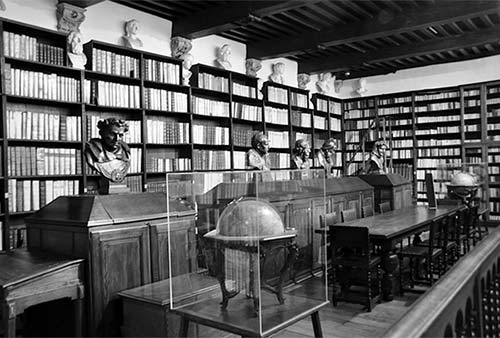
Cost and Hours: €12, includes audioguide, Tue-Sun 10:00-17:00, closed Mon, Vrijdagmarkt 22, +32 3 221 1450, www.museumplantinmoretus.be.
Visiting the Museum: There’s a lot to see in this meandering maze of rooms. I’d suggest following my tour to hit the highlights, while using the excellent—and humorous—audioguide for the whole story. Allow at least one hour to appreciate the place. Though the building is large and sprawling, you follow an easy, one-way route. From the ticket desk, begin by heading to the base of the old stairs to enter the exhibit.
Ground Floor: This floor tries to re-create the house as it looked in the 16th and 17th centuries. Even the lighting is low to simulate a candlelit glow. Room 1 has tapestries on the walls; in Room 2, a large and elaborately decorated hall, find Rubens’ portrait of Plantin (right of the fireplace). In Room 3, find portraits from nine generations of the family—each generation represented by a book in the display case.
Step into the courtyard, and—to the right—find Room 4, a reconstructed bookshop. On the wall is a list of books forbidden by the Catholic Church: The list was printed by, and includes books sold by, Christoffel Plantin. Continue through this wing to Room 6, which offers you a chance to handle paper similar to the type used when printing was young.
Back through the courtyard, Room 7 has a printing press and displays on how it worked—one man inking it up, another lowering a blank paper onto it, then rinsing and repeating every 20 seconds. If you’re lucky, a volunteer will be running the press during your visit—ask if you can help. In the proofreaders’ room (Room 9), you can imagine diligent editors huddled around the enormous, shared oak desk, debating the 17th-century equivalent of whether “email” takes a hyphen. The publisher’s private leather-bound office (Room 10) is classy and surprisingly small.
Finally, you reach the actual workshop. Neatly stacked in Room 13 are some 10 tons of lead letters, with racks of complete sets of fonts and different type sizes. (By the end of his life, Plantin possessed 90 different fonts.) In Room 14, you’ll see several presses, type cases, and other printer’s tools. At the far end stand the two oldest printing presses in the world (c. 1600).
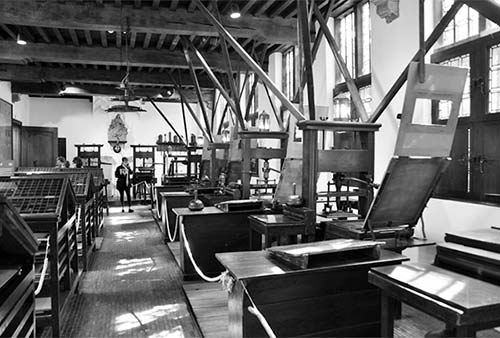
Upstairs: Exhibits here represent the impact Plantin’s books had on the world, organized around the themes of language, science, society, and religion. Look for the vertical red labels by some of the books—these mark what curators feel are the top 10 books in the collection, such as the first Dutch dictionary and the world’s first atlas.
At the end of the first wing, you’ll go down a few stairs into smaller, darker, more lived-in-feeling rooms, including Plantin’s bedroom...with a tiny bed (Room 24). Down a few more steps, the next wing includes fine drawing rooms (and some of the creakiest floors yet).
Finally, near the end of the loop, Room 31 displays religious works, including a (possible) Bible by the founder of modern printing, Johannes Gutenberg (c. 1460). You’ll also see the best Bible that Plantin produced—a beautifully illustrated version from 1583; if you read Latin, it’s still perfectly legible today.
Room 32 displays a polyglot Bible, with five languages on one page, printed by Christoffel Plantin. It took five years to compile the text in Latin, Greek, Hebrew, Chaldean (Aramaic), and Syriac. The result is a masterpiece in eight volumes: four for the Old Testament, one for the New Testament, and three of commentary—weighing a total of 106 pounds.
Nearby: The museum is on a charming square called Vrijdagmarkt, where there really is a “Friday market” (as well as some recommended restaurants).
ModeMuseum (MoMu)
Antwerp is synonymous with fashion and design, and this small museum is perhaps the best place in this city to learn about those topics. Changing exhibits celebrate Belgian designers and display items from an extensive collection of clothing, textiles, accessories, and historic tools and machines used for textile production. Archival footage of fashion shows and interviews with designers add depth.
Cost and Hours: €12 or pay-what-you-will, includes audio-guide, Tue-Sun 10:00-18:00, closed Mon, café, Nationalestraat 28, +32 3 470 2770, www.momu.be.
▲Royal Museum of Fine Arts (Koninklijk Museum voor Schone Kunsten Antwerpen, or KMSKA)
This grand and hulking museum, which anchors the ’t Zuid neighborhood, displays some of the finest works of art in this city of artists. The heart of the collections, which cover seven centuries of primarily Flemish art, is the monumental Rubens Gallery, purpose-built to showcase the works of Peter Paul Rubens, the famously prolific Antwerpenaar and master of the Flemish Baroque.
Cost and Hours: €20, includes excellent audioguide for your phone; Mon-Fri 10:00-17:00, Thu until 22:00 in Sept-June, Sat-Sun 10:00-18:00; €€€€ restaurant (reservations required) and €€€ café, Leopold de Waelplaats 2, +32 3 224 7300, www.kmska.be.
Visiting the Museum: Enter and buy your ticket on level 0, then walk up one level to the De Keyser entrance gallery, where paintings by 19th-century Antwerp artist (and academy director) Nicaise de Keyser hang high up near the ceiling along all four walls. Across the large canvases a pageant of artists proclaims Antwerp’s illustrious artistic heritage: Look for Jan van Eyck and Rogier van der Weyden, Albrecht Dürer visiting Quentin Matsys (a.k.a. Massijs), and Peter Paul Rubens in his study. It’s a fitting welcome to this museum celebrating Flemish artists.
Up the grand marble staircase, on floor 2, are the Old Masters and the large Rubens Gallery (Room 2.2), whose 50-foot ceiling accommodates the display of mammoth Rubens altarpieces. (You may even see restoration work underway on one of them.) Notice the Epitaph of Nicolaas Rockox and His Wife Adriana Perez (1613-1615). It was commissioned by the Antwerp mayor, art lover, and friend of Rubens whose house is now a museum. (See the Snijders-Rockox House listing, earlier.) Two altarpieces by Anthony van Dyck, Rubens’ talented student, are also on display here.
In the themed galleries surrounding the Rubens Gallery, you may find more Old Master artworks (Van Dyke, Gentileschi, Memling, Hals) sharing space with modern works. (While the museum is recognized for its Old Masters, modern works make up 70 percent of its collections.) Some rooms are more fun than others. Room 2.10 (“Entertainment”) celebrates cards, carousing, and music making—take a moment to absorb the satisfied expressions on the faces depicted in Smokers (1633) by David Teniers II and the riotous peasant energy of Pieter Bruegel the Elder’s Wedding Dance (1566). Room 2.19 (“Suffering”) looks at the other side of human experience, depicted most witheringly in Rogier van der Weyden’s Seven Sacraments (1445), which shows scenes of torture, a beheading, and the sorrow of Mary over her crucified son.
When you’ve had your fill of Old Masters, take the elevator or stairs to floor 4: Modern Masters. Here three bright-white galleries are the inverse of floor 2, with modern works taking center stage and organized by themes (such as “Light,” “Form,” and “Color”). Peek into Room 4.2 for the appealing work of Rik Wouters (1882-1916), whose paintings are spectacles of expressive color.
From there, descend to floor 3, where three small, dark blue rooms display gently illuminated cases containing sketches and maquettes representing the early attempts by Rubens, Van Dyck, Jordaen, and other artists to give form to their ideas.
Finish your visit down on floor 1, which draws from an extensive catalog of works by James Ensor (1860-1949), an Ostend-born Modernist who was among the founders of Les XX (“The Twenty”)—Belgium’s homegrown avant-garde movement.
Nearby: Whew! After a visit to this sprawling museum, the surrounding streets offer enticing nightlife and dining; for recommendations, see listings later in this chapter.
Sleeping in Antwerp
Because it’s a commercial center and a major European port, Antwerp has an abundance of business-class hotels. On summer weekends, it’s also a popular party town—so prices can go even higher. While I’ve listed a few options oriented to business travelers, most of my recommended lodgings are more homey establishments concentrated in the Old Town and the high-fashion Sint-Andries district. If you want to look elsewhere, consider ’t Zuid, but be more cautious about the neighborhood around the train station.
€€€€ Hotel Julien, a chic boutique hotel, is Antwerp’s most enticing splurge. Located in a renovated 16th-century building on a drab street just outside the Old Town, its 21 rooms are a perfectly executed combination of old and new. The public areas, with high ceilings and lots of unfinished wood, feel like an art gallery. If you want to pretend you’re royalty—or a rock star—rent the “experience plus” suite (breakfast extra, air-con, spa in basement, Korte Nieuwstraat 24, +32 3 229 0600, www.hotel-julien.com, info@hotel-julien.com).
€€€€ Hotel Rubens is a solid choice for fresh, predictable, business-class comfort. Its 36 rooms are on a quiet street just a block off Grote Market (air-con, Oude Beurs 29, +32 3 222 4848, www.hotelrubensantwerp.be, booking@hotelrubensantwerp.be).
€€€ Antwerp Business Suites has eight bright, classy, smartly appointed, neat-as-a-pin rooms above a business center and gallery just a few minutes’ walk from the Grote Markt. While the rooms—equipped with good desks—are designed for businesspeople, they’re also a comfortable option for tourists and a good value on weekends. Conscientious mother-and-daughter team Anny and Lynsey offer a personal touch (breakfast extra, air-con, Reynderstraat 30, +32 3 502 1000, www.abs-antwerp.be, info@abs-antwerp.be).
€€€ Aplace/Antwerp offers two stylish suites and two apartments overlooking charming Vrijdagmarkt and the Museum Plantin-Moretus. Expertly decorated with a lifetime’s worth of midcentury finds, the spacious suites have a shared “coffee corner”; the apartments offer full-size kitchens (apartments require minimum 3-night stay, last-minute shorter stays sometimes possible, no breakfast, no elevator, Vrijdagmarkt 1, +32 473 735 650, www.aplaceantwerp.be, sleep@aplace.be, knowledgeable Karin makes you feel at home).
€€€ Hotel O Kathedral, on the small square facing the Cathedral of Our Lady, is a modern 33-room boutique hotel with a lounge and a swanky adjoining café-bar-chocolate shop (selling handmade chocolates). “Superior” rooms are plastered with oversized Rubens prints, and “deluxe” rooms place you right inside the paintings by integrating them onto the walls and ceilings (air-con, breakfast extra, Handschoenmarkt 3, +32 3 500 8950, www.hotelokathedral.com, info@hotelokathedral.com).
€€€ B&B Sablon rents three rooms above a café near the river. Two rooms have a private bath across the hall, and one has a bath en suite. While the rooms are a bit plain, host Gea offers a warm welcome and the location is handy (cash or direct transfer only, breakfast served in café, no elevator, Zand 25, +32 468 104 917, https://bb-sablon-hotel.com).
€€ CityStay Antwerp, a great value warmly and conscientiously run by Tobias, has seven tidy, well-appointed rooms on a quiet back street just behind the Butchers Hall, a short walk from Grote Markt (air-con, no elevator, Burchtgracht 43, +32 472 525 297, www.citystay.be, tobias@citystay.be).
€€ Matelote Hotel (“Sailor”) enjoys a central location on a characteristic street deep in the Old Town, just a few steps from...everything. Its nine quiet rooms (eight overlooking a central courtyard) mix heavy old beams with modern flourishes and offer some nice extras such as electric kettles, small bottles of wine, and minifridges with free mineral water. Thoughtful host Erik creates a calm and welcoming oasis (air-con, no elevator, Haarstraat 11a, +32 3 201 8800, www.hotel-matelote.be, info@matelote.be).
¢ Pulcinella Youth Hostel is Antwerp’s most modern official hostel, with 162 beds. In addition to 4-to-6-bed dorms, it also has 21 doubles—offering privacy and bargain prices (fee for nonmembers, in the fashion district at Bogaardeplein 1, +32 3 234 0314, www.jeugdherbergen.be, antwerpen@vjh.be).
Eating in Antwerp
In this trendy, youthful city, the range of options is as impressive as it is ever-changing. What’s good one year is old news (or closed) the next. While I’ve tried to recommend some reliable standbys, the best strategy may be to do some online research, ask locals for recommendations, or simply browse appealing streets or squares and choose the menu and ambience that stand out.
ON OR NEAR GROTE MARKT
On a balmy summer evening, a sea of outdoor tables—each one perfectly positioned to catch every last fleeting moment of sunshine—gives this zone a nearly Mediterranean vibe and attracts both tourists and locals. Many options here are Italian, Greek/Turkish, and French. At most places, you can choose your view, then overpay for forgettable food. I’ve selected a few well-established eateries that offer decent value for this high-rent location. With the exception of Restaurant de Bomma, skip these places if you can’t snag an outdoor table in nice weather—the interiors are nothing special. For less touristy, less expensive alternatives, see the later sections.
€€€ Restaurant de Bomma, as the name indicates, is like eating at Grandma’s. The menu of rib-sticking Belgian classics (robust stews, potatoes, mayonnaise-heavy salads) is designed to be shared, family-style. They have a big terrace overlooking the riverfront road, with great views onto the castle. And the sprawling interior is done up country-cutesy. The theme? Grandma, of course (closed Mon-Tue, reserve for dinner, Willem Ogierplaats 3, +32 3 773 32 01, www.restaurantdebomma.be).
€€€€ Maritime fish restaurant, just down the street from the Grote Markt toward the river, is a fixture among locals for a seafood splurge. While the interior is dressy, the outside tables are plain (closed Wed-Thu, reservations smart, Suikerrui 4, +32 3 233 0758, www.restaurantmaritime.be).
€€€ Pasta-Hippo-Vino, with a ridiculous name and what appears to be the most touristy location in town, has somehow cultivated a loyal following of Antwerpaars who appreciate its good-value Italian cuisine (daily, Oude Koornmarkt 32, +32 3 213 1686).
On Grote Markt: Two places are tucked back in a little corner facing City Hall on Grote Markt; they both have nondescript indoor and big-view outdoor seating: €€ Bia Mara is an outpost of the Brussels-based eatery, founded by an Irishman (the name means “Sea Food” in Irish Gaelic), serving a variety of sustainable fish-and-chips (daily, Maalderijstraat 1, +32 3 707 2387). €€€ Meat Factory adds turf to the surf, focusing on beef; while the steaks are pricey, the good-quality burgers are an affordable choice (dinner daily, also open Sat-Sun for lunch, Grote Markt 28, +32 3 336 7445). The nearby waffle-and-ice-cream place, Compagnie Belge, turns out good-quality but grossly overpriced desserts (daily in summer, closed on fluctuating days off-season, Grote Markt 16).
Pelgrimstraat and Nearby: This street—which branches off the wide main Oude Koornmarkt drag at the recommended Pasta-Hippo-Vino—has some interesting choices. Head south on this street for a tempting variety of options ranging from tapas bars and rustic taverns to sushi, Thai, and South American restaurants.
€€€ ’T Hofke, just off Pelgrimstraat down a tiny medieval alley purported to be the oldest in Antwerp, serves Belgian and other European classics in a cozy, rustic interior. Two cobbled courtyards with unbeatable ambience offer outdoor seating. In summer you may need to reserve a week or more ahead for dinner, but it’s worth it (daily, Oude Koornmarkt 16, +32 3 233 8606, www.thofke.com).
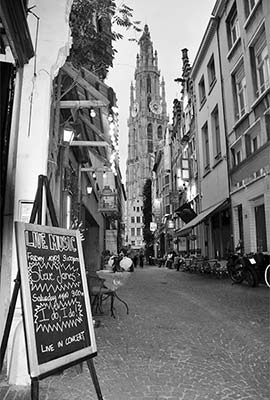
Handschoenmarkt: This small, attractive Old World square, directly in front of the Cathedral of Our Lady’s main entrance, has a variety of scenic options. Browsing here—and along Blauwmoezelstraat, which curls around the left side of the cathedral—can turn up some lovely outdoor dining options with characteristic ambience.
Fries: The handiest place to get a cone of frieten, or fries, € Frituur No. 1 offers the full array of fried, meaty gut-bombs and lots of sauces. While most of their business is takeaway, they also have ample seating (daily until late, Hoogstraat 1; for tips on Flemish fast food, see “Eating” in the Practicalities chapter).
Groceries: Three good grocery stores cluster around Groenplaats: There’s an Albert Heijn at Groenplaats 43 in the former post office building (daily) and a full-size Carrefour nearby in the basement of the Grand Bazar (Beddenstraat 2, closed Sun). Cru Supermarket at Groenplaats 40 has a more upscale selection (daily).
MORE CHARACTERISTIC SPOTS IN THE CENTER
If you’re willing to stroll just a few minutes beyond the Grote Markt and cathedral, you’ll find abundant options with lower prices, plenty of personality, and a more local clientele. Many of these are to the south, moving toward the Sint-Andries fashion zone.
€€€ Billie’s Bier Kafétaria is a tiny gastropub popular with locals for its good food and even better beer (11 on tap, another 250 in bottles and cans). The small menu covers Flemish basics like pork cheeks, plus a few other hearty helpings such as chili. You might even meet Billie—who isn’t the owner, but the dog (Wed-Mon 16:00 until late, Sat-Sun from 14:00, closed Tue, Kammenstraat 12, +32 3 226 3183).
Hendrik Conscienceplein: This delightful, Italian-feeling cobbled square—dominated by a towering Baroque Jesuit church—sits just a five-minute walk behind the cathedral. Several restaurants have inviting outdoor seating here; it’s worth a browse. One good option is €€€€ Bohm & Berkel, a French-style brasserie with high prices but perhaps the best seating on the square (at #3; closed Mon-Tue).
Vrijdagmarkt: A short walk south of the Old Town core, “Friday Market Square” is just that; the other six days a week, it’s simply a tidy, leafy, welcoming square with a nice variety of al fresco restaurants. This area is lively midday and quieter at night. Among the options are €€ In de Roscam, an old-school pub (at #12; closed Tue); and €€ Goodie Foodie, an amiable brunch spot renowned for its American-style pancakes (Tue-Sun 10:00-16:00, closed Mon, Leeuwenstraat 23).
Maarten Lutherplein: This humble square, with the fine Munthof hedged park in its center, is less cutesy than some but feels more local because of it. Here you’ll find a pair of good-quality, low-key eateries with lots of inviting outdoor tables (and less appealing, tight interiors). €€€ Camino turns out a variety of Asian small plates (closed Sun-Mon, Muntstraat 4), while €€ Pici presents an enticing variety of fresh Italian pastas (closed Sat for lunch, Muntstraat 2).
Interesting Frituur: Of the many frieten places in Antwerp, € Frituur Chips has a particularly loyal following. Its thoughtful owner takes pride in the caliber of his chips and sauces, and he sources quality local meat for his burgers. With a few basic tables out on the humble square on a quiet back street, it’s a magnet for Antwerp’s frieten pilgrims (open Wed-Sun for dinner, also open Fri-Sat for lunch, closed Mon-Tue, Sint-Antoniusstraat 35).
Top-Quality Waffles: A short walk south of Groenplaats, €€ Désiré de Lille is the local favorite for waffles. If you want a Belgian waffle cooked to order or an old-fashioned decadent dessert, this historic waffle house is your best bet—it’s been keeping people happy for a century (daily 12:00-18:00, Schrijnwerkersstraat 16, +32 3 233 6226). A second location is at Suikerrui 32.
’T ZUID
For a more authentic Antwerp experience, head south to ’t Zuid. Literally “The South,” this is Antwerp’s top restaurant and nightlife zone. Frequented mostly by urbanites, this is where you’ll find many of the city’s hot new restaurants. Options are scattered around a several-block area, with one or two tempting eateries on each block. It’s about a 15-minute walk south of the Grote Markt (along entertaining Kloosterstraat, lined with antique and home-decor shops). Or, from Groenplaats, catch tram #4.
Marnixplaats: The confluence of eight streets facing a dramatic column dedicated to Neptune creates a circle of corner buildings made-to-order for al fresco drinking and dining. While many of these places are drinks-only (sometimes with light snacks), a few are suitable for a full meal. €€€€ Fiskebar is done up like a fish market (as its name implies) and lists a wide range of specialties on its chalkboard menu; it’s worth reserving ahead (daily, dinner seatings at 18:00 and 20:30, at #12, +32 3 257 1357, www.fiskebar.be). €€ Lucy Chang, part of a small and upscale Belgian chain, serves up tasty Asian noodle and rice dishes (daily, at #17, +32 3 248 9560).
Other Options in ’t Zuid: Find some well-regarded places on Volkstraat, including two interesting Vietnamese choices. €€€€ BÚN is upscale, pricey, and refined, with fixed-price meals, including vegan options (reservations recommended, closed Thu for lunch and all day Sun-Mon, at #43, www.bunantwerp.be); farther down and across the street, €€ Nuoc Mam is more casual and affordable, and quite tasty (closed Tue, at #72G).
On the other side of the Royal Museum of Fine Arts, €€€ Elsie’s offers a great opportunity to sample Ethiopian and Eritrean cuisine. While Antwerp has a large African émigré community, few restaurants are near the center—except this one. It features a few outdoor tables, cheery murals inside, and delicious home cooking (dinner only, closed Wed-Thu, Verschansingstraat 59, +32 484 309 329).
Shopping in Antwerp
As a capital of both fashion and avant-garde culture, Antwerp is a shopper’s delight, with a seemingly endless array of creative little corner boutiques selling unique items, as well as outlets for big-name international designers. Serious fashionistas and window shoppers will both find Antwerp’s quirky browsing culture one of the most delightful in Europe. Note that most shops open between 9:00 and 10:00 and close by the relatively early hour of 18:30.
Shopping Streets: Given the abundance of “pop-up” boutiques in town, it makes little sense to list specific shops; instead, I’ve focused on streets or neighborhoods worth a browse. As you explore, you’ll discover that each street has its own personality and specialties.
Schuttershofstraat and Hopland are where you’ll find famous-label international couture, while Kammenstraat is better for young, trendy, retro-hipster fashions.
I enjoy strolling the starburst of traffic-free streets that spin off from the leafy square along Lombardenvest (just south of the Farmers Tower). Each street has a different focus, such as shoe stores on Groendalstraat and clothing on Lombardenvest.
Kloosterstraat, which sticks closer to the river as it heads south from the Grote Markt area all the way to ’t Zuid, focuses on home furnishings—from antiques to minimalist furniture to home decor and gadgets. You’ll wish you had an unlimited budget to furnish an avant-garde Belgian flat.
A large upscale shopping center, Stadsfeestzaal, is on the boulevard called the Meir, between the train station and the Old Town. South of the Rubens House, streets like Leopoldstraat, Sint-Jorispoort, and Mechelsesteenweg are noted for antiques and home decor. Near the train station, the street called De Keyserlei is known for its jewelry and diamond stores.
Fashion District: Antwerp’s status as a fashion mecca is a relatively recent development. In 1988, six students from the Royal Academy of Fine Arts’ fashion department traveled to a London show, where they got a lot of attention. Because their Flemish names were challenging to pronounce, the English press simply dubbed them the “Antwerp Six.” Each one opened a shop in Sint-Andries, which at the time was a very poor neighborhood. They put this area on the map, other designers began to move in, and now it’s one of Europe’s top fashion zones. The academy is still up and running; it has a small enrollment and a strong focus on creativity (www.antwerp-fashion.be).
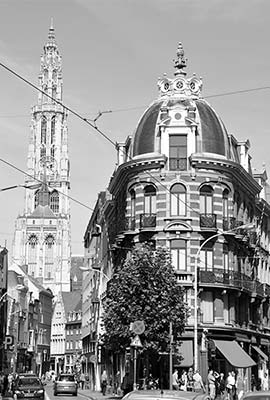
Sint-Andries is a few minutes’ walk south of the Old Town along Nationalestraat. While it’s a three-star destination for couture lovers, anybody would have fun window shopping here. In the shops along the streets of Sint-Andries, you’ll find top-name international designers, funky hole-in-the-wall boutiques, vintage shops, jewelers, and more. The TI offers thoughtfully designed resources for people interested in delving into Antwerp’s high-fashion scene.
Nightlife in Antwerp
Old Town Spots: After hours, Antwerp’s touristy core (around the Grote Markt and cathedral) hums with activity. Find a café or bar with outdoor tables, order a drink, and people-watch. Below are some favorites; note that most of these serve little or no food—go for the ambience and entertainment, not for dinner.
Den Engel, an old-fashioned pub at the corner of the Grote Mark (near the City Hall), is an obvious choice but also a local fixture. The cozy interior oozes authentic charm and feels like it’s been the family living room of Antwerpenaars for generations. Outside, it boasts my favorite view in Antwerp, of the dramatic cathedral tower rising behind a row of fine facades (a few bar snacks, long hours daily, Grote Markt 3, +32 3 233 1252). Den Bengel, next door, has equally good views but a lesser interior.
De Muze Jazzcafé is outrageously atmospheric, with happy drinkers filling antique wooden booths on three levels overlooking the bar. Most come for the live jazz (long hours daily; free jazz usually Mon-Thu from 21:00, Fri-Sat from 22:00, and Sun 15:00-18:00, schedule at www.jazzcafedemuze.be; Melkmarkt 10, +32 3 226 0126).
Billie’s Bier Kafétaria, recommended earlier under “Eating in Antwerp,” is an ideal spot to sample Belgian brews (a short walk south of Grote Markt at Kammenstraat 12).
Kapitein Zeppos, a 10-minute walk from the central square, is a big and inviting beer hall with good basic food (mussels and salads) and a serious appreciation for beer. On hot days, the square is filled with tables. Late in the evening the beer hall is filled with locals (Vleminckveld 78).
In ’t Zuid: A 15-minute walk or 5-minute bus or tram ride south of the Grote Markt, this area is the more local, somewhat younger alternative to the old core. Bars with outdoor tables cluster around two areas: Marnixplaats and in front of the art museum, at Leopold de Waelplaats (for details, see “Eating in Antwerp,” earlier). Along this square, Hopper feels urbane and untouristy—like you’re in on an insider’s tip. The interior is stark but dignified (long hours daily, Leopold de Waelstraat 2, +32 3 248 4933, www.cafehopper.be).
Antwerp Connections
From Antwerp by Train to: Brussels (3/hour, 40-50 minutes), Ghent (3/hour, 1 hour), Bruges (3/hour, 1.5 hours, half change in Ghent), Ypres/Ieper (hourly, 2.25 hours), Amsterdam (hourly by pricey Eurostar, 1.25 hours; also hourly by slower IC train, 1.75 hours), Amsterdam’s Schiphol Airport (hourly, 1 hour by Eurostar, 1.5 hours by IC train), Delft (hourly, 1.25 hours, most change in Breda), Paris (about hourly direct on Eurostar, 2 hours; more possible with a transfer at Brussels Midi/Zuid/South to Eurostar, 2.5 hours). For train information, see BelgianTrain.be; see also the “Transportation” section in the Practicalities chapter.