ORIENTATION TO BRUSSELS
Brussel • Bruxelles
Map: Brussels Public Transportation
Six hundred years ago, Brussels was just a nice place to stop and buy a waffle on the way to Bruges. With no strategic importance, it grew as a free trading town. Today it’s the capital of Belgium, the headquarters of NATO, and the seat of the European Union (EU). It’s also a fascinating and vibrant city in its own right, with fun-to-explore neighborhoods, good sightseeing, pleasant pedestrian zones, an impressive selection of restaurants, and a quirky Flemish/French mix.
The Brussels of today reflects its past. The city enjoyed a golden age of peace and prosperity (1400-1550) when many of its signature structures were built. In the late 1800s, Brussels had another growth spurt, fueled by industrialization, wealth taken from Belgian Congo, and the exhilaration of the country’s recent independence (1830). The “Builder King” Leopold II erected grand monuments and palaces. Then, in 1992, 12 countries established the European Union by signing the Treaty of Maastricht, and sleepy Brussels was thrust into the spotlight as the unofficial capital of the new Europe. It started a frenzy of renovation, infrastructure projects, foreign visitors, and world attention.
As a tourist destination, Brussels captivates some visitors and exasperates others. At its best, Brussels mingles French class and Belgian spunk and adds a shot of diverse, cosmopolitan energy. At its worst, it’s a crowded, jaded city of demanding tourists and stuffy bureaucrats. Its museums are respectable, but not quite befitting its status as a world capital. But if you make an effort to explore some less-traveled neighborhoods, you’ll experience another side of Brussels. The more you see, the more you’ll like it.
In Brussels, people speak French. Bone up on bonjour and play up the s’il vous plaît (see the French survival phrases in the appendix). The Bruxellois are cultured and genteel—even a bit snobby compared to their earthier Flemish cousins. The whole feel of the town is urban French, not rural Flemish. And yet there’s an impish sparkle and joie de vivre, as evidenced by the Bruxellois love of comic strips (giant comic-strip panels are painted on buildings all over town) and their civic symbol: a statue of a little boy peeing.
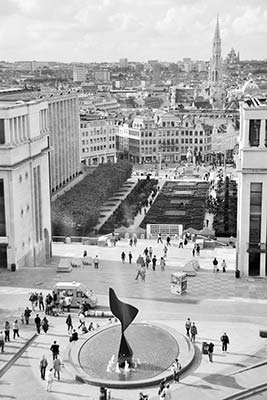
Brussels is the cutting edge of modern Europe, but still clothed in its Old World garments. Stroll the Grand Place, snap a selfie with the Manneken-Pis, and watch diplomats at work at the EU assembly halls. Then grab some mussels, fries, and a hearty Belgian beer, and watch the sun set behind the Town Hall’s lacy steeple.
BRUSSELS: A VERBAL MAP
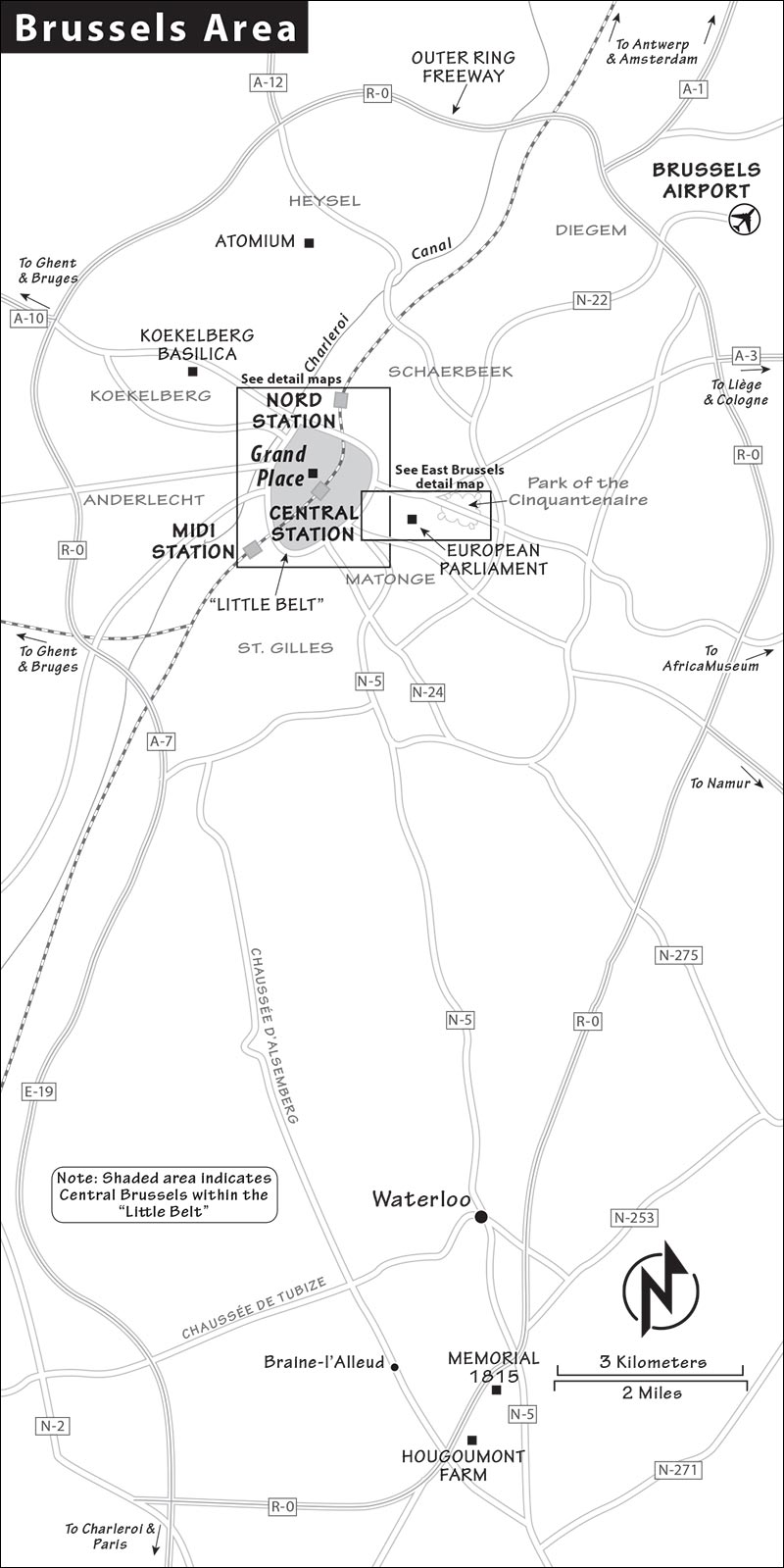
Central Brussels is surrounded by a pentagon-shaped ring of roads, which replaced the old city wall. All hotels and nearly all the sights I mention are within this ring. The epicenter (or petite ceinture, literally “little belt”) holds the main square (the Grand Place), the TI, and Central/Centraal station (all within three blocks of one another).
What isn’t so apparent from maps is that Brussels is a city divided by altitude. A ridgeline splits the town into the Upper Town (east half, elevation 200 feet) and Lower Town (west, at sea level), with Central station in between.
Brussels’ bilingual street signs give the French name first, then the Dutch. That, combined with the lack of a regular grid plan, can make navigating the city confusing. It’s easy to get turned around. I rely heavily on a good map or navigation app when exploring this town. Note that in the Brussels chapters of this book, after introducing a name in French and Dutch, I’ve used the French names alone to keep things simple.
It’s helpful to think of the city as a series of neighborhoods, each with its own character.
The Lower Town: This crowded, touristy district—with the Grand Place (in Dutch: Grote Markt, HROH-teh markt), narrow streets, old buildings, modern shops, tourist-trap eateries, and the famous Manneken-Pis peeing-boy statue—is squeezed between Central station and Boulevard Anspach.
West of Boulevard Anspach: This newly pedestrianized boulevard, which runs over the city’s forgotten river, marks the boundary between Brussels’ touristy core and its more characteristic neighborhoods. Just beyond Boulevard Anspach is the lively and youthful market square called Place St-Géry (Sint-Goriksplein). The Dansaert district (just above Place St-Géry, along Rue Antoine Dansaert) is a high-fashion district with a creative “bobo” (bourgeois-bohème) ambience. Just to the north is the Ste. Catherine neighborhood, a charming village-within-a-city huddled around the old fish market, and home to several recommended hotels and restaurants.
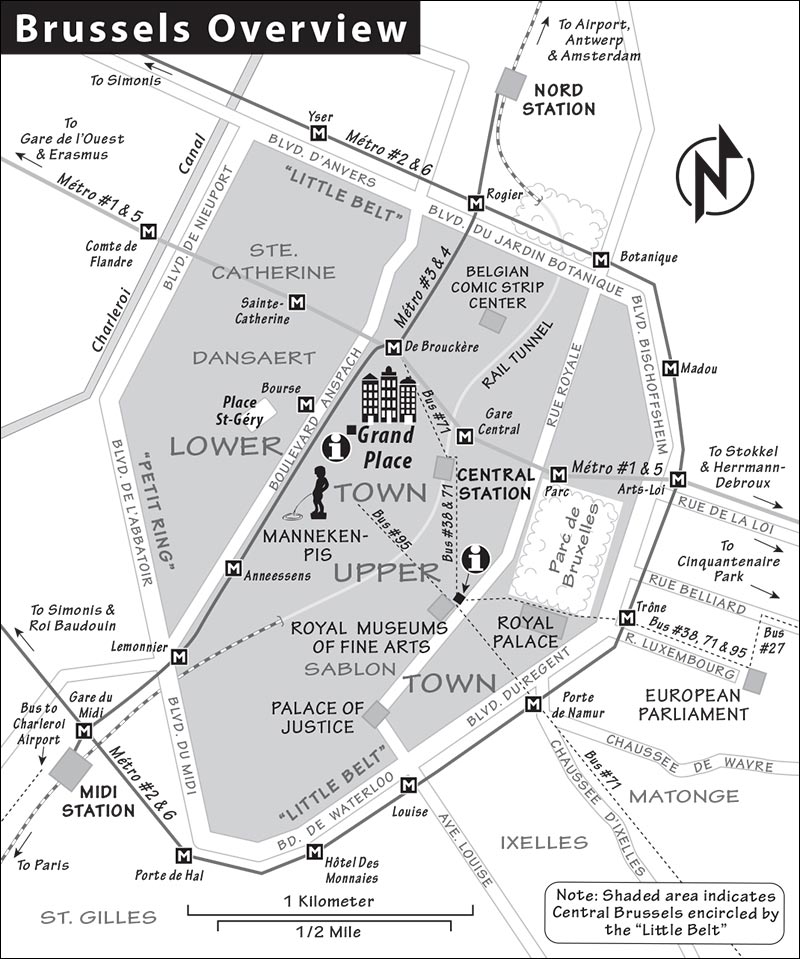
The Upper Town: This uphill, upper-crust district surrounds the Royal Palace. Traditionally the home of nobility and the rich, this area has big marble palaces, broad boulevards, and the major museums. Compared with other parts of the city, it feels stately and sterile. The zone between the Upper and Lower towns, called Sablon, feels French and urbane.
Beyond the Core: Everything within the center of town is walkable. Outside that zone, sprawling suburbs and vast green spaces contain attractions that are more easily reached by public transportation or taxi. To the east are the European Parliament and, beyond that, the Park of the Cinquantenaire (with the Royal Museum of the Armed Forces and Military History and Autoworld). Between the European Parliament and the Upper Town is Matongé, an immigrant African neighborhood that has become high-rent. And far to the north is the 1958 World’s Fair site, with the Atomium and Mini-Europe.
PLANNING YOUR TIME
For a city of its size and prominence, Brussels can be seen quickly: Its main attraction, the Grand Place, is a short walk from Central station; several good museums and neighborhoods are also easily walkable. On a quick trip, a day and a night are enough for a good first taste (but if you have more time, Brussels has enjoyable ways to fill it). Or—if you’re in a hurry—Brussels can be done as a day trip by train from Bruges, Ghent, or Antwerp (frequent trains, less than an hour from any of these) or a stopover on the Amsterdam-Paris or Amsterdam-Bruges ride.
Brussels in Three to Five Hours
Toss your bag in a locker at Central station and confirm your departure time and station (note that fast international trains depart from Midi/Zuid station—not from Central station). Then walk about five minutes into town and do this Brussels blitz:
Head directly for the Grand Place and take my Grand Place Walk. To streamline, skip the Manneken-Pis until later, and end the walk at the Bourse (former stock exchange; now home to a beer museum and a restaurant). Then continue a couple of blocks to Place de Brouckère, where you can catch a bus, taxi, or Uber to Place Royale (Koningsplein) in the Upper Town. Enjoy the Royal Museums of Fine Arts. If catching a train, make a beeline to the station; if you have another hour or two, do my Upper Town Walk, which ends near the Manneken-Pis and the Grand Place. Buy a box of chocolates and a bottle of Belgian beer, and pop the top as your train pulls out of the station.
Brussels in One to Two Days
A full day (with one or two overnights) is about right to get a more complete taste of Brussels. With a second day, you can slow down and really delve into the city.
Day 1
Day 2
If staying for two days, you could do the Grand Place Walk on the first day, and save the art museums and Upper Town Walk for the second day. To fill in the remaining time each day, consider the following options.
Historians enjoy the story of Belgium at the excellent BELvue Museum (very near the Royal Museums). Aficionados of the funny pages head for the Belgian Comic Strip Center (in the Lower Town, a 15-minute walk from the Grand Place). And political-science majors visit the European Parliament complex for a lesson in Euro-civics (best on weekdays).
With more time or a special interest, head to the museums at the Park of the Cinquantenaire. Outside of town, see the Mémorial 1815 museum at the site of the Battle of Waterloo, or venture to Tervuren to tour the AfricaMuseum, set in a big park.
Overview
TOURIST INFORMATION
Brussels has two centrally located TIs: inside the Town Hall on the Grand Place (daily 9:00-18:00) and on Place Royale (Mon-Fri 9:30-17:30, Sat-Sun 10:00-18:00, Rue Royale 2). They share a phone number and website: +32 2 513 8940, www.visit.brussels.
The TI offers a good €1 city map with a Métro/tram map of the city center, a €5 “Official Guidebook,” and a free transit map that includes buses. For concerts and entertainment options in English, grab the free weekly magazine Bruzz (and check the “Agenda” page on the TI website).
Sightseeing Pass: The Brussels Card, sold online, at the TIs, and at the Comic Strip Museum and Royal Museums of Fine Arts, includes entrance to nearly all major sights (€32/24 hours, €44/48 hours, €50/72 hours, www.brusselscard.be [URL inactive])—if you visit three museums in a day, it may be worth it.
ARRIVAL IN BRUSSELS
By Train
Brussels has three stations (none of which is officially the “main” train station): Central/Centraal (central), Midi/Zuid (south), and Nord/Noord (north). Most Brussels-bound trains (except high-speed international trains) stop at all three stations, but Central station is by far the most convenient for arriving sightseers. The three stations are connected by regular trains (leaving every few minutes).
Central/Centraal Station
This station, nearest to the sights and my recommended hotels, has handy shops and services, including a small grocery store, a pharmacy, fast food, waiting rooms, and luggage lockers (near the Horta Gallery exit).
You can walk from the station to the Grand Place in about five minutes: From the main entry hall (with the ticket windows) on the top floor, leave the station, and walk downhill to a little square nicknamed “Agora.” At the far end of this square, turn left to reach the Grand Place.
Hop-on, hop-off tourist buses depart from Central station—a handy way to get oriented to the city (see “Tours in Brussels,” later).
Midi/Zuid Station
About 1.5 miles southwest of the city center, Midi station serves the fastest high-speed international connections, such as Eurostar and TGV, which stop only at this station (for more on these, see “Brussels Connections” on here). All other trains that stop at Midi also stop at Central and Nord.
It’s a good idea to know both the French and Dutch names for this station (Bruxelles-Midi and Brussel-Zuid), as you may see signs for either one.
Midi’s tracks are connected by a long, gloomy, gray-steel concourse with ample computer screens showing upcoming trains. High-speed trains use tracks 1-6 (1-2 for Eurostar and 3-6 for the others). The station has plenty of luggage lockers (between tracks 6 and 7), as well as three separate Travel Centre ticket offices (for domestic, international, and international/immediate departures). The area around the station is a rough-and-tumble neighborhood.
Getting from Midi Station to the Center: If you must disembark at Midi station, it’s easy to make your way to Central station and on to the Grand Place. Trains run every few minutes, and the fare is covered by any train ticket into or out of Brussels (or an active rail pass). Scan the departure boards—even if “Central” isn’t listed as a destination, trains headed for many places (the airport, Antwerp, Leuven, Liège, Namur, etc.) will stop there. Note that trains headed in the opposite direction—including those to Ghent and Bruges—have already stopped at Central station.
Alternatively, you could take a taxi or Uber from Midi into the city center, but cabbies from this station are notorious for taking a roundabout route to run up the fare. The train is the quicker, more direct option.
Nord/Noord Station
Any train that goes through Nord station will also stop at the other two. Don’t bother getting off at this station (with a seedy red light district on one side and sterile skyscrapers on the other)—disembark at Central station instead.
By Plane
Brussels is served by two airports. Most flights use the primary Brussels Airport, a.k.a. Zaventem. No-frills carriers use the Brussels South Charleroi Airport. For details on both, see “Brussels Connections” on here).
HELPFUL HINTS
Theft Alert: The tourist zone—the area within the pentagon-shaped ring road—is basically safe at any hour of day or night, but as in any big city, low-level street crimes (bag snatching/pickpocketing) do occur. Be aware of your surroundings in the Métro, train stations, or any crowded zone.
Festivals and Events: Check www.agenda.brussels for a calendar of concerts, festivals, markets, and more.
Money: Fewer people are using cash, so you’ll find fewer ATMs around town.
Sightseeing Schedules: Many of Brussels’ most important museums are closed on Monday. Of course, the city’s single best sight—the Grand Place—is always open. The BELvue Museum is open daily and you can also enjoy a bus tour any day of the week, or visit the more far-flung sights (also open daily), such as the Atomium/Mini-Europe, the European Parliament’s Parlamentarium museum, or the 1815 Mémorial museum commemorating the Battle of Waterloo.
Travel Bookstore: Anticyclone des Açores has a wide selection of maps and travel books, including many in English (Tue-Sat 11:00-18:00, closed Sun-Mon, Rue Fossé aux Loups 34, +32 2 217 5246, www.anticyclonedesacores.be).
Bilingual Brussels: Because the city is officially bilingual, Brussels’ street signs and maps are in both French and Dutch. Because the languages are so different, many places have two names that barely resemble each other (for example, Marché aux Herbes/Grasmarkt, or Place Royale/Koningsplein). In this book—due to space constraints—I’ve generally given only the French name.
Laundry: Wash Club is near the Grand Place, along the shopping street Rue du Marché au Charbon (at #68, daily 8:00-22:00). A second Wash Club is convenient for those sleeping in the Ste. Catherine neighborhood (daily 9:00-22:00, Rue du Rem des Moines 11). For locations, see the “Brussels Hotels” map on here.
Car Rental: All major agencies have offices at Midi/Zuid station and Brussels Airport.
GETTING AROUND BRUSSELS
Most of central Brussels’ sights can be reached on foot. But public transport is handy for connecting the train stations, climbing to the Upper Town, visiting sights outside the central core (the European Parliament, Autoworld, Atomium, or Matongé neighborhood), and getting to Ste. Catherine neighborhood hotels. The city-run Villo system has public bike stations around town.
By Public Transportation
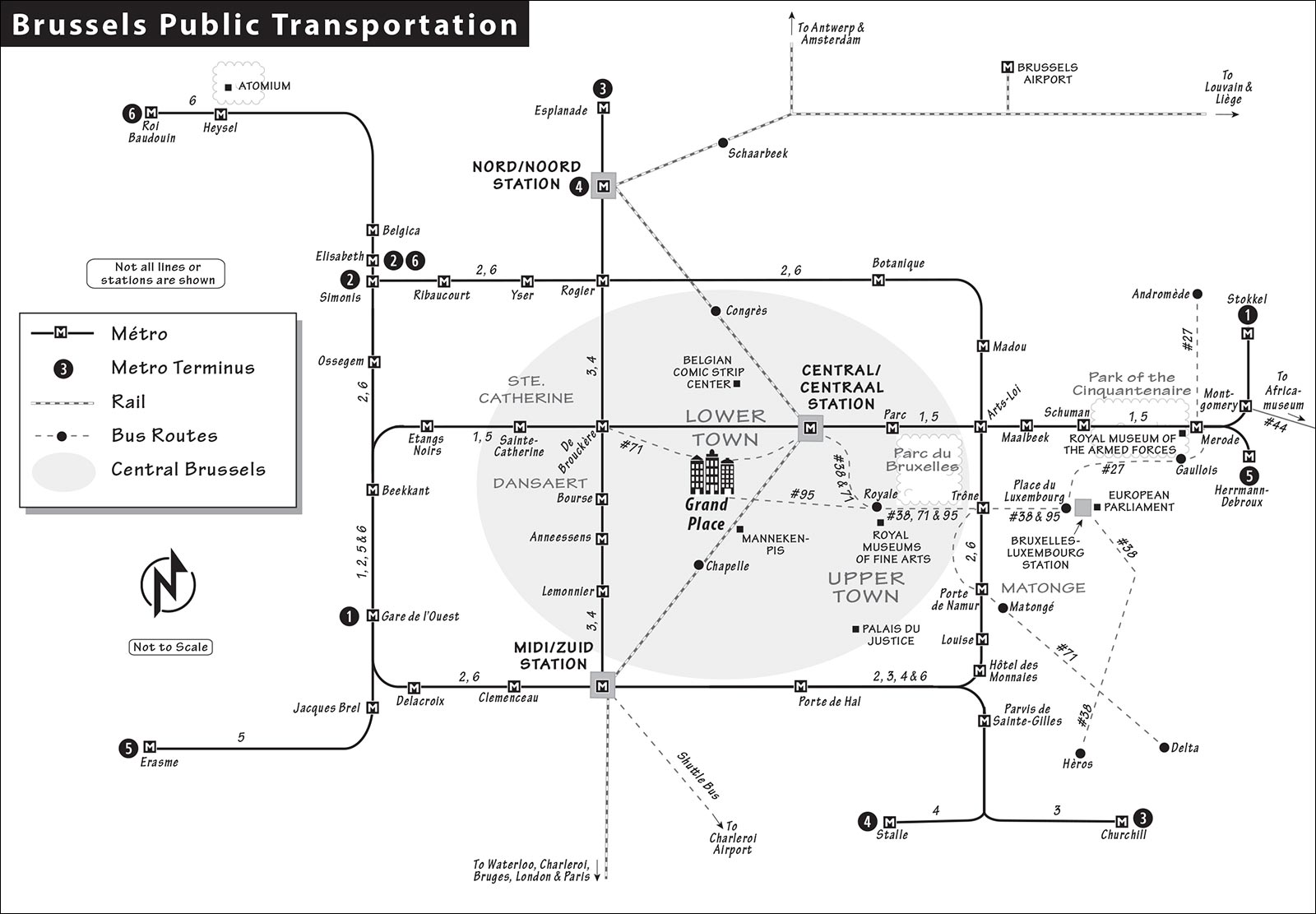
Brussels’ extensive public transport network includes a Métro, trams, and buses (www.stib-mivb.be). Transit stops are labeled in French and Dutch (though sometimes just one name works in both languages). It may be easiest to use a navigation app (such as Google Maps) on your phone; otherwise a downloadable Métro and tram map is available at Brussels.be/public-transport [URL inactive], and complete transit maps (including buses) are available at Stib-mivb.be and at the TI. Maps are also posted at many bus stops and Métro stations.
Buying and Using Tickets: The easiest and cheapest way to pay is to simply tap your credit card at the credit card machine as you enter the tram, bus, or Métro. A single fare costs €2.10 and is good for one hour on all public transportation—even trains shuttling between the city’s train stations. As you tap, the system keeps track of your journeys: You won’t be charged for transfers within one hour, and the maximum you will be charged for multiple trips within one day is €7.50.
A single-fare paper ticket (also good for one hour on all public transportation) costs €2.60, and an all-day pass is €8. You can buy tickets from vending machines at Métro stations and a few central bus and tram stops. When you enter the Métro, a bus, or a tram, validate your ticket by touching the scanner until you hear the beep.
Métro: Lines 1 and 5 travel east-west through the city, with stops at Sainte-Catherine/Sint-Katelijne (recommended hotels), De Brouckère (hotels near the Bourse and the Grand Place), Gare Central/Centraal Station (trains), Parc/Park (Upper Town), and continuing east to Merode (Cinquantenaire). The other Métro lines are less helpful for travelers. Lines 3 and 4 run north and south, with stops at De Brouckère, Bourse/Beurs, and Gare du Midi/Zuidstation. Métro line 6 takes you to sights far north of downtown (Atomium, near Métro stop Heysel/Heizel); lines 2 and 6 are useful to reach the Matongé.
Buses: Buses #38, #71, and #95 travel roughly east-west, connecting the Lower Town (near Central station or the Grand Place), the Upper Town (Royal Museums), and sights farther east (#38 and #95 to the European Parliament, #71 to Matongé). Bus #27 connects the European Parliament with the Park of the Cinquantenaire. Hop-on, hop-off buses (described later) can be helpful to get to some outlying sights.
By Bike
The city of Brussels subsidizes the Villo network of cheap rental bikes for short rides within the city. After you register online or at the kiosk, you can borrow bikes at will, then drop them off at any other station. You must know your credit-card PIN to pick up a bike from a rental station (a €150 hold on your credit card ensures you return the bike; free for up to 30 minutes, the next 30 minutes are €0.50, then the next 30 minutes cost €1, and after that, each additional 30-minute period costs €2; www.villo.be).
By Taxi or Uber
Cabbies charge a €2.60 drop fee, then €2.30 per additional kilometer (€2 surcharge after 22:00). You’ll pay about €15 for a ride from the Place de Brouckère to the Royal Museums of Fine Arts, or about €10 from Central station to the Ste. Catherine neighborhood. Figure €12 to ride from the center to the European Parliament. Convenient taxi stands near the Grand Place are at Place de Brouckère and at the “Agora” square (Rue du Marché aux Herbes). In the Upper Town, try Place du Grand Sablon. For short trips within the central core, the tangled one-way streets make taxis inefficient; it’s easier to just walk. To call a cab, ring Taxi Bleus (+32 2 268 0000) or Autolux (+32 2 512 3123). Uber works in Brussels just like it does in the US (UberX service).
Tours in Brussels
Hop-On, Hop-Off Bus Tour
Tootbus offers two loops with recorded narration: The red route serves the far-flung European Parliament and Parc du Cinquantenaire; the blue route serves the Atomium (€35/24 hours for red route, €49 for blue route, cheaper online; daily 9:30-18:00, 3/hour, Nov-March shorter hours and 2/hour; www.tootbus.com).
Walking and Bus Tour
Brussels City Tour’s half-day guided tour provides an easy way to get the grand perspective on Brussels. You start with the Grand Place, walk to the Manneken-Pis and the St. Hubert Royal Galleries (where you’ll sample a waffle), then jump on a tour bus (€37; runs year-round Tue and Thu at 9:30; buy tickets online or at TI; +32 2 513 7744, www.brussels-city-tours.com).
Local Guides
Roger van Buynder is a good local guide who does history and architecture enthusiastically, but not chocolate (€210/3 hours, €250/4 hours, also does excursions in his car, +32 495 120 517, www.guide-a-ride.be, roger.van.buynder@gmail.com).
Erwin Liekens, who runs Taste the City tours in Brussels and Antwerp, offers good walks, including tours focused on Belgian food and drink (private tours €280/3 hours, €80 per additional hour, +32 3 318 3586, info@tastethecity.be).
Guides Brussels Belgium is an agency with plenty of good guides available for private hire (€187/3 hours, +32 477 020 230, www.guidesbrussels.be, guides@guidesbrussels.be; I enjoyed the guiding of Didier Rochette).
Cathy Manlow is a chocolate expert who loves to teach visitors about what makes truly exquisite chocolate—and where to find it (€56 to join a 1.5-hour walking-and-tasting tour from the Grand Place to Place Ste. Catherine, private tours and chocolate-making workshops also available, +32 47 171 4484, www.thecocoajourney.com).