GRAND PLACE WALK
5 The Bourse and Art Nouveau Cafés
6 Place de la Bourse and Boulevard Anspach
From the Grand Place to the Manneken-Pis
Like most European cities, Brussels has a main square, but few are as “Grand” as this one. From its medieval origins as a market for a small village, the Grand Place has grown into a vast public space enclosed by Old World buildings with stately gables. Today, the “Place” is the place to see Europe on parade. If Brussels is indeed the “capital of Europe,” there’s no better evidence than the crowds that flock here from every nation. Visitors come to bask in the ambience, sample chocolate, and relax with a beer at an outdoor café.
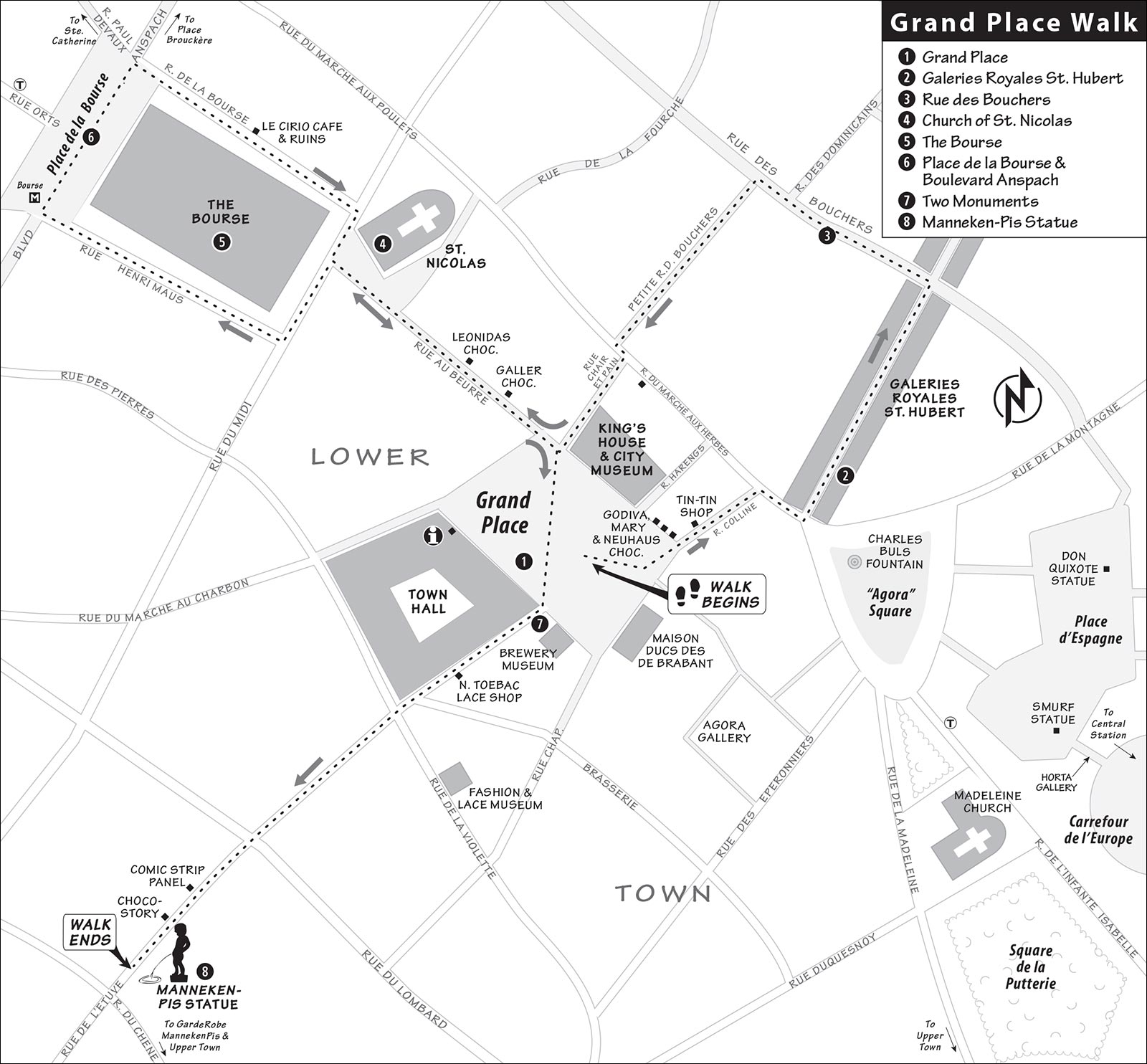
This walk allows all that, but also goes a bit beyond. We’ll take in the spectacular (if heavily touristed) square, browse an elegant shopping arcade, run the frenetic gauntlet of restaurant row (Rue des Bouchers), stand at the center of modern Brussels at the Bourse, and end at the grand finale (he said with a wink): the one-of-a-kind Manneken-Pis.
Orientation
Length of This Walk: Allow two hours.
Town Hall: €15; English tours offered every afternoon except Tue and Thu, some evenings as well—see here.
City Museum: €10, Tue-Sun 10:00-17:00, closed Mon.
Brewery Museum: €5, Wed-Sat 11:00-18:00, closed Sun-Tue.
Chocolate Shops on the Grand Place: Generally open daily until 18:00, later on weekends.
The Walk Begins
1 Grand Place
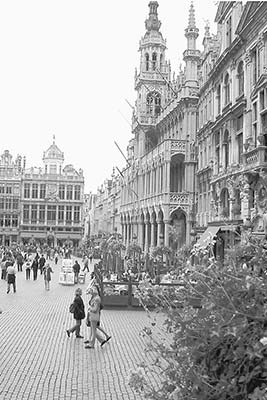
The Grand Place has long been the commercial and geographical heart of Brussels. A thousand years ago, this was where farmers and merchants sold their wares in open-air stalls, enticing travelers from the main east-west highway across Belgium, which ran just north of the square.
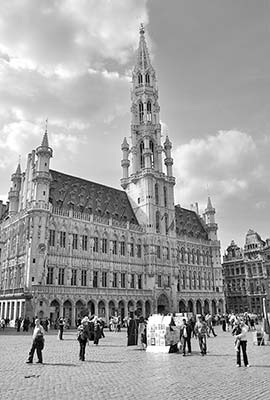
The dominant building on the Grand Place is also the oldest: The Town Hall (Hôtel de Ville). While it was built in the 1400s in Gothic style, the statues and ornamentation are mostly neo-Gothic icing, added in the 1800s. The grand tower, which dates from 1455, is topped with St. Michael, patron and protector of the city.
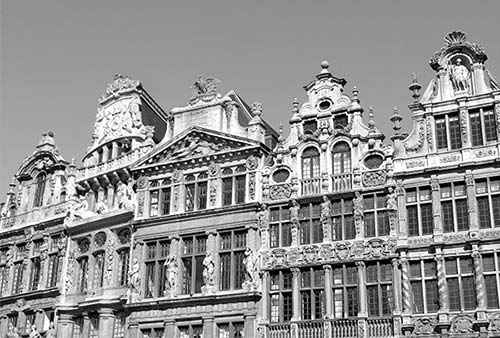
The fancy smaller buildings giving the square its unique character are former guild halls (now mostly shops and restaurants). In the Middle Ages, Brussels consisted of two zones: The king and the Church were on the hill (uptown), and the traders and merchants were on the riverbank (downtown). To assert themselves in a world controlled (until the French Revolution) by an alliance of Church and king, the merchants organized into guilds and built headquarters on this square.
In 1695, during the Nine Years’ War, French King Louis XIV’s troops took the high ground east of the city, sighted their cannons on the Town Hall spire, and managed to level everything around it (4,000 mostly wooden buildings) without ever hitting the spire itself. The “Bombardment of Brussels” was the most destructive event in the city’s history.
As a matter of pride, Brussels’ brewers, bakers, and Manneken-Pis corkscrew makers rebuilt their offices better than ever. They completed everything within seven years—in stone, taller, and topped with ornamented gables and classical statues. Richer guilds had the money to hire top architects and show off with even more lavish buildings, trimmed with gold. The Brussels governor invited the lesser guilds—millers, tanners, and the like—to set up shop here as well, and provided a common facade for their offices on the uphill side of the square.
The many differences in style reflect the independent spirit of the people and the many cultural influences that converged in this crossroads trading center. The entire square comes with a little extra sparkle, thanks to a 2014 restoration project. The result is that you’re completely surrounded by centuries-old buildings, free from any hint of a modern skyscraper, and immersed in historic ambience.
Pan the square to get oriented. Face the Town Hall with its skyscraping spire. The TI is on your right, under the Town Hall’s arches. To your right, a block away (downhill), is the Bourse building (now the Belgian Beer Museum). The Upper Town is to your left, rising up the hill beyond Central train station. Over your left shoulder a short walk away is St. Michael and St. Gudula Cathedral. And the Manneken-Pis is three blocks ahead, down the street that runs along the left side of the Town Hall.
Opposite the Town Hall is the impressive, gray King’s House (Maison du Roi), which now houses the City Museum. The structure has gone through several incarnations in its 800-year history. First it was the medieval square’s bread market—hence, the building’s Dutch name—Broodhuis. Then (early 1500s) it became the regional office for the vast Habsburg empire of Charles V—hence its French name—Maison du Roi. Its lacy, prickly Gothic facade dates from the late 1800s, when it was renovated to be the City Museum (for details on visiting the museum, see the Sights in Brussels chapter).
The Swan House (#9, just to the left of the Town Hall) housed a bar where Karl Marx and Friedrich Engels met in February 1848 to write their Communist Manifesto. Later that year, when the treatise sparked socialist revolution around Europe, Belgium exiled Marx and Engels. Next door (#10) is the Maison des Brasseurs, home of the brewers’ guild and the Brewery Museum.
Today, the grand buildings of the Grand Place host shops and cafés selling chocolates, gaufres (waffles), beer, mussels, fries, dentelles (lace), and flowers. And the Town Hall hosts weddings—it’s where King Philippe got married in 1999. (The Belgian government demands that all marriages are first performed in simple civil ceremonies.)
Imagine this already glorious square filled with a carpet of flowers. Every other August, florists create a colorful 19,000-square-foot pattern of tightly packed begonias—that’s about three-quarters of a million individual flowers (www.flowercarpet.be). Begun in 1971 by a begonia salesman as a way to promote his wares, this gorgeous display has become a biennial Brussels fixture that makes this grand space even grander. If you’re here in August on the off-year, there is a massive floral display inside the Town Hall (see www.floralientime.be).
• Exit the Grand Place next to Godiva (from the northeast, or uphill, corner of the square), and go north one block on Rue de la Colline. Along the way, you’ll pass a popular Tintin boutique (at #13), selling merchandise of the popular Belgian comic-strip hero (see sidebar on here). There’s a fun public bathroom (€1) in the arcade across the street, with whimsical decorations and funky paint designs. Continue to Rue du Marché aux Herbes, which was once the main east-west highway through Belgium. The little parklike square just to your right—a modest gathering place with market stalls—is nicknamed “Agora” (after the nearby covered shopping area). Looking to the right, notice that it’s all uphill from here to the Upper Town, another four blocks (and 200-foot elevation gain) beyond. Straight ahead, you enter the arcaded shopping mall called...
2 Galeries Royales St. Hubert
Built in 1847, one of Europe’s oldest still-operating shopping malls served as the glass-covered model that inspired shopping galleries in Paris, London, and beyond. It celebrated the town’s new modern attitude (having recently gained its independence from the Netherlands). Built in an age of expansion and industrialization, the mall demonstrated efficient modern living, with elegant apartments upstairs above trendy shops, theaters, and cafés—handy for fancy people who wanted to go to the theater without muddying their boots or dealing with the rougher world sprawling alongside this elegant gallery. This mall was the center of upwardly mobile Brussels—home to progressive newspapers and French expats (Hugo, Dumas, Baudelaire), and where the first Belgian motion picture was screened.
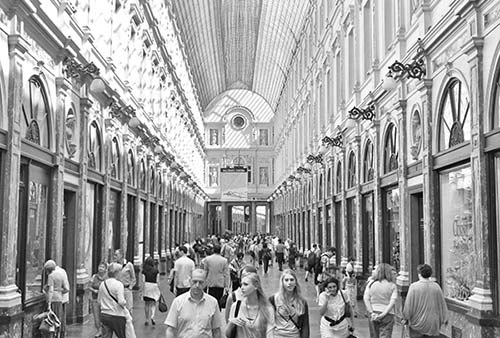
Looking down the arcade, you’ll notice that it bends halfway down, designed to lure shoppers farther in. Its iron-and-glass look is still popular, but the decorative columns, cameos, and pastel colors evoke a more elegant time. It’s Neo-Renaissance, like a pastel Florentine palace.
In this shopping mall, there’s no Gap, no Foot Locker, no Cinnabon. Instead, you’ll find hat, cane, and umbrella stores that sell...hats, canes, and umbrellas—generally handmade on the premises. Ganterie Italienne (immediately on the right) has been making ladies’ leather gloves since 1890. Since 1857, Neuhaus (near the end of the first section, on the right) has sold chocolates here at its flagship store, where many Brussels natives buy their pralines—filled chocolates were invented in this very shop in 1912. Next to Neuhaus is its competition—the avant-garde chocolatier Pierre Marcolini. Across from Neuhaus, the Taverne du Passage restaurant serves the same local specialties that hometown singer-songwriter Jacques Brel used to come here for: croquettes de crevettes (shrimp croquettes), tête de veau (calf’s head), anguilles au vert (eels with herb sauce), and fondue au fromage (cheese croquettes).
• Midway down the mall, where the two sections bend, turn left and exit the mall onto...
3 Rue des Bouchers
Yikes! During mealtimes, this street is absolutely crawling with tourists browsing through wall-to-wall, low-quality restaurants. Brussels is known worldwide for its food, serving all kinds of cuisine, but specializing in seafood (particularly mussels). You’ll have plenty to choose from along this table-clogged restaurant row, where hustlers will try to draw you into their eateries. Don’t count on getting a good value here—better restaurants are just a few steps away (for specifics, see here).
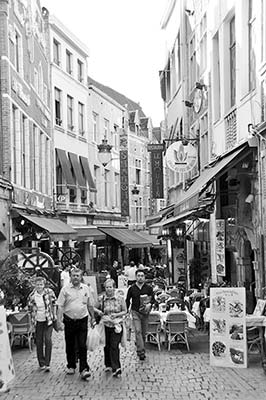
Many diners here are day-trippers. Colin from London, Marie from Paris, Maartje from Holland, and Dietrich from Frankfurt could easily all “do lunch” together in Brussels—just three hours from home.
The first intersection, with Rue des Dominicains to the right and Petite Rue des Bouchers to the left, is the heart of the restaurant quarter, which sprawls for several blocks. The street names reveal what sorts of shops used to stand here—butchers (bouchers), herbs, chickens, and cheese.
• Turn left onto Petite Rue des Bouchers and walk straight back to the Grand Place. (You’ll see the Town Hall tower ahead.) At the Grand Place, turn right on Rue au Beurre. Comparison-shop at the Galler and Leonidas chocolate stores and pass by the little “Is it raining?” fountain (one of a series of fountains you’ll see around town, each featuring a scene from a painting by local boy Pieter Bruegel). At the intersection with Rue du Midi is the...
4 Church of St. Nicolas
Since the 12th century, there’s been a church here. Because of a 1954 restoration, the church looks younger than it is. Inside, along the left aisle, see rough stones in some of the arches from the early church. Outside, notice the barnacle-like shops, such as De Witte Jewelers, built right into the church. Medieval churches often built tiny structures against their walls and rented them out as shops and apartments.
• Just beyond the church, you run into the back entrance of a big Neoclassical building.
5 The Bourse and Art Nouveau Cafés
The Bourse (stock exchange) was built in the 1870s in the Historicist style—a mix-and-match, Neo-everything architectural movement. The building’s €90 million renovation, completed in fall 2023, took more than 10 years, and the former stock exchange now hosts a big beer museum (Belgian Beer World).
Several historic cafés huddle around the Bourse in a car-free zone. To the right is the woody Le Cirio, with its delightful circa-1900 interior. Many Brussels cafés, like Le Cirio, are still decorated in the early-20th-century Art Nouveau style. Ironwork columns twist and bend like flower stems, and lots of Tiffany-style stained glass and mirrors make them light and spacious. Slender, elegant, willowy Gibson Girls decorate the wallpaper, while waiters in vests and bowties glide by.
Beneath the sidewalk here you can look down through windows at the ruins of a 13th-century Franciscan convent uncovered during renovations of the Bourse. You may be able to visit them through the beer museum—check the website for details (www.belgianbeerworld.be).
• Circle around to the front of the Bourse, toward Boulevard Anspach.
6 Place de la Bourse and Boulevard Anspach
Brussels is the political nerve center of Europe (with as many lobbyists as Washington, DC), and the city sees several hundred demonstrations a year. When the local team wins a soccer match or some political group wants to make a statement, Place de la Bourse is where people flock to wave their flags.
It’s also where the old town meets the new. To the right along Boulevard Anspach are two shopping malls and several first-run movie theaters. Rue Neuve, which parallels Anspach, is another bustling pedestrian-only shopping street.
Boulevard Anspach was once the city’s main drag, choked with cars. Since 2015, it’s been closed to car traffic, creating one of the largest pedestrian zones in Europe. And under your feet is the still-flowing Senne River. Remember that Brussels was once a port, with North Sea boats coming as far as this point to unload their goods. But with frequent cholera epidemics killing thousands of its citizens, in 1870 the city decided to cover up its stinky river.
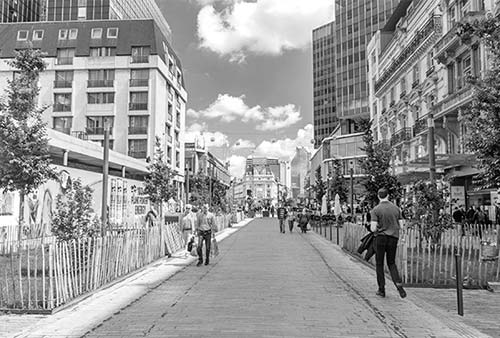
Beyond Boulevard Anspach—down Rue Paul Devaux—is the charming Ste. Catherine neighborhood, clustered around the former fish market and the Church of Ste. Catherine. This village-like zone is the easiest escape from the bustle of downtown Brussels and features several recommended lunch stops.
• For efficient sightseeing, consider catching bus #71 from Place de Brouckère, a few blocks north on Boulevard Anspach, to the Place Royale, where you can follow my Upper Town Walk (see next chapter), ending near the Manneken-Pis. But if you’d rather stay on foot in the Lower Town, walk back to the Grand Place.
From the Grand Place to the Manneken-Pis
• Leave the Grand Place kitty-corner, heading south down the street running along the left side of the Town Hall, Rue Charles Buls. Just five yards off the square, under the arch, are 7 two monuments honoring illustrious Brussels notables:
The first monument is a leafy scene on the wall featuring a beautiful young man. It’s an Art Nouveau allegory of knowledge and science (which brings illumination, as indicated by the Roman oil lamp) designed by Victor Horta. It honors Charles Buls, mayor from 1888 to 1899. If you enjoyed the Grand Place, thank him for saving it. He stopped the “Builder King” Leopold II from blasting a grand esplanade from the Grand Place up the hill to his palace.
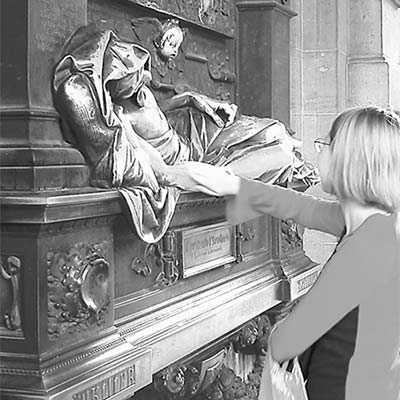
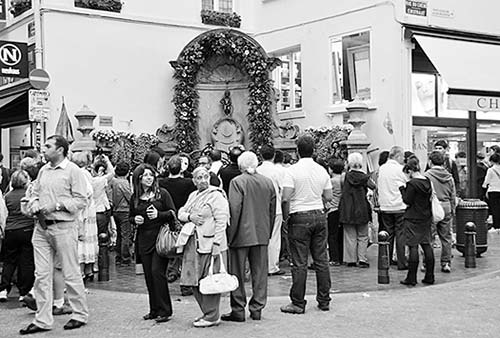
A few steps farther you’ll see locals rubbing a brass statue of a reclining man. This was Alderman Evrard ’t Serclaes, who in 1356 bravely refused to surrender the keys of the city to invaders, and so was tortured and killed. Touch him, and his misfortune becomes your good luck. Judging by the reverence with which locals treat this ritual, I figure there must be something to it.
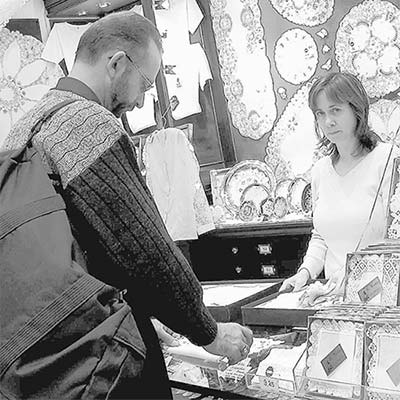
From here, the street becomes a gauntlet of Belgian clichés: lace, waffles, frites, chocolate, and tapestries. The N. Toebac Lace Shop shows off some fine lace and gives travelers with this book a 15 percent discount. For more on lace, visit the Fashion and Lace Museum (a block away and just around the corner—see here).
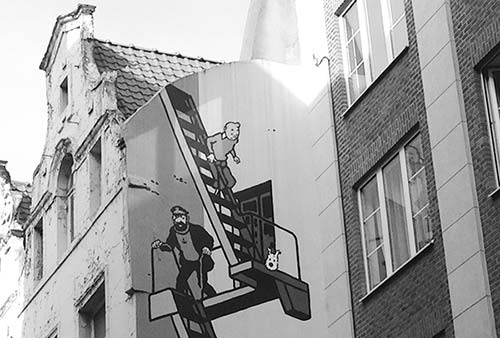
Continuing down the street, notice a comic strip panel mural on the wall a ways ahead, depicting that favorite of Belgian comic heroes, Tintin. Known and beloved by virtually all Europeans, Tintin is the intrepid boy with the wavy hair. In this scene, he’s fleeing yet another misadventure, scrambling down a fire escape. He’s accompanied by his faithful dog, Snowy, and his friend Captain Haddock, who always keeps an eye out for him. Dozens of these building-size comic-strip panels decorate Brussels, celebrating the Belgians’ favorite medium (if interested in tracking them down, buy a map from the TI or search online for “comic street art Brussels”). Just as Ireland has its writers, Italy its painters, and France its chefs, Belgium has a knack for turning out world-class comic artists.
• Follow the crowds, passing the Choco-Story Museum on the right. Notice the excitement building, because in another block you reach the...
8 Manneken-Pis
Even with low expectations, this bronze statue is smaller than you’d think—the little squirt’s under two feet tall, practically the size of a newborn. Still, the little peeing boy is an appropriately low-key symbol for the unpretentious Bruxellois. The statue was made in 1619 to provide drinking water for the neighborhood. Notice that the baby, sculpted in Renaissance style, actually has the musculature of a man instead of the pudgy limbs of a child. The statue was knighted by the occupying King Louis XV—so French soldiers had to salute the eternally pissing lad when they passed.
It’s tradition for visiting VIPs to bring the statue an outfit—and he also dresses up for special occasions—so you can often see the Manneken peeing through a colorful costume. A sign on the fence lists the month’s festival days and how he’ll be dressed. For example, on January 8, Elvis Presley’s birthday, he’s an Elvis impersonator; on Prostate Awareness Day, his flow is down to a slow drip. He can also be hooked up to a keg to pee wine or beer. The collection of costumes he’s worn for three centuries—GardeRobe MannekenPis—is just up the hill on Rue du Chêne.
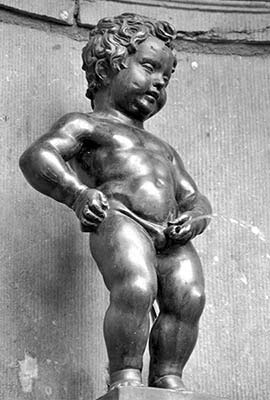
There are several legends about the Manneken—take your pick: He was a naughty boy who peed inside a witch’s house, so she froze him. A rich man lost his son and declared, “Find my son, and we’ll make a statue of him doing what he did when found.” Or—the locals’ favorite version—the little tyke loved his beer, which came in handy when a fire threatened the wooden city: He bravely put it out. Want the truth? The city commissioned the Manneken to show the freedom and joie de vivre of living in Brussels—where happy people eat, drink...and drink...and pee.
The gathering crowds make the scene more interesting. Hang out for a while and watch the commotion this little guy makes as tour groups come and go. When I was there, a Russian man marveled at the statue, shook his head, and said, “He never stop!”