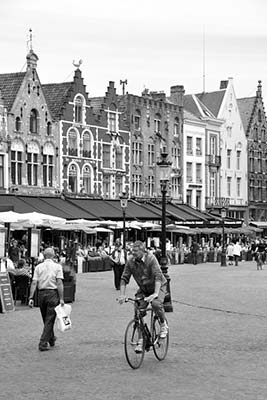
SIGHTS & EXPERIENCES IN BRUGES
While Bruges has several worthwhile museums and churches, the ultimate sight here is the town itself. After seeing the essential sights, I enjoy slowing down and savoring the city, whether it’s getting lost on the back streets away from the lace shops and waffle stands, taking a bike ride along a quiet canal, learning about beer from passionate locals, or sampling chocolate at one of Bruges’ fine chocolatiers. This chapter covers both the top sights and the best experiences Bruges has to offer.
Sightseeing Pass: The Musea Brugge Card covers admission at 13 museums (€33, valid for 3 days, purchase at www.museabrugge.be, at the TI, and at included museums). Because the Groeninge Museum and Sint-Janshospitaal and Memling Collection cost €30 combined, you’ll likely save money with this pass if you plan to see at least one other covered sight.
Sights in Bruges
▲Basilica of the Holy Blood (Heilig-Bloedbasiliek)
▲▲Church of Our Lady (Onze-Lieve-Vrouwekerk)
▲▲Sint-Janshospitaal and Memling Collection (St. John’s Hospital)
▲Folklore Museum (Volkskundemuseum)
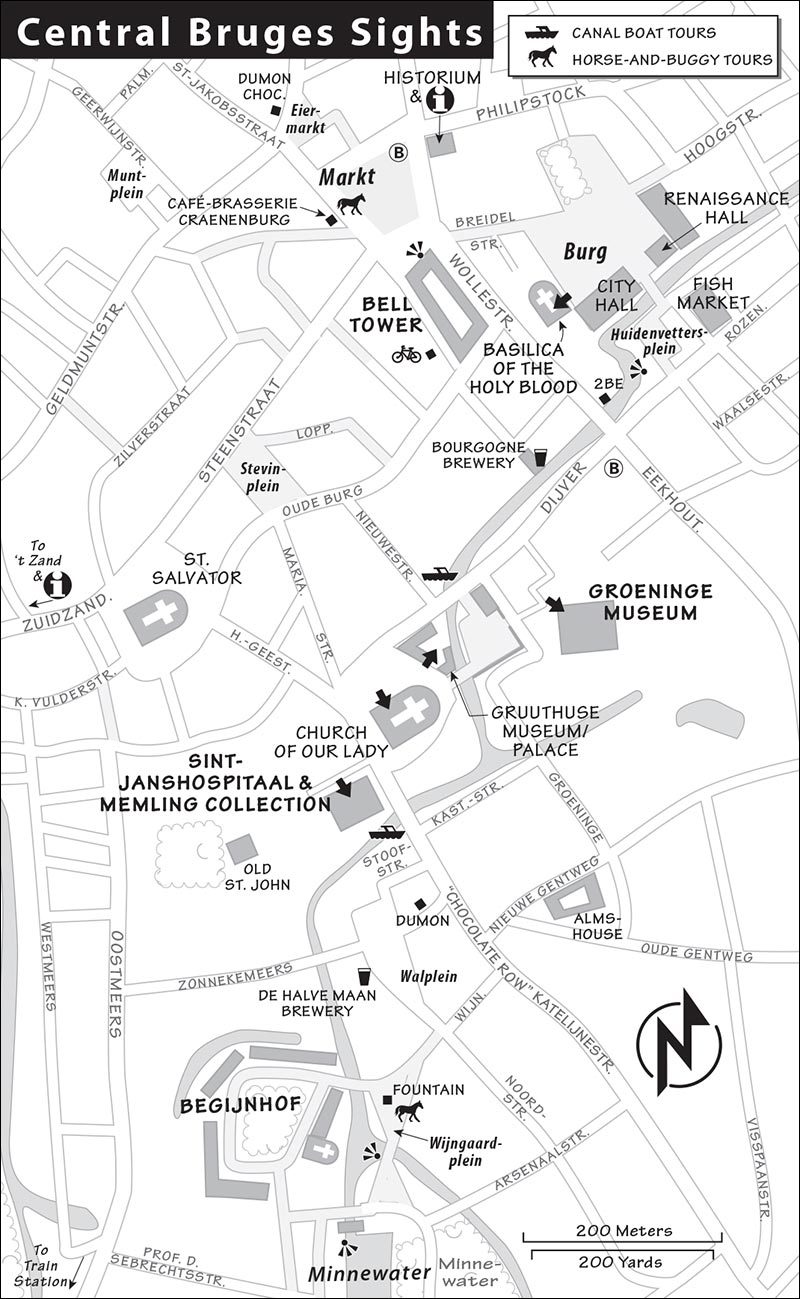
These sights are listed by neighborhood, covering the area around the Markt (Market Square) and Burg Square; the cluster of sights south of the Markt; and the less touristy area northeast of the core. Note that some city-run sights (including the Sint-Janshospitaal and Memling Collection, Folklore Museum, St. Janshuys Windmill, and Gruuthuse Museum) have the same hours (Tue-Sun 9:30-17:00, closed Mon). And, at several sights, admission is by credit card only.
ON OR NEAR THE MARKT
 These sights are described in greater detail in the Bruges City Walk chapter—including details on visiting the interiors of the Basilica of the Holy Blood, the Church of Our Lady, and the City Hall.
▲Markt (Market Square)
The crossroads of Bruges is one of the most enjoyable town squares in Belgium—and in this country, that’s really saying something. In Bruges’ heyday as a trading center, a canal came right up to this square. And today it’s still the heart of the modern city. The square is ringed by the frilly former post office, enticing restaurant terraces, great old gabled buildings, and the iconic bell tower. Under the bell tower are two stands selling classic Belgian (not French) fries. The streets spoking off this square are lined with tempting eateries and shops.
▲▲Bell Tower (Belfort)
Most of this bell tower has presided over the Markt since 1300, serenading passersby with cheery carillon music. The octagonal lantern was added in 1486, making it 290 feet high—that’s 366 steps. The view is worth the climb...and probably even the pricey admission. Some mornings and summer evenings, you can sit in the courtyard or out on the square to enjoy a carillon concert (for details, see here).
Cost and Hours: €15—advance online booking recommended during peak times; open daily 9:00-20:00, Nov-March 10:00-18:00, last entry one hour before closing; pay WC in courtyard, +32 50 448 767, www.museabrugge.be.
Historium
This much-hyped “sight” is little more than a commercial venture with as many actual historic artifacts as a Disney ride. For a steep price you’ll don headphones and follow a 35-minute story through a handful of rooms taking you back to Bruges in the 1430s. You finish what I consider a waste of time and money with a nice view over the Markt.
Cost and Hours: €20, €25 with VR option; daily 11:00-18:00, Sat until 22:00, last entry one hour before closing; Markt 1, +32 50 270 311, www.historium.be.
▲▲Burg Square
This opulent, prickly-spired square is Bruges’ civic center, the historic birthplace of Bruges, and the site of the ninth-century castle of the first count of Flanders. It’s home to the Basilica of the Holy Blood and City Hall (both described next). Today, it’s an atmospheric place to take in an outdoor concert while surrounded by six centuries of architecture.
▲Basilica of the Holy Blood (Heilig-Bloedbasiliek)
Originally the Chapel of Saint Basil, this church is famous for its relic of the blood of Christ, which, according to tradition, was brought to Bruges in 1150 after the Second Crusade. The lower chapel is dark and solid—a fine example of Romanesque style. The upper chapel (separate entrance, climb the stairs) is decorated Gothic. An interesting treasury museum is next to the upper chapel.
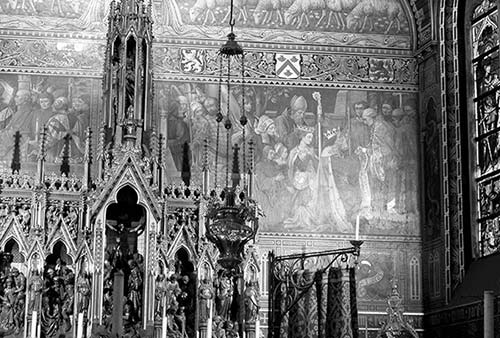
Cost and Hours: Church-free, treasury-€5, daily 10:00-17:15, Burg Square, +32 50 336 792, www.holyblood.com.
▲City Hall (Stadhuis)
This complex houses several interesting sights, including rooms full of old town maps and paintings, and the highlight—the grand, beautifully restored Gothic Room from 1400, starring a painted and carved wooden ceiling adorned with hanging arches. Your ticket also covers the less impressive Renaissance Hall (Brugse Vrije) next door, basically just one ornate room with a Renaissance chimney (separate entrance—in corner of square at Burg 11a, open Sat-Sun only).
Cost and Hours: €8, daily 9:30-17:00, +32 50 448 743, www.museabrugge.be.
SOUTH OF THE MARKT
Most of the following sights are covered in more detail in either the Bruges City Walk chapter or individual tour chapters.
▲▲Church of Our Lady (Onze-Lieve-Vrouwekerk)
This imposing church brims with reminders of the wealth of medieval Bruges. Its prized possession is a delicate Madonna and Child sculpture, the only Michelangelo statue to leave Italy in his lifetime (a Belgian cloth merchant with connections in Italy shipped the statue home in 1506).
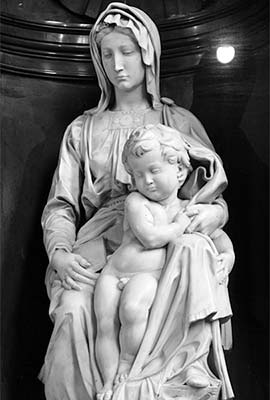
Cost and Hours: Entry to the rear of the church is free. Access to the main section costs €8, while a €17 combo-ticket includes the Gruuthuse Museum (church open Mon-Sat 9:30-17:00, Sun from 13:30; Mariastraat, +32 50 448 711, www.museabrugge.be).
For more on the church, see the Bruges City Walk chapter.
▲▲Gruuthuse Museum
The fine 15th-century mansion of the powerful Gruuthuse family stands next to the Church of Our Lady, its 17 rooms filled with fine examples of Flemish art and craftsmanship. You’ll see antique maps, paintings, tapestries, lace, and the noble family’s private oratory overlooking the church’s chancel, allowing them to “go to Mass” in private. Exhibits, explained in English, track and explain the growth of Bruges through the ages.
Cost and Hours: €15, includes digital audioguide on your device, €17 combo-ticket with adjacent Church of our Lady; Tue-Sun 9:30-17:00, closed Mon; Dijver 17, +32 50 448 711, www.museabrugge.be.
Visiting the Museum: After buying your ticket in the modern entry pavilion, you’ll cross a small courtyard to enter the museum. The permanent exhibition starts to the left of the entrance, in Room 1, where a model of the site shows how the Gruuthuse mansion practically touches the Church of Our Lady. A video illustrates the growth of the building since 1425, when the Gruuthuse family established their palace with a fortune amassed from beer. In the 15th century, Bruges was at the height of its prosperity as a center of trade. But on the wall is a map of Bruges made about 150 years later: Notice the big double moat and all the waterways connecting Bruges to the rest of Europe and the sea. Many of these are new canals (look for the bridges and locks), dug in a desperate attempt to keep trade flowing through Bruges as the Zwin estuary, Bruges’ lifeline to the North Sea, silted up.
In the next room (Room 2), a grand map of Bruges made in 1562—printed from 10 copper plates—exaggerates the size of some of the canals to emphasize the easy access for ships. Meanwhile, a painting called The Seven Wonders of Bruges from the same period touts Bruges’ landmarks and infrastructure—even as it hints that the glory may be fading.
Room 4 contains 15th-century illuminated manuscripts—that is, books made by hand, not printed—including a large work by the early-medieval philosopher Boethius and a tiny missal (used for singing or speaking the Mass). Books symbolized status, and Louis de Gruuthuse had the second-largest library in the Burgundian Netherlands—after that of the Duke of Burgundy himself. Room 5 displays more status symbols: tapestries, furniture, tableware, and shoes that look very uncomfortable.
In Room 7, old account books, receipts, and various trade artifacts, as well as more tapestries and paintings, attest Bruges’ position as a trade hub. Small-scale trade happened as well: Look for some of the earliest waffle irons (from the 15th century). Up a few stairs, Room 8 deals with early-17th-century changes: Religious wars have devastated the region, and the Zwin no longer connects Bruges to the sea. But a new canal to Ostend offers hope, and the Counter-Reformation demands more and more religious art to get its point across—providing craftspeople with plenty of work. A small wooden model of a ship, De Maagd van Gent (“The Virgin of Ghent”), symbolizes the fierce competition between captains from Bruges, Ghent, and Ostend, and a tapestry called America illustrates the new globalization of trade, which brought new products like tobacco, coffee, and cocoa to Bruges. Room 9 showcases the work of the craft guilds, which began in the Middle Ages and flourished for centuries thereafter. Admire ornate metalwork, fancy leather items, and intricately painted and embroidered textiles.
You’ll head up a flight of stairs to reach Room 10, which illustrates luxurious living in 17th- and 18th-century Bruges. The impressive tapestry Astrologia demonstrates the increasing interest in science as one of the “liberal arts”—and weaves in mythology as a reference to the rediscovered knowledge of ancient Greece and Rome. Room 13 was Bruges’ original “Lace Museum,” housing a collection assembled by the Baroness Augusta Liedts. You’ll see elegant and surprising examples worn by both men and women, and learn about the development of different styles.
Room 14, which leads to the Gruuthuse family’s private oratory, is appropriately about prayer. It displays an impressive collection of delicately carved wood statues from the 14th through 16th century. The centerpiece is a figure known as Mary Reading (15th century), which depicts a sympathetic, relatable Mary moments before the angel Gabriel surprises her with the news of her impending motherhood.
From this room, walk into the wooden oratory, where you can look down into the adjacent Church of Our Lady. In exchange for this private viewing chamber, which required removing a church window and constructing a staircase from the church to the chapel, Louis de Gruuthuse donated several expensive tapestries to the church. The chapel, made of fine Baltic oak, was once richly decorated. You can still see angels, each with a different face, painted to hold up the ceiling.
Up a few more stairs, Rooms 15-17 cover Bruges in the 19th century, when tourism became important and Neo-Gothic became...everything.
▲▲Groeninge Museum
This museum houses a world-class collection of mostly Flemish art, from Memling to Magritte. While there’s plenty of worthwhile modern art, the highlights are the vivid and pristine Flemish Primitives. (In Flanders, “Primitive” simply means “before the Renaissance.”) Flemish art is shaped by its love of detail, the egos of its merchant patrons, and the power of the Church. Lose yourself in the halls of Groeninge: Gaze across 15th-century canals, into the eyes of reassuring Marys, and through town squares littered with leotards, lace, and lopped-off heads.
Cost and Hours: €15; Thu-Tue 9:30-17:00, closed Wed; Dijver 12, +32 50 448 743, www.museabrugge.be.
See the Groeninge Museum Tour chapter.
▲▲Sint-Janshospitaal and Memling Collection (St. John’s Hospital)
This former monastery is one of the oldest hospital buildings in Europe. The museum blends a fine collection of artworks with thoughtful displays about the wards where monks and nuns cared for the sick. A special glass room houses works by Hans Memling, the greatest of the Flemish Primitives. Memling created his St. John Altarpiece triptych for the hospital, along with a miniature gilded-oak shrine to St. Ursula.
Cost and Hours: €15; Tue-Sun 9:30-17:00, closed Mon; across the street from the Church of Our Lady, Mariastraat 38, +32 50 448 743, www.museabrugge.be.
See the Sint-Janshospitaal & Memling Collection Tour chapter.
▲▲Begijnhof
The courtyard called the Begijnhof was once enclosed by buildings inhabited by members of a lay sisterhood, the Beguines. Though the original buildings are no longer there, the atmosphere may still make you want to don a habit and fold your hands as you walk under its wispy trees and whisper past modest little homes. Only a few sisters still live and pray here.
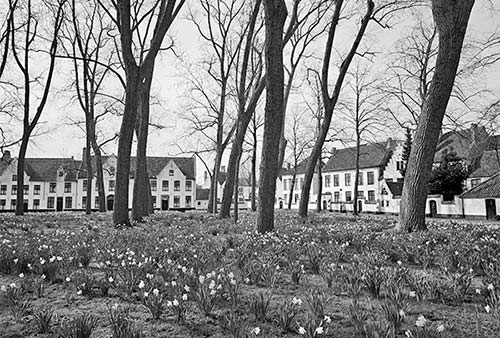
Cost and Hours: Courtyard-free, daily 7:30-20:30, closes earlier off-season. The public is welcome at a daily vespers service in the chapel at 16:30.
Nearby: Just south of the Begijnhof is the waterway called Minnewater, an idyllic world of flower boxes, canals, and swans.
For more on the Begijnhof and Minnewater, see the Bruges City Walk chapter.
NORTHEAST OF THE MARKT
The less touristy streets north and east of the Markt are worth a wander—they don’t suffer from the intense crowd congestion of the main Markt-Burg-Church of Our Lady thoroughfare.
▲Markt to the Moat Stroll
This tranquil walk takes you along postcard canals and through sleepy residential areas to the moat, where you can climb up inside a working windmill (see the map in this section). The walk takes about 30 minutes (longer if you enter the sights). It’s also great on a bike and can be extended with a longer ride to the town of Damme (described later).
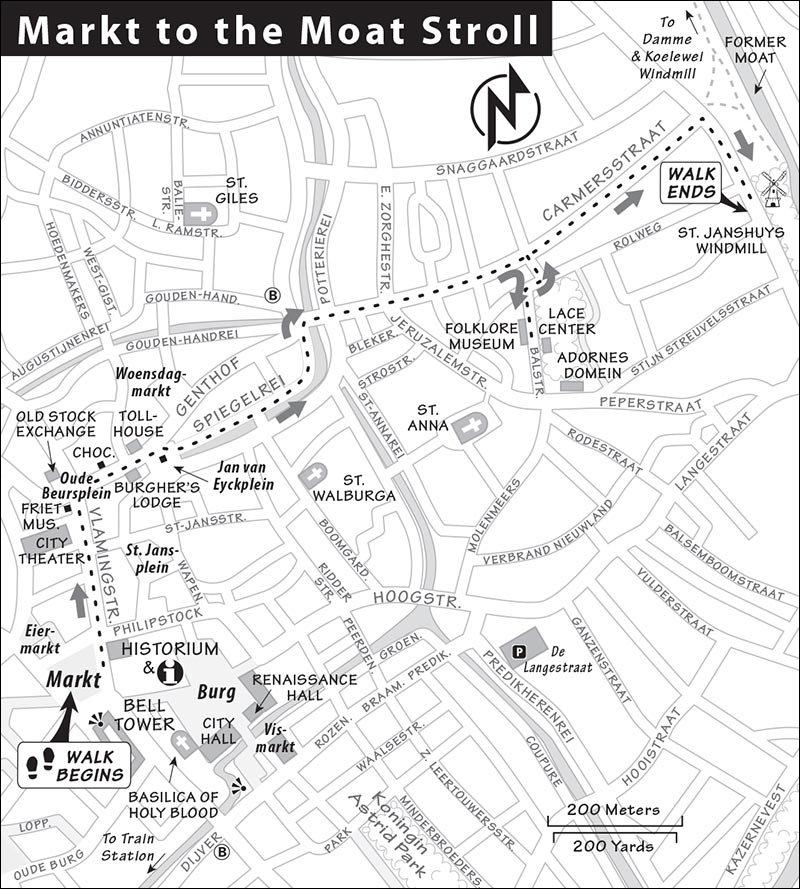
 Self-Guided Walk: From the Markt, head up Vlamingstraat (with the bell tower at your back, exit straight ahead up the top-right corner of the square).
Vlamingstraat: Two short blocks up this street, on the left, you’ll spot the stately, Neo-Renaissance-style City Theater (Stadsschouwburg). Notice how atypically broad this street is for claustrophobic Bruges. That’s because several old buildings were torn down to build this theater in 1869. This was a time of Flemish cultural revival—when Dutch-speaking people began to take pride in what differentiated them from the dominant French-speaking Belgians—and Dutch-language theater was an important symbol of Flemish pride. (essentially, Flemish is to Dutch as American is to English—the same language spoken by people in two different countries.)
Notice the large plaza in front of the main entrance, dating from a time when classy horse carriages would drop off well-heeled theatergoers. The fine gabled facades that surround you are generally just that: facades fronting otherwise plain buildings, added to boost the egos of the merchants who lived there.
• A few steps past the theater, on the left, notice the Friet Museum, dedicated to the esteemed fry (described later in the chapter). Just past the museum and also on the left, look for the angled building set slightly back from the street, with yellow bricks and narrow windows. This marks a small square known as...
Oude Beursplein (Old Stock Exchange): While Amsterdam likes to lay claim to inventing the stock market, Bruges’ predates it. (See the gold letters chiseled into the building, with the date 1276.) In the mid-13th century, the Van der Beurse family built an inn here and offered beers to passing merchants on their way between the tollhouse (which we’ll see soon) and the Markt. Gradually these hangouts began to host more formalized trading of goods and services. Much of this business took place out in this square; traders would scurry under awnings in case of bad weather. To kick off these meetings amid this chaos, they’d ring a bell, which is still used today to start and end stock-trading sessions. And to this day, in most European languages, some variation of the word “Beurse” (Börse, borsa, etc.) means “stock market.” (Conveniently, the family name also means “purse.”)
Directly opposite the old stock market, turn right up Academiestraat. If you have a sweet tooth, don’t miss Confiserie De Clerck, an old-school chocolate shop with some of the best deals in town (about €2.20/100 grams—about six pieces). For more about this shop, see the listing under “Experiences in Bruges,” later.
The big building near the end of the street on your right is the Burghers’ Lodge (Poortersloge)—a meeting place for local businessmen, similar to today’s Rotary clubs. Pause at the building’s ornate doorway, just before the square. Just above, notice the sign with golden Latin words declaring “This building rises like a phoenix from the ashes”; if you add them up, the seemingly random capital letters represent the year of the building’s reconstruction after a devastating fire (VIXXCIVVIVMDVIVI—1655).
• You’ll pop out into a square called...
Jan van Eyckplein: A large statue honors the painter in the middle of this charming waterfront square. He’s identified twice: the Dutch Jan van Eyck on the side facing you, and the French Jean van Eyck on the side facing the canal.
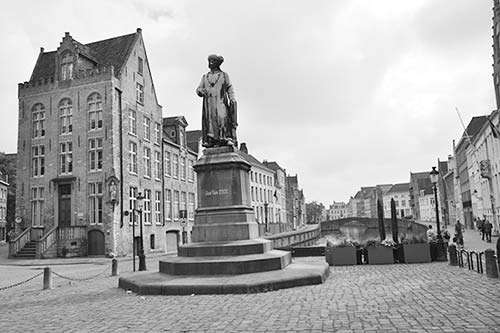
In 1830 Belgium won its independence and began a campaign to celebrate its distinctive heritage by erecting statues to leading cultural figures. Back then the French were the wealthy Belgians and the Flemish were the poor ones. Notice here the 13th-century buildings with their gabled facades—many were rebuilt in the 19th century.
On the left side of the square, you can’t miss the building with the big, fire-engine-red doors. Sure enough, this was once the firehouse. But before that, it was the tollhouse (tolhuis). This canal once went all the way to the Markt (water still runs under this square); entering vessels paused here to pay duties.
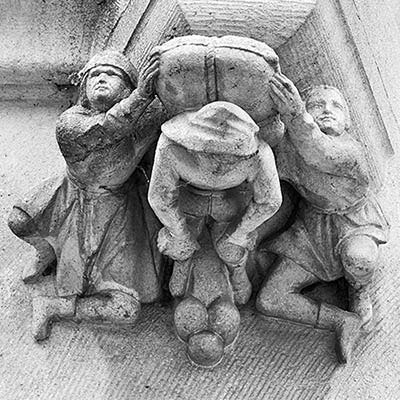
The extremely skinny facade just left of the tollhouse (with the four carved figures over the red door) is the Dockworkers’ House (Pijndershuisje). Below the four figures, around the top of the door, carvings of hardworking stevedores hunch beneath heavy loads. Bruges was a member of the medieval Hanseatic League, a powerful society of trading cities stretching all the way to Norway and the Baltic Sea. As the entry point for trade into the city, this neighborhood, lined with busy warehouses, was an eclectic zone of sailors from around the world. Many international dockworkers lived in little enclaves near here. Some street names in the area still echo this past: Spanjaardstraat (“Spaniard Street”), Biskajerplein (“Basque Square”), and Engelsestraat (“English Street”).
Bruges is rich with legends. Here’s a nice story: Facing the canal, find the brick house on the left corner. On the upper story, a statue of Mary stands in a niche, next to an old lamp. In the 18th century, when Bruges was in decline and in need of beautification, local authorities made landowners a deal: If they added a statue of Mary to their house, the city would install a gas light to illuminate it (benefiting the homeowner with more light and security). Many burghers took them up on the offer, and more than 350 statues of Mary continue to decorate the city (many still with a lamp nearby). Once you start looking for them, you’ll see them everywhere.
• From here, enjoy a stroll through a...
Residential Canal Zone: From the square, head straight along the canal (left side), simply enjoying the serene scenery. Pass the first bridge; when you hit the wide cross-canal, jog left, then cross the bridge to the right, and continue straight up Carmersstraat. At the fifth street on the right—tiny Korte Speelmansstraat—you’re a short block from the Folklore Museum, the Lace Center, and the Adornes Domein (all described later). If you detour there, backtrack to Carmersstraat after your visit and carry on straight until you pop out at the dike that separates Bruges from the old moat that surrounds it.
• Sitting on top of the dike is the...
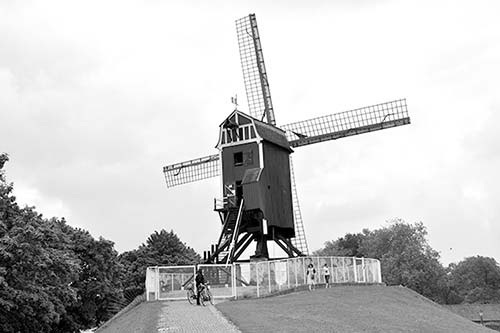
St. Janshuys Windmill: In its heyday, bustling Bruges had 28 windmills, mostly used to grind grain. Built in 1770, this one was funded by several local bakers. Notice how its narrow base allows it to swivel to catch the prevailing wind. Windmill keepers were as skilled at rigging as sailors—ready to cover the blades with canvas when the conditions were right. If you’re curious about how this remarkable old technology operated, you can climb up the steep ladder-like stairs to enter the windmill (€5; April-Oct Tue-Sun 9:30-12:30 & 13:30-17:00, closed Mon and off-season; +32 50 448 743). In the top section, you’ll see the mighty gears and appreciate how wind power not only spun the giant millstones, but also harnessed pulleys to hoist up heavy sacks of grain from the ground below. The grain steadily trickled into the ever-spinning millstones, which ground it and poured it down the spout, in the lower area of the windmill. There it was bagged and hoisted down to send off to the awaiting baker.
• If you’re on foot, you can keep strolling and explore the moat and other nearby windmills.
If you’re on a bike, you can turn left and head up along the moat—past three more windmills—before you angle off to the right and head for the town of Damme (see directions later, under “Bike Ride to Damme”).
▲Folklore Museum (Volkskundemuseum)
While “folklore” usually indicates farming lifestyles and colorful costumes, urbane Bruges dedicates its Folklore Museum to the occupations that kept the city humming through its industrious golden age. It’s a well-presented little slice of Bruggian life, with exhibits filling a row of eight charming, interconnected 17th-century almshouses.
Cost and Hours: €8, €13 combo-ticket with Lace Center; Tue-Sun 9:30-17:00, closed Mon; Balstraat 43, +32 50 448 764, www.museabrugge.be. To find it, ask for the Jerusalem Church.
Visiting the Museum: As you enter, borrow the English descriptions (or use the QR code to read on your device) to bring each room to life. You’ll see a schoolhouse; workshops for a cobbler, clogmaker, and barrelmaker; a grocery; and exhibits featuring devotional objects and pipes.
Beginning in the 1500s and especially throughout the 1600s, lace collars, sleeves, headdresses, and veils became fashionable with members of royalty, the aristocracy, and the Catholic Church. All this fine lace was made by hand—and was expensive. For a time, lacemaking was a significant part of several European economies. Even so, it was primarily a cottage industry, with women working from their homes, using patterns and threads supplied to them by lace dealers. The lacemakers made little money for their effort, but the industry helped many peasant families support themselves (the lace dealers, however, became wealthy from the trade).
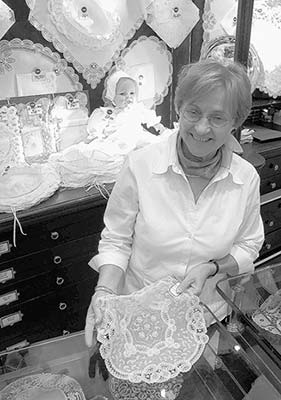
Men stopped wearing lace with the French Revolution of 1789, when suddenly lace for men seemed undemocratic and unmanly. Around 1800, machines replaced human hands, and except for ornamental pieces, the demand for lace died out.
These days, handmade lace is usually also homemade—produced by dedicated, sharp-eyed hobbyists who love their work. Lacemakers create their own patterns or trace tried-and-true designs. It requires total concentration to follow the intricate patterns. Producing a piece of lace by hand is time-consuming—which is why a handmade tablecloth can easily sell for €250 and up.
There are two basic kinds of lace: bobbin lace (a specialty in Bruges) and needle lace. To make bobbin lace, the lacemaker juggles many different strands tied to bobbins, “weaving” a design by overlapping the threads. Needle lace is more like sewing. The lacemaker uses a threaded needle to make loops and knots on top of a pattern in a fancy design. To see lace being made, drop by a demonstration at the Lace Center.
In the garden courtyard, you can play a traditional folk game, then head back up to the main building to see the rest of the collection: the late-19th-century inn/pub (still a working pub, called In de Zwarte Kat—look for the resident black cat), plus a typical living room, candy shop, pharmacy, hatmaker, tailor, costume collection, and more.
Lace Center (Kant Centrum)
Across the street from the Folklore Museum, this lace museum and school lets you learn about lacemaking and see lace being made.
Cost and Hours: €8, €13 combo-ticket with Folklore Museum; Mon-Sat 9:30-17:00, closed Sun, come when demonstrations are scheduled (usually 14:00-17:00); +32 50 330 072, Balstraat 16, www.kantcentrum.eu.
Visiting the Lace Center: Your tour starts with a brief movie about the history of lace (and why it was regarded as women’s work). Next are exhibits explaining the different ways to make lace, as well as beautiful examples from the 17th century onward. A computer lets you try different techniques for making lace yourself.
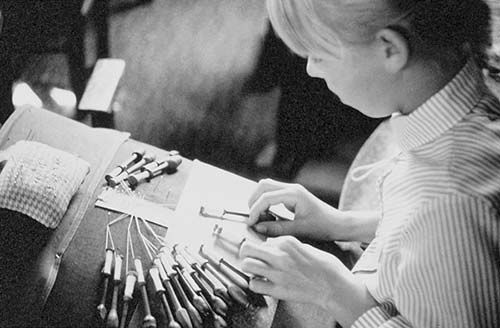
The payoff is upstairs in the demonstration room, where artisans chat merrily while making lace, usually using the bobbin technique perfected in Bruges. Observe as they toss bobbins madly while their eyes go bad. They follow mazelike patterns with a forest of pins to help guide their work. On Wednesday afternoons you may see young people learning the craft.
Lace handiwork is on sale in the gift shop, along with materials for making lace on your own.
Nearby: Just down the street from the Lace Center is a lace shop with a good reputation, ’t Apostelientje (generally Tue-Sat 13:00-17:00, closed Sun-Mon, Balstraat 11, +32 495 562 420).
Adornes Domein
This 15th-century noble estate is still maintained by the family that has owned it for 17 generations. Today they are committed to preserving its character and sharing it with the public. While the exhibit has a fine chapel from 1429 and a special charm, it’s otherwise pretty humble (€10, Mon-Fri 10:00-17:00, Sat until 18:00, closed Sun, Peperstraat 3, +32 50 338 883, www.adornes.org).
Experiences in Bruges
Bruges has some top-notch museums, but many of its charms are experiential: beer drinking, chocolate tasting, and bike riding.
BEER
Much as wine flows through all aspects of French or Italian cuisine, Belgians prize beer above all else. Bruges offers a wide variety of places to sample brews, a couple of enjoyable brewery tours, and an interesting beer museum. For more on Belgian beers, see the “Eating” section of the Practicalities chapter. For recommendations on shops where you can buy bottles, see here.
Beer Halls
Hoisting a glass of beer is a quintessential ▲▲▲ Bruges experience. Places in the old center—which you’d think would be overrun by tourists—are the proud domain of locals who are happy to educate you on the (sometimes) hundreds of choices. I’ve listed some of my favorite spots to sample Bruges beer starting on here.
▲De Halve Maan Brewery Tour
Belgians are Europe’s beer connoisseurs, and this handy tour is a great way to pay your respects. The only working family brewery in Bruges, De Halve Maan produces three beers: Brugse Zot (“Fool from Bruges”), Straffe Hendrik (“Strong Henry”), and Blanche de Bruges. They also give entertaining and informative 45-minute tours. Avoid crowds by visiting early or late.
Their bistro, where you’ll drink your included beer, serves quick, hearty lunch plates daily (and dinner Thu-Sat). You can eat indoors with the smell of hops, or outdoors with the smell of hops. This is a good place to wait for your tour or to linger afterward.
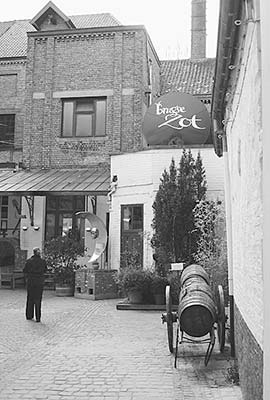
Cost and Hours: €16 tour includes a beer, RS%—ask for a €2 discount; tours run Sun-Wed 12:00-16:30, Thu-Sat until 17:30; smart to book online or call for a reservation, lots of steep steps but a great rooftop panorama; Walplein 26, +32 50 444 222, www.halvemaan.be.
▲Bourgogne des Flandres Brewery Tour
Set idyllically on a canal, this brewery offers a fun walk through a historic brewery accompanied by an audioguide. The visit includes a glass of their famously “impossible to describe” beer on a scenic canalside terrace. To savor the terrace and included beer while enjoying a quick and cheap lunch, consider splitting the hearty €15 meat board (€16 tour includes audioguide and a beer; Tue-Sun 10:30-18:30, closed Mon, last tour at 17:00; Kartuizerinnenstraat 6, +32 50 335 426, www.bourgognedesflandres.be).
Bruges Beer Experience
With a red-carpet entrance just off the Markt, this homage to beer’s frothy history overlooks the square from the top of the former post office.
Cost and Hours: €13, €19 ticket includes three tastings, daily 10:00-18:00, last entry one hour before closing, Breidelstraat 3, +32 50 699 229, www.mybeerexperience.com.
Visiting the Museum: Head up three flights of steep stairs (lined with fun and historic local beer ads) to the museum’s entrance, where you’ll get an iPad and headphones to tour the exhibit and learn about the history of beermaking. The most interesting section is on the top floor, where you can run your hands through raw hops, yeast, and barley while getting a step-by-step guide to modern brewing.
When you’ve had your historical fill, saunter down to the bar and trade the iPad for three tokens good for your choice of tasting-size beers from a rotating list of 16 local drafts. The bar offers Markt views and is open to the public until 18:30 (ticket not required).
CHOCOLATE
Bruggians are connoisseurs of fine chocolate. You’ll be tempted by chocolate-filled display windows all over town. While you’ll see the big-factory/high-price/high-quality brands like Leonidas, Galler, and Neuhaus, there are plenty of smaller family-run places in Bruges that offer exquisite handmade chocolates. All of the following chocolatiers are proud of their creative varieties and welcome you to assemble a 100-gram assortment of five or six chocolates.
The standard price for midrange pralines is about €45 per kilogram (or €4 for 100 grams). Swankier and “gastronomical” places (like The Chocolate Line or Pralinette) charge significantly more, but only aficionados may be able to tell the difference. On the other hand, if a place is priced well below this range, be suspicious: Quality may suffer.
By the way, if you’re looking for value, don’t forget to check the supermarket shelves. Since the country is the largest producer of raw chocolate, Belgium’s stores always have a wall of quality chocolate. Try Côte d’Or’s Noir de Noir for a simple bar of pure dark chocolate that won’t flatten in your luggage.
▲Chocolate Shops
Katelijnestraat, south of the Church of Our Lady, is “Chocolate Row,” with a half-dozen shops within a few steps. Locals rarely buy chocolate along here (as the prices are marked up for tourists), but this is one convenient place to shop. You also can’t go wrong with the following shops; for locations, see the map on here.
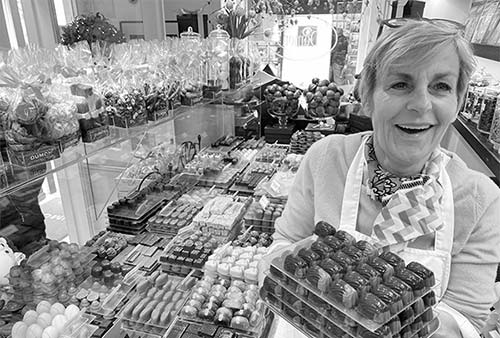
Dumon: Some of Bruges’ smoothest, creamiest chocolates are at Dumon (a selection of five or six chocolates are a deal at €4/100 grams). Try a small mix-and-match box to sample a few out-of-this-world flavors. Chantal is enthusiastic about her pralines—but warns that the Tonka variety is such strong chocolate that it’s banned in the US (daily, +32 50 333 360, past the Church of Our Lady near the Halve Maan Brewery at Walstraat 6). Additional locations are north of the Markt at Eiermarkt 6 and between the Church of Our Lady and the Markt at Simon Stevinplein 11.
The Chocolate Line: Locals and tourists alike flock here to taste the gastronomique varieties (pricey at about €8.40/100 grams) concocted by Dominique Persoone—the mad scientist of chocolate—and his son Julius. Their unique creations mix chocolate with various, mostly savory, flavors. Even those that sound gross can be surprisingly good: Havana cigar (marinated in rum, cognac, and Cuban tobacco leaves), Saké (bitter ganache, seaweed, and Japanese rice wine), and the green-hued Brasil (cilantro, chili, Cachaça rum, and lime). The kitchen—busy whipping up 80 varieties—is on view in the back. Enjoy the window display, refreshed monthly (daily, between the Church of Our Lady and the Markt at Simon Stevinplein 19, +32 50 341 090).
Pralinette: The eye-catching colors and designs of these chocolates make it almost impossible to just glance in the window and then keep on walking. Each praline by chocolatier Fangio De Baets and his small team is a tiny work of art (and priced accordingly at €7.90/100 grams). The attached café has a terrace in back, where you can enjoy coffee drinks or hot chocolate right on the canal (daily, Wollestraat 31, +32 50 348 383).
The Old Chocolate House: This combination chocolate shop and tearoom is proud to be a family business (started by Françoise Thomaes), and the many photos of family members and regular patrons give it a homey atmosphere. The tearoom is not so much about tea as about hot chocolate: You can choose from about 20 varieties. Even locals come here to savor some of the best hot chocolate around (they have waffles, too). Pralines cost about €4.40/100 grams (daily, tearoom closed Wed, Mariastraat 1).
Confiserie De Clerck: Third-generation chocolatier Jan sells his handmade chocolates for about €2.20/100 grams (about six pieces), making this a bargain. Some locals claim his chocolate’s just as good as at pricier places, while others insist that any chocolate this cheap must be subpar—taste it and decide for yourself. The time-warp candy shop (hardly changed over 90 years) is so delightfully old-school, you’ll want to visit, regardless (closed Sun, near the Old Stock Exchange at Academiestraat 19, +32 50 345 338). While Jan is generous with samples, Inge (his wife) runs the beer shop next door—and she isn’t.
While Belgium’s chocolatiers rake in the euros today, their customers are just the latest in a long line of chocoholics.
Ancient Central American indigenous groups—from the Aztecs to the Maya to the Olmecs—indulged in cocoa products for centuries; the earliest evidence of cocoa consumption dates to around 2000 BC. Cocoa was so prized that some societies used it as currency.
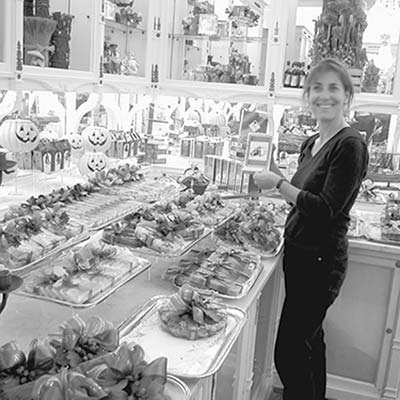
In 1519, the Aztec emperor Montezuma served Spanish conquistador Hernán Cortés a cup of hot cocoa (xocoatl) made from cocoa beans, which were native to the New World. It ignited a food fad in Europe—by 1700, elegant “chocolate houses” in Europe’s capitals served hot chocolate (with milk and sugar added) to wealthy aristocrats. By the 1850s, the process of making chocolate candies was developed, and Belgium, with a long tradition of quality handmade luxuries, was at the forefront.
Cocoa comes from a big orange fruit that grows primarily in the tropical climates of Central and South America. The fruit’s gooey pulp and beans are scooped out and left to ferment, then sun-dried for two weeks. The beans are roasted, creating “nibs”—the essence of cocoa.
Chocolate straight from the bean is very bitter, so nibs are processed into cocoa paste or cocoa butter, and the byproduct is ground again to make cocoa powder. Cocoa butter and cocoa paste are mixed together and sweetened with sugar to make chocolates. (Dark chocolate has a higher concentration of cocoa paste, while milk chocolate has more cocoa butter as well as milk powder.)
Europeans created the first chocolate bar in 1847. In 1876, a Swiss man named Henry Nestlé added concentrated milk, creating milk chocolate. And in 1912, Swiss confectioner Jean Neuhaus invented the Belgian praline in Brussels. Later innovators perfected the process, among them the Greek American chocolatier Leonidas Kestekides, who started his internationally renowned company in Belgium.
Belgians divide their confections into two categories: Truffles have soft, crumbly chocolate shells filled with buttercream, while pralines are made of a hard chocolate shell with a wide range of fillings—totally different from the sugar-and-nuts French praline.
Belgians take chocolate seriously, and rightly so: It’s an essential—and delicious—part of the economy.
Choco-Story: The Chocolate Museum
This kid-friendly museum with lots of artifacts fills you in on the history and production of chocolate.
Cost and Hours: €14, includes audio-guide and samples; various combo-tickets include the Lamp Museum, Friet Museum, and Diamond Museum; daily 10:00-18:00, last entry one hour before closing; where Wijnzakstraat meets Sint Jansstraat at Sint Jansplein, three-minute walk from the Markt; +32 50 612 237, www.choco-story-brugge.be.
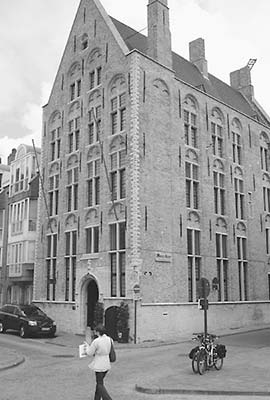
Visiting the Museum: Head up the stairs by the gigantic chocolate egg to follow the chronological exhibit tracing 4,000 years of chocolate history. You’ll discover why, in the ancient Mexican world of the Maya and Aztec, chocolate was considered the drink of the gods, and cocoa beans were used as a means of payment.
Higher up, you’ll learn how chocolates are made and how Belgian pioneers perfected the process. And on the top floor, you’ll view a delicious little video and learn more about the big-name Belgian chocolatiers (including some less-than-subtle product placement for Belcolade, which sponsors this museum). The finale is downstairs, with sample bins and a short cooking demo.
Nearby Sights
The owners of the Chocolate Museum operate two similarly quirky museums that are open the same hours.
The museum owner’s wife got tired of her husband’s ancient lamp collection...so he opened the Lamp Museum (Lumina Domestica) next door. While its appeal is limited, this collection of lamps through the ages is jam-packed and well-described (€20 combo-ticket with Choco-Story—no individual ticket for Lamp Museum).
The same folks also run the fun-loving and kid-friendly Friet Museum, a few blocks away (€11, includes audioguide, Vlamingstraat 33, www.frietmuseum.be). While it tries hard to elevate the story of the potato, this is—for most—one museum too many. Still, it’s the only place in the world that enthusiastically tells the story of Belgian fries.
BIKING
The Dutch word for bike is fiets (pronounced “feets”). And though Bruges’ sights are close enough for easy walking, the town is a treat for cyclists. A bike quickly gets you into dreamy back lanes without a hint of tourism. Take a peaceful evening ride through the town’s nooks and crannies and around the outer canal. Consider keeping a bike for the duration of your stay—it’s the way locals get around. You can try one of the following rides, or ask at the rental shop for maps and ideas (see “Bike Rental” on here).
▲Markt to the Moat Ride
My self-guided walk from the Markt to the Moat (earlier in this chapter) is equally fun on a bike. As this area is less touristy, it’s less congested and easy to navigate on a bike. When you reach the end of the described route, you can continue riding, following the routes described next.
▲Bike Around Bruges
The medieval city is defined by its circular canal, which traces the old medieval wall and passes four surviving medieval gates. Today a delightful six-mile path along the canal is ideal for bikers (and walkers), offering any visitor a wonderfully scenic and peaceful circle tour.
▲▲Bike Ride to Damme
For the best short bike trip out of Bruges, pedal four miles each way to the nearby town of Damme. You’ll enjoy a whiff of the countryside and see a working windmill while riding along a canal to a charming (if well-discovered) small market town. While Damme is cute, it’s sleepy, with little to see—take this ride mostly as an excuse to pedal through the countryside, between canals and farm fields. Allow about two hours for the leisurely round-trip bike ride and a brief stop in Damme. The Belgium/Netherlands border is a 40-minute pedal (along the same canal) beyond Damme.
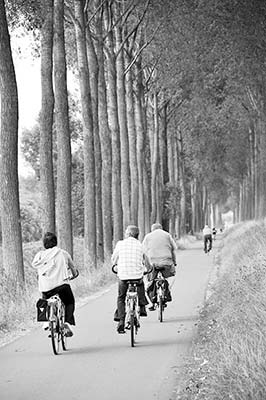
• Head east from Bruges’ Markt through Burg Square and out to the canal. (Or, for a more entertaining route, follow the directions under my “Markt to the Moat Stroll,” earlier.) At the canal, circle to the left, riding along the former town wall and passing four windmills (including the St. Janshuys Windmill, described earlier). After the last windmill, at Dampoort, turn right across the second of two bridges (at the locks), then continue straight along the north/left bank of the Damme Canal (via Noorweegse Kaai/Damse Vaart-West).
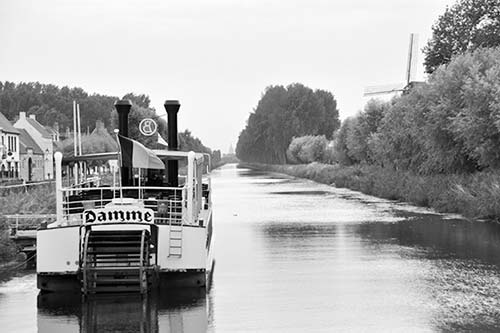
The Damme Canal (Damse Vaart): From Dampoort you’ll pedal straight and level along the canal directly to Damme. Start on the left bank because there’s no opportunity to cross the canal until you reach the town. The farmland to your left is a polder—long ago a salt marsh that flooded each spring, until it was reclaimed by industrious local farmers. The Damme Canal, also called the Napoleon Canal, was built in 1811 by Napoleon (actually by his Spanish prisoners) in a failed attempt to reinvigorate Bruges as a port. Today locals fish this canal for eels. Before climate change, skaters eagerly awaited the first winter freeze. Old-timers have fond memories of skating to Holland on this canal—but nowadays such a hard freeze is a rare event (ask locals about the winter of 2008-2009).
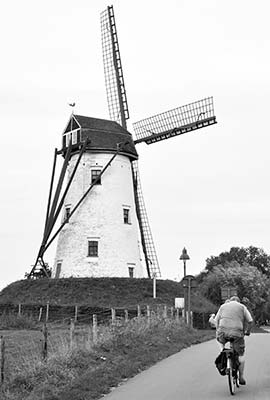
Schelle Windmill (Schellemolen): Just before arriving in Damme, you’ll come upon a working windmill that dates from 1867. This one is ingeniously designed so just the wood cap—rather than the entire building—turns to face the wind. If it’s open, climb up through the creaking, spinning, wind-powered gears to the top floor (free, may be closed for renovation—check locally; otherwise likely open Sat-Sun 9:30-12:30 & 13:00-18:00, closed Mon-Fri and Oct-March).
In its day (13th-15th century), Bruges was one of the top five European ports...and little Damme was important as well. But its once-bustling harbors silted up and the sea retreated. Pause atop the bridge just beyond the windmill, with the windmill on your right and the spire of Bruges’ Church of Our Lady poking up in the distance. It’s easy to imagine how, at Napoleon’s instructions, the canal was designed to mimic a grand Parisian boulevard—leading to the towering church back in Bruges.
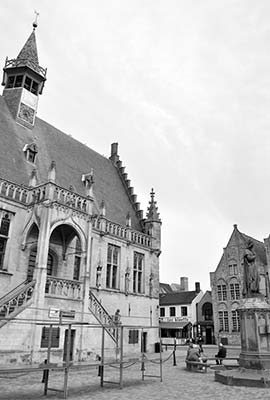
• From here, the canal continues straight to Holland. (If tempted...you’re a third of the way to the border.) Instead, cross the bridge and follow Kerkstraat, which cuts through the center of town, to Damme’s main square and City Hall.
Damme: Damme was once the place where big oceangoing ships offloaded cargo onto smaller boats to float farther inland to Bruges. Its economy was fishing, shipping, and warehousing. Today’s Damme is a tourist center—a tiny version of Bruges. It has a smaller but similar City Hall, a St. John’s Hospital, and a big brick Church of Our Lady. Five hundred years ago, Damme must have been rolling in money—its City Hall is made of expensive imported French limestone rather than more typical Belgian brick. Originally the ground floor was a market and fish warehouse, with government offices upstairs.
• Continue on Kerkstraat as it leads two blocks farther to the Church of Our Lady. Along the way, you could side-trip to the left, down Pottenbakkersstraat, to a quaint little square called Haringmarkt (the Herring Market that made Damme rich in the 15th century). The trees you see from here mark the lines of the town’s long-gone 17th-century ramparts.
Returning to Kerkstraat, continue on to the big church.
The Church of Our Lady: This church, which rose and fell with the fortunes of Damme, dates from the 13th century. Inside are two Virgin Marys: To the right of the altar is a 1630 wooden statue of Mary, and to the left is Our Lady of the Fishermen (c. 1650, in a glass case). Over the nave stands Belgium’s oldest wooden statue, St. Andrew, with his X-shaped cross.
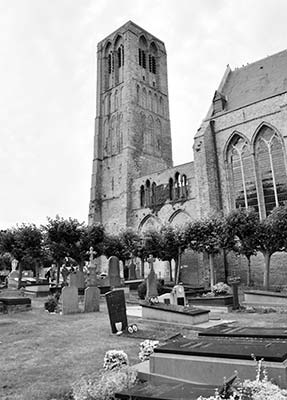
Outside, behind the 13th-century church tower, is a three-faced, modern fiberglass sculpture by the Belgian artist Charles Delporte. Called View of Light, it evokes three lights: morning (grace), midday (kindness), and evening (gentleness). If you like his work, there’s more at a nearby gallery.
• To return to Bruges, continue past the church on Kerkstraat. Just before crossing the next bridge, follow a scenic dirt lane to the right that leads you back to the Damme Canal (and Damse Vaart-Zuid). Take this road back to Bruges. If you want a change of pace from the canal, about halfway back turn off to the left (at the white bridge and brick house), then immediately turn right on Polderstraat and follow the smaller canal back to the outskirts of Bruges.