AUSTRIA: PAST & PRESENT
Holy Roman Empire and the Rise of the Habsburgs
A New Century and the Fall of the Empire
Rise of Fascism and World War II
Wolfgang Amadeus Mozart (1756-1791)
Arnold Schwarzenegger (b. 1947)
Timeline of Austrian History
Romans and Barbarians
c. AD 1
The Romans occupy and defend previously Celtic lands as far northeast as the Danube River, including the strategically critical north-south Brenner Pass through the Alps. Their settlement in Vienna, called Vindobona, was centered on the site of today’s cathedral.
c. 500
Lombard “barbarians”—following on the heels of the Vandals and Huns—drive the last Romans out, claiming this prime location as their own.
Holy Roman Empire and the Rise of the Habsburgs
c. 800
Charlemagne designates Austria—as one boundary of his European empire—the “Eastern Realm,” or Österreich. Charlemagne is crowned Holy Roman Emperor, a title Austria’s rulers would later claim for themselves. Vienna (now called “Wenia”) develops further as a thriving trade city.
1147
Vienna’s St. Stephen’s Cathedral is begun in the Romanesque style (still seen today in the facade). The church would take more than 300 years to complete.
1273
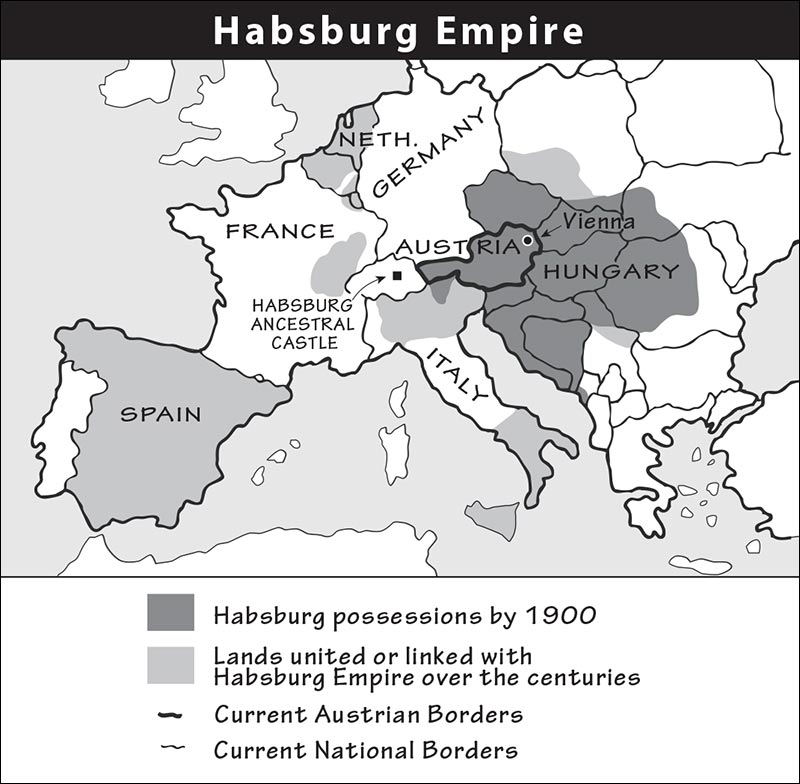
An Austrian noble from the Habsburg family (Rudolf I) is elected Holy Roman Emperor, ruling Austria, Germany, and northern Italy. From 1438 until 1806, every emperor but one is a Habsburg. The Habsburgs arrange strategic marriages for their children with other prominent royalty around Europe, gaining power through international connections.
c. 1450
Vienna flourishes under Holy Roman Emperor Frederick III, considered the “father” of Vienna for turning the small village into a royal town with a cosmopolitan feel. Frederick makes the city his capital, and the Hofburg his home. St. Stephen’s soaring 450-foot spire is completed (1433), the north tower is begun (1450), and the church is given a bishopric (1469), becoming a cathedral. Frederick’s impressive tomb stands in the cathedral today.
1493
Maximilian I is crowned emperor. His marriage to Mary of Burgundy weds two kingdoms together, and their grandson, Charles V, inherits a vast empire. The combined lands instantly make the Habsburg Empire a major player in European politics. In 1498, Maximilian establishes the Vienna Boys’ Choir to sing for him at Mass.
Wars and Turbulence
1519
Charles V (r. 1519-1556) is the most powerful man in Europe, ruling Austria, Germany, the Low Countries, parts of Italy, and Spain (with its New World possessions). Charles is responsible for trying to solve the problems of all those lands, including battling Ottomans in Vienna and Lutherans in Germany. While many lands north of the Danube turn Protestant, Austria remains Catholic.
1522
Charles V gives Austria (and the Ottoman problem) to his little brother, Ferdinand, who, four years later, marries into the Bohemian and Hungarian crowns.
1529
Ottoman invaders from today’s Turkey besiege Vienna, beginning almost two centuries of battles between Austria and the Ottoman Empire. In the course of the wars, Austria gains possession of Hungary and much of Eastern Europe.
1533
Vienna—with 50,000 inhabitants and a long history as the major city of the region—becomes the official capital of the Habsburg Empire.
1556
Charles V retires from the throne to enter a monastery, leaving his kingdom to his son (King Philip II of Spain) and the crown of Holy Roman Emperor to his brother, Ferdinand I of Austria. From now on, Austria’s rulers would concentrate on ruling their eastern empire, which includes part or all of present-day Austria, Hungary, the Czech Republic, Slovakia, Romania, Slovenia, Croatia, Bosnia-Herzegovina, Serbia, northern Italy (Venice), and, later, parts of Poland and Ukraine.
1648
The Thirty Years’ War—a bitter struggle between Catholic and Protestant forces—finally comes to an end, leaving the Holy Roman Empire an empire in name only. Its figurehead emperor oversees a scattered group of German-speaking people, mainly in Austria and (what is now) Germany.
1679
A disastrous bubonic plague kills 75,000 Viennese (remembered today by the plague column on the Graben).
1683
Almost 200,000 Muslims from Ottoman Turkey surround the city of Vienna once again. The Ottomans are driven off, leaving behind bags of coffee that help fuel a beverage craze around Europe. Vienna’s first coffeehouse opens.
Three wars with Louis XIV of France (including the War of the Spanish Succession) drain Austria. Meanwhile, the Habsburgs put down the Hungarian War of Independence (1703-1711), led by Transylvanian prince Ferenc Rákóczi.
1735
The Spanish Riding School is built at the Hofburg in Vienna.
1740
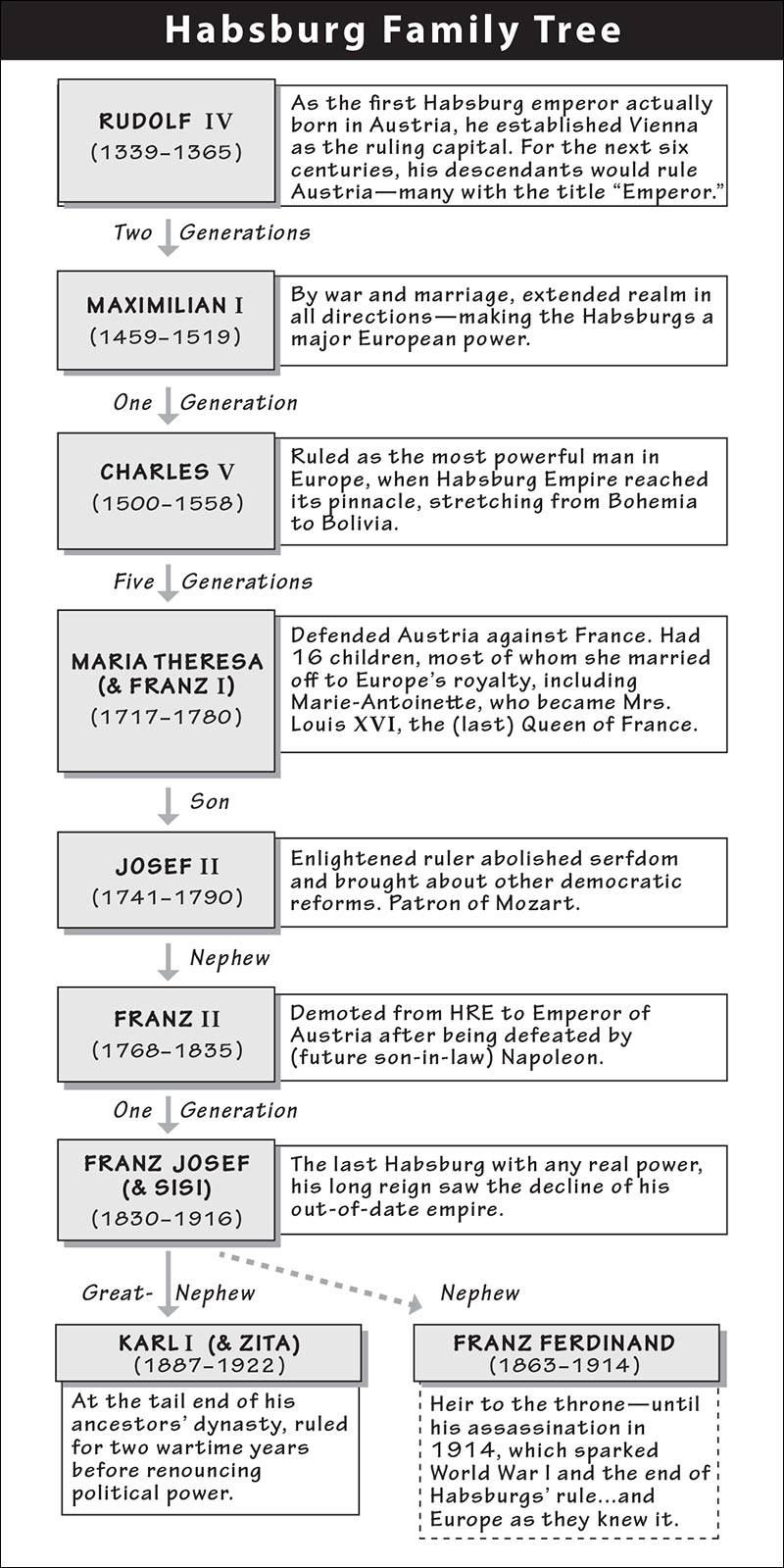
Maria Theresa (r. 1740-1780) ascends to the throne. She eventually has 16 children and still finds time to fight two wars in 25 years, defending her right to rule. Adored by her subjects for her down-to-earth personality, she brings Austria international prestige by marrying her daughters to Europe’s royalty. Under Maria Theresa, Schönbrunn Palace reaches its peak of luxury.
1781
Maria Theresa’s son Josef II, who frees the serfs and takes piano lessons from Mozart, staves off the tide of democratic revolution and rules Austria as an “enlightened despot.”
1791
Mozart’s comic opera The Magic Flute debuts. Vienna is the world capital of classical music, home to Haydn (1732-1809), Mozart (1756-1791), and Beethoven (1770-1827). Mozart was married in St. Stephen’s Cathedral, and, after his death, his Requiem Mass is played there.
1792
When the French queen, the Habsburg Marie-Antoinette, is imprisoned and (later) beheaded by revolutionaries in Paris, her nephew, Austria’s Emperor Franz II, seeks revenge, beginning two decades of wars between revolutionary France and monarchist Austria.
The Austrian Empire
1805
Napoleon defeats Austria at Austerlitz, his greatest triumph over the forces of monarchy. Napoleon occupies Vienna, moves into Schönbrunn Palace, and forces Holy Roman Emperor Franz II to hand over the Imperial Crown (1806), ending a thousand years of empire. Napoleon even marries Franz II’s daughter, Marie-Louise.
1814-1815
After Napoleon is defeated, an Austrian, Chancellor Metternich, heads the Congress of Vienna—reinstalling kings and nobles recently deposed by Napoleon. Metternich’s politics sets the tone for Vienna’s conservative, bourgeois-dominated society.
Early 1800s
Throughout the Habsburgs’ central and eastern European holdings, a gradual cultural revival takes place. Natives of Habsburg lands such as Hungary, the Czech Republic, Slovakia, and Slovenia enjoy a renewed appreciation for their unique, traditional, non-Austrian culture and language—setting the stage for a rocky century.
1832
Franz Sacher invents Vienna’s signature dessert, the Sacher torte.
1848
Emperor Franz Josef (emperor of Austria, but not the “Holy Roman Emperor”) rules for the next 68 years, maintaining white-gloved tradition while overseeing great change—Austria’s decline as an empire and entrance into the modern industrial world. During his first year on the throne, another wave of revolution sweeps Europe, endangering many of his holdings.
1849
Almost 100,000 Austrians attend the funeral of violinist Johann Strauss, responsible for the dance craze called the waltz. His son, Johann Strauss II (1825-1899), takes the baton of the Strauss Orchestra and waltzes on.
c. 1850
Austria flourishes in a Golden Age that lasts throughout the latter half of the 19th century. Vienna is the epicenter of European culture: fine music, exquisite art, coffee and chocolates, dress-up balls, enlightened city planning, and cutting-edge science.
1854
Franz Josef marries the beautiful/neurotic Elisabeth (“Sisi”), and they settle into their lavish home in the Hofburg’s Imperial Apartments.
1857
Vienna—population 450,000—is bursting at the seams. The city embarks on a massive urban renewal project. The old city wall is torn down and turned into a wide, circular boulevard called the Ringstrasse, lined with grand buildings, including the opera, City Hall, and twin Kunsthistorisches and Natural History Museums. The buildings are state of the art but decorated in styles that echo the past: Neoclassical, Neo-Gothic, and so on. Vienna’s incredible transformation is overseen by Emperor Franz Josef, Mayor Karl Lueger, and chief architect Otto Wagner.
1866
Prussia provokes war and defeats Austria, effectively freezing Austria out of any involvement in a modern German nation.
The Austro-Hungarian Empire
1867
“The Blue Danube,” a waltz by Johann Strauss II, debuts. But Austria—while at its cultural peak—is beginning its slow political decline. To better suppress the huge Slavic population in its sprawling empire, and facing a low-morale moment after the war with Prussia, Austria gives partial control over its territories to Hungary. This creates the “Dual Monarchy” of the Austro-Hungarian Empire. In a symbolic compromise, Franz Josef, “emperor” of Austria, is crowned “king” of Hungary (the origin of the royal boast “K+K”—kaiserlich und königlich, imperial and royal).
1869
The Vienna Opera House opens. Vienna in the late 19th century is home to composers Johannes Brahms, Richard Strauss, and Gustav Mahler.
1897
The Secession building opens in Vienna, displaying works by an exciting young generation of artists who vow to “secede” from academic art tradition.
1898
The horse-drawn trams on Vienna’s Ringstrasse give way to electric-powered streetcars.
1899
Viennese psychiatrist Sigmund Freud publishes The Interpretation of Dreams, launching psychoanalysis and the 20th-century obsession with repressed sexual desires, the unconscious mind, and couches.
A New Century and the Fall of the Empire
c. 1900
As the century turns, Vienna is the globe’s fifth-largest city (population 2.2 million)—bigger than it is today. It’s balanced on the cusp between traditional Old World elegance and subversive modern trends. Stalin and Trotsky are rattling around. Women are smoking, riding bikes, and demanding the right to vote. In 1900, Adolf Loos builds his controversial, minimalist Loos House across from the old-school Hofburg.
Gustav Klimt’s painting The Kiss—sensual, daring, semi-abstract, and slightly decadent—epitomizes the Viennese Jugendstil (Art Nouveau) movement.
1908
A young aspiring artist named Adolf Hitler is rejected by Vienna’s Academy of Fine Arts for the second time—one of many rejections and frustrations that will lead him to embrace his violent, anti-Semitic worldview.
1914
Austria fires the opening shots of World War I to avenge the assassination of its heir to the throne, Archduke Franz Ferdinand.
1919
After its defeat in World War I, the Austro-Hungarian Empire is divided into separate democratic nations, with Austria assigned the small, landlocked borders that it has today.
Rise of Fascism and World War II
1927
Riots in the streets of Vienna between liberals and fascists leave dozens dead and hundreds wounded; they show the deep rift in Austrian society. By the time the global Great Depression reaches Austria, the country is a powder keg of extreme ideologies.
1932
Mirroring events in Germany, a totalitarian government (headed by Engelbert Dollfuss) replaces a weak democracy floundering in economic depression.
1938
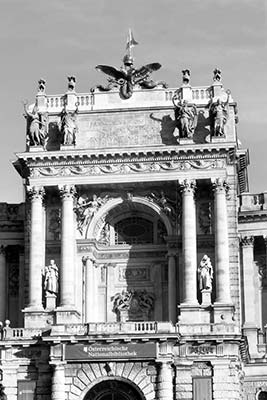
Led by Austrian-born Chancellor Adolf Hitler, Nazi Germany—using the threat of force and riding a surge of Germanic nationalism—annexes Austria in the Anschluss and leads it into World War II. Hitler returns to Vienna in triumph, stands on the New Palace balcony at the Hofburg (now the World Museum Vienna), and addresses his adoring throngs.
1939-1945
During World War II, Austria is part of Nazi Germany and suffers the consequences. Of Vienna’s 200,000 Jews, about a third die in death camps. Nearly 100,000 Jews, criminals, and political dissidents die at Mauthausen Concentration Camp, just up the Danube from Vienna.
1943
The first Allied bombs strike Vienna. Over the next two years, half of the historic center is destroyed in Allied air raids. St. Stephen’s Cathedral catches fire, collapsing the wooden roof. Many of the city’s top art treasures are safely stowed away in cellars and salt mines.
1945
As the war ends, Vienna is liberated by Soviet troops. The city is in ruins. Like Germany, a defeated Austria is divided by the victors into occupied zones, but the country’s occupation is short-lived.
Postwar Era
1949
The movie The Third Man premieres, showing Vienna as a shady, espionage-laced city caught between Cold War superpowers. It’s a hit in Britain and the US but a flop in Austria, a nation not keen to see its recently mighty capital portrayed as an occupied city in ruins.
1952
In Vienna, a new St. Stephen’s cathedral roof, rebuilt with local donations, is dedicated.
1955
Modern Austria (with Vienna as its capital) is born as a neutral nation, with the blessing of the international community. The treaty is signed at Belvedere Palace.
1961
President Kennedy meets Soviet Premier Khrushchev in Vienna for peace talks. As neutral territory between East and West, Austria is a natural choice for summits between the Cold War superpowers. Vienna also becomes home to several UN organizations. The OPEC nations make Vienna its seat in 1965.
1974-1978
The Graben is pedestrianized, signaling Vienna’s determination to modernize while preserving its historic core, and the subway system (U-Bahn) opens its first line (U-1).
1990s
Austria absorbs tens of thousands of war refugees during the breakup of Yugoslavia.
1995
Austria joins the European Union.
The 21st Century
2000
The EU places sanctions on Austria (lifted a few months later) when the far-right Freedom Party—campaigning under the slogan Überfremdung (“Too many foreigners”)—gains seats in Austria’s parliament. Two years later, the party does poorly in elections.
Vienna’s first Starbucks boldly opens—directly across from one of the city’s oldest, best-loved coffee shops. Gott in Himmel!
2008
In September, Austria’s revived far-right parties win 29 percent of the popular vote. A month later, their leader, Jörg Haider, is killed in a car crash.
2010
Vienna is named the most livable city in the world by the Mercer Quality of Life survey, citing the city’s affordability, cultural vivacity, safety, and excellent public transit. The city retains its No. 1 spot for the next 10 years.
2015
Hundreds of thousands of African and Middle Eastern refugees and immigrants pour through Austria—the first Western European nation encountered by many migrants. In August, the world is horrified when 71 migrants are found suffocated in the back of a smuggler’s truck. Relations with Hungary are strained by questions of border control and immigration policy.
2016
In May, Freedom Party candidate and anti-immigration hardliner Norbert Hofer comes within 15,000 votes of winning the Austrian presidency (a role more ceremonial than the chancellor’s, but symbolically important).
2022
Just after midnight on January 1, millions of people around the world welcome the New Year by watching a broadcast of the Vienna Philharmonic playing a waltz by Strauss.
Today
You arrive in Austria and make your own history.
Notable Austrians
Charles V (1500-1558)
Through a series of marriages and unexpected deaths, Charles V inherited not only the Habsburg properties in Austria, but also the Netherlands and the Spanish Empire, including its colonies in the Americas. He said that he ruled an empire “upon which the sun never sets” (a phrase the British stole for their own dominions in the 19th century). But even the most powerful ruler on earth couldn’t stop the spread of Protestantism. Charles’ vision of a unified, Catholic, European empire was thwarted by Martin Luther, German Protestant princes, and their allies, the French.
Maria Theresa (1717-1780)
The first and only female head of the Habsburg dynasty, Maria Theresa consolidated the power of the throne but also reformed Austria by banning torture, funding schools and universities, and allowing some religious freedom for Protestants. Her changes, and those of her son, Josef II, allowed Austria to withstand the upheavals of the French Revolution. Her apartments at Vienna’s Schönbrunn Palace are tourable today (see the Schönbrunn Palace Tour chapter; for more on the empress, see here).
Marie-Antoinette (1755-1793)
The youngest daughter of Maria Theresa, Marie-Antoinette’s marriage to the heir to the French throne was supposed to cement the alliance between France and Austria. But she was not popular; even before the revolution, pamphleteers called her hopelessly stupid, accusing her of adultery, sexual deviance, and treason. During the Reign of Terror, she lost her head to the guillotine, inspiring countless romantic novels and two Hollywood movies.
Wolfgang Amadeus Mozart (1756-1791)
The ultimate child prodigy, Mozart started composing when he was five and performed for Empress Maria Theresa when he was eight. A giant of classical music, he wrote masterpieces in every genre he touched—operas, symphonies, chamber music, piano sonatas, and string quartets. Fans flock to visit his childhood homes in Salzburg (see “Sights in Salzburg” in the Salzburg & Berchtesgaden chapter).
Johann Strauss II (1825-1899)
Vienna was the hometown of many great composers, such as Josef Haydn and Franz Schubert, but Johann Strauss II (the Younger) best captured its spirit. “The Waltz King” helped popularize this musical genre in the 19th century and wrote the most famous waltz of all, “The Blue Danube,” as well as the operetta Die Fledermaus. These musical achievements came despite the objections of his father—also a famous composer—who wanted his son to be a banker.
Franz Josef (1830-1916)
At the age of 18, Franz Josef became emperor—beginning a 68-year reign surpassed in European history only by France’s Louis XIV and a Liechtenstein prince. Franz Josef, a staunch conservative but a terrible general, presided over—and likely contributed to—the decline of the Austro-Hungarian Empire. His family life was similarly troubled; his estranged wife, “Sisi,” was assassinated by an Italian anarchist, and his only son, Crown Prince Rudolf, committed suicide (or did he?) in the arms of a mistress. The end of the Habsburg dynasty came two years after Franz Josef’s death. His Hofburg Imperial Apartments in Vienna are open to the public (see here; for more on the emperor, see here).
Sigmund Freud (1856-1939)
The Austrian physician and psychoanalyst revolutionized the study of human behavior. According to Freud, repressed desires—sexual desires in particular—explained why humans behave the way we do. Although he was a world figure of immense influence, the Nazis despised his Jewish roots and burned his books. After they took over Austria in 1938, Freud left for London, where he died a year later. His office in Vienna has been turned into the Sigmund Freud Museum (see here).
Gustav Klimt (1862-1918)
Erotic, symbolic, Byzantine, radical—the turn-of-the-century paintings of Gustav Klimt shook Viennese society. A leader of the Vienna Secession movement, Klimt was criticized at one point for “pornographic” art—years before the gold-wrapped lovers of The Kiss became an art school icon. His portrait The Golden Adele set a record when American billionaire Ronald Lauder bought it in 2006 for $135 million—at that time the most expensive painting ever sold. Klimt’s art is displayed in museums throughout Vienna; The Kiss, for example, is in the Belvedere Palace (for more on the artist, see here).
Franz Ferdinand (1863-1914)
No one expected Archduke Franz Ferdinand to be the heir to the Habsburg dynasty. But when Crown Prince Rudolf killed himself in 1889 and Franz Ferdinand’s father died in 1896, the young archduke suddenly became the hope of the Habsburgs. As inspector general of the army, he was invited to Sarajevo to review Austrian troops. On June 28, 1914, after his chauffeur took a wrong turn on the city’s streets, Franz Ferdinand and his wife were assassinated by a Serbian nationalist, triggering World War I and the eventual end of the centuries-old dynasty.
Adolf Loos (1870-1933)
The man who said “decoration is a crime” was one of the most influential architects of the modern era. Born in what is now the Czech Republic, he trained in Germany and even spent three years tramping around America as a dishwasher and a mason. But it was in Vienna where he made his name. Excessive ornamentation was criminal, he declared, because it wasted labor and materials; the modern era deserved stripped-down facades. Examples of Loos’ architecture—a bookstore, bar, and even WCs—are in downtown Vienna (see here).
Ferdinand Porsche (1875-1951)
This Austrian automotive engineer is best known as the father of the Volkswagen Beetle. Hitler demanded that Germany build a cheap “people’s car,” so Porsche began working on his world-famous design in 1934. Three years later, Hitler gave him one of Germany’s highest awards. This automotive genius is also known for launching (with the help of his son) the Porsche sports car. But he was a century too soon with another one of his inventions: the world’s first electric/gasoline hybrid car, the Mixte, created in 1901 in Vienna.
Adolf Hitler (1889-1945)
The future dictator—directly responsible for the deaths of more than 43 million people during World War II—was born in Braunau am Inn, north of Salzburg. After dropping out of high school at age 16, he spent eight years in prewar Vienna trying to make his way as an artist. (He was rejected twice by Vienna’s Academy of Fine Arts.) Although Hitler served in the German army during World War I, he didn’t become a German citizen until 1932, just one year before becoming the nation’s chancellor and der Führer.
Maria von Trapp (1905-1987)
An orphan by age seven, Maria Augusta Kutschera was raised in Tirol by an anti-Catholic socialist. When she mistakenly attended a religious lecture (she had thought it would be a Bach concert), she was so moved that she became a staunch Catholic. Her memoir of life as a novice at a Salzburg convent and later as governess for the Von Trapp family was the basis for The Sound of Music (see here). The movie (and play) remain a major draw for Salzburg, with its many S.O.M. sights and tours.
Billy Wilder (1906-2002)
Born in Austria, Hollywood legend Billy Wilder won Oscars for directing The Lost Weekend and The Apartment. He also wrote and/or directed such Hollywood classics as Some Like It Hot, The Seven Year Itch, Ball of Fire, Sunset Boulevard, Stalag 17, Sabrina, and the dark and brooding Double Indemnity. He lost his mother in the Holocaust and was often bitter about his native country. “The Austrians are brilliant people,” he once said. “They made the world believe that Hitler was a German and Beethoven an Austrian.”
Otto Preminger (1905-1986)
Like Wilder, Otto Preminger grew up in Vienna’s Jewish community. His success in Viennese theater eventually led to Hollywood, where Preminger hit the big time directing the 1944 mystery Laura. Twice nominated for a best-director Oscar (for Laura and The Cardinal), Preminger made films that challenged Hollywood taboos of the time, such as rape (Anatomy of a Murder), drug addiction (The Man with the Golden Arm), and homosexuality (Advise and Consent).
Arnold Schwarzenegger (b. 1947)
Born in a village near Graz, Arnold Schwarzenegger was obsessed with bodybuilding even as a teenager. After winning international bodybuilding contests, Schwarzenegger got his big break as Conan the Barbarian, a role that spawned a string of blockbuster action movies, including the Terminator series. In 2003, Ah-nold switched careers and was elected the Republican governor of California; the “Governator” was reelected to a second term in 2006. After leaving office in 2011, news broke that Schwarzenegger had fathered a son more than 14 years earlier with the family housekeeper—prompting his wife, Maria Shriver, to file for divorce.
Felix Baumgartner (b. 1969)
After learning to parachute in the Austrian military, daredevil skydiver Felix Baumgartner, who was born in Salzburg, has made a career of high-profile, wildly dangerous jumps off buildings, bridges, and mountains. All of Austria (and millions around the world) watched on October 14, 2012, when he plummeted 24 miles to earth in a heart-stopping supersonic jump from a helium-balloon capsule. Baumgartner simultaneously set three world records: highest-altitude manned balloon flight (24 miles up), highest-altitude parachute jump (128,100 feet), and greatest free-fall velocity (834 mph).
For more on Austrian history, consider Europe 101: History and Art for the Traveler, written by Rick Steves and Gene Openshaw (available at RickSteves.com).