DANUBE VALLEY
Melk • Wachau Valley • Mauthausen Memorial
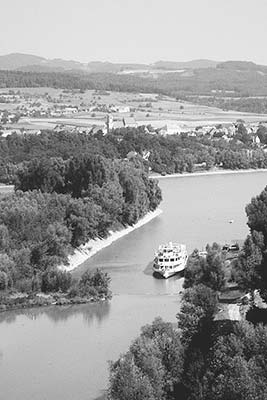
From the Black Forest in Germany to the Black Sea in Romania, the Danube flows 1,770 miles through 10 countries. Western Europe’s longest river (the Rhine is only half as long), it’s also the only major river flowing west to east, making it invaluable for commercial transportation. The Danube is at its romantic best just west of Vienna. Mix a cruise with a bike ride through the Danube’s Wachau Valley, lined with ruined castles, beautiful abbeys (including the glorious Melk Abbey), small towns, and vineyard upon vineyard. Note that in German, Danube is Donau (DOH-now), as you’ll see by the signs.
Much of the valley has a warm, fairy-tale glow, but a trip here isn’t complete without the chilling contrast of a visit to the Mauthausen concentration camp memorial. Visiting this concentration camp, though a little difficult for nondrivers, is unforgettable and worthwhile even if you’ve already seen other camps.
PLANNING YOUR TIME
Allow one day to visit Melk’s abbey and to cruise the Wachau Valley by boat or bike; a second day gives you time to get to Mauthausen. For drivers, it makes sense to see Mauthausen en route to (or from) Salzburg or Hallstatt. For tips on enjoying nearby riverside sights, see “Getting Around the Wachau Valley” later in this chapter.
Day Trip from Vienna: To day-trip to the Danube, catch an early train to Melk, tour its abbey, eat lunch, and take an afternoon boat trip along the river from Melk to Krems (it’s easier in this direction, as you’re going downstream)—or rent a bike in Melk and make the trip on two wheels instead. From Krems, catch the train back to Vienna. The Austrian railway sells a convenient Wachau Ticket, which includes the train trip from Vienna to Melk, entry to the Melk Abbey, a boat cruise to Krems, and the return train trip to Vienna, for €68 (a decent savings off individual tickets; buy at any Vienna train station). Groups of at least two adults can save a few more euros by buying an Einfach-Raus train ticket, or an Einfach-Raus Radticket for bicyclists (see “Transportation” in the Practicalities chapter) and taking a regional train (after 9:00 on weekdays) to Melk, then paying for the boat and the abbey separately.
The fastest train connections to Melk leave from Vienna’s Hauptbahnhof and require an easy transfer en route; a few direct trains from Vienna’s Westbahnhof take 10 minutes longer. From Krems, easy connections via St. Pölten return you to Vienna’s Hauptbahnhof; direct trains from Krems arrive in Vienna at the small Franz-Josefs-Bahnhof (consider getting off at the previous stop, Spittelau, for better connections—on the U-4 and U-6 subway lines—to other points in Vienna).
To Hallstatt: If Hallstatt is the next stop on your itinerary after Melk and you’re traveling by train, make sure to plan for a morning or afternoon arrival; in the evening the boat stops running from the Hallstatt station across the lake to town (see “Arrival in Hallstatt” on here). That may mean going first to Salzburg and then doubling back to Hallstatt.
Melk
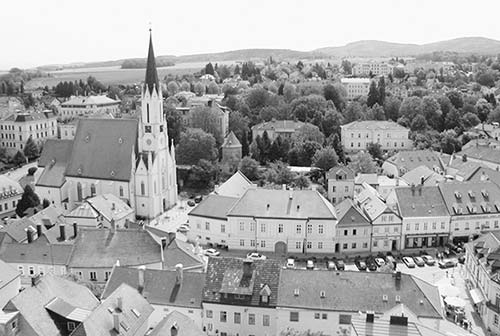
Sleepy and elegant under its huge abbey, which seems to police the Danube, the town of Melk offers a pleasant stop and is a handy springboard for the beautiful Wachau Valley.
Orientation to Melk
TOURIST INFORMATION
The TI is hidden a block off the main square, close to the river, and has info on nearby castles, bike rentals, bike routes along the river, and Zimmer recommendations. The TI rents an audioguide (€3/2 people, €35 deposit) and has lockers and a pay WC (Mon-Sat 9:30-18:00, Sun until 15:30; April and Oct Mon-Sat 9:30-17:00, Sun 10:00-14:00; limited hours Nov-March, Kremser Strasse 5, +43 275 251 160, www.donau.com).
ARRIVAL IN MELK
Melk is just off the A-1 autobahn that runs between Salzburg and Vienna. The town is also on the main Salzburg-Vienna train line, but only regional trains stop here; faster trains bypass the town (you’ll probably transfer in Amstetten or St. Pölten).
By Train: Walk straight out of Melk’s train station and continue ahead for several blocks, then follow the cobbled alley that dumps you into the center of the village. Access to Melk Abbey is up on your right (follow signs to Stift Melk and blue-and-gold pavement stones), and the TI is to your left, a block past the square, near the river.
By Boat: Turn left as you leave the boat dock and follow the walking path toward the big, yellow abbey (the village is beneath its far side). In about five minutes, you’ll come to a flashing light (at intersection with bridge); it’s a short, straight shot from there into the old town.
To reach the boat dock from Melk, leave the town toward the river, with the abbey on your right and the TI behind you. Cross the busy road and walk over the covered bridge. Follow signs for Linienschifffahrt-Scheduled Trips-Wachau.
By Car: If you’re just visiting the abbey, you can park there. To park near the old town, head for the free lot just across the canal from the TI, next to Melk’s open-air theater (the Wachauarena). To reach it, circle around and cross a small one-lane bridge near the gas station, following Wachauarena signs.
Melk Abbey Tour
Melk’s restored abbey, worth ▲▲▲ and beaming proudly over the Danube Valley, is one of Europe’s great sights. Established as a fortified Benedictine abbey (Benediktinerstift) in the 11th century, it was later destroyed by fire. During an 18th-century Baroque building boom, the ruling Habsburgs commissioned architect Jakob Prandtauer to remake the abbey buildings.
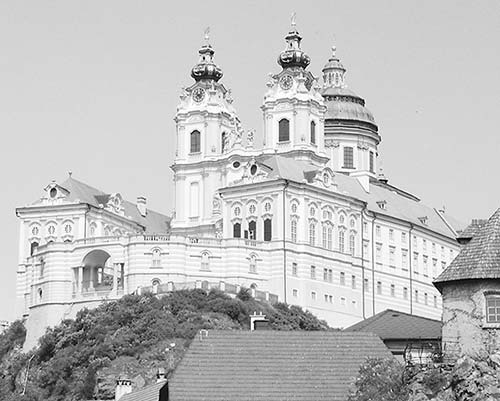
The abbey church, with its 200-foot-tall dome and symmetrical towers, dominates the complex—emphasizing its sacred purpose. The gilded church, restored in 1996 to celebrate the 1,000th anniversary of the first reference to a country named Österreich (Austria), is a grand Baroque dream, a lily alone.
ORIENTATION TO THE ABBEY
Cost and Hours: €13, includes entrance to the abbey and its park and bastions; €4.50 for just the park and bastions. The abbey is open daily 9:00-17:30 (Nov-Dec and March Sat-Sun 10:00-16:30, Mon-Fri by guided tour only; Jan-Feb by guided tour only—see next). The park is open daily 9:00-18:00 (closed Nov-April). Parking is free with a validated ticket (+43 2752 555 232, www.stiftmelk.at).
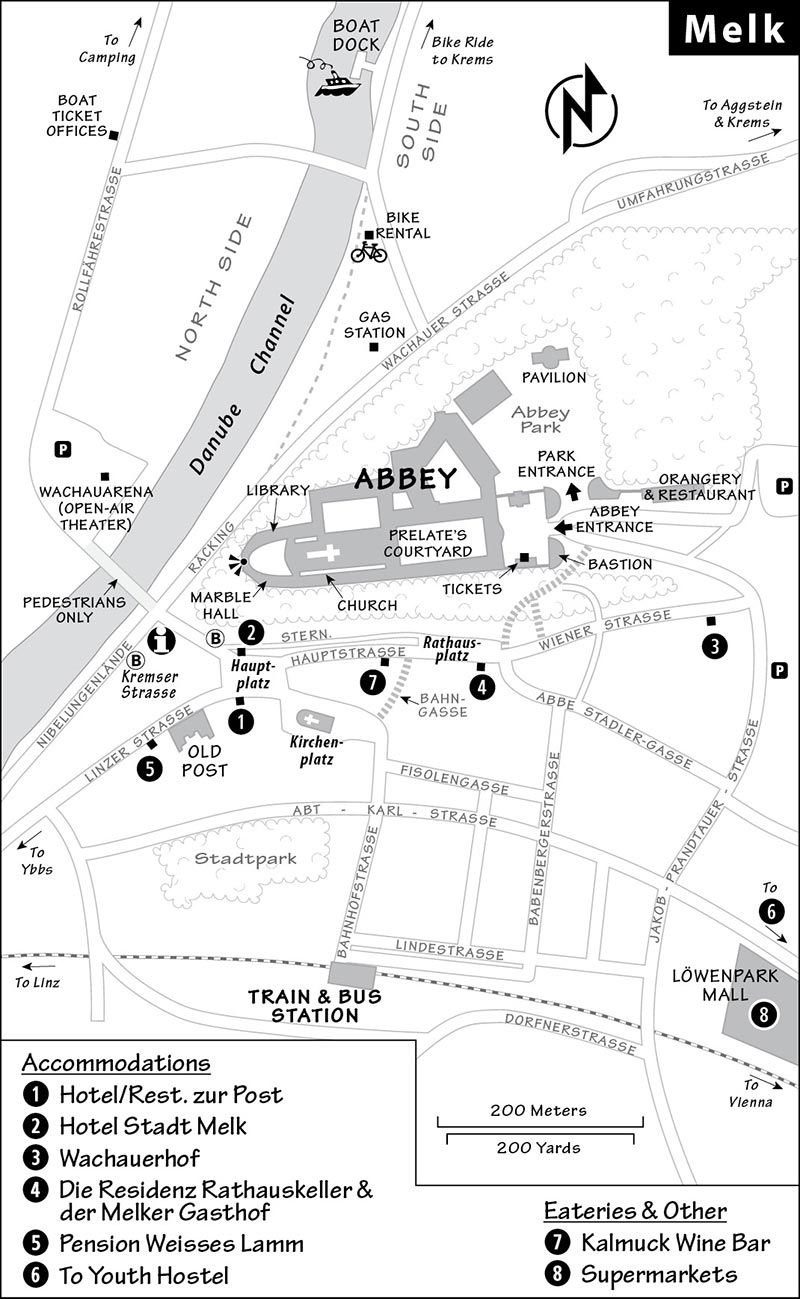
Tours: One-hour English tours of the abbey are offered daily (April-Oct at 10:55 and 14:55, May-Sept also at 13:55; Nov-March at 11:00, 13:30, and 15:00; €16 ticket includes tour and admission). A private guide can be reserved at least one day in advance (€60 plus €13 per-person entrance fee). Book guided tours in advance by calling +43 2752 555 232 or emailing tours@stiftmelk.at.
Eating: The $$ Stiftrestaurant just outside the abbey walls serves traditional Austrian food, mostly to large tour groups, on a modern terrace. There’s also a snack stand in the garden pavilion.
 SELF-GUIDED TOUR
Although you can take a guided tour, it’s easier just to wander through on your own.
• Go through the first passageway and approach the grand entry to the...
East Facade: Imagine the abbot on the balcony greeting you as he used to greet important guests. Flanking him are statues of Peter and Paul (leaders of the apostles and patron saints of the abbey church) and the monastery’s coat of arms (crossed keys). High above are the Latin words “Glory is found only in the cross” and a huge copy of the Melk Cross (one of the abbey’s greatest treasures—the original is hiding in the treasury and viewable only on special occasions).
• Pass into the main courtyard.
Prelate’s Courtyard: This is more than a museum. For 900 years, monks of St. Benedict have lived and worked here. Their task: bringing Christianity and culture to the region and maintaining it. Many of the 29 monks live outside the abbey in the community and run a high school with about 900 students.
There have been low points. During the Reformation (1500s), only eight monks held down the theological fort. Napoleon made his headquarters here in 1805 and 1809. And in 1938, when Hitler annexed Austria, the monastery was squeezed into one end of the complex and nearly dissolved. But today, the institution survives—that’s the point of the four modern frescoes gracing the courtyard—funded by your visit and by agriculture (historically, monasteries are big landowners).
• In the far-left corner, climb the stairs to the...
Imperial Corridor and Abbey Museum: This 640-foot-long corridor, lined with paintings of Austrian royalty, is the spine of the Abbey Museum. Duck into the first room of the museum (on the left, near beginning of hall). These rooms are filled with art treasures, an exhibit with sound-and-light effects meant to convey basic Benedictine precepts, and descriptions of the history of the Benedictines in Melk.
• Continue through the museum—passing through the trippy mirrored room containing gold chalices and monstrances, around a beautifully preserved Northern Renaissance altarpiece—and into the room at the end, with the big rotating model of the abbey.
Marble Hall: The door frames are real marble, but most of this large dining room/ballroom is stucco. The treasure here is the ceiling fresco (by Tirolean Paul Troger, 1731), best appreciated from the center of the room. Notice three themes: 1) The Habsburgs liked to be portrayed as Hercules; 2) Athena, the goddess of wisdom, is included, because the Habsburgs were smart as well as strong; and 3) The Habsburgs were into art and culture. This is symbolized by angels figuratively reining in the forces of evil, darkness, and brutality. Through this wise moderation, goodness, beauty, art, and science can rule. Look up again as you leave the room to see how the columns were painted at an angle to give the illusion of a curved ceiling.
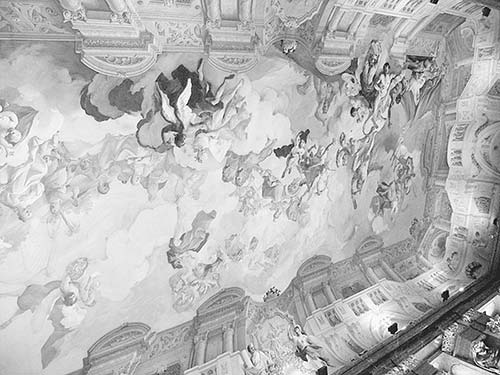
Balcony: Here you’ll enjoy dramatic views of the Danube Valley, the town of Melk, and the facade of the monastery church. The huge statue above everything shows the risen Christ, cross in hand and victorious over death—the central message of the entire place.
Library: Except for the church itself, the library was the most important room in the abbey for the Benedictine monks. Consider how much money they must have invested in its elaborate decor.
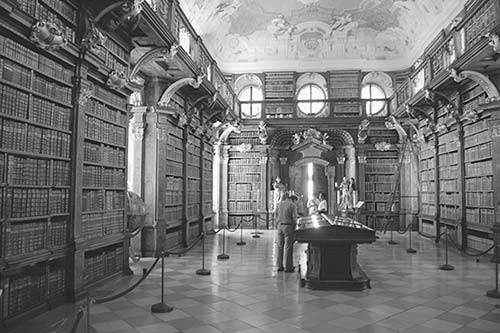
In the Middle Ages, monasteries controlled information and hoarded it in their libraries. At a time when most everyone else was illiterate, monks were Europe’s educated elite and had the power to dictate what was true...and what wasn’t. Students and researchers are still given access to this library and the many manuscripts housed in temperature-controlled rooms under your feet. The precious globes (one terrestrial, one celestial, with the night sky turned inside out) date from 1688 and were painstakingly researched and crafted by Franciscan monk Vincenzo Coronelli, one of the first to raise globemaking to a fine art.
The inlaid bookshelves, matching bindings, and another fine Troger fresco combine harmoniously to create a thematic counterpart to the Marble Hall. This room celebrates not wise politics, but faith. The ceiling shows a woman surrounded by groups of angels representing the four cardinal virtues (prudence, justice, faith, and recycling)—natural traits that lead to a supernatural faith. The statues flanking the doors represent the four traditional university faculties (law, medicine, philosophy, and theology).
There would be a Gutenberg Bible in this room...but the abbey sold it in 1927 (it was later donated to Yale University).
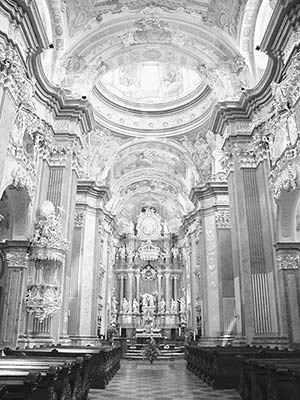
Church: The finale is the church, with its architecture, ceiling frescoes, stucco marble, grand pipe organ, and sumptuous chapels adorned with chubby cherubs. (How many can you count?) All of these elements combine in full Baroque style to make a theological point: A just battle leads to victory. The ceiling shows St. Benedict’s triumphant entry into heaven (on a fancy carpet). Over the altar, below the huge papal crown, the golden saints Peter and Paul shake hands before departing for their final battles, martyrdom, and ultimate victory. And, high above, the painting in the dome shows that victory: the Holy Trinity, surrounded by saints of particular importance to Melk, happily in heaven.
OTHER ABBEY SIGHTS
Near the entrance (and exit), you’ll find the abbey’s park and bastions. The park is home to a picturesque Baroque pavilion housing some fine frescoes by Johann Wenzel Bergel and a small snack stand. The bastions offer decent views from the top terrace, and exhibits by students at the abbey’s school are displayed on the second floor. Nearby, in the former orangery, is the abbey’s restaurant.
Sleeping in Melk
Melk makes a good, inexpensive overnight stop and has plentiful, usually free parking. Except during August, you shouldn’t have any trouble finding a good room at a reasonable rate.
$$ Hotel zur Post is professional and well run by the Ebner family, with 28 comfy and tidy rooms over a good restaurant. The fancy junior suites are the best, but they’re more expensive (RS%, family rooms, air-con in some rooms, elevator, free loaner bikes, sauna, free private parking, closed Jan-mid-Feb, Linzer Strasse 1, +43 2752 523 45, www.post-melk.at, info@hotelpost-melk.at).
$$ Hotel Stadt Melk has 14 bright, straightforward, smartly renovated rooms in a 17th-century building on the town’s main square (fans, lots of stairs, excellent breakfast, free private parking, closed mid-Dec-Feb, Hauptplatz 1, +43 2752 524 750, www.hotelstadtmelk.at, office@hotelstadtmelk.at, Philippe and Pascal).
$$ Wachauerhof is a big, dull, traditional 72-room hotel, but it gets the job done in a good location with free private parking—try here if other options are full (lots of stairs, Wiener Strasse 30, +43 2752 52235, www.wachauerhof-melk.at, office@wachauerhof-melk.at).
$$ Die Residenz Rathauskeller’s 11 spacious rooms and four apartments, housed in a newly renovated historic building, are a good value. Check-in and breakfast are in the lively restaurant below (family rooms, Rathausplatz 13, +43 2752 20460, www.rathauskeller-melk.at).
$ Pension Weisses Lamm is low on atmosphere but has the cheapest beds in the center. Its 14 rooms, above a lackluster restaurant, are basic but tidy and pleasantly renovated (Linzer Strasse 7, look for namesake white lamb on sign, +43 664 231 5297, www.pension-weisses-lamm-melk.at, pension.weisses.lamm@hotmail.com, Kumus).
¢ Hostel: The modern, institutional youth hostel is a 10-minute walk from the train station. Go straight out from the station down Bahnhofstrasse, then turn right at the next corner onto Abt-Karl-Strasse; the hostel is just past the Löwenpark shopping mall (private rooms available, no curfew but reception closes at 21:00, closed Nov-Feb, rental bikes, Abt-Karl-Strasse 42, +43 2752 52681, http://melk.noejhw.at, melk@noejhw.at).
Sleeping near Melk: If you have a car, you could stay in a nearby farm or village. The TI has a list of people renting rooms to travelers for about €35 per person, most a few miles from the center. Also consider the good guesthouse in Willendorf, a 20-minute drive from Melk (see “Towns in the Wachau Valley,” later in this chapter).
Eating in Melk
$$$ Hotel Restaurant zur Post is a classy establishment with a peaceful interior courtyard and lovely streetside seating with an abbey view. They serve traditional Austrian specialties with a modern twist and both local and international wines (Wed-Sun 11:30-21:00, closed Mon-Tue year-round and Jan-mid-Feb, Linzer Strasse 1, +43 2752 52345).
$$$ Rathauskeller der Melker Gasthof takes pride in its good service and fresh ingredients. Its traditional offerings include goulash and venison ragout. Eat on a busy patio or in the cozy interior (daily 10:00-23:00, Rathausplatz 13, +43 2752 20460).
$ Kalmuck, a popular wine bar on the main street, serves inexpensive light meals and pub food and is the one place in Melk that stays lively until the wee hours (daily 11:00-late, shorter hours off-season, Hauptstrasse 10, +43 660 537 7388).
Supermarket: Pick up picnic supplies at either the midrange Eurospar or the budget Hofer, both in the big Löwenpark mall, a 10-minute walk from downtown (Mon-Fri 7:30-19:00, Sat until 18:00, closed Sun; Abt-Karl-Strasse).
Melk Connections
From Melk by Train to: Vienna’s Hauptbahnhof (2/hour, 1 hour, change in St. Pölten; also some direct trains to Vienna’s Westbahnhof), Salzburg (almost hourly, 2.5 hours, transfer in Amstetten or St. Pölten), Mauthausen (every 1-2 hours, 2 hours, usually 2 changes—some with significant layovers). Train info: +43 51 717 (to get an operator, dial 2, then 2), www.oebb.at.
By Bus to the Wachau Valley: See the next section.
By Car to/from the Danube Valley: See “Route Tips for Drivers,” later in this chapter.
Wachau Valley
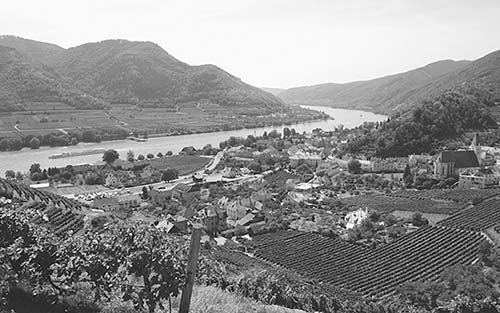
The 24-mile stretch of the Danube between Melk and Krems is as pretty as they come—worth ▲▲. This region, called the Wachau, is blanketed with vineyards and ornamented with cute villages. Keep an eye out for wreaths of straw or greenery, hung as an invitation to come in and taste. (Don’t be dismayed that the Blue Danube isn’t actually blue—it’s not pollution, but the result of a soft riverbed, with sediment that gets stirred up by the current in these parts.) So why do they call it “blue”? Maybe because in local slang, someone who’s feeling his wine is “blue.” Austrians know the region for its apricots (Marillen in Austrian German), which are made into the jam that fills all that Viennese Sacher torte.
GETTING AROUND THE WACHAU VALLEY
The well-run regional transit system makes it easy for visitors without a car to enjoy the valley. You have three good options for experiencing the stretch from Melk to Krems: by bike, boat, or bus.
Of these, my favorite is biking. I enjoy being untethered from a timetable while I get up close with the valley’s sights and scents. If you don’t mind the limited number of sailings (and little opportunity to stop off along the way), hop a boat. If a bike or boat doesn’t appeal to you, the easy, frequent Wachau Line bus (operated by VOR) is the way to go.
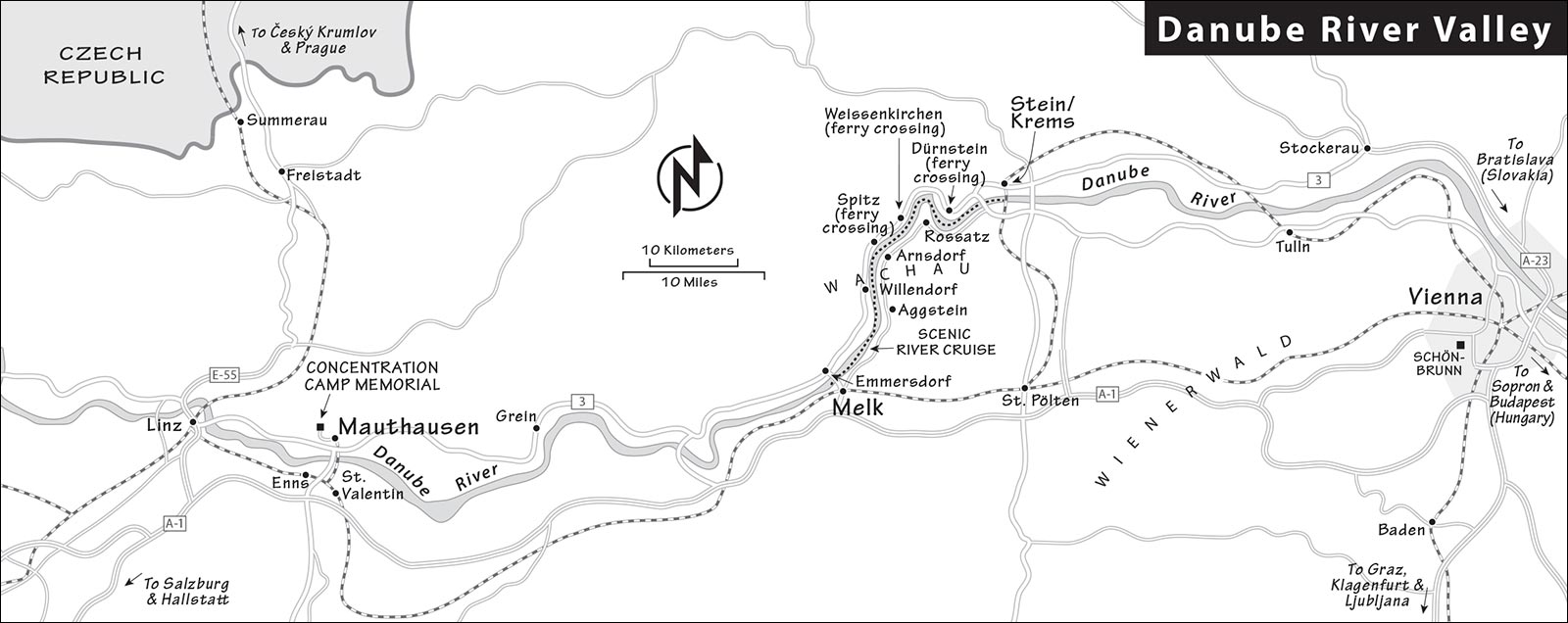
However you travel, pick up a free map from the Melk TI so you can trace the route, as well as the helpful regional bus schedule. For a very basic overview of the region, see the “Danube River Valley” map earlier in this chapter.
By Bike
From Melk to Krems: It’s a three-to-four-hour, gently downhill pedal to Krems. You can bike either the south or the north side of the river; I prefer the north for its interesting villages and sights (Willendorf, Spitz, and Dürnstein). If it’s more important to you to have a dedicated, paved bike path the whole way, choose the more rural south side, where at worst you ride next to—but never on—the road (which has less traffic than the north side) and get a bit more time along the Danube. On both sides you’ll find plenty of vineyards and small Gasthöfe in the villages along the way.
You can change sides at three points—Spitz, Weissenkirchen, and Dürnstein—where inexpensive ferries regularly carry people, bikes, and cars across the river (ferries covered by same day pass that covers buses between Krems and Melk; purchase at Melk TI or on board).
For a shorter bike ride that also gets you on a boat, consider taking a bike on board and cruising by boat from Melk to Spitz—a good midway point—and then biking from Spitz on to Krems (see “By Boat,” later).
Bicyclists rule in this region, and you’ll find all the necessary biking amenities. Bike routes are clearly marked with green Donau-Radweg (Danube cycling route) signs labeled with #6. You’ll pass some serious bikers (or maybe they’ll pass you)—the entire #6 route covers 2,270 miles and spans 10 countries. (Note: The bike-in-a-red-border signs mean “no biking.”)
In Melk, ask your hotelier or at the TI for bike-rental options. Some hotels rent or loan bikes. The easiest option is a small mom-and-pop shop, Wachau Touristik Bernhardt, near the Melk boat dock. Stop by their rickety shack/snack shop and pick up a bike—best to call ahead to confirm they are open (mountain bike-€15/day, e-bike-€27/day; daily April-Oct 9:00-15:00, closed some Sun and off-season; another location at Spitz train station, +43 664 222 2070, www.wachau-touristik.at). If you’re biking one-way, for €4 extra you can drop your bike at the Stein boat dock, Krems train station, or Spitz train station.
You’ll also see bike-sharing Nextbike stands throughout the region (including in Melk—at the train station, TI, and youth hostel—and in Krems, which makes it easy to leave the bike there and return to Melk by bus). Nextbike only works with a mobile phone, which can make it tricky for visitors. Before your trip, download the Nextbike app and register with a credit card under “Lower Austria.” To borrow a bike at a stand, enter the number of the bike you want and receive a code to unlock it (€1/hour, €10/24 hours, +43 2742 229 901, www.nextbike.at).
Returning to Melk: You can ride a bike in both directions, but given that it’s 48 miles round-trip and slightly uphill all the way back, returning by bus or train may be the better option.
Bus #715 makes the trip from Krems back to Melk (see “By Bus,” later in this section). Bikes are not permitted on board, but if you’ve returned your bike in Krems, you can hop on the #715 from the train station, Stadtpark stop near the TI, Stein boat dock, or any point along the way (hourly until 20:20, covered by the same day pass that covers ferries, or pay driver). The #715 also stops in Dürnstein, Weissenkirchen, Spitz, and Aggsbach (Spitz is handy if you want to return your bike there instead of riding all the way to Krems).
Cyclists returning with a bike in tow needn’t panic—from Krems you can hop the train back to Melk (hourly, change in St. Pölten, no river views, ticket required for bike, last train at about 22:15, 1 hour).
In summer, a less frequent “Wachaubahn” train designed for tourists runs along the north side of the river, connecting Krems with Emmersdorf an der Donau, the town across the river from Melk. Bikes ride for free on this train, provided there’s enough room (you can reserve a bike space if you book your seat in advance). The last Wachaubahn train back from Krems leaves in the late afternoon (at 16:20). It’s handy even if you don’t bike all the way to Krems—it makes seven scheduled stops en route, including Willendorf, Spitz, and Dürnstein. From Emmersdorf there’s a shuttle to the Melk train station, but it doesn’t allow bikes; it’s a 15-minute bike ride (or 50-minute walk) to get back to Melk (Wachaubahn train—€16 one-way, €22 round-trip; 4/day, runs daily June-Sept and on weekends mid-March-May and Oct, 1 hour; regional day pass not accepted, reserve ticket online or buy on board, www.wachaubahn.at).
By Boat
From Melk to Krems: For many, Danube dreams involve a boat ride on this famous waterway. It is indeed a relaxing way to take in the valley, although the limited schedule (just four boats a day in season, and two of those only five minutes apart) makes it virtually impossible to stop off en route.
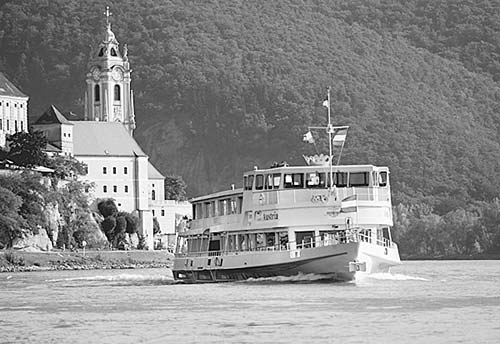
Two companies run boats along this stretch: Brandner (+43 7433 259 021, www.brandner.at) and DDSG (+43 1 58 880, www.ddsg-blue-danube.at). They use adjacent boat docks, and charge roughly the same amount (€31.50 one-way, €37.50 round-trip, round-trip allows stopovers, bikes ride for €2). Rail-pass holders get a 20 percent discount.
In peak season (May-Sept), boats leave from Melk daily at 11:00 (DDSG), 13:45/13:50 (Brandner/DDSG), and 16:25 (DDSG, requires change in Spitz). The trip to Krems takes 1.75 hours (but almost twice as long coming back upstream). In mid-April and October, boats go only twice a day (5 minutes apart; the 13:45/13:50 sailings). There are no boats off-season.
Getting Back to Melk: You can ride the boat in both directions, but because of the six-knot flow of the Danube, the ride back upstream takes three hours. Instead, I’d take the bus (#715—see next).
By Bus
From Melk to Krems: Bus #715 runs nearly hourly along the north side of the river, weaving its way through cute villages and endless vineyards (hourly, one hour, €9.80 one-way between Melk and Krems; €12 day pass makes sense if you plan to stop off en route and/or ride round-trip; day pass sold at Melk TI). This is a fine joyride option for nonbikers who want more flexibility than the infrequent boats provide.
In Melk, catch the bus at the train station or the more central stop by the TI (Kremser Strasse). To hop off anywhere before Krems, watch the bus’s “next stop” screen, and request a stop with a push of the button (within Krems, use the second-to-last stop, Stadtpark, to avoid the walk back into the town center from the station). Ask for a regional bus schedule at the Melk TI or check online at www.vor.at.
Returning to Melk: Bus #715 leaves from the Krems train station, the more central Stadtpark stop, and from the boat dock. When you arrive in Melk, get off at Kremser Strasse, which is more convenient to my recommended hotels than the station.
Should you get stuck, you can always call a taxi—but expect fares to be exorbitant (mobile +43 664 6067 4606; let them know if you need to transport a bike).
Route Tips for Drivers
With a car, you can drive from Melk to Krems on one side of the river and return on the other side. On the north side, stop at Willendorf (Venus Museum) and Dürnstein (for a glimpse at the town and perhaps a walk up to the ruined castle; use pay lots outside walls). On the south side, consider the villages of Rossatz and Rührsdorf (near Krems), which have many small Heurigen winery/restaurants. Closer to Melk is the five-minute detour (signposted) up a steep, narrow road to the well-preserved ruins of Burg Aggstein, which towers over the valley with magnificent views (free overlook near parking lot, about €7/person to enter, open daily mid-March-Nov, www.ruineaggstein.at).
Towns in the Wachau Valley
Willendorf
This is known among prehistorians as the town where the oldest piece of European art was found—the well-endowed, 25,000-year-old, four-inch statuette known as the Venus of Willendorf. (The original is now in Vienna’s Natural History Museum.) The village is worth a visit for its two-room, smartly designed museum, the Venusium, which tells the figure’s story and compares it with similar statues found in other parts of Europe (€3; generally Sat-Sun 10:00-12:00 & 14:00-16:00, closed weekdays—but check ahead to see if schedule has changed; +43 676 517 4546, www.willendorf.info). Above the museum, the Zur Fundstelle sign leads you to the point where the statue was actually found during railway construction in 1908, and you can see where the hillside has been cut away to reveal the layers of sediment deposited over the millennia.
Riverboats don’t stop here, but bus #715 does (roughly hourly, 20-minute trip from Melk, 40-minute trip from Krems). It’s a five-minute walk from the bus stop to the village center.
Consider eating, or even (best with a car) overnighting in Willendorf at $ Schneider’s Gasthof zur Venus, steps from the museum. It serves $$$ Austrian meals (restaurant closed Mon-Tue) and has six good rooms (free parking, +43 2712 202 02, www.gasthof-zur-venus.at, o.zeller@gmx.at).
Dürnstein
This touristic flypaper of a town lures hordes of tour-bus and cruise-ship visitors with its traffic-free quaintness and its one claim to fame (and fortune): Richard the Lionheart was imprisoned here in 1193 on his way home from the Third Crusade. The town is a delight—almost like a Disney movie (but with stores selling overpriced ice cream and apricot jam). The ruined castle above (Burgruine), where Richard was kept, can be reached by a fairly steep 30-minute hike with great river views: Take Anzuggasse from the riverside promenade up to the downstream town gate, then follow Weinbau Familie Pölz signs up the street, which turns into a broad dirt lane lined with informative signposts, and goes all the way up to the castle. There are no services up top, so bring water. Beware: Nonvenomous Aesculapian snakes, up to eight feet long, live in the ruin; they’re harmless but best left alone.
Krems
This town is much bigger than Melk and home to a small university. The Krems Museum and helpful TI are on Kornermarkt square (Mon-Sat 10:00-18:00, Sun until 16:00; shorter hours and closed Sun mid-Oct-March; Körnermarkt 14, +43 2732 82676, www.krems.info.)
Boats from Melk stop about a mile from Krems’ town center (technically in the adjacent town of Stein). It’s a 20-minute walk from the boat dock into town: Go inland to the second roundabout, turn right on Steiner Donaulände, pass under the railroad bridge, walk three blocks farther to a park (Stadtpark), then cross through the park and turn left on Utzstrasse. Pass through the town gate (Steiner Tor), turn left, and walk up Schmidgasse to reach Kornermarkt square.
If coming on bus #715, hop off at the Stadtpark stop and walk to the town gate (Steiner Tor), then follow the previous directions.
If arriving by bike, park your wheels (or drop them off if you’re riding one-way). Bikes aren’t permitted during the day in the heart of the old town. The biggest bike parking area is at the train station, but there are several spots throughout the center, including just in front of the TI and north of the Stadtpark.
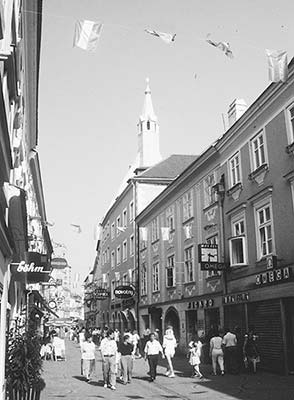
The old Krems city gate is a few doors up Utzstrasse from the TI. Stroll the large, traffic-free old town, a shopper’s wonderland with a lively restaurant scene. When you’re done, find Krems’ rail and bus station between the old town and the river. In addition to its hourly train and bus connections to Melk (described earlier), Krems is connected by hourly trains to Vienna’s Franz-Josefs-Bahnhof (1 hour) and to Vienna’s Hauptbahnhof (easy change in St. Pölten, also 1 hour).
Wachau Valley Connections
For bus and train connections from Melk, see “Melk Connections,” earlier in this chapter.
ROUTE TIPS FOR DRIVERS
Vienna to Hallstatt (via the Wachau Valley, Melk, and Mauthausen, 210 miles): The A-1 autobahn is the most direct route, but for better scenery leave Vienna by crossing the Danube to reach the A-22 autobahn. Head north (following Praha/Prague signs) to Stockerau, then take exit #30 to the S-5 highway, which leads to Krems. After Krems, take Route 3 along the river until just after Schallemmersdorf (and just before Emmersdorf), where a bridge leads across the river to Melk. In Melk, signs to Stift Melk lead to the Benediktinerstift (Benedictine abbey).
From Melk, it’s a speedy hour to Mauthausen on the autobahn, but the curvy and scenic Route 3 along the river is worth the nausea. At Mauthausen, follow Ehemaliges KZ-Gedenkstätte Lager signs to the concentration camp memorial. Leaving Mauthausen, cross the Danube and follow signs to Enns (five minutes from Mauthausen town), and join the autobahn there (heading west). Leave the autobahn at exit #224 and follow scenic Route 145 past Gmunden to Stambach, then to road 166, which leads to Hallstatt.
For tips on going from Hallstatt to Vienna with a stop in the Wachau, see “Hallstatt Connections” on here.
Mauthausen Memorial
On top of one of the rolling hills flanking the Danube River, halfway between Vienna and Salzburg, stands the notorious former concentration camp at Mauthausen (MOWT-how-zehn), worth ▲▲▲. This slave-labor and death camp is the most powerful concentration camp memorial that a traveler can experience in Western Europe. By visiting and putting ourselves through this emotional wringer, we heed and respect the fervent wish of the victims—that we never forget.
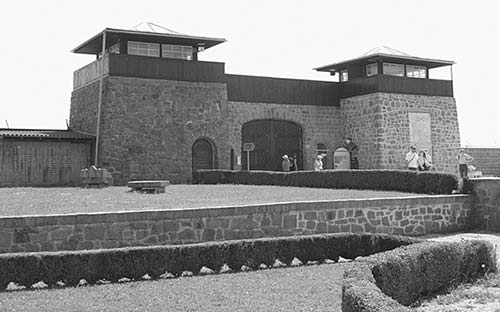
The camp functioned from 1938 to 1945, initially to detain and exploit Hitler’s domestic political opponents, and then (after 1943) primarily to house Jews and prisoners of war from Eastern Europe. Mauthausen also spawned a network of satellite camps (the nearby one at Gusen is also now a memorial).
Some of the Nazis’ camps, such as Auschwitz in Poland, were designed to exterminate people en masse in gas chambers. At others, such as Mauthausen, inmates were essentially worked to death. In these camps, your ability to endure forced labor amounted to a stay of execution. Mauthausen is located above a granite quarry—the region has long supplied building stone to Vienna and Budapest—and the hard labor here was hacking and hauling rocks.
Among Mauthausen’s most famous prisoners was Simon Wiesenthal, who dedicated himself after the war to hunting down Nazis and making sure they paid for their crimes. He was one of the lucky survivors: About half of Mauthausen’s 200,000 prisoners died, mostly from starvation or exhaustion. Mauthausen was the last concentration camp to be liberated—on May 5, 1945, a week after Hitler’s death.
Planning Your Time: Enough of Mauthausen’s buildings survive to give you a gripping sense of the camp’s history. At the least, allow two hours to visit the camp itself, or three if you watch the film at the visitors center.
GETTING THERE
With a car, you can visit Mauthausen on the way between Salzburg (or Hallstatt) and Vienna (or Melk), or as a day trip (easy from Melk, doable from Hallstatt or Salzburg, a long day out from Vienna). By train, Mauthausen works best as a day trip from Salzburg or Vienna.
By Car: From the main B-3 highway along the Danube, the road up to the camp starts a little west of the actual town of Mauthausen. Look for and follow KZ-Memorial or KZ-Mauthausen signs. As you arrive at the camp, bear right to reach the parking lot (up to 4 hours free). Having a car lets you glimpse the quarry where camp prisoners were forced to toil: Leave the main parking lot, head down the hill to the first intersection, turn right (following Gasthaus Kreuzmühle signs), and look for the quarry on your right and a small unpaved parking area to your left.
By Train: Trains depart roughly hourly to Mauthausen from Salzburg (2 hours each way, change in Linz) and Vienna (2 hours, most from Vienna’s Hauptbahnhof, change in St. Valentin or Linz). From Melk there are only a couple of workable connections (often requiring multiple changes and lengthy layovers). It’s not impossible, but it takes longer than from Salzburg or Vienna; check schedules carefully (www.oebb.at).
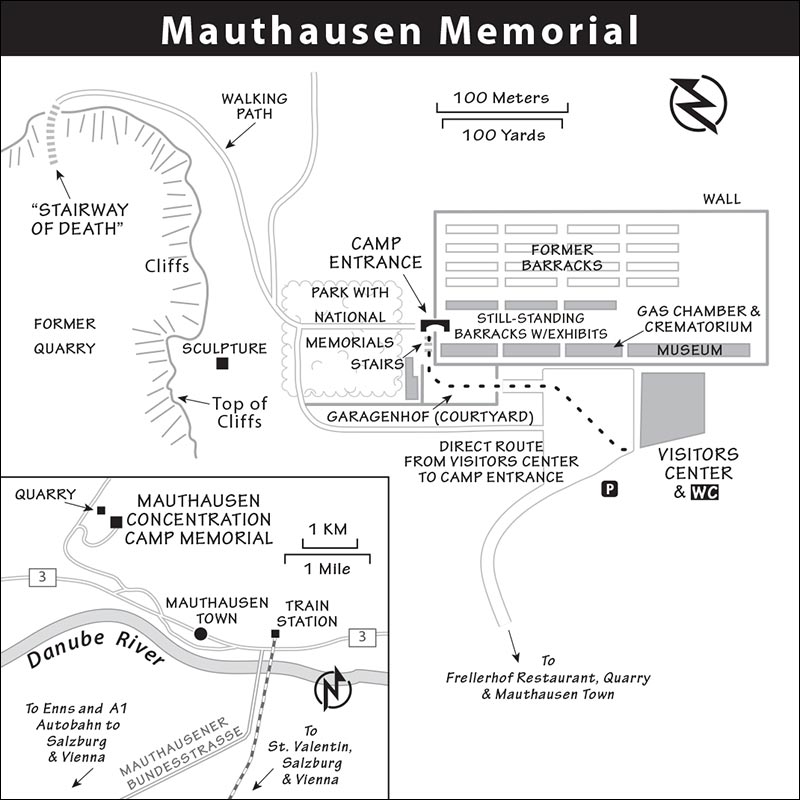
The Mauthausen train station is three miles from the memorial, on the other side of town. There are no lockers at the station, but the memorial visitors center will store bags. There’s no bus from the station to the memorial, and taxis run about €15 (minibus taxis available). Call or email the Mauthausen-based Taxi Brixner (mobile +43 664 462 3699, taxi@brixner.at). Arrange a return pickup with your driver, or ask the memorial ticket office to call a taxi for you when you are ready to go.
ORIENTATION TO THE MEMORIAL
Cost and Hours: Free to enter; March-Oct daily 9:00-17:30; Nov-Feb Tue-Sun until 15:45, closed Mon; last entry 45 minutes before closing.
Information: +43 7238 2269, www.mauthausen-memorial.org.
Tours: A worthwhile audioguide is available for €3 at the information desk, or download the free Mauthausen Audioguide app.
Services: The information desk has a bookstore and small lockers for daypacks. Ask at the information desk if you need to store larger luggage.
Eating: Next door to the visitors center is a café serving drinks, snacks, and sandwiches. A farmhouse below the parking lot also serves meals—see “Sleeping and Eating Near the Memorial,” later in this chapter.
VISITING THE MEMORIAL
The camp has two important areas for visitors. The information desk, café, and visitors center are in the modern complex near the parking lot. The museum is within the camp walls.
Stop briefly at the visitors center, especially if your arrival coincides with the start of the 45-minute film (generally screened at the top of each hour). But save a long visit in the visitors center (and perhaps the film) until after you’ve seen the camp itself—the most worthwhile sightseeing is inside the camp walls.
From the visitors center, circle all the way around to the camp entrance (at the left side of the building—either walk along the road, or go through the gateway, cross the aptly named Garagenhof courtyard, and climb the stairs). In the parklike area outside the camp entrance you’ll find gripping memorials to those who perished here, erected by each home country of the camp’s victims. Many yellowed photos have fresh flowers to honor loved ones who are still not forgotten.
Entering the camp brings you onto a long, open area, which was used for roll call several times a day. To either side are some original barracks (the others have been torn down) with exhibits. On the left, the first barracks show where records were kept and where a brothel operated with imprisoned women from a nearby camp. The second and third barracks show inmates’ housing quarters and that of “kapos” (prisoner functionaries) charged with maintaining order. These trustees were given special privileges and better rations, deliberately creating inequality among the prisoners. On the right, the fourth (farthest) barracks is an absorbing museum that presents the camp’s history and shows you its crematoriums and small gas chamber.
The museum’s upper floor presents the camp’s history chronologically. The central aisle gives wider historical context, while displays on the left explain how the Nazi period and World War II played out in Austria and at Mauthausen specifically. Displays on the right tell the stories of Mauthausen inmates—how they came to be imprisoned here, the arbitrary rules they suffered under, and the numbers they had to wear. Exhibits include gripping artifacts and brief audio and video clips of survivors. The museum is unusual in providing biographies of many of the Nazi officers who ran the camp and detailing their postwar fates: Some committed suicide, some were sentenced to death by Allied tribunals, and others received long prison terms.
Downstairs, exhibits focus on the violence that took place here, by execution or forced labor, and testify to the camp’s inhumanity.
At the end of this room, exit and walk through the crematorium, used to burn the bodies of those who died at Mauthausen, and a room listing the names of 81,000 inmates known to have died here. Take time to read the plaques still being sent by families of those who didn’t make it. Finally you pass the small gas chamber, where about 3,500 inmates were murdered. Afterward, you can see a few more exhibits and the camp prison in the adjoining barrack.
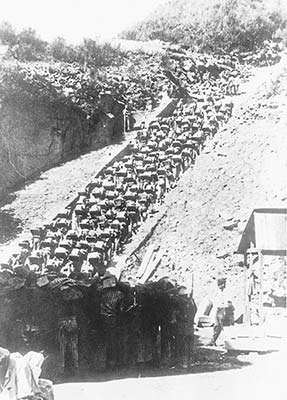
Back outside the camp (right in front of you as you exit), find the huge, black menorah-like sculpture overlooking the quarry. To your right, a rough cobbled path leads a couple hundred yards down to the “Stairway of Death” (inmates had a much rougher ascent before it was rebuilt in 1942). Connecting the quarry with the camp and its stone depot, the long stairway earned its name for good reason. Inmates were fed the bare minimum to continue working. If they couldn’t carry slabs of rocks on their back up the stairway all day long—under the harshest of conditions and on a starvation diet—they were shot on the spot. Most died within a year of their arrival. (Toward the end of the war, the work shifted to making aircraft parts in a factory.) If the vast quarry is open, hike down to its ground level and ponder the scene—you’ll be left with a lasting and poignant impression.
Before you leave, return to the visitors center. It has multimedia displays with more survivor interviews, an exhibit on the camp crematorium, and a graphic 45-minute film. There are several screening rooms—ask the staff which room has the English version.
SLEEPING AND EATING NEAR THE MEMORIAL
I’d try to overnight in Vienna, Melk, or Salzburg instead of around Mauthausen. But if you’re driving and have a special reason to stay near the camp, $$ Hotel zum Goldenen Schiff, in the town of Enns across the river (just off the autobahn, less than four miles southwest of Mauthausen), is a solid value run by the Brunner family. It has 25 comfy rooms and a quaint location right on Enns’ main square (family rooms, elevator, sauna, free parking, Hauptplatz 23, +43 7223 86086, www.hotel-brunner.at, office@hotel-brunner.at). The hotel also rents one $$$ honeymoon double halfway up the Town Hall tower—reached by a stairway with 72 giant steps. This used to be the bell-ringer’s apartment (reserve online—and repack into a day bag).
A good option for a refreshing, peaceful meal before or after your visit to Mauthausen is the Moststube Frellerhof, a farmhouse 50 yards below the Mauthausen parking lot. Their specialty is apple-and-pear wine (called Most in this part of Austria—not the same as the Viennese Most made from grapes) and homemade schnapps, and they serve light, farm-fresh lunches and dinners in a fine modern dining room and shady back patio (sandwiches, limited warm food; generally Tue-Fri 15:00-22:00, Sat-Sun from 11:00, closed Mon; Sept-April closed Mon-Wed; playground, +43 7238 2789).