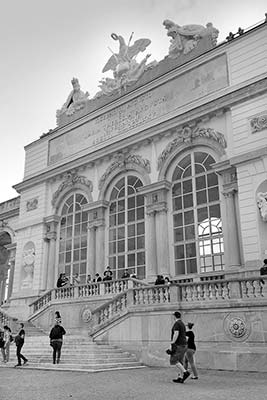
SCHÖNBRUNN PALACE TOUR
Among Europe’s palaces, only Schönbrunn rivals Versailles. This former summer residence of the Habsburgs is big, with more than 300 rooms in the main building alone. But don’t worry—only 40 rooms are shown to the public. Of the plethora of sights at the vast complex, the highlight is a tour of the palace’s ▲▲▲ Imperial Apartments—the chandeliered rooms where the Habsburg nobles lived. You can also stroll the ▲▲ gardens, tour the Imperial Carriage Museum, and visit a handful of lesser sights nearby.
Orientation
Cost: Visits to the palace are by timed-entry tour (book in advance). There are two tour options for the Imperial Apartments (both come with audioguides). The best is the 40-room Grand Tour, which includes both the rooms of Franz Josef and Sisi, as well as the more impressive Rococo rooms of Maria Theresa (€26, 50 minutes, covered by Sisi Ticket). The Imperial Tour covers only the less-interesting first 22 rooms (€22, 35 minutes).
If venturing beyond the apartments, consider the Classic Pass combo-ticket, which includes the Grand Tour, as well as the Gloriette viewing terrace, maze, orangery, and privy garden (€31, available April-Oct only).
Hours: Imperial Apartments open daily 9:00-17:00, July-Aug until 17:30; gardens generally open 6:30-20:00 but varies with season. The palace is busiest from 9:00 to 12:00, and crowds start to subside after 14:00.
Information: +43 1 811 130, www.schoenbrunn.at.
Advance Tickets Recommended: In summer and on good-weather weekends, book your entry time in advance online. Otherwise, you’ll likely have to stand in line at the ticket desk, and then you’ll probably have to wait again for your assigned entry time—which could be hours later. Those with a Sisi Ticket can enter without a reserved entry time (buy your Sisi Ticket online or at the Imperial Furniture Museum—see here for details).
If you don’t have a reservation, come early or late in the day. You can save some time in line by using one of the ticket machines. If you have extra time before your entry time, spend it exploring the gardens or Imperial Carriage Museum.
Getting There: Schönbrunn is an easy 10-minute subway ride from downtown Vienna. Take U-4 (which conveniently leaves from Karlsplatz) to Schönbrunn (direction: Hütteldorf) and follow signs for Schloss Schönbrunn. Exit bearing right, then cross the busy road and continue to the right, to the far, far end of the long yellow building. There you’ll find the visitors center, where tickets are sold.
Length of This Tour: Allow at least three hours (including transit time) for your excursion to Schönbrunn Palace. The palace itself is sprawling and can be mobbed. After viewing the Imperial Apartments, wander the gardens (most of which are free). With more time and energy, pick and choose among the other sightseeing options and buy tickets as you go.
Eating at Schönbrunn: Eating options at the palace range from touristy sit-down restaurants to garden cafés. For a tranquil escape, head to the $$ Landtmann’s Jausen Station café located inside the gardens, a five-minute walk to the left of the palace (closed Oct-Feb).
Starring: Ornately decorated rooms graced by Franz Josef, Sisi, Maria Theresa, Napoleon, and Mozart—plus grand gardens.
The Tour Begins
In the 1500s, the Habsburgs built a small hunting lodge near a beautiful spring (schön-brunn), and for the next three centuries, they made it their summer getaway from stuffy Vienna. The palace’s exterior (late-1600s) is Baroque, but the interior was finished under Maria Theresa (mid-1700s) in let-them-eat-cake Rococo. As with the similar apartments at the Hofburg (the Habsburgs’ winter home), these apartments give you a sense of the quirky, larger-than-life personalities who lived here. It’s the place where Maria Theresa raised her brood of 16 kids...where six-year-old Mozart played his first big gig...and where Maria Theresa’s great-great-grandson Franz Josef (r. 1848-1916) tried to please his self-absorbed wife Elisabeth, a.k.a. Sisi.
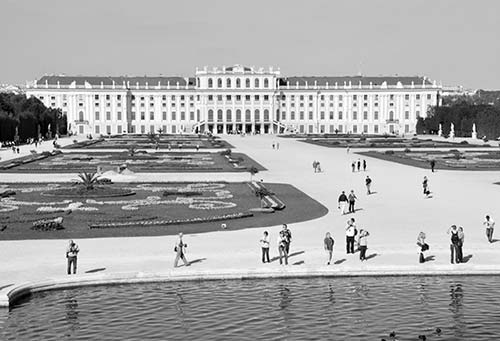
Your tour of the apartments, accompanied by an audioguide, follows a clearly signed one-way route. Think of the following minitour as a series of breadcrumbs, leading you along while the audioguide fills in the details.
• With your ticket in hand, approach the palace. Follow signs to the entrance gate stamped on your ticket. When your entry time arrives, politely push your way through the milling crowds to get to the turnstiles. If you’re doing the Grand Tour, keep your ticket handy as you’ll need it again.
IMPERIAL APARTMENTS
Begin in the guards’ room, where jauntily dressed mannequins of Franz Josef’s bodyguards introduce you to his luxurious world. Continue through the Billiard Room to the Walnut Room. Wow. Rococo-style wood paneling and gilding decorate this room where Franz Josef—a hard-working modern monarch—received official visitors. Nearby is the study—Franz Josef (see his mustachioed portrait) worked at this desk, sometimes joined by his beautiful, brown-haired wife Sisi (see her portrait). In the bedchamber, a praying stool, iron bed, and little toilet all attest to Franz Josef’s spartan lifestyle (though the paintings here remind us of the grand scale of his palace).
• As you turn the corner, you enter...
Empress Sisi’s Study and Dressing Room
See her portrait in a black dress, as well as a reconstruction of the spiral staircase that once led down to her apartments. The long-haired mannequin and makeup jars in the dressing room indicate how obsessive Sisi was about her looks.
• Pass through this room to reach...
Franz Josef’s and Sisi’s Bedroom
The huge wood-carved double bed suggests marital bliss, but the bed is not authentic—and as for the bliss, history suggests otherwise.
Follow along to the dining room. The whole family ate here at the huge table; today it’s set with dinnerware owned by Maria Theresa and Sisi. Next is the children’s room, with portraits of Maria Theresa (on the easel) and some of her 11 (similar-looking) daughters. The bathroom was installed for the last Habsburg empress, Zita.
• Turning the corner, pass through two rooms, until you reach the...
Hall of Mirrors
In this room, six-year-old Mozart performed for Maria Theresa and her family (1762). He amazed them by playing without being able to see the keys, he jumped playfully into the empress’ lap, and he even asked six-year-old Marie-Antoinette to marry him.
• Pass through the next room, which leads to the large, breathtaking, white-and-gold...
Great Gallery
Imagine the parties they had here: waltzers spinning across the floor, lit by chandeliers reflecting off the mirrors, beneath stunning ceiling frescoes—and outside, views of the gardens and the Gloriette monument (described later). When WWII bombs rained on Vienna, the palace was largely spared. It took only one direct hit—crashing through this ballroom—but thankfully, that bomb was a dud. In 1961, President Kennedy and Soviet Premier Khrushchev met here.
• Pass through the final three rooms (pausing at a painting of Maria Theresa riding a Lipizzaner horse) until you reach the...
Hall of Ceremonies
Wedding receptions were held here, beneath a regal portrait of Maria Theresa in a pink lace dress.
• As you prepare to leave this room, look to the left of the doorway (to the right of Maria Theresa) to find a crowded painting with (supposedly) the child Mozart (behind Plexiglas, sitting next to a priest in gray). If you’ve bought the Grand Tour ticket, continue on to reach...
More Fancy Rooms
It was in the Blue Chinese Salon, in 1918, that the last Habsburg emperor Karl I made the decision to relinquish power, marking the end of more than six centuries of Habsburg rule. Up next, the black-lacquer Vieux-Laque Room was remodeled by Maria Theresa as a memorial to her beloved husband who died unexpectedly. Continue to the Napoleon Room. When Napoleon conquered Austria, he took over Schönbrunn and made this his bedroom. He dumped Josephine and took a Habsburg princess as his bride, and they had a son (cutely pictured holding a wreath of flowers).
• Turn the corner through the Porcelain Room and enter the stunning...
Millions Room
Admire the rosewood paneling inset with little painted scenes, and see how the mirrors reflect to infinity.
• We’re nearing the end. Pass through three more (admittedly gorgeous) rooms, and turn the corner into the...
Rich Bedchamber
This darkened room has what may have been Maria Theresa’s wedding bed, where she and her husband Franz produced 16 children. Then comes their study, with a fitting end to this palace tour—a painting showing the happy couple who left their mark all over Schönbrunn. Maria Theresa and Franz are surrounded by their brood. Imagine these kids growing up here, riding horses, frolicking in the gardens, and preparing to marry fellow royals in order to bring peace and prosperity to the happy house of Habsburg.
PALACE GARDENS
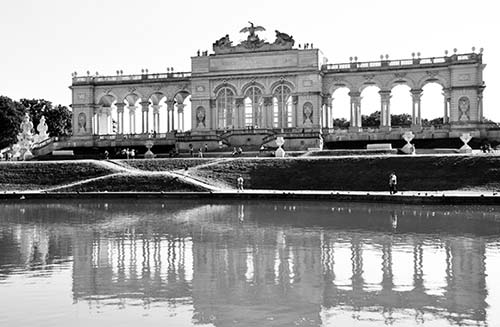
The large, manicured grounds fill the palace’s backyard, dominated by a hill-topping monument called the Gloriette. Unlike the gardens of Versailles, meant to shut out the real world, Schönbrunn’s park was opened to the public in 1779 while the monarchy was in full swing. It was part of Maria Theresa’s reform policy, making the garden a celebration of the evolution of civilization from autocracy into real democracy.
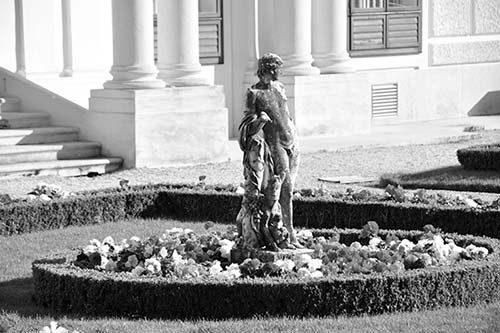
Today it’s a delightful, sprawling place to wander—especially on a sunny day. You can spend hours here, enjoying the views and the people-watching. And most of the park is free, as it has been for centuries (open daily sunrise to dusk, entrance on either side of the palace). Note that some specialty features in the gardens charge admission but are included in the Schönbrunn pass described earlier (under “Cost”).
Getting Around the Gardens: A tourist train makes the rounds all day, connecting Schönbrunn’s many attractions (€8, 2/hour in peak season, none Nov-mid-March, one-hour circuit).
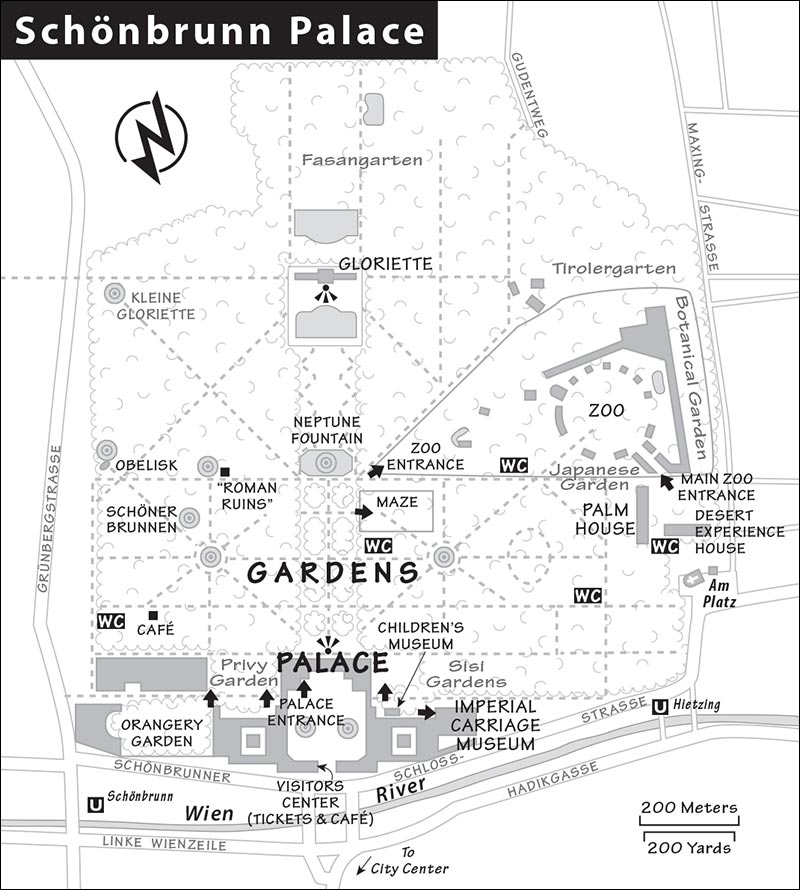
Visiting the Gardens: The grounds are laid out on angled, tree-lined axes that gradually incline, offering dramatic views back to the palace. The most elaborate gardens flank the palace: the Privy Garden/Crown Prince Garden (€4.50) and the free Sisi Gardens. But it’s fun to just explore the expansive grounds (use the map in this book or pick one up at the palace). Highlights include several whimsical fountains, such as the faux “Roman ruins,” the obelisk, and the Neptune Fountain (straight back from the palace). There is also an Orangery (€4.50). Next to the Neptune Fountain is a kid-friendly maze (Irrgarten) and playground area (€4.50).
If the weather is good, huff up the zigzag path above the Neptune Fountain to the Gloriette, a purely decorative monument celebrating an obscure Austrian military victory. To gain access to the view terraces, you can pay for a pricey drink in the café or shell out for an admission ticket (€4.50)—but views are about as good from the lawn just in front of the monument.
NEARBY SIGHTS
Schönbrunn Zoo (Tiergarten Schönbrunn)
The world’s oldest zoo, next door to the palace grounds, was built in 1752 by Maria Theresa’s husband for the entertainment and education of the court. He later opened it up to the public—provided they wore proper attire. Today, it’s a modern A (anteater) to Z (zebra) menagerie that’s especially appealing to families.
Cost and Hours: Adults-€24, kids-€14, daily 9:00-18:30, closes earlier off-season, www.zoovienna.at.
▲Imperial Carriage Museum (Kaiserliche Wagenburg)
The Schönbrunn coach museum is a 19th-century traffic jam of 50 impressive royal carriages and sleighs. It’s overpriced (but worth it if you have extra time before your palace reservation). Highlights include silly sedan chairs, the death-black hearse carriage (used for Franz Josef in 1916, and most recently for Empress Zita in 1989), and an extravagantly gilded imperial carriage pulled by eight Cinderella horses. This was rarely used other than for the coronation of Holy Roman emperors, when it was disassembled and taken to Frankfurt for the big event (check out the huge paintings on the back wall, showing these very carriages in action). You’ll also get a close look at one of Sisi’s impossibly narrow-waisted gowns, and (upstairs) Sisi’s “Riding Chapel,” with portraits of her 25 favorite horses.
Cost and Hours: €12, daily 9:00-17:00, shorter hours off-season, audioguide-€2, 200 yards from palace, walk through right arch as you face palace, +43 1 525 242 500, www.kaiserliche-wagenburg.at.