RINGSTRASSE TRAM TOUR
One of Europe’s great streets, the Ringstrasse is lined with many of Vienna’s top sights. In the 1860s, Emperor Franz Josef had Vienna’s ingrown medieval wall torn down and replaced with a boulevard 190 feet wide. Vienna’s grand “ring road,” arcing nearly three miles around the city’s core, predates all the buildings that line it. Those buildings are very “Neo”: Neoclassical, Neo-Gothic, and Neo-Renaissance—an approach called “Revival” or “Historicism.”
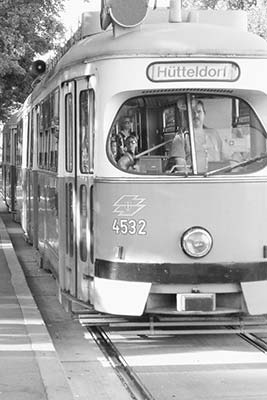
This self-guided tram tour (a big circle starting and finishing at the opera house) gives you a good orientation and a ridiculously quick glimpse of some major sights as you glide by on Vienna’s red trams (a.k.a. streetcars), most of them now sleek and modern. No one tram makes the entire loop around the Ring, but you can see it all by transferring from tram #2 to tram #1 (at the Schwedenplatz stop). Enjoying this circular tram ride is a fun way to sit shoulder-to-shoulder with ordinary Wieners and see their city. In fact, my hope is that you’ll feel like a Wiener yourself as you make this big loop.
PLANNING YOUR TOUR
This tour can be tricky to follow. To prepare, read and remember these pointers:
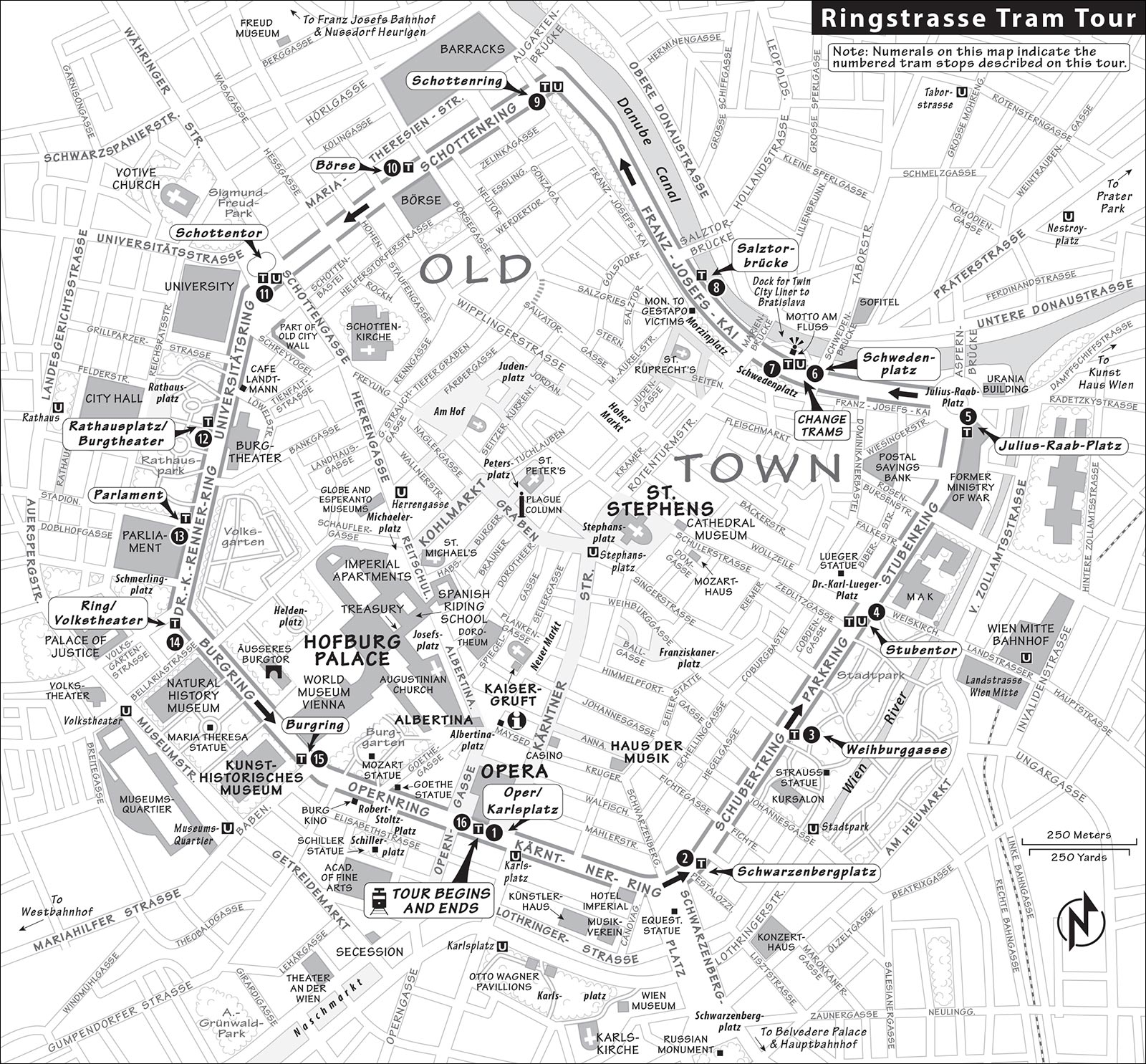
• You’ll start the tour by boarding tram #2 directly—literally directly—across the busy street from the grand opera house. Buy your tram ticket before you board (there’s a machine in the Opera U-Bahn station underpass). You’ll be circling the city counterclockwise. Facing the opera house, you’ll be heading to the right.
• Boarding a tram for this self-guided tour is like jumping onto a quickly moving sidewalk. Don’t board until you are good and ready. Once on board, try to get a seat on the right-hand side for the first half of the ride (tram #2) and the left-hand side for the second half, on tram #1 (if you don’t get the side you want right away, just wait for a seat to open up).
• Each numbered stop on this tour is named for and keyed to a tram stop. While the tram stops and goes a lot, an actual “stop” is when the door opens and people get in and out. Each stop has a name that is announced in German as you approach and labeled in three places: usually in small print atop a round sign on the platform (only visible from the right-hand side); on monitors inside more modern trams; and on the map for this tour in your guidebook.
• When you reach each numbered stop, start reading the corresponding section (while the tram is loading). Finish reading it even if the tram pulls out. That way, you’ll know what to look for once the tram rolls onward. Then enjoy the ride; you’ll read the next section at the next stop.
• Anyone following this tour must disembark at Schwedenplatz to change trams. But if you have a transit pass (instead of a ticket), you can—and should—jump on and off at other stops, seeing sights that interest you. Some of the best stops are Weihburggasse (Stadtpark), Stubentor (Museum of Applied Arts, a.k.a. MAK), Rathausplatz/Burgtheater (City Hall and its summertime food circus), and Burgring (Kunsthistorisches Museum and Hofburg Palace).
• Trams come every five or ten minutes. A monitor at the stop shows how many minutes until your tram will arrive. The entire circle takes about a half-hour. Heck, you can even circle twice on the same ticket if you like.
Orientation
Cost: €2.40 (one transit ticket). A single ticket can be used to cover the whole route, including the transfer between trams (but you’re not otherwise allowed to interrupt your trip). However, with a transit pass (€8/24 hours), you’re free to hop off and on (see “Planning Your Tour” for suggested stops to get off). For more on riding Vienna’s trams, see the Orientation to Vienna chapter.
When to Go: While this tour works fine in the daylight, the tram ride is also pleasant after dark, when nearly every sight on the route is well-lit and the tram is likely to be much less crowded.
Tours:  Download my free Ringstrasse Tram Tour audio tour.
Length of This Tour: About 30-45 minutes; budget more time if you want to hop off and on along the way. Or consider making the loop a second time to just enjoy the ride and the many sights.
Bike Option: To do this approximately 3.25-mile tour at your own pace, you could rent a bike. This allows you to easily stop at sights or to detour to nearby points of interest. The grassy median strip has excellent bike paths that run along almost the entire circuit of the Ring (except for a few blocks after the votive church, near the end of this tour). The WienMobil Rad rental program is cheap and easy with a smartphone, and the Pedal Power bike rental shop is just two blocks from the opera house. For details on both, see the Orientation to Vienna chapter.
Starring: Vienna’s grandest boulevard, major landmarks, and a dizzyingly quick, once-over-lightly look at the city.
The Tour Begins
This tour makes a full circle around the ring road, with one transfer. You’ll catch tram #2 from the middle of the street directly in front of the opera house and ride it for sections 1 through 5 of my tour. At Schwedenplatz (sections 6 and 7), you’ll get out for a look at the Danube Canal before boarding tram #1 for sections 8 through 16. You’ll end up exactly where you started—immediately across from the opera house.
When you’re ready to start, hop on tram #2 going to the right, as you face the opera house; try to grab a seat on the right.
1 Oper/Karlsplatz
Just past the opera house, look left and see the city’s main pedestrian drag, Kärntner Strasse, leading to the zigzag-mosaic roof of St. Stephen’s Cathedral. This tram tour makes a 360-degree circle around the cathedral, staying about this same distance from the great church that marks the center of Vienna.
Along this stretch, you’ll pass a string of Vienna’s finest five-star hotels, including Hotel Imperial (after a couple blocks, on the right)—the choice of nearly every visiting big shot, from royalty to the Rolling Stones.
Fifty yards after the Hotel Imperial (just after the corner, also on the right), at Schwarzenbergplatz, an equestrian statue honors Prince Charles Schwarzenberg, who fought Napoleon. From the end of World War II until 1955, Austria and its capital were occupied by foreign troops, including Russian forces; during that time the square was named Stalinplatz after the Soviet dictator.
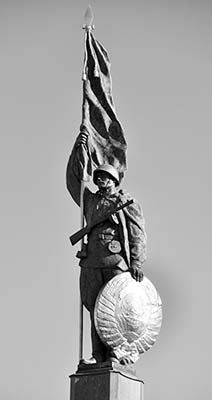
In the distance beyond the prince, at the far end of the long square, look for a fountain with a tall monument and a big colonnade just behind it. This Russian monument was built in 1945 as a forced thank-you to the Soviets for liberating Austria from the Nazis. Formerly a sore point, now the monument is just ignored.
2 Schwarzenbergplatz
Three blocks ahead, on the right, is the huge Stadtpark or City Park. This inviting green space honors many great Viennese musicians and composers with statues. At the beginning of the park, the gold-and-cream concert hall behind the trees is the Kursalon, opened in 1867 by the Strauss brothers, who directed many waltzes here. Touristy Strauss concerts are held in this building (for details, see the Entertainment in Vienna chapter). If the weather’s nice, you could hop off at the next stop for a stroll in Vienna’s finest park.
3 Weihburggasse
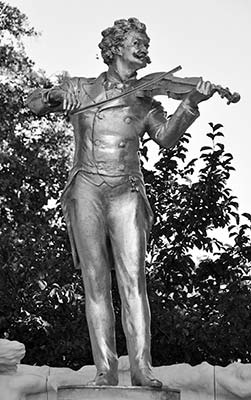
On the right, immediately after this stop, in the park but barely visible from the tram is a gilded tribute to “Waltz King” Johann Strauss (squint through the park gate a few yards beyond the stop to find a statue under a white arch). He holds a violin as he did when he conducted his orchestra, whipping his fans into a three-quarter-time frenzy.
4 Stubentor
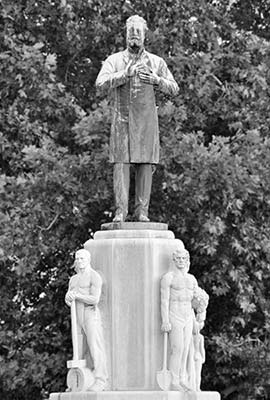
On the left (immediately across from the stop), centered in a public square, is a bronze statue (now green but likely covered with graffiti) of Dr. Karl Lueger. The mayor from 1897 to 1910, he shaped Vienna into a modern city. Once hugely popular and influential, his anti-Semitism has caught up with him and this statue may be gone, as he’s being canceled by Vienna (see “The Birth of Modern Vienna” sidebar).
Immediately after the Lueger statue and across the street, look right at the big, red-brick building. This is the MAK (Museum of Applied Arts), showing furniture and design through the ages (described in the Sights in Vienna chapter).
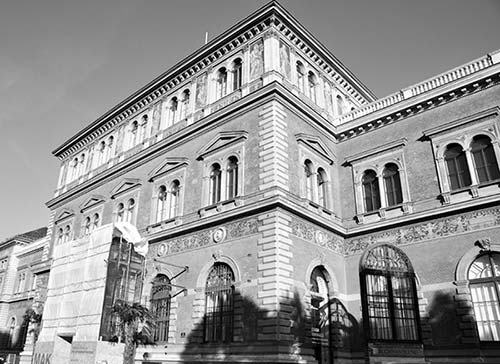
A block after the museum (still on the right), the long, white building used to be the Austrian Ministry of War, back when that was a major operation. Above its oval windows, you can see busts of soldiers, wearing Stratego-style military helmets. Each shows the uniform of a different regiment and the folkloric tradition of its country within the Habsburg realm.
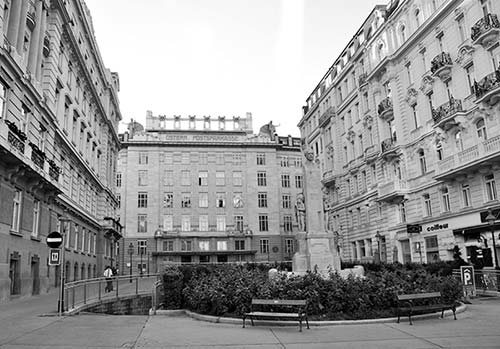
To the left, directly across the street from the start of the Ministry of War, is the Postal Savings Bank (set back on a little square, in a little gap between the buildings; described in the Sights in Vienna chapter). Designed by Otto Wagner, it’s one of the rare Secessionist buildings facing the Ring. (For more on the Secession, see the sidebar on here.)
5 Julius-Raab-Platz
Immediately after this stop, the tram makes a sharp left turn. To the right is the white dome of the Urania, Franz Josef’s 1910 observatory. And in the distance, you may see the famous giant Ferris wheel. Erected in 1897 as the centerpiece of the beloved Prater amusement park, it is 212 feet high and was the world’s tallest until 1985. OK! Get ready to hop off for your transfer at the next stop.
6 Schwedenplatz (Get off Tram #2 and View the Canal)
Hop off tram #2 and find the platform for tram #1. (You get off at track A and hop on at track B—the next track over, a few feet closer to the town center and farther from the canal.) Notice tram #1 arrival times on the monitor. They’ll come every five or ten minutes, so feel free to take a break here before boarding tram #1 to finish your Ringstrasse loop.
For a good viewpoint, cross the street and climb up the wooden stairs of Motto am Fluss, the recommended restaurant immediately opposite the tram stop and overlooking the canal.
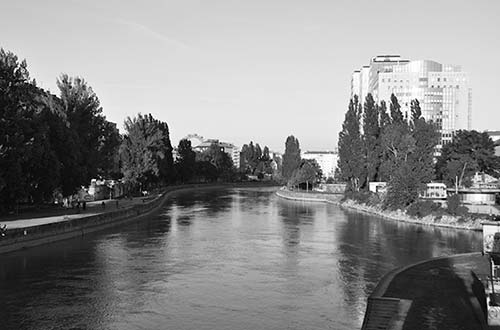
The waterway is the Danube Canal (a.k.a. the “Baby Danube”), one of the many small arms of the river that once made up the Danube at this location. The rest have been gathered in a mightier modern-day Danube, farther away. The river was engineered for stability and trade in 1873.
This area was once the center and harbor of the original Roman town, Vindobona. Located on the banks of the Danube, Vindobona marked the end of the civilized world. To the north lay the barbarian (non-Latin-speaking) Germanic lands.
This tour quickly passes a statue of Dr. Karl Lueger (1844-1910), the influential mayor of Vienna during the pivotal period around the turn of the 20th century. Although controversial for his anti-Semitism, Lueger worked together with architect Otto Wagner (1841-1918) to shape the modern Vienna you see today. Read this information during any downtime (or before you board the tram) so you can recognize Lueger when you see him (at Stubentor, stop #4).
While Lueger was mayor (1897-1910), Vienna was undergoing an incredible growth spurt: In 1850, the city had 500,000 residents; at its peak, around 1900, the population was 2.2 million, compared to the city’s current population of about 1.8 million.
Emperor Franz Josef put Lueger and Wagner (the “Father of Modern Vienna”) to work with a staff of 60 architects to turn the city into a capital befitting the grandiose Habsburg Empire. Consider the dramatic changes this team oversaw in a relatively short time: In the previous generation, Roman-style aqueducts still brought fresh spring water into the city from the Alps. By the 20th century, the city had modern plumbing. Thomas Edison supervised the electrical lighting of Schönbrunn Palace, and shortly after that, gas lighting brightened the entire Ringstrasse. The Danube was tamed by building solid banks, along with other flood-control projects. In the 1870s, engineers even began an artificial island that took a century to complete.
As Vienna grew and sprawled, it became decentralized, as with “city centers” all over the place. To tie it all together, the new Vienna needed a fine tram and subway system. Consequently, much of the city’s subway infrastructure also dates from this era. Around town, you’ll notice that some of the older U-Bahn stops are still Art Nouveau in design. Also during this time (in 1898), the horse-drawn tramline around the Ringstrasse was converted to electric power.
In so many ways, the Vienna of today was created during this brief spurt of architectural and engineering energy. Lueger himself has fallen into disrepute because of his racist politics (Hitler cited him as an inspiration in Mein Kampf). After decades of controversy, the part of the Ring named after Lueger in 1934 was rechristened the Universitätsring in 2012, and many would like to see his statue removed as well.
To the far left are the Vienna Woods and the foothills of the Alps. From this point the Alps arc across Europe all the way to the French Riviera where they plunge into the Mediterranean. The embankment has become a lazy park-like people-zone with restaurant boats, swimming pools, sundecks, bars with lounge chairs for sunning, and bike paths stretching in both directions.
The modern boat station (located where the original Roman harbor was) is the terminal for the fast boat to Bratislava, the capital city of Slovakia, about an hour away downstream.
If some of the buildings across the canal seem a bit drab, that’s because in April 1945, the last month of World War II, this prime real estate was bombed. Postwar buildings were constructed on the cheap and are now being replaced by sleek, futuristic buildings. (The tall black skyscraper houses the Sofitel with an elegant view restaurant on top. And beyond that are a few delightful recommended restaurants.)
By the way, this square is called Schwedenplatz (“Sweden Square”) because after World War I, Vienna was overwhelmed with hungry orphans. The Swedes took several thousand in, raised them, and finally sent them home healthy and well-fed.
7 Schwedenplatz (Hop on Tram #1)
Get ready—here comes tram #1, heading in the same direction you’ve been going. (If you’re waiting a few minutes for it to arrive, read ahead to the next section.) Hopping a tram here, I like to grab a seat on the left to keep an eye toward the old city center—the spire of St. Stephen’s Cathedral peeks above the buildings to your left (beyond the golden arches). After three blocks, on the left, you’ll see the ivy-covered walls and round Romanesque arches of St. Ruprecht’s (Ruprechtskirche), the oldest church in Vienna. It was built in the 11th century on a bit of Roman ruins. Beyond that is a nightclub quarter nicknamed “The Bermuda Triangle.”
8 Salztorbrücke
As there’s not much to see until after the next stop (you’ll pass the Salztorbrücke stop and continue on to Schottenring), spend a couple of minutes reading ahead.
It’s interesting to remember that the Ringstrasse replaced the mighty walls that once protected Vienna from external enemies.
Imagine the great imperial capital contained within its three-mile-long wall, most of which dated from the 16th to 18th century. As was typical of city walls, it was lined with cannons (2,200, in Vienna’s case) and surrounded by a “shooting field” or “cannonball zone.” This swath of land, as wide as a cannonball could fly (about 400 yards), was clear-cut so no one could approach without being seen...and targeted.
After the popular unrest and uprisings of 1848, the emperor realized the true threat against him was from inside. He rid the city of its walls in about 1860, built this boulevard and transportation infrastructure (useful for moving citizens in good times and soldiers in bad), and, as you’ll see in a moment, he moved his army closer at hand. Napoleon III’s remodel of Paris demonstrated that wide boulevards make it impossible for revolutionaries to erect barricades to block the movement of people and supplies. That encouraged Franz Josef to implement a similarly broad street plan for his Ring. A straight stretch of boulevard may seem just stately, but for an embattled emperor, it’s an easy-to-defend corridor.
Vienna’s wall survived longer than those in most European capital cities because its Old Regime rulers did. When the emperor had the walls taken down, the shooting field was wide open and ripe for development. That’s why the wonderful architecture that lines the outer edge of the Ringstrasse is all from the same era (post-1860).
9 Schottenring
After this stop, the tram leaves the canal and turns left.
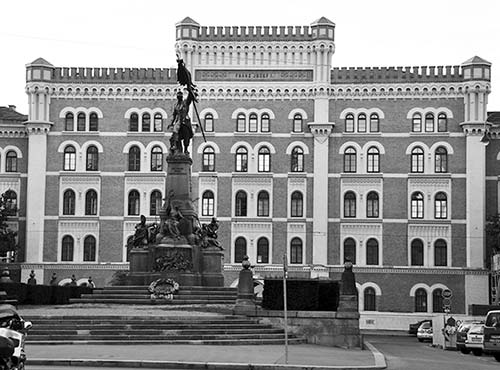
Through a gap in the buildings, you’ll get a glimpse of a huge, red-brick castle—actually high-profile barracks for 6,000 troops built here at the command of a nervous Emperor Franz Josef (who found himself on the throne as an 18-year-old in 1848, the same year people’s revolts against autocracy were sweeping across Europe). Today this is the headquarters of the National Defense.
10 Börse
At the stop look left to see the orange-and-white, Neo-Renaissance temple of money—the Börse was Vienna’s stock exchange. The next block is lined with banks and insurance companies—the financial district of Austria, though many of these flashy financial institutions have sold and moved out to more modern and less central locations (for example, the former Rothschild bank building now houses a big Spar supermarket).
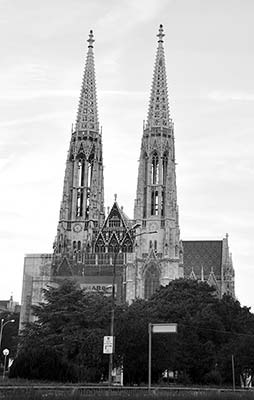
After the corner, look right for the towering, frilly, Neo-Gothic church across the small park. This is a “votive church,” a type of church built to fulfill a vow in thanks for God’s help—in this case, expressing gratitude for the failure of an 1853 assassination attempt on Emperor Franz Josef.
Look left and right to see the fine lines of buildings (two blocks on the left, three on the right) built in the free-fire zone of the wall after 1870. This string of grand, late-19th-century buildings stretches three miles along the real estate freed up with the demolition of the wall. What a gift to developers!
11 Schottentor
Leaving this stop, on the right is the main building of the University of Vienna (Universität Wien). Established in 1365, the university has no real campus, as its buildings are scattered around town. It’s considered the oldest continuously operating university in the German-speaking world and has nearly 100,000 students.
Immediately opposite the university, on the left, a chunk of the old city wall is visible (behind a monument topped with a gilded angel). The seated female statue under the trees is a monument to the Trümmerfrauen, “rubble women” who helped clear and rebuild Vienna brick by brick after World War II. Beethoven lived and composed in the building just above the piece of wall. Imagine, he wrote “Für Elise” right here.
12 Rathausplatz/Burgtheater
At the stop, on the right, you’ll see how the Neo-Gothic City Hall (Rathaus) flies both the local flag and the flag of Europe. The square in front (Rathausplatz) is a festive site in summer, with a thriving food circus and a huge screen showing outdoor movies, operas, and concerts (described in the Entertainment in Vienna chapter).
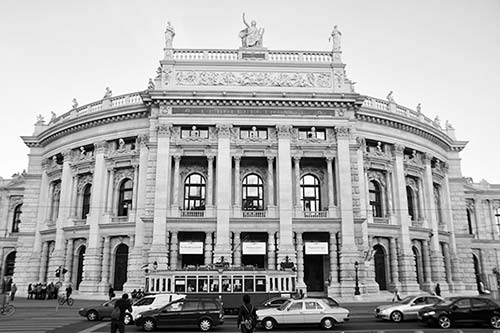
Opposite that on the left is the Burgtheater, Austria’s national theater. Locals brag it’s the “leading theater in the German-speaking world.”
13 Parliament
On the right, you can’t miss the temple of democracy housing the Austrian Parliament. The lady with the golden helmet is Athena, goddess of wisdom. Across the street from the Parliament (on the left) is the imperial park called the Volksgarten, with a fine public rose garden.
14 Ring/Volkstheater
The vast building (on the right) is the Natural History Museum (Naturhistorisches Museum), which faces its twin, the Kunsthistorisches Museum, containing the city’s greatest collection of paintings. The MuseumsQuartier behind them completes the ensemble with a collection of modern art museums. A hefty statue of Empress Maria Theresa squats between the museums, facing the grand gate to the Hofburg Palace.
Opposite Maria Theresa (look left), the arched gate (the only surviving castle gate of the old town wall, its current iteration built to celebrate the 1824 victory over Napoleon) leads to the Hofburg, the emperor’s palace. Of the five arches, the center one was used only by the emperor.
Your tour is nearly finished. Consider hopping off here to visit the Hofburg or the Kunsthistorisches Museum.
15 Burgring
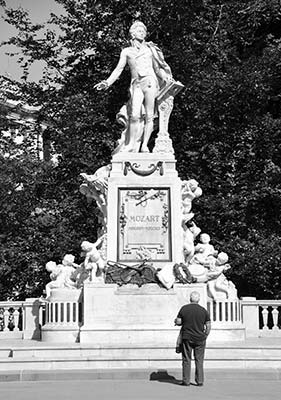
Until 1918, the appealing Burggarten (on the left) was the private garden of the emperor. Today locals enjoy relaxing here, and it’s also home to a famous statue of Mozart (pictured here; he’s hiding behind the leaves).
On the right is the Burg Kino theater, which plays the movie The Third Man several times a week in English (see here).
A hundred yards farther (on the left, just after the park), the German philosopher Goethe sits in a big, thought-provoking chair. Goethe seems to be playing trivia with German poet Schiller across the street (in the little park set back from the street, on your right). Behind the statue of Schiller is the Academy of Fine Arts (described in the Sights in Vienna chapter).
The next stop is our last. We’re back where we started—the opera—and it’s time to get out.
16 Oper/Karlsplatz—Whew!
Jump off the tram and see the rest of the city. To join me on a walking tour of Vienna’s center, which starts here at the opera,  see the Vienna City Walk chapter. Or spend another 30 minutes making this loop again to see all the things you missed.