INNSBRUCK
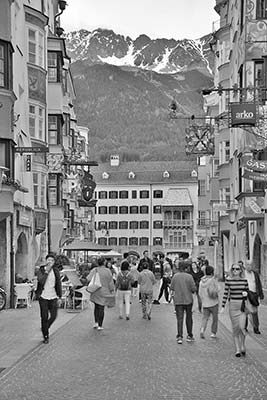
Innsbruck, the proud capital of Tirol, is famous as a ski resort and a hiking haven. The setting is impressive—lined up along the fast-flowing Inn River, with dramatic peaks towering on both sides. Even so, some compare Innsbruck’s sights with the music and architecture of Salzburg and Vienna, and write it off as stale strudel. But you’re not here for music or architecture—you’re here for the mountains. Make a point to get beyond Innsbruck’s touristy patina, and you’ll discover a pleasant high-alpine city with an appealing old town and a youthful verve that’s absent in Austria’s more staid cities. And Innsbruck has just enough of a Habsburg connection (thanks to the 16th-century Emperor Maximilian I, who loved the Tirolean Alps) to give it real class. It even has its very own Hofburg and Sacher Café.
The old town, with the famous copper-tiled Golden Roof, is fun to explore. The museums are well presented; the cleverly coordinated lifts make it easy to ascend high into the mountains; the hotels and restaurants in the old core ooze rustic character; and a lively student buzz and healthy outdoorsiness combine to give Innsbruck a special appeal. Although touristy, Innsbruck hustles to please those tourists, with both good-weather and rainy-day options. In this crossroads city—where, since the creation of an ancient Roman road, passing traders have sought lodging and entertainment—the natives seem to have a sense of hospitality deep in their bones.
PLANNING YOUR TIME
Most travelers view the Inn Valley as “pass-through” territory—between Salzburg to the east, the Italian Dolomites to the south, Bavaria and Munich to the north, and Switzerland to the west. If you have only a few hours, Innsbruck warrants a stretch-your-legs stroll (follow my self-guided walk, which takes a couple of hours). With a day, add a museum visit, or, better yet, head into the mountains—but allow at least 2.5 hours round-trip. Innsbruck deserves an overnight (or two), which allows more time for sightseeing, scenic drives and strolls, and mountain lifts. The town of Hall, with its preserved old town core, is a pleasant side-trip from Innsbruck—or it can be a practical, somewhat cheaper small-town overnight alternative that’s good for drivers (covered at the end of this chapter).
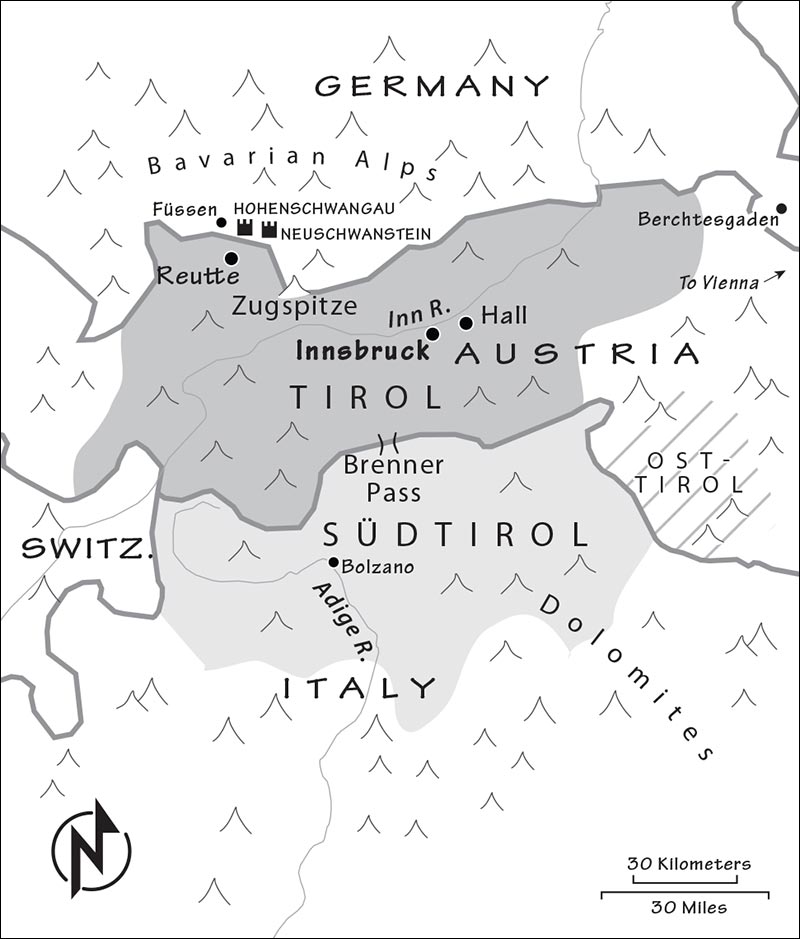
The mountainous Tirol region—in Austria’s western panhandle—is a winter sports mecca known for its alpine panoramas. In the region’s capital, Innsbruck, the Golden Roof glitters and a mountain peak is in every view. Just up the valley, neighboring Hall is also charming, with fewer crowds. This region makes a good stop for those en route from Germany to Italy, or from Vienna to Switzerland.
Today’s Tirol is a fraction of its original size. Controlled by the Habsburgs from the mid-14th to the early 20th century, this realm was chopped up when Austria lost World War I. The southern Tirol became part of Italy, where Mussolini and other rulers worked hard to Italianize the strongly Germanic culture (see here). For a look at this part of the Tirol—what Austrians call the Südtirol—head to Italy’s Dolomites (see the Italian Dolomites chapter). The northern fringe of Tirol—still part of Austria—contains the mountain resort town of Reutte, providing easy access to Bavaria’s fairy-tale castles across the border in Germany (see the Bavarian Alps chapter). If you’re day-tripping across borders, bring your passport (though you aren’t likely to be asked for it).
Orientation to Innsbruck
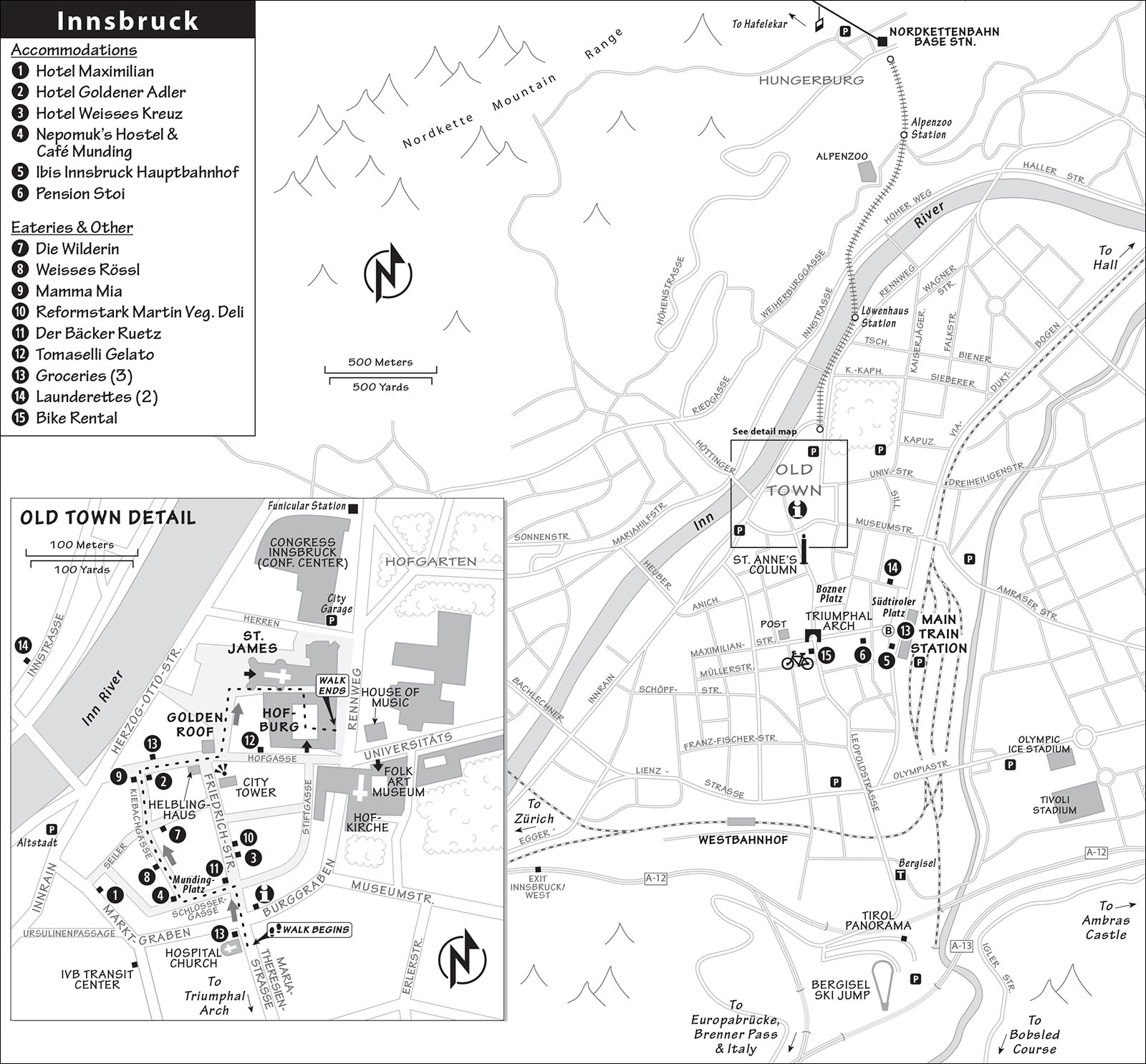
Innsbruck—Austria’s fourth-biggest city—has about 130,000 inhabitants (and 30,000 students). Most recommended sights, including the famous Golden Roof-topped balcony, hotels, and restaurants are in the compact, traffic-free medieval center, tucked along the Inn River. Directly south of the old town, the broad Maria-Theresien-Strasse leads through an upscale neighborhood of 18th- and 19th-century buildings, bounded by the train station to the east. Suburbs climb up the foothills to the north and south. Orient yourself with the mountains called Nordkette, a chain of the Karwendel Alps to the north.
TOURIST INFORMATION
Innsbruck’s main TI is at the edge of the old town (Mon-Sat 9:00-18:00, closed Sun; Burggraben 3, facing the inner ring road three blocks in front of the Golden Roof, +43 512 5356, www.innsbruck.info). There’s also a TI kiosk at the train station (Mon-Sat 9:00-17:00, Sept-June 10:00-15:00, closed Sun year-round). A small TI at the city tower ticket counter is open Sun (when the other TIs are closed).
Innsbruck Card: The €53 Innsbruck Card includes 24 hours of free local transport as far as Hall, access to the nearby mountain lifts, the town walking tour (described later), and entry to most of the attractions I’ve listed. The card pays for itself if you ride the lifts to the top of the Hafelekar and back and see one major sight. It may save money if you visit many sights and use the bus or Sightseer minibus—do the math. In Innsbruck, the card is sold at the TI and most participating sights. The card also covers Hall’s Mint Museum (but not the Mint Tower) and is available from Hall’s TI.
Welcome Card: Some hotels offer the free Innsbruck Welcome Card, which provides discounts on sightseeing and public transport. Travelers staying three days or more also get discounts on cable cars. Check www.innsbruck.info for more details (search for “Welcome Card”).
Walking Tours: The TI offers a great one-hour city walk of Innsbruck (€14, free with Innsbruck Card, July-Aug Wed and Sat at 11:30). To hire your own guide, book through Per Pedes and request Julia Strauhal, who gives well-informed, engaging tours of town (price on request, +43 664 433 9419, www.perpedes-tirol.at, office@perpedes-tirol.at).
Music: The city puts on free outdoor concerts in the courtyard of the Hofburg daily during July. Check the TI website for details.
ARRIVAL IN INNSBRUCK
By Train: Some trains stop at Innsbruck’s Westbahnhof, but stay on the train until you reach the main train station (Hauptbahnhof). Austria’s second-biggest station, it has lockers, a large supermarket, a bookstore, a TI, and a Reisezentrum where you can get rail information and tickets. Local buses stop out front.
From the station, it’s a 10-minute walk to the old town center. As you exit, walk to the right end of the square in front of the station. Turn left on Brixner Strasse, and follow it past the fountain at Bozner Platz, where it turns into Meraner Strasse. Go straight until it dead-ends into Maria-Theresien-Strasse, then turn right and head 300 yards into the old town. You’ll pass the TI on Burggraben (on your right), and then Hotel Weisses Kreuz and the Golden Roof.
By Car: The handiest parking is the City Garage at the Congress Innsbruck conference center, right in the center of town (€1.30/30 minutes, €16/day, Rennweg 3). This works especially well if you’re taking the nearby funicular to the mountain cable car—validate your ticket at the Nordkettenbhan ticket counter. The Altstadt garage, just outside the old town, is close to my recommended hotels there (€2.80/hour, €1.40 each additional half-hour, €19/day, Innrain 4). Hotels may offer a discounted rate for parking at city garages—ask. The OlympiaWorld park-and-ride, near the stadiums behind the train station, is another alternative (€18/day, includes free public transport in town for 5 people).
By Plane: The handy #F bus carries you from the airport to central points around the city (3-4/hour). Buy tickets from machines or from the driver (more expensive).
HELPFUL HINTS
Laundry: There are several self-service Bubblepoint launderettes near my recommended hotels (Mon-Fri 8:00-21:00, Sat-Sun until 20:00, at Brixner Strasse 1 near the train station, longer hours at Innstrasse 11 just across the river from old town, +43 512 565 0075, www.bubblepoint.com).
Bike Rental: The Die Börse bike shop, which started in 1980 and is now run by sisters Laura and Olivia, offers a range of choices. Select from city cruisers (€16/6 hours), mountain bikes (€35/6 hours), and e-bikes (€45/6 hours—reserve ahead); Mon-Sun 9:00-18:00 except Sun closed 12:00-15:00, closed during bad weather; in the back corner of the courtyard at Leopoldstrasse 4, +43 512 581 742, www.dieboerse.at).
Guided Hikes: From late May through late October the TI organizes daily hikes, ranging from easy to challenging, in the surrounding mountains and valleys. They’re free but available only to hotel guests with Welcome Cards (see “Tourist Information,” earlier). Find hike descriptions and booking details on the TI website (www.innsbruck.info—select “Sport and Relaxation,” then “hike”). Transportation, a backpack, and even boots are often provided (confirm with TI); bring your own lunch and water.
GETTING AROUND INNSBRUCK
You won’t need public transportation if you’re sticking to Innsbruck’s compact medieval center and the Hafelekar lift, but you’ll take trams or buses to the museums and ski jump at Bergisel, Ambras Castle, and Hall. Tickets can be purchased at machines, tobacco shops, the TI, and the IVB office mentioned next.
A single ticket within Innsbruck costs €2.80. A day pass is €6.10, and a discounted pack of eight rides is €16.10. Tickets to Hall cost more, and there’s a confusing array of family and group tickets. Sort out your options at the IVB office near the old town (Mon-Fri 7:30-18:00, closed Sat-Sun, Stainerstrasse 2, www.ivb.at).
The made-for-tourists Sightseer minibus (also known as bus #TS) loops around town, connecting the key sights. Buy tickets at the TI, the IVB office, some hotels, or from the driver (€20/24-hour pass, covered by Innsbruck Card, no single-ride tickets). Your Sightseer ticket also covers other buses and trams within Innsbruck. The Sightseer is pricey—more than three times the cost of a regular day pass on public transit—and runs less frequently, but some find it more convenient (minimal headphone commentary in English, departs every 40 minutes from stops throughout town, May-Sept 9:55-17:20, less frequent off-season).
Innsbruck Walk
This self-guided walk introduces you to Innsbruck’s historic core and connects its major sights. Worth ▲▲, it takes about an hour and a half, not counting time spent in museums.
• Begin across the street from the TI, at the head of the pedestrianized shopping street called...
Maria-Theresien-Strasse
This fine, Baroque-era, traffic-free shopping street stretches south from the medieval center. It’s named for Maria Theresa, the powerful 18th-century Habsburg empress who left her mark here in Innsbruck (as in much of her realm). Face away from the old town and take a quick visual tour of this street.
On the right, the pink Baroque church is known as the Hospital Church (Spitalskirche). The busy road behind you—still called the Graben (ditch)—marks the site of the moat and city wall in the old days. It was smart to keep the hospital outside the walled town to reduce the spread of disease.
Farther along, in the middle of Maria-Theresien-Strasse, St. Anne’s Column (Annasäule) marks the middle of the old marketplace. This was erected in the 18th century by townspeople thankful that their army had defeated an invading Bavarian army and saved the town.
Just beyond the column, on the right, is the Rathaus Galerien—the former City Hall, now a sprawling shopping mall.
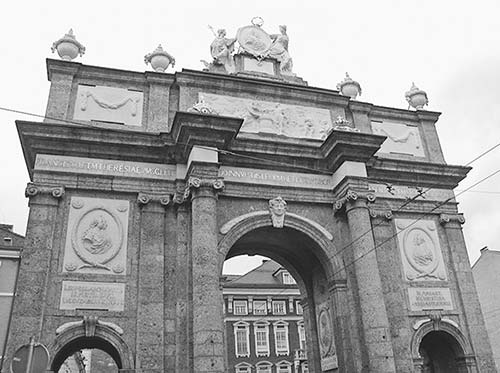
We’re about to do a 180 and head into the old town. But if you went the other way on Maria-Theresien-Strasse—past St. Anne’s Column—in a couple of blocks you’d run into a Triumphal Arch with an interesting backstory (see the sidebar). Now face the old town and enjoy the classic view of Innsbruck: arcaded shopping street, twinkling Golden Roof, and a Nordkette backdrop looming high above. Notice the heavy-duty avalanche protection that stripes the slopes above town.
• Cross the busy street, and pause at the start of the...
Herzog-Friedrich-Strasse Pedestrian Zone
You’re now within Innsbruck’s old town. Facing back the way you came, look up to the right (under the little arch) to see a painting labeled Vor-Stadttor 1765—commemorating what was the city tower, before it was torn down for the wedding of Leopold II. Bricks from this tower were used to build the Triumphal Arch described earlier.
This part of town dates from well before the Habsburgs, however. The street you’re on now, thriving with commerce today, was even more so in ancient Roman times when it was part of the Via Claudia Augusta. Laid out in 15 BC, this trade route over the Brenner Pass connected Italy to Germany. Innsbruck is named for the place where a bridge (Brücke) allowed the Via Claudia Augusta to cross the Inn River.
Look to the far end of the street, where the Golden Roof glitters. The arcades—common in Tirol—offer shelter from both sun and snow.
On the right, at #39, peek into the sleek showroom of the Swarovski Crystal shop. A century and a half ago, the Swarovski family moved from Bohemia (in the Czech lands) to the Inn Valley, seeking ample wood and water for their glassworks. Today they’re a crystal empire with high-end shops all over the world (they also have a visitors center at their Crystal Worlds headquarters in the nearby town of Wattens).
• From here you could walk straight to the Golden Roof in under a minute. But instead, let’s take a more scenic (and less tourist-clogged) route through...
Innsbruck’s Back Streets
Head down Schlossergasse (under the arch, across from Swarovski). After one block, you’ll hit the square called Mundingplatz. On it you’ll find the classic Café Munding (Tue-Sat 9:00-18:00, closed Mon), with decadent pastries. On the wall, notice the huge painting of St. Christopher, the patron saint of travelers—fitting for this historic crossroads town. Just to the right is another, smaller painting—a Madonna and Child, inspired by the locally beloved piece inside St. James’ Cathedral (see “Sights in Innsbruck,” later).
Facing the café, turn right and wander down Kiebachgasse, noticing the typical Innsbruck architecture. While Café Munding itself has had a frilly Baroque makeover, most of the houses along here have clean Gothic lines. Notice that the rooflines come to a V, funneling rain and snowmelt into exterior gutters and downspouts. Each simple house front hides a long, skinny townhouse and a spacious interior courtyard. These spaces, along with the characteristic arcades that line major shopping streets, help protect locals from the volatile alpine climate. Also notice the stout buttresses holding everything firmly in place; Tirol has suffered some devastating earthquakes.
Kiebachgasse opens up into a little zone locals call the “Square of the Four Animals”—look for the horse, lion, eagle, and stag (hint: one is on a weathervane).
Continue straight one more block to the intersection with Herzog-Friedrich-Strasse. Several recommended restaurants face this picturesque intersection. Immediately on your right, duck under the arcade of the recommended Hotel Goldener Adler, which dates from 1390, and peruse the list of illustrious customers, chiseled into a stone plaque (Emperor Maximilian I, Mozart, Goethe, Maria von Trapp, John Glenn...). Peek in the window to the right of that plaque to see on the far-back wall the shimmering golden mosaics honoring four great Tiroleans who defended their land against Bavaria during Napoleon’s time (see the Tirol Panorama listing under “Sights in Innsbruck,” later).
• Speaking of shimmering: You’ve been patient, and now it’s time to see the most famous gold in Austria. Turn right along Herzog-Friedrich-Strasse and window-shop your way one block to the...
Golden Roof (Goldenes Dachl)
Emperor Maximilian I (see sidebar) adored Innsbruck. And so he adorned his residence here with a balcony topped with 2,657 gilded copper tiles. The Golden Roof (1494) offered Maximilian an impressive spot from which to view his medieval spectacles. But he also enjoyed people-watching (and being seen) from here.
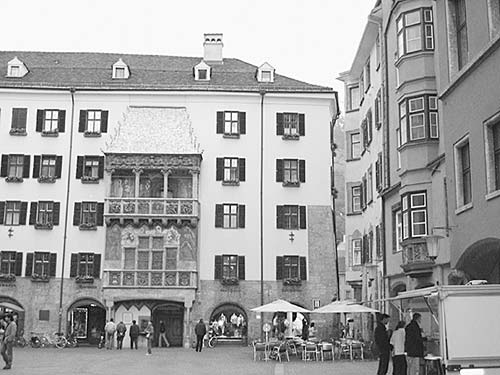
Examine the symbolism of the roof: Just below the balcony is a relief panel of Maximilian facing his two wives (Bianca Maria Sforza—with the golden apple—and Mary of Burgundy). To the right is another panel of Maximilian, flanked by his jester and his key adviser. Acrobatic dancers are a reminder that this balcony was designed for watching spectacles. Just below are frescoes of knights waving the banners of the Holy Roman Empire (black eagle) and Tirol (red eagle). Under that (beneath the windows), the row of heraldic crests identifies with more specificity the many realms Maximilian had ties to, including the Holy Roman Empire, Austria (red and white stripes), Burgundy (lions holding a complex pastiche with fleur-de-lis), and the Sforza family (a snake; also the insignia of Milan-based Alfa Romeo). To learn more, visit the little Golden Roof Museum upstairs (see “Sights in Innsbruck,” later).
Turn around and look up the wide pedestrian street, enjoying the same views that Maximilian did—with one modern addition: the futuristic Bergisel ski jump, which, from this angle, is aptly nicknamed “The Cobra.”
On your right, notice the over-the-top Rococo facade of the Helblinghaus—a rare case of an Innsbruck town house that, rather than keeping its original, stoic Gothic facade, was dressed up later. (Most locals were hardworking merchants with little money for fancy renovations; VIPs lived in frilly countryside villas.) Locals call this style Kucherbäcker—“cake decorator.”
Holy Roman Emperor Maximilian I—a contemporary of England’s King Henry VIII—lived in the waning days of the Middle Ages, on the cusp of the Renaissance. Maximilian had one foot in the modern world and fancied himself a multifaceted “Hans of all trades” (though, reportedly, a master of none). And yet, at the same time, he clung to the last romantic fantasies of the Middle Ages—he was the last Habsburg who personally led his troops into battle. (To see where he fits in among other Habsburgs, see the family tree in the Austria: Past & Present chapter.) Much of what you see in today’s Innsbruck, including the Golden Roof, dates from Maximilian’s time.
During the Habsburgs’ peak in the 17th and 18th centuries, Vienna became their leading city. But during Maximilian’s time, two centuries earlier, the focus was on Italy. He took the “Roman” part of “Holy Roman Emperor” very seriously. This made Innsbruck—the capital of Tirol (a region with a foothold in the Italian world)—extremely important. The visionary emperor hoped that once all of Italy was his, Innsbruck would become the permanent capital of his empire. In reality, he was unlucky at war and ran up huge debts.
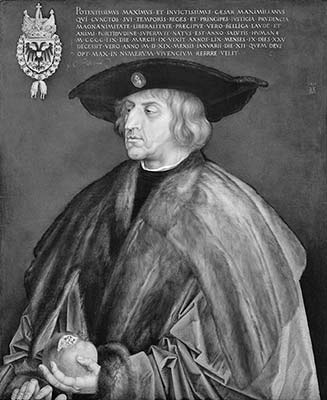
Maximilian also loved being close to the Alps, where he could hike and hunt to his heart’s content. He once said, “Tirol is like a warm coat: If you put your hand in the pocket, you always find something.”
Maximilian’s first wife, Mary of Burgundy, came from a land of stout stone homes. This inspired him to replace the firetrap wooden buildings of Innsbruck with fine stone townhouses—most of which still stand.
Maximilian and Mary were happy together...but only for a short time, as the queen died in a hunting accident after only five years of marriage. Forever obsessed with Italy, Maximilian remarried Princess Bianca Maria Sforza of Milan. But his heart just wasn’t in it. He even sent a proxy to the ceremony (where Leonardo da Vinci was the wedding planner). He wound up with a gigantic dowry (equivalent to 200 years’ tax for the entire city of Vienna), a fancy Golden Roof in Innsbruck (built to commemorate the wedding)...and a loveless marriage.
But Max and Mary’s offspring went on to reshape Europe, and the world. Their grandson was Holy Roman Emperor Charles V, who was also King Charles I of Spain. He ruled over Spain and its far-flung colonies during its Golden Age—an empire that stretched from Holland to Sicily, and from Bohemia to Bolivia. Though Maximilian I had aspirations as a war hero, as with most Habsburgs, his biggest victory came with a trip to the altar.
On the left side of the street is the bulbous city tower (Stadtturm), with a stout stone base that wears a curvy 17th-century Renaissance cap (which replaced the original steeple that tumbled away during an earthquake). This was the old town watchtower; a prison was on the second floor. Today, visitors can climb the 148 steps for a great view (€4.50, daily 10:00-20:00, Oct-May until 17:00).
Several doors down from the city tower—at #31, next to the McDonald’s—is the historic Hotel Weisses Kreuz. It’s built on Roman foundations, but has “only” been hosting guests for the last 500 years. The white cross (weisses Kreuz) is the symbol of the Order of Malta—knights who opened up guesthouses for Holy Land-bound pilgrims during the Crusades. In 1769, a 13-year-old Wolfgang Amadeus Mozart and his father stayed here on their way to Italy. A generation later, this hotel was one of the centers of resistance against Napoleon, and later still, against the Nazis (giving shelter to Jewish refugees). When American soldiers moved in from Italy, they made the hotel their headquarters. Today, it’s still a functioning—and recommended—hotel.
• Go straight up the little street called Pfarrgasse, just to the right of the Golden Roof. In one block, you’ll hit Domplatz, with St. James’ Cathedral. While dull on the outside, its interior is lavishly decorated, free to visit, and well worth a look (tour it now, or come back after the walk). Try to be here at 12:15, when the carillon plays.
As you face the cathedral, take the little street around its right side. Turn right through the gate into the courtyard of the...
Hofburg
The Habsburgs had three palaces called “Hofburg”—in Vienna, in Prague, and right here. (This one’s relatively tiny, with “just” 400 rooms, compared with the 2,600 rooms in Vienna’s.) For the 1765 wedding of her son (see “A Wedding, a Funeral, and an Arch,” earlier), Maria Theresa completely remodeled the complex in her preferred “Viennese Rococo” style, calling it “My little Schloss Schönbrunn in the Alps.” The room where Maria Theresa’s husband died became the chapel of a convent of nuns who were dedicated to praying 24/7 in his memory. If you tour the interior, you can peek in; you might still see a sister praying for Franz’s soul.
• Exit the door on the left side of the courtyard. You’ll end up at a busy urban street called Rennweg. Across the street in the jarringly modern building is a cultural institution and concert venue called the House of Music.
Our walk is over, but several sights are a short stroll away. To the left, you’re one block from the base station of the slick, futuristic network of people movers, funiculars, and cable cars that gradually take you thousands of feet above Innsbruck’s rooftops to the Hafelekar mountaintop. To the right, just past the Hofburg, you’ll find the entrance to the Museum of Tirolean Folk Art and the Hofkirche. Or you can return to the Golden Roof for its museum or tour St. James’ Cathedral. All of these options are described in the next section.
Sights in Innsbruck
Golden Roof Musem (Museum Goldenes Dachl)
▲▲St. James’ Cathedral (Dom zu St. Jakob)
▲Museum of Tirolean Folk Art (Tiroler Volkskunstmusuem)
▲▲▲Nordkettenbahn up to Hafelekar
Ambras Castle (Schloss Ambras)
▲▲Alpine Side Trip by Car to Hinterhornalm
Three worthwhile sights—the Museum of Tirolean Folk Art, the Hofkirche, and the Tirol Panorama (as well as several lesser museums)—are covered by a single €12 combo-ticket. This is the only ticket sold for the folk art museum, so if you’re going there, you’ll get the other sights for free.
IN THE OLD TOWN
Most of these sights are connected by my self-guided “Innsbruck Walk,” earlier.
Golden Roof Museum (Museum Goldenes Dachl)
This modest museum inside the Golden Roof building tells the story of Innsbruck in the time of Maximilian I. It includes exhibits about the roof and its construction, a good 15-minute film about Max and his roof, and a little balcony that lets you enjoy the same view the emperor did. There are few actual artifacts, but the exhibit is informative and well-presented.
Cost and Hours: €5, includes audioguide; daily 10:00-17:00, Oct-April closed Mon; enter directly under the Golden Roof at Herzog-Friedrich-Strasse 15 and walk up to the first floor, +43 512 5360 1441.
▲▲St. James’ Cathedral (Dom zu St. Jakob)
Innsbruck’s cathedral is plain on the outside, but the freshly renovated interior is a lavish High Baroque pastry: pink and frilly, with lots of gold and optical illusions.
Cost and Hours: Free; Mon-Sat 10:15-19:30, Sun from 12:30, Nov-April until 18:30, Domplatz 6, +43 512 583 902, www.dibk.at.
Visiting the Cathedral: Viewing the drab facade, you’d never guess that the church interior is slathered in Baroque illusions. But there is one clue: On the top row of (round) windows, note that only the middle one is real—the other two are painted on, to force a sense of symmetry.
At the very top of the central facade (between the towers), notice the equestrian statue honoring St. James (“Sankt Jakob” in German, or “Santiago” in Spanish). Innsbruck is a crossroads town, located not only on the ancient Via Claudia Augusta, but also on the medieval Camino de Santiago (Way of St. James) pilgrimage route—which runs from here all the way to Santiago de Compostela, in northwest Spain.
Step inside. The church dates from the early 18th century, when Baroque was all the rage. Looking up, notice that the three “domes” over the nave are an illusion—painted onto a flat surface. Walk up the nave. Those illustrations, meant to be viewed from the back, become increasingly distorted as you move toward the front.
The frilly, gilded high altar contains one of Lucas Cranach’s best-known Madonna and Childs, dubbed the Mariahilf. Even though Cranach was a close friend of Martin Luther—the firebrand behind Protestantism, which the Habsburgs fought bitterly in a Counter-Reformation—everyone seems to agree that this is a particularly fine depiction of Mary. Locals love that she’s not shown as a crowned deity, but as an everyday mother. You’ll see replicas of the Mariahilf around town.
For more Baroque illusions, stand in front of the main altar and look up into the church’s one real dome. Just below the dome, flanking the clock, are figures with details that break the frame, reaching from the art world into the real world. On the right, St. Luke the Evangelist writes on a scroll, which curls down over the arch. This curl is real—sculpted from stucco. But on the left, where St. John’s eagle stretches its wing over the edge of the arch, the wingtip is painted on—as is its shadow, to complete the illusion.
Also just below the dome, the two glassed-in galleries were attached by a walkway to the Hofburg next door, allowing royals to attend Mass without having to mingle with their subjects.
In the left transept you’ll see the elaborate altar covering the tomb of Prince Maximilian (not the Maximilian, but a later prince who ruled Tirol from 1602-1618). The canopy is supported by finely cast bronze pillars, covered in vines, bugs, birds, and other critters. Up top, a lance-wielding St. George watches over a kneeling Prince Max. (You’ll see more dynamic statues like this one at the Hofkirche.)
On your way back up the nave (toward the main door), look just above the organ at the only actual round window (even though you can see three round “windows” at this level from the outside). Above this window and on the left, look for Lucifer being thrown out of heaven—and out of the painting itself. It’s yet another Baroque illusion in this church that specializes in them.
Hofburg (Imperial Palace)
This 18th-century Baroque palace, completely rebuilt in 1765 by Maria Theresa and full of her family portraits, is only worth a visit if you aren’t going to the much bigger and better palaces in Vienna. The lone advantage is that, unlike the more famous Habsburg palaces, you’ll have this one virtually to yourself. You get to see the empress’ reception rooms, her private apartment, furniture, and a few rooms of exhibits.
Cost and Hours: €9.50, free audioguide available as app, daily 9:00-17:00, +43 512 587 186, www.hofburg-innsbruck.at.
Nearby: Should you need a Sacher torte fix, opposite the Hofburg entrance you’ll find the local outpost of the venerable Viennese institution, $$$$ Café Sacher (daily 8:30-18:00).
▲Museum of Tirolean Folk Art (Tiroler Volkskunstmuseum)
This big museum offers the best look anywhere at traditional Tirolean culture. Exhibits provide fascinating—and beautiful—insight into daily habits and spiritual rituals as they’ve been practiced for centuries in this part of the world.
Cost and Hours: €12, includes entry to Hofkirche and Tirol Panorama, open daily 9:00-17:00, Universitätsstrasse 2, +43 512 5948 9510, www.tiroler-landesmuseen.at.
Visiting the Museum: English explanations are limited. Download the free Volkskunstmuseum app for a guided tour or to read details about individual exhibits.
Just past Lucifer, on the ground floor, is a lovely collection of Nativity scenes. The first floor up has exhibits on everyday items (cookware, furniture, tools) and celebrations of Christian feast days (the dates are on the floor). The highlight, on the first and second floors, is the carefully reconstructed interiors of several Tirolean parlors with their small windows, wood paneling, and finely crafted furniture. The second floor also covers traditional Tirolean costumes (which differ from valley to valley, and from village to village); rites of passage; and supernatural beliefs, all tied to the uncertainty of life and the fear of death. You can also peek into the interior of the adjacent Hofkirche.
▲▲Hofkirche (Court Church)
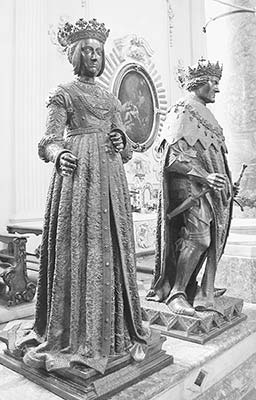
Emperor Maximilian I liked Innsbruck so much, he wanted to be buried here—surrounded by 28 larger-than-life cast-bronze statues of his ancestors, relatives, in-laws...and his favorite heroes of the dying Middle Ages (such as King Arthur). The church interior is worth a visit to stroll among the statues, which stand like giant chess pieces on the black-and-white-checkerboard marble floor, and to ponder one of Europe’s most elaborate funerary monuments.
Cost and Hours: €8, includes audioguide, covered by combo-ticket with Museum of Tirolean Folk Art and Tirol Panorama; Mon-Sat 9:00-17:00, Sun from 12:30; Universitätsstrasse 2—enter through museum, www.tiroler-landesmuseen.at.
Visiting the Church: Start your visit with a trippy multimedia show about the life of Emperor Maximillian I—look for it in the far corner of the courtyard. Just inside the church entrance you’ll find the marble-carved tomb of the locally beloved soldier Andreas Hofer, who rallied the Tiroleans to fight against—and defeat—Napoleon (commemorated by the Tirol Panorama).
In the center of the nave is the huge sarcophagus. That’s Maximilian himself, kneeling on top. Sadly, the real Max isn’t inside. By the time he died, Maximilian (and his 400-person entourage) had become notorious for running up debts, so his supporters weren’t allowed to bring his body here.
Don’t miss King Arthur (as you face the altar, he’s the fifth from the front on the right, next to the heavy-metal dude) and Mary of Burgundy, Maximilian’s first—and favorite—wife (third from the front on the left). Some of these sculptures, including that of König Artur, were designed by German Renaissance painter Albrecht Dürer.
IN THE NEARBY MOUNTAINS
A popular mountain-sports center and host of the 1964 and 1976 Winter Olympics, Innsbruck is surrounded by 150 mountain lifts, 1,250 miles of trails, and 250 hikers’ huts. The sheer sheet of rock that stretches, east to west, across Innsbruck’s valley is called the Nordkette—the “Northern Chain” of the Alps. And the Nordkettenbahn (described next) makes it remarkably easy to gain some altitude.
▲▲▲Nordkettenbahn up to Hafelekar
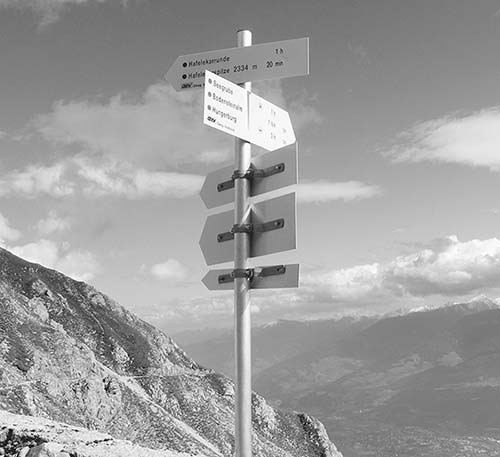
Right from the center of town, a series of three lifts—collectively called the Nordkettenbahn—whisks you above the tree line to the ridge perched thousands of feet directly above the Golden Roof. This is the fastest and easiest way to get your Tirolean mountain high. It’s not cheap, but on a clear day, the trip is worth every euro. Allow at least 2.5 hours round-trip to the top and back, including time for the short hike up to the summit.
Cost and Hours: Funicular—€11 round-trip, €17 combo-ticket with Alpenzoo, prices higher in winter, runs every 15 minutes Mon-Fri 7:15-19:15, Sat-Sun 8:00-19:15. Cable cars and funicular—€42 round-trip from Innsbruck; last lift down from Hafelekar at 18:00 (17:00 off-season), from Seegrube at 18:30 (17:30 off-season), both run every 15 minutes (continuously during busy times).
Information: +43 512 293 344, www.nordkette.com.
Discounts: If you’re going all the way to the top, it makes sense to get the Innsbruck Card, which covers your trip, the Alpenzoo, and much more; for details, see “Tourist Information,” earlier.
Parking: Drivers can park all day at the City Garage adjacent to the base of the funicular (€4—validate parking ticket at the Nordkettenbahn ticket counter).
Ascending the Mountain: The Hungerburgbahn funicular leaves from the station with the Star Trek-esque roof (designed by Dame Zaha Hadid, the Iraqi-born British architect who also did the ski-jump stadium), located outside Congress Innsbruck (the conference center right behind the Hofburg). From here, the futuristic people-mover stops at the Löwenhaus and Alpenzoo stations before reaching the Hungerburg hillside viewpoint.
From the Hungerburg viewpoint (with a little cable-car museum), walk a few steps to catch the first of two cable cars that lead you up into the mountains. The first one gets you to the Seegrube perch; you’ll change there for the highest station, Hafelekar. All three stations have $-$$ self-serve cafeterias.
Once up at Hafelekar, if you’ve lucked out on weather, you’ll see Innsbruck stretching across the valley to the Bergisel ski jump and, just to its right, the graceful Europa Bridge that leads up the Brenner Pass to Italy, beyond the peaks. Looking down the valley to the left, see if you can spot the town of Hall and its Mint Tower. For that “climb every mountain” feeling, hike the 10-minute trail up to the Hafelekar peak (7,657 feet, no hiking boots needed)—as you face Innsbruck, you’ll see it on your left, marked by a little cross. From there, even higher views of Innsbruck are accompanied by sweeping, cut-glass panoramas over the back side of the mountain. At a minimum, walk the short path behind the lift station to peer over the ridge into the Karwendel Alps, jutting up between you and the German border. Take time to relax and soak in the view before returning to earth.
Serious hikers can choose from a range of longer hiking/walking options (well-explained in lift brochures), while hard-core mountain bikers will thrill at the steep trails—some of Europe’s toughest (see “Helpful Hints,” earlier, for bike-rental information).
▲Alpenzoo
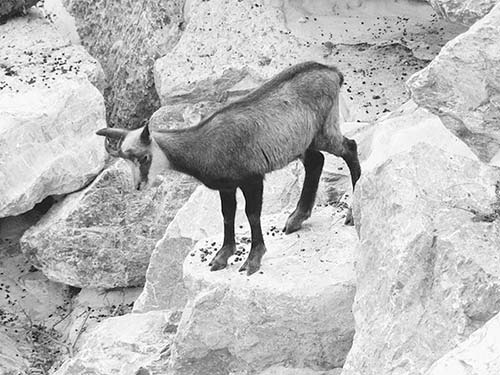
This zoo is one of Innsbruck’s most popular attractions (understandable when the competition is the Golden Roof). It’s compact and well-designed, nestled into the steep natural contours of the mountainside. There’s almost no English, but it’s fun to learn the German words for the animals and watch European children at play. Navigate by the animal outlines on the map to find the various beasts that hide out in the Alps, including wolves, chamois, marmots, and at least one gigantic vulture.
Cost and Hours: €13, €17 combo-ticket with Hungerburgbahn funicular, daily 9:00-18:00, Nov-March until 17:00, Weiherburggasse 37, +43 512 292 323, www.alpenzoo.at.
Getting There: The easiest way up is with the funicular (described earlier). It’s OK to stop off on a round-trip ticket to Hungerburg to see the zoo, then continue up or down (follow signs 5 minutes from Alpenzoo station to the zoo itself). Or you could take the local #W bus, or just walk (following Fussweg Alpenzoo signs from the river).
Olympic Bobsled
For those who envy Olympic bobsled teams whooshing down curvy chutes (who doesn’t?), Innsbruck offers you the chance to try an actual Olympic course. In the summer, you’ll ride with a pilot and three others down the 4,000-foot-long course in a sled-on-wheels.
Cost and Hours: €38, July-Aug only, Thu-Fri at 16:00 (and on request); call ahead, no kids under 12, +43 5275 51220, +43 664 202 4797, www.knauseder-event.at—select “Events,” then “Gästebob” or “Sommerbob.”
Getting There: From the city center, take bus #J from Marktgraben (near Maria-Theresien-Strasse and the TI) to the Olympia express stop (2/hour, 25 minutes)—it’s a short walk along Römerstrasse to the building with the silver Zielhaus sign. Drivers coming from the A-12 autobahn should take the Innsbruck Mitte exit, and follow signs to Igls and then to Olympia Bobbahn.
OUTER INNSBRUCK
These sights are within a tram or bus ride of the old town.
▲Slap-Dancing (Tiroler Abend)
The Gundolf family offers an entertaining evening of slap-dancing and yodeling nightly at 20:30 from May through October (€33 includes a drink with 2-hour show, dinner-€25 extra, pick-up/drop-off service-€10, tickets and info at TI or your hotel; north of the Hauptbahnhof at the Innsbruck Exhibition Center’s Alpensaal on Ingenieur-Etzel-Strasse, tram #1 from near the old town; reservations +43 512 263 263, www.tirolerabend.info).
Ambras Castle (Schloss Ambras)
Just southeast of town is the Renaissance palace Archduke Ferdinand II (1529-1595) renovated for his wife (it was originally a medieval castle). The castle is skippable for most, but worth considering for Habsburg nuts or drivers who’d like an easy castle experience. Its extensive grounds are replete with manicured gardens, a 17th-century fake waterfall, and resident peacocks. Visit the fine armory and the archduke’s assortment of the beautiful and bizarre—ranging from stuffed sharks and crocodiles, to ancient Portuguese frocks, to exquisite objets d’art. The beautiful Spanish Hall (built 1569-1572) is clearly the prize of the whole complex. Its intricate wooden ceiling and 27 life-size portraits of Tirolean princes make this a popular venue for classical music concerts.
Cost and Hours: €16, open daily 10:00-17:00, closed Nov, portrait gallery closed Nov-March, audioguide-€4, Schlossstrasse 20, +43 1 525 244 802, www.schlossambras-innsbruck.at.
Getting There: Drivers find it just off the expressway, overlooking Innsbruck (exit at Innsbruck-Mitte, follow Schloss Ambras signs at the roundabout, free parking). By public transportation, you have three choices: Go direct on the Sightseer; ride bus #4134 (2/hour, 10 minutes) from the train station to the entrance gate of the grounds, then walk five minutes; or take tram #3 to the last stop and walk 15 minutes.
▲Ski Jump Stadium (Bergisel)
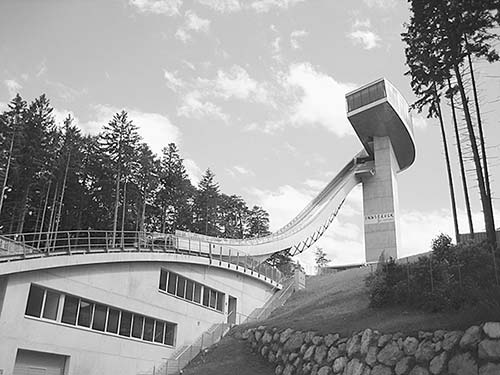
The ski jump here was used for the 1964 and 1976 Olympics. The original ramp (which wasn’t up to modern standards) was torn down and rebuilt from scratch in 2002. The jump is interesting and the views over the city are superb, but for mountain thrills, you’re better off riding up to the ridge on the other side of the valley (see “Nordkettenbahn up to Hafelekar,” earlier).
Cost and Hours: €10 whether you take funicular or not, €14 combo-ticket with Tirol Panorama; daily 9:00-18:00; Nov-May Wed-Mon 10:00-17:00, closed Tue; funicular back down runs until 15 minutes after closing, Bergiselweg 3, +43 512 589 259, www.bergisel.info.
Getting There: Drivers find it just off the Brenner Pass road on the south side of town (take the Innsbruck Süd exit and follow signs to Bergisel; €3 to park). Using public transportation, it’s an easy tram ride from the center (tram #1 to the Bergisel stop, 6/hour) and then a 10-minute uphill walk following Bergisel signs; near the top of the woodsy path, bear left past the wooden pavilions for the Tirol Panorama (described next), or continue uphill for the ski jump. You can avoid most of the walk by taking the pricier Sightseer bus, which drops you near the Tirol Panorama.
Picnic Spot: Park at the end of the road near the Andreas Hofer Memorial, and climb to the empty, grassy stands for a picnic.
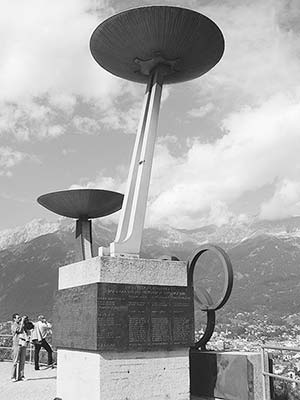
Visiting the Jump: For the best view of the jump itself, go to the right just after you pass through the ticket gate and climb the steps (following Olympisches Feuer signs) to the Olympic rings and the two dishes that held the Olympic flame. (The third dish was for the 2012 Winter Youth Olympics.) The plaques here honor Dorothy Hamill, Franz Klammer, and a host of others who brought home the gold. Other plaques around the sight explain the daredevil sport itself.
To get to the top of the ski jump, you can zip up in a funicular (2-minute ride), or walk up the 455 steps. At the top, an elevator takes you up the tower to great views from an outdoor viewing platform. One level below, a $$$ panoramic restaurant serves drinks and meals. Near the restaurant, find the launch chute where jumpers sit to psych themselves up. As you ride the funicular down alongside the jump, imagine yourself speeding down the 320-foot-long ramp, then flying into the air (jumpers reach 55 miles per hour in just four seconds)...gulp. Note the cemetery, thoughtfully placed just below the jump.
▲▲Tirol Panorama
This worthwhile museum, right by the ski jump, houses a giant panoramic painting created in 1896 to memorialize Tirol’s 1809 victory over Napoleon’s forces. Other exhibits trace the political and military history of Tirol. Be sure to download the free audioguide app.
Cost and Hours: €8, covered by €12 combo-ticket with Museum of Tirolean Folk Art and Hofkirche, €14 combo-ticket with ski jump; Wed-Mon 9:00-17:00, closed Tue; mandatory bag check with €1 deposit, Bergisel 1 (for directions, see ski jump listing, earlier), +43 512 5948 9611, www.tiroler-landesmuseen.at.
Visiting the Museum: The first exhibit is the Cyclorama, a huge 360-degree painting of the defeat of Napoleon’s forces at the hands of a ragtag Tirolean army right here at Bergisel. Napoleon had given Tirol to Bavaria, and Bavarian troops had occupied Innsbruck. But the local army managed to surprise and rout them, attacking early Sunday morning on a holiday weekend. This painting puts you right in the middle of the battle, where the audioguide explains everything in painstaking detail. Similarly to Salzburg’s panorama painting (described on here), the piece toured Europe more than a century ago, giving the wider world a view of Innsbruck’s mountain setting (though compared with Salzburg’s, this panorama is bigger, more beautifully displayed, and more epic, with 3-D elements in the foreground).
The next part of the museum (in an underground passageway) is a good general exhibit on Tirolean culture and politics. Through the passageway is the adjacent and included Kaiserjäger Museum, dedicated to the Tirolean regiment in the Habsburg army, and in particular their sacrifices during World War I. Military-history buffs will be in their groove here, but most others will find it skippable—except for the room dedicated to Andreas Hofer, the leader of the 1809 uprising (he’s the guy with the beard, and you get to see his sword). Alas, the Bavarians retook Innsbruck a few months later. Hofer was captured and executed, but he remains Tirol’s great hero.
NEAR INNSBRUCK
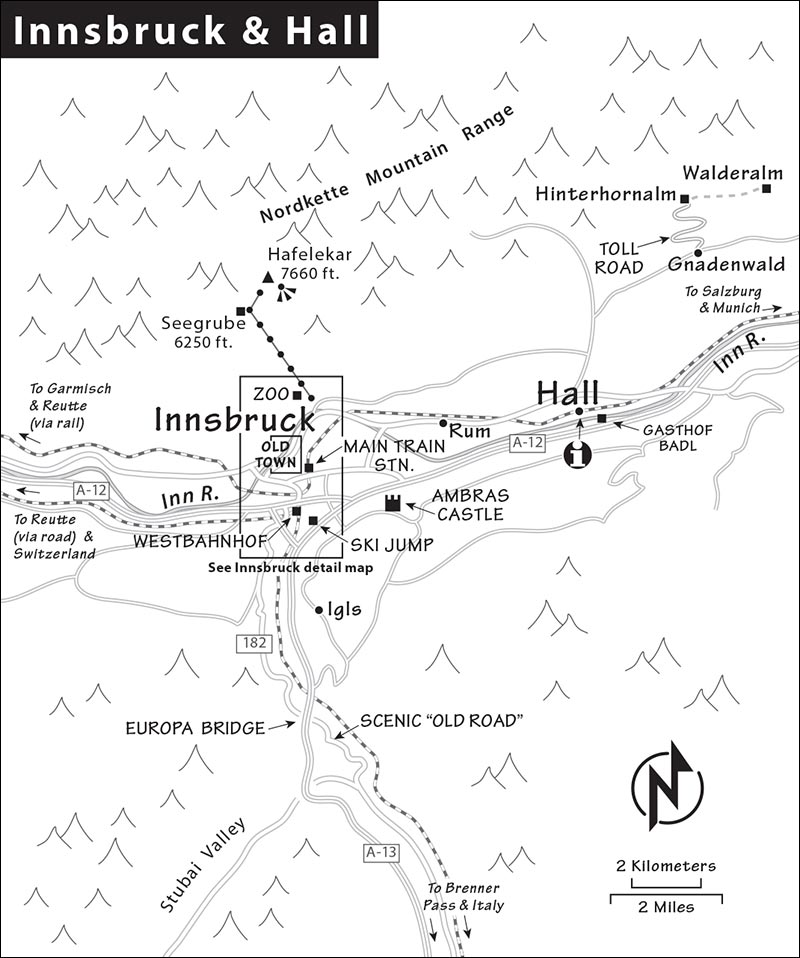
To venture out of Innsbruck, consider the following alpine adventure or a day trip to the charming town of Hall—a 20-minute drive and easily reached by public transportation (see the end of this chapter).
▲▲Alpine Side Trip by Car to Hinterhornalm
In Gnadenwald, a village sandwiched between Hall and its Alps, pay a €5 toll at the machine, pick up a brochure, then corkscrew your way up the mountain. Marveling at the crazy amount of energy put into such a remote road project, you’ll finally end up at the rustic Hinterhornalm restaurant (generally Mon-Wed and Fri 10:00-18:00, Sat-Sun from 8:00, closed Thu, may stay open later in summer—but weather-dependent and often closed, closed Nov-mid-May, +43 664 211 2745). Hinterhornalm is a hang-gliding springboard. On good days, it’s a butterfly nest. From there, it’s a level 20-minute walk to Walderalm, a cluster of three dairy farms with 70 cows that share their meadow with the clouds. One farm has a rustic restaurant serving simple dishes at rough plank tables (soups, sandwiches, drinks, Wed-Sun 9:00-17:00, closed Mon-Tue). Below you spreads the Inn Valley and, in the distance, tourist-filled Innsbruck.
Sleeping in Innsbruck
Prices are highest from May through September and in December.
IN THE OLD TOWN
$$$$ Hotel Maximilian, with its back to the old town and facing a busy street, is Innsbruck’s splurge option for those who value contemporary over cozy. Run by the Penz family, it has 51 rooms, peekaboo-glass bathroom walls, and all the comforts (family rooms, air-con, elevator, pay parking nearby, Marktgraben 7, +43 512 59967, www.hotel-maximilian.com).
$$$ Hotel Goldener Adler is an Innsbruck classic, hosting guests since 1390. Just down the street from the Golden Roof, its 43 rooms alternate between traditional and modern (family rooms, air-con, elevator, pay parking nearby, Herzog-Friedrich-Strasse 6, +43 512 571 111, www.goldeneradler.com, office@goldeneradler.com, Hackl family).
$$$ Hotel Weisses Kreuz, 50 yards in front of the Golden Roof, has been housing visitors for almost 600 years—ask where Mozart slept on his visit here in 1769. While its common spaces still have an old-inn feel—with an airy atrium stairway, antique Tirolean furniture, and big wood beams—its 40 comfortable rooms are a decent value for the location (cheaper rooms with shared bath or small windows, fans, elevator, great breakfast, pay parking—reserve ahead, Herzog-Friedrich-Strasse 31, +43 512 594 790, www.weisseskreuz.at, hotel@weisseskreuz.at).
¢ Nepomuk’s offers lots of character and 18 backpacker beds in two big, well-worn, well-located apartments above Café Munding, a venerable pastry shop in the old town run by the energetic fifth-generation descendants of founder Johann Nepomuk Munding. It’s a mix of dorm beds and simple $ doubles with shared bathrooms and kitchen facilities. The reception and breakfast are in the café. They only accept reservations by telephone (cash only, Kiebachgasse 16, +43 512 584 118, +43 664 787 9197, www.nepomuks.at).
NEAR THE TRAIN STATION
This area is practical for train travelers, but feels far from the cobbles of the old town.
$$ Ibis Innsbruck Hauptbahnhof dazzles the eye with its orange decor. It has 75 conventional, contemporary rooms situated directly in front of the train station. Reach the hotel through the underground passageway (by the luggage lockers), or exit the station’s main doors and look for the logo (breakfast extra, air-con, elevator, pay parking, Sterzinger Strasse 1, +43 512 570 3000, www.ibishotel.com, h5174@accor.com).
$$ Pension Stoi rents 18 inexpensive, basic rooms 200 yards from the train station and a 10-minute walk from the old town center. The entranceway and oddly located reception are a bit off-putting, but the rooms are fine. Otto offers a friendly welcome and lots of local foodie tips (cheaper rooms with shared bath, family rooms, no breakfast, four free parking spaces—no guarantees but ask when you book, reception open daily 8:00-21:00; from station head down Salurnerstrasse, take first left on Adamgasse, and at #16 look for signs in the courtyard on the right; Salurnerstrasse 7, +43 512 585 434, www.pensionstoi.at, pensionstoi@aon.at).
Eating in Innsbruck
$$$$ Die Wilderin (“The Huntress”), a block and a half from the Golden Roof, is a foodie find, unassumingly tucked in the old town (book ahead). It’s a small dinner-only eatery, with a big bar, tables on two levels, a trendy but unsnooty vibe, and a commitment to serving dishes made only with locally sourced ingredients: farm-to-table and nose-to-tail, with a mix of traditional Austrian and modern international influences. They’ll explain the German-only menu (Tue-Sun 17:00-24:00, closed Mon, Seilergasse 5, +43 512 562 728, www.diewilderin.at).
$$$-$$$ Weisses Rössl, in the old town, satisfies culinary adventurers with traditional Tirolean treats such as oven-roasted liver and calf’s brain. Fear not: Schnitzels and steaks abound, or try the tasty Forelle (broiled trout) or Hauspfand’l—meat, potatoes, and veggies served up in a cast-iron skillet (Mon-Sat 12:00-14:30 & 18:00-22:00, closed Sun, restaurant upstairs at Kiebachgasse 8, +43 512 583 057).
$ Mamma Mia, a popular—and cheaper—escape from traditional fare, dishes up hearty portions of pizza and pasta. They have indoor and outdoor seating, or you can get it to go (daily 10:30-24:00, Kiebachgasse 2, +43 512 562 902).
$ Reformstark Martin Vegetarian Deli, hidden inside a health-food store, is where vegetarians can eat in or take away tasty organic meals (weekday lunch specials, Mon-Fri 8:30-18:30, Sat until 17:00, closed Sun, Herzog-Friedrich-Strasse 29, +43 512 565 099).
$ Der Bäcker Ruetz, part of a local bakery chain, serves quality sandwiches, pretzels, and pastries right along the main pedestrian drag (daily 7:00-18:30, Herzog-Friedrich-Strasse 36, +43 512 587 445).
Gelato: Locals and tourists flock to Tomaselli, with branches around town (including an old town location at Hofgasse 5).
Supermarkets: Right in the train station, MPreis is large and has long hours. There’s also a small MPreis in the old town and a handy Spar kitty-corner from the TI.
Innsbruck Connections
BY PUBLIC TRANSPORTATION
From Innsbruck by Train to: Salzburg (hourly, 2 hours), Vienna (at least hourly, 4.5 hours), Reutte (every 2 hours, 2.5 hours, change in Garmisch-Partenkirchen), Füssen, Germany (3/day, 4 hours, fastest via train to Reutte and then bus #4258/#74 to Füssen, last easy connection leaves Innsbruck around 14:30), Munich (every 2 hours, 2 hours), Zürich (every 2 hours, 3.5 hours), Bolzano, Italy (hourly, 2.5 hours, some regional connections change in Brennero), Milan (every 2 hours, 5.5 hours, change in Verona, seat reservation required), Venice (2/day direct, more with changes in Verona, 5 hours). There are also night trains to Vienna (it’s a short night, though), Milan, and Rome. Train info: +43 51 717 (to get an operator, dial 2, then 2), www.oebb.at.
For directions to Hall by bus or train, see “Getting to Hall,” later.
ROUTE TIPS FOR DRIVERS
From Innsbruck to Reutte: Head west (direction Bregenz/Switzerland) and leave the freeway at Telfs, where signs direct you to Reutte (a 1.5-hour drive).
From Innsbruck to Switzerland: Head west on the autobahn. (If you’re coming directly from Innsbruck’s ski jump, go down into town along the huge cemetery and follow blue A-12/Garmisch/Arlberg signs.) The 8-mile-long Arlberg tunnel saves you 30 minutes on your way to Switzerland, but costs you lots of scenery and €11 (Swiss francs and credit cards accepted). For a joyride and to save a few bucks, skip the tunnel, exit at St. Anton, and go via Stuben.
After the speedy Arlberg tunnel, you’re 30 minutes from Switzerland. Bludenz, with its characteristic medieval quarter, makes a good rest stop. Pass Feldkirch (and another long tunnel) and exit the autobahn at Rankweil/Feldkirch Nord, following signs for Altstätten and Meiningen (CH). Crossing the baby Rhine River, you’ve left Austria.
Over Brenner Pass into Italy’s Dolomites: A short swing into Italy is fast and easy from Innsbruck (45-minute drive, easy border crossing). To get to Italy, take the A-13/E-45 expressway, which heads across the great Europa Bridge over Brenner Pass. It costs €10.50, but in 30 minutes you’ll be at the border. (Note: Traffic can be heavy on summer weekends.)
Once in Italy (which has pay-as-you-go tollbooths—take a ticket and keep it handy), you can drop in at a variety of sights that line up along the expressway: At the colorful market town of Vipiteno/Sterzing, you can see (perched on a little hill just west of the road) the tourable Reifenstein Castle. Just beyond is Brixen (and the nearby Kloster Neustift monastery complex). Finally, about an hour from where you crossed the border, you reach Bolzano (Bozen)—the main city of the Dolomites (for details, see the Italian Dolomites chapter).
Near Innsbruck: Hall
Hall—a rich salt-mining and silver-minting center back when Innsbruck was just a humble bridge town on the Inn River—is an easy jaunt from Innsbruck by car, bus, train, or bike. It’s worth ▲ and a few hours for its attractive old town and main square.
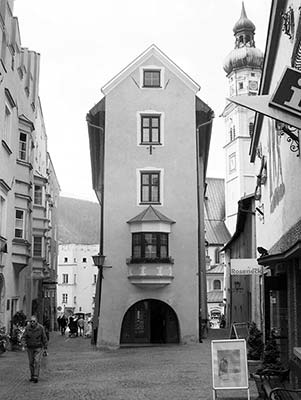
Founded in 1303, Hall’s name is derived from the Celtic word for “salt.” Miners leached natural salt deposits out of a mine six miles away, then piped the brine into town to be distilled. (You can still see the yellow former distillery across the street from the TI.) But the salt deposits became exhausted in 1967, and today Hall is best known as a tidy, upscale town, enjoyable for some boutique shopping and a lazy cobbled stroll. The main square hosts a brisk farmers market on Saturday mornings, but the town closes up tight for its afternoon siesta and sleeps on Sunday.
GETTING TO HALL
Trains and buses make the short run from Innsbruck Hauptbahnhof to Hall frequently. The train is a bit more scenic (4/hour, 9 minutes plus 10-minute walk from Hall station into town—head up Bahnhofstrasse and turn right at Pfannhausstrasse). Bus #504 leaves from platform A and goes through industrial suburbs before dropping you right in Hall’s town center (4/hour, 2/hour on Sun, 25 minutes, covered by Innsbruck Card). Don’t take bus #D, which is slow and stops on the far side of Hall’s old town.
Drivers approaching on the autobahn should take the Hall-Mitte exit; to park, cross the big bridge over the river to find the small P5 lot on the right (3-hour maximum), or continue straight through the intersection and turn left to the underground P2 parking garage. When returning to Innsbruck, take the autobahn to the Innsbruck Ost exit and follow the signs to Zentrum, then Kongresshaus (see “Arrival in Innsbruck,” earlier, for parking tips).
Hall and Innsbruck are connected by a pleasant bike path along the Inn River—a comfortable 30-minute pedal will get you there.
Orientation to Hall
Little Hall (pop. 14,000) is compact and easy to explore. You can walk from one end of its old town to the other in about 10 minutes.
Tourist Information: Hall’s helpful TI has a good town map (Mon-Fri 9:00-18:00, Sat until 13:00, closed Sun, near bus stop at Unterer Stadtplatz 19, +43 5223 455 440, www.hall-wattens.at).
Helpful Hints: Consider enjoying the valley on two wheels. The riverside bike path (7 miles from Hall to Volders) is a treat. Rent bikes at Die Bike-Box (€14/half-day, €18/day, electric bikes-€22/day, Mon-Fri 9:00-13:00 & 14:00-18:00, Sat until 12:00, closed Sun, Unterer Stadtplatz 10, 05223/55944, www.diebikebox.com).
Sights in Hall
Hall Old Town Walk
Unlike Innsbruck, Hall was not damaged or destroyed by WWII bombs—leaving it perfectly preserved. You can see sights in the old town in about 30 leisurely minutes—or allow more time to linger inside the church or visit the Mint Museum.
Begin at the base of Langer Graben, along the ring road at the south end of town, near the bus stop from Innsbruck. A few steps up from the ring road—surrounded by cobbles and tight lanes—enter a tiny square with a fountain honoring Archduke Sigmund of Habsburg (1427-1496), the local ruler who helped reform the currency system and founded the town’s silver mine.
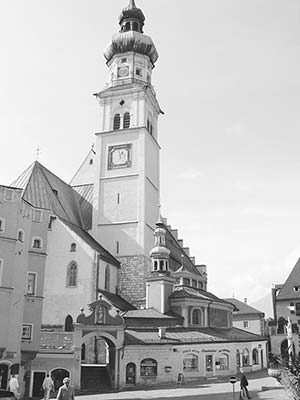
Head gradually uphill toward the main square along Langer Graben, for centuries the market town’s primary shopping street. Signs over the doors identify each business: bookstore, dish seller, and so on. As you stroll, tune in to all the little details. For example, at the Riepenhausen bookstore (at #1), notice the whimsical figures flanking the main entrance: Little Red Riding Hood on the left, and the Big Bad Wolf on the right.
Emerge into the Main Square (Oberer Stadtplatz). Just behind the fountain is the recommended bakery Der Bäcker Ruetz. To the left, the big white building with shutters is the Town Hall (Rathaus). The engraved plaques on the upper floor of the Rathaus Café next door show symbols of Austria and the Habsburgs (on the left, red and white stripes and a proud peacock) and local symbols of Tirol (on the right, eagle feathers and a shield with a red eagle). Wealthy as Hall became, the town still answered to the Habsburgs—to whom they sent every tenth barrel of salt. In the niche over the café’s door is a statue that once stood on a pillar on the main square, representing Hall’s status as a “city”—with privileges to host a market, build bridges, and levy tolls. On the left, over the gate into the Town Hall courtyard, is a mosaic shield celebrating Der Stadt Hall: two lions protecting a salt barrel. (Locals are nicknamed Salzkufen—“salt barrels.”)
Walk just past the Town Hall, hook left, and head into the side door of St. Nicholas Parish Church (Pfarrkirche St. Nikolaus). This much-appended Gothic church is decorated Baroque. It’s dedicated to the patron saint of sailors—in honor of the riverboat crews that kept trade flowing along the Inn River. Immediately to the left as you enter the church is a gated chapel crammed with relics. The knight Florian Waldauf—a friend of Innsbruck’s Maximilian I—built this chapel in 1501 to thank God after the two of them survived a harrowing storm at sea, and filled it with more than 2,000 relics (see the gilded cases on the left wall). During Hall’s big semiannual markets, visitors could touch these relics to heal their ailments. Gradually Hall’s market evolved from a pilgrimage for shoppers into a literal pilgrimage. Before you leave the church, stand in the middle of the nave and note the offset altar. Centuries of additions have left the church crooked as it expanded uphill.
Exiting the church through the same side door, notice the old tombs under the canopy (ahead and to the right). These were relocated here after the unsanitary practice of burying the dead in the city center was banned. The second tomb down, dating from 1502, shows a grotesquely realistic, half-decomposed body. This is a classic example of memento mori: Essentially, don’t get too cocky in life, because eventually we all wind up as worm food.
To visit a sight many tourists miss, hook right around the back end of the church (with the old tombs on your left). You’ll pass a covered staircase (which leads back down to the main shopping street), and then—on your left—a boxy little stone chapel with pointed Gothic windows. Even if the door is closed, let yourself in to St. Magdalen’s Chapel (St. Magdalenen-Kapelle). The deceased were brought here to be mourned, in a holy place near the church, after the cemetery was closed. The chapel is richly decorated by Hall’s wealthy residents, who were eager to facilitate their passage to heaven. The centerpiece is a wood-carved altar from a small church in the Halltal—where simple miners lived and worked—dedicated to St. Barbara, the patron saint of miners. The wall behind the altar commemorates locals who died fighting in World Wars I and II. On the right wall is a gorgeously restored 15th-century Last Judgment fresco.
Our walk is done. You can use the covered staircase you just passed to return to the main shopping street.
Hall Mint Museum and Mint Tower (Münze Hall und Münzerturm)
Hall began minting coins in the 15th century, and along with its lucrative salt-mining industry, minting became one of the city’s hallmarks. The centerpiece of the museum is a functioning replica of a 16th-century minting press—powered by water and made of wood.
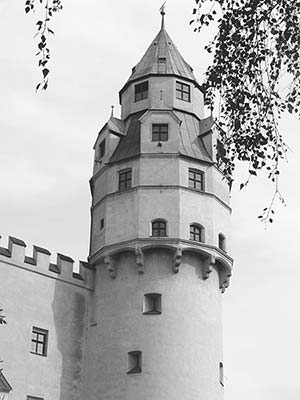
The 150-foot-tall, 14th-century Mint Tower—both a fire watchtower and a castle fortification—is a town landmark. For great views from its top, climb 185 steps...or 202 steps, if you go medieval and take the narrow original stairs.
Cost and Hours: Museum—€8, includes excellent audioguide; tower—€5.50, €11.50 combo-ticket for both; Tue-Sun 10:00-17:00, closed Mon; closed Sun-Mon off-season, closed mid-Jan-mid-March; in Hasegg Castle, between the old town and the TI; www.muenze-hall.at.
Sleeping and Eating in Hall
$$ Gasthof Badl is a big, comfortable, friendly riverside place with 26 art-filled rooms run by Sonja and her family, with help from Ella and Lucy, their enormous, easygoing dogs. It’s my sentimental favorite for its convenience (right off the Hall-Mitte freeway exit, but a short and scenic walk from Hall’s old town), peaceful setting, big breakfast, and warm welcome (family rooms, elevator, laundry service, Innbrücke 4, +43 5223 56784, www.badl.at, info@badl.at). Their $$ restaurant serves excellent dinners in a cozy, pub-like dining room (closed Sun, limited hours in winter).
In town, $ Der Bäcker Ruetz has good, filling sandwiches—along with pretzels, rolls, and pastries (daily, Sparkassengasse 1).