KUNSTHISTORISCHES MUSEUM TOUR
Map: Kunsthistorisches Museum—First Floor
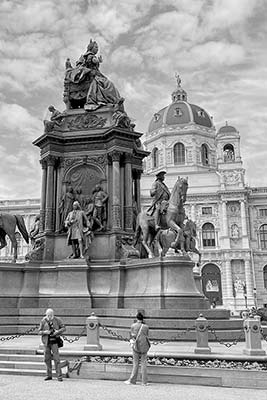
The Kunsthistorwhateveritis Museum—let’s just say “Kunst” (koonst)—houses the family collection of Austria’s luxury-loving Habsburg rulers. Their joie de vivre is reflected in this collection—some of the most beautiful, sexy, and fun art from two centuries (c. 1450-1650). At their peak of power in the 1500s, the Habsburgs ruled Austria, Germany, northern Italy, the Netherlands, and Spain—and you’ll see a wide variety of art from all these places and beyond.
The Neo-Renaissance building is a lavish textbook example of Historicism. Despite its palatial feel, it was originally designed for the same purpose it serves today: to showcase its treasures in an inviting space while impressing visitors with the grandeur of the empire. Enjoy the architecture and dome in the main entry lobby. (The adjacent Egyptian collection hall is actually supported by ancient Egyptian columns.)
This chapter gives just a taste of the Kunst. Hit these highlights—mainly large canvases in the large halls—then explore the smaller side rooms for more delights.
Orientation
Cost: €18, free for those under age 19, €24 combo-ticket includes the Hofburg Treasury.
Hours: Daily 10:00-18:00, Thu until 21:00, closed Mon Sept-May.
Information: +43 1 525 240, www.khm.at.
Getting There: It’s on the Ringstrasse at Maria-Theresien-Platz, U: Volkstheater/Museumsplatz (exit toward Burgring).
Tours: The excellent €6 audioguide, covering nearly 600 items, is worthwhile if you want an in-depth tour beyond the works described in this chapter.
Cuisine Art: The café is on the first floor.
Starring: The world’s best collection of Bruegel, plus Titian, Caravaggio, a Vermeer gem, and Rembrandt self-portraits.
OVERVIEW
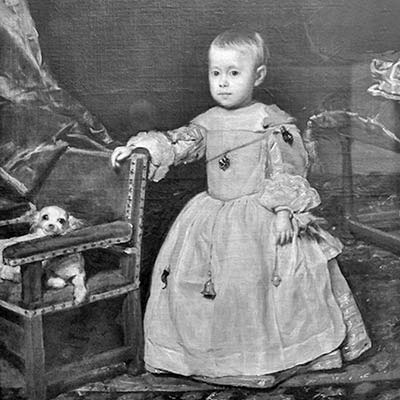
Of the museum’s many exhibits, we’ll tour only the Picture Gallery (Gemäldegalerie) on the first floor. Italian-Spanish-French art is on one half of the floor, and Northern European art is on the other. On our tour, we’ll get a sampling of each. Note that the museum labels the largest rooms in the Picture Gallery with Roman numerals (Saal I, II, III) and the smaller rooms around the perimeter with Arabic (Rooms 1, 2, 3). The museum constantly moves around paintings, so be flexible, pick up the current floor plan in the lobby, and use it to locate the highlights from this tour.
The Tour Begins
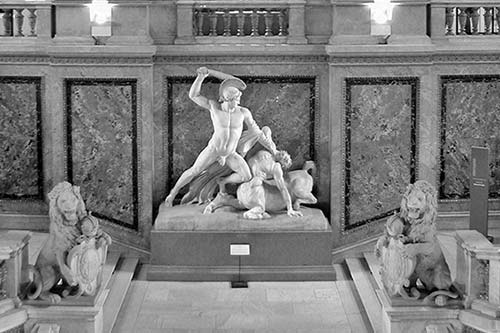
• Climb the main staircase, featuring Antonio Canova’s statue of Theseus clubbing a centaur. At the statue, turn 180 degrees and look up, across the atrium, at the small paintings decorating three arches (between the columns). These exquisite works were done in the 1890s by a young Gustav Klimt when the soon-to-be-famous artist was just a decorator for hire. Bear right when you reach Theseus. At the top of the staircase (at the tempting café), look for Saal VII and walk right into the High Renaissance.
ITALIAN RENAISSANCE
About the year 1500, Italy was in the midst of a 100-year renaissance, or rebirth, of interest in the art and learning of ancient Greece and Rome. In painting, that meant that ordinary humans and Greek gods joined saints and angels as popular subjects.
Canaletto, Habsburg Palaces
In Saal VII, you’ll see glimpses of Baroque art, featuring large, colorful canvases showcasing over-the-top emotions and pudgy, winged babies (the surefire mark of Baroque). Find paintings by Canaletto of the former Habsburg palaces—Schönbrunn and Belvedere—one of which also shows the Viennese skyline in the distance.
• Next, move along into Saal VI to find Caravaggio, who shocked the art world with brutally honest reality.
Caravaggio, Madonna of the Rosary and David with the Head of Goliath
Caravaggio’s Madonna of the Rosary (the biggest canvas in the room) may be titled for the Virgin, but the star of the canvas is the plump young Jesus. He casually balances on his mother’s knee, one hand rubbing his plump tummy. St. Dominic, to the left of the mother and child, distributes rosaries to an imploring crowd (notice their dirty feet—typical of Caravaggio’s honest realism).
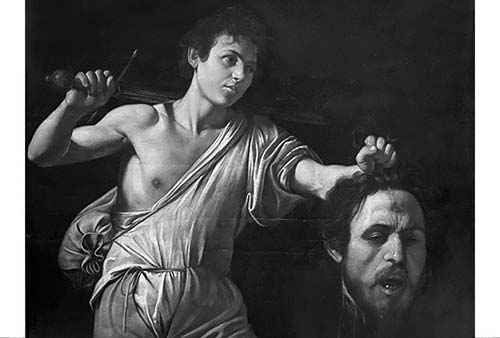
In David with the Head of Goliath, Caravaggio turns a familiar Bible story into a third-degree interrogation as David shoves the dripping head of the slain giant right in our noses. The painting, bled of color, is virtually a black-and-white crime-scene photo—slightly overexposed. Out of the deep darkness shine only a few crucial details. This David is not a heroic Renaissance Man like Michelangelo’s famous statue, but a homeless teen that Caravaggio paid to portray God’s servant. And the severed head of Goliath is none other than Caravaggio himself, an in-your-face self-portrait.
• Make your way into Room 10, in the corner of the museum.
Velázquez, Habsburg Family Portraits
When the Habsburgs ruled both Austria and Spain, cousins kept in touch through portraits of themselves and their kids. Diego Velázquez was the greatest of Spain’s “photojournalist” painters—heavily influenced by Caravaggio’s realism, capturing his subjects without passing judgment, flattering, or glorifying them.
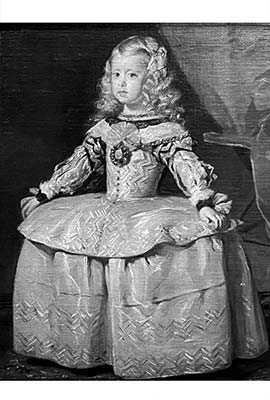
For example, watch little Margarita Habsburg grow up in three different portraits on the same wall, from age two to age nine. Margarita was destined from birth to marry her Austrian cousin, the future Emperor Leopold I. Pictures like these, sent from Spain every few years, let her pen pal/fiancé get to know her.
Also see a portrait of Margarita’s little brother, Philip Prosper, wearing a dress. Sadly, Philip was a sickly boy who would only live two years longer. The amulets he’s wearing were intended to fend off illness. His hand rests limply on the back of the chair—above an adorable puppy who seems to be asking, “But who will play with me?”
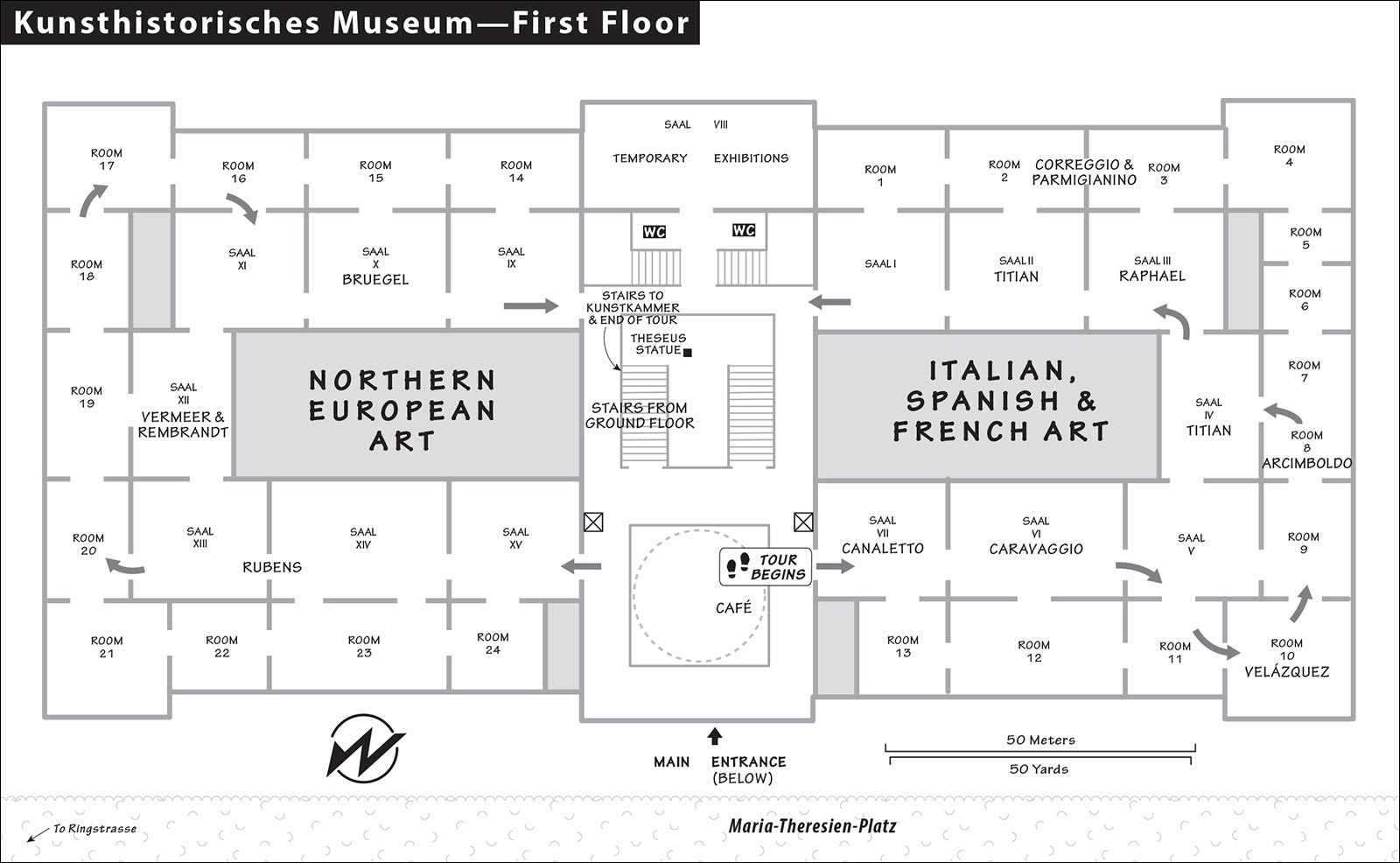
The kids’ oh-so-serious faces, regal poses, and royal trappings are contradicted by their natural precociousness. No wonder Velázquez was so popular.
Also notice that all of these kids are quite, ahem, homely. To understand why, find the portrait of their dad, Philip IV, which shows the defects of royal inbreeding: weepy eyes, no eyebrows, thin hair, an underbite, and a pointed chin (sorry, that pointy mustache doesn’t hide anything).
• Continue through the small rooms along the far end of this wing to find (likely in Room 8)...
Arcimboldo, Portraits of the Seasons
These four cleverly deceptive portraits by the Habsburg court painter, Giuseppe Arcimboldo, depict the four seasons (and elements) as people. For example, take Summer—a.k.a. “Fruit Face.” With a pickle nose, pear chin, and corn-husk ears, this guy literally is what he eats. Its grotesque weirdness makes it typical of Mannerist art.
• Continue to Saal IV, hung with paintings from floor to ceiling to show how art was displayed in Baroque days by society’s elites—just gathering lots of expensive canvases and showing off. Notice how the ceiling is stuccoed with busts and themes that relate to the art hung in this room—a reminder that the building was made specifically for its art, and the art came first. Find...
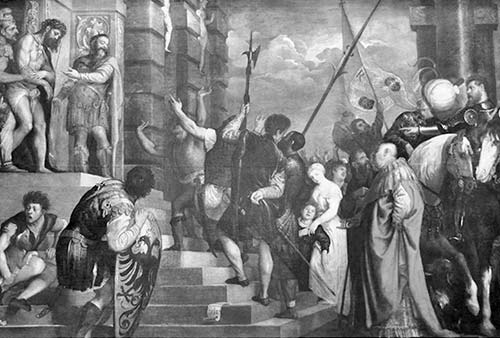
Titian, Ecce Homo
In the long career of Titian the Venetian (it rhymes), he painted portraits, Christian Madonnas, and sexy Venuses with equal ease.
In the large canvas Ecce Homo, a crowd mills about, when suddenly there’s a commotion. They nudge each other and start to point. Follow their gaze diagonally up the stairs to a battered figure entering way up in the corner. “Ecce Homo!” says Pilate. “Behold the man.” And he presents Jesus to the mob. For us, as for the unsympathetic crowd, the humiliated Son of God is not the center of the scene, but almost an afterthought. We’ll see a very different Titian canvas a couple of rooms later.
• Continue to Saal III.
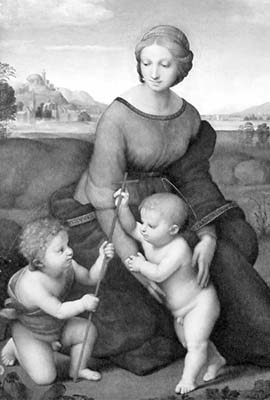
Raphael, Madonna of the Meadow
Young Raphael epitomized the spirit of the High Renaissance, combining symmetry, grace, beauty, and emotion. This Madonna is a mountain of motherly love—Mary’s head is the summit and her flowing robe is the base—enfolding Baby Jesus and John the Baptist. The geometric perfection, serene landscape, and Mary’s adoring face make this a masterpiece of sheer grace—but then you get punched by an ironic fist: The cross the little tykes play with foreshadows their gruesome deaths.
• Head into Saal II.
Titian, Danae
Titian’s Danae features a luscious nude reclining in bed, as she’s about to be seduced. Zeus, the king of the gods, descends as a shower of gold to consort with her—you can almost see the human form of Zeus within the cloud. Danae is enraptured, opening her legs to receive him, while her servant tries to catch the heavenly spurt with a golden dish. Danae’s rich, luminous flesh is set off by the dark servant at right and the threatening sky above. The white sheets beneath her make her glow even more. This is not just a classic nude—it’s a Renaissance Miss August. How could ultra-conservative Catholic emperors have tolerated such a downright pagan and erotic painting? Apparently, without a problem.
• Before moving on from the Italian-Spanish-French art section, explore the smaller side rooms, which display excellent small canvases. In Rooms 1-3, look for Correggio’s Jupiter and Io, showing Zeus seducing another female, this time disguised as a cloud. Parmigianino’s Self-Portrait in a Convex Mirror depicts the artist gazing into a convex mirror and perfectly reproducing the curved reflection on a convex piece of wood. Amazing.
Exit this wing of the museum via Saal I. Next we’ll explore the other half of this floor, dedicated to Northern European art.
NORTHERN ART
The “Northern Renaissance,” brought on by the economic boom of Dutch and Flemish trading, was more secular and Protestant than Catholic-funded Italian art. We’ll see fewer Madonnas, saints, and Greek gods and more peasants, landscapes, and food. Paintings are smaller and darker, full of down-to-earth objects. Northern artists sweated the details, encouraging the patient viewer to appreciate the beauty in everyday things.
• On your way out of the Italian-Spanish-French wing, drop into Saal VIII (to your right as you leave Saal I), which may hold some must-see paintings (including, possibly, Rubens’ portrait of his young bride, described below). To continue to the Northern Art wing, head toward the dome, through the café, and into Saal XV. You’ll find Rubens in the next few rooms.
Peter Paul Rubens
Rubens’ work runs the gamut, from realistic portraits to lounging nudes, from Greek myths to altarpieces, from pious devotion to violent sex.
But can we be sure it’s Baroque? Ah yes, I’m sure you’ll find a pudgy, winged baby somewhere, hovering in the heavens. Take the large Ildefonso Altarpiece (likely in Saal XIII), a rare canvas done entirely in Rubens’ hand, where a glorious Mary appears—with her entourage of darling PWBs—to reward the grateful Spanish St. Ildefonso with a chasuble (priest’s smock).
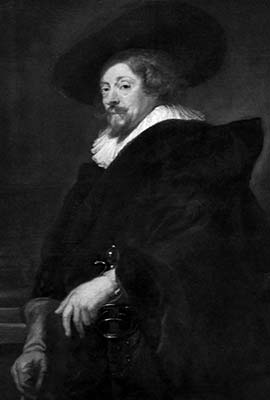
Look for Rubens’ Self-Portrait (likely Room 20) and admire the darling of Catholic-dominated Flanders (northern Belgium) in his prime: famous, wealthy, well-traveled, the friend of kings and princes, an artist, diplomat, man about town, and—obviously—confident.
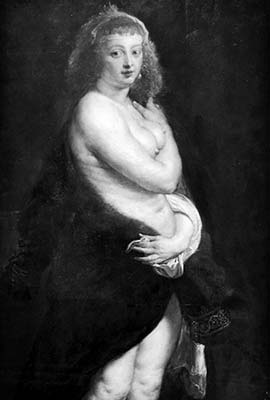
The 53-year-old Rubens married Hélène Fourment, a dimpled girl of 16, whose portrait you may find in Saal VIII (see above). Notice how she pulls the fur around her ample flesh, simultaneously covering herself and exalting her charms. Rubens called this painting The Little Fur—and used the same name for his young bride. Hmm. Hélène’s sweet cellulite was surely an inspiration to Rubens—many of his female figures have Hélène’s gentle face and dimpled proportions.
How could Rubens paint all these enormous canvases in one lifetime? He had help. He ran a busy studio with about 60 artists. Rubens generally painted a small model “cartoon” (you can see several here) from which his team of artists would paint the big canvas. He’d then amp up their work with what he called “the fury of the brush” and it was shipped out...another Rubens masterpiece. For example, the giant canvas The Miracles of St. Ignatius of Loyola (likely in Saal XIV) was painted partly by assistants, guided by Rubens’ sketches.
• Explore the world of Rubens and the rooms on the far end. Then duck into Saal XII to see a little jewel of a canvas by Vermeer.
Jan Vermeer
In his small canvases, the Dutch painter Jan Vermeer quiets the world down to where we can hear our own heartbeat, letting us appreciate the beauty in common things.
The curtain opens and we see The Art of Painting, a behind-the-scenes look at Vermeer at work. He’s painting a model dressed in blue, starting with her laurel-leaf headdress. The studio is its own dollhouse world framed by a chair in the foreground and the wall in back. Then Vermeer fills this space with the few gems he wants us to focus on—the chandelier, the map, the painter’s costume. Everything is lit by a crystal-clear light, letting us see these everyday items with fresh eyes.
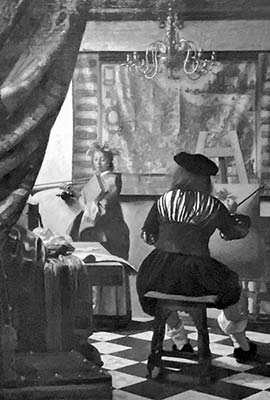
The painting is also called The Allegory of Painting. The model has the laurel leaves, trumpet, and book that symbolize the muse of history and fame. The artist—his back to the public—earnestly tries to capture fleeting fame with a small sheet of canvas.
• Also in Saal XII, look for dark, brooding works by...
Rembrandt van Rijn
Rembrandt became wealthy by painting portraits of Holland’s upwardly mobile businessmen, but his greatest subject was himself. In his Large Self-Portrait we see the hands-on-hips, defiant, open-stance determination of a man who will do what he wants, and if people don’t like it, tough.
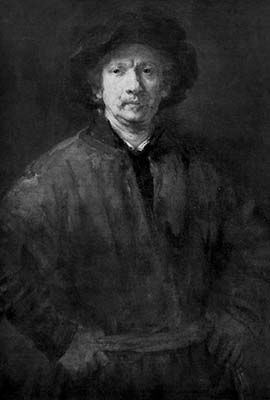
In typical Rembrandt style, most of the canvas is a dark, smudgy brown, with only the side of his face glowing from the darkness. (Remember Caravaggio? Rembrandt did.) Unfortunately, the year this was painted, Rembrandt’s fortunes changed.
Looking at the Small Self-Portrait from 1657, consider Rembrandt’s last years. His wife died, his children died young, and commissions for paintings dried up as his style veered from the popular style of the day. He had to auction off paintings to pay his debts, and he died a poor man. Rembrandt’s numerous self-portraits painted from youth until old age show a man always changing—from wide-eyed youth to successful portraitist to this disillusioned, but still defiant, old man.
• Nearby, Saal X contains the largest collection of Bruegels in captivity. Linger. If you like it, linger longer.
Pieter Bruegel the Elder
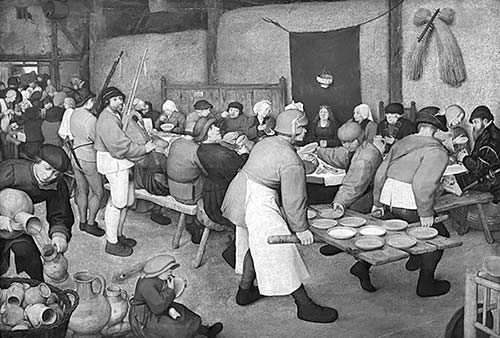
The undisputed master of the slice-of-life village scene was Pieter Bruegel the Elder (c. 1525-1569)—think of him as the Norman Rockwell of the 16th century. His name (pronounced “BROY-gull”) is sometimes spelled Brueghel. Don’t confuse Pieter Bruegel the Elder with his sons, Pieter Brueghel the Younger and Jan Brueghel, who added luster and an “h” to the family name (and whose works are also displayed in the Kunst). Despite his many rural paintings, Bruegel was a cultivated urbanite who liked to wear peasants’ clothing to observe country folk at play. He celebrated their simple life, but he also skewered their weaknesses—not to single them out as hicks, but as universal examples of human folly. About a quarter of all known Bruegel paintings are gathered in this exciting room.
The Peasant Wedding, Bruegel’s most famous work, is less about the wedding than the food. It’s a farmers’ feeding frenzy, as the barnful of wedding guests scramble to get their share of free eats. Two men bring in the next course, a tray of fresh porridge. The bagpiper pauses to check it out. A guy grabs bowls and passes them down the table, taking our attention with them. Everyone’s going at it, including a kid in an oversized red cap who licks the bowl with his fingers. In the middle of it all, look who’s been completely forgotten—the demure bride sitting in front of the blue-green cloth. According to Flemish tradition, the bride was not allowed to speak or eat at the party, and the groom was not in attendance at all. (Also check out the guy carrying the front end of the food tray—is he stepping forward with his right leg, or with his left, or with...all three?)
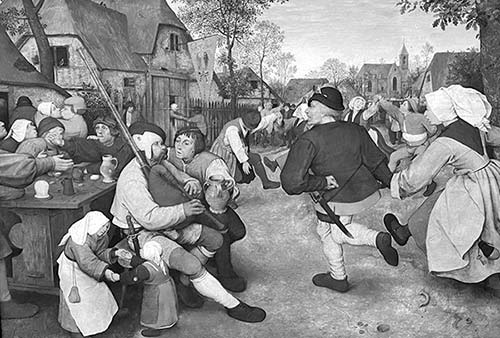
Speaking of two left feet, Bruegel’s Peasant Dance shows a celebration at the consecration of a village church. Peasants happily clog to the tune of a lone bagpiper, who wails away while his pit crew keeps him lubed with wine. Notice the overexuberant guy in the green hat on the left, who accidentally smacks his buddy in the face. As with his other peasant paintings, Bruegel captures the warts-and-all scene accurately—it’s neither romanticized nor patronizing.
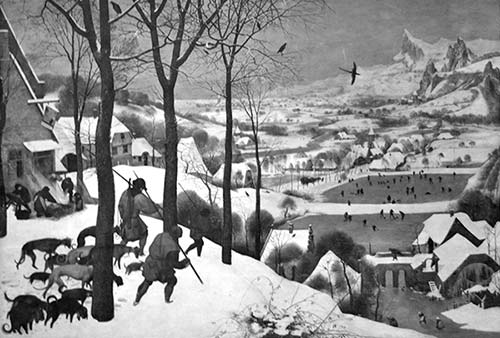
Find several Bruegel landscape paintings. These are part of an original series of six “calendar” paintings depicting the seasons of the year. We see these scenes from above, emphasizing the landscape as much as the people. Gloomy Day opens the cycle, as winter turns to spring...slowly. The snow has melted, flooding the distant river. The trees are still leafless, and the villagers stir, cutting wood and mending fences. We skip ahead to autumn in The Return of the Herd—still sunny, but winter’s storms are fast approaching. Finally, in Hunters in Snow, it’s the dead of winter, and three dog-tired hunters with their tired dogs trudge along with only a single fox to show for their efforts. As they crest the hill, the grove of bare trees opens to a breathtaking view—they’re almost home, where they can join their mates playing hockey. Birds soar like the hunters’ rising spirits—emerging from winter’s work and looking ahead to a new year.
The Tower of Babel, modeled after Rome’s Colosseum, stretches into the clouds, towering over the village. Impressive as it looks, on closer inspection the tower is crooked—destined eventually to tumble onto the village. Even so, the king (in the foreground) demands further work.
• For an unforgettable finale, return to the entry, taking the stairs back to the ground level. The collection of Greek, Roman, and Egyptian antiquities (stairs to the left) is world class and worth a look if you have time. But we’ll end this tour with the Habsburg collection of treasures. Take the stairs to the right to enter the Kunstkammer.
REST OF THE KUNST
The Kunstkammer shows off the personal collection of objets d’art of the House of Habsburg. Amassed by 17 emperors over the centuries, the Kunstkammer (“art cabinet”) is a dazzling display of 2,000 ancient treasures, medieval curios, and jeweled wonders collected from the year 800 to 1891. The U-shaped gallery is laid out chronologically, beautifully lit, and thoughtfully described in English.
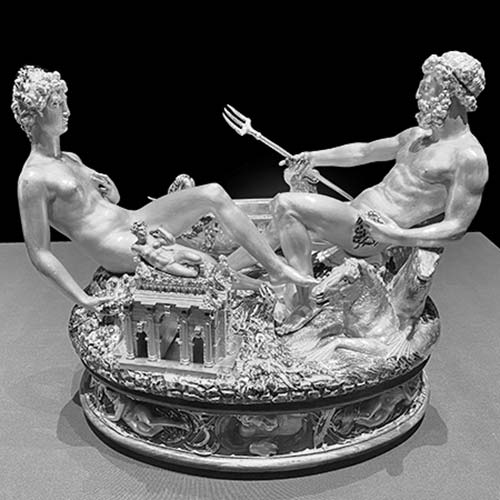
The highlight is at the end of the first long hall (on the left in Room XXIX): Benvenuto Cellini’s famous golden salt cellar (pictured). It was pounded out of a sheet of gold in 1543 by the renowned Florentine goldsmith. Featuring gods of the sea and the earth with symbols of winds and seasons all around, it takes salting and peppering your food to Habsburg heights.