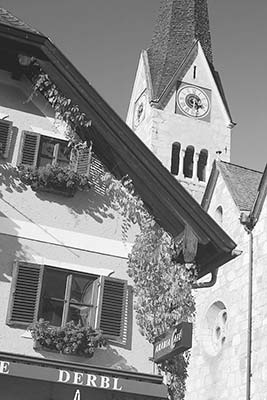
HALLSTATT & THE SALZKAMMERGUT
Commune with nature in the Salzkammergut, Austria’s Lake District. “The hills are alive,” and you’re surrounded by the loveliness that has turned on everyone from Emperor Franz Josef to Julie Andrews. This is The Sound of Music country. Idyllic and majestic, but not rugged, it’s a gentle land of lakes, forested mountains, and storybook villages, rich in hiking opportunities and inexpensive lodging. Settle down in the postcard-pretty, lake-cuddling town of Hallstatt (HAHL-shtaht). While there are plenty of lakes and charming villages in the Salzkammergut, Hallstatt is really the only one that matters.
Lovable Hallstatt is a tiny town bullied onto a ledge between a selfish mountain and a swan-ruled lake, the Hallstätter See, with a waterfall ripping furiously through its middle. It can be toured on foot in about 15 minutes. Salt veins in the mountain rock drew people here centuries before Christ. The symbol of Hallstatt, which you’ll see all over town, consists of two adjacent spirals—a design based on jewelry found in Bronze Age Celtic graves high in the nearby mountains.
The big draws of Hallstatt are its village and its lakeside setting. Come here to relax, nibble, wander, and paddle. The lake is famous for its good fishing and pure water. If you want to do some sightseeing, dip into the endearing town museum, ride the funicular for grand lake views and a salt-mine tour, or side-trip to the nearby town of Obertraun to catch the cable car up to even higher views and ice caves. While tourist crowds can trample much of Hallstatt’s charm on sunny summer weekends, the place somehow retains its unique appeal—and it’s almost dead in the off-season.
PLANNING YOUR TIME
Hallstatt serves as a relaxing break between Vienna and Salzburg. One night and a few hours to browse are all you’ll need to fall in love. If you want time to hike, tour the salt mine or ice cave, or just slow down, you should give it two nights and a day.
Orientation to Hallstatt
Hallstatt (pop. about 800) has two parts: the tightly packed medieval town center (which locals call the Markt), and the newer, more car-friendly Lahn neighborhood, a few minutes’ walk to the south. A lakeside promenade connects the old center to the Lahn. The tiny “main” boat dock (a.k.a. Market Dock), where boats from the train station arrive, is in the old center of town. Another boat dock is in the Lahn, next to Hallstatt’s bus stop and grocery store.
TOURIST INFORMATION
The helpful TI, in the old town at the beginning of the lakeside promenade, can explain hikes and excursions and sort through your transit options (Mon-Fri 8:30-17:00, Sat 9:00-16:30, Sun 9:00-13:00; Mon-Sat closed for lunch midday; Nov-April closed Sat-Sun; Seestrasse 114, +43 5950 9530, www.dachstein-salzkammergut.at, hallstatt@dachstein-salzkammergut.at).
On Mondays and Saturdays, the TI offers one-hour walking tours of the town at 16:30, conducted in both English and German (€10, free with guest card from local hotel or Salzkammergut Card, no tours Oct-April). They can also arrange private tours.
ARRIVAL IN HALLSTATT
By Train: If you’re coming on the main train line that runs between Salzburg and Vienna, you’ll change trains at Attnang-Puchheim to get to Hallstatt (you won’t see Hallstatt on schedules, but any train to Ebensee and Bad Ischl will stop at Hallstatt). Day-trippers can use the coin-op lockers at the Attnang-Puchheim station (follow signs for Schliessfächer, in the lower level near the Reisezentrum). Note: Connections can be tight—check the TV monitor.
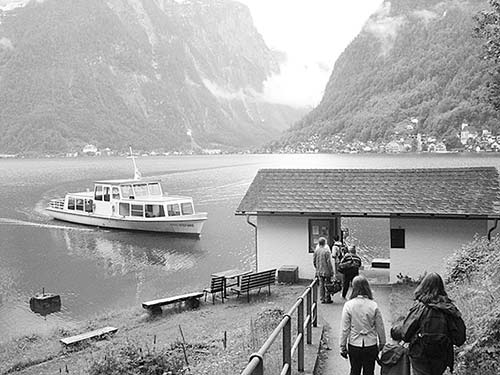
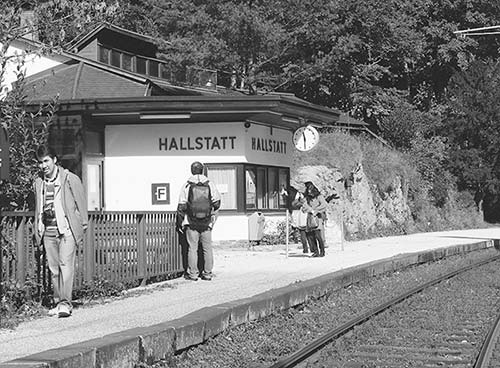
Hallstatt’s train station is a wide spot on the tracks across the lake from town. Stefanie (a boat) meets you at the station and glides scenically across the lake to the old town center (€3.50, meets each train until 18:50, www.hallstattschifffahrt.at). If you arrive after Stefanie stops running, you’ll have to get off in Obertraun and take a taxi to Hallstatt (at least €15). The last departing boat-train connection leaves Hallstatt at 18:15, and the first boat of the day goes at 6:50 (Sun at 8:10 in summer, 8:45 off-season).
Once in Hallstatt, you’re steps away from the old center—five minutes by foot from the TI, and a 15-minute walk from the Lahn.
By Bus: Buses arriving in Hallstatt stop in the Lahn, in front of the boat dock ticket kiosk (look for Hallstatt Lahn on schedules). It’s a 10-minute walk from the bus stop into the old center along the lakeside path.
By Car: The main road skirts the old center via a long tunnel above the town; you’ll emerge in the Lahn. If you’re staying at one of my recommended accommodations in the Lahn, you can park right at the hotel—all have free parking.
Only locals with a special permit are allowed to drive inside the old town. As you approach town, electronic signs direct you to available spots in numbered parking lots (€7/2 hours, €10/12 hours, €15/day).
If you are staying at a hotel in the old town, follow signs to lot P1, reserved for hotel guests. After you park, tell the attendant at the lot office (or the intercom) where you’re staying, and hop on the free shuttle, which will drop you at or near your hotel (runs daily 9:00-19:00). You can also use this shuttle when you depart; ask your hotelier to call. If you need in-and-out privileges, ask the attendant for a “Hotel-Karte” ticket (which lets you drive in and out of the lot, and entitles you to a lower daily rate if you stay four nights or more).
Day-trippers should head to lot P2, which is closer to the old town center and the salt-mine funicular (it’s not served by the hotel shuttle). If P1 and P2 are full, the only option may be lot P4, on the road to Obertraun, a 30-minute walk from the old town. (P3 is for buses.)
For more parking tips, see www.hallstatt.net/parking-in-hallstatt.
HELPFUL HINTS
Baggage Storage: If you’re changing trains in Attnang-Puchheim, you can use the lockers at that station. In Hallstatt, you can leave bags at the funicular station while visiting the salt mine and viewpoint (free, see “Sights in Hallstatt,” later).
Local Guide: Hallstatt-based Cristiana Campanile loves to share her town and the neighboring lakes (€135/1.5 hours, €220/4 hours, €340/full day, +43 664 206 5083, www.hallstatt-guides.at, campanile@hallstatt-guides.at).
Parks and Swimming: Green and peaceful lakeside parks line the south end of Lake Hallstatt. If you walk 15 minutes south of the old center to the Lahn, you’ll find a grassy public park, playground, and swimming area (Badestrand) with the fun Badeinsel play-island.
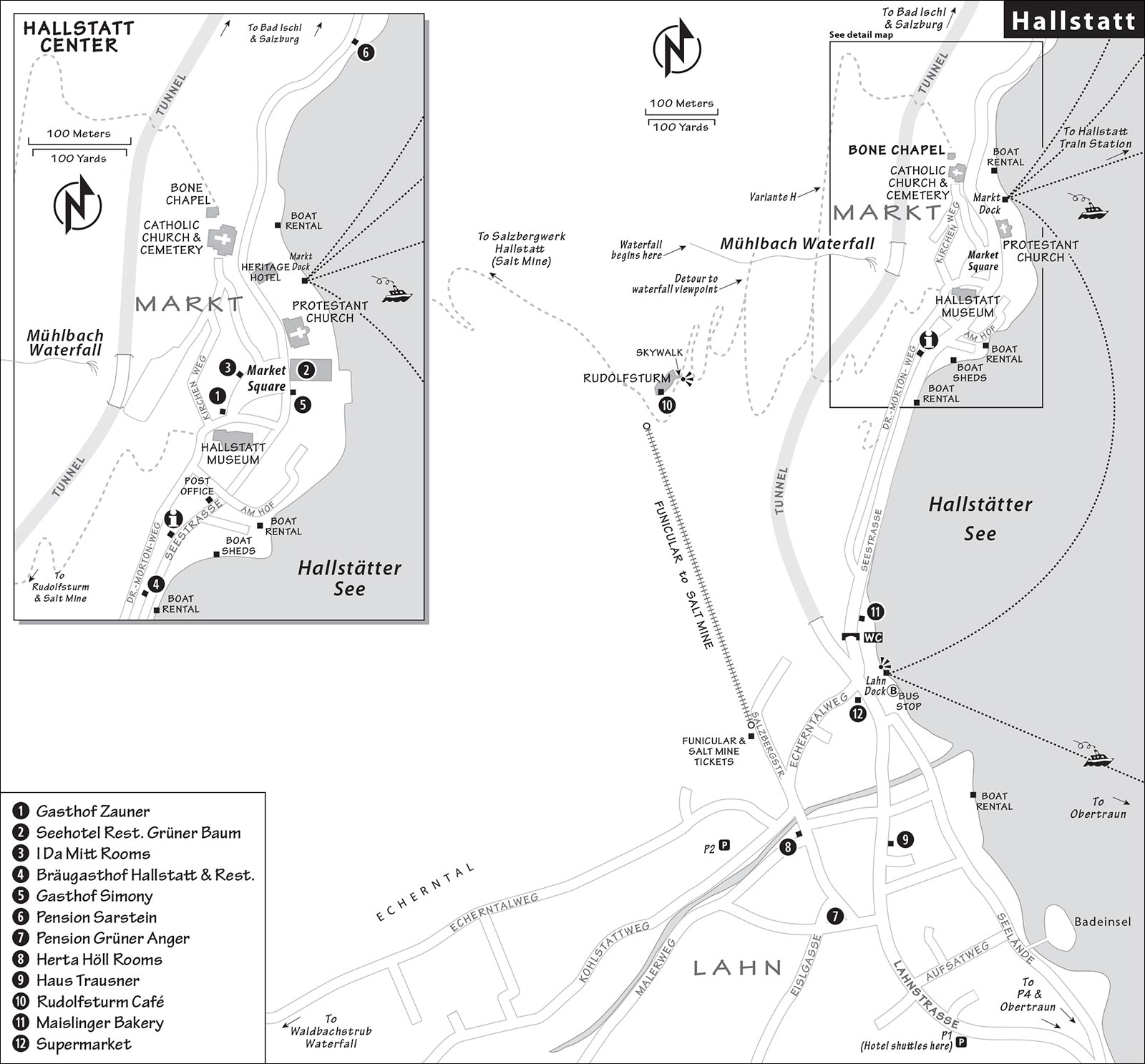
Views and Fewer Tourists: The best high-altitude vantage point is the Skywalk viewpoint at the Rudolfsturm (at the top of the funicular). The steep, 45-minute hike down from there is also grand. Closer to town, you’ll find more postcard views and fewer tourists by heading toward the north end of the village, past the market dock where the road curves and opens up (best light early in the day) or from the little park by the bus stop in the Lahn (best light late in the day). While most visitors stroll the touristy lakeside drag between the old and new parts of town, make a point to take the more higgledy-piggledy high lane called Dr.-Morton-Weg at least once. And, for a great view over Hallstatt, hike above Dr.-Morton-Weg on Hallberg as far as you like, or climb any path leading up the hill.
Nightlife: For after-dinner action, head to the cafés on Market Square in the old town, which stay open until about 22:00.
Hallstatt Walk
• This short, self-guided walk starts at the Markt dock.
Boat Landing: There was a Hallstatt before there was a Rome. In fact, because of the importance of salt mining here, an entire epoch—the Hallstatt Era, from 800 to 400 BC—is named for this important spot. Through the centuries, salt was traded and people came and went by boat. You’ll still see the traditional Fuhr boats, designed to carry heavy loads in shallow water.
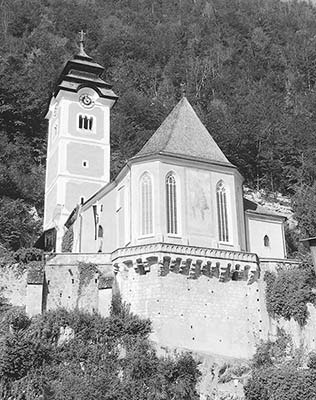
Tiny Hallstatt has two big churches: Protestant (bordering the square on the left, with a grassy lakeside playground) and Catholic (towering up above, with its fascinating bone chapel). Its faded St. Christopher—patron saint of travelers, with his cane and baby Jesus on his shoulder—watched over those sailing in and out.
Until 1875, the town was extremely remote...then came a real road and the train. The good ship Stefanie shuttles travelers back and forth from here to the Hallstatt train station, immediately across the lake.
Look down the shore at the huge homes. Back when Hallstatt’s population was about double its present 800, several generations lived together in each of these houses. Today, the resident population continues to shrink, and many of these houses are now vacation rentals.
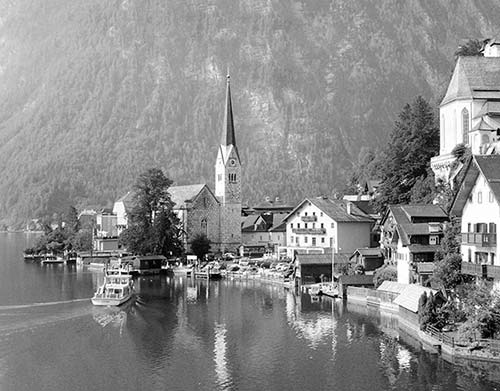
Hallstatt gets about three months of snow each winter, but the lake hasn’t frozen over since 1981. See any swans? They’ve patrolled the lake like they own it since the 1860s, when Emperor Franz Josef and Empress Sisi—the Princess Diana of her day—made this region their annual holiday retreat. Sisi loved swans, so locals made sure she’d see them here. During this period, the Romantics discovered Hallstatt, many top painters worked here, and the town got its first hotel.
Local divers discovered that the lake also served as Hallstatt’s garbage can. For centuries, if something was kaputt, locals would just toss it into the lake. In 1945, Nazi medals decorating German and Austrian war heroes suddenly became dangerous to own. At the end of World War II, throughout the former Third Reich, hard-earned medals floated down to lonely lake beds, including Hallstatt’s.
Walking away from the lake, look right and notice the one-lane road out of town (below the church). Until 1966, when a bigger tunnel was built above Hallstatt, all the traffic crept single-file right through the town.
• Now, walk over the town’s stream and pop into the...
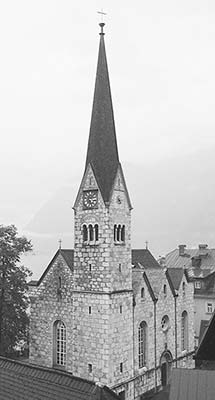
Protestant Church: The Catholic Counter-Reformation was very strong in Austria, but pockets of Protestantism survived, especially in mining towns like Hallstatt. Until the Revolution of 1848, Protestants were only allowed to worship in low-key “houses of prayer.” After that, Hallstatt’s miners helped raise money to build this fine church, opened in 1863. Step inside (free and often open). It’s small and very plain, emphasizing the pulpit and organ rather than fancy art and saints. Check out the portraits: Martin Luther (left of altar), the town in about 1865 with its new church (left wall), and a century of pastors (back wall).
• If you’re up for a short climb, now’s a good time to detour to the Catholic church and bone chapel, described later under “Sights in Hallstatt.” To get there, go straight up from the boat dock along the walkway to the right of the town stream, then up the little lane on the right, following signs marked Kath. Kirche.
Otherwise, continue to the...
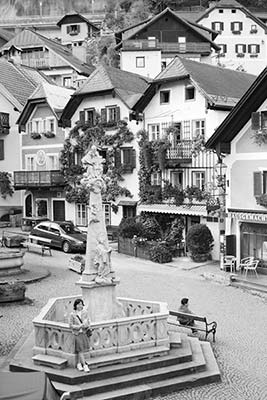
Market Square (Marktplatz): In 1750, a fire leveled this part of town. The buildings you see now are all late-18th-century structures built of stone rather than flammable wood. The three big buildings on the left are government-subsidized housing (mostly for seniors and people with health problems). Along the right side of the square, take a close look at the two-dimensional, up-against-the-wall pear tree (it likes the sun-warmed wall). The statue in the center features the Holy Trinity and was donated by a rich salt-mining family when the village was spared by the plague.
• Continue a block past Gasthof Simony. Stop at the first corner. Look up.
Because 20th-century Hallstatt was of no industrial importance, it was untouched by World War II. But once upon a time, its salt was worth defending. High above, barely peeking out of the trees, is Rudolfsturm (Rudolf’s Tower). Originally a 13th-century watchtower protecting the salt mines, and later the mansion of a salt-mine boss, it’s now a restaurant with a great view. (You can see the sharply angled viewing platform sticking out.) A zigzag trail connects the town with Rudolfsturm and the salt mines just beyond. The big, white houses by the Mühlbach waterfall were water-powered mills that once ground Hallstatt’s grain. (If you hike up a few blocks, you’ll see the river raging through town and a few quaint storybook lanes.)
Within a few steps are several fun shops: The “Schnaps & Holz” (wood) shop is run by Johannes, who serves samples and sells little glasses of the local firewater, and works wonders in his woodshop. A nearby ceramics shop has local handmade work inspired by ancient excavations.
• From here (just before the Gemeindeamt or Town Hall), face the lake and jog right down the tiny lane marked Am Hof, which leads through an intimate bit of domestic town architecture, boathouses, maybe a couple of swans, and lots of firewood (since Habsburg times, many families have rights to free wood from the nearby forest). The lane circles back to the main drag and the...
Museum Square: Climb a few steps into the Hallstatt Museum’s front yard to see a statue (on the left) and some wooden stairs (on the right). The statue honors Johann Georg Ramsauer, the mine manager who excavated prehistoric graves in about 1850. Much of the Schmuck (not an insult—it means jewelry in German) sold locally is inspired by the jewelry found in the area’s Bronze Age tombs.
The wooden stairs in front of the museum are a copy of those found not long ago in Hallstatt’s prehistoric mine. The original stairs, which you can see in person at the end of the salt-mine tour, are more than 3,000 years old. For thousands of years, people have been harvesting salt—precious for preserving meat—from this mountain. A brine spring sprang here, attracting Bronze Age people in about 1600 BC. At first, miners used the “dry” technique: They’d dig tunnels into the mountain, hack out big chunks of salt-rock (70 percent salt), and haul them out in leather backpacks. Later, they wised up and simply dissolved the salt in water to create a brine, flowed it out of the mountain in wooden pipes, and then boiled off the water to distill the salt. In fact, from 1595 until well into the 20th century, a 25-mile wooden pipeline carried salt brine from Hallstatt to Ebensee; finally, they replaced the last stretch of wood with plastic piping. For a look at early salt-mining implements and the town’s story, visit the Hallstatt Museum (described later).
Back at street level, notice the Dachstein Sport Shop. During renovations in the 1990s, archaeologists dug down under the building and hit objects spanning from prehistoric times to the 19th century, including a Celtic and ancient Roman settlement. Peek through the glass pavement on the covered porch to see where the Roman street level was. If the shop is open, pop in and climb downstairs (on the near right as you enter) to see a good, free exhibit of items found in the excavation: Stone Age pottery shards, part of a Roman bathhouse, and the remains of a Habsburg residence. In prehistoric times, people lived near the mines. Romans were the first Hallstatt lakeside settlers.
Continue out of the square with the water on your left and the post office and TI on your right. Look left to see the town’s boat sheds (many now converted into garages). At the end of the nearest shed look for high-water marks from lake flooding over the decades.
• You could follow this promenade all the way to the Lahn. But let’s go the often-overlooked scenic route: Take a right (across from a small, gravel lakeside parking lot) and head up a few stairs to the street called...
Dr.-Morton-Weg: Notice that the house at #26A dates from 1597. This stone structure stopped the fire of 1750 from spreading further and is painted red in remembrance. Modern houses are required to be built of stone or brick. Turn left and follow the lane past more old houses. Until 1890, this was the town’s main drag, and the lake lapped at the lower doors of these houses. Therefore, many main entrances were through the attic, from this level. Enjoy this back-street view of town. Just after the arch, near #133, check out the old tools hanging from the oldest house in Hallstatt. From here, enjoy the lake view, then climb down the stairs and look back up at the striking traditional architecture (the fine woodwork on the left was rebuilt after a fire; parts of the old house on the right date to medieval times).
• Your tour of the town is finished. Within a few minutes’ walk from here are boat rentals, the town museum, and the base of the funicular (up to great views and a salt-mine tour).
Sights in Hallstatt
▲▲Catholic Church and Bone Chapel
Hallstatt’s Catholic church overlooks the town from above. The lovely church has twin altars. The one on the left was made by town artists in 1897. The one on the right is more historic—dedicated in 1515 to Mary, who’s flanked by St. Barbara (on right, patron of miners) and St. Catherine (on left, patron of foresters—a lot of wood was needed to fortify the many miles of tunnels, and to boil the brine to distill the salt). Historically, miners and salt traders sat on the right and townsfolk on the left. Note the VIP boxes in front on the left (for the mayor and town council) and on the right (for bosses of the mine).
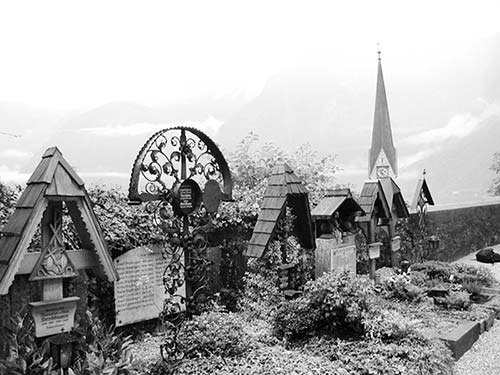
Behind the church, in the well-tended graveyard (with each little plot lovingly cared for like a tiny garden), is the 12th-century Chapel of St. Michael (even older than the church). Its bone chapel—or charnel house (Beinhaus)—contains more than 600 skulls. Each has been carefully decorated and marked with the deceased’s name and date of death. (Skulls with dark, thick garlands are oldest—18th century; those with flowers are more recent—19th century.) In central Europe, cemetery burial is not always permanent: Space was so limited in Hallstatt’s graveyard that bones had only 12 peaceful, buried years before making way for the freshly dead. Many of the dug-up bones and skulls ended up in this chapel. Bone chapels are common in Europe, and skulls were decorated and labeled in some other alpine communities, but nowhere so often as in Hallstatt. The practice ended in the 1960s, about the same time the Catholic Church began permitting cremation. But one woman (who died in 1983) managed to sneak her skull in later (under the cross, with the gold tooth). The skulls on the books are those of priests. Notice the families stacked together for eternity: Steiner. Kierchschlager. Heuschober. Binder. It’s a poignant—and eerily tangible—chronicle of a little community.
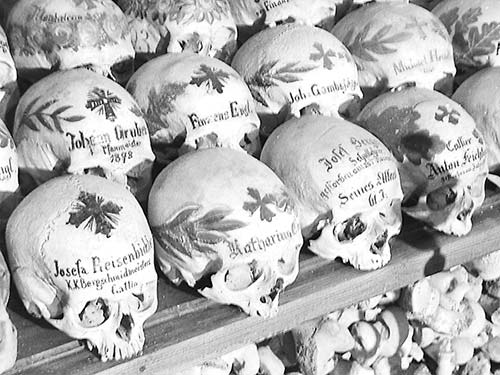
Cost and Hours: Free to enter church, bone chapel-€1.50; daily May-Sept 10:00-18:00, Oct until 17:00, shorter hours and closed Mon-Tue in winter; free English flier, Kirchenweg 40, +43 6134 8279, http://beinhaus.hallstatt.net.
Getting There: From near the main boat dock, walk straight up the little lane next to the stream (to the right of the Gemischtwarenhandlung am See café), turn right at the Kath. Kirche signs, and climb up the covered wooden stairway.
▲▲Hallstatt Museum
This high-quality museum—well-presented and anchored by lots of actual artifacts—tells the story of Hallstatt, providing a solid background for all you’ll see here. It focuses on the Hallstatt Era (800-400 BC), when this village was the salt-mining hub of a culture that spread from France to the Balkans. Back then, Celtic tribes dug for precious salt, and Hallstatt was, as its name means, the “place of salt.” The highlight of the museum is the countless number of artifacts excavated from prehistoric gravesites around the mine. The museum also offers a 10-minute introductory movie and 26 displays, including ones on the Celts and Romans, the region’s flora and fauna, local artists (like locally born modern sculptor Georg Zauner), and the surge in Hallstatt tourism during the Romantic Age. Everything is labeled in English, and the ring binders have translations of the longer texts.
Cost and Hours: €10; May-Sept daily 10:00-18:00, April and Oct until 16:00; Nov-March Wed-Sun 11:00-15:00, closed Mon-Tue; Seestrasse 56, +43 6134 8280, www.museum-hallstatt.at.
▲▲Lake Trips
For a quick boat ride, you can take the Stefanie across the lake and back for €7. It stops at the tiny Hallstatt train station for 30 minutes (note return time in the boat’s window), giving you time to walk to a hanging bridge (ask the captain to point you to the Hängebrücke—HENG-eh-brick-eh—a 10-minute lakeside stroll to the left). For a longer tour, take a round-trip ride to Obertraun (€14, 4-5/day May-Sept only, 50 minutes) or Steeg (€18, 3/day mid-July-Aug only, 1.25 hours); check the posted schedule or www.hallstattschifffahrt.at for departure times.
Another company, Navia, runs flat-bottom boats (Fuhre) reminiscent of Hallstatt’s glory days, when such boats transported salt on the first stage of its journey to the rest of the world. Boats depart from Seestrasse 89 in the Lahn (by the Polreich hotel) and run to Obertraun and back in an hour (€8 one-way, €14 round-trip; May-Sept hourly departures 9:00-17:00, June-Aug also at 18:00, April and Oct 4/day, weather dependent; mobile +43 650 617 7165, www.navia.at).
Even better, rent your own electric boat. It’s cheap, fun, easy, and safe, as gas-powered boats are not allowed on the lake, and these boats can’t go very fast (they have two speeds: slow and stop). A half-hour rental is enough to do a scenic little loop just offshore from town; when split among a few people, it’s cheaper than any of the boat rides I’ve listed. I can think of no more enjoyable cheap thrill on a sunny day in Hallstatt. You can also rent a rowboat, paddleboat, or stand-up paddleboard. There are several locations, both in the old town and the Lahn—look for Boote signs (daytime only, €15/30 minutes, €20/hour for 500-watt boat; no rentals off-season or when windy).
▲▲Salt-Mine Tour and Rudolfsturm Viewpoint
Hallstatt claims to have the oldest salt mine in the world. Along with two others in the area, this one is still active, producing 1.1 million tons of salt each year (mostly used for road salt, though you can also buy souvenir shakers of table salt). Guided tours visit one section of the mine that is no longer active.
The tunnels of the Hallstatt mine lie high above the town, so visitors ascend the mountainside to reach the mine entrance—most by funicular, a few brave hikers by foot. The fun funicular ride is part of the appeal of the mine tour, as are the Rudolfsturm viewpoint, with stunning panoramas over the town and lake, and the pleasant 15-minute walk through the high valley from the top of the funicular to the mine entrance. Allow about three hours total for the round-trip funicular ride, viewpoint visit, and 1.5-hour salt-mine tour. If possible, avoid the last tour of the day, so that you’re not rushed to make the last funicular.
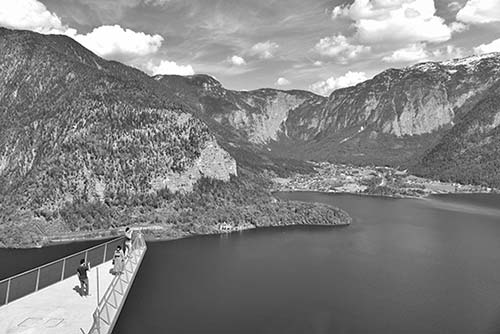
Even if the mine doesn’t interest you, it’s still worthwhile to take the funicular up—for the view, a bite in the café, a stroll on the paths, and perhaps a hike down.
Cost: €36 for mine and round-trip funicular, €25 for mine tour only (you must hike up), €11 one-way/€20 round-trip for funicular only; buy tickets online or at funicular base station; no children under 4.
Hours: April-late Sept daily 9:00-16:00, late Sept-early Jan and early Feb-March 9:00-14:00—these are last ascent times to make it for the day’s final tour, closed early Jan-early Feb; funicular runs at least 4/hour, last descent at 18:00, off-season at 16:30, closed early Jan-early Feb; +43 6132 200 2400, www.salzwelten.at.
Advance Reservations: It’s best to reserve in advance online. Without a reservation, arrive early or late to avoid summer crowds—especially on rainy days.
Tours: Skip the €3 audioguide, which simply recites posted English information plaques scattered around the mountaintop (and is available as a free download on your phone).
Dress Warmly: Be sure to dress for the constant 47-degree temperature in the mine.
Other Salt Mines: While visiting a salt mine is almost obligatory when you’re in this part of Austria, one is plenty. Other options are in Hallein (see here) and Berchtesgaden (here). But Hallstatt’s is a good choice, as it’s the easiest to reach and well worth the time—especially on a rainy day.
Getting to the Funicular: The lower funicular station and ticket office is in the Lahn, close to the bus stop, Lahn boat dock, and P2 parking lot. At the base of the funicular, notice the train tracks leading to the Erbstollen tunnel entrance. This lowest of the salt tunnels goes many miles into the mountain, where a shaft connects it to the tunnels you’ll see on the tour. Today, the salty brine from these tunnels flows 25 miles to the huge modern salt works (next to the highway) at Ebensee.
At the Top: Ride the funicular up the mountain to 2,750 feet. From the top station, take the glass elevator even higher, to the middle of a footbridge that leads to the Rudolfsturm tower (with its café and viewpoint) in one direction, and the trailhead to the mine tour in the other (it’s a 15-minute, slightly uphill walk to the building where the tour starts). If you have time before your tour, head to the viewpoint. The highlight (behind the tower) is the Skywalk platform, which juts out over the lake. Hallstatt’s rooftops are below your toes, and Obertraun (with the Dachstein cable car) fills the little valley at the far end of the lake. In the tower (which was the mine administration building until the 1950s), the $$$ Rudolfsturm café has a basic menu and a million-dollar view (www.rudolfsturmhallstatt.at).
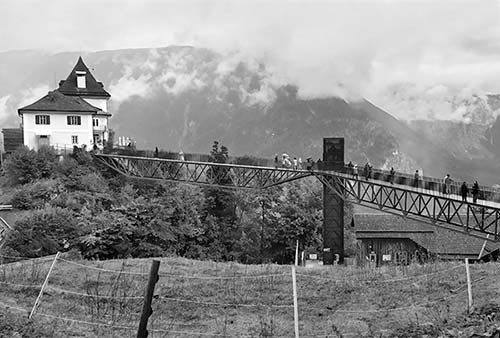
Touring the Salt Mine: To reach the salt mine, cross to the other side of the footbridge and find the trailhead. You’ll walk almost a half-mile up a paved path, past signposts that tell the story of the prehistoric graves found here and a small building with an exhibit of 2,500-year-old bones.
Salt-mine tours leave from the Salzbergwerk building at the upper end of the path every 20-30 minutes. Give yourself time to check your bag, put on light overclothes (provided), take silly photos of your travel partner, and explore a little museum explaining the lives of salt miners. Finally you’ll meet your guide and hike 200 yards higher, entering the mountain through a long tunnel that was dug in the 1700s and named after Austrian empress Maria Theresa. Tours should always be in English and German...if unsure, ask. (The many videos are half-heartedly subtitled in English.)
Inside the mountain, you’ll follow your guide through several caverns, featuring high-concept audio-visual presentations (including a laser show on a glassy subterranean lake). Along the way you’ll find out how, starting 250 million years ago, ocean salt wound up in the Austrian Alps, and about mining techniques over the past 7,000 years. The highlight for most is sliding down two banisters; the second one is the longest in Europe (213 feet) and ends with a flash for a souvenir photo that clocks your speed (see how you did compared to the rest of your group).
The grand finale is the “Bronze Age Cinema,” where you’ll learn about—and then see—the oldest wooden staircase in Europe (and likely the world). Find out how the 26-foot-long, incredibly rickety staircase was discovered, excavated, studied in Vienna (where it was carbon-dated to 1108 BC), and finally reinstalled here. Animated figures projected on the staircase show how people dressed and worked in Bronze Age times.
At the end of the tour, you’ll board a little miners’ train and duck as it zips through narrow tunnels back out of the mountain.
Hiking Back Down to Hallstatt: If you skip the funicular down, the steep and scenic 45-minute hike back into town is (with strong knees) a joy. Find the well-tended gravel path below the skybridge that connects the funicular station with the Rudolfsturm café and viewpoint. You’ll tackle extremely steep and sharp switchbacks as you gradually descend toward town. Along the path, panels teach you about salt-mining history. Partway down, you’ll pass the (closed) entrance to the Franz Josef mine tunnel; notice that recently retired miners have hung their hardhats here (letzte Grubenfahrt means “last descent”). Farther down, watch for the short detour to Terrasse-Mühlbachschlucht, which leads to a metal walkway over the Mühlbach waterfall that tumbles out of the cliffs toward Hallstatt. Farther along on the main path, notice the heavy-duty metal nets that protect the village from rockslides. At the fork, turn left toward Variante H. Cross back over the waterfall, then follow the gravel road, keeping an eye out on the right for the switchback steps that lead down into the Catholic church’s graveyard.
▲Local Hikes
Mountain lovers, hikers, and spelunkers who use Hallstatt as their home base keep busy for days (ask the TI for ideas). Right from town, you can hike up to the Rudolfsturm café/viewpoint/salt-mine tour—or, more easily, take the funicular up and hike down.
To go farther afield, a good, short, and easy walk is the two-hour round-trip from the Lahn up the Echerntal valley to the Waldbachstrub waterfall and back: Follow signs to the salt mines, then follow the little wooden signs marked Echerntalweg. With a car, consider driving 30 minutes to hike around the nearby Altaussee (flat, 3-hour hike) or, a bit farther on, along Grundlsee to Toplitzsee. Regular buses also connect Hallstatt with another small lake, the Gosausee, which you can circle in a pleasant hour-long walk. The TI can also recommend a great two-day hike with an overnight in a nearby mountain hut.
Biking
The best two bike rides run up the Echerntal valley (nearly the same route as the hike just described) and around the lake (ride the Stefanie shuttle across the lake to the train station, then enjoy the bike path around to the right via Obertraun and back to Hallstatt). There’s no public bike rental in Hallstatt, but some hotels have loaner bikes for guests. If you’re desperate, you can take a bus, boat, or train to nearby Obertraun and rent a bike there at B&B Simmer (between the boat dock and train station at Seestrasse 265; call ahead, +43 6131 605).
NEAR HALLSTATT
▲▲Dachstein Mountain Cable Car and Caves
A few miles up the lake beyond Hallstatt, cable cars glide to the high, barren Dachstein mountain plateau, crowned by the tallest mountain in the Salzkammergut (9,800 feet). Along the way, you can hop off to tour two different caves: the refreshingly chilly Giant Ice Cave and the less-impressive Mammoth Cave.
The Dachstein cable car lifts you to the plateau in three stages. The first segment stops at Schönbergalm (4,500 feet); this stop has limited views, but it’s where you find the two caves. The second segment climbs close to the summit of Krippenstein (6,600 feet), with the best views. And the third segment descends to Gjaidalm (5,800 feet), where several hikes begin.
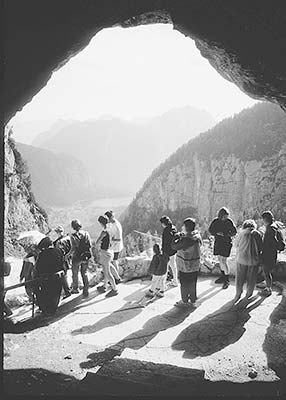
For most, the best plan is to tour the Giant Ice Cave from Schönbergalm, and then (in good weather) head up to Krippenstein for easy hikes to great views. (For a quick high-country experience, Krippenstein is better than Gjaidalm.) To do both the cave and some hiking at Krippenstein, allow five hours total, round-trip, from the valley station; if you’re doing just one of these, allow 2.5 hours round-trip.
Cost: The variety of ticket options can be confusing—survey them carefully before you book. If you’re not sure what you want to do, pick the €50 “Dachstein Salzkammergut” ticket, covering the cable car up to Krippenstein and the Giant Ice Cave. With less time or in poor weather, take the cable car to Schönbergalm and visit the cave (€40). For the best mountain vistas on a clear day, travel all the way to Gjaidalm and back (“Panorama Ticket,” €35). For other variations, see the list at the ticket desk and online (+43 50 140, www.dachstein-salzkammergut.com).
Hours: The cable car runs May-early Nov (but does not stop at Gjaidalm until mid-June). The first cable car leaves at 8:40 and runs every 15 minutes. The last departure from Krippenstein is at 17:00 and from Schönbergalm at 17:10 (2 hours later July-mid-Sept). If touring the ice caves, you’ll need to leave the valley station by 15:30 (or 16:30 in peak season; the ticket seller can advise you).
Services: All lift stations have $$$ eateries and free Wi-Fi.
Getting There: To reach the valley station by car, set your GPS for “Winkl 34” in Obertraun. Drive along the main road south of Hallstatt about three miles; just before reaching the village of Obertraun, turn right up a side road for a mile, following Dachstein signs. For location, see the “Salzkammergut” map later in this chapter.
From Hallstatt without a car, the handiest and cheapest option is bus #543 (€2.40, 7-9/day, 15 minutes; leaves from bus stop in the Lahn, drops you directly at cable-car station; look for “Dachsteinseilbahn Talstation” in “Winkl bei Obertraun” on schedules at www.oebb.at). Romantics could take a boat to Obertraun (see “Lake Trips,” earlier)—but it’s a 45-minute uphill hike from there to the lift station. A taxi between Hallstatt and the cable-car station costs about €18 each way. Or you can walk about 1.5 hours along the lakefront, then uphill.
Visiting the Caves at Schönbergalm: Each cave is a short, steep walk from the first cable-car station, Schönbergalm. If choosing between the two, the Giant Ice Cave is much more interesting than the Mammoth Cave.
Discovered in 1910, the Giant Ice Cave (Riesen-Eishöhle) is viewable by 50-minute, half-mile guided tours in German and English (at the cable-car station, report to the ticket window to get your tour time). It’s a steep 10-minute hike from the station up to the cave entry, along a paved path with switchbacks. Allow time to pause for breath (you’re nearly a mile up).
Guides lead groups through an eerie, icy, subterranean world, traversing limestone caverns the size of subway stations. Carved by rushing water, the caverns are named for scenes from Wagner’s operas—the favorite of the mountaineers who first came here. If you’re nervous, note that the iron oxide covering the ceiling takes 5,000 years to form. Things are very stable. The temperature is just around freezing, and although the many steps help keep you warm, aim to dress as the guides do, in a jacket and hat.
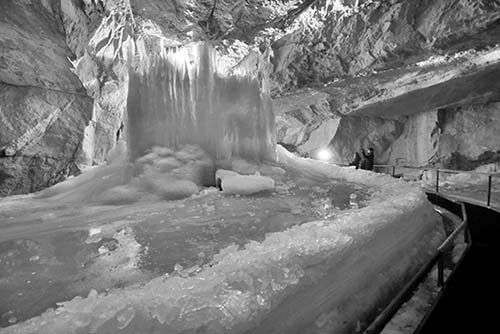
Back down at the Schönbergalm cable-car station, in the clearing just behind the building, a free little museum in a series of little wooden cabins offers exhibits about the caves and local ecology (mostly in German only; save it for the way back).
While huge and well-promoted, the Mammoth Cave (Mammuthöhle), also close to the Schönbergalm station, is much less interesting than the ice cave and—for most—not worth the time. Of the 30-mile limestone labyrinth excavated so far, tours bring you through a half-mile (one-hour tour, 10-minute hike from station to cave entrance).
Hiking at Krippenstein: From the second cable-car station, Krippenstein, you can hike about 30 minutes to its “five fingers” viewpoint, with metal walkways that extend out from the mountain (not for the faint of heart). A different 30-minute hike leads to the “Dachstein Shark” viewing platform. And all around, you get 360-degree views of the surrounding mountains and a good look at the scrubby, limestone, karstic landscape (which absorbs, through its many cracks, the rainfall that ultimately carves all those caves).
Returning to Hallstatt: The last bus from the cable-car station back to Hallstatt leaves around 18:00.
Sleeping in Hallstatt
Prices are highest May through October; mid-July and August can be tight (early August is worst). Staying in the old town is atmospheric, but expensive—and you don’t need to splurge to enjoy this town. Some of the best rooms are in Gästezimmer in the Lahn, just as nice and modern as rooms in bigger hotels, at half the cost, and with free parking and no wait for a hotel shuttle.
As most rooms here are in old buildings with well-cared-for wooden interiors, dripping laundry is a no-no. Be especially considerate when hanging laundry over anything but tile—when in doubt, ask your host about using their clothesline.
IN THE OLD CENTER
Remember, if you are arriving by car, head directly to parking lot P1, where you’ll catch a shuttle to your hotel (see “Arrival in Hallstatt,” earlier in this chapter).
$$$$ Gasthof Zauner has been in the Zauner family since 1893. The 12 pricey, pine-flavored rooms near the inland end of Market Square are decorated with sturdy alpine-inspired furniture—sealed not with lacquer but with beeswax, to let the wood breathe out its calming scent (fans, elevator, Marktplatz 51, +43 6134 8246, www.seewirt-zauner.at, info@seewirt-zauner.at).
$$$$ Seehotel Grüner Baum is the queen of Hallstatt’s hotels, facing Market Square and overlooking the lake in back (second-floor lakeview balcony rooms are the best but more expensive). The owner, Monika, moved here from Vienna and renovated this stately—but still a bit creaky—old lodging with urban taste. Its 30 rooms have classy furnishings and new hardwood floors (RS%, family rooms, fans, elevator, free spa with sauna and steam bath, Marktplatz 104, +43 6134 82630, www.gruenerbaum.cc, contact@gruenerbaum.cc).
$$ I Da Mitt (“In the Middle”) rents four spacious, attractive, and well-equipped double rooms above a café right on Market Square (Marktplatz 45, +43 664 110 1200, www.idamitt.at, welcome@idamitt.at, Thomas Pilz).
$$ Bräugasthof Hallstatt is like a museum filled with antique furniture and ancient family portraits. This former brewery, now a bustling restaurant, rents seven cozy, creaky upstairs rooms. It’s run by Verena, who grew up in this house and also runs the Gasthof Simony. All of the rooms face the lake, and five have gorgeous little lakeview balconies (along lake at Seestrasse 120, +43 6134 8221, www.brauhaus-lobisser.com, info@brauhaus-lobisser.com, Lobisser family).
$$ Gasthof Simony is just off the old town square, with a lake view, balconies, creaky wood floors, and 14 rooms with antique furniture and modern accents. Only half the rooms have private bath; save by choosing to share. The location and the lakefront garden for swimming are enticing (cash only, big family rooms, Wolfengasse 105, +43 6134 8221, www.gasthof-simony.at, info@gasthof-simony.at).
$$ Pension Sarstein is a big, flower-bedecked house right on the water away from the old center bustle. Its four renovated rooms and three apartments are a great value, and all have lakeview balconies. You can swim from its plush and inviting lakeside garden (breakfast on request, one cheaper room has bath across hall, family rooms, no children under 8, cleaning fee for apartments, Wi-Fi only in lobby, loaner bikes, closed mid-Oct-mid-April, 200 yards past the main boat dock at Gosaumühlstrasse 83, +43 6134 8217, find its listing at www.hallstatt.net, pension.sarstein@aon.at, helpful Isabelle and Klaus Fischer).
IN THE LAHN
These three places all have free parking (very convenient), and are within steps of the bus station and a 15-minute walk from the Markt boat dock and old town.
$$ Pension Grüner Anger, near the bus station and base of the funicular, is practical and modern. It’s big and quiet, with 11 characterless but well-tended rooms and no creaks or squeaks. There are mountain views, but none of the lake (air-con, self-service pay laundry, Lahn 10, +43 6134 8397, www.anger.hallstatt.net, office.anger@gmail.com, Sulzbacher family).
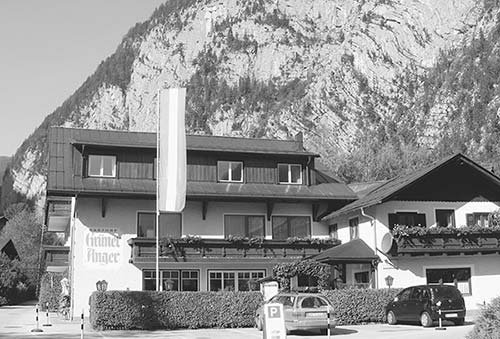
Two good Gästezimmer are just past the bus stop/parking lot and over the bridge. $$ Herta Höll rents a room and two surprisingly modern and spacious apartments with full kitchen on the ground floor of a nondescript riverside house (2-night minimum, cash only, just before the funicular station at Salzbergstrasse 45, +43 676 8394 0843, www.hallstatt-zimmer.com, office@hallstatt-zimmer.com). $ Haus Trausner has three clean, bright, new-feeling rooms adjacent to the Trausner family home (2-night minimum, cash only, breakfast in garden or your room, Lahnstrasse 27, +43 6134 8710, trausner1@aon.at, search for “Haus Trausner” at www.dachstein-salzkammergut.at, charming Maria Trausner makes you want to settle right in).
Eating in Hallstatt
In this town, when someone is happy to see you, they’ll often ask, “Can I cook you a fish?” While everyone cooks the typical Austrian fare, fish is your best bet here. Reinanke (whitefish) is caught wild out of Lake Hallstatt and served the same day. Saibling (lake trout) is also tasty and costs less. You can enjoy good, inexpensive food with delightful lakeside settings. Restaurants in Hallstatt tend to have unreliable hours and close early even during peak season, so don’t wait too long to get dinner. For a mountain-top meal, don’t forget the $$$ Rudolfsturm café at the top of the salt-mine funicular.
$$ Restaurant Bräugasthof, on the edge of the old center, is a bustling restaurant with moody waitstaff and good food. The indoor dining room is cozy in cool weather. On a balmy evening, its great lakeside tables offer the best ambience in town—you can feed the swans while your trout is being cooked (kitchen daily 11:30-20:00, Seestrasse 120, +43 6134 20673).
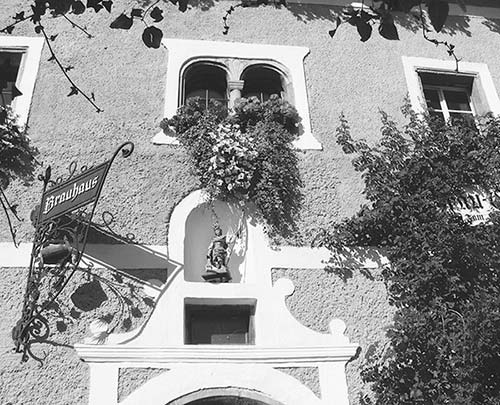
$$$ Hotel Grüner Baum feels upscale, with a more creative seasonal menu and polished service at tables overlooking the lake, inside and out (daily 12:00-21:00, until 22:00 in summer, at bottom of Market Square, +43 6134 82630).
Cheap Eats: The snack stand on the harbor square next to the Protestant church specializes in chicken and döner kebab (with tables and good lakeside picnic options nearby, daily 11:00-late). There are also several informal eateries in the Lahn with meals for under €10, including the Maislinger bakery (€5 sandwiches, Mon-Sat 6:00-18:00, closed Sun, Seestrasse 156), and burger stands by the bus stop and the P2 parking lot.
Groceries: The Nah und Frisch supermarket is in the Lahn across from the bus stop (Mon-Sat 8:00-12:20 & 13:30-18:50, closed Sun, shorter hours off-season).
Hallstatt Connections
BY TRAIN
Most travelers leaving Hallstatt are going to Salzburg or Vienna. In either case, you need to catch the shuttle boat (€3.50, departs 15 minutes before every train) to the little Hallstatt train station across the lake, and then ride 1.5 hours to Attnang-Puchheim (trains depart every 30-90 minutes from about 7:00 to 18:00). After a short wait in Attnang-Puchheim, you’ll catch your onward connection to Salzburg (50 minutes on faster trains, 1.5 hours on slower) or Vienna (2 hours; allow about 4 hours total). The Hallstatt station has a ticket machine, or you can buy tickets online. For schedules, visit www.oebb.at. Ask your hotelier or at the TI if you need help.
BY BUS
The bus ride from Hallstatt to Salzburg is cheaper, more scenic, and no slower than the train. You can still start off from Hallstatt by rail, taking the boat across the lake to the station and then the train toward Attnang-Puchheim—but get off after about 20 minutes in Bad Ischl, where you catch bus #150 to Salzburg (2/hour, 1.5 hours, €11). Alternatively, you can reach Bad Ischl on bus #543/542 from the Hallstatt bus stop (runs about every 2 hours, 40-minute trip, usually an easy change in Gosaumühle) and then catch bus #150 to Salzburg. Plan your trip at www.oebb.at. In Salzburg, bus #150 stops at Hofwirt and Mirabellplatz (convenient to Linzergasse hotels) before terminating at the main train station.
ROUTE TIPS FOR DRIVERS
Hallstatt to Vienna, via Mauthausen, Melk, and Wachau Valley (210 miles): Leave Hallstatt early. Follow the scenic Route 145 through Gmunden to the autobahn and head east. After Linz, take exit #155 at Enns, and follow the signs for Mauthausen (5 miles from the freeway). Go through Mauthausen town and follow the Ehemaliges KZ-Gedenkstätte Lager signs. When leaving Mauthausen for Melk, enjoy the riverside drive along scenic Route 3 (or take the autobahn if you’re in a hurry or prone to carsickness). At Melk, signs to Stift Melk lead to the abbey. Other Melk signs lead into the town.
From Melk (get a Vienna map at the TI), cross the river again (signs to Donaubrücke) and stay on Route 3. After Krems, the riverside route (now the S-5) hits the autobahn (A-22), and you’ll barrel right into Vienna’s traffic. (See here of the Vienna Connections chapter for details.)
Vice Versa: For tips on doing the above trip in reverse (Vienna to Wachau to Mauthausen to Hallstatt), see “Wachau Valley Connections” on here.
From Salzburg: For tips on driving here from Salzburg, see the next section.
Salzkammergut Drive
SALZBURG TO HALLSTATT
This 45-mile scenic driving route from Salzburg to Hallstatt includes worthwhile viewpoints and beautiful Salzkammergut scenery. Without stops, it takes about 1.5 hours. But give yourself time to pull over, enjoy the views, and go for a luge ride. The optional Mondsee detour is worth the extra hour—especially for The Sound of Music fans who’d like to see “the wedding church.” To avoid tolls and maximize scenery, stick to the most direct route (B-158).
From Salzburg to St. Gilgen
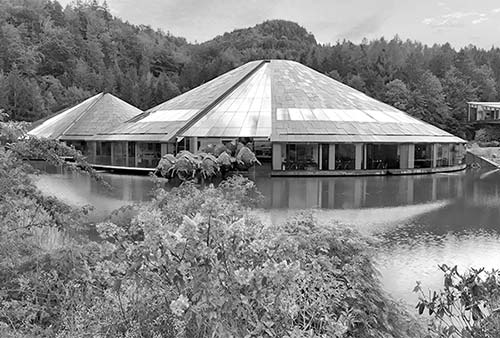
Leave Salzburg on B-158 toward St. Gilgen. About nine miles later, after passing through the town of Hof bei Salzburg, you’ll enjoy fine views (on the left) of the first of the Salzkammergut lakes: Fuschlsee. You’ll curl along the top of the lake, then head down along the lakeside. As you reach the end of the lake and the village of Fuschl, watch on the right for the Red Bull Headquarters—a glassy complex that’s completely unmarked except for the herd of giant bronze bulls charging into the artificial lake. Dietrich Mateschitz founded Red Bull in the 1980s; at the time of his death in October 2022, the energy drink magnate was Austria’s richest man (net worth: more than €20 billion) with a company employing 10,000 people—many of them in this building. Mateschitz owned several sports teams (ice hockey, car racing, and multiple soccer teams) and collected airplanes, race cars, and other expensive vehicles—you can see his collection at Hangar-7 near Salzburg’s airport (see here).
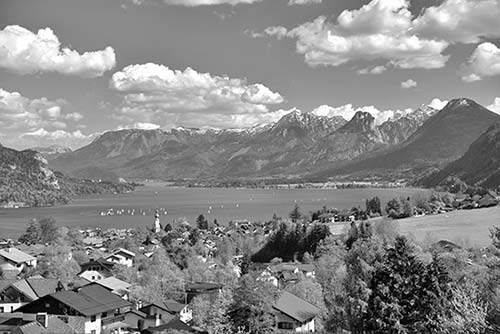
After Fuschl you’ll crest a little saddle between lakes. As you descend and the second lake comes into view, keep an eye out for a P (parking area) sign on the right, then turn into the pullout (it comes up quickly) for a grand view over the Wolfgangsee (you’ll also find a picnic table and WC). On the left is the peak called Schafberg—accessible by a long, slow cogwheel train (featured in The Sound of Music) from the town of St. Wolfgang to the cliff-capping Hotel Schafbergspitze, faintly visible in clear weather. Below and on the right is the town of St. Gilgen—which we’ll pass through soon—with a cable car up to the other side of the lake.
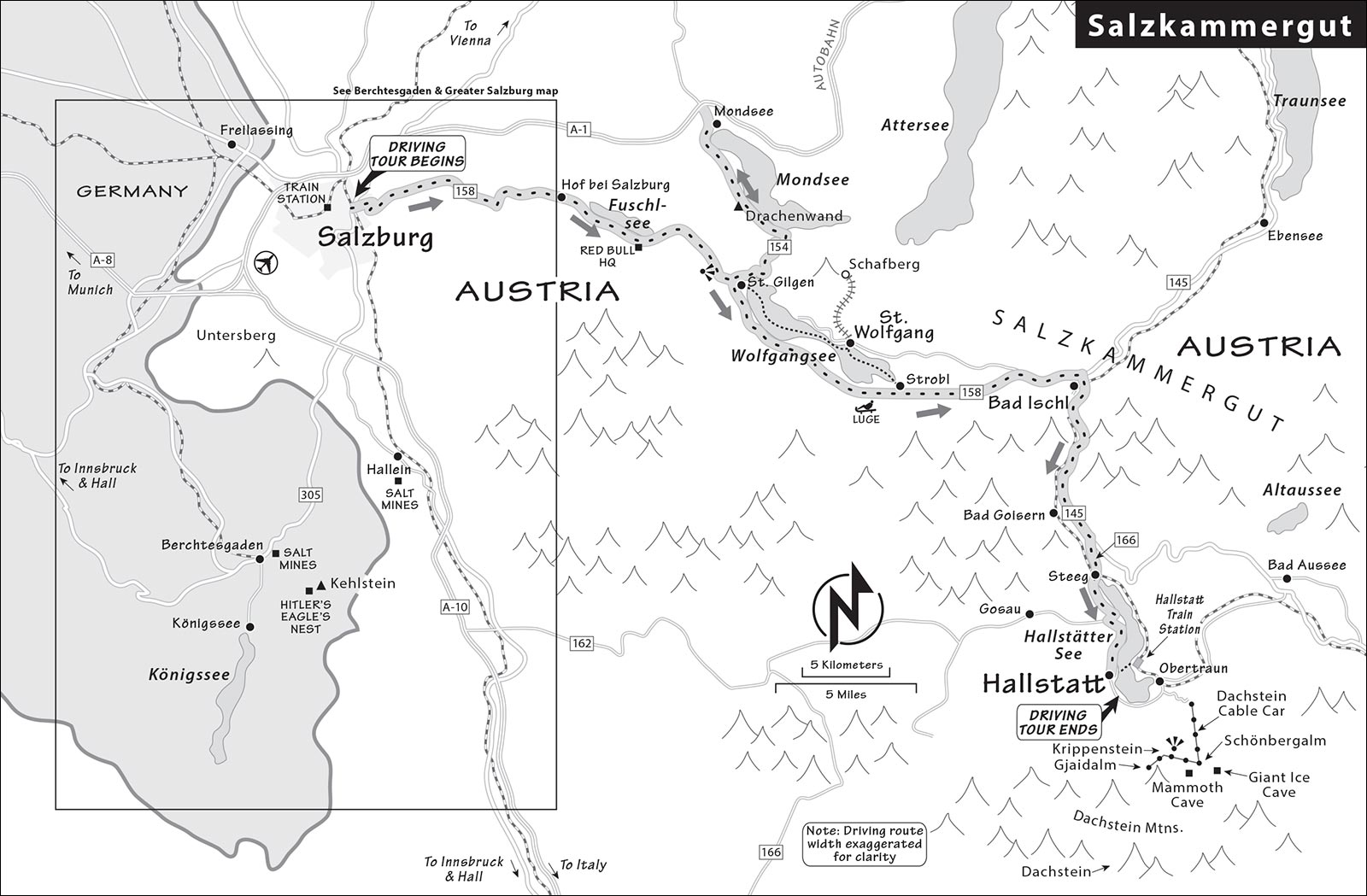
Continuing along the road, coast down into the main roundabout of St. Gilgen (a giant TI is just off one exit—handy for regional information). At the roundabout you can turn off for Mondsee (on Route 154); this detour, described next, adds about an hour (30 minutes of driving, plus 30 minutes to see the town and church). Otherwise, continue through the roundabout to stay on B-158, and skip down to the “From St. Gilgen to Hallstatt” section.
Mondsee Detour
Following Route 154, you’ll drive north and soon reach the shore of Mondsee (“Moon Lake,” named for its crescent shape). As the road swings left along the lakefront, keep an eye on the left for the jagged peak called Drachenwand (“Dragon Wall”)—which looks frightful from across the lake when lit up by a full moon.
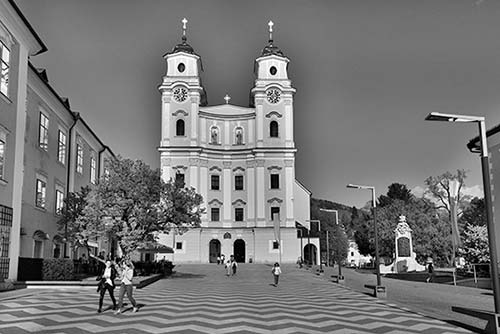
Finally you’ll reach the little town of Mondsee, which feels made-to-order for The Sound of Music pilgrims. Here you’ll find the Basilica of St. Michael—better known as “the wedding church,” where Fräulein Maria married Baron von Trapp. Built in Romanesque style in the eighth century, St. Michael’s was refurbished in bubbly Baroque for its millennial celebration in the mid-1700s. Renovated again since then, it’s beautiful inside and out. Only the interior, with its striking pink-and-brown color scheme, appears in the movie (donation requested, daily April-Oct 8:00-20:00, Nov-March until 18:00, http://www.pfarre-mondsee.at). In front of the church is a pleasant little pedestrian zone jammed with al fresco cafés (for an Apfelstrudel), tacky gift shops, benches, and playful fountains. Of several free parking lots in Mondsee, the Schlosshof lot is closest to the church; put the street name “Schlosshof” into your GPS to reach it.
From Mondsee, backtrack to St. Gilgen on the Wolfgangsee (or, to cut the Salzkammergut circuit short, it’s easy to hop on the A-1 expressway at the top of town and head back to Salzburg or on to Vienna).
From St. Gilgen to Hallstatt
After your Mondsee detour—or if you choose to skip it—stay on B-158, which curves through St. Gilgen along the Wolfgangsee’s south shore. This main road crosses under the cable car, and then—after you exit town—passes many fine viewpoints and pullouts along the lake. A good bike-and-walking path follows the road and lakeshore.
Nearing the end of the lake, after the village of Abersee, keep an eye on the right for a Sommerrodelbahn sign pointing up a side lane—marking the best luge ride in the area. (If you have GPS—a big help here—set it for “Gschwendt 268.”) At 4,265 feet long and with grand lake views, this luge is one of the region’s top rides (€8/ride, less for kids and with multiride cards, figure 20 minutes for the ride up and down; open May-Oct daily 10:00-17:00, July-Aug until 19:00, closed in bad weather; Gschwendt 268 in Strobl; +43 6137 7085, www.rodelnamsee.at). Grab a folding go-cart, set it on the track, then sit backward as the ski lift slowly drags you up the hill. At the top, you’ll take one of two tracks (each equally as fast) and scream down the winding metal course. It’s easy: Push the stick to go, pull to stop, take your hands off your stick and you get hurt. For more details, see “Luge Lesson” on here.
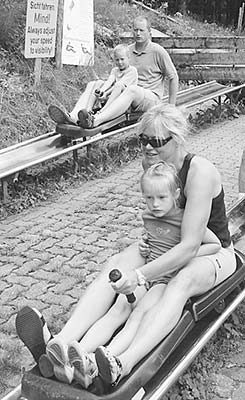
After the luge, the road continues through the village of Strobl, then through a valley. Soon you’ll reach the large spa resort of Bad Ischl. On your way through town, the highway tunnels beneath the Kaiservilla—a favorite retreat for Emperor Franz Josef to get away for a relaxing soak (and handy if you need a Habsburg history fix, www.kaiservilla.at). It was here that the emperor signed the declaration of war that kicked off World War I.
Exiting the tunnel, be ready to turn off for Route 145: At the fork, stay in the right lane, marked for Graz. (Hallstatt appears on most, but not all, signs—when in doubt, follow Goisern.) From here on out, you’ll follow mountain rivers as the scenery crescendos. After Bad Goisern, the road forks—turn off on B-166 and follow Hallstatt signs.
Soon you’ll be driving along the shore of the fjord-like Hallstättersee. When you approach Hallstatt, you’ll be swallowed up by a tunnel that bypasses the town center. Emerging in the Lahn area, follow signs to your preferred lot: P1 for hotel guests, P2 for others. Welcome to Hallstatt.