ST. STEPHEN’S CATHEDRAL TOUR
This massive church is the Gothic needle around which Vienna spins. According to the medieval vision of its creators, it stands like a giant jeweled reliquary, offering praise to God from the center of the city. The church and its towers, especially the 450-foot south tower, give the city its most iconic image. (Check your pockets for €0.10 coins; those minted in Austria feature the south tower.) The cathedral has survived Vienna’s many wars and today symbolizes the city’s spirit and love of freedom.
Orientation
Cost: It’s free to enter the foyer and north aisle of the church, but it costs €6 to get into the main nave, where most of the interesting items are located. The south and north towers and catacombs (all described later) cost extra. The €20 combo-ticket covers everything but is overkill for most visitors.
Hours: The church doors are open daily 6:00-22:00, but the main nave is open for tourists Mon-Sat 9:00-11:30 & 13:00-16:30, Sun 13:00-16:30, July-Aug until 17:30. During services, when the main nave is reserved for worshippers, you can look into the church from the back.
Information: +43 1 515 523 054, www.stephanskirche.at.
Tours: Entry fee includes audioguide.  Or download my free St. Stephen’s Cathedral audio tour.
Catacombs: The catacombs are open to the public only by guided tour (€6, daily 10:00-11:30 & 13:30-16:30, tours generally depart on the half-hour and are in German and English together). Just be at the stairs in the left/north transept to meet the guide—you’ll pay at the end. You’ll see a crypt for bishops and archbishops, and Crock-Pots of Habsburg guts filling dusty shelves.
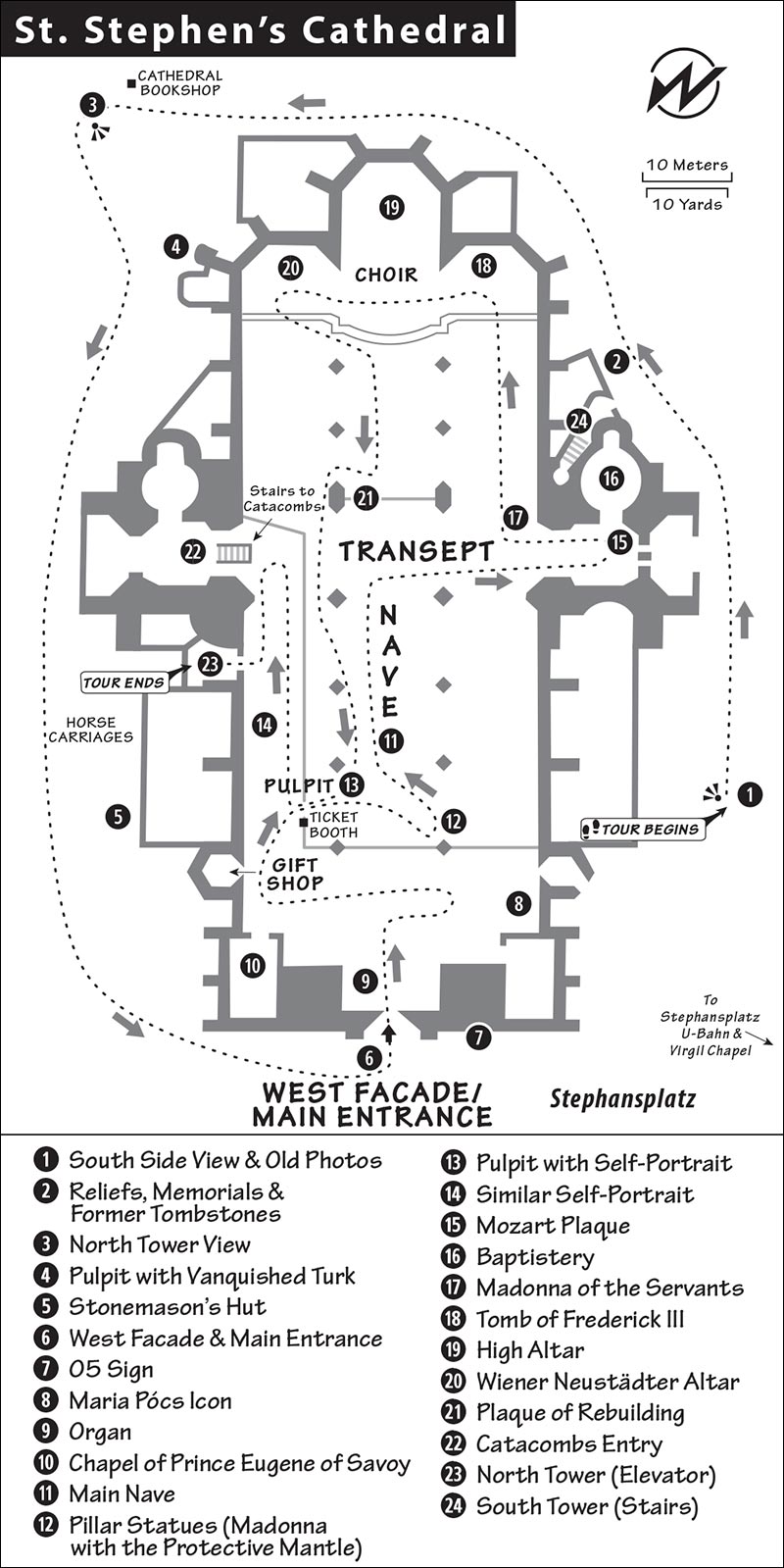
Towers: The iconic south tower rewards a tough climb up a claustrophobic, 343-step staircase with dizzying views through windows near the top. You can reach it via the entrance outside the church, around the right as you face the west facade (€5.50, daily 9:00-17:30).
The shorter north tower holds the famous “Pummerin” bell, and you ascend via elevator (no stairs). While not as high as the south tower, the views are still great (€6, daily 9:00-20:30, entrance inside the church on the left/north side of the nave; you can access this elevator without buying a ticket for the main nave).
English Mass: Each Saturday at 19:00.
Theft Alert: All the commotion in and around the church makes it a favorite for pickpockets. Be on guard.
Starring: The cathedral’s mighty exterior and evocative interior, including an ornately carved pulpit and various bits and pieces of Austrian history.
The Tour Begins
CATHEDRAL EXTERIOR
Before we go inside, let’s circle around the cathedral for a look at its impressive exterior. We’ll stop at several points along the way to take it all in.
1 South Side
• As you face the church’s main entry, go to the right across the little square. From here, you can absorb the sheer magnitude of this massive church, with its skyscraping spire.
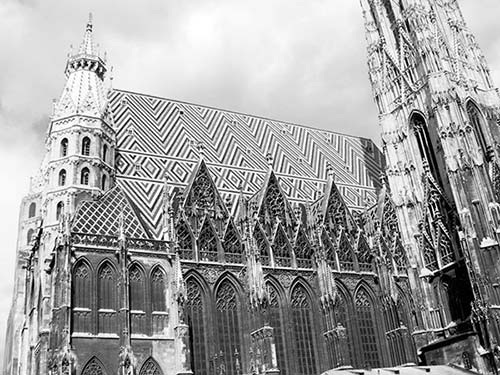
The church we see today is the third one on this spot. A tall, black, glassy info post describes the Virgil Chapel that stood here 800 years ago. Its dank shell survives today below your feet, viewable from the nearby U-Bahn station. Today’s church dates mainly from 1300 to 1450, when builders expanded on an earlier structure and added two huge towers at the end of each transept. When it was built, St. Stephen’s—covering almost an acre of land—was a huge church for what was then just a modest town of 10,000. The ruler who built the church was competing with St. Vitus Cathedral, which was being built at the same time in Prague; he made sure that Vienna’s grand church was bigger than Prague’s. This helped convince the region’s religious authorities that Vienna deserved a bishop, thus making St. Stephen’s a “cathedral.” Politically, this helped Vienna become a city to be reckoned with, and it soon replaced Prague as the seat of the Holy Roman Empire.
The impressive 450-foot south tower—capped with a golden orb and cross—took 65 years to build and was finished in 1433. The tower is a rarity among medieval churches in that it was completed before the Gothic style—and the age of faith—petered out.
Find the Turkish cannonball stuck in a buttress (above the low, green roof on the middle buttress, marked with the date 1683)—a souvenir from one of several Ottoman sieges of the city.
The nave’s sharply pitched roof stands 200 feet tall and is covered in 230,000 colorful ceramic tiles. The zigzag pattern is purely decorative, with no special symbolism.
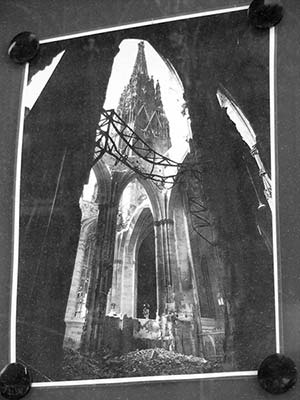
The cathedral was heavily damaged at the end of World War II. (Near where you are standing, at the base of the tower, there may be old photos showing the destruction.) In 1945, Vienna was caught in the chaos between the occupying Nazis and the approaching Soviets. Allied bombs sparked fires in nearby buildings, and the embers leapt to the cathedral rooftop. The original timbered Gothic roof burned, the cathedral’s huge bell crashed to the ground, and the fire raged for two days. Civic pride prompted a financial outpouring, and the roof was rebuilt to its original splendor by 1952—doubly impressive considering the bombed-out state of the impoverished country at that time. Locals who contributed to the postwar reconstruction each had a chance to “own” one tile for their donation. Inside, we’ll see a plaque honoring the rebuilding of the cathedral.
The little buildings lining the church exterior are sacristies (utility buildings used for running the church).
• Circle the church exterior counterclockwise, passing the entrance to the south tower (the 343-step tower climb is described at the end of this chapter).
Just past the tower entrance, look for the carved 2 reliefs and memorials and former tombstones now decorating the church wall. These are a reminder that the area around the church was a graveyard until the 18th century when it was cleaned out for health concerns.
• As you hook around behind the church, pause at the cathedral bookshop (Dombuchhandlung) at the far corner of the square.
3 North Tower View
This spot provides a fine, wide-angle view of the stubby north tower and the apse of the church. From this vantage point, you can see the exoskeletal fundamentals of Gothic architecture: buttresses shoring up a very heavy roof, allowing for large windows that could be filled with stained glass to bathe the interior in colorful light. A battalion of storm-drain gargoyles stands ready to vomit water during downpours. Colored tiles on the roof show not the two-headed eagle of Habsburg times (as on the other side), but two distinct eagles of modern times (1950): the state of Austria on the left and the city of Vienna on the right.
Just above street level, notice the marble 4 pulpit under the golden starburst. Political ranting against other religions was only allowed outside the church. So, the priest would stand here, stoking public opinion against the Muslim Ottomans (or Jews or Protestants), in front of crowds far bigger than could fit into the church. Above the pulpit (in a scene from around 1700), a saint stands victoriously atop a vanquished Turk.
• Continue circling the church, passing a line of horse carriages waiting to take tourists for a ride (€55 for 20 minutes). Watch for the blocky, modern-looking building huddled next to the side of the cathedral. This is the...
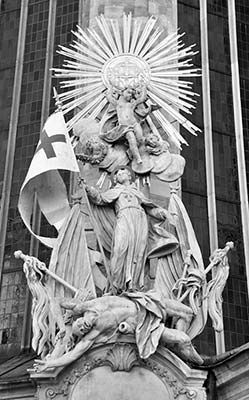
5 Stonemason’s Hut
There’s always been a stonemason’s hut here, as workers must keep the church in good repair. Even today, the masonry is maintained in the traditional way—a never-ending task. Unfortunately, the local limestone used in the Middle Ages is quite porous and absorbs modern pollution. Until the 1960s, this was a very busy traffic circle, and today’s acidic air still takes its toll. Each winter, when rainwater soaks into the surface and then freezes, the stone corrodes—and must be repaired. Your church entry ticket helps fund this ongoing work.
Across the street (past the horse carriages) is the archbishop’s palace, where the head of this church still lives today (enjoying a very short commute).
• Around the corner is the cathedral’s front door. Stand at the back of the square, across from the main entrance, to take in the entire...
6 West Facade
The Romanesque-style main entrance includes bits of the oldest part of the church (which stood here in the 1200s). Right behind you is the site of Vindobona, a Roman garrison town. Before the Romans converted to Christianity, there was a pagan temple here, and this entrance pays homage to that ancient heritage. Roman-era statues are embedded inside the facade, and the two octagonal towers flanking the main doorway are dubbed the “heathen towers” because they’re built with a few recycled Roman stones (flipped over to hide the pagan inscriptions and expose the smooth sides).
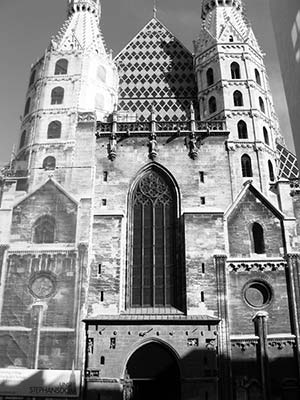
Ten yards to the right of the main doorway, about chest high, is the symbol 7 “O5,” carved into the wall by anti-Nazi rebels (behind the Plexiglas, under the first plaque). The story goes that Hitler—who grew up in Austria—spurned his roots. When he attained power, he refused to call the country “Österreich,” its native name, insisting on the Nazi term “Ostmark.” Austrian patriots wrote the code “O5” to keep the true name alive: The “5” stands for the fifth letter of the alphabet (E), which often stands in for an umlaut, giving the “O” its correct pronunciation for “Österreich.”
Step up to the main door. Before entering, study the details overhead. Christ—looking down from the tympanum—is triumphant over death. Flanked by angels with dramatic wings, he welcomes all. Ornate, tree-like pillars support a canopy of foliage and creatures, all full of meaning to the faithful medieval worshipper. The fine circa-1240 carvings above the door were once brightly painted. The paint was scrubbed off in the 19th century, when pure stone was more in vogue.
• Enter the church.
CATHEDRAL FOYER
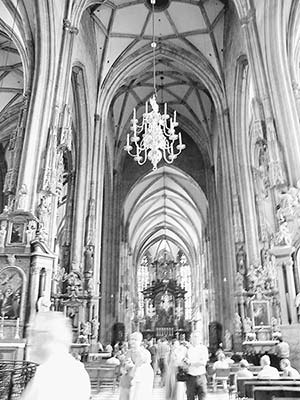
Find a spot to peer through the gate down the immense nave—more than a football field long and nine stories tall. It’s lined with clusters of slender pillars that soar upward to support the ribbed crisscross arches of the ceiling. Stylistically, the nave is Gothic with a Baroque overlay. It’s a spacious, glorious venue that’s often used for high-profile concerts; check the “Concerts” page at StephansKirche.at to see what’s on. We’ll venture down the main nave soon, but first, take some time to explore the foyer area.
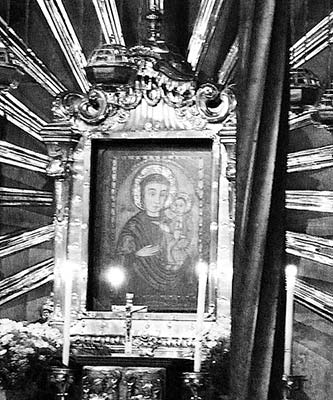
To the right as you enter, in a gold-and-silver sunburst frame, is a crude Byzantine-style 8 Maria Pócs Icon (Pötscher Madonna), brought here from a humble Hungarian village church. The picture of Mary and Child is said to have wept real tears in 1697, as Central Europe was once again being threatened by the Turks. (Skeptics note it’s painted on wood and the “tears” may have been resin beading up.) Prince Eugene of Savoy (described below) saved the day at the stunning Battle of Zenta in modern-day Serbia—a victory that broke the back of the Ottoman army. If you see crowds of pilgrims leaving flowers or lighting candles around the icon, they’re most likely Hungarians thanking the Virgin for helping Prince Eugene drive the Ottomans out of their homeland.
Over the main doorway is the choir loft, with the 12,000-pipe 9 organ, a 1960 replacement for the famous one destroyed during World War II. This organ, among Europe’s biggest, was recently restored after being silent for 25 years.
Along the left wall is the gift shop. Step in to marvel at the 14th-century statuary decorating its wall—some of the finest carvings in the church.
To the left of the gift shop is the gated entrance to the 10 Chapel of Prince Eugene of Savoy. Prince Eugene (1663-1736), a seminary student from France, arrived in Vienna in 1683 as the city was about to be overrun by the Ottoman Turks. He volunteered for the army and helped save the city, launching a brilliant career as a military man for the Habsburgs. His specialty was conquering the Ottomans. He was well-rewarded and eventually owned six palaces in and around Vienna including the Belvedere. When he died, the grateful Austrians buried him here, under this chapel, marked by a tomb hatch in the floor.
• Nearby is the entrance to the 11 main nave. Buy a ticket and walk to the center.
MAIN NAVE
• Looking down the nave, note the statues on the columns (about 30 feet above the ground).
12 Pillar Statues
The nave’s columns are richly populated with 77 life-size stone statues, making a saintly parade to the high altar.
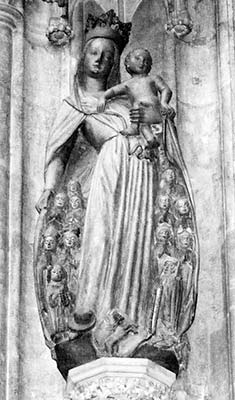
Check out the first pillar on the right (directly above the black metal fence). Facing the wall is the Madonna with the Protective Mantle, shown giving refuge to people of all walks of life (notice the many happy people of faith tucked under her cape). Also on that same pillar, find Moses with the Ten Commandments (to the left of the Madonna). On other columns, Bible students can find their favorite characters and saints—more Madonnas, St. George (killing the dragon), St. Francis of Assisi, arrow-pierced St. Sebastian, and so on.
• Start down the nave toward the altar. At the second pillar on the left is the...
13 Pulpit
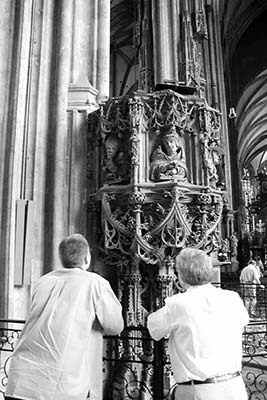
The Gothic sandstone pulpit (c. 1500) is a masterpiece carved from three separate blocks (see if you can find the seams). A spiral stairway winds up to the lectern, surrounded and supported by the four “Latin Church Fathers,” who translated the Bible into Latin in the fourth century (making it more widely accessible to the faithful) and whose writings influenced early Catholic dogma. Each has a very different and very human facial expression (from back to front): Ambrose (daydreamer), Jerome (skeptic), Gregory (explainer), and Augustine (listener).
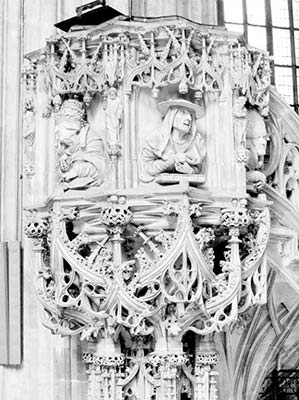
The pulpit is as crammed with religious meaning as it is with beautifully realistic carvings. The top of the stairway’s railing swarms with lizards and toads—symbols of corrupt teaching. The “Dog of the Lord” stands at the top, making sure none of those toads pollutes the sermon. Below the toads, wheels with three parts (the Trinity) roll up, while wheels with four spokes (the four seasons and four cardinal directions, symbolizing mortal life on earth) roll down.
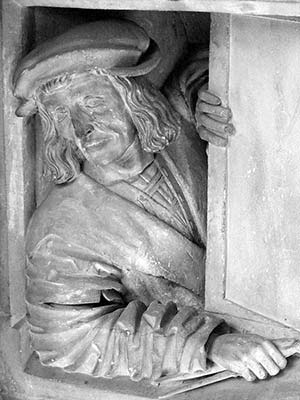
Find the guy peeking out from under the stairs. This may be a self-portrait of the sculptor. In medieval times, art was done for the glory of God, and artists worked anonymously. But this pulpit was carved as humanist Renaissance ideals were creeping in from Italy—and individual artists were becoming famous. So the artist included what may be a rare self-portrait bust in his work. He leans out from a window, sculptor’s compass in hand, to observe the world and his work. The artist, long thought to be Hungarian mason Anton Pilgram, is now believed to be the Dutch sculptor Nicolaes Gerhaert van Leyden; both worked extensively on the cathedral.
About 20 paces toward the front, peering out from the left wall (about 15 feet up), is a similar 14 self-portrait of the architect in color. He holds a compass and L-square and symbolically shoulders the heavy burden of being a master builder of this huge place.
• Continue up the nave. We’ll visit several sights at the front of the church, moving in a roughly counterclockwise direction.
Halfway up the nave, turn right and enter the south transept. Go all the way to the doors, then look left to find the...
15 Mozart Plaque
A plaque on the wall honors one of Vienna’s most famous citizens—Wolfgang Amadeus Mozart, who had strong ties to this cathedral (see sidebar).
Look into the adjacent chapel at the fine 16 baptistery (stone bottom, matching carved-wood top, from around 1500). This is where Mozart’s children were baptized.
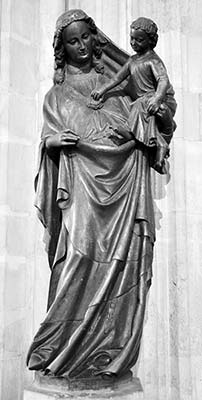
On the right-hand column near the entrance to the south transept, notice the fine carved black stone statue of the 17 Madonna of the Servants (from 1330). This remains a favorite of working people.
• Now walk down the right aisle to the front. Dominating the chapel at the front-right corner of the church is the...
18 Tomb of Frederick III
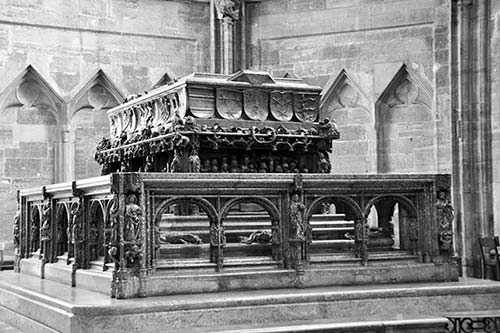
This imposing, red-marble tomb is like a big king-size-bed coffin with an effigy of Frederick lying on top (not visible—but there’s a photo of the effigy on the left). The top of the tomb is decorated with his coats of arms, representing the many territories he ruled over. It’s by the same Nicolaes Gerhaert van Leyden who likely sculpted the pulpit.
Frederick III (1415-1493) is considered the “father” of Vienna for turning the small village into a royal city with a cosmopolitan feel. Frederick secured a bishopric, turning the newly completed St. Stephen’s church into a cathedral. The emperor’s major contribution to Austria, however, was in fathering Maximilian I and marrying him off to Mary of Burgundy, instantly making the Habsburg Empire a major player in European politics. This lavish tomb (made of marble from Salzburg) is as long-lasting as Frederick’s legacy. To make sure it stayed that way, locals saved his tomb from damage during World War II by encasing it in a shell of brick.
• Walk to the middle of the church and face the...
19 High Altar
The tall, ornate, black marble altarpiece (1641, by Tobias and Johann Pock) is topped with a statue of Mary that barely fits under the towering vaults of the ceiling. It frames a large painting of the stoning of St. Stephen, painted on copper. Stephen (at the bottom), having refused to stop professing his faith, is pelted with rocks by angry pagans. As he kneels, ready to die, he gazes up to see a vision of Christ, the cross, and the angels of heaven. The stained glass behind the painting—some of the oldest in the church—creates a kaleidoscopic jeweled backdrop.
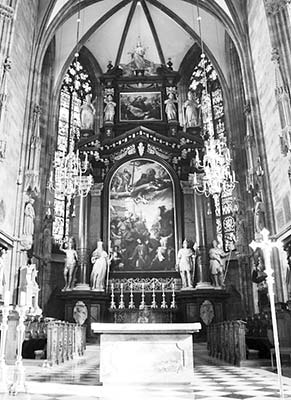
Turn 180 degrees and look back for a view of the nave (not cluttered by the many Baroque chapels added in the 17th and 18th centuries, which are hidden behind the columns from this angle). What you see here is pretty close to a pure Gothic aesthetic.
• Ten steps to the left of the main altar is the...
20 Wiener Neustädter Altar
The triptych altarpiece—the symmetrical counterpart of Frederick III’s tomb—was commissioned by Frederick in 1447. Its gilded wooden statues are especially impressive.
• Return to the high altar and walk back up the middle of the nave. When you reach the third set of pillars, look immediately to the right (on the column with the black gate attached). About 10 feet above the ground is the...
21 Plaque of Rebuilding
St. Stephen’s is proud to be Austria’s national church. The plaque explains in German how each region contributed to the rebuilding after World War II: Die Glocke (the bell) was financed by the state of Upper Austria. Das Tor (the entrance portal) was from Steiermark, the windows from Tirol, the pews from Vorarlberg, the floor from Lower Austria, and so on.
During World War II, many of the city’s top art treasures were stowed safely in cellars and salt mines—hidden by both the Nazi occupiers (to protect against war damage) and by citizens (to protect against Nazi looters). The stained-glass windows behind the high altar were meticulously dismantled and packed away. The pulpit was encased, like the tomb of Frederick III, in a shell of brick. As the war was drawing to a close, it appeared St. Stephen’s would escape major damage. But as the Nazis were fleeing, the bitter Nazi commander in charge of the city ordered that the church be destroyed. Fortunately, his underlings disobeyed. Unfortunately, the church accidentally caught fire during Allied bombing shortly thereafter, and the wooden roof collapsed onto the stone vaults of the ceiling. The Tupperware-colored glass on either side of the nave dates from the 1950s.
From this spot consider the history St. Stephen’s Cathedral has seen—and survived—as the towering centerpiece of this grand European capital.
• Your cathedral tour is over. Head back toward the main entrance. Along the north side of the nave, you have two options: Tour the catacombs or ascend the north tower (both described below). Or you can head outside for the pulse-raising climb up the south tower.
OTHER CATHEDRAL SIGHTS
• Near the middle of the church, at the left/north transept, is the entrance to the...
22 Catacombs
The catacombs (viewable by guided tour only) hold the bodies—or at least the innards—of 72 Habsburgs, including that of Rudolf IV, the man who began building the south tower. This is where Austria’s rulers were buried before the Kaisergruft was built (described in the Sights in Vienna chapter), and where later Habsburgs’ entrails were entombed. The copper urns preserve the imperial organs in alcohol. I touched Maria Theresa’s urn and it wobbled.
• Also in the north nave, but closer to the cathedral’s main door, is the entrance for the north tower (look for the Aufzug zur Pummerin sign).
23 North Tower
The cramped north tower elevator takes you to a fine (and sweat-free) view of the colorful cathedral rooftop, the city, and the Vienna Woods (which mark the start of a little mountain range called the Alps). And you get a close look at a very big bell. Nicknamed “the Boomer” (Pummerin), it’s old (first cast in 1711), big (nearly 10 feet across), and very heavy (21 tons). By comparison, the Liberty Bell is four feet across and weighs one ton. It’s supposedly the second-biggest bell in the world that rings by swinging. A physical symbol of victory over the Ottomans in 1683, the Pummerin was cast from cannons (and cannonballs) captured from the Ottomans when the siege of Vienna was lifted. During the WWII fire that damaged the church, the Pummerin fell to the ground and cracked. It had to be melted down and recast. These days, locals know the Pummerin as the bell that rings in the Austrian New Year. You’ll see its original 1,700-pound clapper in the catacombs if you take that tour.
• Exit the church. Make a U-turn to the left if you’re up for a climb up the...
24 South Tower
The 450-foot-high south tower, once key to the city’s defense as a lookout point, is still dear to Viennese hearts. (It’s long been affectionately nicknamed “Steffl,” Viennese for “Stevie.”) No church spire in what was the Austro-Hungarian Empire is taller—by Habsburg decree. It offers a far better view than the north tower, but you’ll earn it by hiking 343 tightly wound steps up the spiral staircase (burning about one Sacher torte’s worth of calories). From the top, use your city map to locate the famous sights. There are great views of the colorful church roof, the low-level Viennese skyline (major skyscrapers are regulated in the city center), and—in the distance—the Vienna Woods.
• The oldest part of this sight is inside the nearby U-Bahn station.
Virgil Chapel
Before today’s cathedral was built, a humble Romanesque chapel (circa 1200) stood adjacent to the site. It was excavated in 1972 and is tourable today. It has a few surviving wall frescoes and a tiny museum with medieval artifacts under its 35-foot-tall arches. Access is via the Stephansplatz U-Bahn station, underground in front of the cathedral (€5, includes audioguide, Tue-Sun 10:00-18:00, closed Mon).