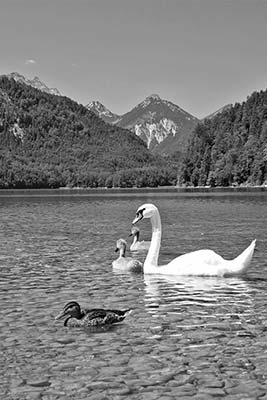
BAVARIAN ALPS
The King’s Castles: Neuschwanstein and Hohenschwangau
Map: Reutte Hotels & Restaurants
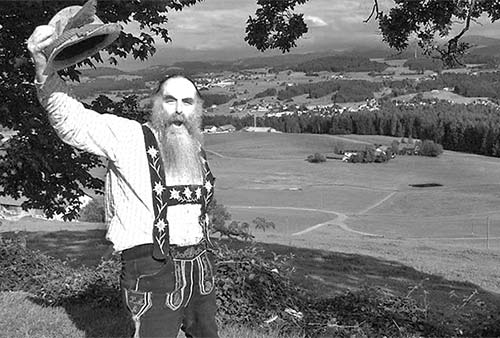
In this picturesque corner of the Alps, you’ll find a timeless land of fairy-tale castles, painted buildings shared by cows and farmers, and locals who still dress in dirndls and lederhosen and yodel when they’re happy.
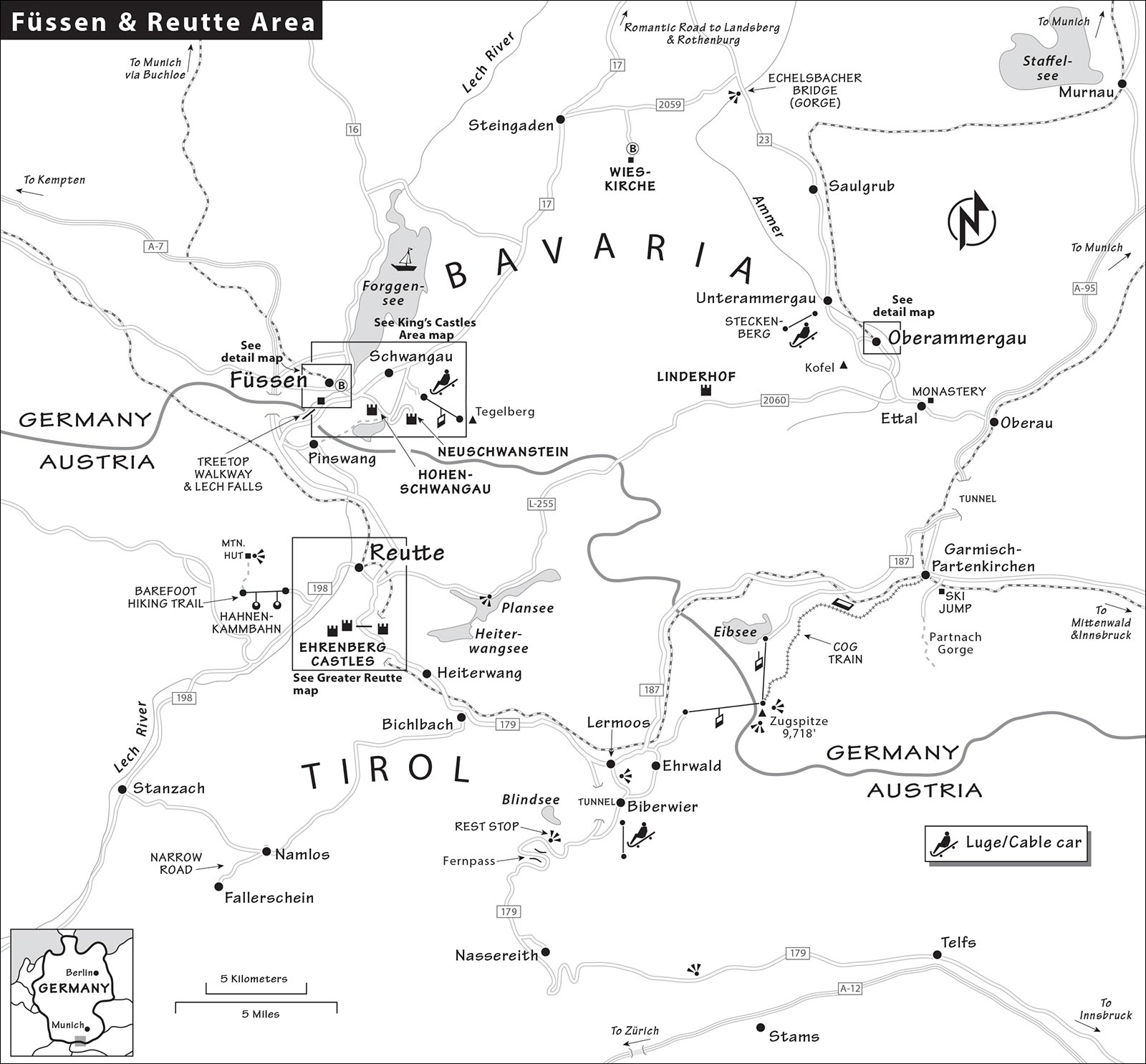
This area (1.5 hours northwest of Innsbruck) straddles the border between Bavaria (part of Germany) and Tirol (part of Austria). On the German side, you can tour “Mad” King Ludwig II’s ornate Neuschwanstein Castle, Europe’s most spectacular. Stop by the Wieskirche, a lavishly decorated Baroque church, and browse through Oberammergau, Germany’s woodcarving capital and home of the famous Passion Play (next performed in 2032). A smaller yet still-impressive Ludwig castle (Linderhof), an important monastery (Ettal), and the highest point in Germany (Zugspitze) round out southern Bavaria’s top attractions.
Just over the border in Austria, you can explore the ruined Ehrenberg Castle and scream down a mountain at one of the area’s many luge runs. In this chapter, I’ll first cover the German side (with the most sights), then the Austrian side around Reutte.
CHOOSING A HOME BASE
My hotel recommendations in this chapter cluster in three areas: Füssen and Oberammergau (in Germany), and Reutte (in Austria). When selecting a home base, consider these factors:
Füssen offers the easiest access to the region’s biggest attraction—the “King’s Castles” (Neuschwanstein and Hohenschwangau)—and is the handiest base for train travelers. The town itself is a mix of real-world and cutesy-cobbled, and has some of the glitziest hotels in the area (as well as more affordable options).
Oberammergau is the best-known, most touristy, and cutest town of the bunch. World-famous for its once-per-decade Passion Play, it’s much sleepier the other nine years. It’s a long bus ride or a 45-minute drive from Oberammergau to the King’s Castles. Three lesser yet worthwhile sights are close by: Ettal Monastery, Linderhof Castle, and the German lift to the Zugspitze.
Reutte is the least appealing town and is less practical for train travelers, but the villages around it are home to the coziest, most pleasant rural accommodations—making it a good option for drivers. Reutte butts up against the ruined Ehrenberg Castle. The King’s Castles, Linderhof, and the Austrian approach to the Zugspitze are all within a 30-minute drive.
PLANNING YOUR TIME AND GETTING AROUND THE BAVARIAN ALPS
While Germans and Austrians vacation here for a week at a time, the typical speedy American traveler will find two days’ worth of sightseeing. With a car and more time, you could enjoy three or four days, but a three-night, two-day stay is sufficient. If the weather’s good, be sure to ride a lift to an alpine peak.
By Car
This region is best by car, and all the sights are within an easy 60-mile loop from Füssen or Reutte. Even if you’re doing the rest of your trip by train, consider renting a car for your time here (for local rental offices, see here). Here’s a good plan for a one-day circular drive from Reutte (from Füssen, you can start about 30 minutes later):
| 8:30 | Depart hotel (breakfast at hotel) |
| 9:00 | Arrive at the King’s Castles (Neuschwanstein and Hohenschwangau) |
| 9:30 | Tour Hohenschwangau |
| 11:30 | Tour Neuschwanstein |
| 13:30 | Drive to Oberammergau (with a 15-minute stop at the Wieskirche), and spend an hour there browsing the carving shops and grabbing a quick lunch |
| 15:30 | Drive to Ettal Monastery for a half-hour stop |
| 16:30 | Tour Linderhof Castle |
| 18:30 | Drive along the scenic Plansee lake |
| 19:30 | Back at hotel |
| 20:00 | Dinner |
Off-season (mid-Oct-March), start your day an hour later—Neuschwanstein and Hohenschwangau tours usually don’t depart until 10:00—and skip Linderhof, which closes at 16:30.
The next morning, you could stroll through Reutte, hike to the Ehrenberg ruins and the pedestrian bridge, and ride a mountain luge on your way to your next destination.
If you’re based in Oberammergau instead, get an early start and hit Neuschwanstein and Hohenschwangau first. If the weather’s good, hike to the top of Ehrenberg Castle (in Reutte). Drive along the Plansee and tour Linderhof and Ettal Monastery on your way back home.
By Public Transportation
Where you stay determines which sights you can see most easily. Train travelers use Füssen as a base and bus or bike the three miles to the King’s Castles and the Tegelberg luge or cable car. Staying in Oberammergau gives you easy access to Linderhof and Ettal Monastery, and you can day-trip to the top of the Zugspitze via Garmisch-Partenkirchen. Reutte is the least convenient base if you’re carless, but travelers staying there can easily bike or hike to the Ehrenberg ruins and can reach Neuschwanstein by bus (via Füssen) or bike (1.5 hours); if you stay at the recommended Gutshof zum Schluxen (between Reutte and Füssen, in Pinswang, Austria) it’s an easy 1.5-hour hike through the woods to Neuschwanstein.
Visiting sights farther from your home base by local bus requires planning. The Deutsche Bahn (German Railway) website (www.bahn.com) is a helpful tool when planning your journey, on both sides of the border. (Schedules are also available in German at www.dbregiobus-bayern.de.) Those staying in Füssen can day-trip by bus to Reutte and the Ehrenberg ruins (but you’ll have to taxi back to the train station to catch the return bus to Füssen), to the Wieskirche, or, with some planning, to Oberammergau. From Oberammergau you can reach Neuschwanstein and Füssen by bus if you plan ahead. From Reutte you can take the train to Ehrwald to reach the Zugspitze from the Austrian side, but side trips to Oberammergau and Linderhof are impractical.
If you’ll be taking multiple trains in Bavaria, consider the Bayern-Ticket: It covers buses and slower regional trains throughout Bavaria for up to five people at a very low price (€26/day for the first person plus €8 for each additional person).
By Bike
This is great biking country. Some hotels loan bikes to guests, and shops in Reutte and Füssen rent bikes for €15-20 per day. The ride from Füssen or Reutte to Neuschwanstein and the Tegelberg luge (1.5 hours) is a breeze. Simply joyriding in the meadows that stretch out from Neuschwanstein is unforgettable. For a bit more adventure, consider a ride around the Forggensee (about 3 hours; see “Activities near Füssen,” later) or the Hopfensee (1-2 hours). The Füssen TI has a map with a multitude of biking tours.
By Tour
Without a car, House LA’s full-day tour of Neuschwanstein, Hohenschwangau, Linderhof, and Oberammergau from Füssen can be a time-efficient option (from €90/person—price includes Neuschwanstein and Linderhof admission but not Hohenschwangau, +49 170 624 8610, www.fussen-info.com). They also offer private, half-day, and bike tours; book at least two days in advance; tours depart from House LA at 9:00—see listing in “Sleeping in Füssen,” later.
HELPFUL HINTS
Palace Sightseeing Pass: The Bavarian Palace Department offers a 14-day ticket (the Mehrtagesticket) that covers admission to Neuschwanstein (but not Hohenschwangau) and Linderhof, as well as many other castles not described in this book (including ones in Munich, Nürnberg, and Würzburg). If your travels will take you deeper into Germany, this might be worth considering (one-person pass-€35, family/partner version for up to two adults plus children-€66, sold online and at covered castles, www.schloesser.bayern.de).
Visiting Churches: To immerse yourself in traditional southern German culture, consider attending a church service. Road signs for Heilige Messe (holy Mass) often indicate the day and time for Mass; otherwise look for a schedule posted at the church. Services are usually on Saturday (Sa.) evening or Sunday (So.) morning.
Füssen, Germany
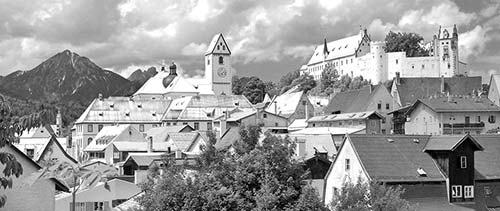
Dramatically situated under a renovated castle on the lively Lech River, Füssen (FEW-sehn) has been a strategic stop since ancient times. Its main street was once part of the Via Claudia Augusta, the Roman road across the Alps. Going north, early travelers could follow the Lech River downstream to the Danube and then cross over to the Main and Rhine valleys—a route now known to modern travelers as the “Romantic Road.” Today, while Füssen is overrun by tourists in the summer, few venture to the back streets...which is where you’ll find the real charm. Apart from my self-guided walk and the Füssen Heritage Museum, there’s little to do here—but it’s a good base for visiting the King’s Castles and other surrounding attractions.
Orientation to Füssen
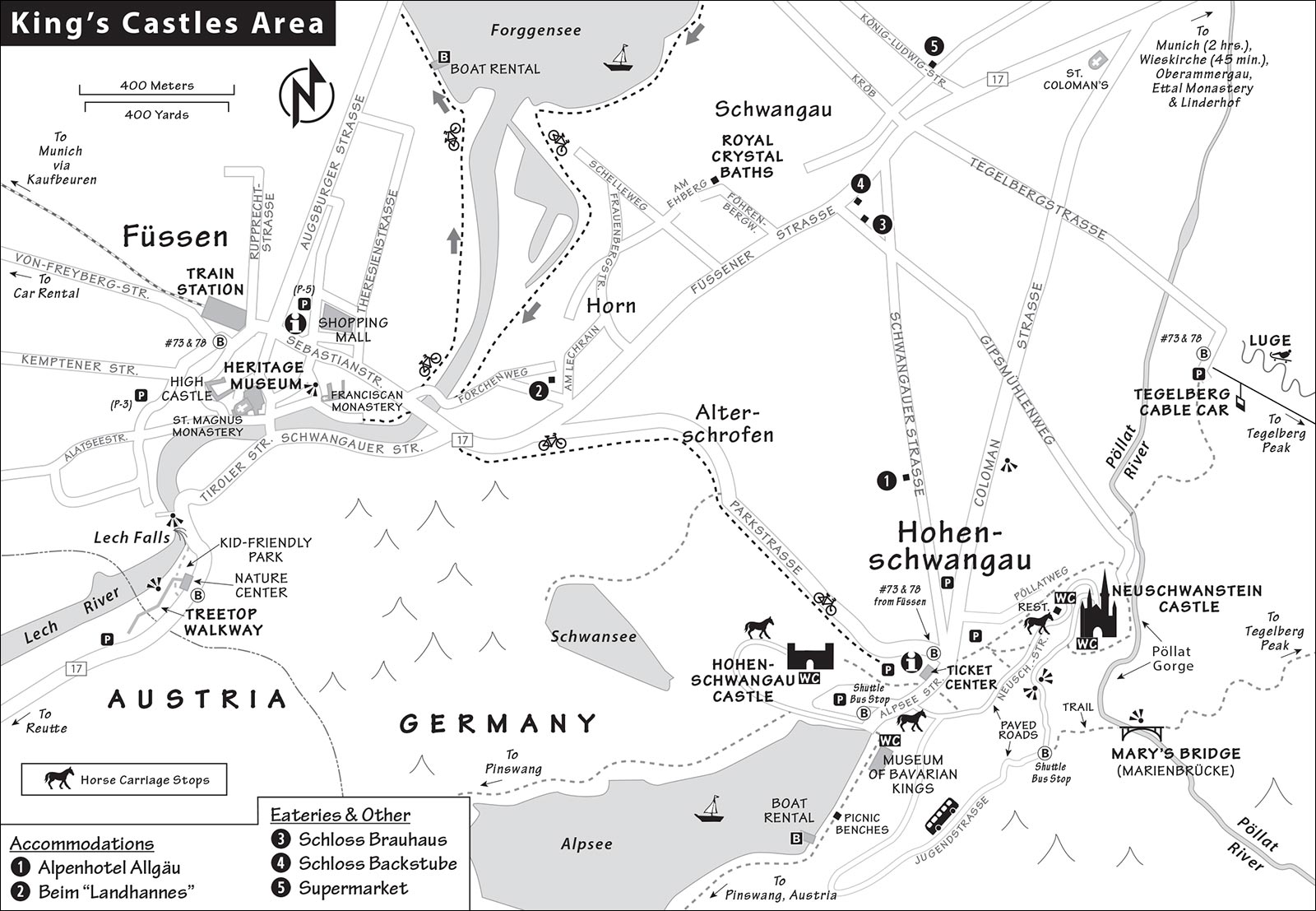
Füssen’s roughly circular Old Town huddles around its castle and monastery, along the Lech River. The train station, TI, and many shops are at the north end of town, and my recommended hotels and eateries are within easy walking distance. Roads spin off in all directions (to Neuschwanstein, to Austria, and to numerous lakes). Halfway between Füssen and the German border (as you drive, or a nice woodsy walk from town) is Lech Falls, a thunderous waterfall (with a handy WC).
TOURIST INFORMATION
The TI is in a big yellow building in the center of town (Mon-Fri 9:00-17:00, Sat until 13:00, closed Sun; 3 blocks from station at Kaiser-Maximilian-Platz 1, +49 8362 93850, www.fuessen.de).
ARRIVAL IN FÜSSEN
By Train: The train station is three blocks from the center of town and the TI. Buses to Neuschwanstein, Reutte, and elsewhere leave from a parking lot next to the station.
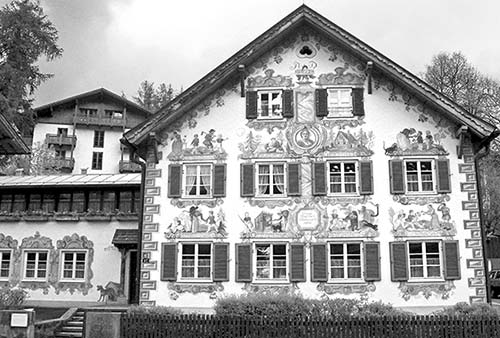
The scenes you’ll see painted on the sides of houses in Bavaria are called Lüftlmalerei. The term came from the name of the house (“Zum Lüftl”) owned by a man from Oberammergau who pioneered the practice in the 18th century. As the paintings became popular during the Counter-Reformation Baroque age, themes tended to involve Christian symbols, saints, and stories (such as scenes from the life of Jesus) to reinforce the Catholic Church’s authority in the region. Some scenes also depicted an important historical event that took place in that house or town.
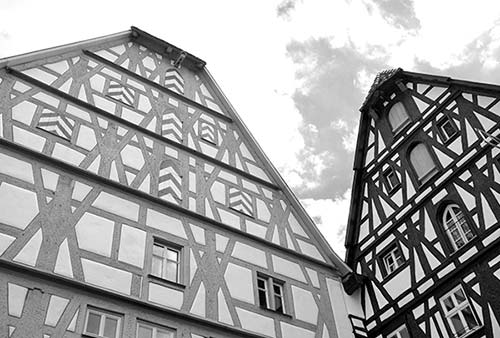
Especially in the northern part of this region (for example, in Rothenburg), you’ll see Fachwerkhäuser—half-timbered houses. A timber frame outlines the wall, which was traditionally filled in with a mixture of wicker and clay. These are most often found inside fortified cities that were once strong and semi-independent (such as Rothenberg, Nürnberg, and Dinkelsbühl). Farther south, you’ll see sturdy, white-walled masonry houses with woodwork on the upper stories and an overhanging roof. The interiors of many Bavarian homes and hotels have elaborate wooden paneling and furniture, often beautifully carved or made from special sweet-smelling wood.
By Car: Füssen is known for its traffic jams, and you can’t drive into the Old Town. The most convenient lots (follow signs) are the underground P-5 (near the TI, €15/day) and the aboveground P-3 (off Kemptener Strasse, €14/day).
HELPFUL HINTS
Hotel Card: Ask your hotel for a Füssen Card, which gives you free use of public transit in the immediate region (including the bus to Neuschwanstein and Wieskirche), as well as minor discounts at Neuschwanstein, Hohenschwangau, Museum of the Bavarian Kings, and several other attractions. Be sure to return the card before you leave town. After the hotel activates the card, it can take an hour or two before it works at sights and on buses.
Drugstore: A catchall drugstore that also carries snacks, Müller is on the west side of the Old Town (Mon-Fri 8:30-19:00, Sat until 18:00, closed Sun, Kemptener Strasse 1).
Bike Rental: Ski Sport Luggi outfits sightseers with good bikes and tips on two-wheeled fun in the area (prices per 24 hours: €15-city bike, €20-mountain bike, €30-electric bike; Tue-Fri 9:00-12:00 & 14:00-17:30, Sat until 13:00, closed Sun-Mon; shorter hours off-season, call ahead to reserve, ID required, Luitpoldstrasse 11, +49 8362 505 9155, www.ski-sport-luggi.de). For a strenuous but enjoyable 20-mile loop trip, see “Activities near Füssen,” later.
Taxi: Call +49 8362 6222 for taxi service to Neuschwanstein Castle (€11), Tegelberg cable car (€16), and other places.
Car Rental: Hertz Rental Car is an easy taxi ride from the center (Mon-Fri 8:00-12:00 & 14:00-18:00, Sat 8:00-12:00, closed Sun and holidays, Füssener Strasse 112, +49 8362 986 580, www.hertz.de).
Local Guide: Silvia Skelac, an American born to German parents, has resided in the region for over 20 years. She is available as a guide—for private tours, hard-to-reach sights, mountain hikes, and alpine herb walks (€95/half-day, €190/full day, up to 4 people, includes transportation in Silvia’s SUV, Austrian mobile +43 664 978 7488, info@crossroads-services.com).
Füssen Walk
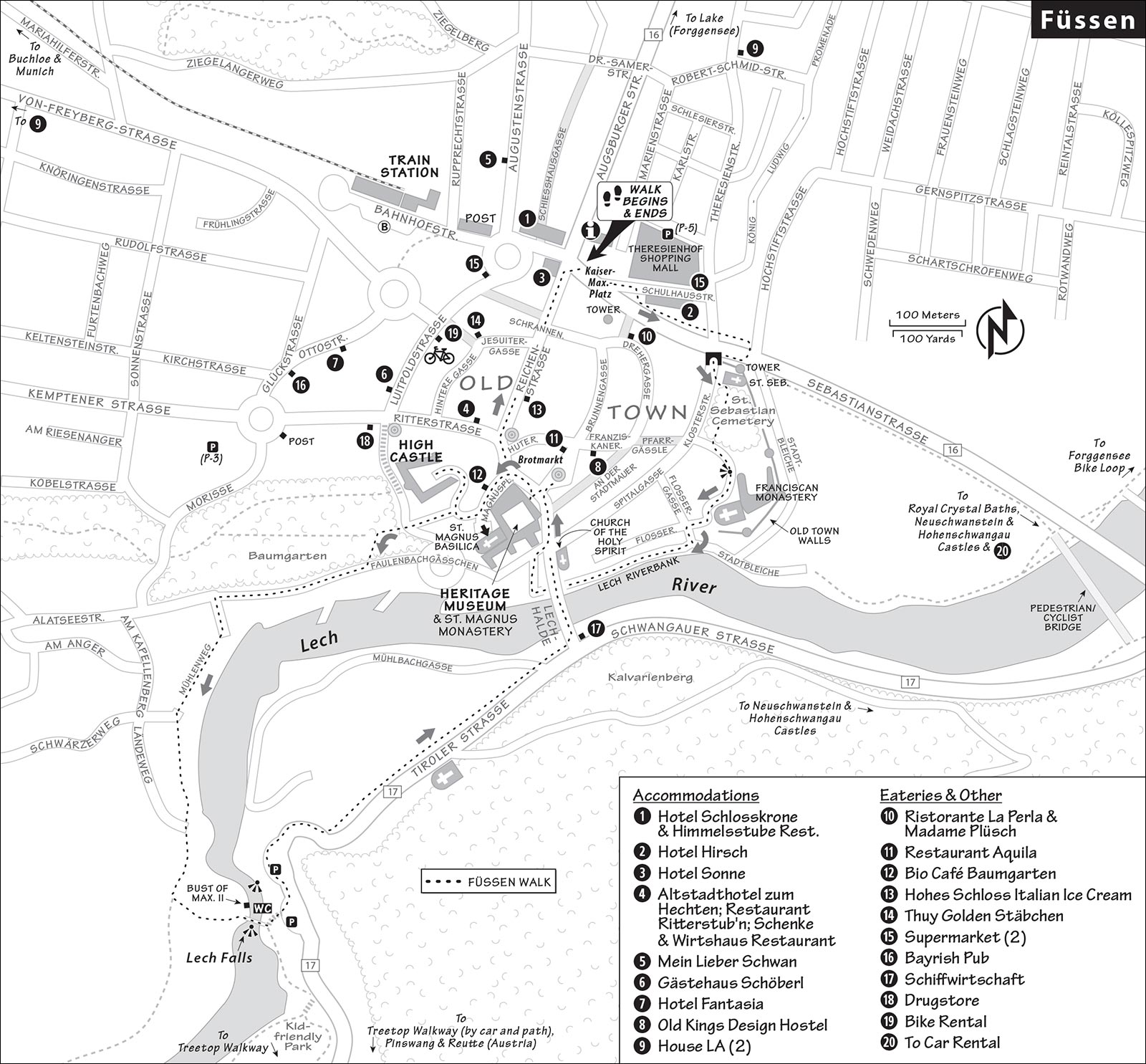
For most, Füssen is just a home base for visiting Ludwig’s famous castles. But the town has a rich history and hides some evocative corners, as you’ll see when you follow this self-guided orientation walk. This 45-minute stroll is designed to get you out of the cutesy old cobbled core where most tourists spend their time. Throughout the town, “City Tour” information plaques explain points of interest in English (in more detail than I’ve provided).
• Begin at the square in front of the TI, three blocks from the train station.
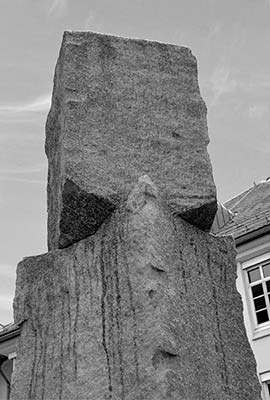
Kaiser-Maximilian-Platz: The entertaining “Seven Stones” fountain on this square, by sculptor Christian Tobin, was built in 1995 to celebrate Füssen’s 700th birthday. The stones symbolize community, groups of people gathering, conviviality...each is different, with “heads” nodding and talking. It’s granite on granite. The moving heads are not connected and nod only with waterpower. It’s frozen in winter but is a popular and splashy play zone for kids on hot summer days.
• Walk along the pedestrian street toward the glass building. To your right you’ll soon see...
Hotel Hirsch and Medieval Towers: Renovations have restored some of the original Art Nouveau flavor to Hotel Hirsch, which opened in 1904. In those days, aristocratic tourists came here to appreciate the castles and natural wonders of the Alps. Across the busy street stands one of two surviving towers from Füssen’s medieval town wall (c. 1502), and next to it is a passageway into the Old Town.
• Walk along the busy street and cross at the second light to another tower. Head to the information plaque and archway where a small street called Klosterstrasse emerges through a surviving piece of the old town wall. Step through the smaller pedestrian archway, walk along Klosterstrasse for a few yards, and turn left through the gate into the...
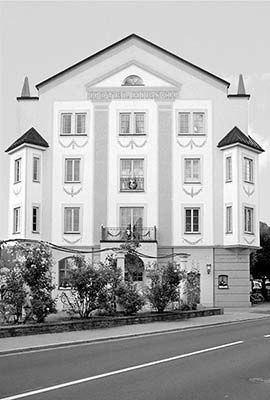
Historic Cemetery of St. Sebastian (Alter Friedhof): This peaceful oasis of Füssen history, established in the 16th century, fills a corner between the town wall and the Franciscan monastery. It’s technically full, and only members of great and venerable Füssen families (who already own plots here) can join those who are buried (free, daily 7:30-19:00, off-season 8:00-17:00).
Immediately inside the gate and on the right is the tomb of Dominic Quaglio, who, in 1835, painted the Romantic scenes decorating the walls of Hohenschwangau Castle. Across the cemetery, on the old city wall (beyond the church), is the World War I memorial, listing all the names of men from this small town killed in that devastating conflict (along with each one’s rank and place of death). A bit to the right, also along the old wall, is a statue of the hand of God holding a fetus—a place to remember babies who died before being born. And in the corner, farther to the right, is a gated area with the simple wooden crosses of Franciscans who lived just over the wall in the monastery. Strolling the rest of the grounds, note the fine tomb art from many ages collected here, and the loving care this community gives its cemetery.
• Exit on the far side, just past the dead Franciscans. Turn left just outside the gate and walk along the picket fence across the street to the Franciscan monastery, which still has big responsibilities but only a handful of monks in residence.
Town View from the Monastery (Franziskanerkloster): Enjoy a lovely view over the medieval town with an alpine backdrop. In the distance you’ll see the dome and clock tower of the Church of St. Magnus and the aptly named High Castle (the former summer residence of the Bishops of Augsburg), where this walk ends. The tall, skinny smokestack (c. 1886) is a reminder that the textile industry (linen and flax) was very big here when Ludwig built Neuschwanstein.
• Follow the wall of the Franciscan monastery and go around the corner and down the stairway. At the bottom, turn left through the medieval “Bleachers’ Gate” (marked 5½, under the mural of St. George slaying the dragon) to the...
Lech Riverbank: This low end of town, the flood zone, was the home of those whose work depended on the river—bleachers, rafters, and fishermen. In its heyday, the Lech River was an expressway to Augsburg (about 70 miles to the north). Around the year 1500, the rafters established the first professional guild in Füssen. Cargo from Italy passed here en route to big German cities farther north. Rafters would assemble rafts and pile them high with wine, olive oil, and other goods—or with people needing a lift. If the water was high, they could float all the way to Augsburg in as little as one day. There they’d disassemble their raft and sell off the lumber along with the goods they’d carried, then make their way home to raft again. Today you’ll see no modern-day rafters here, as there’s a hydroelectric plant just downstream.
• Walk upstream a bit, toward the bridge, appreciating the river’s milky color (from mountain rocks, pulverized to a sediment over the long journey from the Alps). Pass under the bridge and immediately turn right to head inland.
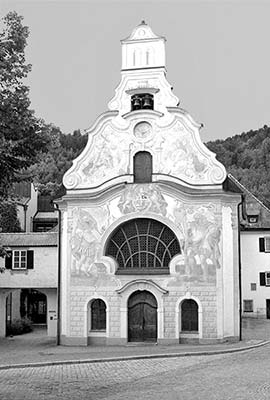
Church of the Holy Spirit, Bread Market, and Lutemakers: Climbing uphill, you pass the colorful Church of the Holy Spirit (Heilig-Geist-Spitalkirche) on the right. As this was the church of the rafters, their patron, St. Christopher (with the Baby Jesus on his shoulder), is prominent on the facade. Today it’s the church of Füssen’s old folks’ home (it’s adjacent—notice the easy-access skyway). Step inside to take in the details packed into this tiny space, from the carved sides of the pews to the trompe l’oeil dome ceiling. Notice also the painting of a raft disaster on the Lech River—once a common fate of those in the dangerous rafting trade.
Farther up the hill on the right is Bread Market Square (Brotmarkt), with a fountain honoring a famous 16th-century lutemaking family, the Tieffenbruckers. In its day, Füssen, surrounded by forests, was a huge center of violin- and lutemaking, with about 200 workshops. Today only three survive.
• Backtrack and go through the archway into the courtyard of the former...
St. Magnus Monastery (Kloster St. Mang): From 1717 until secularization in 1802, this Benedictine monastery was the power center of town. Today the courtyard is popular for concerts, and the building houses the City Hall and the Füssen Heritage Museum.
Füssen Heritage Museum: This is Füssen’s one must-see sight, spanning a thousand years of the town’s history, with industrial artifacts, medieval cloisters, and Baroque halls (€6, €9 combo-ticket includes High Castle painting gallery and tower; Tue-Sun 11:00-17:00, closed Mon; shorter hours and closed Mon-Thu Nov-March; +49 8362 903 143, www.museum.fuessen.de).
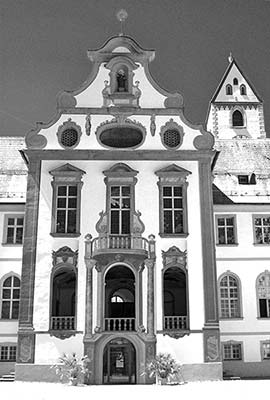
Pick up the loaner English translations and follow the signs to the St. Anna Chapel, with its famous Dance of Death. This was painted shortly after a plague devastated the community in 1590. It shows 20 social classes, each dancing with the Grim Reaper—starting with the pope and the emperor. The words above say, essentially, “You can say yes or you can say no, but you must ultimately dance with death.” Leaving the chapel, you walk over the metal lid of the crypt. Upstairs, exhibits illustrate Füssen’s important trades: ropemaking, rafting, and violin- and lutemaking (with a complete workshop), but the building itself outshines these creaky displays. Among the exquisitely decorated Baroque rooms are an ornate imperial ballroom and a two-tiered oval library displaying cupid statues and frescoes dating from 1719, with an opening to the refectory below.
• Leaving the courtyard, hook left around the old monastery and go slightly uphill to the square tower. This marks...
St. Magnus Basilica (Basilika St. Mang): St. Mang (or Magnus) is Füssen’s favorite saint. In the eighth century, he worked miracles all over the area with his holy rod. For centuries, pilgrims came to this medieval basilica from far and wide to enjoy art depicting the great works of St. Magnus. Then, in the 18th century, the basilica got a Baroque facelift. Above the altar dangles a glass cross containing the saint’s relics (including that holy stick). At the rear of the church is a chapel bright with primary colors that honors a much more modern saint—Franz Seelos (1819-1867), the local boy who went to America (Pittsburgh and New Orleans) and lived such a righteous life that in 2000 he was beatified by Pope John Paul II.
• From the church, find the grassy knolls and the trail ahead of you, and walk uphill toward the castle entrance.
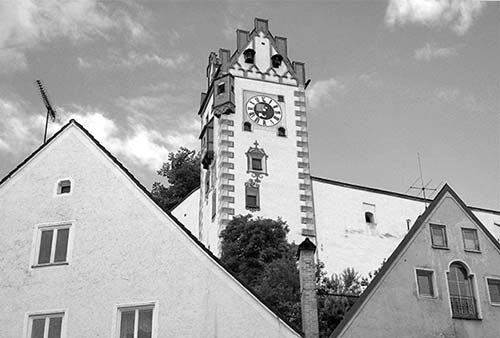
High Castle (Hohes Schloss): This castle, long the summer residence of the Bishop of Augsburg, houses a painting gallery (the upper floor is labeled in English) and a tower with a view over the town and lake (€6, €9 combo-ticket includes Füssen Heritage Museum, same hours as museum). The courtyard (with handy WCs under the sundial, just before the tower climb) is worth even a few minutes to admire the striking perspective tricks painted onto its flat walls.
• Exit the castle wall, and follow the call of the Lech River through the ivy-covered archway to the right. It’s a 15-minute walk from here to the falls.
Baumgarten and Lech Falls: As you explore the castle garden, notice the impressive walls that kept the High Castle safe from pesky invaders. Wander toward the Lech River and follow the signs (away from town and into a quaint neighborhood) that point you toward Lech Falls—it’s just beyond the tall, skinny smokestack you saw earlier.
Cross the bridge to enjoy a bit of impressive natural beauty tucked away just outside town. Some say that the name “Füssen” is derived from the Latin word for gorge. Royals and tourists alike have enjoyed this gorge for centuries. Imagine “Mad” King Ludwig coming here with his family to enjoy a special tea arranged on top of the gorge. High above looms a bust of his father (Maximilian II); down below, the interesting rock formations bulge and twist above the roaring water.
• The Treetop Walkway (described later) is just a 10-minute walk ahead on Tiroler Strasse. Otherwise, from here you can walk downhill to return to town, enjoying a backside view of St. Magnus Monastery where it borders the Lech River. Take a left at the bridge and head back uphill to find the city’s main drag (once the Roman Via Claudia and now Reichenstrasse), which leads you from a grand statue of St. Magnus past lots of shops, cafés, and strolling people to Kaiser-Maximilian-Platz and the TI...where you began.
Activities near Füssen
The following sights lie within a few miles of Füssen. All can be reached by car, bike, or foot. See the “King’s Castles Area” map, later in this chapter, for locations.
▲Royal Crystal Baths (Königliche Kristall-Therme)
This pool/sauna complex just outside Füssen is the perfect way to relax on a rainy day or to cool off on a hot one. The main part of the complex (downstairs), called the Therme, contains two heated indoor pools and a café; outside you’ll find a shallow kiddie pool, a lap pool, a heated Kristallbad with massage jets and a whirlpool, and a salty mineral bath. The extensive saunas upstairs are well worth the few extra euros, if you’re OK with nudity. (Swimsuits are required in the downstairs pools but verboten in the upstairs saunas.) Pool and sauna rules are posted in German, but don’t worry—just follow the locals’ lead.
To enter the baths, first choose the length of your visit and your focus (big outdoor pool only, all ground floor pools but not the saunas, or the whole enchilada—a flier explains all the prices in English). You’ll get a wristband containing a chip that’s used to enter the baths, open and close your locker, and purchase food and drink (you don’t need cash). Enter through the changing stalls, where you’ll change into your bathing suit and choose a storage locker. When it’s time to leave, use your wristband to exit. If you’ve gone over the time limit or made purchases, you’ll pay the receptionist or use a payment machine.
Cost and Hours: Baths only—€15.50/2 hours, €23/4 hours, €29.50/all day; saunas-about €7 extra, towel rental-€3, bathrobe rental-€5, bathing suits sold but not rented; daily 9:00-21:00, Fri-Sat until 22:00; nude swimming everywhere Tue after 19:00; +49 8362 926 940, www.kristalltherme-schwangau.de.
Getting There: From Füssen, drive, take the bus (#73 or #78, ask driver for best stop), bike, or walk (30 minutes) across the river, turn left toward Schwangau; about a mile later, turn left at signs for Kristall-Therme. It’s at Am Ehberg 16. If biking from Füssen, it’s easy to see the castle, enjoy the spa, and then roll back into town (about an hour of pedaling altogether).
Bike or Boat Around the Forggensee
On a beautiful day, nothing beats a bike ride around the bright-turquoise Forggensee, a nearby lake. This 20-mile loop is exclusively on bike paths (give it a half-day; it’s tight to squeeze it into the afternoon after a morning of castle visits, but possible with an early start). Locals swear that going clockwise is less work, but either way has a couple of strenuous uphill parts (total elevation gain of about 600 feet). Still, the amazing views of the surrounding Alps will distract you from your churning legs—so this is still a great way to spend the afternoon. Rent a bike (ideally a 21-speed), pack a picnic lunch, and figure about a three-hour round-trip. From Füssen, follow Festspielhaus signs; once you reach the theater, follow Forggensee Rundweg signs.
You can also take a boat ride on the Forggensee, leaving either from the Füssen “harbor” (Bootshafen) or the theater (Festspielhaus), a 25-minute walk north of town (€12/50-minute cruise, 5/day; €16/2-hour cruise, 3/day; runs daily June-mid-Oct, no boats off-season, +49 8362 921 363, www.stadt-fuessen.de). Unless it’s very crowded in the summer, you can bring your bike onto the boat and get off across the lake—shortening the total loop.
Treetop Walkway (Baumkronenweg Ziegelwies)
This elevated wooden “treetop path” lets you stroll for a third of a mile, high in the trees on a graceful yet sturdy suspension-bridge-like structure 60 feet in the air. The walkway crosses the Austria-Germany border and offers views of the surrounding mountains and the “wild” alpine Lech River, which can be a smooth glacier-blue mirror one day and a muddy torrent the next. Located east of Füssen, just past Lech Falls on the road to Reutte, the walkway can be accessed at either end. The Austrian end (closer to Reutte) has a large parking lot and a tiny ticket booth. At the German end (closer to Füssen) there is a nature center and café, and parking is scarce. Stairs (kids can take the slide) lead down to a riverside trail that loops about a mile through a kid-friendly park, with a log raft to cross a little creek, a wonky little bridge, and a sandy stream great for wading. Those with more energy to burn can try the slightly longer mountain loop, accessed by a tunnel under the road.
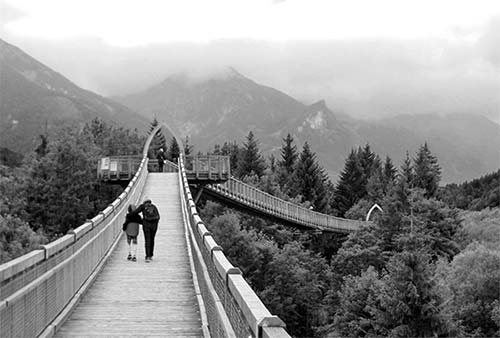
Cost and Hours: €5, free for kids 15 and under, daily 9:00-19:30, April and mid-Oct-Nov 10:00-16:00, closed Dec-March and in bad weather, Tiroler Strasse 10, +49 8362 9002 2150, www.baumkronenweg.eu.
Sleeping in Füssen
Convenient Füssen is just three miles from Ludwig’s castles and offers a cobbled, riverside retreat. My recommended accommodations are within a few handy blocks of the train station and the town center. Parking is easy, and some hotels also have their own lot or garage. Many hotels give a 5-10 percent discount for two-night stays—always ask—and prices drop by 10-20 percent off-season. Competition is fierce, so shop around. Remember to ask your hotelier for a Füssen Card (see here).
BIG, FANCY HOTELS IN THE CENTER OF TOWN
$$$ Hotel Schlosskrone is formal, with 62 rooms in two wings and all the amenities you need to pamper yourself after a long castle visit. It also runs two restaurants and a good pastry shop (some rooms with balconies, family rooms, air-con, elevator, free sauna and fitness center, spa, playroom, pay parking, Prinzregentenplatz 2, +49 8362 930 180, www.schlosskrone.de, rezeption@schlosskrone.de, Norbert Schöll and family).
$$$ Hotel Hirsch, across from Füssen’s Old Town, is a well-maintained, family-run, 71-room hotel that takes pride in tradition. Built in 1904, the hotel’s older section is filled with antiques and Old World craftsmanship, and offers rooms featuring historical and landscape themes; rooms in the newest wing have a contemporary look and come with air-con and refrigerators (family rooms, spacious breakfast room, restaurant with seating indoors and out, elevators, nice rooftop terrace, free parking, Kaiser-Maximilian-Platz 7, +49 8362 93980, www.hotelfuessen.de, info@hotelhirsch.de, sibling-owners Harold and Eva).
$$$ Hotel Sonne takes immense pride in its King Ludwig theme, with imaginative decor celebrating the king and his friends. The sprawling hotel has 78 rooms, some with balconies, and is a convenient home base. The free wellness spa with saunas and fluffy lounge chairs is a good place to unwind. Their Art Deco RIWA (think Richard Wagner) café—crowned with a royal display of cheesecakes—is open all day (newer rooms have open bathrooms—door only on the toilet closet, family rooms, air-con in some rooms, elevator, free laundry machine, fitness room, pay parking—reserve ahead, kitty-corner from TI at Prinzregentenplatz 1, on GPS you may need to enter Reichenstrasse 37, +49 8362 9080, www.hotel-sonne.de, info@hotel-sonne.de).
SMALLER, MIDPRICED HOTELS AND PENSIONS
$$ Altstadthotel zum Hechten offers 35 rooms (some with balconies) in a friendly, family-run hotel with bright, comfortable rooms and a borderline-kitschy breakfast room. It’s a good value, with fun extras such as a travel-resource/game room, borrowable hiking gear, and a recommended restaurant (two buildings, family rooms, elevator, pay parking, situated right under Füssen Castle in the old-town pedestrian zone at Ritterstrasse 6, on GPS you may need to enter Hinteregasse 2, +49 8362 91600, www.hotel-hechten.com, info@hotel-hechten.com, Pfeiffer family).
$$ Mein Lieber Schwan, a block from the train station, is run by Herr Bletschacher, a hometown boy who’s proud of his accommodations’ personality and charm. He offers four superbly outfitted apartments, each with a double bed, sofa bed, kitchen, and antique furnishings (three-night minimum, cash or PayPal only, no breakfast, free parking, laundry facilities, garden, Augustenstrasse 3, +49 8362 509 980, www.meinlieberschwan.de, fewo@meinlieberschwan.de). Herr Bletschacher also has two slightly larger apartments at Klosterstrasse 10.
$ Gästehaus Schöberl, run by Pia and her husband, Georg (who co-manages Altstadthotel zum Hechten), makes you feel like you’re staying with friends. Its six bright and spacious rooms are a great value and set on a quiet street just off the main drag. One room is in the owners’ house, and the rest are in the building next door (three-night minimum, cash only, family room, charming breakfast room, pay parking, closed in Nov, Luitpoldstrasse 14—check-in at #16 around back, +49 8362 922 411, www.schoeberl-fuessen.de, info@schoeberl-fuessen.de).
$ Hotel Fantasia, the little sister of Hotel Sonne, has 16 trendy rooms adorned with violet paint and lots of pictures of King Ludwig that might make the nuns who once lived here blush (breakfast extra, family rooms, pay parking, peaceful garden, Ottostrasse 1, +49 8362 300 670, www.hotel-fantasia.de, info@hotel-fantasia.de).
BUDGET BEDS
¢ Old Kings Design Hostel shoehorns two dorm rooms and three private doubles into an old townhouse that doesn’t resemble a typical hostel. While the quarters are tight (all rooms share bathrooms), the central location, creative decor, and reasonable prices are enticing (bike rental, laundry service, reception open daily 7:00-11:00 & 16:00-21:00, buried deep in the pedestrian zone at Franziskanergasse 2, +49 8362 883 4090, www.oldkingshostel.com, info@oldkingshostel.com).
¢ House LA, run by energetic mason Lahdo Algül and hardworking Aga, has two branches. The backpacker house has 11 basic, clean dorm rooms at rock-bottom prices about a 10-minute walk from the station (private room available, free parking, Wachsbleiche 2). A second building has five family apartments with kitchen and bath (RS%, breakfast extra, pay parking—reserve ahead, 6-minute walk back along tracks from station to von Freybergstrasse 26; contact info for both: +49 8362 607 366, +49 170 624 8610, www.housela.de, info@housela.de). Both locations rent bikes and have laundry facilities.
Eating in Füssen
$$ Restaurant Ritterstub’n offers delicious, reasonably priced German grub plus salads, veggie plates, and a fun kids’ menu. They have three eating zones: modern decor in front, traditional Bavarian in back, and a courtyard. Ask about their three-course fixed-price dinners. Demure Gabi serves while her husband, Claus, cooks (Tue-Sun 11:30-14:00 & 17:30-21:30, closed Mon, Ritterstrasse 4, +49 8362 7759).
$$ Schenke & Wirtshaus (inside the recommended Altstadthotel zum Hechten) dishes up hearty, traditional Bavarian dishes from goulash to pork knuckle in a classic interior. Their specialty is pike (Hecht) pulled from the Lech River, served with a tasty fresh-herb sauce (daily 11:30-21:00, Ritterstrasse 6, +49 8362 91600).
$$$ Ristorante La Perla is an Italian restaurant with a lively ambience. Sit either in the sleek and modern interior, at streetside tables on a quiet Old Town lane, or in the hidden courtyard out back (cheaper pizzas and pastas, Tue-Sun 11:30-21:30, Nov-Jan closed 14:30-17:30, closed Mon year-round, Drehergasse 44, +49 8362 7155).
$$$ The Himmelsstube is the restaurant inside Hotel Schlosskrone, right on Füssen’s main traffic circle. It serves typical Bavarian fare such as pork knuckle and potato dumplings, and offers a weekday lunch buffet that includes a large salad bar. Choose between the traditional dining room or the pastel winter garden (daily 11:30-14:30 & 18:00-22:00, Prinzregentenplatz 2, +49 8362 930 180, www.schlosskrone.de).
$$ Restaurant Aquila serves modern German and Italian-influenced dishes and serious salads in a simple indoor setting, but I prefer the outdoor tables on delightful Brotmarkt square (Wed-Mon 11:30-21:00, closed Tue, reservations smart, Brotmarkt 9, +49 8362 6253, www.aquila-fuessen.de).
$$$ Madame Plüsch, old school and elegant, serves tasty Bavarian dishes (fish, pork, beef, and veggie options), prepared and seasoned with care. Dine in a cozy interior or at tables on the square (Thu-Mon 17:00-21:00, closed Tue-Wed, reservations recommended, Drehergasse 48, +49 8362 938 0949, www.madame-pluesch.de).
$ Bio Café Baumgarten is a tiny, healthy oasis near the St. Magnus Basilica tower, with two tables inside and more out on the square. Its organic fare includes breakfast, smoothies, salads, and sweet and savory crêpes, plus homemade cakes (daily 9:00-18:00, Magnusplatz 6, +49 8362 989 9750).
Brewpub near the Castles: If you have a car, consider heading to Schloss Brauhaus, in the village of Schwangau, for local brew and an unbeatable view (described on here).
Gelato: Hohes Schloss Italian Ice Cream is a popular gelateria on the main drag with a huge menu of decadent sundaes and an inviting people-watching perch (Reichenstrasse 14).
Cheap Eats: $ Thuy Golden Stäbchen serves a mix of Vietnamese, Chinese, and Thai food on a deserted back street with outdoor tables and a castle view (daily 10:00-22:00, Hinteregasse 29, +49 8362 939 7714).
Picnic Supplies: Bakeries and butcher shops (Metzger) abound and frequently have ready-made sandwiches. For groceries, try the discount Netto supermarket, at the roundabout across from Hotel Schlosskrone, or the midrange REWE in the Theresienhof shopping complex (both supermarkets open Mon-Sat 7:00-20:00, closed Sun).
Nightlife: Bayrish Pub is popular for soccer viewing, live music, and conviviality (Mon-Sat 17:00-late, closed Sun, Ottostrasse 7, +49 8362 930 7444). Schiffwirtschaft, just across the river, attracts a happy crowd with its wide selection of cocktails as well as organic fare, including salads and tarte flambée. It’s early-evening river views are exceptional (Wed-Fri 15:00-late, Sat-Sun from 11:00, closed Mon-Tue, +49 8362 924 3370).
Füssen Connections
BY BUS AND TRAIN
Bus schedules from Füssen can be very confusing. The Bahn.com website is good for figuring out your options for a particular day and route.
From Füssen to: Neuschwanstein (bus #73 or #78, departs from train station, most continue to Tegelberg cable car station after castles, at least hourly, 10 minutes, €2.30 one-way, buses #9606 and #9651 also make the trip); Wieskirche (bus #73, #9606, or #9651; 2-6 buses/day, 45-60 minutes); Oberammergau (bus #9606, 1-3/day, 1.5 hours, bus sometimes starts as #73 and changes number to #9606 en route—confirm with driver that bus is bound for Oberammergau); Reutte (bus #100, Mon-Fri 7/day, Sat-Sun 6/day, last bus 19:00, 30-50 minutes, €5.40 one-way); Zugspitze (possible as day trip on bus #100 to Reutte, then train to Ehrwald for Austrian ascent or Garmisch-Partenkirchen, allow up to 3.5 hours total to reach the top); Munich (hourly trains, 2 hours, most with easy transfer in Buchloe); Innsbruck (fastest on bus #100 to Reutte, then train from Reutte to Innsbruck via Garmisch-Partenkirchen, every 2 hours, 2.5 hours; otherwise via Munich); Salzburg (roughly hourly, 4 hours on fast trains, 5 hours on slow trains—included with Bayern-Ticket, transfer in Munich and sometimes in Kaufbeuren or Buchloe); Rothenburg ob der Tauber (hourly trains, 5-6 hours, look for connections with only 3 transfers—often in Augsburg, Treuchtlingen, and Steinach); Frankfurt (hourly trains, 5-6 hours, 1-2 changes). Train info: www.bahn.com.
The Best of the Bavarian Alps
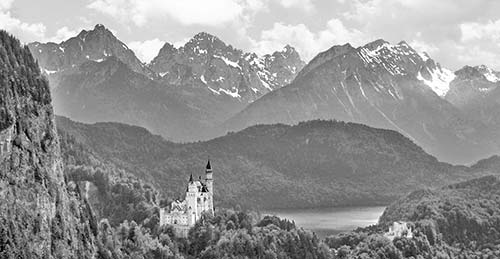
Within a short drive of Füssen and Reutte, you’ll find some of the most enjoyable—and most tourist-filled—sights in Germany. The otherworldly “King’s Castles” of Neuschwanstein and Hohenschwangau capture romantics’ imaginations, the ornately decorated Wieskirche puts the faithful in a heavenly mood, and the little town of Oberammergau overwhelms visitors with cuteness. Yet another impressive castle (Linderhof), another fancy church (Ettal), and a sky-high viewpoint (the Zugspitze) round out this region’s top attractions.
The King’s Castles: Neuschwanstein and Hohenschwangau
The most popular tourist destinations in southern Bavaria are the two “King’s Castles” (Königsschlösser) near Füssen. The older Hohenschwangau, King Ludwig’s boyhood home, is less famous but more historic. The more dramatic Neuschwanstein, which inspired Walt Disney, is the one everyone visits. I recommend visiting both and hiking above Neuschwanstein to Mary’s Bridge. Reservations are a magic wand that smooth out your visit. With fairy-tale turrets built by a fairy-tale king in a fairy-tale alpine setting, these castles are understandably a huge hit.
GETTING THERE
If arriving by car, note that road signs in the region refer to the sight as Königsschlösser. There’s plenty of parking (all lots-€10). The first lots require more walking. The most convenient lot, by the lake (#4, Parkplatz am Alpsee), is up the small road past the souvenir shops and ticket center.
From Füssen, those without cars can catch bus #73 or #78 (at least hourly, generally departs Füssen’s train station at :05 past the hour, extra buses often run when crowded, €2.30 each way, 10 minutes; a few departures of #9606 and #9651 also make this trip). The Füssen Card available from your hotel (see here) lets you ride for free. You can also take a taxi (€11 one-way), ride a rental bike (3 level miles), or—if you’re in a pinch—walk (less than an hour). The bus drops you at the tourist office (note return times so you aren’t stuck waiting); it’s a one-minute walk from there to the ticket office. When returning, note that buses #73 and #78 pointing left (with your back to the TI) are headed to Füssen, while the same numbers pointing right are going elsewhere.
From Reutte, take the bus to the Füssen train station (#100, Mon-Fri 8/day, Sat-Sun 6/day). Once in Füssen, hop on bus #73 or #78 to the castles (see earlier).
ORIENTATION TO THE KING’S CASTLES
Cost: Timed-entry tour tickets for Neuschwanstein are €17.50, €2.50 for kids under 18; Hohenschwangau’s are €23.50, €13.50 for kids 7-17, €2.50 for kids 6 and under (prices include online booking fee). A Königsticket combo-ticket for both castles is usually available for about €37—the Bavarian Palace Department’s 14-day ticket may be a better deal if you’re only touring Neuschwanstein but seeing other Bavarian sights (see “Helpful Hints” on here).
Hours and Entry Times: The ticket center, located at street level between the two castles, is open daily (8:00-16:00, phones open Mon-Fri 9:00-12:00 & 13:30-15:00). The first castle tour of the day departs at 9:00 (usually 10:00 off-season); the last tour departs at 18:00 (15:30 off-season).
All tickets come with admission times. If you miss your appointed tour time, you can’t get in. To tour both castles, try to do Hohenschwangau first (logical, since this gives a better introduction to King Ludwig’s short life). Allow at least two hours between your castle tour bookings. If a combo-ticket is available, you’ll choose two entry times: one for Hohenschwangau and one for Neuschwanstein—keep in mind that the Hohenschwangau tour lasts up to 45 minutes and the Neuschwanstein tour 30 minutes. If you’re planning to hike up to Mary’s Bridge prior to your Neuschwanstein tour, allow plenty of time: There’s often a line to get onto the bridge for that famous view.
Information: +49 8362 930 830, www.hohenschwangau.de.
Advance Tickets: It’s just plain smart to buy advance tickets online (www.hohenschwangau.de), particularly for holidays and weekends during peak season (June-Oct—especially July-Aug), when slots can book up well in advance. Plan to arrive well before your appointed entry time, as it takes a while to get up to the castles. Show up late and they may have given your slot to someone else (but will likely help you book a new reservation). If you know a few hours in advance that you’re running late, call the office: They may be able to rebook you.
If you’re staying in Reutte and depending on buses for transportation, make your reservation for midday (noon or later) to give yourself ample time to arrive at Neuschwanstein.
You can also make reservations online if you have the Bavarian Palace Department’s 14-day ticket (covers Neuschwanstein only, described earlier). When reserving, select “Free BSV Card Holder” from the menu, pay the €2.50 booking fee, and then either print out your ticket or save it on your phone to show at the castle entrance.
Tickets On-Site: A percentage of castle tickets are set aside for in-person purchase, so if reservations for your day of choice are sold out online, you may be able to get a ticket if you arrive between 8:00 and 8:30; these tickets can sell out as early as 9:30.
Getting Up to the Castles: From the ticket booth, Hohenschwangau is an easy 10-minute walk up the paved path past the bus parking (for a quicker ascent zigzag up to the big yellow castle using the ramp/stairs behind Hotel Müller). Neuschwanstein is a moderately steep, 30-minute hike in the other direction (also well signed—the most direct and least steep approach begins across the street from Hotel Müller).
To minimize hiking to Neuschwanstein, you can take a shuttle bus or a horse-drawn carriage. Neither option gets you to the castle doorstep. The shuttle bus departs about every 20 minutes from the bus stop next to the #4 parking lot just below Hohenschwangau and drops you off near Mary’s Bridge (Marienbrücke), leaving you a steep, 10-minute downhill walk to the castle—so be sure to see the view from Mary’s Bridge before hiking down (€3 uphill, €2 downhill, €3.50 round-trip). Horse-drawn carriages, which leave across the street from Hotel Müller, are slower than walking and stop below Neuschwanstein, leaving you a five-minute uphill hike (€7 up, €3.50 down). Carriages also run to Hohenschwangau (€5.50 up, €3 down).
Be warned that both buses and carriages can have long lines at peak times—especially if it’s raining. You might wait up to 45 minutes, making it slower than walking. If you’re cutting it close to your appointed time, you may need to hoof it. Note that buses don’t run in snowy or icy conditions, which can happen even in spring.
With time, here’s the most economical and least strenuous plan: Ride the bus to Mary’s Bridge for the view, hike down to Neuschwanstein, and then catch the horse carriage from below the castle down to the parking lot (round-trip cost: €6.50). If you’re on a tight schedule, consider taking the bus back down, as carriages can be unpredictable.
Entry Procedure: At each castle, tourists jumble in the courtyard, waiting for their assigned tour to light up on the board. When it does, power through the mob and go to the turnstile. Warning: You must use your ticket while your number is still on the board. If you space out, you’ll miss your entry window.
Services: A TI (run by knowledgeable Thomas), bus stop, ATM, pay WC, lockers, and post machine cluster around the main intersection a couple hundred yards before you get to the ticket office (TI open daily April-Oct 10:00-17:30, Nov-March Sat-Sun until 16:00, closed Mon-Fri, +49 8362 81980, www.schwangau.de). While the tiny bathrooms inside the castles themselves are free, you’ll pay to use the WCs elsewhere.
A tragic figure, Ludwig II (a.k.a. “Mad” King Ludwig) ruled Bavaria for 22 years until his death in 1886 at the age of 40. Bavaria was weak. Politically, Ludwig’s reality was to “rule” as either a pawn of Prussia or a pawn of Austria. Rather than deal with politics in Bavaria’s capital, Munich, Ludwig frittered away most of his time at his family’s hunting palace, Hohenschwangau. He spent much of his adult life constructing his fanciful Neuschwanstein Castle—like a kid builds a tree house—on a neighboring hill upon the scant ruins of a medieval castle. Here and in his other projects (such as Linderhof Castle and the never-built Falkenstein Castle), even as he strove to evoke medieval grandeur, he embraced the state-of-the-art technology of the Industrial Age in which he lived. Neuschwanstein had electricity, running water, and a telephone (but no Wi-Fi).
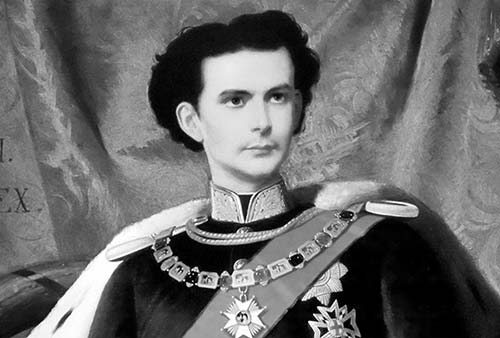
Ludwig was a true romantic living in a Romantic age. His best friends were artists, poets, and composers such as Richard Wagner. His palaces are wallpapered with misty medieval themes—especially those from Wagnerian operas.
Although Ludwig spent 17 years building Neuschwanstein, he lived in it only 172 days. Soon after he moved in (and before his vision for the castle was completed), Ludwig was declared mentally unfit to rule Bavaria and taken away. Two days after this eviction, Ludwig was found dead in a lake. To this day, people debate whether the king was murdered or committed suicide.
Best Views: In the morning, the light comes in just above the mountains, making your initial view of Neuschwanstein hazy and disappointing (though views from the ticket center up to Hohenschwangau are nice). Later in the day, the sun drops down into the pasture, lighting up Neuschwanstein magnificently. Regardless of time of day, the best accessible Neuschwanstein view is from Mary’s Bridge (or, for the bold, from the little bluff just above it), a 10-minute hike from the castle. (Many of the postcards and posters you’ll see are based on photos taken high in the hills, best left to avid hikers.)
Eating at the Castles: I prefer to bring a packed lunch. The park by the Alpsee (the nearby lake) is ideal for a picnic, although you’re not allowed to sit on the grass—only on the benches (or eat out on the lake in one of the old-fashioned rowboats—see “After Your Castle Visit,” next). The restaurants in the “village” at the foot of Europe’s Disney castle are mediocre and overpriced, but you can find decent German fare at the snack stand across from the TI or next to Hotel Alpenstuben (between the TI and ticket center). Up near Neuschwanstein itself (near the horse carriage drop-off) is a cluster of overpriced eateries, and inside the castle is a café with remarkable views, solid sustenance, and unremarkable coffee.
If you have a car or a bike, see “Eating Near the King’s Castles,” later, for better options.
After Your Castle Visit: If you are done with your castle tours in the early afternoon, you have more options nearby. With a car you could try to squeeze in a nearby sight (such as Linderhof Castle, Ehrenberg Castle ruins, Highline 179 suspension footbridge, or Wieskirche). To stick closer, here are some ideas: The hike from Neuschwanstein up to Mary’s Bridge is easy and rewarding; the hike back down to the valley through the Pöllat Gorge is also highly recommended. When the sun is shining, rent a pedal boat or rowboat for a scenic float around the Alpsee, the lake below Hohenschwangau. With a bike you could pedal through the mostly flat countryside that spreads out in front of Neuschwanstein (perhaps partway around the Forggensee). And nearby—an easy drive or bus ride away—the Tegelberg area has both a high-mountain cable car and a fun luge ride. All of these options are described later. Yet another option is to walk all the way around the Alpsee (about 1.5 hours, clockwise is less strenuous, some steps). And for some relaxation, the Royal Crystal Baths in the town of Schwangau are ideal (described earlier).
SIGHTS AT THE KING’S CASTLES
The two castles complement each other perfectly. But if you must choose one, Neuschwanstein’s wow factor—inside and out—is undeniable.
▲▲▲Hohenschwangau Castle
Standing quietly below Neuschwanstein, the big, yellow Hohenschwangau Castle is where Ludwig spent his summers as a young boy. Originally built in the 12th century, it was ruined by Napoleon. Ludwig’s father, King Maximilian II, rebuilt it in 1830. Hohenschwangau (hoh-en-SHVAHN-gow, loosely translated as “High Swanland”) was used by the royal family as a summer hunting lodge until 1912. The Wittelsbach family (which ruled Bavaria for nearly seven centuries) still owns the place (and lived in the annex—today’s shop—until the 1970s).
The interior decor (mostly Neo-Gothic, like the castle itself) is harmonious, cohesive, and original—all from 1835, with paintings inspired by Romantic themes. As you tour the castle, imagine how the paintings must have inspired young Ludwig. For 17 years, he lived here at his dad’s place and followed the construction of his dream castle across the way—you’ll see the telescope still set up and directed at Neuschwanstein.
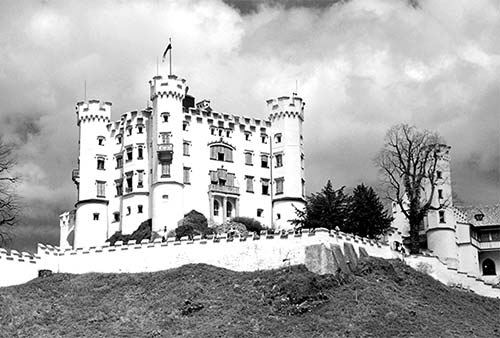
The 45-minute guided tour offers a better glimpse of Ludwig’s life than the more visited and famous Neuschwanstein Castle. Tours here are smaller (up to 35 people) and more relaxed. You’ll explore rooms on two floors—the queen’s rooms, and then, upstairs, the king’s. (Conveniently, their bedrooms were connected by a secret passage.) You’ll see photos and busts of Ludwig and his little brother, Otto; some Turkish-style flourishes (to please the king, who had been impressed after a visit to the Orient); countless swans—try to find them (honoring the Knights of Schwangau, whose legacy the Wittelsbachs inherited); over-the-top gifts the Wittelsbachs received from their adoring subjects; and paintings of VIGs (very important Germans, including Martin Luther—who may or may not have visited here—and an infant Charlemagne).
One of the most impressive rooms is the Banquet Hall (also known as the Hall of Heroes); one vivid wall mural depicts a savage, yet bloodless, fifth-century barbarian battle. Just as the castle itself had running water and electricity despite its historic appearance (both were installed in the 1900s under King Luitpold, Ludwig’s uncle), its Romantic decor presents a sanitized version of the medieval past, glossing over inconvenient details. You’ll also see Ludwig’s bedroom, which he inherited from his father. He kept most of the decor (including the nude nymphs frolicking over his bed) but painted the ceiling black and installed transparent stars that could be lit from the floor above to create the illusion of a night sky.
After the tour is over, wind through the castle gardens and imagine Ludwig frolicking here with his sights set on the hill far in the distance.
▲▲▲Neuschwanstein Castle
Imagine “Mad” King Ludwig as a boy, climbing the hills above his dad’s castle, Hohenschwangau, dreaming up the ultimate fairy-tale castle. Inheriting the throne at the young age of 18, he had the power to make his dream concrete and stucco. Neuschwanstein (noy-SHVAHN-shtine, roughly “New Swanstone”) was designed first by a theater-set designer...then by an architect. While it was built upon the ruins of an old castle and looks medieval, Neuschwanstein is modern iron-and-brick construction with a sandstone veneer—only about as old as the Eiffel Tower. It feels like something you’d see at a home show for 19th-century royalty. Built from 1869 to 1886, it’s the epitome of the Romanticism popular in 19th-century Europe. Construction stopped with Ludwig’s death (only a third of the interior was finished), and within six weeks, tourists were paying to go through it.
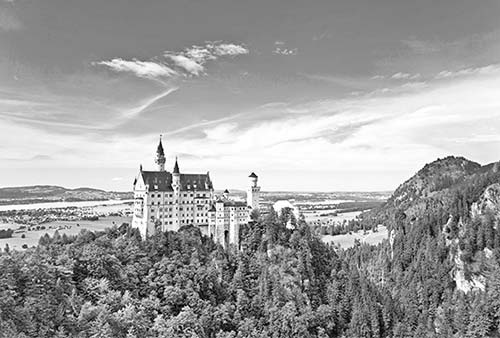
During World War II, the castle took on a sinister role. The Nazis used Neuschwanstein as one of their primary secret storehouses for stolen art. After the war, Allied authorities spent a year sorting through and redistributing the art, which filled 49 rail cars from this one location alone. It was the only time the unfinished rooms were put to use.
Today, guides herd groups of up to 60 people through the castle, giving an interesting—yet often unenthusiastic and rushed—30-minute tour. (While you’re waiting for your timed tour to pop up on the board, climb the stairs to the upper courtyard to see more of the exterior, which isn’t covered on your tour.) Once inside, you’ll go up and down more than 300 steps (keep an eye out for a spiral staircase column that becomes a palm tree), visiting 15 lavish rooms with their original furnishings and fanciful wall paintings—mostly based on Wagnerian opera themes.
Ludwig’s extravagant throne room, modeled in a Neo-Byzantine style, celebrates six valiant Christian kings (whose mantle Ludwig clearly believed he had donned) under a huge gilded-bronze, crown-like chandelier. The exquisite two-million-stone mosaic floor is a visual encyclopedia of animals and plants. While you’re standing on a replica, original segments ring the perimeter. The most memorable stop may be the king’s gilded-lily bedroom, with his elaborately carved canopy bed (with a forest of Gothic church spires on top), washstand (filled with water piped in from the Alps), and personal chapel. After passing through Ludwig’s living room and a faux grotto, you’ll climb to the fourth floor for the grand finale: the Singers’ Hall, an ornately decorated space filled with murals depicting the story of Parzival, the legendary medieval knight with whom Ludwig identified.
After the tour, weave through the crowded gift shop and past the WCs and café to see a 13-minute video (runs continuously) that tells the story of how the castle was built and illustrates all the unfinished parts of Ludwig’s vision (more prickly towers, a central chapel, a fancy view terrace, an ornate bathhouse, and more). Finally, you’ll see a digital model of Falkenstein—a whimsical, over-the-top, never-built castle that makes Neuschwanstein look stubby. Falkenstein occupied Ludwig’s fantasies the year he died.
Then head downstairs to the kitchen (state of the art for this high-tech king in its day), after which you’ll come to a room containing a large castle model.
SIGHTS NEAR THE CASTLES
The first three listings are right at the castles, while the cable car and luge are a few miles away.
▲▲Mary’s Bridge (Marienbrücke)
Before or after the Neuschwanstein tour, climb up to Mary’s Bridge (named for Ludwig’s mom) to marvel at Ludwig’s castle, just as Ludwig did. Jockey with a United Nations of tourists for the best angle—there’s usually a line just to get onto the structure. This bridge was quite an engineering accomplishment 100 years ago. (Access to the bridge is closed in bad winter weather.) If you enjoy romantic hikes, also plan to walk down through the gorge below (described next).
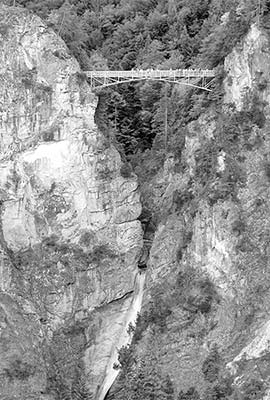
For a more glorious castle view, the frisky can hike even higher: After crossing the bridge, you’ll see very rough, steep, unofficial trails crisscrossing the hillside on your left. If you’re willing to ignore the Lebensgefahr (risk of death) signs, you can scamper up to the bluff just over the bridge.
The trail connecting Neuschwanstein to Mary’s Bridge is also scenic, with views back on Neuschwanstein’s facade in one direction, and classic views of Hohenschwangau—perched on its little hill between lakes, with cut-glass peaks on the horizon—in the other.
▲Pöllat Gorge (Pöllatschlucht)
The river gorge that slices into the rock just behind Neuschwanstein’s lofty perch is an interesting and scenic alternative to shuffling down the crowded main road from the castle. While it takes an extra 15 minutes or so, it’s well worth it. You’ll find the trailhead just above the Neuschwanstein exit, on the path toward Mary’s Bridge (look for Pöllatschlucht signs; trail closed in winter and sometimes impassable due to rockslides).
You’ll begin by walking down a steep, well-maintained set of concrete stairs, with Germany’s finest castle looming through the trees. Then you’ll pop out along the river, passing a little beach (with neatly stacked stones) offering a view up at the grand waterfall that gushes beneath Mary’s Bridge. From here follow the river as it goes over several smaller waterfalls—and stroll for a while along steel walkways and railings that make this slippery area safer. After passing an old wooden channel used to harness the power of all that water, you’ll hit level ground; turn left and walk through a pleasantly untouristy residential settlement back toward the TI.
Museum of the Bavarian Kings (Museum der Bayerischen Könige)
About a five-minute walk from the castles’ ticket center, in a former grand hotel on the shore of the Alpsee, this modern, well-presented exhibit documents the history of the Wittelsbachs, Bavaria’s former royal family. On display are plenty of family portraits and busts, as well as treasures including Ludwig II’s outlandish royal robe and elaborately decorated fairy-tale sword, and the impressive dining set given as a golden-anniversary present to his cousin Ludwig III and his wife, the last reigning Wittelsbachs. Their rule came to an end after World War I, when a socialist revolution forced them from the throne. A free audioguide lends some context to the family’s history, albeit in more detail than you’ll probably want. The museum is worthwhile only if you’re captivated by this clan and have time to kill. (But trying to squeeze it between your two castle visits is rushing it—especially if you like to linger.)
Cost and Hours: €14, includes audioguide and map; daily 9:00-17:00; no reservations required, mandatory lockers, Alpseestrasse 27, +49 8362 887 250, www.hohenschwangau.de.
▲Tegelberg Cable Car (Tegelbergbahn)
Just north of Neuschwanstein is a fun play zone around the mighty Tegelberg cable car, a scenic ride to the mountain’s 5,500-foot summit. At the top on a clear day, you get great views of the Alps and Bavaria and the vicarious thrill of watching hang gliders and paragliders leap into airborne ecstasy. Weather permitting, scores of adventurous Germans line up and leap from the launch ramp at the top of the lift. With someone leaving every two or three minutes, it’s great for spectators. Thrill seekers with exceptional social skills may talk themselves into a tandem ride with a paraglider. From the top of Tegelberg, it’s a steep and demanding 2.5-hour hike down to Ludwig’s castle. (Avoid the treacherous trail directly below the cable car.) Around the cable car’s valley station, you’ll find a playground, a cheery eatery, the stubby remains of an ancient Roman villa, and a summer luge ride (described next).
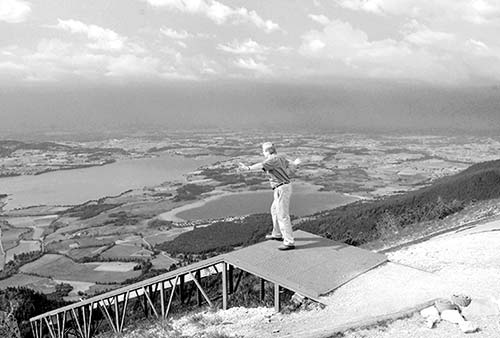
Cost and Hours: €27 round-trip, €17.50 one-way; first ascent daily at 9:00; last descent April-Oct at 17:00, mid-Dec-March at 16:00, closed Nov-mid-Dec; 4/hour, 5-minute ride to the top, in bad weather call first to confirm, +49 8362 98360, www.tegelbergbahn.de.
Getting There: From the castles, most #73 and #78 buses from Füssen continue to the Tegelbergbahn valley station (5-minute ride). It’s a 30-minute walk or 10-minute bike ride from the castles.
▲Tegelberg Luge
Next to the cable car’s valley station is a summer luge course (Sommerrodelbahn). A summer luge is like a bobsled on wheels (for more details, see “Luge Lesson” on here). This course’s stainless-steel track is heated, so it’s often dry and open even when drizzly weather shuts down the concrete luges. A funky cable system pulls riders in their sleds to the top. It’s not as long, fast, or scenic as Austria’s Biberwier luge (described on here), but it’s handy, harder to get hurt on, and half the price.
Cost and Hours: €5/ride, shareable 6-ride card-€20; typically open April-Sept daily 10:00-17:00 depending on weather, call first to confirm, waits can be long in good weather, no children under age 3, ages 3-7 may ride with an adult, +49 8362 98360, www.tegelbergbahn.de.
SLEEPING NEAR THE KING’S CASTLES
Though best for drivers, both of these places are a quick taxi ride from the Füssen train station and also close to bus stops. In return for paying the Schwangau hotel tax, you get a card with the same benefits as the Füssen Card (see here).
$$ Alpenhotel Allgäu is a small, family-run hotel with 18 decent rooms in a bucolic setting perched just below Ludwig’s dream castle. It’s a 15-minute walk from the castle ticket office and a nice place to frolic when the crowds depart (most rooms with balconies or porches—some with castle views; family rooms, elevator, free parking, just before tennis courts at Schwangauer Strasse 37 in the town of Schwangau—don’t let your GPS take you to Schwangauer Strasse 37 in Füssen, +49 8362 81152, www.alpenhotel-allgaeu.de, info@alpenhotel-allgaeu.de, Frau Reiss).
$ Beim “Landhannes,” a 200-year-old working organic dairy farm run by Conny Schön, is a great value for drivers and a unique experience for all. They rent three creaky but sunny rooms and five apartments with kitchenettes, and keep flowers on the balconies, big bells and antlers in the halls, and cows in the yard (cash only, free parking, nearby bike rental, in the village of Horn on the Füssen side of Schwangau—see the “King’s Castles Area” map, 100 yards in front of Hotel Kleiner König down a tiny lane through the meadow, Am Lechrain 22, +49 8362 8349, www.landhannes.de, info@landhannes.de).
EATING NEAR THE KING’S CASTLES
For quick, functional eateries in the immediate castle area, see “Orientation to the King’s Castles,” earlier.
If you have a car and want to eat at a good-value, nontouristy place with stunning castle views, consider $$ Schloss Brauhaus, a sprawling microbrewery restaurant in the village of Schwangau, about 1.5 miles from the castles. They brew five types of beer (dark, light, wheat, and two seasonal brews) and serve classic German fare with limited but hearty vegetarian options. Choose between the woody-industrial interior—with big copper vats and a miniature bowling alley (€8/hour)—and the outdoor Biergarten, with minigolf (€5.50, €3/child) and views of Neuschwanstein. There’s also a bakery and ice-cream shop (food served Mon-Thu 12:00-20:00, Fri-Sun from 11:00; beer served until 23:00; Gipsmühlweg 5 in Schwangau—coming from Füssen, watch for signs on the main street, Füssener Strasse, see the “King’s Castles Area” map; +49 8362 926 4680, www.schlossbrauhaus.de).
Also in Schwangau, try Schloss Backstube for huge, fresh sandwiches. They also have tempting pastries (Mon-Fri 6:30-18:00, Sat until 14:30, Sun 13:00-17:00, Füssener Strasse 15, +49 8362 8220). Farther down the road is a REWE supermarket, handy for picnic items, hearty sandwiches, hot deli foods, and build-your-own salads (daily 7:00-20:00, König-Ludwig Strasse 2, +49 8362 98270).
Wieskirche
Germany’s greatest Rococo-style church, this “Church in the Meadow”—worth ▲▲—looks as brilliant now as the day it floated down from heaven. Overripe with decoration but bright and bursting with beauty, this church is a divine droplet, a curly curlicue, the final flowering of the Baroque movement.
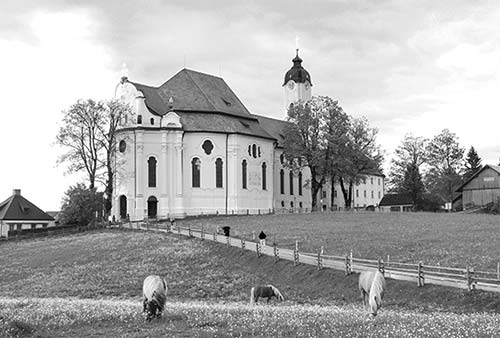
GETTING THERE
By car, the Wieskirche is a 30-minute drive north of Neuschwanstein or Füssen. Head north, turn right at Steingaden, and follow the brown signs to pay parking (€2 for 2 hours, coins only). With careful attention to schedules, you can day-trip here from Füssen by bus (#73, #9606, or #9651; 2-6/day, 45-60 minutes), but it’s a long round-trip for a church that most see in 10-15 minutes.
ORIENTATION TO WIESKIRCHE
Cost and Hours: Donation requested; daily 8:00-20:00, March-April and Sept-Oct until 19:00, Nov-Feb until 17:00. The interior is closed to sightseers during services: Sun 8:00-13:00; Tue, Wed, and Sat 10:00-12:00; and Fri 17:00-20:00.
Information: +49 8862 932 930, www.wieskirche.de.
Tours: Tours in English are possible but must be arranged at least one week in advance by telephone or by fax (fax tel. +49 8862 932 9310).
Services: Trinket shops, snack and sausage stands, a restaurant, and a WC clog the parking area below the church. A shop next to the church sells freshly made doughnuts—look for the Wieskücherl sign.
VISITING THE CHURCH
This pilgrimage church is built around the much-venerated statue of a scourged (or whipped) Christ, which supposedly wept in 1738. The carving—too graphic to be accepted by that generation’s Church—was the focus of worship in a peasant’s barn. Miraculously, it shed tears—empathizing with all those who suffer. Pilgrims came from all around. A tiny and humble chapel was built to house the statue in 1739. (You can see it where the lane to the church leaves the parking lot.) Bigger and bigger crowds came. Two of Bavaria’s top Rococo architects, the Zimmermann brothers (Johann Baptist and Dominikus), were commissioned to build the Wieskirche (completed in 1754) that stands here today.
Follow the theological sweep from the altar to the ceiling: Jesus whipped, chained, and then killed (notice the pelican above the altar—recalling a pre-Christian story of a bird that opened its breast to feed its young with its own blood); the painting of Baby Jesus posed as if on the cross; the golden sacrificial lamb; and finally, high on the ceiling, the resurrected Christ before the Last Judgment. This is the most positive depiction of the Last Judgment around. Jesus, rather than sitting on the throne to judge, rides high on a rainbow—a symbol of forgiveness—giving any sinner the feeling that there is still time to repent, with plenty of mercy on hand. In the back, above the pipe organ, notice the closed door to paradise, and at the opposite end (above the main altar), the empty throne—waiting for Judgment Day.
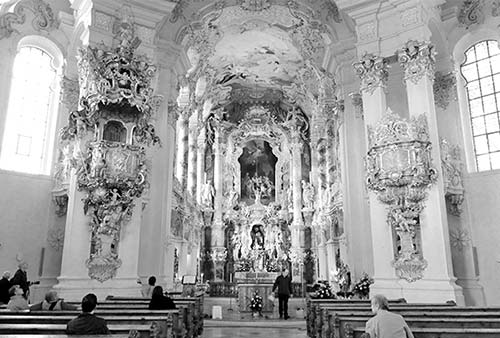
Above the doors flanking the altar are murky glass cases with 18th-century handkerchiefs. People wept, came here, were healed, and no longer needed their hankies. Walk through either of these doors and up an aisle flanking the high altar to see votives—requests and thanks to God (for happy, healthy babies, and healing for sick loved ones). Notice how the kneelers are positioned so that worshippers can meditate on scenes of biblical miracles painted high on the ceiling and visible through the ornate scalloped frames. A priest here once told me that faith, architecture, light, and music all combine to create the harmony of the Wieskirche.
Two paintings flank the door at the rear of the church. The one on the right shows the ceremonial parade in 1749 when the white-clad monks of Steingaden carried the carved statue of Christ from the tiny church to its new big one. The second painting (on the left), from 1757, is a votive from one of the Zimmermann brothers, the artists and architects who built this church. He is giving thanks for the successful construction of the new church.
ROUTE TIPS FOR DRIVERS
Driving from Wieskirche to Oberammergau: Cross the Echelsbacher Bridge, which arches 230 feet over the Pöllat Gorge. Thoughtful drivers let their passengers walk across to enjoy the views, then meet them at the other side. Notice the painting of the traditional village woodcarver (who used to walk from town to town with his art on his back) on the first big house on the Oberammergau side. It holds the Almdorf Ammertal shop, with a huge selection of overpriced carvings and commission-hungry tour guides.
Oberammergau
The Shirley Temple of Bavarian villages, and exploited to the hilt by the tourist trade, Oberammergau wears too much makeup. During its famous once-per-decade Passion Play, the crush is unbearable—and the prices at hotels and restaurants can be as well. The village has about 1,200 beds for the 5,000 playgoers coming daily. But the rest of the time, Oberammergau—while hardly “undiscovered”—is a pleasant, and at times even sleepy, Bavarian village.
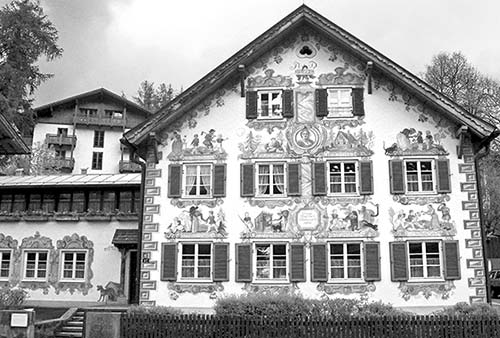
If you’re passing through, Oberammergau is a ▲ sight—worth a wander among the half-timbered, frescoed Lüftlmalerei houses (see sidebar on here). It’s also a relatively convenient home base for visiting Linderhof Castle, Ettal Monastery, and the Zugspitze (via Garmisch-Partenkirchen). A smaller (and less conveniently located) alternative to Füssen and Reutte, it’s worth considering for drivers who want to linger in the area. A day trip to Neuschwanstein from Oberammergau is manageable if you have a car, but train travelers do better to stay in Füssen.
GETTING TO OBERAMMERGAU
From Füssen, you can take the bus (#9606, 1-3/day, 1.5 hours, bus may start as #73 and change to #9606 en route—confirm with driver that bus is going to Oberammergau). Drivers can get here from Reutte in less than 30 minutes via the pretty Plansee lake.
Orientation to Oberammergau
This village of about 5,000 feels even smaller, thanks to its remote location. The downtown core, huddled around the onion-domed church, is compact and invites strolling; my recommended sights, hotels, and restaurants are all within about a 10-minute walk of one another. While the town’s name sounds like a mouthful, it’s based on the name of the local river (the Ammer) and means, roughly, “Upper Ammerland.”
Tourist Information: The helpful, well-organized TI provides English information on area hikes (Mon-Fri 9:00-18:00, Sat until 13:00; closed Sun, also closed Sat Nov-Dec; Eugen-Papst-Strasse 9A, +49 8822 922 7440, www.ammergauer-alpen.de/oberammergau).
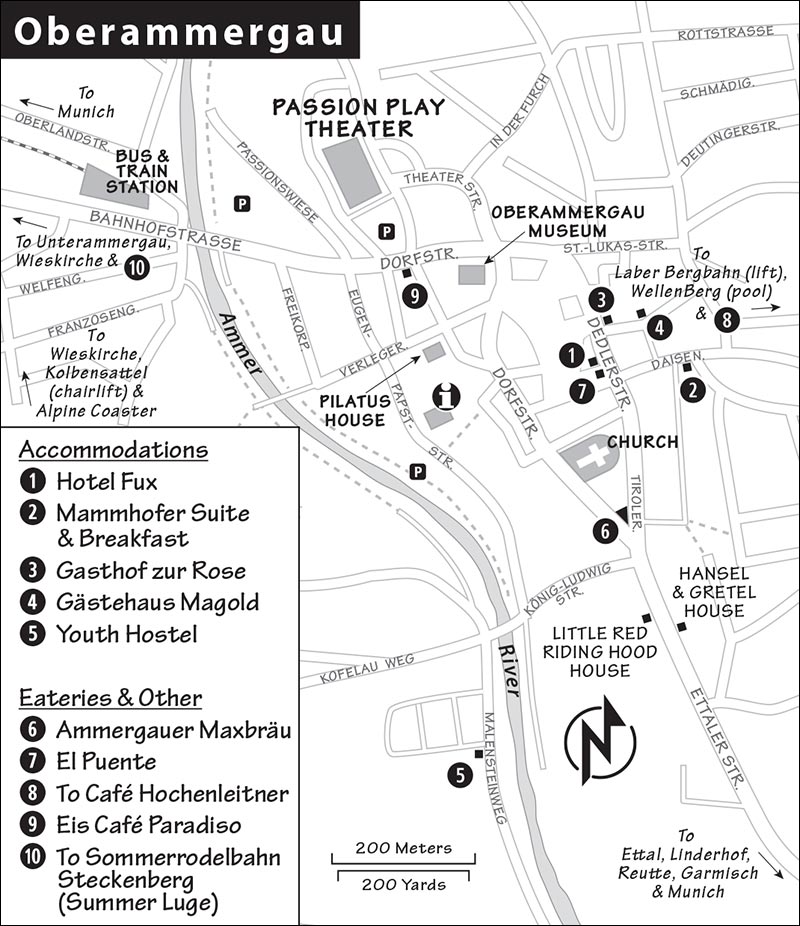
Arrival in Oberammergau: If you’re driving, you’ll find that there are two exits from the main road into Oberammergau—at the north and south ends. Either way, make your way to the free lot between the TI and the river. While there’s ample street parking in town, most is time limited and/or requires payment—be sure to read signs carefully. Hotels and sights are well signed in the town.
Helpful Hint: Travelers staying in the Oberammergau area are entitled to a guest card (Königscard)—be sure to ask your hotel for one. The card’s benefits include free travel on mountain lifts and local buses (including Garmisch-Partenkirchen, Linderhof, Füssen, and Ettal Monastery) and free admission to the Oberammergau Museum, Passion Play Theater, and WellenBerg swimming pool.
Sights in Oberammergau
▲Local Arts and Crafts
The town’s best sight is its woodcarving shops (Holzschnitzerei). Browse through these small art galleries filled with very expensive whittled works. The beautifully frescoed Pilatus House at Ludwig-Thoma-Strasse 10 has an open workshop where you can watch woodcarvers and painters at work on summer afternoons (free, late April-mid-Oct Tue-Sun 13:00-17:00, closed Mon and off-season, open weekends in Dec, +49 8822 949 511). Upstairs in the Pilatus House is a small exhibit of “reverse glass” paintings (verre églomisé) that’s worth a quick glance.
▲Oberammergau Museum
This museum showcases local woodcarving, with good English explanations. The ground floor has a small exhibit of nativity scenes (Krippe—mostly made of wood, but some of paper or wax). In the back, find the small theater, where you can watch an interesting film in English about the 2010 Passion Play. Upstairs is a much more extensive collection of the wood carvings that helped put Oberammergau on the map, including a room of old woodcarving tools, plus a small exhibit on Roman archaeological finds in the region.
Cost and Hours: €3.50; €6 combo-ticket includes museum and theater lobby; Easter-Oct and Dec-early Jan Tue-Sun 10:00-17:00, closed Mon and off-season; Dorfstrasse 8, +49 8822 94136, www.oberammergaumuseum.de.
Passion Play Theater (Festspielhaus)
Back in 1633, in the midst of the bloody Thirty Years’ War and with horrifying plagues devastating entire cities, the people of Oberammergau promised God that if they were spared from extinction, they’d “perform a play depicting the suffering, death, and resurrection of our Lord Jesus Christ” every decade thereafter. The town survived, and as it heads into its 42nd decade, the people of Oberammergau are still making good on the deal. For 100 days every 10 years, about half of the town’s population (a cast of 2,000) are involved in the production of this extravagant five-hour Passion Play—telling the story of Jesus’ entry into Jerusalem, the Crucifixion, and the Resurrection.
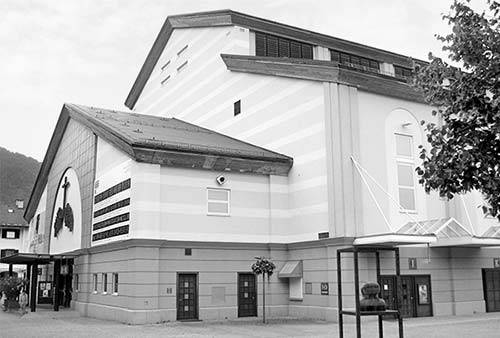
If you’re not visiting during the Passion Play performances (next scheduled in 2030), you’ll have to settle for reading the book, seeing Nicodemus tool around town in his VW, or taking a quick look at the theater, a block from the center of town.
Visiting the Theater: The theater lobby hosts a modest exhibit on the history of the performances. A long wall of photographs of past performers shows the many generations of Oberammergauers who have participated in this tradition. Climb the stairs and peek into the theater itself, which has an unusual indoor/outdoor design and a real-life alpine backdrop.
To learn more, take a 45-minute guided tour of the theater, organized by the museum (€3.50, €6 combo-ticket with Oberammergau Museum, €8 with guided tour; tours run Easter-Oct only, Tue-Sun at 11:00 in English, additional tour times in German; theater open same hours as museum, +49 8822 94136, www.oberammergaumuseum.de).
Oberammergau Church
The town church is typical Bavarian Baroque but a poor cousin of the one at Wieskirche not too far from here. Being in a woodcarving center, it’s only logical that all the statues are made of wood and then stuccoed and gilded to look like marble or gold. Saints Peter and Paul flank the altar, where the central painting can be raised to reveal a small stage decorated to celebrate special times during the church calendar. In the central dome, a touching painting shows Peter and Paul bidding each other farewell (with the city of Rome as a backdrop) on the day of their execution—the same day, in the year AD 67. On the left, Peter is crucified upside-down. On the right, Paul is beheaded with a sword. On your way out look for the wooden cross once used in the Passion Play (open daily 8:00-19:30).
Wander through the lovingly maintained graveyard, noticing the wide variety in headstones. A towering stone WWI memorial at the gate has an imposing look and sternly worded celebrations of the “heroes” of that war. But around the other side, below it on the outer fence, find the newer glass panel that modifies the sentiment: “We honor and remember the victims of the violence that our land gave the world.”
Lüftlmalerei Painted Houses
Wealthy merchants, farmers, and artisans had their houses painted using a special fresco technique called Lüftlmalerei that still sets Oberammergau apart today (see sidebar). The motifs are mostly biblical scenes and famous fairy-tale characters. While you’ll see plenty of these houses, locals recommend the “Little Red Riding Hood” and “Hansel and Gretel” houses on Ettaler Strasse, the main drag into town (see “Oberammergau” map). If you want to see more, ask the TI for a map.
NEAR OBERAMMERGAU
These attractions are a long walk from town but easy to reach by car or bike.
Mountain Lifts, Luges, and More
Laber Bergbahn, a gondola that lifts you up to sweeping views, is at the east end of town. For an easy hike, take the lift up and walk down in about 2.5 hours (www.laber-bergbahn.de).
Kolbensattel, across town to the west, is a family-friendly park with a chairlift, a mountain playground, and a speedy 1.5-mile-long Alpine Coaster (similar to a luge, closed in winter; €9 for chairlift up or down, €14 round-trip chairlift, €10 coaster only, €14.50 coaster combo-ticket with lift; daily May-Sept 10:00-18:00 in good weather, off-season until 17:00; +49 8822 4760, www.kolbensattel.de). From the top, you can hike along the ridge to a series of mountain huts: In about 1.5 hours, you’ll reach Pürschling; two hours later is Brunnenkopf (from which you could hike down to Linderhof Castle). Get tips and maps from the TI before doing these hikes.
WellenBerg Swimming Pool
Near the Laber Bergbahn lift and a 25-minute walk from town is this sprawling complex of indoor and outdoor pools and saunas (€8/3 hours, €12/day, €6 extra for sauna; Wed-Sun 10:00-21:00, closed Mon-Tue; Himmelreich 52, +49 8822 92360, www.wellenberg-oberammergau.de).
Sommerrodelbahn Steckenberg
The next town over, Unterammergau, hosts a stainless steel summer luge track that’s faster than the Tegelberg luge but not nearly as wicked as the one in Biberwier. This one has double seats (allowing a parent to accompany kids) and two sticks—one for each hand; be careful of your elbows. Unlike other luges, children under age three are allowed, and you only pay one fare when a parent and child ride together.
Cost and Hours: €3.50/ride, €15/6 rides; May-late Oct Mon-Fri 13:00-17:00, Sat-Sun 10:00-18:00, closed off-season and when wet; Liftweg 1 in Unterammergau, clearly marked and easy 2.5-mile bike ride to Unterammergau along Bahnhofstrasse/Rottenbucherstrasse, take the first left when entering Unterammergau, +49 8822 4027, www.steckenberg.de.
Sleeping in Oberammergau
Accommodations in Oberammergau tend to be more affordable than in Füssen or Reutte. All offer free parking. I’ve ranked these based on summer prices (generally May-Oct).
$$ Hotel Fux—quiet, romantic, and well run—rents 10 large rooms and six apartments decorated in the Bavarian Landhaus style (free sauna, indoor playground, Mannagasse 2a, +49 8822 93093, www.hotel-in-oberammergau.de, info@firmafux.de).
$$ Mammhofer Suite & Breakfast, run by friendly Josef, offers nine contemporary-Bavarian rooms (mostly suites and most with views) in a quiet, residential neighborhood just across the street from the town center (Daisenbergerstrasse 10, +49 8822 923 753, www.mammhofer.com, stay@mammhofer.com).
$ Gasthof zur Rose is big and centrally located, with 19 mostly small but comfortable rooms run by the friendly Frank family. At the reception desk, look at the several decades’ worth of photos showing the family performing in the Passion Play (family rooms, Dedlerstrasse 9, +49 8822 4706, www.rose-oberammergau.de, info@rose-oberammergau.de).
$ Gästehaus Magold, homey and family-friendly, has three bright and spacious rooms and two apartments—twice as nice as the cheap hotel rooms in town, and for much less (cash only, immediately behind Gasthof zur Rose at Kleppergasse 1, +49 8822 4340, www.gaestehaus-magold.de, info@gaestehaus-magold.de, hardworking Christine).
¢ Oberammergau Youth Hostel, on the river, is just a short walk from the center (family rooms, reception open 8:00-10:00 & 17:00-19:00, closed mid-Nov-Dec, Malensteinweg 10, +49 8822 4114, www.oberammergau.jugendherberge.de, oberammergau@jugendherberge.de).
Eating in Oberammergau
$$$ Ammergauer Maxbräu, in the Hotel Maximilian on the edge of downtown, serves high-quality, thoughtfully presented Bavarian fare with a modern, international twist. The rustic-yet-mod interior—with big copper vats where they brew their own beer—is cozy on a rainy day. And in nice weather, locals fill the beer garden out front (Wed-Fri 17:00-23:00, Sat-Sun from 12:00, closed Mon-Tue, reservations may be required, right behind the church, Ettaler Strasse 5, +49 8822 948 740, www.maximilian-oberammergau.de).
$$ Gasthof zur Rose, a couple of blocks off the main drag, serves reasonably priced Bavarian food in its dining room and at a few outdoor tables (Tue-Sun 11:30-14:00 & 17:30-21:00, closed Mon, Dedlerstrasse 9, +49 8822 4706, www.rose-oberammergau.de).
$$ El Puente may vex Mexican-food purists, but it’s the most hopping place in town, with margaritas and cocktails attracting young locals and tourists alike. Come not for the burritos and enchiladas but for the bustling energy (pricier steaks, Mon-Tue and Thu-Sat 17:30-23:00, closed Wed and Sun, Daisenbergerstrasse 3, +49 8822 945 777).
$ Café Hochenleitner, just a few minutes from the center, is quiet with nice outdoor seating and run by a family whose son is winning awards for his creative confections (Tue-Sun 12:00-17:00, closed Mon, Faistenmantlgasse 7, +49 8822 1312).
Dessert: Eis Café Paradiso serves up good gelato along the main street. In nice weather, Germans sunbathe with their big €5 sundaes on the generous patio out front (daily 9:00-23:00 in summer, Dorfstrasse 4, +49 8822 6279).
Oberammergau Connections
From Oberammergau to: Linderhof Castle (bus #9622, 5-6/day Mon-Fri, 4/day Sat-Sun, 30 minutes; many of these also stop at Ettal Monastery), Hohenschwangau (for Neuschwanstein) and Füssen (bus #9606, 3-4/day, 1.5 hours, some transfer or change number to #73 at Echelsbacher Brücke), Garmisch-Partenkirchen (bus #9606, nearly hourly, better frequency in morning, 40 minutes; possible by train with transfer in Murnau, 1.5 hours; from Garmisch, you can ascend the Zugspitze), Munich (nearly hourly trains, 2 hours, change in Murnau). Train info: www.bahn.com.
Linderhof Castle
This homiest of “Mad” King Ludwig’s castles is a small, comfortably exquisite mini-Versailles—good enough for a minor god, and worth ▲▲. Set in the woods 15 minutes from Oberammergau and surrounded by fountains and sculpted, Italian-style gardens, it’s the only palace I’ve toured that actually had me feeling envious.
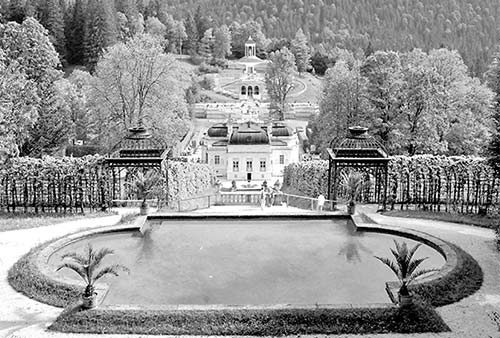
GETTING THERE
Without a car, getting to (and back from) Linderhof is a royal headache, unless you’re staying in Oberammergau. Buses from Oberammergau take 30 minutes (#9622, 5-6/day Mon-Fri, 4/day Sat-Sun). If you’re driving, pay to park near the ticket office. If driving from Reutte, take the scenic Plansee route.
ORIENTATION TO LINDERHOF CASTLE
Cost: Castle—€10 timed-entry guided 30-minute tour, €9 in winter; castle gardens—free.
Hours: Daily 9:00-18:00, mid-Oct-March 10:00-16:30. Outlying buildings are closed mid-Oct-mid-April.
Information: +49 8822 92030, www.linderhof.de.
Castle Reservations: Guided-tour reservations can be made online up to a week before your visit—and are an especially good idea in July and August, when crowds can mean an hour wait to get in. Choose your date and time, and they will email you a confirmation letter to show at the ticket desk when you arrive. Reserved tickets must be paid for and picked up on-site a half-hour before your tour time.
Crowd-Beating Tips: During the busy summer season, the castle is most crowded in the late morning; it’s wise to arrive after 15:00 if you are without a reservation. Any other time of year, your wait to tour the palace should be brief. If you do wind up with time to kill, see the extensive gardens, and some of the smaller buildings can be seen quickly while you’re waiting for your entry time.
Sightseeing Tips and Procedure: The complex sits isolated in natural splendor. Plan for lots of walking and a two-hour stop to fully enjoy this royal park (bring rain gear in iffy weather). The palace is a 10-minute walk from the ticket office. At the palace entrance, wait in line at the turnstile listed on your ticket (A through D). After your tour, explore the rest of the park and the other royal buildings dotting the king’s playground. You can eat lunch at a $$ café across from the ticket office.
Renovations: Expect cranes and construction equipment on the grounds while the grotto behind the palace undergoes restoration (through 2025).
VISITING THE CASTLE
The main attraction here is the palace itself. While Neuschwanstein is Neo-Gothic—romanticizing the medieval glory days of Bavaria—Linderhof is Baroque and Rococo, the frilly, overly ornamented styles more associated with Louis XIV, the “Sun King” of France. And, while Neuschwanstein is full of swans, here you’ll see fleur-de-lis (the symbol of French royalty) and multiple portraits of Louis XIV, Louis XV, Madame Pompadour, and other pre-Revolutionary French elites. Though they lived a century apart, Ludwig and Louis were spiritual contemporaries: Both clung to the notion of absolute monarchy, despite the realities of the changing world around them. Capping the palace roofline is one of Ludwig’s favorite symbols: Atlas, with the weight of the world literally on his shoulders. Oh, those poor, overburdened, misunderstood absolute monarchs!
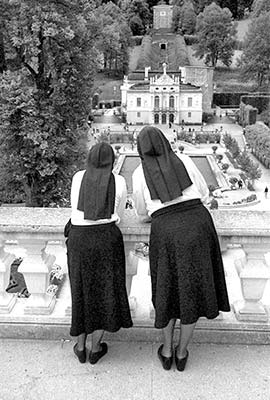
Ludwig was king for 22 of his 40 years. He lived much of his last eight years here—the only one of his castles that was finished in his lifetime. Frustrated by the limits of being a “constitutional monarch,” he retreated to Linderhof, inhabiting a private fantasy world where extravagant castles glorified his otherwise weakened kingship. You’ll notice that the castle is small—designed for a single occupant. Ludwig, who never married or had children, lived here as a royal hermit.
The castle tour includes 10 rooms on the upper floor. (The downstairs, where the servants lived and worked, now houses the gift shop.) You’ll see room after room exquisitely carved with Rococo curlicues, wrapped in gold leaf. Up above, the ceiling paintings have 3-D legs sticking out of the frame. Clearly inspired by Versailles, Linderhof even has its own (much smaller) hall of mirrors—decorated with over a hundred Nymphenburg porcelain vases and a priceless ivory chandelier. The bedroom features an oversized crystal chandelier, delicate Meissen porcelain flowers framing the mirrors, and a literally king-size bed—a two-story canopy affair draped in blue velvet. Perhaps the most poignant sight, a sad commentary on Ludwig’s tragically solitary lifestyle, is his dinner table—preset with dishes and food—which could rise from the kitchen below into his dining room so he could eat alone. (Examine the incredibly delicate flowers in the Meissen porcelain centerpiece.)
The palace is flanked on both sides with grand, terraced fountains (peopled by gleaming golden gods) that erupt at the top and bottom of each hour. If you’re waiting for your palace tour to begin, hike up to the top of the terrace for a fine view.
Ludwig’s grotto, behind the palace, is undergoing restoration work. Inspired by Wagner’s Tannhäuser opera, this artificial cave (300 feet long and 70 feet tall) is actually a performance space. Its rocky walls are made of cement poured over an iron frame. (Although Ludwig exalted the distant past, he took full advantage of then-cutting-edge technology to bring his fantasies to life.) The grotto provided a private theater for the reclusive king to enjoy his beloved Wagnerian operas—he was usually the sole member of the audience. The grotto features a waterfall, fake stalactites, and a swan boat floating on an artificial lake (which could be heated for swimming). Brick ovens hidden in the walls could be used to heat the huge space. The first electricity in Bavaria was generated here, to change the colors of the stage lights and to power Ludwig’s fountain and wave machine.
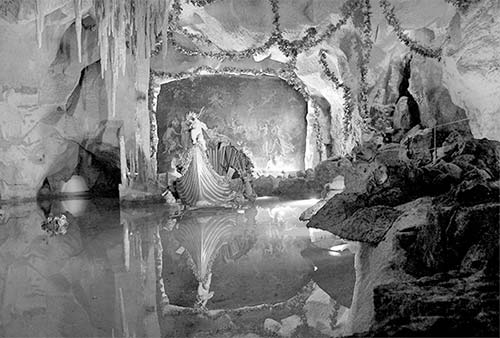
Other Sights at Linderhof: Several other smaller buildings are scattered around the grounds; look for posted maps and directional signs to track them down. Most interesting are the Moroccan House and Moorish Kiosk. With over-the-top decor seemingly designed by a sultan’s decorator on acid, these allowed Ludwig to “travel” to exotic lands without leaving the comfort of Bavaria. (The Moorish Kiosk is more interesting; look for its gilded dome in the woods beyond the grotto.) At the far edge of the property is Hunding’s Hut, inspired by Wagner’s The Valkyrie—a rustic-cottage stage-set with a fake ash tree inside it. And closer to the entrance—along the path between the ticket booth and the palace—is the King’s Cottage, used for special exhibitions (often with an extra charge).
Ettal Monastery
In 1328, the Holy Roman Emperor was returning from Rome with what was considered a miraculous statue of Mary and Jesus. He was in political and financial trouble, so to please God, he founded a monastery with this statue as its centerpiece. The monastery, located here because it was suitably off the beaten path, became important as a place of pilgrimage, and today Ettal is on one of the most traveled tourist routes in Bavaria. Stopping here (free and easy for drivers) offers a convenient peek at a splendid Baroque church, worth ▲. Restaurants across the road serve lunch.
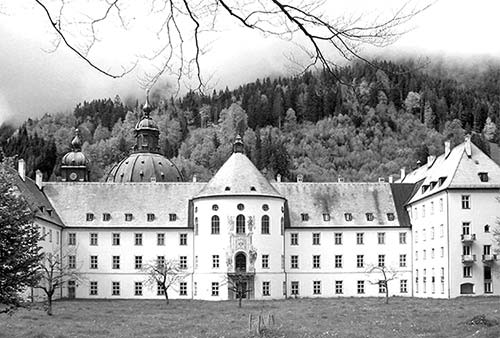
GETTING THERE
Ettal Monastery dominates the village of Ettal—you can’t miss it. Ettal is a few minutes’ drive (or a delightful bike ride) from Oberammergau. Just park and wander in (€2/4 hours in larger lots; free in small, crowded lot near the Klosterladen shop—on the side of the building facing the main drag). Some Oberammergau-to-Linderhof buses stop here (see “Oberammergau Connections,” earlier).
ORIENTATION TO ETTAL MONASTERY
Cost and Hours: The church is free and open daily 8:30-18:30 in summer, until 18:00 off-season. It’s best not to visit during Mass (usually Sun at 9:30 and 11:00). If you’re moved to make a donation, you can drop a coin in one of the old-fashioned collection boxes.
Information: +49 8822 740, www.kloster-ettal.de.
VISITING THE MONASTERY
As you enter the more than 1,000-square-foot courtyard, imagine the 14th-century Benedictine abbey, an independent religious community. It produced everything it needed right here. In the late Middle Ages, abbeys like this had jurisdiction over the legal system, administration, and taxation of their district. Since then, the monastery has had its ups and downs. Secularized during the French Revolution and Napoleonic age, the Benedictines’ property was confiscated by the state and sold. Religious life returned a century later. Today the abbey survives, with 50 or 60 monks. It remains a self-contained community, with living quarters for the monks, workshops, and guests’ quarters. Along with their religious responsibilities, the brothers make their famous liqueur, brew beer, run a hotel, and educate 380 students in their private high school. The monks’ wares are for sale at two shops (look for the Klosterladen by the courtyard or the Kloster-Markt across the street).
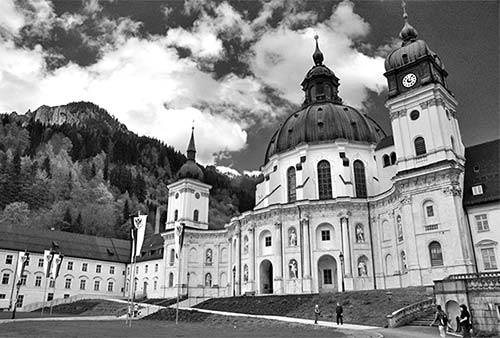
All over Germany (and much of Catholic Europe), you’ll likely see written on doorways a mysterious message: “20 + C + M + B + 23.” This is marked in chalk on Epiphany (Jan 6), the Christian holiday celebrating the arrival of the Magi to adore the newborn Baby Jesus. In addition to being the initials of the three wise men (Caspar, Melchior, and Balthazar), the letters also stand for the Latin phrase Christus mansionem benedicat—“May Christ bless the house.” The numbers represent the year (20+23), and the little crosses remind all who enter that the house has been blessed in this year. Epiphany is a bigger deal in Catholic Europe than in the US. The holiday includes gift-giving, feasting, and caroling door to door—often collecting for a charity organization. Those who donate get their doors chalked up in thanks, and these marks are left on the door through the year.
After entering the outer door, notice the tympanum dating from 1350 over the inner door. It shows the founding couple, Emperor Louis the Bavarian and his wife, Margaret, directing our attention to the crucified Lord and inviting us to enter the church contemplatively.
Stepping inside, the light draws our eyes to the dome (it’s a double-shell design, 230 feet high) rather than to the high altar. Illusions—with the dome opening right to the sky—merge heaven and earth. The dome fresco shows hundreds of Benedictines worshipping the Holy Trinity...the glory of the Benedictine Order. This is classic “south-German Baroque.”
Statues of the saints on the altars are either engaged in a holy conversation with one another or singing the praises of God. Gilded curlicues seem to create constant movement, with cherubs adding to the energy. Side altars and confessionals seem to grow out of the architectural structure; its decorations and furnishings become part of an organic whole. Imagine how 18th-century farmers and woodcutters, who never traveled, would step in here on Sunday and be inspired to praise their God.
The origin of the monastery is shown over the choir arch directly above the altar: An angel wearing the robe of a Benedictine monk presents the emperor with a marble Madonna and commissions him to found this monastery. (In reality, the statue was made in Pisa, circa 1300, and given to the emperor in Italy.)
Dwarfed by all the magnificence and framed by a monumental tabernacle is that tiny, most precious statue of the abbey—the miraculous statue of Mary and the Baby Jesus.
Zugspitze
The tallest point in Germany, worth ▲▲ in clear weather, is also a border crossing. Lifts from both Austria and Germany meet at the 9,700-foot summit of the Zugspitze (TSOOG-shpit-seh). You can straddle the border between two great nations while enjoying an incredible view. Restaurants, shops, a small museum, and telescopes await you at the summit.
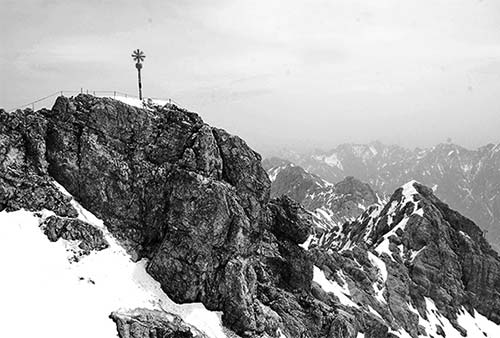
SUMMITING THE ZUGSPITZE
German Approach: Your two options from the German side to the summit both leave from a transit hub near the Eibsee lake, and cost the same (€63 round-trip, less in winter, +49 8821 7970, www.zugspitze.de).
Reaching Eibsee: If relying on public transit, first head to Garmisch-Partenkirchen (for details on getting there from Füssen, see “Füssen Connections,” earlier; from Oberammergau, see “Oberammergau Connections,” earlier). From there ride a train to Eibsee (30 minutes, hourly departures daily 8:15-14:15).
By car it’s about 10 minutes beyond Garmisch (head through town following signs for Fernpass/Reutte and watch for the Zugspitze turnoff on the left; parking-€8).
With extra time, enjoy the easy six-mile walk around the lovely Eibsee (start 5 minutes downhill from cable car station).
To the Summit from Eibsee: At Eibsee you have a choice: You can zip up to the top on a panoramic cable car (10 minutes, daily July-Aug 8:00-17:45; until 16:45 Sept-June, departs every 20 minutes; May-June and Oct-Nov only in good weather). Or you can hop on a cogwheel train (45 minutes to the top, departs hourly—coordinated with train from Garmisch; once up top, transfer from the train to a short cable car for the quick, 3-minute ascent to the summit).
You can choose between the cable car and cogwheel train on the spur of the moment, and go up on one and down on the other. Although the train ride takes longer, many travelers enjoy the more involved cog railway experience—at least one-way. The disadvantage of the train is that more than half of the trip is through dark tunnels deep in the mountains; aside from a few fleeting glimpses of the Eibsee sparkling below, it’s not very scenic.
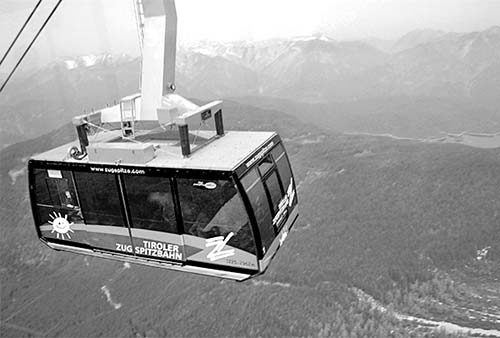
Arriving at the sleek, modern station at the top, head up to level 3 (or take elevators, given the high altitude) and follow signs for Gipfel (summit).
From the Summit Back to Eibsee: For your descent back down to Eibsee, keep in mind that the last cable car departs the summit at 17:45 in summer, and the last cogwheel train at 16:30. In general, allow plenty of time for afternoon descents: If bad weather hits in the late afternoon, cable cars can be delayed at the summit.
Austrian Approach: The Tiroler Zugspitzbahn ascent is less crowded and cheaper than the Bavarian one. Make your way to the village of Ehrwald (drivers follow signs for Tiroler Zugspitzbahn; parking €5). Departing from above Ehrwald, a lift zips you to the top in 10 minutes (€51 round-trip, departures in each direction every 20 minutes, daily 8:40-16:40 except closed during bad weather May-June and Oct-Nov, last ascent at 16:00, +43 5673 2309, www.zugspitze.at). While those without a car will find the German ascent from Garmisch-Partenkirchen easier, the Austrian ascent is also doable. It’s a 35-minute train trip from Reutte to Ehrwald (departures hourly); then either hop the bus from the Ehrwald train station to the lift (departures nearly hourly), or pay about €15 for the five-minute taxi ride from the train station.
VISITING THE SUMMIT
Whether you’ve ascended from the Austrian or German side, you’re high enough now to enjoy a little tour of the summit. The two terraces—Bavarian and Tirolean—are connected by a narrow walkway, which was the border station before Germany and Austria opened their borders. The Austrian (Tirolean) side was higher until the Germans blew its top off in World War II to make a flak tower, so let’s start there.
Tirolean Terrace: Before you stretches the Zugspitzplatt glacier. Is it melting? A reflector once stood here to slow it from shrinking during summer months. Many ski lifts fan out here, as if reaching for a ridge that defines the border between Germany and Austria. The circular metal building far below is the top of the cog railway line that the Germans cut through the mountains in 1931. Just above that, find a small square building—the Hochzeitskapelle (wedding chapel) consecrated in 1981 by Cardinal Joseph Ratzinger (a.k.a. Pope Benedict XVI, who passed away in 2022).
Both Germany and Austria use this rocky pinnacle for communication purposes. The square box on the Tirolean Terrace provides the Innsbruck airport with air traffic control, and a tower nearby is for the German Katastrophenfunk (civil defense network).
This highest point in Germany (there are many higher points in Austria) was first climbed in 1820. The Austrians built a cable car that nearly reached the summit in 1926. (You can see it just over the ridge on the Austrian side—look for the ghostly, abandoned concrete station.) In 1964, the final leg, a new lift, was built connecting that 1926 station to the actual summit, where you stand now. Before then, people had to hike the final 650 feet to the top. Today’s lift carries half a million people up to the Zugspitze every year. The Austrian station has a fine little museum—free with Austrian ticket, €4 if you came up from Germany—that shows three interesting videos (6-minute 3-D mountain show, 30-minute making-of-the-lift documentary, and 45-minute look at the nature, sport, and culture of the region).
Looking up the valley from the Tirolean Terrace, you can see the towns of Ehrwald and Lermoos in the distance, and the valley that leads to Reutte. Looking farther clockwise, you’ll see the Eibsee below. Hell’s Valley, stretching to the right of the Eibsee, seems to merit its name.
Bavarian Terrace: The narrow passage connecting the two terraces used to be a big deal—you’d show your passport here at the little blue hut (now a gift shop) and shift from Austrian schillings to German marks. Notice the regional pride here: no German or Austrian national banners, but regional ones instead—Freistaat Bayern (Bavaria) and Land Tirol.
The German side features a golden cross marking the summit...the highest point in Germany. A priest and his friends hauled it up in 1851. The historic original was shot up by American soldiers using it for target practice in the late 1940s, so what you see today is a modern replacement. In the summer, it’s easy to “summit” the Zugspitze, as there are steps and handholds all the way to the top. Or you can just stay behind and feed the birds. The yellow-beaked ravens get chummy with those who share a little pretzel or bread.
The oldest building up here is the Münchner Haus, the first mountaineers’ hut, built in 1897 and entwined with mighty cables that cinch it down. In 1985, observers clocked 200-mph winds up here—those cables were necessary.
On level 1, near the WCs, an exhibit of historical photos and artifacts is worth a look if you have time to kill before heading back down. If you’re going down on the German side, remember you must choose between the cable car (look for the Eibsee signs) or cog railway (look for Talfahrt/Descent, with a picture of a train; you’ll board a smaller cable car for the quick trip to the train station).
Reutte, Austria
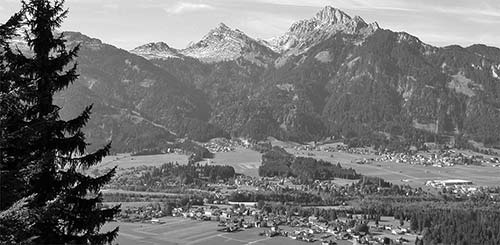
Reutte (ROY-teh, with a guttural r), a relaxed Austrian town of 6,000, is a 20-minute drive across the border from Füssen. While overlooked by the international tourist crowd, it’s popular with Germans and Austrians for its climate. Doctors recommend its “grade 1” air.
Although its setting—surrounded by alpine peaks—is striking, the town itself is pretty unexceptional. But that’s the point. I enjoy Reutte for the opportunity it offers to simply be in a real community. As an example of how the town is committed to its character, real estate can be sold only to those using it as a primary residence. (Many formerly vibrant alpine towns made a pile of money but lost their sense of community by becoming resorts. They allowed wealthy foreigners—who just drop in for a week or two a year—to buy up all the land, and are now shuttered up and dead most of the time.)
Reutte has one claim to fame among Americans: As Nazi Germany was falling in 1945, Hitler’s top rocket scientist, Werner von Braun, joined the Americans (rather than the Russians) in Reutte. You could say that the American space program began here.
Reutte isn’t featured in any other American guidebook. Its charms are subtle. It was never rich or important. Its castle is ruined, its buildings have painted-on “carvings,” its churches are full, its men yodel for one another on birthdays, and its energy is spent soaking its Austrian and German guests in Gemütlichkeit (cozy conviviality). Most guests stay for a week, so the town’s attractions are more time-consuming than thrilling.
Some travelers tell me this town is over-Reutte-d. Füssen’s tidy pedestrian core and glitzy hotels make it an easier home base. But in my view, Reutte’s two big trump cards are its lovely countryside accommodations (the farther from the town center, the more rustic, authentic, and relaxing) and its proximity to one of my favorite ruined castles, Ehrenberg. Since you need a car to take best advantage of these pluses (as well as to reach the King’s Castles quickly), Reutte is a good place for drivers to spend the night.
Orientation to Reutte
Reutte feels spread out, because it’s really a web of several villages that fill a basin hemmed in by mountains and cut through by the Lech River. Drivers find its tangle of crisscrossing roads bewildering at first; know where you’re going and follow signs to stay on track (see the “Greater Reutte” map).
Reutte proper, near the train station, has a one-street downtown where you’ll find the TI, museum, and a couple of hotels and eateries. The area’s real charm lies in the abutting hamlets, and that’s where my favorite hotels and restaurants are located: Breitenwang, flowing directly from Reutte to the east, marked by its pointy steeple; Ehenbichl, a farming village cuddled up against the mountains to the south; Höfen, squeezed between an airstrip and a cable car station, just across the river from Ehenbichl; and remote Pinswang, stranded in a forgotten valley halfway to Germany, just over the mountain from Neuschwanstein. Watching over it all to the south are the Ehrenberg Castle ruins—viewable from just about everywhere and evocatively floodlit at night—two miles out of town on the main Innsbruck road.
TOURIST INFORMATION
Reutte’s excellent TI is a block from the train station (Mon-Fri 8:00-17:00, Sat until 12:00, closed Sun year-round, Untermarkt 34, +43 5672 62336, www.reutte.com). Go over your sightseeing plans, ask about a Tirolean folk evening performance (summer only), and pick up city and biking/hiking maps, bus schedules, a free town info booklet (with a good self-guided walk), and a brochure explaining the Aktiv-Card (available at hotels; described later, under “Helpful Hints”).
ARRIVAL IN REUTTE
By Car: From the expressway, always take the south (Süd) exit into town (even if you pass the Nord exit first). For parking in town, blue lines denote pay-and-display spots. There are a few spaces just outside the TI that are free for up to 30 minutes—handy for stopping by with a few questions en route to your out-of-town hotel. For longer stays, there’s a free lot (P-1) just past the train station on Mühler Strasse (about a 10-minute walk from the town center and TI).
By Train or Bus: When traveling by train make sure to get off at Reutte Bahnhof, not Reutte Schulzentrum. From the tidy little train/bus station (no baggage storage, usually unstaffed), exit straight ahead and walk three minutes straight up Bahnhofstrasse. After the park on your left, you’ll see the TI.
HELPFUL HINTS
Hotel Card: Guests staying in the Reutte area (and, therefore, paying the local hotel tax) are entitled to an Aktiv-Card—be sure to ask your hotel for one. The TI has a brochure explaining the card’s benefits, including free travel on some local buses, low-cost taxi service on most routes in high season, free admission to the recommended museum below Ehrenberg Castle, 50 percent off the Alpentherme bath complex, plus free days and discounts on many outdoor activities.
Laundry: There’s no launderette, but a couple of recommended hotels let nonguests use their laundry services: Hotel Maximilian (wash, dry, and fold) and Alpenhotel Ernberg (self-service).
Bike Rental: Try Sport 2000 Paulweber (city bike-€20/day, mountain bike-€25/day, electric bike-€35/day, Mon-Fri 8:30-12:00 & 14:00-18:00, Sat 8:30-12:00, closed Sun, Allgäuer Strasse 15, +43 5672 62232), or check at the Hotel Maximilian.
Taxi: Inexpensive taxi service is available to hotel guests with an Aktiv-Card (described earlier). Those without a card can call Reutte Taxi (+43 699 1050 4949).
Sights in and near Reutte
Highline 179 Suspension Footbridge
Reutte Museum (Museum Grünes Haus)
▲▲EHRENBERG CASTLE ENSEMBLE
If Neuschwanstein was the medieval castle dream, Ehrenberg (Festungsensemble Ehrenberg) is the medieval castle reality. Once the largest fortification in Tirol, its brooding ruins lie about two miles outside Reutte. What’s here is actually an ensemble of four castles, built to defend against the Bavarians and to bottle up the strategic Via Claudia trade route, which cut through the Alps as it connected Italy and Germany. Half-forgotten and overgrown only a decade ago, the ruins have been transformed into a fine attraction with hiking paths, a museum, a guesthouse, an incline elevator, and a 1,200-foot pedestrian suspension bridge with 360-degree views. The European Union helped fund the project because it promotes the heritage of a multinational region—Tirol—rather than a country.
In Roman times, the Via Claudia—the road below Ehrenberg—was the main route between northern Italy (Verona) and southern Germany (Augsburg), and was broad enough for wheeled traffic. Historians estimate that in medieval times, about 10,000 tons of precious salt passed through this valley each year, so it’s no wonder the locals built this complex of fortresses and castles to control traffic and levy tolls on all who passed.
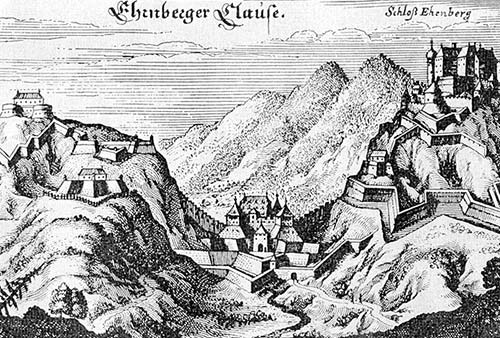
The complex has four parts: the old toll buildings on the valley floor, where you park (the Klause); the oldest castle, on the hilltop directly above (Ehrenberg); a mightier castle on a higher peak of the same hill (Schlosskopf); and a smaller fortification across the valley (Fort Claudia). All four were once a single complex connected by walls. Signs posted throughout the site help orient visitors and explain some background on the region’s history, geology, flora, and fauna, and colorful, fun boards relate local folktales.
Cost and Hours: The castle ruins are free and always open, but the museum, suspension bridge, and elevator have fees (for details, see individual listings).
Information and Services: +43 5672 62007, www.ehrenberg.at. A helpful information desk has maps of trails leading up to the castle. Take advantage of the WC stop before you begin your ascent.
Getting There: The castles are on the road to Lermoos and Innsbruck, just five minutes by car from Reutte (parking-€4/day). It’s a pleasant but steep 30-minute walk or a short bike ride from town; bikers can use the Radwanderweg along the Lech River (the TI has a good map). For an overview, see the “Greater Reutte” map on here.
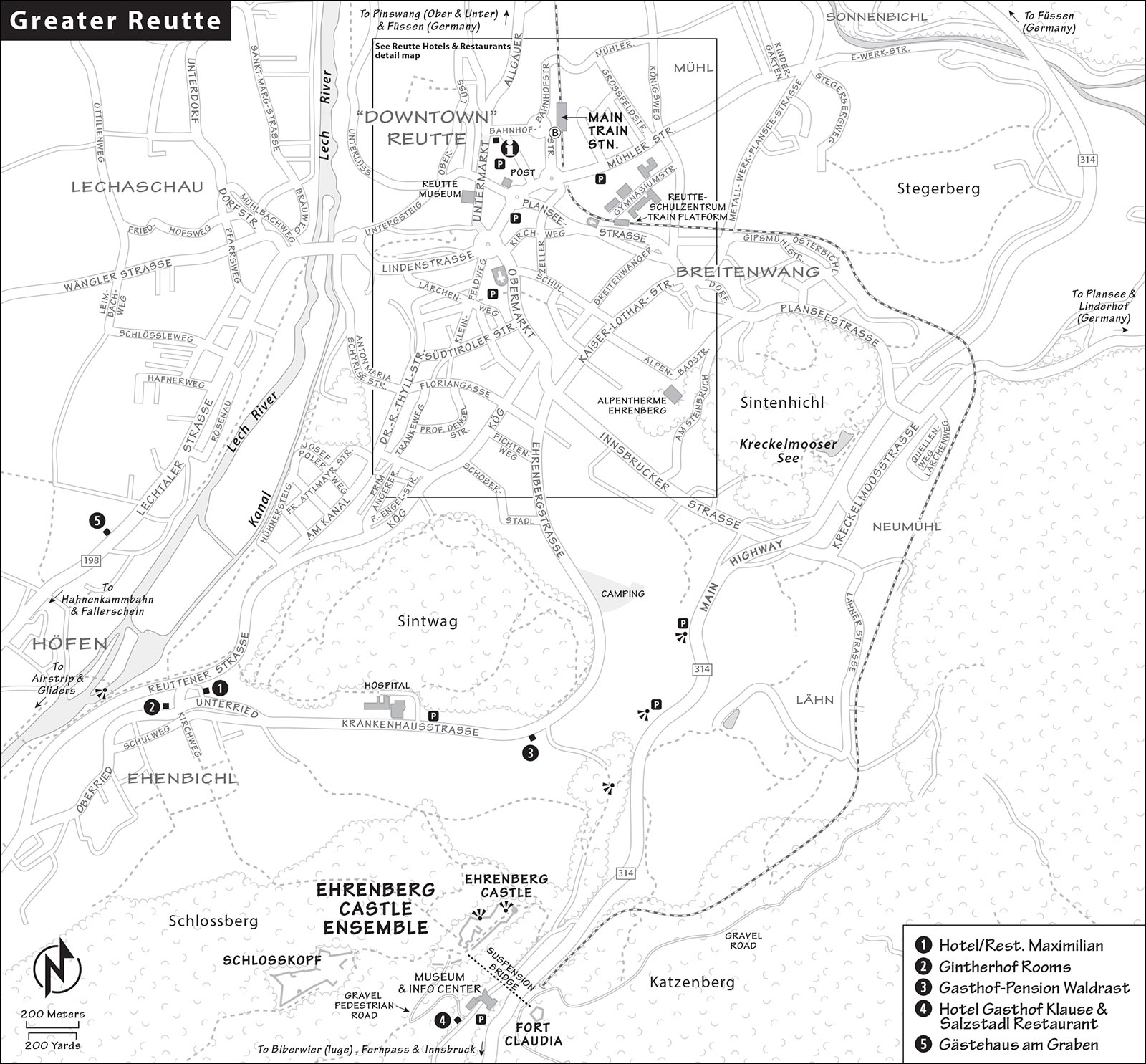
Local bus #120 runs sporadically from Reutte’s main train station to Ehrenberg (5-8/day Mon-Sat, 3/day Sun, 10 minutes, €2.90; see www.vvt.at for schedules—the stop name is “Ehrenberger Klause”). However, no buses run directly back to Reutte from the castle. If you aren’t driving, a taxi is your only option here (see “Helpful Hints,” earlier).
Taking the Lift: You can cut down the steep climb to the ruins by taking the Ehrenberg Liner elevator from the visitor center up to the suspension bridge (where you can continue on the footpath to the Ehrenberg ruins). You’ll enjoy panoramic views as you ascend 360 feet in less than three minutes (€8—buy ticket at info desk or vending machine, runs daily 8:30-10:00). Starting in mid-2023, a second incline elevator should be running from the suspension bridge station up to the Schlosskopf ruins (additional charge; buy two-elevator ticket at info desk).
Ehrenberg Museum
While there are no real artifacts here, this kid-friendly museum is hands-on and well described in English. The focus is on castles, knights, and medieval warcraft. Video exhibits trace a fictional (and rather glum) story of a horse groomer in the 1300s who leaves behind the love of his life to seek his fortune so they can wed. Following his quest, you can try on a set of armor (and then weigh yourself), learn about everyday medieval life, empathize with victims of the plague, and join a Crusade. In the armory section, you can heft replica weapons from the period. Videos and soundtracks spring to life if you press a button (select E for English).
A smaller exhibit (with separate entry fee) focuses on the still-wild Lech River and how it affects everything around it, from industry (rafting trade) to flora and fauna.
Cost and Hours: Museum-€8, nature exhibit-€5.50, combo-ticket for both-€10.80, daily 10:00-18:00, Dec-April until 16:00, closed Nov, last entry one hour before closing.
Eating: The $$ Salzstadl (“salt barn”), next to the museum, once held valuable salt being transported along the Via Claudia. Now it’s a rustic restaurant serving typical Tirolean meals and snacks (Brotzeiten), as well as the local brew—Lechweg-Bier (lots of outdoor seating, salad bar; open Tue-Sun 10:00-22:00, closed Mon, hot food served until 20:00; +43 5672 62213).
▲▲Ehrenberg Ruins
Ehrenberg, a romantic 13th-century ruin, provides a super opportunity to let your imagination off its leash. Hike up 30 minutes from the parking lot in the valley or take the Ehrenberger Liner elevator most of the way up (see “Taking the Lift,” earlier)—either way you’ll get great views. The trail is well marked and has well-groomed gravel, but it’s quite steep, and once you reach the castle itself, you’ll want good shoes to scramble over the uneven stairs. The castle is always open.
 Self-Guided Tour: From the parking lot, follow yellow signs up into the woods, tracking Ruine Ehrenberg or Bergruine Ehrenberg. At the top of the first switchback, notice the option to turn left and hike 45 minutes up to Schlosskopf, the higher castle (described next; this is an easier ascent than the very steep route you can take from closer to Ehrenberg). But we’ll head right and continue up the path through the lower entrance bastion of Ehrenberg.
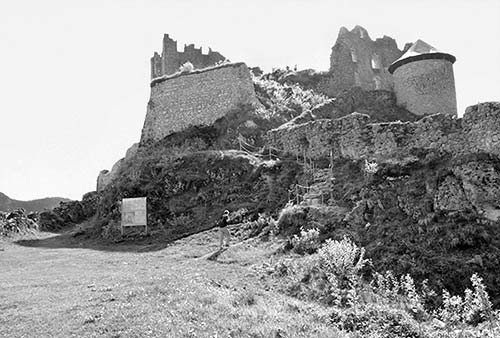
Emerging from the woods, you’ll pop out at a saddle between two steep hills. (This is where you’ll join the hike if you take the elevator up; the suspension bridge is just beyond.) As you face Reutte, the hill on the left is Schlosskopf (notice the steeper ascent here to reach the top), and to the right is Ehrenberg. Ehrenberg is the older of the two, built around 1290. Thirteenth-century castles were designed to stand boastfully tall. Later, with the advent of gunpowder, castles dug in. (Notice the 18th-century ramparts around the castle.)
Now continue twisting up the path to Ehrenberg Castle. As you approach its outer gate, look for the small door to the left. It’s the night entrance (tight and awkward, and therefore safer against a surprise attack). But we’ll head through the main gate—actually, two of them. Castles were designed with layered defenses—outer bastion down below, outer gate here, inner gate deeper within—which allowed step-by-step retreat, giving defenders time to regroup and fight back against invading forces.
After you pass through the outer gate, but before climbing to the top of the castle, follow the path around to the right to a big, grassy courtyard with commanding views and a fat, restored turret. This stored gunpowder and held a big cannon that enjoyed a clear view of the valley below. In medieval times, all the trees approaching the castle were cleared to keep an unobstructed view.
Look out over the valley. The pointy church spire marks the village of Breitenwang, which was the site of a Roman camp in AD 46. In 1489, after a bridge was built across the Lech River at Reutte (marked by the onion-domed church with the yellow tower), Reutte was made a market town and eclipsed Breitenwang in importance. Any gliders circling? They launch from just over the river in Höfen.
For centuries this castle was the seat of government—ruling an area called the “judgment of Ehrenberg” (roughly the same as today’s “district of Reutte”). When the emperor came by, he stayed here. In 1604, the ruler moved downtown into more comfortable quarters, and the castle was no longer a palace.
Now climb to the top of Ehrenberg Castle. Take the high ground. There was no water supply here—just kegs of wine, beer, and a cistern to collect rain. Up at the top, appreciate how strategic this lofty position is—with commanding views over Reutte and its broad valley, as well as the narrow side-valley where the suspension bridge looms over the highway down below. But also notice that you’re sandwiched between two higher hilltops: Schlosskopf in one direction and Falkenberg (across the narrow valley) in the other. In the days before gunpowder, those higher positions offered no real threat. But in the age of cannonballs, Ehrenberg was suddenly very vulnerable...and very obsolete.
Still, Ehrenberg repelled 16,000 Swedish soldiers in the defense of Catholicism in 1632. But once Schlosskopf was fortified a few decades later, Ehrenberg’s days were numbered, and its end was not glorious. In the 1780s, a local businessman bought the castle in order to sell off its parts. Later, in the late 19th century, when vagabonds moved in, the roof was removed to make squatting miserable. With the roof gone, deterioration quickened, leaving only this evocative shell and a whiff of history.
Scramble around the ruined walls a bit—nocking imaginary arrows—and head back down through the main gate, returning to the valley the way you came. If you have more energy and castle curiosity, you could try conquering the next castle over: Schlosskopf.
▲Schlosskopf
When Bavarian troops captured Ehrenberg in 1703, the Tiroleans climbed up to the bluff above it to rain cannonballs down on their former fortress. In 1740, a mighty new castle—designed to defend against modern artillery—was built on this sky-high strategic location: Schlosskopf (“Castle Head”). But it too fell into ruin, and by the end of the 20th century, the castle was completely overgrown with trees—you literally couldn’t see it from Reutte. But today the trees have been shaved away, and the castle has been excavated. In 2008, the Castle Ensemble project, led by local architect Armin Walch, opened the site with English descriptions and view platforms. One spot gives spectacular views of the strategic valley. The other looks down on the older Ehrenberg Castle ruins, illustrating the strategic problems presented by the advent of the cannon.
Getting There: There are two hiking routes to Schlosskopf, both steep and time-consuming. The steeper of the two (about 30 minutes straight up) starts at the little saddle of land between the two castles (described earlier). The second, which curls around the back of the hill, is less steep but takes longer (45-60 minutes); this one begins from partway down the gravel switchbacks between Ehrenberg and the valley floor—just watch for Schlosskopf signs. A new incline elevator could be running from the saddle up to Schlosskopf starting in mid-2023.
Highline 179 Suspension Footbridge
At more than 1,200 feet long, this suspended pedestrian bridge hangs more than 300 feet above the valley floor, connecting Ehrenberg with the previously difficult-to-reach Fort Claudia across the valley. It was the vision of architect and local trailblazer Armin Walch, who helped restore the Ehrenberg ruins and wanted to do something to draw attention to the region. Designed by Swiss engineers and paid for by private investors, the bridge was erected in just six months. With your ticket, the turnstile lets you in, then you walk to the far side, where you’re welcome to leave the bridge and enjoy the viewpoint. With the same ticket, you can walk back across the bridge to your starting point.
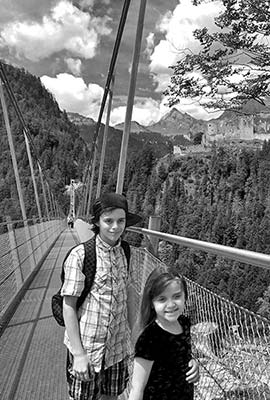
I’m not much into adventure sports, but for me, this wobbly ramble is a thrill. If you look down, directly beneath you is the Via Claudia, which in Roman times was the main route between Italy and Germany. Now this bridge is at the foot of all these great castles, allowing travelers a fun way to reach them—if you like a little adventure.
Cost and Hours: €8 round-trip, better to purchase ticket at the complex’s information desk (at parking lot level, credit cards accepted) in case the cash-only machines at the top aren’t working, children’s tickets available only at information desk; daily 8:00-22:00, open rain or shine unless too windy, +43 5672 62007, www.highline179.com.
IN REUTTE TOWN
Reutte Museum (Museum Grünes Haus)
Reutte’s cute city museum offers a quick look at the local folk culture and the story of the castles. There are exhibits on Ehrenberg and the Via Claudia, local painters, and more—ask to borrow the English translations.
Cost and Hours: €3; Tue-Sat 13:00-17:00, closed Sun-Mon; shorter hours and closed Sun-Tue off-season; closed Easter-end of April and Nov-early Dec; in the green building with trompe l’oeil columns and window trim at Untermarkt 25, around corner from Hotel Goldener Hirsch, +43 5672 72304, www.museum-reutte.at.
▲▲Tirolean Folk Evening
Ask the TI or your hotel if there’s a Tirolean folk evening scheduled. During the summer (July-Sept), nearby towns (such as Höfen) occasionally put on an evening of yodeling, slap dancing, and Tirolean frolic. These are generally free and worth the short drive. You’ll have to do your own yodeling in the off-season. Free open-air concerts (Platzkonzerte) are held in Reutte and the surrounding communities in the summer.
Alpentherme Ehrenberg
This extensive swimming pool and sauna complex, a 15-minute walk from downtown Reutte, is a tempting retreat. The Badewelt section features two indoor pools and a big outdoor saltwater pool, and two indoor waterslides. The all-nude Saunaparadies section (no kids under age 16) consists of three indoor saunas, three freestanding outdoor saunas, and a big outdoor swimming pool. You’ll be given a wristband that lets you access your locker and buy snacks on credit without needing a key or cash. Those staying in the Reutte area get a 50 percent discount with an Aktiv-Card (see “Helpful Hints,” earlier); it’s a nice way to relax after hiking around castles all day.
Cost and Hours: Pools only-€11/2 hours, €13/4 hours, €15/day; sauna and pools-€24/3 hours, €31/day; towel rental-€3, robe rental-€5, swimsuits sold but not rented; daily 10:00-21:00, sauna until 22:00, closes for one week every May; Thermenstrasse 10, +43 5672 72222, www.alpentherme-ehrenberg.at.
ACROSS THE RIVER, IN HÖFEN
Just over the Lech River are two very different ways to reach high-altitude views. To get here from Reutte, head up Lindenstrasse (where the cobbled Obermarkt ends), cross the bridge, and turn left down Lechtaler Strasse; as you enter the village of Höfen, you’ll see the cable car to your right and the airstrip to your left.
▲Scenic Flights
For a major thrill on a sunny day, drop by the tiny airport in Höfen, where small single-prop planes and gliders take passengers on scenic flights (April-Oct). Although I’ve listed contact information here, your best bet is to show up at the airstrip on a good-weather afternoon and ask around. Prop planes can buzz the Zugspitze and Ludwig’s castles and give you a bird’s-eye peek at the Ehrenberg ruins (+43 699 1022 2274, www.segelflugvereinausserfern.at). The prop planes and gliders are based out of two different restaurants that face the airstrip. From the main road, watch for the big building marked Flugplatz down below.
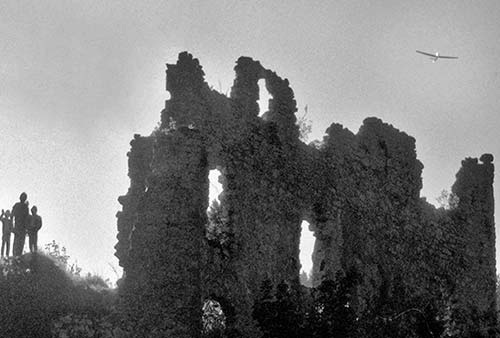
Hahnenkammbahn
This mountain lift swoops you high above the tree line in eight-seat gondolas to an attractive panoramic restaurant and starting point for several hikes that lead to sweeping vistas. In the alpine flower park, special paths take you past countless varieties of local flora. Unique to this lift is a barefoot hiking trail (Barfusswanderweg), designed to be walked without shoes—no joke.
Cost and Hours: €17 one-way, €22 round-trip, runs daily late May-early Nov 9:00-16:30, flowers best in late July, base station across the river in Höfen, +43 5672 62420, www.reuttener-seilbahnen.at.
NEAR REUTTE
Sights Along the Lech River
The Lech River begins high in the Alps and meanders 75 miles (including right past Reutte) on its way to the Lechfall, where it becomes navigable, near Füssen. This stretch of the Lech River Valley (Lechtal) has been developed as a popular hiking trail, called the Lechweg, divided into 15 stages (Strecken); part of the area has also been designated as a nature park. A variety of glossy brochures—mostly in German and available at local TIs and hotels—explain the importance of the Lech to local culture and outline some enticing hikes.
Within the pristine Tiroler Lech Nature Park, a little outside Reutte, is an impressive wooden lookout tower from which you can observe the vibrant bird life in the wetlands along the Lech River (110 species of birds nest here). Look for Vogelerlebnispfad signs as you’re driving through the village of Pflach (on the road between Reutte and Füssen; www.naturpark-tiroler-lech.at).
Taking a wild ride on a summer luge (pronounced “loozh”) is a quintessential alpine experience. In German, it’s called a Sommerrodelbahn (“summer toboggan run”). To try one of Europe’s great accessible thrills, take the lift up to the top of a mountain, grab a wheeled sled-like go-cart, and scream back down the mountainside on a banked course. Then take the lift back up and start all over again.
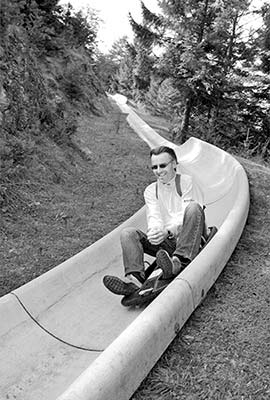
Luge courses are highly weather dependent and can close at the slightest hint of rain. If the weather’s questionable, call ahead to confirm that your preferred luge is open. Stainless steel courses are more likely than concrete ones to stay open in drizzly weather.
Operating the sled is simple: Push the stick forward to go faster, pull back to apply brakes. Even a novice can go very, very fast. Most are cautious on their first run, speed demons on their second...and bruised and bloody on their third. A woman once showed me her travel journal illustrated with her husband’s dried five-inch-long luge scab. He had disobeyed the only essential rule of luging: Keep both hands on your stick. To avoid a bumper-to-bumper traffic jam, let the person in front of you get as far ahead as possible before you start. You’ll emerge from the course with a windblown hairdo and a smile-creased face.
| Lenkstange | lever |
| drücken / schneller fahren | push / go faster |
| ziehen / bremsen | pull / brake |
| Schürfwunde | scrape |
| Schorf | scab |
▲▲Biberwier Luge Course
Near Lermoos, on the road between Reutte and Innsbruck, you’ll find the Biberwier Sommerrodelbahn. At 4,250 feet, it’s the longest summer luge in Tirol. The drawbacks are its brief season, short hours, and a proclivity for shutting down sporadically—even at the slightest bit of rain. This is clearly the most exciting (and dangerous) of the region’s luge rides. Keep your knees and elbows in tight, keep both hands on the stick, and watch your speed on corners. Every day some hotshot leaves a big chunk of skin on the course—a painful souvenir that lasts a very long time.
If you don’t have a car, this is not worth the trouble; consider the luge near Neuschwanstein instead (see “Tegelberg Luge” on here). The ugly cube-shaped building marring the countryside near the luge course is a hotel for outdoor adventure enthusiasts. You can ride your mountain bike right into your room, or skip the elevator by using its indoor climbing wall.
Cost and Hours: €9.20/ride, cheaper with multiride tickets; daily mid-May-early Oct 8:30-17:00, July-Aug until 18:00, closed off-season; +43 5673 2323, www.bergbahnen-langes.at.
Getting There: It’s 20 minutes from Reutte on the main road toward Innsbruck; Biberwier is the first exit after a long tunnel.
▲Fallerschein
Easy for drivers and a special treat for those who may have been Kit Carson in a previous life, this extremely remote log cabin village, south of Reutte, is a 4,000-foot-high flower-speckled world of serene slopes and cowbells. Thunderstorms roll down the valley like it’s God’s bowling alley, but the pint-size church on the high ground, blissfully simple in a land of Baroque, seems to promise that this huddle of houses will survive, and the river and breeze will just keep flowing. The couples sitting on benches are mostly Austrian vacationers who’ve rented cabins here. Some of them, appreciating the remoteness of Fallerschein, are having affairs.
Getting There: From Reutte, it’s a 45-minute drive. Take road 198 to Stanzach (passing Weissenbach am Lech, then Forchach), then turn left toward Namlos. Follow the L-21 Berwang road for about five miles to a parking lot. From there, it’s a two-mile walk down a drivable but technically closed one-lane road. Those driving in do so at their own risk.
Sleeping in Fallerschein: ¢ Michl’s Fallerscheiner Stube is a family-friendly mountain-hut restaurant with a low-ceilinged attic space that has basic dorm beds for up to 17 sleepy hikers. The accommodations aren’t fancy, but if you’re looking for remote, this is it (May-Oct only, wildlife viewing deck, reservations best made by phone, +43 676 727 9681, www.alpe-fallerschein.com, michael@alpe-fallerschein.com, Knitel family).
Sleeping in and near Reutte
While it’s not impossible by public transport, staying here makes most sense for those with a car. Reutte is popular with Austrians and Germans, who visit year after year for one- or two-week vacations. Prices stay fairly even throughout the year. Remember to ask for the Aktiv-Card (see here). My recommendations all have free parking and a great breakfast.
My listings are in the “villages” around Reutte (such as Breitenwang, Ehenbichl, and Höfen), which basically feel like the suburbs. For even more options, ask the Reutte TI for their list of private homes that rent out rooms.
IN BREITENWANG
Now basically a part of Reutte, the older and quieter village of Breitenwang has good Zimmer and a fine bakery. It’s a 20-minute walk from the Reutte train station: From the post office, follow Planseestrasse past the onion-dome church to the pointy straight-dome church near the two hotels. The Hosp family—as well as some others renting private rooms—have places along Kaiser-Lothar-Strasse, the first right past this church. Reutte’s Alpentherme indoor pool complex, 50 percent off with your Aktiv-Card, is just around the block.
If staying in Breitenwang and traveling by train, take advantage of the tiny Reutte-Schulzentrum station, just a five-minute walk from these listings. All trains on the Garmisch-Reutte line stop here, but only on demand—which means you have to let the conductor know in advance where you want to get off. To board at Reutte-Schulzentrum, stand on the platform and flag the train down; you’ll be able to buy a ticket from the conductor with no penalty.
$$ Alpenhotel Ernberg’s 26 comfortable, renovated rooms, with wooden accents and colorful terraces, are run with great care by gracious and hardworking Hermann, who combines alpine elegance with modern touches. Nestle in for some serious coziness among the carved-wood eating nooks, tiled stoves, and family-friendly backyard with a view of the Ehrenberg castle complex (RS%, family rooms, pay self-service laundry, popular restaurant, bar, Planseestrasse 50, +43 5672 71912, www.ernberg.at, info@ernberg.at).
$$ Moserhof Hotel has 42 traditional rooms with alpine accents and balconies plus an elegant dining room and sitting areas throughout (elevator, restaurant, sauna and whirlpool, Planseestrasse 44, +43 5672 62020, www.hotel-moserhof.at, info@hotel-moserhof.at, Hosp family).
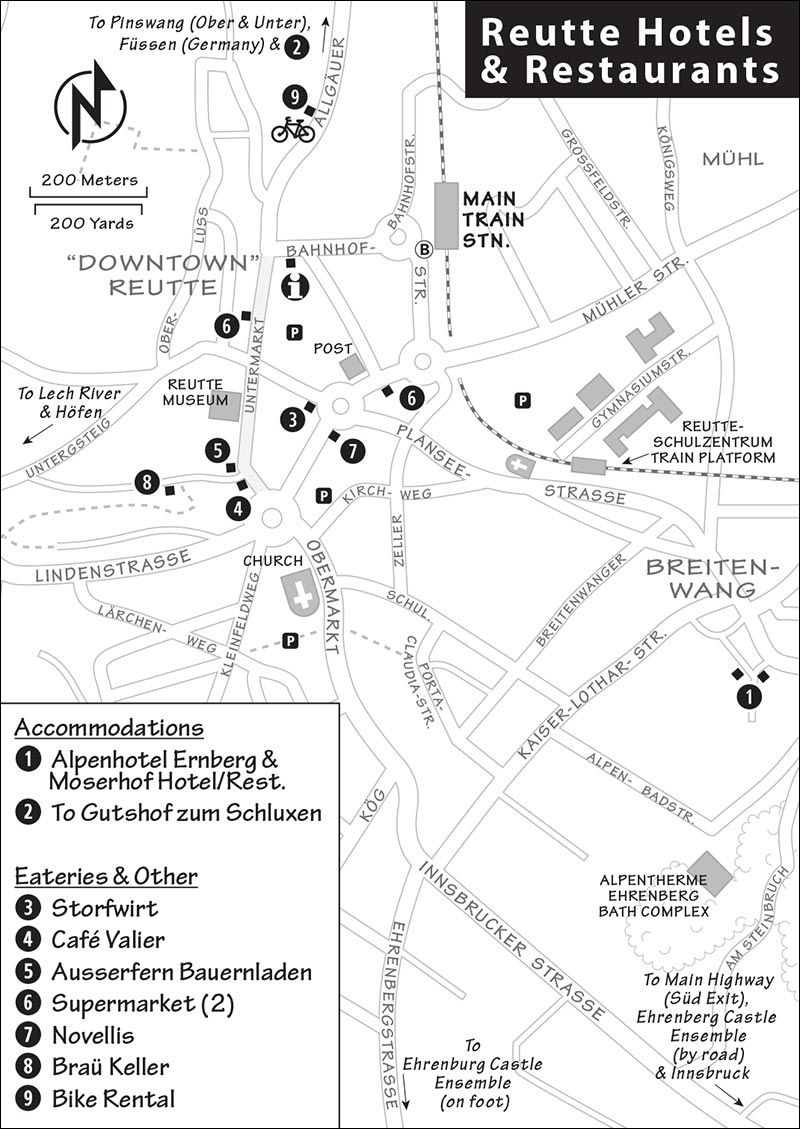
IN EHENBICHL, NEAR THE EHRENBERG RUINS
These listings are a bit farther from central Reutte, a couple of miles upriver in the village of Ehenbichl. From central Reutte go south on Obermarkt and turn right on Kög, which becomes Reuttener Strasse, following signs to Ehenbichl. These places are inconvenient by public transit (you’ll need to brave infrequent local buses; see www.vvt.at for schedules). For taxi service, ask your hotelier. For locations, see the “Greater Reutte” map, earlier.
$$ Hotel Maximilian offers 32 rooms and a good restaurant (evenings only, closed Wed). Friendly Gabi, Monika, and the rest of the Koch family proudly leave no detail unattended and keep guests entertained with table tennis, a pool table, play areas for children (indoors and out), a piano, and a sauna (family rooms, some view rooms, elevator, laundry service, hotel closed late Oct-mid-Dec, Reuttener Strasse 1 in Ehenbichl—don’t let your GPS take you to Reuttener Strasse in Pflach, +43 5672 62585, www.hotelmaximilian.at, info@hotelmaximilian.at). They also rent bikes.
$ Gintherhof is part of a working dairy farm that provides its guests with fresh milk, butter, and homemade jam. Kind, hardworking Annelies Paulweber offers a warm welcome, geranium-covered balconies, four cozy rooms, and one apartment (with kitchenette), all complete with free hiking gear and a Madonna in every corner (cash only, Unterried 7, just up the road behind Hotel Maximilian, +43 5672 67697, www.gintherhof.com, info@gintherhof.com).
$ Gasthof-Pension Waldrast is run by the Huter family and their friendly old dog, Picasso. Built in 1928, the place is comfy and cozy, with decor that hints at the 1970s. It doesn’t have a restaurant, but it’s inexpensive and offers 10 pleasant, spacious rooms with generous sitting areas, castle-view balconies, and traditional Austrian furnishings. It’s also within easy walking distance of the Ehrenberg Castle ruins. Friendly Gerd restored a nearly 500-year-old flour mill and will happily show it to interested guests (family rooms with kitchenettes, Krankenhausstrasse 16, +43 5672 62443, www.waldrasttirol.com, info@waldrasttirol.com).
AT THE EHRENBERG RUINS
$$ Hotel Gasthof Klause, just below the Ehrenberg ruins and next to the castle museum, rents 12 surprisingly sleek and modern rooms with balconies, as well as 15 apartments (some with kitchenettes). You’ll need a car to get anywhere besides Ehrenberg. Reception is in the Salzstadl restaurant just across the street (family rooms, +43 5672 62213, www.ehrenberg.at, gasthof-klause@ehrenberg.at, see the “Greater Reutte” map, earlier).
ACROSS THE RIVER, IN HÖFEN
$$ Gästehaus am Graben is tidy and traditional, right down to the bright flowers in the window boxes. With 13 rooms and a community room for playing games or socializing, it’s family-friendly and a good value less than two miles from Reutte (fine castle views, family rooms sleep 4-6, closed April, Nov, and last three weeks in Jan; from downtown Reutte, cross bridge and follow main road left along river, or take bus #110 to the Graben stop; Graben 1—see the “Greater Reutte” map, earlier, +43 5672 626 440, www.hoefen.at, info@hoefen.at, Reyman family).
IN PINSWANG
The village of Pinswang is closer to Füssen (and Ludwig’s castles), but still in Austria. While this hotel works best for drivers, about half of the departures of regional bus #100, which runs between the Reutte and Füssen train stations, stop here (3-4/day, get off at Pinswang Gemeindeamt stop, verify details with hotel or at www.vvt.at, or use www.bahn.com and plug in “Pinswang Gemeindeamt” to find a workable train-bus connection). For Pinswang location, see the “Füssen & Reutte Area” map on here.
$ Gutshof zum Schluxen is a family-friendly farm offering rustic elegance, woody decor throughout, and a bucolic setting. Owner Markus offers 20 fresh, bright rooms in a range of sizes and configurations. The family room sleeps six and includes two separate bedrooms with TVs for the kids. All the accommodations are self-catering and have small hotplate kitchens, so bring food and plan to cook your own meals. Their appealing spa with tubs and saunas is a good place to relax after a hike to nearby Neuschwanstein castle (3-night minimum, family room, some rooms with balconies, no breakfast, self-service laundry, loaner bikes, game room, children’s play area, closed Nov, Unterpinswang 24; +43 5677 53217, www.schluxen.at, info@schluxen.at).
To reach Neuschwanstein from here by foot or bike, follow the dirt road up the hill behind the hotel. When the road forks at the top of the hill, go right (downhill), cross the Austria-Germany border (marked by a sign and a deserted hut), and follow the narrow, paved path to the castles. It’s a 1- to 1.5-hour hike or a great circular bike trip (allow 30 minutes; cyclists can return to Schluxen from the castles on a different 30-minute bike route via Füssen).
Eating in Reutte
The nicer restaurants in Reutte are all in hotels. $$$ Alpenhotel Ernberg, the $$$ Moserhof Hotel, and $$$ Hotel Maximilian (evenings only, closed Wed) all have fine restaurants. On weekdays, Alpenhotel Ernberg serves a good three-course lunch for €14 and the Moserhof Hotel offers lunch specials for around €12.
$ Storfwirt is ideal for a quick and cheap weekday lunch. This rustic cafeteria in downtown Reutte serves some 300 happy eaters every day (salad bar, daily soup-and-main-course specials, always something for vegetarians). Their adjacent deli is a great place to shop for a Tirolean picnic; choose from the local meats, cheeses, and prepared salads in the glass case, pick up a schnitzel with potato salad, or ask them to make you a sandwich to order. You can take your food away or eat at informal tables (Storfwirt and deli both open Mon-Fri 9:00-14:00, closed Sat-Sun; next door to the big Müller pharmacy at Schrettergasse 15, +43 5672 62640, www.storfwirt.at).
$ Café Valier, perfect for coffee and cake, is a local mainstay that has been run by the same family for five generations (Mon-Sat 7:00-18:00, closed Sun, Untermarkt 5, +43 5672 62462).
Picnic Supplies: Along Untermarkt, next to Café Valier, is the Ausserfern Bauernladen (farmers shop), where local farmers sell their own products. You can buy picnic fixings (cheeses, spreads, and yummy Heuwürstchen sausages cooked in hay), or ask them to make you a rustic sandwich to eat at one of the tables (Tue-Fri 9:00-18:00, Sat until 12:00, closed Sun-Mon, Untermarkt 9, +43 567 265 134). A large Eurospar has a wide selection of groceries and a handy deli section with salads, sandwiches, and hot meals (Mon-Fri 7:15-19:30, Sat until 18:00, Sun until 11:00; Mühler Strasse 20). Billa supermarket also has picnic supplies (across from TI at Untermarkt 33, Mon-Fri 7:15-19:30, Sat until 18:00, closed Sun).
Nightlife: $ Novellis is the most happening joint in town, with live music on Fridays and Saturdays. Its salads, burgers, and wraps offer a nice escape from typical Bavarian food (Mon-Fri 9:00-24:00, Sat from 10:00, closed Sun; Mühler Strasse 12, +43 5672 64612). Braü Keller, down the street next to Café Valier, offers a classier lounge with a nice drink menu and small bites (Thu-Sat 17:00-24:00, closed Sun-Wed, Untermarkt 7a). A strip of bars, dance clubs, and Italian restaurants lines Lindenstrasse.
Reutte Connections
BY PUBLIC TRANSPORTATION
From Reutte by Train to: Ehrwald (at base of Zugspitze lift, every 2 hours, 30 minutes), Garmisch-Partenkirchen (same train, every 2 hours, 1 hour), Innsbruck (every 2 hours, 2.5 hours, transfer in Garmisch), Munich (hourly, 2.5 hours, easiest with change in Garmisch), Salzburg (every 2 hours, 5 hours, transfer in Garmisch and Munich). Austrian train info: www.oebb.at; German train info: www.bahn.com.
By Bus to: Füssen (#100, 6-7/day, last bus at 18:05, 30-50 minutes, €5.40 one-way, buses depart from train station, pay driver).
ROUTE TIPS FOR DRIVERS
From downtown Reutte, Fernpass signs lead you out to the main Innsbruck road, which is also the best way to reach the Ehrenberg ruins. To reach the Ehrenberg Castle ruins, the Biberwier luge, the Zugspitze (either the Austrian ascent at Ehrwald or the German ascent at Garmisch-Partenkirchen), or Innsbruck, turn right for the on-ramp (marked Fernpass and Innsbruck) to highway 179. But if you’re headed for Germany via the scenic Plansee, Linderhof Castle, Ettal Monastery, or Oberammergau, continue straight (bypassing the highway on-ramp).