ITALY’S DOLOMITES
Bolzono • Castelrotto • Alpe di Siusi
Nightlife in and near Castelrotto
Sleeping in and near Castelrotto
Activities in the Alpe di Siusi
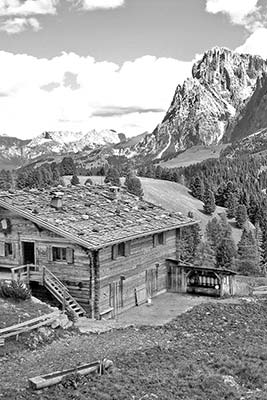
The Italian Dolomites offer some of the best mountain thrills in Europe. The city of Bolzano—about 75 miles south of Innsbruck, over Austria’s border with Italy—is the gateway to the Dolomites, blending Austrian tidiness with an Italian love for life. And the village of Castelrotto is a good home base for your exploration of Alpe di Siusi (Seiser Alm), Europe’s largest alpine meadow. Dolomite, a sedimentary rock similar to limestone, gives these mountains their distinctive shape and color. The bold, light-gray cliffs and spires flecked with snow, above green, flower-speckled meadows and beneath a blue sky, offer a powerful and memorable mountain experience.
A hard-fought history has left the region bicultural, with an emphasis on the German. In the mountains and closer to the border, most locals speak German first, and some wish they were still part of Austria. In the Middle Ages, as part of the Holy Roman Empire, the region faced north. Later, it was firmly in the Austrian Habsburg realm. By losing World War I, Austria’s Südtirol (South Tirol) became Italy’s Alto Adige. Mussolini did what he could to Italianize the region, including giving each town an Italian name. But even as recently as the 1990s, secessionist groups were agitating to reunify with Austria (see sidebar).
Today all signs and literature in the province of Alto Adige/Südtirol are in both Italian and German. Some include a third language, Ladin—an ancient Romance language still spoken in a few traditional areas. (I have listed both Italian and German, so the confusion caused by this guidebook will match that experienced during your travels.)
The Dolomites are well developed, and the region’s most famous destinations suffer from après-ski fever. But in spite of all the glamorous resorts and busy construction cranes, the regional color survives in a warm, blue-aproned, ruddy-faced, felt-hat-with-feathers way. There’s yogurt and yodeling for breakfast. Culturally, as much as geographically, the area is reminiscent of Austria. In fact, the Austrian region of Tirol is named for a village that is now part of Italy.
PLANNING YOUR TIME
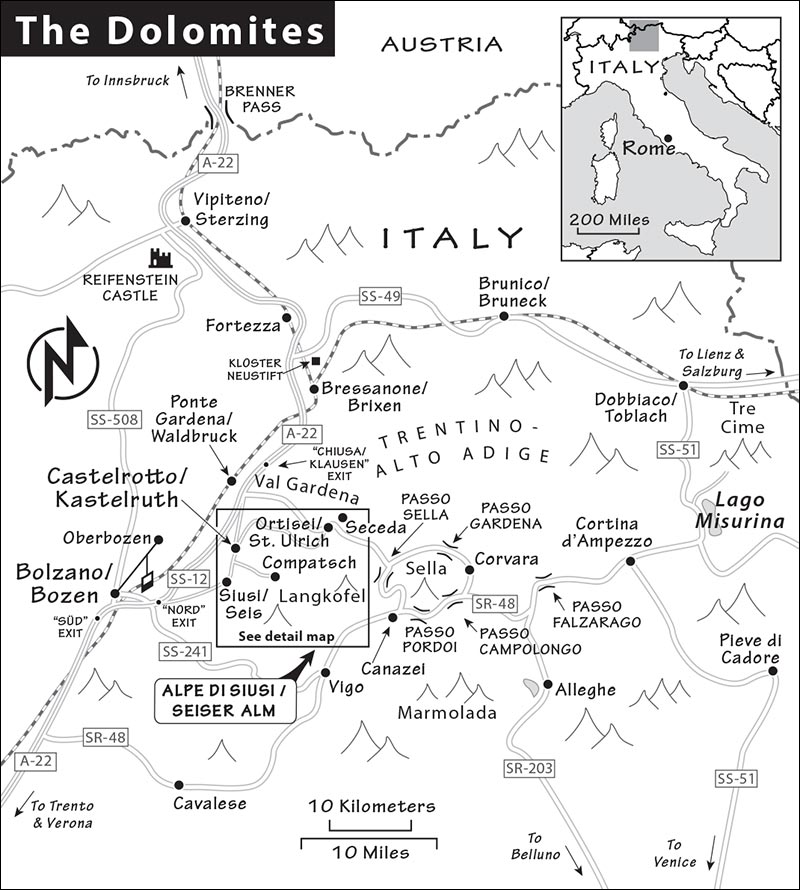
One night in the Dolomites will give you a feel for South Tirol’s alpine culture. But it’s best to stay at least two nights so you have at least one full day to hike. Pretty Castelrotto/Kastelruth is the best base for hiking in the spectacular Alpe di Siusi alpine meadow, but Italian-flavored Bolzano, down in the valley, is also in easy reach of the high-mountain lifts.
From either town, plan an early start up to Compatsch, the gateway to the high Alpe di Siusi/Seiser Alm meadow. Tenderfeet stroll and ride the lifts from there. For serious mountain thrills, do an all-day hike. And for an unforgettable memory, spend a night in a mountain hut. With a second day, do more hiking or spend time in Bolzano, where you can stroll the old town and visit Ötzi the Iceman at the excellent archaeology museum (best to get tickets a few days in advance, especially if you expect to visit on a rainy day). Seceda, above the town of Ortisei/St. Ulrich, is another very satisfying place for a day of alpine hiking.
Hiking season is mid-June through mid-October. The region is particularly crowded, booming, and blooming from mid-July through mid-September (but once you’re out on the trails, you’ll leave the crowds behind). It’s packed with Italian vacationers in August. Spring is usually dead, with lifts shut down, huts closed, and the most exciting trails still under snow. Many hotels and restaurants close in April and November. By mid-May, most businesses reopen, some lifts start running (check dates at www.seiseralm.it), and—if you luck into good weather—a few rewarding hikes are already possible. Ski season (Dec-Easter) is busiest—and most expensive—of all.
Getting Around the Dolomites: This is a road-tripping paradise, but you can easily connect the dots on the region’s good public-transit system. For details, see “Getting Around the Alpe di Siusi,” later.
Bolzano
Willkommen to the Italian Tirol! If Bolzano (Bozen in German) weren’t so sunny, you could be in Innsbruck. This enjoyable old city is the most convenient gateway to the Dolomites, especially if you’re relying on public transportation. It’s just the place to take a Tirolean stroll.
Bolzano feels like a happy castaway between the Germanic and Italian worlds. The people are warm and friendly, but organized. One person greets you in Italian, the next in German. But everyone can agree the city has a special verve, with lively shopping arcades, a bustling food-and-flower market, and a tidy main square with a backdrop of colorful churches and wooded foothills.
The town has only one museum worth entering, but it’s world class, offering the chance to see Ötzi the Iceman—a 5,300-year-old Tirolean found frozen on a mountaintop—in the (shriveled, leathery) flesh. Beyond that, Bolzano is made for strolling, relaxing, and hiking in the nearby hills—and works well as a home base for venturing deeper into the mountains (though pretty Castelrotto is closer to the high-mountain lifts).
Orientation to Bolzano
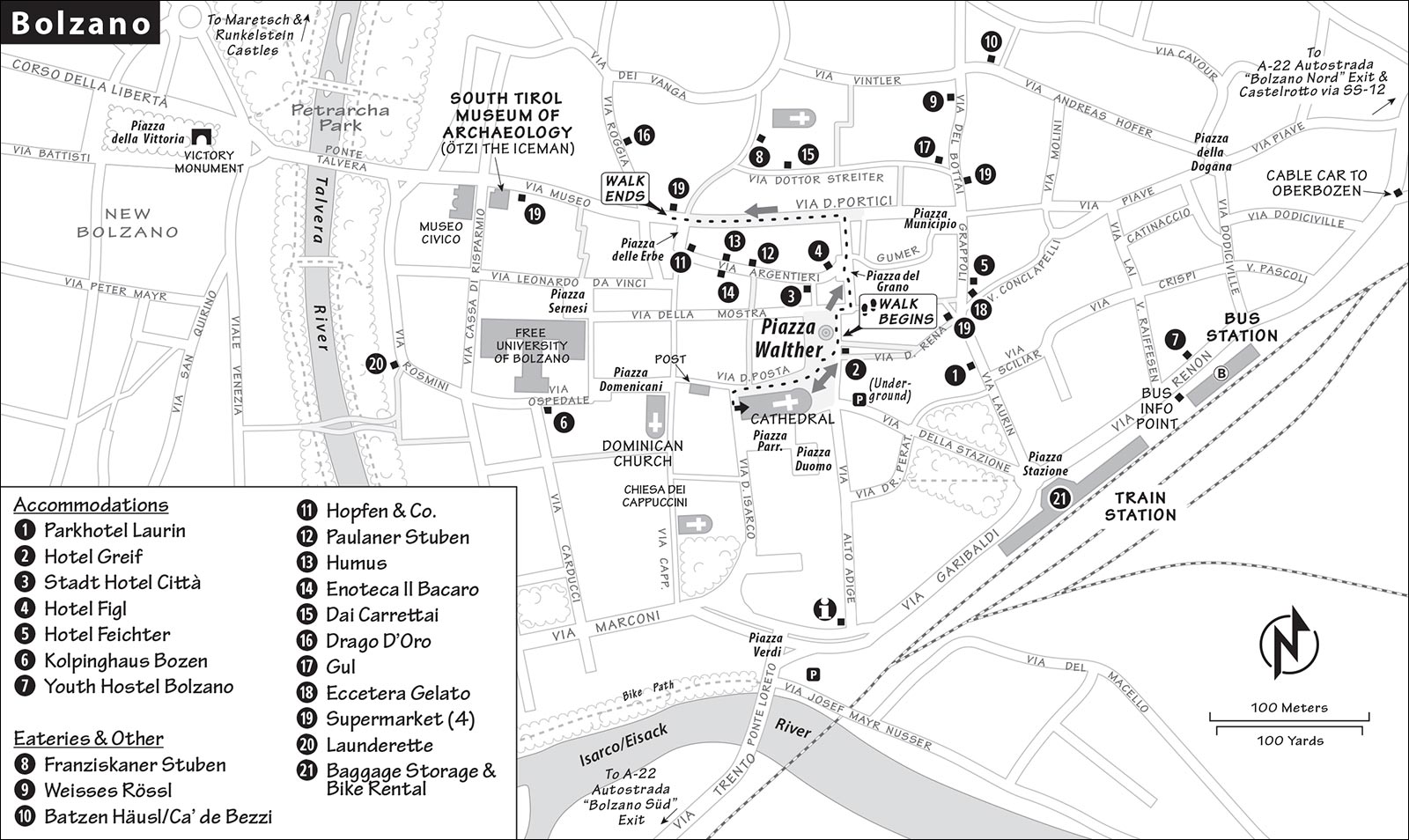
Virtually everything I mention in Bolzano (pop. 107,000) is in the compact and strollable old town, which radiates out from the main square, Piazza Walther/Waltherplatz.
TOURIST INFORMATION
Bolzano’s TI, just down the street from the train station, is helpful (Mon-Fri 9:00-19:00, Sat 9:30-18:00, Sun 10:00-15:00 except Nov-April closed Sun, Via Alto Adige/Südtiroler Strasse 60, +39 0471 307 000, www.bolzano-bozen.it).
Museum and Transit Cards: Busy sightseers might make use of the Museumobil Card, which covers most museums in South Tirol (including the archaeology museum, with its famous Iceman), plus local trains, buses, the Renon/Rittner cable car (funivia/Seilbahn) to Oberbozen, and more (€30/7 days, doesn’t cover the gondola to or chairlifts on the Alpe di Siusi, available at the TI and transit offices, www.mobilcard.info). Some Bolzano hotels hand out free regional guest passes that cover essentially the same thing—check before shelling out for one. A transit-only version, the Mobilcard, covers the same trains, buses, and lifts (€15/1 day, €23/3 days, sold at TIs and transit offices).
Walking Tours: The TI offers a guided two-hour town walking tour in English on Fridays in season (€10, April-Oct at 10:30—confirm day and time in advance, departs from TI).
ARRIVAL IN BOLZANO
By Train: Bolzano has two train stations—you want Bolzano, not Bolzano Süd. WCs are in the underground passage by track 1, and luggage storage is just upstairs (see “Helpful Hints,” next). To reach the TI, exit the station, turn left, and walk two long blocks. To get downtown, jog left through the park and go two blocks up the tree-lined Viale della Stazione/Bahnhofsallee to Piazza Walther/Waltherplatz and the start of my self-guided walk.
By Car: Some areas of Bolzano are ZTL zones (marked on signs with a red circle); avoid these or risk an automatic ticket. The most convenient parking lot for a short visit is the Piazza Walther garage, right under the main square (€3/hour, cheaper overnight; to find it, make your way to the train station, then drive up tree-lined Viale della Stazione/Bahnhofsallee, watching for the Piazza Walther entrance on your right). For longer stays or to save a few euros, try Parking Centro/Mitte, just south of the ring road and west of the train station—about a 10-minute walk from the main square (€1.80/hour, cheaper overnight, enter from Via Josef Mayr Nusser).
With the exception of Bolzano, where Italian has become the primary language, you’ll hear mostly German in Dolomite villages. Overall, seven in ten Italians living in South Tirol speak German as their mother tongue. Many are fair-skinned and blue-eyed and prefer dumplings and strudel to pasta and gelato. Most have a working knowledge of Italian, but they watch German-language TV, read newspapers auf Deutsch, listen to jaunty oompah music, and live in Tirolean-looking villages.
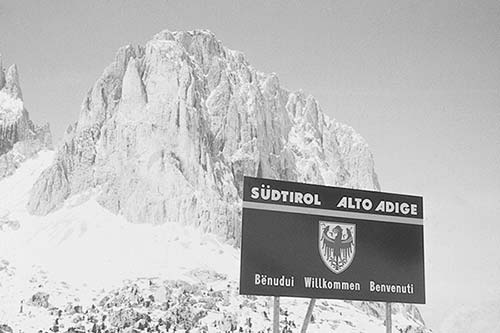
At the end of World War I, the region was ceded by Austria (loser) to Italy (winner). Mussolini suppressed Germanic cultural elements as part of his propaganda campaign to praise all things Italian. Many German speakers hoped that Hitler would “liberate” them from Italy, but Hitler’s close alliance with Mussolini prevented that from happening. Instead, in June 1939, residents were given six months to make a hard choice: Move north to the Fatherland and become German citizens, or stay in their homeland (Heimat) under Italian rule. The majority (212,000 people, or 85 percent) decided to leave, but with the outbreak of World War II, only 75,000 actually moved.
After the war, German speakers were again disappointed when the Allies refused to grant them autonomy—or the chance to become Austrian citizens. Instead, the victors decided to stick with the prewar arrangement. The region rebuilt and the two linguistic groups patched things up, but for the remainder of the 20th century, German speakers were continually outvoted by the Italian-speaking majority in the regional government (comprising two provinces, Italian-speaking Trentino and German-speaking Alto Adige/Südtirol).
German speakers lobbied the national government for more control on the provincial (not regional) level, even turning to demonstrations and violence. Over the years, Rome has slowly and grudgingly granted increased local control. The country’s 2001 constitution gave South Tirol a large measure of autonomy—similar to Sicily and Sardinia—though it’s still officially tied to Trentino. Roads, water, electricity, communications, and schools are all under local control, including the Free University of Bozen-Bolzano, founded in 1998.
A good way to sum it all up: In many ways, the people of the Dolomites feel a closer bond with their Austrian ancestors than with their countrymen to the south. But when Italy plays Austria in a big soccer match, whom do locals root for? Italy.
HELPFUL HINTS
Sleepy Sundays: This small, culturally conservative city is dead on Sunday (young locals add, “and the rest of the week, too”).
Street Markets: Piazza delle Erbe/Obstplatz hosts an ancient and still-thriving open-air produce market (Mon-Sat all day, generally closed Sun). Wash your produce in the handy drinking fountain in the middle of the market. Another market (offering more variety, not just food) runs Saturday mornings on Piazza della Vittoria.
Baggage Storage: You can store bags at Base Camp Dolomites, at the train station by track 1 (daily 8:30-18:30, they also rent bikes, +39 0471 971 733, www.basecampdolomites.com).
Laundry: The self-service Bolzano Lavanderia is at Via Rosmini/Rosministrasse 39, southwest of the South Tirol Museum of Archaeology (daily 7:00-22:30, doors lock automatically at closing time, +39 0474 832 204).
Bike Rental: The city has a well-developed bike-trail system and a subsidized bike-sharing program. But visitors will find it easiest to rent a bike from Base Camp Dolomites at the station.
Bus InfoPoint: You can ask questions, get schedules, and buy tickets for buses and the Renon/Ritten cable car at the lime-green SüdtirolMobil office at the bus depot (Mon-Sat 7:00-19:20, Sun 8:00-13:40, pay WCs).
Bolzano Walk
This brief self-guided walk will help you get your bearings in central Bolzano.
• Start the walk in...
Piazza Walther/Waltherplatz: The statue in the center honors the square’s namesake, Walther von der Vogelweide, a 12th-century politically incorrect German poet who courageously stood up to the pope in favor of the Holy Roman (German) Emperor. Walther’s spunk against a far bigger power represents the Germanic pride of this region. The statue is made of marble quarried in the village of Laas, a little north of Bolzano.
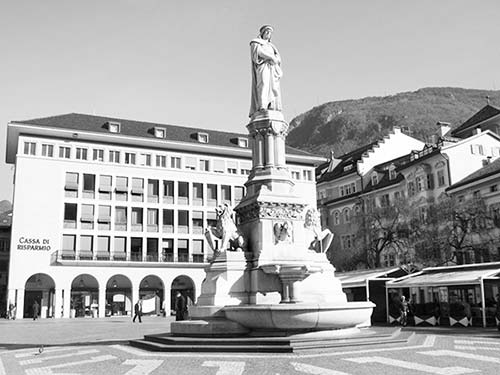
When not hosting Bolzano’s Christmas market, flower market (May Day), or Speck Fest (a spring ham festival), Piazza Walther/Waltherplatz is simply the town’s living room. And locals care about it. It was the site of Italy’s first McDonald’s, which, in the early 1990s, became the first McDonald’s to be shut down by locals protesting American fast food. Today the square is home to bustling cafés such as Café Walther, where (outside of meal times) you’re welcome to nurse a local “Hugo” aperitif, “Venetian” spritz, or a pricier cocktail as long as you like.
• Cross the street to the big church.
The Cathedral: The cathedral’s glazed-tile roof is typical of the Germanic world—a reminder that from the sixth century until 1919, when Italy said benvenuti to the Südtirol, German was the region’s official language. The church was flattened in World War II (a common consequence of being located near a train station in 20th-century Europe).
Walk around to the right, to the Romanesque Lion’s Gate entrance (at the far end), and step inside. The place feels Teutonic, rather than Italian, with a mostly Gothic interior that’s broken at the front by an impressive Baroque tabernacle. Partway down the nave is a sandstone pulpit (c. 1500) with reliefs of the four Church fathers whose presence gave credibility to sermons preached here. Most of the art is by Bavarian artists.
• Leaving the church, return to Piazza Walther/Waltherplatz and cross it diagonally, heading up the street to the right of the big Sparkasse bank building. Follow this for one block, to...
Piazza del Grano/Kornplatz: Nine hundred years ago, this square was the center of urban life in Bolzano. The 12th-century castle of the Trentino prince-bishop was here—until a Tirolean rival destroyed it in 1277. The grain market was at one end of the square, livestock at the other. The one freestanding building here (#12), the Casa della Pesa/Waaghaus, is the oldest structure in Bolzano. Until the late 18th century, this was the public weighing house—with the only officially calibrated scale in town. (You can catch a glimpse of the scale’s appearance in an old fresco in the alley to the left of the building.)
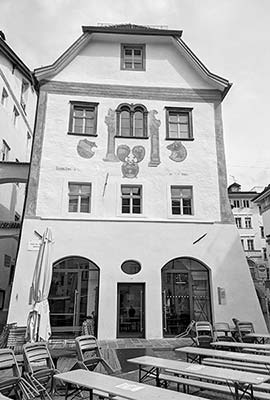
• Jog left into the alley with the scale fresco (above the archway at the end). You’ll then pop out in the middle of...
Via dei Portici/Laubengasse: In the 12th century, this was the only street in Bolzano. Step into the center (dodging bikes). Looking east and west, you see the width of the original town.
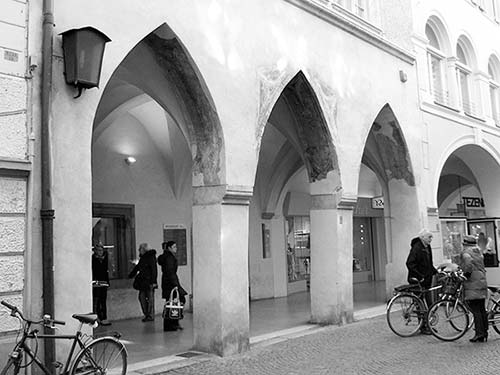
Turn left and stroll a bit, watching on the right for the frescoed, pointed arches of the old City Hall—the street’s only Gothic building (at #30). Notice that the other buildings, with uniform round arches, are all basically the same: Each had a storm cellar, cows out back, a ground-level shop, and living quarters upstairs. Bay windows were designed for maximum light—just right for clerks keeping track of accounts and for women doing their weaving. The arcades (Lauben, pictured at right), typical of Tirol, sheltered merchants and their goods from both snow and sun. Narrow passages between shops lead to neighboring streets.
A bit farther along on the left, the only balcony marks the street’s lone Baroque building—once the mercantile center (with a fine worth-a-look courtyard), now a skippable museum.
• Continue to the end of the street, where you’ll find a bustling market generally every day but Sunday.
Piazza delle Erbe/Obstplatz: This square hosts an open-air produce market, liveliest in the morning. The historic market fountain gives Bolzano its only hint of the sea—a 17th-century statue of Neptune. Stroll around and see what’s in season. All the breads, strudel, and hams schmecken sehr gut.
• From the market, Via Museo/Museumstrasse leads you straight ahead to the archaeology museum and Ötzi the Iceman.
Sights in Bolzano
▲▲▲South Tirol Museum of Archaeology (Museo Archeologico dell’Alto Adige/Südtiroler Archäologiemuseum)
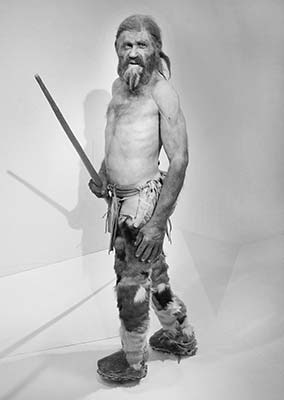
This excellent museum, which illuminates the prehistory of the region, boasts a unique attraction: the actual body of Ötzi the Iceman, who spent more than five millennia stuck in a glacier. With Ötzi as the centerpiece, the museum takes you on an intriguing journey through time, recounting the evolution of humanity—from the Paleolithic era to the Roman period and finally to the Middle Ages—in vivid detail. The interactive exhibit offers informative displays and models, and video recounts Ötzi’s extraction and explains his personal effects. Everything’s well described in English.
Cost and Hours: €13; Tue-Sun 10:00-18:00, closed Mon except July-Sept and Dec, €4 audioguide isn’t essential; near the river at Via Museo/Museumstrasse 43, +39 0471 320 100, www.iceman.it [URL inactive].
Crowd-Beating Tips: If you’re visiting in summer, it’s smart to reserve an entry time in advance online, which lets you skip the line (can reserve only up to 3 days in advance). Capacity is limited, and ticket-buying lines can be long—sometimes up to three hours. It’s busiest on rainy days in July and August, especially in the morning.
Background: Ötzi’s frozen body was discovered high in the mountains on the Italian/Austrian border by a German couple in 1991. Police initially believed the corpse was a lost hiker, and Ötzi was chopped roughly out of the glacier, damaging his left side. But upon discovering his pre-Bronze Age hatchet, officials realized what they had found: a 5,300-year-old, nearly perfectly preserved man with clothing and gear in excellent condition for his age. Austria and Italy squabbled briefly over who would get him, but surveys showed that he was located 100 yards inside Italian territory. Tooth enamel studies have now shown that he did grow up on the Italian side. An Austrian journalist dubbed him Ötzi, after the Ötztal valley, where he was discovered.
Visiting the Museum: The permanent exhibit is smartly displayed on three floors (plus temporary exhibits on the top floor). First you’ll learn about Ötzi’s discovery, excavation, and preservation. Upstairs, you’ll walk through displays of his incredibly well-preserved and fascinating clothing and gear, including a finely stitched two-color coat, his goat-hide loincloth, a fancy hat, shoes, a well-crafted hatchet, 14 arrows, a longbow, a dagger, and shreds of his rucksack (which held fire-making gadgets and a tree fungus used as a primitive antibiotic). And finally, you’ll peek into a heavily fortified room to see Ötzi himself—still kept carefully frozen.
One floor up, exhibits focus on the Copper Age. The discovery of Ötzi helped researchers realize that the use of copper occurred in this region more than a millennium earlier than previously thought. There’s also a complete medical workup of Ötzi, including an interactive flatscreen where you can zoom in on different parts of his body to see the layers of skin, muscle, and bone. And you’ll learn how researchers have used modern forensic science techniques to better understand who Ötzi was and how he died. (Think of it as a very, very, very cold case.)
From all of this, scientists have formed a complete picture of the Iceman: In his mid-40s at the time of his death, Ötzi was 5 feet, 3 inches tall, with brown hair and brown eyes. He weighed about 110 pounds, was lactose intolerant, ate too much animal fat, and likely had trouble with his knees. And they’ve even determined the cause of death: an arrowhead buried in Ötzi’s left shoulder. (Discoveries still make the news every few years—in 2018, for example, scientists were able to deduce what he’d eaten for his last meal.) At the end of the exhibit, you’ll see an eerily lifelike reconstruction of how Ötzi may have looked when he was alive.
Dominican Church (Chiesa dei Domenicani/Dominikanerkirche)
Art lovers can drop by this austere 13th-century Gothic church, part of a Dominican convent complex. You’ll see surviving bits of 14th-century frescoes on the church’s main walls, and massive octagonal pillars that divide the nave into three sections. The highlight, though, is the long and narrow side chapel of St. John (San Giovanni/St. Johannes; behind the modern altar and to the right). Frescoed in about 1329, the chapel is evidence of how disruptive Giotto’s figural innovations at Padua’s Scrovegni Chapel were—and how quickly his style spread northward. Just 20 or so years after Giotto completed his fresco cycle in Padua, artists in Bolzano were already experimenting with the new naturalism, with barely a hint of Gothic linearity to be seen.
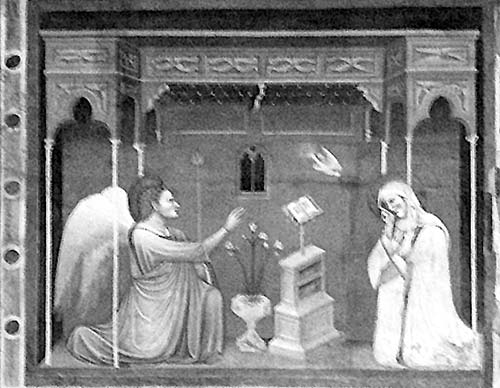
If it’s open, peek through the door opposite the chapel entrance for a view of the convent’s peaceful cloister.
Cost and Hours: Free, Mon-Sat 8:00-18:00, Sun from 12:00, on Piazza Domenicani, two blocks west of Piazza Walther/Waltherplatz.
Lift to Oberbozen and Renon/Ritten
The Renon/Rittner cable car (funivia/Seilbahn) whisks you over the hills from Bolzano to the resort village of Oberbozen on the high plateau of Renon/Ritten. The 12-minute cable-car ride is the main attraction, offering views of the town, surrounding mountains, made-for-yodeling farmsteads, and 18-wheelers downshifting along the expressway from Austria. It’s no replacement for a trip to Castelrotto and the Alpe di Siusi, but you’ll get a taste of the Alpine wonderland that lies above the valley floor—and this lift runs when many other do not. From Oberbozen, it’s worth hopping on the narrow-gauge train to the village of Klobenstein/Collalbo for even better views (if you do, allow about two hours for the whole outing).
Cost and Hours: Cable-car—€10 round-trip, ticket machine (cash or cards) on ground floor to the left of the stairs, validate tickets in blue box next to machine or upstairs just before the gates; departures every 4 minutes year-round Mon-Sat 6:30-21:48, Sun from 7:10; every 12 minutes after 21:00 in low season; for info, visit www.ritten.com.
Getting There: The cable car’s valley station is at Via Renon/Rittner Strasse 12, a five-block walk east of the Bolzano train station.
At the Top: Oberbozen (elevation 4,000 feet) is mostly a collection of resort hotels, most famous as the place where Sigmund Freud and his wife once celebrated their wedding anniversary. The TI is straight ahead from the cable-car station.
From Oberbozen, a narrow-gauge train makes a scenic 16-minute trip to Klobenstein/Collalbo, a larger and slightly less touristy village at 3,800 feet. From the train station, head left and follow signs to the center (5 minutes) for the TI, cafés, and restaurants (€3.50 one-way, €6 round-trip, €15 round-trip for both Oberbozen cable car and train, daily departures every 30 minutes—reduced to hourly early and after 19:00). The local TI has branches in both villages (www.ritten.com).
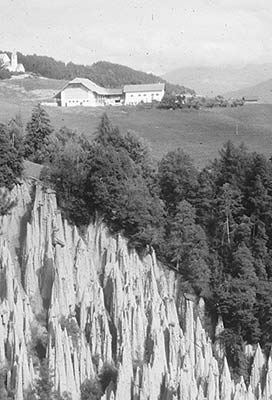
The lift station and narrow-gauge train depot have brochures suggesting short walks (as does the TI). More interesting than Oberbozen itself (though not a must-see) are the nearby “earth pyramids”—Bryce Canyon-like pinnacles that rise out of the ridge, created by eroding glacial debris dumped at the end of the last ice age. Some of these are visible from the Oberbozen cable car (on the right as you’re riding up), but they’re challenging to hike to; an easier-to-reach area is a 15-minute walk from Klobenstein. Another walk is the Freudpromenade, a fairly level, 1.5-hour stroll between Oberbozen and Klobenstein (you can take the train back).
New Bolzano (Nuova Bolzano)
Just across the river from the Museum of Archaeology, the fascist-style Victory Monument (Monumento alla Vittoria) glistens in white Zandobbio marble. It marks the beginning of the “new” city built by the fascist government in the 1920s to Italianize the otherwise Germanic-looking city. Indeed, you won’t hear much German spoken in the shops and bars along the colonnaded Corso della Libertà—it feels a world away from the old town. A visit to New Bolzano comes with a delightful stroll over the river and the inviting, parklike Talvera promenade (described later).
In the basement of the arch-like structure, you’ll find a small but well-done exhibit about the history of the monument itself, the Italianization of South Tirol, and the efforts of local people to keep their language, culture, and traditions alive (monument always viewable; exhibit free and open April-Sept Tue-Sun 11:00-13:00 & 14:00-17:00, Thu 15:00-21:00, shorter hours off-season, closed Mon year-round; good information in English, www.monumenttovictory.com).
The grand plans for this part of the city were never fully realized. But several blocks of buildings were constructed in a repetitive Modernist design, following the idea of imperial monumentalism trumpeting the dawn of a new era in Italy. Most of the structures were intended to house state institutions and highly desirable apartments for state employees. (A few blocks south on Piazza Tribunale, you can still find the somewhat faded image of Mussolini waving from one of the buildings.)
Bolzano Walks
Pick up the good map at the TI for scenic, accessible strolls that provide a different perspective on the region.
One popular option is the easy, shaded Talvera promenade just west of the Museum of Archaeology, following the river embankment north. This route has great people-watching in good weather, with views of vineyards and Maretsch Castle (Castello Mareccio/Burg Maretsch) to the right. In about 25 minutes you’ll reach the Bridge of St. Antonio, where you can cross (look for Runkelstein signs), loop under onto the pedestrian path, and follow the river for another 15 minutes to the impressive Runkelstein Castle (Castel Roncolo/Schloss Runkelstein; be aware that the last 10 minutes are up a steep, unevenly cobbled path). Inside this 13th-century “illustrated manor” is an impressively large collection of secular medieval frescoes, with scenes from the everyday lives of knights and ladies (€8; Tue-Sun 10:00-18:00, until 17:00 off-season, closed Jan-Feb and Mon year-round; perched above the river north of town on Kaiser-Franz-Josef Weg, +39 0471 329 808, www.runkelstein.info).
To extend your hike, go back to the Bridge of St. Antonio and head up the hill about 45 minutes for the St. Oswald walk. This route takes you to the church of Santa Magdalena (with its 14th-century frescoes), offering great views back to the city.
Sleeping in Bolzano
All the places listed here are in the city center, within walking distance of the train and bus stations. Bolzano has no real high or low season; most hotels have the same rates all year.
$$$$ Parkhotel Laurin is a fancy Old World hotel near the train station, with 100 tastefully decorated rooms, marble bathrooms, a chic dining room and terrace, a small swimming pool (summer only), an extensive garden with dining options, and attentive staff. Frescoes throughout the grand lobby and atmospheric bar depict the legend of King Laurin (air-con, elevator, pay parking, Via Laurin/Laurinstrasse 4, +39 0471 311 000, www.laurin.it, info@laurin.it).
$$$$ Hotel Greif, a luxury boutique hotel, is right on Piazza Walther/Waltherplatz. Each of the 33 individually designed rooms makes you feel like you’re in an avant-garde art installation (its website gives a room-by-room tour). It’s not exactly cozy, but it is striking, and a stay here comes with one of my favorite breakfasts in Italy (family rooms, air-con, elevator, sauna, pay parking at Parking Walther under main square—enter hotel directly from level 1 of the garage or at Via della Rena/Raingasse 28, +39 0471 318 000, www.greif.it, info@greif.it).
$$$$ Stadt Hotel Città, a venerable old hotel with 99 modern, straightforward rooms and serving an uncommonly good breakfast, is ideally situated on Piazza Walther/Waltherplatz. The hotel’s café spills out onto the piazza, offering a prime spot for people-watching (family rooms, air-con, elevator, pay parking at Parking Walther under main square—enter hotel directly from level 1 of the garage, Piazza Walther/Waltherplatz 21, +39 0471 180 0161, www.hotel-citta.com, info@hotel-citta.com). This place is an especially good value if you take advantage of their free-for-guests Wellness Center (Turkish bath, whirlpool, Finnish sauna, biosauna, massage by appointment)—a fine way to unwind.
$$$ Hotel Figl, warmly run by Anton and Helga Mayr, has 22 comfy, bright, good-value rooms. It’s situated over a popular-with-locals café on a pedestrian square located a block from Piazza Walther/Waltherplatz (breakfast extra, air-con, elevator, pay parking at Parking Walther under main square—take the escalator to the square and walk a couple of minutes, Piazza del Grano/Kornplatz 9, +39 0471 978 412, www.figl.net, info@figl.net, include a phone number if you email).
$$ Hotel Feichter is a solid value: a well-priced, well-kept, family-run place with simple but sufficient amenities in a great location. Most of the 34 rooms are a little tight, but pleasantly renovated, and some share a communal terrace overlooking the rooftops of Bolzano. Papà Walter, Mamma Hedwig, Hannes, Irene, and Wolfi Feichter have run this homey hotel since 1969, and are a good source of local advice (family rooms, excellent breakfast, air-con, pay parking, elevator, ground-floor café serves lunch Mon-Fri 11:30-14:00; from station, walk up Via Laurin/Laurinstrasse, which becomes Via Grappoli/Weintraubengasse—hotel is on the right at #15; +39 0471 978 768, www.hotelfeichter.it, info@hotelfeichter.it). They also rent two nice apartments.
$$ Kolpinghaus Bozen, modern, clean, and church-run, has 50 rooms that feel like a renovated college dorm (doubles have two twin beds placed head to toe). Though institutional, it makes me feel thankful for no-nonsense budget rooms (weak air-con, elevator, pay laundry, pay parking, 4 blocks from Piazza Walther/Waltherplatz near Piazza Domenicani at Largo A. Kolping/Adolph-Kolping-Strasse 3, +39 0471 308 400, www.kolpingbozen.it, info@kolpingbozen.it). The line of people out front at lunchtime are waiting for their cafeteria to open (generally Mon-Fri 11:45-14:00, closed Sat-Sun).
¢ Youth Hostel Bolzano Youth Hostel Bolzano is one of the most comfortable and inviting hostels I’ve seen in Italy. It has 17 four-bed rooms (each with two bunk beds and a full bathroom; fifth bed possible), one triple, and 10 delightful singles with bath. The bright, clean, modern rooms make it feel like a dorm in a fancy university (family discounts, no age limit, elevator, pay laundry, 9:00 checkout, 100 yards to the right as you leave the train station at Via Renon/Rittner Strasse 23; +39 0471 300 865, easy online reservations at www.ostello.bz, bolzano@ostello.bz).
Eating in Bolzano
All my recommendations are in the center of the old town. While nearly every local-style place serves a mix of German/Tirolean and Italian fare, I favor eating Tirolean here in Bozen. Many restaurants have no cover charge but put a basket of bread on the table; as in Austria, if you eat the bread, you’ll be charged a small amount. Bolzano’s restaurants tend to stay open all day, but at a few places the kitchen closes in the afternoon with only snacks available.
$$$ Franziskaner Stuben, with three spacious rooms, wide-plank wood floors, and genteel decor, spoils their customers with regional cuisine, fine wines, and attentive service (some outside tables, daily 11:00-14:30 & 18:00-22:00, Franziskanergasse/Via dei Francescani 7, +39 0471 976 183).
$$ Weisses Rössl (“White Pony”) offers a spacious, traditional woody setting and a tasty mix of pasta and Tirolean food. This is a good spot for dining indoors among savvy locals (Mon-Fri 11:00-24:00, Sat 10:00-15:00, closed Sun, 2 blocks north of Piazza Municipio at Via Bottai/Bindergasse 6, +39 0471 973 267).
$$ Batzen Häusl/Ca’ de Bezzi is Bolzano’s oldest inn, with two Teutonic-feeling upper floors; by contrast, the patio and back room are refreshingly modern and untouristy. They make their own breads, pastas, and beer, and serve traditional Tirolean fare—stick-to-your-ribs grub (daily 9:00-late, Via Andreas Hofer/Andreas-Hofer-Strasse 30, +39 0471 050 950).
$$ Hopfen & Co. fills an 800-year-old house with happy eaters, drinkers, and the beer lover’s favorite aroma: hops (Hopfen). A tavern since the 1600s, it’s a microbrewery today. This high-energy, boisterous place is packed with locals who come for its homemade beer, delicious Tirolean food, and reasonable prices (great salads, limited menu outside of mealtimes, daily 9:30-24:00, Piazza delle Erbe/Obstplatz 17, +39 0471 300 788).
$$ Paulaner Stuben is a restaurant-pizzeria-Bierstube serving good food (more Italian than German) and a favorite Bavarian beer. It has good outside seating and a take-me-to-Munich interior (Mon-Sat 11:00-24:00, closed Sun, Via Argentieri/Silbergasse 16—or use back entrance at Via dei Portici/Laubengasse 51, +39 0471 980 407).
$$ Humus is a trendy eatery packed with locals enjoying a hearty mix of Italian and Middle Eastern dishes. With an emphasis on organic food, this place feels fresh, lively, and inviting (Mon-Sat 8:00-20:00, closed Sun, Via Argentieri/Silbergasse 16D, +39 0471 971 961).
Drinks and Light Food: $ Enoteca Il Bacaro, a hole-in-the-wall wine bar, is an intriguing spot for a glass of wine and bar snacks amid locals. Wines available by the glass are listed on the blackboard (Mon-Fri 8:00-14:00 & 17:00-21:00, Sat 8:00-14:00, closed Sun; located a half-block east of Hopfen & Co. on a hidden alley off Via Argentieri/Silbergasse 17, look for vino/Wein sign next to fountain on south side of street and enter courtyard; +39 0471 971 421). $ Dai Carrettai is a popular bar where locals meet after work over a glass of wine—the crowd spills out onto the street. Browse the array of toothpick snacks at the counter, or order a bruschetta from the menu (also serves hot lunches, Mon-Fri 7:00-14:00 & 16:30-21:00, Sat 7:00-14:00, closed Sun, Via Dr. Streiter/Dr.-Streiter-Gasse 20b, +39 0471 970 558).
International Food: $ Drago D’Oro is a good, affordable Chinese restaurant on a pleasant old-town lane, with plenty of shaded seating out back (Mon 11:30-15:00, Tue-Sun 11:30-15:00 & 18:00-23:00, Via Roggia/Rauschertorgasse 7a, +39 0471 977 621). $$ Gul has Indian-Pakistani standards (Mon-Sat 12:00-14:30 & 18:00-23:00, closed Sun, at Via Dr. Streiter/Dr.-Streiter-Gasse 2, +39 0471 970 518). Both are takeout-friendly, as are several small pizzerias in the same area.
Gelato: At the tip of a city block less than five minutes from Piazza Walther/Waltherplatz is Eccetera, a tiny gelato counter with no seating, just excellent (and excellently priced) gelato. They often have more flavors available than what’s right under your nose—check the sign overhead for today’s selection (daily, Via Grappoli/Weintraubengasse 23).
Picnics: Assemble the ingredients at the Piazza delle Erbe/Obstplatz market and dine in the park along the Talvera River (the leafy green area with benches past the museum). Bakeries up and down Via del Bottai/Grappoli sell a tempting variety of takeaway sandwiches. Or visit one of the four Despar supermarkets: The largest is just before the museum at Via Museo/Museumstrasse 39 (daily 9:00-19:00). Another is a little more centrally located at the end of the Galleria Greif arcade (enter arcade from Piazza Walther/Waltherplatz by Hotel Greif and walk to far end—the supermarket is downstairs; same hours as the big store but closes Sun at 13:00). Smaller branches are on Piazza delle Erbe/Obstplatz and at Via Bottai/Bindergasse 29 (both open Mon-Sat 8:30-19:30, closed Sun).
Bolzano Connections
Most trains from Bolzano are operated by Trenitalia (departures marked R or RV on schedules), but some long-distance trains on the Innsbruck-Bolzano-Verona line are run by the German or Austrian railways—DB/ÖBB for short (trains marked Eurocity, EC, or Trenord). Tickets for either are sold through Trenitalia (machines in stations or on the Trenitalia app, www.trenitalia.com).
From Bolzano by Train to: Milan (about hourly, 4 hours, change in Verona; one fast Freccia train is direct), Venice (about hourly, 3.5 hours, change in Verona), Florence (every 1-2 hours, 5 hours, change in Verona and/or Bologna), Innsbruck (1/hour, 2.5 hours, some regional connections change in Brennero), Vienna (4/day, 7 hours, change in Innsbruck), Salzburg (at least hourly, 4 hours, change in Brennero/Brenner, Innsbruck, and/or Rosenheim), Munich (called “Monaco” in Italy, 5/day direct, 4 hours).
By Bus: Bus #170 connects Bolzano with the gondola to Compatsch (putting you at the gateway to all the Alpe di Siusi hikes in about an hour) and the town of Castelrotto (direction: Kastelruth/Castelrotto, 2/hour Mon-Sat, hourly on Sun, last departure at 20:12—may run until later in summer, free schedule at bus station, €4 each way, buy tickets from machine or counter at bus depot InfoPoint, +39 0471 220 880, www.suedtirolmobil.info).
The bus leaves from Bolzano’s bus station (just north of the train station) and then winds high into the mountains. For the Alpe di Siusi, ask the driver to let you off at the “Bergbahn” station (Seiser Alm Bahn gondola, 40 minutes from Bolzano), then ascend to Compatsch. Otherwise, stay on the bus another 10 minutes to reach the center of Castelrotto.
Castelrotto
Castelrotto (altitude: 3,475 feet, Kastelruth in German) is the ideal home base for a day of hiking on the Alpe di Siusi/Seiser Alm or Seceda. Stay at least two nights. Relax on the traffic-free main square, surrounded by a mountain backdrop and a thousand years of history, with an oversized (and hyperactive) bell tower above you. You’ll feel almost lost in another world. Easy bus and cable-car connections bring you up to trails on the Alpe di Siusi and down to Bolzano.
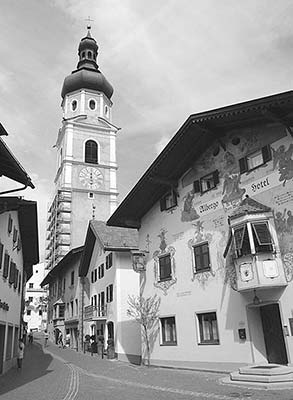
With a population of around 2,300, Castelrotto is a combination of real town, ski resort, and administrative center for surrounding villages. Tourism has become increasingly important here; while farming occupied most of the population in the 1960s, it’s a small part of the economy nowadays. Castelrotto’s good lodging and services help make your stay trouble-free. Though I’ve used the town’s Italian name, life here goes on almost entirely in German. (Fewer than 5 percent of Castelrotto’s residents are native Italian speakers.)
Orientation to Castelrotto
TOURIST INFORMATION
The helpful TI is on the main square, facing the church (Mon-Sat 8:30-12:00 & 15:00-18:00, closed afternoons in Nov and sometimes April, closed Sun except July-Aug 9:00-12:00, +39 0471 706 333, www.castelrotto.info). If you plan to hike, pick up the TI’s free “Hiking Area” pictorial map, which includes estimated walking times and trail numbers. For longer hikes, 1:25,000 maps are worthwhile.
If visiting the TI, pop upstairs for a minute to see the free Trachten Museum, where traditional costumes are displayed beside paintings and photos of the same styles worn by locals in centuries past (no English descriptions, hours similar to TI).
Transit Deals: If you’re sleeping anywhere in the Castelrotto and Alpe di Siusi area, you’ll get a free Südtirol Guest Pass (ask at hotel check-in). It covers local buses between Castelrotto and Bolzano and the base of the Seiser Alm Bahn gondola (but not the Seiser Alm gondola itself, and no other lifts or buses to or on the Seiser Alm). It doesn’t cover anything above the gondola base (at Seis/Siusi).
The TI also sells the pricey Combi Card transit pass, which only makes sense if you’re here several days and/or take at least three round-trip rides on the Seiser Alm Bahn gondola.
HELPFUL HINTS
Spring and Fall Closures: The periods between ski season and hiking season (April-mid-May and Nov) are quiet, with lifts closed for maintenance and most hotels and restaurants shuttered.
Business Hours: Shops in Castelrotto close between 12:30 and 15:30—a good time for a long lunch, a hike in the hills...or a siesta.
Launderette: There’s none in the area.
Recreation: A heated outdoor swimming pool with alpine views and nearby tennis courts is in the hamlet of Telfen, between Castelrotto and Seis/Siusi (mid-May-mid-Sept 9:00-21:00, +39 0471 705 090). You can rent a horse at Unter-Lanzinerhof in Telfen (+39 339 868 6868, www.reiterhof-oberlanzin.com, Karin speaks some English). For more excitement, tandem paragliding flights—you and the pilot—depart from the Alpe di Siusi and land either there or in Castelrotto (+39 335 603 6400, www.tandem-paragliding.com, Ruben). You can rent skis and snowboards at both the bottom and top stations of the Alpe di Siusi lift.
Annual Events: The Oswald-von-Wolkenstein Riding Tournament, held on a spring weekend (between mid-May and mid-June), features medieval-style equestrian tournament games, followed by a feast (www.ovwritt.com). The town also holds religious processions with locals dressed in traditional costumes, usually on the Sunday after Corpus Christi; on the feast day of the village protectors, Sts. Peter and Paul (nearest Sunday to June 29); and on the local Thanksgiving (first Sun in Oct). On the night following Ascension, the church’s big bell intermittently clangs for an hour beginning at 3:30 (at 4:00, townsfolk gather in the square to begin a long procession marking the area’s suffering during plague times). In mid-October, the town is packed for the Kastelruther Spatzenfest, a concert weekend for the local musical heartthrobs, the Kastelruther Spatzen.
ARRIVAL IN CASTELROTTO
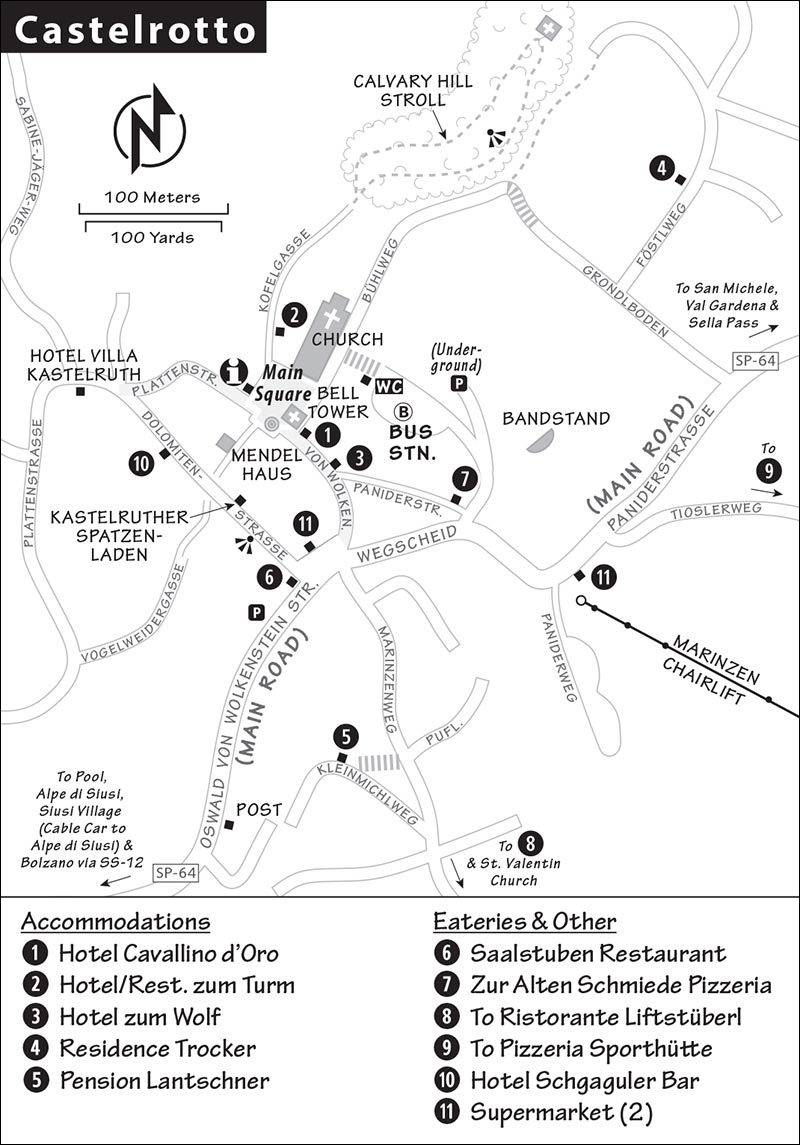
The bus station (Busbahnhof) is 100 yards below the town’s main square. It’s unstaffed, but there’s a shelter with timetables and a ticket machine (cash only). Free WCs are in a building at the tip of the bus loop. Take the stairs (by the tiny elevator) to get to the main square and TI.
Drivers can park in one of the two underground parking lots: The Zentrum garage is near the bus station, and the other is on Wolkensteinstrasse, next to the recommended Saalstuben Restaurant (€1.80/hour, €20/day, cash only). My recommended hotels have free parking (ask for details when you book).
Coming from Innsbruck and points north, exit (earlier than you would expect) at Chiusa/Klausen and continue five miles toward Bolzano along the secondary road (SS-12) before crossing the river (signed Waidbruck/Ponte Gardena) and following signs for Kastelruth/Castelrotto.
Castelrotto Walk
Castelrotto is a great place to sleep but has only a little sightseeing of its own—the surrounding mountains and hikes are the attractions here. This quick self-guided walk will get you oriented and trace the town’s history.
• Start in the...
Main Square (Krausplatz): This square is named for the noble family who ruled the town from 1550 to 1800. Their palace, now the City Hall, overlooks the square and sports the Kraus family coat of arms.
Castelrotto puts its square to use. A farmers market takes place here on Friday mornings in the summer, and a clothing/craft market fills the square most Thursday mornings. Before and after Sunday Mass, the square is crowded with villagers and farmers (who fill the church) dressed in traditional clothing. The main Mass (Sat at 20:00 and Sun at 10:00) is in German.
• A landmark in the square is the...
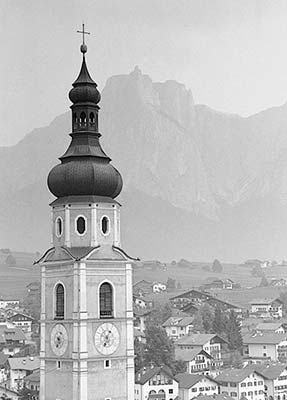
Bell Tower: At 250 feet, the freestanding bell tower dominates the town. It was once attached to a church, which burned down in 1753. While the bell tower was quickly rebuilt, the gutted church was torn down, and the church you see today was constructed farther back, enlarging the square.
When you feel the pride that the locals have in their tower—which symbolizes their town—you’ll better understand why Italy has been called “the land of a thousand bell towers.” The bells of Castelrotto, which are a big part of the town experience, ring on the hour from 6:00 until 22:00. While sleepy tourists may wonder why the bells clang so very early in the morning, locals who grew up with the chimes find them comforting. The beloved bells mark the hours, summon people to work and to Mass, announce festivals, and warn when storms threaten. In the days when people used to believe that thunder was the devil approaching, the bells called everyone to pray. (Townspeople thought the bells’ sound cleared the clouds.)
Bells ring big at 7:00, noon, and 19:00. The biggest of the eight bells (7,500 pounds) peals only on special days. When the bells ring at 15:00 on Friday, it commemorates Christ’s sacrifice at the supposed hour of his death—a little bit of Good Friday every Friday. The colorful poles in front of the church (yellow-and-white for the Vatican, red-and-white for Tirol) fly flags on festival days. The towering maypole, a Bavarian tradition, was a gift from Castelrotto’s sister city in Bavaria.
• Also on the square is the...
Church: Before entering, notice the plaque on the exterior. This commemorative inscription honors the tiny community’s WWI dead—Fraktion Dorf means from the village itself, and the other sections list soldiers from the surrounding hamlets. Stepping into the church, you’re surrounded by harmonious art from about 1850. The church is dedicated to Sts. Peter and Paul, and the paintings that flank the high altar show how each was martyred (crucifixion and beheading). The pews (and smart matching confessionals) are carved of walnut wood.
• Back outside, belly up to the...
Fountain: Opposite the church, Castelrotto’s fountain dates from 1884. St. Florian, the protector against fires, keeps an eye on it today as he did when villagers (and their horses) first came here for a drink of water.
• With your back to the church and the fountain on your left, walk a half-block down the lane to see the finely frescoed...
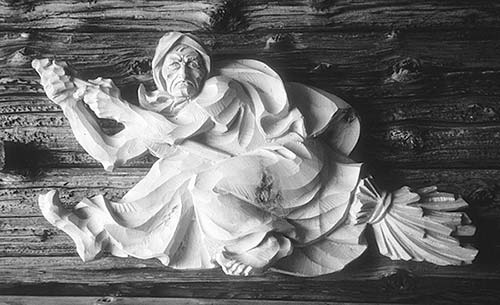
Mendel Haus: This house, with its traditional facade, contains a woodcarving shop. Its frescoes (from 1886) include many symbolic figures, as well as an emblem of a carpenter above the door—a relic from the days when images, rather than address numbers, identified the house. Notice St. Florian again; this time, he’s pouring water on a small painting of this very house engulfed in flames. Inside Mendel Haus are fine carvings, a reminder that this region—especially nearby Val Gardena—is famous for its woodwork. You’ll also see many witches, folk figures that date back to when this area was the Salem of this corner of Europe. Women who didn’t fit society’s mold—including midwives, healers, and redheads—were sometimes burned as witches.
• Continue downhill to the left of Mendel Haus, then before the underpass, climb the stairs on your right. At the top of the stairs, turn left on Dolomiten Strasse. In 50 yards, on the left at #21, is a shop dedicated to Castelrotto’s big hometown heroes.
Kastelruther Spatzen-Laden: The ABBA of the Alps, the folk-singing group Kastelruther Spatzen (literally “sparrows”) is a gang of local boys who put Castelrotto on the map in the 1980s. They have a huge following here and throughout the German-speaking world. Though he’s now in his early 60s, the lead singer, Norbert Rier, remains a Germanic heartthrob. You’ll see his face on ads all over town—in the recommended Saalstuben Restaurant, suggesting what to order for dessert, or in the Co-op supermarket, reminding you to drink lots of Tirolean milk. The group’s feel-good folk-pop style—an alpine version of German Schlager music—is popular with the kind of conservative, working-class Germans who like to vacation in South Tirol. (Younger, more progressive Germans cringe at this stuff, with its nationalistic overtones.) At a big festival in Castelrotto on the second weekend in October, the band puts on a hometown concert, filling this place with fans from as far away as the Alsace and the Netherlands. They also hold an open-air concert here in June and a Christmas concert.
Browse the store, which is part souvenir shop and part insignia and apparel outlet. Downstairs is a sprawling, folksy museum slathered with gifts, awards, and gold records (€2 museum entry, refunded with €5 purchase in the shop, Mon-Fri 9:30-12:00 & 15:00-18:00, Sat 9:30-12:00, closed Sun).
• Leaving the shop, cross the street for a...
Fine Mountain View of the Schlern: This bold limestone outcropping—so typical of the Dolomites—is a symbol of the Südtirol. Witches are said to live there, and many locals climb it yearly (it’s an easy—if long—walk up the back side).
Look left—the street points to a ridge in the distance. That’s Puflatsch (a high meadow with a popular trail called the “Trail of the Witches”—see “Activities in the Alpe di Siusi,” later).
• Continue uphill 50 yards, cross left, pass the little parking lot square, and find two stones marking the top of a cobbled pedestrian lane that leads downhill back into town. Look up at the top of the bell tower. Ahead stands the elegant...
The Dolomites have been called the most beautiful mountains on earth, and certainly they are among the most dramatic.
They differ from the rest of the Alps because of their dominant rock type, dolomite, which forms sheer vertical walls of white, gray, and pink that rise abruptly from green valleys and meadows. Many parts of the mountains (including the Alpe di Siusi/Seiser Alm) are protected as regional or national parks, where development is restricted. Still, rail lines, roads, good bus routes, and innumerable lifts make this group of mountains very accessible.
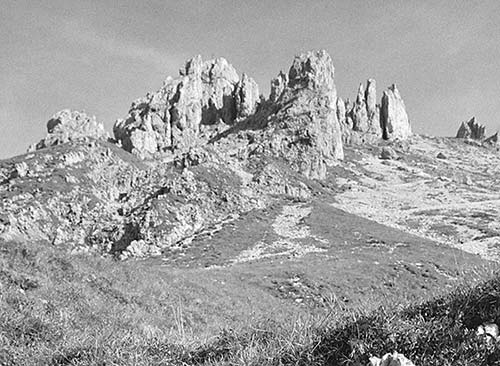
Once dubbed the “Pale Mountains” or the “Venetian Alps,” this mountain range was named after French mineralogist Dolomieu, who in the late 1700s first described the rock type responsible for the region’s light-colored bluffs and peaks.
These sedimentary rocks (similar to limestone) were formed in warm tropical seas during the Triassic Period (about 250 million years ago). The marine sediments, along with the fossilized remains of coral reefs and other animals, were buried, hardened, and later scooped upward along with the rest of the Alps by the tectonic-plate action of Africa slowly smashing into Europe. Today, marine fossils are found atop the region’s highest peaks, including the skyscraping, nearly 11,000-foot-high Marmolada.
During World War I, the front line between the Italian and Austro-Hungarian forces ran through these mountains, and many paths were cut into the range for military use. Today mountaineers can still follow these networks of metal rungs, cables, and ladders (called via ferrata). One famous wartime trail is the “Strada delle Gallerie,” near Rovereto, which passes through 52 tunnels (gallerie).
A paradise for hikers, cyclists, and climbers in summer, the Dolomites are even better known as a top skiing destination. A popular winter activity for intrepid skiers is the “Sella Ronda”—circling the Sella massif using a system of lifts and 28 miles of ski runs. The 1956 Winter Olympics in Cortina d’Ampezzo brought the Dolomites to the world’s attention, and the 2026 Winter Olympics (shared between Cortina and Milan) are set to do it all over again.
Whether you experience the Dolomites with your hand on a walking stick, a ski pole, or an aperitivo while mountain-gazing from a café, it’s easy to enjoy this spectacular region.
Hotel zum Wolf Facade: This was painted by the same artist who did the Mendel Haus. St. Florian is still pouring water on burning houses and locals are busy enjoying the local wine.
As you head left, uphill back to the town square, enjoy windows filled with traditional Südtirol formal wear—delightful dirndls. You’ll pass an old hotel, which, by the looks of its street sign, must be called The Golden Pony (Cavallino d’Oro or Goldenes Rössl). Ahead of you is the inviting sound of a refreshing drink from the town fountain.
• Our walk is over. Ahead (through a white arch just to the right of the TI) are two big pictorial maps showing the region in summer and in ski season, as well as a modern café with ice cream and a nice terrace. The arch that’s closer to the church leads up to Calvary Hill for a nice little loop walk, described next.
Activities in Castelrotto
Calvary Hill (Kalvarienberg) Stroll
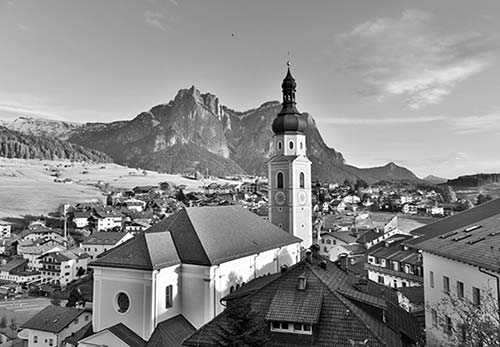
For an easy stroll to Castelrotto’s finest postcard views—the giant bell tower with a dramatic alpine backdrop—take a 15-minute mini-hike around the town’s hill, Kalvarienberg/Calvario (Calvary). Originally, this was the site of the ancient Roman fortress, and later the fortified home of the medieval lord. One lane circles the hill while another spirals to the top past seven little chapels, each depicting a scene from Christ’s Passion and culminating in the Crucifixion. Facing the church, take the road under the arch to the left, and then follow signs to Kofelrunde (to go around the hill) or Kofelkapelle (to get directly to the top). The light is best late in the day, and the stroll is also great after dark—romantically lit and under the stars. (The lead singer of the Kastelruther Spatzen enjoyed his first kiss right here.) For a longer walk back into town, take the Friedensweg (Peace Trail) from the top of the hill. This 30-minute forest walk is decorated with peace-themed artwork by local elementary students.
Marinzen Lift
The little Marinzen chairlift trundles you up above town in two-person seats to the Marinzenhütte café (at 4,875 feet), which has a playground and animal park for kids (open when the lift runs). The views from the top are nothing special, but several hikes leave from here—and as you ride back down, you’ll enjoy pleasant panoramas over Castelrotto. Or skip the return ride—it’s a scenic one-hour hike back down; to extend the walk, detour to St. Valentin church, described next. While the chairlift doesn’t compare with going up to the Alpe di Siusi, it’s still a nice activity. Catch it right in town, up the lane behind the Co-op/Konsum-Markt supermarket.
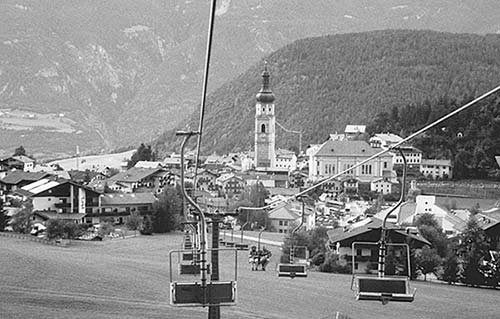
Cost and Hours: €9 one-way, €14 round-trip, daily late May-Oct 9:00-17:00, until 17:30 July-Aug, slow and scenic 22 minutes each way, closed off-season and rainy mornings, +39 0471 707 160, www.marinzen.com.
Hillside Walk to St. Valentin Church
On a clear summer evening, my favorite post-dinner activity is the gentle 40-minute walk above town to the picture-perfect St. Valentin Church, perched on a hillside high above Seis/Siusi. Although the church is rarely open, on the way there you’ll enjoy uninterrupted views of the stern Schlern, the smell of hay (and cows), and the distinct clang of Castelrotto’s church bell.
From Castelrotto’s town center, walk uphill along Marinzenweg, passing the driveway to Ristorante Liftstüberl. Stay on the road until you reach a signpost for St. Valentin and Seis. Follow the path (and signs to Seis) past a few farmhouses to a well-kept shrine to the Virgin Mary. Just after the shrine, take the path to the right and into the grass (on the #7 trail). Crossing a road, you’ll head down a paved driveway and take the far-left fork between a barn and a white building (marked za Oberzonn) to find the church standing proudly under the mighty Schlern.
From the church you can either retrace your steps back to Castelrotto (my preference), walk another 15 minutes steeply downhill to Seis/Siusi and catch a bus back to Castelrotto (#3, #3a, or #170; last departure around 20:45), or split the difference and head more gently downhill to the main road to catch the bus back.
This walk can be combined with a walk down from the top of the Marinzen chairlift, but it’s a steep descent to the church. Instead I’d walk down toward Castelrotto until the path leaves the forested hillside, then head left to follow the gentle, mostly level walk toward the church.
NEAR CASTELROTTO
Pflegerhof Herb Farm
On a narrow country road a little outside the nearby town of Seis/Siusi, you’ll find an organic farm that grows dozens of varieties of herbs. Walk among the scent-filled, fully labeled beds and browse the wide variety of herbal products in the shop. To reach the farm from Castelrotto, drive through Seis/Siusi, pass the turnoff for the cable car on your left, and after about a half-mile, turn right following St. Oswald and Pflegerhof signs.
Cost and Hours: Free, Mon-Sat 10:00-18:00, Sept-March until 17:00, closed Sun year-round, St. Oswald 24, +39 0471 706 771, www.pflegerhof.com.
Nightlife in and near Castelrotto
In summer, traditionally costumed groups offer free band concerts on Thursday evenings at the bandstand near the bus station (usually at 21:00 and kicked off with a procession from the main square).
For a more contemporary scene, the recommended Zur Alten Schmiede Pizzeria in Castelrotto is a fun spot that’s open late. Hotel Schgaguler in Castelrotto has a fancy bar, and Sasso’s, on Schlernstrasse in the nearby town of Seis/Siusi, is a trendy wine bar. A popular hangout for the younger crowd in Seis/Siusi is Santners (the only dance club in the area), at the Seiser Alm Bahn station. If you’re here on the weekend, the “Nightliner” version of bus #170 can bring you home in the wee hours (Fri-Sat roughly hourly 20:40-2:40, schedules at www.silbernagl.it).
Sleeping in and near Castelrotto
Castelrotto has the largest selection of accommodations and is the only truly convenient option for those traveling in this region by public transport. If you’ve come to hike on the Alpe di Siusi, you could also stay in one of the hotels there (in or around Compatsch)—I’ve listed two less expensive options—and even a mountain hut.
Dozens of farmhouses in the area also offer accommodations; I’ve listed a few that are willing to accept guests for two or three nights (the typical American stay here).
Dollar-sign ratings are based on the price of a double room in June or September. Rates skyrocket in July, August, and around Christmas. Accommodations often close in November and from April to mid-May.
If sleeping in this area, you’re entitled to the Südtirol Guest Pass—a free pass for many local buses (described earlier, under “Tourist Information”). Be sure to ask your hotelier for one.
IN CASTELROTTO VILLAGE
These listings are within 300 yards of the bus station. The first three are in the traffic-free area of the old town; hotel guests are allowed to drive in to park. All have free parking.
$$$ Hotel Cavallino d’Oro (in German, Goldenes Rössl), right on the main square, is plush and inviting, with the best Tirolean character in town. The entire place is dappled with artistic, woodsy touches—painted doors, carved wood, and canopy beds in many rooms—and historical photos. If you love antiques and a chance to fancy yourself a weary medieval traveler, this 700-year-old hotel is the place for you. The honesty bar in the front lounge and cozy game room beyond the stairway make rainy days less of a disappointment. The reception desk is generally unstaffed; check in at Hotel Villa Kastelruth, a short walk away at Plattenstrasse 9—see “Castelrotto” map (elevator, free self-service laundry, closed late March-mid-May and mid-Oct-Nov, Krausplatz 1, +39 0471 706 337, www.cavallino.it, info@cavallino.it). What had once been the hotel’s wine cellar is now a Roman steam bath and Finnish sauna (free for guests, great after a hike, can book an hour for exclusive use before 14:00)—complete with heated tile seats, and a solarium for tanning.
$$ Hotel zum Turm (in Italian, Albergo alla Torre) is comfortable, cozy, and warmly run by Gabi and Günther. The 15 rooms are woody and modern. If you’re staying at least three nights, the €15/person half-board option is a great value (family rooms, elevator, free passes for Marinzen chairlift, closed April-mid-May and mid-Oct-Nov, Kofelgasse 8, +39 0471 706 349, www.zumturm.com, info@zumturm.com). From Castelrotto’s main square, walk (or drive) through the upper of the two archways. If coming on a Wednesday, let them know your arrival time in advance.
$$ Hotel zum Wolf (in Italian, al Lupo) is pure Tirolean, with all the comforts in 23 neat-as-a-pin rooms, most with balconies (elevator, coin-op laundry, closed April-late May and Nov-mid-Dec, a block below main square at Wolkensteinstrasse 5, +39 0471 706 332, www.hotelwolf.it, info@hotelwolf.it, Malknecht family).
$$ Residence Trocker is run by the Moser family, who rent 11 great rooms in a place that’s solid yet warm-wood cozy. While perhaps less welcoming than some other places listed here, this compound is beautifully laid out—with a café-bar (a popular, often-smoky local hangout), garden, sauna, steam bath, roof deck with hot tub, and coin-op laundry (family rooms, apartments available, elevator, closed Nov, Föstlweg 3, +39 0471 705 200, www.residencetrocker.com, garni@residencetrocker.com, Stefan). If arriving on Sunday (the family’s day off), be sure to let them know in advance what time you’ll arrive.
$ Pension Lantschner is family-run and a good budget value. Its 10 rooms—on the two upper floors of a large traditional house—are a little smaller, simpler, and older than at my other listings, but all are comfortable and have balconies with views (Kleinmichlweg 8, +39 0471 706 025, www.garni-lantschner.com, info@garni-lantschner.com).
FARM STAYS NEAR CASTELROTTO
Dozens of working farms around Castelrotto take in visitors, mostly in apartments with a kitchen and a minimum stay of five to seven nights (the TI has a complete list). A few farms also accept guests for short stays—even one night—and serve breakfast. Expect rustic doubles with bath for about €70-90. Staying in these places is practical only if you have a car. Consider the following (all $): Goldrainerhof (a 10-minute uphill trudge from Castelrotto, Tioslerweg 10, +39 0471 706 100, www.goldrainerhof.com); Tonderhof (a fruit farm in a dramatic hillside setting along the road down to Waidbruck/Ponte Gardena, Tisens 25, +39 0741 706 733, www.tonderhof.com) and their neighbor, Schiedhof (Tisens 23, +39 345 583 7278, www.schiedhof.it); and Formsunhof (along the road up to Alpe di Siusi, before the checkpoint, 4-night minimum stay, St. Valentin 12, +39 0471 706 015, www.formsunhof.com).
ON THE ALPE DI SIUSI/SEISER ALM, NEAR THE HIKING TRAILS
There are more than two dozen hotels up on the Alpe di Siusi, most in Compatsch (where the gondola from Seis/Siusi arrives) but some farther into the park. Most are quite expensive, four- and five-star affairs, with doubles from €200 and up in July and August. The two hotels listed here cost less—because Compatsch and the park entrance are a 10-minute uphill walk away. These are most practical for drivers (though they can be reached by the Seiser Alm Bahn gondola and bus #10). Half-board is wise here, as there’s nowhere else to eat dinner (except other hotels). The main advantage: Staying here, you can hike all day without concern for catching the last gondola down. Serious hikers should consider staying at the park’s high-altitude mountain huts (mentioned under “Activities in the Alpe di Siusi,” later).
$$$ Hotel Schmung is along the road and has fine, recently renovated rooms (most with balconies). During the day, the Seiser Alm Bahn gondolas float through the air just outside the front balconies (dinner available, free sauna, closed mid-April-May and Nov-mid-Dec, Compatsch 12, +39 0471 727 943, www.schmung.com, info@schmung.com).
$$ Hotel Seelaus is a friendly, mellow, family-run, creekside place a little off the road to Compatsch. Most of its 30 rooms have been smartly renovated with a modern look, but the hotel still has an Austrian feel (family rooms, half-board pricing; free wellness area with sauna, hydro-massage, and mini-pool; closed mid-April-mid-May and mid-Oct-early Dec, Compatsch 8, +39 0471 727 954, www.hotelseelaus.it, info@hotelseelaus.it, Roberto). Roberto offers free rides from the bus or cable-car station, and affordable transfers to/from Bolzano—arrange in advance.
Eating in Castelrotto
$$$ Hotel zum Turm’s restaurant tries hard to up the culinary bar in town, focusing on locally sourced ingredients and serving good, meaty fare—including venison—and inventive vegetarian options. You can sit in the humdrum breakfast room, the cozy and very traditional Stube, or out on the oasis of a back terrace. The service is a bit Germanic (read: formal) but still welcoming (salad bar, Thu-Tue 12:00-13:45 & 18:00-20:45, closed Wed, closed April-mid-May and late Oct-Nov, +39 0471 706 349, www.zumturm.com).
$$$ Saalstuben Restaurant is a good choice for Tirolean cuisine that’s classic (including lots of grilled meats) yet elevated, with modern presentation and a few creative twists. The interior is cozy, while the outdoor terrace—a few steps below the main road through town—is cheery and breezy (Fri-Wed 11:30-14:00 & 18:00-21:00, may also open Thu in July-Aug, Wolkensteinstrasse 12, +39 0471 707 394, www.saalstuben.com).
$$ Zur Alten Schmiede Pizzeria is a great place to enjoy an evening drinking Forst, the local beer, and playing darts. They offer a wide range of nothing-fancy grub—pizzas, pastas, meaty dishes, and wurst meals (Tue-Sun 12:00-14:00 & 17:30-21:00, pizza until 23:00, closed Mon, outdoor seating, near bus station entrance at Paniderstrasse 7, +39 0471 707 390).
$$ Ristorante Liftstüberl is a good bet on a nice day if you’d like to eat in nature rather than in town. It’s a charming local favorite offering good traditional dishes and three-course dinners for less than €20. The classic woody interior is nothing special, but the picnic benches come with sweeping views, and there’s a mini-playground for the kids. Find it in a meadow about a 10-minute, gently uphill walk south of town (Mon-Sat 9:00-23:00, closed Sun, Marinzenweg 35, +39 0471 706 804).
$$ Pizzeria Sporthütte, with gingham curtains and a log-cabin vibe, offers good wood-fired pizzas, a salad bar, and daily Tirolean specials. It’s about a 10-minute walk from the center (including a bit uphill), but worth it for the view from the outdoor tables (Tioslerweg 3, +39 0471 706 465).
Picnics: Castelrotto has two supermarkets in the center, both with a decent selection of useful items beyond groceries. Eurospar is the handiest, at the town’s main intersection (Mon-Sat 8:00-19:00, closed Sun except in high season, on Wolkensteinstrasse). The Co-op/Konsum-Markt has the best selection of locally produced food and a hardware section where you can pick up a bell for your cow—no joke (Mon-Sat 7:30-12:30 & 15:00-19:00, closed Sun, Paniderstrasse 24).
Castelrotto Connections
Get bus schedules at the TI, or check Suedtirolmobil.info or Silbernagl.it.
From Castelrotto by Bus to: Seiser Alm Bahn gondola station (#3 and #3a, frequent departures—see “Alpe di Siusi/Getting There,” later), Bolzano (#170, 2/hour Mon-Sat, hourly Sun, 50 minutes, last departure at 20:00 most of the year, covered by Südtirol Guest Pass; if you’re connecting to a train in Bolzano, give yourself about 10 minutes to get to your platform at the train station). From Bolzano, you can easily connect to Innsbruck, Munich, Venice, and beyond.
Alpe di Siusi
This grassy mountain plateau above the village of Seis/Siusi (the next over from Castelrotto) is the largest high meadow—and summer pastureland—in the Alps. It’s a premier hiking and skiing area, and also home to hundreds of cows every summer. Undulating rather than flat, broken by rushing streams, and dappled with shapely evergreens, what makes the Alpe di Siusi/Seiser Alm really spectacular are the views of the surrounding Dolomite peaks. Well-kept huts, trails, and lifts make hiking here a joy. It’s family-friendly, with lots of playgrounds.
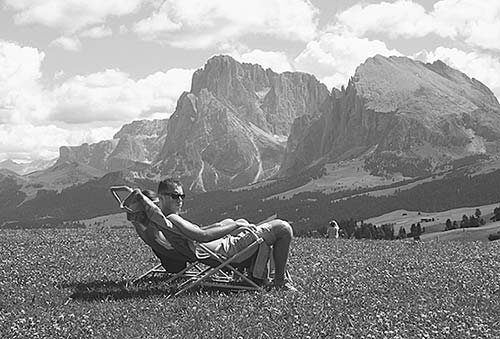
The cows munching away in this vast pasture all summer after a winter huddled in Castelrotto produce two million gallons of milk annually, much of which is sent to Bolzano to make cheese. After tourism, dairy is the leading industry here.
To enjoy the Alpe di Siusi, you’ll need a full day and decent weather. Arrive in Compatsch (the main entry point) as early as you can, then hike (or bike) as much as you please. Bring a picnic (or buy lunch at a high mountain hut), and aim to wrap up the day in midafternoon—many upper lifts close at 17:00, and thunderclouds tend to gather even on days that start out sunny.
The hiking season runs roughly from mid-June through mid-October (though if the weather’s good, you can hit some of the trails as early as mid-May). The trails are pretty dead in April, early May, and November. For a fragrant festival of wildflowers suited to growing at 6,000 feet, come in June.
With additional time, you can explore more of the park or overnight in one of the mountain huts as a base for more remote and challenging hikes. You’re more than a mile high here, so take it easy and give yourself frequent breaks to catch your breath.
Get to know the park’s mountains by sight. The jagged peaks called Langkofel (Sassolungo, “Long Stone”) and Plattkofel (Sasso Piatto, “Flat Stone”) together form an “M” at the far end of the Alpe di Siusi—providing a storybook Dolomite backdrop. The dark, eerie saddle between them fires the imagination. To the right, and closer to Compatsch, the outcropping called the Schlern (Sciliar in Italian) is a long, flat ridge that ends in spooky crags boldly staring into the summer haze. The Schlern’s Santner Peak, looking like a devilish Winged Victory, gave ancient peoples enough willies to spawn legends of supernatural forces. The Schlern witch, today’s tourist-brochure mascot, was the cause of many a broom-riding medieval townswoman’s fiery death.
Compatsch provides great views of the Schlern, but only a truncated look at Langkofel and Plattkofel. For better views, gain some altitude on a lift, or hop the bus (or hike) toward Saltria, at the far end of the Alpe di Siusi. (Because Saltria sits down in a valley, the views are even better from the road just above it, near the hut called Rauchhütte.)
GETTING THERE
By Car: The winding, six-mile road up to Compatsch starts between Castelrotto and Seis/Siusi (at San Valentino). To keep the meadow serene, it’s closed to cars during the day (9:00-17:00), unless you’re staying in one of the hotels in the park. (The road is unblocked, but you’ll likely be stopped by roving traffic monitors—be ready to show your hotel reservation confirmation.) But if you’re an early riser, there’s no reason not to drive up if you can arrive at the checkpoint before 9:00. (You can drive back down at any time.) Compatsch has a huge parking lot (€19/day—the same price as one round-trip cable-car ticket, so groups of at least two save by driving).
By Bus from Bolzano or Castelrotto to the Gondola near Seis/Siusi: Regular buses from Bolzano and Castelrotto link to the bottom of the gondola that whisks visitors from Seis/Siusi to the Alpe di Siusi. Buses #3 and #3a run from Castelrotto (4/hour July-Aug in morning and afternoon peak times, otherwise 2/hour; 10 minutes, €1.50 ticket valid for the whole day, use machine, if no machine pay driver, covered by Südtirol Guest Pass). Be sure to check your bus’s direction before boarding (or ask the driver)—you want buses to the Seiser Alm Bahn. These buses stop directly at the gondola station. Some buses, including #170 to/from Bolzano (see here), stop on the main road just below the station—a steep five-minute hike up.
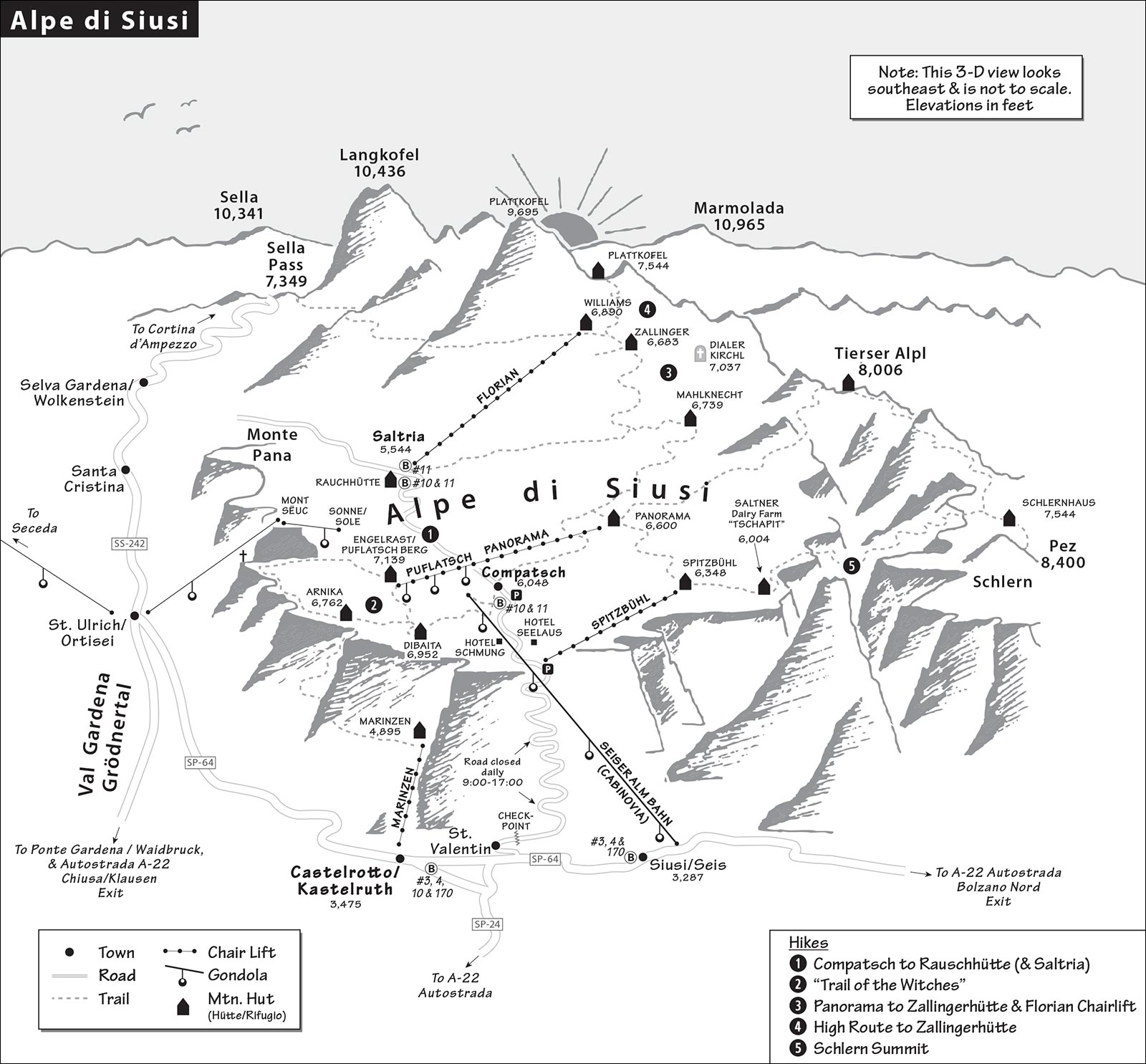
By Gondola from Seis/Siusi: The Seiser Alm Bahn gondola (in Italian, Cabinovia Alpe di Siusi) runs hikers and skiers up to Compatsch (mid-May-early Nov daily 8:00-18:00, mid-June-mid-Sept until 19:00, closed most of Nov and mid-April-late May, runs continuously during open hours, 15-minute ride to the top, €13.50 one-way, €20 round-trip, +39 0471 704 270, www.seiseralmbahn.it). You can reach the valley station either by car (free outdoor parking and pay garage parking) or by bus (see earlier). The lower cable-car station is a slick mini-shopping mall, with lots of outdoor outfitters and a tempting local-products store.
By Bus from Castelrotto: Bus #10 runs from Castelrotto all the way to Compatsch. It costs the same as the more memorable—and environmentally friendly—gondola, takes the same amount of time, and runs less frequently. The only advantage to the bus: It runs in some shoulder season periods when the gondola doesn’t, and in high season leaves Compatsch 10 minutes after the gondola stops running—useful if you’re a little late getting back to Compatsch (9 buses/day mid-June-mid-Oct, 20 minutes, fewer mid-May-mid-June and late Oct, www.silbernagl.it). Round-trip gondola tickets aren’t good on the bus (or vice versa). Note that the Südtirol Guest Pass does not cover this bus (or other buses that run above Seis/Siusi).
Transit Passes: For short-time visitors, most passes don’t make sense. If you’re here for three or more days, the Combi Card pass covering the Seiser Alm Bahn gondola and area buses can be worthwhile. Consider the Seiser Alm Card Gold pass only if you’re staying for a week. Ask at a TI or your hotel for details.
Missed the Last Gondola Down? If you don’t make the last gondola off the meadow, you can walk about 2.5 hours to Castelrotto (via St. Valentin) or about 2 hours to Seis for buses to Bolzano—or call a taxi (about €35 to Castelrotto; the ”Hiking Area” map/brochure has numbers for taxi services—call one for the Seiser Alm).
GETTING AROUND THE ALPE DI SIUSI
For a helpful journey planner and downloadable timetables for buses, see Suedtirolmobil.info and Silbernagl.it. For gondolas, cable cars, and chairlifts, see SeiserAlm.it.
Shuttle Buses: The plateau is essentially car-free, except for guests staying at a few hotels inside the park. The #11 shuttle bus takes visitors to and from key points along the tiny road between Compatsch—the gateway to the Alpe di Siusi—and Saltria, at the foot of the postcard-dramatic Kofel/Sasso peaks and the base of the Florian lift (2-3/hour mid-June-mid-Oct, fewer mid-May-mid-June and in late Oct, runs about 8:30-18:40—but double-check before heading out, 15 minutes from Compatsch to Saltria, €2.50, not covered by Südtirol Guest Pass, buy ticket at vending machines at the station or pay driver, www.silbernagl.it). At the end of the day, buses back from Saltria can be jam-packed, and may be too full to pick up passengers between Saltria and Compatsch. Bus #14 serves some hotels on the meadow but isn’t helpful for points in this chapter.
Gondolas and Chairlifts: Five upper lifts (marked on maps) are worth the €8-14 per ride to get you into the higher and more scenic hiking areas expeditiously (or back to the shuttle buses quickly). The Puflatsch lift takes credit cards, but as of my last visit, the others are cash only. Keep in mind that the upper lifts stop running fairly early (typically at about 17:00; the Seiser Alm Bahn gondola from Compatsch down into the valley runs until 18:00 most of the year—and until 19:00 in high season). Check local schedules and plan your day accordingly.
Orientation to Compatsch
Compatsch (about 6,000 feet), at the entrance to Alpe di Siusi, isn’t quite a “village,” but rather a collection of hotels and visitor services. The upper station of the Seiser Alm Bahn gondola has WCs and a few shops and eateries, but most services cluster around a parking lot about five minutes away (including the TI, ATMs, restaurants, bike rental, small grocery store, and shops; from the top of the gondola, it’s to the right).
Make a point to stop by the Compatsch TI, which sells maps and has the latest on snow conditions and trail openings. If considering a demanding hike, review your plan here. If you’re not sure where to start, let them suggest a day plan that takes into account your hiking ability, time constraints, and the weather (Mon-Sat 8:15-12:30, closed Sun, +39 0471 727 904, www.seiseralm.it).
HELPFUL HINTS
Trekking-Pole Rental: Most of the hikes here have at least some bits with uneven or gravely footing—poles can be nice to have along (rentals-€4-5/day, used poles often available to buy for about €15-20, at nearly every sport shop on either end of the Seiser Alm Bahn gondola).
Bike Rental: Two shops offer standard, performance, and e-bikes, along with helmets, maps, and trail advice, and have roughly similar prices (standard bike-€28-38/day; performance or e-bike-€48-62/day). Sporthaus Fill is near the cable-car station (+39 0471 729 063, www.sporthausfill.com) and Sport Hans is across from the parking lot (+39 0471 727 824, www.sporthans.com, Hans and son Samuel). There’s a world of tiny paved and gravel lanes to pedal. Pick up a map of suggested routes and consider the ones I describe later. Rentable baby buggies are popular for those with toddlers.
Groceries: Onkel Eugen’s, a tiny store across from the parking lot, has necessities (open early June-mid-Oct and Dec-Easter 9:00-17:30).
Horse-Drawn Carriage Rides: These are available next to the TI (May-Oct 9:00-16:00, €30 for 30 minutes in a one-horse carriage, price depends on size of carriage).
Activities in the Alpe di Siusi
HIKING
Easy meadow walks abound on the Alpe di Siusi, giving novice hikers classic Dolomite views from manicured trails. Experienced hikers should consider the tougher, more exciting treks. Before attempting a hike, call or stop by the TI to confirm lift schedules and check your understanding of the time and skills required. As always, when hiking in the mountains, assume weather can change quickly, and pack accordingly (wear good shoes and carry water and an extra layer). Meadow walks, for flower lovers and strollers, are pretty—but for advanced hikers, they can be boring. Chairlifts are springboards for more dramatic and demanding hikes. Upper lifts generally close at 17:00.
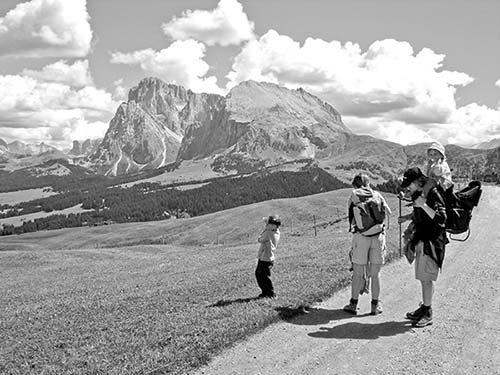
Trails are very well marked with wooden signposts pointing to mountain huts (Hütte in German, rifugi in Italian), which offer food and, often, beds. The number on the arrow is the number of the trail; the number near the destination name is the approximate time in minutes. In theory, the trail numbers are keyed into local maps. In practice, trail numbers on signs don’t always match the numbers shown on maps. Instead, navigate by knowing your huts, which are clearly labeled on all signage and maps. (When asked for directions, most locals will know the trail by the huts it connects rather than its number.) For simple hikes, you can basically string together three or four names off the free pictorial map in the “Hiking Area” brochure. For anything more serious, invest in a good 1:25,000 map from the TI. The Alpe di Siusi website (www.seiseralm.it) has more information (click on “Active/Summer/Hiking”).
Low-Exertion Excursions: Besides hiking, there are fun ways to bask in the high-alpine beauty with minimum huffing and puffing. From the two lift stations near Compatsch you could ride the Puflatsch and/or Panorama lifts up on a round-trip ticket, look at the views, enjoy a restaurant meal or picnic at the top, and simply ride back down. You could also ride the #11 shuttle bus from Compatsch to Saltria (or walk there, described later) and take a round-trip ride on the Florian chairlift before riding back to Compatsch.
Shoulder-Season Strategies: The Seiser Alm Bahn gondola up to Compatsch starts running in mid-May, but upper lifts begin operating a few weeks later; there’s a similar gap at the end of the season (mid-Oct-early Nov). But even during these shoulder seasons, the Alpe di Siusi can still be worth visiting (and busy with hikers) in good weather. Many of the hikes listed here are doable without a lift—but only if you’re willing to hike to the trailhead (most realistic for the “Trail of the Witches” and the Panorama-to-Zallingerhütte route). Get local advice about snow levels and which hikes are possible. The simplest option is to hike trail #30 or ride bus #11 along the valley floor between Compatsch and Saltria, enjoying the views along the way.
Easy Hikes
▲Compatsch to Rauschhütte (and Saltria)
Bus #11 connects Compatsch to Saltria (at the far end of Alpe di Siusi, tucked under Langkofel and Plattkofel) in about 15 minutes—zipping past some impressive scenery en route. For a very easy, mostly level walk, follow this same route by foot, in about one hour one-way (returning on the bus) or 1.5 hours round-trip (using trail #30, which parallels the route). To begin, leave the top gondola station via the stairs to the road that leads under the view terrace to the TI. From the TI, follow the road for a few minutes (with the gondola station behind and to your right) to the modern wood chapel, then follow signs pointing off the road to the #30 trail.
The last stretch—into Saltria—is steeply downhill and has less impressive views; consider going only as far as Rauchhütte (a charming old hut serving good food, spectacular views, closed Wed, www.rauchhuette.com), located where the road starts to switchback down. Bus #11 stops at various points along this route (including Rauchhütte and Ritschhütte)—making it easy to do as much or as little of this by foot as you like. (Saltria is not a good destination on its own: It’s a steep walk below Rauchhütte and has hotels, trailheads, and a bus stop, but no shops.)
▲▲▲The “Trail of the Witches”
This three-hour loop trail—past the legendary stone “witches’ benches” (Hexenbänke)—is popular with first-time visitors and can be crowded in peak season. You’ll enjoy ever-changing views as you get a handy 360-degree panorama of the peaks and valleys that ring the Alpe di Siusi. It’s mostly downhill, with a few brief uphill stretches.
From the top of the Seiser Alm Bahn gondola, ride the Puflatsch gondola (or chairlift, depending on weather) up to Puflatsch Berg (6,952 feet). A two-minute walk above the lift, an engraved map at the Engelrast (“Angel’s Rest”) observation point identifies the surrounding mountains. The counterclockwise hike follows PU/Puflatsch signs around the rim of the Puflatsch plateau. First you’ll have Langkofel and Plattkofel on your right as you hike gently but steadily uphill. Eventually you’ll hit a little cross overlooking the valley village of Ortisei/St. Ulrich (far below in Val Gardena), then hook left and trace the dramatic rim of the plateau. Soon tiny Castelrotto pops into view, then you’ll pass Arnikahütte (with a café), and finally you’ll head back toward the Schlern. At Arnika, you can either take a steep hike back up to the Engelrast/Puflatsch Berg lift, or—better and easier—keep going downhill all the way into Compatsch, with great valley views the entire time.
Note: If you’re here when the upper lifts aren’t running (or even in the early evening, assuming you’re staying in Compatsch or have a car for returning to the valley after the main lift stops running), this is your most realistic and rewarding option. But be ready for a very steep 30-minute uphill hike to the top of the Puflatsch lift to begin the hike.
Moderate Hikes
▲▲▲Panorama to Zallingerhütte and Florian Chairlift
This walk on well-marked trails is a great introduction to the Alpe di Siusi. While it starts and ends at about the same altitude, it includes plenty of ups and downs. It comes with fine vistas, changes of scenery (meadows, woods, and high valleys), fun stops along the way, and lifts up and down on each end. Though signs rate it at three hours without stops, allow five or six hours (including the lift from Compatsch, lift down to Saltria, and bus back to Compatsch) so you’ll have time to dawdle, yodel, and eat.
Start by riding the Panorama chairlift from its base near Compatsch (the Panorama lift is on your right as you walk down the gravel path from the Seiser Alm Bahn’s terrace). From the Panorama hut (6,600 feet), find the signpost pointing toward trail #2, follow it across the meadow to the paved road, and then join trail #7. You’ll pass the rustic Edelweisshütte (snacks only), and the Almrosenhütte (hot food); after about 1.5 hours total you’ll reach the Mahlknechthütte (6,739 feet, hot food and plenty of outside seating).
From the Mahlknechthütte, you’ll cross two streams (one on stepping stones, another by bridge). Shortly after the bridge, you hit the highest point of the walk, just below a small wooden church (Dialer Kirchl, 7,037 feet) that makes a good picnic spot. Continuing on trail #7 from just below the church, you’ll go gently through woods, mostly downhill, for another hour and a quarter to Zallingerhütte (6,683 feet). From here it’s a serious 10-minute climb to Williamshütte (6,890 feet, full restaurant), where you catch the Florian chairlift (€11.50 one-way) to Saltria and the shuttle-bus stop (return to Compatsch on bus #11).
High Route to Zallingerhütte: For a more thrilling, demanding version of the previous hike—longer by two hours—branch off at the wooden church (Dialer Kirchl), following trail #4B, and then the high #4 ridge trail, with commanding views both left and right, to the Plattkofelhütte/Rifugio Sasso Piatto hut (7,544 feet, excellent lunches, +39 0462 601 721). Then descend steeply to Zallingerhütte and Williamshütte (6,890 feet). No special experience or gear is needed for this trail, and it richly rewards those who take it.
Serious hikers can hike a steep and satisfying hour from the Plattkofelhütte to the peak of the Plattkofel/Sasso Piatto.
Challenging Hikes
▲▲▲Schlern Summit
For a serious 12-mile hike—with a possible overnight in a traditional mountain refuge (generally open mid-June-Sept)—consider hiking to the summit of Schlern (Sciliar). This route, which takes about eight hours round-trip (including lunch) from Compatsch, is popular with hardy hikers; some call it the best hike in the region.
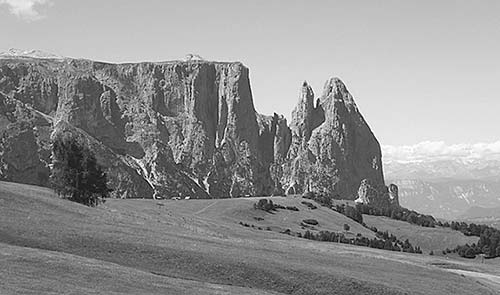
Start at the Spitzbühl chairlift, a 20-minute walk below Compatsch (5,659 feet, free parking, Castelrotto-Compatsch bus stops here), which brings you up to 6,348 feet. Trail #5 takes you through a high meadow, down to the Saltner dairy farm (6,004 feet—you want the Saltner dairy farm at Tschapit, not the one near Zallingerhütte), across a stream, and steeply up the Schlern mountain. About three hours into your hike, you’ll meet trail #1 and walk across the rocky tabletop plateau of Schlern to the Schlernhaus mountain “hut,” really a simple restaurant and 120-bed hostel (7,544 feet, called “Rifugio Bolzano” in Italian). From this dramatic setting, you can enjoy a meal and get a great view of the Rosengarten range. Hike 20 more minutes up the nearby peak (Monte Pez, 8,400 feet), where you’ll find a lofty meadow, cows in the summer, and the region’s ultimate 360-degree alpine panorama. Unless you’re staying overnight, hike back the way you came.
Overnight Option: To do the Schlern summit hike as an overnight, either sleep at the ¢ Schlernhaus (bunks and private rooms, open early June-mid-Oct, coin-op shower, summer only +39 0471 612 024, off-season +39 0471 724 094, can reserve by email before hut opens in June, www.schlernhaus.it, info@schlernhaus.it) or walk two hours farther along the Schlern to the hut at ¢ Tierser Alpl, at 8,006 feet (bunks and private rooms, open June-late Oct, +39 0471 727 958, mobile +39 333 654 6865, www.tierseralpl.com, info@tierseralpl.com). From Tierser Alpl, you can descend to Saltria or Compatsch by any of several different scenic routes.
TRAIL RUNNING
The Running Park Seiser Alm includes 46 miles of signed running trails in the meadow. The clean air and high mountain altitude attract many international runners/masochists. During a one-day, scenic half-marathon on the first Sunday of July, they invite the public to run with them...or at least try. Contact the Compatsch TI for trail info and maps, or go to www.seiseralm.it and click on “Active/Summer/Running.”
BIKING
Bikes are easy to rent (including electric ones—see “Helpful Hints,” earlier), welcome on many lifts for free or a small fee, and permitted on many of the trails and lanes in Alpe di Siusi. The Compatsch TI has a good information flier that lists the best routes. You can also go to www.seiseralm.it and click on “Active/Summer/Biking.” Get local advice to confirm difficulty levels and your plan before starting any ride; the TI hands out helpful bike-route cards. Those with a bike don’t need to worry as much about lifts shutting down early.
For a fairly easy, 2.5-hour ride that gives you the same scenic thrills as the Panorama to Zallingerhütte and Florian Lift hike recommended earlier, try this: Start from Compatsch (6,048 feet), bike or ride the lift to Panorama (6,600 feet), and take road #7, which runs generally uphill to Goldknopf and then follows a series of hills and dips to Mahlknechthütte (6,739 feet). Then take road #8 downhill to Saltria (5,544 feet) and back to Compatsch (6,048 feet). About 60 percent is paved and 40 percent is gravel lanes.
More Sights in the Dolomites
▲▲▲Alpe di Seceda
In good weather, hiking among the serrated formations at Seceda is among the most dramatic experiences in the Dolomites. These are the striking peaks that you can see, from a distance, on some of the Alpe di Siusi’s most impressive hikes.
From Castelrotto, it’s a short ride on bus #172 (or a 20-minute drive) northeast, up the Val Gardena/Grödner Tal, to the town of Ortisei/St. Ulrich. From the Seceda parking garage at the top of town, cable cars whisk you up to the edge of a thrilling cliff with unforgettable ridge walks and jaw-dropping views. A ski area in winter, Seceda is a meadow in summer, with lots of enticing trails. The obvious, easy choice is to simply hike straight out along the ridge toward the otherworldly dragon’s-teeth peaks that jab sharply into the sky. From there, you can circle back to the cable car, or follow any of several scenic paths farther down into the meadow. (The rounded formations at Pieralongia are a satisfying extension.) As at the Alpe di Siusi, a variety of smaller lifts make it easier to traverse the meadow (and skip some demanding uphill stretches), so come up with a plan based on your time and stamina, and with an eye on when various lifts stop running. For details, see Seceda.it.
▲▲Short Dolomite Loop Drive
You could spend a day from Bolzano or Castelrotto driving a loop over the scenic Sella Pass (Sellajoch, Passo di Sella)—it’s about 70 miles on windy roads, so allow four hours. Note that on certain summer days, traffic on the pass may be limited to buses and bikes. Confirm the route is open to drivers by talking to a local TI or your hotelier before heading out.
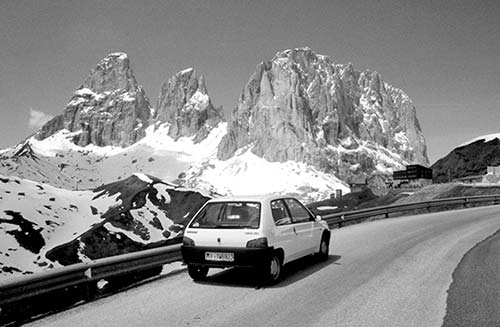
Going clockwise, you drive first through a long valley, the Grödner Tal/Val Gardena, which is famous for its skiing and hiking resorts, traditional Ladin culture (notice the trilingual road signs), and woodcarvers (the woodcarving company ANRI is from the town of St. Cristina). You’ll first reach the large town of Ortisei/St. Ulrich, with base stations for two different cable cars. One heads up to the Alpe di Siusi, the other to Seceda (described earlier).
An hour beyond Ortisei/St. Ulrich, you’ll reach Sella Pass (7,349 feet). After a series of tight hairpin turns a half-mile or so over the pass, you’ll see some benches and cars. Pull over and watch the rock climbers. Over the pass is the town of Canazei, with nice ambience and altitude (4,642 feet).
If you’d like to take a ridge hike, hop the gondola that runs from Canazei to a hillside shelf called Pecol; from there a cable car runs up to Col dei Rossi Belvedere. From the top cable-car station you can hike the Viel del Pan trail past Rifugio Belvedere and Rifugio Fredarola along an easy but breathtaking ridge to Rifugio Viel del Pan. This three-hour round-trip hike has views of the highest mountain in the Dolomites—the Marmolada—and the Dolo-mighty Sella range.
From Canazei, you can either follow very twisty roads (via St. Zyprian and Tiers) back to Castelrotto, or take the easier and slightly faster route via Welschnofen and Birchabruck back to Bolzano and the main valley highway.
Bus Option: It’s possible to experience the Sella Pass without a car by riding a bus from Castelrotto via Ortisei/St. Ulrich and Plan to the base of the Col dei Rossi cable car (about 2 hours one-way). Get details at the TI.
Brixen (Bressanone)
This charming small city (pop. 20,000), on the highway between Bolzano and Innsbruck, is a worthwhile pit stop (park at garage P2 and take the pedestrian underpass into the old town; the main square is a 5-minute stroll away). With an illustrious history of powerful bishops—and a sleepy present—Brixen feels like a charming, mini-Bolzano with a bit more Germanic character. It has a sprawling, traffic-free old town; a big main square with two stately churches (connected by a lovely cloister); arcaded shopping streets; and plenty of al fresco cafés and restaurants. Explore the lanes beyond the main square to find a beautiful waterside walking and biking path.
Near Brixen: More impressive than any sight in Brixen, the Kloster Neustift (Abbazia di Novacella)—just two miles north—is an Augustinian monastery complex that’s open to the public. The centerpiece is a basilica with the region’s most glorious Bavarian-style Baroque interior—slathered with decadent white-and-pink stucco, frilly curlicues, twisty columns, and pudgy winged babies everywhere. While a quick stroll through the grounds and a look at the church interior is plenty satisfying, you can also take a guided tour or try the monk-made wines in the enoteca (+39 0472 836 189, www.kloster-neustift.it).
▲Reifenstein Castle (Castel Tasso)
Reifenstein Castle, with one of my favorite castle interiors in Europe, is just off the highway at the town of Sterzing/Vipiteno. While easy for drivers, it’s not worth the trouble for those without wheels—it’s unique and interesting but only open for a few tours a day. The castle is privately owned and has not been developed for tourism (no gift shop, no café—and no photos). Its layout and decor have changed little since the 15th century, when it passed into the hands of the Teutonic Knights. Since 1813, a branch of the noble Thurn and Taxis family has owned the castle. The current heads of the family have chosen to keep the castle just as it was when they spent summer vacations here in the 1940s as children. On your tour, you’ll see most of the building, including bedrooms with original wall paneling and decorations, a real dungeon, wooden boxes knights slept in, and a medieval kitchen with a roof that is black with centuries of soot.
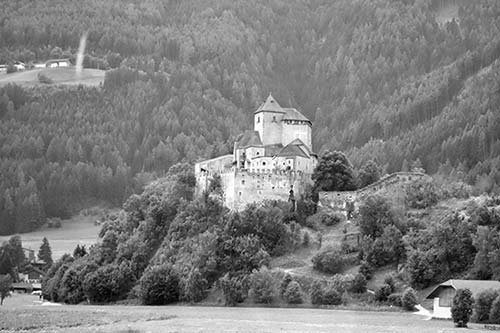
Cost and Hours: €8 for required downloadable audio tour; May-early Nov Sun-Fri 10:30-12:30 & 14:00-16:00, until 17:00 mid-July-early Sept, closed Sat year-round; +39 339 264 3752; www.sterzing-ratschings.com, choose “Activities/Sightseeing.”
Getting There: By car, the castle is about 45 minutes from Bolzano, Castelrotto, and Innsbruck. Exit the Innsbruck-Bolzano expressway at Sterzing/Vipiteno (just on the Italian side of the Brenner Pass and Austrian/Italian border), and carefully follow brown Reifenstein signs. Park at the base of the castle’s rock (in the spot right off the road from the bridge) and hike up the castle drive (10 minutes). Of the two castles here, Reifenstein is the one to the west of the expressway.