ENTERTAINMENT IN VIENNA
Vienna Boys’ Choir (Wiener Sängerknaben)
Touristy Mozart and Strauss Concerts
Vienna—the birthplace of what we call classical music—still thrives as Europe’s music capital. On any given evening, you’ll have your choice of opera, Strauss waltzes, Mozart chamber concerts, and lighthearted musicals. The Vienna Boys’ Choir lives up to its worldwide reputation.
Besides music, you can spend an evening enjoying art, watching a classic film, or sipping Viennese wine in a village wine garden. Be sure to save some energy for Vienna after dark.
Music
As far back as the 12th century, Vienna was a mecca for musicians—both sacred and secular (troubadours). The Habsburg emperors of the 17th and 18th centuries were not only generous supporters of music, but fine musicians and composers themselves. (Maria Theresa played a mean double bass.) Composers such as Haydn, Mozart, Beethoven, Schubert, and Brahms gravitated to this music-friendly environment. They taught each other, jammed together, and spent a lot of time in Habsburg palaces. Beethoven was a famous figure, lost in musical thought while walking through the Vienna Woods. In the city’s 19th-century belle époque, “Waltz King” Johann Strauss and his brothers kept Vienna’s 300 ballrooms spinning.
This musical tradition continues into modern times, leaving many prestigious Viennese institutions for today’s tourists to enjoy: the Vienna State Opera, the Boys’ Choir, and the great Baroque halls and churches, all busy with classical and waltz concerts. As you poke into churches and palaces, you may hear groups practicing. You’re welcome to sit and listen.
In Vienna, it’s music con brio from September through June, reaching a symphonic climax during the Vienna Festival each May and June. Sadly, in summer (generally July and August), the Boys’ Choir, opera, and many other serious music companies are—like you—on vacation. But it’s OK: Vienna hums year-round with live classical music, and tickets to touristy, crowd-pleasing shows are always available.
For music lovers, Vienna is also an opportunity to make pilgrimages to the homes (now mostly small museums) of their favorite composers. If you’re a fan of Schubert, Brahms, Haydn, Beethoven, or Mozart, there’s a sight for you. But I find these homes inconveniently located and generally underwhelming. The centrally located Haus der Musik (see the Sights in Vienna chapter) is my favorite setting for celebrating the great musicians and composers who called Vienna home.
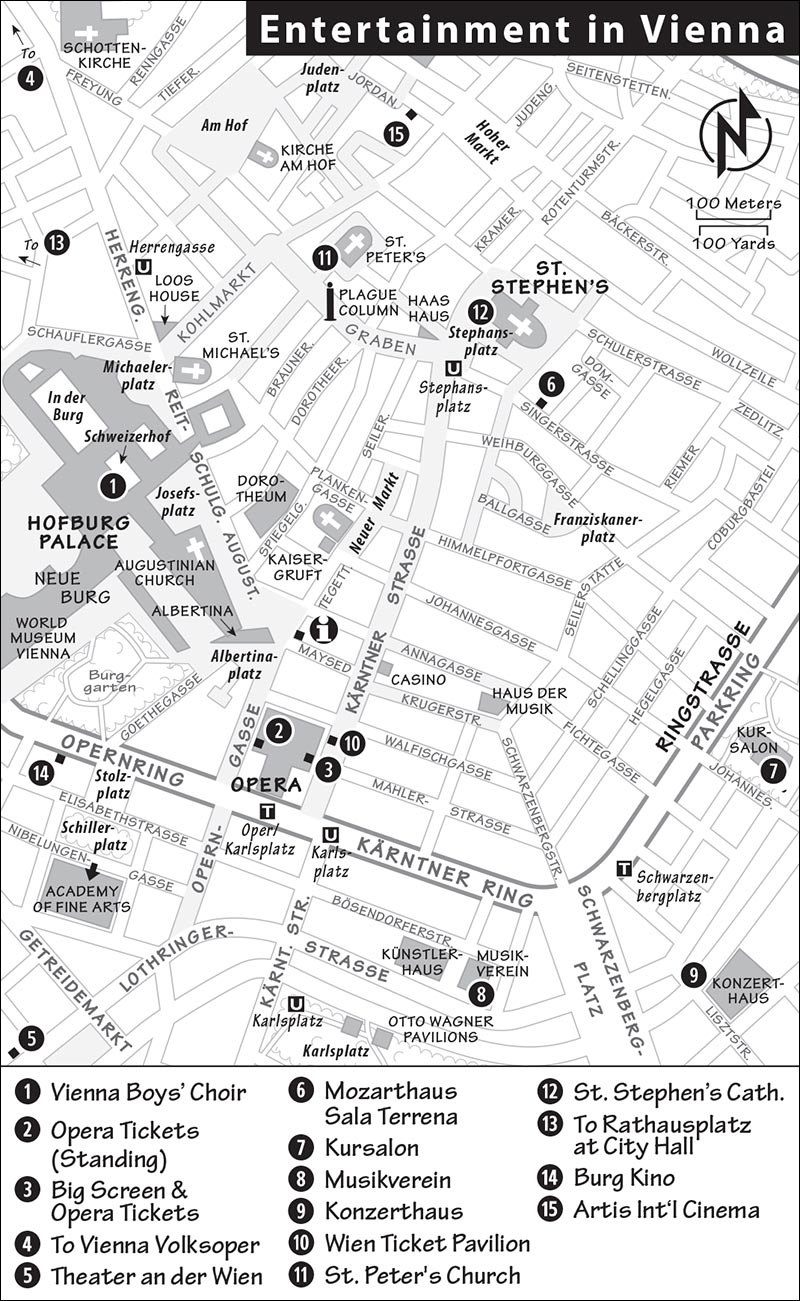
Venues: Vienna remains the music capital of Europe, with 10,000 seats in various venues around town mostly booked with classical performances. The best-known entertainment venues are the Staatsoper (State Opera House), the Volksoper (for musicals and operettas), the Theater an der Wien (opera and other performances), the Wiener Musikverein (home of the Vienna Philharmonic Orchestra), and the Wiener Konzerthaus (various events). Schedules for these venues are listed in the Spot arts brochure (available at TI). You can also check event listings at www.viennaconcerts.com.
Buying Tickets: Most tickets run from €45 to €60 (plus a stiff booking fee when purchased in advance by phone or online, or through a box office like the one at the TI). A few venues charge as little as €30; look around if you’re not set on any particular concert. While it’s easy to book tickets online long in advance, spontaneity is also workable, as there are invariably people selling their extra tickets at face value or less outside the door before concert time. If you call a concert hall directly, they can advise you on the availability of (cheaper) tickets at the door. Vienna takes care of its starving artists (and tourists) by offering cheap standing-room tickets to top-notch music and opera (generally an hour before each performance).
Vienna Boys’ Choir (Wiener Sängerknaben)
The boys sing (from a high balcony, heard but not seen) at the 9:15 Sunday Mass from mid-September through June in the Hofburg’s Imperial Music Chapel (Hofmusikkapelle). The entrance is at Schweizerhof; you can get there from In der Burg square or go through the tunnel from Josefsplatz.
Reserved seats must be booked in advance (€12-43; reserve online or by sending an email to office@hofmusikkapelle.gv.at; call +43 1 533 9927 for information only—they can’t book tickets at this number; www.hofmusikkapelle.gv.at).
Much easier, standing room inside is free and open to the first 60 who line up. Even better, rather than line up early, you can simply swing by and stand in the narthex just outside, where you can hear the boys and see the Mass on a TV monitor.
The Boys’ Choir also performs at the MuTh concert hall on some Fridays at 17:00 during peak season (€39-62, Am Augartenspitz 1 in Augarten park, U: Taborstrasse, +43 1 347 8080, www.muth.at, tickets@muth.at).
They’re talented kids, but, for my taste, not worth all the commotion. Remember, many churches have great music during Sunday Mass. Just 200 yards from the Hofburg’s Boys’ Choir chapel, the Augustinian Church has a glorious 11:00 service each Sunday (which generally features its wonderful organ, a choir, and a small orchestra; see listing in the Sights in Vienna chapter), and St. Stephen’s Cathedral has one of the largest pipe organs in Europe.
Opera
Vienna State Opera (Wiener Staatsoper)
The Vienna State Opera puts on 300 performances a year, featuring the “Orchestra of the Opera” in the pit. (Any musician aspiring to join the Vienna Philharmonic Orchestra must put in two years here before even being considered.) In July and August the singers are on summer break (as government employees, they get a nice vacation). Since there are different operas nearly nightly, you’ll see big trucks out back and constant action backstage—all the sets need to be switched each day. Even though the expensive seats normally sell out long in advance, the opera is perpetually in the red and subsidized by the state, so affordable seats are often available. The excellent “electronic libretto” translation screens help make the experience worthwhile for opera newbies. (Press the button to turn yours on; press again for English.) Dress is casual—but do your best.
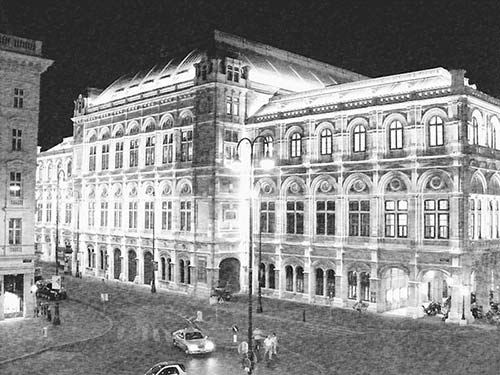
Opera Tickets: Main-floor seats go for €79-240; bargain hunters get limited-view seats for €16-30. Those under 27 can buy a youth ticket to very good seats for €20. You can book tickets online (www.wiener-staatsoper.at) or in person at the opera’s box office on Kärntner Strasse (Mon-Sat 10:00-18:00 or until one hour before each performance, Sun until 13:00). Note that premier performances are generally jam-packed.
Standing-Room Tickets: Unless a top tenor is in town, it’s easy to get one of 460 standing-room tickets (Stehplätze, €15 up top or €18 downstairs, one ticket/person). While the front doors open one hour before the show starts, a side door (middle of building, on the Operngasse side) opens 90 minutes before curtain time, giving those in the know an early grab at standing-room tickets. Just walk straight in, then head right until you see the ticket booth marked Stehplätze. Spaces are numbered—show up early and try for the “Parterre” section, where you’ll end up dead-center at stage level, directly under the Emperor’s Box. Otherwise, you can choose between the third floor (Balkon), or the fourth floor (Galerie); regulars prefer these sections because each ticket holder gets a section of railing along with a digital screen to read the libretto. While most visitors will not want to stand through the entire performance, some spots offer a wall for leaning.
Unfortunately, if you buy a ticket but show up after the performance has started, you will be forced to watch it on a closed-circuit TV until intermission.
Rick’s Crude Tip: For me, three hours is a lot of opera. But just to see and hear Vienna’s opera in action for an hour or so is a treat. And if you go, you’ll get the added entertainment of seeing Vienna all dressed up. I’d buy a standing-room ticket and plan to watch the first part of the show. Before cutting out, have a glass of champagne at the opera’s most glamorous bar (on the first floor, center front).
“Live Opera on the Square”: Demonstrating its commitment to bringing opera to the masses, each spring and fall the Vienna State Opera projects several performances live on a huge screen on its building, puts out chairs for the public to enjoy...and it’s all free. (These showings are noted as Oper Live am Platz in the official opera schedule and are posted all around the opera building. They are also listed in the Spot brochure and at www.wiener-staatsoper.at.)
Vienna Volksoper
For less-serious operettas and musicals, try Vienna’s other opera house, located along the Gürtel, west of the city center (see Spot brochure or ask at TI for schedule, Währinger Strasse 78, +43 1 5144 43670, www.volksoper.at).
Theater an der Wien
Considered the oldest theater in Vienna, this venue was designed in 1801 for Mozart operas—intimate, with just a thousand seats. It treats Vienna’s music lovers to a different opera every month (except summer), most with a contemporary setting and modern interpretation (facing the Naschmarkt at Linke Wienzeile 6, +43 1 58 885, www.theater-wien.at).
Touristy Mozart and Strauss Concerts
If the music comes to you, it’s touristy—designed for flash-in-the-pan Mozart fans. Powdered-wig orchestra performances are given almost nightly in grand traditional settings. Pesky wigged-and-powdered Mozarts peddle tickets in the streets (earning a commission of about €10 per ticket). They rave about the quality of the musicians, but you’ll get second-rate chamber orchestras, clad in historic costumes, performing the greatest hits of Mozart and Strauss. (The musicians are usually quite good—often Hungarians, Poles, and Russians working a season here to fund music studies back home—but they haven’t performed together much, so they’re not “tight.”) These are casual, easygoing concerts with lots of tour groups attending. While there’s not a Viennese person in the audience, the tourists generally enjoy the evening.
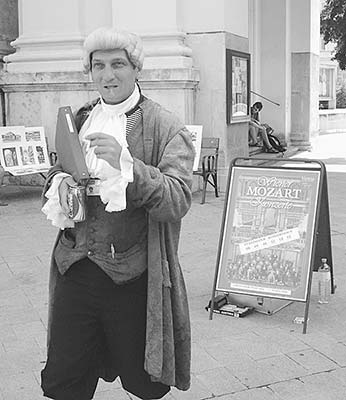
To sort through your options, check with the ticket office in the TI (same price as on the street, but with all venues to choose from). Savvy locals suggest getting the cheapest tickets, as no one seems to care if cheapskates move up to fill unsold pricier seats.
Mozarthaus Concert Venue
Of the many fine venues in Vienna, the Sala Terrena at Mozarthaus might be my favorite. Intimate chamber-music concerts with musicians in historic costume take place in a small room richly decorated in Venetian Renaissance style (€42-69; Wed, Fri, and Sun at 19:30, Sat at 18:00; near St. Stephen’s Cathedral at Singerstrasse 7, +43 1 911 9077, www.mozarthaus.at). Don’t confuse this with the Mozarthaus Vienna Museum on Domgasse, which also holds concerts.
Strauss and Mozart Concerts in the Kursalon
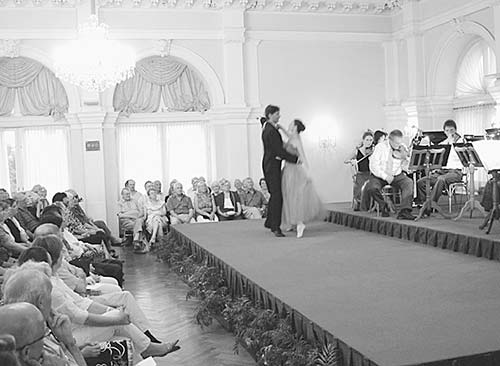
For years Strauss and Mozart concerts have been held in the Kursalon, the hall where the “Waltz King” himself directed wildly popular concerts 100 years ago (€63-105, concerts generally nightly at 20:30, Johannesgasse 33 at corner of Parkring, tram #2: Weihburggasse or U: Stadtpark, +43 1 512 5790 to check on availability—generally no problem to reserve—or buy online at www.soundofvienna.at). Shows last two hours and are a mix of ballet, waltzes, and a 15-piece orchestra. It’s touristy—tour guides holding up banners with group numbers wait out front after the show. Even so, the performance is playful, visually fun, good quality for most, and with a tried-and-tested, crowd-pleasing format. The conductor welcomes the crowd in German (with a wink) and English; after that...it’s English only.
Musicals
The Wien Ticket pavilion next to the opera house (near Kärntner Strasse) sells tickets to contemporary American and British musicals performed in German with English subtitles (€50-110). Same-day tickets are sometimes available at a discount directly from the theater from 14:00 until 18:00 (ticket pavilion open daily 10:00-19:00). Or you can reserve (full-price) tickets for the musicals by phone or online (+43 1 58 885, line answered daily 8:00-20:00, www.wien-ticket.at).
Nightlife
If powdered wigs and opera singers in Viking helmets aren’t your thing, Vienna has plenty of alternatives.
Evening Scene
Vienna is a great place to just be out and about on a balmy evening. While tourists are attracted to the historic central district and its charming, floodlit corners, locals go elsewhere. Depending on your mood and taste, you can join them. Survey and then enjoy lively scenes with bars, cafés, trendy restaurants, and theaters in these areas: Donaukanal (the Danube Canal, especially popular in the summer for its imported beaches); Naschmarkt (after the produce stalls close up, the bars and eateries bring new life to the place through the evening); MuseumsQuartier (surrounded by far-out museums, a young scene of bars with local students filling the courtyard); and City Hall (on the parklike Rathausplatz, where in summer free concerts and a food circus of eateries attract huge local crowds—described next).
Open-Air Music-Film Series and Food Circus
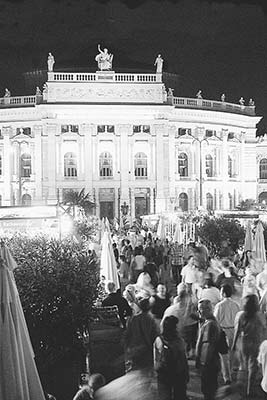
A convivial, free-to-everyone people scene erupts each evening in summer (July-Aug) on Rathausplatz, the welcoming park in front of City Hall (right on the Ringstrasse). Thousands of people keep a food circus of simple stalls busy. There’s not a plastic cup anywhere, just real plates and glasses—Vienna wants the quality of eating to be as high as the music that’s about to begin. And most stalls are outposts of local restaurants—including some of Vienna’s most esteemed—making this a fun and easy way to sample some of the city’s most interesting options. About 2,000 spots on comfy benches face a 60-foot-wide screen up against the City Hall’s Neo-Gothic facade. When darkness falls, an announcer explains the program, and then the music starts. The program is different every night, so check the website—it’s mostly films of opera and classical concerts, but with some jazz and R&B too (www.filmfestival-rathausplatz.at, programs generally last about 2 hours, starting when it’s dark—between 21:30 in July and 20:30 in Aug).
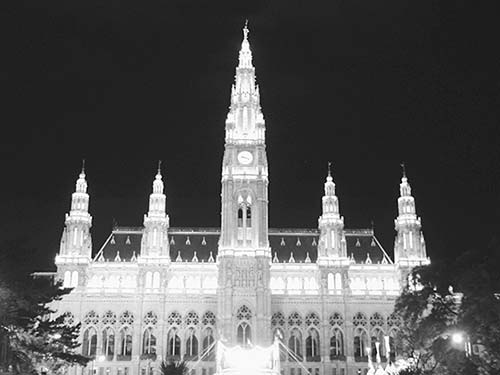
Since 1991, the city has paid for 60 of these summer event nights each year. Why? To promote culture. Officials know that the music-film series is mostly a “meat market” where young people come to hook up. But they believe many of these people will develop a little appreciation of classical music and high culture on the side.
Balls and Waltzing
Renowned for its ball scene, Vienna boasts hundreds of balls each year, where the classic dance is the waltz. The height of ball season falls generally between December and February, when Viennese and visitors of all ages dress up and swirl to music ranging from waltzes to jazz to contemporary beats. Balls are put on by the Vienna Philharmonic, Vienna Boys’ Choir, Vienna State Opera, and others (search for events at www.events.wien.info). The glamorous Hofburg Silvesterball traditionally takes place on New Year’s Eve at the Hofburg Palace, featuring big-name orchestras, bands, and opera singers; a sumptuous dinner; and champagne toast (www.hofburgsilvesterball.com).
Heurigen
Viennese wine gardens, called Heurigen, are a great way to enjoy new wine, a light meal, and a festive local atmosphere. Eat and drink in intimate taverns or leafy courtyards, surrounded by antique wine presses, friendly Wieners, strolling musicians, and fellow tourists. Most gardens are located on the outskirts of town—in the legendary Vienna Woods—but they’re easy to reach by tram, bus, or taxi. For more on the Heurigen, including recommendations and transportation information, see the Eating in Vienna chapter.
English Cinema
Several great theaters offer three or four screens of English movies nightly (€8-11). Burg Kino, a block from the opera house, facing the Ring, plays contemporary movies plus the classic The Third Man (see the sidebar, Opernring 19, +43 1 587 8406, www.burgkino.at). English Cinema Haydn is near my recommended hotels on Mariahilfer Strasse (Mariahilfer Strasse 57—see the map on here, +43 1 587 2262, www.haydnkino.at), and Artis International Cinema is right in the town center a few minutes from the cathedral (Schultergasse 5, +43 1 535 6570, www.cineplexx.at/center/artis-international).