HOFBURG TREASURY TOUR
FROM THE FIRST HABSBURG TO NAPOLEON
REGALIA OF THE HOLY ROMAN EMPIRE
The Hofburg Palace’s Imperial Treasury contains the best jewels on the Continent. Slip through the vault doors and reflect on the glitter of 21 rooms filled with secular and religious ornaments: scepters, swords, crowns, orbs, weighty robes, double-headed eagles, gowns, gem-studded bangles, and a unicorn horn.
There are plenty of beautiful objects here—I’ve highlighted those that have the most history behind them. But you could spend hours in here marveling at the riches of the bygone empire.
Use this chapter to get the lay of the land, but renting the excellent audioguide gives you a deeper explanation of these historic jewels.
Orientation
Cost: €14, €24 combo-ticket with Kunsthistorisches Museum.
Hours: Wed-Mon 9:00-17:30, closed Tue.
Information: +43 1 525 240, www.kaiserliche-schatzkammer.at.
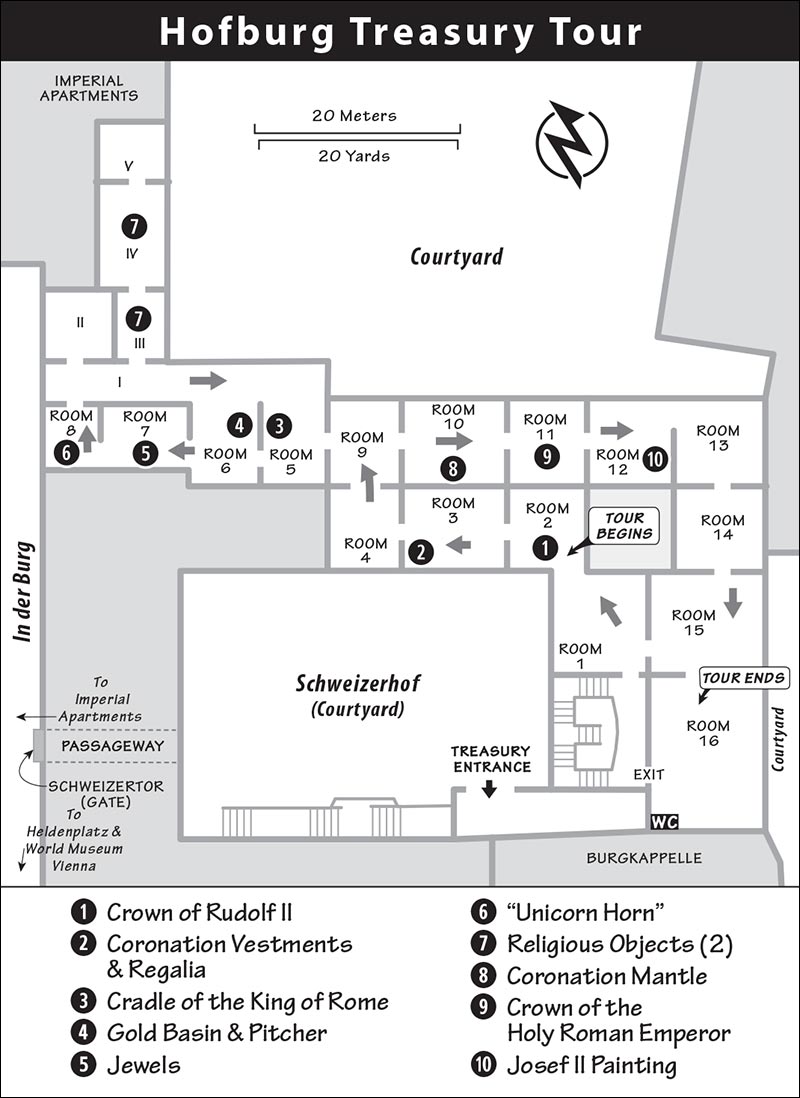
Getting There: The Treasury is tucked away in the Hofburg Palace complex. From the Hofburg’s central courtyard (In der Burg), pass through the black, red, and gold gate (Schweizertor), following Schatzkammer signs, which lead into the Schweizerhof courtyard; the Treasury entrance is in the far-right corner.
Tours: The €5 audioguide (€7/2 people) describes 100 stops—well worth it to get the most out of this dazzling collection.
Starring: The Imperial Crown and other accessories of the Holy Roman Emperors, plus many other crowns, jewels, robes, and priceless knickknacks.
The Tour Begins
The Habsburgs saw themselves as the successors to the ancient Roman emperors, and they wanted crowns and royal regalia to match the pomp of the ancients. They used these precious objects for coronation ceremonies, official ribbon-cutting events, and their own personal pleasure. You’ll see the prestigious crowns and accoutrements of the rulers of the Holy Roman Empire (a medieval alliance of Germanic kingdoms so named because it wanted to be considered the continuation of the Roman Empire). Other crowns belonged to Austrian dukes and kings, and some robes and paraphernalia were used by Austria’s religious elite. And many costly things were created simply for the enjoyment of the wealthy Habsburgs.
• Skip through Room 1 to where we’ll begin, in Room 2. Note throughout the Treasury how paintings hung in each room relate to the jewels on display.
FROM THE FIRST HABSBURG TO NAPOLEON
Room 2
The personal 1 crown of Rudolf II (1602) occupies the center of the room along with its accompanying scepter and orb; a bust of Rudolf II (1552-1612) sits nearby. The crown’s design symbolically merges a bishop’s miter (“Holy”), the arch across the top of a Roman emperor’s helmet (“Roman”), and the typical medieval king’s crown (“Emperor”). Accompanying the crown are the matching scepter (made from the ivory tusk of a narwhal) and orb (holding four diamonds to symbolize the four corners of the world, which the emperor ruled). Orbs have been royal symbols of the world since ancient Roman times. They seem to indicate that, even in pre-Columbus days, Europe’s intelligentsia assumed the world was round.
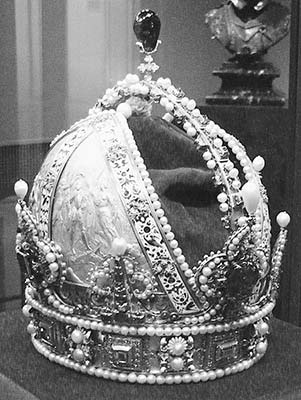
This crown was Rudolf’s personal one. He wore a different crown (which we’ll see later) in his official role as Holy Roman Emperor. In many dynasties, a personal crown like this was dismantled by the next ruler to custom-make his own. But Rudolf’s crown was so well-crafted that it was passed down through the generations, even inspiring crown-shaped church steeples as far away as Amsterdam (when that city was under Habsburg control).
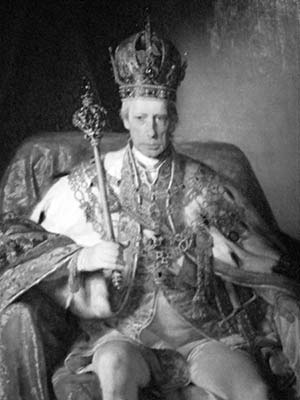
Two centuries later (1806), this crown and scepter became the official regalia of Austria’s rulers, as seen in the large portrait of Franz I (the open-legged guy behind you). Napoleon Bonaparte had just conquered Austria and dissolved the Holy Roman Empire. Franz (r. 1792-1835) was allowed to remain in power, but he had to downgrade his title from “Franz II, Holy Roman Emperor” to “Franz I, Emperor of Austria.”
Rooms 3 and 4
These rooms contain some of the 2 coronation vestments and regalia needed for the new Austrian (not Holy Roman) Emperor. There was a different one for each of the emperor’s subsidiary titles—for example, King of Hungary or King of Lombardy. So many crowns and kingdoms in the Habsburgs’ vast empire! Those with the white ermine collars are modeled after Napoleon’s coronation robes. Sketches on the wall were done to get the royal OK. Notice in the group of four robes how Franz marked an X on his choice.
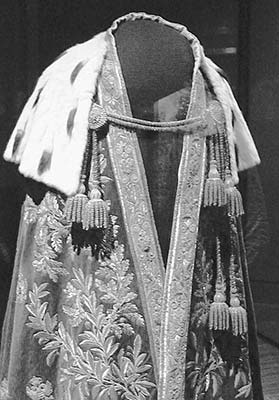
• For more on how Napoleon had an impact on Habsburg Austria, pass through Room 9 and into...
Room 5
Ponder the 3 Cradle of the King of Rome, once occupied by Napoleon’s son, who was born in 1811 and made King of Rome. The little eagle at the foot is symbolically not yet able to fly, but glory-bound. Glory is symbolized by the star, with dad’s big N raised high. While it’s fun to think of Napoleon’s baby snoozing in here, this was actually a ceremonial “throne bed” that was rarely used.
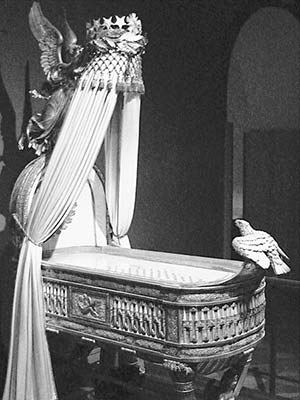
Napoleon Bonaparte (1769-1821) was a French commoner who rose to power as a charismatic general in the Revolution. While pledging allegiance to democracy, he in fact crowned himself Emperor of France and hobnobbed with Europe’s royalty. When his wife Josephine could not bear him a male heir, Napoleon divorced her and married into the Habsburg family.
Portraits show Napoleon and his new bride, Marie Louise, Franz I/II’s daughter (and Marie-Antoinette’s great-niece). Napoleon gave her a jewel chest decorated with the bees of industriousness, his personal emblem. With the birth of the baby King of Rome, Napoleon and Marie Louise were poised to start a new dynasty of European rulers...but then Napoleon met his Waterloo, and the Habsburgs remained in power.
• Exit to the left of the cradle.
MISCELLANEOUS WONDERS
Room 6
For Divine Right kings, even child-rearing was a sacred ritual that needed elaborate regalia for public ceremonies. The 23-pound 4 gold basin and pitcher were used to baptize noble children, who were dressed in the baptismal dresses displayed nearby.
Room 7
These 5 jewels are the true “treasures,” a cabinet of wonders used by Habsburgs to impress their relatives (or to hock when funds got low). The irregularly shaped, 2,680-karat emerald is rough-cut, as the cutter wanted to do only the minimum to avoid making a mistake and shattering the giant gem. The helmet-like, jewel-studded crown (left wall) was a gift from Muslim Turks supporting a Hungarian king who, as a Protestant, was a thorn in the side of the Catholic Habsburgs (who eventually toppled him).
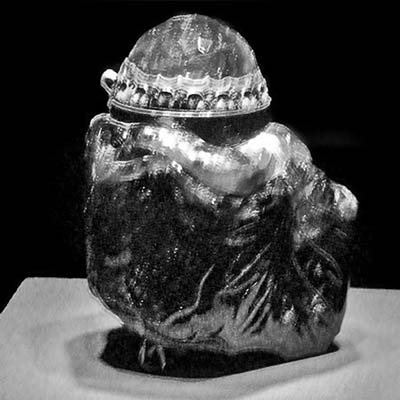
Room 8
The eight-foot-tall, 500-year-old 6 “unicorn horn” (actually a narwhal tusk), was considered to have magical healing powers bestowed from on high. This one was owned by the Holy Roman Emperor—clearly a divine monarch. The huge agate bowl, cut from a single piece, may have been made in ancient Roman times and eventually found its way into the collection of their successors, the Habsburgs. It was thought to be the Holy Grail when it was stolen from Constantinople.
Religious Rooms
After Room 8, you enter several rooms of 7 religious objects—crucifixes, chalices, mini-altarpieces, reliquaries, and bishops’ vestments. Like the medieval kings who preceded them, Habsburg rulers mixed the institutions of church and state, so these precious religious accoutrements were also part of their display of secular power.
• Browse these rooms, then backtrack, passing by the Cradle of the King of Rome, and eventually reaching...
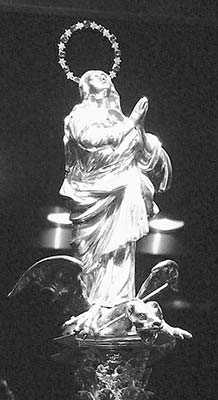
REGALIA OF THE HOLY ROMAN EMPIRE
Room 10
The next few rooms contain some of the oldest and most venerated objects in the Treasury—the robes, crowns, and sacred objects of the Holy Roman Emperor.
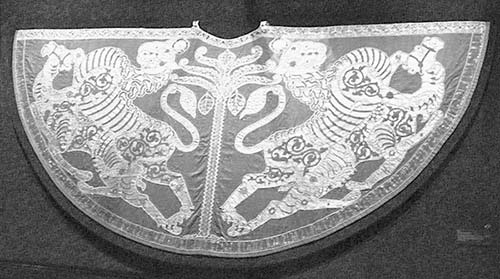
The big red-silk and gold-thread 8 coronation mantle, nearly 900 years old, was worn by Holy Roman Emperors when they received their crown. Thousands of tiny white pearls were drilled and threaded for this one garment. Notice the oriental imagery: a palm tree in the center, flanked by lions subduing camels. The hem is written in Arabic (wishing its wearer “great wealth, gifts, and pleasure”). This robe, brought back from the East by Crusaders, gave the Germanic emperors an exotic look that recalled great biblical kings such as Solomon. Many Holy Roman Emperors were crowned by the pope himself. That fact, plus this Eastern-looking mantle, helped put the “Holy” in Holy Roman Emperor.
Room 11
The collection’s highlight is the 10th-century 9 crown of the Holy Roman Emperor. It was probably made for Otto I (c. 960), the first king to call himself Holy Roman Emperor.
The Imperial Crown swirls with symbolism “proving” that the emperor was both holy and Roman: The cross on top says the HRE ruled as Christ’s representative on earth, and the jeweled arch over the top is reminiscent of the parade helmet of ancient Romans. The jewels themselves allude to the wearer’s kinghood in the here and now. Imagine the impression this priceless, glittering crown must have made on the emperor’s medieval subjects.
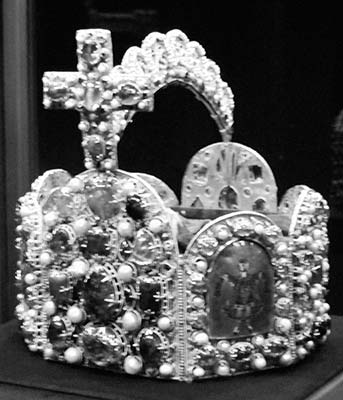
King Solomon’s portrait on the crown (to the right of the cross) is Old Testament proof that kings can be wise and good. King David (next panel) is similar proof that they can be just. The crown’s eight sides represent the celestial city of Jerusalem’s eight gates. The jewels on the front panel symbolize the 12 apostles.
On the forehead of the crown, notice that beneath the cross there’s a pale-blue, heart-shaped sapphire. Look a little small for the prime spot? That’s because this is a replacement for a long-lost opal said to have had almost mythical, magical powers.
Nearby is the 11th-century Imperial Cross that preceded the emperor in ceremonies. Encrusted with jewels, it had a hollow compartment (its core is wood) that carried substantial chunks thought to be from the cross on which Jesus was crucified and the Holy Lance used to pierce his side (both pieces are displayed in the same glass case). Holy Roman Emperors actually carried the lance into battle in the 10th century. Look behind the cross to see how it was a box that could be clipped open and shut, used for holding holy relics. You can see bits of the “true cross” anywhere, but this is a prime piece—with the actual nail hole.
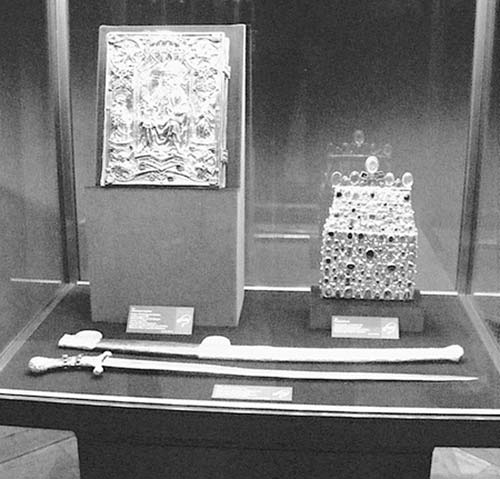
Another case has additional objects used in the coronation ceremony: The orb (orbs were modeled on late-Roman ceremonial objects, then topped with the cross) and scepter (the one with the oak leaves), along with the sword, were carried ahead of the emperor in the procession. In earlier times, these objects were thought to have belonged to Charlemagne himself, the greatest ruler of medieval Europe, but in fact they’re mostly from 300 to 400 years later (c. 1200).
Another glass case contains more objects said to belong to Charlemagne. Some of these may be authentic, since they’re closer to his era. You’ll see the jeweled, purse-like reliquary of St. Stephen and the saber of Charlemagne. The gold-covered Book of the Gospels was the Bible that emperors placed their hands on to swear the oath of office.
Room 12
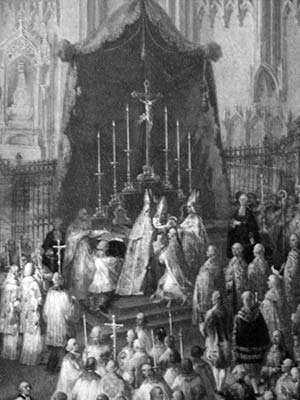
Now picture all this regalia used together. The 10 Josef II painting shows the coronation of Maria Theresa’s son as Holy Roman Emperor in 1764. Set in a church in Frankfurt (filled with the bigwigs—literally—of the day), Josef is wearing the same crown and royal garb that you’ve just seen.
Emperors followed the same coronation ritual that originated in the 10th century. The new emperor would don the mantle. The entourage paraded into a church for Mass, led by the religious authorities carrying the Imperial Cross. The emperor placed his hand on the Book of the Gospels and swore his oath. Then he knelt before the three archbishop Electors, who placed the Imperial Crown on his head (sometimes he even traveled to Rome to be crowned by the pope himself). The new emperor rose, accepted the orb and scepter, and—dut dutta dah!—you had a new ruler.
• The tour is over. Pass through Rooms 13-16 to reach the exit, browsing relics, portraits, and objects along the way.