HOFBURG IMPERIAL APARTMENTS TOUR
IMPERIAL PORCELAIN AND SILVER COLLECTION
Map: Hofburg Imperial Apartments Tour
In this tour of the Hofburg Imperial Apartments, you’ll see the lavish, Versailles-like rooms that were home to the hardworking Emperor Franz Josef I and his reclusive, eccentric empress, known as “Sisi.” From here, the Habsburgs ruled their vast empire.
Franz Josef was the last of the great Habsburg monarchs, and these apartments straddle the transition from old to new. You’ll see chandeliered luxury alongside office furniture and electric lights.
Franz Josef and Sisi were also a study in contrasts. Where Franz was earnest, practical, and spartan, Sisi was poetic, high-strung, and luxury-loving. Together, they lived in the cocoon of the Imperial Apartments, seemingly oblivious to how the world was changing around them.
Orientation
Cost: €16, includes well-done audioguide; also covered by Sisi Ticket, which includes the Schönbrunn Palace Grand Tour and the Vienna Furniture Museum (Sisi Ticket described on here). To avoid lines, buy your Sisi Ticket at the Vienna Furniture Museum or online (see below).
Hours: Daily 9:00-17:30, July-Aug until 18:00, last entry one hour before closing.
Information: +43 1 533 7570, www.sisimuseum-hofburg.at.
When to Go: It can be crowded midmornings, so go either right at opening time or after 14:00.
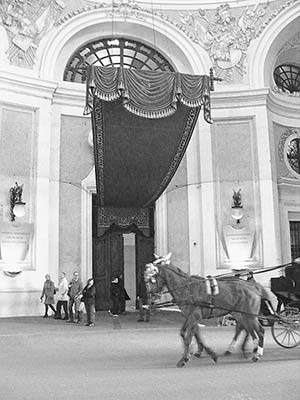
Getting There: Enter from under the rotunda just off Michaelerplatz, through the Michaelertor gate.
Tours: Guided English tours (€4) run daily at 14:00. The included audioguide brings the exhibit to life; with it and this chapter, you won’t need to buy the official guidebook.
Length of This Tour: If you listen to the entire audioguide, allow 40 minutes for the porcelain and silver collection, 30 minutes for the Sisi Museum, and 40 minutes for the apartments.
OVERVIEW
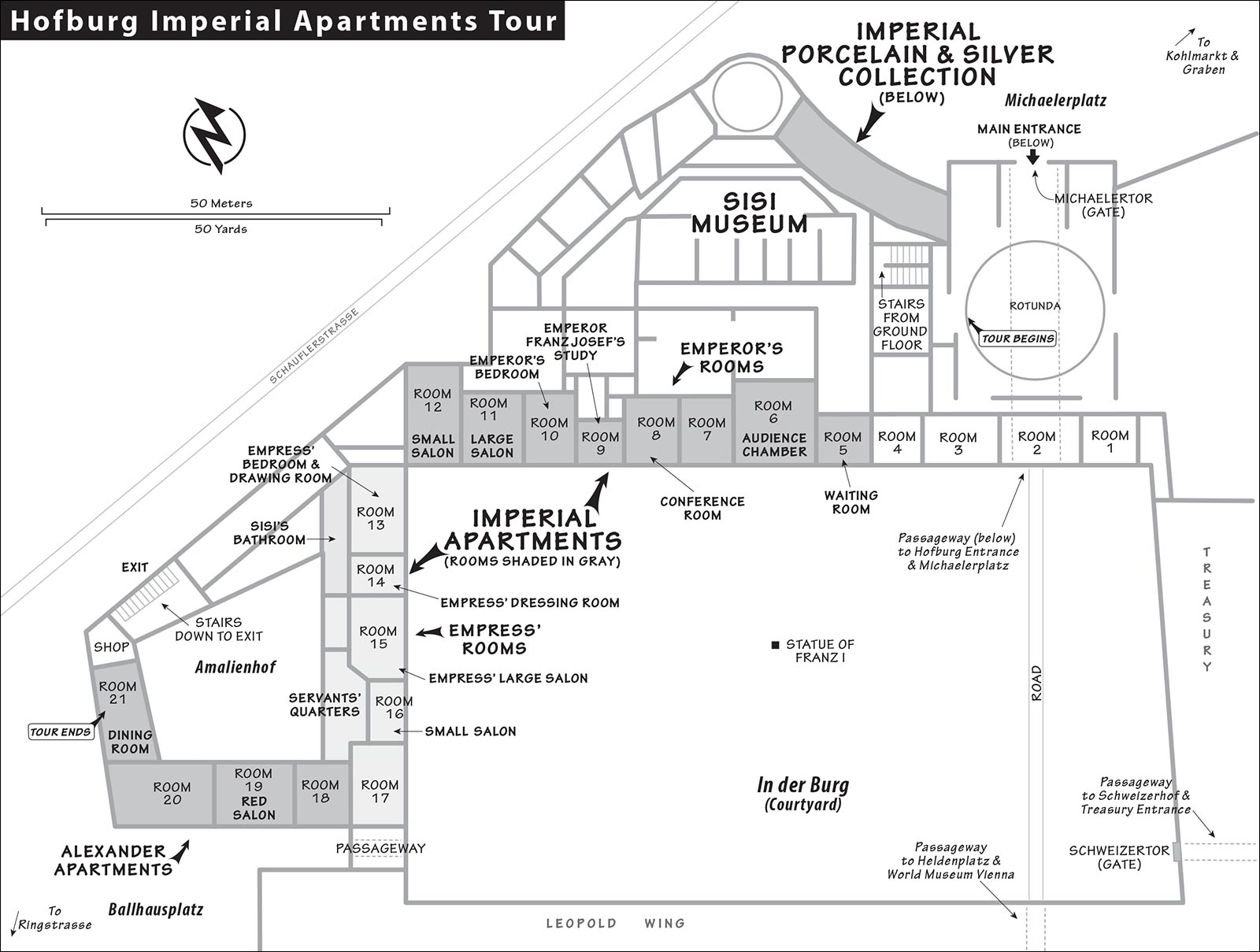
The Imperial Apartments are part of the large Hofburg Palace complex (for an overview of the entire palace area, see the “Vienna’s Hofburg Palace” map in the Sights in Vienna chapter). Your ticket grants you admission to three separate exhibits, which you’ll visit on a one-way route. The first floor holds a collection of precious porcelain and silver knickknacks (Silberkammer). You then go upstairs to the Sisi Museum, which has displays about her life. This leads into the 20 or so rooms of the Imperial Apartments (Kaiserappartements), starting in Franz Josef’s rooms, then heading into the dozen rooms where his wife Sisi lived.
The Tour Begins
IMPERIAL PORCELAIN AND SILVER COLLECTION
• Your visit (and the excellent audioguide) starts on the ground floor.
Tableware Collection
The audioguide actually manages to make the Habsburg court’s vast tableware collection interesting. The cabinets are full (with the contents intact—this area was never bombed), and the displays were functional so that servants could select the proper items, as the royals would entertain up to 800 guests at a time. Browse the collection to gawk at the opulence and to take in some colorful Habsburg trivia. (Who’da thunk that the court had an official way to fold a napkin—and that the technique remains a closely guarded secret?) Still, I wouldn’t bog down here, as there’s much more to see upstairs.
• Once you’re through all those rooms of dishes, climb the stairs—the same staircase used by the emperors and empresses who lived here. At the top is a timeline of Sisi’s life. Swipe your ticket to pass through the turnstile, consider the rare WC (“go when you can, not when you have to”), and enter the room with the...
Model of the Hofburg
Survey the model. It shows the original 19th-century vision of the Habsburgs: an Austrian “Foro Romano” glorifying the imperial family, with a garden of statues surrounded by a vast and symmetrical complex reaching all the way to the imperial stables at the far end. But by this time, the era of emperors was rapidly passing; this vision would never come to fruition, and by 1918 the Habsburgs were history.
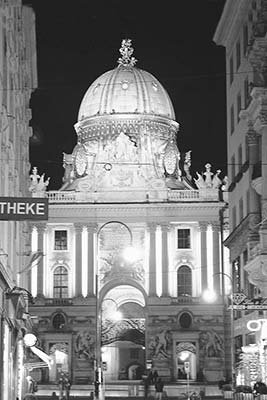
Circle to the far side to find where you’re standing right now, near the Hofburg’s largest dome. That dome tops the entrance to the Hofburg from Michaelerplatz.
The Hofburg was the epicenter of one of Europe’s great political powers—600 years of Habsburgs lived here. The Hofburg started as a 13th-century medieval castle (near where you are right now) and expanded over the centuries to today’s 240,000-square-meter (60-acre) complex, now owned by the state.
A world within a world, the Hofburg was a kind of forbidden city accessible only to the ruling elite until 1891. Stand at the center and imagine the unfinished bit filled in, and ponder the imperial greatness of the palace complex. The twin buildings just before the stables were purpose-built to be museums.
To the left of the dome (as you face the facade) is the steeple of the Augustinian Church. It was there, in 1854, that Franz Josef married 16-year-old Elisabeth of Bavaria, and their story began.
• Now enter a darkened room at the beginning of the...
SISI MUSEUM
Empress Elisabeth (1837-1898)—a.k.a. “Sisi” (SEE-see)—was Franz Josef’s mysterious, beautiful, and narcissistic wife. This museum traces her fabulous but tragic life—and it does so with the help of her flowery poetry, which is posted for reading as you stroll through these ornate halls. She wrote thousands of pages of intimate insights into her rich—yet unhappy—life.
Sisi’s Death
The exhibit starts with Sisi’s sad end, showing her death mask, photos of her funeral procession (by the Hercules statues facing Michaelerplatz), and an engraving of a grieving Franz Josef. It was at her death that the obscure, private empress’ legend began to grow.
• Continue into the corridor.
The Sisi Myth
Sisi was not a major public figure in her lifetime, as newspaper clippings of the day make clear. She was often absent from public functions, and the censored press was gagged from reporting on her eccentricities. After her death, however, her image quickly became a commodity and began appearing on everyday items such as candy tins and beer steins.
The plaster-cast life-sized statue captures the one element of her persona everyone knew: her beauty. Sisi was nearly 5’8” (a head taller than her husband), had a 20-inch waist (she wore very tight corsets), and weighed only about 100 pounds. (Her waistline eventually grew...to 21 inches. That was at age 50, after giving birth to four children.) This statue, a copy of one of 30 statues that were erected in her honor in European cities, shows her holding one of her trademark fans. It doesn’t show off her magnificent hair, however, which reached down as far as her ankles in her youth.
Sisi-mania really got going in the 1950s with a series of movies based on her life (starring Romy Schneider), depicting the empress as beautiful and innocent, and either crying or singing at any given point in the films.
• Round the corner into the next room.
Sisi’s Childhood
Sisi grew up in Bavaria, far from sophisticated city life. (See her baby shoes in a box and the picture of her childhood palace.) Franz Josef—who’d been engaged to her older sister—spied seemingly happy-go-lucky Sisi when she was 15 and fell in love. They married. At the wedding reception, Sisi burst into tears, the first sign that something was not right.
The Ballroom: Sisi at Court
In the glass display cases are replicas of her gowns. Big portraits of Sisi (considered the most realistic in existence) and Franz Josef show them dressed to the nines. Jewels (also replicas) reproduce some of the finery she wore as empress—but to her, they were her “chains.” She hated official court duties, the constraints of public life, and being the center of attention. Sisi’s mother-in-law dominated her child-rearing, her first-born died as an infant, and she complained that she couldn’t sleep or eat. However, she did participate in one political cause—championing the rights of Habsburg-controlled Hungary (see her bust and portrait as Queen of Hungary).
• Head into the next, darkened room.
Sisi’s Beauty
Sisi longed for the carefree days of her youth. She began to withdraw from public life, passing time riding horses (see horse statuettes and pictures) and tending obsessively to maintaining her physical beauty. In the glass case on the right wall, you’ll see some of her menus, and a bill from Demel. Her recipes for beauty preparations included creams and lotions as well as wearing a raw-meat face mask while she slept. Sisi weighed herself obsessively on her gold-trimmed scale and tried all types of diets, including bouillon made with a duck press. (She never gave up pastries and ice cream, however.) After she turned 30, Sisi refused to appear in any portraits or photographs, preferring that only her more youthful depictions be preserved. Appreciate the white gloves, the ivory fan, and the white nightgown (displayed nearby)...because her life was about to turn even more dark.
• Then enter the darkest room.
Death of Sisi’s Son
A mannequin wears a replica of Sisi’s black dress, and nearby you’ll see black jewels and accessories. In 1889, Sisi and Franz Josef’s son, Prince Rudolf—whose life had veered into sex, drugs, and liberal politics—apparently killed his lover and himself in a suicide pact. Sisi was shattered and retreated further from public life.
• Stroll through several more rooms.
Empress Elisabeth—Franz Josef’s beautiful wife—was the 19th-century equivalent of Princess Diana. Born on Christmas Eve and known as “Sisi” since childhood, she became an instant celebrity when she married Franz Josef at 16.
The daughter of a Bavarian duke, Sisi enjoyed an idyllic girlhood riding horses in the forests near Munich. But after marrying, she became obsessed with preserving her reputation as a beautiful empress, maintaining her Barbie-doll figure (her goal: to stay under 110 pounds), and tending to her fairy-tale, ankle-length hair. In the 1860s, she was considered one of the most beautiful women in the world. But, despite severe dieting and fanatical exercise, age—not to mention the near impossibility of adhering to such demanding standards of feminine beauty—took their toll. After turning 30, she refused to allow photographs or portraits, and was generally seen in public with a delicate fan covering her face (and bad teeth).
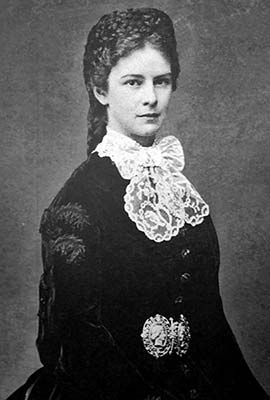
Complex and influential, Sisi was adored by Franz Josef, whom she respected. Although Franz Josef was supposed to have married Sisi’s sister Helene (in an arranged diplomatic marriage), he fell in love with Sisi instead. It was one of the Habsburgs’ few marriages for love.
Sisi had a special affinity for Hungary. She enthusiastically studied and spoke Hungarian, and her personal mission and political cause was promoting Hungary’s bid for autonomy within the empire—which her husband accommodated in 1867 by dividing his empire into the “Dual Monarchy” of the Austro-Hungarian Empire. Her personal tragedy was the death of her son Rudolf, the crown prince, in an apparent suicide (an incident often dramatized as the “Mayerling Affair,” named after the royal hunting lodge where it happened). Disliking Vienna and the confines of the court and eager for time out of the spotlight, Sisi traveled more and more frequently. (She spent so much time in Budapest, and with Hungarian statesman Count Andrássy, that many believe her third daughter to be the count’s.)
As the years passed, the restless Sisi and her hardworking husband became estranged. In 1898, while visiting Geneva, Switzerland, she was murdered by an Italian anarchist. Sisi’s beauty, bittersweet life, and tragic death helped create her larger-than-life legacy. However, her importance is often inflated by melodramatic accounts of her life. The Sisi Museum (here in the Hofburg) seeks to tell a more accurate story.
Escape
Sisi consoled herself with poetry (the museum has quotes on the walls) that expresses a longing to escape into an ideal world. As you continue through the exhibit, you’ll see she also consoled herself with travel. There’s a reconstruction of her rail car. A map shows her visits to Britain, Eastern Europe, and her favorite spot, Greece.
Final Room: Assassination
Sisi met her fate while traveling. While walking along a street in Geneva, Sisi was stalked and attacked by an Italian anarchist who despised royal oppressors and wanted notoriety for his cause. (He’d planned on assassinating a less-famous French prince that day—whom he’d been unable to track down—but quickly changed plans when word got out that Sisi was in town.) The murder weapon was a small, crude, knife-like file. It made only a small wound, but it proved fatal.
• After the Sisi Museum, a one-way route takes you through a series of royal rooms. The first room—as if to make clear that there was more to the Habsburgs than Sisi—shows a family tree tracing the Habsburgs from 1273 (Rudolf I at upper left) to their messy WWI demise (Karl I, lower right). From here, enter the private apartments of the royal family (Franz Josef’s first, then Sisi’s). Much of the following commentary complements the information you’ll hear in the audioguide.
IMPERIAL APARTMENTS
These were the private apartments and public meeting rooms for the emperor and empress. Franz Josef I lived here from 1857 until his death in 1916. (He had hoped to move to new digs in the Neue Burg—which now houses the World Museum Vienna and a few other museums—but that was not finished until after his death.)
Franz Josef was the last legendary Habsburg. (For an abridged Habsburg family tree, see the Austria: Past & Present chapter.) In these rooms, he presided over defeats and liberal inroads as the world was changing and the monarchy becoming obsolete. Here he met with advisors and welcomed foreign dignitaries; hosted lavish, white-gloved balls and stuffy formal dinners; and raised his children. He slept (alone) on his austere bed while his beloved wife Sisi retreated to her own rooms. He suffered through the execution of his brother, the suicide of his son and heir, the murder of his wife, and the assassination of his nephew, Archduke Ferdinand, which sparked World War I and spelled the end of the Habsburg Monarchy.
The Emperor’s Rooms
Waiting Room for the Audience Room
Every citizen had the right to meet privately with the emperor, and people traveled far to do so. While they waited nervously, they had these three huge paintings to stare at—propaganda art showing crowds of commoners enthusiastic about their Habsburg rulers.
The painting on the right shows an 1809 scene of Emperor Franz II (Franz Josef’s grandfather) returning to Vienna, celebrating the news that Napoleon had begun his retreat.
In the central painting, Franz II makes his first public appearance to adoring crowds after recovering from a life-threatening illness (1826).
In the painting on the left, Franz II returns to Vienna (see the Karlskirche in the background) to celebrate the defeat of Napoleon. The 1815 Congress of Vienna that followed was the greatest assembly of diplomats in European history. Its goal: to establish peace by shoring up Europe’s monarchies against the rise of democracy and nationalism. It worked for about a century, until a colossal war—World War I—wiped out the Habsburgs and other European royal families.
This room’s chandelier—considered the best in the palace—is Baroque, made of Bohemian crystal. It lit things until 1891, when the palace installed electric lights.
Audience Chamber
This is the room where Franz Josef received commoners from around the empire. Imagine you’ve traveled for days to have your say before the emperor. You’re wearing your new fancy suit—Franz Josef required that men coming before him wear a tailcoat, women a black gown with a train. You’ve rehearsed what you want to say. You hope your hair looks good.
Suddenly, you’re face-to-face with the emp himself. (The portrait on the easel shows Franz Josef in 1915, when he was more than 80 years old.) Despite your efforts, you probably weren’t in this room long. He’d stand at the lectern (far left) as the visiting commoners had their say (but for no more than two-and-a-half minutes). Standing kept things moving. You’d hear a brief response from him (quite likely the same he’d given all day), and then you’d back out of the room while bowing (also required). On the lectern is a partial list of 56 appointments he had on January 3, 1910 (three columns: family name, meeting topic, and Anmerkung—the emperor’s “action log”).
Conference Room
The emperor and his cabinet sat at this long Empire-style table to discuss policy. An ongoing topic was what to do with unruly Hungary. After 1867, Franz Josef granted Hungary a measure of independence (thus creating the “Austro-Hungarian Empire”). Hungarian diplomats attended meetings here, watched over by paintings on the wall showing Austria’s army suppressing the popular Hungarian uprising...subtle. (You can see his longtime personal servant standing by in the distant room.)
Franz Josef I—who ruled for 68 years (1848-1916)—was the embodiment of the Habsburg Empire as it finished its six-century-long ride. Born in 1830, Franz Josef had a stern upbringing that instilled in him a powerful sense of duty and—like so many men of power—a love of all things military.
His uncle, Ferdinand I, suffered from profound epilepsy, which prevented him from being an effective ruler. As the revolutions of 1848 rattled royal families throughout Europe, the Habsburgs forced Ferdinand to abdicate and put 18-year-old Franz Josef on the throne. Ironically, in one of his first acts as emperor, Franz Josef—whose wife would later become closely identified with Hungarian independence—put down the 1848 revolt in Hungary with bloody harshness. He spent the first part of his long reign understandably paranoid, as social discontent continued to simmer.
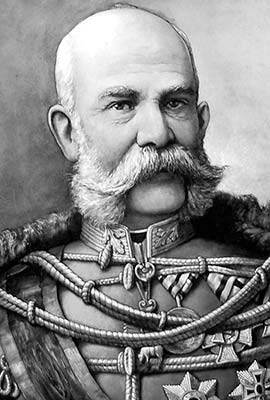
Franz Josef was very conservative. But worse, he wrongly believed that he was a talented military tactician, leading Austria into catastrophic battles against Italy (which was fighting for its unification and independence) in the 1860s. As his army endured severe, avoidable casualties, it became clear: Franz Josef was a disaster as a general.
Wearing his uniform to the end, Franz Josef never saw what a dinosaur his monarchy was becoming, and never thought it strange that the majority of his subjects didn’t even speak German. Franz Josef had no interest in democracy and pointedly never set foot in Austria’s parliament building. Like his contemporary Queen Victoria, he was a microcosm of his empire—old-fashioned and sacrosanct. His passion for low-grade paperwork earned him the nickname “Joe Bureaucrat.” Mired in these petty details, he missed the big picture. In 1914, he helped start a Great War that ultimately ended the age of monarchs. The year 1918 marked the end of Europe’s big royal families: Hohenzollerns (Prussia), Romanovs (Russia), and Habsburgs (Austria).
Emperor Franz Josef’s Study
This room evokes how seriously the emperor took his responsibilities as the top official of a vast empire. Famously energetic, Franz Josef lived a spartan life dedicated to duty. The desk was originally positioned in such a way that Franz Josef could look up from his work and see the portrait of his lovely, long-haired, tiny-waisted Empress Elisabeth reflected in the mirror. Notice the trompe l’oeil paintings above each door, giving the believable illusion of marble relief. Notice also all the family photos—the perfect gift for the dad/uncle/hubby who has it all.
The walls between the rooms are wide enough to hide servants’ corridors (the hidden door to his valet’s room is in the back-left corner). The emperor lived with a personal staff of 14: “three valets, four lackeys, two doormen, two manservants, and three chambermaids.”
Emperor’s Bedroom
Franz Josef famously slept on this no-frills iron bed and used the portable washstand until 1880 (when the palace got running water). He typically rose before dawn and started his day in prayer, kneeling at the prayer stool against the far wall. After all, he was a “Divine Right” ruler. While he had a typical emperor’s share of mistresses, his dresser was always well-stocked with photos of Sisi, even after their estrangement. An etching shows the empress (dressed in black after the 1889 suicide of her son)—a fine rider and avid hunter—sitting sidesaddle while jumping a hedge.
Large Salon
This red-walled room was for royal family gatherings and went unused after Sisi’s death. The big, ornate stove in the corner was fed from behind (this remained a standard form of heating through the 19th century).
Small Salon
This room is dedicated to the memory of Franz Josef’s brother (see the portrait with the weird beard), the Emperor Maximilian I of Mexico, who was overthrown and executed in 1867. It was also a smoking room. This was a necessity in the early 19th century, when smoking was newly fashionable for men, and was never done in the presence of women.
After the birth of their last child in 1868, Franz Josef and Sisi began to drift further apart. Left of the door is a small button the emperor had to buzz before entering his estranged wife’s quarters. You, however, can go right in.
• Enter Sisi’s wing.
Empress’ Rooms
Empress’ Bedroom and Drawing Room
This was Sisi’s room, refurbished in the Neo-Rococo style in 1854. The room always had lots of fresh flowers. Sisi not only slept here, but also lived here—the bed was rolled in and out daily—until her death in 1898. The desk is where she sat and wrote her letters and sad poems.
Empress’ Dressing/Exercise Room
Servants worked three hours a day on Sisi’s famous hair, while she passed the time reading and learning Hungarian. She’d exercise on the wooden structure and on the rings suspended from the doorway to the left. Afterward, she’d get a massage on the red-covered bed. You can psychoanalyze Sisi from the portraits and photos she chose to hang on her walls. They’re mostly her favorite dogs, her Bavarian family, and several portraits of the romantic and anti-monarchist poet Heinrich Heine. Her infatuation with the liberal Heine, whose family was Jewish, caused a stir in royal circles.
Empress’ Lavatory and Bathroom
Detour into the behind-the-scenes palace. In the narrow passageway, you’ll walk by Sisi’s hand-painted porcelain, dolphin-head WC (on the right). The big tank left of the tub warmed her towels. In the main bathroom, you’ll see her huge copper tub (with the original wall coverings behind it), where servants washed her hair. Sisi was the first Habsburg to have running water in her bathroom (notice the hot and cold faucets). Beneath the carpet you’re walking on is the first linoleum ever used in Vienna (c. 1880). As you leave, notice a bit of the faded original wallpaper behind protective glass.
Servants’ Quarters (Bergl Rooms)
Next, enter the servants’ quarters, with hand-painted tropical scenes. Take time to enjoy the playful details. Painted by Johann Bergl in the 1770s, these date from the reign of Maria Theresa, a century before the decor you’ve seen up to this point. As you leave these rooms and reenter the imperial world, look back (through an open door) to the room on the left.
Empress’ Large Salon
The room is painted with Mediterranean escapes, the 19th-century equivalent of travel posters. Franz Josef and Sisi would—on their good days—share breakfast in this room.
Small Salon
The portrait is of Crown Prince Rudolf, Franz Josef’s and Sisi’s only son. On the morning of January 30, 1889, the 30-year-old Rudolf and a beautiful baroness were found shot dead in his hunting lodge in Mayerling. An investigation never came up with a complete explanation, but Rudolf had obviously been cheating on his wife, and the affair ended in an apparent murder-suicide. The scandal shocked the empire and tainted the Habsburgs; Sisi retreated further into her fantasy world, and Franz Josef carried on stoically with a broken heart. The mysterious “Mayerling Affair” has been dramatized in numerous movies, plays, an opera, and even a ballet.
• Leaving Sisi’s wing, turn the corner into the white-and-gold rooms occupied by the czar of Russia during the 1814-1815 Congress of Vienna. Sisi and Franz Josef used the rooms for formal occasions and public functions.
Alexander Apartments
In these apartments—named for the tapestries of Alexander the Great that once adorned the walls—empress Sisi would host dinners and receptions for her guests.
Red Salon
The Gobelin wall hangings (one of the four is an original) were a 1776 gift from Marie-Antoinette and Louis XVI in Paris to their Viennese counterparts.
Dining Room
It’s dinnertime, and Franz Josef has called his extended family together. The settings are modest...just silver. Gold was saved for formal state dinners. Next to each name card was a menu listing the chef responsible for each dish. (Talk about pressure.) While the Hofburg had tableware for 4,000, feeding 3,000 was a typical day. The cellar was stocked with 60,000 bottles of wine. The kitchen was huge—50 birds could be roasted at once on the hand-turned spits.
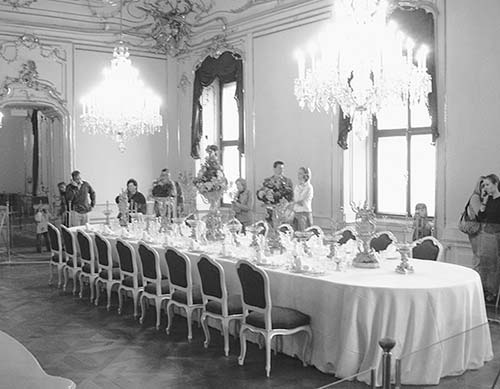
The emperor sat in the center of the long table. “Ladies and gentlemen” alternated in the seating. The green glasses were specifically for Rhenish wine (dry whites from the Rhine valley). Franz Josef enforced strict protocol at mealtime: No one could speak without being spoken to by the emperor, and no one could eat after he was done. While the rest of Europe was growing democracy and expanding personal freedoms, the Habsburgs preserved their ossified worldview to the bitter end.
In 1918, World War I ended, Austria was created as a modern nation-state, the Habsburgs were tossed out...and Hofburg Palace was destined to become the museum you’ve just toured.
• Drop off your audioguide, zip through the shop, go down the stairs, and you’re back on the street. Two quick lefts take you back to the palace square (In der Burg), where the Treasury awaits just past the black, red, and gold gate on the far side (see the next chapter).