VIENNA CITY WALK
11 Graben
14 Loos’ Loos
15 Kohlmarkt
Vienna, one of Europe’s grandest cities of the past, is also a vibrant city of today. Here in Vienna’s urban core, where old meets new, you’ll get the lay of the land as you stroll between the city’s three most important landmarks: the opera house, St. Stephen’s Cathedral, and the Hofburg Palace. Along the way, we’ll drop into some of the smaller sights that help make this city so intriguing: the poignant monuments that subtly cobble together this proud nation’s often-illustrious, sometimes-tragic history; the genteel stores, cafés, and pastry shops where the Viennese continually perfect their knack for fine living; the unassuming churches where the remains of the Habsburg monarchs are entombed; and the defiantly stern architectural styles that emerged to counteract all that frilly Habsburg excess. Use this walk as a springboard for exploring this fine city—and, along the way, get an overview of Vienna’s past and present.
Orientation
Length of This Walk: Allow one hour for the walk itself, more time if you plan to stop at any major sights along the way.
When to Go: This walk works just as well in the evening as it does during the day, as long as you don’t plan on touring some of the sights you’ll pass.
Opera House: A visit is possible only with a guided tour—€13, schedule varies, but generally more tours in the afternoon and in July-Aug (fewer tours Sept-June).
Albertina Museum: €17.90, daily 10:00-18:00, Wed and Fri until 21:00.
Kaisergruft: €8, daily 10:00-18:00.
St. Stephen’s Cathedral: Church foyer and north aisle—free, daily 6:00-22:00; main nave—€6, includes audioguide, Mon-Sat 9:00-11:30 & 13:00-16:30, Sun 13:00-16:30, July-Aug until 17:30. The cathedral’s towers and catacombs have varying costs and hours—see the St. Stephen’s Cathedral Tour chapter for specifics.
St. Peter’s Church: Free; Mon-Fri 8:00-19:00, Sat-Sun from 9:00; free organ concerts daily at 15:00.
St. Michael’s Church Crypt: €8 for mandatory 45-minute tour, tours run Fri-Sat only and may only be in German.
Hofburg Imperial Apartments: €16, covered by Sisi Ticket, daily 9:00-17:30, July-Aug until 18:00, last entry one hour before closing.
Hofburg Treasury: €14, €24 combo-ticket with Kunsthistorisches Museum, Wed-Mon 9:00-17:30, closed Tue.
Tours:  Download my free Vienna City Walk audio tour. For efficiency, you can splice my St. Stephen’s Cathedral audio tour (see next chapter) into this walk.
Starring: Vienna’s “big three” (opera house, cathedral, palace), plus an array of sights, squares, and shops tucked between them.
The Walk Begins
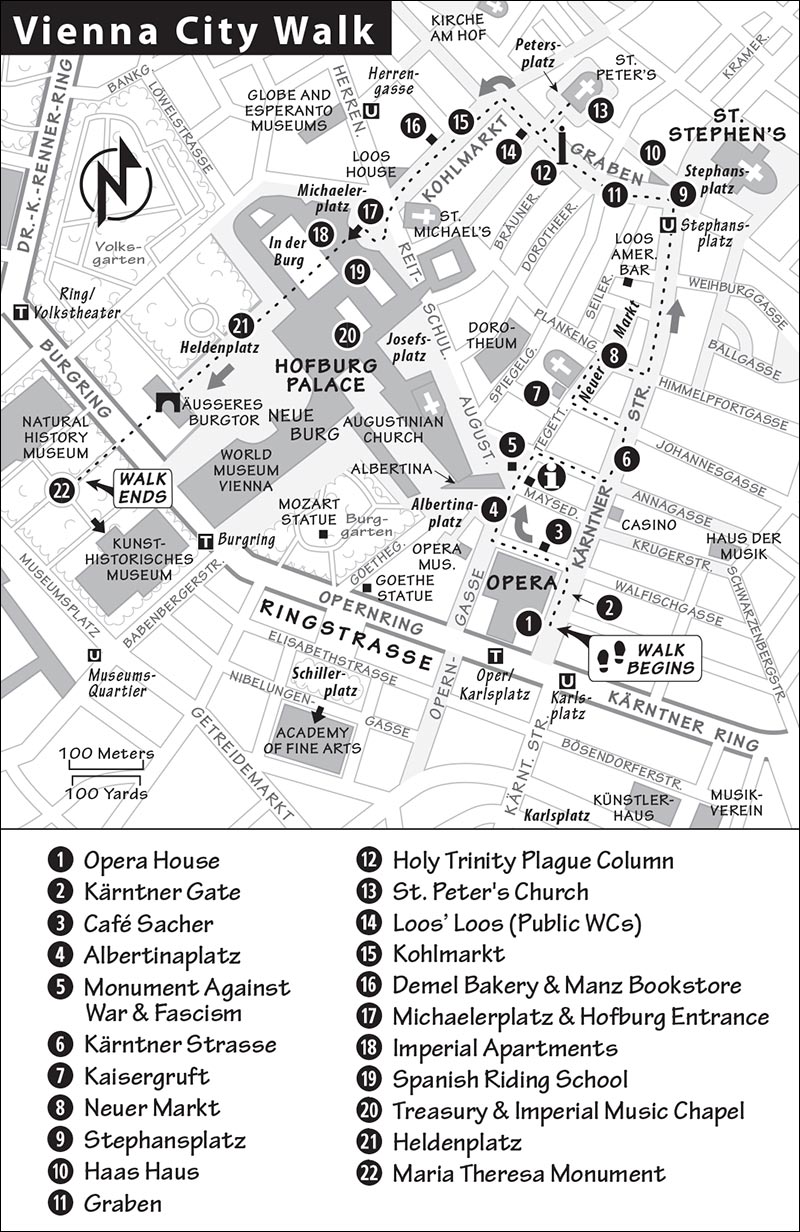
• Begin at the square outside Vienna’s landmark opera house, home of the Vienna State Opera. (The entrance faces the Ringstrasse; we’re starting at the busy pedestrian square that’s to the right of the entrance as you’re facing it.)
1 Opera House
If Vienna is the world capital of classical music, this building is its throne room, one of the planet’s premier houses of music. It’s typical of Vienna’s 19th-century buildings in that it features a revival style—Neo-Renaissance—with arched windows, half-columns, and the sloping, copper mansard roof typical of French Renaissance châteaux (see sidebar on here).
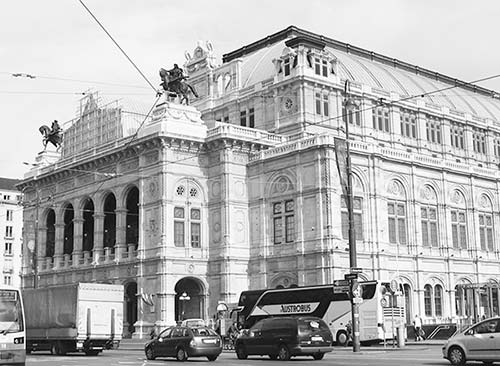
Since the structure was built in 1869, almost all of the opera world’s luminaries have passed through here. Its former musical directors include Gustav Mahler, Herbert von Karajan, and Richard Strauss. Luciano Pavarotti, Maria Callas, Placido Domingo, and many other greats have sung from its stage.
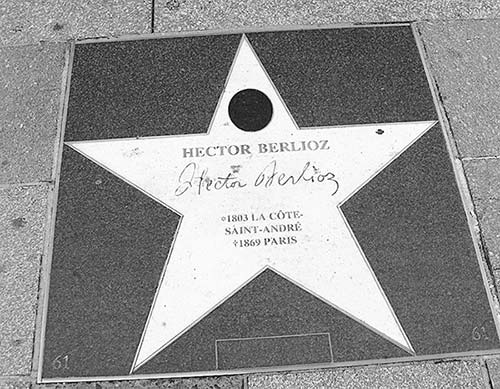
In the pavement along the side of the opera house (and all along Kärntner Strasse, the bustling shopping street we’ll visit shortly), you’ll find plaques forming a Hollywood-style walk of fame. These represent the stars of classical music—famous composers, singers, musicians, and conductors. Look up at the building. During opera season, you’ll notice the giant outdoor screen that shows some live performances (as noted in the posted schedules and on the screen itself).
If you’re a fan, take a guided tour of the opera (see here). Or consider an evening performance (standing-room tickets are surprisingly cheap; see the Entertainment in Vienna chapter). Regular tickets are sold at the opera’s box office on Kärntner Strasse. For information about other entertainment options during your visit, check in at the Wien Ticket kiosk in the booth on this square.
The opera house marks a busy intersection in Vienna, where Kärntner Strasse meets the Ring. The Karlsplatz U-Bahn station in front of the opera is an underground shopping mall with fast food, newsstands, and lots of pickpockets.
• With your back to the Ringstrasse and the opera house on your left, face the busy pedestrian boulevard that leads into the center of town.
2 Kärntner Gate
Even though the center of town sits on an irregular medieval street plan, you’ll notice the parallel rows of more modern, uniform buildings in front of you. These were built where the city wall once stood. The opera’s lower stage is where the old moat used to be—outside the walls. This was a main gate, through which a road led to the Kärnten (Carinthia) region of southern Austria.
Notice the pedestrian signals and how they feature both gay and straight couples. Vienna’s Green Party is part of the city’s current ruling coalition and they like to remind the world that, while Austria’s national government is more conservative (reflecting the fears and concerns of rural and small-town voters), Vienna celebrates diversity.
• Walk behind the opera and across the street toward the dark-red awning to find the famous...
3 Café Sacher
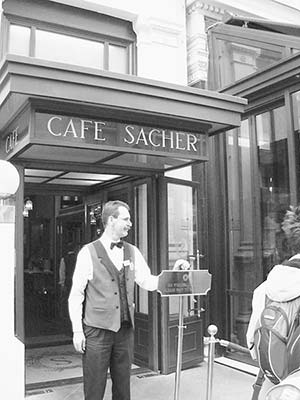
This is the home of the world’s classiest chocolate cake, the Sacher torte: two layers of cake separated by apricot jam and covered in dark-chocolate icing, usually served with whipped cream. It was invented in a fit of improvisation in 1832 by Franz Sacher, dessert chef to Prince Metternich (the mastermind diplomat who redrew the map of post-Napoleonic Europe). The cake became world famous when the inventor’s son served it next door at his hotel (you may have noticed the fancy door attendants). Look through the windows for a peek at 19th-century elegance. Many locals complain that the cakes here have gone downhill, and some tourists are surprised by how dry they are—you really need that dollop of Schlagobers.
For a more genuine serving of 19th-century Viennese elegance, have your coffee and cake at the recommended Gerstner Café (facing the opera, back on Kärntner Strasse at #51). Enter under the green awnings, climb to the third level, and spend a little time back in the 1860s.
• Continue past Hotel Sacher. On a corner (to the right) at the end of the street, the Vienna TI has a handy ticket desk for concerts. And dead ahead is a small, triangular, cobbled square adorned with memorial sculptures.
4 Albertinaplatz
Overlooking the square, the tan-and-white Neoclassical building marks the tip of the Hofburg Palace—the sprawling complex of buildings that was long the seat of Habsburg power (we’ll end this walk at the palace’s center). The balustraded terrace up top was originally part of Vienna’s defensive rampart. Later, it was the balcony of Empress Maria Theresa’s daughter Maria Christina, who lived at this end of the palace. Today, her home houses the Albertina Museum, topped by a sleek, controversial titanium canopy (called the “diving board” by critics). The museum’s plush, 19th-century state rooms are the only Neoclassical (post-Rococo) palace rooms anywhere in the Habsburg realm. And the Batliner Collection of modernist paintings (Monet to Picasso) is a delight (see here).
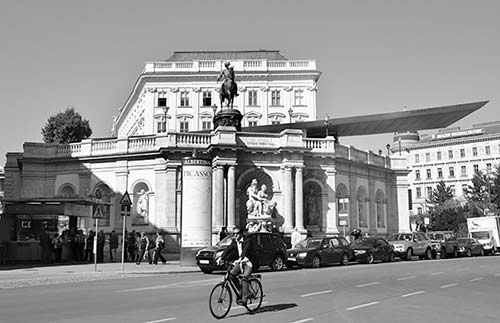
High above (just left of the “diving board”), a statue of Archduke Albrecht looks down on the city. A symbol of Habsburg oppression, he brutally suppressed popular uprisings in Vienna and Italy in the mid-1800s.
At street level is a grand fountain of Danubius, the Danube River god, flanked by six little gods. Each represents a major tributary that feeds the Danube as it flows through Austria.
The hotdog stand to the left of Danubius is known for its quality local sausages. This is the operagoers’ hangout...they gather here in their fine ballgowns and tuxedos enjoying some of the best of Vienna’s beloved wurst. By the way, this is the only sausage stand in town that sells champagne by the glass. And that bunny on the rooftop? It’s a reminder that the famous Albrecht Dürer watercolor Hare is in the adjacent Albertina Museum.
Albertinaplatz itself is filled with sculptures that make up the powerful, thought-provoking 5 Monument Against War and Fascism, which commemorates the dark years when Austria came under Nazi rule (1938-1945).
The memorial has four parts. The split white monument, The Gates of Violence, remembers victims of all wars and violence. Standing directly in front of it, you’re at the gates of a concentration camp. Then, as you explore the statues, you step into a montage of wartime images: clubs and WWI gas masks, a dying woman birthing a future soldier, victims of cruel medical experimentation, and chained slave laborers sitting on a pedestal of granite cut from the infamous quarry at the former concentration camp at Mauthausen (see the Danube Valley chapter). The hunched-over figure on the ground behind is a Jew forced to scrub anti-Nazi graffiti off a street with a brush. Of Vienna’s 200,000 Jews, more than 65,000 died in Nazi concentration camps. The sculpture with its head buried in the stone is Orpheus entering the underworld, meant to remind Austrians (and the rest of us) of the victims of Nazism...and the consequences of not keeping our governments on track. Behind that, the 1945 declaration that established Austria’s second republic—and enshrined human rights—is cut into the stone.
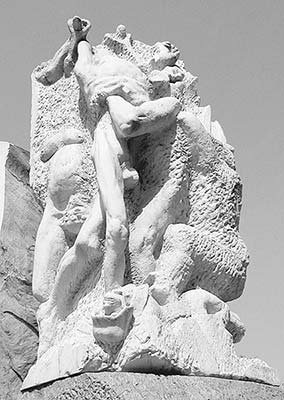
Viewing this monument gains even more emotional impact when you realize what happened on this spot: During a WWII bombing attack, several hundred people were buried alive when the cellar they were using as shelter was demolished.
Austria was led into World War II by Germany, which annexed the country in 1938 with disturbingly little resistance, saying Austrians were wannabe Germans anyway. But Austrians are not Germans (this makes for an interesting topic of conversation with Austrians you may meet). They’re proud to tell you that Austria was founded in the 10th century, whereas Germany wasn’t born until 1870. For seven years just before and during World War II (1938-1945), there was no Austria. In 1955, after 10 years of joint occupation by the victorious Allies, Austria regained total independence on the condition that it would be forever neutral (and never join NATO or the Warsaw Pact). To this day, Austria is outside of NATO (and Germany).
Behind the monument is Café Tirolerhof, a classic Viennese café. Refreshingly air-conditioned, it’s full of things that time has passed by: chandeliers, marble tables, upholstered booths, formally dressed servers, and newspapers. (For more on Vienna’s cafés, see here.)
• From the café, turn right on Führichsgasse. Walk one block until you hit...
6 Kärntner Strasse
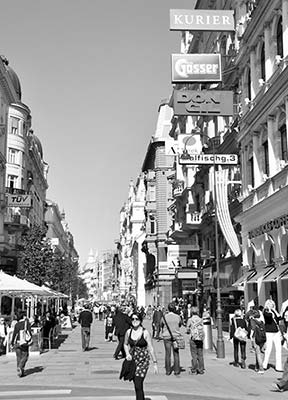
This grand, traffic-free street is the people-watching delight of this in-love-with-life city. Today’s Kärntner Strasse (KAYRNT-ner SHTRAH-seh) is mostly a crass commercial pedestrian mall—its famed elegant shops long gone. But locals know it’s the same road Crusaders marched down as they headed off from St. Stephen’s Cathedral for the Holy Land in the 12th century. Today it’s full of shoppers.
Where Führichsgasse meets Kärntner Strasse, note the old Grundemann Esterházy Palace—now a Casino (across the street and to your right, at #41)—once elegant, now tacky, it exemplifies the worst of the street’s evolution. Turn left to head up Kärntner Strasse, going away from the opera house. As you walk, be sure to look up, above the modern storefronts, for glimpses of the street’s former glory.
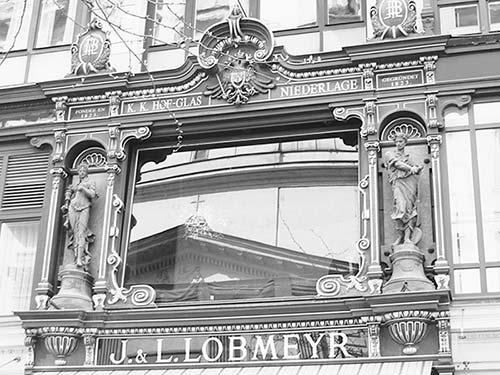
Local shops can’t compete with international chains, considering the high rent here. But one venerable shop that has survived is near the end of the block, on the left at #26: J & L Lobmeyr Crystal (“Founded in 1823”) still has its impressive brown storefront with gold trim, statues, and the Habsburg double eagle. In the market for some $400 napkin rings? Lobmeyr’s your place. Inside, breathe in the classic Old World ambience as you peruse the wares and visit the glass museum (free entry; ground floor—glasses and chandeliers, first floor—silver and Murano glass, second floor—museum; closed Sun).
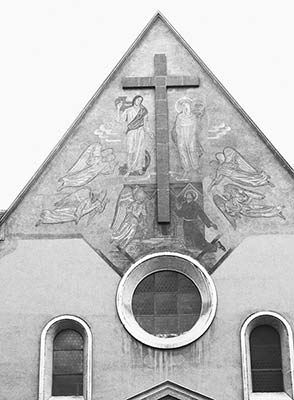
• At the end of the block, turn left on Marco d’Aviano Gasse (passing the fragrant flower stall) to make a short detour to the square called Neuer Markt. Straight ahead is an orange-ish church with a triangular roof and cross, the Capuchin Church. In its basement is the...
7 Kaisergruft
Under the church sits the Imperial Crypt, filled with what’s left of Austria’s emperors, empresses, and other Habsburg royalty. For centuries, Vienna was the heart of a vast empire ruled by the Habsburg family, and here is where they lie buried in their fancy pewter coffins. You’ll find all the Habsburg greats, including Maria Theresa, her son Josef II (Mozart’s patron), Franz Josef, and Empress Sisi. Before moving on, consider paying your respects here (see here).
• Stretching north from the Kaisergruft is the square called...
8 Neuer Markt
Survey the architecture lining this square—a good mix, from 1700s to post World War II. You can tell which buildings replaced bombed-out ones. This square was once congested with parked cars, but a new-in-2022 underground garage turned Neuer Markt into the people-friendly space it is today.
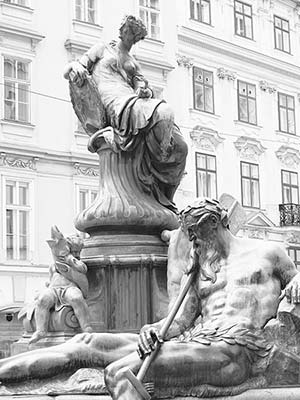
A block farther down, in the center of Neuer Markt, is the four rivers fountain showing Lady Providence surrounded by figures symbolizing the rivers that flow into the Danube. The sexy statues offended Empress Maria Theresa, who actually organized “Chastity Commissions” to defend her capital city’s moral standards.
• Return to Kärntner Strasse. Before you head back to the busy shopping street, you could stop for a sweet treat and enjoy a nice outdoor table at the heavenly, recommended Kurkonditorei Oberlaa (at the far-left corner of the square).
Leave the square and return to Kärntner Strasse, where you’ll turn left. Continuing down Kärntner Strasse, you’ll find lots of shops filled with merchandise to entice tourists. The Gustav Klimt “exhibition” across the street (opposite Kupferschmiedgasse), while not an exhibition, is fun for Klimt fans. At #6 (a block farther along, on the left) is the Austrian Workshop (Österreichische Werkstätten). Calling itself “the right place for Austrian design,” it shows off traditional, locally made gifts (with an elegant-yet-simple Arts and Crafts Movement sensibility) and has more exhibits upstairs.
As you approach St. Stephen’s Cathedral, you’re likely to first see it as a reflection in the round-glass windows of the postmodern Haas Haus. The traditional Aida Cafeteria (left) is a favorite for sitting over a coffee or pastry and people-watching. Pass the U-Bahn station (which has WCs) where the street spills into Vienna’s main square...
9 Stephansplatz
The cathedral’s frilly spire looms overhead, worshippers and tourists pour inside the church, and shoppers buzz around the outside. You’re at the center of Vienna.
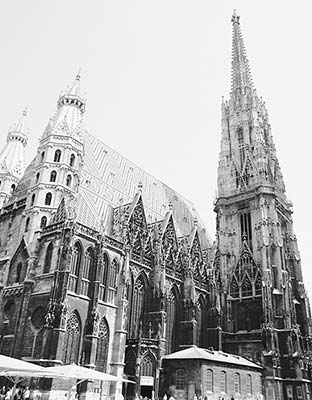
The Gothic St. Stephen’s Cathedral (c. 1300-1450) is known for its 450-foot south tower; its colorful, patterned roof; and its place in Viennese history. When it was built, it was a huge church for what was then a small town, and it helped put the fledgling city on the map. At this point, you may want to take a break from this walk to tour the church ( see the St. Stephen’s Cathedral Tour chapter or download my audio tour).
Where Kärntner Strasse hits Stephansplatz, the grand, soot-covered building with red columns is the Equitable Building (filled with lawyers, bankers, and insurance brokers). It’s a fine example of Neoclassicism from the turn of the 20th century—look up and imagine how slick Vienna must have felt in 1900.
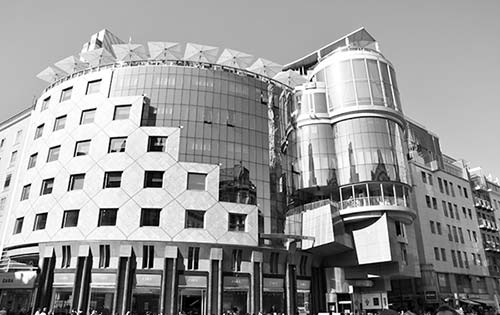
Facing St. Stephen’s is the sleek concrete-and-glass 10 Haas Haus, a postmodern building by noted Austrian architect Hans Hollein (finished in 1990). The curved facade is supposed to echo the Roman fortress of Vindobona (its ruins were found near here). Although the Viennese initially protested having this stark modern tower right next to their beloved cathedral, since then, it’s become a fixture of Vienna’s main square. Notice how the smooth, rounded glass reflects St. Stephen’s pointy architecture, providing a great photo opportunity—especially at twilight. The café and pricey restaurant on the rooftop offer a nice perch, complete with a view of Stephansplatz below—though not necessarily of the cathedral (take the elevator up to the sixth floor, which has a glassed-in lounge; walk up one flight to reach the rooftop terrace and restaurant).
• Exit the square with your back to the cathedral. Walk past the Haas Haus, and bear right down the street called the...
11 Graben
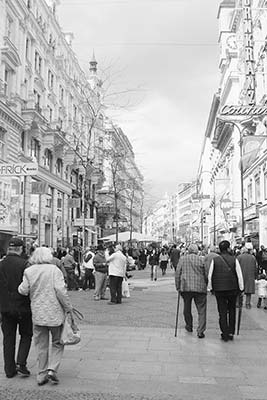
This was once a Graben, or ditch—originally the moat for the Roman military camp. Back during Vienna’s 19th-century heyday, more than 200,000 people were packed into the city’s inner center (inside the Ringstrasse), walking on dirt streets. Today this area houses 20,000. The Graben was a busy street with three lanes of traffic until the 1970s, when the city inaugurated its new subway system and the street was turned into one of Europe’s first pedestrian-only zones. Take a moment to enjoy a slow 360-degree spin tour. Absorb the scene—you’re standing in an area surrounded by history, postwar rebuilding, grand architecture, fine cafés, and people enjoying life...for me, quintessential Europe.
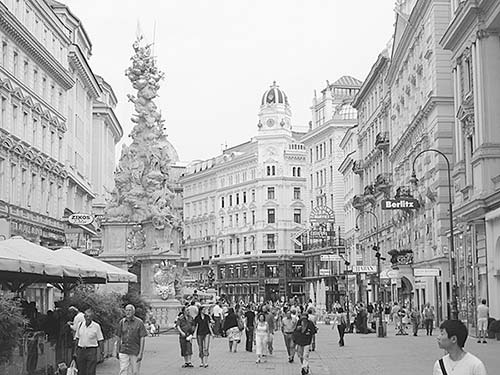
As you stroll down the Graben from Stephansplatz, after about 50 yards, you’ll reach a modern water dispenser. A changing climate means fiercely hot summers in Vienna, leading the city government to install watering stations and shady benches for its citizens and visitors.
In another 50 yards, you reach Dorotheergasse, on your left, which leads (after two more long blocks) to the Dorotheum auction house. Consider poking your nose in here later for some fancy window shopping (see here). Also along this street are two recommended eateries: the sandwich shop Trześniewski—one of my favorite places for lunch—and the classic Café Hawelka.
In the middle of the Graben pedestrian zone is the extravagantly blobby 12 Holy Trinity plague column (Pestsäule). The 60-foot pillar of clouds sprouts angels and cherubs, with the wonderfully gilded Father, Son, and Holy Ghost at the top (all protected by an anti-pigeon net).
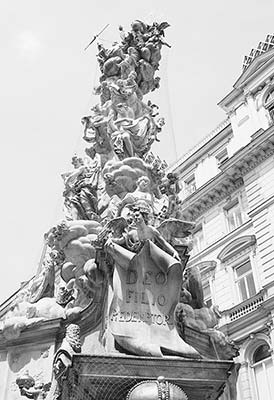
In 1679, Vienna was hit by a massive epidemic of bubonic plague. Around 75,000 Viennese died—about a third of the city. Emperor Leopold I dropped to his knees (something emperors never did in public) and begged God to save the city. (Find Leopold about a quarter of the way up the monument, just above the brown banner. Hint: The typical inbreeding of royal families left him with a gaping underbite.) His prayer was heard by Lady Faith (the statue below Leopold, carrying a cross). With the help of a heartless little cupid, she tosses an old naked woman—symbolizing the plague—into the abyss and saves the city. In gratitude, Leopold vowed to erect this monument, which became a model for cities throughout the empire that were ravaged by the same plague. (The three golden banners represent the core of that empire: Austria, Hungary, and Bohemia.)
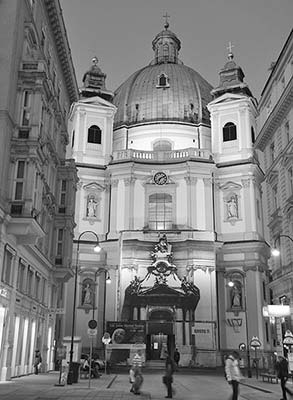
• Thirty yards past the plague monument, look down the short street to the right, which frames a Baroque church with a stately green dome.
13 St. Peter’s Church
Leopold I ordered this church to be built as a thank-you for surviving the 1679 plague. The church stands on the site of a much older church that may have been Vienna’s first (or second) Christian church. Inside, St. Peter’s shows Vienna at its Baroque best (for a description, see here). Note that the church offers free organ concerts (daily at 15:00, advertised at the entry).
• Continue west on the Graben, where you’ll immediately find some stairs leading underground to...
14 Loos’ Loos
In about 1900, a local chemical maker needed a publicity stunt to prove that his chemicals really got things clean. He purchased two wine cellars under the Graben and had them turned into classy WCs in the Modernist style (designed by Adolf Loos—see sidebar), complete with chandeliers and finely crafted mahogany. While the chandeliers are gone, the restrooms remain a relatively appealing place to do your business. (In the men’s room, the urinals survive but are enjoying a peaceful retirement behind protective glass.) Locals and tourists happily pay €0.50 for a quick visit.
• The Graben dead-ends at the aristocratic supermarket Julius Meinl am Graben. From here, you could turn right into Vienna’s “golden corner,” with the city’s finest shops. But we’ll turn left. In the distance is the big green-and-gold dome of the Hofburg, where we’ll head soon. The street leading up to the Hofburg is...
“Decoration is a crime,” wrote Adolf Loos, the turn-of-the-20th-century architect who was Vienna’s answer to Frank Lloyd Wright. Foreshadowing the Modernist style of “less is more” and “form follows function,” Loos stripped buildings down to their structural skeletons.
In his day, most buildings were plastered with fake Greek columns, frosted with Baroque balustrades, and studded with statues. Even the newer buildings featured flowery Art Nouveau additions. Loos’ sparse, geometrical style stood out at the time—and it still does more than a century later. Loos was convinced that unnecessary ornamentation was a waste of workers’ valuable time and energy, and was a symbol of an unevolved society. (He even went so far as to compare decoration on a facade with a lavatory wall smeared with excrement.) On this walk, you’ll pass several examples of his work:
Loos American Bar: Built in 1908, the same year that Loos published his famous essay “Ornament and Crime,” this tiny bar features Loos’ specialties—and fine cocktails. The facade is cubical, with square columns and crossbeams (and no flowery capitals). The interior is elegant and understated, with rich marble and mirrors that appear to expand the small space. As they have little patience with gawkers, the best way to admire the interior is to sit down and order a drink (a half-block off Kärntner Strasse, on the left just before Stephansplatz at Kärntner Durchgang 10, see “Vienna City Walk” map).
Public WCs on Graben: These are some of the classiest bathrooms in town (see stop #14).
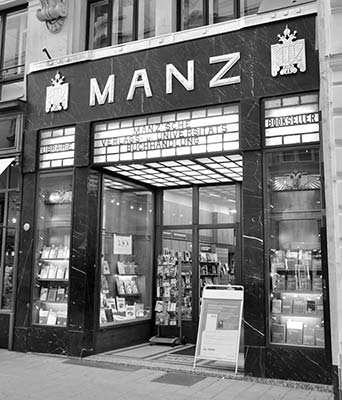
Manz Bookstore: The facade is a perfect cube, divided into other simple, rectangular shapes (next to Demel chocolate shop, described later in this chapter).
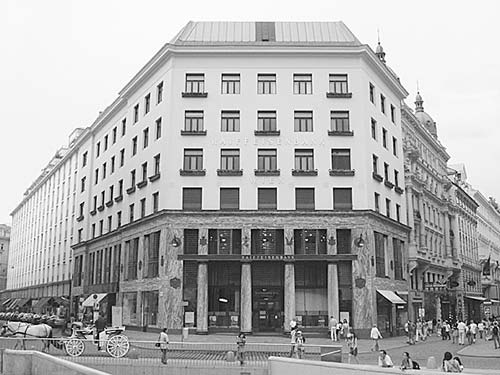
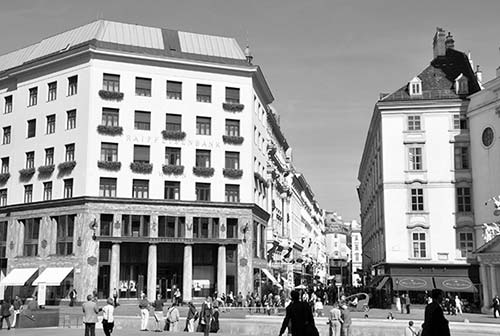
Loos House on Michaelerplatz: This boldly stripped-down facade (pictured above) peers defiantly across the square at the over-the-top Hofburg. Compare this former bank building with the Hofburg’s ornate, Neo-Baroque look (done only a few decades earlier) to see how revolutionary Loos was (see the “Michaelerplatz: Where New Faces Down Old” sidebar, later).
Loos Room in the Wien Museum Karlsplatz: The architect’s finely furnished living room is preserved and on display in the city’s history museum on Karlsplatz (may be closed for renovation, check www.wienmuseum.at).
15 Kohlmarkt
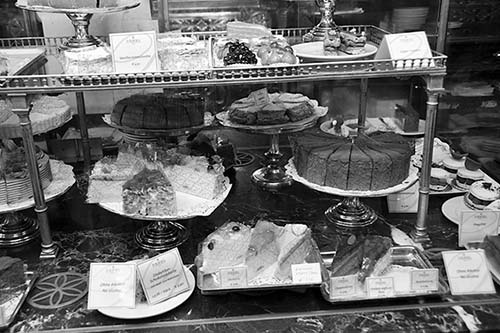
This is Vienna’s most elegant and unaffordable shopping street, lined with Cartier, Armani, Gucci, Tiffany, and the emperor’s palace at the end. Strolling Kohlmarkt, daydream about 16 Demel, the ultimate Viennese chocolate shop (#14, daily 9:00-19:00). While people line up to enjoy their famous café, there’s no wait to walk through the café to the shop in back, where you’ll find a room filled with Art Nouveau boxes of Empress Sisi’s choco-dreams come true: Kandierte Veilchen (candied violet petals), Katzenzungen (cats’ tongues), and so on. The cakes here are moist (compared with the dry Sacher tortes). Shops like this boast “K.u.K.”—signifying that during the Habsburgs’ heyday, it was patronized by the König und Kaiser (king and emperor—same guy).
Next to Demel, the Manz Bookstore has a Loos-designed facade (see the “Adolf Loos” sidebar).
• Kohlmarkt ends at the square called...
17 Michaelerplatz
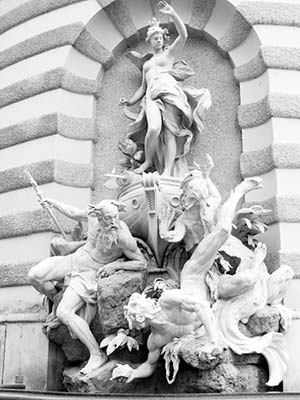
This square is dominated by the Hofburg Palace. Study the grand Neo-Baroque facade, dating from about 1900. The four heroic giants illustrate Hercules wrestling with his great challenges (Emperor Franz Josef, who commissioned the gate, felt he could relate). The facade’s Hercules statues remind mere mortals to stay in their place.
In the center of this square, a scant bit of Roman Vienna lies exposed just beneath street level.
Michaelerplatz Spin Tour: Do a slow, clockwise pan to get your bearings, starting (over your left shoulder as you face the Hofburg) with St. Michael’s Church, which offers fascinating tours of its crypt (see here). To the right of that is the fancy Loden-Plankl shop, with traditional Austrian formalwear, including dirndls. Farther to the right, across Augustinerstrasse, is the wing of the palace that houses the Spanish Riding School and its famous white Lipizzaner stallions. Farther down this street lies Josefsplatz, with the Augustinian Church (see here), and the Dorotheum auction house. At the end of the street are Albertinaplatz and the opera house (where we started this walk).
Continue your spin: Two buildings over from the Hofburg (to the right), the Loos House has a facade featuring a perfectly geometrical grid of square columns and windows. Compared to the Neo-Baroque facade of the Hofburg, the stern Modernism of the Loos House appears to be from an entirely different age. And yet, both of these—as well as the Eiffel Tower and Mad Ludwig’s fairy-tale Neuschwanstein Castle—were built in the same generation, roughly around 1900. In many ways, this jarring juxtaposition exemplifies the architectural turmoil of the turn of the 20th century and represents the passing of the torch from Europe’s age of divine monarchs to the modern era (see sidebar).
By the way, you may see some of Vienna’s iconic horse-and-buggies (Fiaker) lined up on this square. Imagine the clip-clop soundtrack of thousands of these buggies providing chauffeur and taxi services to the wealthy of Vienna in the 19th century. Poor people likely never sat in one. But affordable public transit was on the way. Around 1900, Otto Wagner designed modern infrastructure with public transportation for Vienna. Emperor Franz Josef got his own train service to the Schönbrunn. He rode it just once...then never again, as he preferred horse-and-buggy. It’s another example of an imperial ruler refusing to embrace the modern world.
• Let’s take a look at where Austria’s glorious history began—at the...
Hofburg Imperial Palace
This is the complex of palaces where the Habsburg emperors lived out their lives (except in summer, when they resided at Schönbrunn Palace). Enter the Hofburg through the gate, where you immediately find yourself beneath a big rotunda (the netting is there to keep birds from perching). The doorway on the right is the entrance to the 18 Imperial Apartments, where the Habsburg emperors once lived in chandeliered elegance. Today you can tour its lavish rooms, as well as a museum about Empress Sisi, and a porcelain and silver collection ( see the Hofburg Imperial Apartments Tour chapter). To the left is the ticket office for the 19 Spanish Riding School (see here).
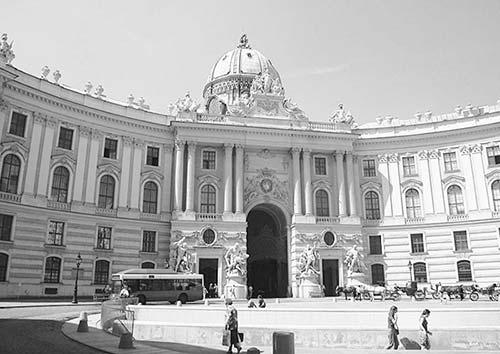
It’s fascinating to think of Michaelerplatz as the architectural embodiment of a fundamental showdown that took place at the dawn of the 20th century, between the old and the new.
Emperor Franz Josef came to power during the popular revolution year of 1848 (as an 18-year-old, he was locked in his palace for safety). Once in power, he saw that the real threat to him was not from without, but from within. He dismantled the city wall and moved his army’s barracks to the center of the city. But near the end of his reign, the modern world was clearly closing in.
Franz Josef’s Neo-Baroque design for the Hofburg, featuring huge statues of Hercules in action at the gate, represents a desperate last stand of the absolutism of the emperor. Hercules was a favorite of emperors—a prototype of the modern ruler. The only mythical figure that was half-god, Hercules earned this half-divinity with hard labors. Like Hercules, the emperor’s position was a combination of privileged birth and achievement—legitimized both by God and by his own hard work. (Blue bloods throughout Europe favored statues of Hercules for this reason.)
A few decades after Franz Josef erected his celebration of divine right, Loos responded with his starkly different building across the street. Although the Loos House might seem boring today, in its time, this anti-Historicist, anti-Art Nouveau statement was shocking. Inspired by his studies in the US (and by Frank Lloyd Wright), Loos designed what was considered to be Vienna’s first “modern” building, with a trapezoidal footprint that makes no attempt to hide the awkwardly shaped street corner it stands on. Windows lack the customary cornice framing the top—a “house without eyebrows.”
And so, from his front door, the emperor had to look at the modern world staring him rudely in the face, sneering, “Divine power is B.S. and your time is past.” The emperor was angered by the bank building’s lack of decor. Loos relented only slightly by putting up the 10 flower boxes (or “mustaches”) beneath the windows.
But a few flowers couldn’t disguise the notion that the divine monarchy was beginning to share Vienna with new ideas. As Loos worked, Stalin, Hitler, Trotsky, and Freud were all rattling about Vienna. Women were smoking and riding bikes. It was a scary time...a time ripe with change. And, of course, by 1918, after the Great War, the Habsburgs and the rest of Europe’s autocratic imperial families were history.
Continuing on, you emerge from the rotunda into the main courtyard of the Hofburg, called In der Burg. The Caesar-like statue is of Habsburg Emperor Franz II (1768-1835), grandson of Maria Theresa, grandfather of Franz Josef, and father-in-law of Napoleon. Behind him is a tower with three kinds of clocks (the yellow disc shows the phase of the moon tonight). To the right of Franz are the Imperial Apartments, and to the left are the offices of Austria’s mostly ceremonial president (the more powerful chancellor lives in a building just behind this courtyard).
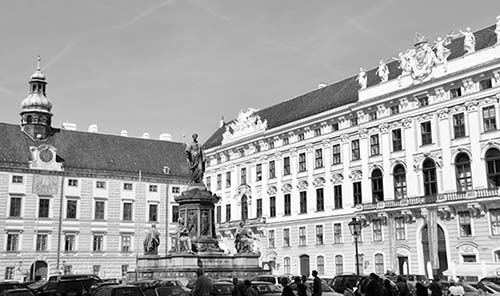
Franz Josef faces the oldest part of the palace. The colorful red, black, and gold gateway (behind you), which used to have a drawbridge, leads over the moat and into the 13th-century Swiss Court (Schweizerhof), named for the Swiss mercenary guards once stationed there. Study the gate. Imagine the drawbridge and the chain. Notice the Habsburg coat of arms with the imperial eagle above and the Renaissance painting on the ceiling of the passageway.
As you enter the Gothic courtyard, you’re passing into the historic core of the palace, the site of the first fortress, and, historically, the place of last refuge. Here you’ll find the 20 Treasury (Schatzkammer; see the Hofburg Treasury Tour chapter) and the Imperial Music Chapel (Hofmusikkapelle; see here), where the Boys’ Choir sings Mass. Ever since Joseph Haydn and Franz Schubert were choirboys here, visitors have gathered like groupies on Sundays to hear the famed choir sing.
Returning to the bigger In der Burg courtyard, face Franz and turn left, passing through the tunnel, with a few tourist shops and restaurants, to spill out into spacious 21 Heldenplatz (Heroes’ Square). On the left is the impressive curved facade of the World Museum Vienna (formerly the New Palace). This vast wing was built in the early 1900s to be the new Habsburg living quarters and was meant to have a matching building facing it. But in 1914, the heir to the throne, Archduke Franz Ferdinand—while waiting politely for his long-lived uncle, Emperor Franz Josef, to die—was assassinated in Sarajevo. The archduke’s death sparked World War I and the eventual end of eight centuries of Habsburg rule.
The World Museum Vienna contains an eclectic collection of ethnography, weaponry, suits of armor, musical instruments, and ancient Greek statues (see here). The two equestrian statues depict Prince Eugene of Savoy (1663-1736), who battled the Ottoman Turks, and Archduke Charles (1771-1847), who battled Napoleon. Eugene gazes toward the far distance at the prickly spires of Vienna’s City Hall.
Heldenplatz Spin Tour: Make a slow 360-degree turn, and imagine this huge square filled with people.
In 1938, 300,000 Viennese gathered here, entirely filling vast Heroes’ Square, to welcome Adolf Hitler and celebrate their annexation with Germany—the Anschluss. The Nazi tyrant stood on the balcony of the then New Palace and declared, “Before the face of German history, I declare my former homeland now a part of the Third Reich. One of the pearls of the Third Reich will be Vienna.” He never said “Austria,” a word that was now forbidden.
When pondering why the Austrians—eyes teary with joy and vigorously waving their Nazi flags—so willingly accepted Hitler’s rule, it’s important to remember that Austria was already a fascist nation. Austrian Chancellor Engelbert Dollfuss, though pro-Catholic, pro-Habsburg, and anti-Hitler, was a dictator who silenced any left-wing opposition. Also, memories of the grand Habsburg Empire were still fresh in the collective psyche. The once vast and mighty empire of 50 million at its 19th-century peak came out of World War I a tiny landlocked land of six million that now suffered terrible unemployment. The opportunistic Hitler promised jobs along with a return to greatness—and the Austrian people gobbled it up.
Standing here, it’s fascinating to consider Austrian aspirations for grandeur. In fact, the Habsburgs envisioned an ancient Rome-inspired Imperial Forum stretching from here across the Ringstrasse.
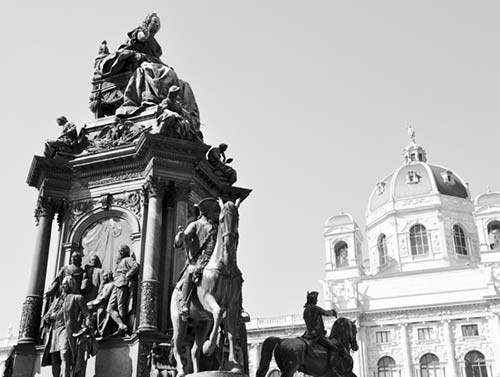
• Walk on through the Greek-columned passageway (the Äusseres Burgtor), cross the Ringstrasse, and stand between the giant Kunsthistorisches and Natural History Museums, built in the 1880s to house the private art and scientific collections of the empire and to celebrate its culture and power. The emperor planned to tie these grand buildings and the palace together with two mighty triumphal arches spanning the Ringstrasse, connecting them into an awe-inspiring ensemble. While the emperor’s vision died with his empire, a huge statue of the powerful empress Maria Theresa stands in the center of it all.
22 Maria Theresa Monument
Vienna’s biggest monument shows the empress (the empire’s only female ruler) holding a scroll from her father granting the right of a woman to inherit his throne. Built in the 1870s, a hundred years after Maria Theresa’s death, the statues and reliefs surrounding her speak volumes about her reign: Her four top generals sit on horseback while her four top advisers stand. Behind them, reliefs celebrate cultural leaders of her day, including little Wolfie Mozart with mentor “Papa” Joseph Haydn (with his hand on Mozart’s shoulder, facing the Natural History Museum). The moral of this propaganda: that a strong military and a wise ruler are prerequisites for a thriving culture—attributes that characterized the 40-year rule of the woman who was perhaps Austria’s greatest monarch.
• Our walk is finished. You’re in the heart of Viennese sightseeing. Surrounding this square are some of the city’s top museums. And the Hofburg Palace itself contains many of Vienna’s best sights and museums. From the opera to the Hofburg, from chocolate to churches, from St. Stephen’s to Sacher tortes—Vienna waits for you.