APPENDIX
Holidays and Festivals
This list includes selected festivals in major cities, plus national holidays observed throughout Austria. Vienna and Salzburg have music festivals nearly every month, and many sights and banks close on national holidays—keep this in mind when planning your itinerary. Before planning a trip around a festival, verify the dates with the festival’s website, TI sites (www.austria.info), or my “Upcoming Holidays and Festivals in Austria” web page at RickSteves.com/europe/austria/festivals.
| Jan/Feb | Fasnacht, western Austria (carnival season, balls, parades) |
| Jan-Feb | Vienna Ball Season (2,000 hours of dancing, www.wien.info, search “Balls Season”); Mozart Week, Salzburg (daily performances) |
| March/April | Osterfestspiele Salzburg and OsterKlang Wien, Salzburg and Vienna (week before Easter, music festivals) |
| March/April | Easter Sunday-Monday (Ostersonntag & Ostermontag): March 31-April 1, 2024; April 20-21, 2025 |
| May 1 | May Day with maypole dances, throughout Austria |
| May | Ascension (Christi Himmelfahrt): May 9, 2024; May 29, 2025 |
| May/June | Pentecost Monday (Pfingstmontag): May 20, 2024; June 9, 2025 |
| May/June | Corpus Christi (Fronleichnam): May 30, 2024; June 19, 2025 |
| May-June | Vienna Festival of Arts and Music (www.festwochen.at) |
| Late June | Danube Island Music Festival, Vienna (three days of free music) |
| Late June | Midsummer Eve celebrations, throughout Austria |
| Mid-July-Aug | Salzburg Festival (www.salzburgerfestspiele.at) |
| Aug 15 | Assumption (Mariä Himmelfahrt), parts of Austria |
| Sept 24 | St. Rupert’s Day, Salzburg (Ruperti-Kirtag; parade and fireworks) |
| Mid-Sept-early Oct | Wiener Wiesn-Fest, Vienna (Oktoberfest celebrations in the Prater); fall beer festivals, throughout Austria and Bavaria |
| Mid-Oct | Salzburg Kulturtage (series of affordable concerts) |
| Oct 26 | Austrian National Day (Nationalfeiertag) |
| Nov 1 | All Saints’ Day (Allerheiligen) |
| Nov 11 | St. Martin’s Day celebrations, Austria and Bavaria |
| Late Nov-Dec | Christmas markets across Austria and Bavaria |
| Dec | Perchtenlaufen, Alpine regions (winter processions) |
| Dec 6 | St. Nicholas Day, throughout Austria (Nikolaustag, parades) |
| Dec 8 | Feast of the Immaculate Conception (Mariä Empfängnis) |
| Dec 24 | Christmas Eve (Heilige Abend; when Austrians celebrate Christmas) |
| Dec 25 | Christmas |
| Dec 26 | St. Stephen’s Day (Stefanitag) |
| Dec 31 | New Year’s Eve (Silvester, a.k.a. Altjahrstag; fireworks throughout Austria, especially in Vienna) |
Books and Films
To learn more about Austria past and present, check out a few of these books or films.
Nonfiction
The Age of Insight (Eric R. Kandel, 2012). Kandel beautifully tells how the Vienna School of Medicine inspired pioneers in science, medicine, and art.
The Austrians: A Thousand-Year Odyssey (Gordon Brook-Shepherd, 2003). This overview of Austrian history focuses on Austria’s political history in the 19th and 20th centuries.
Beethoven: The Music and the Life (Lewis Lockwood, 2005). This biography weaves together the musician’s life in Vienna and his contributions to Viennese culture.
Fin-de-Siècle Vienna: Politics and Culture (Carl E. Schorske, 1981). This is a comprehensive analysis of the birth of modern art and thought through the work of Klimt, Freud, and other Viennese luminaries.
The Habsburgs: The History of a Dynasty (Benjamin Curtis, 2013). This in-depth but never dry volume brings the Habsburgs to life.
The Hare with the Amber Eyes: A Family’s Century of Art and Loss (Edmund de Waal, 2010). De Waal insightfully recounts the rise and fall of his storied family, whose Vienna home, the Palais Ephrussi on the Ringstrasse, was confiscated by the Nazis in the Anschluss.
Hitler’s Vienna: A Dictator’s Apprenticeship (Brigitte Hamann, 1999). This book paints a disturbing portrait of the young Hitler’s formative years in Vienna.
A Nervous Splendor and Thunder at Twilight (Frederic Morton, 1979 and 1983). In these companion volumes, Morton tells the story of the Austro-Hungarian Empire’s last years.
The Spell of the Vienna Woods: Inspiration and Influence from Beethoven to Kafka (Paul Hofmann, 1994). Personal anecdotes, tourist information, and stories about artists who found inspiration in Vienna are blended in this history.
The Story of the Trapp Family Singers (Maria von Trapp, 2001). Maria tells the extraordinary story behind the famous singing family.
Wittgenstein’s Vienna (Allan Janik and Stephen Toulmin, 1973). Janik follows the philosopher Ludwig Wittgenstein as he crafts his ideas in his native city of Vienna.
World of Yesterday (Stefan Zweig, 1942). Zweig recalls living through Vienna’s golden days, World War I, and the Hitler years.
Fiction
Airs Above the Ground (Mary Stewart, 1965). A woman goes to Vienna in search of her missing husband in this classic featuring Lipizzaner stallions and the Austrian Alps.
Brother of Sleep (Robert Schneider, 1992). In an Austrian mountain village in the early 19th century, a musical prodigy goes unappreciated by the locals.
A Death in Vienna (Daniel Silva, 2004). A bombing in Vienna leads to a shocking series of discoveries dating back to World War II in this fast-paced thriller.
Embers (Sándor Márai, 1942). Two military friends become reacquainted in cobblestoned, gaslit Vienna just before the empire’s glory begins to fade.
The Empty Mirror (J. Sydney Jones, 2009). This mystery connects historic Vienna and famous Austrian figures.
The Exiles Return (Elizabeth de Waal, 2013). Three exiles return to Vienna in the years after World War II, variously seeking change, fortune, and a return to a lost way of life.
Henry James’ Midnight Song (Carol de Chellis Hill, 1993). A cast of famous historical characters is caught up in a series of mysterious deaths in fin-de-siècle Vienna.
The Painted Kiss (Elizabeth Hickey, 2005). In the lush elegance of turn-of-the-century Vienna, a relationship develops between painter Gustav Klimt and his pupil Emilie Flöge, who posed for Klimt’s The Kiss.
The Piano Teacher (Elfriede Jelinek, 1983). Austrian feminist Jelinek, who won the 2004 Nobel Prize in Literature, tells of a troubled piano teacher who upends the lives of her students. The book was made into a 2001 film.
The Radetzky March (Joseph Roth, 1932). This classic novel follows four generations of an aristocratic family during the decline and fall of the Habsburgs.
The Seven-Per-Cent Solution (Nicholas Meyer, 1974). Sherlock Holmes travels to Vienna to meet with Sigmund Freud and gets involved in a case.
When Nietzsche Wept (Irvin D. Yalom, 1992). Set in the 19th century, this novel tells a fascinating story of the birth of psychoanalysis.
Films
Amadeus (1984). Mozart’s life is told from the perspective of his fellow composer Antonio Salieri, who recounts Mozart’s unmatched gift and unorthodox character.
Before Sunrise (1995). Ethan Hawke sightsees, talks, romances, and talks some more with Julie Delpy as they spend one night in Vienna.
A Dangerous Method (2011). Michael Fassbender and Viggo Mortensen play opposite each other in this film about the tumultuous relationship between Sigmund Freud and Carl Jung.
The Illusionist (2006). A magician in circa-1900 Vienna uses his abilities to gain the love of a woman engaged to the crown prince.
Immortal Beloved (1994). Beethoven’s assistant tries to unravel the mystery suggested by the composer’s real-life letters to an “immortal beloved” in this biopic starring Gary Oldman.
Letter from an Unknown Woman (1948). A concert pianist receives a letter from a mysterious woman as he prepares to flee Vienna to avoid a duel.
Mahler (1974). Flashbacks and dreams tell the story of Austrian composer Gustav Mahler.
Mayerling (1968). Omar Sharif portrays the Habsburg heir Archduke Rudolf, whose suicide played a pivotal role in Austrian history.
Miracle of the White Stallions (1963). The Lipizzaner stallions are the stars in this true story of their liberation by General Patton after World War II.
Museum Hours (2012). A museum steward and a Canadian tourist bond over famous works of art and wander through the streets of Vienna.
The Sound of Music (1965). The beloved musical, about a nun-turned-governess in Salzburg on the eve of World War II, helped turn Julie Andrews into a star.
The Third Man (1949). Filled with noir foreboding, this celebrated film, starring Orson Welles, was shot in bombed-out Vienna after World War II.
Sissi (1955). The first in a trilogy, this movie shares the story of beloved princess Elisabeth “Sissi” of Austria.
Conversions and Climate
Numbers and Stumblers
• Europeans write a few of their numbers differently than we do. 1 =  , 4 =
, 4 =  , 7 =
, 7 =  .
.
• In Europe, dates appear as day/month/year, so Christmas 2024 is 25/12/24.
• Commas are decimal points and decimals are commas. A dollar and a half is $1,50, one thousand is 1.000, and there are 5.280 feet in a mile.
• When counting with fingers, start with your thumb. If you hold up your first finger to request one item, you’ll probably get two.
• What Americans call the second floor of a building is the first floor in Europe.
• On escalators and moving sidewalks, Europeans keep the left “lane” open for passing. Keep to the right.
Metric Conversions
A kilogram equals 1,000 grams (about 2.2 pounds). One hundred grams (a common unit at markets) is about a quarter-pound. One liter is about a quart, or almost four to a gallon.
A kilometer is six-tenths of a mile. To convert kilometers to miles, cut the kilometers in half and add back 10 percent of the original (120 km: 60 + 12 = 72 miles). One meter is 39 inches—just over a yard.
| 1 foot = 0.3 meter | 1 square yard = 0.8 square meter |
| 1 yard = 0.9 meter | 1 square mile = 2.6 square kilometers |
| 1 mile = 1.6 kilometers | 1 ounce = 28 grams |
| 1 centimeter = 0.4 inch | 1 quart = 0.95 liter |
| 1 meter = 39.4 inches | 1 kilogram = 2.2 pounds |
| 1 kilometer = 0.62 mile | 32°F = 0°C |
Clothing Sizes
When shopping for clothing, use these US-to-European comparisons as general guidelines (but note that no conversion is perfect).
Women: For pants and dresses, add 30 in Austria (US 10 = Austrian 40). For blouses and sweaters, add 8 for most of Europe (US 32 = European 40). For shoes, add 30-31 (US 7 = European 37/38).
Men: For shirts, multiply by 2 and add about 8 (US 15 = European 38). For jackets and suits, add 10. For shoes, add 32-34.
Children: Clothing is sized by height—in centimeters (2.5 cm = 1 inch), so a US size 8 roughly equates to 132-140. For shoes up to size 13, add 16-18, and for sizes 1 and up, add 30-32.
Vienna’s Climate
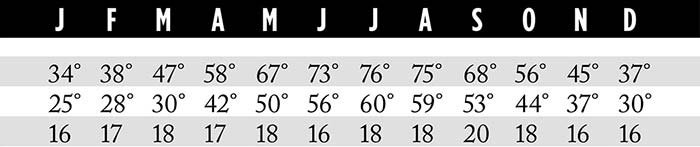
First line, average daily high; second line, average daily low; third line, average days with some rain. For more detailed weather statistics for destinations in this book (as well as the rest of the world), check Wunderground.com.
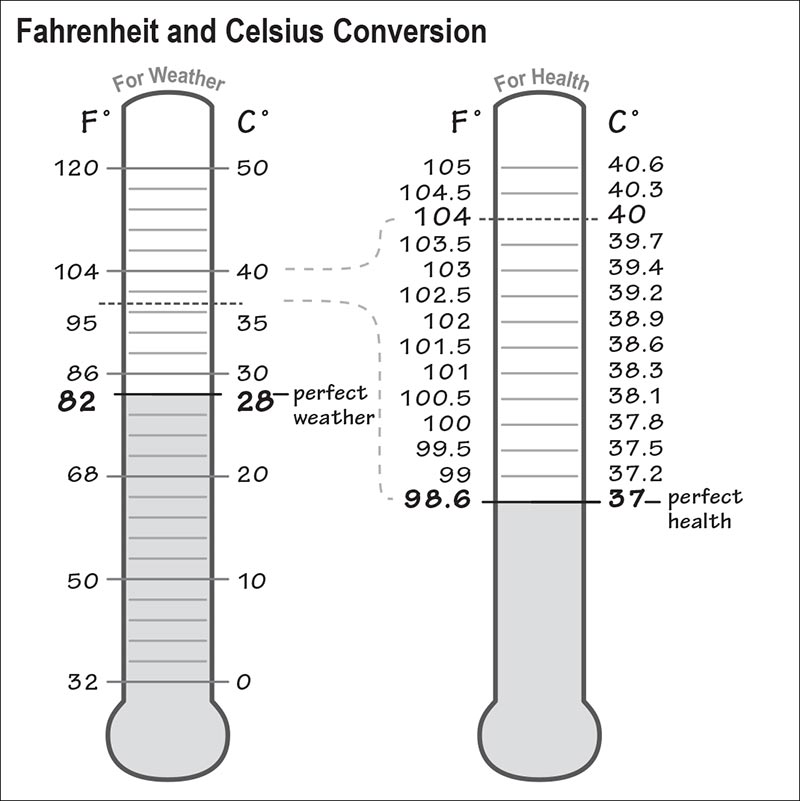
Europe takes its temperature using the Celsius scale, while we opt for Fahrenheit. For a rough conversion from Celsius to Fahrenheit, double the number and add 30. For weather, remember that 28°C is 82°F—perfect. For health, 37°C is just right. At a launderette, 30°C is cold, 40°C is warm (usually the default setting), 60°C is hot, and 95°C is boiling. Your air-conditioner should be set at about 20°C.
Whether you’re traveling for five days or five weeks, you won’t need more than this. Pack light to enjoy the sweet freedom of true mobility.
 5 shirts: long- & short-sleeve
2 pairs pants (or skirts/capris)
1 pair shorts
5 pairs underwear & socks
1 pair walking shoes
Sweater or warm layer
Rainproof jacket with hood
Tie, scarf, belt, and/or hat
Swimsuit
Sleepwear/loungewear
Debit card(s)
Credit card(s)
Hard cash (US $100-200)
Money belt
Passport
Other required ID: Vaccine card/Covid test, entry visa, etc.
Driver’s license, student ID, hostel card, etc.
Tickets & confirmations: flights, hotels, trains, rail pass, car rental, sight entries
Photocopies of important documents
Insurance details
Guidebooks & maps
Mobile phone
Camera & related gear
Tablet/ebook reader/laptop
Headphones/earbuds
Chargers & batteries
Phone car charger & mount (or GPS device)
Plug adapters
Basics: soap, shampoo, toothbrush, toothpaste, floss, deodorant, sunscreen, brush/comb, etc.
Medicines & vitamins
First-aid kit
Glasses/contacts/sunglasses
Face masks & hand sanitizer
Sewing kit
Packet of tissues (for WC)
Earplugs
Daypack
Sealable plastic baggies
Laundry supplies: soap, laundry bag, clothesline, spot remover
Small umbrella
Travel alarm/watch
Notepad & pen
Journal
Second pair of shoes (flip-flops, sandals, tennis shoes, boots)
Travel hairdryer
Picnic supplies
Disinfecting wipes
Water bottle
Fold-up tote bag
Small flashlight
Mini binoculars
Small towel or washcloth
Inflatable pillow/neck rest
Tiny lock
Address list (to mail postcards)
Extra passport photos
German Survival Phrases
In the phonetics, ī sounds like the long i in “light,” and bolded syllables are stressed.
| Good day. | Grüss Gott. grews gote |
| Do you speak English? | Sprechen Sie Englisch? shprehkh-ehn zee ehng-lish |
| Yes. / No. | Ja. / Nein. yah / nīn |
| I (don’t) understand. | Ich verstehe (nicht). ikh fehr-shtay-heh (nikht) |
| Please. | Bitte. bit-teh |
| Thank you. | Danke. dahng-keh |
| I’m sorry. | Es tut mir leid. ehs toot meer līt |
| Excuse me. | Entschuldigung. ehnt-shool-dig-oong |
| No problem. | Kein Problem. kīn proh-blaym |
| (Very) good. | (Sehr) gut. (zehr) goot |
| Goodbye. | Auf Wiedersehen. owf vee-der-zayn |
| one / two | eins / zwei īns / tsvī |
| three / four | drei / vier drī / feer |
| five / six | fünf / sechs fewnf / zehkhs |
| seven / eight | sieben / acht zee-behn / ahkht |
| nine / ten | neun / zehn noyn / tsayn |
| How much is it? | Wieviel kostet das? vee-feel kohs-teht dahs |
| Write it? | Schreiben? shrī-behn |
| Is it free? | Ist es umsonst? ist ehs oom-zohnst |
| Included? | Inklusive? in-kloo-zee-veh |
| Where can I buy / find…? | Wo kann ich kaufen / finden…? voh kahn ikh kow-fehn / fin-dehn |
| I’d like / We’d like… | Ich hätte gern / Wir hätten gern… ikh heh-teh gehrn / veer heh-tehn gehrn |
| …a room. | …ein Zimmer. īn tsim-mer |
| …a ticket to ____. | …eine Fahrkarte nach ____. ī-neh far-kar-teh nahkh ____ |
| Is it possible? | Ist es möglich? ist ehs mur-glikh |
| Where is…? | Wo ist…? voh ist |
| …the train station | …der Bahnhof dehr bahn-hohf |
| …the bus station | …der Busbahnhof dehr boos-bahn-hohf |
| …the tourist information office | …das Touristeninformationsbüro dahs too-ris-tehn-in-for-maht-see-ohns-bew-roh |
| …the toilet | …die Toilette dee toh-leh-teh |
| men / women | Herren / Damen hehr-rehn / dah-mehn |
| left / right | links / rechts links / rehkhts |
| straight | geradeaus geh-rah-deh-ows |
| What time does this open / close? | Um wieviel Uhr wird hier geöffnet / geschlossen? oom vee-feel oor veerd heer geh-urf-neht / geh-shloh-sehn |
| At what time? | Um wieviel Uhr? oom vee-feel oor |
| Just a moment. | Moment. moh-mehnt |
| now / soon / later | jetzt / bald / später yehtst / bahld / shpay-ter |
| today / tomorrow | heute / morgen hoy-teh / mor-gehn |
In a German/Austrian Restaurant
| I’d like / We’d like… | Ich hätte gern / Wir hätten gern… ikh heh-teh gehrn / veer heh-tehn gehrn |
| …a reservation for… | …eine Reservierung für… ī-neh reh-zer-feer-oong fewr |
| …a table for one / two. | …einen Tisch für eine Person / zwei Personen. ī-nehn tish fewr ī-neh pehr-zohn / tsvī pehr-zoh-nehn |
| …the menu (in English), please. | …die Speisekarte (auf Englisch), bitte. dee shpī-zeh-kar-teh (owf ehng-lish) bit-teh |
| nonsmoking | Nichtraucher nikht-rowkh-er |
| Is this seat free? | Ist hier frei? ist heer frī |
| service (not) included | Trinkgeld (nicht) inklusive trink-gehlt (nikht) in-kloo-zee-veh |
| cover charge | Eintritt īn-trit |
| to go | zum Mitnehmen tsoom mit-nay-mehn |
| with / without | mit / ohne mit / oh-neh |
| and / or | und / oder oont / oh-der |
| menu (of the day) | (Tages-) Karte (tah-gehs-) kar-teh |
| set meal for tourists | Touristenmenü too-ris-tehn-meh-new |
| specialty of the house | Spezialität des Hauses shpayt-see-ah-lee-tayt dehs how-zehs |
| breakfast / lunch / dinner | Frühstück / Mittagessen / Abendessen frew-shtuhk / mit-ah-geh-sehn / ah-behn-deh-sehn |
| appetizers | Vorspeise for-shpī-zeh |
| bread / cheese | Brot / Käse broht / kay-zeh |
| sandwich | Sandwich zahnd-vich |
| soup / salad | Suppe / Salat zup-peh / zah-laht |
| meat / poultry | Fleisch / Geflügel flīsh / geh-flew-gehl |
| fish / seafood | Fisch / Meeresfrüchte fish / mee-rehs-froysh-teh |
| fruit / vegetables | Obst / Gemüse ohpst / geh-mew-zeh |
| dessert | Nachspeise nahkh-shpī-zeh |
| tap water | Leitungswasser lī-toongs-vah-ser |
| mineral water | Mineralwasser meen-eh-rahl-vah-ser |
| milk | Milch milsh |
| (orange) juice | (Orangen-) Saft (oh-rahn-zhehn-) zahft |
| coffee / tea | Kaffee / Tee kah-fay / tay |
| wine | Wei vīn |
| red / white | rot / weiß roht / vīs |
| glass / bottle | Glas / Flasche glahs / flah-sheh |
| beer | Bier beer |
| Cheers! | Prost! prohst |
| More. / Another. | Mehr. / Noch eins. mehr / nohkh īns |
| The same. | Das gleiche. dahs glīkh-eh |
| The bill, please. | Rechnung, bitte. rehkh-noong bit-teh |
| tip | Trinkgeld trink-gehlt |
| Delicious! | Lecker! lehk-er |
For more user-friendly German phrases, check out Rick Steves German Phrase Book.