MIKULOV WINE REGION
Mikulov • Pavlov and the Pálava Hills • Lednice and Valtice
Sights in and near Lednice and Valtice
Lednice and Valtice Connections
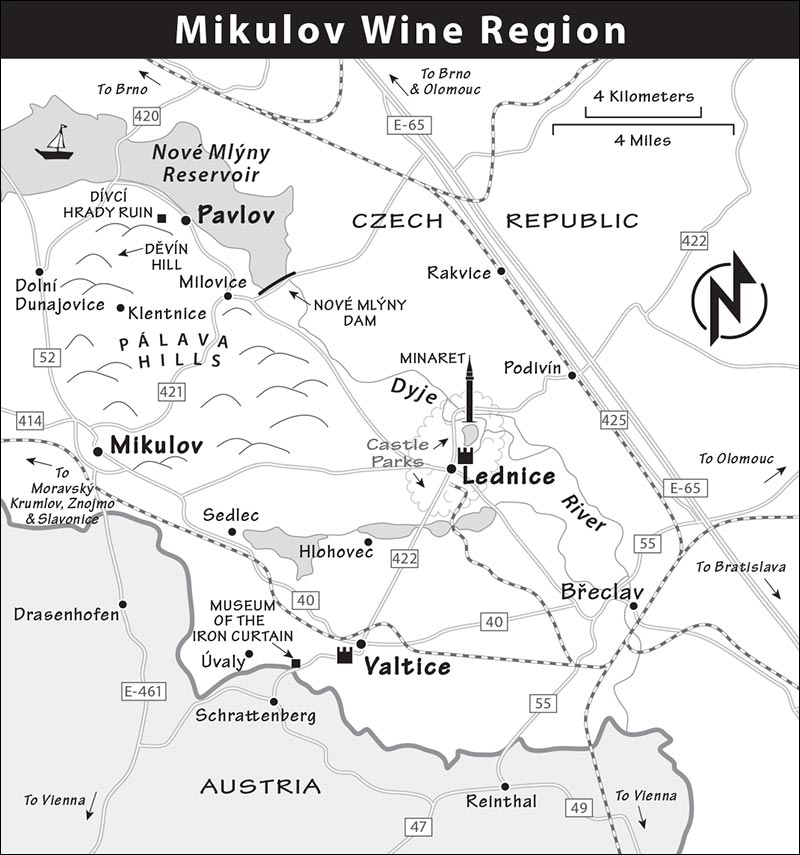
Blessed by a warm climate and limestone geology, the Mikulov region produces the Czech Republic’s most famous wines. Like the spine of a colossal humpback whale, the limestone ridge of the Pálava Hills rises out of the fertile alluvial plains of the Morava and Thaya rivers. Some 40,000 years ago, this region’s inhabitants made the world’s first-ever ceramic sculpture: the voluptuous Venus of Věstonice. The area has been continuously inhabited since. Slavs founded their first state from here, and for good reason: This is a land where it’s said the wine flows from the tap and plums fall from the sky. To back up their word the Moravians generously share their riches: Whether in a chance encounter or as a paying guest, you will soon find out that the people here are dedicated to matter-of-fact, nonintrusive hospitality.
At the southern end of the ridge, the historic town of Mikulov, long the cultural center of South Moravia, has the look and feel of an Italian hill town—and some particularly vivid artifacts of a rich Jewish heritage. Seven miles north, on the slopes of the 300-yard-high “hump” of Děvín Hill, the village of Pavlov boasts unique rustic architecture and hillside wine cellars. To the east, straddling the banks of the Thaya, the Lednice-Valtice complex of two châteaux and 19th-century English-style parks is one of the largest man-made landscapes in Europe. The glistening white Lednice Château is the ideal starting point for exploring the area’s meandering waterways, oak- and cypress-dotted meadows, and romantic structures. Bordered by parks on one side, the town of Valtice is encircled by vineyards on the other. The deep cellars of its château hide the country´s official wine salon—with all regions represented—while a local winery has become one of the country’s largest brands. The Iron Curtain that once loomed on the hill just above town, separating Czechoslovakia from Austria, is thoughtfully documented.
As this area is right off the main highway and rail line between Prague/Brno and Vienna/Bratislava, it’s a natural stop for those traveling from the core of the Czech Republic to Austria or Hungary. While popular with Czech, Slovak, and Austrian holidaymakers, this region remains relatively undiscovered by American tourists—adding to its many charms.
Choosing a Home Base: Mikulov and Pavlov are both fine home bases from which to explore the region. Mikulov’s advantages are its hillside setting, cultured small-town feel, and restaurants and wine bars. Pavlov’s romantic upper street is best at dusk when vintners serve wines directly by their cellars; you’ll be glad to be in stumbling distance of your bed.
GETTING AROUND THE MIKULOV WINE REGION
The main railway junction of Břeclav is the gateway to the Mikulov wine region, whether you come through as a public transit transfer point or stop here to rent a car or bike. For bus and train schedules, see https://idos.idnes.cz.
By Train from Břeclav: You can connect by train to Mikulov (hourly, 30 minutes, goes through Valtice), Valtice (hourly, 15 minutes), Prague (9/day direct, 3 hours), Olomouc (hourly, 2 hours, may transfer in Brno or Přerov), and Vienna (5/day, 1 hour).
By Bus from Břeclav: It’s hourly (Mon-Fri, fewer Sat-Sun) to Mikulov (1 hour), Lednice (15 minutes), and Pavlov (45 minutes). You can bus to Prague (1-2/hour, fewer on weekends, 5 hours), but the train is better.
By Car: Although it’s perfectly feasible to connect these destinations by public transportation, a car speeds things up substantially. Mikulov, Pavlov, Lednice, and Valtice form a handy little rectangle, each about 10-15 minutes’ drive from the next. This makes it easy to home-base in one and side-trip to the others. Get a good map. You can pick up a rental car in Břeclav (see “Helpful Hints,” later). This is especially handy if you’re arriving in the Czech Republic by train from Vienna or Budapest and want to rent a car.
By Bike: Many Czechs—and even more Austrians—connect their Mikulov-area wine-cellar visits by bicycle. To bike on flat terrain, stay within the Břeclav-Lednice-Valtice parks complex. From Valtice to Mikulov expect small hills, and out of Mikulov to Pavlov there is one gradual climb. From Pavlov to Lednice is level terrain. Figure about 35 miles for a full-day circuit connecting Valtice, Mikulov, Pavlov, and Lednice; starting in Břeclav adds another 10 miles. Also consider side-tripping to the nearby hillside winemaking villages of Bavory, Perná, and Věstonice. Bike paths, both paved and gravel, are well marked and filled with bikers who can provide needed directions or assistance. Bikes are allowed on trains.
For bike rentals, see “Helpful Hints,” next.
HELPFUL HINTS
Taxis: Catch one in front of the Břeclav train station. In or around Mikulov, call Patrik Špiřík (+420 775 959 295).
Bike Rental: Reserve ahead in summer (particularly on weekends). Bikes come in all varieties—specify your preferences when you reserve.
In Břeclav: Get to Břeclav early, drop your luggage at the train-station baggage check, and walk (or taxi) up the main street about a mile before turning left, following the green sign for the TI (U Tržiště 8, +420 731 428 235, tic@ticbreclav.cz).
In Mikulov: Cyklopomoc is a friendly bike-repair-and-rental shop (Pavlovská 24, +420 773 523 120, cyklopomoc.cz). Another option is Fun Morava in nearby Pasohlávky—they can deliver a bike to your hotel (www.funmorava.cz).
In Valtice: Cykloráj rents bikes and sells sport equipment in a purpose-built facility just across the big intersection off the main square (+420 539 050 773, mobile +420 605 983 978, http://cykloraj.com).
Car Rental: The Bors rental office in Břeclav is convenient and rents Renaults (Mon-Fri 8:00-17:00, Sat until 11:00, closed Sun, +420 519 444 241, mobile +420 731 606 243, https://renault.bors.cz/autopujcovna). To get to Bors from Břeclav’s train station, it’s a quick taxi ride (under 50 Kč) or a 10-minute walk (exit train station into park, turn left, walk along main street past the post office, go under a railway bridge, and find the Bors Renault dealership next door to the gas station).
Local Guides: Barbora Hammond, based in Brno, guides individuals in Valtice or Mikulov. With her insights on local customs, nature, and architecture, she makes the wine region’s dreamy landscapes come alive (500 Kč/hour plus 400 Kč for gas, +420 728 983 858, barboraham@gmail.com).
Mikulov
An important border town on the ancient “Amber Road” from the Baltic Sea to the Adriatic, Mikulov (MEE-kuh-lohv) was briefly the unofficial capital of Moravia. When the Austrian kings expelled the Jews from Austria in the early 1400s, they settled here on the border. As Jews in Moravia were soon forced to find protection in towns under aristocratic (rather than royal) jurisdiction, aristocrat-ruled Mikulov grew further. Jewish philosopher and scholar Judah Loew ben Bezalel—the famous Rabbi Loew—was the head Moravian rabbi here in the 16th century before moving to Prague. In 1835, Mikulov’s 3,500 Jewish residents made up half the town’s population and formed the largest Jewish community in what is now the Czech Republic outside of Prague. When the railway line to Vienna bypassed Mikulov a few years later, the town was fated to a stagnation that mercifully protected it from Industrial Age construction.
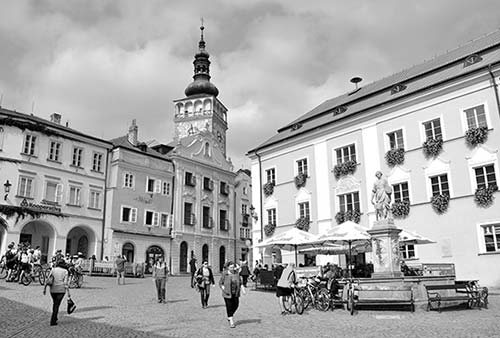
Set between two hills that act as twin viewpoints—and with a beautifully restored main square dotted with cafés and wine bars—Mikulov today is the cultural hub of South Moravia. It’s an almost startlingly beautiful and sophisticated-feeling town, with a tight and tidy cobbled core of pretty pastel buildings, huddled under a grand château. The main square exudes a certain gentility, with ivy-blanketed buildings, thoughtfully tended flower boxes, pristine gurgling fountains, and bubbly Baroque sculptures. A piano sits under the arches at the bottom part of the square for anyone to play. And tucked behind the hill are the town’s Jewish sights, including a synagogue and a soulful cemetery.
Tourist Information: The TI on the main square is a wealth of regional and biking information (daily 9:00-18:00, shorter hours and closed Sat-Sun off-season; Náměstí 1, +420 519 510 855, www.mikulov.cz).
Arrival in Mikulov: The train and bus stations are right next to each other, a little over a half-mile south of town. To reach Mikulov’s main square, you can either walk along Nádražní street toward the hilltop château, take a taxi, or ride bus #550 or #585 for two stops.
Sights in Mikulov
The major sights in Mikulov are scattered between its hills and the town square. I’ve connected them with easy up-and-down walking directions.
Main Square
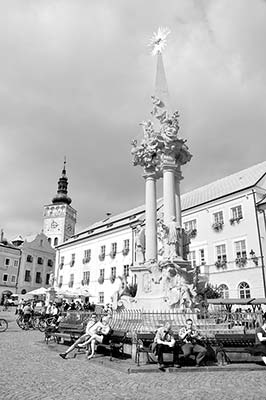
Start in the upper part of the main square. Stand near the TI, between the plague column and the fountain. The Holy Trinity Column in the middle of the square is a fine piece of late-Baroque sculpture.
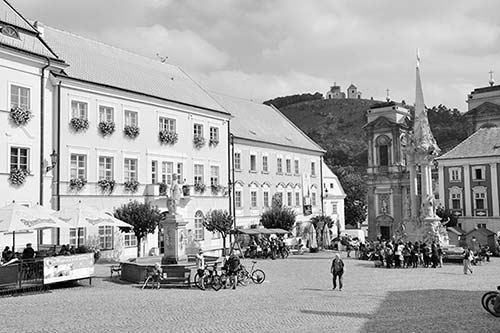
Look up at Holy Hill with the Church of St. Sebastian at the top (to reach this panoramic spot from the main square, follow the blue-marked trail down the alley and then past the Stations of the Cross). On the first Sunday in September, this is the destination of the annual pilgrimage to the Black Madonna of Mikulov (a statue of the Virgin Mary based on the famous Black Madonna of Loreto, Italy). The Madonna is housed in the large Church of St. Wenceslas—you can see its onion dome (with a big clock face) jutting up above the square. Inside, you can visit the ossuary in the church’s crypt (free; church open July-Aug daily 10:00-12:00 & 13:00-18:00; Sept-June only during Mass Sun at 8:00, Tue at 17:30, and Thu at 7:00; +420 605 900 544).
At the foot of the square—between you and the Holy Hill—stands a prominent, Italian-feeling, churchlike building, the Tomb of the Dietrichstein Family. These aristocrats ruled Mikulov from the 16th century to 1945 (100 Kč, daily 10:00-18:00, shorter hours off-season, closed in winter).
Above the square is the town’s château. The original castle burned down at the end of World War II and was rebuilt in 1950, so it lacks the period interiors of neighboring châteaux in Valtice and Lednice and isn’t worth the price of admission.
• From the top of the square, step into the first castle courtyard (free to enter). Note the wrought-iron gate and coat-of-arms of the Dietrichstein family, with two vintners’ knives in the center. Walk through the castle’s small park, past a fountain, and take the switchback trail toward the castle. As you gain altitude, the surrounding countryside comes into view.
You’ll circle gradually around behind the castle. After passing the stout round tower, continue ahead 30 yards and take the staircase that descends down to Husova street—noticing the Star of David topping the tent-like red roof ahead of you. At the bottom of the stairs, enter the...
▲▲Synagogue
Mikulov’s synagogue, the only Polish-type synagogue in Moravia, is now a museum and a regional Jewish cultural center. It was gorgeously renovated from top to bottom as part of the EU-funded “Ten Stars” project, which improved synagogues around the country. Step inside the blueish, spiritually charged space to appreciate the unique design: a bema with oversized marble pillars that carry four finely carved ceiling cupolas, a lavish Baroque ark (rebuilt from scratch from old plans and photographs), and an upstairs gallery that lets you look down and take it all in. While the exhibits—pertaining to the history of the local community, including two panels on Rabbi Loew—are only in Czech, you can pick up a blue plastic folder with English translations as you enter.
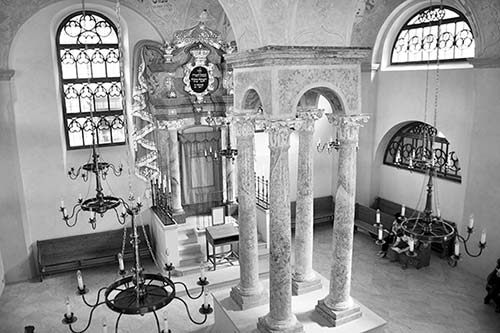
Cost and Hours: 50 Kč, Tue-Sun 9:00-18:00, closed Mon, shorter hours off-season.
• Exiting the synagogue, turn right on Husova street. Where you emerge at the little square, turn left, then veer right and uphill, following the brown Židovský hřbitov sign.
Jewish Cemetery
Buy your ticket at the white, Baroque-frilled Ceremonial Hall (which houses several small exhibits on the history and customs of the local Jewish community). Then continue up into the extremely evocative cemetery, peacefully filling the hillside. It’s larger and less crowded—both with graves and with tourists—than the one in Prague. The oldest tombstone dates from 1603.
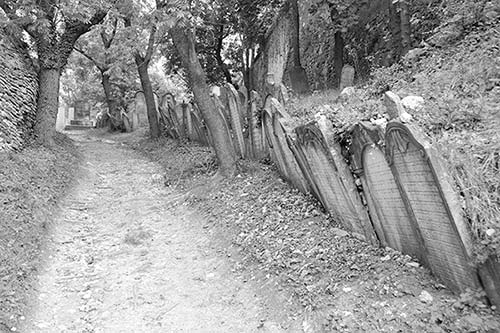
Cost and Hours: 40 Kč; daily 10:00-18:00, shorter hours off-season, closed in winter but can be opened with a few days’ notice; Hřbitovní Náměstí, +420 731 484 500, info@zidovskyhrbitovmikulov.cz.
• Upon leaving the cemetery, veer to the hillside on a small street, then turn left up a narrow staircase to walk up to the brick tower on the adjacent Kozí Hrádek hilltop—offering fine views over Mikulov and into Austria. From here, walk down the narrow staircase back to the main square. Or continue in the opposite direction toward Turold Hill for a magnificent eight-mile hike along the Pálava Ridge to Pavlov (described next).
NEAR MIKULOV
▲Hiking in the Mikulov-Pavlov Hills
The Pálava Nature Reserve packs an incredible amount of biological and geological diversity into a small area. For a highly enjoyable, vista-filled seven-mile hike through a protected natural area filled with limestone formations, hillside meadows, vineyards, forests, and castle ruins, consider the red-and-white-marked trail from Mikulov to Pavlov.
From the top end of the square, walk up the steps to the Kozí Hrádek (“Goat Castle”) ruins. On the other side of the ruins, the trail gently descends into a newer part of town. Continue straight along a residential street, and after an intersection, turn left on a path leading up to Turold Hill, topped with a radio tower. After a short descent, the trail briefly skirts a vineyard along the Mikulov-Pavlov country road. On the right, appreciate the rare limestone geology of the craggy outcrop known as Cats’ Rocks.
Just as you turn left off the road on a footpath to scale the Stolová Hora (“Table Hill”), consider stopping for a snack at the Wild West-themed Pony Ranch. First you only see a scrub of bushes, but as you walk through this natural palisade, you enter a hidden, white-cliff-enclosed gulch seemingly fitted for a Western movie set: a horse-filled corral in the middle, a two-story saloon at the far end, and a beer-and-sausage kitchen shack on the side. No movie was ever shot here. Rather, the Pony Ranch is part of an Old West-inspired Czech phenomenon that began in the 1930s but really took off in the 1970s (when the political situation turned from bad to worse). With the barbed wire of the Iron Curtain scratching the southern edge of town, locals were reminded daily that they lived in a prison, rather than a free land. As if to say, “You can trap our bodies but not our spirits,” scores of similar Western-themed stage sets popped up around the country. On Fridays locals rushed here to live, and on Sundays they returned to town to survive. The authorities didn’t mind these tiny Americas...as long as they kept the people quiet. The strategy seemingly worked—until 1989. Today the scruffy Pony Ranch is run by a friendly Mikulov couple who seem to never have left their 1980s paradise.
As you reach the meadow-covered Stolová Hora, survey the land. Here you are at Europe’s crucial geopolitical juncture: The mountain range rising in the east is the beginning of the Carpathians, while to the south—on a clear day—you can see the Alps. In between these two principal mountain ranges of Europe, the gray-green Danube River dashes southeast. For millennia, cultures and armies followed it in either direction. Four centuries ago, the Turks ruled in Budapest, while the Habsburgs desperately clung to Vienna. Today, three country capitals straddle its banks within 100 miles of here.
Consider the contrasting energy policies: South of the border you see a sea of wind farms, while due west notice the four cooling towers of the Dukovany nuclear plant rising like mushrooms on the horizon. Austrians have always been opposed to nuclear energy, while Czech politicians are still expanding this Soviet legacy, although no permanent storage place for waste has been found in the country.
Descend toward the Sirotčí Hrádek castle ruin (one of many ancient fortifications along the ridge where, ever since Neolithic times, people from surrounding countryside took refuge during invasions). Just before the ruin itself, you have an option of turning down to the right to reach the village of Klentnice, with the recommended Café Fara (if you pass through the village, notice the rare monument to fallen Red Army soldiers in front of the church—with a cross in place of the typical star or hammer and sickle). Otherwise, continue along the trail to the ruins, then descend on the other side and touch the road at the far end of the village. After a small intersection, the trail turns into an oak, maple, and linden forest and eventually climbs to the radio tower-topped Děvín Hill. From here it’s a sharp descent to Dívčí Hrady (“Maidens’ Castle”), a spectacularly set ruin over the village of Pavlov, and then—following the green-and-white marked path (a green line between white lines)—to Pavlov itself.
You can also do this hike in the opposite direction, but the initial ascent to Děvín Hill is steeper than the gradual climb from Mikulov. Buses run every hour in both directions.
Sleeping in Mikulov
The first three hotels lie along Husova street, in the heart of the former Jewish district under the castle, while the other one is near the Jewish Cemetery.
$$ Hotel Templ is situated in two delightfully restored houses, one Renaissance (with a former synagogue in the back), the other Art Nouveau (with a private garden). Each room is uniquely decorated, and all attic rooms have air-conditioning (apartment with fireplace—firewood provided, pool, Husova 50, +420 724 161 336, www.templ.cz, info@templ.cz).
$$ Hotel Desatero offers 10 specially designed rooms in a historic building that was once home to the famous Rabbi Loew. The second-floor rooms have glass roofs that let you appreciate the night sky (Husova 52, +420 776 442 258, www.desatero.cz, hotel@desatero.cz).
$ Penzion Baltazar is a 19th-century house that uniquely preserves its historic spirit amid modern amenities (Husova 44, +420 720 611 712, www.pensionbaltazar.cz, info@pensionbaltazar.cz).
$ Penzion and Café Bárta is a family-run place with simple, clean rooms and an excellent café cuddling on the side of Kozí Hrádek hill. While the website is only in Czech, the owner speaks English as well as Hebrew (breakfast extra—available at the café; park in the small square in front of the cemetery, then walk right; otherwise, from the upper end of the main square walk up the narrow staircase; +420 608 833 821, www.penzion-mikulov.cz, info@penzion-mikulov.cz).
Eating in Mikulov
$$$ Restaurant and Winery Šílová combines local ingredients into exquisite dishes calibrated to perfectly supplement the wines from their own nearby winery. The seating is equally unique, either in the modern, high-ceilinged interior or in the courtyard behind (daily, two blocks south of the square at Vídeňská 5, +420 703 144 007).
$$ Marcel Ihnačák Restaurant, inside the Hotel Tanzberg, is run by a Slovak celebrity-chef who, apart from superb renderings of Czech and Slovak dishes, also serves a full Jewish menu appropriate for the restaurant’s location in the heart of the former Jewish district (daily, Husova 8, +420 724 729 707).
$ Sojka & Spol is a trendy, spirited, family-run organic-food store with an airy restaurant upstairs serving a variety of dishes, from creamy mushroom risotto to Thai curry (Náměstí 10, +420 518 327 862).
$ Kafe Pala serves both sweet and savory buckwheat crêpes in a pleasant, secluded little Renaissance courtyard just off the main square (daily from 9:00, +420 775 699 990).
$$ Korek Wine Bar and Bistro (“Cork”) is the first co-op wine bar in town, serving wines from over a dozen Dunajovice-hills wineries. The interior spans two bright, vaulted rooms and the drinks are supplemented by a wide selection of meat and cheese tapas. They also serve a hearty breakfast (daily from 8:30, one block north of the square at Pavlovská 1, +420 736 486 962, www.korekmikulov.cz).
Dobrý Ročník (“Good Vintage Year”) is a handy wine bar serving local fare right on the main square (daily).
Mikulov Connections
BY PUBLIC TRANSPORTATION
From Mikulov, you can take the train to Valtice (hourly, 15 minutes), Břeclav (hourly, 30 minutes; connect from here to Prague), and Vienna (8/day, 2 hours, transfer in Břeclav). Buses run hourly (Mon-Fri, fewer Sat-Sun) to Pavlov (20 minutes), Lednice (45 minutes), and Břeclav (1 hour). For bus and train schedules, see https://idos.idnes.cz.
ROUTE TIPS FOR DRIVERS
From Mikulov to Pavlov: Mikulov sits just below the plateau of the Pálava Hills. The most scenic route to Pavlov is through the hills and vineyards; get clear directions in town for how to find the road (to avoid circling around via Milovice, which is easier driving but less scenic). Leaving town, you’ll climb up into hills blanketed with cornfields and vines, and vineyards tucked beneath white limestone hills (while not exactly breathtaking, it’s pleasant). Passing through the winemaking town of Klentnice, track Pavlov signs. You’ll cruise downhill, with vineyards all around and a big reservoir on the horizon, then come down through the top of Pavlov—a confusing spaghetti of narrow streets that suddenly become gravel wine roads; set your sights on the lower church tower, where you can park and hike up Česká street to explore the cellars. You can return to Mikulov the way you came.
From Pavlov to Lednice and Onward: Drop down on Pavlov’s main street to the road that parallels the reservoir, turn right, and follow Břeclav, then Lednice signs through villages to the castle.
From Lednice, you’re just 10 minutes from the expressway, which takes you in about 1.5 hours north to Olomouc (via Brno) or 1 hour south to Bratislava. To reach Vienna (1.5 hours), head south from Lednice through Valtice to the Austrian border, then pick up the A-5 expressway south into the capital.
Pavlov and the Pálava Hills
The traditional, sleepy, endearingly ragtag winemaking village of Pavlov stretches from the banks of a water reservoir toward the dramatic hilltop ruin of Dívčí Hrady (“Maidens’ Castle”). In deep brick cellars, you can taste local wines and spicy Hungarian salami while listening to a local dulcimer band. Or take nature walks along the wooded slopes of the white, limestone Pálava Hills to Bavory, Perná, and Věstonice, other cute winemaking villages on the opposite side of the ridge. Either way, you’ll see Moravian village architecture at its best. The town of Pavlov, which slopes severely downhill toward the reservoir, has two distinct sections: the upper part—an attractive traditional village with a wine-cellar atmosphere—and a more disorganized area catering to sports fishing closer to the reservoir. If you stay in the upper part, you won’t even know the reservoir exists.
Sights in Pavlov
Wandering the Town
Sloping Na Návsi (“on the village green”) street, stretching from under the hill to a parking lot above the church, is lined with magnificent examples of rustic Baroque architecture. Two parallel hillside streets up above, Česká and Vinařská, are host to many traditional wine cellars. The owners typically live on or rent out the first floor, wine is pressed on the ground floor, and extensive cellars run deep into the mountain. The atmosphere at dusk is unbeatable.
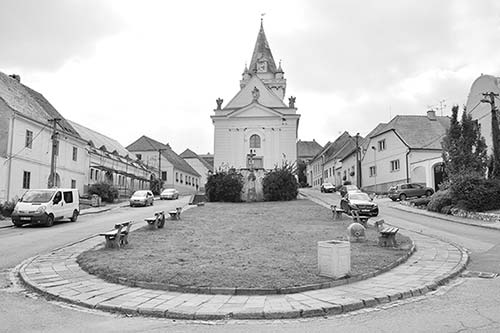
Wine Cellars
Thirteen family wineries here open their cellars to passers-by on a regular basis. Sipping your way from one to the next, either at an outside table or in the vaulted brick cellar, is a highlight of any visit. Ask your host whether a dulcimer band is playing in any of the wine cellars. September can be a wild month here as many arrive for harvest festivals and to drink the popular, slightly fermented wine juice called burčák.
To buy a famous bottle, consider one of the top wineries in the Czech Republic—Reisten—which produces its wines in Pavlov on Vinařská street (Mon-Sat 9:00-18:00, Sun 10:00-14:00, shorter hours and closed Sun in off-season, +420 724 793 429, www.reisten.net). Paulus Winery combines tradition with modern trends and is the most accessible of Pavlov’s many wine cellars (Mon-Thu 10:00-20:00, Fri-Sat until 24:00, Sun until 19:00; weekends only in off-season; follow the green-and-white-marked trail uphill in the direction of the castle to Na Cimbuří 159, +420 773 334 433, www.vinarstvipaulus.cz). Just below, on the corner of Česká and Na Cimbuří, the modern Venuše Gallery and Wine Bar (+420 773 644 183) and Marináda Winery (+420 734 303 000) offer a wide sampling of local wines. On Česká, the wineries Antoš and Topolský are also worth a stop.
Nové Mlýny Reservoir
Three successive dams, planned for decades as part of an immense water-regulation project, were built here shortly before the Velvet Revolution. They caused an ecological disaster: In the name of flood prevention, one of the last wetland forests in the Czech Republic was inundated—destroying precious flora and fauna. One of the intended benefits of the plan—to irrigate southern Moravia—also did not pan out. By the early 1990s, the collectivized fields and vineyards had been returned to individual owners. For these small producers, building channels or pumping water from the dams turned out to be too expensive. Still, the townspeople try to make the best of it. During the day, the yacht club at the bottom of the village rents paddleboats, canoes, and windsurfing boards. The relatively shallow water is warm for most of the summer and, as long as you bring water shoes or are careful about mussels, excellent to swim in. Fishing enthusiasts delight in the waters here: Recently, one Pálava native caught a seven-foot sheatfish (a large, freshwater catfish) here.
Hiking in the Pálava Hills
For a good half-day hike to Mikulov, follow the route recommended earlier, under “Sights in Mikulov,” in reverse. Or use that same green-and-white-marked trail to hike up to the Maidens’ Castle (1 mile, 30 minutes) and then descend on the other side to the winemaking villages of Věstonice, Perná, and Bavory. An educational winemaking route (marked by white signs with diagonal green stripes) passes through these vineyards west of the hills.
Sleeping and Eating in Pavlov
During the hot summer months and in September, getting a room on short notice can be difficult—book ahead.
$$$ Marináda Wine House has three luxurious rooms above their wine cellar (Na Cimbuří 57, +420 731 507 557, www.marinadavinicnidum.cz, info@marinadavinicnidum.cz).
$$ Apartmány u Venuše offers three modern apartments with kitchenettes and boasts views of the castle ruins above (Česká, +420 733 534 088, www.uvenuse.cz, rezervace@uvenuse.cz).
$ Pension u Josífka, part of the Paulus Winery, has six fully furnished apartments and a large garden to enjoy (Na Návsi 55, +420 773 608 040, www.vinarstvipaulus.cz/penzion, info@ubytovanivpavlove.cz.
$$ Hotel Pavlov is a suitable fallback if the pensions I recommend are full (Klentnická 174, +420 519 324 246, www.hotelpavlov.cz, info@hotelpavlov.cz).
$ Pension Pod Hradem (“Under the Castle”) and Nad Starým Sklepem (“Above the Old Wine Cellar”), across the street from each other with seven rooms between them, are built above 400-year-old wine cellars and run by the Garčica vintner family. They pride themselves on having a garden with the best views of the Pálava Hills and Dívčí Hrady (Maidens’ Castle). The young owners studied winemaking in France and speak both French and English. Tours of the wine cellars, with samples of homemade wines, are available on request (cheaper rooms with shared bath, Vinařská 237, +420 519 515 375, mobile +420 728 746 500, www.garcicovi.cz, penzion@garcicovi.cz).
Part of $$$$ Café Fara (“The Parish House”), in the nearby village of Klentnice, is an all-wood building inspired by traditional Moravian architecture. Winner of a historical-renovation award, it rents nine contemporary-cozy rooms (including family rooms), but has become almost too popular with trendy Czechs. The historic parish house next door serves homemade meals and cakes on a large outdoor terrace (restaurant open daily until 20:00, +420 725 217 962, www.cafefara.cz, info@cafefara.cz).
Lednice and Valtice
The twin towns of Lednice and Valtice, each boasting a palatial castle-château, are just four miles apart and connected by a lush, bikeable greenbelt.
Since the 1200s, Lednice (LEHD-neet-seh, pop. 2,400) and Valtice (VAHLT-eet-seh, pop. 3,600) have been under the control of the Mikulov-based Lichtenstein family. The Lichtensteins were to South Moravia what the Rožmberks were to South Bohemia: either caring benefactors who turned marshes and beech woods into the promised land, or despotic aristocrats who mercilessly impoverished their serfs...depending on whom you ask. While the Rožmberks died out in the early 1600s, the Lichtensteins thrived during the Thirty Years’ War (they wisely stayed loyal to the victorious Habsburgs) and continued to enrich the region until the 1940s. Valtice was their winter residence, but they summered at cooler Lednice (Lednice means “fridge,” so named because this stretch of the Dyje River is known for frequent frosts). Of the two châteaus, Lednice is more interesting to tour.
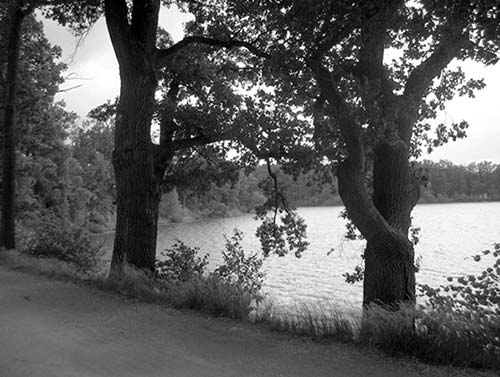
An even more compelling reason to make the short side trip from Mikulov, Pavlov, or Břeclav is the spectacular 19th-century English-style park, which extends for miles between the two châteaux. While less manicured than similar elegant gardens in France or Austria, its ruggedness is part of its charm. Native oaks and exotic cedars span their gnarled branches over wild meadows and green lakes, Romantic castles and Taj Mahal-style minarets rise in the middle of woods like apparitions, and rare birds silently glide through the sky.
Tourist Information: Lednice’s TI, by the main parking lot across from the entrance to Lednice Château, sells an inexpensive info brochure and maps of the garden complex (daily 9:00-17:00, shorter hours off-season, closed Sat-Sun in winter; Zámecké Náměstí 68, +420 519 340 986, www.lednice.cz).
Valtice’s TI is on the town’s main square (daily 9:00-17:00, shorter hours and closed Sat-Sun in off-season; Svobody Náměstí 4, +420 734 256 709, www.valtice.eu).
Arrival in Lednice and Valtice: From Lednice train station, follow the bike path along the greenbelt for half a mile to the castle complex. Buses from Břeclav and Valtice stop right in front of the castle entrance.
In Valtice, the train station is a bit over a half-mile walk along a sidewalk from the center—take the main road to the main square, where you’ll find the castle entrance.
Sights in and near Lednice and Valtice
LEDNICE
▲Lednice Château (Zámek Lednice)
Lednice, the Moravian answer to England’s Windsor Castle, is an immense structure built in the English Neo-Gothic style (1846-1858). Today, the castle houses a university for winemakers; anyone is welcome to sign up for a short summer course. To tour the palace, choose between Route I (ground-floor halls) or Route II (prince’s apartments).
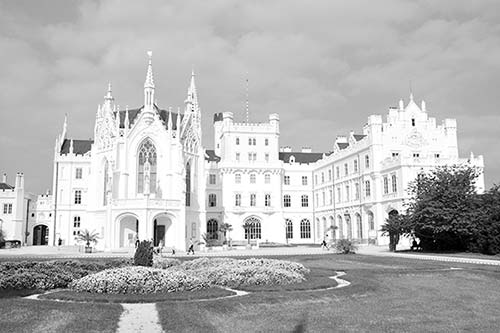
Cost and Hours: Route I or II—240 Kč each; Tue-Sun 9:00-18:00 (Sept until 17:00), closed Mon; Sat-Sun only in off-season, closed Nov-March; +420 519 340 128, www.zamek-lednice.com.
Castle Parks
From Lednice Château, parks extend both north and south. The 19th-century nobles loved everything Romantic, peppering these woods with a quirky architectural hodgepodge: a Neo-Roman aqueduct, a Neo-Gothic castle ruin, a Neo-Greek temple, a victory column, a rendezvous pavilion, a minaret, and so on. Navigate between these spots with the help of the map from the TI.
Cost and Hours: Depending on how many of the recommended park attractions you visit, plan on spending about 400 Kč/person. Hours vary per sight.
Getting There and Getting Around: To reach the minaret from Lednice Château, you can walk (one mile), hire a horse carriage (100 Kč/person, 30 minutes), or take a boat. Boats and carriages depart from the little dam just behind the castle; prices depend on the number of riders. Although most horse-carriage rides throughout Europe are tourist traps, here it feels appropriate to ride through the alleys like the nobles once did—even the school groups do it. A good plan is to ride to the minaret and walk back.
Visiting the Parks: Here are some highlights of the parks.
The Palm Greenhouse, located near the château entrance, takes you from Moravia to the tropics (100 Kč, similar hours as castle but open even during winter). Notice the construction above you: one of the oldest examples of a cast-iron roof in Europe. Created in England in the 1830s, this innovation was one of the great technical marvels of the 19th century, enabling the construction of ever-more-spacious train stations and market halls as its use gradually spread through Europe.
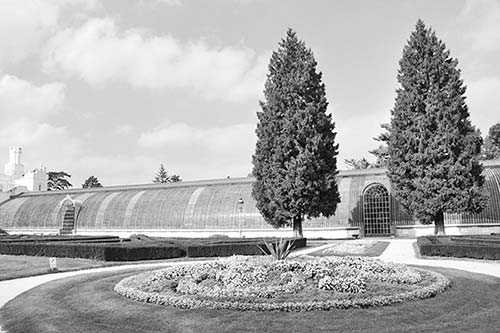
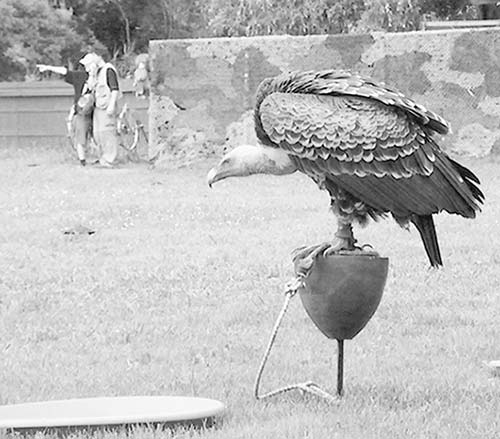
From the greenhouse, it’s a five-minute walk to the predator-bird show; en route, you’ll see a small archery stand, where you can try your skill on the medieval and modern crossbows (60 Kč for five shots, daily in summer, weekends only in spring and fall).
The 45-minute show of live predator birds features more than 20 kinds of birds from all over the world. The falcons, merlins, marsh harriers, buzzards, and goshawks demonstrate their hunting skills on simulated rabbits and quails. Some are breathtakingly fast, others comically slow. You can leave whenever you want (short visit-35 Kč, whole show-70 Kč, pick up English brochure in ticket tent that describes every bird; July-Aug Tue-Sun at 12:00, 14:00, and 16:00; April-June and Sept-Oct Sat-Sun at 12:00 and 14:00).
My favorite part of the park stretches north, from the château to the minaret. The minaret is an impressive bit of Romantic-era garden planning that copies the kind of Muslim-style minarets that flank the Taj Mahal in India. Those who climb its 302 winding steps (100 Kč) are rewarded with a grand view. Locals say that Count Alois Josef I intended to build a new church for the village of Lednice, but no plan seemed quite right to the villagers. Their pickiness finally irritated the count so much that he decided to build a mosque with a minaret instead of a church. The mosque never materialized, but the minaret did (completed in 1804). Since the ground around the Dyje River is made up of moving sands, the 200-foot-tall tower had to be anchored almost as deep underground, on beech and oak pilings. The minaret’s architect, Josef Hardtmuth, was a versatile genius. The most successful of his patents was the idea of mixing graphite and mud and coating it with wood. The pencil factory he founded (which bears his name) is still one of the largest in Europe.
The four Arabic inscriptions on the sides of the minaret roughly translate as: “There is no God except God, and Muhammad is his prophet. The world betrayed its people. Do not forsake your worldly possessions. There is no difference between wealth and renunciation. True happiness can be reached only in the world beyond. Only through industry and hard work can you reach well-being in this world. When fate stands against you, all plans lose meaning; indeed, without the help of fate, man does not reach redemption.” Whoever utters the contents of the first inscription aloud is technically considered a Muslim.
VALTICE
Valtice Château
While not as appealing as Lednice, this winter residence of the Lichtenstein family is home to the Wine Salon of the Czech Republic, enormous castle cellars, and an extensive herb garden.
The Wine Salon of the Czech Republic exhibits the best 100 Czech wines—selected annually in a vote by wine experts. The 1.5-hour wine tasting lets you make your own selections from any featured wines (599 Kč; Tue-Thu 9:30-17:00, Fri-Sat 10:30-18:00, June-Sept also open Sun 10:30-17:00, closed Jan and Mon year-round; enter through the basement of the main château entrance, +420 519 352 072, www.salonvin.cz).
The 15th- and 17th-century cellars are rented by the leading local wine producer—Vino Château Valtice. Tours here include a look at the vats and tastes of three wines (60 Kč; daily 10:00-18:00 in summer, Sat-Sun only in off-season, closed in winter; enter to left of castle entrance, call ahead for tours in English, +420 519 361 314, www.vsvaltice.cz).
The castle’s Tiree Chmelar Herb Garden was founded by an American couple with Czech roots; it was designed by students at the Mendel University in Lednice (60 Kč; daily 10:00-18:00 in summer, shorter hours and closed Mon in off-season, closed in winter; enter to left of château entrance, +420 776 251 058, www.bylinkovazahradavaltice.cz).
Valtice Underground (Valtické podzemí)
This complex is a unique labyrinth of interconnected cellars that has been restored and is now run by the winery. It’s a great spot for dinner or wine tasting. To get there, follow the red-marked trail from the main square along Růžová and then turn right onto Vinařská.
Cost and Hours: Cost varies with tour; Tue-Fri 17:00-22:00, Sat 10:00-22:00, Sun 10:00-17:00, closed Mon; longer hours in summer, shorter hours and Fri-Sun only in off-season, closed in winter; music performances Fri-Sat evenings by reservation only, +420 723 600 423, www.valtickepodzemi.cz.
BEYOND VALTICE
The sights outside of town are best connected by bike (too far to walk, too close to drive).
▲Museum of the Iron Curtain (Muzeum Železné Opony)
Near the border with Austria is a stark reminder of the Cold War. This museum exhibits uniforms, guns, and old photographs in the rooms of a former border-crossing station. You’ll see the guards’ quarters, a detention cell, and a piece of the barbed-wire fence that once divided Czechoslovakia and Austria. One room documents various imaginative attempts at illegal crossings, and a memorial lists the names and dates of those who were killed during their unsuccessful attempts. Your visit ends with a chilling 1980s propaganda film about the work of hunting down a “trespasser” (narušitel). The museum’s motto is “Freedom is the right to hit the road.”
Cost and Hours: 150 Kč; daily 10:00-17:00 in summer, Fri-Sun only in off-season, closed in winter; to arrange a visit outside normal hours or a guided tour call +420 519 340 130 or +420 608 968 388, Hraniční Přechod 483, www.muzeumopony.cz.
Getting There: From Valtice, you can either walk or bike the 1.5 miles to the museum—follow the paved bike path that starts by the large Vinné Sklepy Valtice winery. By car (drive or take a taxi), follow the road to Schrattenberg in Austria.
Úvaly Village
Continuing another mile and a half west past the Museum of the Iron Curtain, you’ll reach the remote, cut-off village of Úvaly with its appealing, professionally run, recommended pension and restaurant Villa Daniela. Lunch is served on a pleasant, rustic summer patio with manicured lawns, a fountain, and Moravian dulcimer music on the loudspeakers. Another six miles along the 1950s-era paved military signal road (now an endearingly rough bike path) takes you to Mikulov, past panels illustrating stories of attempted escapes across the Iron Curtain.
Sleeping in Valtice and Úvaly
$$ Château La Veneria has six aristocratic rooms, lavishly renovated and richly decorated, in the former residence of the castle’s chief groundskeeper. Breakfast is served in a gorgeous, secluded garden with a small waterfall and a summer kitchen; from here you have direct access to the castle parks. One could not find a better fit for visiting the opulent Lednice-Valtice complex (in summer and on weekends reserve two months ahead, walk to the far end of the main square and then continue 200 yards along Růžová before turning left, K. Venerii 82, +420 737 684 308, www.penzion-la-veneria.com, penzion@penzion-la-veneria.com).
$ Villa Daniela has 14 standard rooms in a newly built mansion that very successfully imitates a red-brick traditional farmstead. Set in the middle of the “end-of-the-road” village of Úvaly, this is a perfect base not just for wine tasting but also to get a sense for the borderlands in this part of Europe. Before 1989, visitors to the village had to be accompanied to their stated destination by guards and couldn’t stay past the 18:00 curfew. Yet a group of four youngsters, one of whose grandmother lived here, managed to dig a tunnel under the border 300 yards away. Today, the patio atmosphere is so quietly perfect that all that history seems surreal (at the end of the road in Úvaly, about 3 miles from Valtice, +420 774 111 776, www.sklepuvaly.cz, recepce@villadaniela.cz).
Lednice and Valtice Connections
This area is made for biking. Or consider taking the bus to Lednice, walking through the gardens to Valtice (a level four-mile stroll), and then taking the train from there. For bus and train schedules, see https://idos.idnes.cz.
From Lednice to: Mikulov (hourly buses Mon-Fri, fewer Sat-Sun, 45 minutes) and Vienna (8 trains/day, 2 hours, transfer in Břeclav).
From Valtice to: Mikulov (hourly trains, 15 minutes), Prague (hourly trains, 4 hours, 1 transfer), and Olomouc (3 trains/day, 3 hours, several transfers).