ORIENTATION TO PRAGUE
With sumptuous Art Nouveau facades, cheap Mozart and Vivaldi concerts, and some of the best beer in Europe, Prague is a crowd-pleaser. Here you can explore characteristic neighborhoods that weave the medieval and Baroque with a world of opulent Art Nouveau paintings and architecture. See remnants of a strong Jewish heritage and stark reminders of the communist era. And meet an entrepreneurial mix of locals and expats, each with their own brilliant scheme of how to make money in the tourist trade.
Cross the famous Charles Bridge, communing with street musicians, artists, tourists, and a stoic lineup of Czech saints in stone. Hike up to the world’s biggest castle for a lesson in Czech history and sweeping views across the city’s spires and domes. To escape the crowds and have Prague to yourself, seek out the back lanes and pretend you’re strolling through the 18th century. Duck into pubs to enjoy the hearty food and good pilsner beer, and tour museums packed with fine art. After a well-planned and thoughtful visit, you’ll leave Prague dreaming of coming back.
This chapter offers an overview of Prague’s neighborhoods, detailed day plans, helpful hints, and information on tourist services. It also covers your options for getting around, plus recommendations for organized tours.
PLANNING YOUR TIME
A few days in Prague is plenty of time to experience the city and enjoy some side trips. Even if you’re in a rush, allow at least two full days (with three nights) for a good introduction to the city.
Keep in mind that Jewish Quarter sights close on Saturday and Jewish holidays. Some museums, mainly in the Old Town, are closed on Monday.
Prague in Two or More Days
Here’s my suggested plan for experiencing Prague in two days.
Day 1
| 9:00 | Orient yourself to the city’s core with my Old Town Walk. Along the way, enter some of the sights (such as the Municipal House) and climb the old tower at either end of the Charles Bridge to enjoy the view. |
| 13:00 | Have lunch in the Old Town or Lesser Town. |
| 15:00 | Follow my Jewish Quarter Tour. |
| Evening | Choose between a beer hall, live music, or Black Light Theater. |
Day 2
| 8:00 | Zip up to Prague Castle on the tram. Be in the ticket line before 9:00, visit St. Vitus Cathedral before the crowds arrive, then follow my Prague Castle Tour. |
| 11:00 | As you leave the castle, tour the Lobkowicz Palace. |
| 12:00 | Have lunch on Castle Square, at the Strahov Monastery, or in the Lesser Town. |
| 13:30 | Explore the Castle Quarter and Lesser Town (options include Loreta Church, Strahov Monastery, Nerudova street, Lesser Town Square, Lennon Wall, and Kampa Island). |
| 15:30 | Metro to the Muzeum stop (at the National Museum) and take my Wenceslas Square Walk. |
| 16:30 | Tour the Mucha Museum. |
| Evening | Ride the Metro to Vyšehrad Park for a pleasant, crowd-free stroll. |
| Tips: | You could tour the Cold War Museum (on Wenceslas Square) while there, but check tour times in advance and adjust your day plan as needed. If you’d rather sleep in today, flip this plan—do the Wenceslas Square Walk and visit the Mucha Museum; then tram up to the castle in the early afternoon (after 14:00) as the crowds disperse. |
Day 3 and Beyond
With more time, fit in additional museums that interest you. With four days or more, add some of Prague’s worthwhile day trips. I’d prioritize Kutná Hora (delightful small town with gorgeous cathedral and famous bone church) and/or the Terezín Memorial. Several castles (Karlštejn, Konopiště, and Křivoklát) are worth considering. Český Krumlov is another wonderful destination, but it’s a bit far for a day trip—it’s much better if you stay overnight.
Prague Overview
PRAGUE BY NEIGHBORHOOD
Prague boasts one of the largest compact historical centers in Europe. The Vltava River divides the city in two. East of the river are the Old Town and New Town (with its iconic Wenceslas Square), the main train station, and most of my recommended hotels. To the west of the river is Prague Castle, and below that, the sleepy Lesser Town. Connecting the two halves are several bridges, including the landmark Charles Bridge.
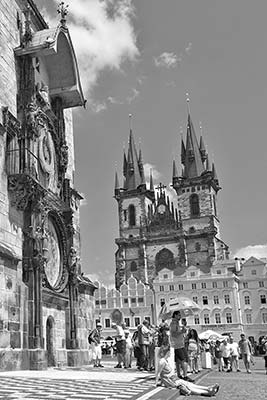
Until about 1800, Prague was four distinct towns with four town squares, all separated by fortified walls. Each town had a unique character, drawn from the personality of its first settlers. Today, much of Prague’s charm survives in the distinct spirit of these towns.
Old Town (Staré Město): Nestled in the bend of the river, this is the historic core, almost traffic-free, where most tourists spend their time. It’s pedestrian-friendly, with small winding streets, old buildings, shops, and beer halls and cafés. In the center sits the charming Old Town Square. Slicing east-west through the Old Town is the main pedestrian axis, along Celetná and Karlova streets. Look at a map of the modern road plan to trace the walls that once protected the town; the Powder Tower is a remnant of the wall system that completed a fortified ring, the other half of which was formed by the river.
Jewish Quarter (Josefov): Within the Old Town, this area by the river contains a high concentration of old synagogues and sights from Prague’s deep Jewish heritage. It also holds the city’s glitziest shopping area (with big-name international designers filling gorgeously restored Art Nouveau buildings).
New Town (Nové Město): Stretching south from the Old Town is the long, broad expanse of Wenceslas Square, marking the center of the New Town. Arcing around the Old Town, the New Town cuts a swath from riverbank to riverbank. As the name implies, it’s relatively new (“only” 600 years old). It’s the neighborhood for noisy traffic, modern buildings, fancy department stores, and a few communist-era sights.
Castle Quarter (Hradčany): High atop a hill on the west side of the river stands the massive complex of Prague Castle, marked by the spires of St. Vitus Cathedral. For a thousand years, this has been the neighborhood of Czech rulers (including today’s president and foreign minister). Consequently, the surrounding area is noble and leafy, with high art and grand buildings, little commerce, and few pubs.
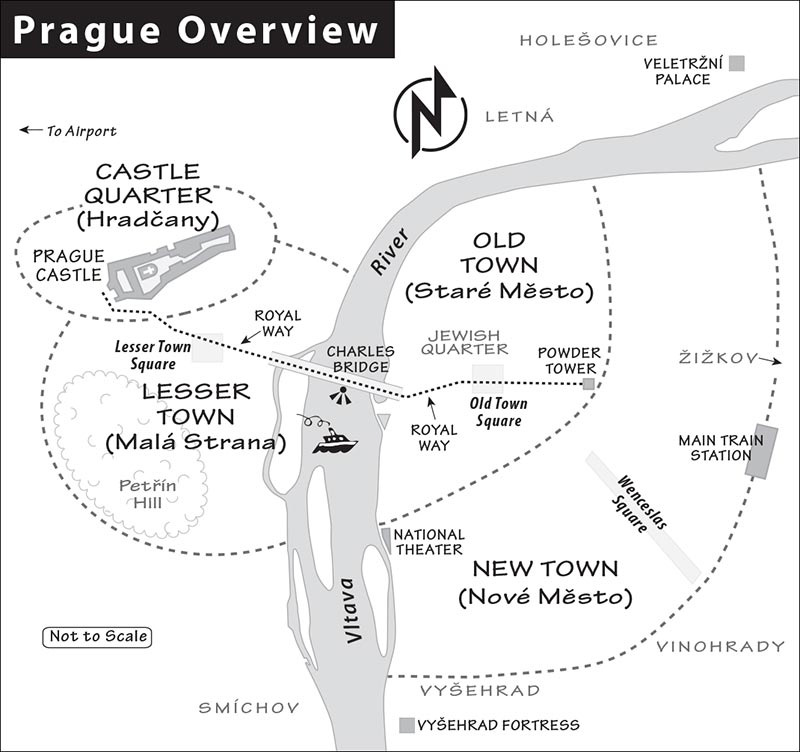
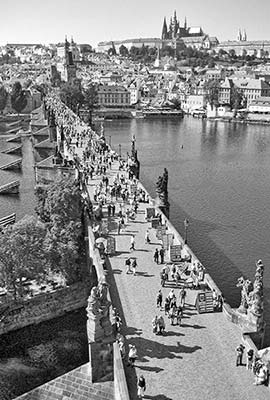
Lesser Town (Malá Strana): Nestled at the foot of Castle Hill is this pleasant former town of fine palaces and gardens (and a few minor sights). This is Prague’s diplomatic neighborhood, made to feel elegant by stately embassies, but lacking some of the funky personality of the Old Town.
The Royal Way: Cutting through the towns—from the Powder Tower through the Old Town, crossing the Charles Bridge, and winding up to St. Vitus Cathedral—is the ancient path of coronation processions. Today, this city spine (the modern streets of Celetná, Karlova, and Nerudova) is marred by tacky trinket shops and jammed by tour groups—explore beyond it if you want to see the real Prague.
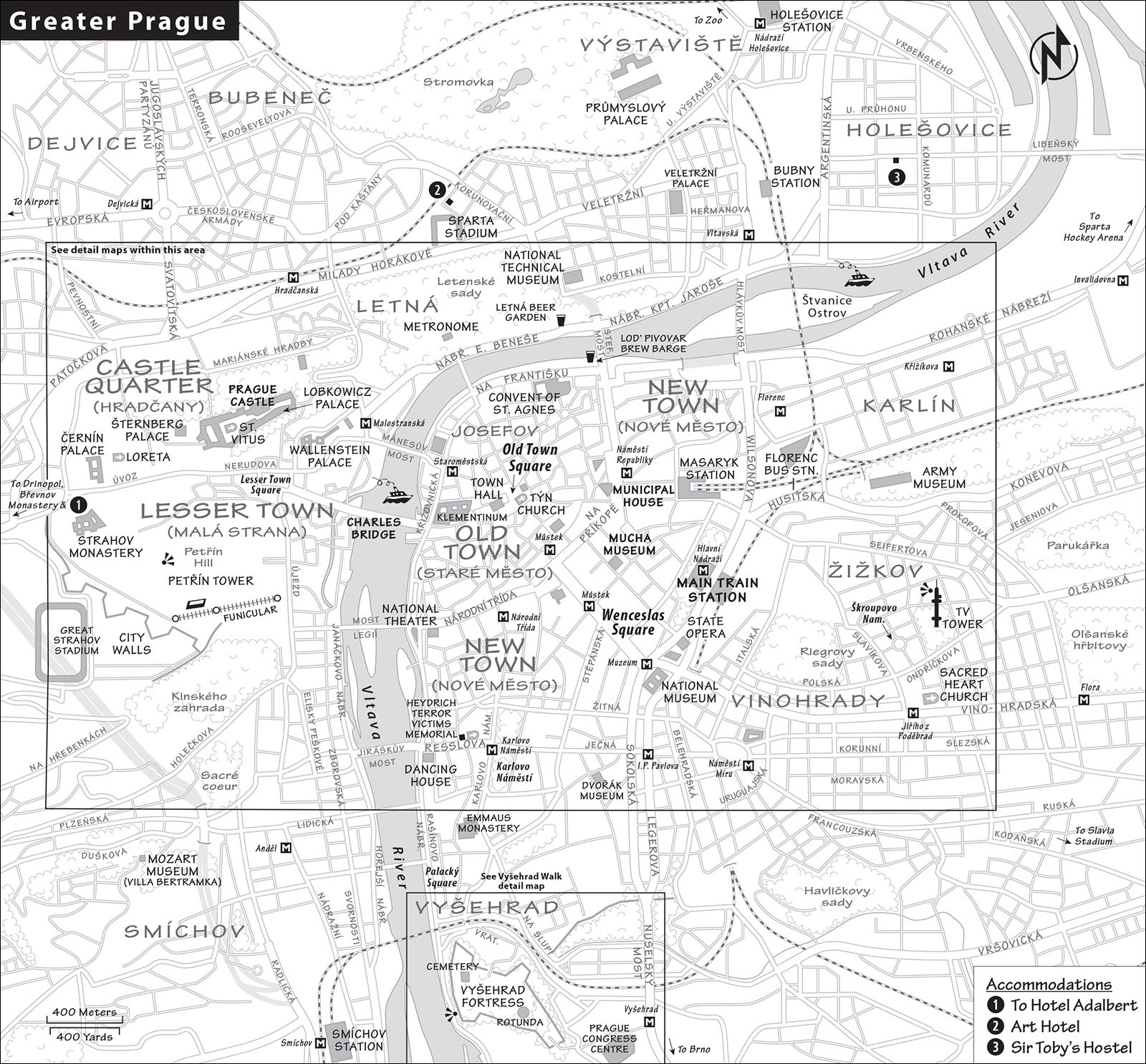
Outlying Neighborhoods: Wrapping around the New Town, a bit farther from the center of town, are two interesting neighborhoods. South along the river is the historic hill called Vyšehrad, with great views and the Czechs’ national cemetery. Southeast of the New Town is the Žižkov/Vinohrady neighborhood, an upscale residential area with some recommended hotels and a trendy nightlife zone marked by the city’s futuristic TV tower.
District System: Prague is administratively carved up into numerical districts (like Budapest, Vienna, and Paris). Almost everything of interest to tourists is in “Praha 1,” the old center on both sides of the river, but a few accommodations and attractions are in outlying districts. Addresses include the district number: For example, the Žižkov TV tower is in the third district, so its address is Mahlerovy Sady 1, Praha 3.
TOURIST INFORMATION
The Old Town has two TIs: on the Old Town Square (in the Old Town Hall, just to the left of the Astronomical Clock; Tue-Sun 9:00-19:00, Mon from 11:00) and around the corner from Havelská Market (at Rytířská 12; daily 9:00-19:00). There’s also a TI in the Lesser Town at Petřín Tower (daily 9:00-20:30, shorter hours off-season). For general tourist information in English, dial +420 221 714 714 (Mon-Fri 9:00-17:00) or check the useful TI website: www.prague.eu. Look for the helpful transit guide and information on guided walks and bus tours. TIs can also book local guides and concerts. The Prague Visitor Pass offered by the TI is probably not worth buying.
Monthly event guides include the Prague Guide (small fee), and the free Prague This Month and Heart of Europe (summer only).
Sightseeing Passes: Prague has two pricey passes—the Prague Visitor Pass offered by the TI, and the Prague CoolPass (www.praguecoolpass.com). For most travelers, neither is worth the steep cost (e.g., 2,100 Kč/2 days). Do the math before you buy.
ARRIVAL IN PRAGUE
Most visitors arrive at Prague’s main train station (Hlavní Nádraží), on the eastern edge of downtown—a 20-minute walk, short taxi ride, or bus ride to the Old Town Square and many of my recommended hotels. Prague’s Václav Havel Airport—12 miles from downtown—is easily connected to the city center by public bus, airport bus, minibus shuttle, and taxis. For details on these options, see the Prague Connections chapter.
HELPFUL HINTS
Rip-Offs: As in any heavily touristed city, in Prague naive tourists can fall victim to con artists. Most scams happen right under your nose: being charged a two-scoop price for one scoop of ice cream, having extra items appear on your restaurant bill, or not getting the correct change. Anytime you pay for something with cash, make a mental note of how much it costs, how much you’re handing over, and how much you expect back. Count your change. Don’t be in a rush. Wait until you get all the money you’re due.
Freestanding ATMs are notorious for bad rates. Use an ATM attached to an actual bank (look for names that include the word banka or spořitelna, and avoid Euronet machines).
Pickpockets: They’re abundant in Prague. They can be little children or adults dressed as professionals—sometimes even as tourists with jackets draped over their arms to disguise busy fingers. Thieves work crowded and touristy places in teams—for example, they might create a commotion at the door to a Metro or tram car. Assume any big distraction is a smokescreen for theft, keep things zipped up, and wear a money belt. All of this can sound intimidating, but Prague is safe. Simply stay alert.
Medical Help: There are two state hospitals in the center: the General Hospital (open daily 24 hours, right above Karlovo Náměstí at U Nemocnice 2, Praha 2, use entry G, +420 224 961 111) and the Na Františku Hospital (on the embankment next to Hotel InterContinental, Na Františku 1, go to the main entrance, +420 222 801 343—serious problems only).
For above-standard assistance in English (including dental care), consider the top-quality Hospital Na Homolce (appointment-less than 1,000 Kč, daily 8:00-16:00, Roentgenova 2, Praha 5, +420 257 271 111). The Canadian Medical Care Center is a small, private clinic with an English-speaking Czech staff at the Nádraží Veleslavín Metro station (appointment-3,000 Kč, house call-4,500 Kč, halfway between the city and the airport, +420 222 300 300).
Thai massage parlors (which might sound salacious but are legit) are all the rage in the Old Town.
Useful Apps: Czech Tourism’s free Czech Republic—Land of Stories app has info on popular destinations and events, along with historical background. The free Beer Adventures app guides you on a suds-sampling tour of Prague bars, pubs, and breweries.
Bookstore: Shakespeare and Sons is a friendly English-language bookstore with a wide selection of translations from Czech, the latest publications, and a reading space downstairs overlooking a river channel (daily 11:00-19:00, one block from Charles Bridge on Lesser Town side at U Lužického Semináře 10, +420 257 531 894, www.shakes.cz).
Maps: Google Maps works well here for navigation. A good map of Prague is also helpful. Look for one with trams and Metro lines marked, and tiny sketches of the sights (30-70 Kč; sold at kiosks, exchange windows, and tobacco stands). The Kartografie Praha city map, which shows all the tram lines and major landmarks, also includes a castle diagram and a street index.
Enjoy the “Golden City of a Hundred Spires” during the early evening, when the light is warm and the colors are rich. Good viewpoints include the following:
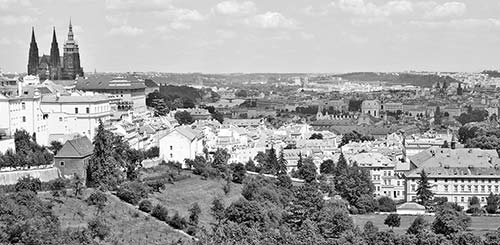
• The garden terrace in front of Strahov Monastery, above the castle (see here)
• The many balconies and spires at Prague Castle
• Villa Richter restaurant, overlooking the city from just below the castle past the Golden Lane
• The top of either tower on Charles Bridge
• The Old Town Square clock tower (with a handy elevator)
• Hotel u Prince’s rooftop dining terrace overlooking the Old Town Square (also with an elevator, free but for diners only)
• The steps of the National Museum overlooking Wenceslas Square
• The top of the Žižkov TV tower, offering spaceship views of the city, in the Žižkov/Vinohrady neighborhood east of the city center (150 Kč for elevator to observatory at 300 feet, free access to Oblaca restaurant at 200-foot level for customers—see here)
Pharmacies: You’ll find handy pharmacies in the Palladium shopping center on Náměstí Republiky and at Palackého 5 near Wenceslas Square (both open 9:00-18:00). A 24-hour pharmacy is at the Na Františku hospital (see “Medical Help,” earlier).
Laundry: A full-service laundry near most of my recommended hotels is at Karolíny Světlé 11 (3-hour wash-and-dry, Mon-Fri 7:30-19:00, closed Sat-Sun, 200 yards from Charles Bridge on Old Town side, +420 721 030 446); another laundry is at Rybná 27 (same-day pickup, Mon-Fri 8:00-18:00, closed Sat-Sun, +420 602 511 695); for locations of both, see the map on here. Prague Andy’s Laundromat offers full service (weekdays only) and self-service (Mon-Fri 9:00-20:00, Sat-Sun from 8:00, last load at 18:30, near Náměstí Míru Metro stop at Korunní 14, Praha 2, +420 733 112 693, www.praguelaundromat.cz).
Minimarkets: These corner convenience stores, generally open daily until midnight, fill most of your grocery needs. Many are run by Vietnamese immigrants, who first came here from northern Vietnam in the 1980s to train in textile factories as part of a communist government program. After the fall of communism, they stayed on. Prices are generally fair.
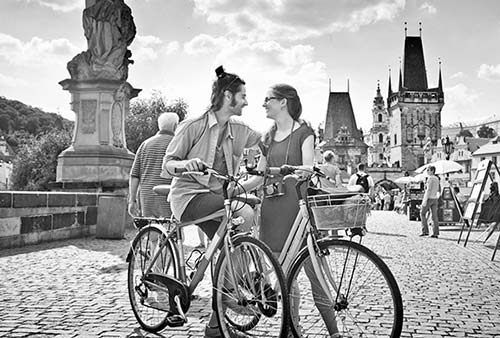
Bike Rental: Prague’s network of bike paths makes bicycles a feasible option for exploring the center of the town and beyond (see https://mapa.prahounakole.cz for a map). Two bike-rental shops are located near the Old Town Square: Praha Bike (Dlouhá 24, +420 732 388 880, www.prahabike.cz) and City Bike (Králodvorská 5, +420 776 180 284, www.citybike-prague.com). They also rent electric bikes and organize guided bike tours.
Car Rental: You won’t want or need to drive within compact Prague, but a car can be handy for exploring the countryside. All the biggies have offices in Prague (check each company’s website or ask at the TI).
Travel Service and Tours: Magic Praha is a tiny travel service run by Lída Jánská. A Jill-of-all-trades, she can help with accommodations and transfers throughout the Czech Republic, as well as private tours and side trips to historic towns (+420 604 207 225, magicpraha@magicpraha.cz).
GETTING AROUND PRAGUE
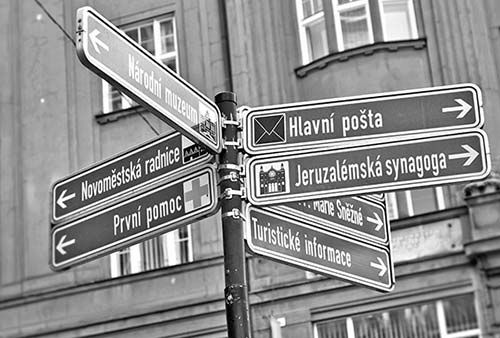
You can walk nearly everywhere. Brown street signs (in Czech, but with helpful little icons) direct you to tourist landmarks. For a sense of scale, the walk from the Old Town Square to the Charles Bridge takes less than 10 minutes (depending on crowds).
Prague’s Pedestrian Freeways: Four pedestrian thoroughfares cut (like congested freeways in US cities) through the essentially traffic-free center of Prague. You’ll find yourself swept along on an international river of touristic humanity on the following streets: Na Příkopě (“On the Moat”; from the bottom of Wenceslas Square to the Municipal House and Republic Square), Celetná (from Municipal House to the Old Town Square), Karlova (from the Old Town Square to the Charles Bridge), and Melantrichova/Na Můstku (from the bottom of Wenceslas Square to the Old Town Square). The shops along these tourist-clogged arteries are generally tourist traps. If you simply walk a block away, you’ll find better values and more charming corners.
Commit to Public Transportation: It’s worth figuring out the public-transportation system, which helps you reach farther-flung sights (Prague Castle, Vyšehrad, and so on) and can save time and sweat jumping from spot to spot within the center. The Metro is slick, the trams fun, and Uber quick and easy. Prague’s tram system is especially wonderful—trams rumble by frequently and take you just about anywhere. Be bold and you’ll swing through Prague like Tarzan.
By Public Transportation
Excellent, affordable public transit (Metro, trams, and buses) is perhaps the best legacy of the communist era (locals with annual passes ride for 10 Kč a day). For a map, see the color section at the back of this book. You can find more information and a route planner in English at www.dpp.cz. You can also pick up a transit guide at the TI.
Tickets: The Metro, trams, and buses all use the same tickets:
• 30-minute short-trip ticket (krátkodobá), which allows as many transfers as you can make in a half-hour—30 Kč
• 90-minute standard ticket (základní)—40 Kč
• 24-hour pass (jízdenka na 24 hodin)—120 Kč
• 3-day pass (jízdenka na 3 dny)—330 Kč
Since Prague is a great walking town, most find that buying a few individual tickets works better than a pass. Tickets are available from several outlets: The official PID Lítačka app allows you to purchase mobile tickets, which you can either activate immediately or save to use later. To use a mobile ticket, scan the QR code as you board.
Paper tickets are sold at hotels, newsstand kiosks, and machines at Metro stops. Be sure to validate these tickets as you get on the tram or bus, or as you enter the Metro station, by sticking it in the yellow machine, which stamps a time on it. Inspectors routinely ambush ticketless riders (including tourists) and fine them 1,000 Kč on the spot.
For trams and buses, tickets are also sold on board at a red ticket machine in the middle of the tram car or bus (tap-to-pay cards only). Tickets bought from these onboard machines have the time printed on them and don’t need to be validated.
By Tram
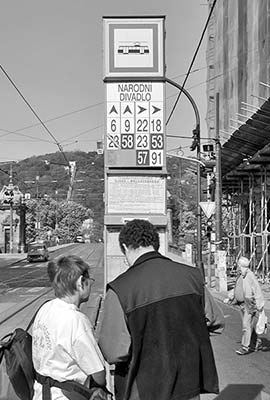
Trams run every few minutes in the daytime (a schedule is posted at each stop). Navigate by signs that list the end stations. At the platform, a sign lists all the stops for each tram in order. Remember that trams going one direction leave from one platform, while trams going the other direction might leave from a different platform nearby—maybe across the street or a half-block away. When the tram arrives, open the doors by pressing the green button.
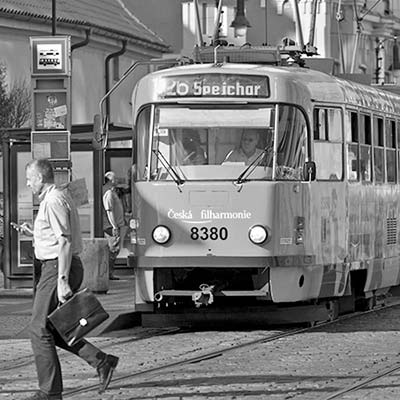
As you go, follow along carefully so you’ll be ready when your stop comes up. Newer trams have electronic signs that show either the next stop (příští) or a list of upcoming stops. Also, listen to the recorded announcements for the name of the current stop, followed by the name of the stop that’s coming up next. (Confused tourists, thinking they’ve heard their stop, are notorious for rushing off the tram one stop too soon.) It’s best to sit on the right near the front, where it’s easy to see the sign on the platform of each stop.
Handy Trams: These lines are especially useful.
Tram #22 (or #23, the retro 1960s version) is practically made for sightseeing, connecting the New Town with the Castle Quarter (see my “Tram #22 Tour,” later, and find the line marked on the Prague Metro map). The tram uses some of the same stops as the Metro (making it easy to get to—or travel on from—the tram route). Of the many stops this tram makes, the most convenient are in the New Town (at Národní Třída, between the bottom of Wenceslas Square and the river; and Národní Divadlo, at the National Theater), in the Lesser Town (Malostranské Náměstí, on the Lesser Town Square; and Malostranská Metro stop, near the riverbank), and above Prague Castle (Královský Letohrádek—for the Summer Palace and scenic entry to Prague Castle, Pražský Hrad—for the main castle entry, and Pohořelec—for the Strahov Monastery).
Trams #17 and #18 go along the south bank of the river, connecting Vyšehrad and the New and Old Town embankments (including stops at the National Theater/Národní Divadlo—closest stop to Charles Bridge, and Old Town/Staroměstská).
Tram #2 connects Malostranská (near the riverbank, on the castle side of the river) with stops along the Old Town embankment (Old Town/Staroměstská, Charles Bridge/Karlovy Lázně, National Theater/Národní Divadlo), cuts inland along Národní Třída and south to Charles Square/Karlovo Náměstí, and then returns to the river at Výtoň, at the base of Vyšehrad hill.
Trams #9 and #24 are helpful for traveling across town from the main train station and the Wenceslas Square/Václavské Náměstí and Republic Square/Náměstí Republiky stops.
By Metro
The three-line Metro system is handy and simple but doesn’t always get you right to the tourist sights (landmarks such as the Old Town Square and Prague Castle are several blocks from the nearest Metro stops). The Metro closes at midnight, but nighttime tram routes (identified with white numbers on blue backgrounds at tram stops) run all night at 30-minute intervals. Although it seems that all Metro doors lead to the neighborhood of Výstup, that’s simply the Czech word for “exit.” Note that the Metro system was begun in the 1970s and still largely maintains its original, over-the-top communist aesthetic.
By Uber and Taxi
While Prague is fraught with rip-off taxis, it’s well served by Uber. If you’re comfortable with Uber at home, it works the same way here and you can generally get a ride within five minutes with no fuss and at about half the taxi fare. The great things about Uber are that your driver knows exactly where you want to go without you having to pronounce the Czech name, you know exactly what it will cost, you don’t deal with cash, and you get to chat with a friendly local.
If you use taxis, here are a few tips to avoid being overcharged.
Legitimate local rates are cheap: Drop charge starts at 40 Kč, per-kilometer charge is around 30 Kč, and waiting time per minute is about 6 Kč. These rates are clearly marked on the door, so be sure the cabbie honors them. Also insist that cabbies turn on the meter and that it’s set at the right tariff, or “sazba” (usually but not always tariff #1). Unlike in many cities, there’s no extra charge for calling a cab—the meter starts only after you get in. Tip by rounding up; locals never tip more than 5 percent.
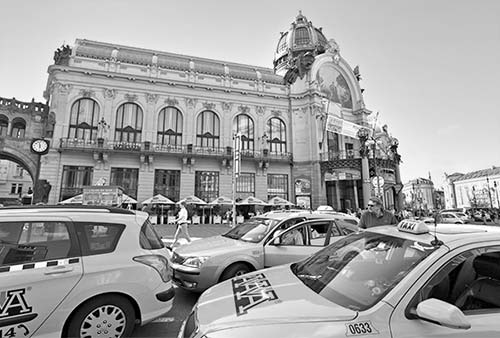
Have a ballpark idea of what your ride will cost. Figure about 150-200 Kč for a ride between landmarks within the city center (for example, from the main train station to the Old Town Square, or from the Charles Bridge to the castle). Even the longest ride in the center should cost under 300 Kč.
To improve your odds of getting a fair metered rate, call for a cab (or ask someone at your hotel or restaurant to call for you), rather than hailing one on the street. AAA Taxi (+420 222 333 222) and City Taxi (+420 257 257 257) are the most likely to have English-speaking staff and honest cabbies. Hailing a passing taxi usually gets you a decent price, but at a slightly higher rate. Avoid cabs waiting at tourist attractions and train stations; these are far more likely to be crooked.
If a cabbie surprises you at the end with an astronomical fare, challenge it. Point to the rates on the door. Get your hotel receptionist to back you up. Pull out your phone and threaten to call the police. (Because of legislation to curb dishonest cabbies, the police will stand up for you.) Or simply pay what you think the ride should cost and walk away—300 Kč (about $15) should cover you for a long ride anywhere in the center.
Tours in Prague
 To sightsee on your own, download my free Prague City Walk audio tour.
Walking Tours
A staggering number of small companies offer walking tours of the Old Town, the castle, and more (check at the TI). Since guiding is a routine side job for university students, you’ll generally get hardworking young guides with fine language skills at good prices. While I’d rather go with my own local guide (see below), public walking tours are cheaper (4 hours for about 450 Kč), cover themes you might not otherwise consider, connect you with other English-speaking travelers, and allow for spontaneity. The quality depends on the guide rather than the company. Your best bet is to show up at the Astronomical Clock a couple of minutes before 8:00, 10:00, or 11:00, then chat with a few of the umbrella-holding guides and choose the one you click with.
“Free” Tours: These are not really free—at the end, you’re expected to tip your guide (with bills, not coins). Guides are usually expat students who memorize a script and give an entertaining performance as you walk through the Old Town, with little respect for serious history. In general, they’re fine for the backpacker and hostel crowd (for whom they’re designed).
Local Guides
In Prague, hiring a guide is particularly smart (and a ▲▲ experience). Expect to pay around 3,000 Kč for a half-day tour. Because prices are usually per hour (around 850 Kč), not per person, small groups can hire an inexpensive guide for a whole day or for chunks of time over several days. Guides meet you wherever you like and tailor the tour to your interests. Visit websites for details on various walks, airport transfers, countryside excursions, and other services offered, then make arrangements by email.
Guide Services: These two outfits represent a cadre of top-notch guides.
At PragueWalker, Kateřina Svobodová, a hardworking historian-guide who knows her stuff, manages a team of enthusiastic and friendly guides (+420 603 181 300, www.praguewalker.com, katerina@praguewalker.com).
At Personal Prague Guide Service, Šárka Kačabová uses her teaching background to help you understand Czech culture and has a team of personable and knowledgeable guides (RS%—30 minutes free with this book, +420 777 225 205, www.personalpragueguide.com).
Private Guides: These guides generally learned their trade post-communism but can still share memories of the time before the transition. For even more guides, see www.guide-prague.cz.
Jana Hronková has a natural style—a welcome change from the more strict professionalism of some other guides—and a penchant for the Jewish Quarter (+420 732 185 180, https://praguediscoveries.com). A tour with my co-author, Honza Vihan, adds more nuance and context to the history covered in this guidebook (+420 603 418 148, honzavihan@hotmail.com). Zuzana Tlášková speaks English as well as Hebrew (+420 774 131 335, tlaskovaz@seznam.cz). Martin Bělohradský, formerly an organic-chemistry professor, is enthusiastic about fine arts and architecture (+420 723 414 565, martinb5666@gmail.com).
Jana Krátká enjoys sharing Prague’s tumultuous 20th-century history with visitors (+420 776 571 538, janapragueguide@gmail.com). Friendly Petra Vondroušová designs tours to fit your interests (+420 602 319 420, www.compactprague.com). Kamil and Pavlína run a family business specializing in tours of Prague and beyond. They also provide sightseeing and transport as far as Vienna and Berlin (+420 605 701 861, https://prague-extra.com).
My readers have also had good experiences with these guides: Renata Blažková, who has a special interest in the history of Prague’s Jewish Quarter (+420 777 995 156, blazer@volny.cz); Václav Štorek, who specializes in history (+420 603 743 523, http://storek.guide-prague.cz); Petr Zídek, who specializes in music history (+420 721 286 869, www.bohemiantours.cz); and Darina Krajakova, who particularly likes to share stories of communism (+420 724 274 210, blazer@volny.cz).
Running Tours Prague are guided by Radim Prahl, a local with an appetite for ultramarathons; he’ll run you past monuments, through parks, and down back alleys at your own pace (1,250 Kč for one person, 1,500 Kč for two people; +420 777 288 862, www.runningtoursprague.com).
Jewish Quarter Tours
Jewish guides (of varying quality) lead private three-hour tours in English of the Jewish Quarter. Consider Wittmann Tours (4,800 Kč, or 6,800 Kč with Sylvie Wittman herself, plus museum entry fees; +420 603 426 564, www.wittmann-tours.com). Several of the private guides recommended earlier also do good tours of the Jewish Quarter.
Bus Tours
Since Prague’s sightseeing core (Castle Quarter, Charles Bridge, and the Old Town) is not accessible by bus, I don’t recommend any of the city’s bus-tour companies. (Most are basically walking tours that use buses for pickups and transfers.)
Prague—so delightful on foot—doesn’t lend itself to the hop-on, hop-off bus tour formula. These buses give ticket holders 24 hours to hop on and off tour buses that come by every half-hour or so as they circulate through town, stopping at major attractions. An uninspired recorded narration plays along the way. The cheapest tickets cost 550 Kč and include a one-hour riverboat cruise (described next).
Bus tours can make sense for day trips out of Prague. Several companies have kiosks on Na Příkopě, where you can comparison-shop. Premiant City Tours’ many offerings include a tour to Český Krumlov or Karlovy Vary (1,950 Kč, 8.5 hours) and a river cruise. The tours have live guides and depart from near the bottom of Wenceslas Square at Na Příkopě 23. Get tickets at your hotel, on the bus, or at Na Příkopě 23 (+420 224 946 922, mobile +420 606 600 123, www.premiant.cz). Wittmann Tours, listed earlier under “Jewish Quarter Tours,” offers an all-day minibus tour to the Terezín Memorial.
Tour salespeople are notorious for telling you anything to sell a ticket. Some tours, especially those heading into the countryside, can be in as many as four languages. Hiring a local guide, many of whom can drive you around in their car, can be a much better value.
Boat Tours and Rentals
Prague isn’t ideal for a boat tour—you might spend half the time waiting to go through the locks. Still, the hour-long Vltava River cruises, which leave from near the castle end of Charles Bridge about hourly, are scenic and relaxing, though not informative (300 Kč).
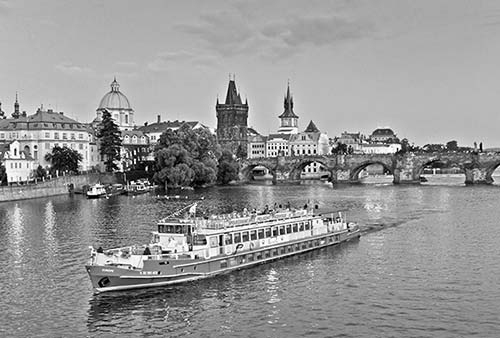
Renting a rowboat or paddleboat on the island by the National Theater is a better way to enjoy the river (worth ▲). You’ll float at your own pace among the swans and watch local lovers cruise by in their own boats (250 Kč/hour for rowboats, 300 Kč/hour for paddleboats, bring photo ID for deposit).
Tours Outside Prague
To get beyond the sights listed in most guidebooks, or for a deeply personal look at the usual destinations, contact Tom and Marie Zahn. Tom is American, Marie is Czech, and together they organize and lead family-friendly day excursions (in Prague and throughout the country). Their tours are creative and affordable, and they teach travelers how to find off-the-beaten-track destinations on their own. Their specialty is Personal Ancestral Tours & History (P.A.T.H.)—with sufficient notice, they can help Czech descendants find their ancestral homes, perhaps even a long-lost relative. Tom and Marie can also help with other parts of your travel in Central and Eastern Europe by linking you with associates in other countries, especially Germany, Hungary, Poland, Romania, and Slovakia (US +1 360 450 5959, Czech +420 257 940 113, www.pathways.cz for tours, www.pathfinders.cz for genealogy research).
Reverend Jan Dus, an enthusiastic pastor who lived in the US for several years, now serves a small congregation about 100 miles east of Prague. Jan can design itineraries and likes to help travelers connect with locals in little towns, particularly in northeastern Bohemia and Moravia. He also has an outstanding track record in providing genealogical services (US +1 800 807 1562, www.revjan.com).
Tram #22 Tour
A trip on tram #22 (or #23, using a 1960s-vintage car on the same route) is a fun way to lace together a few sights while getting up to the castle. It runs roughly every 5-10 minutes, and you can hop on and off as you like (40 Kč standard ticket valid for 1.5 hours). Be warned: Thieves and plainclothes ticket-checkers like this route as much as the tourists.
Catch the tram at Národní Třída (next to the Metro station of the same name) and enjoy the ride. Sit in front on the right so you can see each stop’s name out your window. You can hop out whenever you like or, in 20 minutes, you’ll be up at the castle. I’ve listed each stop in order of appearance. Read ahead while at a stop so you’ll know what to look for on the next stretch (or so you’ll know when to get off to see something). Be warned: Things go by fast.
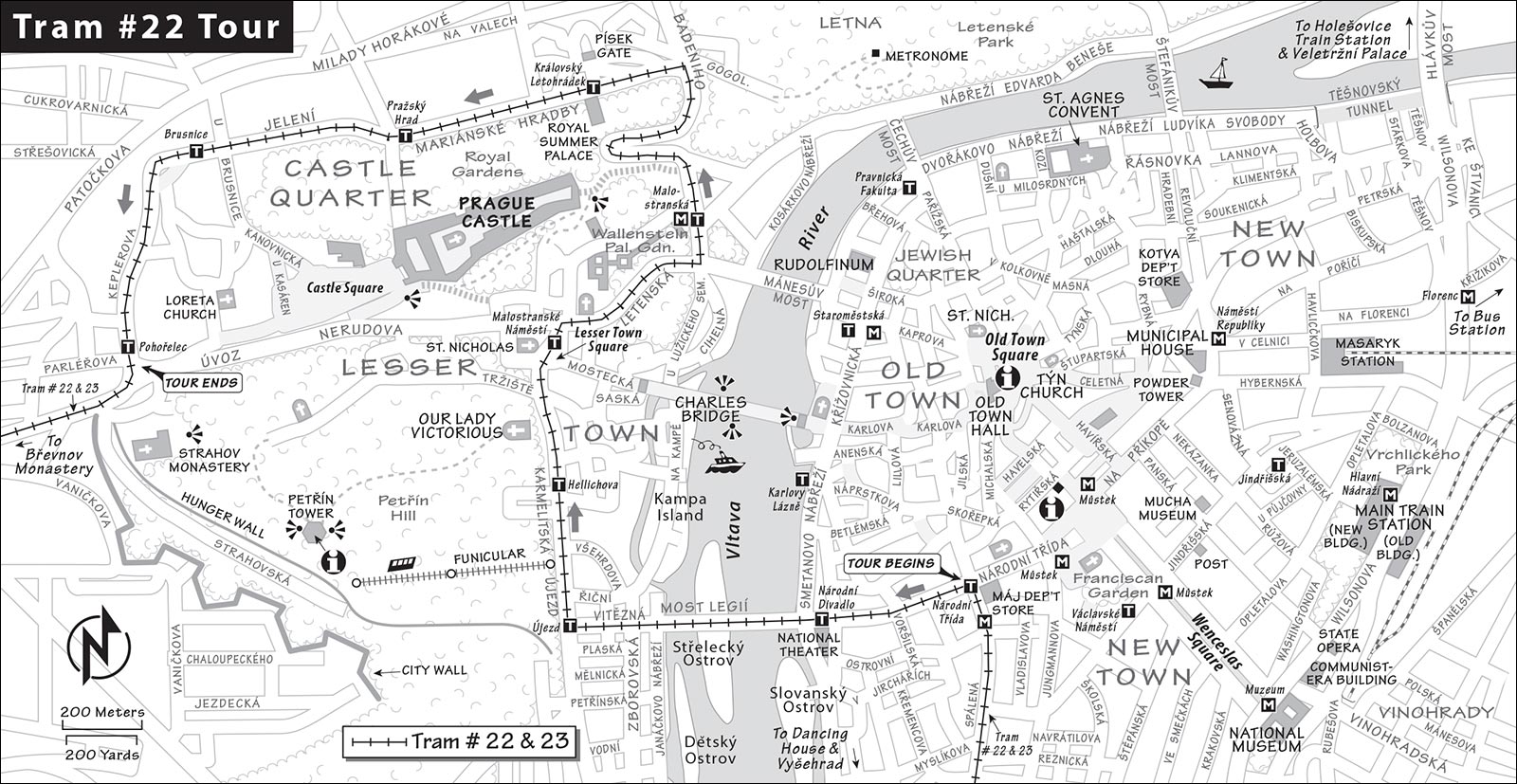
Národní Třída: Start here on the same side of Spálená street as the iconic Máj department store. The tram will turn and rattle along National Street (Národní Třída)—once the moat just outside the city fortifications. The Old Town is to your right. On the left is a collection of theaters new and old. (For details on this stretch—which makes a nice walk for a dose of modern Prague—see here.)
Národní Divadlo: The National Theater is on your left and the venerable old Slavia café is on the right. This is the last stop before crossing the Vltava River. You’re near the boat-rental scene (island with rental wharfs) and the romantic beach island. The Dancing House (designed by Frank Gehry), while hard to see, is 400 yards to the left. As you cross the bridge, look right to enjoy scenes of paddle boaters, the Charles Bridge, and Prague Castle on the hill. Hitting the west bank of the river you enter a former working-class district that is now quite classy and has few tourists.
Újezd: The tram turns at Petřín Park. At the corner (on the left) leading down from the park is the Monument to Victims of Communism—with bronze figures descending the steps (described on here). Nearby, a funicular leads to the Eiffel-like Petřín Tower.
Hellichova: The tram now heads north, paralleling Kampa Island on the river side (to the right) and passing the Church of Our Lady Victorious (on the left), popular with pilgrims for its Infant Jesus of Prague. The area beyond the church is the embassy district, leading up toward the castle and the Czech president’s office. As the tram makes a little bump uphill, look right for a peekaboo view of the Charles Bridge before you stop in the main square of the Lesser Town.
Malostranské Náměstí: This is the closest stop to the Charles Bridge, on the Lesser Town’s main square, which is dominated by the Church of St. Nicholas. If you get off here, you can hike up Nerudova street to Prague Castle. Pulling away, you pass the Czech parliament and government buildings on the left.
Malostranská: On the left (behind the Metro station) is the entry to the Wallenstein Palace Garden. On the right, a bridge leads across the Vltava River to the Neo-Renaissance Rudolfinum concert hall and the Jewish Quarter. From this stop it’s a pleasant stroll down to the riverbank for great Charles Bridge views.
The tram now climbs uphill, entering a park-like zone outside the castle walls. Enjoy the view over the city’s spires. Just after the tram completes its climb up the hill and makes a sharp left turn, you’ll see the Písecká Brána gate on your right, one of the few preserved gates from Prague’s 18th-century fortification system.
Královský Letohrádek (Royal Summer Palace): Immediately across the street on the left is the Royal Summer Palace and its entrance/security gate (with few crowds), the Royal Gardens leading fragrantly to Prague Castle, and a public WC. This is the place to enter Prague Castle the scenic way (see the sidebar on here).
Pražský Hrad (Prague Castle): This stop is closest to the main castle entrance. Climbing higher yet, you’ll see Petřín Hill on the left. And...wait...is that the Eiffel Tower peeking up over the tree line? No, it’s the Petřín Tower.
Brusnice: From here you can explore the Nový Svět (New World) neighborhood, a time capsule of cobblestone streets and tiny houses with no shops or tourists. (To reach this area from the stop, walk across the small park that has a statue—just ahead on the left—then go down the steps). The tram now winds through a greenbelt built along the remains of the city wall.
Pohořelec: This is the stop closest to the Strahov Monastery. Hop out here, next to the statues of astronomers Tycho Brahe and Johannes Kepler (who once had a lab here), and it’s all downhill (for directions to the monastery, see here). Or catch a tram going the opposite direction to do this trip in reverse.
Extending the Route: To experience workaday Prague without a hint of tourism, stay on the tram three more stops to Drinopol (only possible on tram #22). Browse organic shops and Greek cheese stores, indicating that this 1930s neighborhood is now populated by cosmopolitan young families. Sit down for a fine meal at the $$ U Bílého Lva (“By the White Lion,” daily, Bělohorská 79, +420 233 355 909, just left as you get off the tram) or choose from a wide array of poppyseed pastries in the tiny bakery-cum-café across the street.
You can also walk or take the tram two stops farther to Břevnovský Klášter (Břevnov Monastery, five stops after Pohořelec) to reach a peaceful Benedictine monastery built in a pleasantly simple Baroque style with a garden, a rustic restaurant, and the recommended Hotel Adalbert. To get back to the Strahov Monastery and the castle at any point, simply take tram #22 back in the other direction.