JEWISH QUARTER TOUR
Josefov
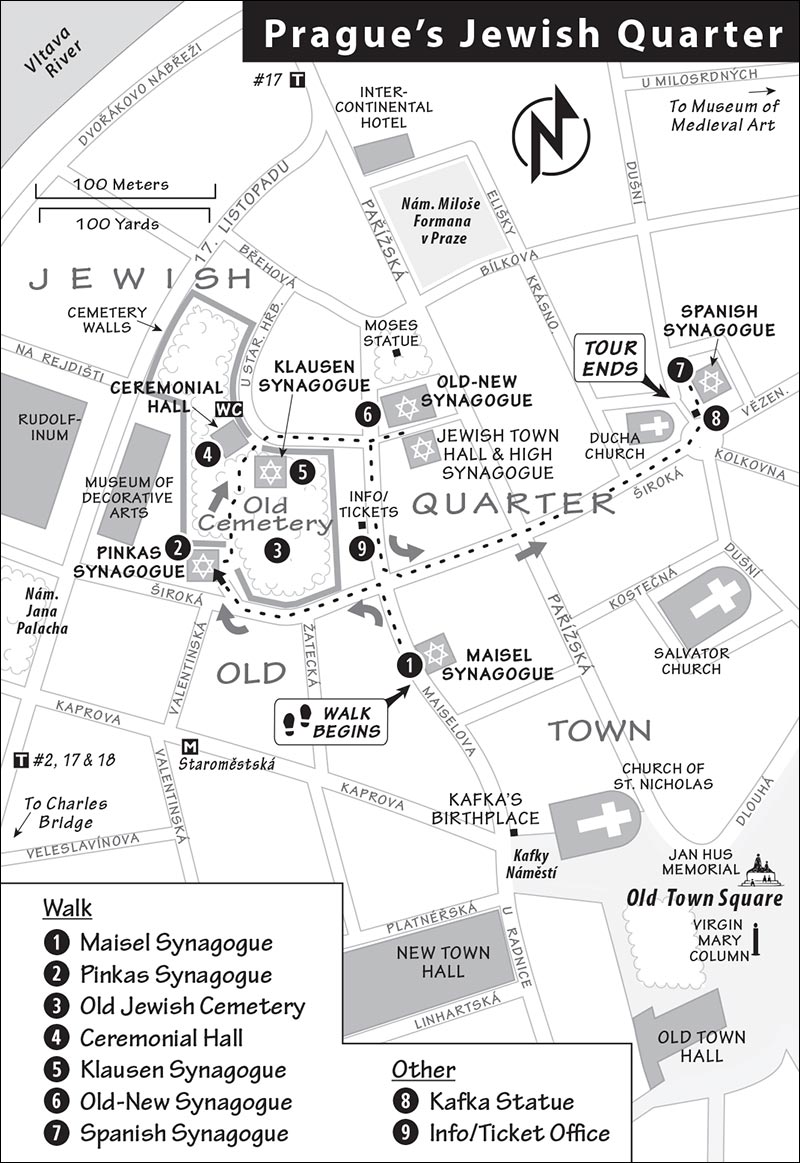
1 Maisel Synagogue (Maiselova Synagóga)
2 Pinkas Synagogue (Pinkasova Synagóga)
3 Old Jewish Cemetery (Starý Židovský Hřbitov)
4 Ceremonial Hall (Obřadní Síň)
5 Klausen Synagogue (Klauzová Synagóga)
6 Old-New Synagogue (Staronová Synagóga, a.k.a. Altneuschul)
7 Spanish Synagogue (Španělská Synagóga)
The fluctuating fortunes of Central Europe’s Jews are etched in the streets of Prague’s historic Jewish Quarter. This three-block area in the Old Town has been home to a Jewish community for a thousand years. The neighborhood features several impressive synagogues (including the oldest medieval one in Europe), an evocative cemetery, a powerful memorial honoring Czech Jews murdered in the Holocaust, and engaging exhibits on Jewish customs and tradition.
All but one of the sights are part of the Jewish Museum in Prague (Židovské Muzeum v Praze) and are treated as a single attraction. The remaining sight is the Old-New Synagogue. For me, this is the most interesting collection of Jewish sights in Europe, and—despite the high admission cost—well worth seeing.
PLANNING YOUR TIME
You can see the sights in any order. My tour starts at the Maisel Synagogue, with interactive exhibits that give a good introduction to Jewish history in Bohemia. Next is the Jewish Quarter’s most popular (and crowded) sight, the Pinkas Synagogue, a sobering reminder of Holocaust victims. This leads into the Old Jewish Cemetery, crowded with tombstones. The small Ceremonial Hall covers burial rites, and the Klausen Synagogue has an exposition on the cycle of Jewish holidays and the accompanying rituals. Break for coffee, then visit the Old-New Synagogue to soak up its majestic, medieval ambience. Finish with the ornately decorated Spanish Synagogue and its fine exhibits that bring Jewish history up to the moment.
Alternatively, you could plan your time around the crowded Pinkas Synagogue. Ideally, be there right as it opens to avoid the crowds. A more leisurely option (involving some backtracking) is to see the sights in roughly chronological order: Start with the Old-New Synagogue (medieval ambience), move on to the Klausen and Maisel (with their helpful museum displays), and then visit the Spanish Synagogue (modern Jewish history). Late in the day when the crowds have died down, finish with the powerful Pinkas.
Orientation
Cost: You have three options: Ticket #1 (“Jewish Town of Prague”)—550 Kč, covers all six Jewish Museum sights plus the Old-New Synagogue; Ticket #2—400 Kč, covers Jewish Museum sights only; Ticket #3—220 Kč, covers the Old-New Synagogue only. Tickets are good for a week.
Hours: The six Jewish Museum in Prague sights are open Sun-Fri 9:00-18:00, Nov-March until 16:30, closed year-round on Sat and Jewish holidays; check the website for a complete list of holiday closures, especially if visiting in the fall. The Old-New Synagogue is open Sun-Thu 9:00-18:00, off-season until 17:00, Fri closes one hour before sunset, closed Sat and Jewish holidays.
Information: Jewish Museum in Prague, +420 222 317 191, www.jewishmuseum.cz; Old-New Synagogue, +420 222 317 191, www.synagogue.cz.
Buying Tickets and Avoiding Lines: Tickets are sold in person and on the Jewish Museum and Old-New Synagogue websites. In person, buy your ticket at the Maisel or Klausen synagogues or at the Information Center at Maiselova 15 (near the intersection with Široká street). Avoid buying at the Pinkas Synagogue, which tends to have long lines.
The Pinkas Synagogue can be packed, especially between 10:00 and 11:30, so consider getting there right as it opens or later in the day.
Dress Code: Men are expected to cover their heads when entering an active synagogue or cemetery. While you’ll see many visitors ignoring this custom, it’s respectful to bring a cap or borrow a museum-issued yarmulke.
Getting There: The Jewish Quarter is an easy walk from Old Town Square, up delightful Pařížská street (next to the green-domed Church of St. Nicholas). The Staroměstská Metro stop is just a couple of blocks away.
Tours: The neighborhood is easy to see on your own using this chapter, and you’ll find thoughtful information in English posted throughout the quarter. Guided tours are probably unnecessary (though I’ve listed one option—Wittmann Tours; see also my recommendations for local guides, some of whom specialize in Jewish Quarter tours; for details, see “Tours in Prague” on here). The audioguide (300 Kč) is probably more information than you’ll need.
Length of This Tour: Allow three hours (which can be split over several days—your ticket is good for a week). With limited time, focus on the Old-New Synagogue (for the ambience); the Pinkas Synagogue and Old Jewish Cemetery (for the history); and the Klausen Synagogue (for the exhibits).
Services: A café and WCs are at the ticket office at Maiselova 15. Two more WCs are at the exit from the cemetery and on the second floor of the Spanish Synagogue.
Eating: For recommended restaurants in this neighborhood, see here.
Nearby: The fine Museum of Medieval Art is only a few blocks from the Spanish Synagogue (see the next chapter).
Starring: The synagogues and cemetery of a faith and culture that has left its mark on Prague.
BACKGROUND
The Jewish people from the Holy Land (today’s Israel and Palestine) were dispersed by the Romans nearly 2,000 years ago. Over the centuries, their culture survived in enclaves throughout the world; it was said that “the Torah was their sanctuary, which no army could destroy.”
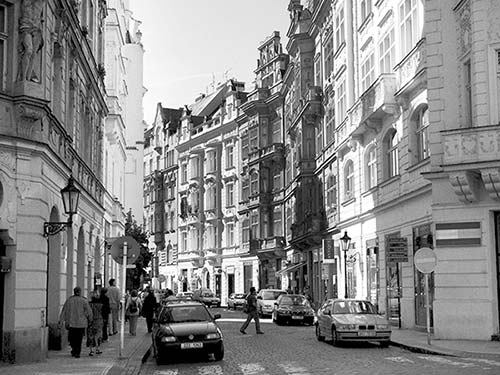
Jews first came to Prague in the 10th century. The least habitable, marshy area closest to the bend was allotted to the Jewish community. The Jewish Quarter’s main intersection (Maiselova and Široká streets) was the meeting point of two medieval trade routes. For centuries, Jews coexisted—at times tensely—with their non-Jewish Czech neighbors.
During the Crusades in the 12th century, the pope declared that Jews and Christians should not live together. Jews had to wear yellow badges, and their quarter was walled in and became a ghetto (minority neighborhood) of wooden houses and narrow lanes. In the 16th and 17th centuries, Prague had one of the biggest ghettos in Europe, with 11,000 inhabitants. Within its six gates, Prague’s Jewish Quarter was a gaggle of 200 wooden buildings.
Faced with institutionalized bigotry and harassment, Jews relied mainly on profits from moneylending (forbidden to Christians) and community solidarity to survive. While their money bought them protection (the kings taxed Jewish communities heavily), it was often also a curse. Throughout Europe, when times got tough and Christian debts to the Jewish community mounted, entire Jewish communities were evicted or killed. The worst pogroms were in 1096 and in 1389, when around 3,000 Jews were killed.
In 1781, Emperor Josef II, motivated more by economic concerns than by religious freedom, eased much of the discrimination against Jews. In 1848, the Jewish Quarter’s walls were torn down, and the neighborhood—named Josefov in honor of the emperor who provided this small measure of tolerance—was incorporated as a district of the Old Town.
In 1897, ramshackle Josefov was razed and replaced by a new modern town—the original 31 streets and 220 buildings became 10 streets and 83 buildings. They leveled the medieval-era buildings (except the synagogues) and turned this into perhaps Europe’s finest Art Nouveau neighborhood. Here (and all along this walk) you’ll enjoy stately facades with gables, turrets, elegant balconies, mosaics, statues, and all manner of architectural marvels. By the 1930s, Prague’s Jewish community was prospering.
But then World War II hit. Of the 55,000 Jews living in Prague in 1939, just 10,000 survived the Holocaust to see liberation in 1945. And in the communist era—when the atheistic regime was also anti-Semitic—recovery was slow.
Today Prague’s Jewish community numbers about 7,000 people. A community school run by the Lauder Foundation is popular among Jews and non-Jews alike. And while today’s modern grid plan has replaced the higgledy-piggledy medieval streets of old, Široká (“Wide Street”) remains the main street. A few Jewish-themed shops and restaurants in the area add extra ambience to this (otherwise modern) neighborhood.
The Tour Begins
• The center of the neighborhood is the intersection of Maiselova and Široká streets. A half-block south on Maiselova street is the...
1 Maisel Synagogue (Maiselova Synagóga)
Renovated in gentle pastel colors, this synagogue was built as a private place of worship for the Maisel family during the late 16th century. This was a “golden age” for Prague’s Jews, when Habsburg rulers lifted the many bans and persecutions against them. Maisel, the wealthy financier of the Habsburg king, lavished his riches on this synagogue.
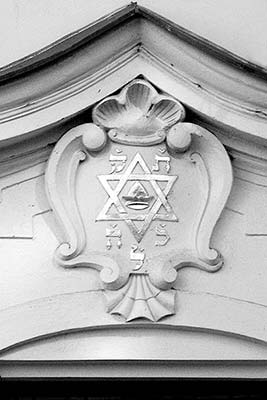
Before entering, notice the facade featuring the Ten Commandments top and center (standard in synagogues). Below that is the symbol for Prague’s Jewish community: the Star of David, with the pointed hat local Jews wore here through medieval times. Notice how the facades on the adjacent two apartment blocks include hints of ramparts, crenulations, and Neo-Gothic windows to match the style of the synagogue.
Inside, the interactive exhibit retraces a thousand years of Jewish history in Bohemia and Moravia. Well explained in English, topics include the origin of the Star of David, Jewish mysticism, the golem legend, the history of discrimination, and the creation of Prague’s ghetto. Pre-WWII photographs of small-town synagogues from the region are projected on a large screen. Notice the eastern wall, with the holy ark containing a precious Torah mantel. Look for the banner of the Prague Jewish Butchers Guild, the emblem of the Cobblers Guild, a medieval seal ring, and the bema grillwork from Prague’s demolished Zigeuner Synagogue. A bird’s-eye-view video takes you through the streets of the ghetto as they appear in a 1787 model of Prague.
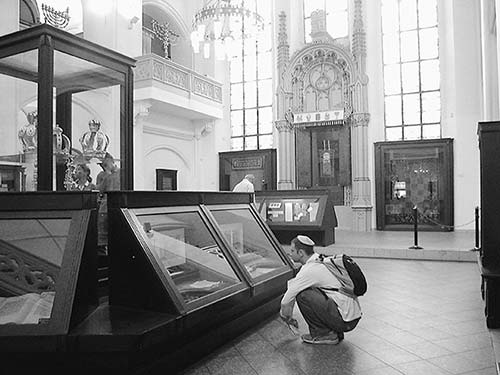
In World War II, this synagogue became a warehouse for Jewish artifacts after the Nazis ordered synagogues to send their riches—Torah scrolls, books, menorahs—to Prague to be catalogued and filed away in the closed-down Jewish museum. The communists reopened the museum but made sure these objects were displayed with little attention to their historical or ritual context.
• Walk to Široká street and turn left—following the cemetery wall—to find the...
2 Pinkas Synagogue (Pinkasova Synagóga)
A site of Jewish worship since the 16th century, this synagogue is certainly historic. But these days it’s best known as a poignant memorial to the victims of the Nazis.
Enter and go down the steps leading to the main hall of this small late-Gothic/early-Renaissance synagogue. Aaron Meshulam Horowitz, a prosperous merchant and man of influence in his day, built the synagogue in 1535. Notice the old stone-and-wrought-iron bema in the middle, the niche for the ark at the far end, the crisscross vaulting overhead, and the Art Nouveau stained glass filling the place with light.
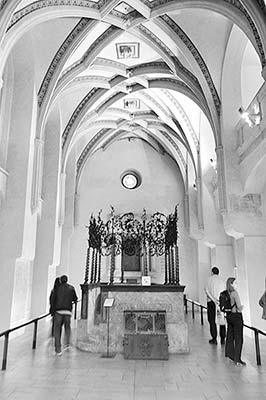
But the focus of this synagogue is its walls, inscribed with the handwritten names of 77,297 Czech Jews sent to the gas chambers at Auschwitz and other camps. Czech Jews were especially hard hit by the Holocaust. More than 155,000 of them passed through the nearby Terezín camp alone. Most died with no grave marker, but they are remembered here.
The names are carefully organized: Family names are in red, followed in black by the individual’s first name, birthday, and date of death (if known) or date of deportation. Members of the same family are set off from others sharing the same surname by a dot. You can tell by the dates that families often perished together.
The names are gathered in groups by hometowns (listed in gold, as well as on placards at the base of the wall). Prague’s dead fill the main hall. On the ark wall is a list of the ghettos and extermination camps that received Czech Jews—Terezín, as well as Dachau, Bergen-Belsen, and the notorious Oświęcim (Auschwitz). As you ponder this sad sight, you’ll hear the somber reading of the names alternating with a cantor singing the Psalms.
A synagogue (from the Greek word for “gathering place”) is a place of public worship, where Jews gather to pray, sing, and read from the Torah. Most synagogues have similar features, though they vary depending on the congregation.
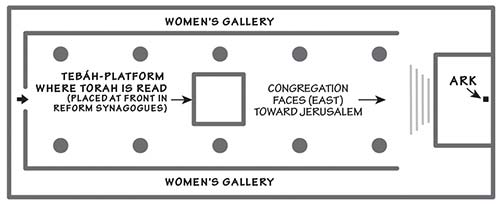
The synagogue generally faces toward Jerusalem (so in Prague, worshippers face east). At the east end is an alcove called the ark, which holds the Torah. These scriptures (the first five books of the Christian Old Testament) are written in Hebrew on scrolls wrapped in luxuriant cloth. The other main element of the synagogue is the bema, a platform from which the Torah is read aloud. In traditional Orthodox synagogues (like the Old-New and Pinkas synagogues), the bema is near the center of the hall, and the reader stands facing the same direction as the congregation. Other branches of Judaism place the bema at the front, and the reader faces the worshippers (like in the Spanish and Jerusalem synagogues).
The synagogue walls might be decorated with elaborate patterns of vines or geometric designs, but never statues of people, as that might be seen as idol worship. A lamp above the ark is always kept lit, as it was in the ancient temple of Jerusalem, and candelabras called menorahs also recall the temple. Other common symbols are the two tablets of the Ten Commandments given to Moses, and the Star of David, representing the Jewish king’s shield.
At a typical service, the congregation arrives at the start of Sabbath (Friday evening). As a sign of respect toward God, men don yarmulkes (small round caps). As the cantor leads songs and prayers, worshippers follow along in a book of weekly readings. At the heart of the service, everyone stands as the Torah is ceremoniously paraded, unwrapped, and placed on the bema. Someone—the rabbi, the cantor, or a congregant—reads the words aloud. The rabbi (“teacher”) might give a commentary on the Torah passage.
Services similar to this have gone on in Prague’s Jewish Quarter for a thousand years.
Among the names are the grandparents of (Prague-born) former US secretary of state Madeleine Albright—Arnošt and Olga Korbel, listed at the far end of the long wall.
Climb eight steps into the women’s gallery, where (as is typical in traditional synagogues) the women worshipped separately from the men. On the left wall, upper part, find some names in poor condition. These are originals, and some of the oldest. The name project began in the 1950s. But the communist regime closed the synagogue and erased virtually everything. With freedom, in 1989, the Pinkas Synagogue was reopened and many names had to be rewritten.
On your way out, watch on the right for the easy-to-miss stairs up to the small Terezín Children’s Art Exhibit. Well described in English, these drawings were made by Jewish children imprisoned at Terezín, 40 miles northwest of Prague (a worthy day trip from here). This is where the Nazis shipped Prague’s Jews for processing before transporting them east to death camps. Thirty-five thousand Jews died at Terezín of disease and starvation, and many tens of thousands more died in other camps.
Of the 8,000 children transported from Terezín, only 240 came back. The teacher who led the drawing lessons and hid these artworks believed children could use imagination to liberate their minds from the camp. Their art survives to defy fate. The collection is organized into poignant themes: dreams of returning to Prague, yearning for a fantasized Holy Land, memories of the simple times before imprisonment, biblical and folkloric tales focusing on the themes of good and evil, and scenes of everyday life at Terezín.
Apart from the Jews, Nazis also targeted the Roma (Gypsies), as well as homosexuals. The site of the Roma transit camp in Lety (40 miles south of Prague), which was run by Czech (rather than German) police, was only bought by the Czech government in 2018, and is now finally being turned into a proper memorial to this—for many years overlooked—aspect of the Holocaust.
• Exiting the Pinkas Synagogue, the visit leads up several stairs into the adjoining cemetery.
3 Old Jewish Cemetery (Starý Židovský Hřbitov)
Enter one of the most wistful scenes in Europe—Prague’s Old Jewish Cemetery—and meander along a path through 12,000 evocative tombstones. They’re old, eroded, inscribed in Hebrew, and leaning this way and that. A few of the dead have larger ark-shaped tombs. Most have a simple epitaph with the name, date, and a few of the deceased’s virtues. Among the dead buried here are Aaron Meshulam Horowitz (builder of the Pinkas Synagogue), Mordechai Maisel (of the Maisel Synagogue), and Rabbi Loew (of golem fame; see “From Golems to Robots” sidebar, later).
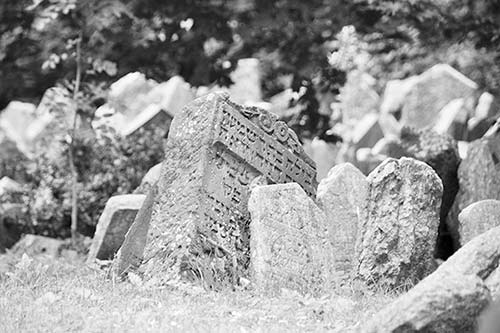
From 1439 until 1787, this was the only burial ground allowed for the Jews of Prague. Over time, the bodies had to be stacked on top of each other—seven or eight deep—so the number of people buried here is actually closer to 85,000. Graves were never relocated because of the Jewish belief that, once buried, a body should not be moved. Layer by layer, the cemetery grew into a small plateau. And as things settled over time, the tombstones became crooked. Tune in to the noise of passing cars outside, and you realize that you’re several feet above the modern street level—which is already high above the medieval level.
People place pebbles on honored tombstones. This custom, a sign of respect, shows that the dead have not been forgotten and recalls the old days, when rocks were placed upon a sandy gravesite to keep the body covered. Others leave scraps of paper that contain prayers and wishes. The most popular tombstone on which to place pebbles, coins, and paper is the reddish tomb found alongside the wall (the path leads right by it). This is the burial site of Prague’s beloved Rabbi Loew. The cemetery is called Beth Chaim in Hebrew, meaning “House of Life.”
• The cemetery visit spills out at the far end, right at the entrances to the Ceremonial Hall (on your left) and Klausen Synagogue (right).
4 Ceremonial Hall (Obřadní Síň)
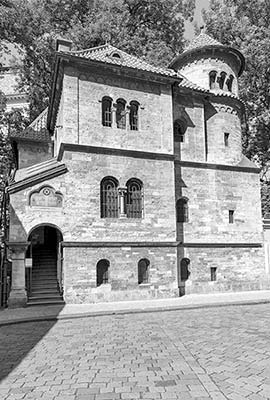
This rustic stone tower (1911) was a mortuary house used to prepare the body and perform purification rituals before burial. The inside is painted in fanciful, flowery Neo-Romanesque style. It’s filled with a worthwhile exhibition on Jewish medicine, death, and burial traditions. A series of crude but instructive paintings (c. 1780, hanging on walls throughout the house) show how the “burial brotherhood” took care of the ill and buried the dead. As all are equal before God, the rich and poor alike were buried in embroidered linen shrouds similar to the one you’ll see on display.
• Next door is the...
5 Klausen Synagogue (Klauzová Synagóga)
The 17th-century Baroque-style synagogue is impressive and historic—again, locate the bema, the ark, and the women’s gallery above—but the focus here is the displays on Jewish religious practices.
Ground-floor displays touch on Jewish holidays. The bema displays a Torah (the first five books of the Christian Old Testament) and the solid silver pointers used when reading it—necessary since the Torah is not to be touched. Now start at the entrance and work clockwise. In the first big, horizontal display case, the biggest book is a Torah (1444) associated with the great medieval philosopher Maimonides. The second display case has shofar horns, blown ritually during Jewish high holy days. Up in the elevated area, the ark contains elaborately wrapped Torah scrolls ornamented with silver. In the next cases you’ll see a seder plate, used to serve the six traditional foods of Passover; a tiny “Omer Calendar,” an ingenious device used to keep track of the holidays; and a palm frond (lulav), waved when reciting a blessing during the holiday of Sukkot. At the back of the synagogue are objects from the Prague community, including menorahs used in both synagogues and the Hanukkah celebration.
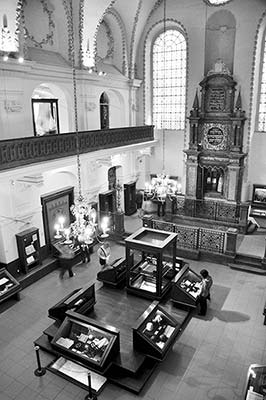
Upstairs, exhibits illustrate the rituals of everyday Jewish life. It starts at birth. There are good-luck amulets to ensure a healthy baby, and a wooden cradle that announces, “This little one will become big.” A male baby is circumcised (see the knife). The baby grows to celebrate a coming-of-age Bar or Bat Mitzvah around age 12 or 13. Marriage takes place under a canopy, and the couple sets up their home—the exhibit ends with some typical furnishings.
• Exiting the synagogue, turn right and go one block down to the...
6 Old-New Synagogue (Staronová Synagóga, a.k.a. Altneuschul)
For more than 700 years, this has been the most important synagogue and the central building in Josefov. Built in 1270, it’s the oldest synagogue in Central Europe (and some say the oldest still-working synagogue in all of Europe). A prosaic explanation derives the name from the fact that it was “New” when built but became “Old” when other, newer synagogues came on the scene. A more intriguing theory proposes that altneu is the German spelling of the original Hebrew al-tenai (meaning “on condition”). According to a legend, the foundation stones of the Altneuschul were brought by angels from the destroyed Holy Temple in Jerusalem “on condition” they be returned when the original temple is restored. The building’s exterior is simple, with a unique sawtooth gable. Standing like a reinforced bunker, it feels as though it has survived plenty of hard times.
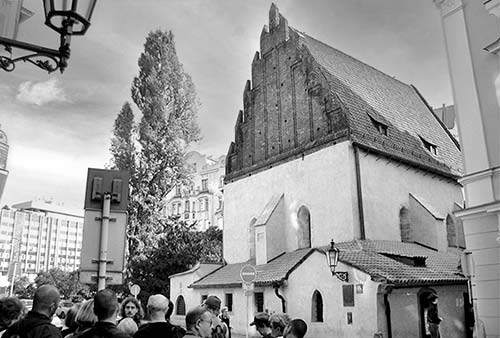
As you enter, you descend a few steps below street level to 13th-century street level and the medieval world.
The interior is pure Gothic—thick pillars, soaring arches, and narrow lancet windows. If it looks like a church, well, the architects were Christians. The stonework is original, and the woodwork (the paneling and benches) is also old. This was one of the first Gothic buildings in Prague.
Seven centuries later, it’s still a working synagogue. There’s the stone bema in the middle where the Torah is read aloud, and the ark at the far end, where the sacred scrolls are kept. To the right of the ark, one chair is bigger, with a Star of David above it. This chair always remains empty out of respect for great rabbis of the past. Where’s the women’s gallery? Here, women worshipped in rooms that flanked the hall, watching the service through those horizontal windows in the walls.
The big red banner rising above the bema is (a copy of) a gift from Charles IV, given in honor of the Jewish community’s service to the crown. For centuries it has been proudly carried by the Jewish community during parades. On the banner is a Star of David and the Hebrew prayer at the heart of the service: “Hear, O Israel...” Within the Star of David is pictured the yellow-pointed hat that Jewish men were obliged to wear.
Twelve is a popular number in the decor, because it symbolizes the 12 tribes of Israel: There are 12 windows, 12 vines in the frieze at the base of the bema, 12 bunches of grapes carved over the entrance, and so on. While Nazis routinely destroyed synagogues, this most historic synagogue in the country survived because the Nazis intended it to be part of their “Museum of the Extinct Jewish Race.”
Jews were not permitted in the Stonemasons Guild, but it’s nonetheless taken as a sign of how well Prague’s Jews were doing that guild members built this Jewish place of worship (the same stonemasons also built the nearby Convent of St. Agnes). Notice that they outfitted the ceiling with clumsy five-ribbed vaulting. The builders were good at four-ribbed vaulting, but it wasn’t right for a synagogue, because it resulted in a cross.
Before leaving, check out the lobby (the long hall where you show your ticket). It has two fortified old lockers—in which the most heavily taxed community in medieval Prague stored its money in anticipation of the taxman’s arrival.
The Baroque building across the street, the only secular survivor of the ghetto clearing, is the former Jewish town hall. Check out the decorative Stars of David with yellow hats in the center, as well as the Hebrew numbered clock on the roof. In keeping with the fact that Hebrew reads from right to left, this clock moves counterclockwise.
• The Spanish Synagogue is four blocks from here. Before moving on, check out the dynamic statue of a kneeling man in the adjacent park: This is Moses in the act of inscribing the name of Adam on parchment, symbolizing the start of the human journey.
To reach the Spanish Synagogue, head up Maiselova street (toward Old Town Square), and turn left on Široká, which leads to the...
7 Spanish Synagogue (Španělská Synagóga)
In its size and ornateness, this building is typical of many synagogues built around Central Europe in the late 1800s. With the reforms accompanying the transformation of the Austro-Hungarian Empire in 1867, Jews were finally granted full rights. To express their new self-confidence, Jews built in a deliberately distinct style that evoked their golden days in Muslim-ruled Spain (rather than emulating the church architecture of the time). Recently renovated, the Spanish Synagogue should have reopened by the time you visit. Be aware that some details may have changed from what’s described here.
Before entering, circle around the left side of the building for a better view of the facade. It’s called “Spanish,” but the style is really Moorish: horseshoe arches atop slender columns, different colored stone, elaborate tracery, and topped with pseudo-minarets. Though the building is relatively new, it stands on the site of Prague’s oldest synagogue (from c. 1150), which burned down during the pogrom of 1389. Notice that there are two churches (Catholic and Protestant) directly across the street, separating the Spanish Synagogue neighborhood from the rest of the former ghetto. This is a holdover from medieval times, when Prague had two separate Jewish communities: one centered on today’s Maiselova street, the other on what is now the Spanish Synagogue.
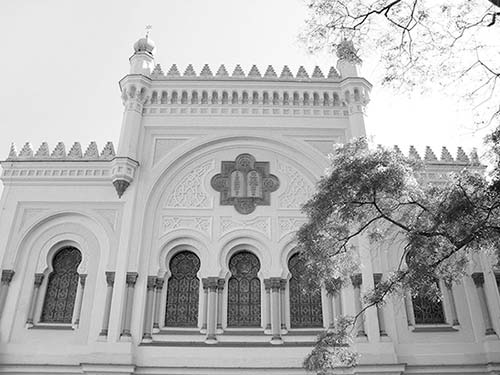
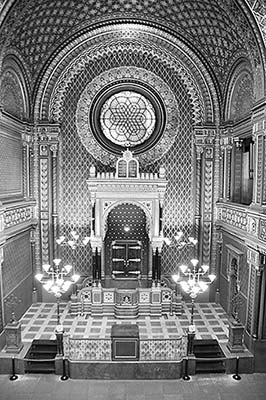
Inside, the decor is exotic and awe-inspiring. Intricate interweaving designs (of stars and vines) cover every inch of the red-gold and green walls and ceiling. A rose window with a stylized Star of David graces the ark.
The new synagogue housed a new movement within Judaism—a Reform congregation—that worshipped in a more modern way. The bema has been moved to the front of the synagogue, so the officiant faces the congregation. There’s also a prominent organ (upper right) to accompany the singing.
Displays of Jewish history bring us through the 18th, 19th, and tumultuous 20th centuries to today. In the 1800s, Jews were increasingly accepted and successful in the greater society. But tolerance brought a dilemma—was it better to assimilate within the dominant culture or to join the growing Zionist homeland movement? To reform the religion or to remain orthodox?
Upstairs, the balcony exhibits focus on Czech Jews in the 1900s. Start in the area near the organ, which explains the modern era of Jewish Prague, including the late-19th-century development of Josefov. Then work your way around the balcony, with exhibits on Jewish writers (Franz Kafka), philosophers (Edmund Husserl), and other notables (Freud). This intellectual renaissance came to an abrupt halt with World War II and the mass deportations to Terezín (see more sad displays on life there, including more children’s art and a box full of tefillin prayer cases). The final displays bring it home: After 2,000 years of living away from their Holy Land roots, the Jewish people had a homeland—the modern nation of Israel. Finish your visit across the landing in the Winter Synagogue, showing a trove of silver—Kiddush cups, Hanukkah lamps, Sabbath candlesticks, and Torah ornaments. This collection got its start in the early 20th century, when the Jewish Museum was formed—and began its important work of preserving places and artifacts that otherwise might have been forever lost.
• Next to the Spanish Synagogue is a bizarre 8 statue by Jaroslav Róna commemorating the writer Franz Kafka. It’s a reference to a short story by Kafka (“Description of a Struggle”) in which the oppressed protagonist is carried through an imaginary landscape on the shoulders of a headless giant, which supposedly represents his other, dominant self.
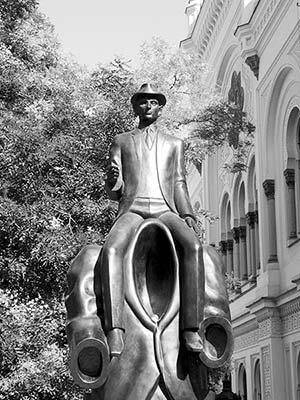
Our walk is over. You’ve explored the story of one of countless Jewish communities in Europe with an important story to tell.