OLD TOWN & CHARLES BRIDGE WALK
Staré Město & Karlův Most
1 Jan Hus and Virgin Mary Monuments
Map: Old Town & Charles Bridge Walk
2 Old Town Square Orientation Spin-Tour
3 Old Town Hall and Astronomical Clock
6 Church of St. James (Kostel Sv. Jakuba)
8 House of the Black Madonna (Dům u Černé Matky Boží)
9 Estates Theater and Charles University
10 Powder Tower
11 Municipal House (Obecní Dům)
12 Na Příkopě, the Old City Wall
16 Charles IV Statue: The Bohemian Golden Age
18 Charles Bridge (Karlův Most)
Nestled in the bend of the river is Prague’s compact, pedestrian-friendly Old Town. It’s also Prague’s tourism ground zero, jammed with tasteful landmarks and tacky amusements alike.
A boomtown since the 11th century, the Old Town has long been the busy commercial quarter, filled with merchants, guilds, students, and supporters of the Church and social reformer Jan Hus (who wanted a Czech-style Catholicism). Here Prague feels like the Gothic metropolis that it—at its heart—still is.
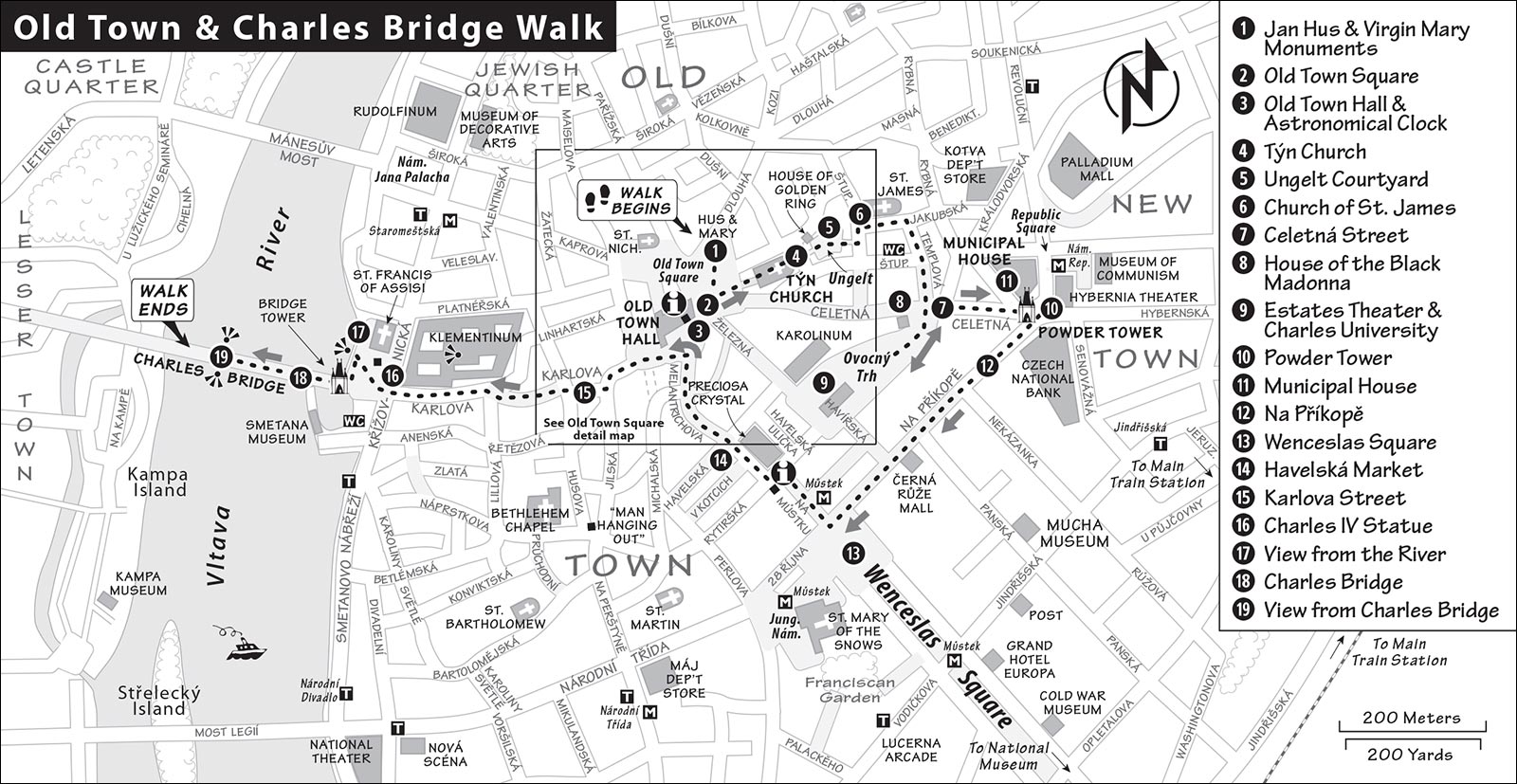
This walk starts in the heart of the neighborhood, the Old Town Square. From here we’ll snake through the surrounding neighborhood, get a glimpse of the New Town (at Wenceslas Square), and end at the river, on the Charles Bridge—one of the most atmospheric spots in all of Europe.
Along the way, we’ll see Gothic churches with Baroque interiors, Renaissance gables, Art Nouveau facades, and a curious old clock. And we’ll learn the story of how the Czech people have courageously fought against foreign oppression, from Austrian Habsburgs to German Nazis to Soviet communists.
Orientation
Length of This Walk: Allow three hours for this walk. It’s a great overview of sights you may want to visit in depth later.
Crowd Warning: Much of this walk is packed with sightseers all day long. A huge bottleneck occurs in front of the Astronomical Clock near the top of each hour.
Getting There: This walk begins right on the Old Town Square, Prague’s centerpiece.
Týn Church: 40 Kč requested donation, generally open to sightseers Tue-Sat 10:00-13:00 & 15:00-17:00, Sun 10:30-12:00, closed Mon.
Old Town Hall Tower and Tour: 300 Kč for Old Town Hall and tower ascent, discount for advance purchase online; Tue-Sun 9:00-21:00, Mon from 11:00, shorter hours Jan-March; 45-minute Town Hall tours usually 4/day in English at 10:00, noon, 14:00, and 16:00—preregister at ticket office; +420 775 400 052, www.prague.eu.
Church of St. James: Free, Tue-Sun 9:30-12:00 & 14:00-16:00, closed Mon.
Municipal House: Free to view entrance halls and public spaces; daily 10:00-18:00; tours—290 Kč, usually 3/day, departures 11:00-17:00.
Havelská Market: Open-air market open daily 9:00-18:00; fruit, souvenirs, puppets, and toys on weekends.
Klementinum: 300 Kč, tours depart daily every half-hour 10:00-17:30, shorter hours off-season.
Charles Bridge Tower Climb: 150 Kč, daily 9:00-21:00, April-May and Sept 10:00-19:00, Oct-March until 18:00.
Starring: Prague’s showpiece main square, fine old churches, architectural landmarks, and the spunky Czech spirit.
The Tour Begins
• Plant yourself anywhere in the Old Town Square and survey the scene.
You’re standing in the center of historic Prague, a city of 1.3 million people and the capital of the Czech Republic. The vast square (worth ▲▲▲) is ringed with colorful buildings; dotted with towers, steeples, and statues; lined with cafés; and alive with people. It seems there’s always something entertaining happening here.
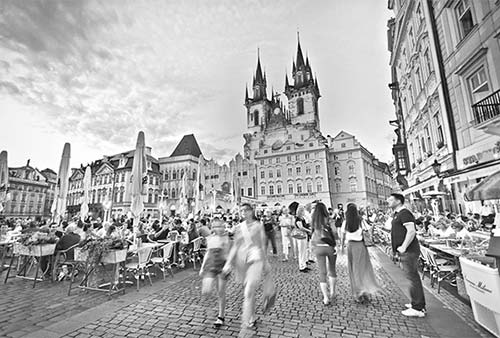
This has been a market square since the 11th century. It became the nucleus of the Old Town (Staré Město) in the 13th century, when its Town Hall was built. In the past, it was the site of commerce, parades, demonstrations, and executions. Today, the old-time market stalls have been replaced by outdoor cafés and the tackiest breed of souvenir stands. But you’re surrounded by plenty of history.
• Begin with the square’s centerpieces, the...
1 Jan Hus and Virgin Mary Monuments
The first monument, the Jan Hus Memorial, was erected in 1915 and is an enduring icon of the long struggle for (Czech) freedom. In the center, Jan Hus—the reformer who became the symbol of Czech nationalism—stands tall amid the rising flames. Hus, born in 1369, was a priest who challenged both the Church’s and the secular rulers’ claim to dominion. His defiant stance—depicted so powerfully in this monument—galvanized the Czech people, who rallied to fight not just for their religious beliefs but for independence from any man-made (rather than natural, or God-given) controls.
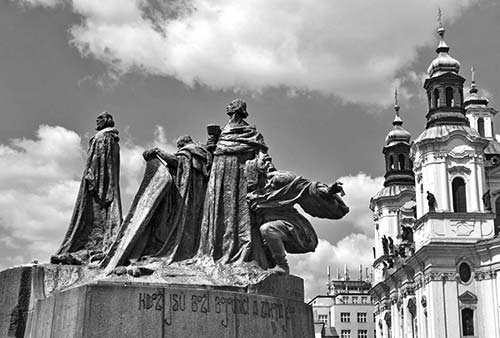
But Hus was centuries ahead of his time. He was arrested, charged with heresy, excommunicated, and, in 1415, burned at the stake. His followers, called Hussites, picked up the torch and fought on for two decades in the Hussite Wars, which killed tens of thousands and left Bohemia a virtual wasteland.
Surrounding Hus’ statue are the Hussites who battled the entrenched powers of their time. One patriot holds a cup, or chalice. This symbolizes one of the changes the Hussites were fighting for: the right of everyone (not just priests) to drink the wine at Communion. Look into the faces of these medieval warriors of faith—it was a bitter fight. Two hundred years later, in 1620, a disorganized Czech rebellion was crushed by the united Habsburgs at White Mountain just outside Prague—effectively ending Czech independence and freedom of worship for three centuries. Another group of followers chooses exile over submission: Study their dejected and hopeless expressions.
But the story ends well. Huddled just behind Jan Hus are a mother and her children—prophesizing the ultimate rebirth of the Czech nation. And indeed, three years after the statue was unveiled, the Czechs regained their political independence.
Each subsequent age has interpreted Hus to its liking: For Protestants, Hus was the founder of the first Protestant church (though he was actually an ardent Catholic); for revolutionaries, this critic of the temporal powers was a proponent of social equality; for nationalists, this Czech preacher was the defender of the language; and for communists, this ideologue was first to preach the gospel of communal ownership (though he never spoke against individual property per se).
Now turn your attention to the Virgin Mary atop her sandstone column. Originally erected in 1652, shortly after the Thirty Years’ War, the first genuinely Baroque statue in Prague honored Mary as the city’s protector. Mary was intended to rally Catholics and non-Catholics alike—just as they had been rallied four years earlier to defend their homes from Swedish invasion. But by the late 19th century, ardent nationalists had come to perceive this delicate, Bernini-inspired Mary as a symbol of the militantly Catholic Habsburgs. (Cue installation of the Jan Hus Memorial, with Jan’s eyes locked on Mary in a defiant stare-down.)
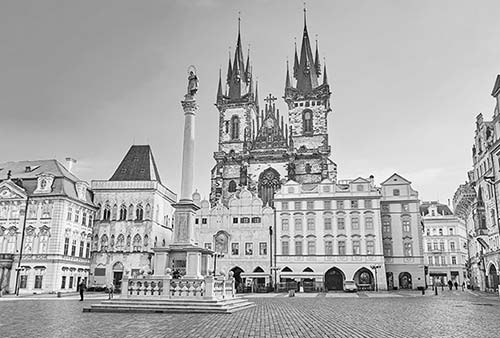
A few days after the declaration of independence in 1918, a rebellious mob turned on the “Habsburg” Virgin, tearing down the column and breaking the statue. At the time, the majority viewed this act as historical vindication. But pious Catholics (the country remained predominantly Catholic even after independence) felt a sense of injustice: Isn’t Mary a symbol of unity and peace?
Under communism there was little chance to restore the monument, but the debate resurfaced after 1989. For 23 years Czech sculptor Petr Váňa worked on a faithful replica. Finally, in 2020, Prague’s city council allowed the Virgin to return to her original spot, reigniting the century-old controversy.
It will take time for Prague’s citizens to get used to having two monuments in the square. Rather than seeing Mary’s return as overcrowding the square and a victory for conservatives, I see it as a sign of a mature democracy that allows minority voices to be heard, and as a more nuanced reflection of the country’s conflicted past. And let’s not forget that Mary’s statue celebrates artistic beauty, and its presence restores meaning to Jan Hus’ equally artistic stare.
• Stepping away from the monuments, stand in the center of the Old Town Square, and take a 360-degree...
2 Old Town Square Orientation Spin-Tour
Whirl clockwise to get a look at Prague’s diverse architectural styles: Gothic, Renaissance, Baroque, Rococo, and Art Nouveau. Prague was largely spared the devastating aerial bombardments of World War II that leveled so many European cities (like Berlin, Warsaw, and Budapest). And—except for the Jewish Quarter—it also avoided the equally destructive urban-renewal projects of the 19th century that had wiped out the medieval fabric of grand capitals such as Paris and Vienna. Few places can match the Old Town Square for Old World charm.
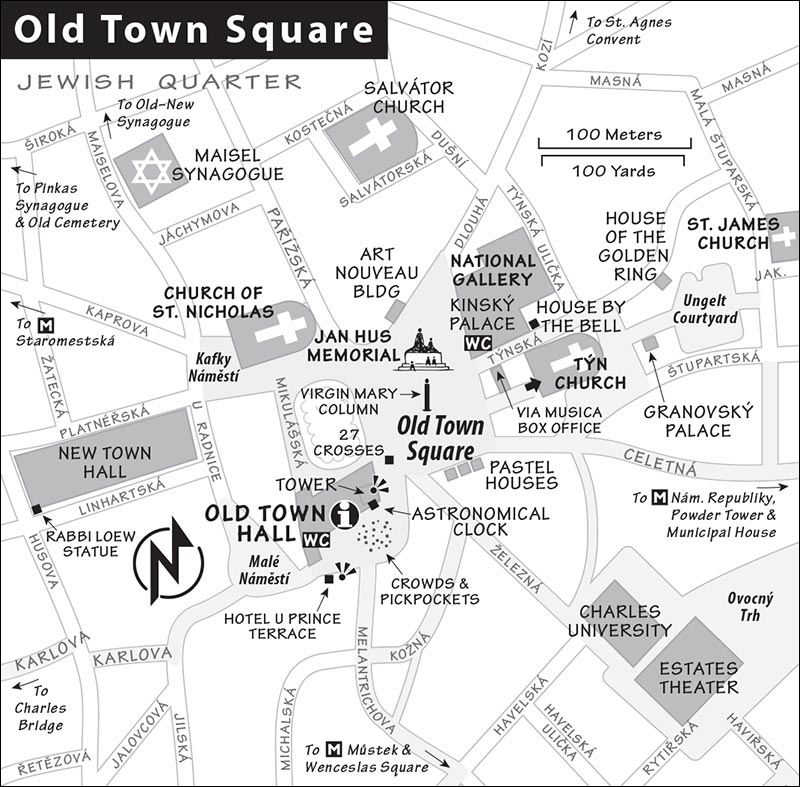
Start with the green domes of the Baroque Church of St. Nicholas. Originally Catholic, now Hussite, this church is a popular concert venue. The Jewish Quarter is a few blocks behind the church, down the uniquely tree-lined “Paris Street” (Pařížská)—which also has the best lineup of Art Nouveau houses in Prague.
Spin to the right. Behind the Hus Memorial is a fine yellow building that introduces us to Prague’s wonderful world of Art Nouveau: pastel colors, fanciful stonework, wrought-iron balconies, colorful murals—and what are those firemen statues on top doing? Prague’s architecture is a wonderland of ornamental details.
Continue spinning a few doors to the right to the large, red-and-tan Rococo Kinský Palace, which displays the National Gallery’s top-notch temporary exhibits (check out what’s on; there’s also a handy WC in the courtyard).
Immediately to the right of the Rococo palace stands the tower-like House by the Bell, one of the finest examples of a 13th-century Gothic patrician house anywhere in Europe (also the oldest building on the square).
Farther to the right is the towering, Gothic Týn Church (pron. “teen”), with its fanciful twin spires. It’s been the Old Town’s leading church in every era. In medieval times, it was Catholic. When the Hussites came to dominate the city (c. 1420s), they made it the headquarters of their faith. After the Habsburg victory in 1620, it reverted to Catholicism. The symbolism tells the story: Between the church’s two towers, find a golden medallion of the Virgin Mary. Beneath that is a niche with a golden chalice. In Hussite times, the chalice symbolized their cause—that all should be able to take Communion. When the Catholics triumphed, they melted down the original chalice and made it into the golden image of Mary. For centuries the niche was empty. In 2016, the chalice—with the Communion wafer added to dispel potential Hussite symbolism—was returned to the niche.
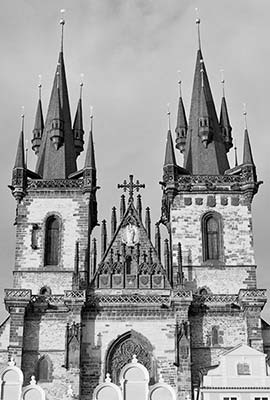
The row of pastel houses in front of Týn Church has a mixture of Gothic, Renaissance, and Baroque facades and gables. If you like live music, the convenient Via Musica box office near the church’s front door has all the concert options; we’ll pass it later on this walk.
Spinning right, to the south side of the square, take in more glorious facades, each a different color with a different gable on top—step gables, triangular, bell-shaped. The tan 19th-century Neo-Gothic house at #16 has a steepled bay window and a mural of St. Wenceslas on horseback.
Finally, you reach the pointed 250-foot-tall spire marking the 14th-century Old Town Hall. In the 19th century, a building was constructed on the square’s west side that once stretched from the Old Town to the Church of St. Nicholas. Then, in the last days of World War II, German tanks knocked it down...to the joy of many Prague citizens who considered it an ugly 19th-century stain on the medieval square.
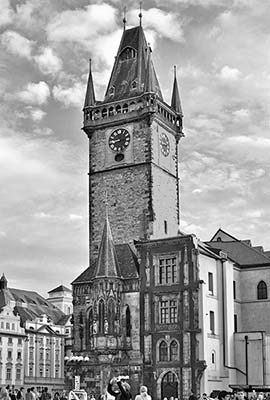
Approach the Old Town Hall. At the base of the tower, near the corner of the tree-filled park, find 27 white crosses inlaid in the pavement. These mark the spot where 27 nobles, merchants, and intellectuals—Protestants and Catholics—were beheaded in 1621 after the White Mountain defeat. This is still considered one of the grimmest chapters in the country’s history.
Jan Hus (c. 1369-1415) lived and preached more than a century before Martin Luther (1483-1546), but they had many things in common. Both were college professors as well as priests. Both drew huge public crowds as they preached in their university chapels. Both condemned Church corruption, promoted local religious autonomy, and advocated for letting the common people participate more in worship rituals. Both established their national languages. (It’s Hus who gave the Czech alphabet its unique accent marks so that the letters could fit the sounds.) And, by challenging established authority, both got in big trouble.
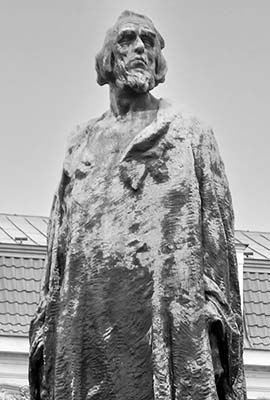
Hus was born in the small southern Bohemian town of Husinec and moved to Prague to study at the university. He served as a rector at Charles University starting in 1402. Preaching from the pulpit in Bethlehem Chapel (still open to the public and described in the Sights in Prague chapter), Hus drew inspiration from the English philosopher John Wycliffe (c. 1320-1384), who was an early advocate of reforming the Catholic Church to strip the clergy of its power.
Hus’ revolutionary sermons drew huge crowds of reverent but progressive-minded Czechs. He proposed that the congregation should be more involved in worship (for example, be allowed to drink the wine at Communion) and have services and scriptures written in the people’s language, not in Latin. Even after he was excommunicated in 1410, Hus continued preaching his message.
In 1414, the Roman Catholic Church convened the Council of Constance to grapple with the controversies of the day. First they posthumously excommunicated Wycliffe, proclaiming him a heretic and exhuming his corpse to symbolically burn at the stake. Then they called Hus to Constance, where on July 6, 1415, they declared him a heretic. After refusing to recant his beliefs and praying that God would forgive his enemies, Hus was tied to a stake and burned alive. But by this time, Hus’ challenging ideas had been embraced by many Czechs and sparked the bloodiest civil war in the country’s history.
The Council, this early Catholic precursor to the Counter-Reformation, kept things under control for three generations. But in the 16th century, a German monk named Martin Luther found a more progressive climate for these same revolutionary ideas. Thanks to the new printing press, and his more widely spoken German language, Luther was able to spread his message cheaply and effectively. While Hus loosened Rome’s grip on Christianity, Luther orchestrated the Reformation that finally broke it. Today, both are honored as national heroes as well as religious reformers.
• Around the left side of the tower are two big, fancy, old clock faces, being admired by many, many tourists.
3 Old Town Hall and Astronomical Clock
The Old Town Hall, with its distinctive trapezoidal tower, was built in the 1350s, during Prague’s golden age. First, turn your attention to the famous clock.
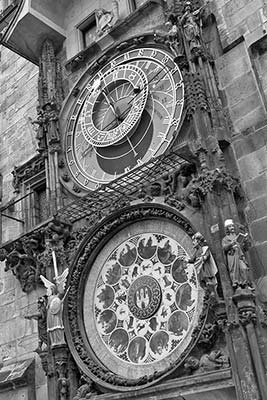
Astronomical Clock: See if you can figure out how it works. Of the two giant dials on the tower, the top one tells the time. It has a complex series of revolving wheels within wheels, but the basics are simple. Read this while you’re waiting for the clock to spring to life.
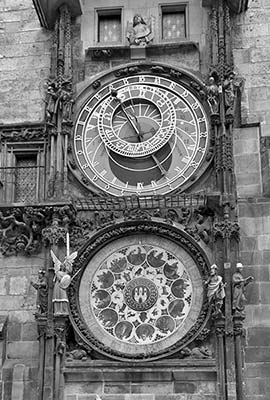
The two big, outer dials tell the time in a 24-hour circle. Of these, the inner dial is stationary and is marked with the Roman numerals I-XII twice, starting at the top and bottom of the dial—noon and midnight. The colorful background of this dial indicates the amount of daylight at different times of day: The black circle surrounded by orange at the bottom half (from XII “p.m.” to IV “a.m.”) is nighttime, while the blue top half is daytime, and the shades of gray and orange between them represent dawn and dusk.
Meanwhile, the outer dial (with the golden numbers on a black band) lists the numbers 1 through 24, in a strange but readable Bohemian script. But because this uses the medieval Italian method of telling time—where the day resets at sunset—the 1 is not at the top, but somewhere in the lower-right quadrant of the Roman dial. The Roman numeral that the Bohemian 1 lines up with tells you the time of last night’s sunset (typically between IV and VIII “p.m.”).
The “big hand” (with the golden sun on it) does one slow sweep each 24-hour period, marking the time on both dials.
Now pay attention to the offset inner ring, marked with the zodiac signs. This ring both rotates on its own and moves around the outer dial, so the sunny “big hand” also lands on today’s zodiac sign. And the “little hand” (with a blue moon) appears in this month’s zodiac.
If all of this seems complex, it must have been a marvel in the early 1400s, when the clock was installed. Remember that back then, everything revolved around the Earth (the fixed middle background—with Prague marking the center, of course). The clock was heavily damaged during World War II, and much of what you see today is a reconstruction.
The second dial, below the clock, was added in the 19th century. It shows the signs of the zodiac, scenes from the seasons of a rural peasant’s life, and a ring of saints’ names. There’s one for each day of the year, and a marker on top indicates today’s special saint. In the center is a castle, symbolizing Prague.
Four statues flank the upper clock. These politically incorrect symbols evoke a 15th-century outlook: The figure staring into a mirror stands for vanity, a Jewish moneylender holding a bag of coins is greed, and (on the right side) a Turk with a mandolin symbolizes hedonism. All these worldly goals are vain in the face of Death, whose hourglass reminds us that our time is unavoidably running out.
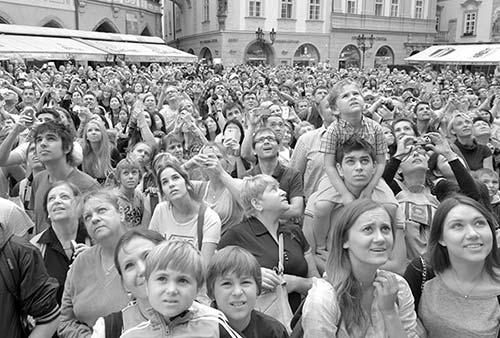
The clock strikes the top of the hour and puts on a little glockenspiel show daily from 9:00 to 23:00 (until 20:00 in winter). As the hour approaches, keep your eye on Death. First, Death tips his hourglass and pulls the cord, ringing the bell, while the moneylender jingles his purse. Then the windows open and the 12 apostles shuffle past, acknowledging the gang of onlookers. Finally, the rooster at the very top crows and the hour is rung. The hour is often wrong because of Daylight Saving Time (completely senseless to 15th-century clockmakers). I find an alternative view just as interesting: As the cock crows, face the crowd and snap a photo of the mass of gaping tourists.
Old Town Hall: The ornately carved Gothic entrance door to the left of the clock leads to the TI, a pay WC, and the ticket desk for the clock tower elevator and Old Town Hall tours.
Step into the entry hall (free). It’s beautifully decorated with a 1904 Art Nouveau mosaic that celebrates Prague (Lady Prague on the throne is being honored by characters representing all the nationalities of the Habsburg Empire) and various Czech mythological scenes. Concerned that this was too patriotic to survive the Nazi occupation, locals whitewashed these walls in 1939. Because of that smart move, the mosaics survive today.
Before moving on, stand facing the Astronomical Clock again to get oriented. You’re at the axis of several main streets. To the right and left are Celetná and Karlova streets, which form the main east-west spine through the Old Town. Behind you is Melantrichova street, which leads south to Wenceslas Square. We’ll be traversing all of these (Celetná, Melantrichova, and Karlova—in that order) on our walk.
• Now head back across the square to tour the pointy Týn Church. Enter by making your way through the cluster of buildings in front of it. (If the church is closed, try peeking in from the locked gate just inside the door.)
4 Týn Church
This is the Old Town’s main church (worth ▲). While it has roots dating back to the 1100s, this structure dates from Prague’s golden age. It was built around 1360 as the university church by the same architect who designed St. Vitus Cathedral at Prague Castle.
Visiting the Church: The structure is full of light, with soaring Gothic arches. The ornamentation reflects the church’s troubled history. Originally Catholic, it was taken over by the Hussites, who whitewashed it and stripped it of Catholic icons. When the Catholic Habsburgs retook the church, they redecorated with a vengeance—encrusting its once elegant and pure Gothic columns with ornate Baroque altars and statues of Mary and the saints.
Now do a slow, counterclockwise tour around the church, heading up the right aisle.
At the front-right corner of the church (to the right of the pulpit), on the pillar is a brown stone slab showing an armored man with a beard and ruff collar, his hand resting on a globe. This is the first modern astronomer, Tycho Brahe (1546-1601). Buried here, he was brought to Prague by the Habsburgs.
Now circle around to face the stunning main altar, topped with a statue of the archangel Michael with a flaming sword. A painting (on the lower level) shows Mary ascending to heaven where (in the next painting up) she’s to be crowned.
To the right of the altar is a statue of one of Prague’s patron saints, John of Nepomuk—always easy to identify thanks to his halo of stars (we’ll learn more about him later in the walk).
You’re surrounded by the double-eagle symbol of the Catholic Habsburgs: on the flag borne by a knight statue on the altar, atop the organ behind you (Prague’s oldest), and above you on the ceiling.
Exploring the rest of the church, you’ll see lots of reliefs of knights who are buried underfoot, and a number of “marble” altarpieces that are (knock, knock) actually made of wood. Before leaving, read the Catholic spin on the church’s history (in the entry vestibule, in English)—told with barely a mention of Hus, whose followers made their home in this building for two centuries.
Leaving the Church: After exiting, walk through the Via Musica ticket office (on your right; a handy place to get classical music tickets—see here). Leaving at the far end, turn right, where you’ll walk by the north (formerly main) entrance to the Týn Church (with the most delicate pieces of Gothic stone masonry in town—all original 14th-century).
Look to the left across the street at Granovský Palace, the fine Renaissance building with sgraffiti and openings for muskets. In what was economically the most important place in the Old Town, this was a fortress within a fortified town. Notice the carved stone gate to a courtyard and also the House of the Golden Ring (to the left).
• Tucked immediately behind Týn Church is a welcome oasis of tranquility in the midst of the Old Town Square hubbub—the courtyard called the Ungelt. Through an imposing gate, enter what was once the commercial nucleus of medieval Prague.
5 Ungelt Courtyard
This pleasant, cobbled, quiet courtyard of upscale restaurants and shops is one of the Old Town’s oldest places. It served as a hostel for foreign merchants, much like a Turkish caravanserai.
During the Bohemian golden age (c. 1200-1400), the Ungelt was a multicultural hub of international trade. Prague—located at the geographical center of Europe—attracted Germans selling furs, Italians selling fine art, Frenchmen selling cloth, and Arabs selling spices. They converged on this courtyard, where they could store their goods and pay their customs (which is what Ungelt means, in German). In return, the king granted them protection, housing, and a stable for their horses. By day, they’d sell their wares on the Old Town Square. At night, they’d return here to drink and exchange news from their native lands. Notice that, to protect the goods, there are only two entrances to the complex. After centuries of disuse, the Ungelt has been marvelously restored—a great place for dinner, and a reminder that Prague has been a cosmopolitan center for most of its history.
• Exit the Ungelt at the far end. Just to your left, across the street, is the...
6 Church of St. James (Kostel Sv. Jakuba)
Perhaps the most beautiful church interior in the Old Town, the Church of St. James (worth ▲) has been the home of the Minorite Order almost as long as merchants have occupied the Ungelt. A medieval city was a complex phenomenon: Commerce and a life of contemplation existed side by side.
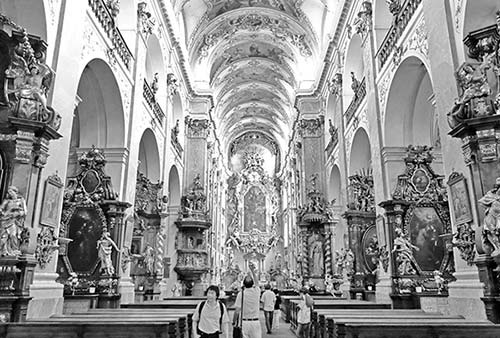
Visiting the Church: Step inside (or, if it’s locked, peek through the glass door). Artistically, St. James is a stunning example of how simple medieval spaces could be rebuilt into sumptuous feasts of Baroque decoration. The original interior was destroyed by fire in 1689; what’s here now is an early 18th-century remodel. The blue light in the altar highlights one of Prague’s most venerated treasures—the bejeweled Madonna Pietatis. Above the pietà, as if held aloft by hummingbird-like angels, is a painting of the martyrdom of St. James.
Proceed grandly up the central aisle, enjoying a parade of gilded statues and paintings under a colorfully frescoed ceiling telling stories of the Virgin Mary’s life. When you reach the altar at the front, turn around and notice how the church suddenly becomes simpler without all that ornamentation. Prague’s grandest pipe organ fills the back wall.
As you leave, look for the black, shriveled-up arm with clenched fingers (hanging by a chain from a metal post 15 feet above and to the left of the door). According to legend, a thief attempted to rob the Madonna Pietatis from the altar, but his hand was frozen the moment he touched the statue. The monks had to cut off his arm to get the hand to let go. The desiccated arm now hangs here as a warning.
• Exiting the church, do a U-turn to the left (heading up Jakubská street, along the side of the church, past some rough-looking bars). After one block, turn right on Templová street. Head two blocks down the street (passing a nice view of the Týn Church’s rear end, and some self-proclaimed “deluxe toilets”) and go through the arcaded passageway, where you emerge onto...
7 Celetná Street
Since the 10th century, this street has been a corridor in the busy commercial quarter—filled with merchants and guilds. These days, it’s still pretty commercial, and very touristy.
Here on Celetná street, you’re surrounded by a number of buildings with striking facades. To the left is the medieval Powder Tower—we’ll head there in a moment. Straight ahead of you is a Baroque balcony supported by four statues. Many facades on this street are Baroque or Neoclassical—pastel colors, with frilly or statuesque features. It’s little wonder that, when filmmakers want to shoot a movie set in frilly Baroque times, they often choose Prague.
• To your right is a striking, angular cinnamon-colored building called the...
8 House of the Black Madonna (Dům u Černé Matky Boží)
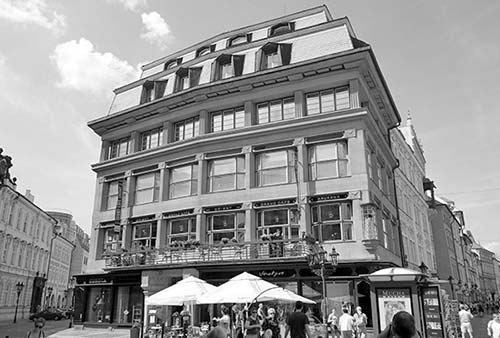
Back around the turn of the 20th century, Prague was a center of avant-garde art. Art Nouveau blossomed here (as we’ll soon see), as did Cubism. The House of the Black Madonna’s Cubist exterior is a marvel of rectangular windows and cornices—stand back and see how masterfully it makes its statement while mixing with its neighbors...then get up close and study the details. The interior houses a Cubist café (the recommended Grand Café Orient, one flight up the parabolic spiral staircase)—complete with cube-shaped chairs and square rolls. The Kubista gallery in the far corner shows more examples of this unique style. This building is an example of what has long been considered the greatest virtue of Prague’s architects: the ability to adapt grandiose plans to the existing cityscape.
• The long, skinny square that begins just to the left of the Cubist house is the former fruit market (Ovocný Trh). For a peek at the local university and a historic theater, side-trip to the end of this square, then return to this spot.
9 Estates Theater and Charles University
The Estates Theater (Stavovské Divadlo) is the fancy green-and-white Neoclassical building at the end of the square. Built in the 1780s in a deliberately Parisian style, it was the prime opera venue in Prague at a time when an Austrian prodigy was changing the course of music. Wolfgang Amadeus Mozart premiered Don Giovanni in this building (with a bronze statue of Il Commendatore, a character from that opera, duly flanking the main entrance), and he directed many of his works here. Prague’s theatergoers would whistle arias from Mozart’s works on the streets the morning after they premiered.
Today, the Estates Theater (part of the National Theater group) continues to produce The Marriage of Figaro, Don Giovanni, and The Magic Flute. This building is generally seen as a German theater. In fact, for a time the Habsburgs forbade plays here in the Czech language. These days the Czechs put on plays and opera in whatever language they like.
The main building of Prague’s Charles University, the Karolinum, is next door (on the right as you face the theater, tucked down a little courtyard). Imagine Prague in the late 1500s, when it was the center of the Holy Roman Empire, and one of the most enlightened places in Europe. The astronomers Tycho Brahe (who tracked the planets) and his assistant Johannes Kepler (who formulated the laws of motion) both worked here. Charles University has always been at the center of Czech political thinking and revolutions, from Jan Hus in the 15th century to the passionately patriotic Czech students who swept communists out of power in the Velvet Revolution. Today, Charles University still attracts the best and brightest, and it’s in this venerable building that they graduate (for more on Charles University, see the sidebar).
The ground-floor Gothic interior of the Karolinum can be visited for free—find the modern main entrance in the little fenced-off courtyard by the lions fountain (just turn left as you walk past the guard).
• Return to the House of the Black Madonna. Pause and consider the beauty of a traffic-free city center. Then, turn right and head up busy Celetná street to the big, black...
10 Powder Tower
The 500-year-old Powder Tower was the main gate of the old town wall. It also housed the city’s gunpowder—hence the name. This is the only surviving bit of the wall that was built to defend the city in the 1400s. (Though you can go inside, it’s not worth paying to tour the interior.)
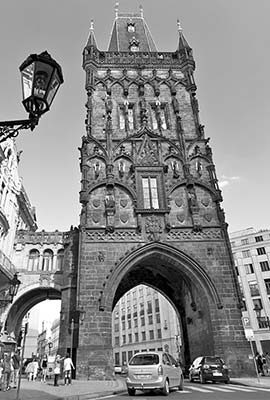
The Powder Tower was the city’s formal front door—the road from Vienna entered here. Picture the scene three centuries ago, when Habsburg empress Maria Theresa had finally been crowned Queen of Bohemia. As she returned home in triumph, she passed through the Powder Tower gate.
Go back 500 years and look up at the impressive Gothic-carved welcoming committee, reminding all of the hierarchy of our mortal existence: Reading from the bottom up, you’ll see artisans flanking Prague’s coat of arms, a pair of Czech kings with seals of alliance with neighboring regions, angels with golden wings, and saints flanking Christ in majesty. The tower is topped with one of Prague’s signature styles—a trapezoidal roof.
• Pass regally through the Powder Tower, leaving the Old Town. You’ll emerge into a big, busy intersection. To your left is the Municipal House, a cream-colored building topped with a green dome. Find a spot with a good view of the facade.
11 Municipal House (Obecní Dům)
The Municipal House is the “pearl of Czech Art Nouveau.” Art Nouveau flourished during the same period as the Eiffel Tower and Europe’s great Industrial Age train stations.
The same engineering prowess and technological advances that went into making those huge erector-set rigid buildings were used by artistic architects to create quite the opposite effect: curvy, organically flowing lines, inspired by vines and curvaceous women. Art Nouveau was a reaction to the sterility of modern-age construction. Look at the elaborate wrought-iron balcony—flanked by bronze Atlases hefting their lanterns—and the lovely stained glass (as in the entrance arcade).
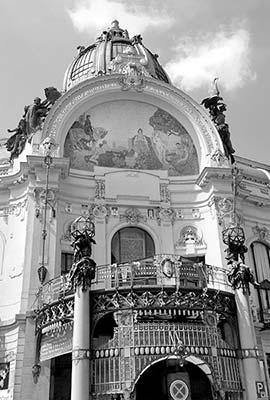
Mosaics and sculptural knickknacks (see the faces above the windows) made the building’s facade colorful and joyous. Study the bright mosaic above the balcony, called Homage to Prague. A symbol of the city, the goddess Praha presides over a land of peace and high culture—an image that stoked cultural pride and nationalist sentiment. On the balcony is a medallion showing the three-tower castle that is the symbol of Prague.
The Municipal House was built in the early 1900s, when Czech nationalism was at a fever pitch. Having been ruled by the Austrian Habsburgs for the previous 300 years, the Czechs were demanding independence. This building was drenched in patriotic Czech themes, and all the artists and materials used were Czech. Within a few short years, in 1918, the nation of Czechoslovakia was formed—and the independence proclamation was announced to the people right here, from the balcony of the Municipal House.
Prague is Europe’s best city for Art Nouveau. That’s the style of art and architecture that flourished throughout Europe around 1900. It was called “nouveau”—or new—because it was associated with all things modern: technology, social progress, and enlightened thinking. Art Nouveau was neo-nothing, but instead a fresh answer to all the revival styles of the late 19th century, and an organic response to the Eiffel Tower art of the Industrial Age.
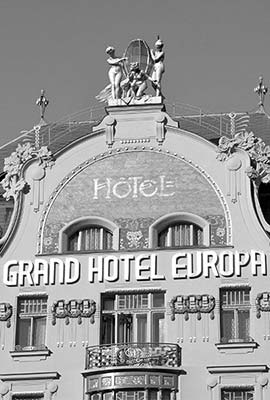
By taking advantage of recent advances in engineering, Art Nouveau liberated the artist in each architect. Notice the curves and motifs expressing originality—every facade is unique. Artists such as Alphonse Mucha believed that the style should apply to all facets of daily life. They designed everything from buildings and furniture to typefaces and cigarette packs.
Though Art Nouveau was born in Paris, it’s in Prague where you’ll find some of its greatest hits: the Municipal House and nearby buildings, Grand Hotel Europa (on Wenceslas Square), the exuberant facades of the Jewish Quarter, the Jerusalem Synagogue, and—especially—the work of Mucha. You can see his stained-glass window in St. Vitus Cathedral (at Prague Castle) and his art at the excellent Mucha Museum (near Wenceslas Square). Mucha’s final masterpiece, the Slav Epic, is on display in his hometown of Moravský Krumlov (see here).
The Municipal House interior has some of Europe’s finest Art Nouveau decor and is worth ▲▲ (for details, see the Sights in Prague chapter). It’s free to enter and wander the public areas. On a quick stop, check out the Art Nouveau café and restaurant near the entrance, then go downstairs to peek at another restaurant. Enjoy the colorful mosaic designs, razzle-dazzle chandeliers, and curvaceous wooden chairs. While to really appreciate the building you must attend a concert here or take one of the excellent tours offered throughout the day, any visit here offers a sweet dose of Art Nouveau.
Before moving on, note the two fine buildings across the street. The Hybernia Theater (Divadlo Hibernia), now a concert hall, was originally a Baroque church transformed into an Empire-style (1815) customs house. Standing boldly across the street is the Czech National Bank, sternly functional and dating from the 1930s. Its one piece of decor: the lion with a lady liberty on top.
• Now head west down Na Příkopě.
12 Na Příkopě, the Old City Wall
The street called Na Příkopě was where the old city wall once stood. More specifically, the name Na Příkopě means “On the Moat,” and you’re walking along what was once the moat outside the wall. To your right is the Old Town. To the left, the New. Look at your city map and conceptualize medieval Prague’s smart design: The city was protected on two sides by its river and on the other two sides by its walls (marked by the modern streets called Na Příkopě, Revoluční, and Národní Třída). The only river crossing back then was the fortified Charles Bridge.
Though the moat and city wall are now long gone, there’s still a strong divide between the Old Town and the New Town. Na Příkopě—with its modern buildings, banks, and workaday franchise stores—is more New than Old. It’s bustling and lively, without a hint of the trouble Prague endured in the mid-20th century. Many modern shopping malls hide behind protected facades along this boulevard.
Pause for a moment—immersed in all of this modern commerce—and ponder the hard times under communism: Prague became a gray and bleak world of decrepit buildings (although this boulevard looked fancy even in those times). Some consumer goods were scarce—customers waited in long lines for bananas or a bottle of ersatz Coke. Statues were black with soot, and on the Charles Bridge—so busy today—there was nothing but onrushing locals and a few shady characters trying to change money. At the train station, frightened but desperate locals would meet arriving foreigners and offer to rent them a room, hoping to earn enough Western cash to buy Swiss chocolate or Levi’s at one of the hard-currency stores. Life seemed hopeless. In spring 1968, the Czechs tried to rise up, enacting government reforms that came to be called “Prague Spring.” But Soviet tanks rumbled into Prague and crushed the rebellion. It wasn’t until a generation later, in 1989, that the sad tale finally had its happy ending...and it happened just steps away from here, at our next stop.
• Continue up Na Příkopě street to an intersection (and nearby Metro stop) called Můstek. To your left stretches the vast expanse of the wide boulevard called...
13 Wenceslas Square
Wenceslas Square—with the National Museum and landmark statue of St. Wenceslas at the very top—is the centerpiece of Prague’s New Town (rated ▲▲▲). This square was originally founded as a thriving horse market. Today it’s a modern world of high-fashion stores, glitzy shopping malls, fine old facades (and some jarringly modern ones), fast-food restaurants, and sausage stands.
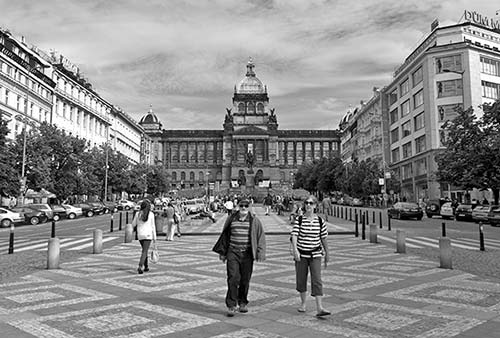
Picture the scene on this square on a cold November night in 1989: The Berlin Wall had fallen, and a student protest in Prague had been put down violently—the last straw for a city that was fed up with the oppressive communist system. Each night for two weeks, hundreds of thousands of freedom-loving Czechs filled Wenceslas Square, jingling their key chains as a sign that it was time for their overlords to pack up and go home. Finally, the formerly jailed playwright Václav Havel appeared on a balcony to announce the end of communism. The crowd celebrated wildly, having overthrown the rule of an “Evil Empire” without firing a shot...a feat that has come to be known as the Velvet Revolution. ( For more on the Velvet Revolution, landmarks of Wenceslas Square, and the New Town, see the Wenceslas Square Walk chapter; if you’d like to take that walk now, you can stroll 10 minutes up to the starting point at the top of the square.)
• Let’s plunge back into the Old Town and return to the Old Town Square. Turn around, and with your back to Wenceslas Square, head downhill on the street called Na Můstku—“along the bridge”—that crossed the moat (příkopě) we’ve been following until now. After one touristy block, Na Můstku jogs slightly to the left and becomes Melantrichova.
Ahead, on the next corner, is Preciosa House of Czech Crystal, established in Bohemia in 1724. The shop’s awe-inspiring chandeliers invite you to step in and browse, and its staff is evangelical about showing visitors around.
A block farther along, on the left, is the thriving...
14 Havelská Market
This open-air market, offering crafts and produce, was first set up in the 13th century for the German trading community. Though heavy on souvenirs these days, the market (worth ▲) still feeds hungry locals and vagabonds. Lined with inviting benches, it’s an ideal place to enjoy a healthy snack—and merchants are happy to sell a single vegetable or piece of fruit. The market is also a fun place to browse for crafts. It’s a homegrown, homemade kind of place; you may be dealing with the actual artist or farmer. The cafés in the old arcades offer a relaxing vantage point from which to view the action.
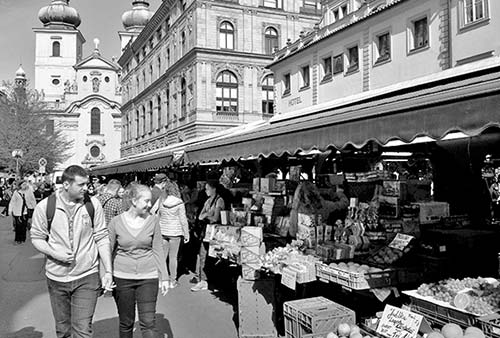
Make the loop clockwise, browsing the market-stall action on the left side, take one of the grandest photos in Prague from the far end with the spires and domes of the church that gave the market its name in the distance, then walk back through the medieval arcade to complete the circle.
• Continue along Melantrichova street. Eventually—after passing increasingly tacky souvenir shops—Melantrichova curves right and spills out at the Old Town Square, right by the Astronomical Clock. At the clock, turn left down Karlova street. The rest of our walk follows Karlova to the Charles Bridge. Begin by heading along the top of the Small Market Square (Malé Náměstí, with lots of outdoor tables), then follow Karlova’s twisting course—Karlova street signs keep you on track, and Karlův Most signs point to the bridge. Or just go generally downhill and follow the crowds.
15 Karlova Street
Although traffic-free, Karlova street is utterly jammed with tourists as it winds toward the Charles Bridge. But the route has plenty of historic charm if you’re able to ignore the contemporary tourism. As you walk, look up. Notice historic symbols and signs of shops, which advertised who lived there or what they sold. Cornerstones, designed to protect buildings from careening carriages, also date from centuries past.
The touristy feeding-frenzy of today’s Prague is at its ugliest along this commercial gauntlet. Obviously, you’ll find few good values on this drag. The many charming stalls selling trdlo (chimney cakes) imply that they are a Czech tradition. But they’re just another gimmick, imported from Hungary in the last few years, to snare a little of that tourist money.
The Klementinum (which once housed the university’s library) is the large building that borders Karlova street on the right. Just past the intersection with Liliová, where the street opens into a little square, turn right through the archway (at #1) and into a tranquil courtyard that feels an eternity away from the touristy hubbub of Karlova. You can also visit the Klementinum’s impressive ▲ Baroque interior on a guided tour (see here).
• Karlova street leads directly to a tall medieval tower that marks the start of Charles Bridge. But before entering the bridge, stop on this side of the river. To the right of the tower is a little park with a great view of both the bridge and the rest of Prague across the river.
16 Charles IV Statue: The Bohemian Golden Age
Start with the statue of the bridge’s namesake, Charles IV (1316-1378). Look familiar? He’s the guy on the 100-koruna bill. Charles was the Holy Roman Emperor who ruled his vast empire from Prague in the 14th century—a high-water mark in the city’s history. The statue shows one of Charles’ many accomplishments: He holds a contract establishing Charles University, the first in Central Europe. The women around the pedestal symbolize the school’s four traditional subjects: theology, the arts, law, and medicine.
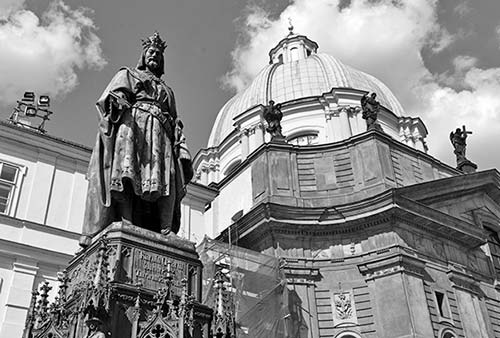
Charles was the preeminent figure in Europe in the late Middle Ages, and the father of the Prague we enjoy today. His domain encompassed the modern Czech Republic, and parts of Germany, Austria, Italy, and the Low Countries.
Charles was cosmopolitan. Born in Prague, raised in Paris, crowned in Rome, and inspired by the luxury-loving pope in Avignon, Charles returned home bringing Europe’s culture with him. Besides founding Charles University, he built Charles Bridge, much of Prague Castle and St. Vitus Cathedral, and the New Town (modeled on Paris). His Golden Bull of 1356 served as Europe’s constitution for centuries (and gave anti-Semite Charles first right to the property of Jews). Power-hungry, he expanded his empire through networking and shrewd marriages, not war. Charles traded ideas with the Italian poet Petrarch and imported artists from France, Italy, and Flanders (inspiring the art of the Museum of Medieval Art—described in the Sights in Prague chapter). Under Charles, Prague became the most cultured city in Europe. Seemingly the only thing Charles did not succeed in was renaming Prague: He wanted it to be called “New Jerusalem.”
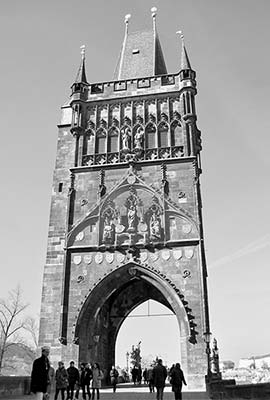
Now look up at the bridge tower (which you can climb for wonderful views—see here). Built by Charles, it’s one of the finest Gothic gates anywhere. The statuary shows the 14th-century hierarchy of society: people at street level, above them kings, and bishops above the kings.
• Stroll to the riverside, belly up to the banister, and take in the...
17 View from the River
Before you are the Vltava River and Charles Bridge. Across the river, atop the hill, is Prague Castle topped by the prickly spires of St. Vitus Cathedral. Prague Castle has been the seat of power in this region for over a thousand years, since the time of Wenceslas. By some measures, it’s the biggest castle on earth. Given the castle’s long history, it’s no wonder that, when the nation of Czechoslovakia was formed in 1918, Prague Castle served as the “White House” of its new president. If you tour the castle, you also get access to historic St. Vitus Cathedral, which was begun by Charles IV. The cathedral has the tomb of Wenceslas as well as a stunning Art Nouveau stained-glass window by Alphonse Mucha. ( For details, see the Prague Castle Tour chapter.)
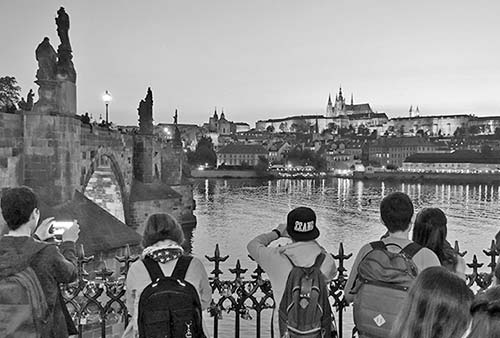
The Vltava River (from Old German “wild waters”) is better known by the modern German mutation of the same name, Moldau. It bubbles up from the Šumava Hills in southern Bohemia and runs 270 miles through a diverse landscape, like a thread connecting the Czech people. As we’ve learned, the Czechs have struggled heroically to carve out their identity while surrounded by mightier neighbors—Austrians, Germans, and Russians. The Vltava is their shared artery.
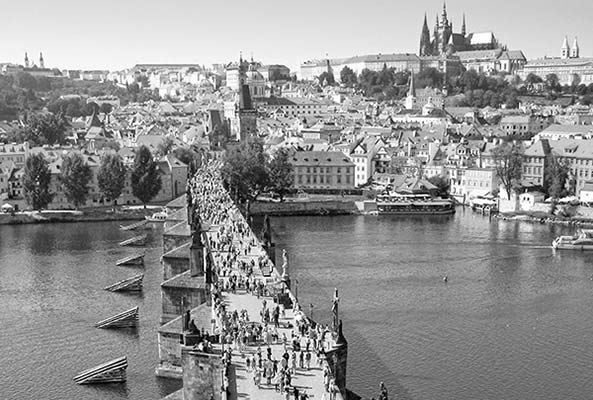
The view of Charles Bridge from here is supremely photogenic. The historic stone bridge, commissioned in 1342, connects the Old Town with the district called the Lesser Town at the base of the castle across the river. The bridge is almost seven football fields long, lined with lanterns and 30 statues, and bookmarked at each end with medieval towers (both climbable).
• Now wander onto the bridge. Make your way slowly across the bridge, checking out several of the statues, all on the right-hand side.
18 Charles Bridge (Karlův Most)
Among Prague’s defining landmarks, this much-loved ▲▲▲ bridge offers one of the most pleasant and entertaining strolls in Europe. Musicians, artisans, and a constant parade of people make it a festival every day. You can return to this bridge throughout the day to enjoy its various charms. Early and late, it can be enchantingly lonely. It’s a photographer’s delight during that “magic hour,” when the sun is low in the sky.
The impressively expressive statues on either side of the bridge depict saints. Today, most of these statues are replicas—the originals are in city museums, safe from the polluted air (and some are in the casemates below the hill called Vyšehrad; see the Vyšehrad Walk chapter).
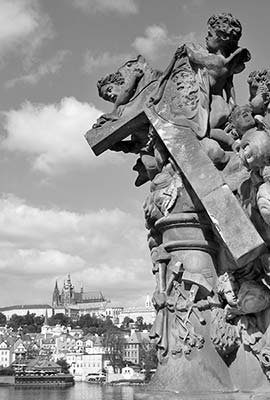
Pause at the third statue on the right. Originally, there were no statues on the bridge, only a cross. You can still see that cross incorporated into this crucifixion scene. The rest of the bridge’s statues were added when the Habsburg Catholics ruled in the 17th and 18th centuries. After the Hussite years, the Habsburgs wanted to make sure the saints overlooked and inspired the townsfolk each day as they crossed what was still the only bridge in town. This statue has a gilded Hebrew inscription from the Book of Isaiah anachronistically placed over the head of crucified Christ: “Holy, holy, holy is the Lord of hosts.” The inscription was paid for by a fine imposed on a member of Prague’s Jewish community who secretly made sure not to let this particular attribute of his Lord be mocked here so blatantly.
Continue two more statues to see Cyril and Methodius, the two brothers who brought Christianity to this area around 865. Born in Thessaloniki (part of northern Greece today), Cyril and Methodius are credited with introducing Christianity not only to the Czechs, but to all Slavs; you’ll see them revered from here to Dubrovnik, Warsaw, and Vladivostok. In this statue, they’re bringing a pagan and primitive (bare-breasted) Czech woman into the Christian fold.
Now continue on, past the next statue, and find a small brass relief showing a cross with five stars embedded in the wall of the bridge (it’s just below the little grate that sits on top of the stone banister). The relief depicts a figure floating in the river, with a semicircle of stars above him. This marks the traditional spot where the Czech patron saint John of Nepomuk is believed to have been tossed off the bridge and into the river.
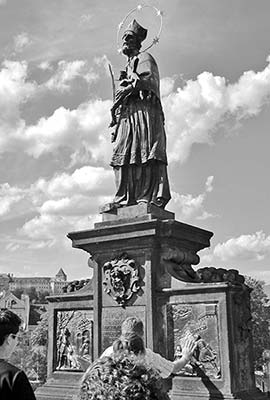
For the rest of that story, continue past two more statue groups to the bronze Baroque statue of St. John of Nepomuk, with the five golden stars encircling his head. This statue always draws a crowd. John was a 14th-century priest to whom the queen confessed all her sins. According to a 17th-century legend, the king wanted to know his wife’s secrets, but Father John dutifully refused to tell. The shiny plaque at the base of the statue shows what happened next: John was tortured and killed by being thrown off the bridge. The plaque shows the heave-ho. When he hit the water, five stars appeared, signifying his purity. Notice the date on the inscription—1683. This oldest statue on the bridge was unveiled on the supposed 300th anniversary of the martyr’s death. Traditionally, people believe that touching the St. John plaque will make a wish come true. But you get only one chance in life to make this wish, and in keeping with the namesake’s virtuous silence, you may never tell anyone what that wish is.
Bridges had previously been built at this location, as the tower from the earlier Judith Bridge attests (it’s the smaller of the two bridge towers at the far end), but all were washed away by floods. After a major flood in 1342, Emperor Charles IV commissioned an entirely new structure, which was designed and built by architect Peter Parler. Initially called the Stone Bridge, it was Prague’s only bridge across the Vltava River for more than 400 years.
The bridge has long fueled a local love of legends—including one tied to numbers. According to medieval records, the bridge’s foundation was laid in 1357. In the late 1800s, an amateur astronomer noticed a curious combination of numbers, leading to a popular theory about Charles IV. Charles is known to have been interested in numerology and astrology, and was likely aware of the significance of this date: the ninth of July at 5:31 in the morning. Written out in digits—as the year, month, day, hour, and minute—it’s a numerical palindrome: 135797531. It’s said that Charles must have chosen that precise moment (which also coincides with a favorable positioning of the Earth and Saturn) to lay the foundation stone of the bridge.
Further “corroboration” of this remarkable hypothesis was provided by the discovery that the end of the bridge on the Old Town side aligns perfectly with the tomb of St. Vitus (in the cathedral across the river) and the setting sun at summer solstice. In the absence of accurate 14th-century records, this intriguing proposition has delighted the modern Czech imagination. The number “135797531” is bound to remain celebrated as the adopted birthday of Prague’s most beloved structure.
But even the most auspicious numbers could not protect the bridge from periodic damage caused by floods, ice, and shoddy repairs. In 2010, an ambitious reconstruction project was completed, leaving the bridge cleaner—and stronger—than ever before.
You’ll find statues to St. John on squares and bridges throughout the Czech Republic, testifying to the popularity of this essentially Baroque cult.
Even if 19th-century Czechs defied their Catholic upbringing, they continued to be devoted to several patron saints who—even for agnostics—served as a rallying point for Czech national identity. For example, directly across from John is St. Ludmila, who raised her grandson to become St. Wenceslas—the 10th-century duke-turned-saint who first united the Czech people (and whose statue is found at the far end of the bridge).
• A good way to end this walk is to enjoy the city and river view from near the center of the bridge. Stand here and survey your surroundings.
19 View from Charles Bridge
First, look upstream (south). Notice the icebreakers immediately below. They protect the abutments upon which the bridge sits, as river ice has historically threatened its very survival. Look farther upstream for the tiny locks on the right side. While today’s river traffic is limited to tourist boats, in earlier times timber, lashed like rafts, was floated down the river. On the left, farther upstream by the next bridge, is a building with a gilded crown atop its black dome. That’s the National Theater. The rentable paddleboats plying the water are a romantic way to get a little exercise (see here).
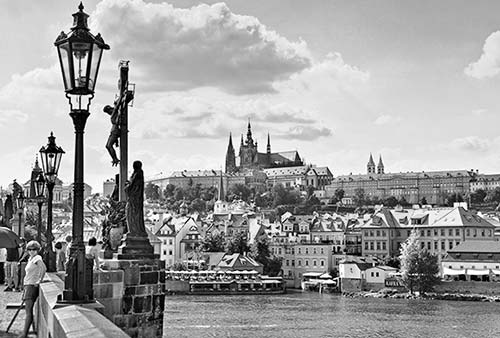
Now, cross over and look downstream. Scan from right to left. You’ll see the modern Four Seasons Hotel—that’s the black roof, doing a pretty good job of fitting in. Farther down (with the green roof) is the large Neo-Renaissance concert hall of the Czech Philharmonic. Across the river and up the hill is a red needle of a giant metronome. It stands at the spot where a 50-foot-tall granite Joseph Stalin—flanked by eight equally tall workers and soldiers—stood from 1955 to 1962. To the right of Stalin’s former perch (hiding under the trees and worth the climb on a hot summer day) is Prague’s most popular beer garden.
Finally, capping the hill, follow the line of noble palaces that leads to the spire of the cathedral. It stands at the center of a castle, which—for a thousand years—has been the oversized seat of those who managed to impose their authority on the people living in the towns below—both according to and against their wishes.
And beneath your feet flows the majestic Vltava River—the watery thread that connects the Czech people.
• From here, you can continue across the bridge to the Lesser Town (Kampa Island, on your left as you cross the bridge, is a tranquil spot to explore; for more details, see here). You can also hike or take the tram up to the castle (a 10-minute walk to the right is the Malostranská stop for the Metro or for handy tram #22 or #23). Or retrace your steps across the bridge to enjoy more time in the Old Town.
Ahoj!