PRAGUE CASTLE TOUR
Pražský Hrad
1 Powder Bridge (Prašný Most)
3 St. Vitus Cathedral (Katedrála Sv. Víta)
5 Old Royal Palace (Starý Královský Palác)
6 The Story of Prague Castle Exhibit (Příběh Pražského Hradu)
7 Basilica of St. George (Bazilika Sv. Jiří)
9 Lobkowicz Palace (Lobkowiczký Palác)
10 Ramparts Garden (Zahrada Na Valech)
11 Castle Square (Hradčanské Náměstí)
For more than a thousand years, Czech leaders—from kings and emperors to Nazis, communists, and presidents—have ruled from Prague Castle. When Christianity arrived in the Czech lands, this promontory—stretching on an east-west axis overlooking the Vltava River—proved a perfect spot for a church and, later, the cathedral. Eventually, the nobles built their representative palaces in proximity to the castle to compete with the Church for influence on the king. Even today, you feel like clip-clopping through this neighborhood in a fancy carriage.
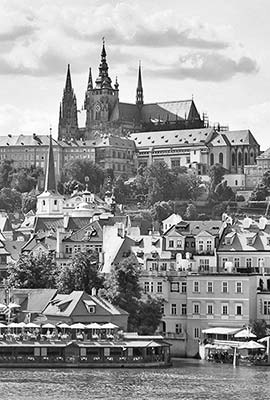
This large complex contains several worthwhile sights: the castle itself (the grounds, gardens, and Old Royal Palace interior), St. Vitus Cathedral (stained glass and royal tombs), and a museum on the castle’s history. With more time, you can step inside the historic Basilica of St. George, tour a noble family’s private collection (Lobkowicz Palace), wander through the Royal Gardens, climb the cathedral tower, and more.
GETTING THERE
By Tram: Trams #22 and #23 take you up to the castle (see here for my self-guided tram tour). Catch either tram at Národní Třída (between Wenceslas Square and the National Theater in the New Town), in front of the National Theater (Národní Divadlo, on the riverbank in the New Town), or at Malostranská (the Metro stop in the Lesser Town). After rattling up the hill, trams make three stops near the castle:
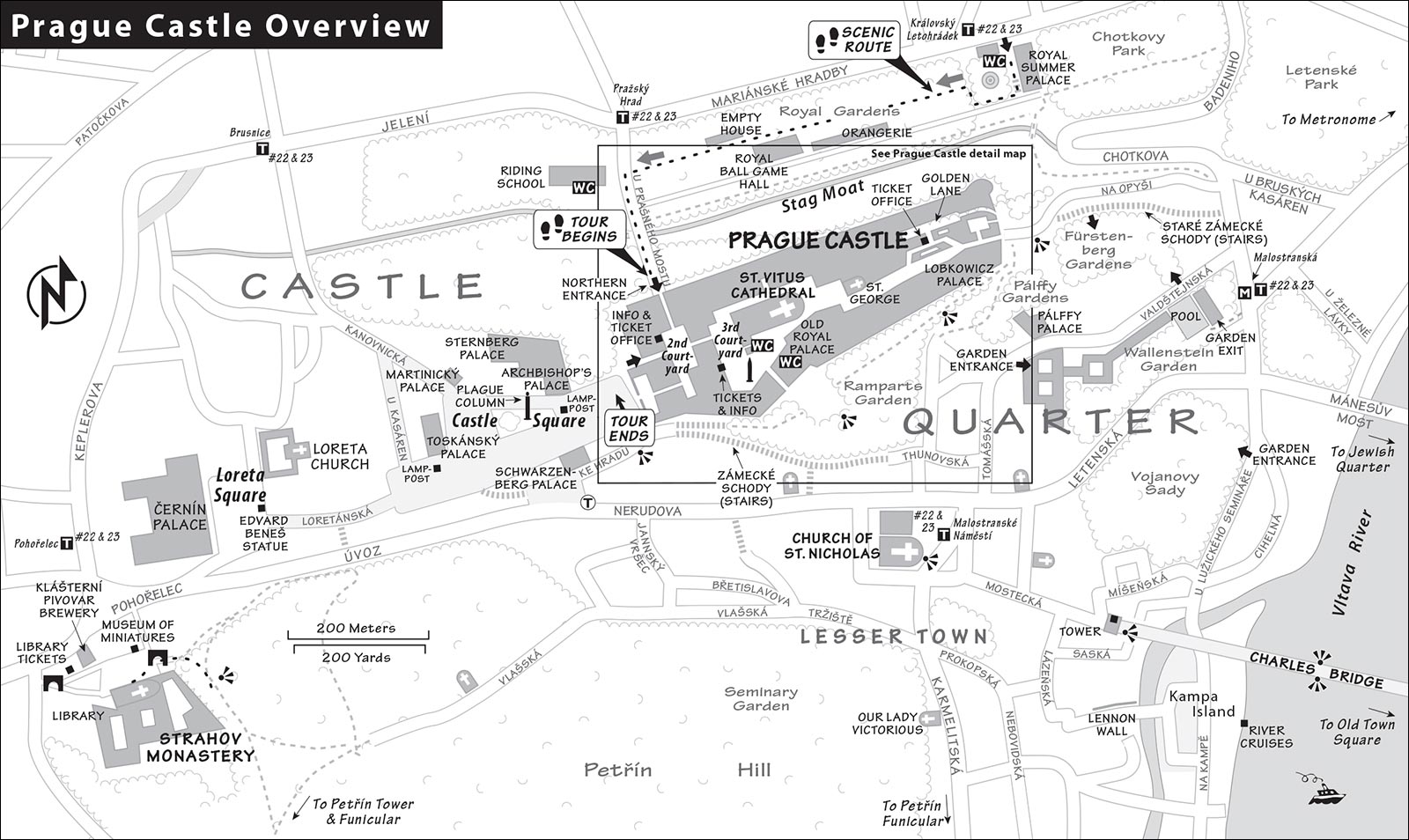
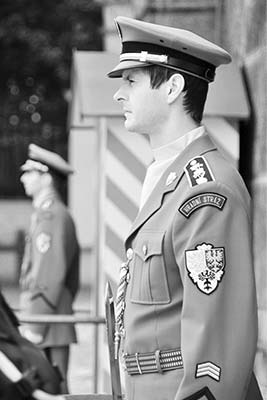
Pražský Hrad (Prague Castle) offers the quickest commute to the castle—from the stop, simply walk along U Prašného Mostu and over the bridge, past the stone-faced but photo-op-friendly guards at the northern entrance, which leads into the castle’s Second Courtyard.
Královský Letohrádek (Royal Summer Palace) allows a scenic and relaxed approach through the Royal Gardens to the bridge near the castle’s northern entrance.
Pohořelec is best if you’d like to start with the Strahov Monastery, then hike 10 minutes down to Castle Square (by way of Loreta Church) and begin your tour there, at the castle’s main entrance.
By Taxi or Uber: Ask your driver to drop you at either Pražský Hrad or Královský Letohrádek (see above). Another option is to have them drop you off just under the castle at the top of Nerudova street (at the little square under the staircase) and then climb 200 yards up the pedestrian-only cobblestone street from there.
By Foot: The fairly steep, three-quarter-mile uphill walk from the river takes about 20 minutes. From the Charles Bridge, follow the main cobbled road (Mostecká) to the Lesser Town Square, marked by the huge, green-domed Church of St. Nicholas. From there, hike uphill along Nerudova street. After about 10 minutes, a steep lane on the right leads to Castle Square.
PLANNING YOUR TIME
Minimize the effect of crowds and maximize your enjoyment by following one of these plans.
Early-Bird Visit: Leave your hotel no later than 8:00. Ride the tram to the Pražský Hrad stop, look around Castle Square, and be sure you’re in line at the ticket office in the Third Courtyard, across from St. Vitus Cathedral, before 9:00. Once you have your ticket, head to the cathedral as soon as possible after it opens at 9:00, and for a few minutes, you’ll have the sacred space to yourself...then, on your way out, you’ll pass a noisy human traffic jam of multinational tour groups. Visit the rest of the castle sights at your leisure: the Old Royal Palace, the Basilica of St. George, and Lobkowicz Palace.
Here’s a delightful way to approach the castle and enjoy an elegant, untouristed dimension of the complex. Start by riding tram #22 or #23 (or Uber) to the Královský Letohrádek stop. Ideally, arrive at 10:00, when the grounds open (closed Nov-March).
The Royal Summer Palace, directly across the street from the tram stop, is the purest Renaissance building in town. You can’t go inside, but the building’s detailed reliefs are worth a close look. From an architectural history point of view, the Summer Palace is one of the most groundbreaking in Prague. After four centuries of medieval Gothic, it announced (in the 1520s, quite late) the arrival of the Italian Renaissance and a distinctly different attitude: “The Dark Ages are over; enjoy and play.” Commissioned by Ferdinand, the first of Prague’s Habsburg rulers, it broke, literally, out of the fortress mentality. The gardens required the building of a security-compromising bridge across the deep moat that separates them from the castle fortress.
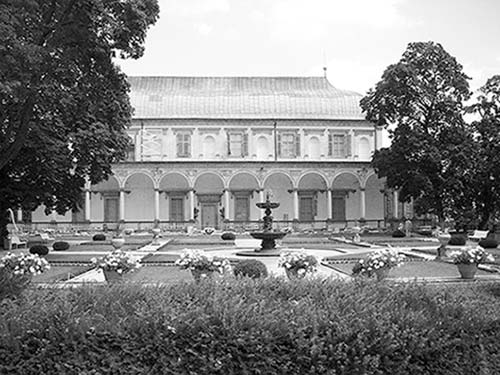
Study the delicate works of stucco. In good Renaissance style, they’re based on classical, rather than Christian, stories. The one depicted here is Virgil’s Aeneid. Survey the characteristic green copper roof, visible from all over town—built to resemble the overturned keel of a seafaring ship. Ferdinand’s three kingdoms of Austria, Bohemia, and Hungary were landlocked, but he was born in Spain—shortly after Columbus voyaged to America—and his brother, another Habsburg, ruled Spain at the time. The roof pays homage to the vessels that spread Habsburg pan-European dominance across the globe.
The Renaissance fountain in front of the palace is cast from especially resonant “bell bronze.” Kneel under the fountain and listen to how the dropping water makes the fountain hum. The audio rainbow you hear is the reason it’s called the Singing Fountain. (Many Czechs say the tune you hear predicts the future. While I hear a trip to Tibet, hopeful would-be brides swear they hear Mendelssohn’s “Wedding March.”)
Walk to the end of the palace, to the Modernist sculpture of a nude boy with a laurel leaf (Victory by Jan Štursa). Take in the no-nonsense fortress-like appearance of the castle complex across the deep natural moat (including three medieval fortified towers)—quite a contrast to the palatial appearance projected to town from the other side.
Now set your sights on the cathedral’s lacy, black spires marking the castle’s entrance. As you walk through the gardens (following the path along the castle wall to the complex entrance), you’ll enjoy fine views of the cathedral.
Take a moment to appreciate the Royal Gardens (Královská Zahrada)—the first “exotic” garden in town. Tree varieties, newly discovered by those seafaring ships, were imported from across the world. The first tulips in Europe were grown here in the 1530s (and then imported by the Dutch, changing Holland’s history).
On the left, pass the white, Renaissance Ball Game Hall. Study the Greek mythology-inspired decor. The allegorical figures at the top depict (from left to right) the four elements, the seven virtues, and the seven sciences.
Continue along. On the right, notice the small, ostensibly empty house, with a pseudo-Baroque entry adjoining two side wings—once the residence of the communist “people’s” presidents (who, in a royal gesture, used the adjacent garden only for themselves). In the late 1980s, this was where the estranged and aging last communist president Gustáv Husák lived and eventually (so hated by his countrymen) went insane. His successor, Václav Havel, refused to live in the house his former jailer had used and opened the garden to the public. To many Czechs, enjoying the formerly off-limits garden of kings and presidents is a celebration of freedom and democracy.
As you leave the garden, you’ll come to the Powder Bridge, which leads to the castle complex. You’re now ready to join this chapter’s castle tour.
Afternoon Visit/Adding on Strahov Monastery and Loreta Church: If you’re heading to Prague Castle after lunch and want to add on an efficient visit to the sights above the castle, ride the tram to the Pohořelec stop. Tour the Strahov Monastery, then drop by Loreta Church on your way (downhill) to Castle Square (monastery and church both described in the Sights in Prague chapter). By the time you hit Castle Square, the crowds should be thinning out. The only risk is running out of time to enter all the sights by closing time.
Note that if you do this plan too early (starting with Strahov and Loreta), you’ll wind up at the busiest entrance (Castle Square) at the busiest time. Instead, save these sights for after your castle visit; backtrack to see them by foot (about a 15-minute uphill hike).
Nighttime Visit: The castle is least crowded at night. True, the sights are closed, but the castle grounds are free, safe, peaceful, floodlit, and open late. The tiny, normally jammed Golden Lane (medieval merchant street) is empty and romantic at night—and no ticket is required.
Orientation
Cost: Admission to the castle grounds is free, but you need a ticket to enter the sights. The “Basic circuit” ticket (250 Kč) covers the highlights: St. Vitus Cathedral, the Old Royal Palace, the Basilica of St. George, and the Golden Lane. A second “Permanent exhibitions” ticket (200 Kč) adds two sights (the Prague Castle Picture Gallery and The Story of Prague Castle exhibit) that interest those with a healthy appetite for history—read the description on here before buying this add-on. Tickets are good for two days.
It’s free to enter the vestibule of St. Vitus Cathedral for a peek at its impressive interior. But to get a close-up of its stained-glass windows and historic tombs, you’ll need a ticket.
Hours: Castle grounds—daily 6:00-22:00; castle sights—daily 9:00-17:00, Nov-March until 16:00; castle gardens—daily 10:00-18:00, closed Nov-March. On Sunday, St. Vitus Cathedral is closed until noon for Mass. The cathedral can close unexpectedly for special services (check the event calendar at www.katedralasvatehovita.cz or call +420 724 933 441).
Information: +420 224 371 111, www.hrad.cz.
Buying Castle Tickets: Inside the castle complex, ticket offices are marked by a green i. You’ll find one in the Second Courtyard, one in the Third Courtyard (in front of the cathedral), and one at the east end of the complex (near the Golden Lane). Lines can be long at one and nonexistent at the next—they may be shortest at the office in front of the cathedral. Hang on to your ticket; you must present it at each sight. Tickets are not sold online.
Crowd-Beating Tips: Prague Castle is the city’s most crowded sight. The grounds become a sea of tourists during peak times (worst 9:30-14:00 in high season). The most cramped area is the free vestibule inside St. Vitus Cathedral; any sight that you pay to enter—including other parts of the cathedral—will be less jammed. For detailed suggestions for structuring your visit, see “Planning Your Time,” earlier.
The shortest lines are typically at the northern entrance (where this tour starts), which you can reach from the Pražský Hrad tram stop or through the scenic Royal Gardens approach; the longest lines are at the main Castle Square entrance.
More Sights at the Castle: Additional sights within the complex are covered by separate tickets and have their own hours: the St. Vitus Treasury in the Chapel of the Holy Cross (300 Kč, daily 10:00-18:00, last entry one hour before closing), climbing the Great South Tower of St. Vitus Cathedral (150 Kč, daily 10:00-18:00, until 16:00 in winter), and Lobkowicz Palace (290 Kč, daily 10:00-18:00, +420 233 312 925, www.lobkowicz.cz).
Tours: An audioguide is available at ticket offices (350 Kč plus 500 Kč deposit). I’d skip it in favor of the tour in this chapter.
Length of This Tour: Seeing the castle complex takes two to three hours; touring Lobkowicz Palace adds another hour. Figure yet another hour to add the Strahov Monastery and Loreta Church (described in the Sights in Prague chapter).
Eateries: The castle complex has several forgettable cafés scattered within it, but good eateries are nearby; for listings and a map with locations, see the Eating chapter. I like the scenic, creative café at Lobkowicz Palace.
Starring: Europe’s biggest castle, a fine cathedral with a stained-glass Mucha masterpiece, and grand views over the city.
The Tour Begins
• This tour starts at the bridge just outside the northern entrance, which is easily reached from the Pražský Hrad tram stop or via a longer but pleasant stroll through the Royal Gardens. If approaching from Castle Square, join this tour at stop #2, the Second Courtyard.
1 Powder Bridge (Prašný Most)
Before you cross the bridge, survey the scene ahead of you. To your left is the most impressive view of the prickly steeples and flying buttresses of the majestic St. Vitus Cathedral, which stands in the middle of the medieval iceberg called Prague Castle. It’s a 1,900-foot-long series of courtyards, churches, and palaces, covering 750,000 square feet—by some measures, the largest castle on earth. Crossing the bridge (actually a landfill), look down into the abysmal Stag Moat (Jelení příkop) that naturally protects the fortress from the north.
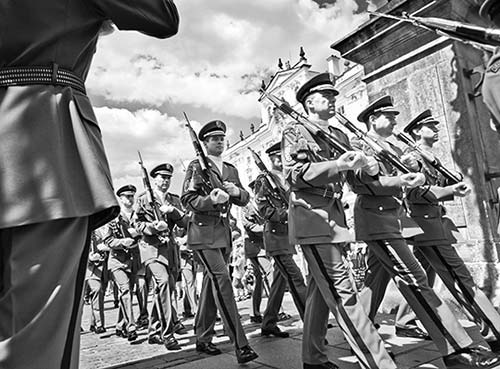
The stoic guards at this northern entrance make a great photo-op, as does the changing of the guard (on the hour). In fact, there’s a guard-changing ceremony at every gate: top, bottom, and north. The biggest, but also most crowded, ceremony and music occurs at noon, at the top gate by Castle Square.
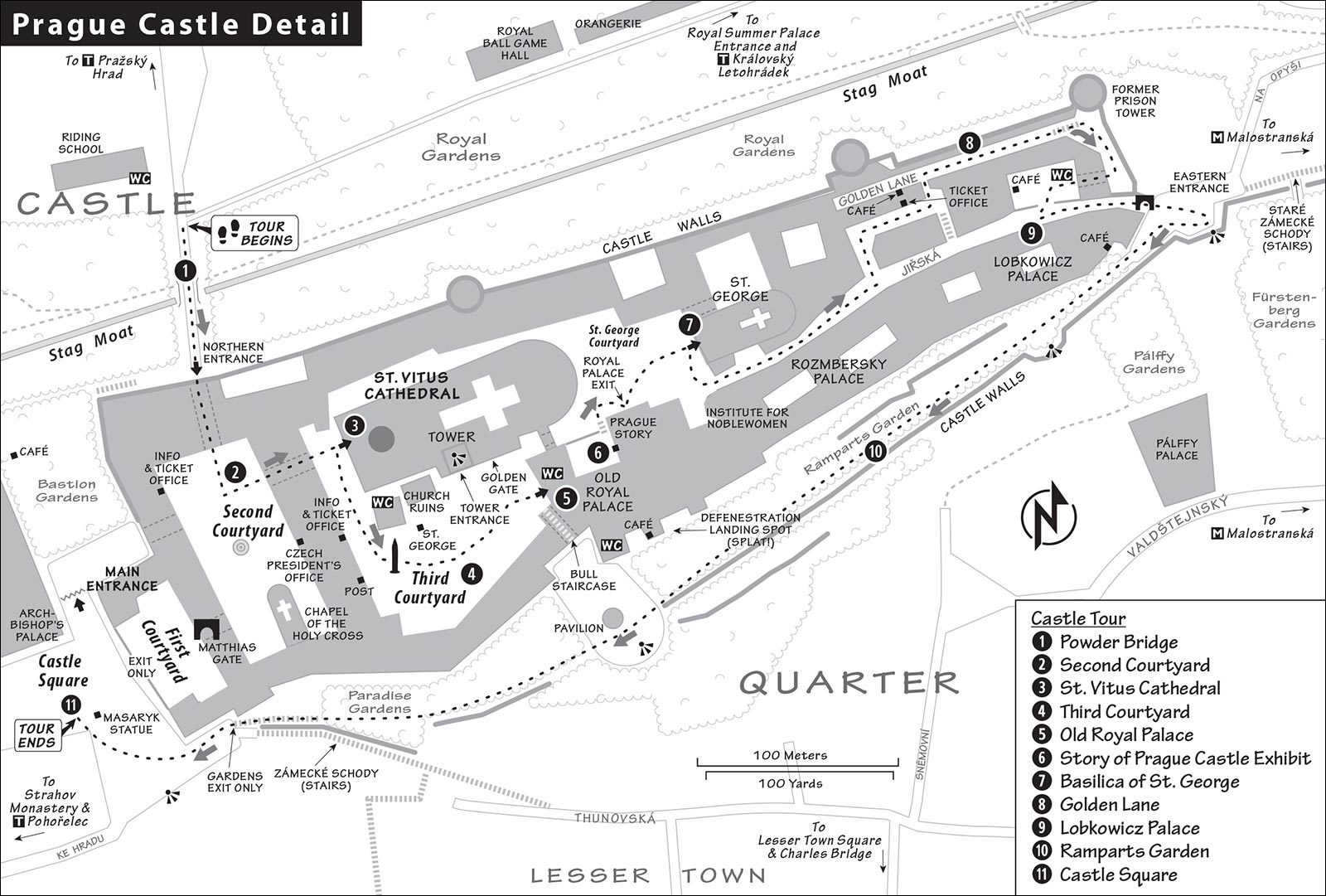
• Walk through the double gate and emerge into the Second Courtyard. To your right is an information center where you can buy your ticket (or, if lines are long, try the one in the Third Courtyard, then come back to start the tour).
2 Second Courtyard
During the 18th century, Empress Maria Theresa commissioned her favorite Italian architect to connect the disparate buildings in the castle grounds into a unified Neoclassical whole. Notice how the uniform facade lacks the expressiveness of Baroque seen elsewhere in town. On the eve of the French Revolution, fancy facades were suddenly considered ostentatious, as aristocrats no longer wanted to display wealth and status on the outside. But even in this sea of rectangular uniformity there is an element that fits with Prague: the curved upper line over the windows that harks back to the flowing Baroque dynamism of the preceding era.
While Maria Theresa never resided here, the imposing—and to this day largely empty—complex was meant to project the aura of undisputed Habsburg power. This included painting the whole thing in the Habsburgs’ favorite shade of yellow. Locals still feel uncomfortable in these “Viennese” surroundings and rush through the courtyard to take cover in one of the blessedly medieval interiors.
Before you do the same, note the fountain and Renaissance well in the middle of the square.
Just to the left of the well, the modern green awning (with the golden-winged, cat-like griffin) marks the entrance to the offices of the Czech president. If the president is in town, his flag flies over the roof at the opposite end of the square.
• Now walk through the passageway (to the left of the president’s office) that leads into the Third Courtyard. There you’ll see the impressive facade of St. Vitus Cathedral. Even without a ticket, tourists can step into the church entryway for a crowded view of the nave (and a bit of the Mucha stained glass)—but it’s worth paying to see the whole church.
3 St. Vitus Cathedral (Katedrála Sv. Víta)
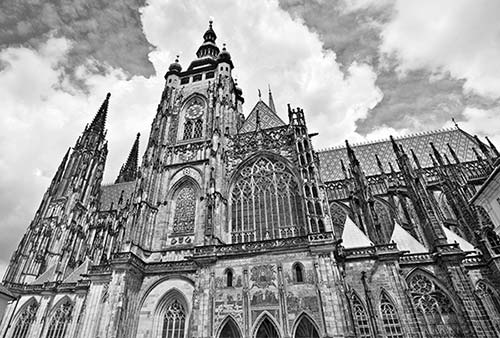
This Roman Catholic cathedral is the Czech national church—it’s where kings were crowned, royalty have their tombs, the relics of saints are venerated, and the crown jewels are kept. Since AD 920, a church has stood on this spot, marking the very origins of the Czech nation.
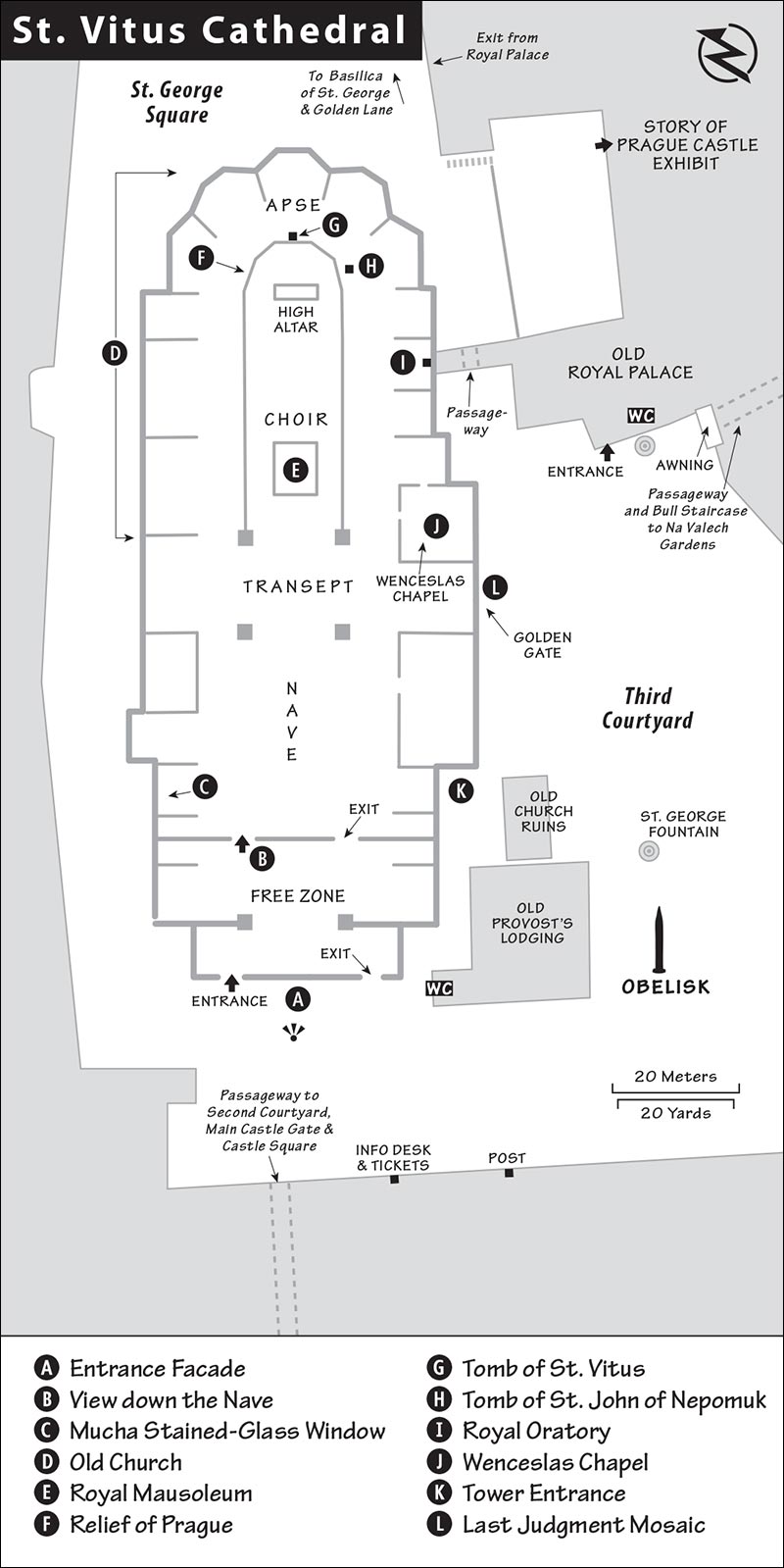
 Self-Guided Tour: The letters below correspond to the cathedral map on the facing page.
A Entrance Facade: The two soaring towers of this Gothic wonder rise 270 feet. The ornate facade features pointed arches, elaborate tracery, Flamboyant pinnacles, a rose window, a dozen statues of saints, and gargoyles sticking out their tongues.
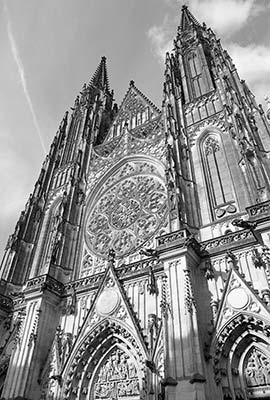
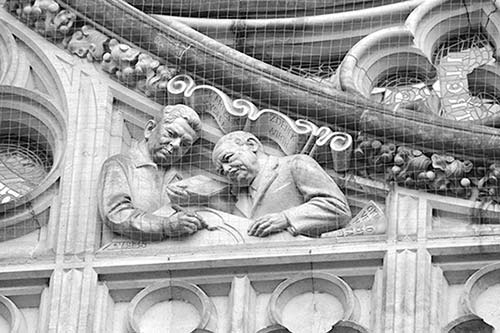
So what’s up with the four guys in modern suits carved into the stone, as if supporting the big round window on their shoulders? They’re the architects and builders who finished the church six centuries after it was started. Even though church construction got underway in 1344, wars, plagues, and the reforms of Jan Hus conspired to stall its completion. Finally, fueled by a burst of Czech nationalism, Prague’s top church was finished in 1929 for the 1,000th Jubilee anniversary of St. Wenceslas. The entrance facade and towers were the last parts to be finished.
• Enter the cathedral. If it’s not too crowded in the free entrance area, work your way to the middle of the church for a good...
B View down the Nave: The church is huge—more than 400 feet long and 100 feet high—and flooded with light. Notice the intricate “net” vaulting on the ceiling, especially at the far end. It’s the signature feature of the church’s chief architect, Peter Parler (who also built the Charles Bridge).
• Now make your way through the crowds and pass through the ticket turnstile (left of the roped-off area). The third window on the left wall is worth a close look.
C Mucha Stained-Glass Window: This masterful 1931 Art Nouveau window was designed by Czech artist Alphonse Mucha and executed by a stained-glass craftsman (if you like this, you’ll love the Mucha Museum in the New Town).
Mucha’s window was created to celebrate the birth of the Czech nation and the life of Wenceslas. The main scene (in the four central panels) shows Wenceslas as an impressionable child kneeling at the feet of his Christian grandmother, St. Ludmila. She spreads her arms and teaches him to pray. Wenceslas would grow up to champion Christianity, uniting the Czech people.
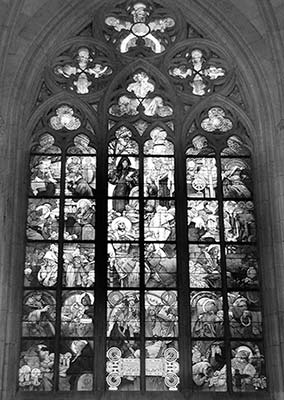
Above Wenceslas are the two saints who first brought Christianity to the region: Cyril (the monk in a black hood holding the Bible) and his older brother, Methodius (with a beard and bishop’s garb). They baptize a kneeling convert.
Follow their story in the side panels, starting in the upper left. Around AD 860 (back when Ludmila was just a girl), these two Greek missionary brothers arrive in Moravia to preach. The pagan Czechs have no written language to read the Bible, so (in the next scene below), Cyril bends at his desk to design the necessary alphabet (Glagolitic, which later developed into Cyrillic), while Methodius meditates. In the next three scenes, they travel to Rome and present their newly translated Bible to the pope. But Cyril falls ill, and Methodius watches his kid brother die.
Methodius carries on (in the upper right), becoming bishop of the Czech lands. Next, he’s arrested for heresy for violating the pure Latin Bible. He’s sent to a lonely prison. When he’s finally set free, he retires to a monastery, where he dies mourned by the faithful.
But that’s just the beginning of the story. At the bottom center are two beautiful (classic Mucha) maidens, representing the bright future of the Czech and Slovak peoples.
Mucha employs other symbolism. Ludmila stands for the past, while the young Wenceslas represents the hope and future of a nation. Notice how master designer Mucha draws your attention to these two figures through the use of colors—the dark blue on the outside gradually turns into green, then yellow, and finally the gold of the woman and the crimson of the boy in the center. In Mucha’s color language, blue stands for the past, gold for the mythic, and red for the future. Besides all the meaning, Mucha’s art is simply a joy to behold. (And on the bottom, the tasteful little ad for Banka Slavie, which paid for the work, is hardly noticeable.)
• Continue circulating around the church, following the one-way, clockwise route.
D Old Church: Just after the transept, notice there’s a slight incline in the floor. That’s because the church was constructed in two distinct stages. You’re entering the older, 14th-century Gothic section. The front half (where you came in) is a Neo-Gothic extension that was finally completed in the 1920s (which is why much of the stained glass has a modern design). For 400 years—as the nave was being extended—a temporary wall kept the functional altar area protected from the construction zone.
• In the choir area (on your right), soon after the transept, look for the big, white marble tomb surrounded by a black iron fence.
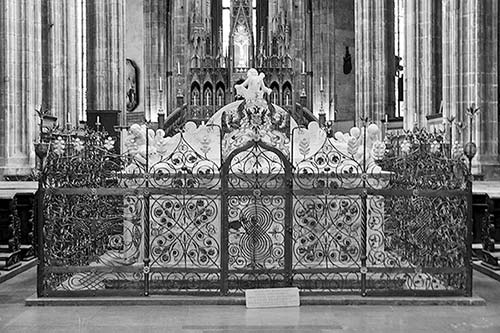
E Royal Mausoleum: This contains the remains of the first Habsburgs to rule Bohemia, including Ferdinand I, his wife Anne, and Maximilian II. The tomb dates from 1590, when Prague was a major Habsburg city.
• Just after the choir, as you begin to circle around the back of the altar, watch on your right for the fascinating, carved-wood...
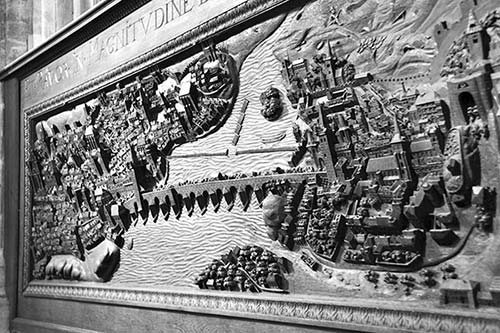
F Relief of Prague: This depicts the aftermath of the Battle of White Mountain, when the Protestant King Frederic escaped over the Charles Bridge (before it had any statues). Carved in 1630, the relief gives you a peek at old Prague. Find the Týn Church (far left) and St. Vitus Cathedral (far right), which was half-built at that time. Back then the Týn Church was Hussite, so the centerpiece of its facade is not the Virgin Mary (more of a Catholic figure) but a chalice, a symbol of Jan Hus’ ideals. The old city walls—now replaced by the main streets of the city—stand strong. The Jewish Quarter is the flood-prone zone along the riverside below the bridge on the left—land no one else wanted. The weir system on the river—the wooden barriers that help control its flow—survives to this day.
• Circling around the high altar, you’ll see various...
Tombs in the Apse: Among the graves of medieval kings and bishops is that of G St. Vitus, shown as a young man clutching a book and gazing up to heaven. Why is this huge cathedral dedicated to this rather obscure saint, who was martyred in Italy in AD 303 and never set foot in Bohemia? A piece of Vitus’ arm bone (a holy relic) was supposedly acquired by Wenceslas I in 925. Wenceslas built a church to house the relic on this spot, attracting crowds of pilgrims. Vitus became quite popular throughout the Germanic and Slavic lands, and revelers danced on his feast day. (He’s now the patron saint of dancers.) At the statue’s feet is a rooster, because the saint was thrown into a boiling cauldron along with the bird (the Romans’ secret sauce)...but he miraculously survived. Another theory explains the rooster as symbolic of dawn and light, an important attribute of the pagan-darkness-dispelling Vitus.
A few steps farther, the big silvery tomb with the angel-borne canopy honors H St. John of Nepomuk. Locals claim it has more than a ton of silver.
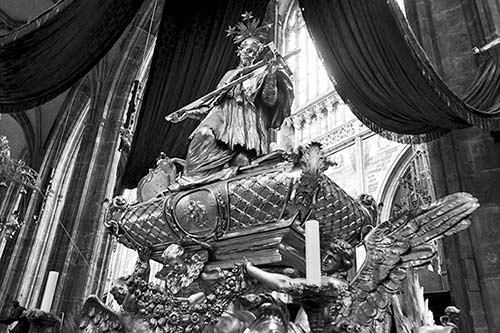
Just past the tomb, on the wall of the choir (on the right), is another finely carved, circa-1630 wood relief depicting an event that took place right here in St. Vitus: Protestant nobles trash the cathedral’s Catholic icons after their (short-lived) victory.
Ahead on the left, look up at the I royal oratory, a box supported by busy late-Gothic, vine-like ribs. This private box, connected to the king’s apartment by an outside corridor, let the king attend Mass in his jammies. The underside of the balcony is morbidly decorated with dead vines and tree branches, suggesting the pessimism common in the late Gothic period, when religious wars and Ottoman invasions threatened the Czech lands.
• From here, walk 25 paces and look left through the crowds and door to see the richly decorated chapel containing the tomb of St. Wenceslas. Two roped-off doorways give visitors a look inside. The best view is from the second one, around the corner and to the left, in the transept.
J Wenceslas Chapel: This fancy chapel is the historic heart of the church. It contains the tomb of St. Wenceslas, patron saint of the Czech nation; it’s where Bohemia’s kings were crowned, and it houses (but rarely displays) the Bohemian crown jewels. The chapel walls are paneled with big slabs of precious and semiprecious stones. The jewel-toned stained-glass windows (from the 1950s) admit a soft light. The chandelier is exceptional. The place feels medieval.
In stark contrast to the Poles, the modern Czechs never fully accepted the powerful Catholic Church. They traditionally associated Catholicism with the Habsburgs and Austria—a foreign import. The communists took advantage of this sentiment and did everything short of banning the Church to uproot the faith of the relatively few practicing Catholics in Bohemia (Moravia, the eastern part of the country, has traditionally been much more Catholic). In the early 1950s, most monks and priests, including the archbishop, were arrested and sent to prisons, from which they were not released until the 1960s. A wise priest remembered his 13 years in a labor camp as “a fascinating, well-spent time in the company of some truly great minds.”
During the communist era, Church property was confiscated, churches quickly deteriorated, churchgoers were persecuted, and many priests had to become confidants of the secret police in order to continue their service. Ironically, by persecuting Catholics, the communists gave the Church an opportunity to improve its reputation with the Czechs. From 1946 through 1989, two successive charismatic archbishops of Prague—Cardinals Beran (a survivor of several Nazi labor camps) and Tomášek—became local heroes by frequently standing up to the regime. The communists forced Beran into exile; he died in Rome, was buried in St. Peter’s Basilica in 1969, and was only reburied in this cathedral in 2018. By the 1980s, Tomášek, Beran’s handpicked successor, was one of the prominent Czechs who spoke out against communism (along with Václav Havel).
After 1989, many Czechs returned to the Catholic faith. The trend peaked in 1992 when Tomášek died (he’s now buried under the Mucha window in St. Vitus Cathedral). Since then, the Church’s hold has steadily declined. For now, many parishes are served by Polish missionaries with heavy accents.
The tomb of St. Wenceslas is a colored-stone coffin topped with an ark. Above the chapel’s altar is a statue of Wenceslas, bearing a lance and a double-eagle shield. He’s flanked by (painted) angels and the four patron saints of the Czech people. Above Wenceslas are portraits of Charles IV (who built the current church) and his beautiful wife. On the wall to the left of the altar, frescoes depict the saint’s life, including the episode where angels arrive with crosses to arm the holy warrior.
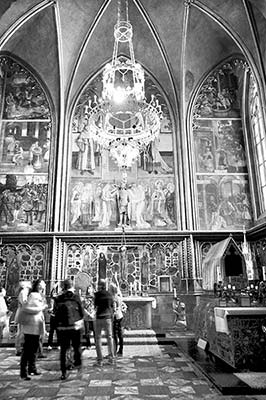
For centuries, Czech kings were crowned right here in front of Wenceslas’ red-draped coffin. The new king was handed a royal scepter, orb, and sword, and fitted with the jeweled St. Wenceslas crown made for Charles IV. While Wenceslas is considered the eternal ruler of the Czech lands, later kings were loaned his crown and authority. These precious objects are kept locked away behind a door in the corner of the chapel. The door (and the iron safe behind it) has seven locks whose seven keys are held by seven bigwigs (including the Czech president), who must all meet here when someone needs to get inside.
• Leave the cathedral, turn left (past the WC), and survey the...
4 Third Courtyard
The obelisk was erected in 1928—a single piece of granite celebrating the 10th anniversary of the establishment of Czechoslovakia and commemorating the soldiers who fought for its independence. It was originally much taller but broke in transit—an inauspicious start for a nation destined to last only 70 years.
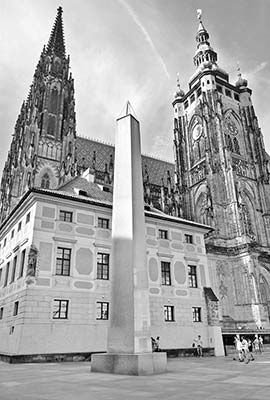
From here, you get a great look at the sheer size of St. Vitus Cathedral and its fat green tower (325 feet tall). Up there is the Czech Republic’s biggest bell (16.5 tons, from 1549), nicknamed “Zikmund.” In June 2002 it cracked, and two months later the worst flood in recorded history hit the city—the locals saw this as a sign. You can view the bell as you climb up the 287 steps of the tower to the observation deck at the top (K tower tickets and entry near sculpture of St. George—a 1960s replica of the 13th-century original). A few steps to the left you can survey the ruins of the first basilica of St. Vitus from the 11th century, protected under a green roof.
It’s easy to find the church’s Golden Gate (for centuries the cathedral’s main entry)—look for the glittering L 14th-century mosaic of the Last Judgment. The modern, cosmopolitan, and ahead-of-his-time Charles IV commissioned this monumental decoration in 1370 in the Italian style. Jesus oversees the action, as some go to heaven and some go to hell. The Czech king and queen kneel directly beneath Jesus and six patron saints. Look for a cool detail in the scene in the right bottom corner. Archangel Gabriel, with a flaming sword, turns away a group of sinners. They are tied up with a golden rope and dragged away by two devils toward a flaming cave, where grotesque Lucifer grins in anticipation. Directly below Gabriel, the naked backside of another hellish underling juts out of a white coffin; apparently, he’s making sure no sinner is hiding from his deserved punishment. On coronation day, royalty would walk under this arch, a reminder to them (and their subjects) that even those holding great power are not above God’s judgment.
Across from the Golden Gate, in the corner, notice the copper, scroll-like awning supported by bulls. This leads to a fine garden just below the castle. The stairway, garden, and other features around the castle were designed in the 1920s by the Slovene architect Jože Plečnik. Around the turn of the 20th century, Prague was considered the cultural standard-bearer of the entire Slavic world—making this a particularly prestigious assignment.
• In the corner of the Third Courtyard, near the copper awning, is the entrance to the Old Royal Palace. In the lobby, there’s a WC with a window shared by the men’s and women’s sections—meet your partner to enjoy the view.
5 Old Royal Palace (Starý Královský Palác)
Since the ninth century, this has been the seat of the Bohemian princes. The highlight of the palace building (dating from the 12th century) is the large Vladislav Hall—200 feet long, with an impressive vaulted ceiling of vine-shaped (late-Gothic) tracery. This hall, used by the old nobility, served many purposes. It could be filled with market stalls, letting aristocrats shop without going into town. It was big enough for jousts—even the staircase (which you’ll use as you exit) was designed to let a mounted soldier gallop in. Beginning in the 1500s, nobles met here to elect the king. The tradition survived into modern times. As recently as the 1990s, the Czech parliament crowded into this room to elect their president.
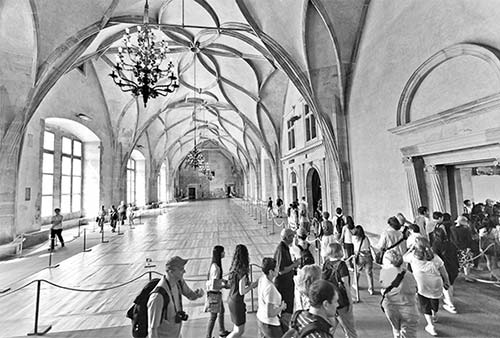
On your immediate right, enter the two small Renaissance rooms known as the “Czech Office.” From these rooms (empty today except for their 17th-century porcelain heaters), two governors used to oversee the Czech lands for the Habsburgs in Vienna. Head for the far room, wrapped in windows. In 1618, angry Czech Protestant nobles poured into these rooms and threw the two Catholic governors out the window. An old law actually permits this act—called defenestration—which usually targets bad politicians. An old print on the glass panel shows the third of Prague’s many defenestrations. The two governors landed on a slope that slowed their fall and thus saved their lives. Even though they suffered only one broken arm and bruised egos, this event kicked off the huge and lengthy Thirty Years’ War.
As you reenter the main hall, go to the far end and out on the balcony for a sweeping view of Prague. Then head for the door immediately opposite. It opens into the Diet Hall, with a fine Gothic ceiling, a crimson throne, and benches for the nobility who once served as the high court. Notice the balcony on the left where scribes recorded the proceedings (without needing to mix with the aristocrats). The portraits on the walls depict Habsburg rulers, including Maria Theresa, and Joseph II dressed up as George Washington (both wore fashionable 18th-century attire). The display case on the right contains replicas of the Czech crown jewels.
Return to the main hall; the next door to your right is the exit. Head down those horseback stairs. As you exit outside, pause at the door you just came through to consider the subtle yet racy little Renaissance knocker. Go ahead—play with it for a little sex in the palace (be gentle).
• The next sight requires the extra “Permanent exhibitions” ticket; if you don’t have one, skip down to the Basilica of St. George.
Otherwise, as you exit the Royal Palace, hook left around the side of the building and backtrack a few steps uphill to find stairs leading down to...
6 The Story of Prague Castle Exhibit (Příběh Pražského Hradu)
This museum of old artifacts (with good English descriptions) is your best look at castle history and its kings, all housed in the cool Gothic cellars of the Old Royal Palace. Throughout the exhibit, models of the castle show how it grew over the centuries.
Origins (Room 1): In this low-ceilinged medieval room, you’ll learn about prehistoric finds (mammoth bones) and the first settlers (c. 800), churches, and fortifications, and see ivory hunting horns of the first kings.
Patron Saints (Room 2): Czechs trace their origins as a people to several early saints. The first was St. Wenceslas, and you can admire (what may be) his actual chain-mail tunic and helmet. He was raised Christian by his grandmother, Ludmila (view her supposed clothes), and went on to found the original St. Vitus church. St. John of Nepomuk (no artifacts here) lies buried in the church’s most ornate tomb.
Archaeological Finds (Room 3): Look through the metal floor to see the foundations of the 12th-century palace. An adjoining room displays ecclesiastical gear, church documents, and (upstairs) bones from early funerals.
Golden Age of Bohemia (Room 4): This large hall hosts numerous artifacts from 1200 through 1400. First come the kings of the Přemysl family (including Ottokar II), then the dynasty of Charles IV and his IV wives.
Habsburg Rulers (Room 5): With Bohemia under Austrian rule, Prague briefly became the Habsburg capital in the 1520s (Turks were pounding on the gates of Vienna). When the Habsburgs returned to Vienna, Prague declined. But Emperor Rudolf II moved the Habsburg court for one last time from Vienna to Prague (1583-1612), bringing with him current art styles (Mannerism—the transition from Renaissance to Baroque) and leading-edge scientists (astronomers Tycho Brahe and Johannes Kepler).
A display on the Czech coronation ceremony (always held in St. Vitus) includes fine replicas of the Bohemian crown jewels—scepter, orb, and crown (the originals are exhibited only on special occasions). They’re a reminder that Prague Castle has been the center of the Czech state for more than a millennium.
There’s also an exhibit that shows how construction of St. Vitus Cathedral—for many years stymied—was finally jump-started in the 19th century and completed.
• Directly across the courtyard from the rear buttresses of St. Vitus is a very old church with a pretty red facade. This is the...
7 Basilica of St. George (Bazilika Sv. Jiří)
Step into one of the oldest structures at Prague Castle to see this re-created Romanesque church (a product of a 19th-century “purification” that removed the layers of Baroque) and the burial place of Czech royalty. The church was founded by Wenceslas’ dad before 920, and the present structure dates from the 12th century. (Its Baroque facade and side chapel that survived the purification came later.) Inside, the place is beautiful in its simplicity. Notice the characteristic thick walls and rounded arches. In those early years, building techniques were not yet advanced enough to use those arches for the ceiling—it’s made of wood instead.
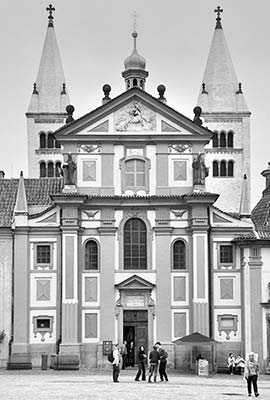
This was the royal burial place before St. Vitus was built, so the tombs here contain the remains of the earliest Czech kings. Climb the stairs that frame either side of the altar to study the area around the apse. St. Wenceslas’ grandmother, Ludmila, was reburied here in 925. Her stone tomb is in the added Gothic chapel just to the right of the altar. Inside the archway leading to her tomb, look for her portrait. Holding a branch and a book in this 18th-century depiction, she looks quite cultured for a 10th-century woman.
As you exit the church, you’ll pass some small exhibits about the layers of history at this site.
• Continue walking downhill. Notice the basilica’s gorgeous Renaissance side entrance, with St. George fighting the dragon in the tympanum. You’ll next see the basilica’s Romanesque nave and towers—a strong contrast to the lavish painted Baroque facade. To your right, tucked together, you’ll see the palaces of Catholic nobility who wanted to be both close to power and able to band together should the Protestants grab the upper hand. Take a left once you have passed the apse of the St. George Basilica, then turn right and then left again to stroll through the...
8 Golden Lane
This medieval merchant street was once lined with the former residences of soldiers and craftsmen. Today it’s filled with touristy shops.
• At the end of the Golden Lane, walk down the stairway in a tunnel and, keeping the former prison tower to your left, make a sharp right turn through a small gate. Walk across a courtyard and exit to the left to face the...
9 Lobkowicz Palace (Lobkowiczký Palác)
This palace, rated ▲▲ and covered by a separate ticket, displays the private collection of a prominent Czech noble family, including paintings, ceramics, and musical scores. The Lobkowiczes’ property was confiscated twice in the 20th century: first by the Nazis at the beginning of World War II, and then by the communists in 1948. In 1990, William Lobkowicz, then a Boston real estate broker, returned to Czechoslovakia to fight a legal battle to reclaim his family’s property and, eventually, to restore the castles and palaces to their former state. While the National Gallery may seem a more logical choice for the art enthusiast, the obvious care that went into creating this museum, the collection’s variety, and the personal insight it offers into Czech nobility make the Lobkowicz worth an hour of your time.
Members of the Lobkowicz family (including William) narrate the delightful, included audioguide. If you visit, use the map that comes with your ticket to focus on the highlights:
Second-Floor Landing and Room B: As you pass by the portraits of Lobkowicz’s ancestors, listen to their stories, including that of Polyxena, whose determination saved the two Catholic governors defenestrated next door (according to family legend, she hid the bruised officials under the folds of her skirt).
Room G: The family loved music. See their instruments, including old lutes. There’s the manuscript of Beethoven’s Eroica symphony (with his last-minute changes). The piece was dedicated to his sponsor—Prince Lobkowicz (see his portrait)—and premiered at the Lobkowicz Palace in Vienna. Nearby is Mozart’s handwritten reorchestration of Handel’s Messiah.
Rooms H-J: The highlights of the museum’s paintings include Pieter Bruegel the Elder’s magnificently preserved Haymaking (1565). It’s one of the earliest entirely secular landscape paintings in Europe, showing an idyllic and almost heroic connection between peasants and nature. Admire a few paintings of various Lobkowicz castles (by no-name artists), as well as two Canaletto scenes of London’s Westminster Abbey and St. Paul’s Cathedral.
• Once you’re done touring the palace, you can exit the castle complex through the gate at the bottom (eastern) end of the castle. A scenic rampart just below the lower gate offers a commanding view of the city. From there, you can either head to the Malostranská tram/Metro station and riverbank or loop around to Castle Square (where this tour continues).
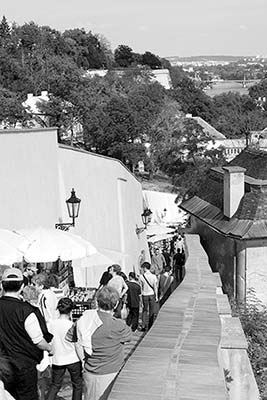
To reach Malostranská station, follow the crowds down the 700-some steps of a steep lane called Staré Zámecké Schody (“Old Castle Stairs”). To continue this tour (or to reach Strahov Monastery), take a hard right as you leave the castle gate, and stroll through the long, delightful...
10 Ramparts Garden (Zahrada Na Valech)
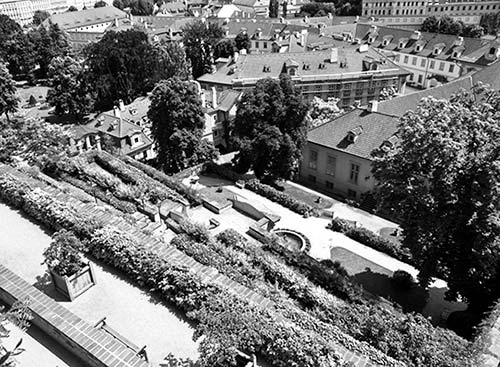
This garden comes with commanding views of the city below (free, daily 10:00-18:00 or later, closed Nov-March). Along the way, notice the Modernist layout of the garden, designed by Jože Plečnik of Slovenia. Halfway through the long park is a circular viewpoint. At roughly the same distance under the brick wall of the Royal Palace, find a Baroque column commemorating the miraculous survival of the defenestrated overlords. As you exit the garden at the far end through a narrow gate on top of a wide, monumental staircase, notice the cool wolf-snout design of the adjacent doorknob, another Plečnik trademark.
• Make your way into...
11 Castle Square (Hradčanské Náměstí)
Castle Square was the focal point of premodern power. The Fighting Titans sculpture, depicting two triumphant gladiators, marks the main entry into the residence of Czech kings. The archbishop lived (and still lives) in the Archbishop’s Palace—the ornate, white-and-yellow Rococo building with the oversized facade. Above the doorway is the family coat of arms of the archbishop that built this palace: three white goose necks in a red field. (The portal on the left leads to the Sternberg Palace art museum, described in the Sights in Prague chapter.)
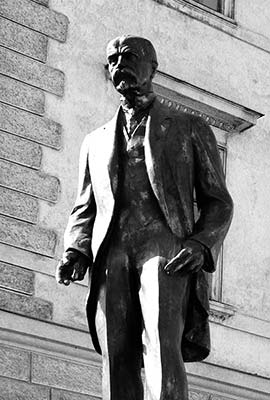
Closer to you, near the overlook, the statue of a man in a business suit (marked TGM) honors the father of modern Czechoslovakia: Tomáš Garrigue Masaryk. At the end of World War I, Masaryk—a university professor—united the Czechs and Slovaks into one nation and became its first president.
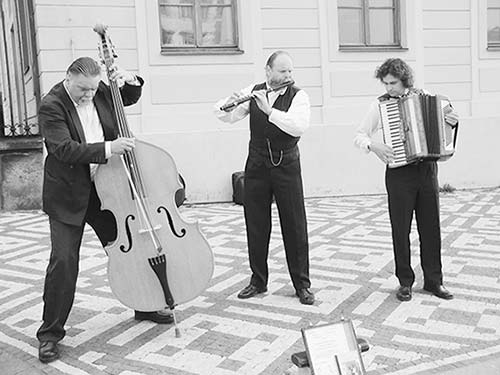
Entertaining bands play regularly by the Masaryk statue in the mornings and early afternoons. (If the Prague Castle Orchestra is playing, say hello to friendly, mustachioed Josef, and consider buying the group’s CD—it’s terrific.)
On the left side of the square, behind the statue, the building with a step-gable roofline is Schwarzenberg Palace, where the aristocrats from Český Krumlov stayed when they were visiting from their country estates. Most of the palaces flanking Castle Square date from the 16th century, when the Turks-weary Habsburgs moved their capital from Vienna to Prague. A wife of one of the aristocrats captured the ensuing real-estate craze when she exhorted her husband in a letter “to immediately procure that chunk of land lest we be subjected to the humiliation of having to borrow a place near the court.” Notice the envelope-shaped patterns stamped on the exterior. These Renaissance-era adornments etched into wet stucco—called sgraffito—decorate buildings throughout the castle and all over Prague and the Czech Republic. Today Schwarzenberg Palace is an art museum with a collection of Renaissance, Baroque, and Rococo masterpieces (see listing in the Sights in Prague chapter).
Tomáš Masaryk founded the first democracy in Central Europe at the end of World War I, uniting the Czechs and the Slovaks to create Czechoslovakia. Like Václav Havel 70 years later, Masaryk was a politician whose vision extended far beyond the mountains enclosing the Bohemian basin.
Masaryk, from a poor servant family in southern Moravia, earned his PhD in sociology in Vienna, studied in Leipzig, then became a professor at Charles University of Prague. By then, he was married to American Charlotta Garrigue, a social revolutionary from a Unitarian New York family. Through Charlotta, Masaryk was introduced to America’s high society, which proved crucial in 1918 when he successfully campaigned there for the recognition of his new country.
Masaryk was greatly impressed with America, and his admiration for its democratic system (and his wife) became the core of his evolving political creed. He traveled the world and served in the Vienna parliament. At the outbreak of World War I, while most other Czech politicians stayed in Prague and supported the Habsburg Empire, 64-year-old Masaryk went abroad in protest and formed a highly original plan: to create an independent, democratic republic of Czechs and Slovaks. Masaryk and his supporters recruited an army of 100,000 soldiers who were willing to fight with the Allies against the Habsburgs, establishing a strong case to put on official desks in Paris, London, and Washington.
On the morning of October 28, 1918, news of the unofficial capitulation of the Habsburgs reached Prague. Supporters of Masaryk’s plan quickly took control of the city and proclaimed the free republic. As the people of Prague tore down double-headed eagles (a symbol of the Habsburgs), the country of Czechoslovakia was born.
On December 21, 1918, four years after he had left the country as a political unknown, Masaryk arrived in Prague as the greatest Czech hero since the revolutionary priest Jan Hus. He told the jubilant crowd, “Now go home—the work has only started.” Throughout the 1920s and 1930s, Masaryk was a vocal defender of democratic ideals in Europe against the rising tide of totalitarian ideologies. Today Masaryk is one of only a few foreign leaders to be honored with a statue in Washington, DC.
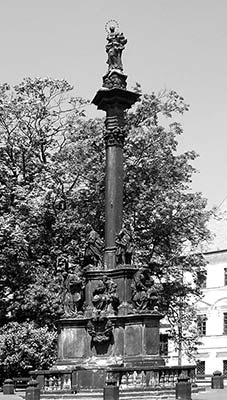
The dark gray Baroque sculpture in the middle of the square is a plague column. Erected as a token of gratitude to Mary and the saints for saving the population from epidemic disease, these columns are an integral part of the main squares of many Habsburg towns.
Two more palaces are worth looking at. At the far-right corner of the square, past the plague column, is the delightful Martinický Palace, with delicate Renaissance portals and detailed figural sgraffito depicting the feats of biblical Joseph and mythic Hercules. The pastel Toskánský Palace at the western end of the square is a beautifully balanced example of Baroque palatial architecture.
• From the top corner of Toskánský Palace, you can either continue up along Loretánská street to the Loreta Church and Strahov Monastery (both described in the Sights in Prague chapter) or take the scenic staircase on the left down to the top of Nerudova street in the Lesser Town. The Pohořelec tram stop is across from Strahov Monastery.