OLOMOUC & NEARBY
Olomouc • Kroměříž • Wallachia
Sleeping and Eating in Kroměříž
Olomouc (OH-loh-moats), the historical capital of Moravia, is a showcase of Baroque city planning. Today, it’s the Czech Republic’s fifth-largest city (pop. 100,000) and harbors Moravia’s oldest university. Students rule the town. With its wealth of cafés, clubs, and restaurants, Olomouc is the place to taste vibrant local culture—without the hassles and scams of Prague.
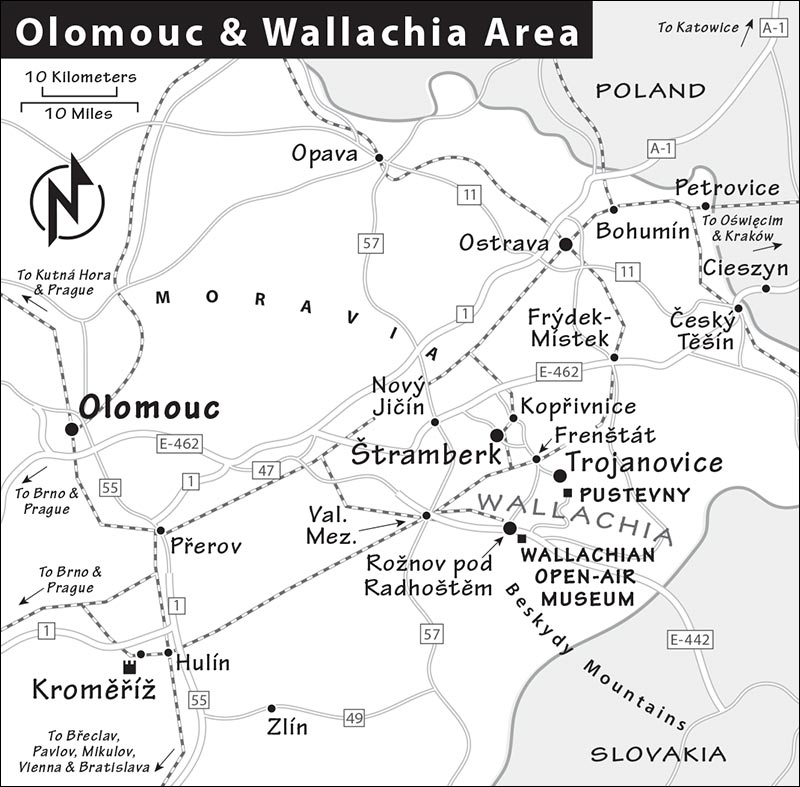
Anything labeled “Haná” is from this particular part of Moravia—you’ll notice plenty of Haná pride here. Olomouc is a fine place to just kick back for a day or two in a beautiful Baroque town with its Haná-centric gaze fixed on the future. Nearby Kroměříž, an hour away by train, beckons day-trippers with its lavish castle and gardens. And to delve even more deeply into the Moravian countryside, linger in Wallachia—tucked in the forested hills between Olomouc and the Polish border.
Olomouc
Olomouc has pride. It’s at a crossroads about 150 miles from each of the other great cities of the region (Prague, Wrocław, Kraków, Bratislava, and Vienna) and wants to play with the big boys. While it ruled Moravia from the 11th century until 1642, today it’s clearly playing second fiddle to Brno, the booming industrial city four times its size an hour south. Locals brag that Olomouc has the country’s second-most-important archbishopric and the tastiest diet cheese (less than one percent fat) in the world. Like Prague, it has its own fancy astronomical clock. Olomouc actually built its bell tower in the 19th century to be six feet taller than Prague’s. Olomouc is unrivaled in one category: Its plague monument is the tallest and most grandiose anywhere.
Although Olomouc’s suburbs sprawl with 1960s apartment complexes and factories, its historic core was spared experiments in urban design. It’s not lost in a time warp like the old-town areas of Český Krumlov, Telč, and Slavonice. It’s simply workaday Moravia. Trams clatter through the streets, fancy boutiques sell designer fashions, and locals pack the busy pubs. Few tourists come here, so the town thrives on its own economy.
In the mornings, proud farmers dig out their leeks and carrots and descend upon the colorful open-air market. Haná, the region that immediately surrounds Olomouc, is among the most fertile in the Czech Republic. The big landowners here have never had trouble converting their meat, milk, and bread into gold and power. The most distinguished landowner of all has always been the Church. Archbishops have ruled from here for a thousand years, filling the town with churches and monasteries. In 1946, these buildings were turned into departments of the new Palacký University.
Being a student town, Olomouc feels young and alive (though quiet during summer weekends and school vacations, when the students clear out). It’s also noticeably artistic, with more than its share of oddball characters roaming the streets. Olomouc has managed to blend the old and the new better than any other town in the country. The McDonald’s on the Baroque main square is not an intruder, but simply a contented acknowledgment of modern times.
PLANNING YOUR TIME
Olomouc is a delightful mix of Baroque space and 21st-century life. Don’t approach the city as a sightseer; Olomouc is to be experienced and enjoyed. The only must-see “sights”—the two squares and the plague column—can be covered in an hour, but you can enjoy additional time in the city’s restaurants, bars, and clubs.
If you’re passing through, hop off the train for a three-hour lunch stop on the main square. Better yet, stay the night to relax and sample the rich nightlife. I enjoy the city enough to visit it as a long day trip from Prague. On a more leisurely visit, consider worthwhile side trips to Kroměříž (with a sumptuous château) and the Wallachia region (a rural, rustic corner of Moravia).
Orientation to Olomouc
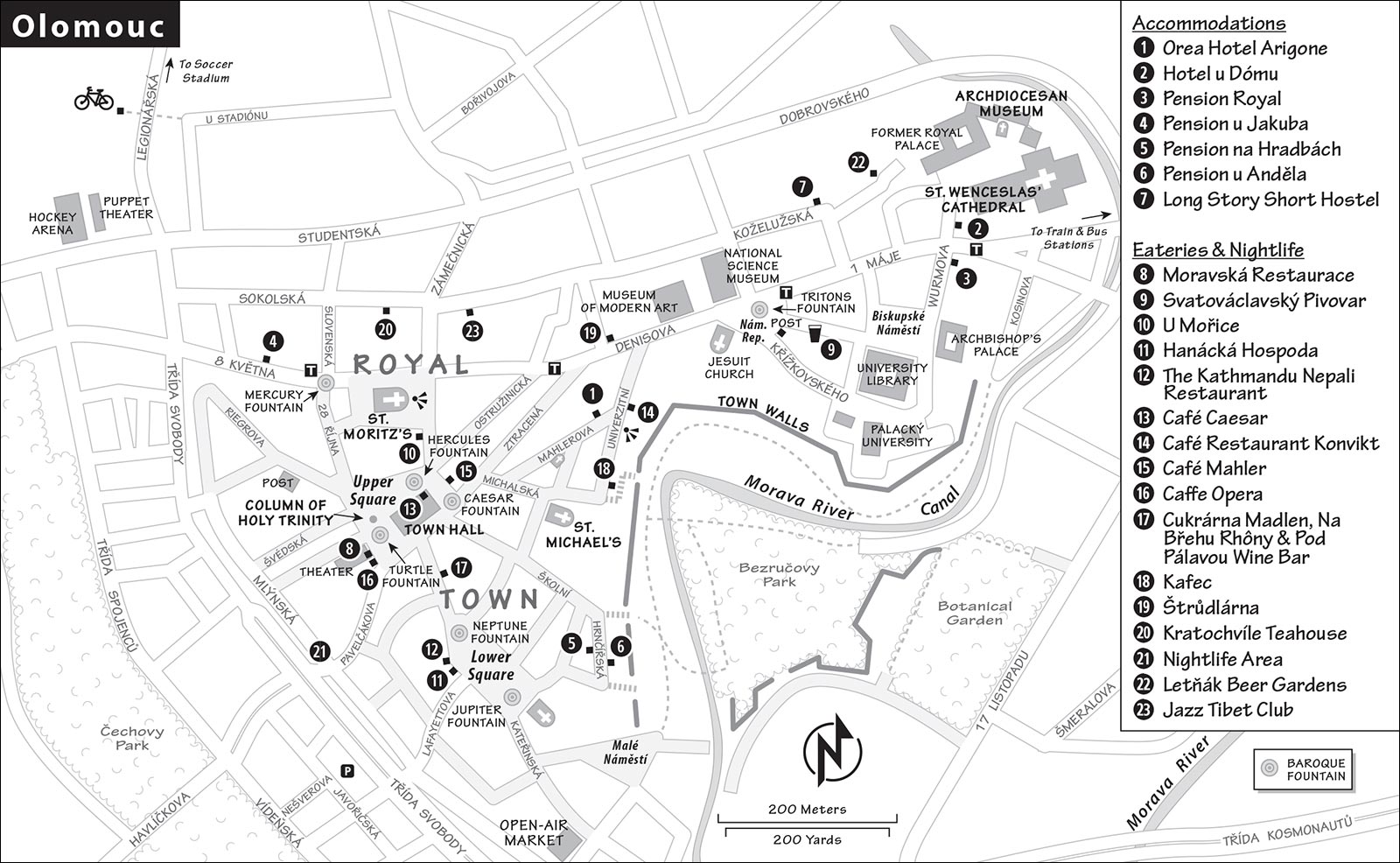
Olomouc’s historic core is small, compact, and just five tram stops from the train station. The core has two parts: the original settlement around the former royal palace and cathedral, and the royal town (west of the cathedral). The royal town is concentrated around two connected squares: Upper Square (Horní Náměstí), with the Town Hall and plague column; and Lower Square (Dolní Náměstí), with many restaurants.
Part of Olomouc’s charm is that it’s a Baroque town on a medieval street plan. Everything of sightseeing interest is contained within its historic core, defined by the circular greenbelt that follows the town’s old wall.
TOURIST INFORMATION
Olomouc’s main TI is in the Town Hall on the Upper Square (daily 9:00-19:00, +420 585 513 385, https://tourism.olomouc.eu). They sell tickets to concerts, organize tours of individual sights, and can set you up with a local guide (reserve ahead).
ARRIVAL IN OLOMOUC
By Train: Olomouc’s circa-1950s train station (Hlavní Nádraží) is downright cute. Bright, happy peasants still greet you with their banners, rakes, and trays of koláče (pastries). As you exit through the main station hall, on your left you’ll see the Czech state railways center, with 24-hour help on train connections (+420 972 741 620). On your right are ticket windows for RegioJet and Leo Express (private railway companies with service to Prague), and the city-transit office with information about trams and tickets (Mon-Fri 5:00-19:00, Sun from 14:00, closed Sat).
The fortune and misfortune of Olomouc has always come from its strategic location at the intersection of Central Europe’s main east-west and north-south routes: Merchants, pilgrims, kings, and armies had to pass through the city.
Until the 1640s, Olomouc was the second-largest city in the Czech lands. The king’s younger brother governed Moravian politics from here, while the archbishop kept the spirits (and the lands) of Moravians in God’s hands—that is, his own.
Olomouc was trashed by passing armies during the Thirty Years’ War (1618-1648) and occupied by the Swedes for the last eight of those years. More than 70 percent of the town’s population died in battles or from plagues, and the Moravian capital was moved to Brno. In 1709, Olomouc burned to the ground...only to emerge from the ashes with a Baroque flair during the Habsburg years. The new Olomouc—filled with churches, colleges, statues, and fountains—became the largest Baroque town in the country. But its prosperity again ended abruptly, as Prussia (occupying what is now western Poland and eastern Germany) threatened to invade Vienna—and Olomouc was right in the way. The Habsburgs had Olomouc’s students and monks leave, and replaced them with soldiers who would defend the city. They surrounded Olomouc with tall, thick walls, and what once was a cultural center became an immense fortress. The Prussians laid siege to the city, but never managed to take it. The ring of walls and moats that protected the town also ended up preventing the encroachment of modern-day architecture into the historic center.
Olomouc eventually began to thrive again, but it remains overshadowed by Brno. Today, it still comes in second as the economic powerhouse of Moravia. But ever since Palacký University was founded here in 1946—on the grounds of the centuries-old theological university—Olomouc has been Moravia’s intellectual center.
Take the tram into the center. Trams #2, #4, and #6 stop in front of the train station and go past the cathedral (U Dómu, third stop), then continue to Koruna (fifth stop), right by the main square. Even if you’re not arriving by train, consider riding the tram for an easy orientation to the city (described later).
Taxis are inexpensive (figure on 100 Kč to the center). Call Atlant-taxi (+420 800 113 030; or use their app, at www.atlanttaxi.cz) or Citytaxi (+420 800 223 030).
By Car: Several streets in the city center are closed to traffic; others allow street parking (pay at meter Mon-Fri 8:00-18:00). The best plan is to park your car at a pay garage. Garages that are handy to the Upper Square include one at the corner of Mlýnská and Pavelčákova, and another a couple of blocks away, at Palachovo Náměstí.
HELPFUL HINTS
Beer Spa: For an unforgettable memory, it’s hard to beat soaking in a sudsy beer bath at the Svatováclavský Pivovar brewery (see listing later, under “Eating in Olomouc”).
Pharmacy: A 24-hour pharmacy is on Aksamitova street.
Bike Rental: Centrum Semafor, just north of the city center at Legionářská street, rents bikes and e-bikes (+420 604 295 037, https://centrum-semafor.cz).
Local Guide: Štefan Blaho, who speaks English well, is a rare Olomouc guide ready to connect with curious visitors who figure out how much fun Olomouc is to visit—especially with a local (1,400 Kč for a one-hour tour, 2,000 Kč for 2 hours, +420 602 729 613, www.olomouc-guide.cz, sarpedon@seznam.cz).
GETTING AROUND OLOMOUC
Although Olomouc is walkable, I recommend taking a tram ride for a good orientation. Tickets are good for 40 minutes, so you can hop on and off (14 Kč, buy at tabák shops or yellow machines, or pay a little extra to buy on board from the driver).
Olomouc Overview Tram Ride: The 10-minute tram ride from the train station (Hlavní Nádraží) to the Upper Square (stop: Koruna) is a handy way to get an overview of the city. It’s easy. Trams #2, #4, and #6 make the route, going every few minutes.
In front of the train station stretches a modern town center with planned communist-era apartment blocks. While there are plenty of drawbacks to the city’s communist heritage, one good leftover from that era is Olomouc’s fine, still-subsidized public transit. As you ride, notice that people often forgo owning a car because of dirt-cheap monthly passes. It’s second nature here.
Going downtown from the station, you peel through the city’s architectural layers of history. Crossing the three branches of the river, you pass through the university district before reaching the center. A red light at the front of the car indicates your next stop. Hop out at “Koruna” and head toward the big square (Upper Square) a block to your left.
Sights in Olomouc
Olomouc is divided between its royal town (surrounding the magnificent Upper Square, with its famous plague column) and its bishop’s town, or cathedral district (the other end of town, with the bishop’s palace and Archdiocesan Museum). The huge university sprawls between these two former centers of power. Visitors connect the two zones with an easy 10-minute walk. The sights here are listed in that order: Upper Square and its surroundings, crosstown walk, and cathedral.
THE ROYAL TOWN
▲▲Upper Square (Horní Náměstí)
Standing in front of the Town Hall, surrounded by the vast square and the many beautiful noble and bourgeois residences, you can imagine Olomouc’s importance over the centuries.
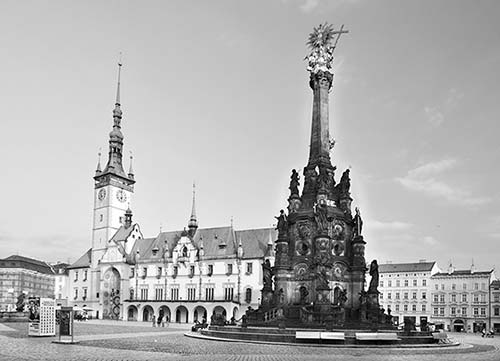
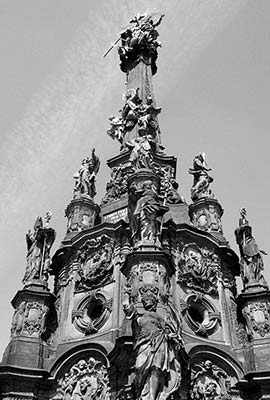
The square is dominated by the Column of the Holy Trinity (Sousoší Nejsvětější Trojice). The artistic pride of Olomouc is the tallest plague column in Europe. Squares throughout Central and Eastern Europe are dotted with similar structures, erected by locals to give thanks for surviving the plague. This one was started in 1716 by a local man named Render, who announced—with a confidence characteristic of the Haná region—that he would create a work that in “its height and ornamentation would not have a peer in terms of excellence.” He donated his entire fortune, employing many great artists for decades to build the monument. Sadly, he died before its consecration, which occurred in the presence of the Habsburg ruler Maria Theresa, the Holy Roman Empress.
The Holy Trinity group on the highest point of the column features God the Father giving a blessing, Christ with a cross sitting on a globe, and the dove in gold (representing the Holy Spirit) crowning everything. Tumbling with the Trinity, the archangel Michael—holding his fiery sword and shield—reminds us that the Church is in a constant struggle with evil. A third of the way down from the top of the column (past the golden cannonball—embedded there as a reminder of the 1758 Prussian siege), we see Mary—the mediator between heavenly and earthly spheres—carried off by angels during the Assumption.
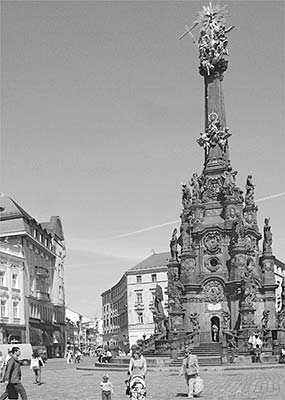
The bottom third features three reliefs with allegories of the Christian virtues (Faith, Hope, and Charity), surrounded by six saints. Four of the saints are closely connected with the life of Jesus (saints Joachim and Anne—the parents of the Virgin Mary—as well as St. Joseph and St. John the Baptist); the other two are the patron saints of Olomouc (saints Jerome and Lawrence). This particular arrangement of saints shows that universal faith is often combined with a distinctly local myth and belief.
It all sits atop a tiny (and rarely open) chapel where Maria Theresa knelt to pray—devout, yet green with envy. Olomouc had a plague column grander than Vienna’s.
Olomouc’s grand Town Hall is a testament to the city’s 600 years of prominence in Moravia. The three wings around a rectangular courtyard once served as both council chambers and market halls. In the late 1400s, part of the building was converted into an armory, guards’ house, and jail. The Town Hall is busy with local weddings—if you see a festively decorated car parked on the square, it’s probably waiting to zip a bride and groom away. You can visit the Town Hall’s interior and climb the tower only with an escort (30 Kč for 30-minute tour, 6/day in summer, 2/day off-season, book tickets and depart from the TI located within the Town Hall).
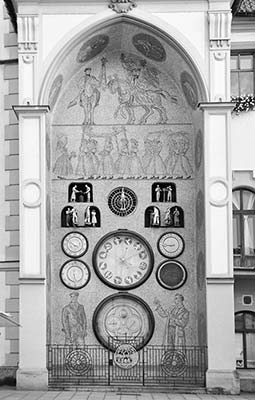
The huge astronomical clock on the Town Hall was once far more complex than the one in Prague. Originally, it depicted the medieval universe divided into three spheres, but it was periodically rebuilt to correspond with new advances in knowledge. In 1898, purists worked to restore it to its original state.
Sprinkled around Olomouc’s old town is a series of seven allegorical fountains with statues. Since pagan times, Olomouc—whose wealth has always been based on agriculture—has had a close relationship with water. Most of the fountains were inspired by classical mythology.
One features a statue of Neptune, the god of water. Another shows Hercules depicted as the guardian of Olomouc, holding the Moravian checkered eagle in his left hand and a mace in his right. Jupiter, the overlord of the gods, replaced an earlier sculpture of the only Christian saint who appeared on the fountains: St. Florian, protector from fires and floods.
The Tritons fountain—closely based on the one at Rome’s Piazza Barberini—has the most developed composition: a pair of water spirits and a dolphin carrying a conch, with a fragile boy leading two dogs.
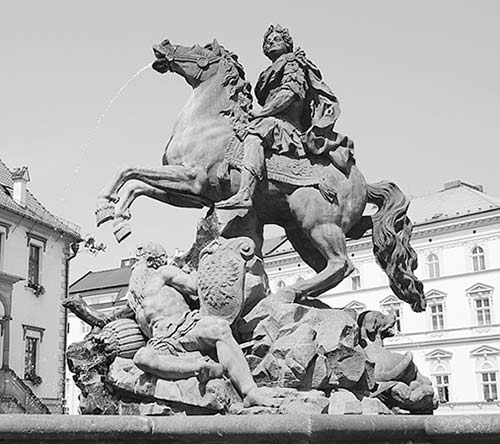
The culmination of the cycle is the equestrian statue of Caesar, who looks proudly toward Michael Hill (where legend says he founded Olomouc). The water gods Morava and Danubius carry the coats of arms of Moravia and Lower Austria, and the dog represents Olomouc’s fidelity to the Austrian emperor.
The Mercury statue (by the tram stop near the Upper Square) is artistically the most successful. Mercury fulfilled the same role in classical mythology as the archangel Michael did in the Old Testament: He was the guide through the land of the dead and the messenger of the gods.
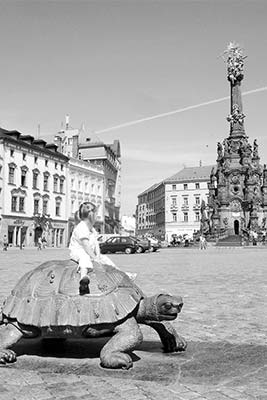
The modern turtle fountain, at the end of the Town Hall, is the most entertaining. The turtle, who lives a long life, symbolizes ancient Olomouc’s ability to hang in there. The city’s history in maps and documents is inscribed on the turtle’s pillar. Contribute to the tourist tradition of rubbing the tail on the dolphin statue to assure your return to Olomouc. This fountain is a fun place to watch young kids enjoying art.
The placement of the fountains and statues at the intersections of roads and squares—reminiscent of stage props in Baroque theater—imitates the spectacular cycle of Bernini’s fountains in Rome. Since the second half of the 18th century, every view down any main street in Olomouc has ended with a sculpture. Look for these as you sightsee, and you’ll better appreciate the town as theater.
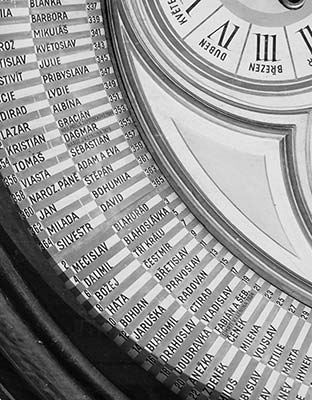
Like Prague’s clock, Olomouc’s astronomical clock was intentionally destroyed by the Nazis in World War II. Today’s version was rebuilt in 1953 by the communists, who had a flair for kitschy propaganda. In this one-of-a-kind clock made in the Socialist Realist style, you have earnest chemists and heroic mothers rather than saints and Virgin Marys. High noon is marked by a proletarian parade, when, for six minutes, a mechanical conga line of milkmaids, clerks, blacksmiths, medics, and teachers are celebrated as the champions of everyday society. Study the mosaic symbols of the 12 months (leden is January; circle down on the left—červen is June). The Haná region is agriculturally rich, so each month features a farm activity. As with any proper astronomical clock, there’s a wheel with 365 saints, so you’ll always know whose special day it is. But this clock comes with a Moscow-inspired bonus—red bands on the wheel splice in the birthdays of communist leaders (Lenin was born on the 112th day of the year in 1870; Stalin’s saint was Toman—day 355). Note that the clock’s designers were optimists—the year mechanism (on the bottom) is capable of spinning until AD 9999.
Locate the town model, near the fountain just in front of the clock. While designed for blind people, it gives anyone interested a feel—literally—for the medieval street plan, otherwise easily overlooked among all the Baroque grandeur.
Circle around the left side of the Town Hall to find another fountain, with an equestrian statue of Julius Caesar. This is dedicated to the legendary founder of the town (excavations reveal that it actually originated as a third-century-AD Roman military camp—centuries after Caesar). For more on the fountains that are strategically scattered around Olomouc’s core, see the sidebar, earlier.
Just behind Caesar, Café Mahler is a reminder of the great composer Gustav Mahler (1860-1911), who worked in the local German theater for two months in 1883.
On this side of the Town Hall, notice the beautiful Mannerist loggia, used for the entry into the council chambers and for ceremonial purposes (such as the mayor’s declarations to the public). The coats of arms of many nations show that Moravia was part of the vast and multiethnic Habsburg Empire.
This motto, which inspired the transformation of Olomouc’s military fortress into a lively university campus, came from John Amos Comenius (a.k.a. Jan Amos Komenský), one of the Czech Republic’s most influential teachers and writers (pull out a 200 Kč banknote to have a look at him). You’ll find his dictum embedded in the pavement at the entrance to Olomouc’s former central armory, which is the main university library today.
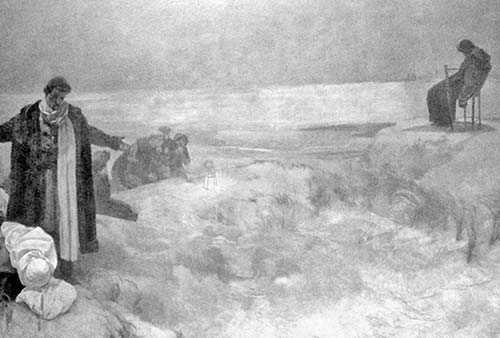
Comenius was born into the Moravian Brethren faith, which was founded on the pacifist ideals of the Czech religious reformer Petr Chelčický (c. 1390-1460). Having studied at universities in Germany, Comenius returned to Moravia as a young pastor to run the Protestant schools in Fulnek and Přerov. The beginning of the Thirty Years’ War had a direct impact on him: His wife and two children died in a plague epidemic, and following the defeat of the Czech Protestants by the Catholic Habsburgs, Comenius had to choose exile over abandoning his faith. Personal misfortune went hand-in-hand with a professional one: During his escape through Poland, his entire library went up in flames, a fate that later befell many of his personal writings.
Surrounded by the chaos and destruction of war, Comenius believed that guns were no way to restore order—what the world really needed was a revolution in learning. He envisioned a liberal arts education that would create citizens rather than specialists, and proposed a new teaching system based on the novel principle of “school through play.” To promote this idea, he wrote extensively. His works included a textbook aimed at making learning Latin fun for children, one of the first scholarly treatments of preschool education, and Orbis Pictus (“World in Pictures”), the first children’s encyclopedia. His most famous and acclaimed work, The Labyrinth of the World and the Paradise of the Heart (written in Czech, not Latin), argued that all human knowledge and ambition are futile if unaccompanied by faith and charity. His fame spread across the Atlantic: In 1636, Comenius was asked to become the first president of Harvard University. Still hoping to return home (and afraid of sea journeys after he almost lost his life in a storm in the North Sea), Comenius declined the offer.
For the remainder of his wandering life, Comenius taught and wrote in Poland, Hungary, the Netherlands, England, and Sweden, never able to return home. Alphonse Mucha powerfully captured Comenius’ tragic fate as a homeless exile—a fate later to be shared by thousands of free-spirited Czechs—in one of the canvases of his Slav Epic.
During the communist era, Comenius’ grave (in Naarden, near Amsterdam) became a shrine for Czech exiles; immediately after the fall of the Iron Curtain, the site was swamped with Czechs who came to pay their respects. Today, Comenius is considered one of the founders of modern education, and his birthday is celebrated as Teachers’ Day in both the Czech Republic and Slovakia.
Circling the rest of the way around the Town Hall, you’ll see the wide street leading down to Olomouc’s Lower Square.
Lower Square (Dolní Náměstí)
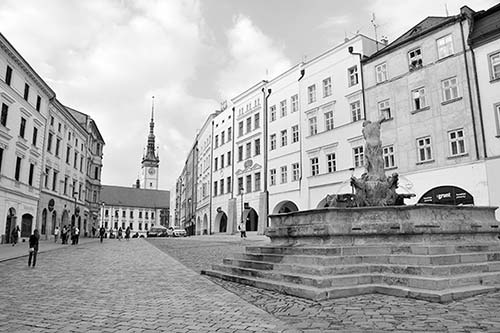
Below the Upper Square stretches the more workaday Lower Square. The dark blocks in the paving stones mark the site of an old chapel’s foundation, which was discovered during the renovation. Today the square enjoys a sparkle that rivals its big brother—it even has its very own, twisty plague column.
Open-Air Market
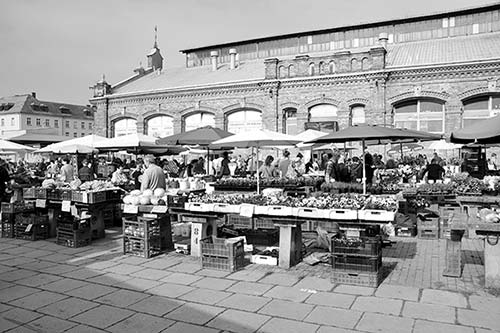
As was the norm in medieval times, poor people traded tax- and duty-free items just outside the town walls. The city’s market remains in the same spot, just outside the town wall a long block below the Lower Square. The town’s circa-1900 brick market hall is of no interest today, but around it sprawls a colorful open-air market. While Moravian farmers sell their vegetables and herbs, foreign traders hawk knockoff jeans and cheap sunglasses (closed Sun, busiest on Wed and Sat, but fun any morning). The rough little snack bar sells langoš (a Hungarian cheese-and-garlic savory doughnut), cheap coffee, and good beer.
Churches
Since its origin, Olomouc has been the seat of bishops. The great number of churches—concentrated in such a small area—shows the strong presence of the Church here. Of the many churches in town, two are worth a peek (each one is a block off the Upper Square; both are free to enter—though donations are appreciated—and open daily 7:00-18:00, shorter hours off-season).
St. Michael’s Church (Sv. Michal), located at the highest point in town, dominates Olomouc’s skyline. It’s a fine, single-nave Baroque church full of illusory paintings, fake armor, and lovely Gothic frescoes hidden under Baroque whitewash. As it was rebuilt after looting by the Protestant Swedes during the Counter-Reformation, the Catholic propaganda is really cranked up. The three-domed ceiling—a reminder of the Trinity—is an unusual feature. From the cloister, stairs lead down to the 11th-century “rock chapel” and its tiny lake. The chair in the dark hole on the left is an invitation to pray or meditate. This humble grotto was the site of the first hermitage here on Olomouc’s high rock. As Michael is the Christian antidote to paganism, archaeologists assume that this church sits upon a pagan holy spot.
St. Moritz’s Church (Sv. Mořic) is a must-see for its pair of asymmetrical towers, which look more like fortresses. The church has an original Gothic vault, but its Gothic treasures are in a Prague museum. The altar and windows, while lovely, are Neo-Gothic, dating only from the 19th century. Climb the 206 steps to the tower to enjoy a commanding city view (20 Kč).
STROLLING BETWEEN THE ROYAL TOWN AND THE CATHEDRAL
Connect the two sightseeing zones with a short walk along the city’s main drag. Leaving the Upper Square on Ostružnická street, you’ll pass real-estate offices and lots of bookstores (supplying 17,000 local university students).
When you hit the main road, Denisova, turn right. In the little square, notice the fine gas streetlamp that lit the street in 1899, when the tram first ran. Follow the tram line toward the lacy spire of the cathedral in the distance. The mix of facades, from Gothic to Art Nouveau, masks narrow medieval buildings.
At Univerzitní street (a block after the lamppost), a quick detour to the right leads past the Vertigo Bar (where students believe a mind is a wonderful thing to waste) to the grand and renovated University building on the left (with its recommended Café Restaurant Konvikt and a courtyard with a nice view over the town wall).
Continuing up the main drag, you pass the Museum of Modern Art (interesting) and the Natural Science Museum (boring). The collection at the Museum of Modern Art (Muzeum Moderního Umění) spans the 20th century from Expressionism and Cubism to more recent conceptual and Postmodernist works (200 Kč, 350 Kč combo-ticket with worthwhile Archdiocesan Museum; open Tue-Sun 10:00-18:00, closed Mon; free audioguide downloadable from museum website, Denisova 47, +420 585 225 241, www.muo.cz).
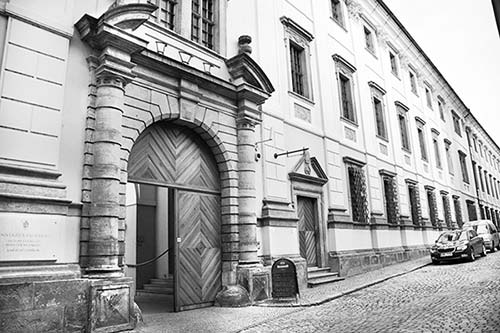
The big square called Náměstí Republiky is marked by a fountain inspired by Bernini’s Triton Fountain in Rome (see the “Baroque Fountains of Olomouc” sidebar, earlier). The Jesuits, whose gorgeous church faces the square, founded the original university in the 16th century. This square marks the division between the royal town and the bishop’s town.
Ahead (past the square, veering a bit to the right), Mariánská street leads to the archbishop’s stately 17th-century palace (closed to the public). On the slopes below the palace are Jesuit colleges (now university classrooms) and a Clarist convent (now a museum). When you reach the archbishop’s palace, turn left, head down the street, cross the tram tracks, and continue straight ahead up Dómská to reach the next two sights.
IN THE BISHOP’S TOWN, NEAR THE CATHEDRAL
St. Wenceslas’ Cathedral (Dóm Sv. Václava)
Supposedly, this has been the resident church of Olomouc’s bishops ever since the Christian missionaries Cyril and Methodius visited in the ninth century. The present church has been rebuilt many times. While it maintains its Gothic lines, what you see is 19th-century pseudo-Gothic, with Neo-Renaissance paintings. On the walls under the organ loft and on big black panels flanking the main door, you can trace the lineage of local archbishops back 68 men—from today’s archbishop to St. Methodius in 869. Step up to the cavernous, gated-off choir area, where a Neo-Gothic altarpiece glitters at the far end. Nearby, look for photos from Pope John Paul II’s visit here in 1995. The crypt (entrance to the left as you face the choir) houses a collection of liturgical ornaments—the second largest in the country, after Loreta Church in Prague.
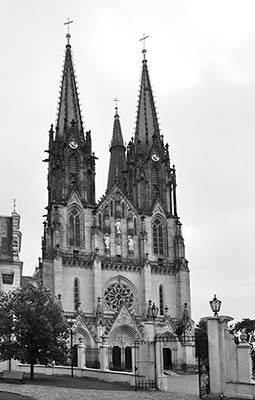
Cost and Hours: Small fee possible, crypt generally open daily 10:00-17:00, closed off-season.
▲Archdiocesan Museum
Reopened in 2023 after a major revamp, this state-of-the-art museum is Olomouc’s pride and joy. The city created it at the prompting of Pope John Paul II after his 1995 visit. Its mission is “In Glory and Praise—To Share a Thousand Years of Spiritual Culture in Moravia”...and it does just that. Enter it through the gated park just to the left as you face the cathedral.
Cost and Hours: 200 Kč, 350 Kč combo-ticket with Museum of Modern Art; open Tue-Sun 10:00-18:00, closed Mon; free audioguide downloadable from museum website; Václavské Náměstí 3, +420 585 221 190, www.muo.cz.
Visiting the Museum: This former royal castle, once the king’s principal Moravian residence, later became home to Olomouc’s archbishop. The exterior is a mix of Romanesque and Gothic elements. Inside you’ll wander among a small collection of some of the finest medieval art in Central Europe. While English descriptions are posted, using the downloadable audioguide can deepen your appreciation of the art.
The maze-like floor plan is confusing, but attendants will point the way. Entering the main collection, you’ll be wowed by the bishop’s gilded coach, which understandably gave the Holy Roman Empress Maria Theresa more reason for envy. The adjacent treasury—one small room—displays several priceless items, including its remarkable centerpiece: a monstrance (Communion-wafer holder) with 1,800 diamonds and seven pounds of pure gold (from 1750). From here, you’ll circle on several levels through the rest of the collection, from archaeological finds in the cellar, to lots of S-curve Madonna-and-Child altarpiece statues, to the fine little cloister with its well-tended herb garden.
Finally, head back to the ticket desk and go upstairs to find the painting gallery. You’ll slide on slippers to protect the not-so-hardwood floor and shuffle through the staterooms lined with well-lit paintings.
Entertainment in Olomouc
During the summer, music festivals fill the town. Outside of festival time, when school is in session (Sept-May), Olomouc is hopping, with good independent movie theaters and live music in bars.
Festivals
The Festival of Song (early June, www.svatkypisniolomouc.cz), the country’s biggest choral festival, kicks off the summer calendar. In August the churches ring with music from another major event, the Olomouc Baroque Festival (www.baroknislavnosti.cz).
Theaters
The town’s main theater, Moravské Divadlo, regularly puts on opera performances (ticket office open Mon-Fri 9:00-18:00, closed Sat-Sun, located on the Upper Square next to the recommended Moravská Restaurace, +420 585 500 500, www.moravskedivadlo.cz, pokladna@moravskedivadlo.cz).
The Metropol movie theater screens a mixture of artsy and mainstream flicks (Sokolská 25).
Music Venues
Rasputin Bar, Mi Casa Su Casa Music Bar, and Morgan’s—all occupying venues built into Vodní Kasárna, the massive red-brick 18th-century town wall—feature nightlife inspired by various corners of the world. Fueled by the vibrant local crowd, these spots open around 17:00 but don’t really start to swing until around 21:00, when the disco and live music begin. Head to the corner of Mlýnská and Pavelčákova, just across the Třída Svobody from Maria Theresa Gate.
In summer the open outdoor area Letňák, next to the recommended hostel Long Story Short, comes alive with beer gardens and live music.
Jazz Tibet Club offers good food and live music (mainly jazz) about twice a week from fall through spring in a modern, pub-like setting (closed Sun-Mon and in summer, Sokolská 48, +420 777 881 297, https://jazztibet.cz).
Sleeping in Olomouc
$$ Orea Hotel Arigone fills three tastefully renovated townhouses on the hill by St. Michael’s Church. While some of the 53 rooms have 17th-century wooden ceilings and 19th-century-style furniture, most are furnished in a modern style and are accessible by elevator (rental bikes, parking, Univerzitní 20, +420 585 232 351, www.orea.cz/hotel-arigone, rezervace.arigone@orea.cz).
$$ Hotel u Dómu, a six-room place on a quiet street next to the cathedral, is run with a personal touch that makes it popular with quirky visiting professors (parking, Dómská 4, +420 +420 724 335 609, www.hoteludomu.cz, hoteludomu@seznam.cz).
$$ Pension Royal rents two apartments in a Baroque house with wooden beams and solid furniture (family rooms, pay breakfast, parking, Wurmova 1, +420 734 200 602, www.pension-royal.cz, royal.olomouc@gmail.com).
$ Pension u Jakuba rents six self-contained, IKEA-furnished apartments in a 400-year-old house on a busy street. The business-style pension also has seven quiet, modern rooms in an annex in the courtyard (family rooms, parking, 8 Května #9, to reach reception walk through passage into courtyard, +420 585 209 995, mobile +420 777 747 688, www.pensionujakuba.cz, ujakuba@iol.cz).
$ Pension na Hradbách rents four modern rooms, each with a personal touch (no breakfast, Hrnčířská 3, +420 585 233 243, mobile +420 602 755 848, https://nhpension.eu, rezervace@nhpension.eu).
$ Pension u Anděla, across the street, is well suited to be on Hrnčířská (“Potter’s street”), a quiet row of two-story village houses with brightly painted facades and window boxes full of geraniums. Two of the four simply furnished rooms overlook the bastion and park (no breakfast but in-room fridge, downstairs restaurant can make breakfast the night before on request, Hrnčířská 10, +420 602 512 763, www.uandela.cz, info@uandela.cz).
¢ Long Story Short offers dorm beds as well as private rooms and an apartment, all done in a clean, modern design—including one room with a freestanding bathtub right in the middle of the living space. The ground floor has a bakery, a popular bar, and a café that serves breakfast and some nibbles throughout the day (breakfast extra, Koželužská 31, +420 588 008 278, mobile +420 606 090 469, www.longstoryshort.cz, reception@longstoryshort.cz).
Eating in Olomouc
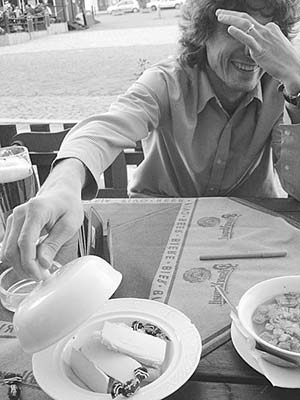
Try the sour, foul-smelling, yet beloved specialty of the Haná region, Olomouc cheese sticks (olomoucké tvarůžky). The milk goes through a process of natural maturation under chunks of meat. Czechs figure there are two types of people in the world: tvarůžky lovers and sane people. The tvarůžky are so much a part of the Haná and Czech identity that when the European Union tried to forbid the product, the Czech government negotiated for special permission to continue to rot their milk. Zip a few of these stinkers into a baggie, and you can count on getting a train compartment to yourself.
RESTAURANTS
Olomouc restaurants cater to a local crowd, so even when an English menu is available, daily specials will be posted only in Czech. Ask your waiter for a translation.
$$$ Moravská Restaurace (“Moravian Restaurant”) is a woody, rustic (and touristy) place on the Upper Square. It’s decorated with Moravian painted ceramics and serves both traditional and trendy dishes, with an emphasis on game (daily, reservations recommended, Horní Náměstí 23, +420 585 222 868, www.moravskarestaurace.cz).
$$ Svatováclavský Pivovar (“St. Wenceslas Brewery”) features seven kinds of unpasteurized beer brewed on the premises, an extensive menu of stick-to-your ribs Czech dishes, and Olomouc’s first “beer spa,” where you can take a bath in the brew (restaurant open daily; spa open daily 14:00-21:00, last reservation 19:00; Mariánská 4, +420 585 207 517, spa +420 585 242 219, https://svatovaclavsky-pivovar.cz).
$$ U Mořice puts a modern spin on (and takes some of the fat out of) Czech classics in the sleek contemporary interior of a former Baroque palace (daily until late, Opletalova 1, +420 581 222 888).
$ Hanácká Hospoda has the most attractive outdoor seating on the Lower Square—it’s a busy spot on summer evenings. The menu sticks to Czech classics with no frills, and Moravia’s most popular beer, Radegast, flows from the tank (daily, Dolní Náměstí 38, +420 774 033 045).
$$ The Kathmandu Nepali Restaurant, in a spacious hall decorated with Himalayan art, is the best choice in town for a change from Czech cuisine. Curry dishes are concocted by an award-winning Nepali chef auspiciously named Buddha (daily, Sun until 17:00, Dolní Náměstí 25, +420 773 279 782).
$ Café Caesar, filling the Gothic vaults in the Town Hall, is a popular pizza place with fine seating both inside and out. It’s within a flea’s hop of the plague monument (Mon-Tue lunch only, Wed-Sat lunch and dinner, closed Sun, +420 585 229 287). The little gallery next door, run by the café, promotes local artists.
$$ Café Restaurant Konvikt is a modern-feeling place in the delightfully restored former Jesuit college. They cater primarily to businesspeople, though some philosophy students also wander in here from the classrooms upstairs. In summer, they offer seating in a peaceful courtyard above the city walls and greenbelt (long hours Mon-Fri, closed Sat-Sun, Univerzitní 3, +420 585 631 190).
CAFÉS, TEAHOUSES, AND WINE BARS
Olomouc is the Moravian university town, and every aspect of student life (except sleeping) happens right in the old center. Being a student town, Olomouc is lively and cheap during the school year but slower in July-September (although foreign students coming here for summer programs in languages, music, and history are doing their best to make up for the annual vacation energy drain).
$ Café Mahler (daily until 18:00, breakfast served, +420 774 007 512) and $ Caffe Opera (daily until 22:00, breakfast and lunch served, +420 724 486 192), both on the Upper Square, are stylish places for coffee and cake, while Cukrárna Madlen, between the Upper Square and the Lower Square, is the local ice-cream paradise (daily, +420 602 715 490).
$ Kafec serves coffee, waffles, and wine on the ground floor of a historic Art Nouveau villa and in its secluded garden, with views over the city walls (Mon-Fri 8:00-20:00, Sat-Sun until 19:00, Univerzitní 224, +420 775 554 506).
$ Štrůdlárna (“The Strudel Factory”) is a small takeaway spot serving a wide selection of savory (including Olomouc cheese) and sweet (including poppy seed) strudel by the slice, ideal for a picnic (Mon-Fri 9:00-19:00, Sat-Sun until 15:00, along the tram tracks between the Upper Square and the cathedral at Denisova 27, +420 608 593 111).
$ Kratochvíle Teahouse offers a wide array of freshly harvested tea leaves, as well as coffee, Moravian wines, and hookahs (water pipes). This contemplative, bamboo-lined space also hosts exhibitions, concerts, and author readings (daily, Sat-Sun from 15:00, Sokolská 36, +420 603 564 120).
$$ Na Břehu Rhôny (“On the Banks of the Rhone”), a popular offshoot of its Prague namesake, is a cozy wine bar pouring only wines from France, paired with a wide range of accompanying delicacies (daily from 15:00, reservations recommended, Dolní Náměstí 2, +420 775 321 500).
$$ Pod Pálavou Wine Bar, just next door, takes a different tack, serving exclusively Czech and Moravian wines in a modern, art-filled interior. Samples available from nearly three dozen bottles at the tasting bar let you try before you buy (daily from 16:00, Dolní Náměstí 2, +420 730 587 074).
Olomouc Connections
Olomouc is on several major rail lines (including the one from Prague to Kraków). Three companies serve the Prague-Olomouc route. The Czech railway’s Pendolino trains are fastest. But the private companies are also worth considering: Leo Express is the most comfortable, and RegioJet is cheapest and serves the best (free) coffee. For bus and train schedules, see https://idos.idnes.cz.
From Olomouc by Train to: Kroměříž (hourly, 1 hour, transfer in Hulín), Prague (at least hourly, 2.5 hours), Brno (buses and trains at least hourly, 1.5 hours), Rožnov pod Radhoštěm (7/day, most connections require transfer in Valašské Meziříčí, allow 2 hours total; also consider bus), Břeclav (hourly, 2 hours, may transfer in Brno or Přerov), Kraków (5/day, 5 hours, transfer in Katowice, Poland, and possibly Přerov, Czech Republic), Vienna (8/day, 3.5 hours, transfer in Brno, Břeclav, or Přerov), Budapest (6/day, 7 hours, transfer in Brno or Přerov).
From Olomouc by Bus to: Třeboň, Telč, and Třebíč—take the bus or train to Brno, then take the bus in the direction of České Budějovice (2-3/day), Rožnov pod Radhoštěm (hourly, 2 hours, most with change in Valašské Meziříčí).
Kroměříž
Whereas Olomouc was the official seat of the Moravian archbishops, Kroměříž (KROH-myehr-eezh) was the site of their lavish summer château. In 1948, this castle and its enormous gardens were nationalized and opened to the public. Kroměříž—showing off the richness of this corner of the Czech Republic—is the most lavish and best-renovated Rococo castle in the country. The 19th-century English-style park, with lakes, woods, and Chinese pavilions, is good for a walk or picnic.
While there are no other worthwhile sights in town, the pleasant square and streets filled with little bakeries offer a perfect complement to the grandeur of the archbishop’s estate. The town and château of Kroměříž combine for a perfect half-day excursion from Olomouc; it’s a wonderful opportunity to enjoy the genteel art and gentle life of small-town Moravia.
Getting There: From Olomouc, take one of the hourly trains in the direction of Přerov and Břeclav. Get off at Hulín (the stop after Přerov on fast trains, 45 minutes), walk through the train station to the other side of the building, and hop on the small motor train to Kroměříž (departure scheduled to coincide with the arrival of Břeclav-bound trains, 8 minutes). Turn right out of the train station, then take the first left over the bridge. The main square (Velké Náměstí) and the entrance to the château are an easy 10-minute walk away.
On the way back, most trains from Kroměříž to Hulín connect with an Olomouc-bound train. For bus and train schedules, see https://idos.idnes.cz.
Tourist Information: The TI is on the main square, next to City Hall (Mon-Fri 9:00-18:00, Sat-Sun until 17:00, closed Sat afternoon and all day Sun off-season, Velké Náměstí 115, +420 573 321 111, https://kromeriz.eu).
Helpful Hints: Throughout the summer, the city government joins forces with art schools and conservatories to enliven historical spaces with weekly concerts. The quality of the performers and the unique setting—in château halls and gardens—make a visit worthwhile (ticket booking and purchase at the TI). The Kroměříž Music Summer Festival is in September.
Sights in Kroměříž
Archbishop’s Château (Arcibiskupský Zámek)
Dominating the main square and the whole town, this château was rebuilt in Baroque style by archbishop Karel Lichtenstein (dubbed the “Moravian Richelieu”) after an earlier castle was severely damaged in the Swedish siege during the Thirty Years’ War. The furniture and decorations are in the Rococo style (from the second half of the 18th century). The breathtaking chandeliers are made of Czech crystal.
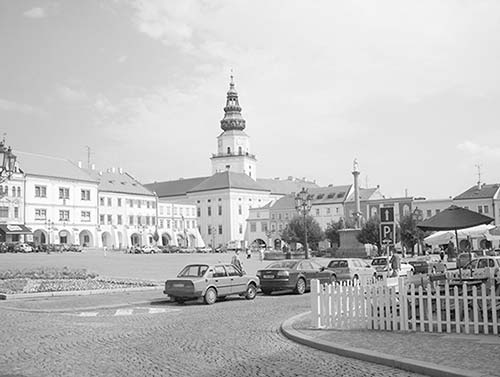
The château is famous for one historic event: The Austrian parliament moved here from unstable Vienna during the tumultuous year of 1848, when a wave of revolutions spread across the Habsburg lands. The Parliament drafted the first Austrian constitution in the château’s main hall.
Cost and Hours: Château—250 Kč or more (by tour only—see below), art gallery—110 Kč, tower—70 Kč; Tue-Sun 9:00-17:00, closed Mon; April and Oct Sat-Sun 9:00-16:00, closed Mon-Fri; closed Nov-March; +420 573 502 011, www.zamek-kromeriz.cz.
Tours: You can see the art gallery and climb the tower on your own, but to visit the château interior, you must go on a tour led by a Czech-speaking guide; English-language tours (370 Kč) can be reserved only for groups of 15 or more. Tours run about every hour and last 70 minutes, with the time about evenly split between the first floor (eight rooms) and second floor (which has a beautifully painted ceiling depicting the history of the bishopric and overlooks a stunning library interior with 80,000 books).
Art Gallery: Art lovers should consider visiting the bishop’s art gallery. Sure, it’s not the Louvre, but it’s the best Moravian collection of European paintings from 1400 to 1800, with works by Titian, Lucas Cranach, Albrecht Dürer, and Paolo Veronese.
Castle Garden (Podzámecká Zahrada)
This green space, filled with little ponds, exotic trees, and Chinese pavilions, offers a peaceful refuge. It’s in the English style—wilder and more natural than the geometrically designed French gardens.
Cost and Hours: Free; Tue-Sun 9:00-17:00, closed Mon, longer hours in summer, shorter hours in off-season, closed in winter.
Sleeping and Eating in Kroměříž
Kroměříž works best as a day trip from Olomouc, but if you want to attend a concert and stay the night, try $ Hotel Bouček. This well-renovated, traditional townhouse on the main square rents 11 decent rooms (Velké Náměstí 108, +420 724 564 244, https://hotelboucek.cz, hotel@hotelboucek.cz).
Several good eateries are on or just off the main square (Velké Náměstí).
$ Atmosféra u Zámku is a popular place to sip a frappé or iced coffee (daily, on the corner of main square next to the château, +420 731 477 513).
$$ Radniční Restaurace a Pivotéka serves grilled meats and traditional Czech cuisine using ingredients from local organic producers, and its beer and wine come from the local microbrewery and the archbishop’s winery. The remodeled interior is simple but comfortable; in good weather you can sit outside along the street (Mon-Sat until 22:00, Sun until 17:00, at top of main square across street from Town Hall at Kovářská 20).
¢ Bistro Avion, a blue-collar self-service cafeteria on the main square, is good for a basic, filling meal (Mon-Fri 7:00-18:00, Sat-Sun until 15:00, +420 725 065 000). The place has no menu—just point to what looks good.
Wallachia
About an hour east of Olomouc, the mountainous region of Wallachia (wah-LAY-kee-uh)—where Slovakia and Poland meet the eastern edge of the Czech Republic—is ideal for an escape into nature. Here you can enjoy both the ruggedness of the mountains and the easy tourist facilities of an accessible recreational area.
Wallachia (Valašsko) comprises three east-west ridges separating three long valleys. The Beskydy Mountains—the westernmost part of the Carpathian mountain range—make an impressive backdrop.
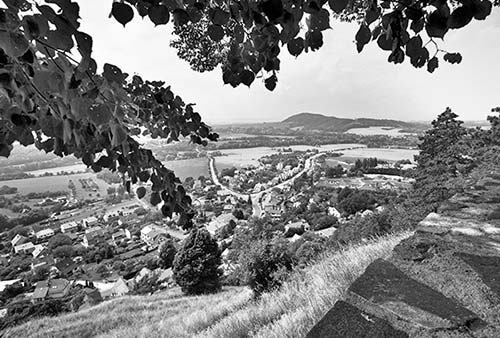
Wallachia has a sparse but proud population: the Wallachians (Valaši). They were originally Romanian shepherds who, following their sheep, drifted west along the pristine meadows and rugged canyons of the hauntingly beautiful Carpathians. In exchange for guarding the border, these shepherds received many privileges—most importantly, exemption from taxes.
Today, the Wallachians have their own tongue-in-cheek, tax-free “kingdom.” In local restaurants and hotels, you can buy Wallachian “passports,” which come with a brochure explaining in English why you should emigrate.
For the easiest and quickest foray into this region, visit the pretty, touristy village of Štramberk, which sits at the edge of Wallachia. For greater immersion, venture to the open-air folk museum at Rožnov pod Radhoštěm, and hang your hiking boots at the hilltop refuge called Pustevny.
Getting Around Wallachia: This region is best with a car, though it is doable by public transportation. From Olomouc, the closest major transit hub, it’s at least 1.5 hours by train to Štramberk and 2 hours by train or bus to Rožnov pod Radhoštěm. From Rožnov, you can catch a 45-minute direct bus to Pustevny (for details, see “Getting There” under each destination).
ŠTRAMBERK
The endearing village of Štramberk (SHTRAM-berk) is the delightful gateway to wild Wallachia. Štramberk dates way back—remains in the nearby Šipka Cave suggest there was a Neanderthal settlement here as far back as 40,000 BC—but today it’s a sleepy tourist town, ideal for a low-impact, stretch-your-legs lunch stop. Sitting just a few minutes’ drive off the expressway (between Olomouc and Ostrava, near the border with Poland), it offers an enticing and accessible glimpse at the region.
The TI is on the main square (Náměstí 31, +420 558 840 617, www.stramberk.info).
Getting There: For drivers, Štramberk is well marked from the D-1 expressway east of Olomouc. Approaching town, follow the one main road as it curls around the base of the hill. Most spaces near the main square are reserved for locals (and are scrupulously monitored by overeager cops), so it’s safest to park in the large public lot at the far end of town (near the House of Culture/Kulturní Dům). From there, walk back along the main road 10 minutes to the square.
To get to Štramberk without a car, take a train from Olomouc to Studénka (1 hour, may require a transfer), then hop on the hourly spur line to Štramberk (30 minutes). While the town is pretty, I wouldn’t bother making the trip by public transportation.
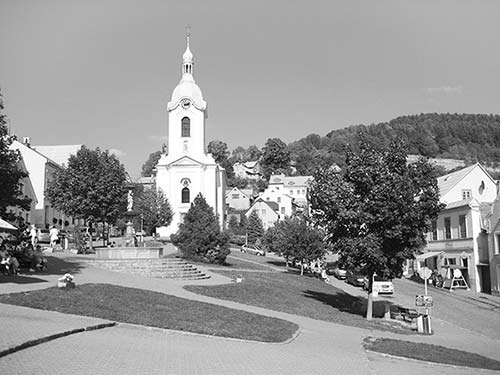
Visiting Štramberk: The hamlet is huddled tightly against the base of a forested hill. The sloped main square boasts a quaint gurgling fountain, watched over by a postcard-perfect Baroque church with a pink onion dome. A short but steep hike brings you to the crest of the hill and Štramberk’s “castle”—really more of a rustic defensive tower, called the Trúba. You can pay a modest fee to spiral up to the tower’s summit for cozy views of a square hemmed in by rolling countryside.
Other than the tower climb and a few tacky amusements, there’s not much to see or do in Štramberk; just let your pulse slow and enjoy its tranquil square. Several decent restaurants ring the square, including the Městský Pivovar (“Town Brewery”), serving its own unfiltered Trubač beer. Save room for the local temptation—“Štramberk ears” (Štramberské uši), soft, flat gingerbread cookies rolled into a cone shape (sometimes filled with whipped cream and fruit). While munching, try not to be turned off by their gruesome origin story: During the Tatar incursions in 1241, invaders would lop off the ears of their victims as trophies to be brought back to the Khan. But after clever locals broke a dam and flooded the enemy camp, the Tatars were driven away, leaving bags of ears behind.
ROŽNOV POD RADHOŠTĚM
Rožnov pod Radhoštěm (ROHZH-novh pohd rahd-hosh-tyem), the largest town in the region and once a popular spa resort, may not be worth an overnight stay, but it certainly merits a visit for its open-air folk museum.
Getting There: To reach Rožnov pod Radhoštěm by train or bus from Olomouc, you’ll need to transfer in Valašské Meziříčí (7 trains/day, allow 2 hours total; hourly bus, 2 hours). From Rožnov’s main square, it’s a 10-minute walk to the museum (look for direction markers).
▲Wallachian Open-Air Folk Museum (Valašské Muzeum v Přírodě)
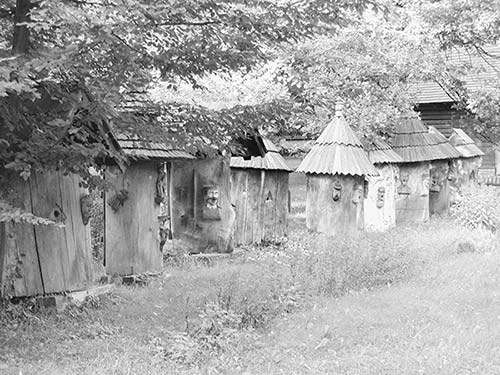
The museum, which re-creates a traditional Wallachian village, is divided into three parts. Touring the “Little Wooden Town” is sufficient to give you a good sense of regional mountain architecture, which blends here with elements of Moravian house building. The museum is also the resting place for the most distinguished Wallachians, among them the incredible runner Emil Zátopek, who won three gold medals at the Helsinki Olympics in 1952.
Cost and Hours: 130 Kč for each of three parts—Little Wooden Town, Water Mill Valley, and Wallachian Village; daily 9:00-17:00, shorter hours and closed Mon in off-season, closed most of Nov and part of Dec; www.nvmp.cz [URL inactive].
Tours: Although you can visit the complex on your own, you can more fully appreciate the sight with an English-speaking guide—reserve 10 days ahead (500 Kč for an hour-long tour, +420 603 209 811, julie.hlavenkova@nvmp.cz).
PUSTEVNY
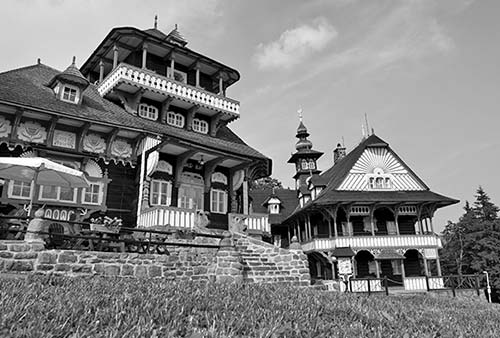
Pustevny (POO-stehv-nee, “Hermitage”) is a small, pleasant resort atop the Beskydy (BEH-skih-dee) Mountains’ most sacred ridge, in a spot where a legendary hermit once lived. The style of the mountain huts here is an imaginative combination of Art Nouveau and wooden village architecture. Peak season is June through August for hiking, and Christmas through Easter for skiing.
Getting There: To get to Pustevny by public transportation, take a direct bus from Rožnov pod Radhoštěm (hourly 8:30-16:30, 45 minutes, stop is marked Prostřední Bečva/Pustevny).
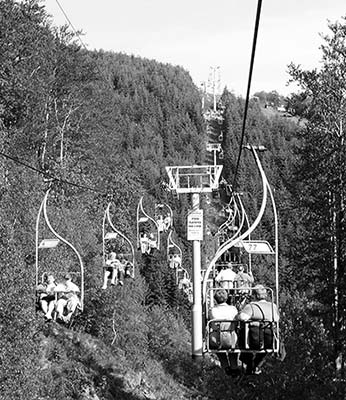
If you’re driving, you can reach the summit either from the south via Rožnov pod Radhoštěm and Prostřední Bečva, or from the north via Frenštát pod Radhoštěm and Trojanovice (which is linked to Pustevny by a scenic chairlift). From Frenštát, follow signs for Trojanovice, drive to the end of the road at the Ráztoka Hotel, then walk 500 yards to find the chairlift (220 Kč one-way, 270 Kč round-trip, in summer runs daily once per hour 9:00-18:00, off-season until 16:00 or 17:00, 15-minute ride). On arrival in Pustevny, be sure to check the schedule for the last chairlift back down to Trojanovice.
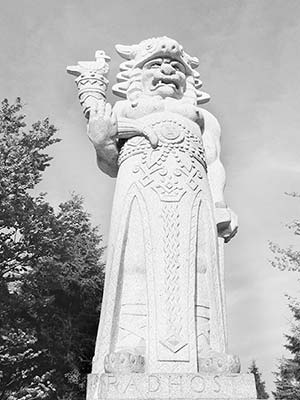
Hiking in Pustevny: The 30-minute hike from Pustevny along the red-marked trail on the ridge toward the west will take you to a statue of Radegast, the old Slavic god of sun, friendship, and harvest. If you hike farther along the ridge for two miles, you’ll reach the top of the sacred Radhošť mountain and statues of the Slavic ninth-century missionaries St. Cyril and St. Methodius. They hold a page of the beginning of the Gospel according to John, which they translated for the Slavic people more than 1,100 years ago. A wooden church dedicated to these two patrons of all Slavs stands behind the statue.
Hiking along the ridge from Pustevny in the opposite direction takes you through less-visited woods and into a virgin forest preserve at Kněhyně.
Sleeping and Eating in Pustevny: A century-old historical landmark, $$$ Hotel Maměnka fits sumptuously furnished rooms into a wooden structure that uniquely blends Art Nouveau with regional architecture (+420 739 658 858, https://novylibusin.cz, ubytovani@novylibusin.cz). Its Koliba Valaška annex (+420 736 682 289), with similar rooms, is an opulent imitation of a shepherd’s lodge. The complex has two $$ restaurants, including the famous Art Nouveau Restaurant Libušín, meticulously restored after a devastating fire; and Restaurant Koliba, which serves mountain fare in a traditional setting.
$ Hotel Tanečnica, large and modern, is a solid, standard, circa-1980 Czech mountain lodge (swimming pool, pay parking, +420 603 143 241, https://tanecnica3.webnode.cz, recepce@tanecnica.cz).