PRAGUE & THE CZECH REPUBLIC
The Czech Republic’s Top Destinations
Map: The Czech Republic’s Top Destinations
Map: The Czech Republic’s Best Two-Week Trip by Car
Wedged between Germany and Austria, the Czech Republic is many travelers’ first stop in Central Europe. While geographically small, the country packs in plenty of surprises. Quaint villages? Check. Stunning Art Nouveau? Check. Friendly people? Hearty food? Great beer? Czech, Czech, and Czech.
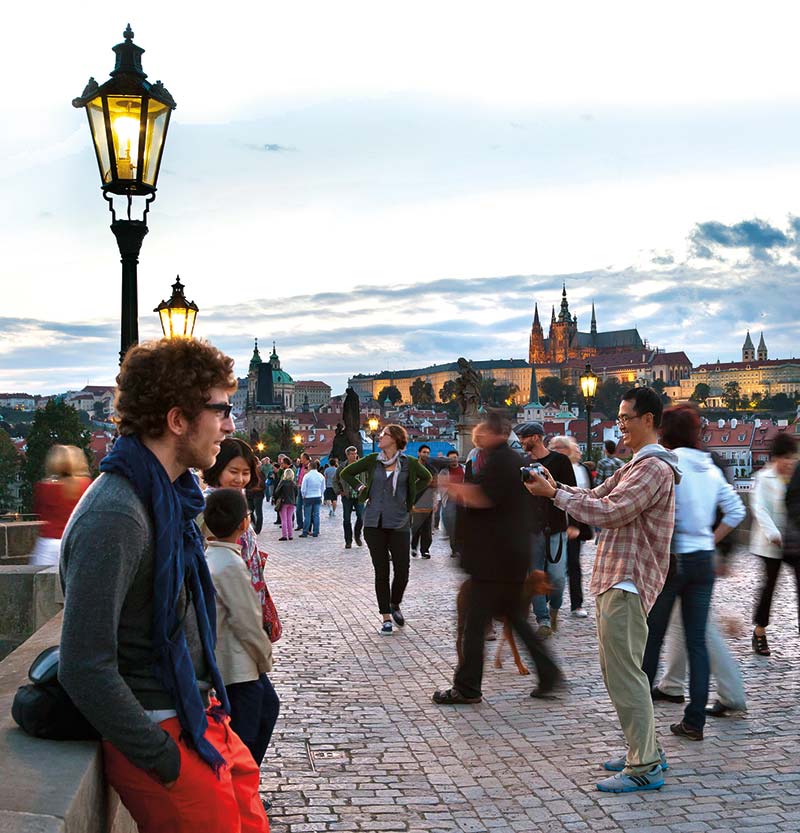
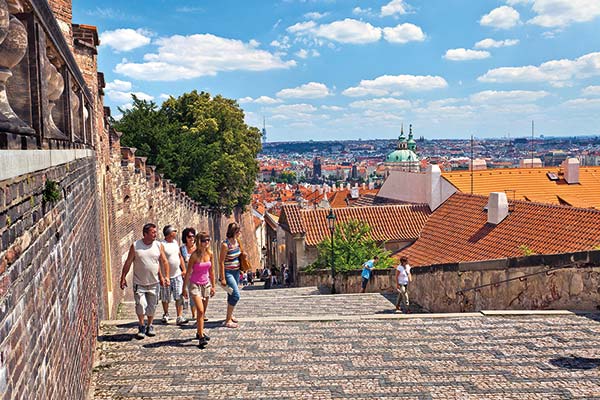
Few cities can match the over-the-top romance, Old World charm…and tourist crowds of the Czech capital, Prague. But this fun, historic city is popular for good reason: It’s the only major Central European capital to escape the bombing of the last century’s wars, and it’s one of the continent’s best-preserved cities.
Residents call it Praha (PRAH-hah). It’s big, with about 1.3 million people, in a country of 10.6 million. But during a quick visit, you’ll focus on the city’s relatively compact old center and walkable neighborhoods.
Prague is a photographer’s delight—the city itself seems a work of art. The Old Town Square is a magnet for tourists and locals alike. Pastel facades ringing the square are adorned with gables, balconies, and lanterns. Diverse architectural styles from Gothic to Art Nouveau chronicle the passage of centuries this vital marketplace has endured. The square’s centerpiece, a statue of feisty Jan Hus, commemorates an early Czech rebel who—a century before Martin Luther—protested church corruption and was martyred.
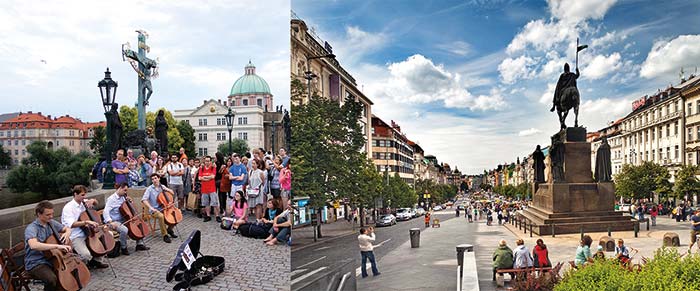
Prague’s famous Charles Bridge, lined with stoic 17th- and 18th-century statues of saints, is a celebration of life, with a festival of artists and street musicians all along its length. A walk across this delightful pedestrian-only bridge is one of the most pleasant strolls in Europe. At the far end, take a tram or hike up to the world’s biggest castle—where Wenceslas, an early Czech ruler, is buried. You’ll get a lesson in Czech history and enjoy sweeping views over this “Golden City of a Hundred Spires.”
Peaceful today, Prague’s modern yet historic Wenceslas Square in the New Town has hosted grass-roots protests over the years, which brought about major changes—most notably, independence in 1989 after five decades of oppressive rule: by the Nazis in World War II, then the Soviets during the Cold War.
Having overthrown communism, the Czech parliament elected the playwright, philosopher, and Czech patriot Václav Havel to serve two terms as president. In 1993, he oversaw the amicable split of Czechoslovakia that resulted in two new nations: the Czech Republic and Slovakia.
The Czechs strongly value education and intellect and have produced some famously clever writers—from Franz Kafka (who wrote about a man waking up as a giant cockroach) to Karel Čapek (who wrote science fiction about artificially created beings he dubbed “roboti,” or robots).
It’s easy to take it easy in Prague: stroll through the markets, attend shows, cruise the river, and sip a local brew with a view.
The Old Town Square is a great place to start exploring. The vast square, lively with people at all hours, sports an old-time astronomical clock with a mechanical show that draws a crowd. Street performers provide a constant soundtrack. Stop by the Týn and St. James churches and the appealing Ungelt courtyard.
Browse through the open-air Havelská Market for produce and Czech handicrafts. You’ll see wooden toys, rustic ornaments, and “kitchen witch” marionettes that people hang in their kitchens for good luck. Shoppers gawk at crystal and garnet jewelry in shops lining side streets.
Linger on the pedestrian-only Charles Bridge to enjoy an impromptu concert, with a backdrop of the Vltava River and hill-topping Prague Castle. Near the bridge, visit the beloved Lennon Wall, which locals write and draw on, remembering a time when free speech wasn’t allowed. For city views from the water, rent a rowboat or paddleboat and bring a picnic aboard for a memorable meal.
Authentic, affordable Czech dinners come with a generous helping of ambience, from woody beer halls and elegant Art Nouveau restaurants to hip cafés. You won’t go hungry with fill-the-tank Central European fare: meat, potatoes, goulash, and dumplings—savory or sweet.
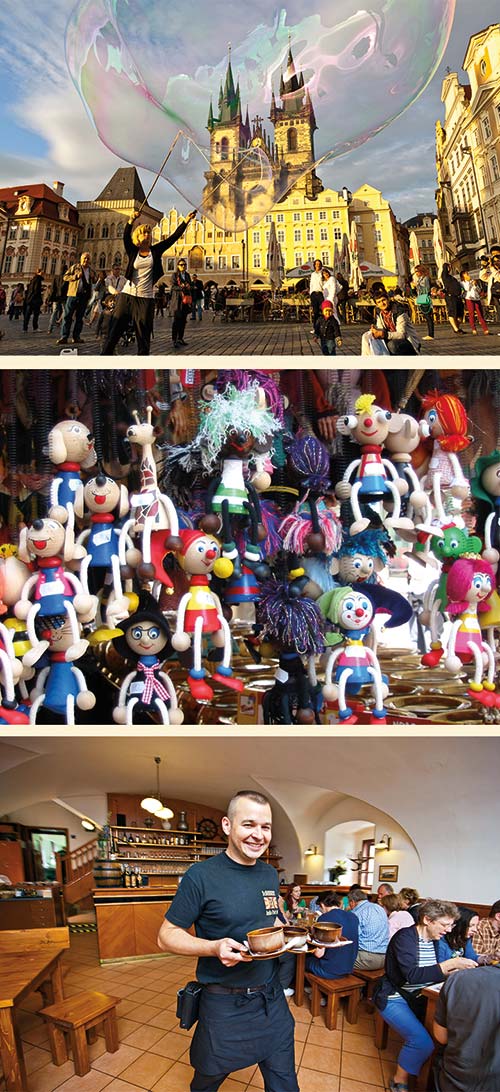
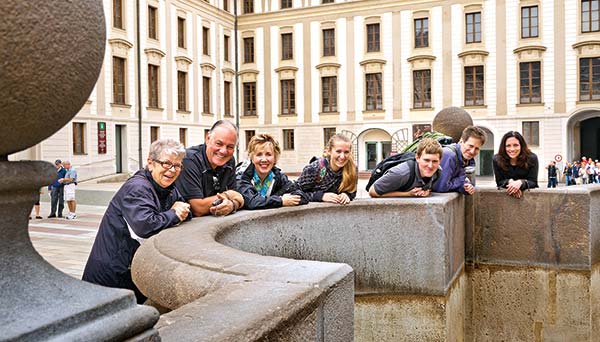
People-friendly Old Town Square; wooden toys at Havelská Market; service with a smile at a Czech pub
Sunset is the perfect time to grab a drink at one of the city’s viewpoints, such as the rooftop terrace at Hotel u Prince, overlooking the Old Town Square. For a uniquely local evening experience, try Black Light Theater, a mix of pantomime and modern dance. Neon-clad actors twirl and contort around the stage, creating optical illusions with puppets and big-screen projections against a black backdrop. And with no dialogue, there’s no language barrier.
Prague buzzes nightly with jazz, opera, classical music, and pop. Ornate churches and halls offer crowd-pleasing concerts: Vivaldi, best of Mozart, pop arias, and works by Czech composers Anton Dvořák and Bedřich Smetana.
It’s pleasant to just stroll lazy laps around the city as the night closes in—from modern Wenceslas Square to the Old Town Square and the always-popular Charles Bridge. Wander through the neighborhoods known for nightlife to enjoy bistros, bars, beer gardens, dance halls, and even nightclubs on open-air river barges.
At any bar or restaurant you choose, a beer will land on your table about as readily as water does in the US. Czechs are among the world’s most enthusiastic beer (pivo) drinkers. Be sure to learn the local “Cheers!” It’s “Na zdraví!” (To your health!) You can remember it by just saying, “Nice driving!” It’s close enough. After a few beers, fun-loving Czechs stumble on their own words, too, raising their mugs and bellowing “Nádraží!” (Train station!).
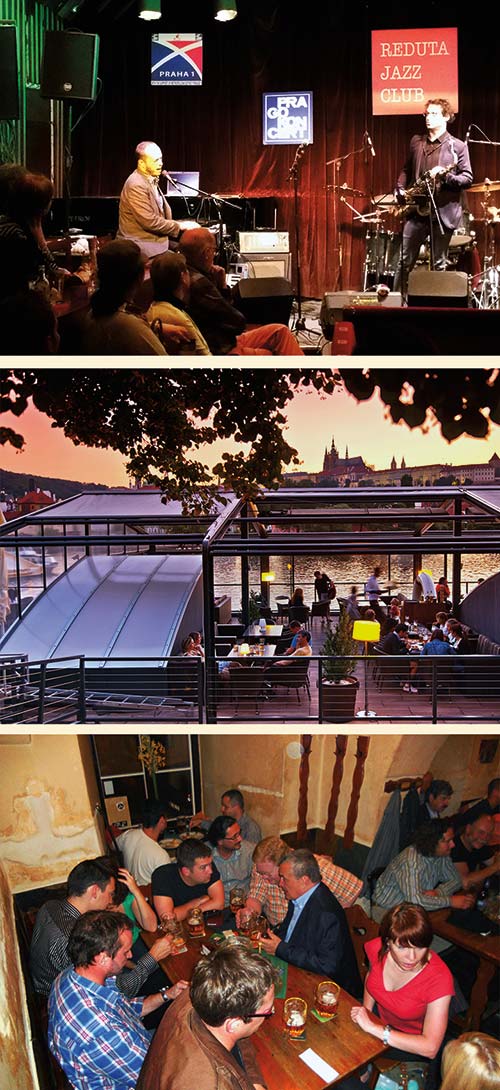
Jazzing it up; a nightclub on a river barge; Czechs enjoying beer and conversation
Prague’s seamless marriage of Old World charm and urban bustle makes it ideal for experiences beyond the typical sightseeing routine. With a convivial pub scene and music spilling into the streets, Prague welcomes you to join in the fun.
Czechs have a sharp, dry sense of humor and appreciate irony. When the country voted for the greatest Czech of all time, the winner by far was Jára Cimrman—a fictional character created by a pair of radio satirists in the 1960s. Other beloved Czech characters are the smiling Good Soldier Švejk, who befuddles his Austro-Hungarian army officers by cleverly playing dumb, and a little cartoon mole called Krtek who’s always in trouble; you’ll see these characters all over the city.
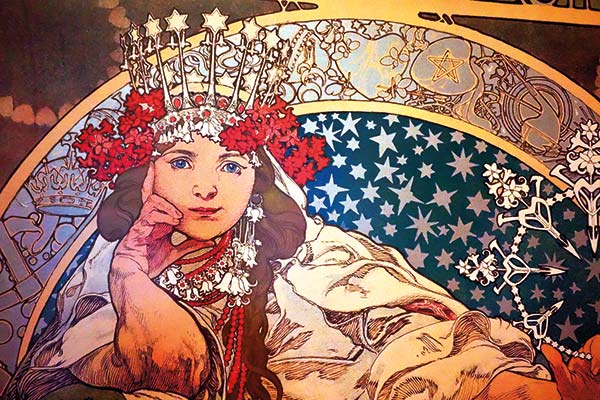
At the Mucha Museum, you’ll also see the influential artistry of Czech painter Alphonse Mucha, whose willowy Art Nouveau style started a movement. The monumental Slav Epic—a series of vast canvases depicting the struggles and successes of the Slavic people—is his masterwork (it’s currently on display in the southern Czech town of Moravský Krumlov).
Most visitors to the Czech Republic see only Prague. But if you venture outside the capital, you’ll encounter better prices, far fewer tourists, and a gentle countryside dotted by historic castles and traditional towns. Hiking and biking opportunities abound. Country roads are lined with wild poppies and fruit trees for everyone to share—take your pick.
The Czech Republic is made up of three regions: Bohemia, starring Prague; laid-back Moravia; and a slice of Silesia. Bohemia has nothing to do with beatnik bohemians; the name comes from the Celtic tribe that lived here before the Germans and the Slavs. A longtime home of Czechs, Germans, and Jews, Bohemia is circled by a fortifying ring of mountains and cut down the middle by the Vltava River. The wine-growing region of Moravia (to the east) is more Slavic, colorful, and focused on the land.
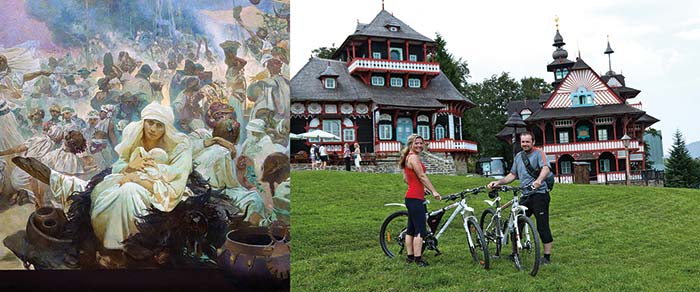
A scene from Mucha’s monumental Slav Epic; biking in the Moravian countryside
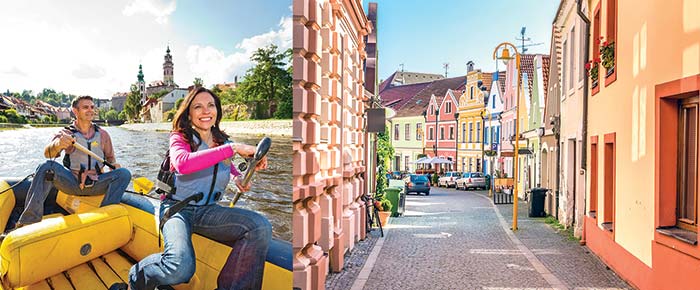
River rafting in Český Krumlov; colorful buildings in Třeboň
No matter which region you’re in, towns and villages in the countryside evoke a simple joy of life. The hill town of Český Krumlov, tucked in a riverbend and topped with a castle, is relaxing—you’ll feel like you’re on vacation. The university town of Olomouc is known for its many fountains, student vibe, and notoriously stinky cheese. A cluster of three neighboring towns—Třeboň, Telč, and Třebíč—offers a mix of sumptuous squares, lakes, and peat-spa baths. Carpeted with vineyards, the Mikulov wine region has picturesque towns, wine-tasting cellars, and historic Jewish sights.
This proud, resilient country—independent now for three decades—has forged its own path. English is widely spoken, public transportation is modern and reliable, and the economy is thriving.
Stroll Prague’s inviting lanes and enjoy the unvarnished beauty of this photogenic city. Tour its fascinating museums—from medieval art to Art Nouveau and communism to the Cold War. Duck into a pub to enjoy stick-to-your-ribs food washed down with pilsner beer—the best in all of Europe. After visiting this enjoyable city, you’ll be plotting your return.
The Czech Republic’s Top Destinations
This little country offers a lot to see. Everyone visits its capital, Prague: This beautiful city is one of Europe’s most popular destinations. Come see what the fuss is about…but don’t overlook the rest of this intriguing country.
To help you decide where and how to spend your valuable time, this overview categorizes the Czech Republic’s top destinations into home-base cities and day trips. I’ve ranked each and suggested a minimum number of days to allow for each city or region.
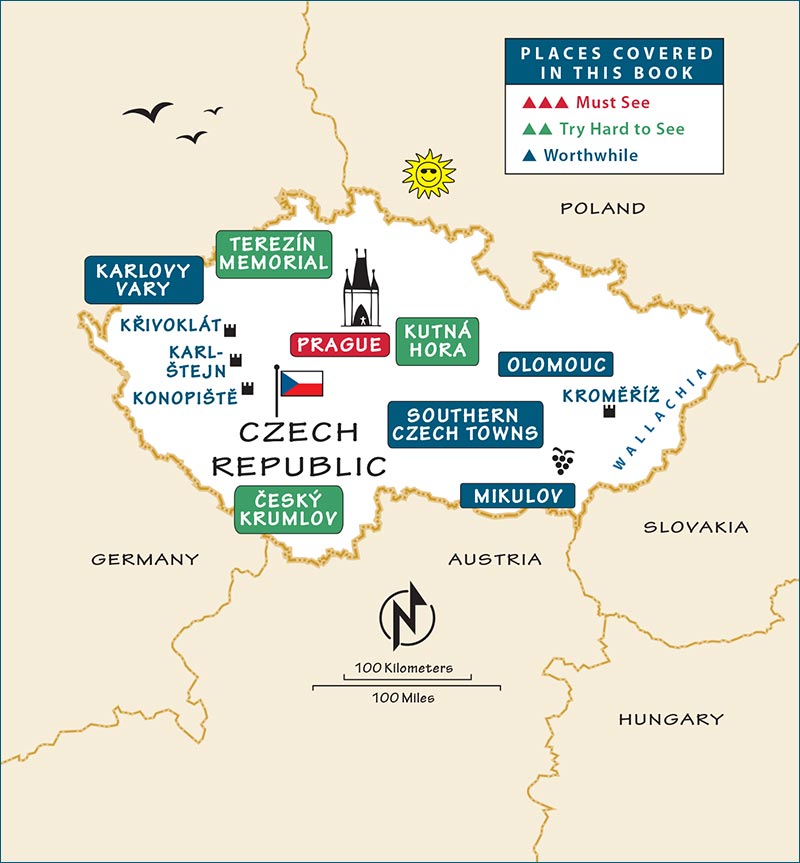
BEST HOME BASES
For a well-rounded look at the Czech Republic, include several or all of these towns in your itinerary. To home-base solely in Prague and still get a taste of the others, make half-day stops in any of the other towns on your way into and out of the country (they’re located too far from Prague to work well as day trips).
▲▲▲Prague (allow 2-3 days)
Prague, the Czech capital and one of Europe’s most romantic cities, boasts a remarkably well-preserved Old Town, a bustling New Town packed with Art Nouveau, the picturesque Charles Bridge, a historic castle atop a hill, and intriguing 20th-century history.
▲▲Český Krumlov (1 day)
The country’s cutest and most touristic destination, this charming hill town huddles under a colorful castle (with a live bear pit and a Baroque theater) and hugs a river bend, fun for water sports such as canoeing. The town also offers museums (art, photography, puppets, and history), a brewery tour, and a pleasant stay.
▲Southern Czech Towns (2 days)
These towns make a fine case for meandering: Třeboň, with a peat spa, is surrounded by artificial lakes; little Telč has a spectacular main square and a Renaissance castle; and Třebíč echoes with Jewish history (ghetto and cemetery). Slavonice, an artists’ retreat tucked near the Austrian border, harbors evocative, never-used WWII fortifications. To the east, Moravský Krumlov hosts Mucha’s stunning Slav Epic paintings.
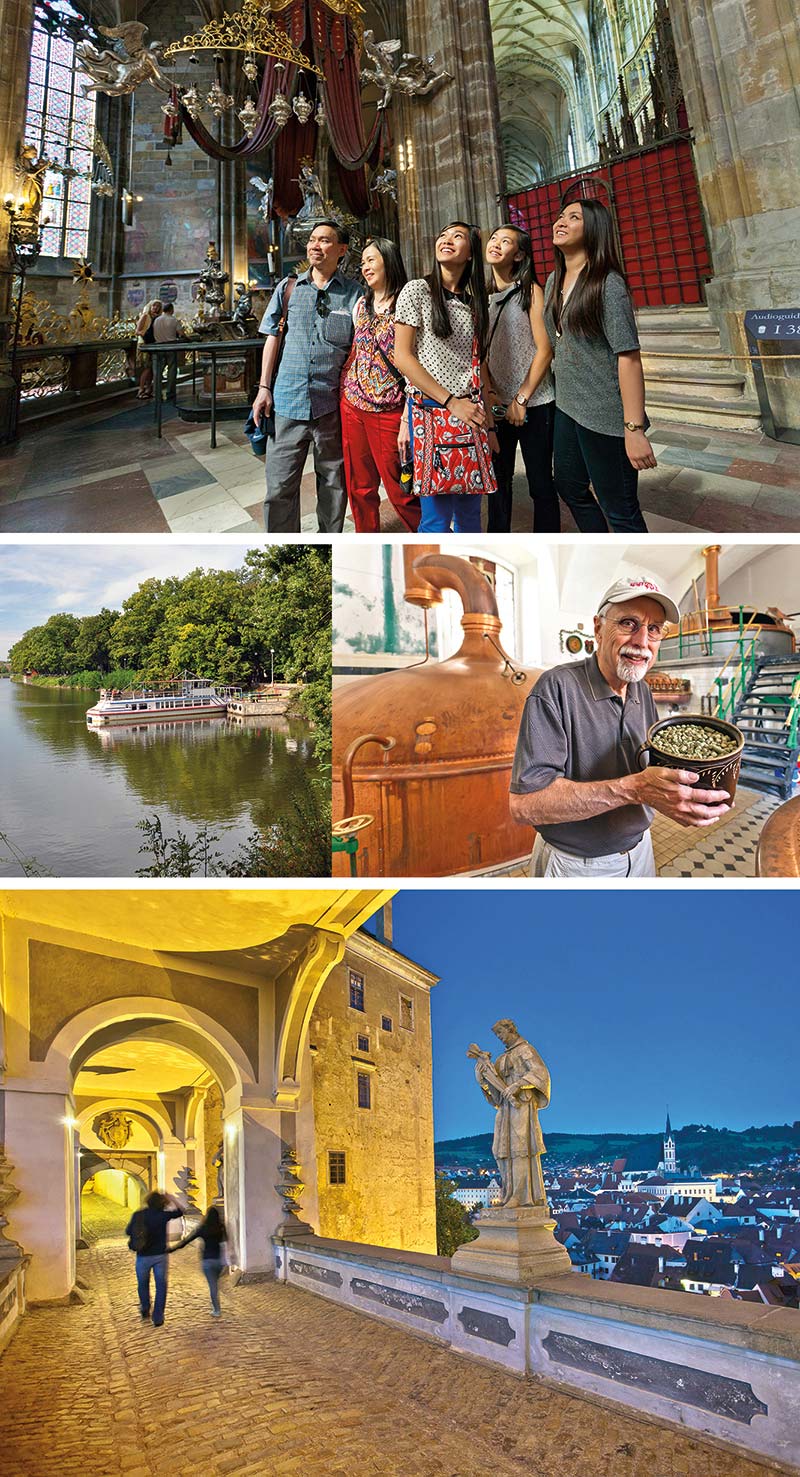
Princess Hyacinth in Prague’s Mucha Museum (opposite); St. Vitus Cathedral in Prague; brewery tour and view from castle in Český Krumlov; man-made lake in Třeboň
▲Olomouc & Nearby (1 day)
This Moravian cultural capital and university city, with fun nightlife and locally prized stinky cheese, is your best stop for a vibrant, workaday city with far less tourism than Prague. It’s near a lavish château in Kroměříž and the mountainous region of Wallachia, with a delightful village, an open-air folk museum, and hiking trails.
▲Mikulov Wine Region (1-2 days)
The Czech Republic’s top wine-growing area offers several worthwhile stops: the historic, pretty town of Mikulov, the sleepy village of Pavlov (with lots of wineries open for tastings), and a pair of impressive château-and-garden complexes: Lednice (more interesting) and Valtice.
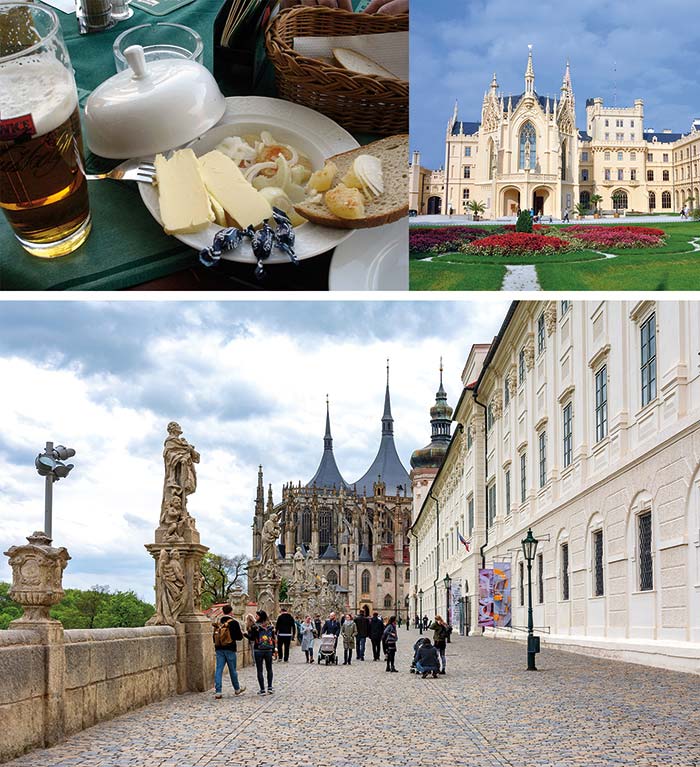
Stinky cheese in Olomouc; Lednice Château; Kutná Hora terrace; (opposite top) visiting Terezín
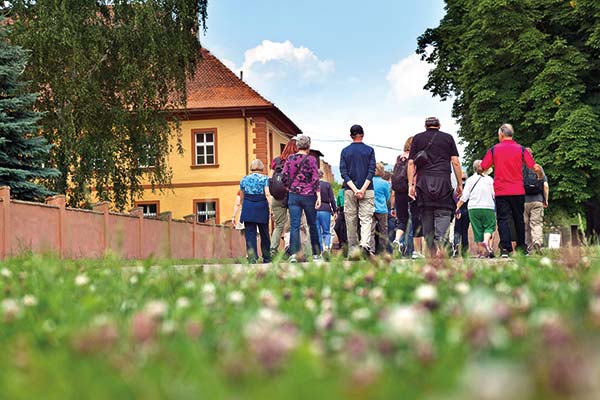
DAY TRIPS FROM PRAGUE
These interesting places are all within about an hour’s ride by bus or train from Prague, except for Karlovy Vary (which spa lovers can visit en route to or from Prague by train). For longer visits, Kutná Hora and Karlovy Vary offer accommodations and all the amenities.
▲▲Kutná Hora
This authentic, appealing town—easy to reach from Prague—has an offbeat bone church, a stunning cathedral, and a silver-mining museum. From its panoramic promenade to its stately architecture, the town is gorgeous, thanks to the silver trade that once flourished here.
▲▲Terezín Memorial
The Nazis turned this walled town into a concentration camp, but presented it as a tidied-up “Jewish town” to mislead Red Cross inspectors and the outside world. Today it’s a sobering memorial, featuring reconstructed barracks and exhibits of art drawn by “residents,” including children.
▲Konopiště Castle
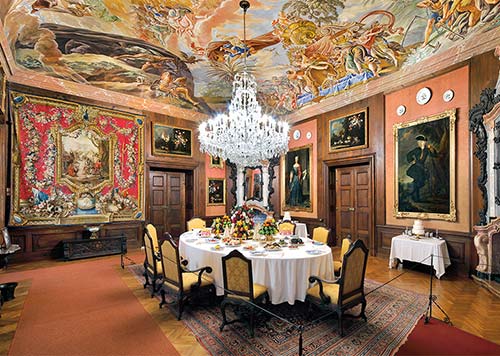
The Neo-Gothic residence of Archduke Franz Ferdinand—whose assassination sparked the start of World War I—has captivating stories to tell about its former inhabitants.
The interior, meticulously restored, looks as if Ferdinand and his Czech wife, Žofie, have just stepped out for the day.
▲Karlštejn Castle
Popular with tourists, the dramatically situated summer residence of Charles IV has a fairy-tale exterior but relatively little to see inside.
▲Křivoklát Castle
The genuinely Gothic hunting palace of Czech kings—rustic, simple, and set in a forest—was later transformed into a royal prison.
▲Karlovy Vary (Carlsbad)
This famous, swanky spa resort, with grand architecture and 16 thermal springs (plus a geyser), attracts spa aficionados and aching pilgrims seeking a cure.
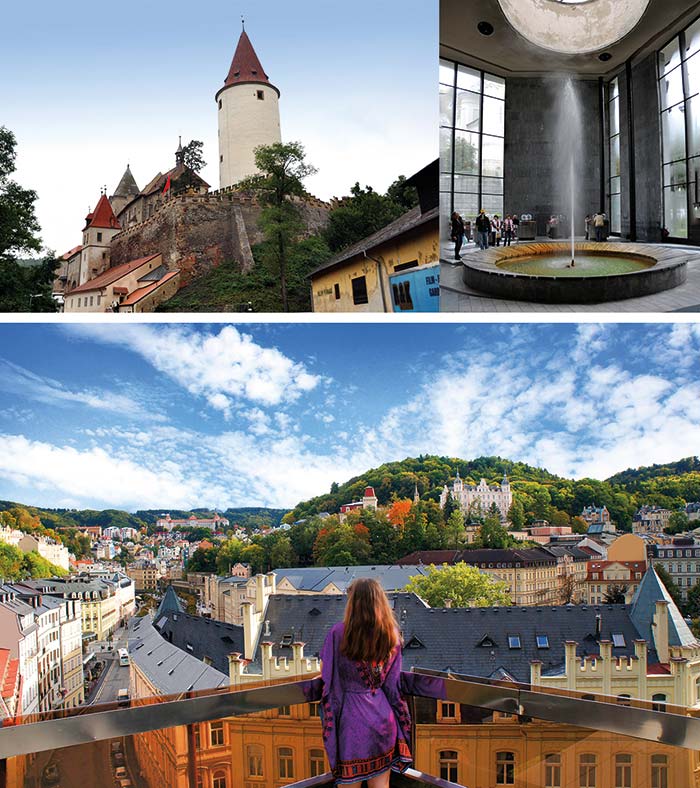
Křivoklát Castle in the forested countryside; Karlovy Vary’s geyser of hot and healing waters; overlook of Karlovy Vary’s elegant architecture
Planning Your Trip
To plan your trip, you’ll need to design your itinerary—choosing where and when to go, how you’ll travel, and how many days to spend at each destination. For general advice on sightseeing, accommodations, restaurants, and more, see the Practicalities chapter.
DESIGNING AN ITINERARY
As you read this book and learn your options…
Choose your top destinations.
My recommended itinerary (see later) gives you an idea of how much you can reasonably see in 12-14 days, but you can adapt it to fit your own interests and time frame.
If you like all that big cities have to offer—lots of sights, tours, eateries, and nightlife—stay longer in Prague.
If you’re fond of smaller towns, linger in the other home-base towns, such as Český Krumlov (a prettier, smaller version of Prague) or Olomouc (a less-touristy university town with nightlife).
Both Prague and Český Krumlov come with interesting castles. But Habsburg lovers should also head to Konopiště.
Hikers have many options: Most towns and castles offer good hiking. The Mikulov-Pavlov hills and the region of Wallachia (near Olomouc) are particularly scenic.
Wine connoisseurs savor the Mikulov wine region. Spa enthusiasts soak up Karlovy Vary and Třeboň. Canoeing is fun in Český Krumlov and Třeboň. Mucha fans must go to Moravský Krumlov. Photographers will be satisfied everywhere.
Decide when to go.
The tourist season runs roughly from Easter through October, peaking in May, June, and September. July and August have the warmest weather, more daylight hours, and many small-town festivals popping up around the country. Prague never really quiets down; winter travelers find the concert season in full swing and somewhat fewer crowds. Outside the capital, things are quiet, and some sights—such as castles—are closed. For weather specifics, see the climate chart in the appendix.
Connect the dots.
Link your destinations into a logical route. Decide if you’ll travel by car or public transportation. A car is useless in Prague but helpful for exploring the countryside (where public transportation can be sparse). Trains and buses run dependably; for some destinations, buses are more efficient than trains.
Begin your search for transatlantic flights on Google Flights. If you stick to the Czech Republic, you’ll arrive in Prague. For a multicountry trip, decide which cities you’ll fly into and out of.
To determine approximate travel times between destinations, study the driving map in the Practicalities chapter or check Google Maps; visit Bahn.com for train schedules.
Note that Prague can splice neatly into a wider-ranging trip, with direct train connections to Berlin, Vienna, Kraków, and Budapest (connections to some destinations can be faster from Olomouc). Budget flights can be an alternative to long train rides; check Skyscanner.com for intra-European flights (but keep in mind air travel’s larger carbon footprint).
| Day | Plan | Sleep |
| 1 | Arrive in Prague | Prague |
| 2 | Prague | Prague |
| 3 | Prague | Prague |
| 4 | Day trip to Terezín Memorial | Prague |
| 5 | Pick up car. Tour Konopiště Castle en route to Český Krumlov. | Český Krumlov |
| 6 | Český Krumlov | Český Krumlov |
| 7 | To Třeboň, then Slavonice | Slavonice |
| 8 | Day trip to Telč | Slavonice |
| 9 | Visit Třebíč or Moravský Krumlov on the way to the Mikulov wine region | Mikulov or Pavlov |
| 10 | Tour Lednice Château and visit whichever town you’re not sleeping in | Mikulov or Pavlov |
| 11 | To Olomouc (with time, visit Kroměříž en route) | Olomouc |
| 12 | Olomouc | Olomouc |
| 13 | Visit Kutná Hora en route to Prague. Drop off car. | Prague |
| 14 | Fly home |
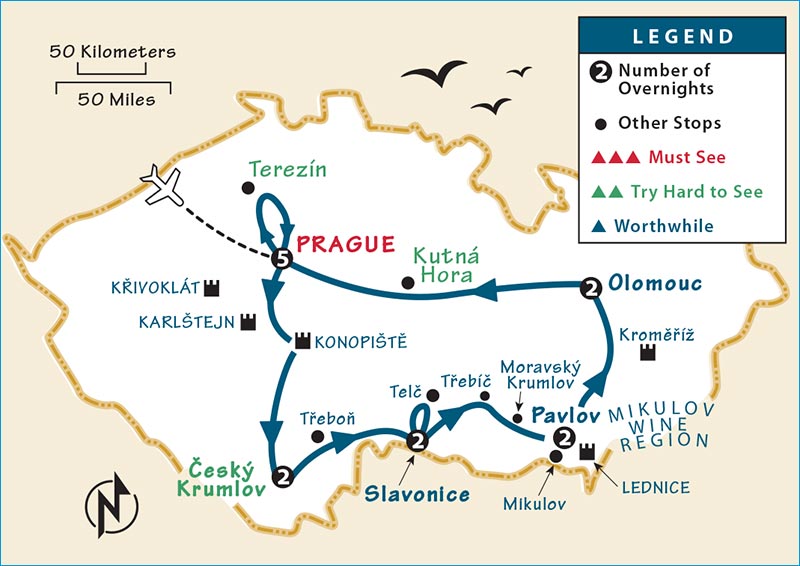
| Day | Plan | Sleep |
| 1 | Arrive in Prague | Prague |
| 2 | Prague | Prague |
| 3 | Prague | Prague |
| 4 | Day trip to Terezín Memorial | Prague |
| 5 | To Český Krumlov | Český Krumlov |
| 6 | Český Krumlov | Český Krumlov |
| 7 | To Telč via Třeboň | Telč |
| 8 | To Olomouc via Třebíč | Olomouc |
| 9 | Olomouc | Olomouc |
| 10 | Return to Prague | Prague |
| 11 | Side-trip to Kutná Hora | Prague |
| 12 | Fly home |
With Less Time: Home-base in Prague, make day trips to Terezín and Kutná Hora, and stop at Český Krumlov on your way in or out of the country.
With More Time: Consider a pair of destinations that are more difficult, but still doable, by public transportation: Hikers enjoy Wallachia, which fits into the above itinerary after Olomouc (make your home base in Pustevny or Trojanovice). Wine lovers head for the Mikulov wine region, easiest to visit between Telč and Olomouc (stay in Mikulov or Pavlov).
Write out a day-by-day itinerary.
Figure out how many destinations you can comfortably fit in your time frame. Don’t overdo it—few travelers wish they’d hurried more. Allow enough days per stop (see estimates in “The Czech Republic’s Top Destinations,” earlier). Minimize one-night stands. It can be worth taking a late-afternoon drive or train ride to settle into a town for two consecutive nights—and gain a full uninterrupted day for sightseeing. Include sufficient time for transportation; it’ll take you a half-day to get between most destinations.
Staying in a home base (like Prague) and making day trips can be more time-efficient than changing locations and hotels.
Check opening hours; avoid planning a visit to a must-see sight on the one day a week it’s closed. Check if any holidays or festivals fall during your trip—these attract crowds and can close sights (for the latest, visit www.czechtourism.com). Note sights where advance tickets are required (or recommended).
Give yourself some slack. Every trip, and every traveler, needs downtime for doing laundry, picnic shopping, people-watching, and so on. Pace yourself. Assume you will return.
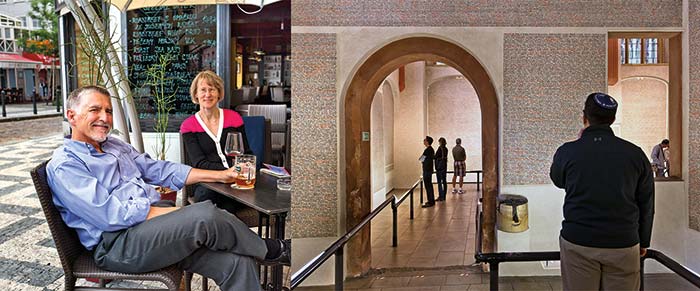
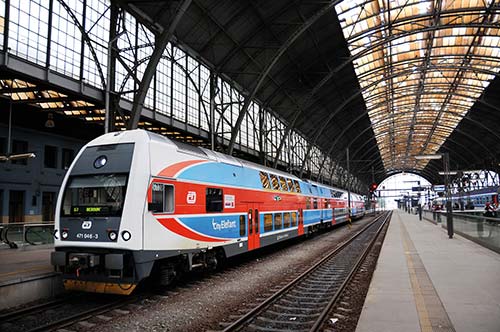
Prague’s main train station; a sidewalk café break; Pinkas Synagogue—honoring Holocaust victims—in the Jewish Quarter
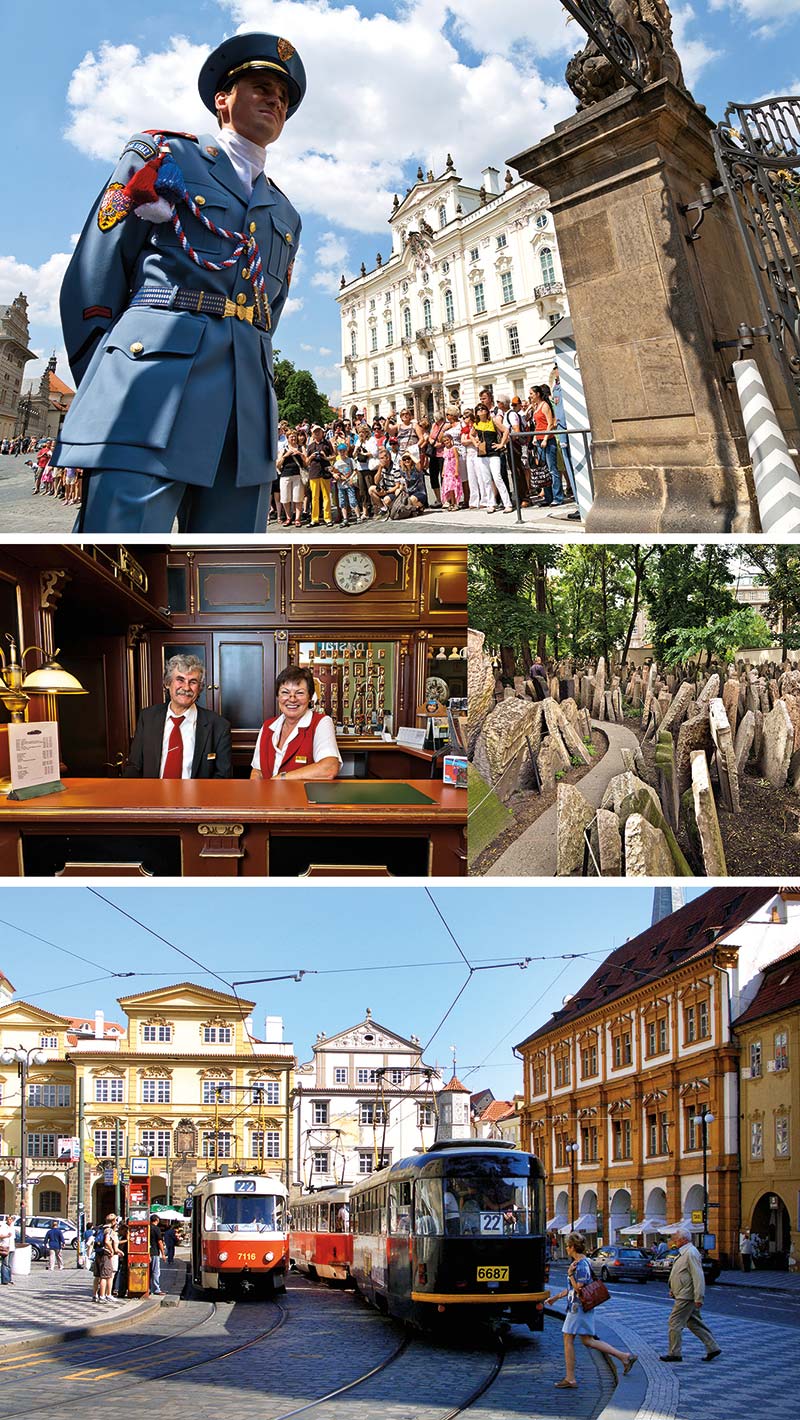
Prague sights: changing of the guard at Prague Castle; Jewish cemetery; convenient trams; friendly hoteliers
Run a reality check on your dream trip. You’ll have major transportation costs in addition to daily expenses.
Flight: A round-trip flight from the US to Prague costs about $900-1,500, depending on where you fly from and when.
Transportation: For a two-week trip, allow about $100 per person for public transportation (train and bus tickets).
Car Rental: Allow $350-500 per week (booked well in advance), not including tolls, gas, parking, and insurance.
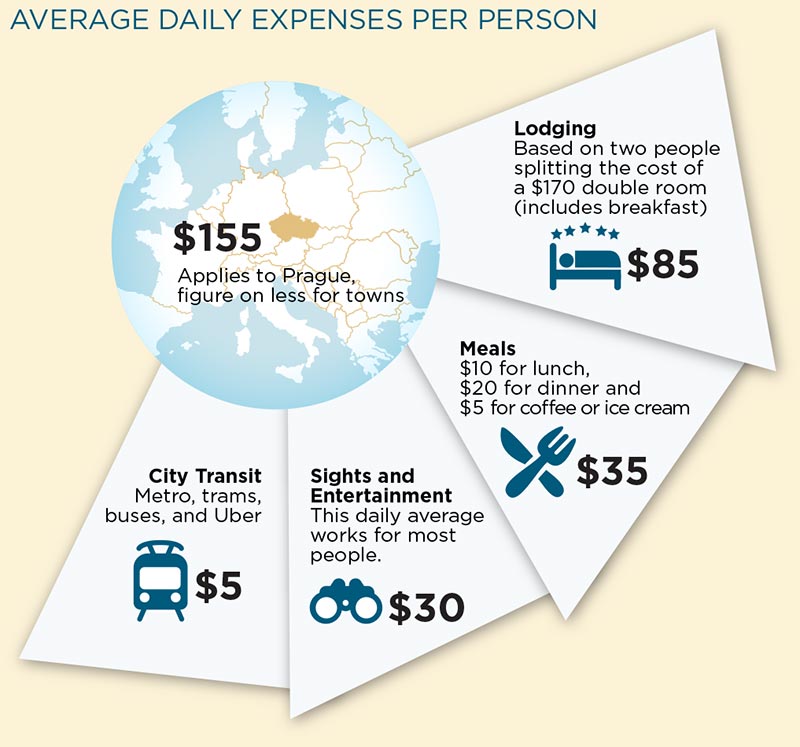
To cut your daily expenses, take advantage of the deals you’ll find throughout the Czech Republic and mentioned in this book.
Avid sightseers buy combo-tickets that cover multiple sights. If a town doesn’t offer deals, visit only the sights you most want to see, and seek out free sights and experiences (people-watching counts).
Some businesses—especially hotels and walking-tour companies—offer discounts to my readers (look for the RS% symbol in the listings in this book).
Reserve your rooms directly with the hotel. Some hotels offer a discount if you pay in cash and/or stay three or more nights (check online or ask). Rooms can cost less outside of peak season. And even seniors can sleep cheaply in hostels (most have private rooms) for about $30 per person. Or check Airbnb-type sites for deals.
It’s no hardship to eat inexpensively in the Czech Republic. You can get tasty, affordable meals at cafeterias, bakeries, takeaway spots, and street vendors. Cultivate the art of picnicking in atmospheric settings.
When you splurge, choose an experience you’ll always remember, such as a concert or a Black Light Theater performance. Minimize souvenir shopping; focus instead on collecting wonderful memories.
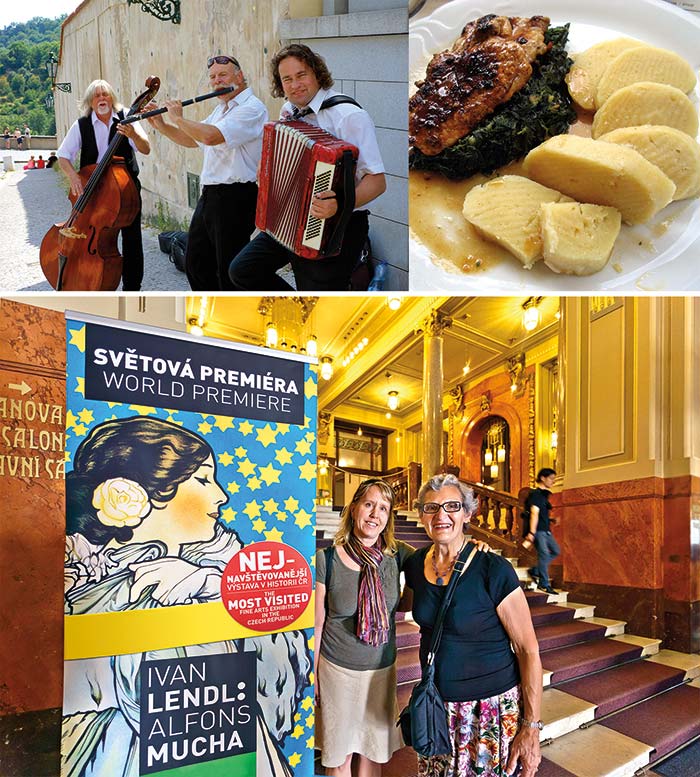
Prague Castle Orchestra; hearty cuisine; Municipal House—venue for art exhibits and concerts
BEFORE YOU GO
You’ll have a smoother trip if you tackle a few things ahead of time. For more details on these topics, see the Practicalities chapter and RickSteves.com, which has helpful travel-tip articles and videos.
Make sure your travel documents are valid. If your passport is due to expire within six months of your ticketed date of return, you need to renew it. Allow 12 weeks or more to renew or get a passport. Be aware of any special entry requirements, and pack a copy of your vaccine record (or store it on your phone). Get passport and country-specific travel info at Travel.State.gov.
Arrange your transportation. Book your international flights. Overall, Google Flights is the best place to start searching for flights. Figure out your transportation options: It’s worth thinking about renting a car, buying train tickets online in advance, getting a rail pass, or booking a cheap flight. (You can wing it once you’re there, but it may cost more.) Drivers: Consider bringing an International Driving Permit (sold at AAA offices in the US, www.aaa.com) along with your license.
Book rooms well in advance, especially if your trip falls during peak season (May, June, or Sept) or any major holidays or festivals.
Reserve ahead for special sights. If your heart’s set on getting a peat-spa bath in Třeboň, book several months in advance. Several castles (Konopiště, Karlštejn, and Český Krumlov) require you to reserve a day or so ahead for a spot on a guided tour to visit all or part of the interior; request an English tour. It’s also smart to book ahead for the Silver Museum and Mine in Kutná Hora and the brewery tour in Český Krumlov.
Consider travel insurance. Compare the cost of insurance to the cost of your potential loss. Understand what protections your credit card might offer and whether your existing insurance (health, homeowners, or renters) covers you and your possessions overseas.
Manage your money. “Tap-to-pay” or “contactless” cards are widely accepted and simple to use. You may need your credit card’s PIN for some purchases—request it if you don’t have one. Alert your bank that you’ll be using your debit and credit cards in Europe. You don’t need to bring Czech crowns for your trip; you can withdraw currency from ATMs in the Czech Republic.
Use your smartphone smartly. Sign up for an international service plan to reduce your costs, or rely on Wi-Fi in Europe instead. Download any apps you’ll want on the road, such as maps, translators, transit schedules, and Rick Steves Audio Europe (see sidebar).
Pack light. You’ll walk with your luggage more than you think. I travel for weeks with a single carry-on bag and a day pack. Use the packing checklist in the appendix as a guide.
Rick Steves Audio Europe, a free app, makes it easy to download my audio tours and listen to them offline as you travel. For this book (look for the  ) a free audio tour covers my Prague City Walk. The app also offers my public radio show interviews with travel experts from around the globe. Scan the QR code to find it in your app store or visit RickSteves.com/AudioEurope.

Rick Steves Classroom Europe, a powerful tool for teachers, is also useful for travelers. This video library contains about 600 short clips excerpted from my public television series. Enjoy these videos as you sort through options for your trip and to better understand what you’ll see in Europe. Check it out at Classroom.Ricksteves.com [URL inactive].

Travel Smart
If you have a positive attitude, equip yourself with good information (this book), and expect to travel smart, you will.
Read—and reread—this book. To have an “A” trip, be an “A” student. Note opening hours of sights, closed days, crowd-beating tips, and whether reservations are required or advisable. Check the latest at RickSteves.com/update.
Be your own tour guide. As you travel, get up-to-date info on sights, reserve tickets and tours, reconfirm hotels and travel arrangements, and check transit connections. Visit local tourist information offices (TIs). Upon arrival in a new town, lay the groundwork for a smooth departure; confirm the train, bus, or road you’ll take when you leave.
Outsmart thieves. Especially in bigger cities like Prague, pickpockets abound in crowded places where tourists congregate. Treat commotions as smokescreens for theft. Keep your passport and backup cash and cards secure in a money belt tucked under your clothes; carry only a day’s spending money and a single card in your front pocket or wallet. Don’t set valuable items down on counters or café tabletops, where they can be quickly stolen or easily forgotten.
Minimize potential loss. Keep expensive gear to a minimum. Bring copies or take photos of important documents (passport and cards) to aid in replacement if they’re lost or stolen. Back up photos and devices to the cloud as you travel.
Guard your time and energy. Taking a taxi can be a good value if it saves you a long wait for a cheap bus or an exhausting walk across town. To avoid long lines, follow my crowd-beating tips, such as sightseeing early or late.
Be flexible. Even if you have a well-planned itinerary, expect changes, strikes, closures, sore feet, bad weather, and so on. Your Plan B could turn out to be even better.
Attempt the language. Many Czechs—especially in the tourist trade and in cities—speak English, but if you learn some Czech, even just a few pleasantries, you’ll get more smiles and make more friends. Apps such as Google Translate work for on-the-go translation help, but you can get a head start by practicing the survival phrases near the end of this book.
Connect with the culture. Interacting with locals carbon-ates your experience. Enjoy the friendliness of the Czech people. Ask questions; most locals are happy to point you in their idea of the right direction. Set up your own quest for the most authentic Czech pub (no English menus allowed), best street musician, or most interesting conversation with a local. When an opportunity pops up, make it a habit to say “yes.”
Your next stop…Prague and the Czech Republic!